FROM LEVI D. GREEN TO DEAR FATHER – NOVEMBER 19, 1862
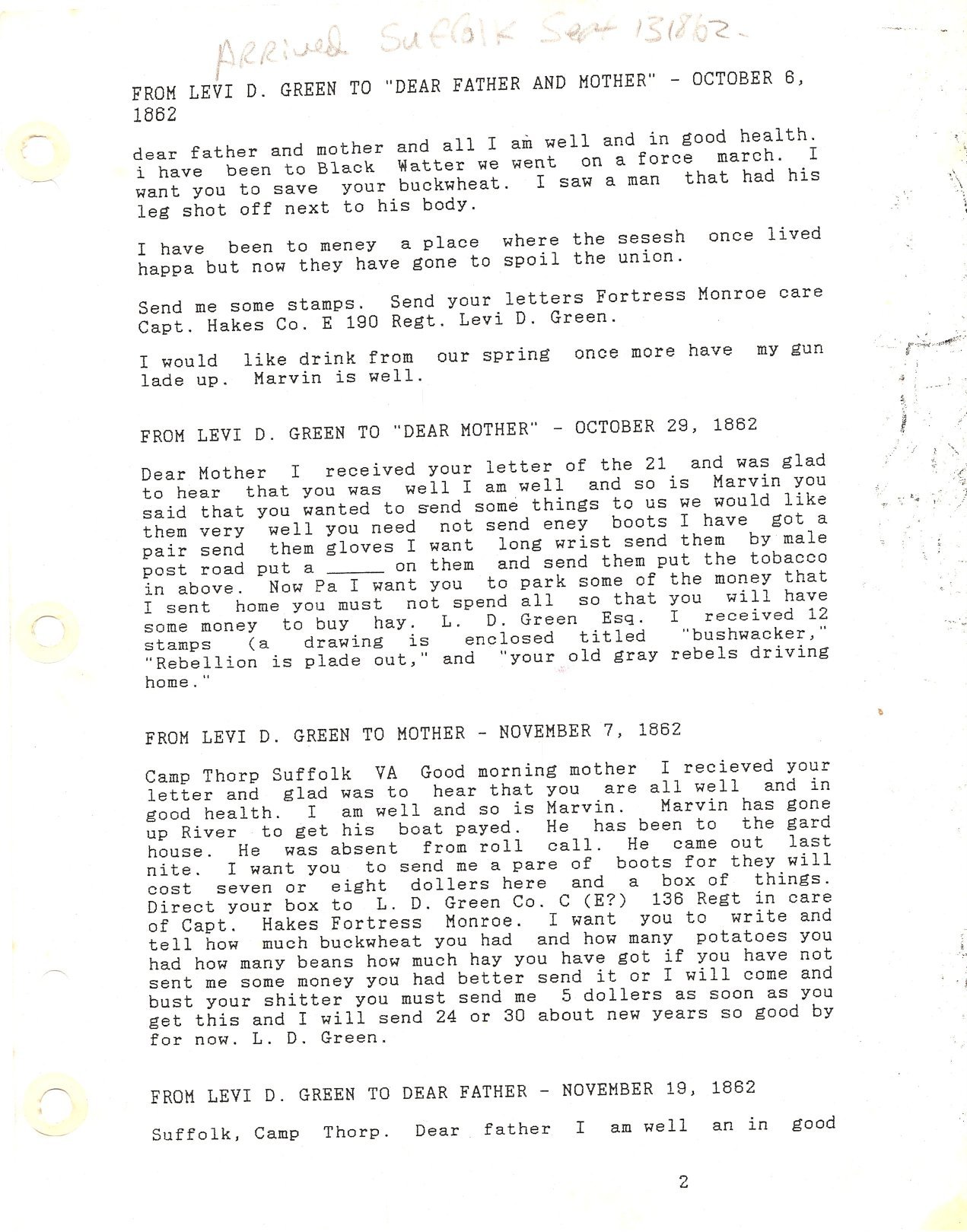
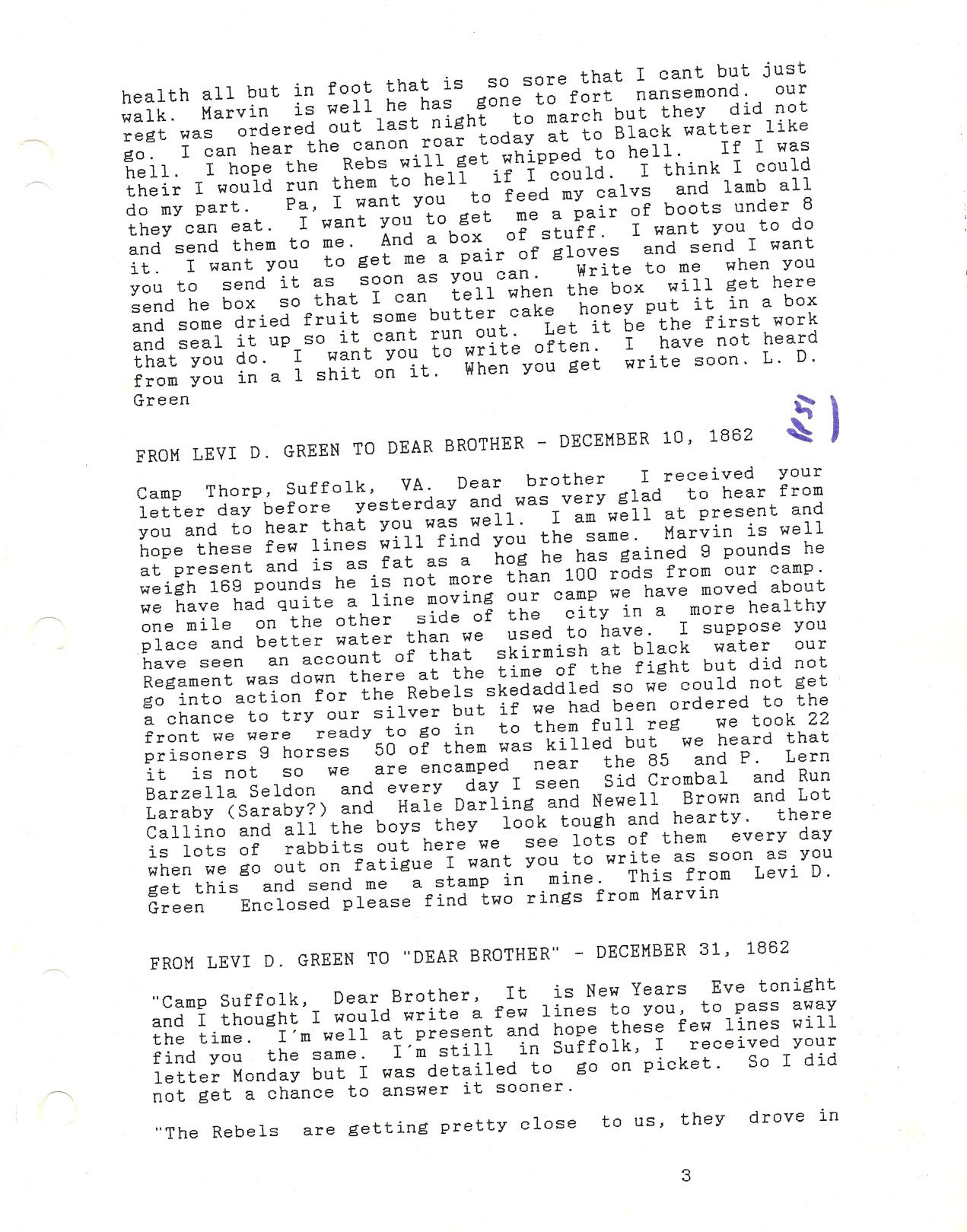
The letter as it survives in the family typescript prepared by Marjorie Kuski, scanned from the complete typescript PDF held on this site.
About this Letter
Levi Davis Green wrote this from Camp Thorp at Suffolk on November 19, 1862, laid up with a foot too sore to walk on while the sound of a fight rolled in from the west. The 130th New York was still infantry, posted under Col. Alfred Gibbs in Gen. John Peck’s command, and the Blackwater River line, twenty-odd miles out, was where the regiment’s war kept flaring. On this day Levi was close enough to hear it and too crippled to march to it.
The camp was on edge. “Our regt was ordered out last night to march but they did not go,” he writes, and then, listening westward, “I can hear the canon roar today at to Black watter like hell.” He does not hide which side he wants beaten: “I hope the Rebs will get whipped to hell. If I was their I would run them to hell if I could. I think I could do my part.” His brother Marvin, he notes, has gone off to Fort Nansemond.
Underneath the bravado is a homesick, footsore young farmer sending an urgent order north. He wants boots under a size eight, gloves, and a box of food packed to survive the trip: “some dried fruit some butter cake honey put it in a box and seal it up so it cant run out. Let it be the first work that you do.” He asks his father to feed his calves and his lamb all they can eat, still tending, from Virginia, the animals waiting at home.
He heard cannon at the Blackwater and wished the enemy whipped, not knowing that within a month the war’s worst Union defeat to date would come at Fredericksburg on December 13, and not knowing how his own war would end. After the regiment became the 1st New York Dragoons, Levi would be captured in June 1864 and die at Camp Lawton prison that fall, the calves and the lamb long since grown without him. His service record and the finding of his grave are gathered on Levi’s own page. The pages below are the family typescript prepared by Marjorie Kuski; the transcription keeps his spelling exactly as he set it down.
The Letter
Suffolk, Camp Thorp. Dear father I am well an in good health all but in foot that is so sore that I cant but just walk. (see Resercher’s note below) Marvin is well he has gone to fort nansemond. our regt was ordered out last night to march but they did not go. I can hear the canon roar today at to Black watter like hell. I hope the Rebs will get whipped to hell. If I was their I would run them to hell if I could. I think I could do my part. Pa, I want you to feed my calvs and lamb all they can eat. I want you to get me a pair of boots under 8 and send them to me. And a box of stuff. I want you to do it. I want you to get me a pair of gloves and send I want you to send it as soon as you can. Write to me when you send he box so that I can tell when the box will get here and some dried fruit some butter cake honey put it in a box and seal it up so it cant run out. Let it be the first work that you do. I want you to write often. I have not heard from you in a 1 shit on it. When you get write soon. L. D. Green
Transcribed from Marjorie Kuski’s family typescript, preserving the original spelling and punctuation.
Researcher’s Notes
RESEARCHER’S NOTE: In Bowen’s Regimental History, he speaks of this moment. Taken from his text: “The history of the First New York Dragoons is unique. In one respect, as an unbroken organization, it has served in two distinct branches of military service, one year in infantry and two in the cavalry. During the first year, we were known as the One Hundred and Thirtieth New York Volunteer Infantry and had abundant experience as ‘doughboys’ in fighting on foot and in long and exhausting marches with blistered feet” and aching joints. As cavaliers, we also had our turn of pitying the poor boys who still had to ” hoof it.”We also learned that, though riding our prancing steeds, the mounted service was not all fun, especially under such vigorous leaders as Sheridan.” View text in original source
The term “doughboys” was a nickname used to refer to American soldiers. The origin of the term is uncertain, but it may have originated from the appearance of the uniform, which was said to resemble uncooked dough, or from “doughboy,” a slang term for a young man who was inexperienced or naive. Some held that the term related to the physical shape of the men before they received their physical military training. The term was most widely used to refer to American soldiers during World War I and has since become a symbol of American military service and sacrifice.
Views: 441