General Alfred Gibbs · From the Family Papers
The Sale of Sunswick and the Move to New York
A widow, a mortgaged estate, and a decision made in the autumn of 1833, told through the family’s own letters

Alfred Gibbs was born at Sunswick in 1823, but he did not spend his whole boyhood on the East River. When his father, Colonel George Gibbs III, died in 1833, his widow, Laura Wolcott Gibbs, sold Sunswick and moved the family into New York City, as one account puts it, “for the sake of improving the educational facilities for her children.”
It is an easy sentence to write, and biographers have written it for a century. What they never had was the paper underneath it. The family’s own correspondence for the autumn of 1833, scanned from the Gibbs Family Papers, lets us watch the decision being made, week by week: the mounting cost of the children, a school bill the household could not readily pay, and a trustee in Boston laying out, in plain figures, why the estate would have to go.
A Widow, an Estate, and a Mortgage
Colonel George Gibbs III, the mineralogist whose great cabinet Yale had bought for twenty thousand dollars, died in the summer of 1833. He left Laura Wolcott Gibbs, daughter of Oliver Wolcott, a widow with young children, an annuity, scattered real estate in Rhode Island, and the forty-acre farm at Astoria that the family called Sunswick, carrying a mortgage. Within weeks the letters begin to circle a single question: could she keep it?
“An unexpected amount I am myself not prepared to pay”
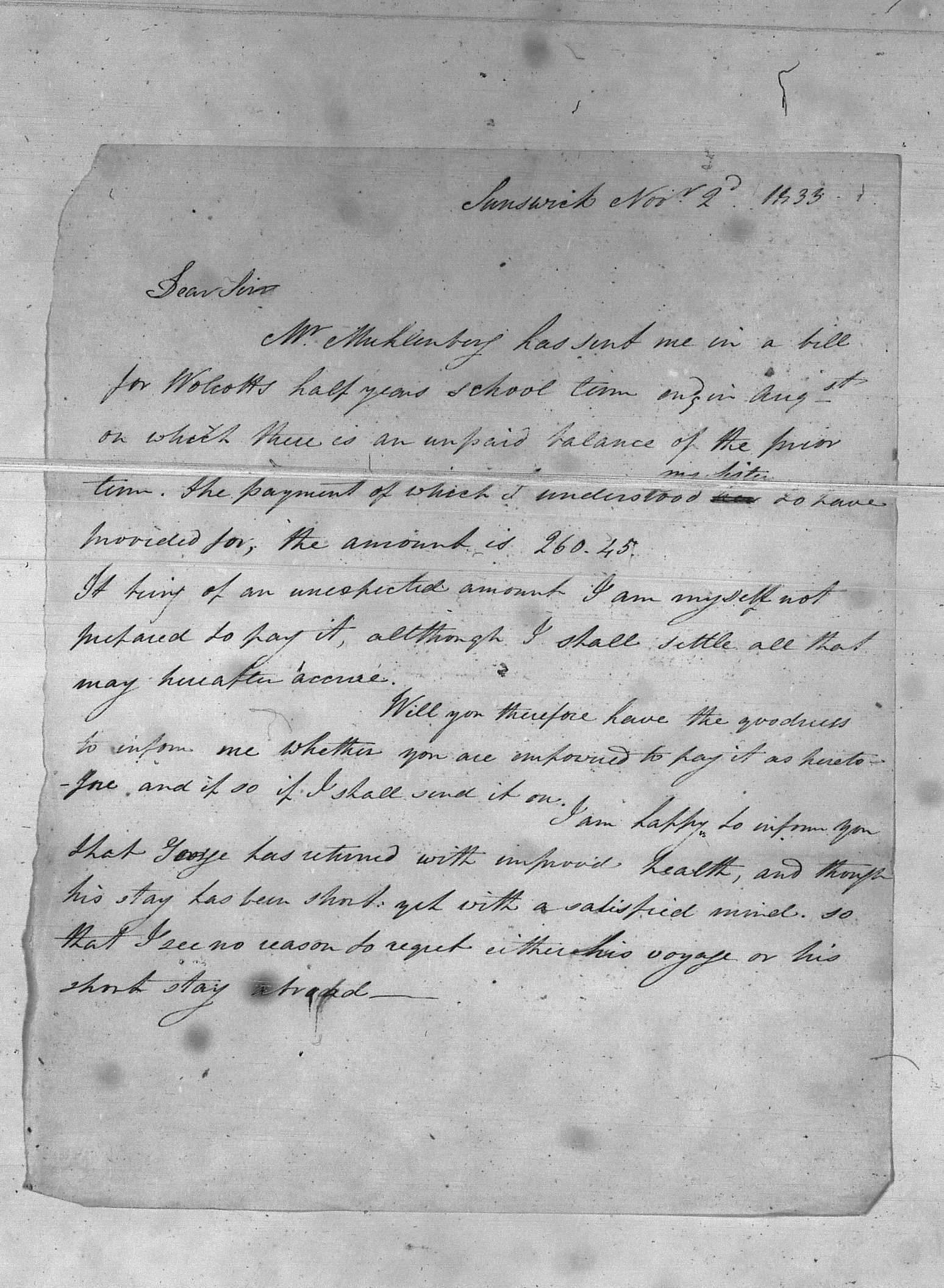
Sunswick Novr 2d 1833
Dear Sir,
Mr Muhlenberg has sent me in a bill for Wolcott’s half year’s school term ending in Augst, on which there is an unpaid balance of the prior term, the payment of which I understood my sister to have provided for; the amount is 260.45.
It being of an unexpected amount I am myself not prepared to pay it, allthough I shall settle all that may hereafter accrue.
Will you therefore have the goodness to inform me whether you are empowered to pay it as heretofore, and if so if I shall send it on.
I am happy to inform you that George has returned with improved health, and though his stay has been short, yet with a satisfied mind, so that I see no reason to regret either his voyage or his short stay abroad.
Note: the writer is still at Sunswick in November 1833, keeping the household accounts and pressing a son’s tuition at the Reverend William Augustus Muhlenberg’s school. Two hundred sixty dollars was a serious sum, and the widow had to ask the trustee whether he was even “empowered to pay it as heretofore.” The passage names the pressure that every account of the move points to: the children, and their schooling.
“Your best course will be to Sell”
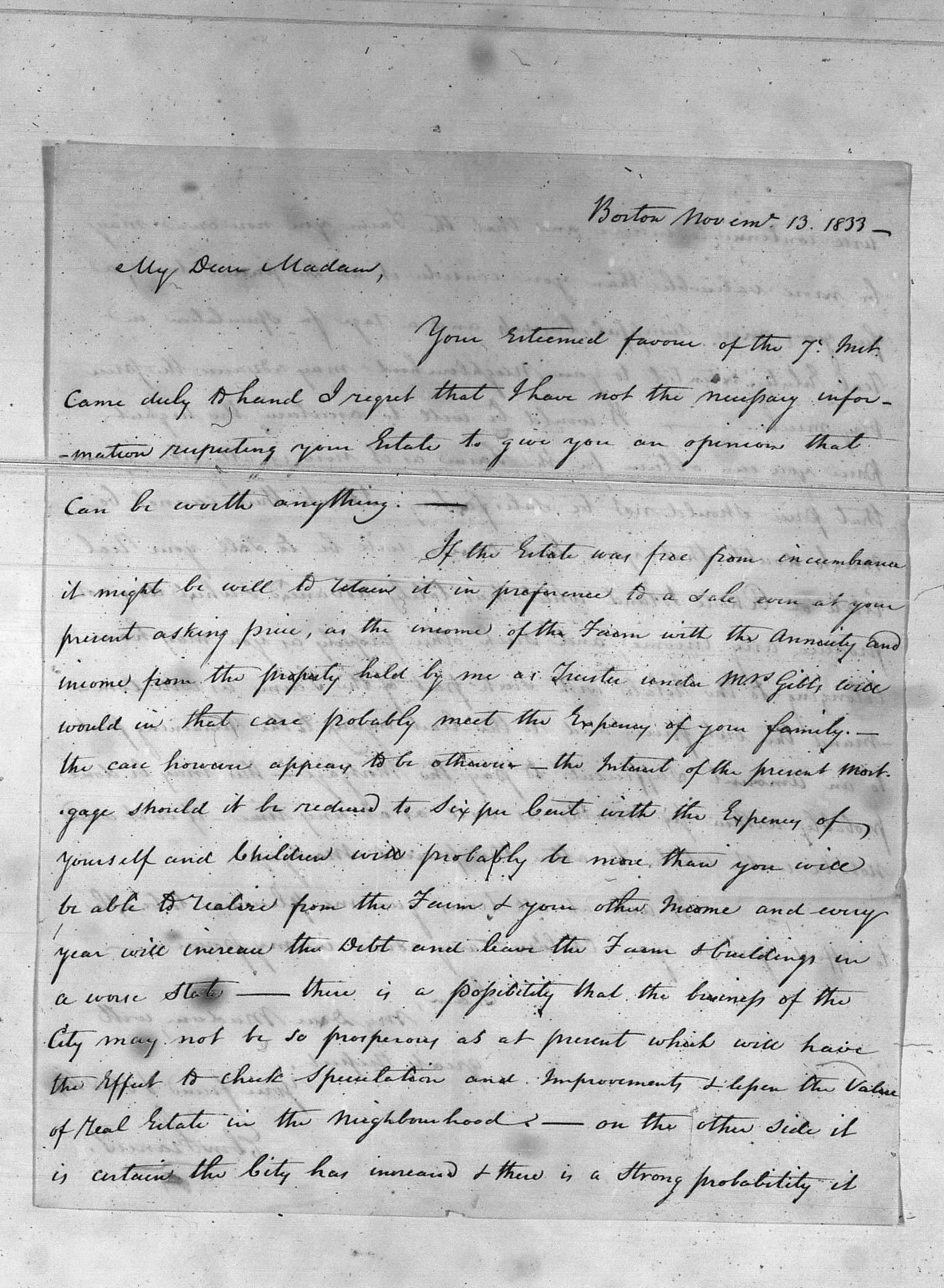
Boston Novemr 13. 1833
My Dear Madam,
Your esteemed favour of the 7th inst. came duly to hand. I regret that I have not the necessary information respecting your Estate to give you an opinion that can be worth anything.
If the Estate was free from incumbrance it might be well to retain it in preference to a Sale even at your present asking price, as the income of the Farm with the Annuity and income from the property held by me as Trustee under Mrs Gibbs’ will would in that case probably meet the Expences of your family. The case however appears to be otherwise. The Interest of the present Mortgage, should it be reduced to Six per Cent, with the Expences of yourself and Children, will probably be more than you will be able to realize from the Farm and your other Income, and every year will increase the Debt and leave the Farm and buildings in a worse State. There is a possibility that the business of the City may not be so prosperous as at present, which will have the Effect to check Speculation and Improvements and lessen the Value of Real Estate in the Neighbourhood. On the other side it is certain the City has increased, and there is a Strong probability it will continue to increase, and that the Farm you now own may be more valuable than you consider it at the present time; a few years more successful business, and a rage for Speculation in Real Estate extended to your Neighbourhood, may advance the price very much.
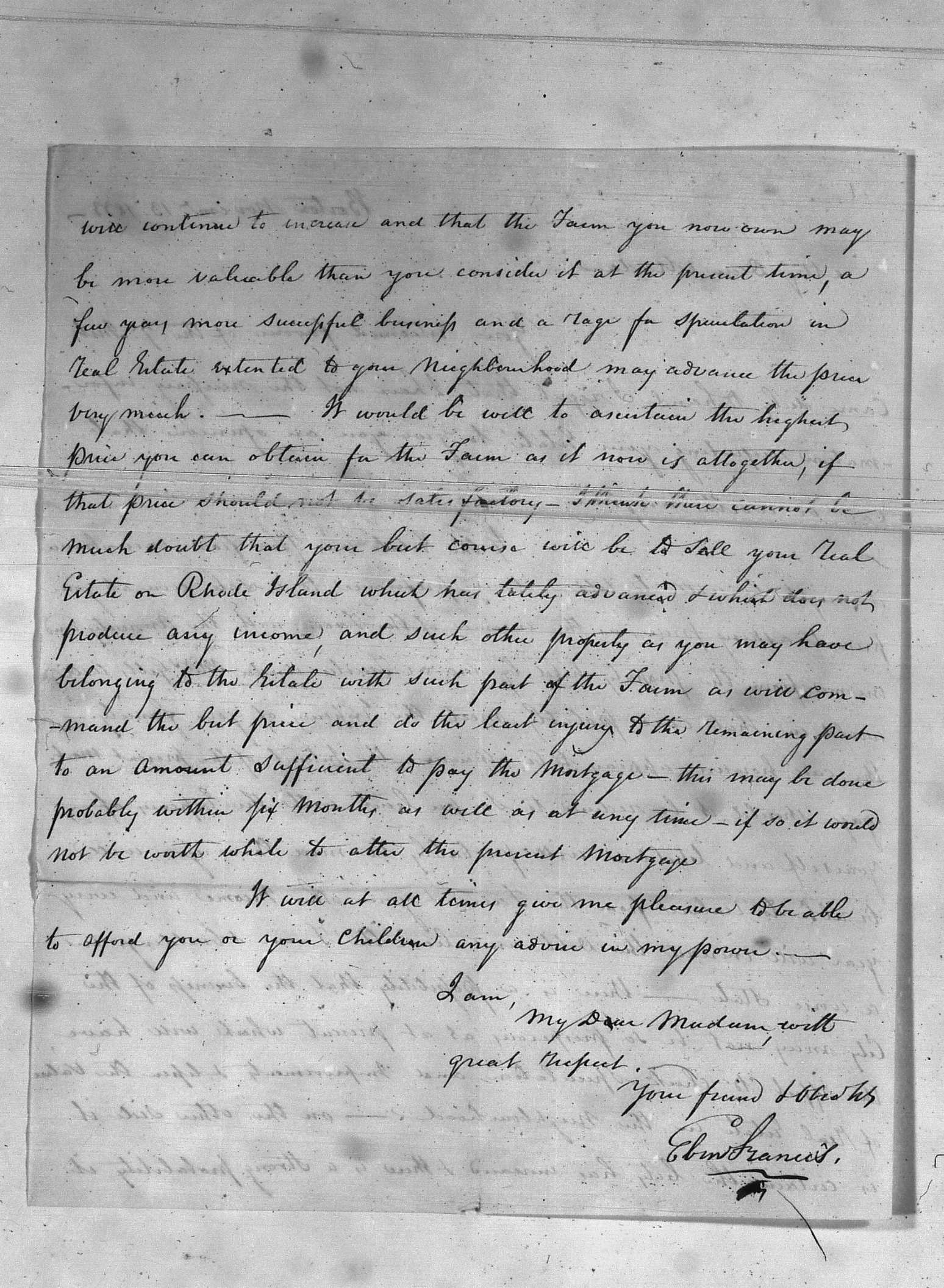
It would be well to ascertain the highest price you can obtain for the Farm as it now is altogether; if that price should not be satisfactory, there cannot be much doubt that your best course will be to Sell your Real Estate on Rhode Island, which has lately advanced and which does not produce any income, and such other property as you may have belonging to the Estate, with such part of the Farm as will command the best price and do the least injury to the remaining part, to an amount sufficient to pay the Mortgage. This may be done probably within Six Months, as well as at any time. If so it would not be worth while to alter the present Mortgage.
It will at all times give me pleasure to be able to afford you or your Children any advice in my power.
I am, My Dear Madam, with great Respect, Your friend and Obt Servt,
Ebenr Francis.
Note: Ebenezer Francis, the family’s Boston trustee, does the arithmetic the widow could not avoid. The mortgage plus “the Expences of yourself and Children” would outrun the income from the Farm; the Debt would only grow. He values the estate by “the business of the City” and whether “the City has increased,” which is exactly Sunswick’s situation, the farm at Astoria across the water from a booming New York. His counsel is to get the best price for the Farm, and failing that, to sell the Rhode Island land and part of the Farm to clear the mortgage, “probably within Six Months.” One honest caution: these pages describe the property as “the Farm” in “your Neighbourhood,” not by the name Sunswick; the identification rests on that description and on the separate mention of the family’s Rhode Island real estate.
The Decision
The two letters stand eleven days apart, both in the same season of loss. On the second of November the household at Sunswick cannot cover a son’s school bill; on the thirteenth the trustee in Boston explains, gently and in figures, that the estate cannot be carried. The advice was taken. Sunswick was sold, and Laura Wolcott Gibbs moved her children into the city, to a house on Winthrop Place off Washington Square, “for the sake of improving the educational facilities for her children.” The sentence the biographers wrote turns out to be true, and here is the paper underneath it.
The story continues. The documents of the sale itself have now been found and read: the widow’s own price negotiations, the two bonds of Barnabas Bates for the Hallett’s Cove land, the estate ledger that shows the proceeds paying down the mortgage exactly as Francis advised, and, in the same weeks, her gift of the great meteoric iron to Yale as her husband’s monument. Read the whole documented story of the woman at the center of it: Laura’s War: The Widow Who Held the Gibbs Family Together.
The Address Today
Their new home stood at 261 Greene Street, a genteel row then known as Winthrop Place, just below Washington Square in the Fifteenth Ward of Manhattan, Greenwich Village, the fashionable residential district laid out in 1832. You cannot stand at that address today, because the street itself was erased. Greene Street once ran north from Canal all the way up to the south edge of Washington Square, and number 261 placed the Gibbs house near that top end. In the mid-1950s, New York University and the Robert Moses era of “urban renewal” condemned and demolished the entire district south of the Square, the ground bounded roughly by West Third, Bleecker, Mercer, and LaGuardia Place, to raise the university’s superblocks: Washington Square Village, and just below it University Village, the Silver Towers designed by a young I. M. Pei. That work wiped out this reach of Greene Street as a public street; it survives only as a private interior driveway, for the easterly of the two drives through Washington Square Village was once Greene Street itself. So the line of that block now runs through the university superblock a couple of hundred feet south of Washington Square Park. There is no longer a 261 Greene Street, nor a Winthrop Place, anywhere on the map. The ground where the widow Gibbs once hid escaped slaves in her cellar lies today beneath New York University, on the vanished line of Greene Street just below the Square.
Finding the Spot Today
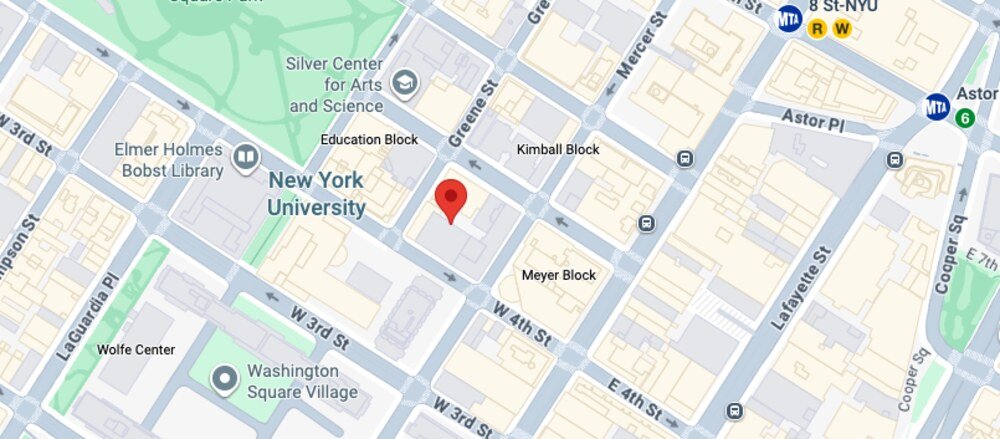
How we placed the pin. The address itself points the way. Greene Street was numbered from the south, so the two hundreds sat at its northern end, hard against Washington Square, which is why every account puts the Gibbs house just below the Square. That northern reach of Greene Street runs straight into New York University. The blocks immediately south of the park, where the high numbers stood, are now the university’s academic core, the Silver Center and the Education and Kimball blocks; farther south the street was swallowed whole by the residential superblocks, Washington Square Village, whose eastern interior driveway is the documented survival of Greene Street, and the Silver Towers. Following the Greene Street line down from the park to the first block below the Square, and cross-checking it against Washington Square Village’s own coordinates, places the site of number 261 at roughly 40.7293 degrees north, 73.9953 degrees west, a couple of hundred feet south of Washington Square Park. It is a band rather than a doorway, for the old house numbers vanished with the street, but the pin stands within a stone’s throw of where the widow Gibbs settled her children.
A correction to the record. Some name indexes of the National Archives cadet application papers give Alfred Gibbs’s residence as “Orange, New York.” That is a transcriber’s error. Every contemporary account, and the family’s own letters above, place the Gibbses first at Sunswick and then in Manhattan; they were never residents of Orange County. The distinction matters, because it is through his New York City home, and not an upstate county, that the road to his West Point appointment must be traced.
Sources
The two letters shown here are from the Gibbs Family Papers (Wisconsin Historical Society copy), scans 885 and 886 to 887, transcribed from the manuscripts and hosted on this site. For the family and the house, see Chapter II, Part 6, The Gibbs Family (this site), which preserves the reference to 261 Greene Street and Winthrop Place. For the twentieth-century demolition of the block and the surviving Greene Street driveway, see the published histories of Washington Square Village and of University Village, Manhattan.
Views: 45