The Cadet File: How Alfred Gibbs Got to West Point
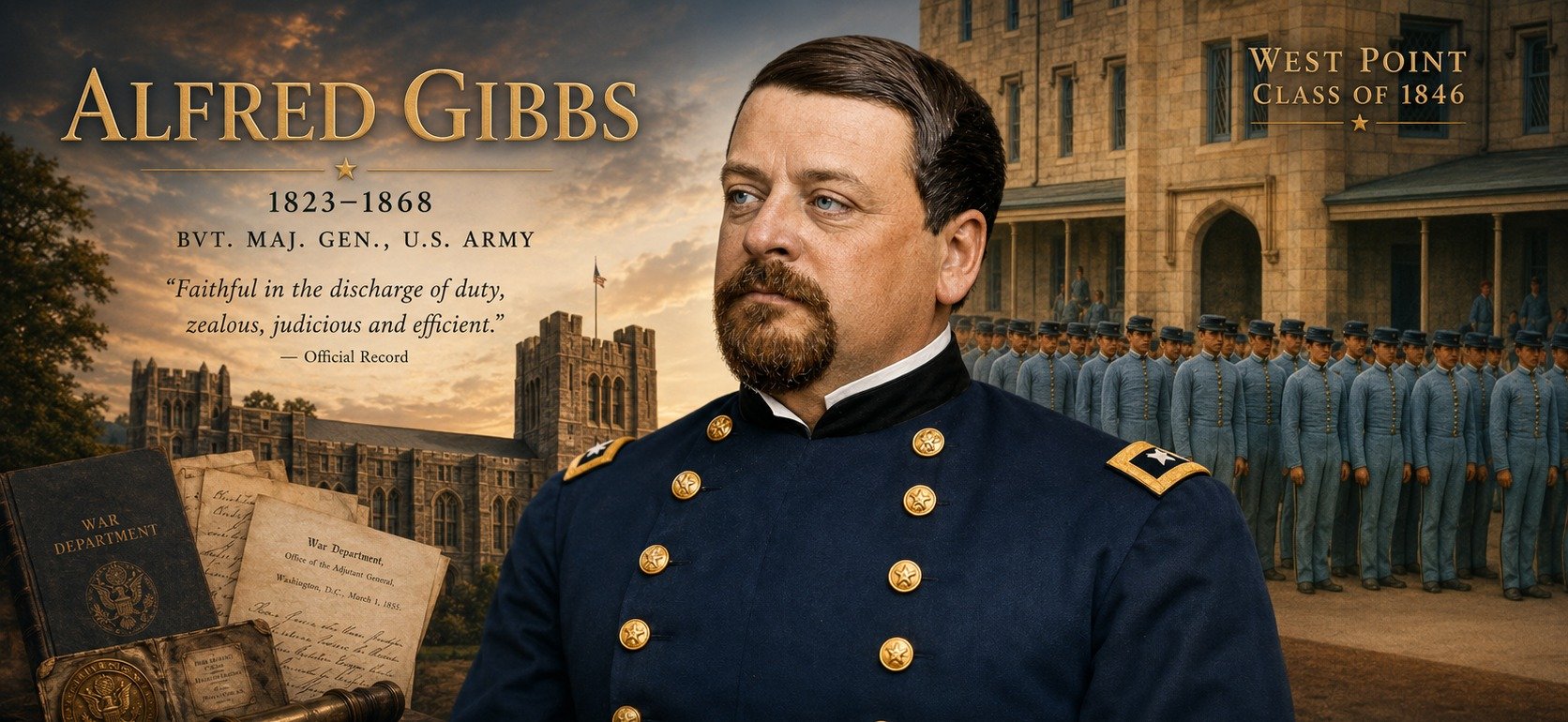
A Report from the National Archives · Record Group 94 · File 1840/129
“A Sacrifice of the Boy to Party Revenge”
How Alfred Gibbs got to West Point: the complete cadet application file, 1838-1842, with every letter reproduced and transcribed in full.
On the cover of a worn file jacket in the National Archives, a clerk of the Adjutant General’s Office wrote three words that answer a question this site has been chasing for years: “By his Mother.” Alfred Gibbs, the future general whose name this archive bears, was not handed to West Point by a patron or a party. He was carried there, over three years and against a deliberate political injury, by his widowed mother, his eldest brother, his uncle, four congressmen, a senator, and Winfield Scott, until at last the appointment came at large: conferred, in the words of the notification Alfred acknowledged, by the President of the United States. The complete cadet application file, hunted for months and located on July 10, 2026, is reproduced below: every featured document photographed from the National Archives microfilm and set beside its complete transcription.
What the File Establishes
- The appointment was Presidential. Alfred Gibbs entered West Point on a conditional at large appointment conferred by President John Tyler, notified by Secretary of War John C. Spencer on April 19, 1842. No single congressman “sponsored” him.
- The original applicant was his mother. Laura Wolcott Gibbs first applied in 1838, for her second son Oliver Wolcott Gibbs, through Rep. Churchill C. Cambreleng; Alfred, the third son, was substituted in January 1839.
- The first warrant was destroyed by political spite. After the Gibbs brothers campaigned for the Whigs in the spring 1839 election, Cambreleng, a Van Buren Democrat, withdrew his recommendation and demanded the warrant for Henry M. Judah, who took it. The War Department’s own memorandum records that Alfred “was not appointed solely because Mr. C. withdrew his support from him & transferred it to Judah.”
- Winfield Scott recommended Alfred twice in writing: a signed letter of February 6, 1841, and a signed endorsement of March 2, 1842.
- Secretary Bell ruled on April 29, 1841 that “Gibbs is to have the first vacancy in that district,” and the family had assurances from President Harrison and Bell of an at large appointment if no district vacancy opened (the uncle’s account; Harrison died that April). The promise was made good a year later, under Tyler.
- The “Oliver W Gibbs” index mystery is solved. Index entries for Oliver in this file are not errors: the file really begins with him. He stayed at college and became one of America’s foremost chemists.
- The “Orange, New York” residence in the M688 index is an artifact, taken from a paper written at West Point, Orange County. The family lived in Manhattan throughout.
Dramatis PersonaeThe Family and the Officials
Act I · 1838-1839The First Application, and the Betrayal
It began as a simple family errand. In 1838 Laura Wolcott Gibbs asked her congressman, Churchill C. Cambreleng, to put forward her second son Oliver for West Point; when Oliver prospered at college, the family asked that fifteen year old Alfred take his place. Then came the spring election of 1839. The documents below, family letters and the War Department’s own memoranda, trace what a defeated congressman did with a warrant he had promised to fix.
The Jacket: “By his Mother”
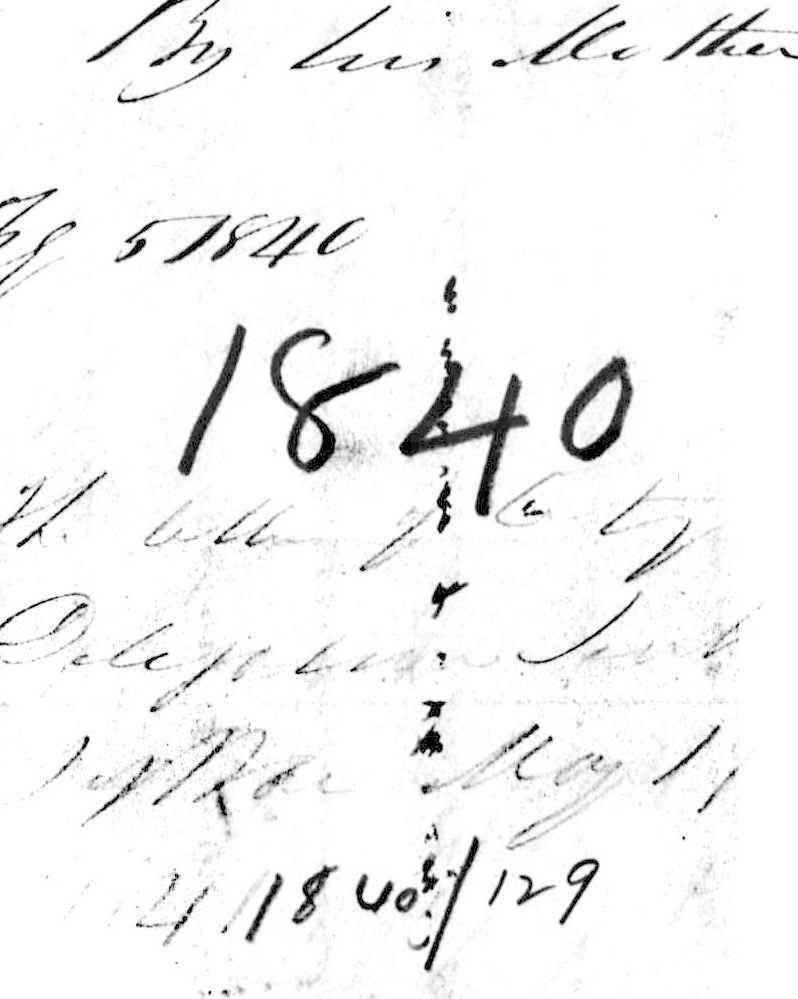
No. 45 [renumbered] 129.
N. York
Alfred Gibbs
for Cadet appt
By his Mother
Reg[istered] 5 1840
1840
[several faded pencil lines, largely illegible]
1840/129
Alfred Enters the Books
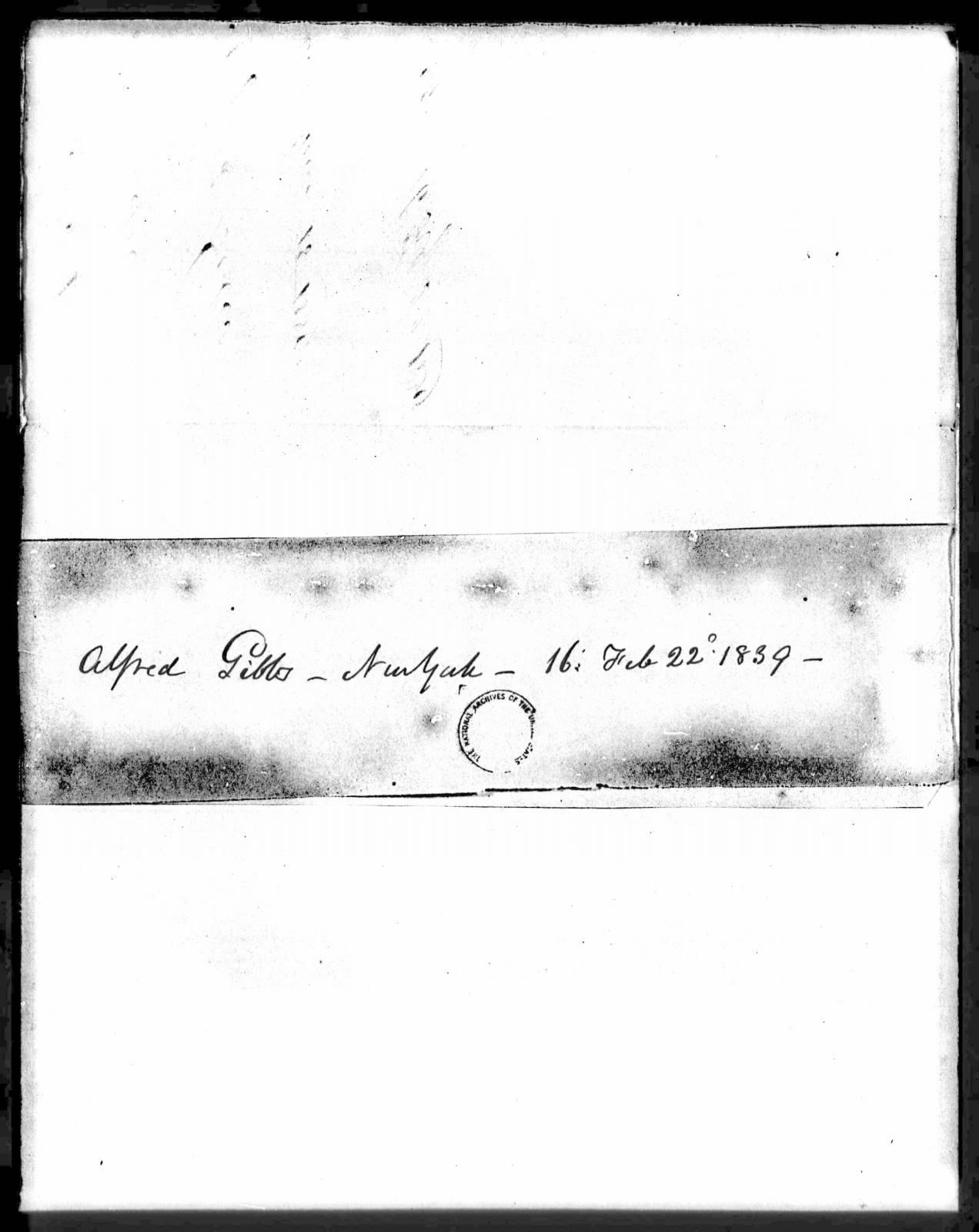
Alfred Gibbs – New York – 16: Feb 22d 1839 –
The Brother’s First Letter
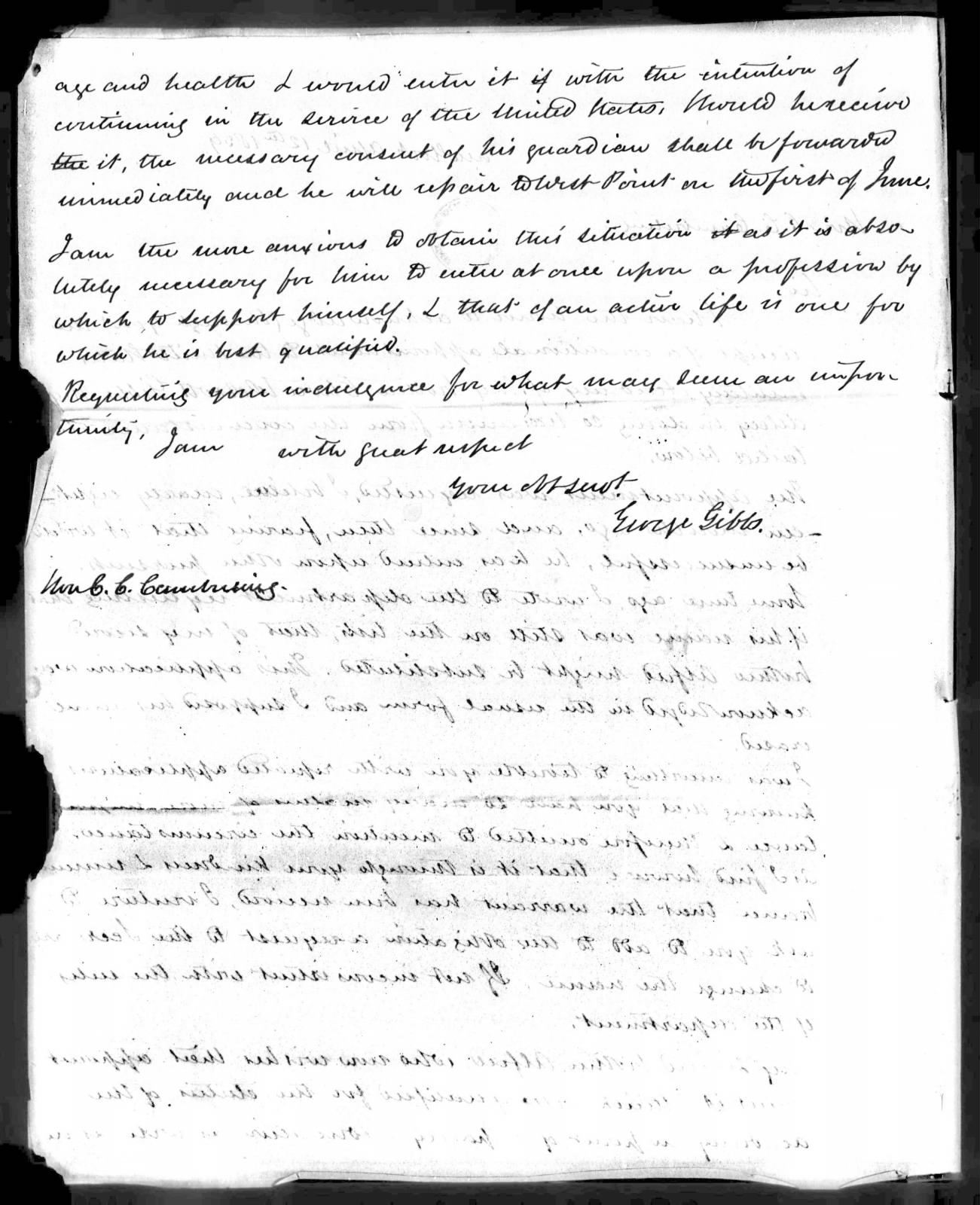
[The letter opens mid-sentence; the earlier page or pages are not in the file.]
…age and health & would enter it if with the intention of continuing in the service of the United States. Should he receive it, the necessary consent of his guardian shall be forwarded immediately and he will repair to West Point on the first of June.
I am the more anxious to obtain this situation as it is absolutely necessary for him to enter at once upon a profession by which to support himself, & that of an active life is one for which he is best qualified.
Requesting your indulgence for what may seem an importunity, I am with great respect
Your Obt servt
George Gibbs.
Hon C. C. Cambreling.
The Substitution Request
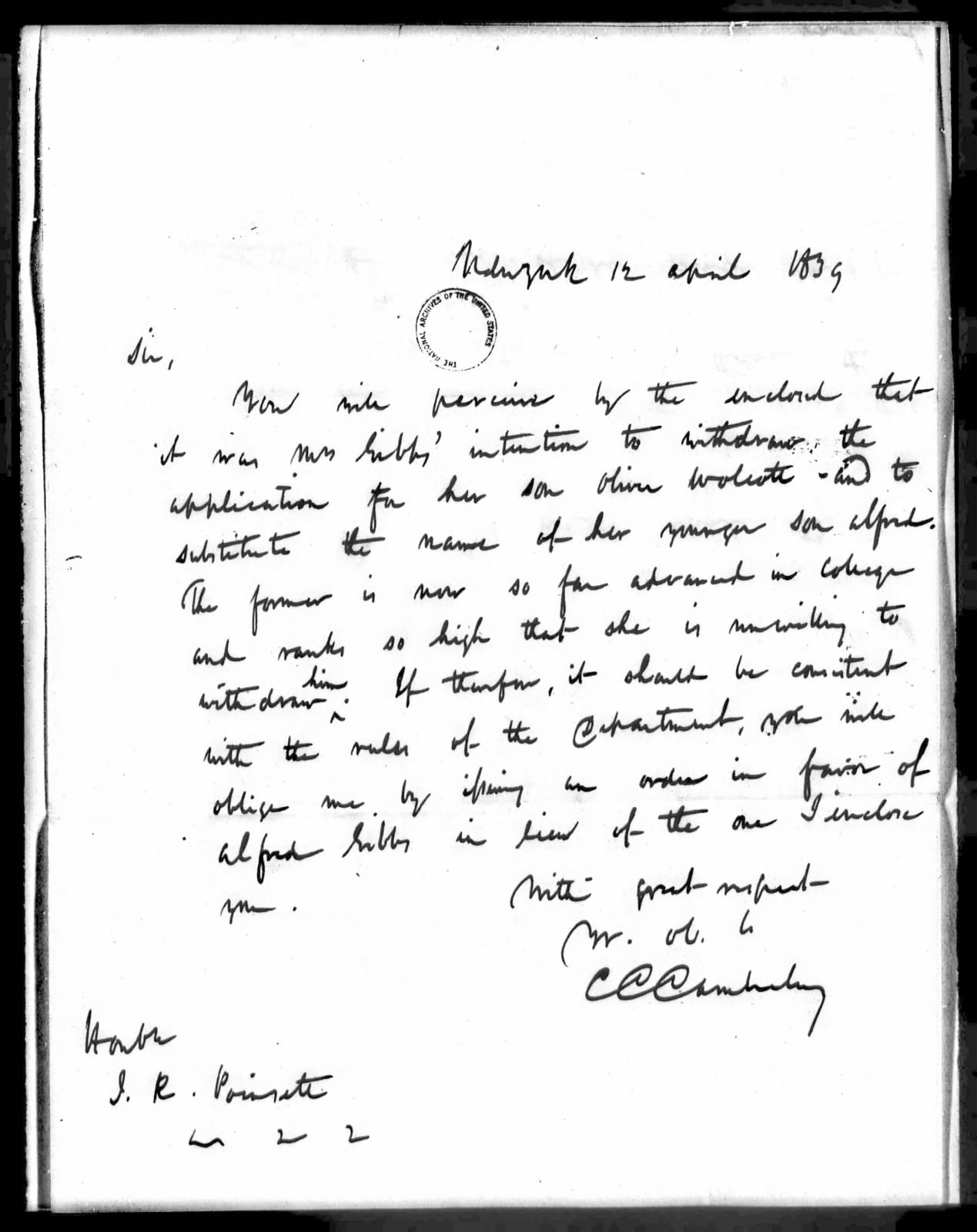
New York 12 april 1839
Sir,
You will perceive by the enclosed that it was Mrs Gibbs’ intention to withdraw the application for her son Oliver Wolcott – and to substitute the name of her younger son Alfred. The former is now so far advanced in college and ranks so high that she is unwilling to withdraw him. If therefore, it should be consistent with the rules of the Department, you will oblige me by issuing an order in favor of Alfred Gibbs in lieu of the one I enclose you.
With great respect
Yr. ob. Se
C C Cambreleng
Honble J. R. Poinsett
&c &c &c
The Betrayal, in Thirteen Lines
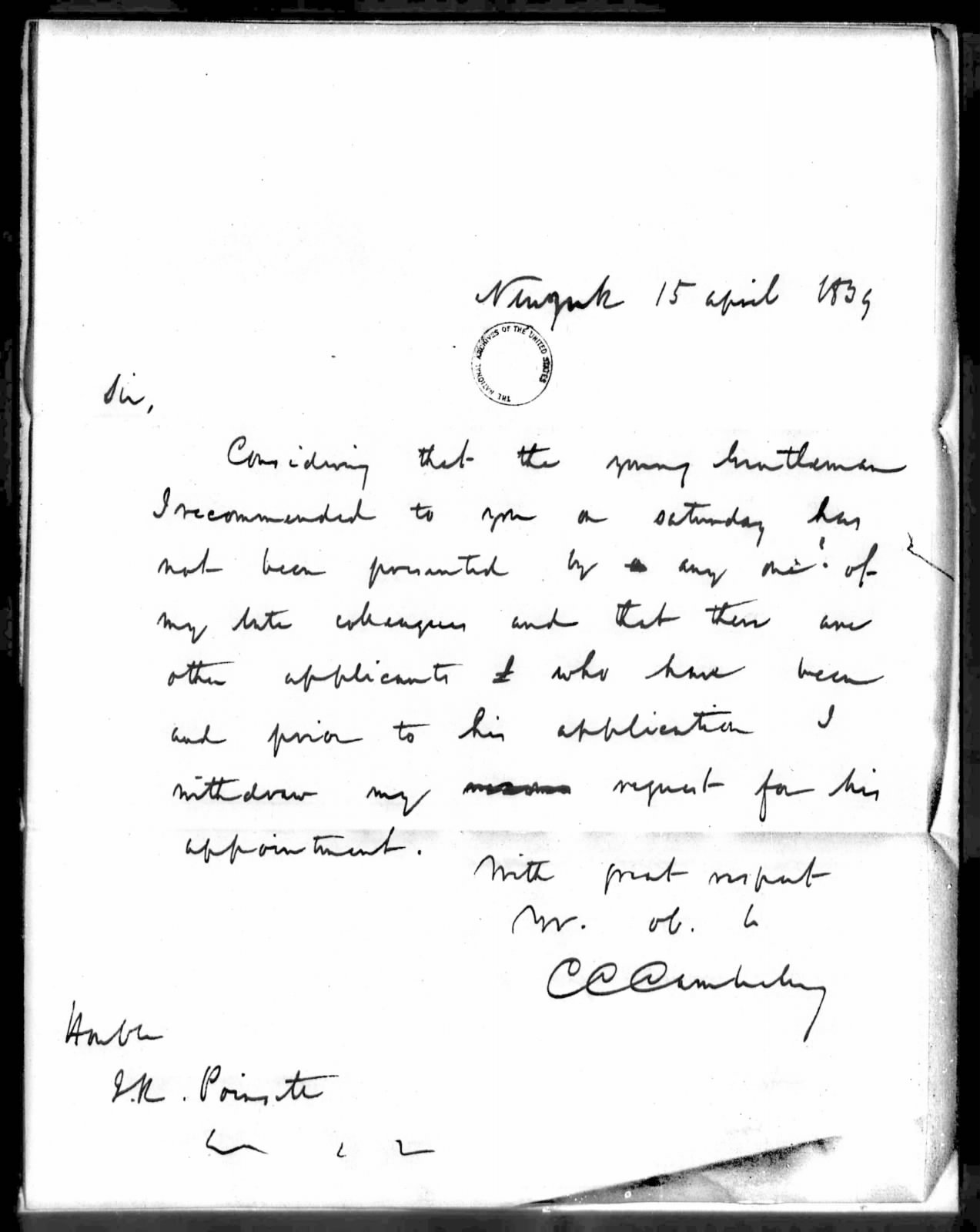
New York 15 april 1839
Sir,
Considering that the young gentleman I recommended to you on saturday has not been presented by any one of my late colleagues and that there are other applicants who have been [named?] prior to his application I withdraw my [word struck out] request for his appointment.
With great respect
Yr. ob. Se
C C Cambreleng
Honble J. R. Poinsett
&c &c &c
“The Appointment Has Been Cancelled”
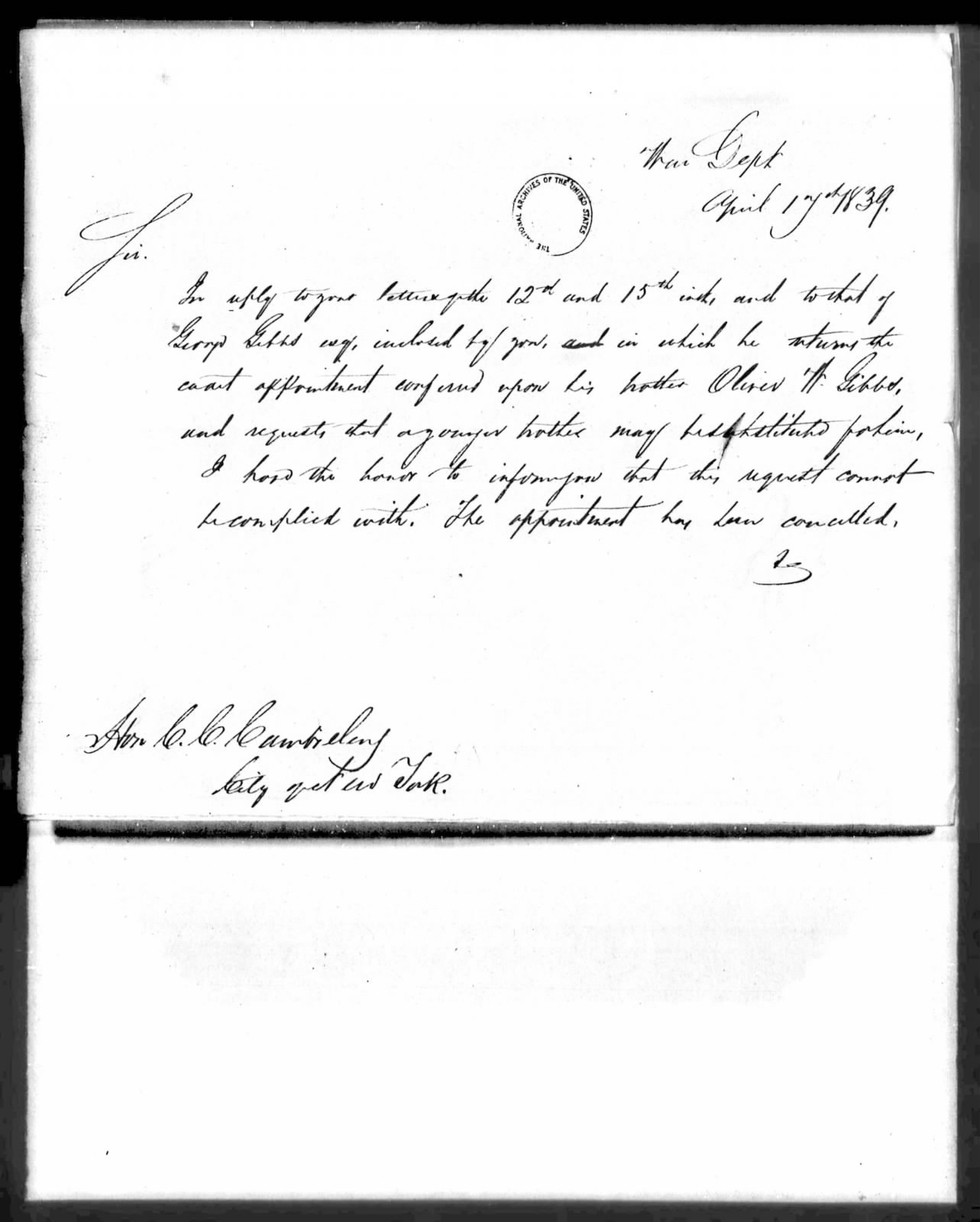
War Dept
April 17th 1839.
Sir.
In reply to your letters of the 12th and 15th inst, and to that of George Gibbs esq, inclosed by you, in which he returns the cadet appointment conferred upon his brother Oliver W. Gibbs, and requests that a younger brother may be substituted for him, I have the honor to inform you that this request cannot be complied with. The appointment has been cancelled.
Hon C. C. Cambreleng
City of New York.
The Department’s Own Reconstruction
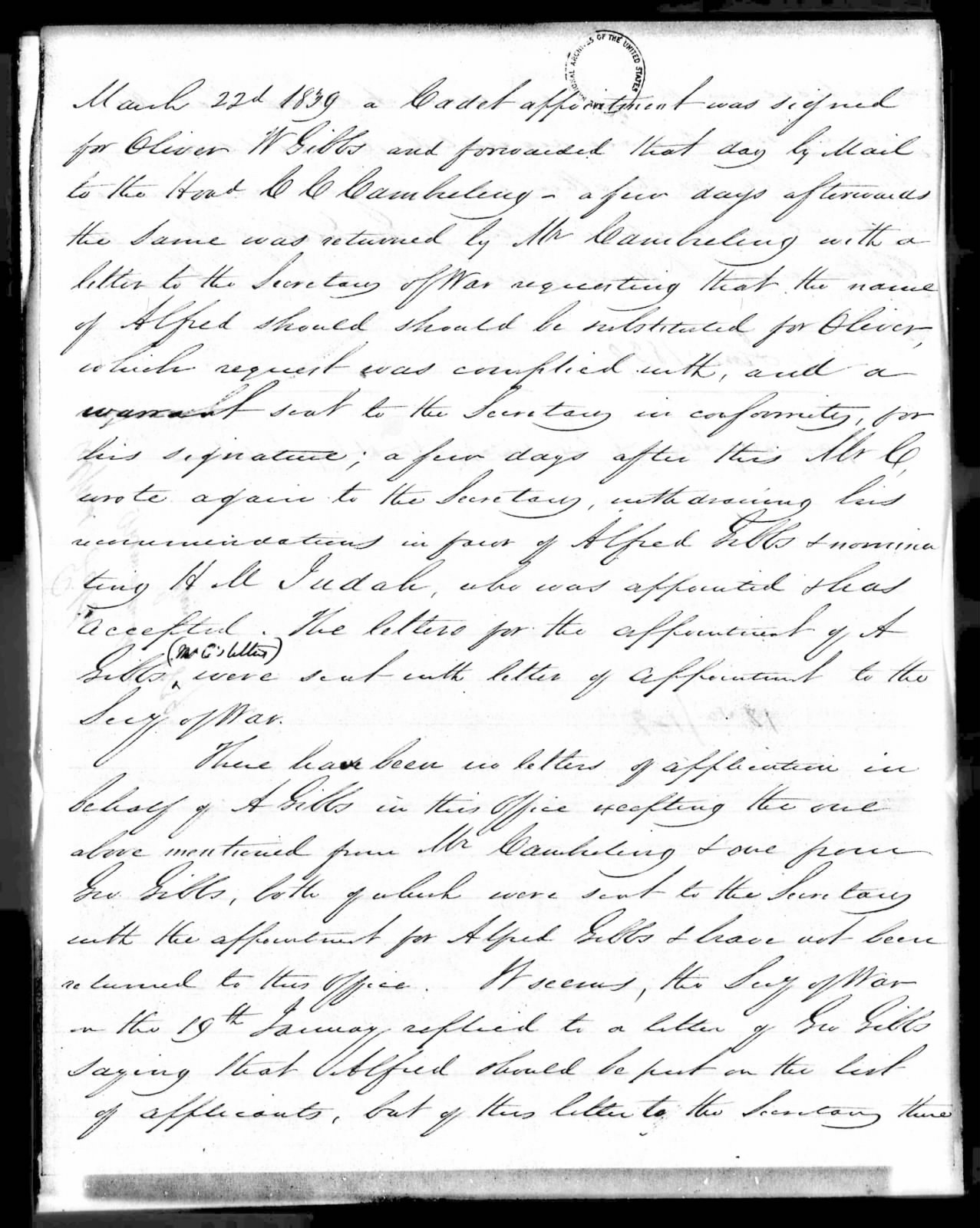
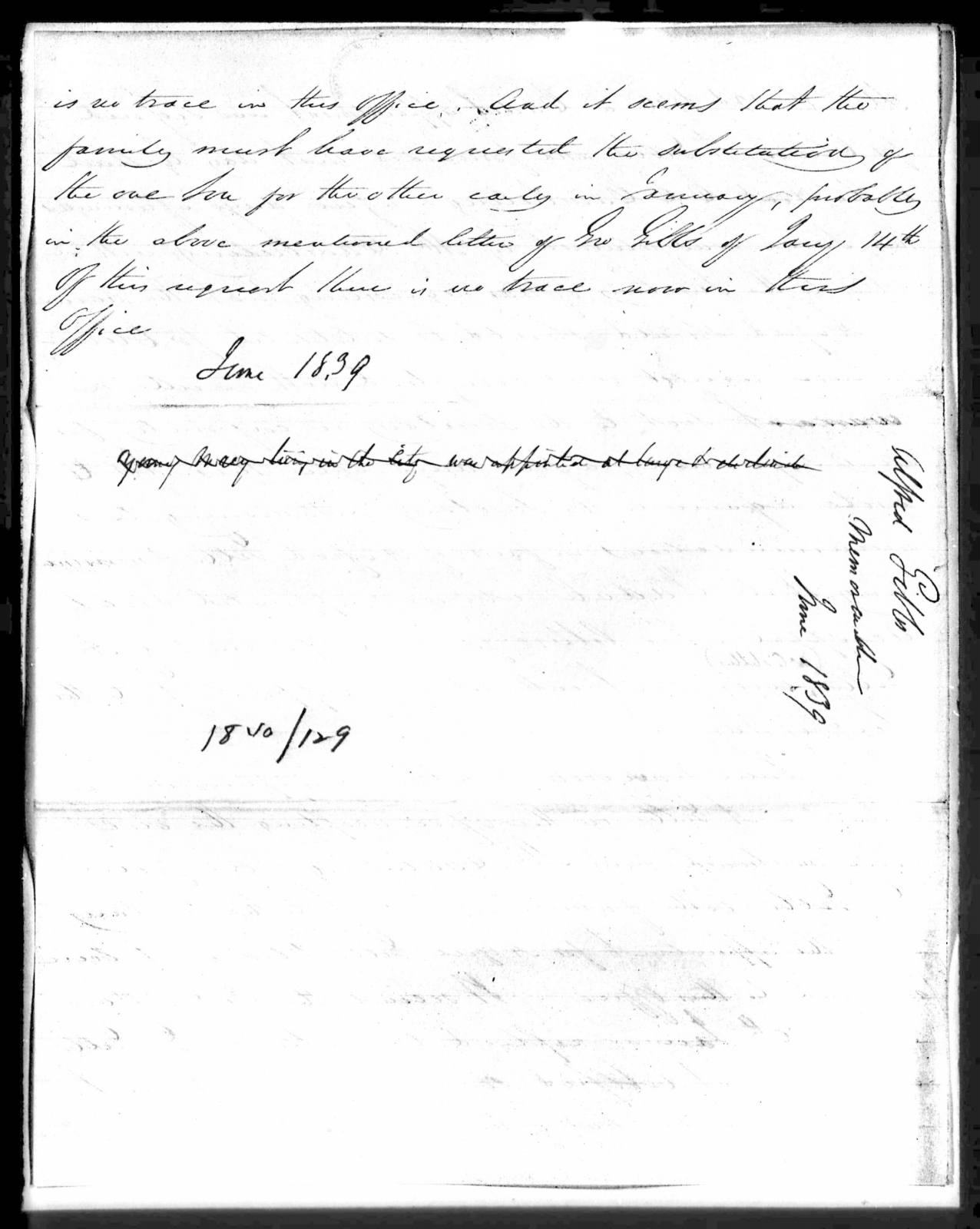
March 22d 1839 a Cadet appointment was signed for Oliver W Gibbs and forwarded that day by Mail to the Honble C C Cambreleng – a few days afterwards the same was returned by Mr Cambreleng with a letter to the Secretary of War requesting that the name of Alfred should be substituted for Oliver, which request was complied with, and a [warrant] sent to the Secretary in conformity, for his signature; a few days after this Mr C. wrote again to the Secretary, withdrawing his recommendations in favr of Alfred Gibbs & nominating H M Judah, who was appointed & has accepted. The letters for the appointment of A Gibbs (Mr C’s letter) were sent with letter of appointment to the Secy of War.
There have been no letters of application in behalf of A Gibbs in this Office excepting the one above mentioned from Mr Cambreleng & one from Geo Gibbs, both of which were sent to the Secretary with the appointment for Alfred Gibbs & have not been returned to this Office. It seems, the Secy of War on the 19th January replied to a letter of Geo Gibbs saying that Alfred should be put on the list of applicants, but of this letter to the Secretary there is no trace in this Office. And it seems that the family must have requested the substitution of the one Son for the other early in January, probably in the above mentioned letter of Geo Gibbs of Jany 14th. Of this request there is no trace now in this Office.
June 1839
young Brady[?] living in the city was appointed at large & declined [line struck through]
[Docket:] Alfred Gibbs / Memorandum / June 1839 / 1840/129
What They Told the Widow to Her Face
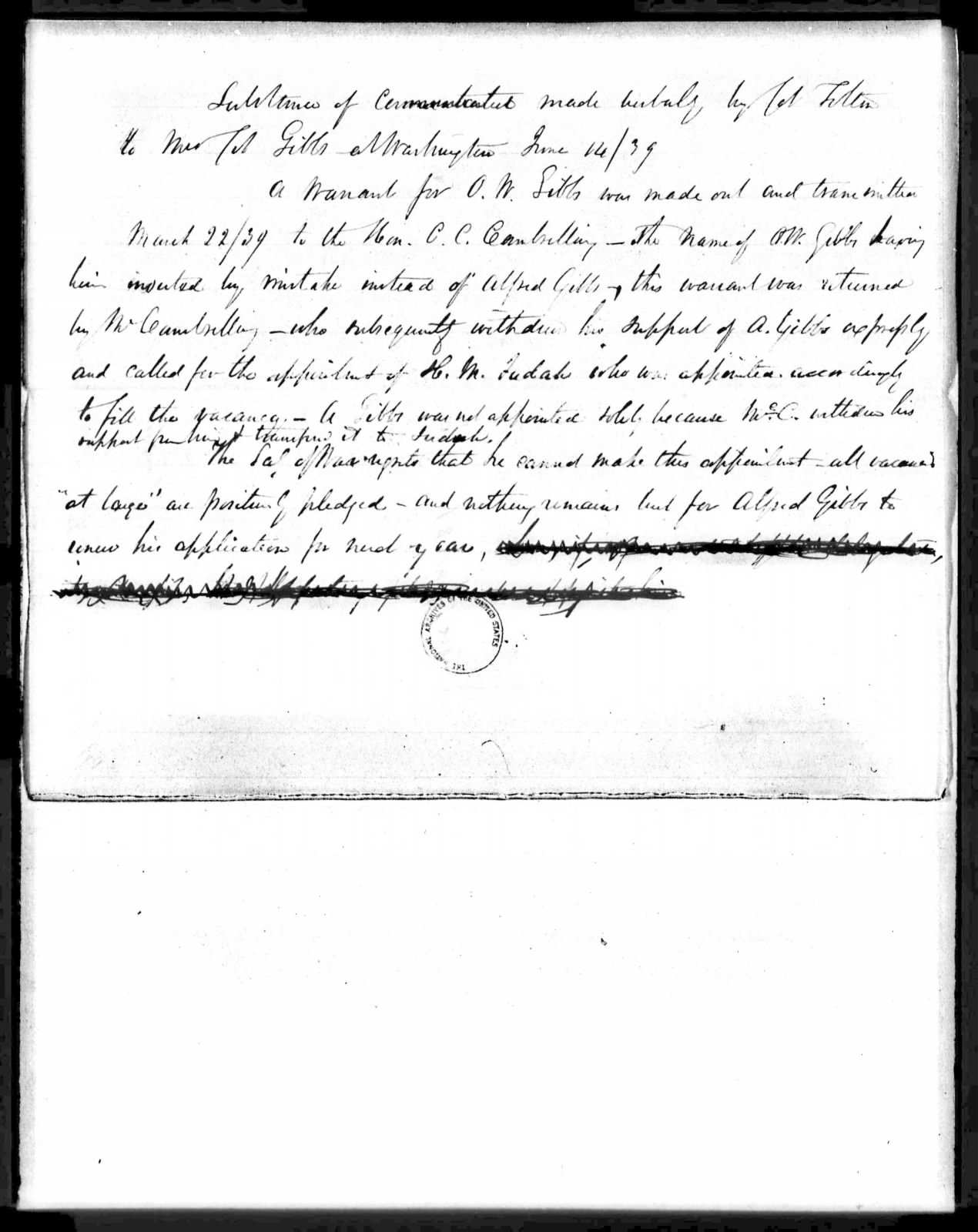
Substance of communication made verbally by Col Totten to Mrs Col Gibbs at Washington June 14/39
A Warrant for O. W. Gibbs was made out and transmitted March 22/39 to the Hon. C. C. Cambreleng – The name of O. W. Gibbs having been inserted by mistake instead of Alfred Gibbs – this warrant was returned by Mr Cambreleng – who subsequently withdrew his support of A. Gibbs expressly and called for the appointment of H. M. Judah who was appointed accordingly to fill the vacancy. – A. Gibbs was not appointed solely because Mr. C. withdrew his support from him & transferred it to Judah.
The Secy of War regrets that he cannot make this appointment – all vacancies “at large” are positively pledged – and nothing remains but for Alfred Gibbs to renew his application for next year, [two lines struck through and illegible]
Act II · 1840The Widow Renews
Rebuffed in person at Washington, told to seek the nomination of the very man who had injured her, Laura waited out the year and applied again in January 1840, in her own name. Secretary Poinsett’s reply, initialed in his own hand, told her to wait for 1841: a new year, and, though he did not say it, a new administration.
The Widow Renews, the Secretary Answers
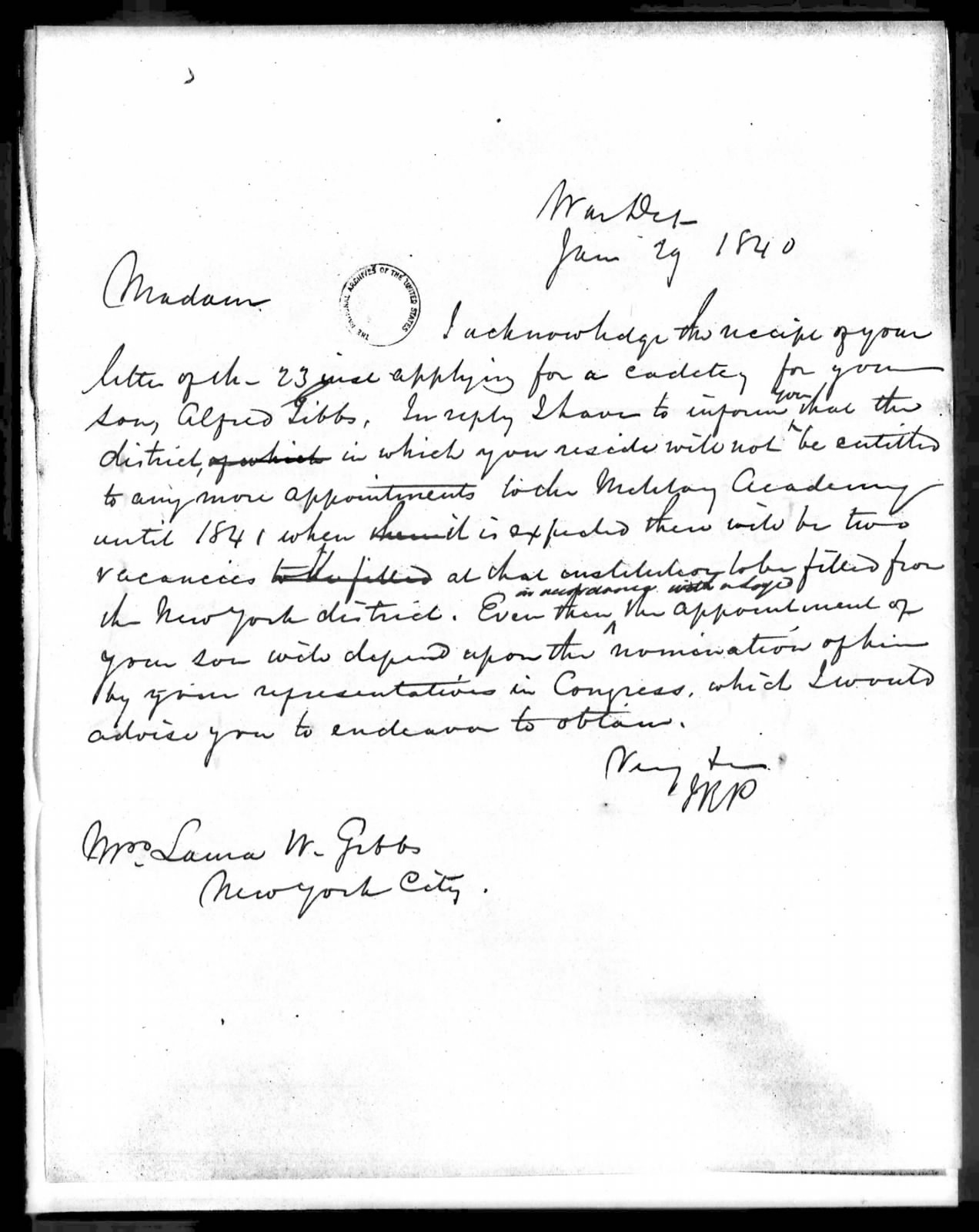
War Dep –
Jan 29 1840
Madam
I acknowledge the receipt of your letter of the 23 inst applying for a cadetcy for your son, Alfred Gibbs. In reply I have to inform you that the district in which you reside will not be entitled to any more appointments to the Military Academy until 1841 when it is expected there will be two vacancies at that institution to be filled from the New York district. Even then, the appointment of your son will depend upon the nomination of him [interlined: in accordance with usage] by your representatives in Congress, which I would advise you to endeavor to obtain.
Very &c
J. R. P.
Mrs Laura W. Gibbs
New York City.
Act III · 1841The Campaign
The Whig victory of 1840 changed everything. In the spring of 1841 the family moved on every front at once: General Scott wrote in February; the New York delegation demanded answers in March and got Poinsett’s apology on nearly his last day in office; George and Laura each laid the whole case before the new Secretary, John Bell, in letters written a day apart; and on April 29, 1841, the ruling came: Gibbs is to have the first vacancy.
Update, October 31, 2026: This note earlier said that the congressman whose nomination Poinsett told her to obtain was Cambreleng. By January 1840 Cambreleng was no longer in the House: his own letter of April 15, 1839, above, speaks of “my late colleagues.” The representatives Poinsett meant were the sitting New York City members, the four who sign the letter of March 31, 1841, below. Corrected.
General Scott Adds His Voice
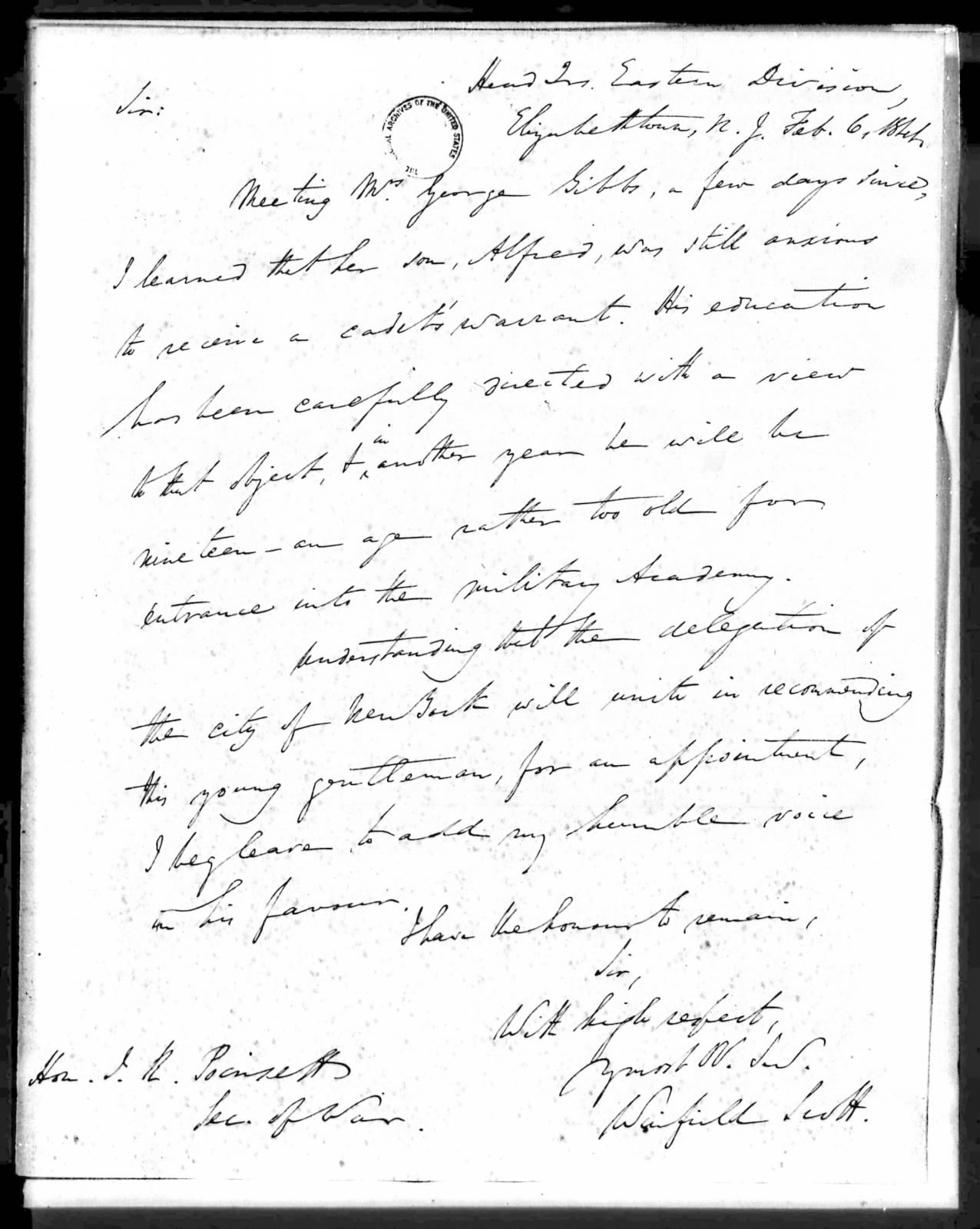
Head Qrs. Eastern Division,
Elizabethtown, N. J. Feb. 6, 1841.
Sir:
Meeting Mrs. George Gibbs, a few days since, I learned that her son, Alfred, was still anxious to receive a cadet’s warrant. His education has been carefully directed with a view to that object, & in another year he will be nineteen – an age rather too old for entrance into the military Academy.
Understanding that the delegation of the city of New York will unite in recommending this young gentleman, for an appointment, I beg leave to add my humble voice in his favour.
I have the honour to remain, Sir,
With high respect,
Yr most Ob. Servt
Winfield Scott.
Hon. J. R. Poinsett,
Sec. of War.
Poinsett Explains Himself
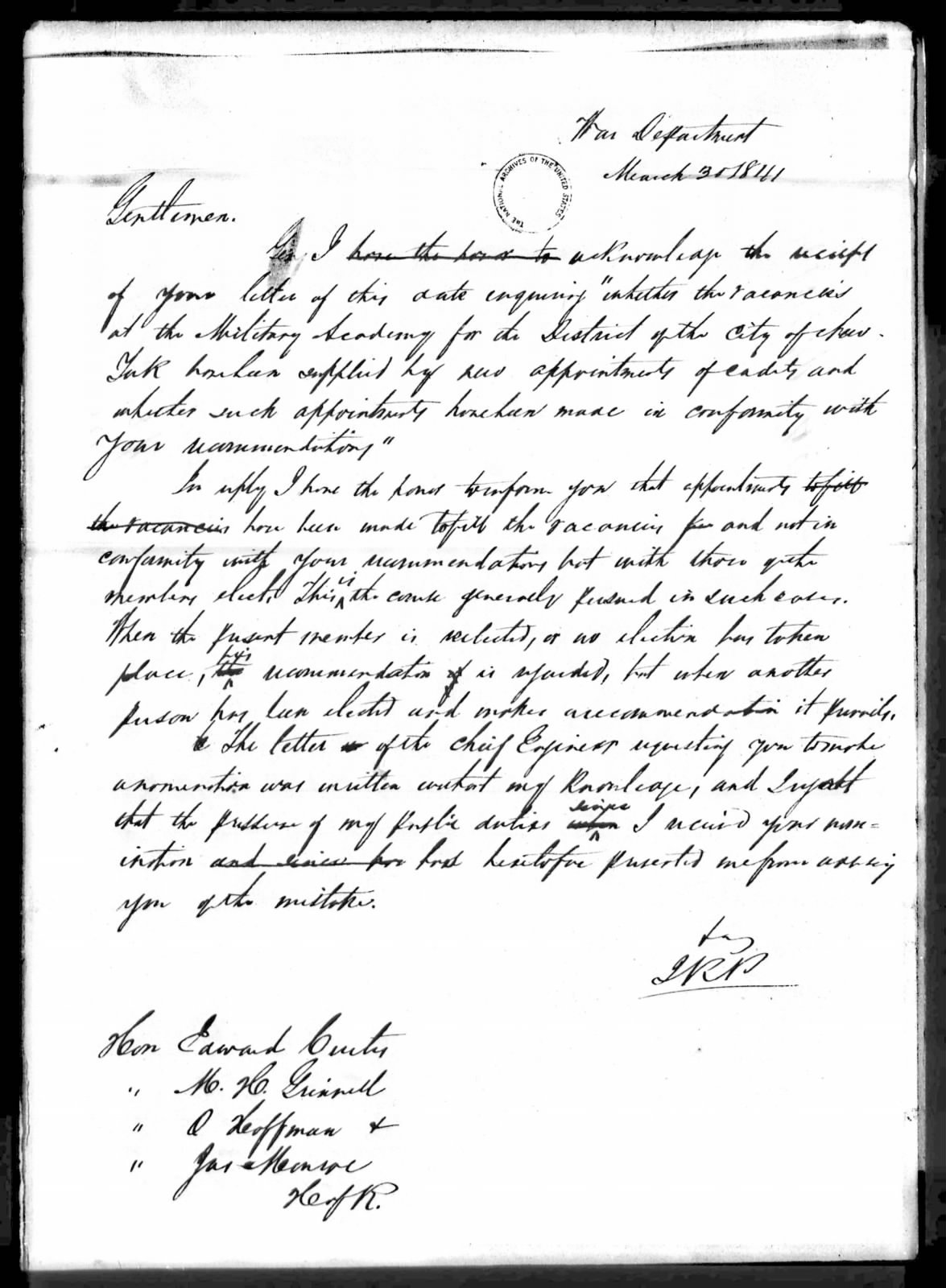
War Department
March 3d 1841
Gentlemen.
I acknowledge the receipt of your letter of this date enquiring “whether the vacancies at the Military Academy for the District of the City of New York have been supplied by new appointments of cadets and whether such appointments have been made in conformity with your recommendations.”
In reply I have the honor to inform you that appointments have been made to fill the vacancies and not in conformity with your recommendations but with those of the members elect. This is the course generally pursued in such cases. When the present member is reelected, or no election has taken place, his recommendation is regarded, but when another person has been elected and makes a recommendation it prevails.
The letter of the Chief Engineer requesting you to make a nomination was written without my knowledge, and I regret that the pressure of my public duties since I received your nomination has heretofore prevented me from advising you of the mistake.
J. R. P.
Hon Edward Curtis
” M. H. Grinnell
” O. Hoffman &
” Jas Monroe
H of R.
The Brother’s Great Letter
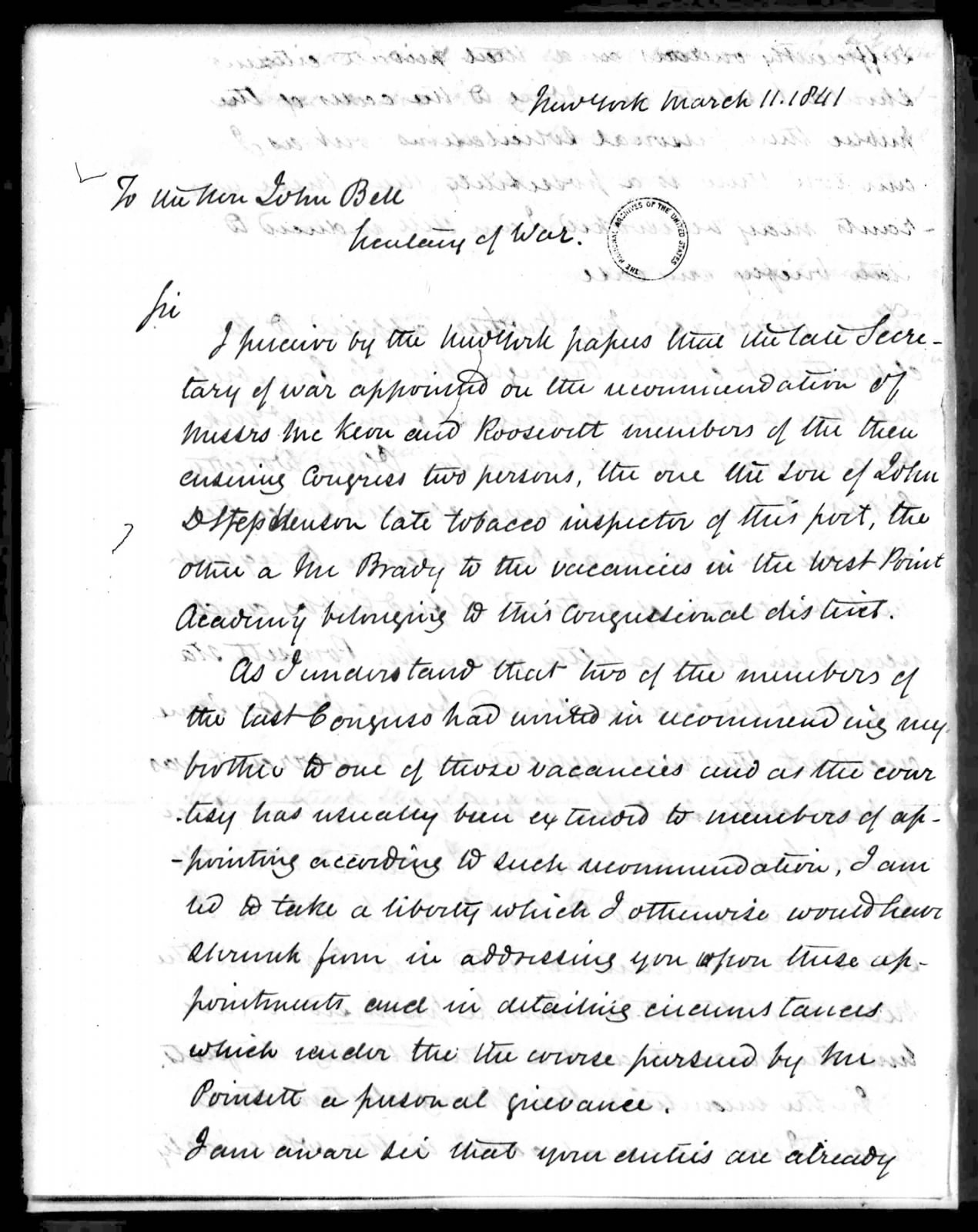
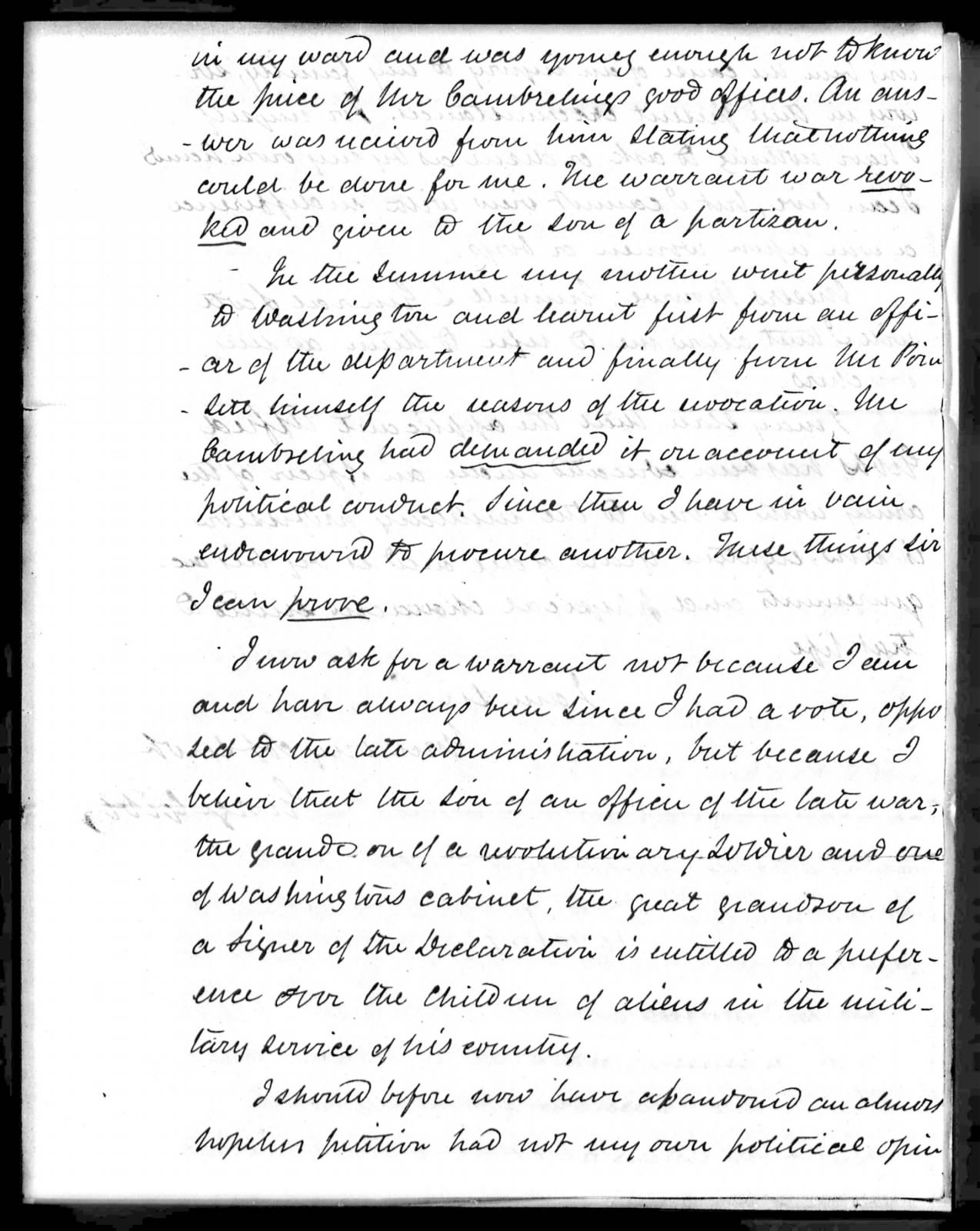
New York March 11. 1841
To the Hon John Bell
Secretary of War.
Sir
I perceive by the New York papers that the late Secretary of war appointed on the recommendation of Messrs McKeon and Roosevelt members of the then ensuing Congress two persons, the one the son of John D Stephenson late tobacco inspector of this port, the other a Mr Brady to the vacancies in the West Point Academy belonging to this Congressional district.
As I understand that two of the members of the last Congress had united in recommending my brother to one of those vacancies and as the courtesy has usually been extended to members of appointing according to such recommendation, I am led to take a liberty which I otherwise would have shrunk from in addressing you upon these appointments, and in detailing circumstances which render the course pursued by Mr Poinsett a personal grievance.
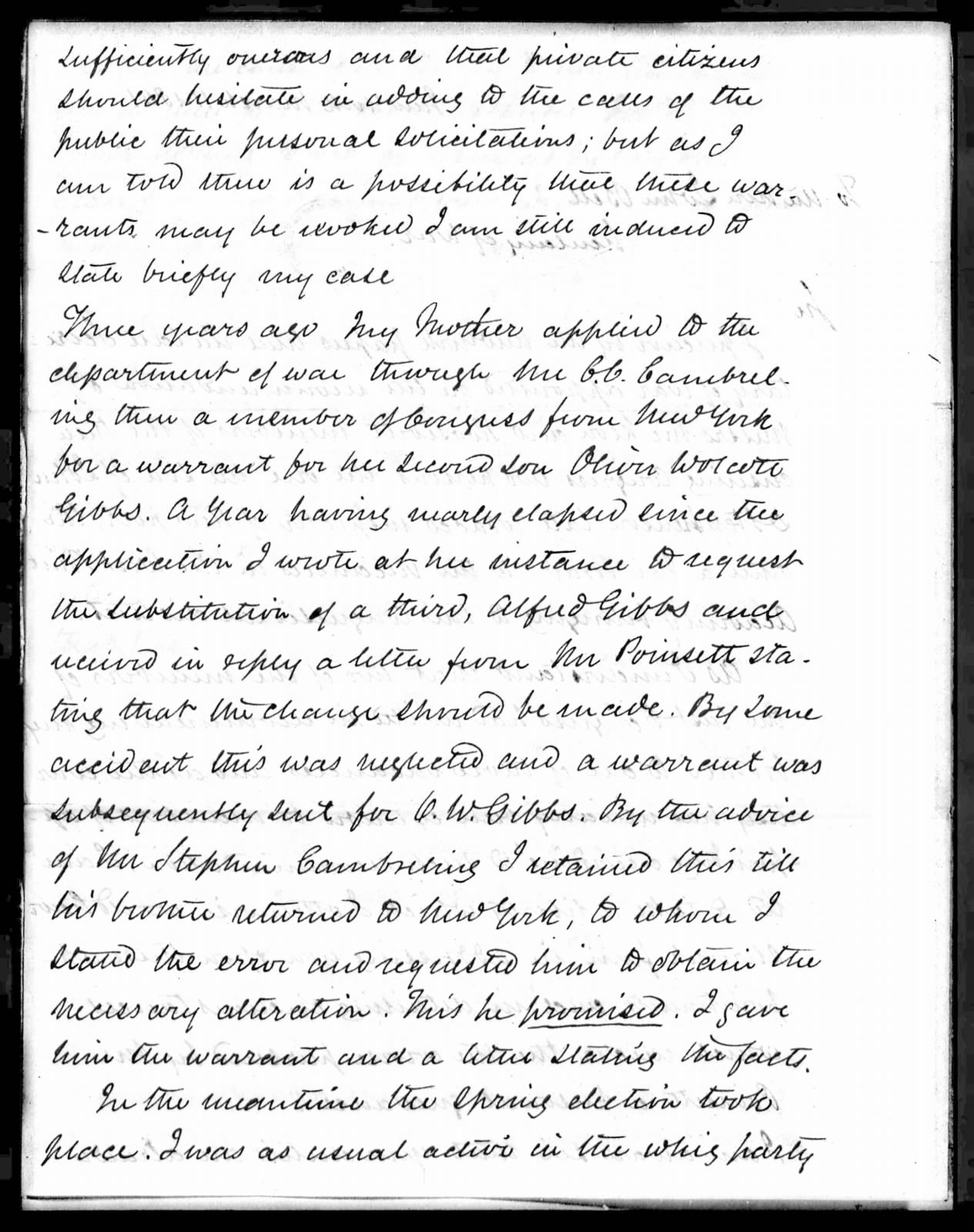
I am aware sir that your duties are already sufficiently onerous and that private citizens should hesitate in adding to the calls of the public their personal solicitations; but as I am told there is a possibility that these warrants may be revoked I am still induced to state briefly my case
Three years ago My Mother applied to the department of war through Mr C. C. Cambreling then a member of Congress from New York for a warrant for her second son Oliver Wolcott Gibbs. A Year having nearly elapsed since the application I wrote at her instance to request the substitution of a third, Alfred Gibbs and received in reply a letter from Mr Poinsett stating that the change should be made. By some accident this was neglected and a warrant was subsequently sent for O. W. Gibbs. By the advice of Mr Stephen Cambreling I retained this till his brother returned to New York, to whom I stated the error and requested him to obtain the necessary alteration. This he promised. I gave him the warrant and a letter stating the facts.
In the meantime the Spring election took place. I was as usual active in the whig party in my ward and was young enough not to know the price of Mr Cambrelings good offices. An answer was received from him stating that nothing could be done for me. The warrant was revoked and given to the son of a partizan.
In the Summer my mother went personally to Washington and learnt first from an officer of the department and finally from Mr Poinsett himself the reasons of the revocation. Mr Cambreling had demanded it on account of my political conduct. Since then I have in vain endeavoured to procure another. These things sir I can prove.
I now ask for a warrant not because I am and have always been since I had a vote, opposed to the late administration, but because I believe that the son of an officer of the late war, the grandson of a revolutionary soldier and one of Washingtons cabinet, the great grandson of a Signer of the Declaration is entitled to a preference over the children of aliens in the military service of his country.
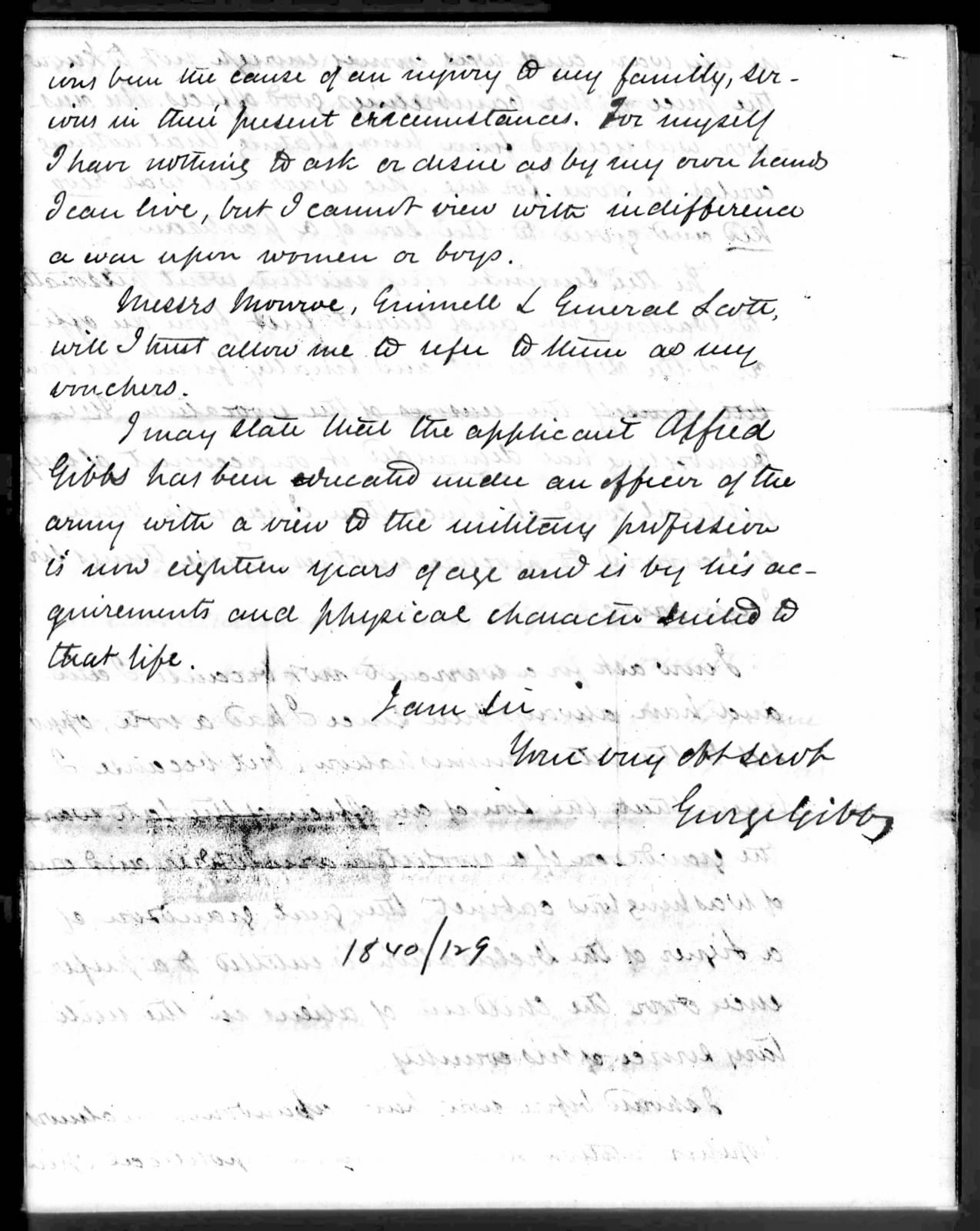
I should before now have abandoned an almost hopeless petition had not my own political opinions been the cause of an injury to my family, serious in their present circumstances. For myself I have nothing to ask or desire as by my own hand I can live, but I cannot view with indifference a war upon women or boys.
Messrs Monroe, Grinnell & General Scott, will I trust allow me to refer to them as my vouchers.
I may state that the applicant Alfred Gibbs has been educated under an officer of the army with a view to the military profession is now eighteen years of age and is by his acquirements and physical character suited to that life.
I am sir
Your very obt servt
George Gibbs
The Mother States Her Case
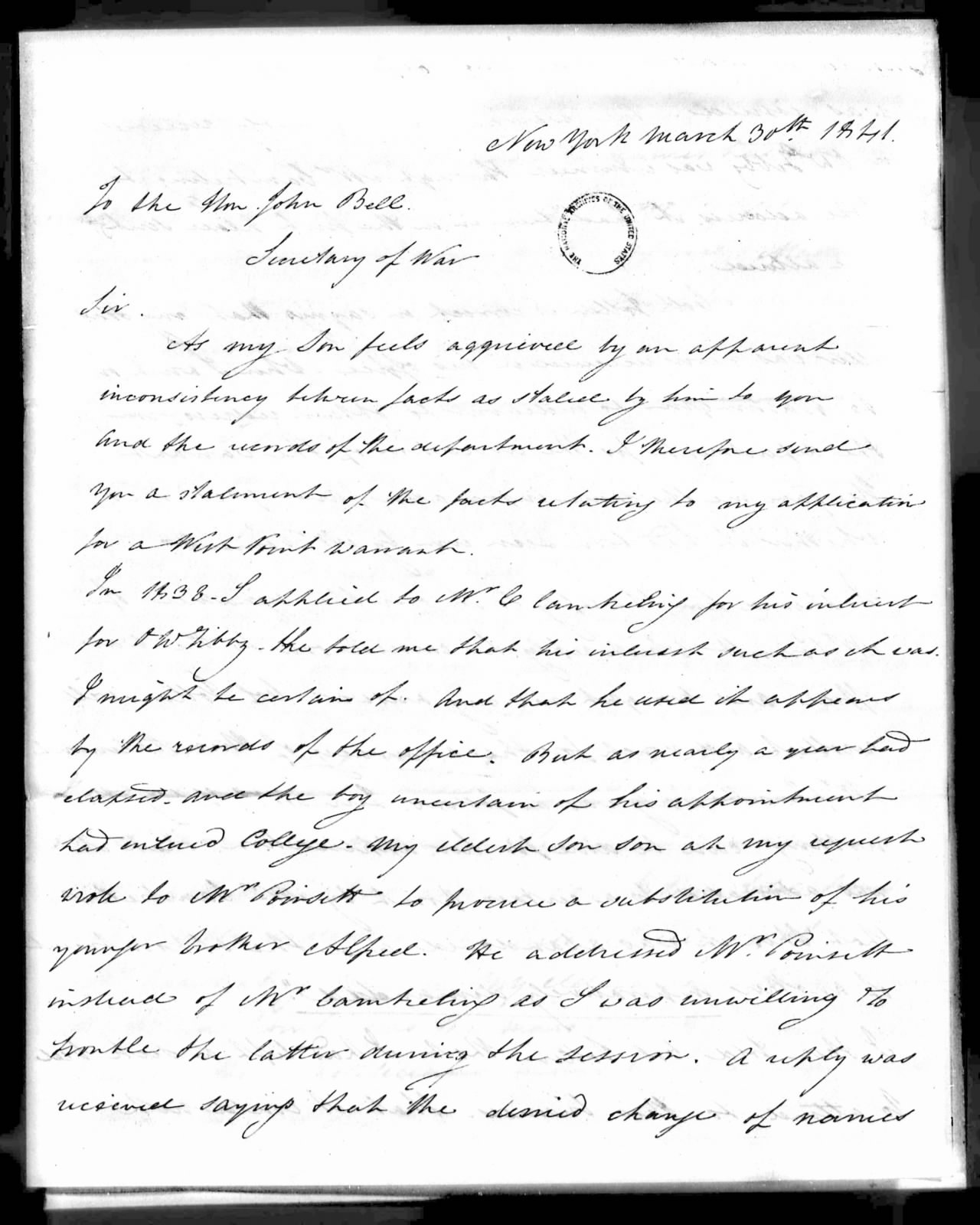
New York March 30th 1841.
To the Hon. John Bell.
Secretary of War
Sir.
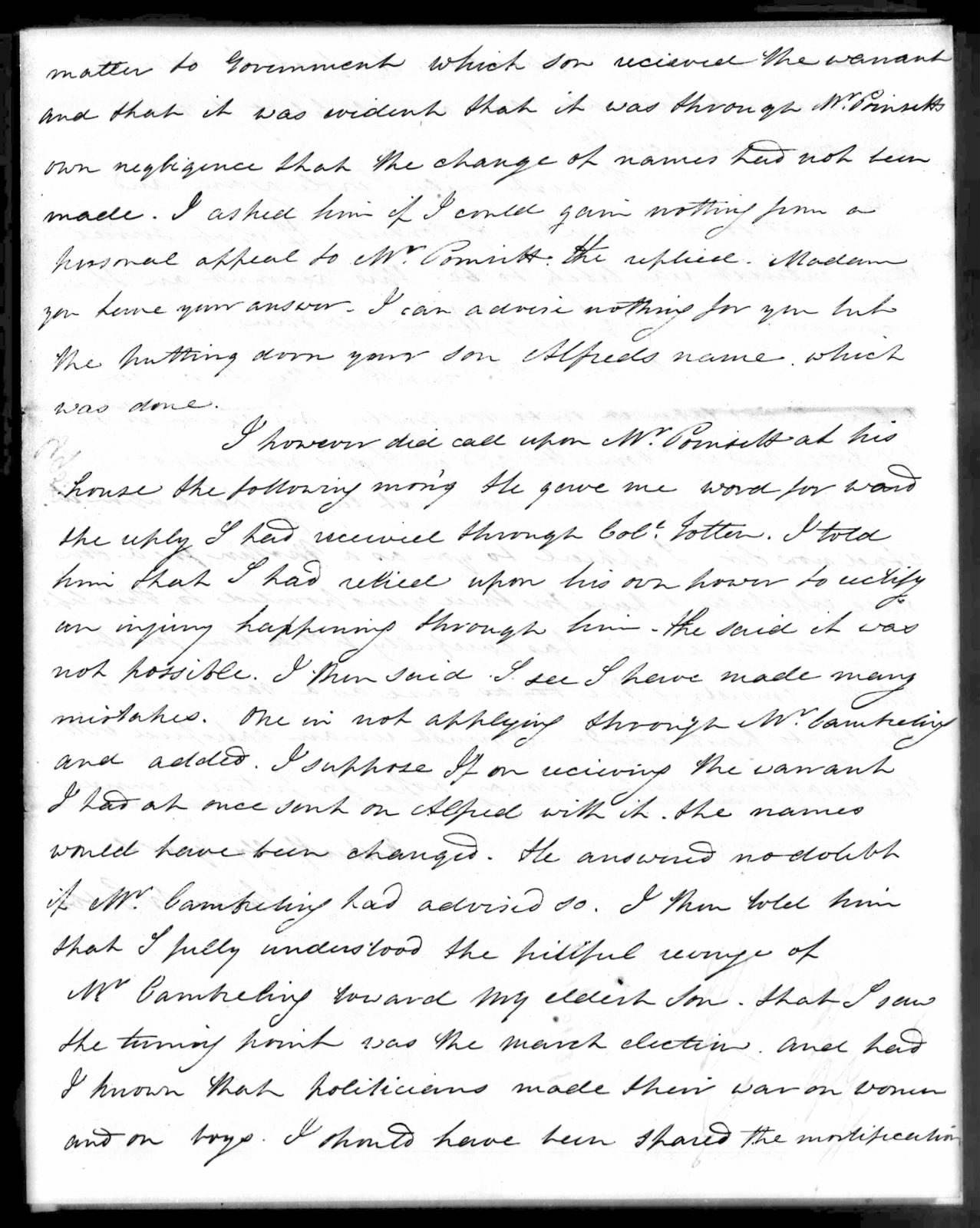
As my Son feels aggrieved by an apparent inconsistency between facts as stated by him to you and the records of the department. I therefore send you a statement of the facts relating to my application for a West Point warrant.
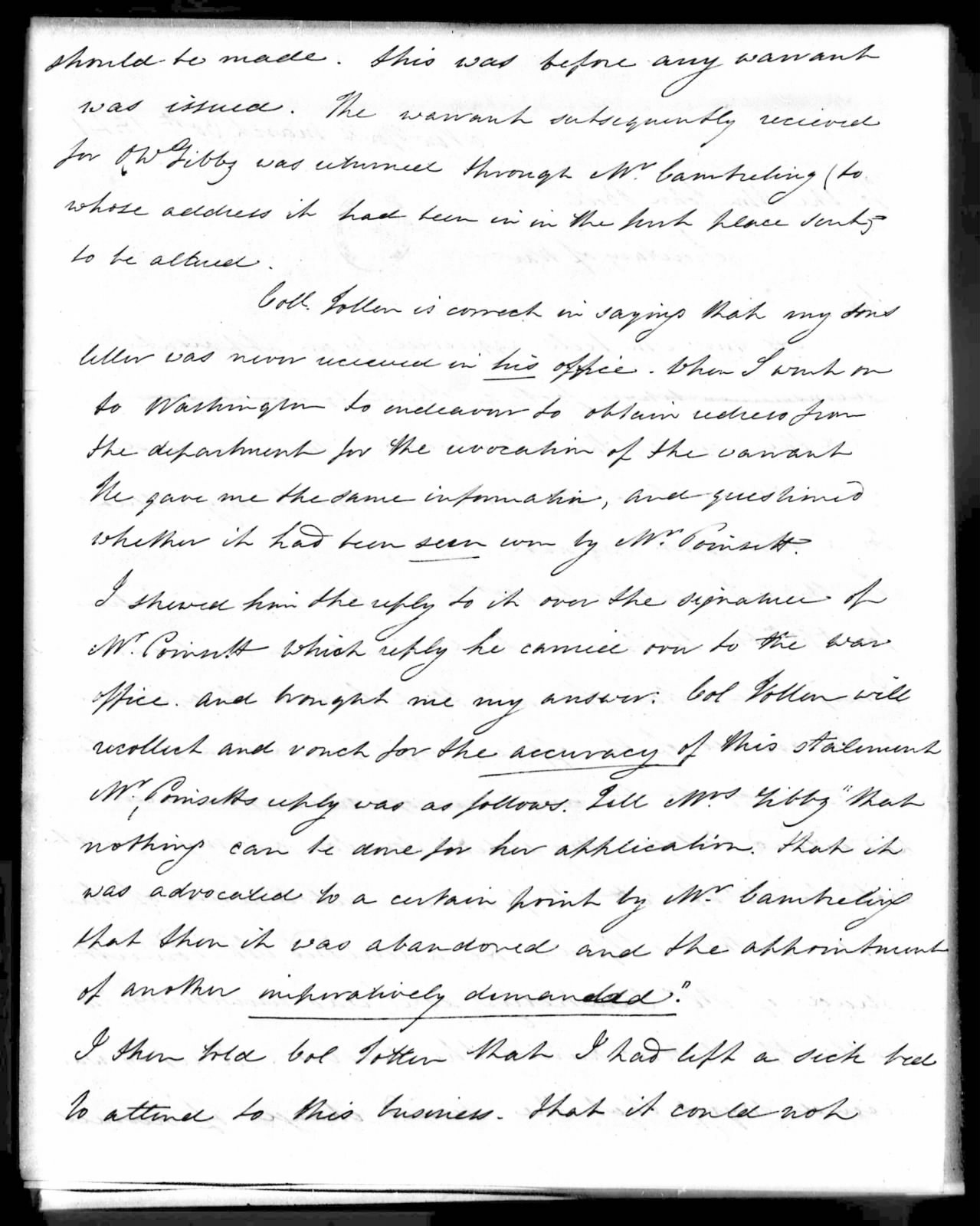
In 1838. I applied to Mr. C Cambreling for his interest for O W Gibbs. He told me that his interest such as it was, I might be certain of. And that he used it appears by the records of the office. But as nearly a year had elapsed, and the boy uncertain of his appointment had entered College. My eldest son at my request wrote to Mr Poinsett to procure a substitution of his younger brother Alfred. He addressed Mr. Poinsett instead of Mr Cambreling as I was unwilling to trouble the latter during the session. A reply was received saying that the desired change of names should be made. This was before any warrant was issued. The warrant subsequently received for O W Gibbs was returned through Mr. Cambreling (to whose address it had been in the first place sent) to be altered.
Coll. Totten is correct in saying that my sons letter was never received in his office. When I went on to Washington to endeavour to obtain redress from the department for the revocation of the warrant He gave me the same information, and questioned whether it had been seen even by Mr Poinsett.
I shewed him the reply to it over the signature of Mr Poinsett which reply he carried over to the war office. and brought me my answer. Col Totten will recollect and vouch for the accuracy of this statement. Mr Poinsetts reply was as follows. Tell Mrs Gibbs “that nothing can be done for her application. That it was advocated to a certain point by Mr. Cambreling that then it was abandoned and the appointment of another imperatively demanded.”
I then told Col Totten that I had left a sick bed to attend to this business. That it could not matter to Government which son received the warrant and that it was evident that it was through Mr Poinsetts own negligence that the change of names had not been made. I asked him if I could gain nothing from a personal appeal to Mr Poinsett. He replied. Madam you have your answer. I can advise nothing for you but the putting down your son Alfreds name. which was done.
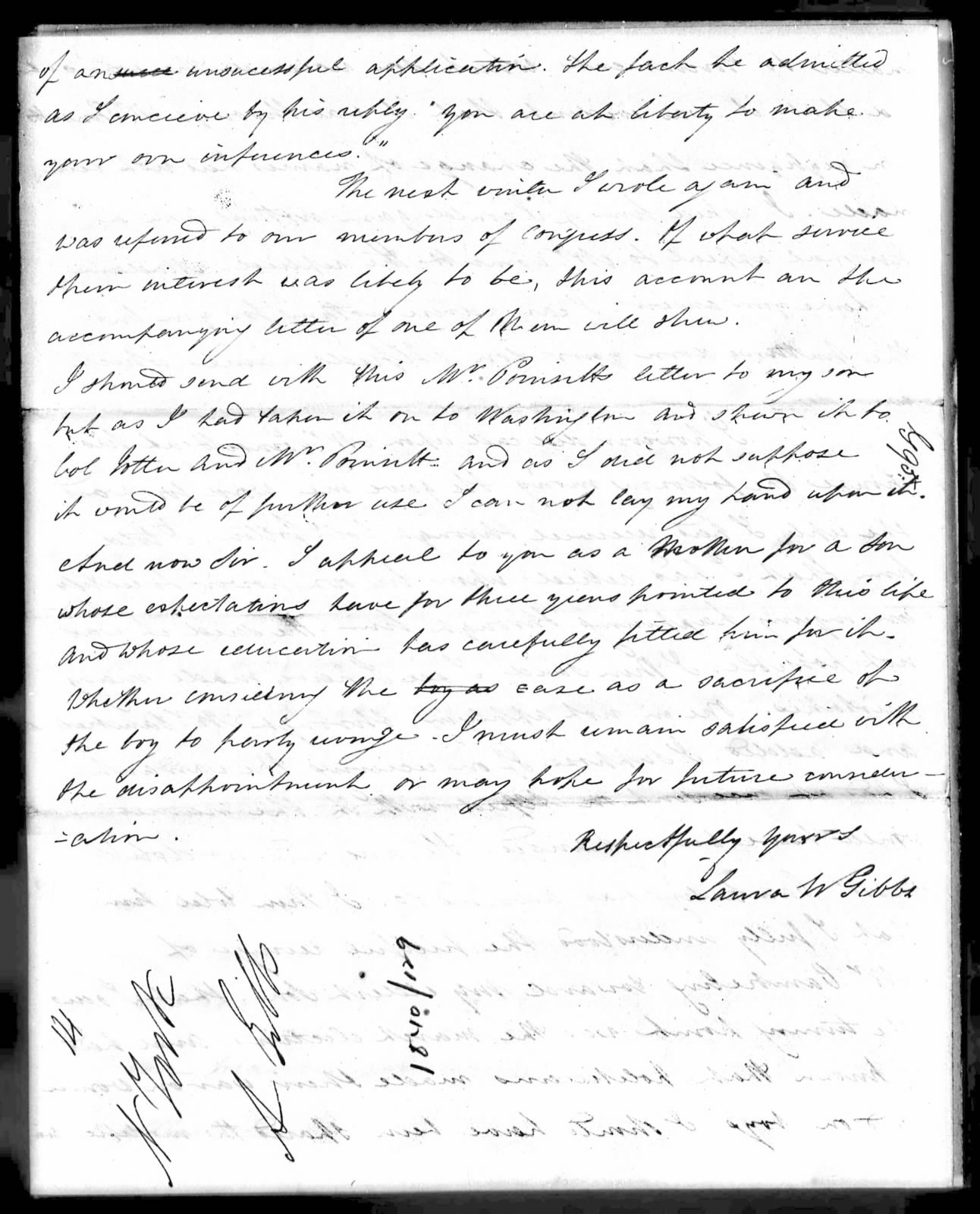
I however did call upon Mr Poinsett at his house the following morn’g He gave me word for word the reply I had received through Colo. Totten. I told him that I had relied upon his own honor to rectify an injury happening through him. He said it was not possible. I then said I see I have made many mistakes. One in not applying through Mr Cambreling and added. I suppose If on receiving the warrant I had at once sent on Alfred with it. the names would have been changed. He answered no doubt if Mr Cambreling had advised so. I then told him that I fully understood the pitiful revenge of Mr Cambreling toward my eldest Son. that I saw the turning point was the march election. and had I known that politicians made their war on women and on boys. I should have been spared the mortification of an unsuccessful application. The fact he admitted as I conceive by his reply “you are at liberty to make your own inferences.”
The next winter I wrote again and was refered to our members of congress. Of what service their interest was likely to be, this account and the accompanying letter of one of them will shew.
I should send with this Mr. Poinsetts letter to my son but as I had taken it on to Washington and shewn it to Col Totten And Mr. Poinsett. and as I did not suppose it would be of further use I can not lay my hand upon it.
And now Sir. I appeal to you as a Mother for a Son whose expectations have for three years pointed to this life and whose education has carefully fitted him for it. Whether considering the case as a sacrifice of the boy to party revenge. I must remain satisfied with the disappointment or may hope for future consideration.
Respectfully yours
Laura W Gibbs
Four Congressmen Set It Right
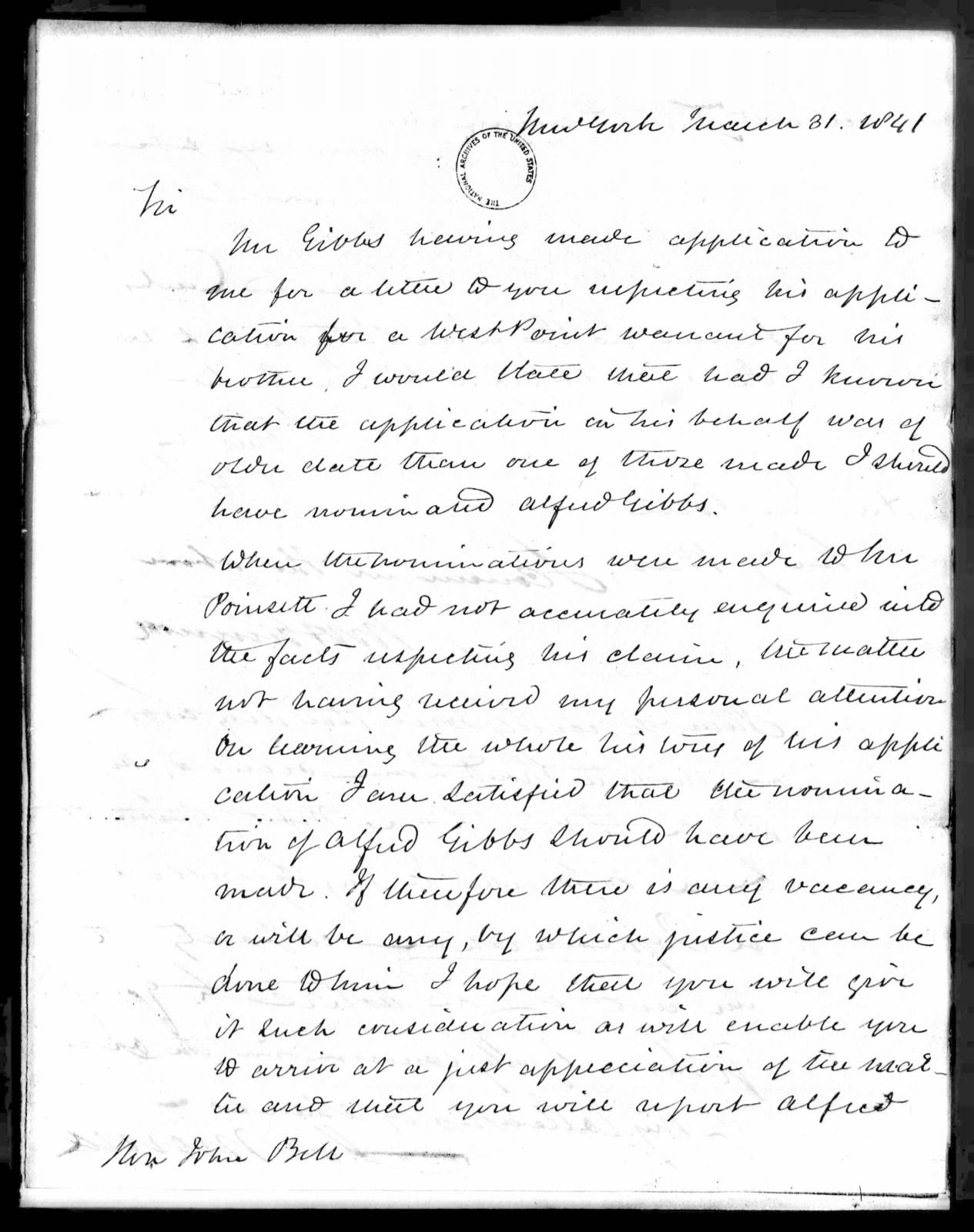
New York March 31. 1841
Sir
Mr Gibbs having made application to me for a letter to you respecting his application for a West Point warrant for his brother, I would state that had I known that the application in his behalf was of older date than one of those made I should have nominated Alfred Gibbs.
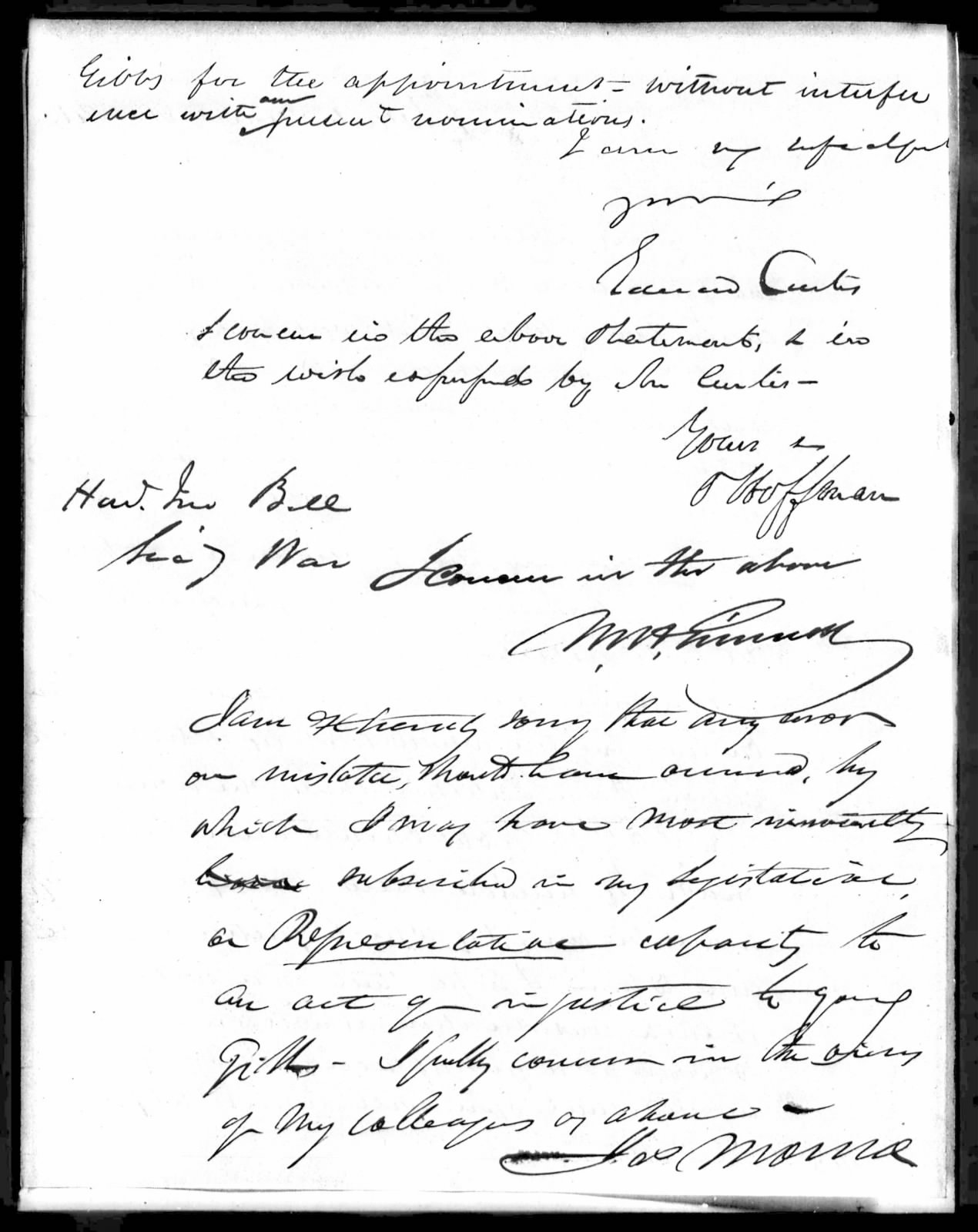
When the nominations were made to Mr Poinsett I had not accurately enquired into the facts respecting his claim, the matter not having received my personal attention. On learning the whole history of his application I am satisfied that the nomination of Alfred Gibbs should have been made. If therefore there is any vacancy, or will be any, by which justice can be done to him I hope that you will give it such consideration as will enable you to arrive at a just appreciation of the matter and that you will report Alfred Gibbs for the appointment – without interference with our present nominations.
I am very respectfully yours
Edward Curtis
I concur in the above statements, & in the wish expressed by Mr Curtis –
Yours &c
O Hoffman
Hon. Jno Bell
Secy War
I concur in the above
M. H. Grinnell
I am extremely sorry that any error or mistake should have occurred, by which I may have most innocently subscribed in my legislative, or Representative capacity to an act of injustice to young Gibbs – I fully concur in the [views] of My colleagues as above –
Jas Monroe
“Gibbs Is to Have the First Vacancy”
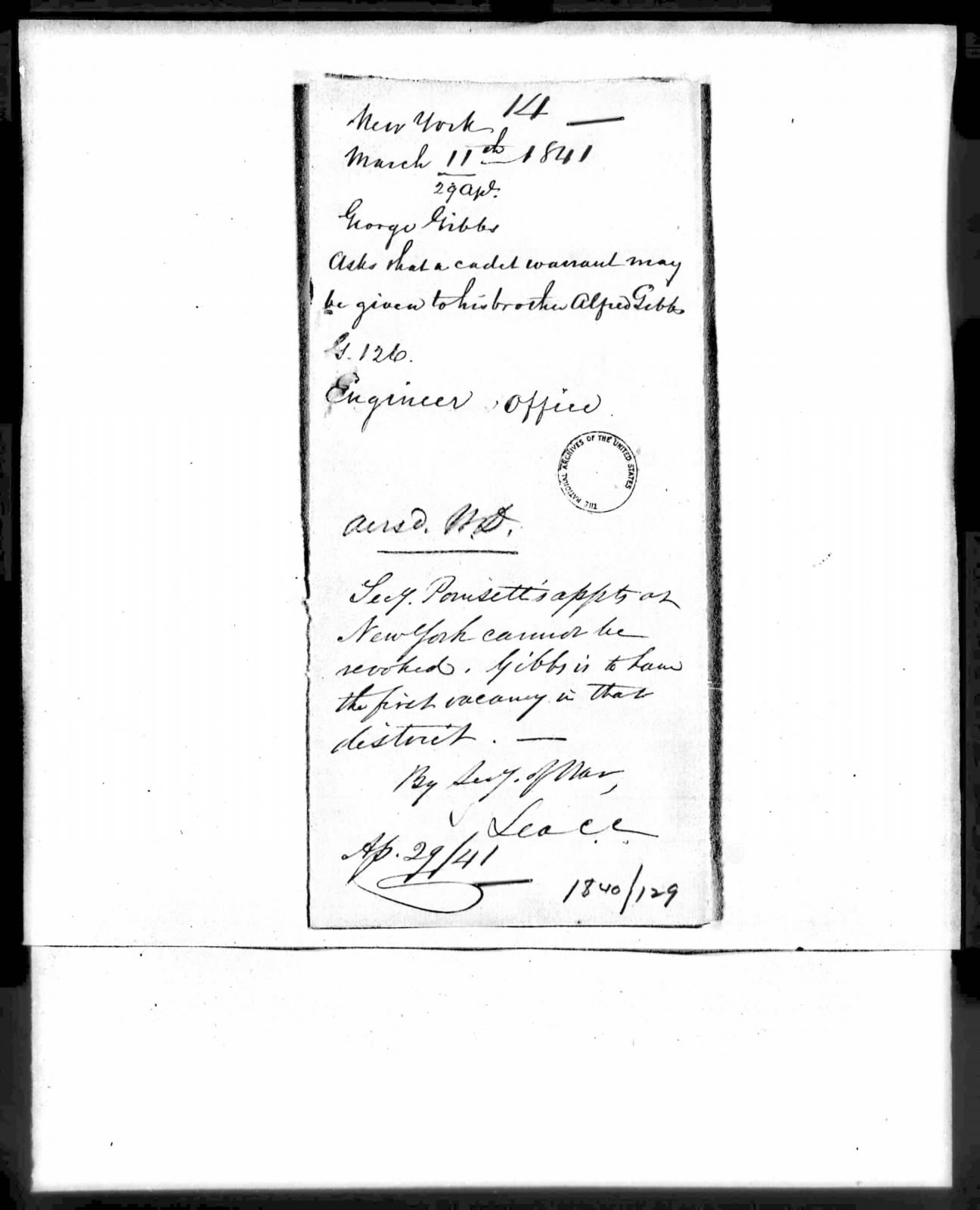
14 –
New York
March 11th 1841
[answered] 29 Apl.
George Gibbs
Asks that a cadet warrant may be given to his brother Alfred Gibbs
G.126.
Engineer Office
Ansd. W. D.
Secy. Poinsett’s appts at New York cannot be revoked. Gibbs is to have the first vacancy in that district. –
By Secy. of War,
Lea c.c.
Ap. 29/41
1840/129
Act IV · 1842The President’s Warrant
No vacancy opened, and the family called in the promise. Laura gave Scott a deadline of the spring; the uncle, Governor Gibbs of Rhode Island, asked Senator Tallmadge to carry the case to President Tyler himself. On April 19, 1842, Secretary Spencer notified Alfred that the President had conferred the appointment at large. Alfred answered on April 22: his nineteenth birthday.
“Once More”
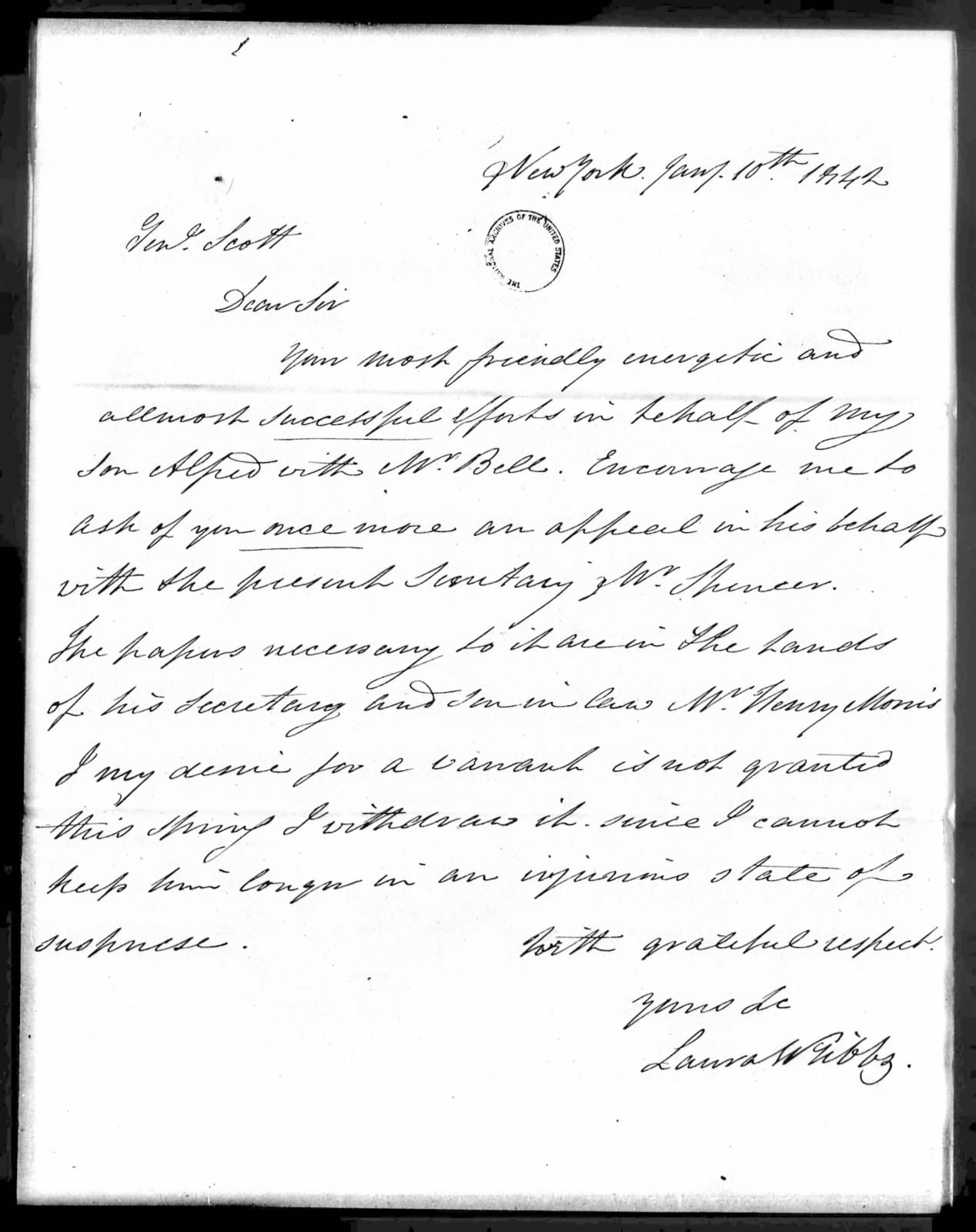
New York. Jany. 10th 1842
Genl. Scott
Dear Sir
Your most friendly energetic and allmost successful efforts in behalf of my Son Alfred with Mr. Bell. Encourage me to ask of you once more an appeal in his behalf with the present Secretary Mr. Spencer.
The papers necessary to it are in the hands of his Secretary and Son in law Mr Henry Morris
If my desire for a warrant is not granted this spring I withdraw it. since I cannot keep him longer in an injurious state of suspense.
With grateful respect
yours &c
Laura W Gibbs.
Scott Forwards It, In His Own Hand
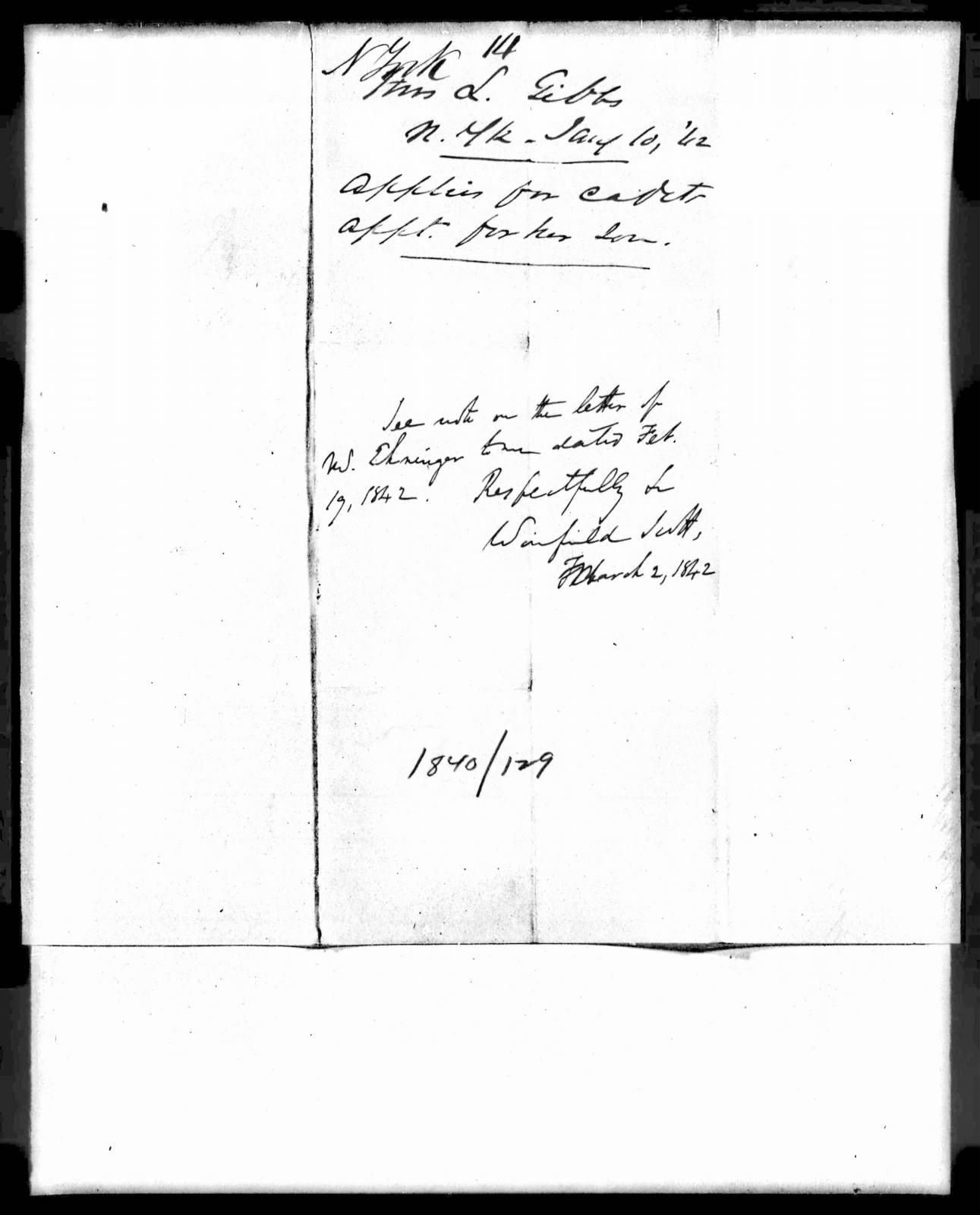
14
N. York
Mrs L. Gibbs
N. Yk – Jany 10, ’42
Applies for cadets appt. for her Son.
See note on the letter of W. Ehninger to me dated Feb. 19, 1842. Respectfully &c
Winfield Scott,
March 2, 1842
1840/129
The Uncle Asks the President’s Favor
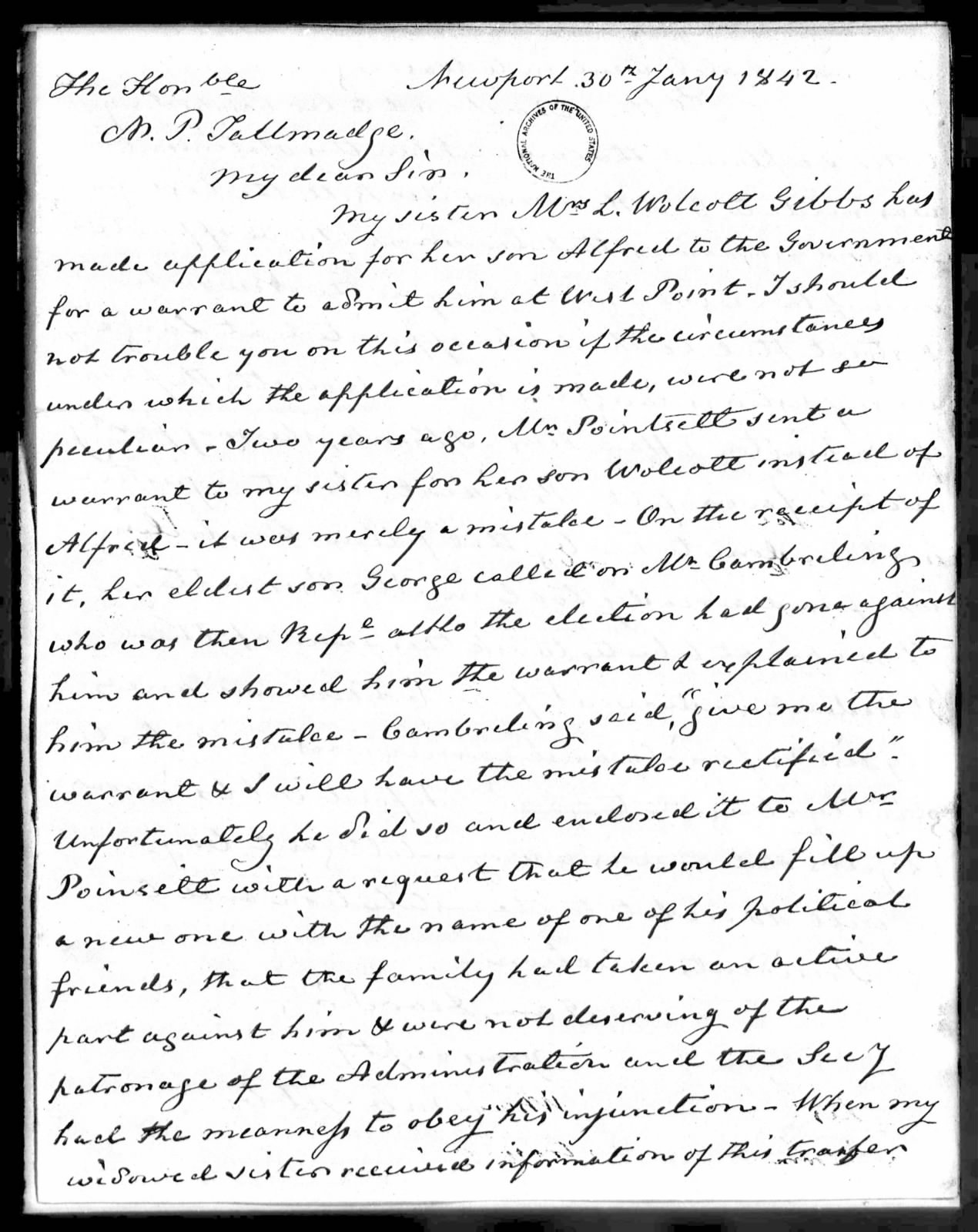
Newport 30th Jany 1842.
The Honble N. P. Tallmadge.
My dear Sir,
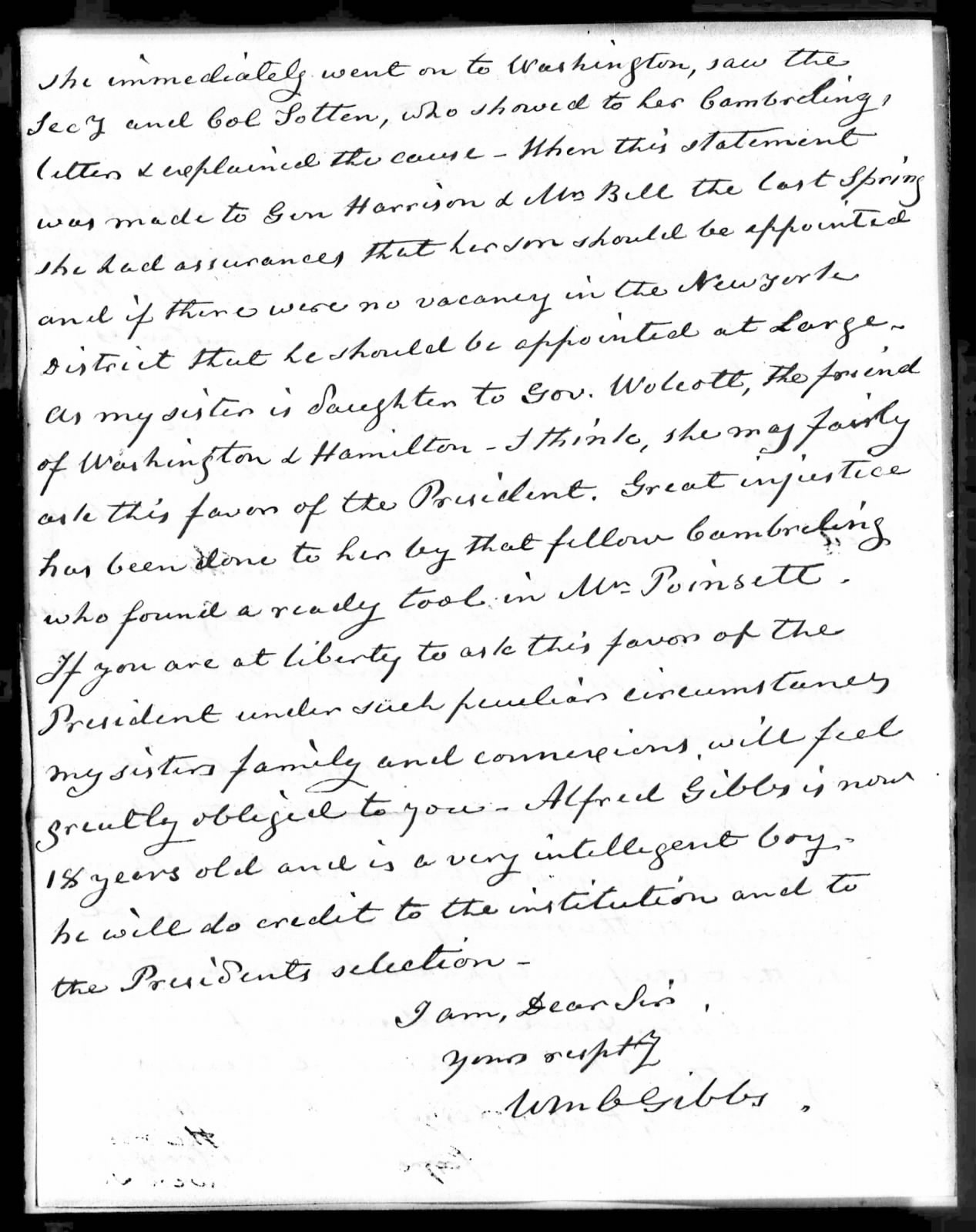
My sister Mrs L. Wolcott Gibbs has made application for her son Alfred to the Government for a warrant to admit him at West Point – I should not trouble you on this occasion if the circumstances under which the application is made, were not so peculiar – Two years ago, Mr Pointsett sent a warrant to my sister for her son Wolcott instead of Alfred – it was merely a mistake – On the receipt of it, her eldest son George called on Mr Cambreling who was then Repe – altho the election had gone against him and showed him the warrant & explained to him the mistake – Cambreling said, “give me the warrant & I will have the mistake rectified.” Unfortunately he did so and enclosed it to Mr Poinsett with a request that he would fill up a new one with the name of one of his political friends, that the family had taken an active part against him & were not deserving of the patronage of the Administration and the Secy had the meanness to obey his injunction – When my widowed sister received information of this transfer she immediately went on to Washington, saw the Secy and Col Totten, who showed to her Cambreling’s letter & explained the cause – When this statement was made to Gen Harrison & Mr Bell the last Spring she had assurances that her son should be appointed and if there were no vacancy in the New York District that he should be appointed at Large –
As my sister is Daughter to Gov. Wolcott, The friend of Washington & Hamilton – I think, she may fairly ask this favor of the President. Great injustice has been done to her by that fellow Cambreling who found a ready tool in Mr. Poinsett.
If you are at liberty to ask this favor of the President under such peculiar circumstances my sisters family and connexions will feel greatly obliged to you – Alfred Gibbs is now 18 years old and is a very intelligent boy – he will do credit to the institution and to the Presidents selection –
I am, Dear Sir,
yours respty
Wm C Gibbs
The Acceptance: Two Signatures, One Page
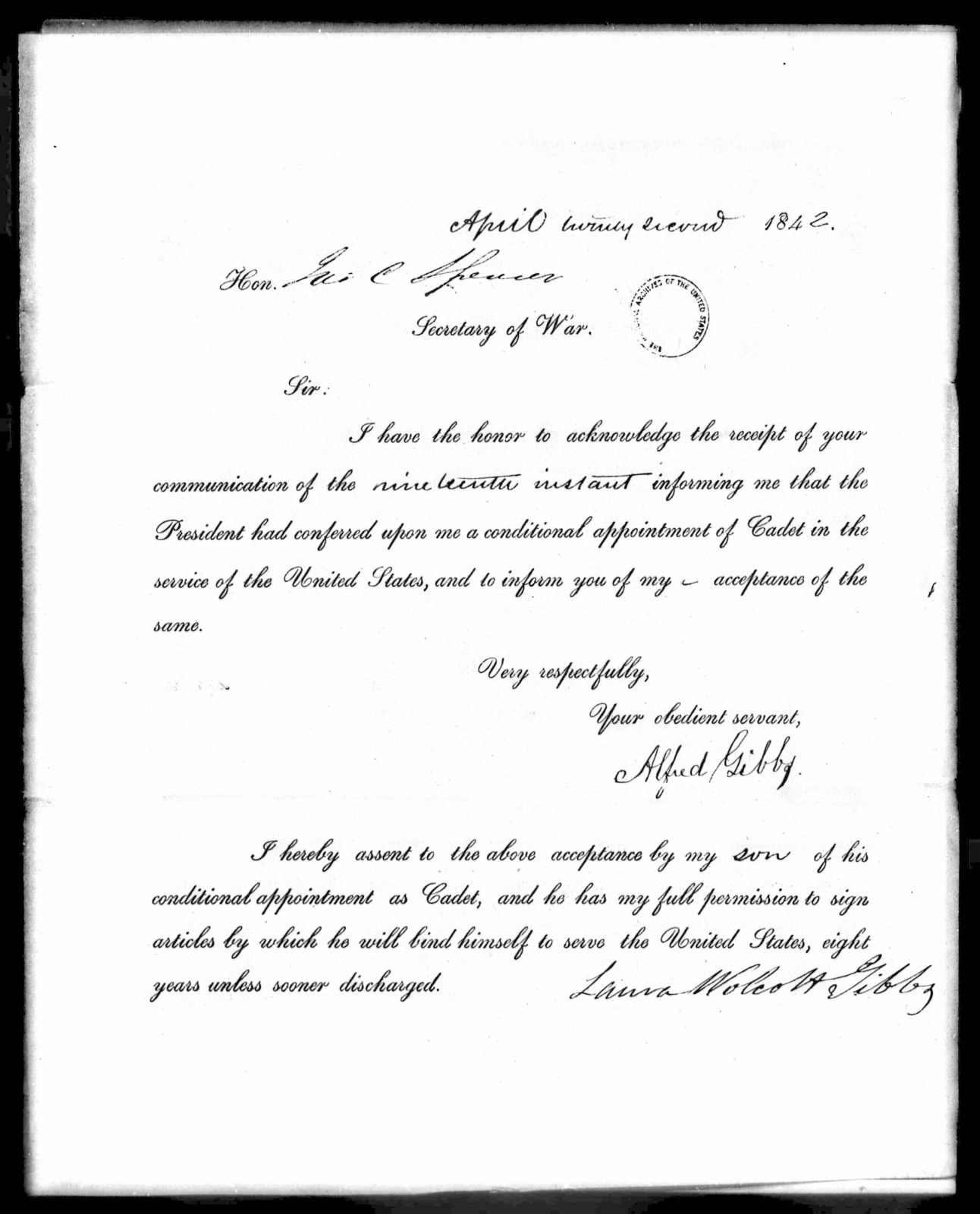
April twenty second 1842.
Update, October 31, 2026: This page earlier called Alfred’s acceptance of April 22, 1842 his earliest known autograph. It is not: his signed three-page Dartmouth essay, “Reflections, arising on the ruins of Rome,” dated October 1841 and found at Dartmouth’s Rauner Special Collections Library in February 2026, is older. See Reflections, Arising on the Ruins of Rome. Corrected.
Hon. Jn. C Spencer
Secretary of War.
Sir:
I have the honor to acknowledge the receipt of your communication of the nineteenth instant informing me that the President had conferred upon me a conditional appointment of Cadet in the service of the United States, and to inform you of my acceptance of the same.
Very respectfully,
Your obedient servant,
Alfred Gibbs.
I hereby assent to the above acceptance by my son of his conditional appointment as Cadet, and he has my full permission to sign articles by which he will bind himself to serve the United States, eight years unless sooner discharged.
Laura Wolcott Gibbs
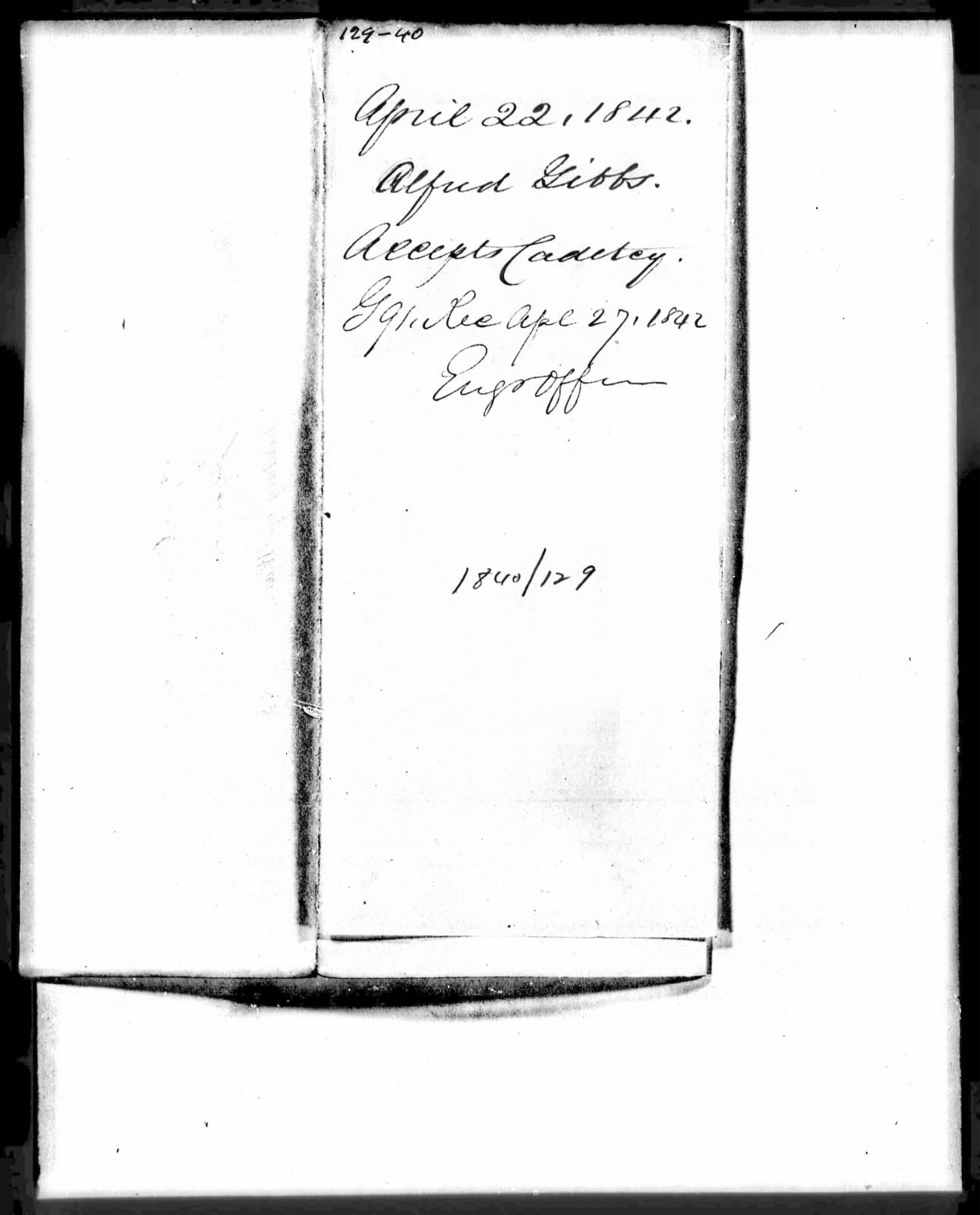
[Docket:] 129-40 / April 22, 1842. / Alfred Gibbs. / Accepts Cadetcy. / G91. Rec Apl 27, 1842 / Engr Office / 1840/129
EpilogueWhat Became of Them
Alfred Gibbs reported to West Point that summer and graduated with the storied class of 1846, forty-second in the order of merit, going straight into the Mounted Rifles and the war in Mexico. The boy whose profession was chosen at a widow’s kitchen table became the captain of Fort Fillmore’s commissary papers, the colonel of the First New York Dragoons, and the brevet major general this archive remembers. Oliver Wolcott Gibbs, the brother whose name began the file, kept to his laboratory and became one of the foremost American chemists of his century. Henry M. Judah, who took Alfred’s warrant, graduated in 1843 and wore a Union general’s stars with a far more troubled record. Churchill C. Cambreleng never again held elected office. And George Gibbs, twenty three years later, would once more gather senators, generals, and merchants to write the Secretary of War on his brother’s behalf; that story is told in The Making of a General. The method was learned here first, in the file marked, in a clerk’s tired hand, By his Mother.
About this report
Research and transcription completed July 10, 2026, from the digitized National Archives microfilm (accessed via Fold3). Every document above is reproduced in full beside its complete verbatim transcription: original spelling, capitalization, and punctuation are preserved (Cambreleng appears as “Cambreling” in most family letters; “recieved,” “allmost,” and similar spellings are the writers’ own). Editorial matter appears in [brackets]; uncertain readings are marked with a question mark; words struck through in the originals are noted. Manuscript dashes are rendered as plain dashes. The full file of 41 page images, including routing dockets and wrappers not reproduced above, is preserved in the site archive.
Source citation
Cadet application file of Alfred Gibbs, 1840, file 129, U.S. Military Academy Cadet Application Papers, 1805-1866 (National Archives Microfilm Publication M688, roll 126); Records of the Adjutant General’s Office, Record Group 94; National Archives, Washington, D.C. Accessed via Fold3, July 10, 2026.
References
Primary sources. All manuscript items below are filed in: Cadet application file of Alfred Gibbs, 1840, file 129, U.S. Military Academy Cadet Application Papers, 1805-1866 (National Archives Microfilm Publication M688, roll 126); Records of the Adjutant General’s Office, Record Group 94; National Archives, Washington, D.C. Each was retrieved July 10, 2026, from the Fold3 image linked in its entry (viewing may require a Fold3 subscription).
Cambreleng, C. C. (1839, April 12). [Letter to J. R. Poinsett requesting the substitution of Alfred Gibbs for Oliver W. Gibbs]. https://www.fold3.com/image/505217052
Cambreleng, C. C. (1839, April 15). [Letter to J. R. Poinsett withdrawing the request for Alfred Gibbs’s appointment]. https://www.fold3.com/image/505217047
Curtis, E., Hoffman, O., Grinnell, M. H., & Monroe, J. (1841, March 31). [Letter to J. Bell recommending Alfred Gibbs for appointment]. https://www.fold3.com/image/505217059 (signatures at /image/505217060)
Gibbs, A., & Gibbs, L. W. (1842, April 22). [Acceptance of the conditional appointment of cadet, with parental assent]. https://www.fold3.com/image/505217036
Gibbs, G. (1839, ca. January 14). [Letter to C. C. Cambreleng, final page only]. https://www.fold3.com/image/505217028
Gibbs, G. (1841, March 11). [Letter to J. Bell stating the case of his brother Alfred Gibbs]. https://www.fold3.com/image/505217035 (continues at /image/505217040, /image/505217038, /image/505217039)
Gibbs, L. W. (1841, March 30). [Letter to J. Bell: statement of the facts relating to her application]. https://www.fold3.com/image/505217029 (continues at /image/505217030, /image/505217031, /image/505217032)
Gibbs, L. W. (1842, January 10). [Letter to W. Scott asking a renewed appeal to Secretary Spencer]. https://www.fold3.com/image/505217050
Gibbs, W. C. (1842, January 30). [Letter to N. P. Tallmadge asking that the case be laid before the President]. https://www.fold3.com/image/505217066 (continues at /image/505217068)
Poinsett, J. R. (1840, January 29). [Letter to L. W. Gibbs on her renewed application, initialed J. R. P.]. https://www.fold3.com/image/505217037
Poinsett, J. R. (1841, March 3). [Letter to E. Curtis, M. H. Grinnell, O. Hoffman, and J. Monroe on the New York appointments, initialed J. R. P.]. https://www.fold3.com/image/505217064
Scott, W. (1841, February 6). [Letter to J. R. Poinsett recommending Alfred Gibbs]. https://www.fold3.com/image/505217048
Scott, W. (1842, March 2). [Endorsement on the letter of L. W. Gibbs of January 10, 1842]. https://www.fold3.com/image/505217051
U.S. War Department. (1839, February 22). [Register entry: Alfred Gibbs, New York, aged 16]. https://www.fold3.com/image/505217061
U.S. War Department. (1839, April 17). [Letter to C. C. Cambreleng: the appointment has been cancelled]. https://www.fold3.com/image/505217056
U.S. War Department. (1839, June). [Memorandum on the applications of O. W. and Alfred Gibbs and the nomination of H. M. Judah]. https://www.fold3.com/image/505217043 (concludes at /image/505217045)
U.S. War Department. (1839, June 14). [Memorandum of a verbal communication by Col. J. G. Totten to Mrs. Gibbs at Washington]. https://www.fold3.com/image/505217055
U.S. War Department. (1840). [File jacket: Alfred Gibbs, for cadet appointment, by his mother]. https://www.fold3.com/sub-image/612230776
U.S. War Department. (1841, April 29). [Ruling by order of the Secretary of War, endorsed on the docket of George Gibbs’s letter: “Gibbs is to have the first vacancy in that district”]. https://www.fold3.com/image/505217057
Archival series and digitized collections.
National Archives and Records Administration. (n.d.). U.S. Military Academy cadet application papers, 1805-1866 (National Archives Microfilm Publication M688; Record Group 94, Records of the Adjutant General’s Office) [Catalog description, National Archives Identifier 656631]. https://catalog.archives.gov/id/656631
Fold3 by Ancestry. (2016). US, Military Academy cadet application papers, 1805-1908 [Digitized microfilm collection]. https://www.fold3.com/publication/846/us-military-academy-cadet-application-papers-1805-1908
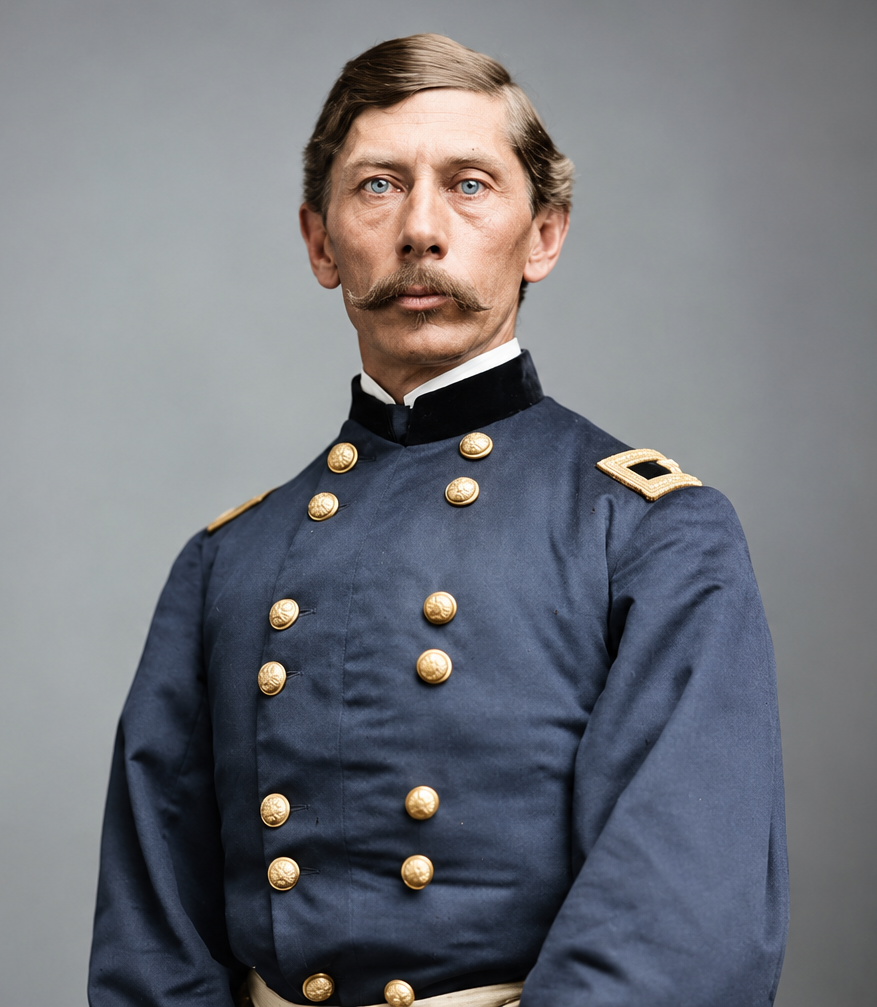
Brady National Photographic Art Gallery. (ca. 1861-1865). Portrait of Brig. Gen. Henry M. Judah, officer of the Federal Army [Photograph]. Library of Congress; via Wikimedia Commons. https://en.wikipedia.org/wiki/Henry_M._Judah#/media/File:HMJudah.jpg (colorized and enhanced copy displayed on this page)
Secondary sources.
Biographical directory of the United States Congress, 1774-present. (n.d.). U.S. Congress. https://bioguide.congress.gov/ (service details for C. C. Cambreleng, E. Curtis, M. H. Grinnell, O. Hoffman, J. Monroe, and N. P. Tallmadge)
Clarke, F. W. (1910). Wolcott Gibbs, 1822-1908. In Biographical memoirs (Vol. 7, pp. 1-22). National Academy of Sciences.
Cullum, G. W. (1891). Biographical register of the officers and graduates of the U.S. Military Academy at West Point, N.Y., from its establishment, in 1802, to 1890 (3rd ed., Vol. 2). Houghton, Mifflin. https://archive.org/details/biographicalregi02cull (entries for Alfred Gibbs, class of 1846, and Henry M. Judah, class of 1843)
National Governors Association. (n.d.). Gov. William Channing Gibbs. https://www.nga.org/governor/william-channing-gibbs/
Related on this site
Laura’s War: The Widow Who Held the Gibbs Family Together · The Making of a General: The 1864 Campaign for the Star · Sunswick, and Where the Family Went After · The Margin That Won · The West Point Record of Alfred Gibbs
Accuracy review: transcriptions checked against the full resolution scans, July 10, 2026. Corrections are made openly; this page will be updated, never silently, if better readings are established.
Correction, October 5, 2026: the cast list attributed the words “Madam you have your answer” to Secretary Poinsett. Laura’s own letter, transcribed on this page, shows that Colonel Totten said them when she asked whether a personal appeal to Poinsett could help. The cast list now reads correctly.
Views: 63