Correcting the Record: The General, the Historian, and the Margin That Won
The Gibbs Papers · Correcting the Record
The Margin That Won
The general, the historian, and how Alfred Gibbs argued a single line of history into existence.
Every step of this story survives in the original documents, in this collection.
The documents shown below are drawn from the nearly 900 primary source documents from the West Point archives now available on this site.
I. A Claim That Would Not Rest
Three times in the papers of Alfred Gibbs, in three different documents written across three different decades, the same claim appears. In his private list of battles (Document #35 in this archive), in his own hand: “Contreras, Churubusco, Garita de San Antonio, Aug. 19th and 20th 47.” In his 1859 letter from Carlisle Barracks (Document #76), written from memory with his papers a thousand miles away in New Mexico. And in the margins of a printed page (Document #107), in ink, beside the official summary of his Mexican War record.
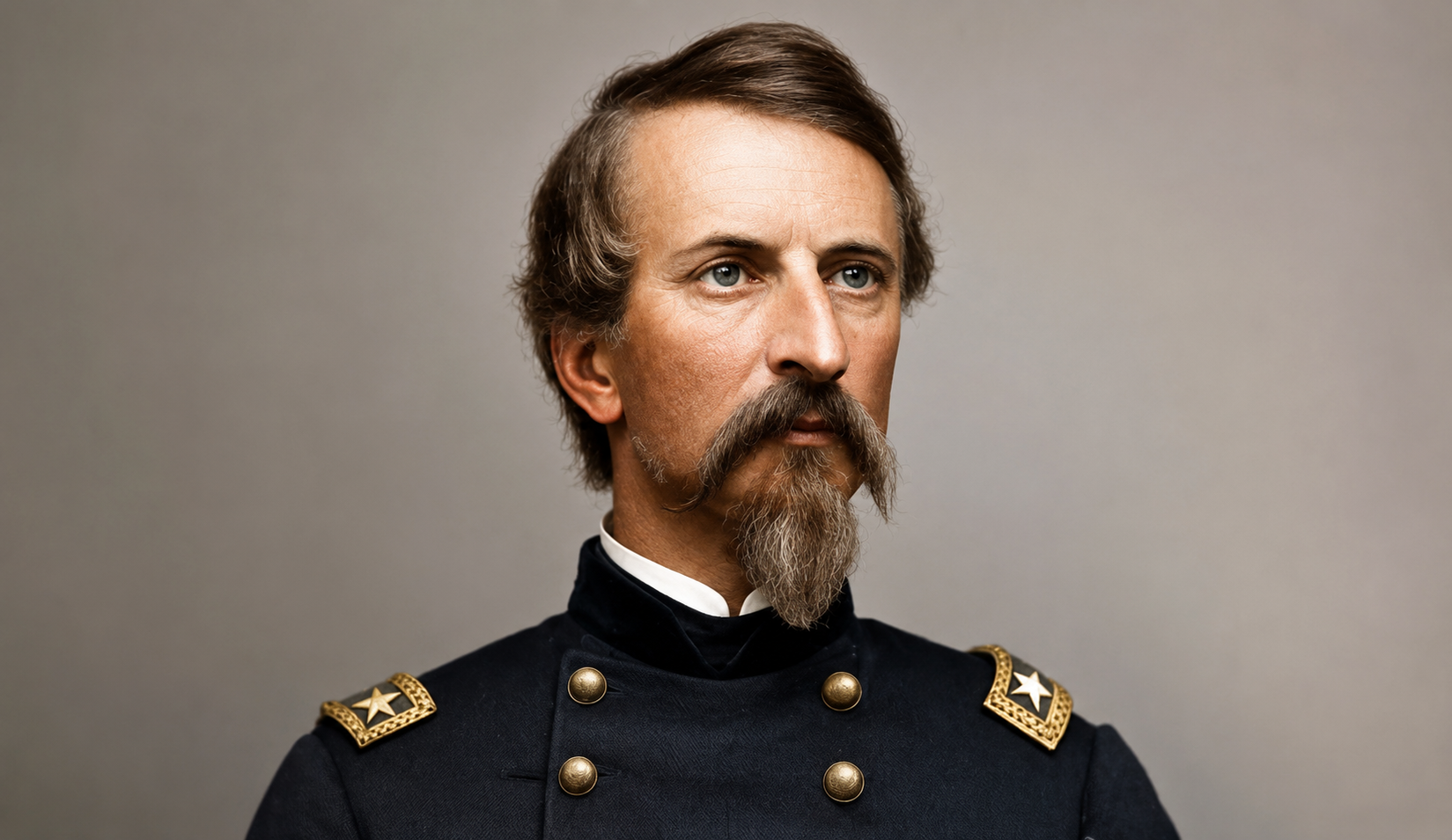
The claim was this: at the gates of Mexico City on August 20, 1847, Gibbs took part in the charge on the Garita de San Antonio. That charge was famous. It was led by Captain Philip Kearny, whose dragoons galloped nearly into the city itself, and it cost Kearny his left arm. It was the kind of exploit a soldier would want on his record.
Gibbs’s official record did not include it. This is the story of how he fixed that, and of the remarkable fact that every step of the correction survives, in the original documents, in this collection.
II. The Historian Who Asked
After the Civil War, Brevet Major General George W. Cullum, then Superintendent of West Point, was compiling the great work of his life: the Biographical Register of the Officers and Graduates of the U.S. Military Academy, one numbered entry for every graduate since 1802. Cullum knew the Army’s files were riddled with errors, so he did something historians still admire: he mailed every living graduate a printed proof of his own entry and asked the man himself to correct it.
The Gibbs Papers preserve both sides of that correspondence.
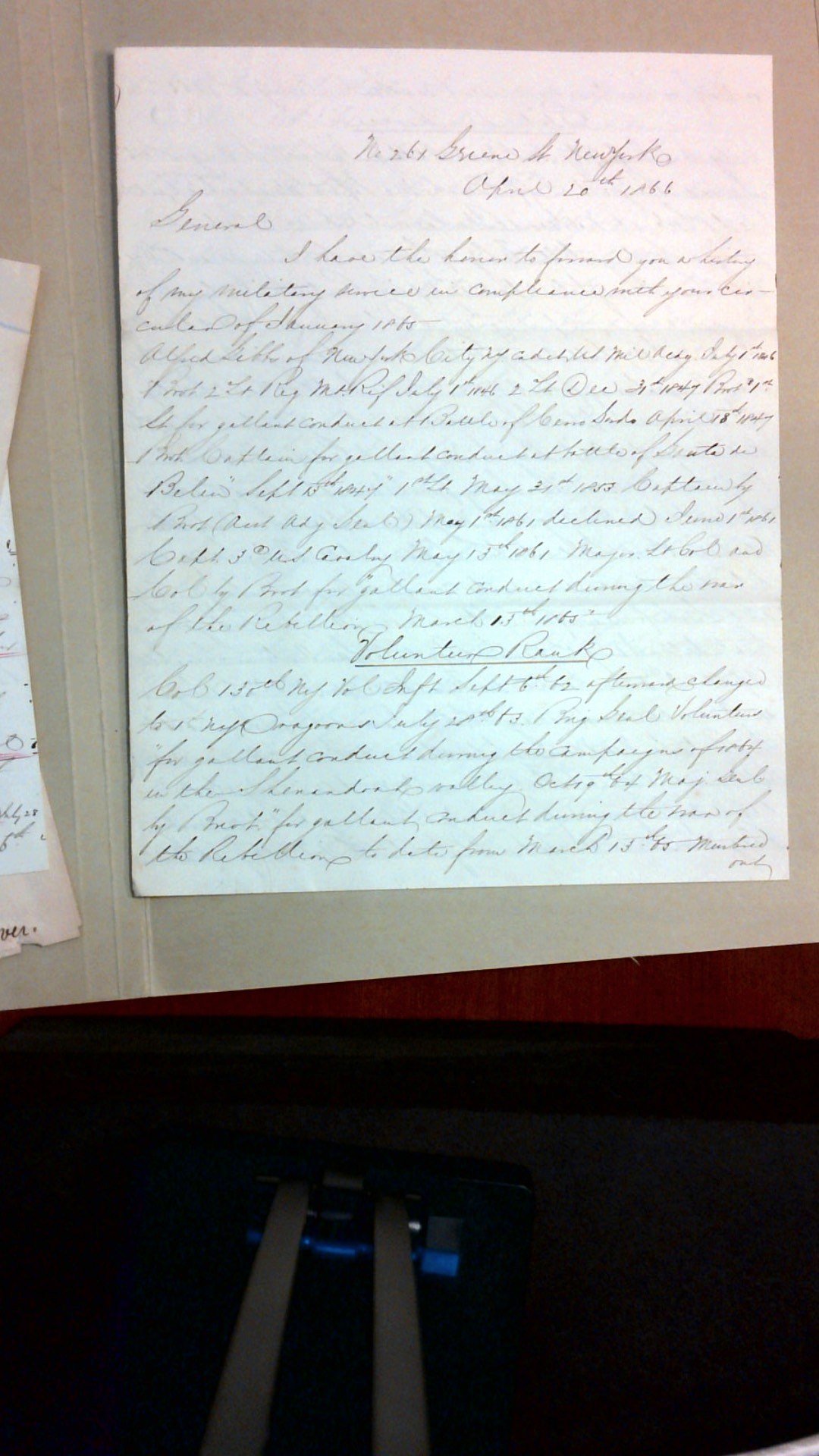
First came a circular of January 1865, asking graduates for their service histories. Gibbs’s answer survives as Document #215, written from 261 Greene Street, New York, on April 20, 1866: “I have the honor to forward you a history of my military service in compliance with your circular of January 1865.” Document #241 is another piece of what he sent: a battle list in his own hand, addressed to “Brig. Gen. G. W. Cullum, U.S. Corps of Engrs., Supt.,” running from the Shenandoah fights of 1864 through “Lee’s Surrender April 9th 1865.”
And in the resume itself, on the page that carries his Mexican War engagements (Document #90, viewable with its full transcription in the archive), the claim is already present: “Contreras. Churubusco, Garita de San Antonio Aug 19th and 20th /47.” Gibbs did not wait for the proof to make his point. He put the charge into his very first submission, and the same page shows the care he took with the whole exercise: a postscript explains his private system of underlines, so Cullum could tell which names were pitched battles, which combats, which actions, and which mere skirmishes. The proof Cullum sent back a year later omitted the Garita anyway. What happened next is the heart of this story.
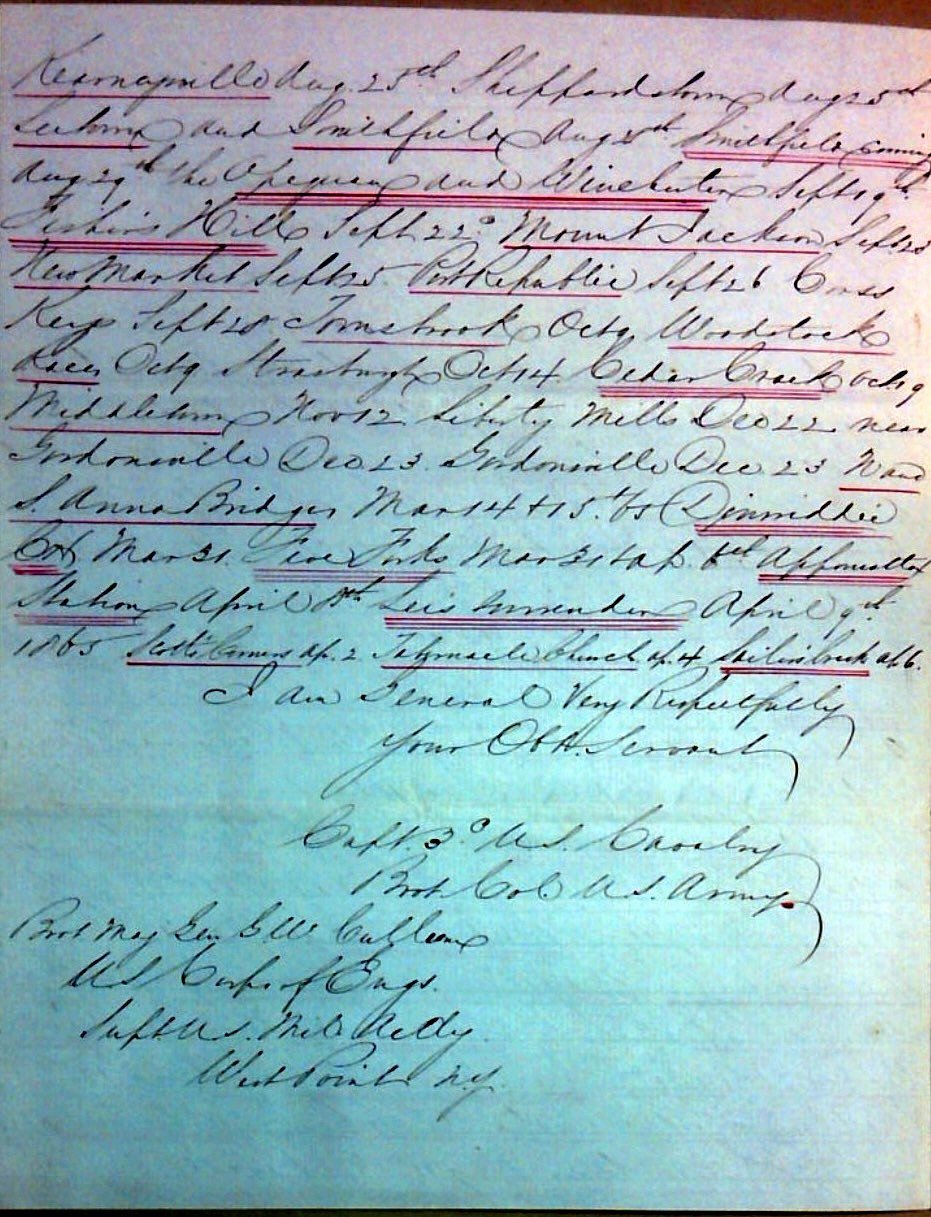
Then, on June 1, 1867, from 395 Canal Street in New York, Cullum sent every graduate the printed proof. His circular is Document #172:
“Herewith is enclosed your Etat-de-Service as prepared for the new edition of my Register of Graduates of the United States Military Academy… The returns in the Adjutant General’s Office being incomplete, many errors doubtless will be found, and the services in campaigns, battles, &c., frequently omitted… Of course the exact truth should be fairly stated. I have therefore to request that you will carefully examine your Etat-de-Service, correct all errors, supply, if practicable, many deficient dates…”
An invitation, from the official historian of West Point, to correct the record. Gibbs accepted it.
III. The Proof and the Pen
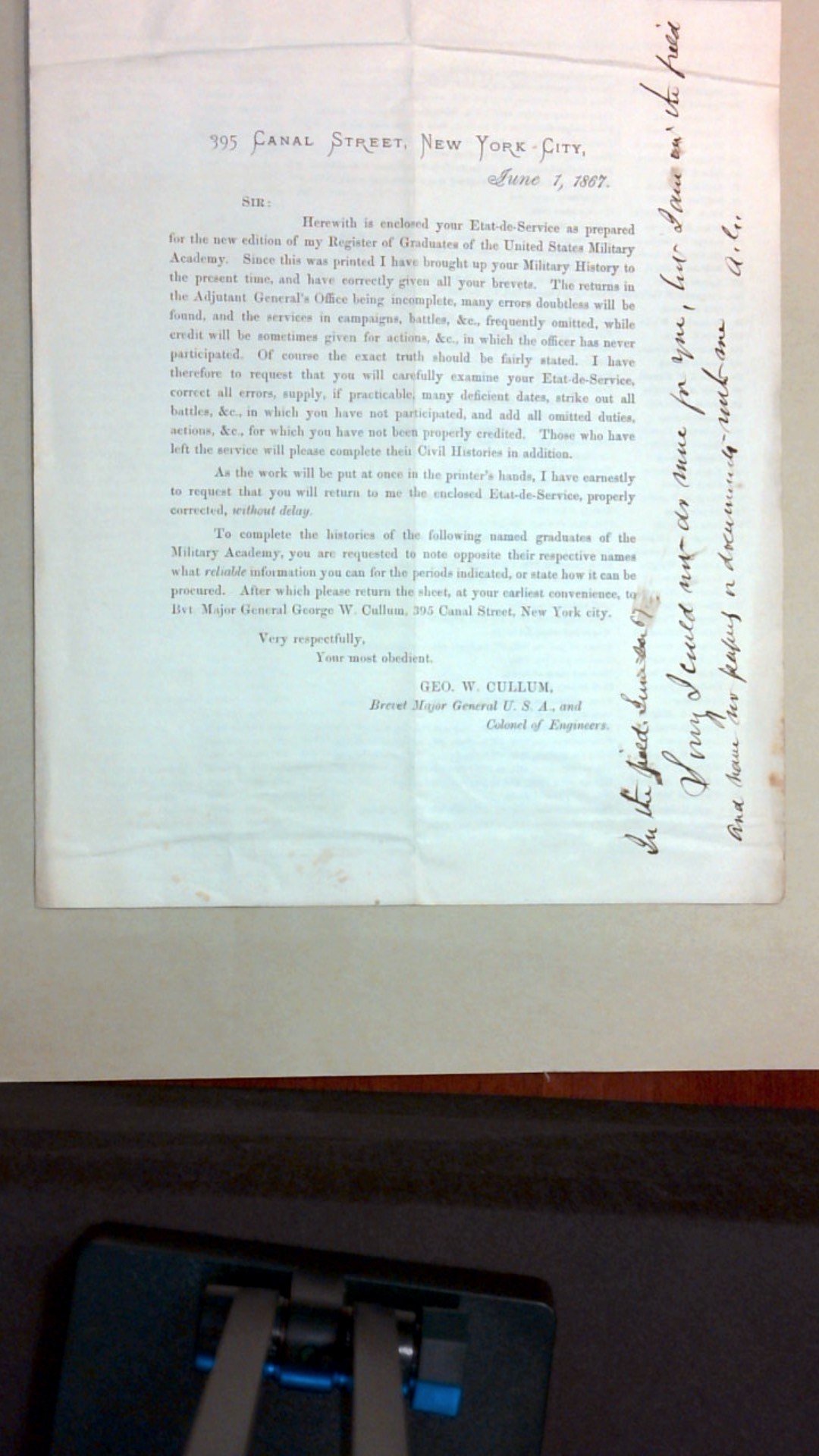
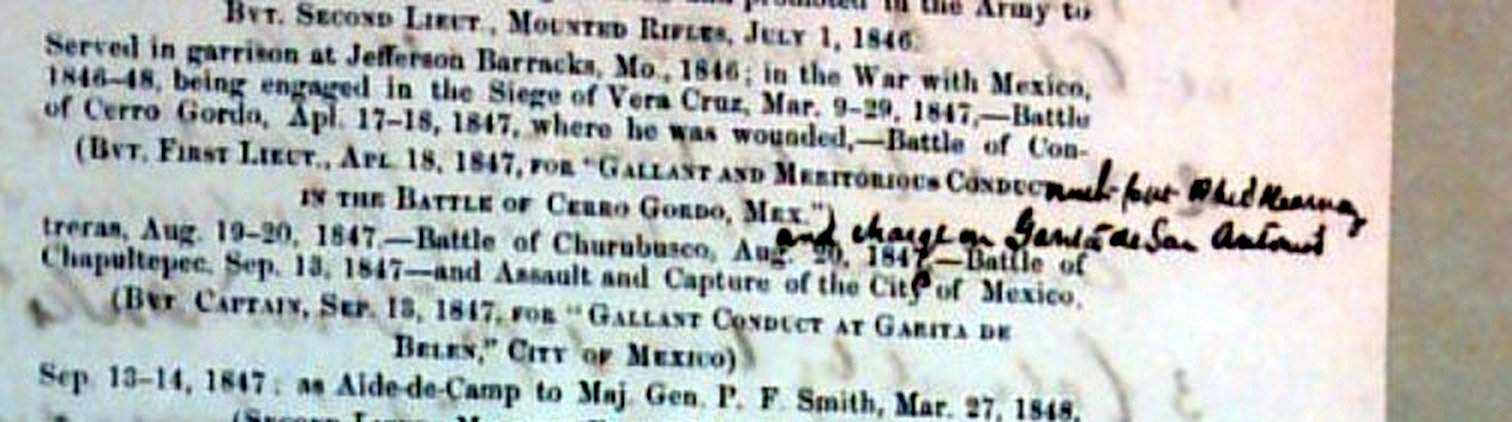
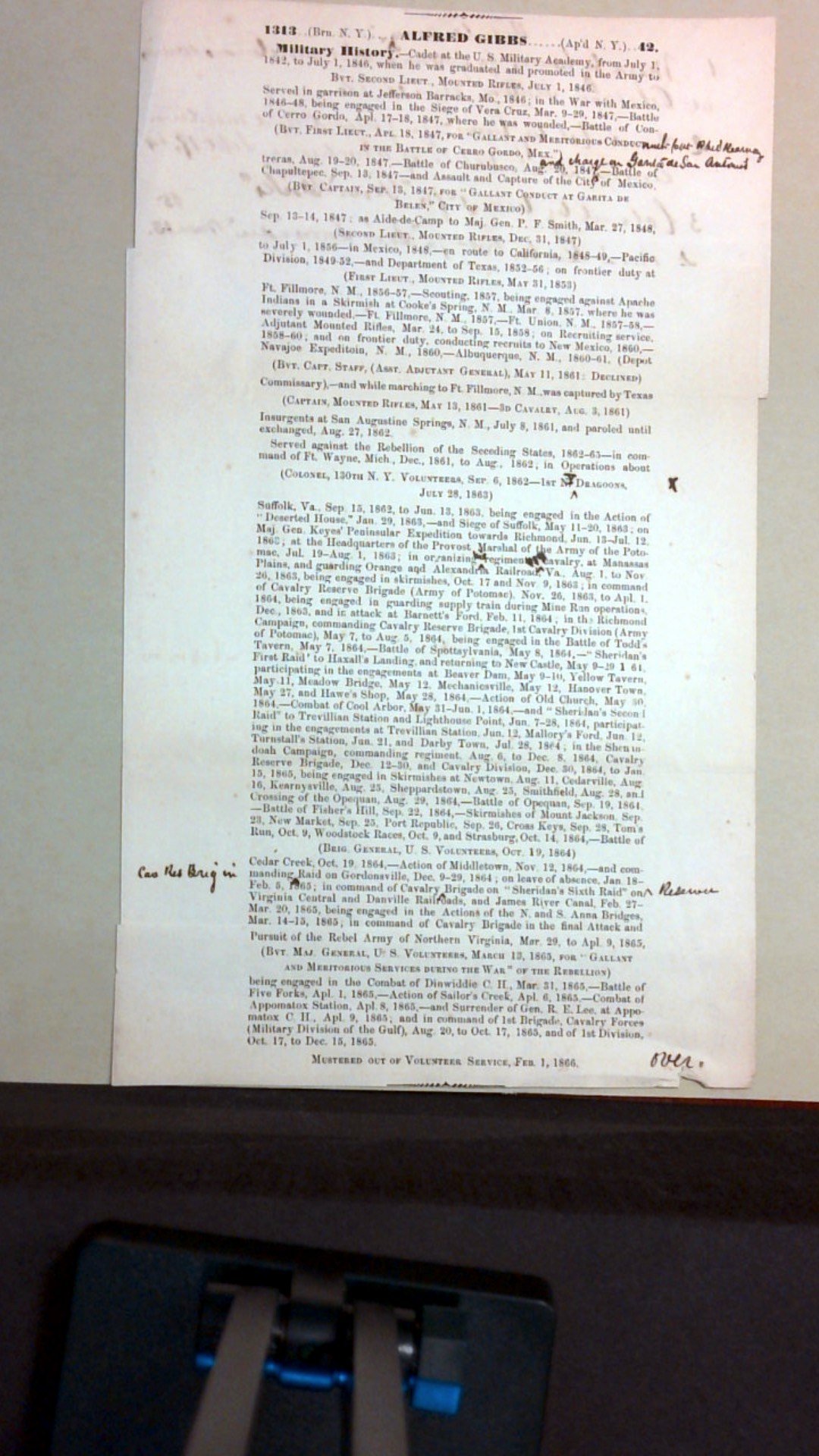
Document #107 is the proof itself: entry No. 1313, ALFRED GIBBS, in type. Read the printed Mexican War passage and you will find Vera Cruz, Cerro Gordo (“where he was wounded”), Contreras, Churubusco, Chapultepec, the capture of the City of Mexico, and both brevets. What you will not find is the Garita de San Antonio.
Then look at the right margin. In Gibbs’s ink, keyed to the Churubusco line by a caret, are the words:
“with Genl Phil Kearny … and charge on Garita de San Antonio”
Farther down the page he kept working: correcting his regiment to the “1st N.Y. Dragoons,” clarifying his Reserve Brigade commands, and writing “over.” at the foot to send the reader to the back of the sheet. This was not a man idly annotating. This was an officer answering the official historian’s request with the precision of a returned proof.
IV. The Verdict of the Type
Did it work? Open the second edition of Cullum’s Register, printed in 1879, to entry No. 1313, and read the same passage:
“Battle of Contreras, Aug. 19-20, 1847, Battle of Churubusco, and in Kearny’s charge on the San Antonio Garita, Aug. 20, 1847, Battle of Chapultepec, Sep. 13, 1847…”
The words from the margin, set in type. The 1891 third edition carries them still. From that day to this, every historian who has looked up Alfred Gibbs in the standard reference of West Point graduates has read, as settled fact, the line he wrote into his own margin. When A. F. H. Armstrong verified facts for his 1961 study of the Lynde affair against Cullum’s Register, this is the book he trusted; when this site verified the Grant and Dent family connection this very week, it was through the same pages.
One question stays honestly open: whether Gibbs’s corrections reached Cullum in time for the 1868 first printing, or entered with the 1879 second edition. The first edition is not yet available to us in digital form, and this page will be updated when we have examined it.
V. What a Margin Means
There is a larger story here, and readers of this site will recognize it. This week we published the story of Surgeon James Cooper McKee, who spent twenty-five years and three editions of a pamphlet trying to force his version of the Fort Fillmore surrender into the official record, and failed: “this pamphlet has no place in the records of the War of the Rebellion,” the Adjutant General’s office told him in 1885.
Gibbs wanted the record changed too. His method was different. He waited until the record’s own keeper asked, answered the question that was put to him, made his correction in the proper margin of the proper document, and let the historian judge. The historian judged in his favor. McKee’s campaign produced a pamphlet the government refused to shelve; Gibbs’s produced a single line of type that has stood in the official record for a century and a half.
The archive teaches the same lesson twice, once as tragedy and once as a quiet success: history is not simply found. It is argued into being. The difference lies in how, and to whom, the argument is made.
Researcher’s Notes
- Open verification: locate the 1868 first edition of the Register and confirm whether the Kearny phrase is absent, dating the correction’s entry into print precisely between the proof of 1867 and the second edition of 1879.
- The first words of the marginalia are cramped; we read them as “with Genl Phil Kearny” and invite sharper eyes to the close-up image above.
- The 1891 edition contains its own error, giving Gibbs’s capture at San Augustine Springs as “July 8, 1861” (it was July 27). Even the master register nods.
- Dabney H. Maury, whose 1894 memoir describes watching Lieutenant Gibbs’s riflemen at Cerro Gordo “ensconced in a sheltered spot rather nearer to the enemy than our own,” may also appear in this archive: Document #283, signed by a “1. Lt. Rifles” Maury at Carlisle Barracks in 1859, awaits verification against his autograph.
References
Cullum, G. W. (1867, June 1). Printed circular to Military Academy graduates enclosing Etat-de-Service proofs [Document #172]. West Point Gibbs Archive, AlfredGibbs.com.
Cullum, G. W. (1879). Biographical register of the officers and graduates of the U.S. Military Academy (2nd ed., Vol. 2), entry No. 1313. D. Van Nostrand. https://archive.org/details/biographicalregi02cull
Cullum, G. W. (1891). Biographical register of the officers and graduates of the U.S. Military Academy (3rd ed., Vol. 2), entry No. 1313. Houghton, Mifflin. https://archive.org/details/biographicalregi02bost
Gibbs, A. (1859, August 17). Letter from Carlisle Barracks furnishing his military history from memory [Document #76]. West Point Gibbs Archive, AlfredGibbs.com.
Gibbs, A. (1866, April 20). Letter forwarding his military service history in compliance with the circular of January 1865 [Document #215]. West Point Gibbs Archive, AlfredGibbs.com.
Gibbs, A. (ca. 1866). Handwritten battle list addressed to Brig. Gen. G. W. Cullum, Superintendent [Document #241]. West Point Gibbs Archive, AlfredGibbs.com.
Gibbs, A. (ca. 1867). Annotated printed proof of Register entry No. 1313, with marginal corrections [Document #107]. West Point Gibbs Archive, AlfredGibbs.com.
Gibbs, A. (n.d.). Autograph list of battles, combats, actions, skirmishes [Document #35]. West Point Gibbs Archive, AlfredGibbs.com.
Maury, D. H. (1894). Recollections of a Virginian in the Mexican, Indian, and Civil Wars. Charles Scribner’s Sons. https://archive.org/details/recollectionsofv00maur
Accuracy review: this page was checked against primary and scholarly sources on July 7, 2026. Historical research is never finished. If new evidence changes anything stated here, this page will be updated, and corrections will be noted rather than made silently.
Views: 27