The Lost Diary of Private Sylvester W. Matson: A Soldier’s Fort Fillmore, 1851–1855
This is the first in a series of articles meant to recover the people of Fort Fillmore, the men who lived, worked, and served honorably inside those adobe walls in the years before one July day in 1861 reduced the whole post to a byword for disgrace. We begin not with an officer or a battle, but with an ordinary enlisted man, because his is the rarest voice of all to survive, and because his diary reached us by one of the strangest journeys in the records of the Southwest.
A Diary That Came Back From the Dead
For most of a century the diary had no name on it. George Griggs printed a few passages in his 1930 History of the Mesilla Valley and could only call the writer an “unknown soldier” stationed at Fort Fillmore in 1851. In 1967 a handful more entries surfaced in El Palacio, but the editor warned that the diary’s very authenticity was “questionable,” because no one had ever managed to track it down. It read almost like a ghost story: a soldier’s private journal, surfacing in fragments, dismissed by scholars as perhaps a fake.
The truth was stranger than the doubt. In 1989 the historian Jerry D. Thompson, editing the journal of a Confederate hospital steward named Morgan Wolfe Merrick, followed a thread back to a long-buried newspaper serial. The diary, it turned out, had been left behind at Fort Fillmore when its author was discharged in 1855. It lay in the post for six years. When the fort fell to Lieutenant Colonel John R. Baylor’s Texans in July 1861, Baylor set Merrick to cleaning out the abandoned hospital, and there Merrick found it. He carried it to San Antonio, where it passed from hand to hand and was finally printed, still anonymous, in the San Antonio Express in 1907. The paper romantically claimed it had been taken “on the body” of a Union soldier killed at the Battle of Valverde. That was wrong, but it was the clue that let Thompson, working from enlistment registers, pension files, and Yale’s records, finally give the unknown soldier his name (Thompson, 1990).
Who Was Sylvester W. Matson
He was no ordinary recruit. Sylvester W. Matson was born at Mesopotamia, in Trumbull County, in the corner of northeastern Ohio, and he was a printer by trade. He had entered Yale with the freshman class of 1840 but did not graduate. He returned to Elyria, Ohio, where his physician father ran the post office and a variety store, became part owner and editor of the Lorain Argus, and then moved to Cleveland. In December 1847 he married Almira King, and a son followed the next year. Why a married man with an infant left his family and enlisted as a private in Company K, Third U.S. Infantry, at Chicago on December 14, 1850, the record does not say (Thompson, 1990).
He stood five feet seven and three-quarter inches, with blue eyes, sandy hair, and a fair complexion. He served on the New Mexico frontier and was discharged at Fort Fillmore on December 4, 1855. He went home to Cleveland, where a second son, Harry Wilmer, was born in 1860. And when the Civil War came he enlisted again, this time as a sergeant in Company G of the 67th Ohio Infantry, and was killed on May 10, 1864, at Chester Station, Virginia. The educated, literate, restless printer who had written so carefully about Fort Fillmore died a soldier in the East, never knowing his diary had survived him (Thompson, 1990).
His Fort Fillmore, in His Own Words
What makes the diary precious is exactly what makes it rare: it is the daily life of the post seen from the ranks, by a man with the schooling and the eye to set it down well. He opens, fittingly, in melancholy. “We are at Fort Fillmore,” he wrote on November 1, 1851. “To me it is a very gloomy day, although the day is a beautiful day with a clear sky and the birds singing sweetly everywhere around me. The glittering Rio Grande glides under the shining and almost summer-like sun.” What darkened the morning was the sight of a Mexican woman, who had worked at the fort, being carried back across the river into peonage for a small debt, and his own thoughts of home: he had dreamed the night before that the courthouse at Elyria burned, and called it “one of ill omen.”
The post had its hard characters. On November 3 he recorded how First Lieutenant Abraham Buford, “or ‘Old Bully’ as we soldiers call him,” settled a quarrel between two privates with rough justice: he “handed them both a black snake whip such as the Government teamsters use, and ordered them to whip each other well and until both were glad to quit.” Ten days later Matson rode out on his first Apache scout with Company H of the First Dragoons: “This is my first scout for savages. We are in the saddle and off within the hour. We ride as fast as our horses can carry us.”
And there were the small, human textures that no official report ever preserved. The night a wagon detail camped on the Rio Grande for driftwood: “The wolves serenade us nearly the whole night.” His first Christmas in uniform: “This is my first Christmas as a soldier and while it is a very lovely day for the celebration by the irony of fate I am spending it doing guard duty.” A New Year at Las Cruces with “a number of chicken fights in the afternoon and for our benefit a fandango, or Mexican dance.” And the plainest soldier’s misery of all, on a waterless winter march: “the night being cold and the march a long one we suffered both from cold and thirst.” It is worth remembering that ten years later, on another waterless march from this same valley, thirst would help destroy an entire command.
The Names He Gives Us
For a project trying to give Fort Fillmore’s people their names back, the diary is a gift, because famous men and forgotten men walk through it side by side. The post Matson knew was inspected by Colonel Edwin V. Sumner and reviewed by Lieutenant Colonel Dixon S. Miles; his major was Israel Bush Richardson, who once had the men haul out an old brass howitzer to fire shells at the mountains for target practice. All three would become Civil War generals; Richardson would die of his wounds at Antietam. The hard-handed Lieutenant Abraham Buford would ride as a Confederate cavalry general. Even the future Catholic bishop Joseph P. Machebeuf, later immortalized in Willa Cather’s Death Comes for the Archbishop, passed through, saying mass in the adjutant’s tent on Christmas Eve 1851.
But the names that matter most here are the ones almost no other source records: Matson’s own comrades in the ranks, Privates Crotty, Gallagher, Ray, and Morris, Sergeants Wade, Graves, Everts, Bowman, and Bernard, Captain Love, Surgeon Fritz. These are the honorable ghosts of Fort Fillmore, the men who garrisoned the post in its working years, and they survive because one literate printer thought their days worth writing down.
The Complete Diary of Private Sylvester W. Matson, 1851–1853
What follows is the surviving diary of Private Sylvester W. Matson in full, his own words from the New Mexico frontier between November 1851 and the end of 1853. The text is in the public domain. It is reproduced here from the portion that ran in the San Antonio Express in 1907 and was reconstructed, identified, and edited by Jerry D. Thompson in The Journal of Arizona History (1990), to whose scholarship we are indebted. The square-bracketed names and corrections are the editor’s, supplied to identify the people and places behind Matson’s spellings; everything else is Matson’s own. Only this serialized portion is known to survive; the original diary, last seen about 1910, has never been found. Matson’s nineteenth-century spellings and punctuation are kept as written, and a few minor transcription artifacts may remain.
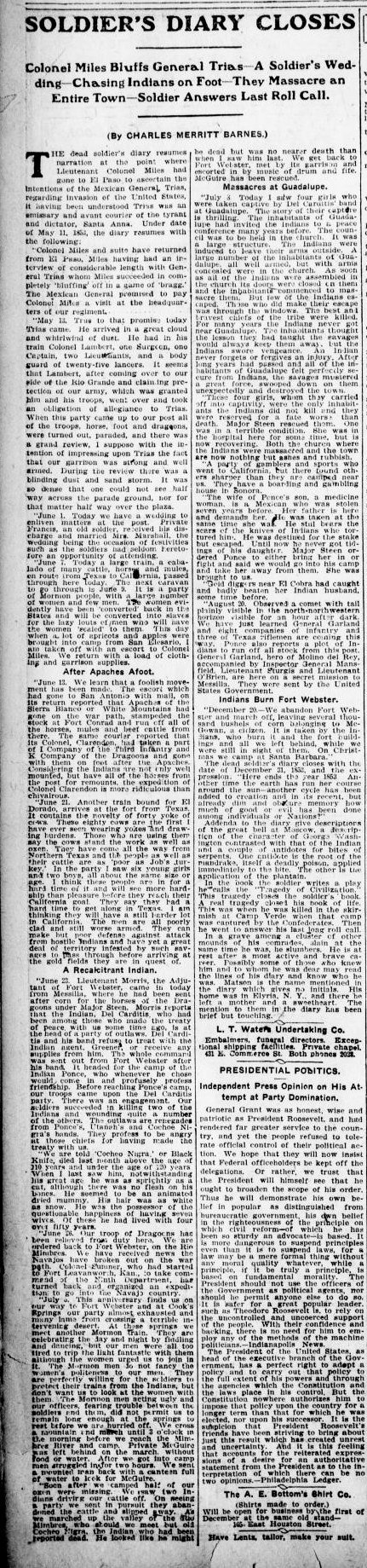
The original serial: five Sundays in the 1907 San Antonio Express
Matson’s diary first reached print as a five-part Sunday serial in the San Antonio Daily Express in the fall of 1907, recovered and bylined by the newspaperman Charles Merritt Barnes. Below are all five installments exactly as they appeared. Each one links to the full newspaper page at the Portal to Texas History (UNT Libraries).
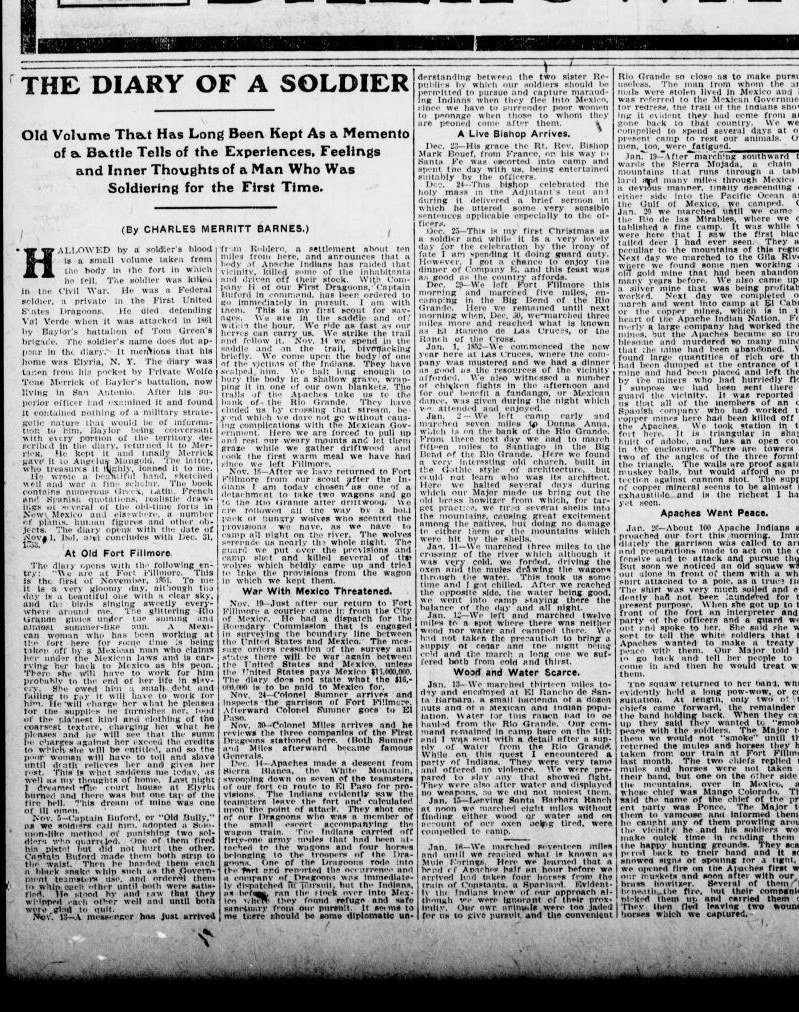
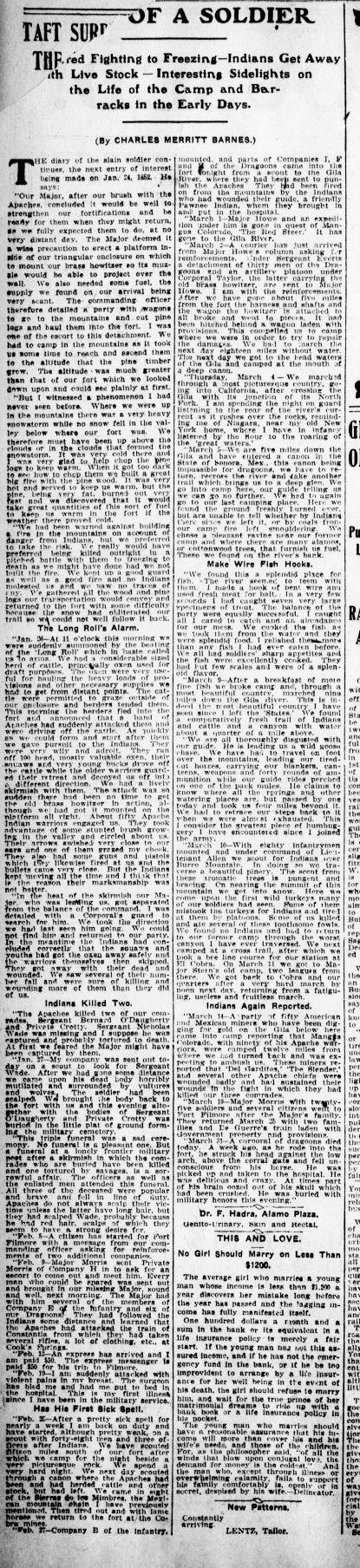
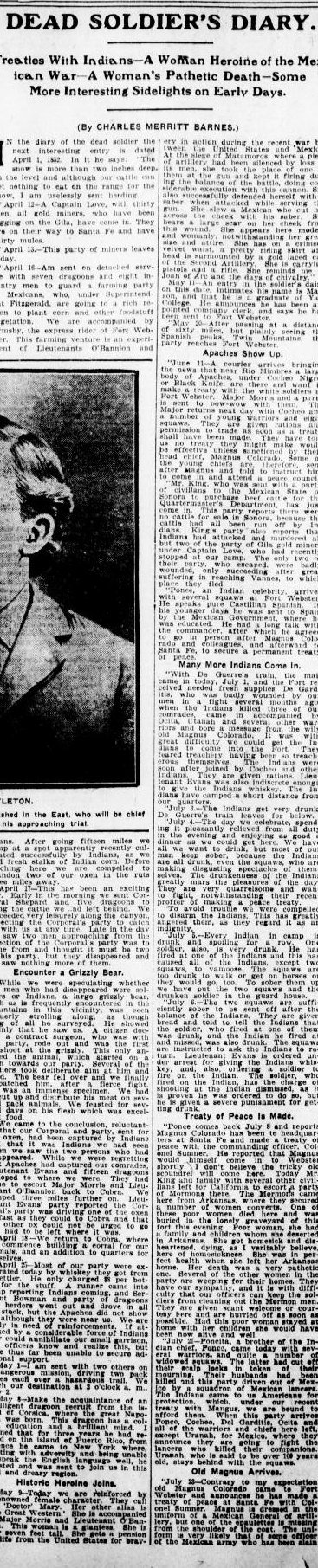
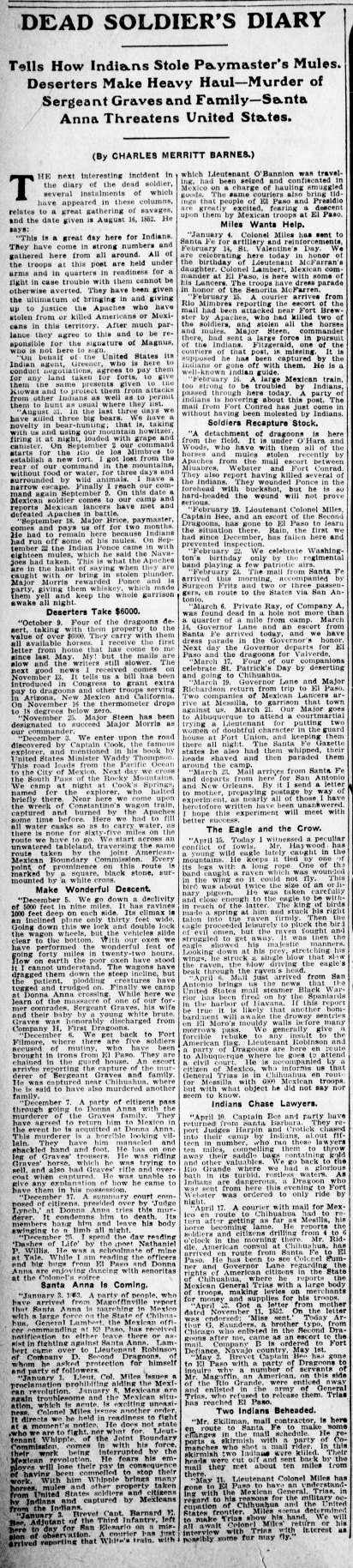
1851
Nov. 1, 1851. We are at Fort Fillmore. This is the first of November 1851. To me it is a very gloomy day, although the day is a beautiful day with a clear sky and the birds singing sweetly everywhere around me. The glittering Rio Grande glides under the shining and almost summer-like sun. A Mexican woman who has been working at the fort here for some time is being taken off by a Mexican man who claims her under the Mexican laws and is carrying her back to Mexico as his peon. There she will have to work for him probably to the end of her life in slavery. She owed him a small debt and failing to pay it will have to work for him. He will charge her what he pleases for the supplies he furnishes her, food of the plainest kind and clothing of the coarsest texture, charging her what he pleases and he will see that the sum he charges against her exceeds the credits to which she will be entitled, and so the poor woman will have to toil and slave until death relieves her and gives her rest. This is what saddens me today as well as my thoughts of home. Last night I dreamed the court house at Elyria burned and there was but one tap of the fire bell. The dream of mine was one of ill omen.
Nov. 3 Captain [First Lieutenant Abraham] Buford, or “Old Bully” as we soldiers call him, adopted a Solomon-like method of punishing two soldiers who quarreled. One of them fired his pistol but did not hurt the other. Captain Buford made them both strip to the waist. Then he handed them both a black snake whip such as the Government teamsters use, and ordered them to whip each other well and until both were glad to quit.
Nov. 13 A messenger has just arrived from Robledo, a settlement about ten miles from here and announces that a body of Apache Indians has raided the vicinity, killing some of the inhabitants and driven off their stock. With Company H of our First Dragoons, Captain Buford in command, has been ordered to go immediately in pursuit. I am with them. This is my first scout for savages. We are in the saddle and off within the hour. We ride as fast as our horses can carry us. We strike the trail and follow it. Nov. 14 we spend in the saddle and on the trail, bivouacking briefly. We come upon the body of one of the victims of the Indians. They have scalped him. We halt long enough to bury the body in a shallow grave wrapping it in one of our own blankets. The trails of the Apaches take us to the bank of the Rio Grande. They have eluded us by crossing that stream beyond which we dare not go without causing complications with the Mexican Government. Here we are forced to pull up and rest our weary mounts and let them graze while we gather driftwood and cook the first meal we have had since we left Fillmore.
Nov. 18 After we have returned to Fort Fillmore from our scout after the Indians, I am today chosen as one of a detachment to take two wagons and go to the Rio Grande after driftwood. We are followed all the way by a bold pack of hungry wolves who scented the provisions. We lay in camp all night on the river. The wolves serenade us nearly the whole night. The guard we put over the provisions and camp shot and killed several of the wolves which boldly came up and tried to take the provisions from the wagon in which we kept them.
Nov. 20 Just after our return to Fort Fillmore a courier came in from the City of Mexico. He had a dispatch for the Boundary Commissioner [Pedro Garcia Conde] that is engaged in surveying the boundary line between the United States and Mexico. The message orders cessation of the survey and states there will be war again between the United States and Mexico unless the United States pays Mexico $15,000,000.
Nov. 24 Colonel [Edwin V.] Sumner arrives and inspects the garrison of Fort Fillmore. Afterward Colonel Sumner goes to El Paso.
Nov. 26 Colonel [Dixon S.] Miles arrives and he reviews the three companies of the First Dragoons stationed here.
Dec. 14 Apaches made a descent from Sierra Blanca, the White Mountain, swooped down on seven of the teamsters of our fort en route to El Paso for provisions. The Indians evidently saw the teamsters leave the fort and calculated upon the point of attack. They shot one of our Dragoons who was a member of the small escort accompanying the wagon train. The Indians carried off fifty-one army mules that had been attached to the wagons and four horses belonging to the troopers of the Dragoons. One of the Dragoons rode into the fort and reported the occurrence and a company of Dragoons was immediately dispatched in pursuit but the Indians, as before, ran the stock over into Mexico where they found refuge and safe sanctuary from our pursuit. It seems to me there should be some diplomatic understanding between the two sister Republics by which our soldiers should be permitted to pursue and capture marauding Indians when they flee into Mexico, where we have to surrender poor women to peonage when those to whom they are peoned come after them.
Dec. 23 His grace the Rt. Rev Bishop Mark Bouef [Joseph P. Machebeuf] from France, on his way to Santa Fe was escorted into camp and spent the day with us, being entertained suitably by the officers.
Dec. 24 The bishop celebrated the holy mass in the Adjutant’s tent and during it delivered a brief sermon in which he uttered some very sensible sentences applicable especially to the officers.
Dec. 25 This is my first Christmas as a soldier and while it is a very lovely day for the celebration by the irony of fate I am spending it doing guard duty. However, I get a chance to enjoy the dinner of Company E, and this feast was as good as the country affords.
Dec. 29 We left Fort Fillmore this morning and marched five miles encamping in the Big Bend of the Rio Grande. Here we remained until next morning when Dec 30 we marched three miles more and reached what is known as the El Rancho de Las Cruces or the Ranch of the Cross. We commence the new year here at Las Cruces where the company was mustered and we had a dinner as good as the resources of the vicinity afforded. We also witnessed a number of chicken fights in the afternoon and for our benefit a fandango, or Mexican dance, was given during the night which we attended and enjoyed.
1852
Jan. 3 [1852] We left camp early and marched seven miles to Donna Anna [Doña Ana] which is on the bank of the Rio Grande. From there next day we had to march fifteen miles to Santiago [San Diego] in the Big Bend of the Rio Grande. Here we found a very interesting old church built in the Gothic style of architecture but could not learn who was its architect. Here we halted several days during which our Major [Israel Bush Richardson] made us bring out the old brass howitzer from which, for target practice, we fired several shells into the mountains causing great excitement among the natives but doing no damage to either them or the mountains which were hit by the shells.
Jan. 11 We marched three miles to the crossing of the river which, although it was very cold, we forded, driving the oxen and the mules drawing the wagons through the water. This took us some time and I got chilled. After we reached the opposite side, the water being good, we went into camp staying there the balance of the day and all night.
Jan. 12 We left and marched twelve miles to a spot where there was neither wood nor water and camped there. We had not taken the precaution to bring a supply of cedar and the night being cold and the march a long one we suffered both from cold and thirst.
Jan. 13 We marched thirteen miles today and encamped at El Rancho de Santa Barbara, a small hacienda of a dozen huts and of a Mexican and Indian population. Water for the ranch had to be hauled from the Rio Grande. The command remained in camp here on the 14th and I was sent with a detail after a supply of water from the Rio Grande. While on this quest I encountered a party of Indians. They were very tame and offered no violence. We were prepared to slay them that showed fight. They were all after water and displayed no weapons and we did not molest them.
Jan. 15 Leaving Santa Barbara Ranch at noon we marched eight miles without finding either wood or water and on account of our men being tired were compelled to camp.
Jan. 16 We marched seventeen miles until we reached what is known as Mule Springs. Here we learned that a band of Apaches half an hour before we arrived had taken four horses from the train of Constancia, a Spaniard. Evidently the Indians knew of our approach although we were ignorant of their presence. Our own animals were too jaded for us to give pursuit and the convenient Rio Grande so close as to make pursuit useless. The man from whom the animals were taken lived in Mexico and he was referred to the Mexican Government for redress, the trail of the Indians showing it evident they had come from and gone back to that country. We were compelled to spend several days at our present camp to rest our animals. Our men, too, were fatigued.
Jan. 19 After marching southward towards the Sierra Mojada, a chain of mountains that runs through a tableland and many miles through Mexico into a devious manner many descending in either side into the Pacific Ocean and the Gulf of Mexico, we camped. On Jan. 20 we marched until we came to the Rio de los Mimbres where we established a fine camp. It was while we were here that I saw the first black-tailed deer I had ever seen. They are peculiar to the mountains of this region. Next day we marched to the Gila River, where we found some men working an old gold mine that had been abandoned many years before. We also came upon a silver mine that was being profitably worked. Next day we completed our march and went into camp at El Cobra [Cobre] or the copper mines which is in the heart of the Apache Indian Nation. Formerly a large company had worked these mines, but the Apaches became so troublesome and murdered so many miners that the mine had been abandoned. We found large quantities of rich ore that had been dumped at the entrance of the mine and had been placed and left there by the miners who had hurriedly fled. I suppose we had been sent there to guard the vicinity. It was reported to us that all the members of a Spanish company who had worked the copper mines here had been killed off by the Apaches. We took station in the old fort here. It is triangular in shape, built of adobe, and has an open court in the enclosure. There are towers at each of the angles forming the triangle. The walls are proof against musket balls but would afford no protection against cannon shot. The supply of copper mineral seems to be almost inexhaustible and is the richest I have ever seen.
Jan. 22 About 100 Apache Indians approached our fort this morning. Immediately the garrison was called to arms and preparations made to be on the defensive and to attack and pursue them. But soon we noticed an old squaw walk out alone in front of them with the white shirt attached to a pole as a truce flag. The shirt was very much soiled and evidently had not been laundered for the purpose. When she got up to the front of the fort an interpreter and a party of the officers and a guard went out and spoke to her. She said she was sent to tell the white soldiers that the Apaches wanted to make a treaty of peace with them. Our Major told her to go back and tell her people to all come in and he would treat with them. The squaw returned to her band, they evidently held a long pow-wow or [illegible] only two of the chiefs came forward, the remainder of the band holding back. When they came up they said they wanted to “smoke peace with the soldiers.” The Major told them he would not smoke until they returned the mules and horses they had taken from our train at Fort Fillmore last month. The two chiefs replied the mules and horses were not taken by their band but by one on the other side of the mountains over in Mexico and their chief was Mangus Colorado [Mangas Coloradas]. They said the name of the chief of the present party was Ponce. The Major told them to vamoose and informed them if he caught any of them prowling around the vicinity, he and his soldiers would make quick time in sending them to the happy hunting grounds. They scampered back to their band and it soon showed signs of preparing for a fight so we opened our fire on the Apaches first with our muskets and soon after with our old brass howitzer. Several of them fell beneath the fire and their companions picked them up and carried them off. They then fled leaving two wounded squaws which we captured.
Jan. 24, 1852. Our Major, after our brush with the Apaches, concluded it would be well to strengthen our fortifications and be ready for them when they might return as we fully expected them to do at no very distant day. The Major deemed it a wise precaution to erect a platform inside of our triangular enclosure on which to mount our brass howitzer so its muzzle would be able to project over the wall. We also needed some fuel, the supply we found on our arrival being very scant. The commanding officer therefore detailed a party with wagons to go to the mountains and cut pine logs and haul them into the fort. I was one of the escort to this detachment. We had to camp in the mountains as it took us some time to reach and [cut] them in the altitude that the pine timber grew. The altitude was much greater than that of our fort which we looked down upon and could see plainly at first. But I witnessed a phenomenon I had never seen before. Where we were up in the mountains there was a very heavy snowstorm while no snow fell in the valley below where our fort was. We therefore must have been up above the clouds or in the clouds that formed the snowstorm. It was very cold there and I was very glad to help chop the pine logs to keep warm. When it got too dark to see how to chop them we built a great big fire with the pine wood. It was very hot and served to keep us warm but the pine burned out very fast and we discovered that it would take great quantities of this sort of fuel to keep us warm in the fort if the weather there proved cold. We had been warned against building a fire in the mountains on account of danger from Indians, but we preferred to take the risk. We really would have preferred being killed outright in a pitched battle with them to freezing to death as we might have done had we not built the fire. We kept up a good guard as well as a good fire and no Indians molested us and we saw no traces of any. We gathered all the wood and pine logs our transportation would convey and returned to the fort with some difficulty because the snow had obliterated our trail so we could not well follow it back.
Jan. 26 At 11 o’clock this morning we were suddenly summoned by the beating of the “Long Roll” which in haste called us to arms. We had a considerable sized herd of cattle, principally oxen used for draft purposes. The oxen were useful for hauling the heavy loads of provisions and other necessary supplies we had to get from distant points. The cattle were permitted to graze outside of the enclosure and herders tended them. This morning the herders fled into the fort and announced that a band of Apaches had suddenly attacked them while driving off the cattle. As quickly as we could form and start after them we gave pursuit to the Indians. They were very wily and adroit. They ran off the herd, mostly valuable oxen, their squaws and very young bucks drove off the cattle while the older warriors guarded their retreat and decoyed us off into a different direction. We had a lively skirmish with them. The attack was so sudden there had been no time to get the old brass howitzer in action, although we had got it mounted on the platform all right. About fifty Apache Indian warriors engaged us. They took advantage of some stunted brush growing in the valley and circled about us. Their arrows swished very close to our ears and one of them grazed my cheek. They also had some guns and pistols which they likewise fired at us and the bullets came very close. But the Indians kept moving all the time and I think that is the reason their marksmanship was not better. In the heat of the skirmish our Major who was leading us got separated from the balance of the command. I was detailed with a corporal’s guard to search for him. We took the direction we had last seen him going. We could not find him and returned to our party. In the meantime the Indians had concluded correctly that the squaws and youths had got the oxen away safely and the warriors themselves then skipped. They got away with their dead and wounded. We saw several of their numbers fall and were sure of killing and wounding more of them than they did of us. The Apaches killed two of our comrades. Sergeant Bernard O’Daugherty and Private Crotty [John Croty]. Sergeant Nicholas Wade was missing and I suppose he was captured and probably tortured to death. At first we feared the Major might have been captured by them.
Jan. 27 My company was sent out today on a scout to look for Sergeant Wade. After we had gone some distance we came upon his dead body horribly mutilated and surrounded by vultures and wolves. The soldier had been scalped. We brought the body back to the fort with us and this evening altogether with the bodies of Sergeant O’Daugherty and Private Crotty was buried in the little plot of ground forming the military cemetery. The triple funeral was a sad ceremony. No funeral is a pleasant one. But a funeral at a lonely frontier military fort after a skirmish in which the comrades who are buried have been killed and one tortured by savages is a sorrowful affair. The officers as well as the enlisted men attended this funeral. All three of the deceased were popular and brave and fell in the line of duty. Apaches do not always scalp their victims unless the latter have long hair, but they had scalped Wade probably because he had red hair, scalps of which they seem to have a strong desire for.
Feb. 5 A citizen has started for Fort Fillmore with a message for our commanding officer asking for reinforcements of two additional companies.
Feb. 6 Major [Gouverneur] Morris sent Private Morris of Company H in to ask for an escort to come out and meet him. Every man who could be spared was sent out and brought in our missing Major [Richardson] sound and well next morning. The Major had with him several of the members of Company E of the infantry and six of our Dragoons. They had followed the Indians some distance and learned that the Apaches had attacked the train of Constancia from which they had taken several rifles, a lot of clothing, etc., at Cook’s Springs.
Feb. 12 An express has arrived and I am paid $16. The express messenger is paid $26 for the trip to Fillmore.
Feb. 21 I am suddenly attacked with violent pain in my breast. The surgeon has bled me and had me put to bed in the hospital. This is my first illness while I have been in the military service.
Feb. 26 After a pretty sick spell for nearly a week I am back on duty and have started, although pretty weak, on a scout with forty-eight men and three officers after Indians. We have scouted fifteen miles south of our fort after which we camp for the night beside a very picturesque rock. We spend a very hard night. The next day scouted through a canon where the Apaches had been and had herded cattle and other stock but had left. We came in sight of the Sierras de los Mimbres, the Mexican mountain chain, I have previously mentioned. Then tired out and with lame horses we return to the fort at the Cobra mines.
Feb 26 [sic] Company D of the infantry mounted and parts of Companies I, F and K of the Dragoons came into the fort tonight from a scout to the Gila River where they had been sent to punish the Apaches. They had been fired on from the mountains by the Indians who had wounded their guide, a friendly Pawnee Indian, whom they brought in and put in the hospital.
March 1 Major [Marshall S.] Howe and an expedition under him has gone in quest of Mangus Colorado, the “Red Sleeve.” It has gone to the Gila River.
March 2 A courier has just arrived from Major Howe’s column asking for reinforcements. Under Sergeant Everts a detachment of thirty men of the Dragoons and an artillery platoon under Corporal Taylor, the latter carrying the old brass howitzer, are sent to Major Howe. I am with the reinforcements. After we have gone about five miles from the fort the harness and shafts and the wagon the howitzer is attached to all broke and went to pieces. It has been hitched behind a wagon laden with provisions. This compelled us to camp where we were in order to try to repair the damages. We had to march the next day eighteen miles without water. The next day we got in the head waters of the Gila and camped at the mouth of a deep canon. Thursday, March 4 We marched through a most picturesque country going into California, after crossing the Gila with its junction of its North Fork. I am spending the night on guard listening to the roar of the river current as it rushed over the rocks reminding me of Niagara near my old New York home, where I have in infancy listened by the hour to the roaring of the “great waters.”
March 5 We are five miles down the Gila and have entered a canon in the state of Sonora, Méx., this canon being impassable for dragoons, we have to return, recross the river and take another trail which brings us to a deep glen. We go into camp here, our guide telling us we can go no further. We had to again go to our last camping place. Here he found the ground freshly burned over but are unable to tell whether by Indians there since we left it or by coals from our camp fire left smoldering. We chose a pleasant ravine near our former camp and where there are many alamos or cottonwood trees that furnish us fuel. These we found on the river’s bank. We found this a splendid place for fish. The river seemed to teem with them. I made a hook of bent wire and used fresh meat for bait. In a very few seconds I had caught seven very large specimens of trout. The balance of the party were equally successful. I caught all I cared to catch and an abundance for our mess. We cooked the fish as we took them from the water and they were splendid food. I relished them more than any fish I had ever eaten before. We all had soldiers sharp appetites and the fish were excellently cooked. They had but few scales and were of a splendid flavor.
March 9 After a breakfast of more fine fish we broke camp and through a most beautiful country marched nine miles down the Gila River. This is indeed the most beautiful country I have ever seen since I left the States. We found a comparatively fresh trail of Indians and cattle and a canyon with water about a quarter mile above. We are all thoroughly disgusted with our guide. He is leading us on a wild goose chase. We have had to travel on foot over the mountains, leading our tired out horses, carrying our blankets, canteens, weapons and forty rounds of ammunition while our guide rides perched on one of the pack mules. He claims to know where all the springs and other watering places are, but passed by one today and took us four miles beyond it. We had to retrace our steps back [to] it where we were almost exhausted. This I consider the greatest piece of humbuggery I have encountered since I joined the army.
March 10 With eighty infantrymen mounted and under command of Lieutenant Allen [John W. Alley] we scout for Indians over Burro Mountain. In doing so we traverse a beautiful pinery. The scent from these romantic trees is pungent and bracing. On nearing the summit of this mountain we got into snow. Here we came upon the first wild turkeys any of our soldiers had seen. Some of them mistook the turkeys for Indians and fired at them by platoons. Some of us killed and ate several of the toothsome fowls. We found no Indians and had to return to our former camp through the worst canon I have ever traversed. We next camped at a cross trail after which we took a bee line course for our station at El Cobra. On March 11 we got to Major [Enoch] Steen’s old camp, two leagues from there. We got back to Cobra and our quarters after a very hard march by noon next day, returning from a fatiguing, useless and fruitless march.
March 14 A party of fifty American and Mexican miners who have been digging for gold on the Gila below here came into camp reporting that Mangus Colorado, with ninety of his Apache warriors, were camped twelve miles from where we had turned back and was expecting to ambush us. These miners reported that “Del Garditos” [Delgadito], “The Slender”47 and several other Apache chiefs were wounded badly and had sustained their wounds in the fight in which they had killed our three comrades.
March 18 Major Morris with twenty- five soldiers and several citizens went to Fort Fillmore after the Major’s family. They returned March 26 with two families and De Guerre’s [Alexandre Daguerre’s] train laden with government property and provisions.
March 31 A corporal of dragoons died today. A week ago as he rode into the fort, he struck his head against the low arch, above the corral gate and fell unconscious from his horse. He was picked up and taken to the hospital. He was delirious and crazy. At times part of his brain oozed out of his skull which had been crushed. He was buried with military honors this evening.
April 1, 1852 The snow is more than two inches deep on the level and although our cattle can get nothing to eat on the range for the snow, I am uselessly sent herding.
April 12 A Captain Love with thirty men, all gold miners, who have been digging on the Gila, have come in. They are on their way to Santa Fe and have thirty mules.
April 13 This party of miners leaves today.
April 16 Am sent on detached service with seven dragoons and eight infantry men to guard a farming party of Mexicans, who, under Superintendent [John] Fitzgerald, are going to a rich region to plant corn and other foodstuff vegetation. We are accompanied by Ormsby, the express rider of Fort Webster. This farming venture is an experiment of Lieutenants O’Bannion [Laurence W. O’Bannon] and [Nathan George] Evans. After going fifteen miles we camp at a spot apparently recently cultivated successfully by Indians as we find fresh stalks of Indian corn. Before marching here we are compelled to abandon two of our oxen in the ruts three miles away.
April 17 This has been an exciting day. Early in the morning we sent Corporal Shepard and five dragoons to bring the cattle we had left behind. We proceeded very leisurely along the canon expecting the Corporal’s party to catch up with us at any time. Late in the day we saw two men approaching from the direction of the Corporal’s party was to come from and thought it must be two of his party, but they disappeared and we saw nothing more of them. While we were speculating whether the men who had disappeared were soldiers or Indians, a large grizzly bear, such as is frequently encountered in the mountains in this vicinity, was seen leisurely strolling along as though king of all he surveyed. He showed plainly that he saw us. A citizen doctor, a contract surgeon, who was with our party rode out and was the first to shoot at the grizzly. This only angered the animal, which started on a rush towards our party. Several of the soldiers took deliberate aim at him and fired. The bear fell over and we finally dispatched him after a fierce fight. He was an immense specimen. We had to cut up and distribute his meat on several pack animals. We feasted for several days on his flesh which was excellent food. We came to the conclusion reluctantly that our Corporal and party went for the oxen, had been captured by Indians and that it was Indians we had seen when we saw the two persons who had disappeared. While we were regretting that Apaches had captured our comrades, Lieutenant Evans and fifteen dragoons galloped in where we were. They had come to escort Major Morris and Lieutenant O’Bannion back to Cobra. We camped three miles further on. Lieutenant Evans’ party reported the Corporal’s party was driving one of the oxen as fast as they could to Cobra and that the other ox could not be urged to go and had to be left where it was.
April 13 [sic] We return to Cobra where we commence building a corral for our animals and an addition to quarters for ourselves.
April 26 Most of our party were exhilarated today by whiskey they got from a sutler. He only charged $3 per bottle for the stuff. A runner came into camp reporting Indians coming and Sergeant [Albert] Bowman and party of dragoons and herders went out and drove in all the stock but the Apaches did not show up although they were near us. We are badly in need of reinforcements. If attacked by a considerable force of Indians they could annihilate our small garrison. Our officers know and realize this, but have thus far been unable to secure additional support.
May 1 I am sent with two others on a dangerous mission, driving two pack mules each over a hazardous trail. We reach our destination at 3 o’clock a.m. May 3.
May 8 Make the acquaintance of an intelligent dragoon recruit from the Island of Corsica where the great Napoleon was born. This dragoon had a college education and a brilliant mind. I learned that for three years he had resided on the island of Puerto Rico from whence he came to New York where meeting with adversity and being unable to speak the English language well, he enlisted and was sent to join us in this wild and dreary region.
May 9 Today we are reinforced by a renowned female character. They call her “Doctor Mary.” Her other name is “The Great Western.”56 She is accompanied by Major Morris and Lieutenant O’Bannion. This woman is a giantess. She is over seven feet tall. She gets a pension for life from the United States for bravery in action during the recent war between the United States and Mexico. At the siege of Matamoros, where a piece of artillery had been silenced by loss of the men she took the place of one of them at the gun and kept it firing during the balance of the battle, doing considerable execution with this cannon. She also successfully defended herself with a saber when attacked while serving the gun. She slew a Mexican who cut her across the cheek with his saber. She boasts a large scar on her cheek from this wound. She appears here modest and womanly not withstanding her great size and attire. She has on a crimson velvet waist, a pretty riding skirt and head is surmounted by a gold laced cap of the Second Artillery. She is carrying pistols and a rifle. She reminds me of Joan of Arc and the days of chivalry.
June 11 A courier arrives bringing the news that near Rio Mimbres a large body of Apaches under Cocheo Nigro [Cuchillo Negro] or Black Knife, are there and want to make a treaty with the white soldiers at Fort Webster. Major Morris and party is sent to pow-wow with them. The Major returns next day with Cocheo and a number of young warriors and eight squaws. They are given rations and permission to trade as soon as a treaty shall have been made. They have told us no treaty they might make would be effective unless sanctioned by their head chief, Mangus Colorado. Some of the young chiefs are therefore sent after Mangus and told to instruct him to come in and attend a peace council. Mr. King, who was sent with a party of civilians tò the Mexican State of Sonora to purchase beef cattle for the Quartermaster’s Department has just come in. This party reports there were no cattle for sale in Sonora, because the cattle had all been run off by the Indians. King’s party also reports that Indians had attacked and murdered all but two of the party of Gila gold miners under Captain Love, who had recently stopped at our camp. The only two of their party who escaped were sadly wounded, only succeeding after great suffering in reaching Vannes [Janos], to which place they fled. Ponce, an Indian celebrity, arrives with several squaws at Fort Webster. He speaks pure Castilian Spanish. In his younger days he was sent to Spain by the Mexican Government where he was educated. He had a long talk with the commander, after which he agreed to go in person after Mangus Colorado and colleagues, and afterward to Santa Fe to secure a permanent treaty of peace. With De Guerre’s train, the mail came in today, July 1, and the fort received needed fresh supplies. De[l] Garditis, who was badly wounded by our men in a fight several months ago, when the Indians killed three of our comrades, came in accompanied by Ocita, Utanah and several other warriors and bore a message from the wily old Mangus Colorado. It was with great difficulty we could get the Indians to come into the fort. They feared treachery, having been so treacherous themselves. The Indians were soon after joined by Cocheo and other Indians. They are given rations. Lieutenant Evans was also indiscreet enough to give the Indians whiskey. The Indians have camped a short distance from our quarters.
July 3 The Indians get very drunk. De Guerre’s train leaves for below.
July 4 The day we celebrate, spending it pleasantly relieved from all duty in the evening and enjoying as good a dinner as we could get here. We have all we want to drink, but most of our men keep sober, because the Indians are all drunk, even the squaws who are making disgusting spectacles of themselves. The drunkenness of the Indians greatly mars the pleasures of the day. They are very quarrelsome and want to fight, notwithstanding their recent offer of making a peace treaty. To avoid trouble we were compelled to disarm the Indians. This has greatly angered them, as they regard it as an indignity.
July 5 Every Indian in camp is drunk and spoiling for a row. One soldier, also, is very drunk. He has fired at one of the Indians and this has caused all of the Indians, except two squaws, to vamoose. The squaws are too drunk to walk or get on horses or they would go too. To sober them up we have put the two squaws and the drunken soldier in the guard house.
July 6 The two squaws are sufficiently sober to be sent off after the balance of the Indians. They are given bread and told to tell the Indians that the soldier, who fired at one of them was drunk, and the Indian he fired at and missed, was also drunk. The squaws are instructed to ask the Indians to return. Lieutenant Evans is ordered under arrest for giving the Indians whiskey, and also, ordering a soldier to fire on the Indian. The soldier, who fired on the Indian, has the charge of shooting at the Indian dismissed, as it is proven he was ordered to do so, but he is given a severe punishment for getting drunk. Ponce comes back July 8 and reports Mangus Colorado has been to headquarters at Santa Fe and made a treaty of peace with the commanding officer, Colonel Sumner. He reports that Mangus would himself come in to Webster shortly. I don’t believe the tricky old scoundrel will come here. Today Mr. King and family with several other civilians left for California to escort a party of Mormons there. The Mormons came here from Arkansas, where they secured a number of women converts. One of these poor women died here and was buried in the lonely graveyard of this fort this evening. Poor woman, she had a family and children whom she deserted in Arkansas. She got homesick and disheartened, dying as I veritably believe here of homesickness. She was in perfect health when she left her Arkansas home. Her death was a very pathetic one. Several of the other women in the party are weeping for their homes. They have our sympathy, and it is with difficulty that our officers can keep the soldiers from cleaning out the Mormon men. They are given scant welcome or courtesy here and are hurried off as soon as possible. Had this poor woman stayed at home with her children she would have been now alive and well.
July 21 Poncita, a brother of the Indian Chief Ponce, came today with several warriors and quite a number of widowed squaws. The latter had cut off their scalp locks in token of their mourning. Their husbands had been killed and this party driven out of Mexico by a squadron of Mexican lancers. The Indians came to us Americans for protection which under recent treaty with Mangus, we are bound to afford them. When this party arrives Ponce, Cocheo, Del Garditis, Ocita and all of the warriors and chiefs here left except Uranah, for Mexico, where they announce they are going to fight the lancers who killed their companions. Uranah, who is said to be over 100 years old, stays behind with the squaws.
July 23 Contrary to my expectation old Mangus Colorado came to Fort Webster and announces he has made a treaty of peace at Santa Fe with Colonel Sumner. Mangus is dressed in the uniform of a Mexican General of artillery, but one of the epaulettes is missing from the shoulder of the coat. The uniform is very likely that of some officer of the Mexican army who had been slain by the Indians. There is a reward of $10,000 for old Mangus offered by the Mexican Government, dead or alive, but this sum has not been sufficient to secure his capture by that Government. Mangus speaks Spanish well. He possesses supreme power over his Apache people and thinks a great deal of himself. He called up one of his subjects and showed him to us. This one had his nose cut off and pieces of both of his ears sliced off permanently disfiguring him. Mangus told our officer he had done this to perpetually disgrace him because the man had killed a Mexican [and] taken his horse and rifle, without permission from Mangus.
July 30 Dr. Mary, the amazon I have previously mentioned who has been off among the Indians, has just come in with a Mexican boy, whom they have had in captivity. He was taken from a family near Monter[r]ey some time before. The Indians had badly abused the boy. She reports 400 Indian warriors with several thousand horses and other stock camped three miles from our fort.
August 1 The Indians move their camp closer to our fort. We can plainly see their campfires. They are acting suspiciously, inquiring how many men we have on duty, how many we keep on guard and how many we send out to herd. All of their questions are answered evasively. They are led to believe we have a great many more men than we possess, as they could annihilate us. They outnumber us 20 to 1.
August 3 Two Navajo Indian warriors and several squaws come in and ask for provisions. The Navajoes are far superior to the Apaches. Many of the Apaches march off to join the expedition that left recently to attack the Mexican lancers. Old Uranah, the centenarian, and the squaws are still left in the camp with several other men.
August 8 Charles Murphy, a fellow soldier, and I are sent up the Needle mountain, a rock 12,000 feet high, commanding a view of all the country around for many miles.
August 12 Today Mr. Greener [John Greiner], United States Indian Agent for the Territory of New Mexico, arrives with mail and orders for abandonment of Fort Webster and establishment of another post at some suitable place on the Rio de los Mimbres. Mr. Greener had crossed the plains with me when I first came out to this region. He is much improved in looks now. He will wait here for the Indians to return, as he is authorized by the United States Government to make a formal treaty with them.
August 16, 1852 This is a great day here for Indians. They have come in strong numbers and gathered here from all around. All of the troops at this post are held under arms and in quarters in readiness for a fight in case trouble with them cannot be otherwise averted. They have been given the ultimatum of bringing in and giving up to justice the Apaches who have stolen from or killed Americans or Mexicans in this territory. After much parlance they agree to this and to be responsible for the signature of Mangus who is not here to sign. On behalf of the United States its Indian agent, Greener, who is here to conduct negotiations, agrees to pay them for any land taken for forts, to give them the same presents given to the Kiowas and to protect them from attacks from other Indians as well as to permit them to hunt as usual where they live.
August 31 In the last three days we have killed three big bears. We have a novelty in bear hunting, that is, taking with us and using our mountain howitzer, firing it at night, loaded with grape and canister. On September 2 our command starts for the Rio de los Mimbres to establish a new fort. I got lost from the rear of our command in the mountains without food or water, for three days and surrounded by wild animals. I have a narrow escape. Finally I reach our command again September 9. On this date a Mexican soldier comes to our camp and reports Mexican lancers have met and defeated Apaches in battle.
September 18 Major [Benjamin William] Brice, paymaster comes and pays us off for two months. He had to remain here because Indians had run off some of his mules. On September 22 the Indian Ponce came in with eighteen mules, which he said the Navajoes had taken. This is what the Apaches are in the habit of saying when they are caught with or bring in stolen plunder. Mîyor Morris rewarded Ponce and his party giving them whiskey, which made them yell and keep the whole garrison awake all night.
October 9 Four of the dragoons desert, taking with them property of an unstated value [illegible in the source]. They carry with them all available horses. I receive the first letter from home that has come to me since last May. My! but the mails are slow and the writers still slower. The next good news I received comes on November 13. It tells us a bill has been introduced in Congress to grant extra pay to dragoons and other troops serving in Arizona, New Mexico and California. On November 16 the thermometer drops to 18 degrees below zero.
November 25 Major Steen has been designated to succeed Major Morris as our commander.
December 3 We enter upon the road discovered by Captain [Philip St. George] Cook[e], the famous explorer, and mentioned in his book by United States Minister Waddy Thompson. This road winds from the Pacific Ocean to the City of Mexico. Next day we cross the South pass of the Rocky Mountains. We camp at night at Cook’s Springs named for the explorer, who halted briefly there. Near here we come upon the wreck of Constantino’s [Constancia?] wagon train captured and burned by the Apaches some time before. Here we had to fill all water casks so as to carry water as there is none for sixty-five miles on the route we have to go. We start across an unwatered tableland traversing the same route taken by the joint American-Mexican Boundary Commission. Every point of prominence on this route is marked by a square, black stone, but mounted by a white cross.
December 5 We go down a declivity of 5000 feet in nine miles. It has ravines 3000 feet deep on each side. Its climax is an inclined plane only thirty feet wide. Going down this we lock and double lock the wagon wheels, but the vehicles slide clear to the bottom. With our oxen we have performed the wonderful feat of going forty miles in twenty-two hours. How on earth the poor oxen have stood it I cannot understand. The wagons have dragged them down the steep incline, but the patient, plodding creatures have tugged and trudged on. Finally we camp at Donna Anna crossing. While here we learn of the massacre of one of our former comrades, Sergeant Graves, his wife and their baby by a young white brute. Graves was honorably discharged from Company H., First Dragoons.
December 6 We get back to Fort Fillmore where there are five soldiers accused of mutiny, who have been brought in irons from El Paso. They are chained in the guard house. An escort arrives reporting the capture of the murderer of Sergeant Graves and family. He was captured near Chihuahua where he is said to have also murdered another family.
December 7 A party of citizens pass through going to Donna Anna with the murderer of the Graves family. They have agreed to return him to Mexico in the event he is acquitted at Donna Anna. This murderer is a horrible looking villain. They have him manacled and shackled hand and foot. He has on one leg of Graves’ trousers. He was riding Graves’ horse which he was trying to sell and also had Graves’ rifle and overcoat when captured. He was unable to give any explanation of how he came to have them in his possession.
December 17 A. summary court composed of citizens presided over by “Judge Lynch” at Donna Anna tries this murderer. It condemns him to death. Its members hang him and leave his body swinging on a limb all night.
December 25 I spend the day reading “Dashes of Life” by Nathaniel [Parker] Willis. He was a schoolmate of mine at Yale. While I am reading the officers and big bugs from El Paso and Donna Anna are enjoying dancing with señoritas at the Colonel’s soiree.
1853
January 3, 1853 A party of people who have arrived from Magoffinville [present-day El Paso, Texas] report that Santa Anna is marching in Mexico with a large force on the State of Chihuahua. General Lambert [Colonel Emilio Langberg], the Mexican officer commanding at El Paso, has received notification to either leave there or assist in fighting against Santa Anna. Lambert came over to Lieutenant Robinson [Beverly H. Robertson] of Company D, Second Dragoons, of whom he asked protection for himself and party of followers.
January 7 Lieut. Col. Miles issues a proclamation prohibiting aiding the Mexican revolution.
January 8 Mexicans are again troublesome and the Mexican situation which is acute is exciting uneasiness. Colonel Miles issues another order. It directs we be held in readiness to fight at a moment’s notice. He does not state who we are to fight nor what for. Lieutenant [Amiel Weeks] Whipple of the Joint Boundary Commission comes in with his force their work being interrupted by the Mexican revolution. He fears his employees will lose their pay in consequence of having been compelled to stop their work. With him Whipple brings many horses, mules, and other property taken from United States soldiers and citizens by Indians and captured by Mexicans from Indians.
January 9 Brevet Capt. Barnard E. Bee, Third Infantry, left here today for San Elizario on a mission of observation. A courier has just arrived reporting that White’s train with which Lieutenant O’Bannion was traveling had been seized and confiscated in Mexico on a charge of hauling smuggled goods. The same couriers also bring tidings that people of El Paso and Presidio are greatly excited, fearing a descent upon them by Mexican troops at El Paso.
January 4 Colonel Miles has sent to Santa Fe for artillery and reinforcements.
February 14 St. Valentine Day. We are celebrating here today in honor of the birthday of [First] Lieutenant [John Courts] McFerran’s daughter. Colonel Lambert, Mexican commander at El Paso, is here with some of his Lancers. The troops have dress parade in honor of the Señorita McFerran.
February 15 A courier arrives from Rio Mimbres reporting the escort of the mail had been attacked near Fort Webster by Apaches, who had killed two of the soldiers, and stolen all the horses and mules. Major Steen, commander there had sent a large force in pursuit of the Indians. Fitzgerald, one of the couriers of that post, is missing. It is supposed he had been captured by the Indians or gone off with them. He is a well known Indian guide.
February 16 A large Mexican train too strong to be troubled by Indians passed through here today. A party of Indians is hovering about this post. The mail from Fort Conrad has just come in without having been molested by Indians. A detachment of dragoons is here from the Held. It is under O’Hara and Woods, who have with them all of the horses and mules stolen recently by Apaches from the mail escort between Mimbres, Webster and Fort Conrad. They also report having killed several of the Indians. They wounded Ponce in the forehead with buckshot, but he is so hard-headed the wound will not prove serious.
February 19 Lieutenant Colonel Miles, Captain Bee, and an escort of the Second Dragoons, has gone to El Paso to learn the situation there. Rain, the first we have seen since December, has fallen here and prevented inspection.
February 22 We celebrate Washington’s birthday only by the regimental band playing a few patriotic airs.
February 23 The mail from Santa Fe arrived this morning accompanied by Surgeon Fritz and two or three passengers en route to the States via San Antonio.
March 8 Private [Sam H.] Ray of Company A was found dead in a hole not more than a quarter of a mile from camp.
March 10 Governor [William Carr] Lane and an escort from Santa Fe arrived today and we have dress parade in the Governor’s honor. Next day the Governor departs for El Paso and the dragoons for Valverde.
March 17 Four of our companions celebrate St. Patrick’s Day by deserting and going to Chihuahua.
March 19 Governor Lane and Major Richardson return from a trip to El Paso. Two companies of Mexican Lancers arrive at Messilla [sic] to garrison that town against us.
March 21 Our Major goes to Albuquerque to attend a court martial trying a Lieutenant for putting two women of doubtful character in the guard house at Fort Union, and keeping them there all night. The Santa Fe Gazette states he also had them whipped, their heads shaved and then paraded them around the camp.
March 23 Mail arrives from Santa Fe and departs from here for San Antonio and New Orleans. By it I send a letter to mother, prepaying postage by way of experiment, as nearly all of those I have heretofore written have been unanswered. I hope this experiment will meet with better success.
April 5 Today I witnessed a peculiar conflict of fowls. Mr. Haywood has a young wild eagle lately caught in the mountains. He keeps it tied by one of its legs with a long rope. One of the band caught a raven which was wounded in the wing so it could not fly. This bird was about twice the size of an ordinary pigeon. He was taken carefully and close enough to the eagle to be within reach of the latter. The king of birds made a spring at him and struck his right talon into the raven firmly. The eagle proceeded leisurely to pluck the bird of evil omen, but the raven fought and struggled to get away. It was then the eagle showed his majestic manners. Looking down at his prey, stretching his wings, he struck a single blow that slew the raven, the blow driving the eagle’s beak through the raven’s head.
April 6 Mail just arrived from San Antonio brings us the news that the United States mail steamer Black Warrior had been fired on by the Spaniards in the harbor of Havana. If this report be true it is likely that another bombardment will awake the drowsy sentries on El Moro’s mouldy walls before many morrows pass. We generally give a forcible rebuke to any insult to the American flag. Lieutenant Robinson and a party of Dragoons are here en route to Albuquerque where he goes to attend a civil court. He is accompanied by a citizen of Mexico, who informs us that General [Angel] Trias is in Chihuahua en route for Messilla with 9,000 Mexican troops but with what object he did not say nor did he know.
April 10 Captain Bee and party have returned from Santa Barbara. They report Judges Harpin and Crotick chased into their camp by Indians, about fifteen in number, who ran these lawyers ten miles, compelling them to throw away their saddle bags containing gold and other valuables. We go back to the Rio Grande where we had a glorious bath in its turbid, restless waters. As Indians are dangerous a dragoon who was sent from here this evening to Fort Webster was ordered to only ride by night.
April 17 A courier with mail for Mexico en route to Chihuahua had to return after getting as far as Messilla, his horse becoming lame. He reports the soldiers and citizens drilling from 4 to 6 o’clock in the morning there. Mr. Riddle [Bennet Riddells], American consul at Chihuahua, has arrived en route from Santa Fe to El Paso. He has been to see Colonel Sumner and Governor Lane regarding the rights of American citizens in the State of Chihuahua, where he reports the Mexican General Trias with a large body of troops making levies on merchants for money and supplies for his troops.
April 23 Got a letter from mother dated November 11, 1852. On the letter was endorsed, “Miss sent.” Today Arthur G. Saunders, a brother type [typo, i.e. typographer] from Chicago, who enlisted in the Second Dragoons after me, came as an escort to the mail. Company E is ordered to Fort Defiance, Navajo Country, May 1st.
May 3 Brevet Captain Bee has gone to El Paso with a party of Dragoons to inquire why a number of servants of Mr. [James Wiley] Magoffin, an American on this side of the Rio Grande, were enticed away and enlisted in the army of General Trias, who refuses to release them. Trias had reached El Paso. Mr. [Henry] Skillman, mail contractor, is here en route to Santa Fe to make some changes in the mail schedule. He reports a skirmish with a party of Comanches who shot a mail rider. In this skirmish two Indians were killed. Their heads were cut off and sent back by the mail they met about ten miles from there.
May 11 Lieutenant Colonel Miles has gone to El Paso to have an understanding with the Mexican General Trias in regard to the reasons for the military occupation of Chihuahua and the United States frontier. Miles seems determined to make Trias show his hand. We will all await Colonel Miles return or his interview with Trias with interest as possibly fur may fly.
May 11 [sic], 1853 Colonel Miles and suite have returned from El Paso. Miles having had an interview of considerable length with General Trias whom Miles succeeded in completely bluffing off in a game of “bragg.” The Mexican general promised to pay Colonel Miles a visit at the headquarters of our regiment.
May 13 True in that promise today Trias came. He arrived in a great cloud and whirlwind of dust. He had in his train Colonel Lambert, one Surgeon, one Captain, two Lieutenants, and a body guard of twenty-five Lancers. It seems that Lambert, after coming over to our side of the Rio Grande and claiming protection of our army, which was granted him and his troops, went over and took an obligation of allegiance to Trias. When this party came up to our post all of the troops, horse, foot and dragoons, were turned out, paraded, and there was a grand review, I suppose with the intention of impressing upon Trias the fact that our garrison was strong and well armed. During the review there was a blinding dust and sand storm. It was so dense that one could not see half way across the parade ground, nor for that matter half way over the plaza.
June 1 Today we have a wedding to enliven matters at the post. Private Francis, an old soldier, received his discharge and married Mrs. Marshall, the wedding being the occasion of festivities such as the soldiers had seldom heretofore had opportunity of attending.
June 7 Today a large train, a cabaldo [caballada] of many cattle, horses and mules en route from Texas to California passed through here today. The next caravan to go through is June 3 [sic]. It is a party of Mormon people with a large number of women and few men. The women evidently have been “converted” back in the States and will be converted into slaves for the lazy lusts of men who will have the women sealed to them. This day when a lot of apricots and apples were brought into camp from San Elizario, I was taken off with an escort to Colonel Miles. We return with a load of clothing and garrison supplies.
June 13 We learn that a foolish movement has been made. The detail which had gone to San Antonio with mail, on its return reported that Apaches of Sierra Blanca or White Mountains had been on the war path, stampeded the stock at Fort Conrad and run off all of the horses, mules and beef cattle from there. The same courier reported that Colonel Clarendon [George Bibb Crittenden] had taken a party of I Company of the Dragoons and gone with them on foot after the Apaches. Considering the Indians are not only well mounted, but have all of the horses from the post for remounts, the expedition of Colonel Clarendon is more ridiculous than chivalrous.
June 21 Another train bound for El Dorado arrives at the fort from Texas. It contains the novelty of forty yoke of oxen. These eighty cows are the first I have ever seen wearing yokes and drawing burdens. Those who are using them say the cows stand the works as well as oxen. They have been all the way [illegible]. Their cattle are as poor as Job’s donkey. In the party I saw six young girls and two boys all about the same size or age. I think these people are in for a hard time of it and will see more hard ship than pleasure before they reach their California goal. They say they had a hard time to get along in Texas. I am thinking they will have a still harder lot in California. The men are all poorly clad and still worse armed. They can make but poor defense against attack from hostile Indians and have yet a great deal of territory infested by such savages to pass through before arriving at the gold fields they are in quest of.
June 23 Lieutenant Morris, the Adjutant of Fort Webster, came in today from Messilla, where he had been sent after corn for the horses of the Dragoons under Major Steen. Morris reports that the Indians, Del Carditis who had been among those who made the treaty of peace with us some time ago, is at the head of a party of outlaws. Del Carditis and his band refuse to treat with the Indian agent, Greener, or receive supplies from him. The whole command was sent out from Fort Webster after his band. It headed for the camp of the Indian Ponce, who whenever he chose would come in and profusely profess friendship. Before reaching Ponce’s camp our troops came upon the Del Carditis party. There was an engagement. Our soldiers succeeded in killing two of the Indians and wounding quite a number of the others. The outlaws are renegades from Ponce’s, Utanah’s and Cocheo Negro’s band. They profess to be angry at these chiefs for having made the treaty with us. We are told Cocheo Negro or Black Knife died last month about the age of 110 years and under the age of 120 years. When I last saw him notwithstanding his great age, he was as sprightly as a cat although there was no flesh on his bones. He seemed to be an animated dried mummy. His hair was as white as snow. He was the possessor of the questionable happiness of having seven wives. Of them he had lived with four over fifty years.
June 28 Our troop of Dragoons has been relieved from duty here and are ordered back to Fort Webster on the Rio Mimbres. We have received news the Navajoes have broken out on the war path. Colonel Sumner, who had started to Fort Leavenworth, Kan., to take command of the Ninth Department, had turned back and organized an expedition to go into the Navajo country.
July 5 This anniversary [July 4] finds us on our way to Fort Webster and at Cook’s Springs our party camped exhausted from crossing a terrible desert. At these springs we meet another Mormon train. They are celebrating the day and night by fiddling and dancing, but our men are all too tired to trip the light fantastic with them although the women urged us to join in it. The Mormon men do not fancy the women’s politeness to our men. They are perfectly willing for the soldiers to protect their trains from the Indians, but don’t want us to look at the women with them. The Mormon men acting ugly and our officers, fearing trouble between the soldiers and them, did not permit us to remain long enough at the springs to rest before we are hurried off. We cross the mountain and march until 3 o’clock in the morning before we reach the Mimbres and camp. Private McGuire was left behind on the march without food or water. After we got into camp men straggled in for two hours. We sent a mounted man back with a canteen full of water to look for McGuire. Soon after we camped half of our oxen were missing. We saw two Indians driving our cattle off. On seeing a party we went in pursuit they abandoned the cattle and slipped away. As we marched up the valley of the Rio Mimbres who should we meet but old Cucheo Negro the Indian who had been reported dead. He looked like he might be dead but was no nearer death than when I saw him last. We got back to Fort Webster, met by its garrison and escorted in by music and drum and fife. McGuire has been rescued.
July 8 Today I saw four girls who were taken captive by Del Carditis’s band at Guadalupe. The story of their capture is thrilling. The inhabitants of Guadalupe had invited the Indians to a peace conference many years before. The council was to be held in the church. It was a large structure. The Indians were induced to leave their arms outside. A large number of the inhabitants of Guadalupe, all well armed, but with arms concealed were in the church. As soon as all of the Indians were assembled in the church its doors were closed on them and the inhabitants commenced to massacre them. But few of the Indians escaped. Those who did make their escape was through the windows. The best and bravest chiefs of the tribe were killed. For many years the Indians never got near Guadalupe. The inhabitants thought the lesson they had taught the savages would always keep them away, but the Indians swore vengeance. An Indian never forgets or forgives an injury. After long years had passed and all of the inhabitants of Guadalupe felt perfectly secure from the Indians, the savages mustered a great force, swooped down on them unexpectedly and destroyed the town. These four girls, whom they carried off into captivity, were the only inhabitants the Indians did not kill and they were reserved for a fate worse than death. Major Steen rescued them. One was in a terrible condition. She was in the hospital here for some time, but is now recovering. Both the church where the Indians were massacred and the town are now nothing but ashes and rubbish. A party of gamblers and sports who went to California, but there found others sharper than they, are camped near us. They have a boarding and gambling house in Sonora. The wife of Ponce’s son, a medicine woman, is a Mexican who was stolen seven years before. Her father is here and demands her. He was taken at the same time she was. He still bears the scars of the knives of Indians who tortured him. He was destined for the stake but escaped. Until now he never got tidings of his daughter. Major Steen ordered Ponce to either bring her in or fight and said we would go into his camp and take her away from them. She was brought to us. Gold diggers near El Cobra had caught and badly beaten her Indian husband some time before.
August 26 Observed a comet with tail plainly visible in the north-northwestern horizon visible for an hour after dark. We have just learned [Brevet Brigadier] General [John] Garland and eight companies of infantry and three of Texas riflemen are coming their way. Ponce also reports a plot of Indians to run off all stock from this post. General Garland, hero of Molino del Rey, accompanied by Inspector General [Joseph King Fenno] Mansfield, Lieutenant [Samuel Davis] Sturgis and Lieutenant O’Brien are here on a secret mission to Messilla. They were sent by the United States Government
December 20 We abandon Fort Webster and march off, leaving several thousand bushels of corn belonging to [Edward “Ned”] McGowan, a citizen. It is taken by the Indians who burn it and the fort buildings and all we left behind while we were still in sight of them. On Christmas we camp at Santa Barbara.
December 31, 1853 Here ends the year 1853. Another time the earth has run her course around the sun – another cycle has been added to creation and in its recent, but already dim and obscure memory, how much of good or evil has been done among the individuals or Nations.
Why This Page Begins the Series
Fort Fillmore is remembered for its end. But the end was a single July day, and the fort lived for eleven years, and the overwhelming part of what happened inside its walls was honorable service of exactly the kind Matson describes: the scouts, the guard mounts, the homesick Christmases, the long dry marches after raiders. This page opens a series that will examine the post’s whole life and all its people, the reason the fort was built, the town of Mesilla it watched over, the officers who would one day surrender it, Lynde and McKee and Potter and Gibbs, the Apache agent Michael Steck, and the many enlisted men whose names are still buried in muster rolls and pension files waiting to be recovered. Private Matson, the unknown soldier who got his name back, is where that recovery begins.
Do you carry one of these names in your family? If a Fort Fillmore soldier is among your people, we would be glad to hear from you.
Sources and Further Reading
- Thompson, J. D. (Ed.). (1990). With the Third Infantry in New Mexico, 1851–1853: The Lost Diary of Private Sylvester W. Matson. The Journal of Arizona History, 31(4), 349–404. JSTOR. Matson’s complete surviving diary is reproduced on this page from this edition; the diary text itself is in the public domain.
- Griggs, G. (1930). History of the Mesilla Valley (earliest published excerpts of the diary, author unidentified).
- Barnes, C. M. (1907, October 27). The Diary of a Soldier. San Antonio Daily Express, p. 33. Digitized by The Portal to Texas History (UNT Libraries). The first of five Sunday installments (October 27, November 3, November 10, December 1, and December 8, 1907) in which the diary was originally published.
Views: 57