FROM LEVI D. GREEN TO MOTHER – NOVEMBER 7, 1862
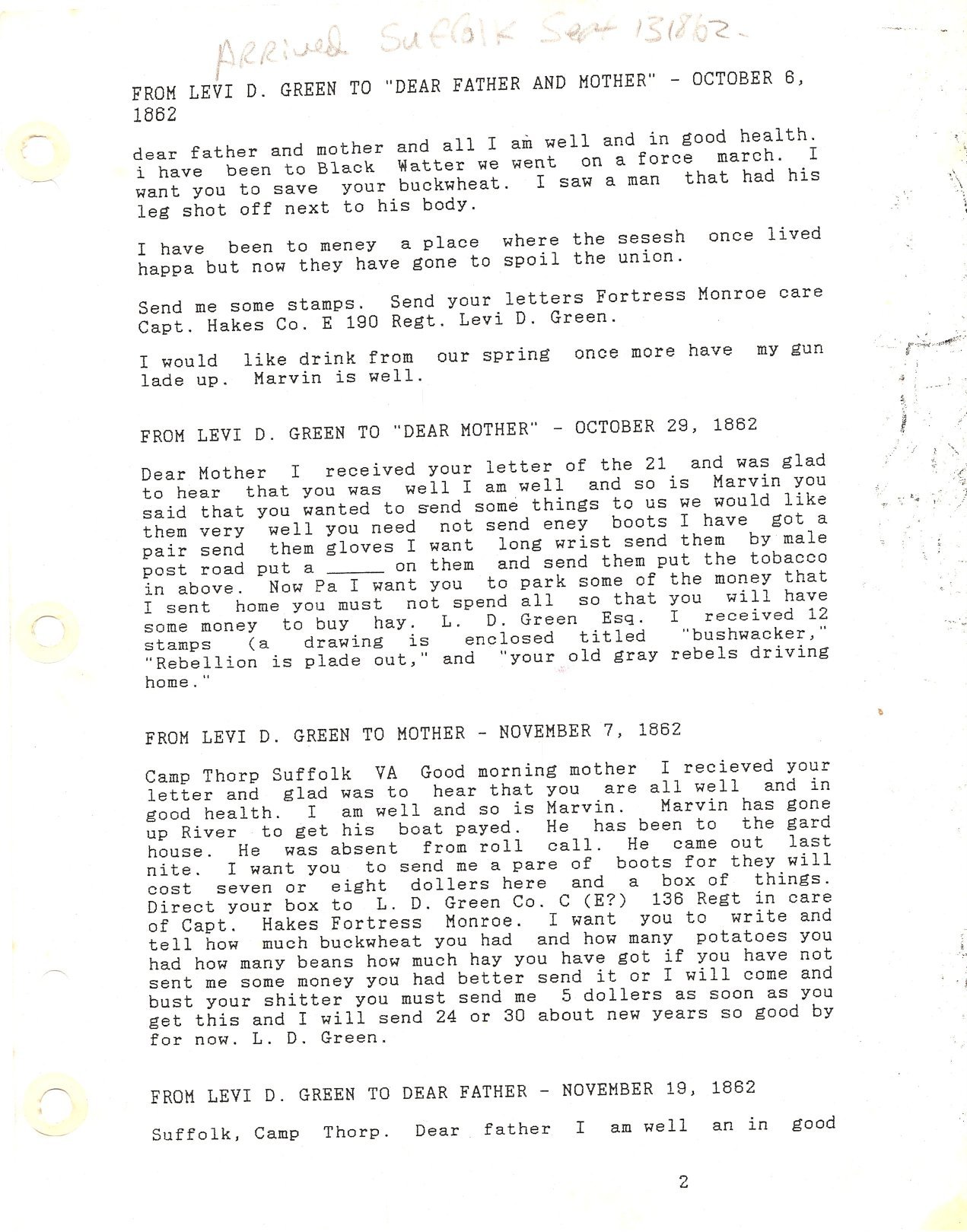
The letter as it survives in the family typescript prepared by Marjorie Kuski, scanned from the complete typescript PDF held on this site.
About this Letter
Levi Davis Green wrote this from Camp Thorp at Suffolk on November 7, 1862, and it is the letter of a man settling into the grind of a garrison winter. The 130th New York was still infantry then, posted west of Norfolk under Col. Alfred Gibbs in Gen. John Peck’s command, its months divided between camp and the reconnaissance marches toward the Blackwater River. Between marches there was time for a brother to get into trouble, and Levi reports it.
His brother Marvin, in the same company, had run afoul of camp discipline. “Marvin has gone up River to get his boat payed,” Levi writes, and then, more bluntly, “He has been to the gard house. He was absent from roll call. He came out last nite.” Boots that would cost seven or eight dollars in camp had to come from home instead, so Levi asks for a pair and a box of things, sent care of Capt. Hakes at Fortress Monroe, and he wants the farm figures too: how much buckwheat, how many potatoes and beans, how much hay.
The money worries turn rough. “If you have not sent me some money you had better send it or I will come and bust your shitter,” he warns, before striking a deal: “you must send me 5 dollers as soon as you get this and I will send 24 or 30 about new years.” It is the voice of a plain young farmer who has not learned to soften anything for paper, counting dollars against the turn of the year.
He set that turn of the year, “about new years,” as an ordinary marker for a debt, and could not know what the next New Year’s morning would carry. On January 1, 1863, Lincoln would sign the Emancipation Proclamation and the war would change its meaning, while the men at Suffolk kept counting beans and potatoes and boots. Levi himself, after the regiment became the 1st New York Dragoons, would be captured in June 1864 and die at Camp Lawton that fall; Marvin, in the guard house here, would survive the war. His service record and the finding of his grave are gathered on Levi’s own page. The pages below are the family typescript prepared by Marjorie Kuski; the transcription keeps his spelling exactly as he set it down.
The Letter
Camp Thorp Suffolk VA Good morning mother I recieved your letter and glad was to hear that you are all well and in good health. I am well and so is Marvin. Marvin has gone up River to get his boat payed. He has been to the gard house. He was absent from roll call. He came out last nite. I want you to send me a pare of boots for they will cost seven or eight dollers here and a box of things. Direct your box to L. D. Green Co. E 130 Regt in care of Capt. Hakes Fortress Monroe. I want you to write and tell how much buckwheat you had and how many potatoes you had how many beans how much hay you have got if you have not sent me some money you had better send it or I will come and bust your shitter you must send me 5 dollers as soon as you get this and I will send 24 or 30 about new years so good by for now. L. D. Green.
Transcribed from Marjorie Kuski’s family typescript, preserving the original spelling and punctuation.
Researcher’s Notes
Researcher’s Note: The 130th N.Y. State Vols. was attached to Spinola’s Brigade, Peck’s Division at Suffolk, 7th Army Corps in October. Colonel Alfred (Abraham) Gibbs, a classmate of General McClellan at West Point, was appointed by McClelland to command the regiment, taking over for Lieutenant Colonel Thomas J. Thorp and Major Rufus Scott. It is for this reason it is logical to assume that regiment named their camp Camp Thorp when they first arrived in Suffolk, VA as they prepared for future battles. I have documented where I believe Camp Thorp was located. I believe that the location of the camp is approximately where the Portsmoth Water Quality Lab is today. You can find images with location captured in Chapter II of Bowen’s book, linked here.
Views: 36