At His Solicitation: How the 130th New York Became the First Dragoons
The Gibbs Papers · A Documentary Investigation
At His Solicitation: How the 130th New York Became the First Dragoons
The making of a cavalry regiment, told from three records that have never been read together: the War Department’s terms, the regiment’s own history, and the private letters of the Gibbs family.
The First New York Dragoons ended the Civil War as one of Philip Sheridan’s most dependable cavalry regiments, the command other troopers pointed to when there was “an extra job on hand.” But it did not begin on horseback. It began as foot soldiers: the 130th New York Volunteer Infantry. How that infantry regiment became cavalry, and who drove the change, is a small but revealing story, and the answer sits in two independent records that have never been set side by side: the regiment’s own published history, and the private letters preserved in the War Department file of its colonel.
A cavalryman handed infantry
Alfred Gibbs was, by training and temperament, a horse soldier. West Point, class of 1846; twenty years in the Regular Army; a lieutenant and then captain of Mounted Rifles and the 3rd U.S. Cavalry; wounded by an Apache in New Mexico; captured at San Augustine Springs in 1861. When he was exchanged and returned to duty in the fall of 1862, he was given command of a regiment of infantry, the newly raised 130th New York. The regiment’s own historian, J. R. Bowen, records that Gibbs came to them at Suffolk, Virginia, and had been appointed, he understood, at the suggestion of an old classmate:
A trained cavalry officer commanding men on foot was a mismatch, and Gibbs seems to have felt it from the start.
The chain: from paperwork to horseback
A regiment does not vote itself onto horses. To answer the only question that matters here, how a foot regiment actually became cavalry, the record has to be read as a sequence, and, it turns out, every link survives. Here is the chain, each step with the document behind it.
- Colonel Gibbs presses for the change1862 to 1863
A trained cavalryman is stuck with a foot regiment, and he sets out to change it. The regiment’s own historian later fixes the credit in four words: the transfer came through “the strenuous efforts of Colonel Gibbs.”
Bowen, Regimental History, ch. VI. - Washington offers termsJuly 1863 · Yorktown
Papers reach Gibbs from Washington: if the regiment will furnish half the horses it needs, the transfer may be made. Called into line, the men pledge the horses on the spot, and a dispatch goes back accepting.
Bowen, ch. VI. - The War Department converts the regimentJuly 28, 1863
War Department Special Orders No. 335 turns the 130th New York from infantry into cavalry, what Bowen calls the war’s only outright infantry-to-cavalry transfer.
War Dept. Special Orders No. 335, July 28, 1863; date confirmed in Phisterer, New York in the War of the Rebellion (1912); Bowen, ch. VI. - The Army of the Potomac sends it to ManassasAugust 2, 1863
Special Orders No. 205, by command of Maj. Gen. Meade, directs the new cavalry regiment to Manassas Junction and attaches it to the cavalry corps.
H.Q. Army of the Potomac, S.O. No. 205, para. 5; NARA naId 652535793 (verified from the original). - Mounted and drilledAugust to October 1863 · Manassas
The regiment moves by rail on August 3 and encamps at Manassas on the 6th; the horses arrive September 13; a month of hard mounted drill follows. It is first carried on the rolls as the Nineteenth New York Cavalry.
Bowen, chs. VI to VII. - A name of its ownOctober 10, 1863
On dress parade the order is read: the regiment becomes the First New York Dragoons, confirmed by the governor of New York, the name it will carry to Cedar Creek and Appomattox.
Bowen, ch. VII.
The regimental history preserves the mechanism in its own words. First the bargain, struck at Yorktown:
Then the order that carried it out, in the government’s own hand, from Meade’s own headquarters order book at the National Archives:
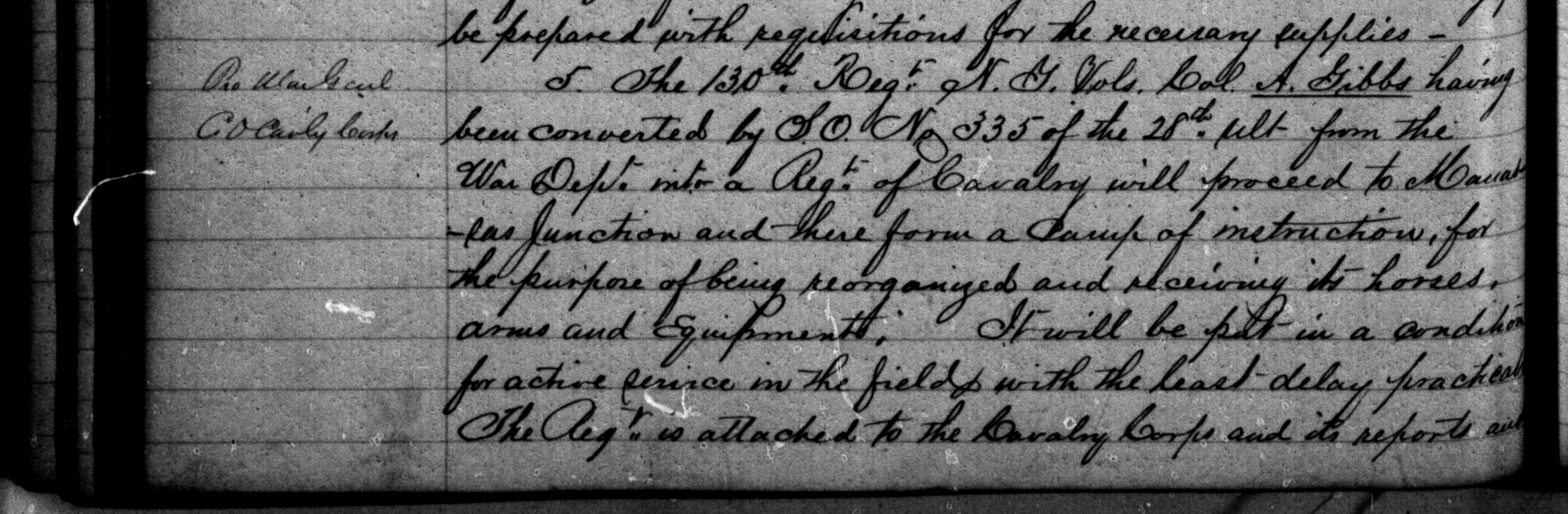
A companion order the day before had already named the regiment in the same breath as the War Department’s: “The following Officers and men of the 130th New York Vols., changed to a Cavalry Regiment by S.O. 335… from the War Dept., are detailed to proceed to Elmira…” (Special Orders No. 204, Aug. 1, 1863, naming Lieut. Col. T. J. Thorp). Two orders from Meade’s headquarters, on consecutive days, put the conversion on the government’s own paper and independently confirm War Department Special Orders No. 335.
A month later, at Manassas, the mounted regiment took the name it kept:
Who set it in motion
On this question the record is neither divided nor thin. The regiment’s own historian states it flatly: the transfer was owed to “the strenuous efforts of Colonel Gibbs.” That is the independent account, written by the men who served under him, and it credits Alfred by name.
George’s letter to Stanton only agrees with it. Pressing for his brother’s promotion in October 1864, he wrote:
“At his solicitation his regiment was changed from Infantry into Cavalry, and is now known as the 1st New York Dragoons.”George Gibbs to Secretary of War Stanton, Oct. 19, 1864. NARA, RG 94, G581 CB 1864, naId 70516353; full letter as Document 06.
And Alfred, given the same subject in his own hand, took no credit at all, which may be the most telling of the three. Asked in 1866 to set down his war record, and endorsed by his commander as “truthful and modest,” he disposed of the change in the passive voice:
“… When regiment was changed to Cavalry, and ordered to Manassas to organize as the 1st Reg’t N.Y. Vol. Dragoons.”Alfred Gibbs, statement of military services, April 11, 1866. NARA, naId 70516353; full statement as Document 45.
All three point one way. Bowen and George name Colonel Gibbs as the mover; Alfred, characteristically, does not. The regiment became cavalry because its colonel pushed for it and Washington answered with Special Orders No. 335. What George’s Stanton correspondence was really about, and what genuinely ran through the Secretary of War, was the next campaign, the fight for Alfred’s general’s star. And the hand that had first placed Gibbs with the regiment belonged to another soldier entirely: his West Point classmate George B. McClellan. The two had graduated together in the Class of 1846, and the family’s tie to McClellan ran deeper than the classroom: the McClellan Papers at the Library of Congress preserve correspondence from Alfred’s brother, the ethnologist George Gibbs, from the years of the western surveys. When McClellan suggested Gibbs for the colonelcy of the 130th in 1862, as Bowen records, he was recommending a classmate and a family friend, not a stranger.
The family’s hand: George and Truman Smith
Alongside the military channel ran a political one. George Gibbs, Alfred’s brother and a well-connected man, worked the conversion from the outside, and this letter names the lever he pulled: not a general but a former United States Senator, Truman Smith of Connecticut, a family friend. It is not the mechanism that mounted the regiment, but it is the family’s hand on the scale, running in parallel with Alfred’s own solicitation and the men’s pledge. By the time George writes, in December 1863, the mounting is already done and he is turning to the next object, a brigadier’s star, but his opening sentence records that months earlier he had gone to Smith “in reference to the mounting of his regiment.”
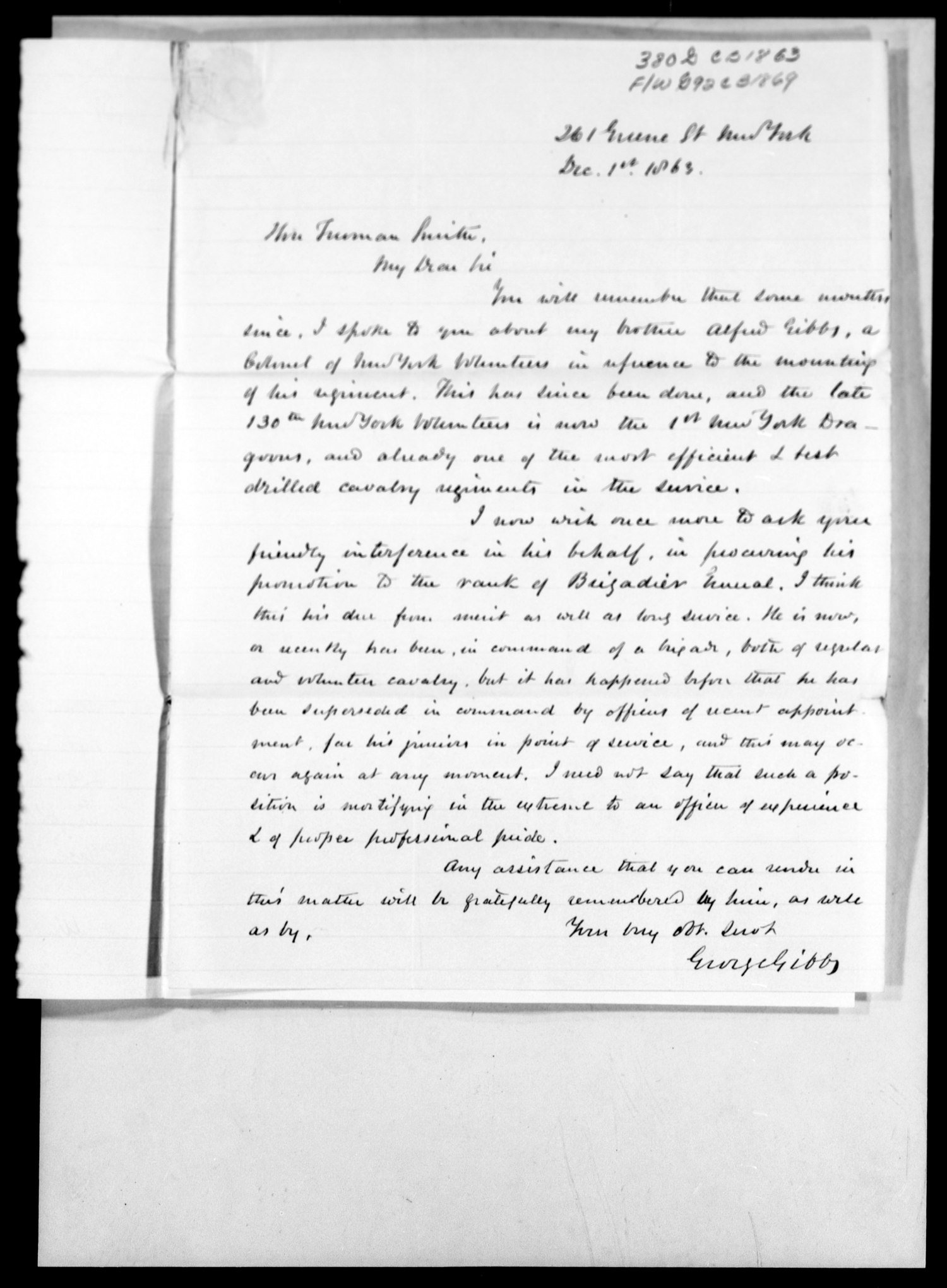
261 Greene St. New York Dec. 1st 1863.
Hon. Truman Smith, My Dear Sir
You will remember that some months since, I spoke to you about my brother Alfred Gibbs, a Colonel of New York Volunteers in reference to the mounting of his regiment. This has since been done, and the late 130th New York Volunteers is now the 1st New York Dragoons, and already one of the most efficient & best drilled cavalry regiments in the service.
I now wish once more to ask your friendly interference in his behalf, in procuring his promotion to the rank of Brigadier General. I think this his due from merit as well as long service. He is now, or recently has been, in command of a brigade, both of regular and volunteer cavalry, but it has happened before that he has been superseded in command by officers of recent appointment, far his juniors in point of service, and this may occur again at any moment. I need not say that such a position is mortifying in the extreme to an officer of experience & of proper professional pride.
Any assistance that you can render in this matter will be gratefully remembered by him, as well as by, Yours very obt. Servt. George Gibbs
George Gibbs to Hon. Truman Smith, December 1, 1863, lobbying a former United States Senator for the mounting of his brother’s regiment. NARA, RG 94, file 380 G CB 1863, filed with G92 CB 1869, naId 70516353.
The Grant question, answered
It is natural to assume that a change of this kind ran through U. S. Grant, and that George reached out to him to have the regiment mounted. The documents do not support that. Grant did not command in the East until the spring of 1864, after the 130th was already cavalry. There is a letter from George Gibbs to Grant, but it is from July 1866, and it concerns something else entirely: the post-war Regular Army commission, a “Colonelcy of Cavalry,” which by regulation had to be transmitted through the General-in-Chief. The shared word “cavalry” is almost certainly the source of the confusion. That single letter (George Gibbs to Gen. U. S. Grant, July 29, 1866, transmitting the colonelcy papers; NARA, RG 94, file G134 CB 1866, filed with G92 CB 1869, naId 70516353) is a post-war recommendation, three years after the 130th was already mounted.
So the Grant connection is real, but it belongs to 1866 and the Regular Army, not to the 1863 volunteer conversion. The conversion itself was Alfred’s solicitation, the War Department’s horse-for-cavalry bargain, and the regiment’s own pledge.
Why it mattered
The change turned a mismatch into an asset. A professional cavalryman finally commanded cavalry, and the regiment he shaped became one of the hardest-used mounted units in Sheridan’s corps. It is a case study in how, in a volunteer army, a single well-placed officer’s initiative, a family’s political reach, and five hundred men’s willingness to pledge their own horses could redirect an entire regiment’s war.
The open thread
One document would still enrich the record: the physical text of War Department Special Orders No. 335 of July 28, 1863, and the correspondence that prompted it. Bowen names that order and prints the Army of the Potomac order that executed it, and the chain now rests on the government’s own orders, retrieved from the National Archives and shown above. What remains to recover is the War Department’s own Special Orders No. 335 itself, in the Adjutant General’s 1863 records, and any 1862 letter behind McClellan’s recommendation, in McClellan’s Army of the Potomac letters received or the McClellan Papers at the Library of Congress.
Sources. Family and service letters: National Archives (NARA), Record Group 94, Records of the Adjutant General’s Office, Letters Received, file G92 CB 1869 (with 380 G CB 1863 and G134 CB 1866), naId 70516353, transcribed in full in Alfred Gibbs: A Life in the Archive. Regimental account: J. R. Bowen, Regimental History of the First New York Dragoons (chs. I, VI, VII), read in full at Regimental History by Chapter. Service record: G. W. Cullum, Biographical Register, no. 1313. Conversion date corroborated by Frederick Phisterer, New York in the War of the Rebellion (Albany, 1912), and the New York State Military Museum. West Point Class of 1846: G. W. Cullum, Biographical Register, no. 1313 (Gibbs); McClellan graduated second in the same class. Transcribed at AlfredGibbs.com, 2026.
“It is Colonel Gibbses Doings” — the Conversion Seen from the Ranks
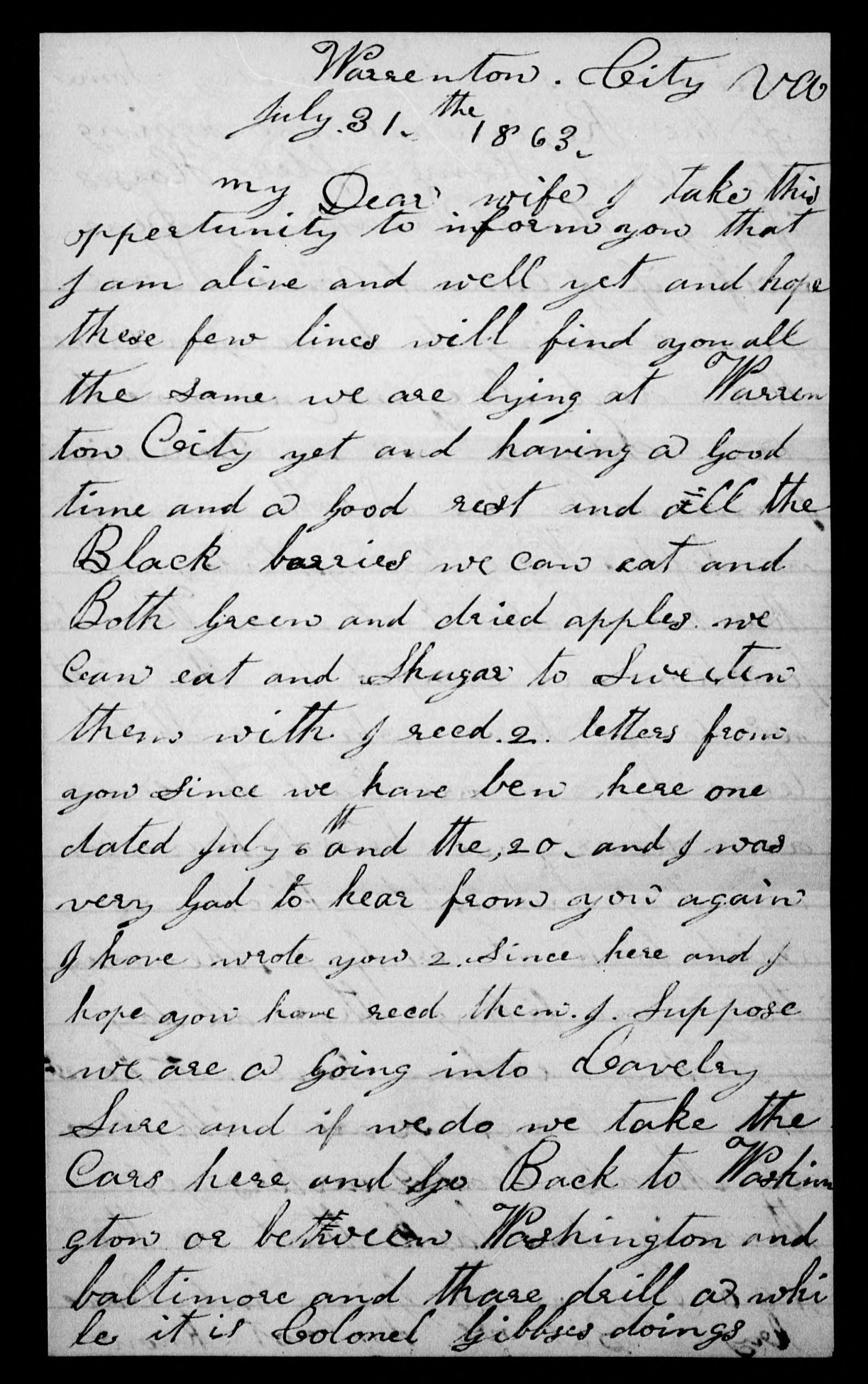
Private George D. Benedict of Company G to his wife Sarah, Warrenton, Virginia, 31 July 1863.
“I Suppose we are a going into Cavelry Sure and if we do we take the Cars here and go Back to Washington or between Washington and baltimore and thare drill a while it is Colonel Gibbses doings”
— George D. Benedict, 31 July 1863
The whole page, transcribed
Warrenton City Va July 31st 1863
my Dear wife I take this oppertunity to inform you that I am alive and well yet and hope these few lines will find you all the Same
we are lying at Warrentow City yet and having a good time and a good rest and all the Black barries we can eat and Both green and dried apples we Can eat and Shugar to Sweeten them with
I recd 2 letters from you Since we have ben here one dated July 6th and the 20 and I was very gad to hear from you again I have wrote you 2 Since here and I hope you have recd them.
I Suppose we are a going into Cavelry Sure and if we do we take the Cars here and go Back to Washington or between Washington and baltimore and thare drill a while it is Colonel Gibbses doings
The documents on this page make the case for the conversion from the top down: Colonel Alfred Gibbs’s applications, the endorsements, the War Department order. This letter makes it from the bottom up.
Writing on 31 July 1863 — before the order was issued — a private in Company G already knew three things: that the regiment was going into the cavalry, where it would be sent to drill, and who had brought it about. He does not credit the governor, the War Department or the brigade. He credits his colonel by name. Whatever passed between Gibbs and Washington on paper, the men in the ranks understood the change as his personal work and were saying so in letters home weeks in advance.
Benedict did not live to serve out the change he reported. He was shot at Todd’s Tavern on 7 May 1864 and died of the wound on 25 May. The full run of his letters, transcribed page by page, is on his own page.
Source. Benedict, G. D. (1863–1864). George D. Benedict Papers (Collection #4943-z). Southern Historical Collection, Louis Round Wilson Special Collections Library, University of North Carolina at Chapel Hill.
“Colonel Thorp Has Gone to York State” — Buying the Regiment’s Horses
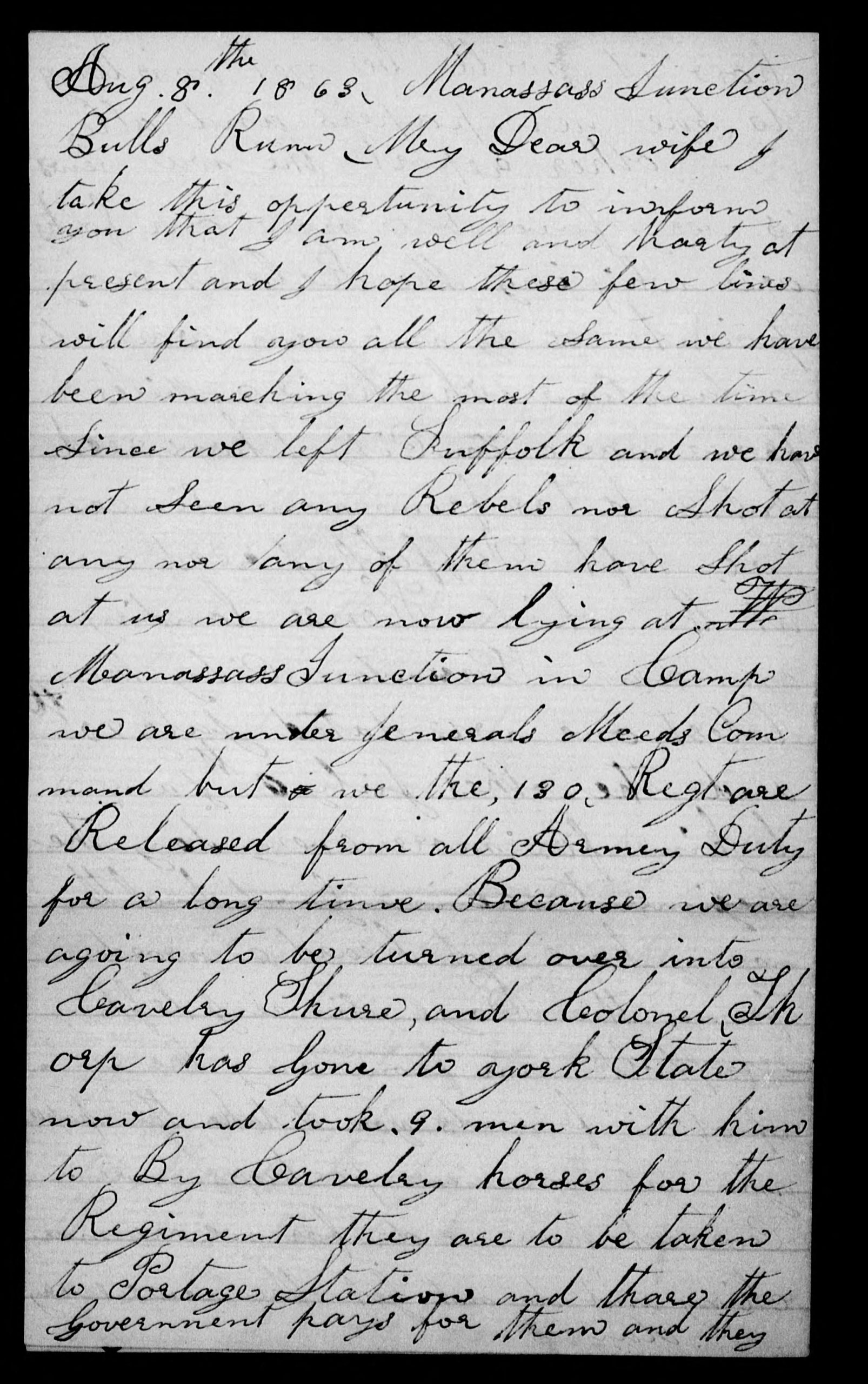
Private George D. Benedict of Company G to his wife Sarah, Manassas Junction, 8 August 1863.
“we the 130 Regt are Released from all Army Duty for a long time Because we are agoing to be turned over into Cavelry Shure, and Colonel Thorp has gone to York State now and took 9 men with him to By Cavelry horses for the Regiment they are to be taken to Portage Station and thare the Government pays for them”
— George D. Benedict, 8 August 1863
The whole page, transcribed
Aug 8th 1863 Manassass Junction Bulls Run
My Dear wife I take this oppertunity to inform you that I am well and harty at present and I hope these few lines will find you all the Same
we have been marching the most of the time Since we left Suffolk and we have not Seen any Rebels nor Shot at any nor any of them have Shot at us we are now lying at Manassass Junction in Camp
we are under Generals Meeds Command but we the 130 Regt are Released from all Army Duty for a long time Because we are agoing to be turned over into Cavelry Shure,
and Colonel Thorp has gone to York State now and took 9 men with him to By Cavelry horses for the Regiment they are to be taken to Portage Station and thare the Government pays for them and they
A week after Benedict credited Colonel Gibbs with the change, the machinery of it is visible. The regiment has been released from all army duty under Meade, the conversion is no longer rumour (“turned over into Cavelry Shure”), and Colonel Thomas J. Thorp has gone back to New York with nine men to buy the horses, for delivery at Portage Station.
This supplies the step between the order and the regiment: someone had to go home and buy sixteen hundred horses. This letter names who went, how many men he took, where the animals were gathered and who paid. It is the fullest inside account of that errand, and the county newspapers that summer printed the same bargain in other soldiers’ words. That primary-source finding, the letters that prove the regiment had to furnish half its own horses, is set out in Furnish Half the Horses.
The full run of Benedict’s letters, transcribed page by page, is on his own page.
Source. Benedict, G. D. (1863–1864). George D. Benedict Papers (Collection #4943-z). Southern Historical Collection, Louis Round Wilson Special Collections Library, University of North Carolina at Chapel Hill.
Views: 16