From Union College to the Battlefield
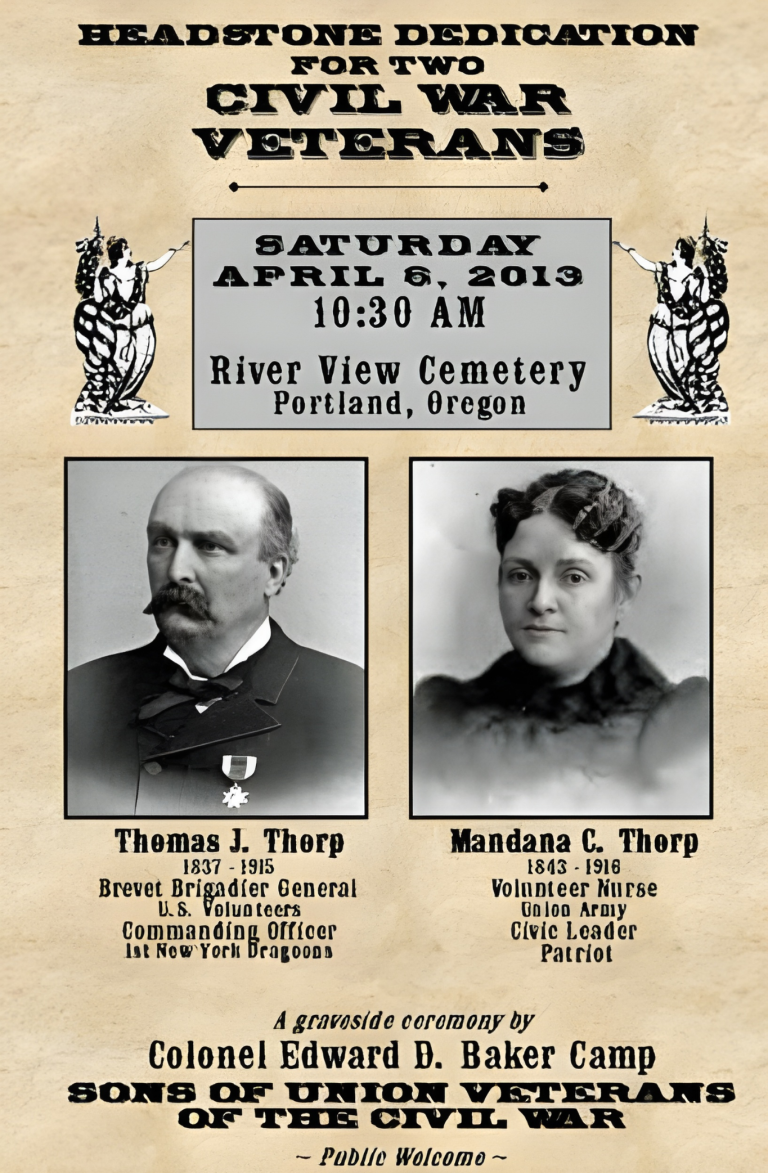
Thomas Jones Thorp, a native of Granger, Allegany County, NY, was a young man of remarkable talent, enthusiasm, and dedication. Graduating from Union College around the outbreak of the Civil War, he immediately engaged in the effort to organize a regiment for the Union cause. He joined the 85th New York Regiment as a captain of Company E, bringing with him a mastery of drill and discipline that led his company to a state of high efficiency. Thorp’s bravery and courage were evident during the Peninsula Campaign, where he was wounded in the leg at the Battle of Fair Oaks on May 31, 1862. Despite his injury, his indomitable spirit carried him through the subsequent battles and retreat to Harrison’s Landing, where he was ultimately furloughed home to recover from a bout of malarial fever.
Recognized for his merit, Thorp was appointed lieutenant-colonel of the newly formed 130th New York Regiment, later to be renamed the First New York Dragoons when it transitioned into the cavalry. His selection was lauded as a wise decision, and his leadership continued to shine through the regiment’s subsequent campaigns.
Service and Sacrifice
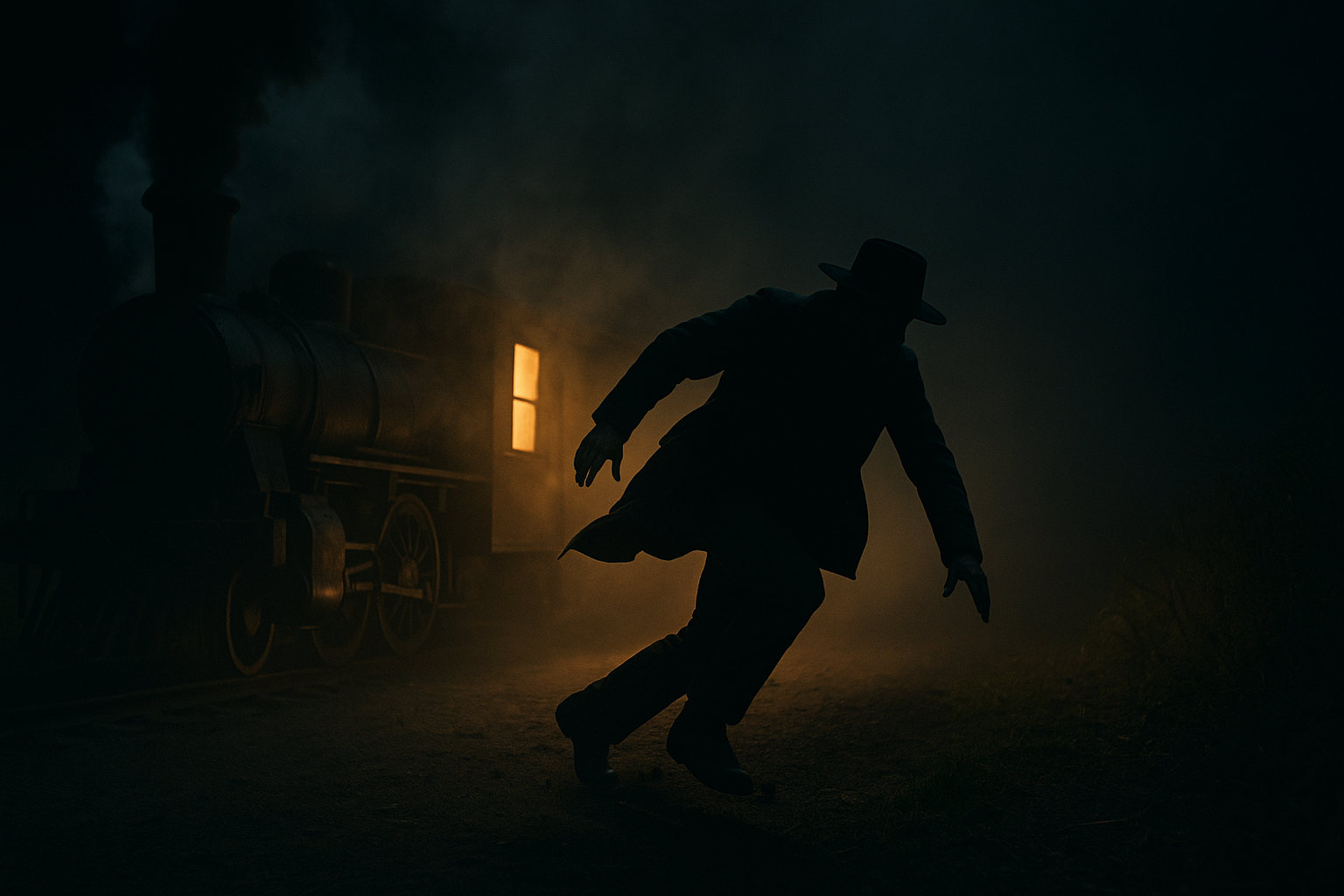
Throughout his service, Thomas J. Thorp rose through the ranks. He was promoted to Colonel on December 24, 1864, and then Brevet Brigadier General on March 13, 1865, for his gallant service. His bravery came at a personal cost. During the Battle of Trevillian Station on June 11, 1864, he was captured by Confederate forces and sent to Macon, Georgia, where he was imprisoned. On July 4, 1864, while imprisoned, Thorp delivered an impassioned Independence Day speech to his fellow Union officers, a speech considered so inflammatory that he was placed on a train bound for Charleston. However, in a daring escape, Thorp jumped from the train under the cover of darkness.
A Life After War
After the war, Thomas J. Thorp’s accomplishments did not end. He spent several years in education and mechanics, securing numerous patents for his inventions. He lived in Forest Grove, Oregon, before moving to Corvallis, where he spent the last years of his life. Thorp passed away on July 26, 1915, in Corvallis, and was buried in Crystal Lake Cemetery. His wife, Mandana Coleman Major Thorp, and their children survived him.
One of the most personal and notable moments of his life came during the war when he married Mandana, daughter of Colonel John Major, in a ceremony performed by a regimental captain, while his troops formed a hollow square around him.
Legacy Preserved
Thorp’s legacy lives on not only in the numerous patents he held and the soldiers who served under him, but also in the monument erected by his family in Short Tract, NY, commemorating the men of Granger who served in the war, including Thorp himself. His remarkable life was honored many years later when a headstone was placed at his grave in Crystal Lake Cemetery by members of the Sons of Union Veterans of the Civil War in 2008, ensuring that the memory of Brigadier General Thomas J. Thorp will endure.
Primary Sources & Records
Original documents located in federal and state archives that name this soldier. Each is shown with its full transcription and citation.
County History Account (1881)
WAR OF THE REBELLION. 149
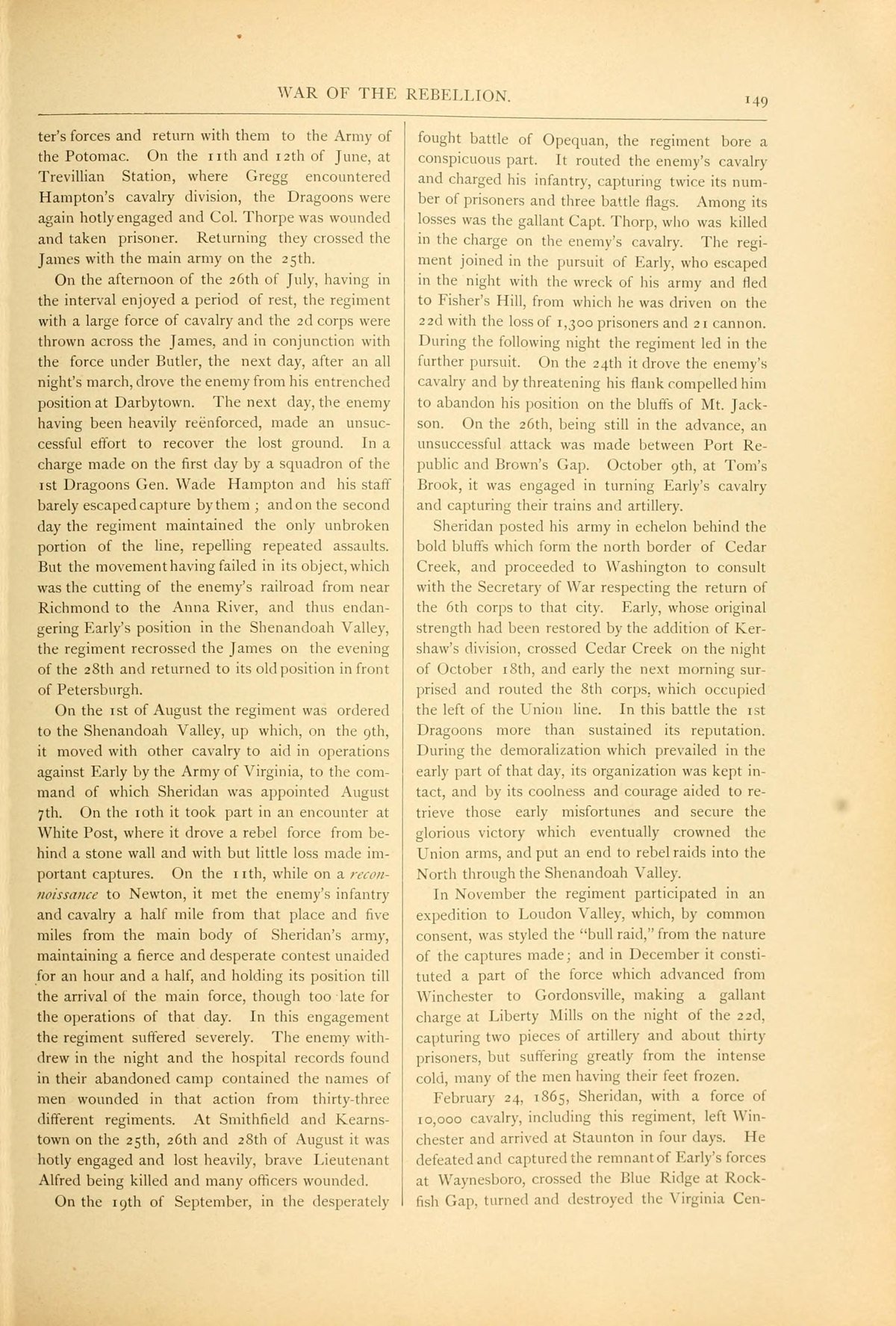
ter’s forces and return with them to the Army of the Potomac. On the 11th and 12th of June, at Trevillian Station, where Gregg encountered Hampton’s cavalry division, the Dragoons were again hotly engaged and Col. Thorpe was wounded and taken prisoner. Returning they crossed the James with the main army on the 25th.
On the afternoon of the 26th of July, having in the interval enjoyed a period of rest, the regiment with a large force of cavalry and the 2d corps were thrown across the James, and in conjunction with the force under Butler, the next day, after an all night’s march, drove the enemy from his entrenched position at Darbytown. The next day, the enemy having been heavily reënforced, made an unsuccessful effort to recover the lost ground. In a charge made on the first day by a squadron of the 1st Dragoons Gen. Wade Hampton and his staff barely escaped capture by them; and on the second day the regiment maintained the only unbroken portion of the line, repelling repeated assaults. But the movement having failed in its object, which was the cutting of the enemy’s railroad from near Richmond to the Anna River, and thus endangering Early’s position in the Shenandoah Valley, the regiment recrossed the James on the evening of the 28th and returned to its old position in front of Petersburgh.
On the 1st of August the regiment was ordered to the Shenandoah Valley, up which, on the 9th, it moved with other cavalry to aid in operations against Early by the Army of Virginia, to the command of which Sheridan was appointed August 7th. On the 10th it took part in an encounter at White Post, where it drove a rebel force from behind a stone wall and with but little loss made important captures. On the 11th, while on a reconnoissance to Newton, it met the enemy’s infantry and cavalry a half mile from that place and five miles from the main body of Sheridan’s army, maintaining a fierce and desperate contest unaided for an hour and a half, and holding its position till the arrival of the main force, though too late for the operations of that day. In this engagement the regiment suffered severely. The enemy withdrew in the night and the hospital records found in their abandoned camp contained the names of men wounded in that action from thirty-three different regiments. At Smithfield and Kearnstown on the 25th, 26th and 28th of August it was hotly engaged and lost heavily, brave Lieutenant Alfred being killed and many officers wounded.
On the 19th of September, in the desperately fought battle of Opequan, the regiment bore a conspicuous part. It routed the enemy’s cavalry and charged his infantry, capturing twice its number of prisoners and three battle flags. Among its losses was the gallant Capt. Thorp, who was killed in the charge on the enemy’s cavalry. The regiment joined in the pursuit of Early, who escaped in the night with the wreck of his army and fled to Fisher’s Hill, from which he was driven on the 22d with the loss of 1,300 prisoners and 21 cannon. During the following night the regiment led in the further pursuit. On the 24th it drove the enemy’s cavalry and by threatening his flank compelled him to abandon his position on the bluffs of Mt. Jackson. On the 26th, being still in the advance, an unsuccessful attack was made between Port Republic and Brown’s Gap. October 9th, at Tom’s Brook, it was engaged in turning Early’s cavalry and capturing their trains and artillery.
Sheridan posted his army in echelon behind the bold bluffs which form the north border of Cedar Creek, and proceeded to Washington to consult with the Secretary of War respecting the return of the 6th corps to that city. Early, whose original strength had been restored by the addition of Kershaw’s division, crossed Cedar Creek on the night of October 18th, and early the next morning surprised and routed the 8th corps, which occupied the left of the Union line. In this battle the 1st Dragoons more than sustained its reputation. During the demoralization which prevailed in the early part of that day, its organization was kept intact, and by its coolness and courage aided to retrieve those early misfortunes and secure the glorious victory which eventually crowned the Union arms, and put an end to rebel raids into the North through the Shenandoah Valley.
In November the regiment participated in an expedition to Loudon Valley, which, by common consent, was styled the “bull raid,” from the nature of the captures made; and in December it constituted a part of the force which advanced from Winchester to Gordonsville, making a gallant charge at Liberty Mills on the night of the 22d, capturing two pieces of artillery and about thirty prisoners, but suffering greatly from the intense cold, many of the men having their feet frozen.
February 24, 1865, Sheridan, with a force of 10,000 cavalry, including this regiment, left Winchester and arrived at Staunton in four days. He defeated and captured the remnant of Early’s forces at Waynesboro, crossed the Blue Ridge at Rockfish Gap, turned and destroyed the Virginia Cen-
Source. Smith, J. H. (1881). History of Livingston County, New York, with illustrations and biographical sketches of some of its prominent men and pioneers (p. 149). Syracuse, NY: D. Mason & Co. Internet Archive identifier 1687historyofliv00smit. https://archive.org/details/1687historyofliv00smit
County-history narrative of the 130th NY / 1st NY Dragoons; page 149 records Col. Thorpe wounded and captured at Trevillian Station, June 11-12, 1864. The “gallant Capt. Thorp” killed at Opequan later on the same page is a different officer (2d Lt. A. K. Thorp of Co. F on the original roster), not Col. Thomas J. Thorp.
In the County Histories
Two county histories, compiled within twenty years of the war by men who had served, record Thorp’s command of the regiment, his capture, and the five wounds he carried out of the war.
Roll of the First Dragoons, regimental officers
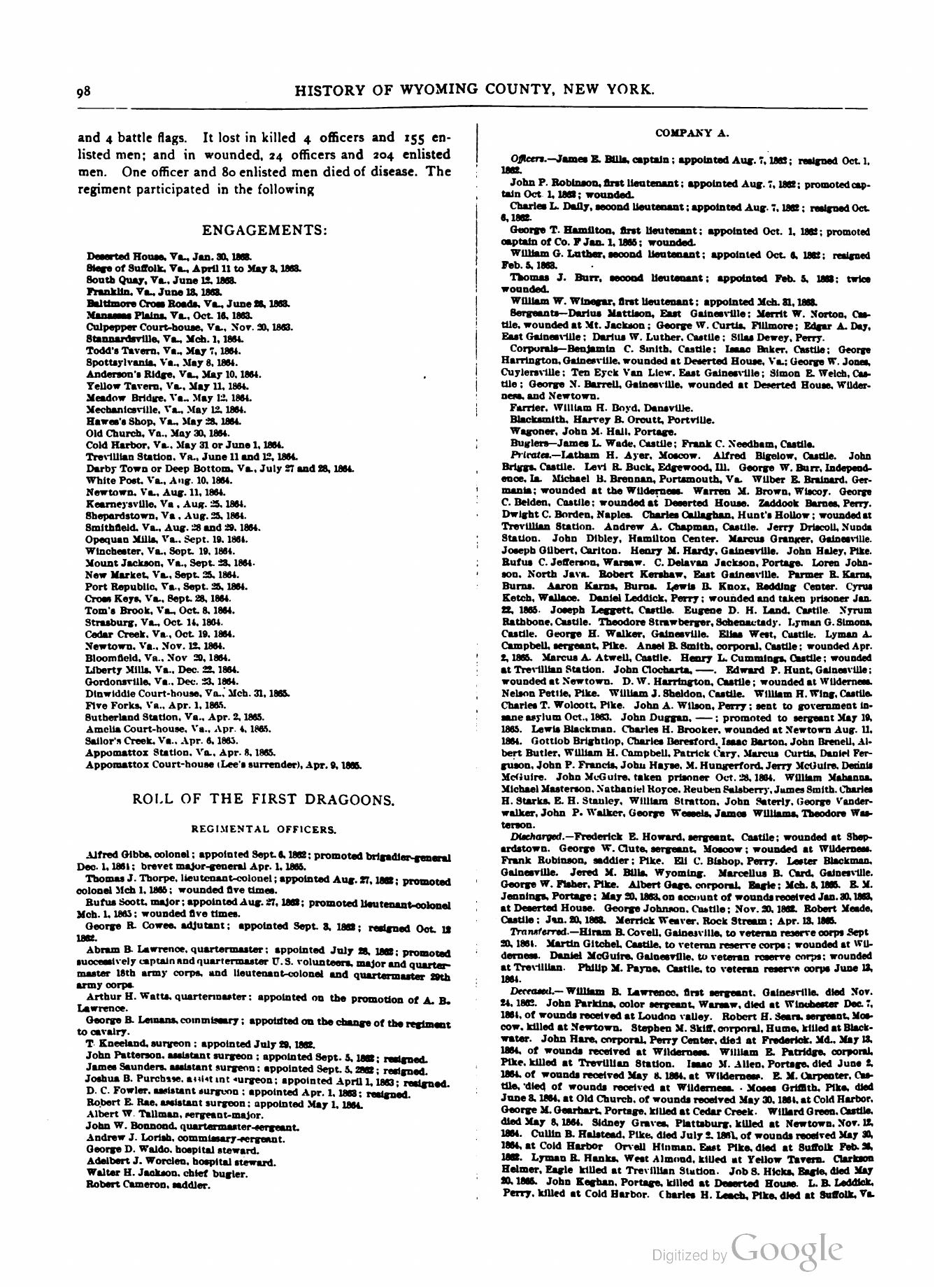
“Thomas J. Thorpe, lieutenant-colonel; appointed Aug. 27, 1862; promoted colonel Mch. 1, 1865; wounded five times.”
The same roll records Major Rufus Scott as also “wounded five times.” That is not a printer’s error: Scott’s own New York muster roll abstract lists his wounds one by one — Fair Oaks, 31 May 1862; Suffolk, 17 April 1863; Yellow Tavern, 11 May 1864; Cold Harbor, 31 May 1864; Newtown, 11 August 1864; and Port Republic, 26 September 1864. Six of them. The two colonels of this regiment were wounded eleven times between them.
Source. F. W. Beers & Co. (1880). History of Wyoming County, N.Y. (p. 98). New York, NY: F. W. Beers & Co. Public domain.
Commanding the regiment under fire
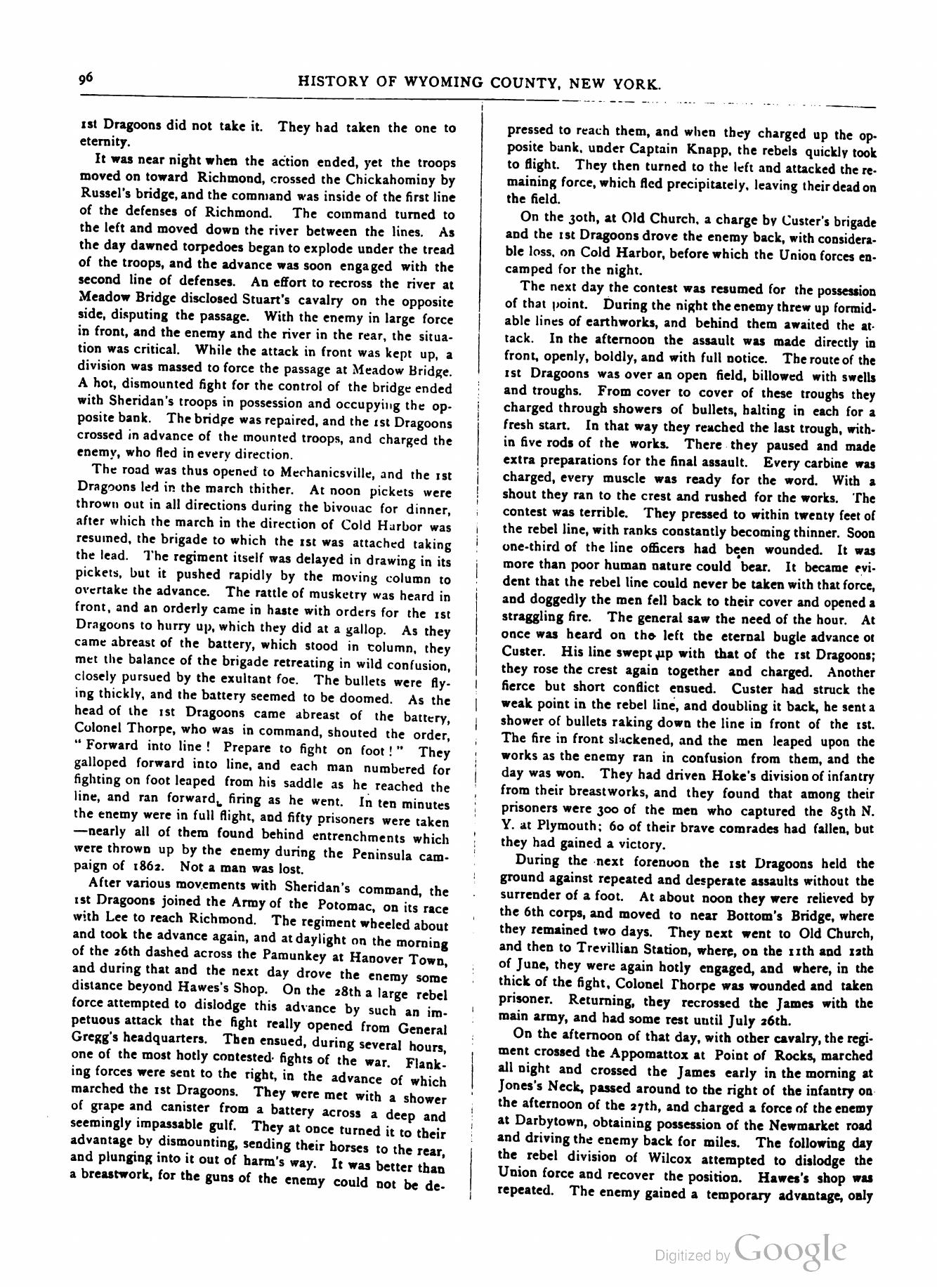
“As the head of the 1st Dragoons came abreast of the battery, Colonel Thorpe, who was in command, shouted the order, “Forward into line! Prepare to fight on foot!” They galloped forward into line, and each man numbered for fighting on foot leaped from his saddle as he reached the line, and ran forward, firing as he went. In ten minutes the enemy were in full flight, and fifty prisoners were taken.”
The brigade ahead of them had broken and was falling back on the guns; the battery was about to be overrun.
Source. F. W. Beers & Co. (1880). History of Wyoming County, N.Y. (p. 96). New York, NY: F. W. Beers & Co. Public domain.
Wounded and captured at Trevilian Station
“They next went to Old Church, and then to Trevillian Station, where, on the 11th and 12th of June, they were again hotly engaged, and where, in the thick of the fight, Colonel Thorpe was wounded and taken prisoner.”
Source. F. W. Beers & Co. (1880). History of Wyoming County, N.Y. (p. 96). New York, NY: F. W. Beers & Co. Public domain.
Union College, and a regular-army commission declined
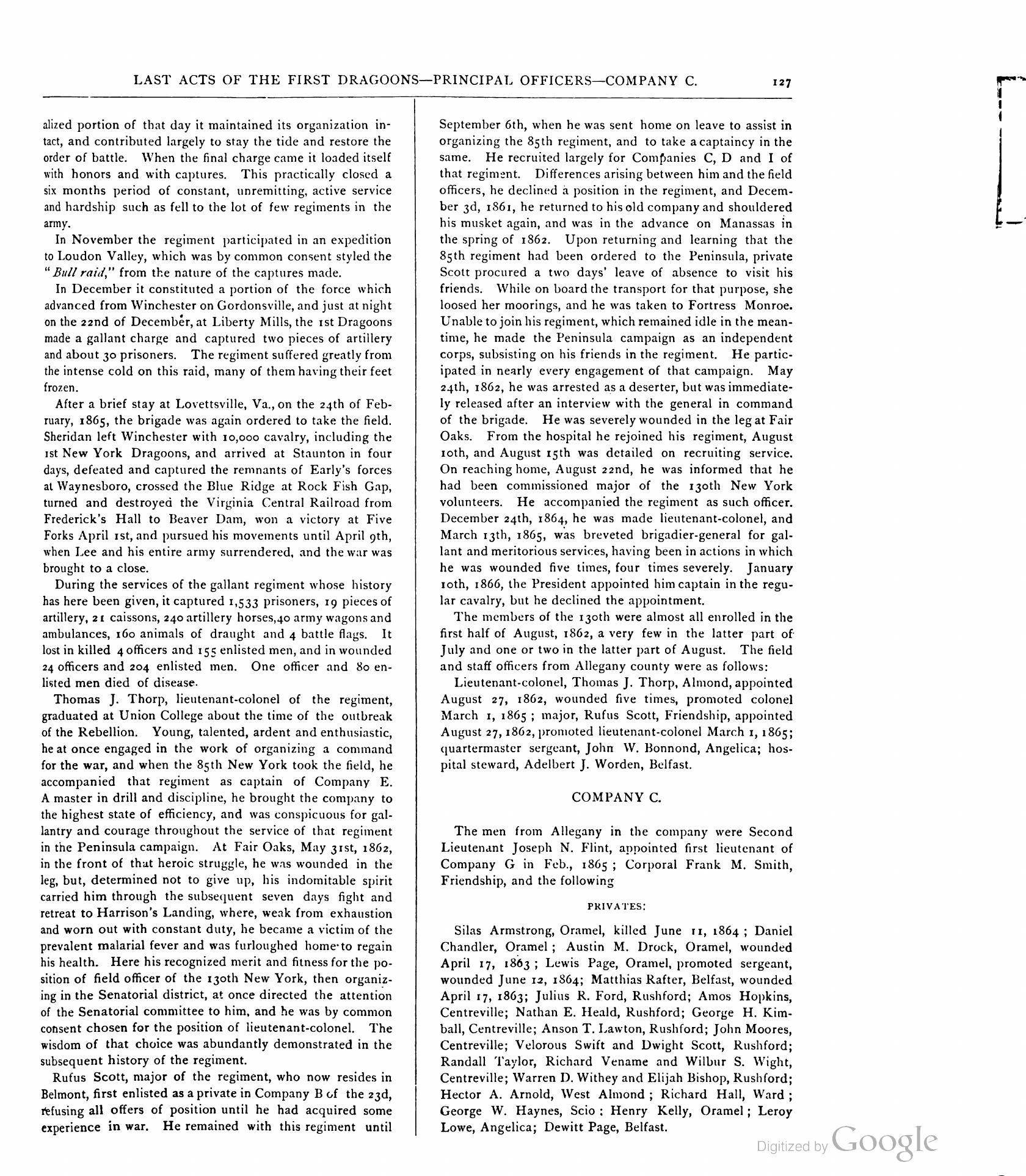
“Thomas J. Thorp, lieutenant-colonel of the regiment, August 27, graduated at Union College about the time of the outbreak of the Rebellion. Young, talented, ardent and enthusiastic, he at once engaged in the work of organizing a command for the war … [the government] appointed him captain in the regular cavalry, but he declined the appointment.”
The Allegany field-and-staff list on the same page reads: “lieutenant-colonel, Thomas J. Thorp, Almond, appointed [Aug.] 27, 1862, wounded five times, promoted colonel [Marc]h 1, 1865.”
Source. F. W. Beers & Co. (1879). History of Allegany County, N.Y. (p. 127). New York, NY: F. W. Beers & Co. Public domain.
A note on identity: the same volumes record a “gallant Captain Thorpe” killed in the charge at Opequan on 19 September 1864. That is a different soldier. Colonel Thomas J. Thorp survived the war.
The Man Himself: Portraits and Service Records
Two photographs of Thorp survive in the regimental history, taken more than thirty years apart, together with the New York muster roll abstract that records his service in his own army’s hand.
“Our Boy Commanders,” 1861
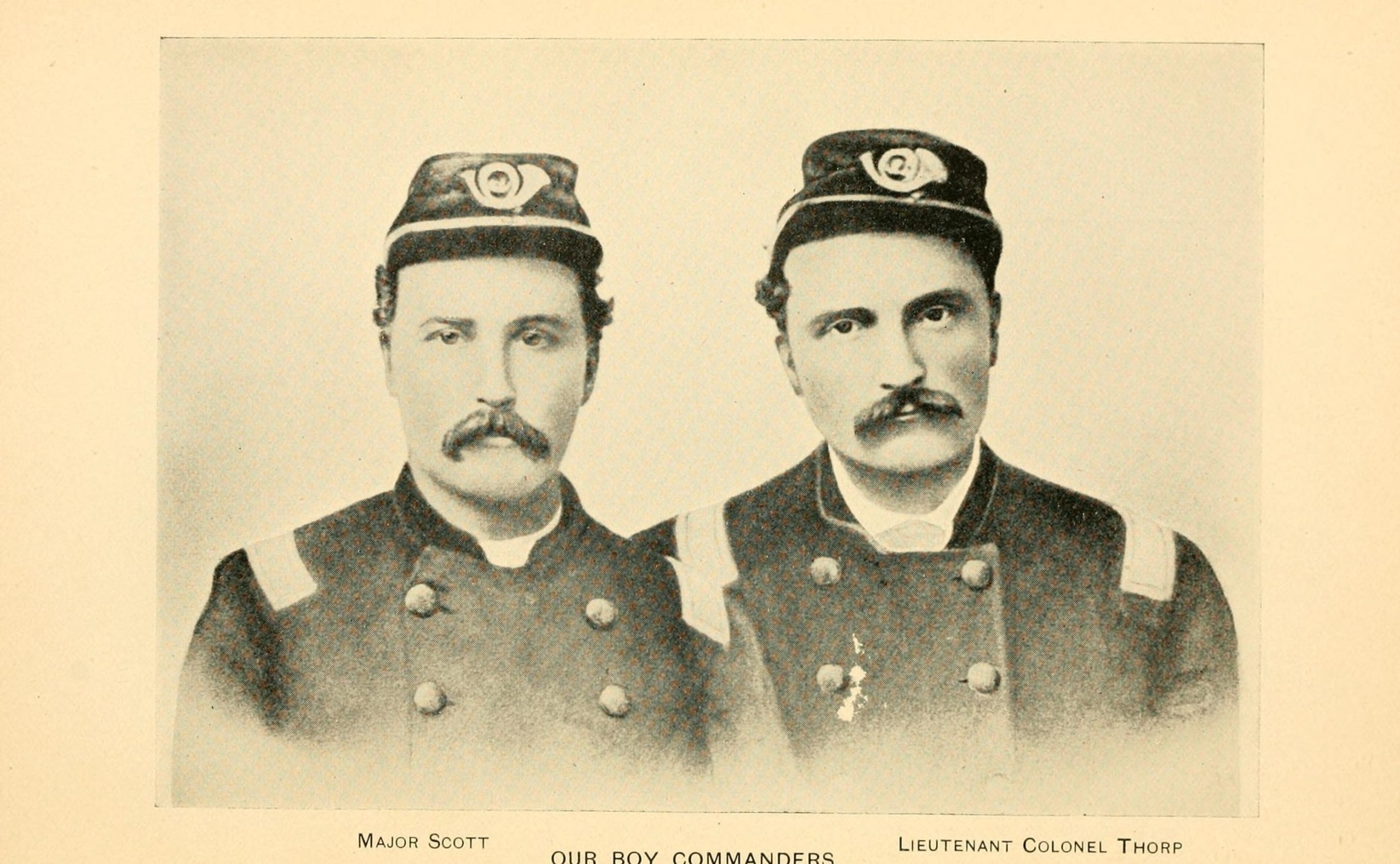
Thorp was twenty-four when this was taken. Bowen titled the plate Our Boy Commanders.
Colonel Thomas J. Thorp, from a late photograph
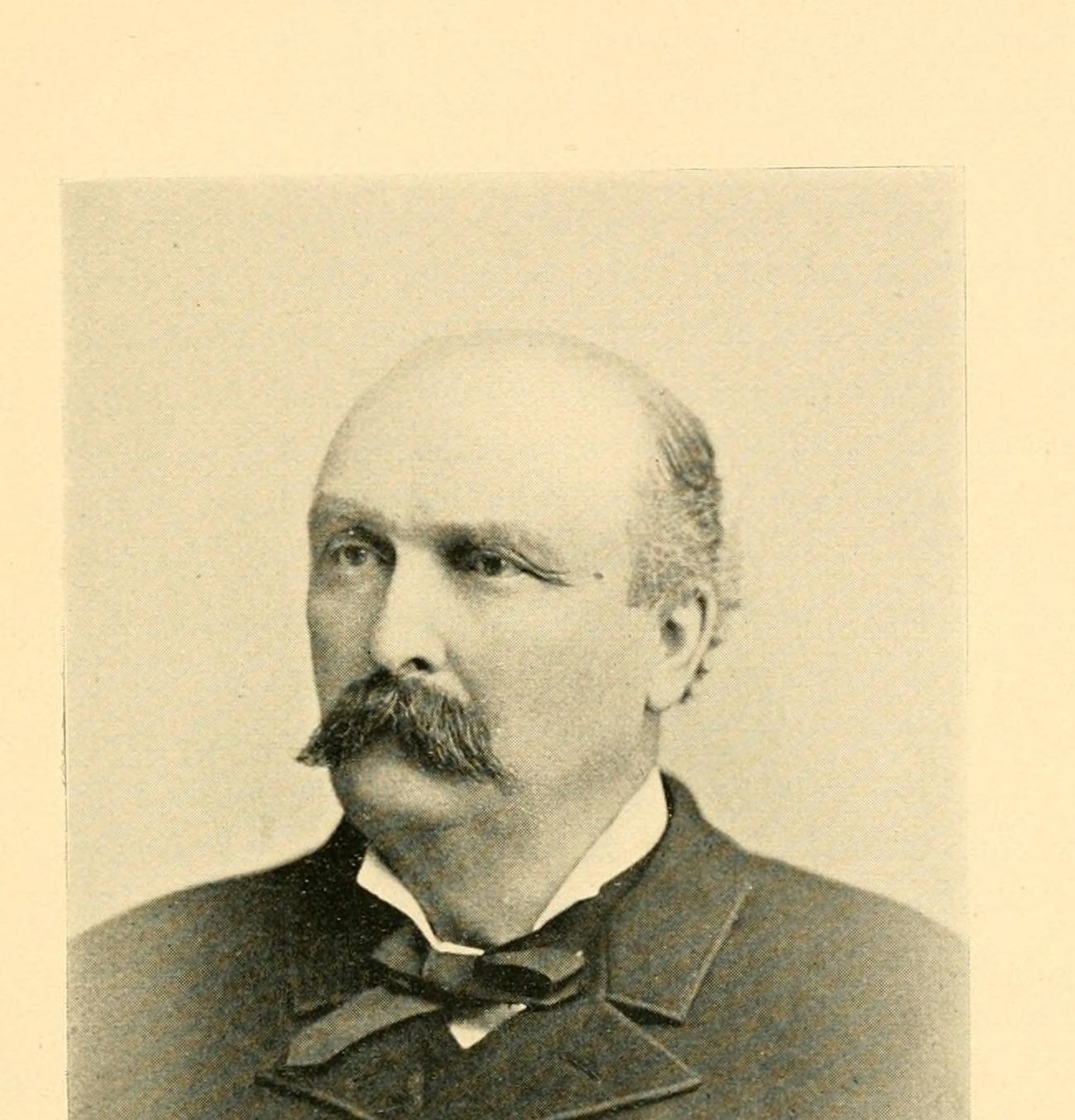
He wears the star-shaped badge of the Military Order of the Loyal Legion of the United States, the officers’ veteran order.
His New York muster roll abstract
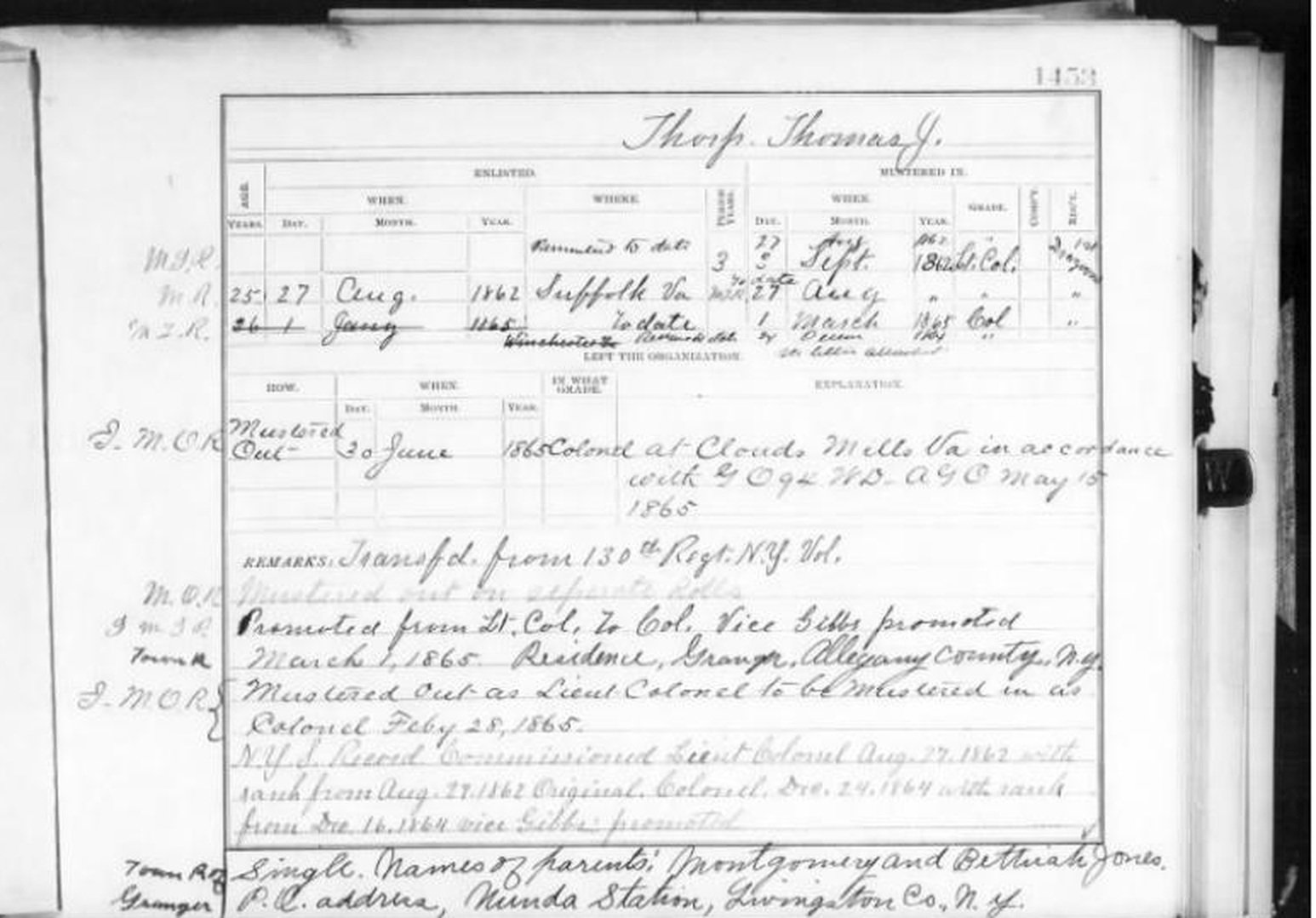
“Thorp, Thomas J. — Age 25. Enlisted 27 August 1862 at Suffolk, Va., to serve three years; mustered in 27 August 1862, grade Lieutenant Colonel. [Second entry:] age 26, 1 January 1865, Winchester, to date 1 March 1865, Colonel. Left the organization: Mustered out 30 June 1865, as Colonel, at Clouds Mills, Va., in accordance with G.O. 92, W.D., A.G.O., May 15, 1865. Remarks: Transf’d from 130th Regt. N.Y. Vol. Promoted from Lt. Col. to Col. vice Gibbs promoted, March 1, 1865. Residence, Granger, Allegany county, N.Y. Mustered out as Lieut. Colonel to be mustered in as Colonel Feby. 28, 1865. N.Y.S. Record: Commissioned Lieut. Colonel Aug. 27, 1862, with rank from Aug. 27, 1862, original; Colonel, Dec. 24, 1864, with rank from Dec. 16, 1864, vice Gibbs promoted. Single. Names of parents: Montgomery and Bettriah Jones. P.O. address, Nunda Station, Livingston Co., N.Y.”
This card is the source for two facts found nowhere in the regimental history: that he was unmarried when he went to war, and that his parents were Montgomery Thorp and Bettriah Jones — which is where his middle name came from.
Source. New York State Archives. Civil War muster roll abstracts, 1861–1900 [1st Dragoons, Thorp, Thomas J.]. Albany, N.Y. Digital image consulted via Fold3 (file 316458937).
Remustered by act of Congress, 1897
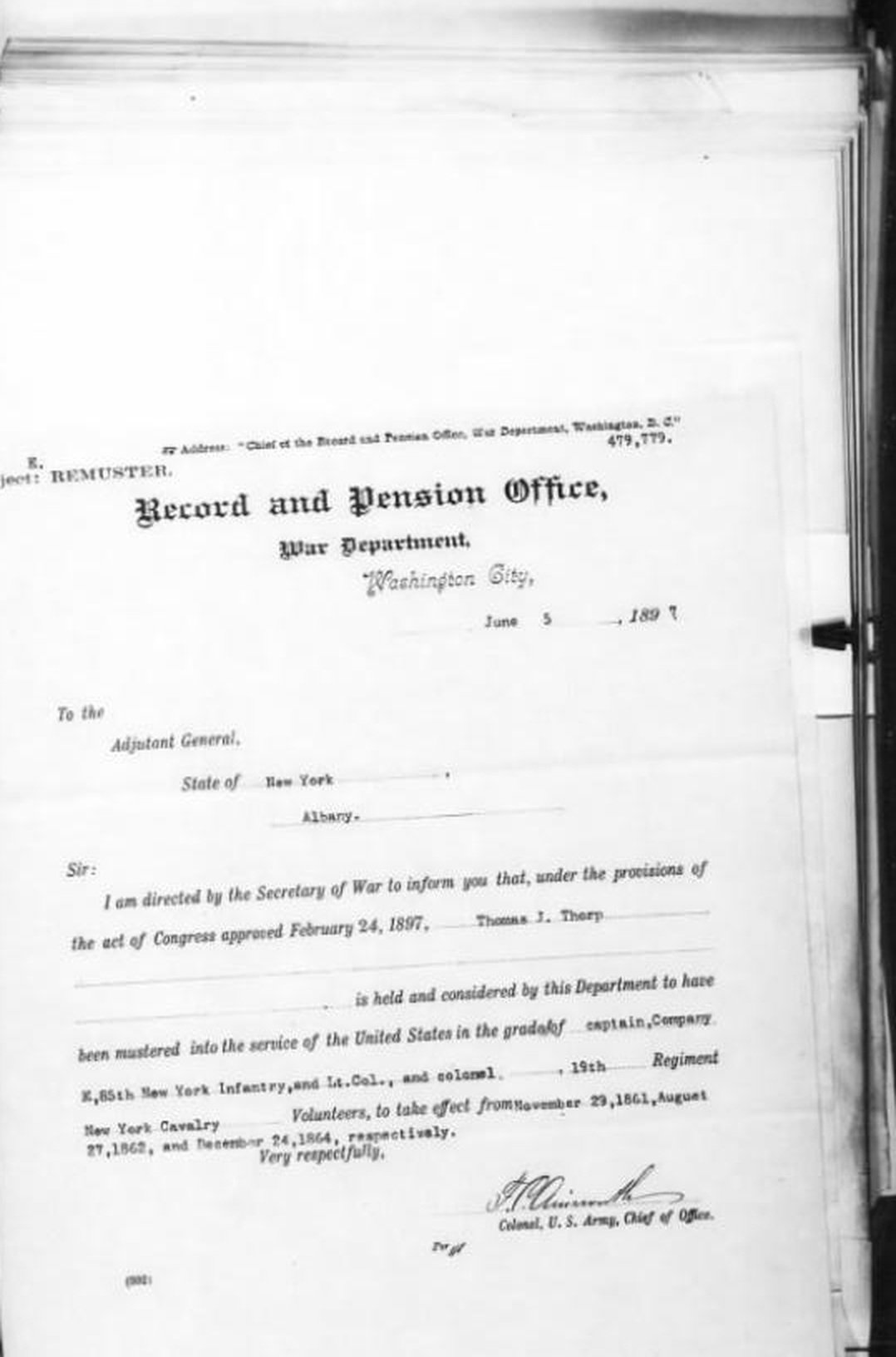
“Record and Pension Office, War Department, Washington City, June 5, 1897. To the Adjutant General, State of New York, Albany. Sir: I am directed by the Secretary of War to inform you that, under the provisions of the act of Congress approved February 24, 1897, Thomas J. Thorp is held and considered by this Department to have been mustered into the service of the United States in the grade of captain, Company K, 85th New York Infantry, and Lt. Col., and colonel, 19th Regiment New York Cavalry Volunteers, to take effect from November 29, 1861, August 27, 1862, and December 24, 1864, respectively. Very respectfully, [signed] Colonel, U. S. Army, Chief of Office. [File] 479,779.”
Thirty-two years after the war the War Department went back and formally recognised his whole service, beginning as a captain of the 85th New York Infantry on 29 November 1861. The “19th Regiment New York Cavalry” named here is the Dragoons under their original designation, changed to First Dragoons by the State on 10 September 1863 and announced to the regiment on dress parade on 10 October 1863.
Update, 2 November 2026. This sentence first gave only 10 September 1863. That is the date of the State’s order changing the name, as Phisterer records it (“this designation was changed September 10, 1863, to 1st Regiment of Dragoons”). The regiment heard it a month later: Bowen writes that “the order announcing this change was read on dress parade October 10” (Bowen, 1900, p. 99). Both dates are now given.
Source. Record and Pension Office, War Department. (1897, June 5). Remuster: Thomas J. Thorp (File 479,779). Filed with the New York muster roll abstracts, New York State Archives. Digital image consulted via Fold3.
“Colonel Thorp Has Gone to York State” — Buying the Regiment’s Horses
Private George D. Benedict of Company G to his wife Sarah, Manassas Junction, 8 August 1863.
“we the 130 Regt are Released from all Army Duty for a long time Because we are agoing to be turned over into Cavelry Shure, and Colonel Thorp has gone to York State now and took 9 men with him to By Cavelry horses for the Regiment they are to be taken to Portage Station and thare the Government pays for them”
— George D. Benedict, 8 August 1863
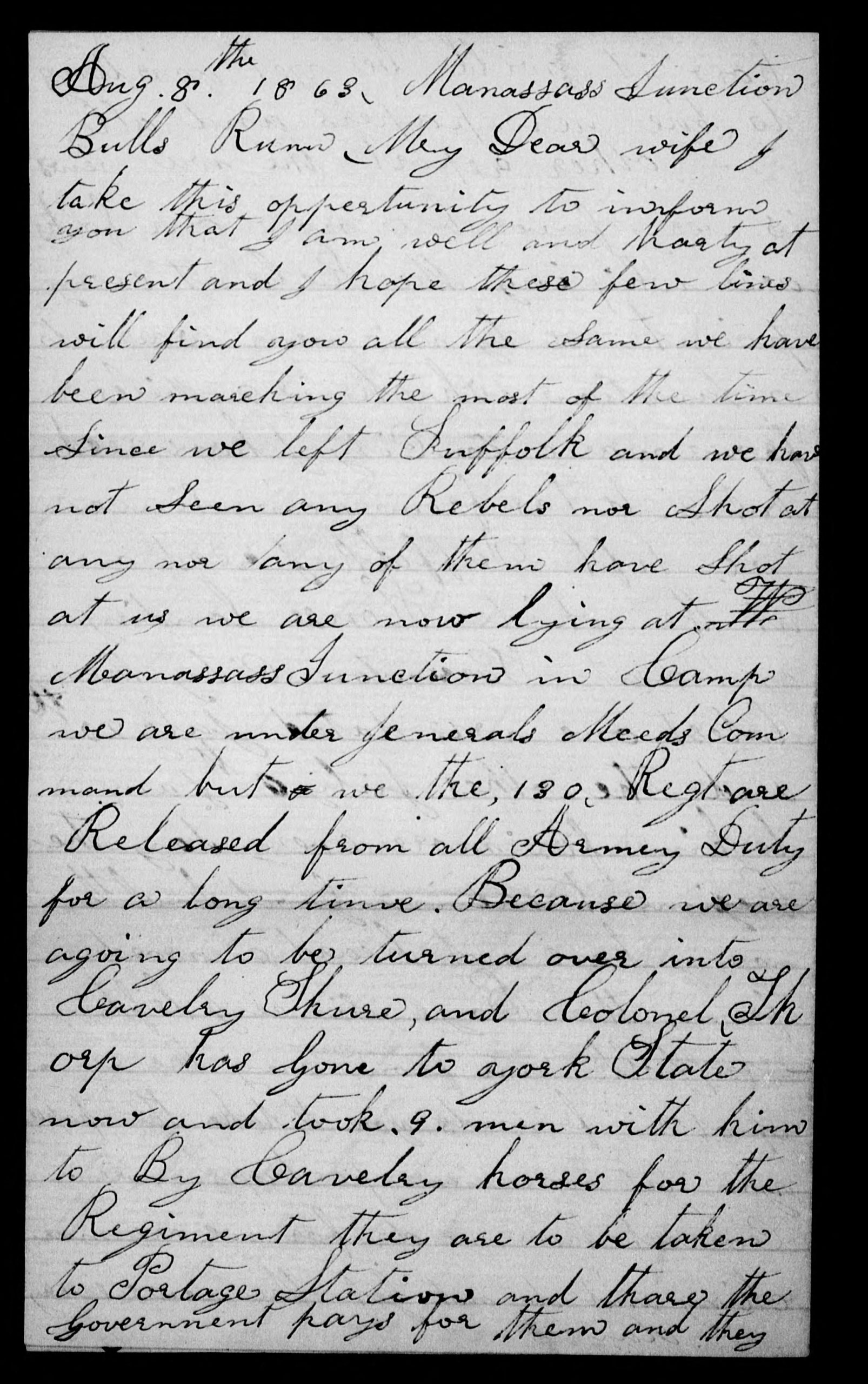
The whole page, transcribed
Aug 8th 1863 Manassass Junction Bulls Run
My Dear wife I take this oppertunity to inform you that I am well and harty at present and I hope these few lines will find you all the Same
we have been marching the most of the time Since we left Suffolk and we have not Seen any Rebels nor Shot at any nor any of them have Shot at us we are now lying at Manassass Junction in Camp
we are under Generals Meeds Command but we the 130 Regt are Released from all Army Duty for a long time Because we are agoing to be turned over into Cavelry Shure,
and Colonel Thorp has gone to York State now and took 9 men with him to By Cavelry horses for the Regiment they are to be taken to Portage Station and thare the Government pays for them and they
Most of what survives about Thomas J. Thorp is official — commissions, casualty returns, the roster he certified in 1865. This is different. It is a private in Company G, writing to his wife, who happens to record what his colonel was doing in the first week of August 1863.
Thorp had gone back to New York State with a detail of nine men to buy horses for the regiment, the animals to be gathered at Portage Station where the government would pay for them. The 130th New York Volunteers had just been released from all duty under Meade pending its conversion, and Thorp was the officer sent home to mount it. When the First New York Dragoons rode, it rode on horses he went and bought.
The date, the number of men and the delivery point are all specific, and they come from a witness with no reason to invent them — he was telling his wife why the regiment was standing still. For the conversion itself, and Colonel Alfred Gibbs’s part in bringing it about, see At His Solicitation: How the 130th New York Became the First Dragoons.
Benedict did not live to serve long under the change he reported. He was shot at Todd’s Tavern on 7 May 1864 and died of the wound on 25 May. The full run of his letters, transcribed page by page, is on his own page.
Source. Benedict, G. D. (1863–1864). George D. Benedict Papers (Collection #4943-z). Southern Historical Collection, Louis Round Wilson Special Collections Library, University of North Carolina at Chapel Hill.
“We Do Not Like Him at All” — 26 January 1864
Private George D. Benedict of Company G to his wife Sarah at Belvidere, from winter quarters near the Rapidan.
“Sarah, T. J. Thorp is with us now, we do not like him at all Because he drinks. The officers most all drink and Gamble … and dont Regard the Sabboth day at all. oh So much evil in the army, the Good Lord have mercy upon us all.”
— George D. Benedict, 26 January 1864
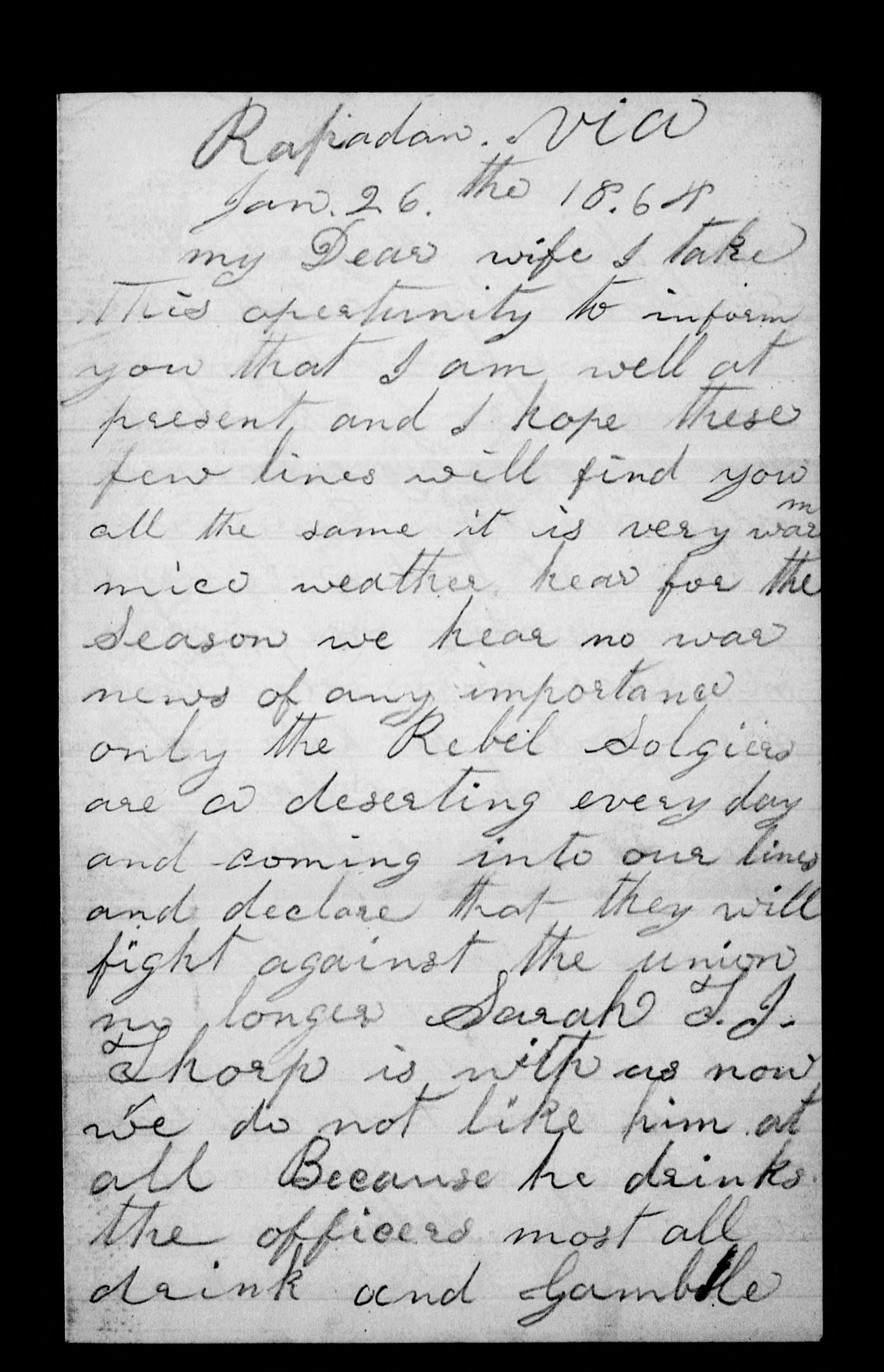
The whole page, transcribed
Rapadan Va Jan 26th 1864
my Dear wife I take this opertunity to inform you that I am well at present and I hope these few lines will find you all the same
it is very warm nice weather hear for the Season
we hear no war news of any importance only the Rebel Solgiers are a deserting every day and coming into our lines and declare that they will fight against the union ny longer
Sarah T. J. Thorp is with us now we do not like him at all Because he drinks the officers most all drink and Gamble
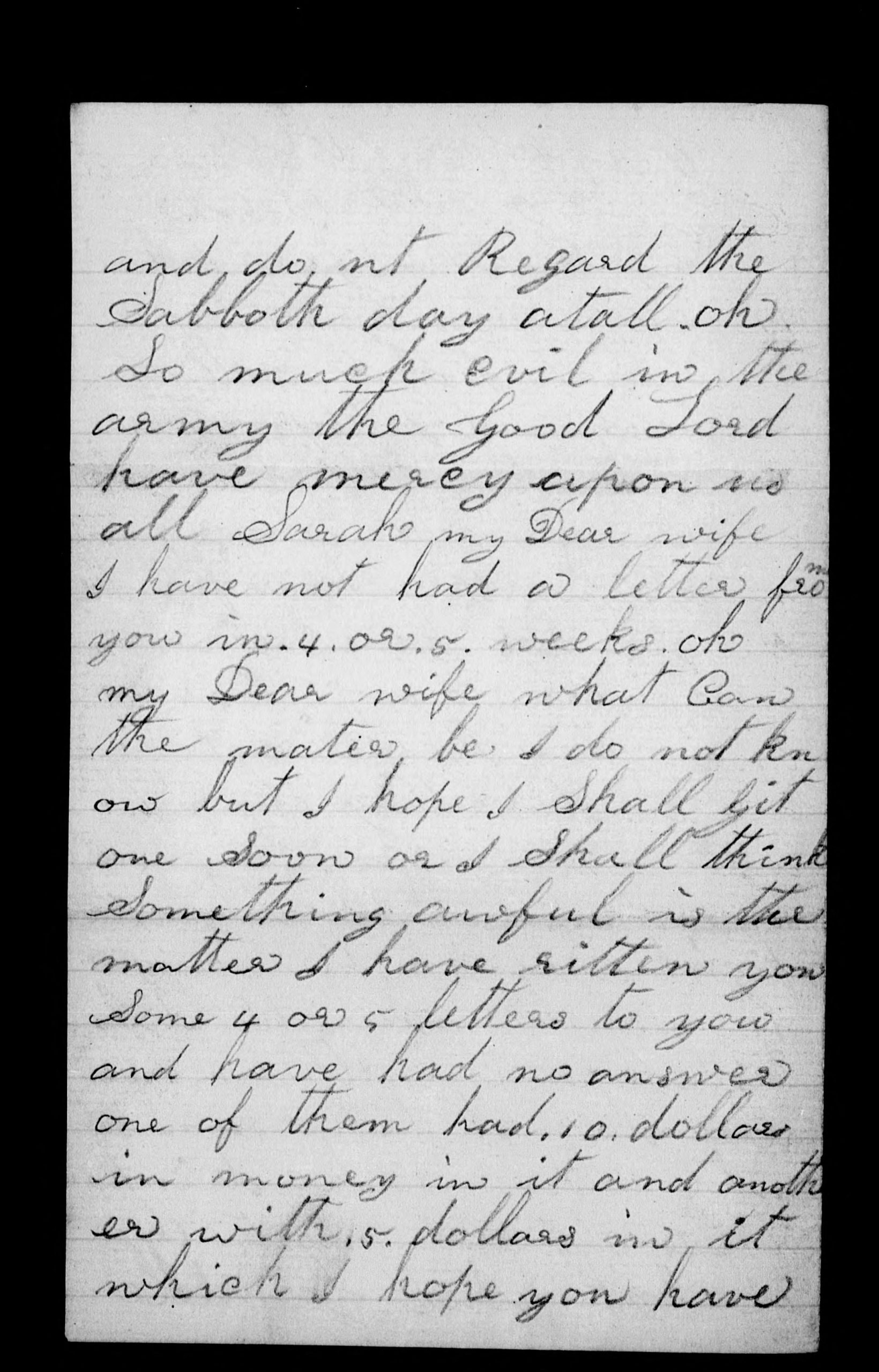
The whole page, transcribed
and dont Regard the Sabboth day at all oh So much evil in the army the Good Lord have mercy upon us all
Sarah my Dear wife I have not had a letter from you in 4 or 5 weeks oh my Dear wife what Can the mater be I do not know but I hope I Shall git one Soon or I Shall think Something awful is the matter
I have ritten you Some 4 or 5 letters to you and have had no answer one of them had 10 dollars in money in it and another with 5 dollars in it which I hope you have
This is published here because the other letter is. The same private, writing to the same wife in the same series, reported five months earlier that Colonel Thorp had gone home to New York with nine men to buy the regiment’s horses — the document that explains how the First New York Dragoons got mounted, and which appears elsewhere on this page. A site that carried that letter and suppressed this one would be flattering the record rather than keeping it.
How much weight it carries, honestly assessed. Benedict was a private in Company G. He was devout: he tented nine months with a Close Baptist preacher, thanked God in nearly every letter, and asked his wife for her prayers. The complaint he makes here is not aimed at Thorp alone — it runs straight on into the officers most all drink and Gamble and dont Regard the Sabboth day. It is a religious man’s indictment of army manners, with his colonel named as the nearest instance.
It should also be weighed against the man’s own habit of judgement. In July 1863 Benedict wrote that he hoped Captain Brundage would never rejoin the company, calling him a drinking, swearing, quick-tempered fellow whom the company mostly hated — and ten days later was applying to that same captain for a furlough and recording that he would do all he could. Benedict’s first impressions were strongly felt and did not always last.
What it does not do is touch Thorp’s record as a soldier. He was wounded five times with this regiment, commanded it, and certified its roster at muster-out in 1865. Officers who drank were the rule rather than the exception in the Army of the Potomac, and Benedict says as much in the same breath. The letter records what some of the men in the ranks thought of their colonel in the winter of 1864. That is all it records, and it is worth having.
The full run of Benedict’s letters, transcribed page by page, is on his own page. He was shot at Todd’s Tavern on 7 May 1864 and died of the wound on 25 May.
Source. Benedict, G. D. (1863–1864). George D. Benedict Papers (Collection #4943-z). Southern Historical Collection, Louis Round Wilson Special Collections Library, University of North Carolina at Chapel Hill.
From the Regimental Register
The regiment’s own record of Thomas J. Thorp, as printed in Bowen’s history of the First New York Dragoons.
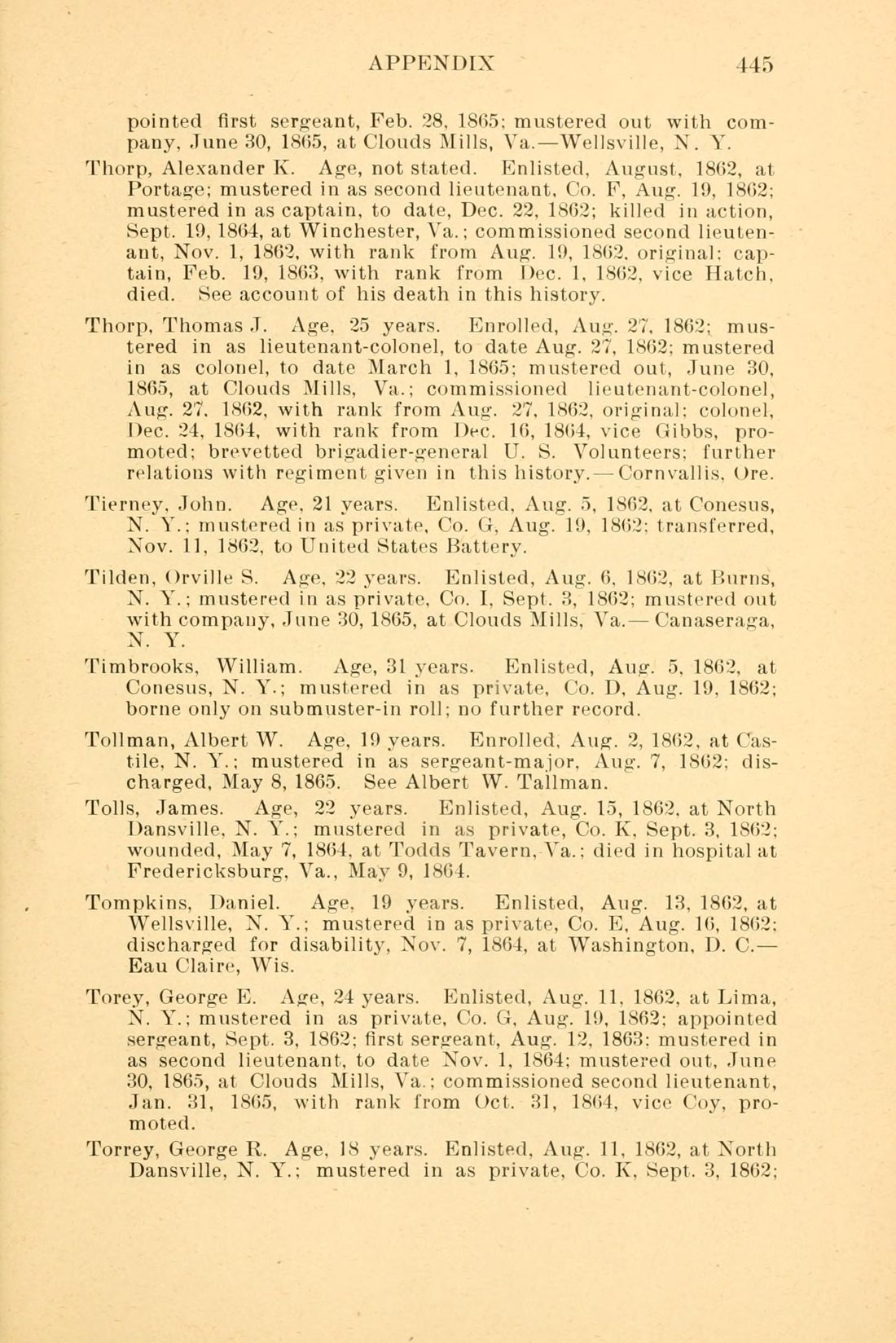
His entry as printed on page 445 of the regimental history. Click to enlarge.
“Thorp, Thomas J. Age, 25 years. Enrolled, Aug. 27, 1862; mustered in as lieutenant-colonel, to date Aug. 27, 1862; mustered in as colonel, to date March 1, 1865; mustered out, June 30, 1865, at Clouds Mills, Va.; commissioned lieutenant-colonel, Aug. 27, 1862, with rank from Aug. 27, 1862, original; colonel, Dec. 24, 1864, with rank from Dec. 16, 1864, vice Gibbs, promoted; brevetted brigadier-general U. S. Volunteers; further relations with regiment given in this history.—Cornvallis, Ore.”
Source. Bowen, J. R. (1900). Regimental history of the First New York Dragoons (originally the 130th N. Y. Vol. Infantry) during three years of active service in the great Civil War (p. 445). Author. archive.org/details/regimentalhistor00bowe
Views: 73