First New York Dragoons · A Primary-Source Finding
Furnish Half the Horses
How a foot regiment bought its way onto horseback, told in the words of the men who would ride them.
Watch · the finding in three minutes, told in the documents’ own words
One sentence in a regimental history explains how the 130th New York became cavalry. For more than a century it stood on the authority of that single book, published in 1900, long after the war it described. The claim was that the War Department set a price on the change: the regiment could turn into cavalry only if it found half of its own horses. This page shows that the price was real, because the men of the regiment wrote it down themselves while it was happening.
The regimental history records that the transfer to cavalry was offered on one condition, that the regiment furnish half the horses. That account was written in 1900 by a veteran looking back. It is now confirmed by the ranks in real time. Three letters sent home in June and August 1863, and printed at once in the soldiers’ own county newspapers, state the same bargain independently of the book. A fourth letter, a private one that never saw print, names the officer who rode home to buy the animals and the nine men he took with him.
A claim that rested on one book
The standard account is James R. Bowen’s regimental history. Writing near the turn of the century, Bowen set the scene at Yorktown in the summer of 1863, when papers came down from Washington.
“While at Yorktown, Colonel Gibbs received papers from Washington to the effect that if the regiment would furnish half the horses needed, the transfer to cavalry might be made. The regiment, on being called into line, quickly pledged the horses, and a dispatch was forwarded to Washington accordingly.”J. R. Bowen, Regimental History of the First New York Dragoons, p. 85 (1900).
It is a clean story, but it comes to us secondhand and thirty-seven years late. A regiment does not remember its own paperwork that precisely across a generation. The question is whether anyone said the same thing at the time. They did, in the documents below.
The documents: the ranks, in real time
Soldiers of the 130th wrote home constantly, and the papers of Livingston, Wyoming, and Allegany counties printed their letters as news. Three of those letters, written weeks and months before the transfer was final, name the horse bargain plainly. They survive as transcriptions in the New York State Military Museum’s clipping archive, linked beneath each document; the original newspaper pages are held at NYS Historic Newspapers. The first, from Yorktown, describes the very roll call Bowen mentions.
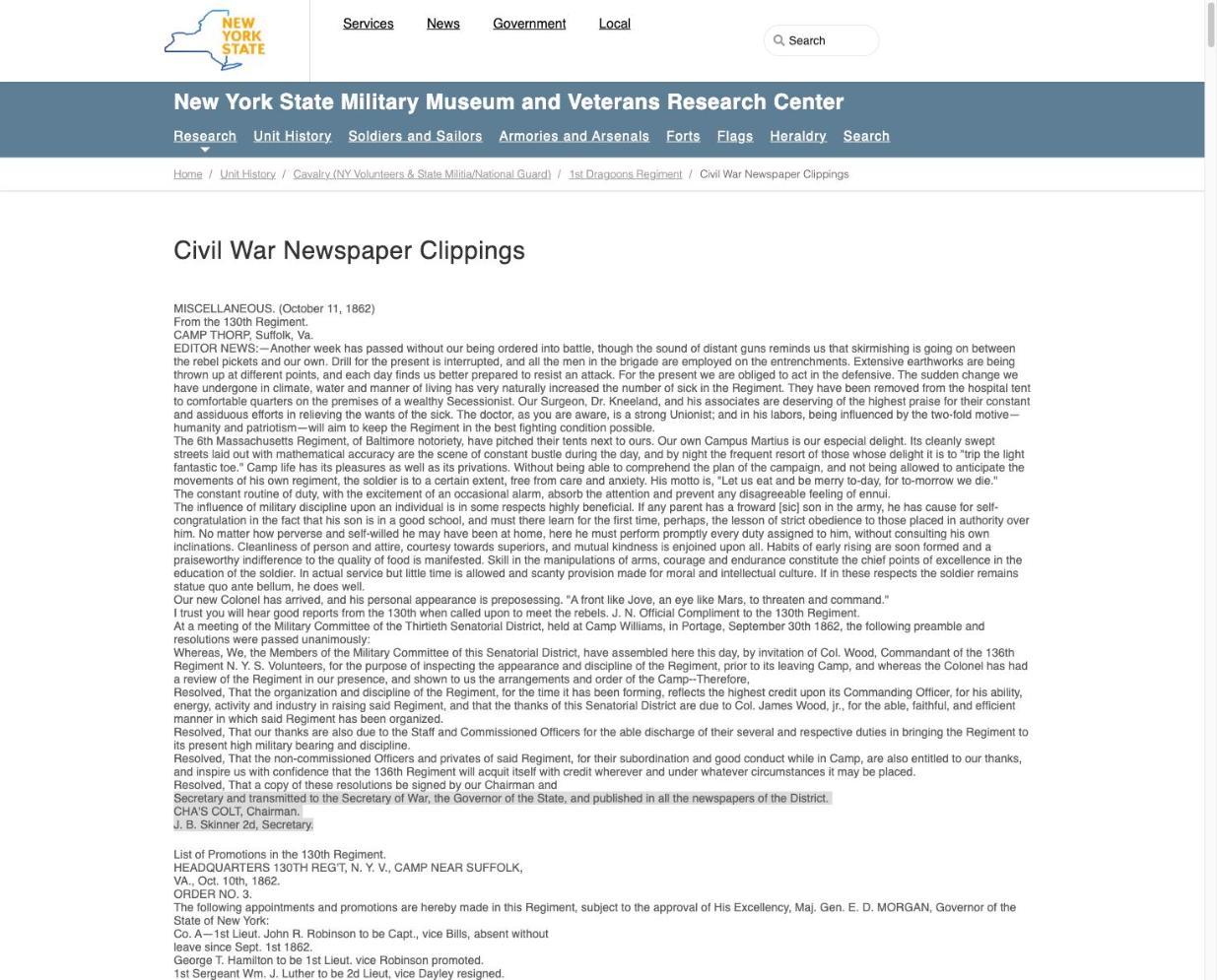
These soldier letters reach us through the New York State Military Museum’s clipping archive, the page shown above. That archive publishes the letters as modern transcriptions, not as images of the original 1863 newspapers. We reproduce the museum’s transcriptions below as evidence, and we say so plainly: we trust this state archive, but we have not independently verified its transcriptions against the original papers. We trust; we did not verify. The search for the original newspaper pages, held at NYS Historic Newspapers, is under way, and each document here will be upgraded to a scan of the original as it is found.
“Our Regiment were called into line this morning, to see how many of us could furnish our own horses for Cavalry; about all agreed to. All that is wanted now to change us to the Cavalry service, is horses, the Government agreed to furnish some, and we the rest.”
The second states the terms as a fraction, in the exact words Bowen would use decades later. It is the single most important document on this page: a private in Company A wrote Bowen’s sentence for him, in the field, more than a month before the order came.
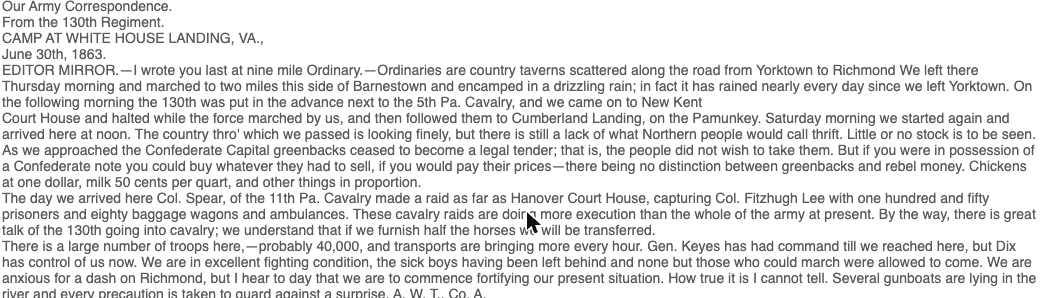
“By the way, there is great talk of the 130th going into cavalry; we understand that if we furnish half the horses we will be transferred.”
The third, written the morning the change became official, records how the horses would actually be handled: gathered by the men, delivered to a rendezvous back home, appraised by one of their own, and paid for in cash by the government.
“This morning Col. Gibbs came from Washington, and our Regiment is now a Cavalry Reg’t instead of Infantry. … We are to furnish our horses and the Government take them off our hands at the place of rendezvous—probably Portage or Elmira,—where they are to be apprized and the Government pays the cash there. The apprizer is to be from our Reg’t.”
Those three notes were not a memory. They were the thing the men were talking about while they waited, set down in ink and printed in their home papers within days.
“Colonel Thorp has gone to York State”
The most vivid account of the errand is the one that never reached a newspaper. Private George D. Benedict of Company G wrote to his wife Sarah from Manassas Junction on August 8, 1863. He had no reason to invent the number of men or the delivery point. He was simply explaining to her why the regiment was standing still.
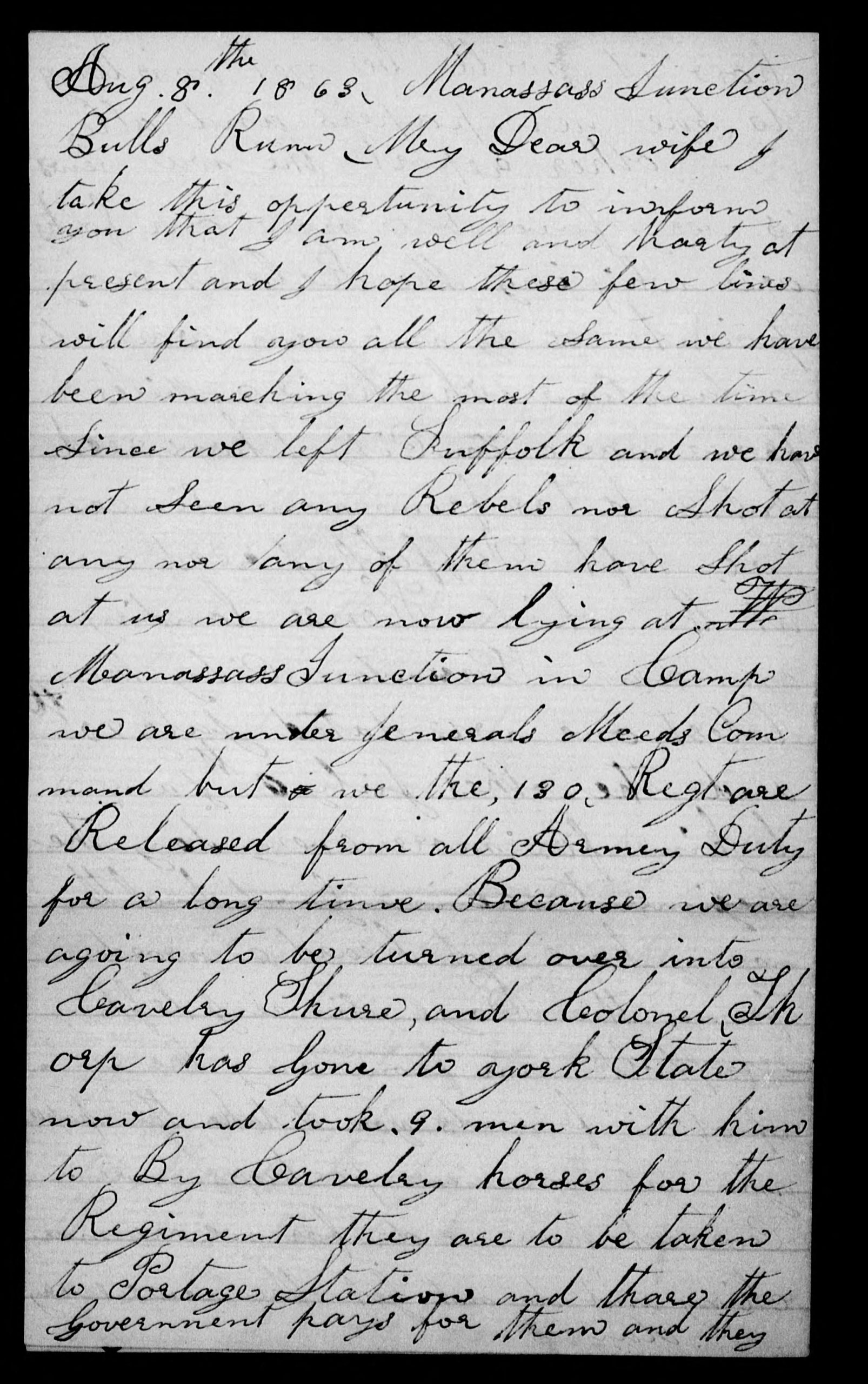
Aug 8th 1863 Manassass Junction Bulls Run
My Dear wife I take this oppertunity to inform you that I am well and harty at present and I hope these few lines will find you all the Same
we have been marching the most of the time Since we left Suffolk and we have not Seen any Rebels nor Shot at any nor any of them have Shot at us we are now lying at Manassass Junction in Camp
we are under Generals Meeds Command but we the 130 Regt are Released from all Army Duty for a long time Because we are agoing to be turned over into Cavelry Shure,
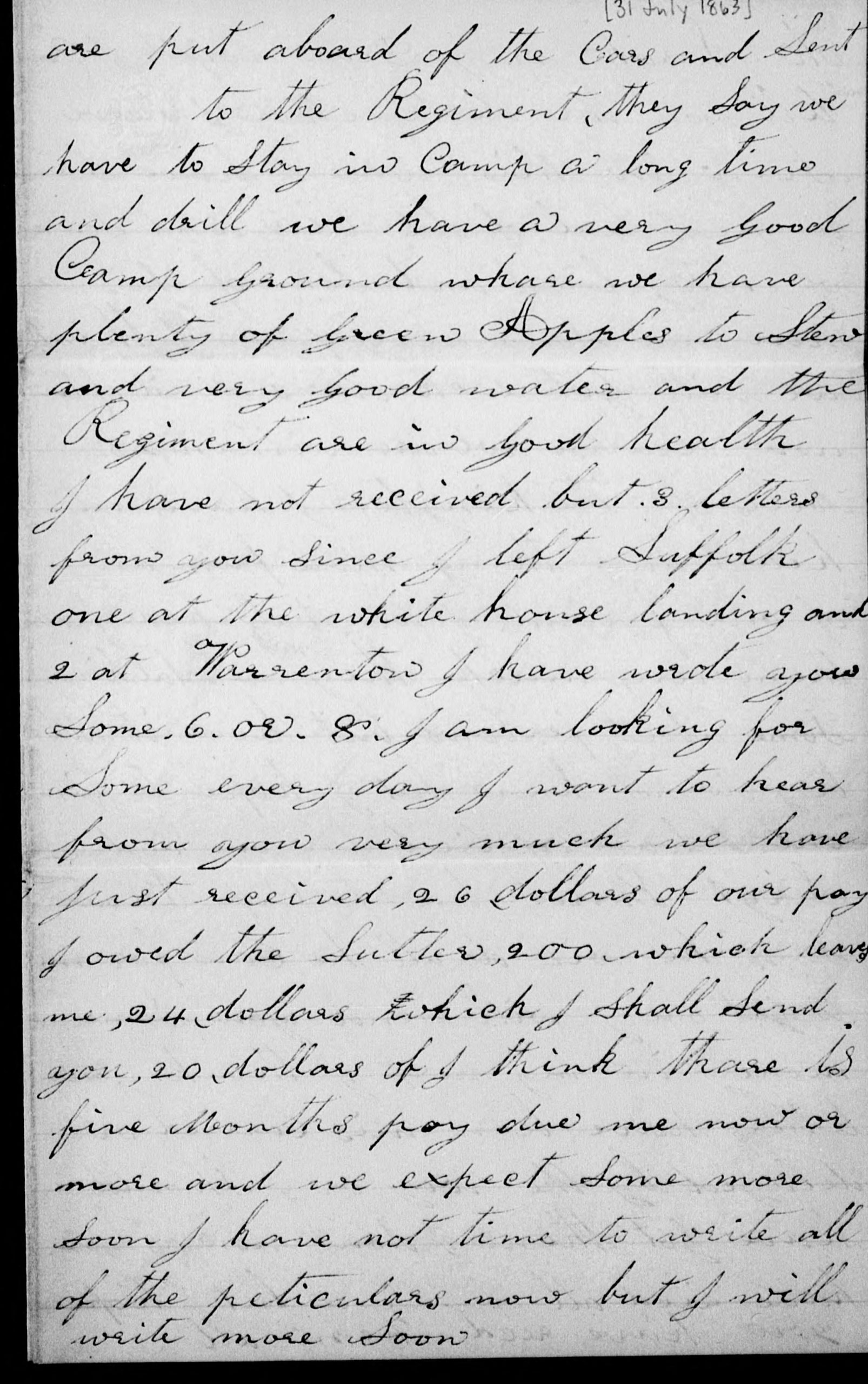
and Colonel Thorp has gone to York State now and took 9 men with him to By Cavelry horses for the Regiment they are to be taken to Portage Station and thare the Government pays for them and they are put aboard of the Cars and Sent to the Regiment,
they Say we have to Stay in Camp a long time and drill we have a very good Camp ground whare we have plenty of green Apples to Stew and very good water and the Regiment are in good health
I have not received but 3 letters from you Since I left Suffolk one at the white house landing and 2 at Warrenton I have wrote you Some 6 or 8 I am looking for Some every day I want to hear from you very much
we have just received 26 dollars of our pay I owed the Sutler 2.00 which leavs me 24 dollars which I Shall Send you 20 dollars of I think thare is five Months pay due me now or more and we expect Some more Soon
I have not time to write all of the peticulars now but I will write more Soon
The government’s own order
The soldiers’ letters are the evidence for the bargain. The federal government’s own paperwork is the evidence that the bargain was carried out. Five days after the War Department converted the regiment, the Army of the Potomac entered the order below in its order book, scanned here from the original at the National Archives. It does not state the half condition, but in the government’s own hand it names both the order that carried it, War Department Special Orders No. 335, and the horses themselves: the regiment is to form a camp of instruction “for the purpose of being reorganized and receiving its horses, arms and equipments.” These are the “papers from Washington” the men had been writing about all summer.
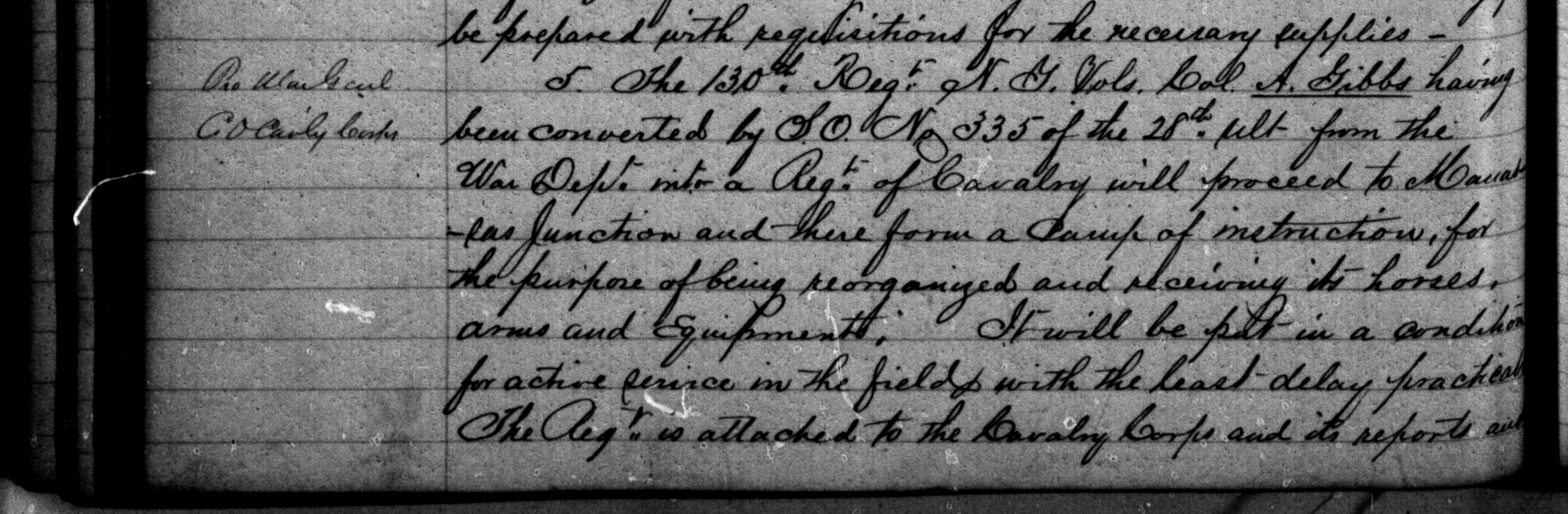
“The 130th Reg’t N.Y. Vols., Col. A. Gibbs, having been converted by S.O. No. 335 of the 28th ult. from the War Dep’t into a Reg’t of Cavalry, will proceed to Manassas Junction and there form a camp of instruction, for the purpose of being reorganized and receiving its horses, arms and equipments; it will be put in a condition for active service in the field with the least delay practicable. The Reg’t is attached to the Cavalry Corps, and its reports and returns will hereafter be rendered accordingly.”
By command of Major-General Meade; S. Williams, Assistant Adjutant-General. Transcribed from the order-book manuscript above; Bowen’s 1900 printing gives the same order but drops the word “horses.”
Who went home for the horses
Several notices in the home papers name the party and its orders. The regiment did not wait for the army to supply mounts. It sent officers back to the Genesee Valley to buy them. In these first weeks the papers had not settled on a number for the new command, calling it the 17th Cavalry before Governor Seymour fixed it as the 19th.
“Lieut.-Col. THORP, Capts. ROBINSON and SMITH, and a detail of non-commissioned officers of the 17th Cavalry (late 130th infantry) are at home for the purpose of getting men and horses for their Reg’t. Two companies of 100 men each and 500 good horses are wanted. … The officers offer good inducements to volunteers, and will pay from $125 to $160 for horses.”
A second notice confirms the buying order and its size: Captain H. M. Smith “returned with ample orders for recruiting two hundred men and purchasing five hundred horses for his Reg’t.” A third, from Perry, fixes the rendezvous exactly where Benedict said the animals would go, reporting that Captain John P. Robinson of Company A was “engaged in procuring horses for the same, to rendezvous at Portage,” and was “ordered to take charge of drafted men at Elmira.”
So the officer Benedict named, Colonel Thorp, went north with Captains Robinson and Smith and a detail of enlisted men. They carried orders to buy hundreds of horses at up to $160 a head, to be gathered at Portage Station and shipped south by rail to the waiting regiment. The nine men Benedict counted were the working end of that errand.
| Dragoon | Rank & company, 1863 | Home | Reported doing |
|---|---|---|---|
| Thomas J. Thorp | Lieut.-Colonel, commanding the detail | — | home “for the purpose of getting men and horses” |
| John P. Robinson | Captain, Co. A | Perry | “engaged in procuring horses … to rendezvous at Portage” |
| Howard M. Smith | Captain, soon Major, Co. B | Mount Morris | “ample orders … purchasing five hundred horses” |
| Justin Smith, Jr. | Sergeant, Co. B | Mount Morris | “returns with Capt. Smith … on business connected with this Regiment” |
| Albert W. Tallman | Private, Co. A | Perry | “accompanied Capt. Robinson” home |
What “furnish half” meant
The documents agree on the shape of the deal and correct a natural misreading of it. The regiment’s obligation was to find half the horses, not to pay for them. The government agreed to supply some from army stock; the regiment supplied the rest, partly through troopers who pledged their own mounts and partly through the buying detail. When the animals reached the rendezvous they were appraised by a man from the regiment, and, as both Holton and Benedict say in almost the same words, the government paid the cash. To furnish half the horses was a burden of procurement, of riding home and finding good animals in a wartime market, more than a burden on the men’s own purses.
The open question, and what the archives hold
What no government document yet settles is the final accounting. We searched for one. The published Official Records do not print the horse terms; the War Department order that carried them, Special Orders No. 335, survives only in manuscript in Record Group 94 and has not been digitized; the digitized “Special Orders, 1863” in the National Archives catalog belong to the Confederate government, not the Union War Department, and are not this order. The one federal record that would price the bargain, the Quartermaster’s purchase vouchers for the horses gathered at Portage, is held undigitized in Record Group 92. A search of the National Archives catalog, the Official Records, and Fold3 turns up no online federal document that values the deal. Recovering it means an ordered or on-site pull from those two record groups, and it would turn a proven bargain into a settled ledger.
Sources. Regimental account: J. R. Bowen, Regimental History of the First New York Dragoons (originally the 130th N. Y. Vol. Infantry), 1900, p. 85; read by chapter at Regimental History by Chapter. Soldiers’ letters of June 21, June 30, and August 1, 1863, and the recruiting notices of August 1863, reprinted from the Livingston, Wyoming, and Allegany county press in New York State Military Museum and Veterans Research Center, Civil War Newspaper Clippings, 1st Dragoons Regiment (museum.dmna.ny.gov); original pages at NYS Historic Newspapers (nyshistoricnewspapers.org). Benedict letter of August 8, 1863: George D. Benedict papers, 1863–1864 (Collection No. 4943), Southern Historical Collection, Wilson Library, University of North Carolina at Chapel Hill. Conversion order: War Department Special Orders No. 335, July 28, 1863; designation as 19th New York Cavalry by Governor Horatio Seymour. Transcribed and compiled at AlfredGibbs.com, 2026.
Read the narrative of the change in How the 130th New York Became Cavalry · the soldier who wrote it home, Private George D. Benedict · the officer who bought the horses, Colonel Thomas J. Thorp.
Views: 11