Private George D. Benedict
Private George D. Benedict
George D. Benedict of Amity, New York, enlisted in Company G of the regiment that became the First New York Dragoons, originally the 130th New York Volunteer Infantry, in August 1862, at the age of 42. He died of wounds received at Todd’s Tavern.
Every one of the letters below has been read in full and woven into a single narrative: the man before the war, the chaplain his officers forbade, the men he named, and the deaths the roster never recorded. Bowen gives the regiment its memory; Benedict gives it its pulse.
Read the storyThe Service Record
Enlisted: August 1862, at Amity, N.Y.; age 42.
Company: Company G, 130th New York Volunteers → First New York Dragoons.
Rank: Private.
Fate: Died in service.
Source: New York Adjutant-General’s register of the First New York Dragoons; Bowen, J. R. (1900). Regimental History of the First New York Dragoons.
From the Regimental Register
“George D. Benedict. Mustered in as Private, Co. G, Aug. 13, to serve three years; wounded, May 7, as Todd’s Tavern, Va.; died of such . wounds, May 25, 1864.”
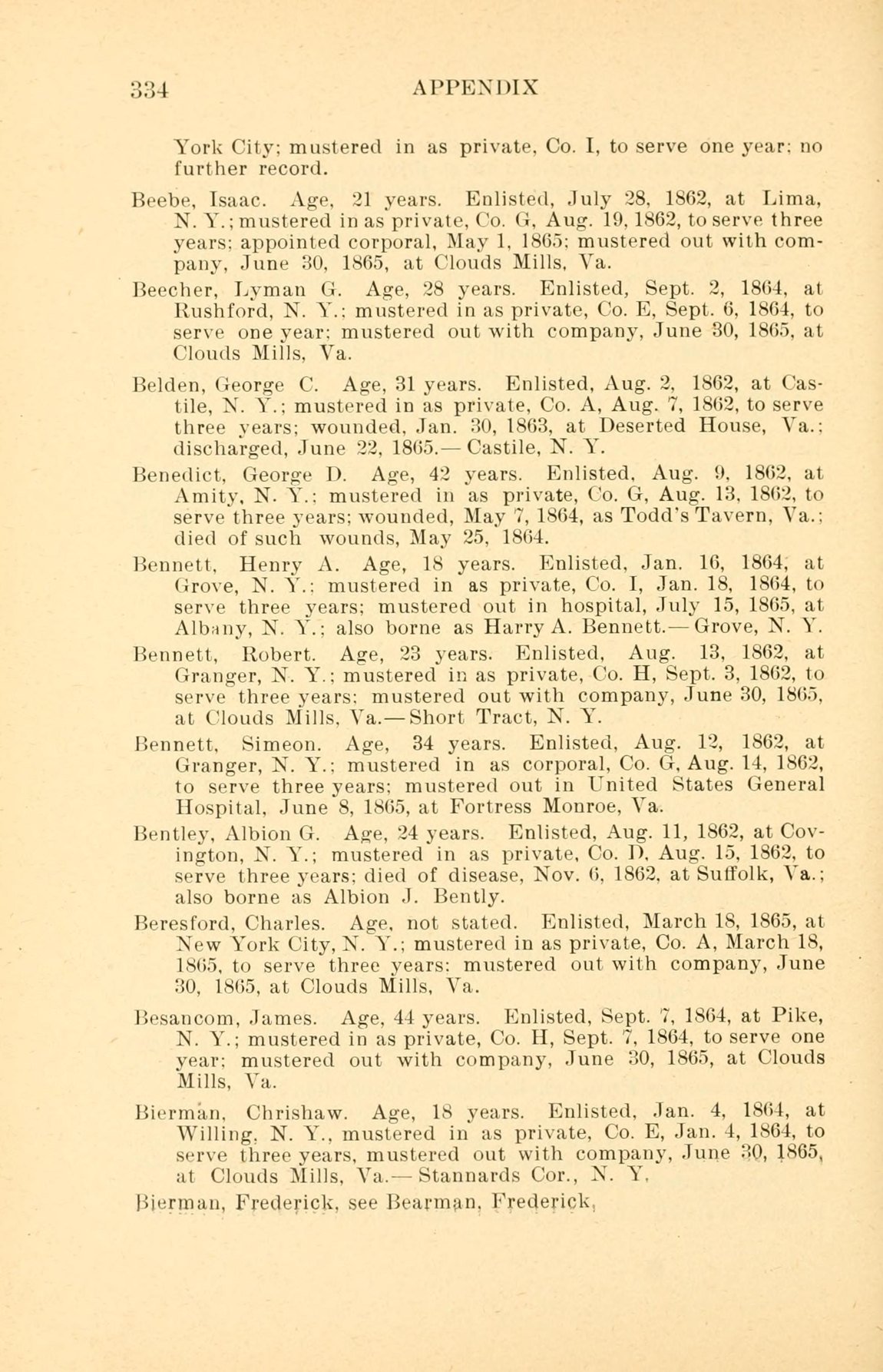
Verbatim from the roster of the First New York Dragoons in the New York Adjutant-General’s report. The page reproduced above is from Bowen, J. R. (1900). Regimental History of the First New York Dragoons (originally the 130th N.Y. Vol. Infantry) (p. 334). Internet Archive. archive.org/details/regimentalhistor00bowe
Terms on this page, from brevet and mustered out to the classes of the Roll of Honor, are defined in the site Glossary.
The Pension File of his Widow
The claim and its proofs
13 sheetsThe Pension Bureau’s brief, no. 53,251Sheet 1
Printed Pension Bureau brief form, completed in manuscript; pencilled “Can” and “H” in the left margin; certificate number “53,251” written large at the head.
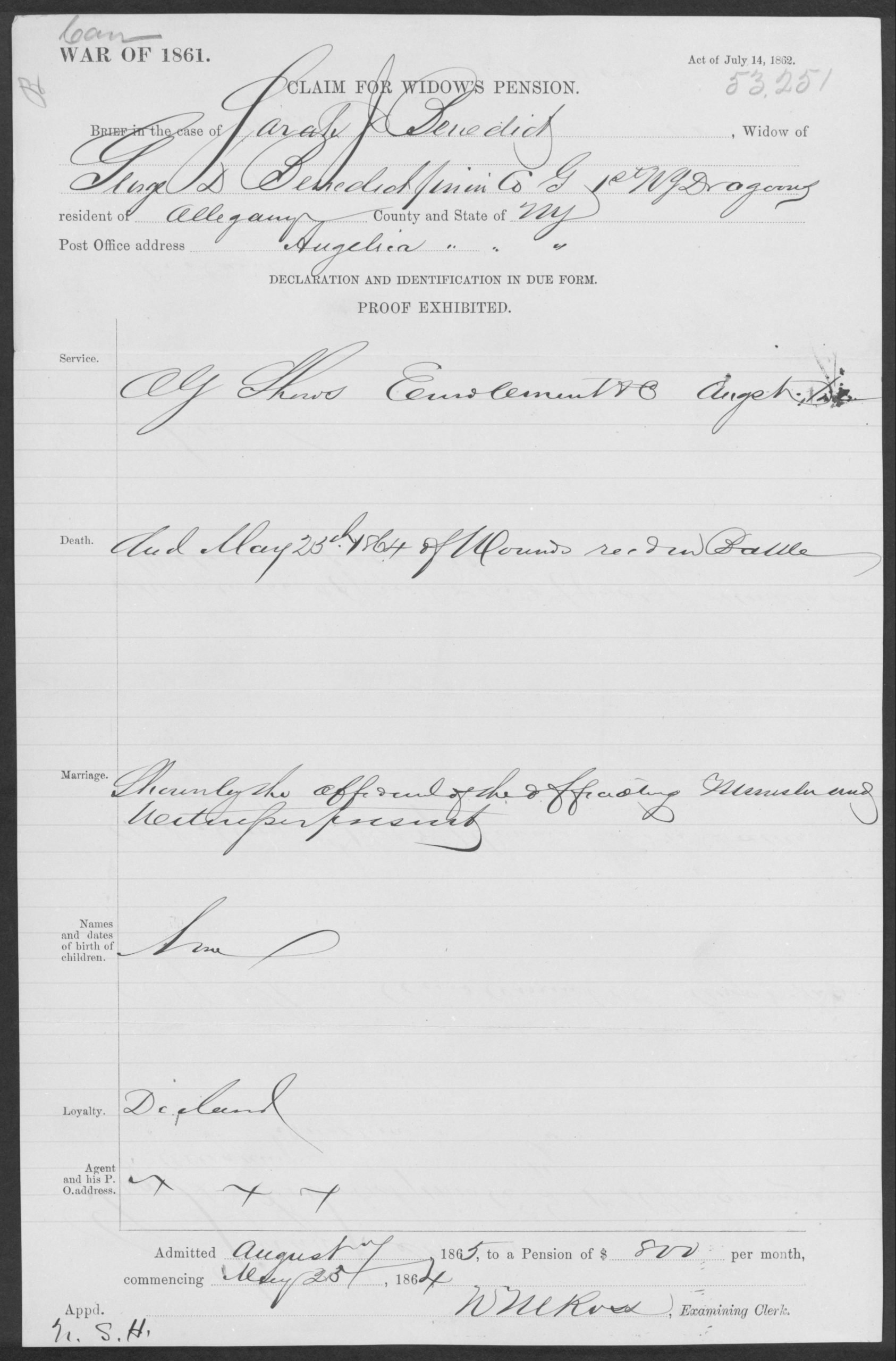
WAR OF 1861. Act of July 14, 1862.
CLAIM FOR WIDOW’S PENSION.
Brief in the case of Sarah J. Benedict, Widow of
Geo. D. Benedict, Priv. in Co. “G” 1st N.Y. Dragoons
resident of Allegany County and State of N.Y.
Post Office address Angelica ” ” “
DECLARATION AND IDENTIFICATION IN DUE FORM.
PROOF EXHIBITED.
Service. A.G. shows enrolment &c August [1862]
Death. And May 23d 1864 of wounds rec’d in battle
Marriage. Shown by the affidavit of the officiating minister and witness present
Names and dates of birth of children. None
Loyalty. Dispensed [with]
Agent and his P.O. address. [three pen strokes]
Admitted August 7, 1865, to a Pension of $8.00 per month,
commencing May 23d, 1864.
W. H. Ross, Examining Clerk.
Appd. N. S. H.
Widow’s Declaration, sworn 9 January 1865Sheet 2
Widow’s declaration in a clerk’s hand; the month “November” is struck through and “January” written above it, so the paper was drafted in the autumn and sworn in the new year.
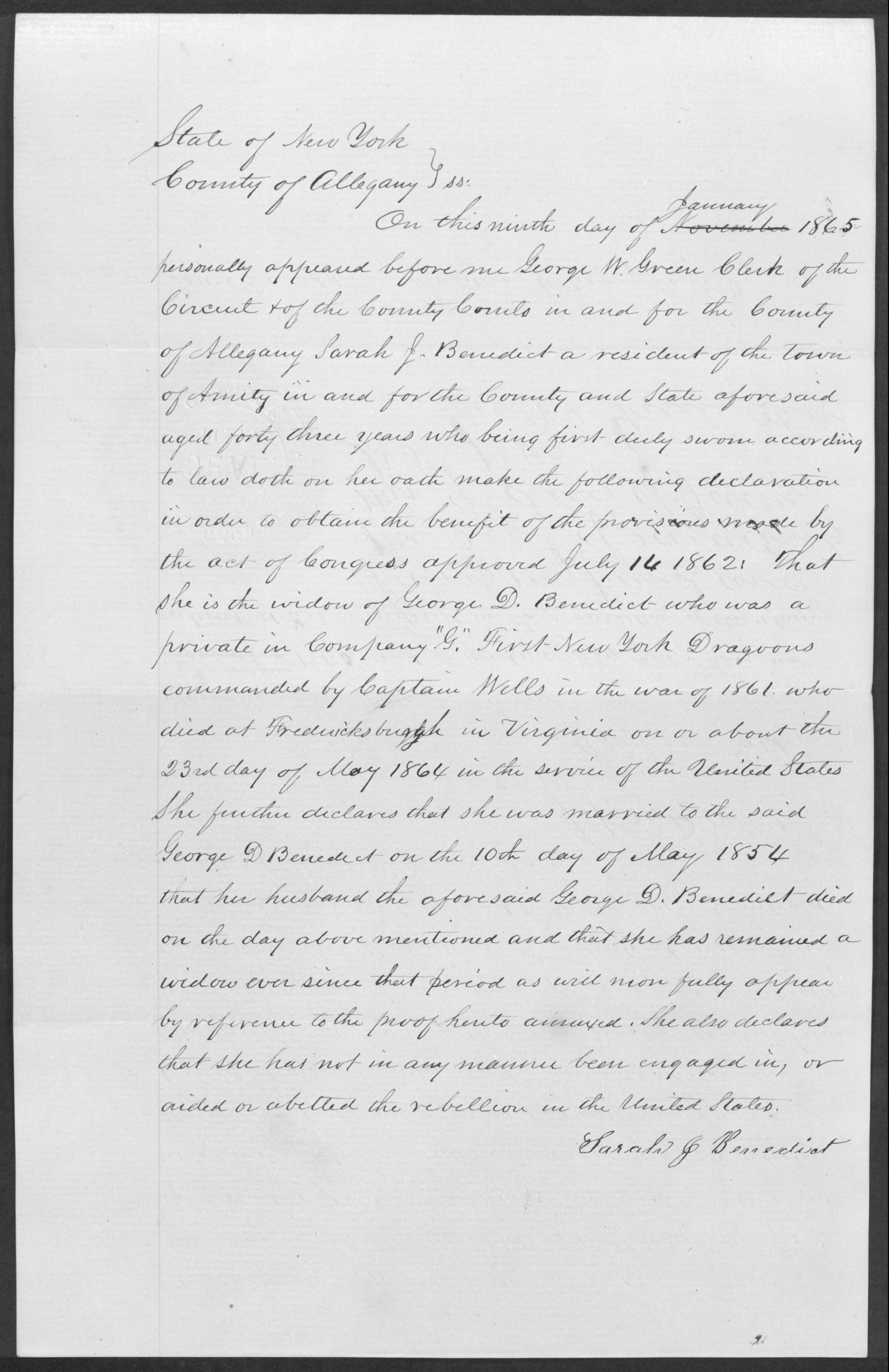
State of New York
County of Allegany } ss.
On this ninth day of January 1865 personally appeared before me George W. Green Clerk of the Circuit & of the County Courts in and for the County of Allegany Sarah J. Benedict a resident of the town of Amity in and for the County and State aforesaid aged forty three years who being first duly sworn according to law doth on her oath make the following declaration in order to obtain the benefit of the provisions made by the act of Congress approved July 14 1862: That she is the widow of George D. Benedict who was a private in Company “G” First New York Dragoons commanded by Captain Wells in the war of 1861. who died at Fredericksburgh in Virginia on or about the 23rd day of May 1864 in the service of the United States She further declares that she was married to the said George D Benedict on the 10th day of May 1854 that her husband the aforesaid George D. Benedict died on the day above mentioned and that she has remained a widow ever since that period as will more fully appear by reference to the proof hereto annexed. She also declares that she has not in any manner been engaged in, or aided or abetted the rebellion in the United States.
Sarah J Benedict
The identifying witnesses and the county sealSheet 3
Second leaf of the declaration, carrying the identifying witnesses and the county seal.
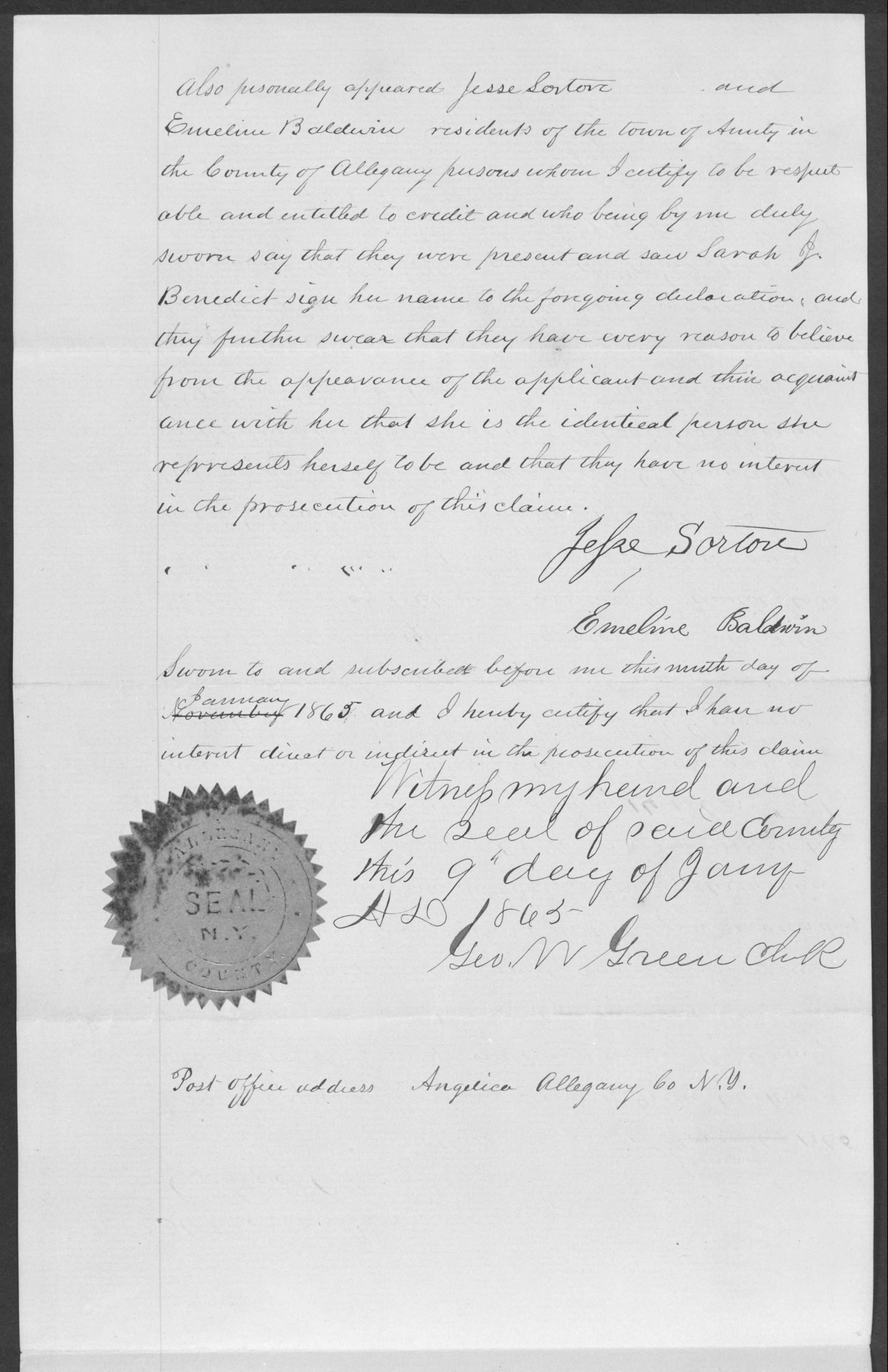
Also personally appeared Jesse Sorton and Emeline Baldwin residents of the town of Amity in the County of Allegany persons whom I certify to be respectable and entitled to credit and who being by me duly sworn say that they were present and saw Sarah J. Benedict sign her name to the foregoing declaration, and they further swear that they have every reason to believe from the appearance of the applicant and their acquaintance with her that she is the identical person she represents herself to be and that they have no interest in the prosecution of this claim.
Jesse Sorton
Emeline Baldwin
Sworn to and subscribed before me this ninth day of January 1865 and I hereby certify that I have no interest direct or indirect in the prosecution of this claim Witness my hand and the Seal of said County this 9th day of Jany A.D. 1865 –
Geo. W. Green Clerk
Post Office address Angelica Allegany Co N.Y.
Duplicate of the witnesses’ certificate, stamped 14 January 1865Sheet 4
The same witnesses’ certificate again, the sheet broken off below the jurat; the Pension Office receipt stamp is struck on the reverse, upside down: DEPARTMENT OF THE INTERIOR / PENSION OFFICE / JAN 14 1865.
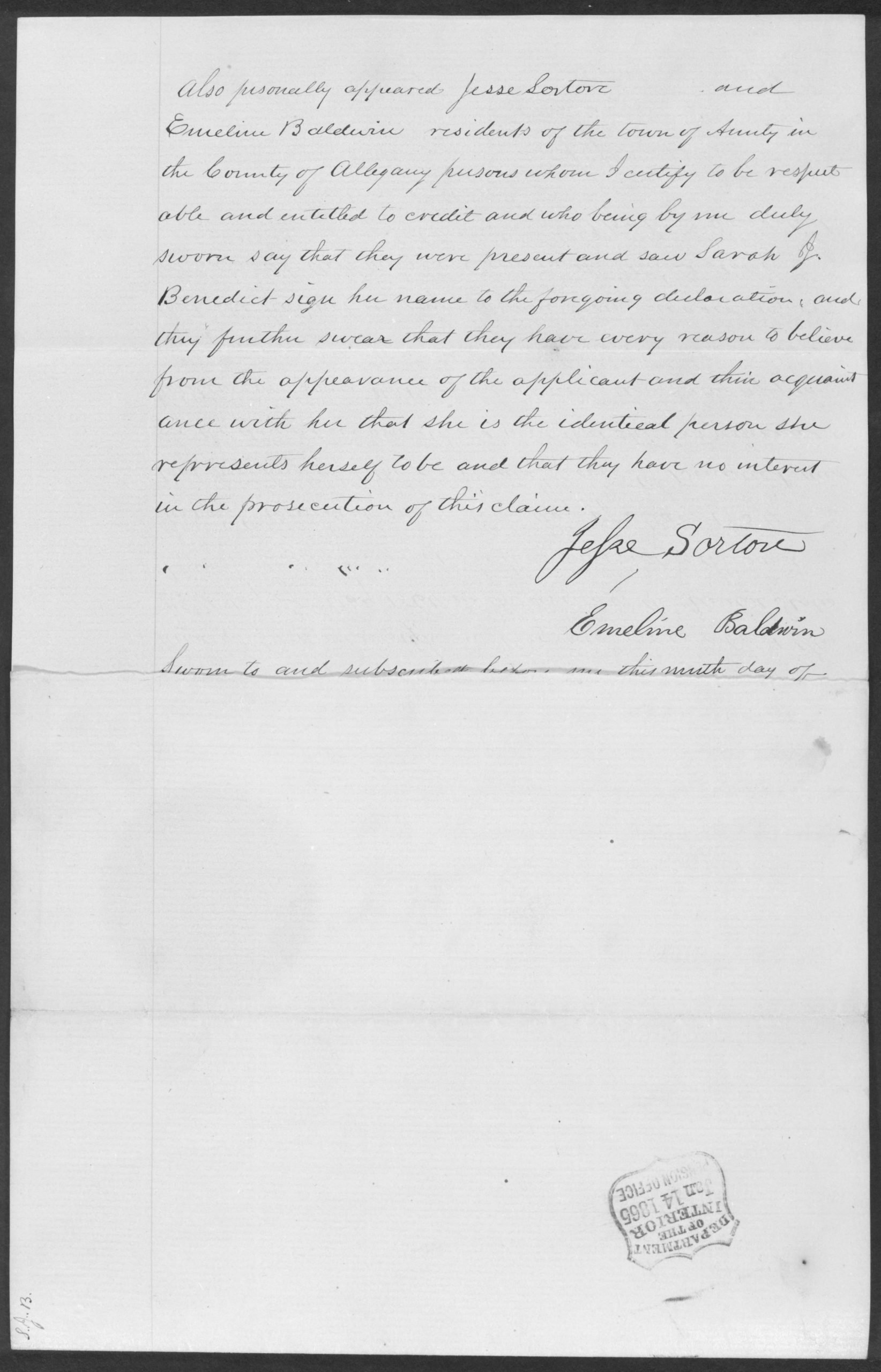
Also personally appeared Jesse Sorton and Emeline Baldwin residents of the town of Amity in the County of Allegany persons whom I certify to be respectable and entitled to credit and who being by me duly sworn say that they were present and saw Sarah J. Benedict sign her name to the foregoing declaration, and they further swear that they have every reason to believe from the appearance of the applicant and their acquaintance with her that she is the identical person she represents herself to be and that they have no interest in the prosecution of this claim.
Jesse Sorton
Emeline Baldwin
Sworn to and subscribed before me this ninth day of
The marriage certificate of 10 May 1854Sheet 8
Engraved marriage certificate on a printed blank, headed by a vignette of a wedding party; imprint at the foot: Wellstood, Benson & Hanks, New York. One corner is torn where the sheet was detached from the minister’s affidavit.
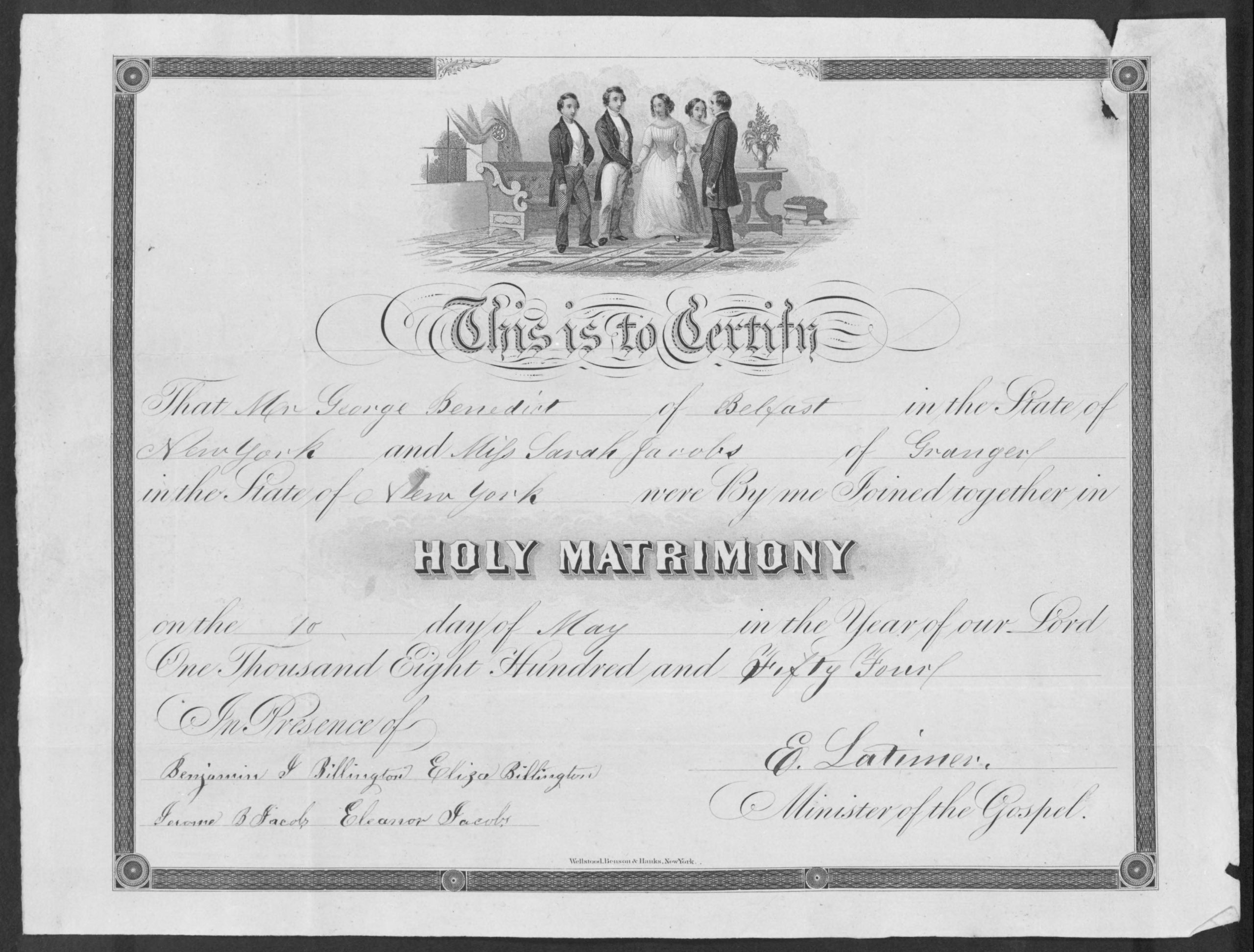
This is to Certify
That Mr George Benedict of Belfast in the State of New York and Miss Sarah Jacobs of Granger in the State of New York were By me Joined together in
HOLY MATRIMONY
on the 10 day of May in the Year of our Lord One Thousand Eight Hundred and Fifty Four
In Presence of
Benjamin J Billington Eliza Billington
Jerome B Jacobs Eleanor Jacobs
E. Latimer.
Minister of the Gospel.
Ontario County clerk’s certificate, 1 August 1865Sheet 16
Printed clerk’s certificate on a narrow slip, with the embossed seal of Ontario County at the left.
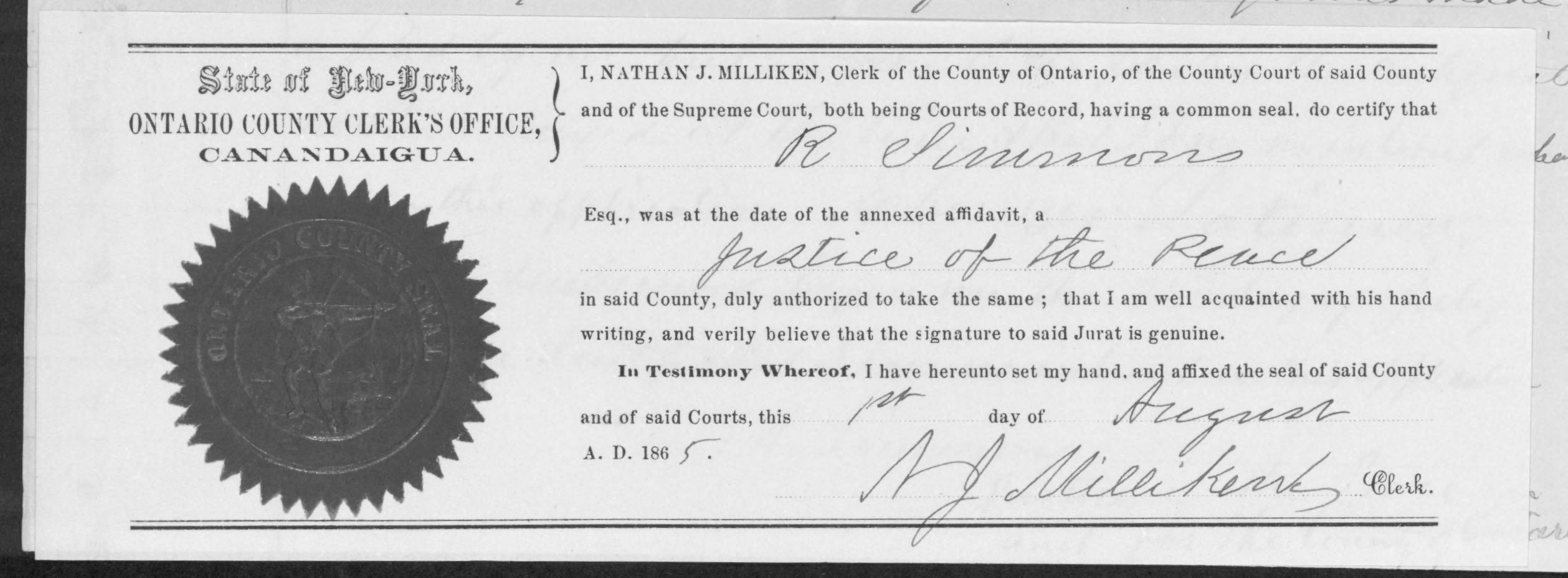
State of New-York,
ONTARIO COUNTY CLERK’S OFFICE,
CANANDAIGUA.
I, NATHAN J. MILLIKEN, Clerk of the County of Ontario, of the County Court of said County and of the Supreme Court, both being Courts of Record, having a common seal, do certify that R Simmons Esq., was at the date of the annexed affidavit, a Justice of the Peace in said County, duly authorized to take the same; that I am well acquainted with his hand writing, and verily believe that the signature to said Jurat is genuine.
In Testimony Whereof, I have hereunto set my hand, and affixed the seal of said County and of said Courts, this 1st day of August A. D. 1865.
N J Milliken, Clerk.
Affidavit of the Rev. Ebenezer Latimer, who married them, 25 July 1865Sheet 17
Affidavit of the officiating minister, written on ruled paper; the blind-embossed seal of Ontario County shows at the left edge. This is the proof of marriage the Bureau’s brief refers to.
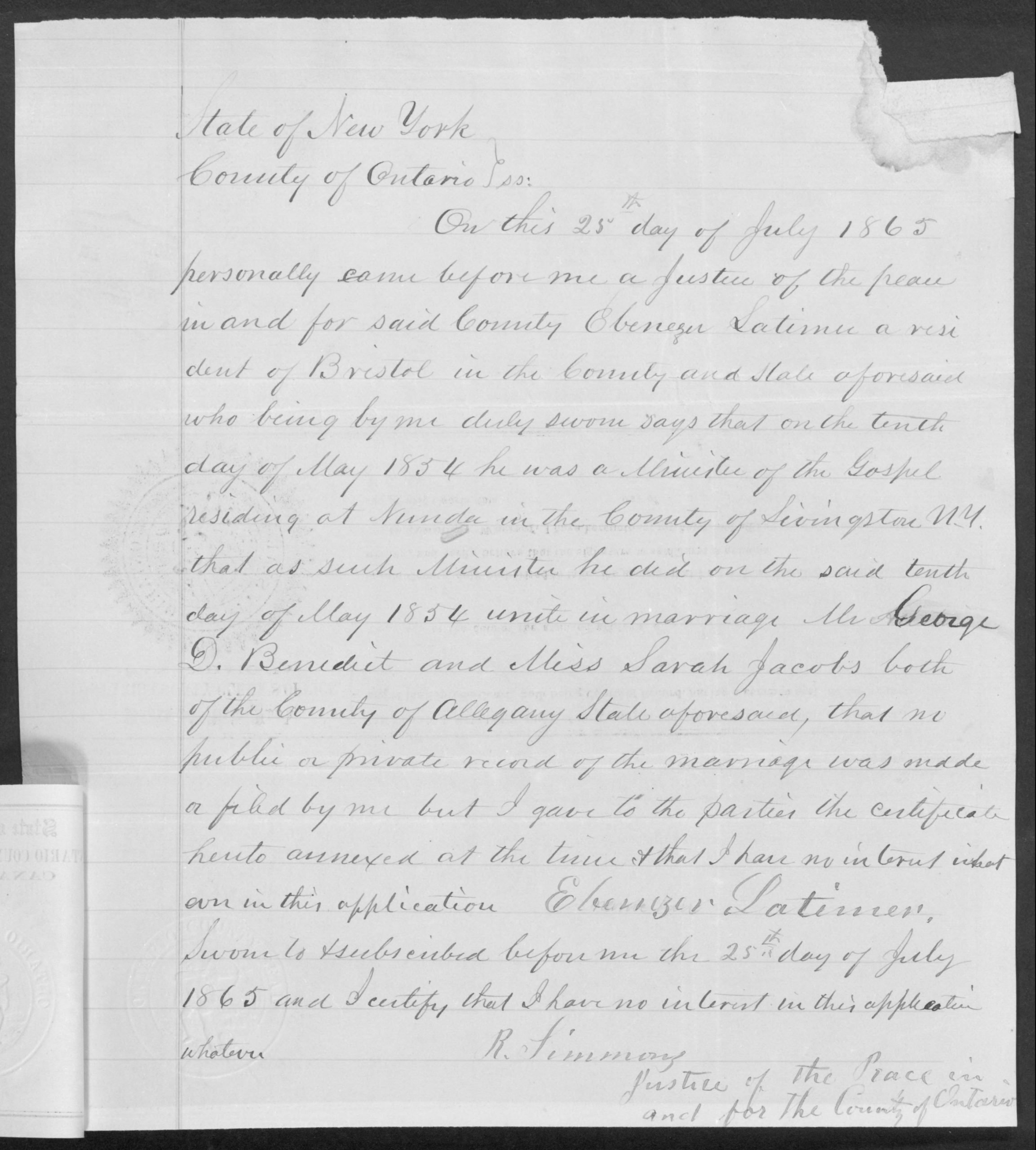
State of New York
County of Ontario } ss:
On this 25th day of July 1865 personally came before me a justice of the peace in and for said County Ebenezer Latimer a resident of Bristol in the County and State aforesaid who being by me duly sworn says that on the tenth day of May 1854 he was a Minister of the Gospel residing at Nunda in the County of Livingston N.Y. that as such Minister he did on the said tenth day of May 1854 unite in marriage Mr George D. Benedict and Miss Sarah Jacobs both of the County of Allegany State aforesaid, that no public or private record of the marriage was made or filed by me but I gave to the parties the certificate hereto annexed at the time & that I have no interest whatever in this application
Ebenezer Latimer
Sworn to & subscribed before me the 25th day of July 1865 and I certify that I have no interest in this application whatever
R. Simmons
Justice of the Peace in and for the County of Ontario
Verso and docket of the minister’s affidavitSheet 18
Verso of the minister’s affidavit, showing the text through the paper; the docket is written in pencil at the foot and the Pension Office receipt stamp struck beside it: DEPARTMENT OF THE INTERIOR / PENSION OFFICE / AUG 5 1865.
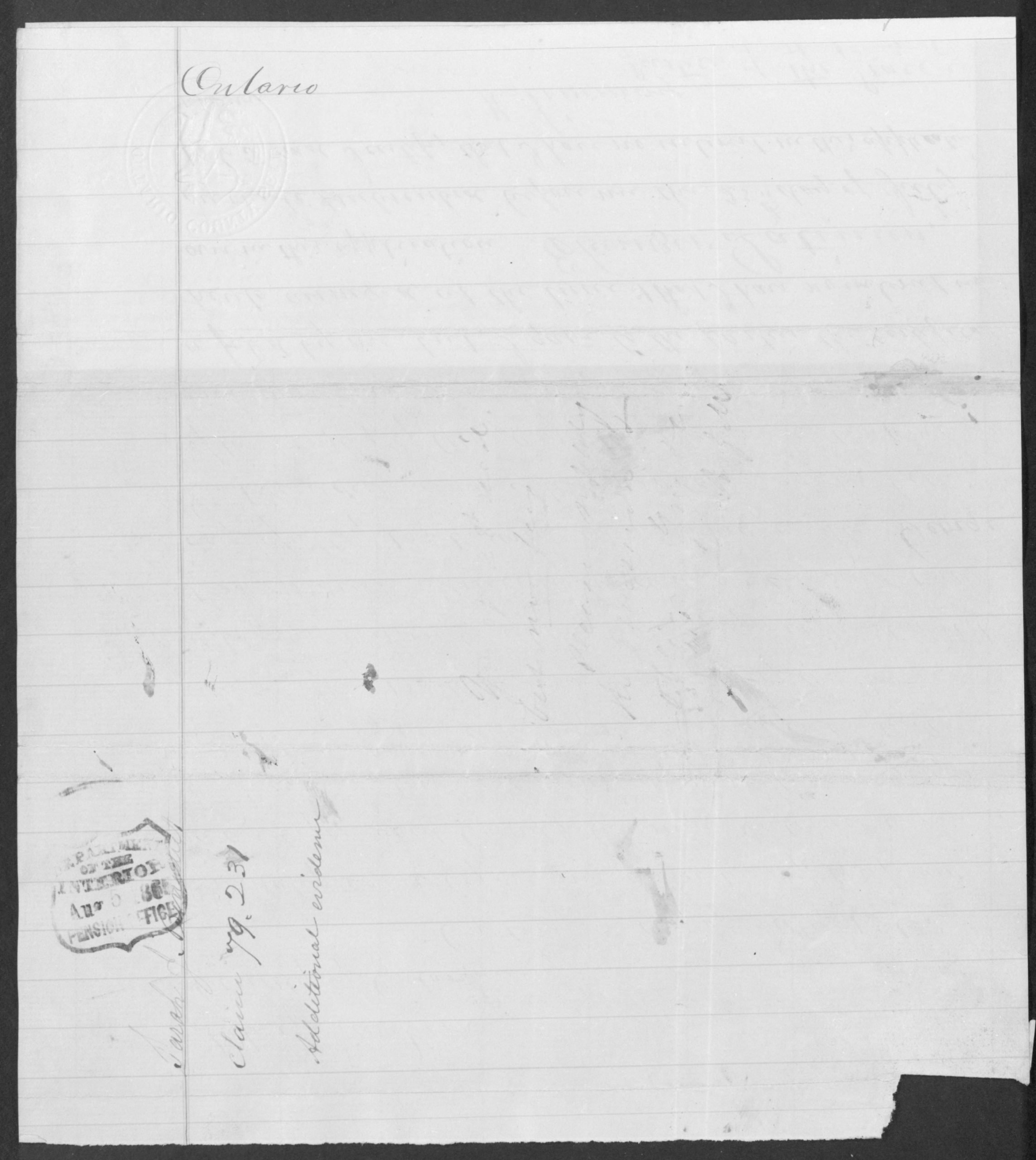
Ontario
Sarah J. Benedict
Claim 79,231
Additional evidence
Letter of Ransom Lloyd, claim agent, 7 August 1865Sheet 19
Letter of the claim agent, on ruled paper.
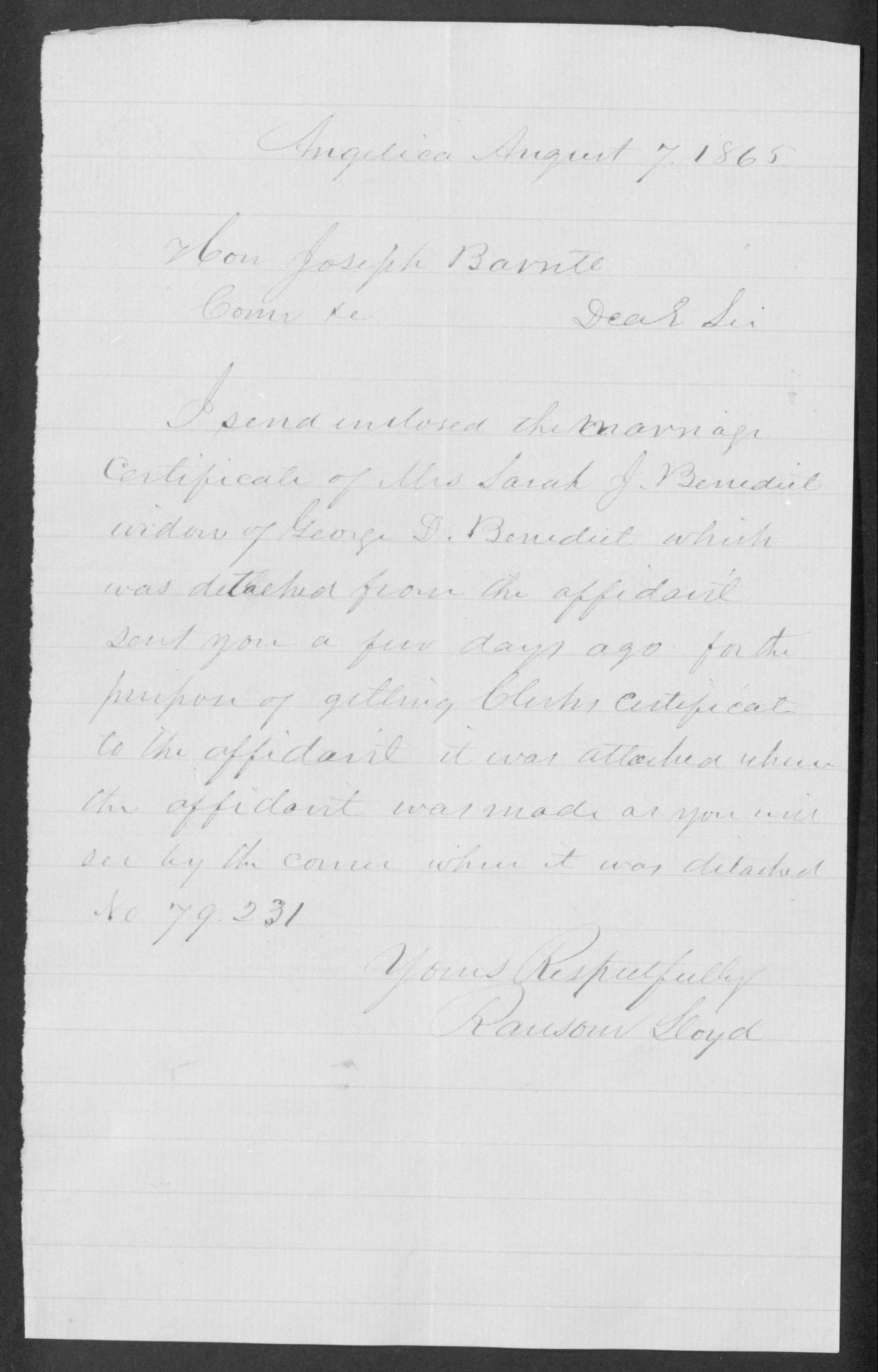
Angelica August 7. 1865
Hon Joseph Barrett
Comm &c
Dear Sir
I send inclosed the Marriage Certificate of Mrs Sarah J. Benedict widow of George D. Benedict which was detached from the affidavit sent you a few days ago for the purpose of getting Clerks certificate to the affidavit it was attached when the affidavit was made as you will see by the corner where it was detached
No 79,231
Yours Respectfully
Ransom Lloyd
Reverse of the marriage certificateSheet 20
Reverse of the engraved marriage certificate; nearly blank, with the printed heading showing through the paper and a faint pencilled signature across the lower half.
This leaf carries no text.
Allegany County clerk’s certificate, 11 March 1865Sheet 21
Printed clerk’s certificate on a narrow slip; the words “Declaration” and “Power of Attorney” are struck through, leaving “Affidavit”. The embossed county seal shows at the left.
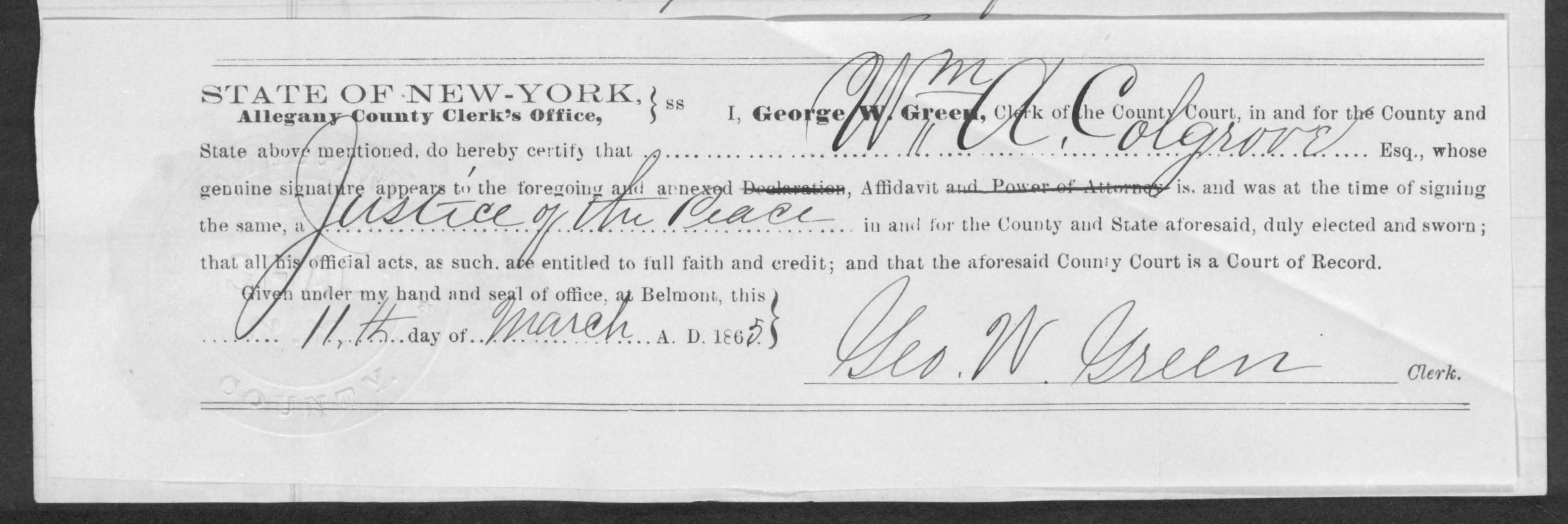
STATE OF NEW-YORK,
Allegany County Clerk’s Office, } ss
I, George W. Green, Clerk of the County Court, in and for the County and State above mentioned, do hereby certify that Wm. A. Colgrove Esq., whose genuine signature appears to the foregoing and annexed Affidavit is, and was at the time of signing the same, a Justice of the Peace in and for the County and State aforesaid, duly elected and sworn; that all his official acts, as such, are entitled to full faith and credit; and that the aforesaid County Court is a Court of Record.
Given under my hand and seal of office, at Belmont, this 11th day of March A. D. 1865.
Geo. W. Green, Clerk.
Affidavit of Eleanor Jacobs and Amanda M. Johnson, 15 February 1865Sheet 22
Affidavit of the two women who stood up at the wedding eleven years before, taken to prove a marriage of which no public record had been made.
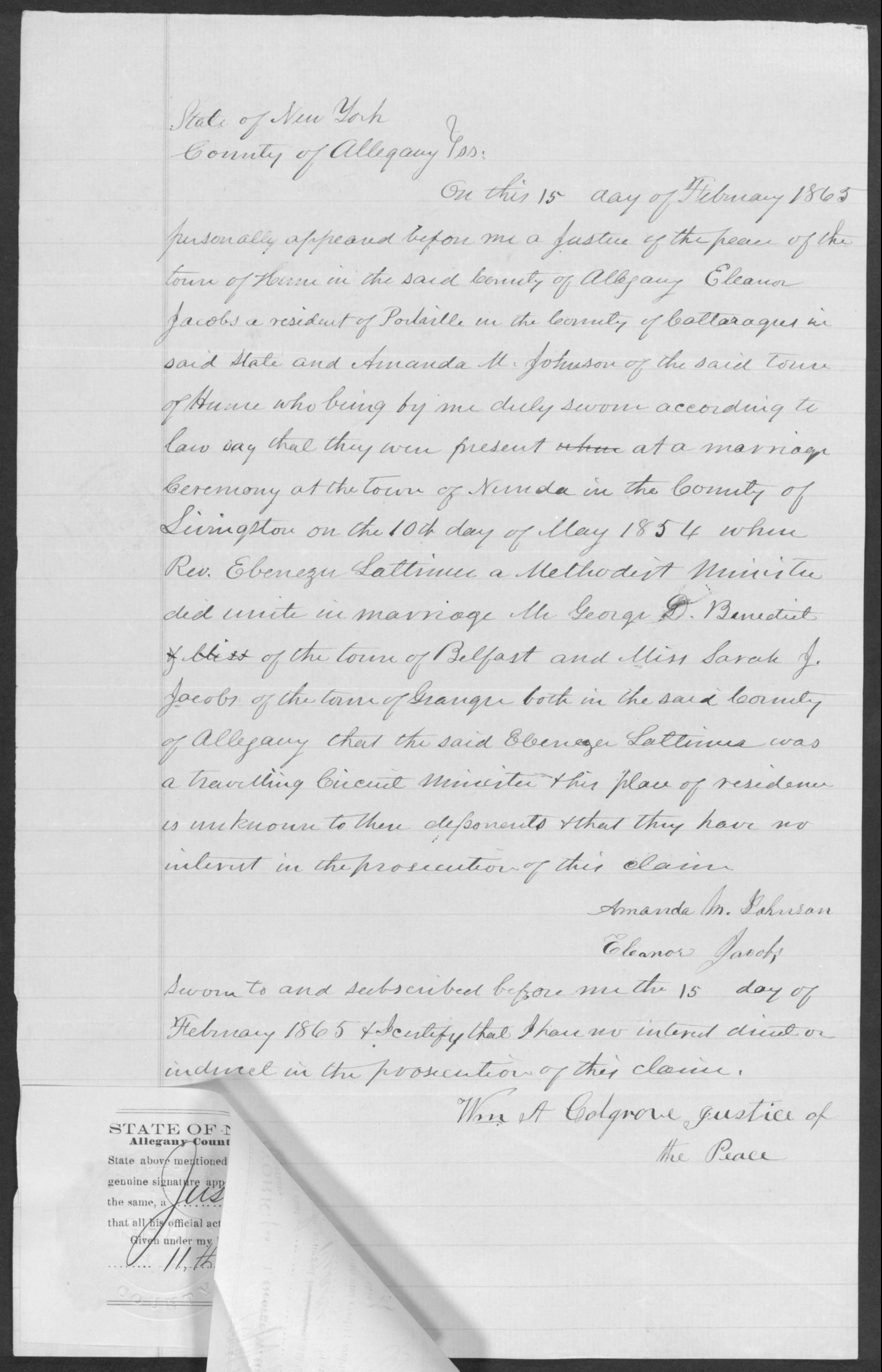
State of New York
County of Allegany } ss:
On this 15 day of February 1865 personally appeared before me a Justice of the peace of the town of Hume in the said County of Allegany Eleanor Jacobs a resident of Portville in the County of Cattaraugus in said State and Amanda M. Johnson of the said town of Hume who being by me duly sworn according to law say that they were present at a marriage ceremony at the town of Nunda in the County of Livingston on the 10th day of May 1854 when Rev. Ebenezer Latimer a Methodist Minister did unite in marriage Mr George D. Benedict of the town of Belfast and Miss Sarah J. Jacobs of the town of Granger both in the said County of Allegany that the said Ebenezer Latimer was a travelling Circuit Minister & his place of residence is unknown to these deponents & that they have no interest in the prosecution of this claim
Amanda M. Johnson
Eleanor Jacobs
Sworn to and subscribed before me the 15 day of February 1865 & I certify that I have no interest direct or indirect in the prosecution of this claim.
Wm. A. Colgrove Justice of the Peace
Docket of the Jacobs and Johnson affidavitSheet 23
Docket panel of the folded affidavit, in the claim agent’s hand; Pension Office receipt stamp: DEPARTMENT OF THE INTERIOR / PENSION OFFICE / MAR 16 1865.
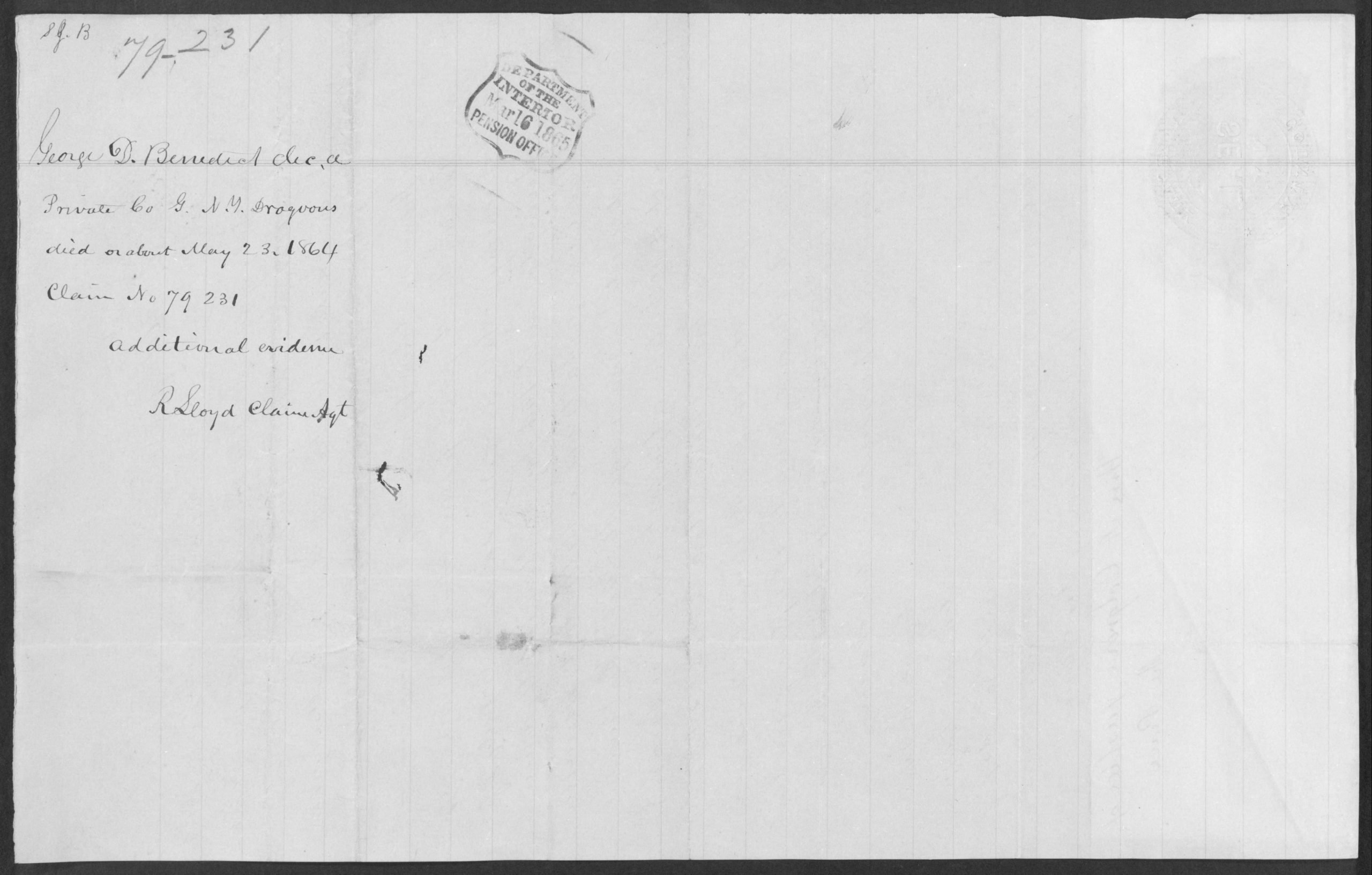
S.J.B. 79,231
George D. Benedict dec’d
Private Co G. N.Y. Dragoons
died or about May 23. 1864
Claim No 79,231
Additional evidence
R Lloyd Claim Agt
The Department’s returns and the certificate
7 sheetsAdjutant General’s return, 1 February 1865Sheet 5
Printed Adjutant General’s Office form, completed in a clerk’s hand.
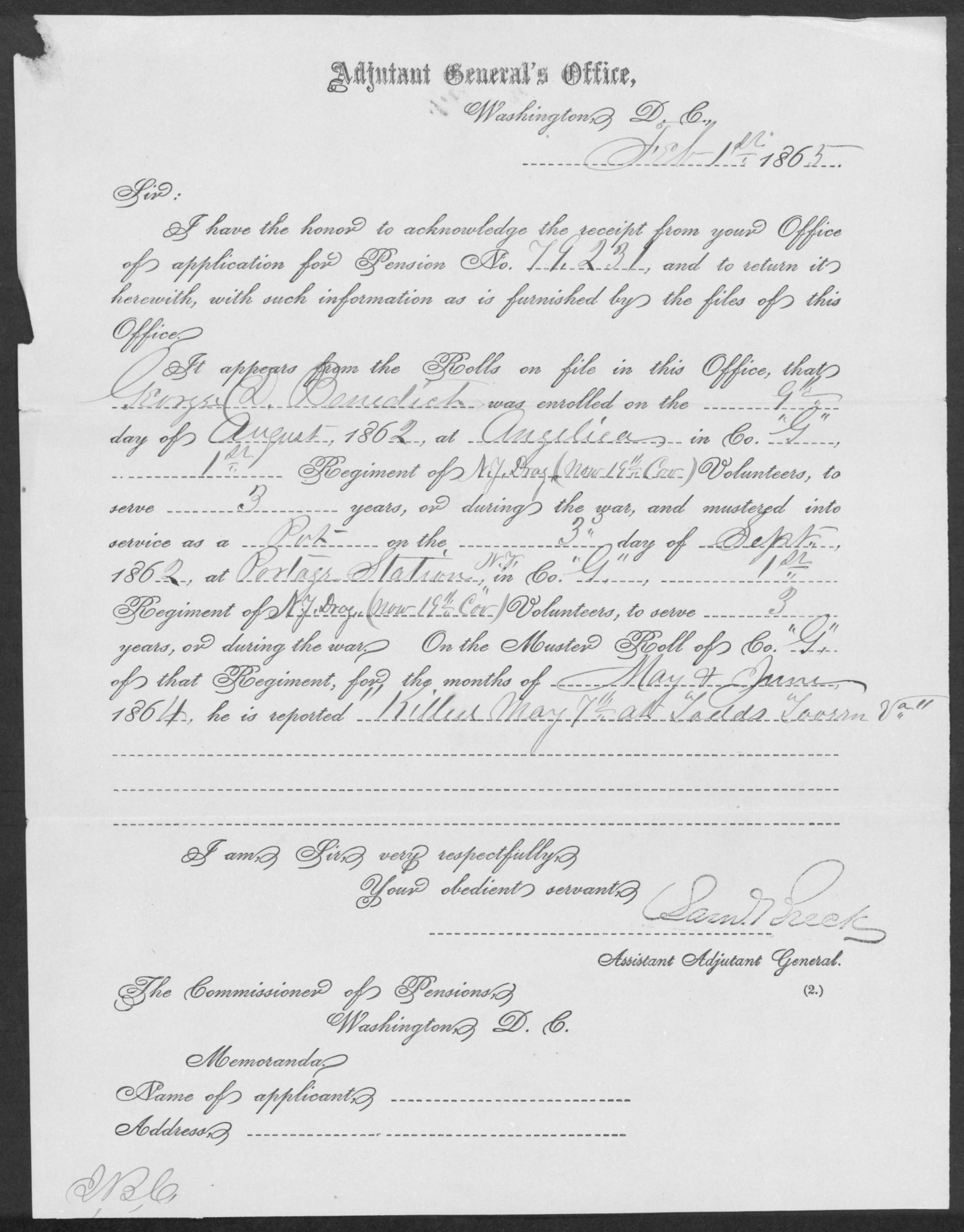
Adjutant General’s Office,
Washington, D. C., Feb 1st 1865
Sir:
I have the honor to acknowledge the receipt from your Office of application for Pension No. 79,231, and to return it herewith, with such information as is furnished by the files of this Office.
It appears from the Rolls on file in this Office, that George D. Benedict was enrolled on the 9th day of August, 1862, at Angelica in Co. “G”, 1st Regiment of N.Y. Drag. (now 19th Cav.) Volunteers, to serve 3 years, or during the war, and mustered into service as a Prt. on the 3d day of Sept., 1862, at Portage Station, N.Y., in Co. “G”, 1st Regiment of N.Y. Drag. (now 19th Cav.) Volunteers, to serve 3 years, or during the war. On the Muster Roll of Co. “G” of that Regiment, for the months of May & June 1864, he is reported “Killed May 7th at Todds Tavern Va.”
I am, Sir, very respectfully,
Your obedient servant,
Sam’l Breck
Assistant Adjutant General.
The Commissioner of Pensions,
Washington, D. C.
Captain Chamberlain’s certificate of death, 3 July 1865Sheet 6
Printed circular for a commissioned officer’s certificate of death, completed in Captain Chamberlain’s hand at the regiment’s headquarters after the war.
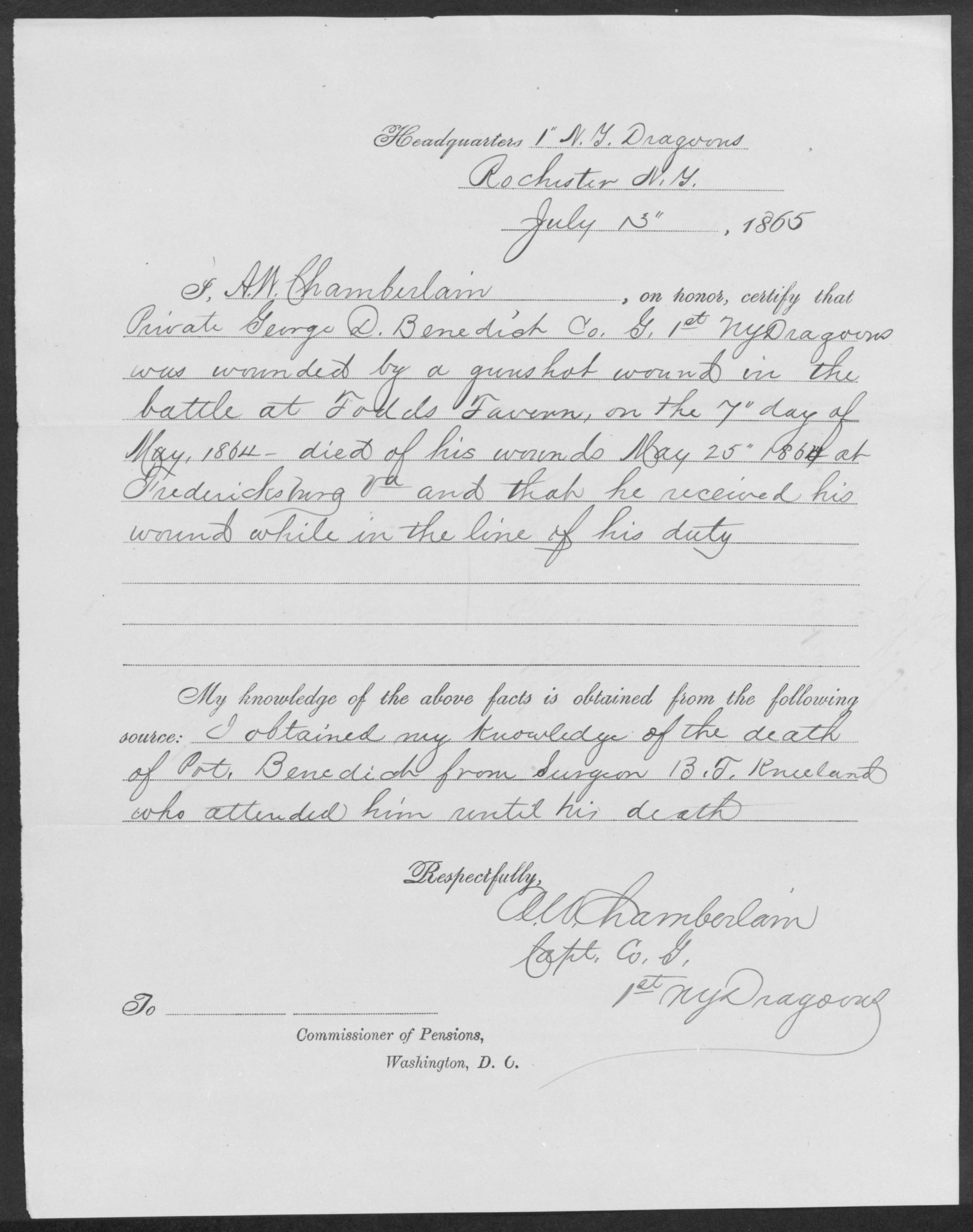
Headquarters 1st N.Y. Dragoons
Rochester N.Y.
July 3d, 1865
I, A. W. Chamberlain, on honor, certify that Private George D. Benedict Co. G, 1st N.Y. Dragoons was wounded by a gunshot wound in the battle at Todds Tavern, on the 7th day of May, 1864 – died of his wounds May 25th 1864 at Fredericksburg Va and that he received his wound while in the line of his duty
My knowledge of the above facts is obtained from the following source: I obtained my knowledge of the death of Prt. Benedict from Surgeon B. T. Kneeland who attended him until his death
Respectfully,
A. W. Chamberlain
Capt. Co. G,
1st N.Y. Dragoons
To the Commissioner of Pensions, Washington, D. C.
Pension Office circular to a commissioned officer, 7 June 1865Sheet 7
Printed Pension Office cover slip; “Sir” struck through and “Madam” written above. Receipt stamp: DEPARTMENT OF THE INTERIOR / PENSION OFFICE / JUL 7 1865.
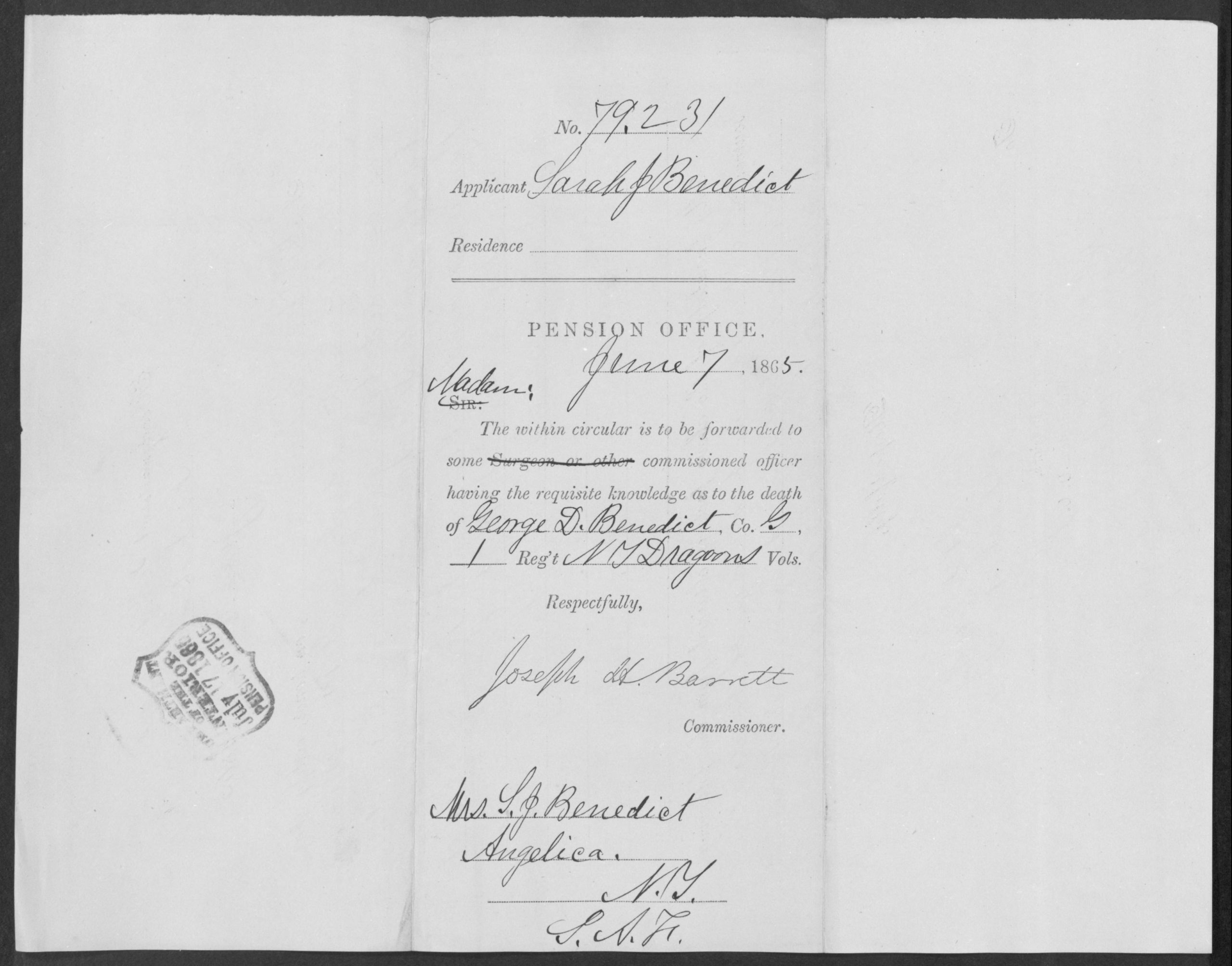
No. 79,231
Applicant Sarah J. Benedict
Residence
PENSION OFFICE,
June 7, 1865.
Madam:
The within circular is to be forwarded to some commissioned officer having the requisite knowledge as to the death of George D. Benedict, Co. G, 1 Reg’t N.Y. Dragoons Vols.
Respectfully,
Joseph H. Barrett
Commissioner.
Mrs. S. J. Benedict
Angelica.
N.Y.
S. A. H.
Endorsement: additional evidenceSheet 9
Docket panel of a folded sheet, written in pencil; a Pension Office stamp is struck at the lower left.
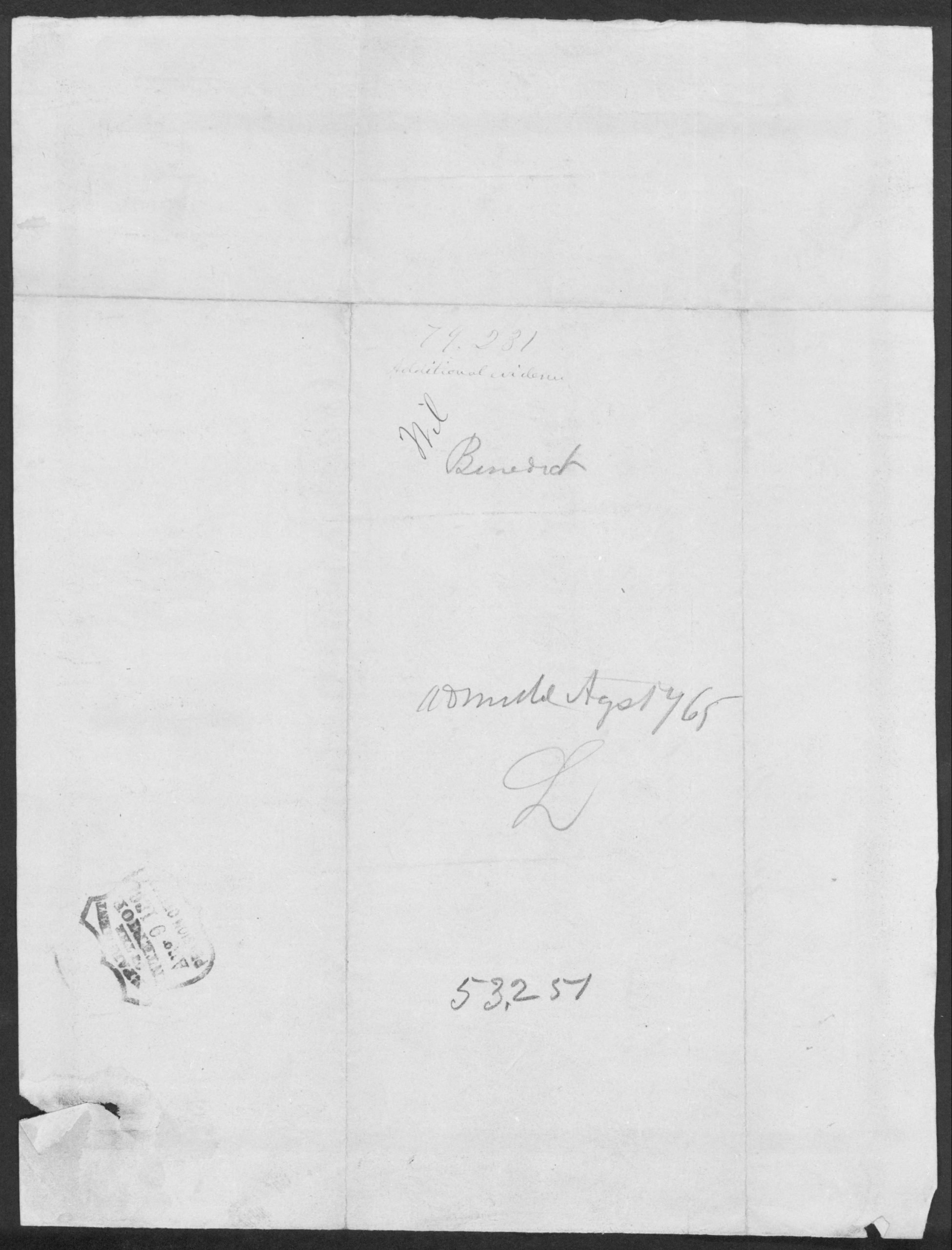
79,231
Additional evidence
Wid. Benedict
Admitted Agst 7/65
[initialled]
53,251
Pension Office referral to the Adjutant General, 30 January 1865Sheet 12
Printed referral slip on a folded panel; “53,251” added later in pencil at the head.
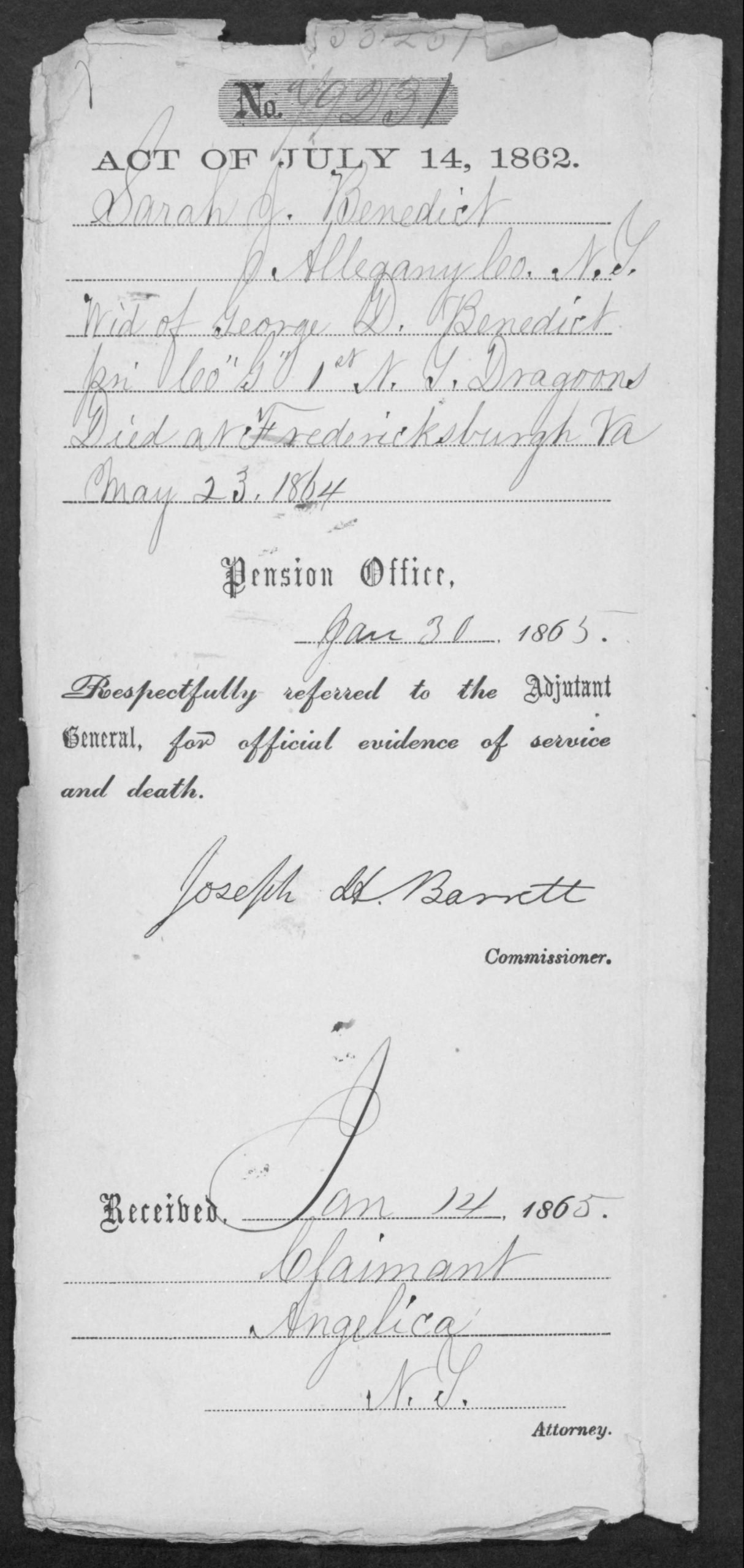
No. 79,231
ACT OF JULY 14, 1862.
Sarah J. Benedict
J. Allegany Co. N.Y.
Wid of George D. Benedict
Pri. Co. “G” 1st N.Y. Dragoons
Died at Fredericksburgh Va
May 23. 1864
Pension Office,
Jan 30, 1865.
Respectfully referred to the Adjutant General, for official evidence of service and death.
Joseph H. Barrett
Commissioner.
Received Jan 14, 1865.
Claimant
Angelica
N.Y.
Attorney.
Endorsement of the circulars sentSheet 13
Endorsement panel of a folded sheet, in pencil: the clerks’ note of which printed circulars were sent to the claimant, and when.
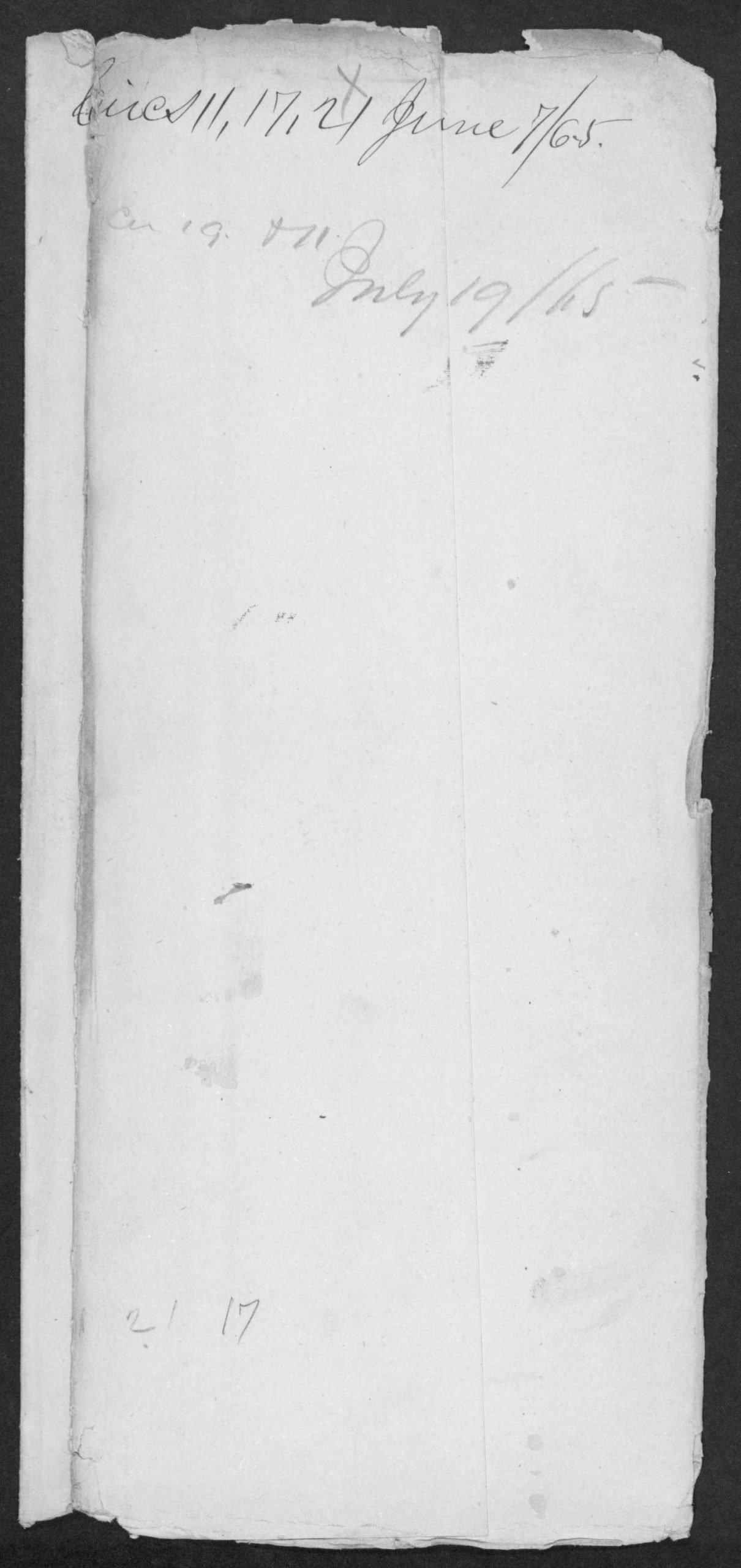
Circs 11, 17, 21 June 7/65.
Cir 19 & 21
July 19/65 –
21 17
The widow’s certificate stub, 11 August 1865Sheet 14
The widow’s certificate stub, the Bureau’s own record of the pension granted. The word DEAD is stamped across the head; the sheet is worn and chipped at the edges.
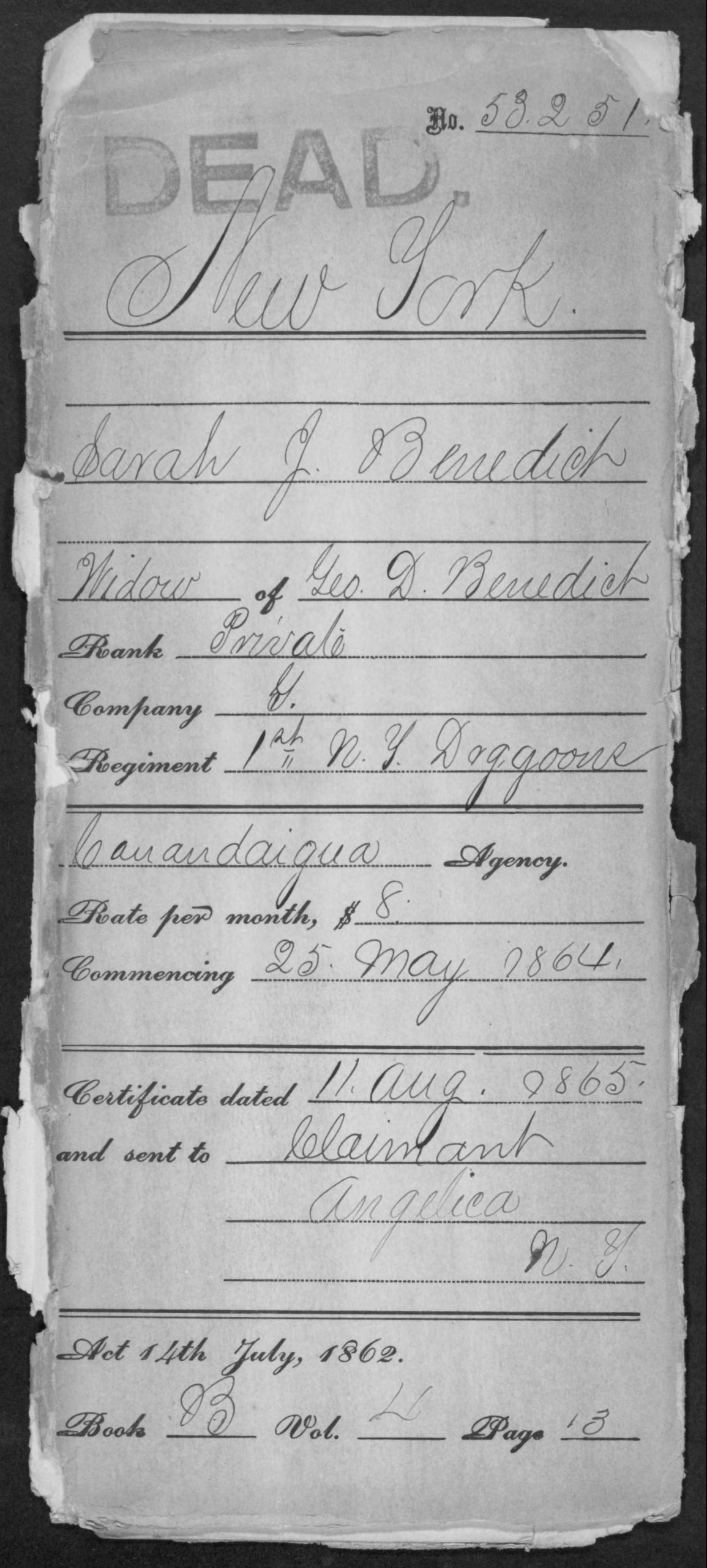
No. 53,251
DEAD.
New York.
Sarah J. Benedict
Widow of Geo. D. Benedict
Rank Private
Company G.
Regiment 1st N.Y. Dragoons
Canandaigua Agency.
Rate per month, $8.
Commencing 25 May 1864.
Certificate dated 11 Aug. 1865.
and sent to Claimant
Angelica
N.Y.
Act 14th July, 1862.
Book B Vol. L Page 13
The end of the pension, 1903
3 sheetsNotice that the pensioner was dropped, 4 March 1903Sheet 10
Printed Pension Agency form 3-1081, completed in manuscript; a large ink blot obscures the agency name and part of the date line.
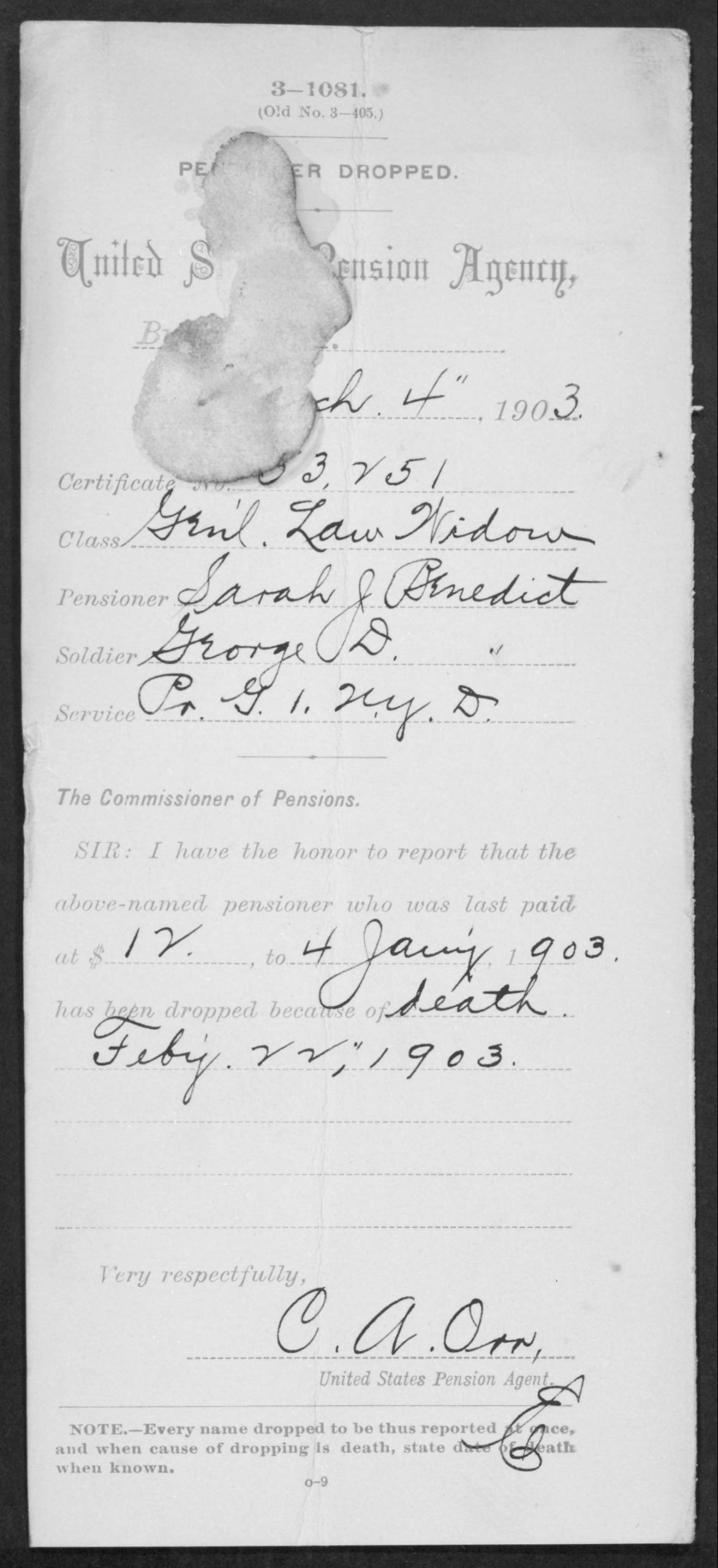
3-1081.
(Old No. 3-405.)
PENSIONER DROPPED.
United States Pension Agency,
B[uffalo, N.Y.]
[Mar]ch. 4th, 1903.
Certificate No. 53,251
Class Gen’l. Law Widow
Pensioner Sarah J Benedict
Soldier George D. “
Service Pr. G. 1. N.Y. D.
The Commissioner of Pensions.
SIR: I have the honor to report that the above-named pensioner who was last paid at $12, to 4 Jany, 1903, has been dropped because of death Feby. 22, 1903.
Very respectfully,
C. A. Orr,
United States Pension Agent.
NOTE.-Every name dropped to be thus reported at once, and when cause of dropping is death, state date of death when known.
Reverse of the dropped-pensioner reportSheet 11
Reverse of the dropped-pensioner report; blank but for two office stamps.

U.S. BUREAU OF PENSIONS
FINANCE DIVISION
MAR 6 1903
U.S. PENSION OFFICE
MAR 5 1903
Reverse of the stub, stamped DROPPEDSheet 15
Reverse of the certificate stub. DROPPED is stamped across it and the entry completed by hand.
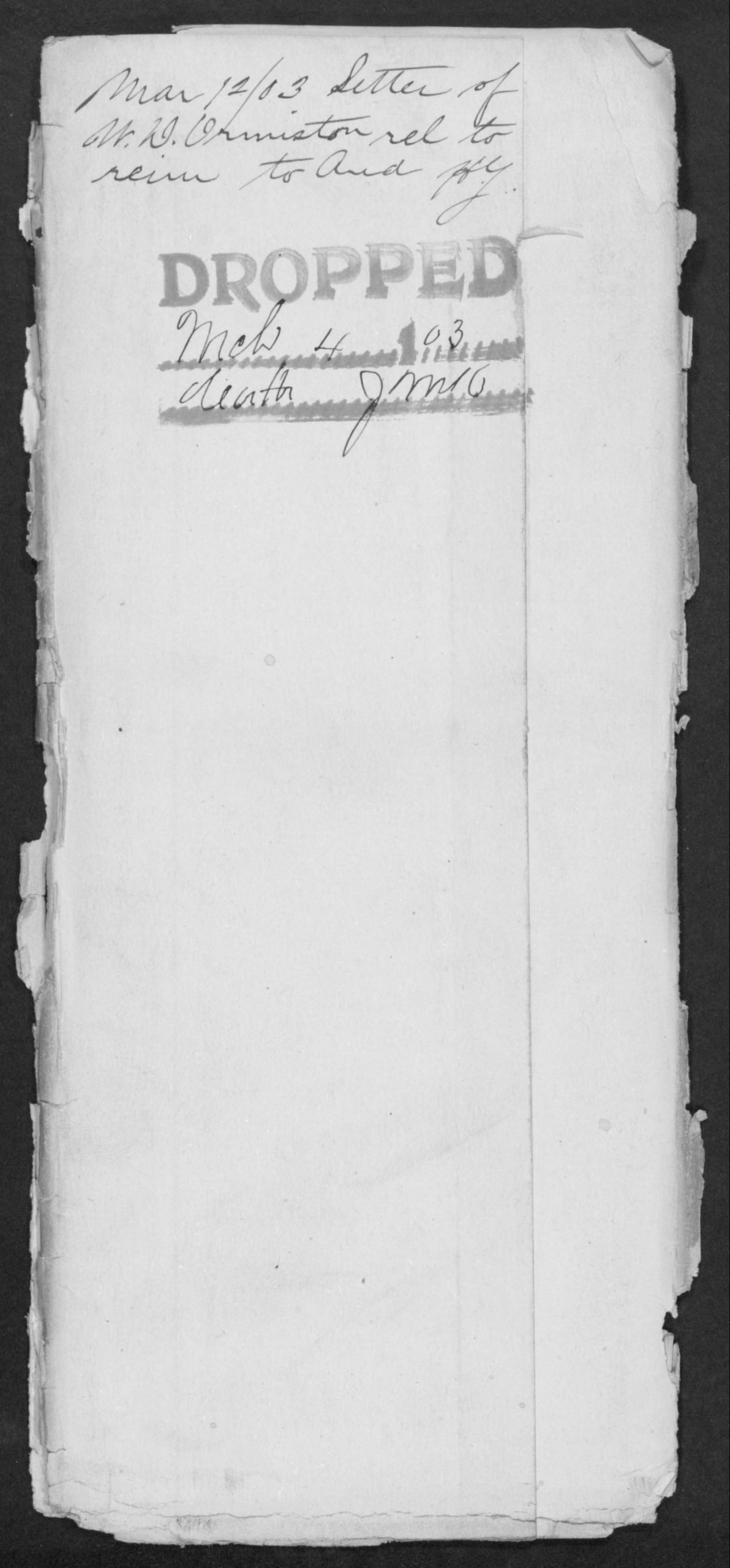
Mar 12/03 Letter of W. D. Ormiston rel to reim to And. Hy.
DROPPED
Mch 4 1903
death J M C
Source. Approved Pension Application File for Sarah J. Jacobs Benedict, Widow of George D. Benedict, Company G, 1st New York Dragoons (19th New York Cavalry) — application no. 79,231, certificate no. 53,251 (WC53251). Case Files of Approved Pension Applications of Widows and Other Dependents of the Army, Record Group 15 (National Archives Identifier 115942209). National Archives, Washington, DC.
His Letters Home, 1863
George Benedict wrote to his wife Sarah at Belvidere in Allegany County. His letters survive in the Southern Historical Collection at the University of North Carolina. He writes in his own spelling, which is kept here exactly as he set it down.
On 7 May 1864 he was shot at Todd’s Tavern, Virginia. He died of the wound on 25 May 1864, eighteen days later. Sarah Benedict was a widow at Belvidere before that summer was out.
Five letters that carry the collection
“Colonel Thorp has gone to York State… to By Cavelry horses for the Regiment.”How the Dragoons Got Their Horses
“T. J. Thorp is with us now, we do not like him at all Because he drinks.”The Men on Their Colonel
“We are a going into Cavelry Sure… it is Colonel Gibbses doings.”The Regiment Turns Cavalry
“My life is at Stake every day, and I want you Should remember me.”A Father Writes to His Daughter
“Severely wounded in the shoulder and back… he sends his love.”The News from Fredericksburg
Suffolk & the Siege
April–June 1863 · 31 letters“I have new tent mates now”
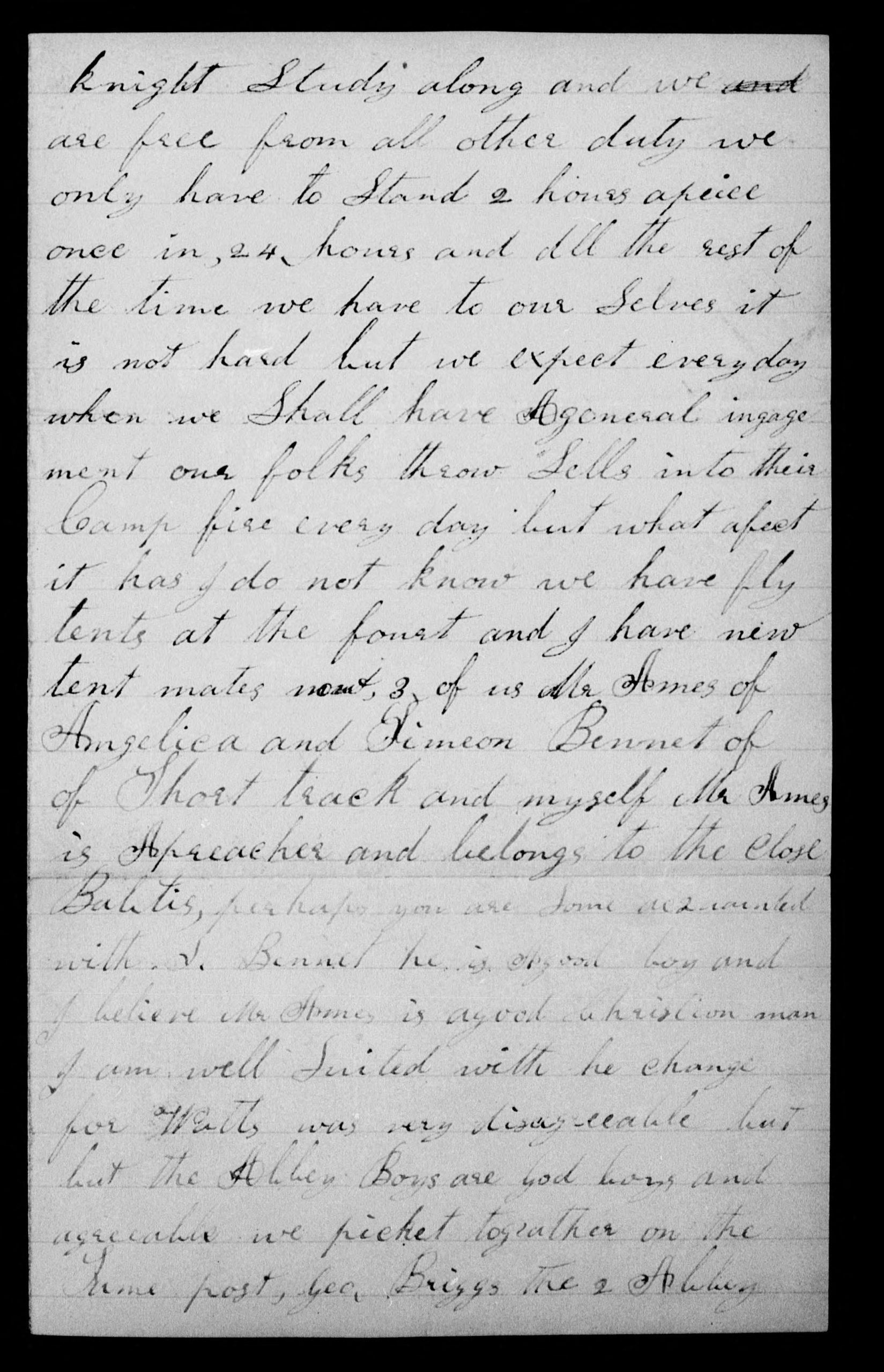
knight I study along and we [and] are free from all other duty we only have to Stand 2 hours apiece once in 24 hours and all the rest of the time we have to our Selves it is not hard but we expect every day when we Shall have a general ingagement our folks throw Shells into their Camp fire every day but what afect it has I do not know we have fly tents at the fount and I have new tent mates now 3 of us Mr Ames of Angelica and Simeon Bennet of Short tract and myself Mr Ames is a preacher and belongs to the Close Baptis, perhaps you are some acquainted with S. Bennet he is a good boy and I believe Mr Ames is a good Christian man I am well Suited with the change for Watts was very disagreeable but but the Abbey Boys are god boys and agreeable we picket together on the Same post, Geo. Briggs the 2 Abbey
“I now inclose 20 dollars in this letter”
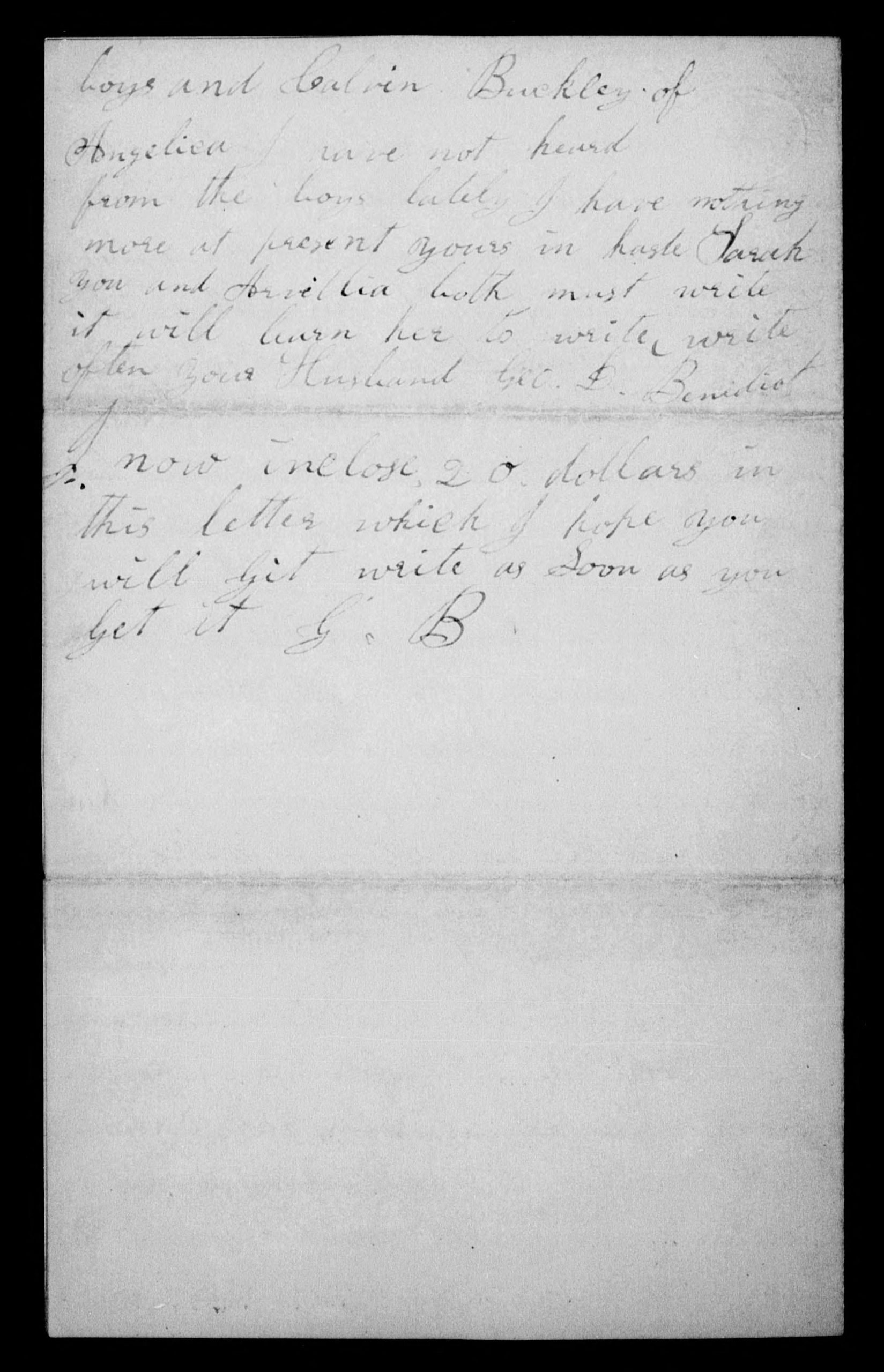
boys and Calvin Buckley of Angelica I have not heard from the boys lately I have nothing more at present yours in haste Sarah you and Arvillia both must write it will learn her to write write often Your Husband Geo. D. Benedict
I now inclose 20 dollars in this letter which I hope you will git write as soon as you get it G. B.
Arvillia was their daughter. He wanted her writing letters so that she would learn to write.
2 May 1863, Suffolk — the fight on the Blackwater road
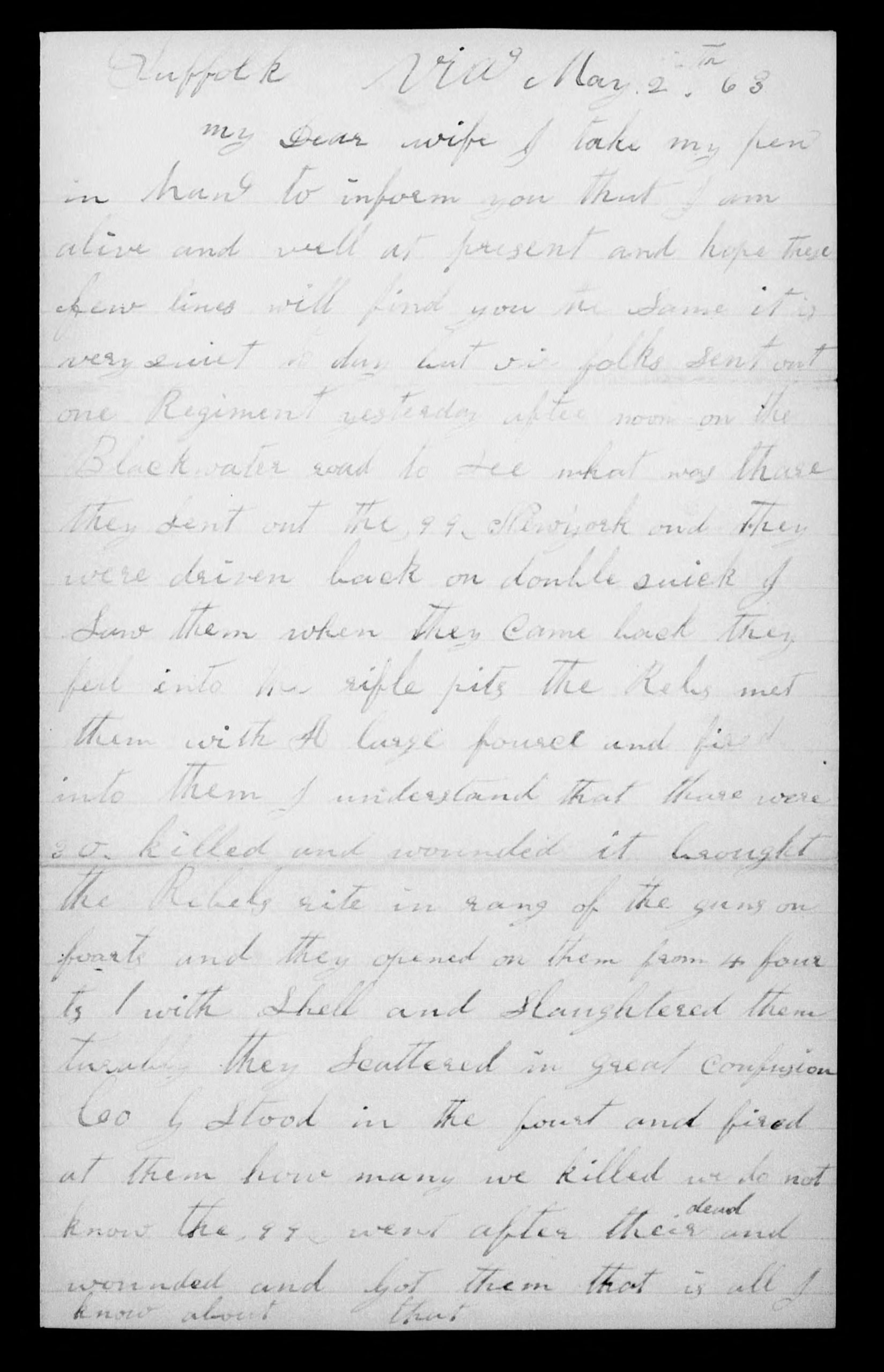
Suffolk Va May 2th 63
my Dear wife I take my pen in hand to inform you that I am alive and well at present and hope these few lines will find you the Same
it is very quiet to day but our folks sent out one Regiment yesterday after noon on the Blackwater road to see what was thare they sent out the 99 Newyork and they were driven back on double quick I Saw them when they Came back they fell into his rifle pits
the Rebs met them with A large fource and fired into them I understand that thare were 20 killed and wounded it brought the Rebels rite in rang of the guns on fourts and they opened on them from 4 to 1 with Shell and Slaughtered them twenty they Scattered in great Confusion
Co G Stood in the fourt and fired at them how many we killed we do not know the 99 went after their dead and wounded and got them that is all I know about that
This is the earliest fighting Benedict describes, and he saw it. During the siege of Suffolk in the spring of 1863, a Union regiment — the 99th New York — was sent out the Blackwater road to test the enemy and was driven back at the double into the rifle pits. Benedict watched it happen: the Confederates followed too close, came into range of the guns in the forts, and the artillery “opened on them from 4 to 1 with Shell and Slaughtered them.”
And his own company was in it: “Co G Stood in the fourt and fired at them.” This is eight months before the regiment became cavalry — the men of the 130th New York serving the guns and the works of the Suffolk defences as infantry. It is the earliest combat this collection records, and one of the few times Benedict describes a fight he saw with his own eyes rather than heard of in camp.
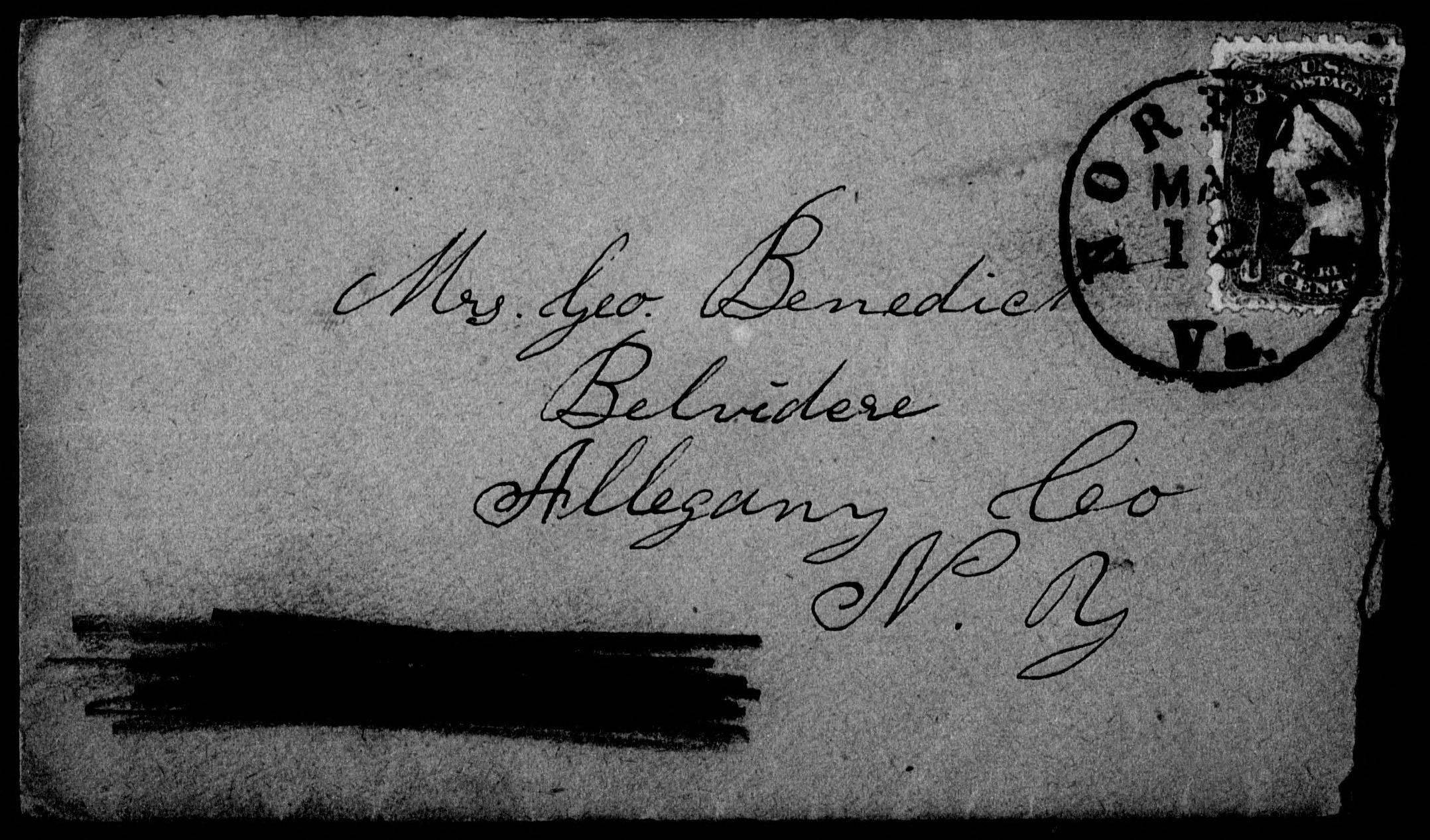
A note on sequence: this sheet (2 May) and its envelope were transcribed after the rest of the 1863 letters and are restored here to their proper place, at the head of the Suffolk letters.
Sunday, 3 May 1863 — the siege of Suffolk
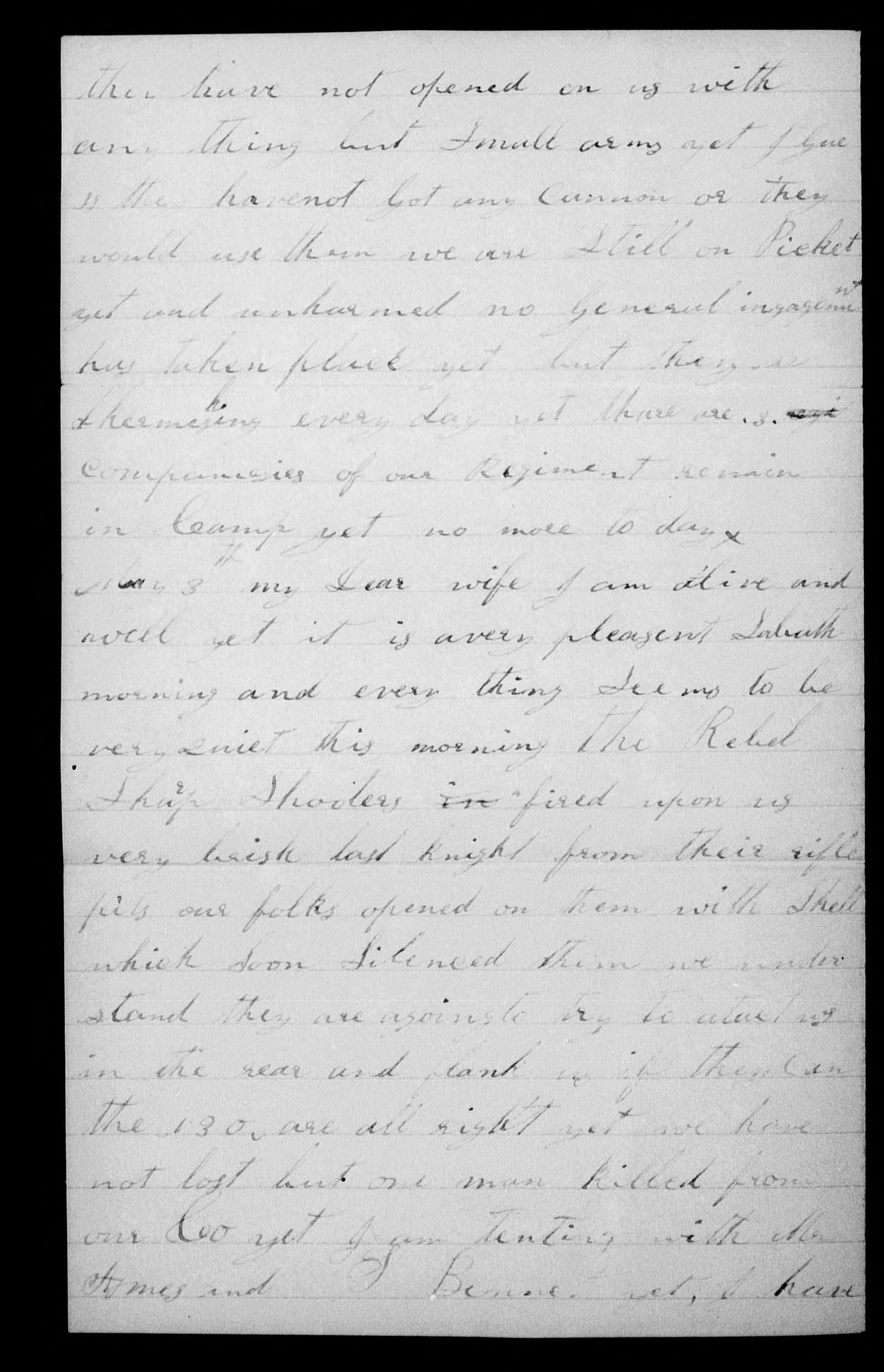
they have not opened on us with any thing but Small arms yet I gues is the havenot got any Cannon or they would use them we are Still on Picket yet and unharmed no General ingagement has taken place yet but they are Skermeging every day yet there are 3 Companies of our Rejiment remain in Camp yet no more to day
May 3rd my Dear wife I am alive and well yet it is a very pleasent Sabath morning and every thing Seems to be very quiet this morning the Rebel Sharp Shooters fired upon us very brisk last knight from their rifle pits our folks opened on them with Shell which soon Silenced them we understand they are agoing to try to attack us in the rear and flank us if they can the 130 are all right yet we have not lost but one man killed from our Co yet I am tenting with Mr Ames and S. Bennet, I have
“I guess fleshier than you ever saw me”
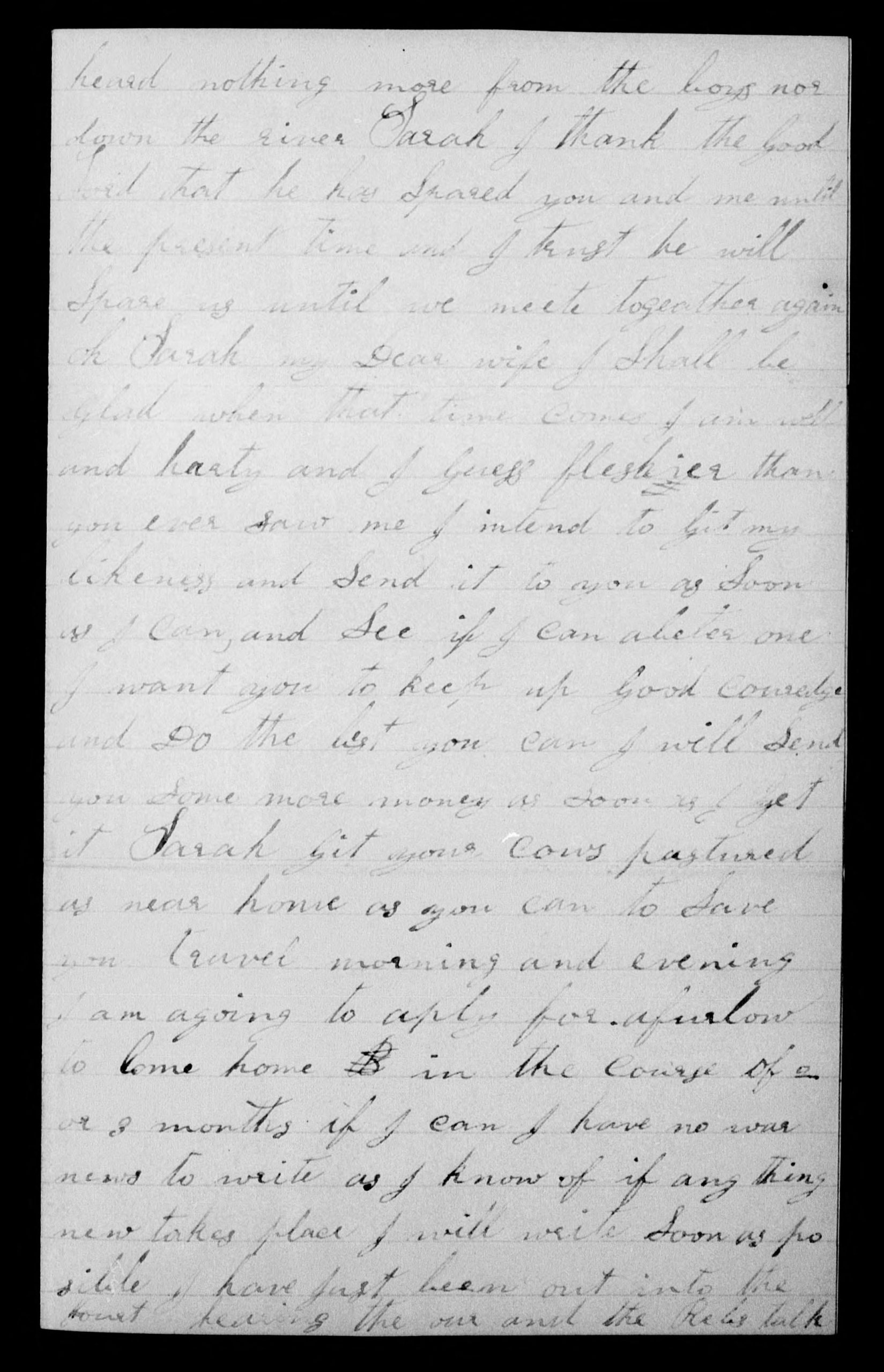
heard nothing more from the boys nor down the river Sarah I thank the Good [Lord] that he has Spared you and me until the present time and I trust he will Spare us until we meete togeather again oh Sarah my Dear wife I Shall be Glad when that time Comes I am well and harty and I guess fleshier than you ever saw me I intend to git my likeness and Send it to you as Soon as I Can, and See if I can a leter one I want you to keep up Good courage and Do the best you can I will Send you Some more money as Soon as I get it Sarah git your Cows pastured as near home as you can to Save you travel morning and evening I am agoing to aply for a furlow to come home in the Course of 2 or 3 months if I can I have no war news to write as I know of if any thing new takes place I will write Soon as posible I have just been out into the front hearing the our and the Rebs talk
A “likeness” is a photograph. He is telling his wife he has put on weight, promising to send his picture, and asking her to keep the cows pastured close to the house so she is not walking out to them twice a day.
“They Stood on top of their works and talked with our men”
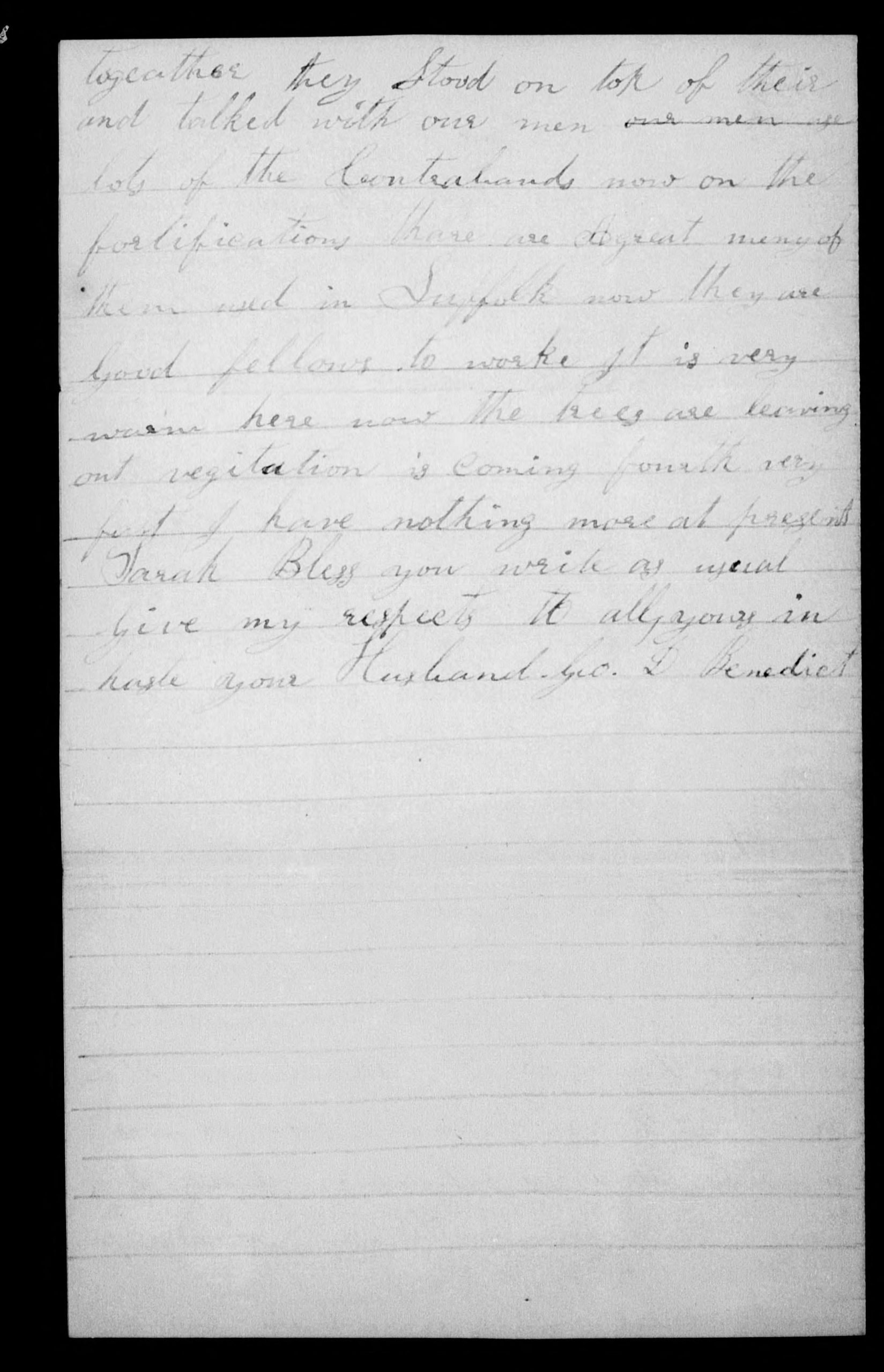
togeather they Stood on top of their [works] and talked with our men lots of the Contrabands now on the fortifications thare are a great many of them and in Suffolk now they are good fellows to worke it is very warm here now the trees are leaving out vegitation is Coming forwth very fast I have nothing more at present Sarah Bless you write as usual Give my respects to all yours in haste your Husband Geo. D. Benedict
Two things are recorded here that rarely reach the official record. The first is the informal truce of the picket line, with men of both armies standing openly on their works to talk. The second is his account of the contrabands — the period term for enslaved people who had freed themselves by reaching Union lines — working in numbers on the Suffolk fortifications in the spring of 1863.
Suffolk, 4 May 1863 — the siege lifts
Longstreet had besieged Suffolk since April. On this morning Benedict woke to find the Confederate lines empty — they had marched in the night to reinforce Lee against Hooker at Chancellorsville. This letter records the siege lifting, hour by hour, as the news reached him.
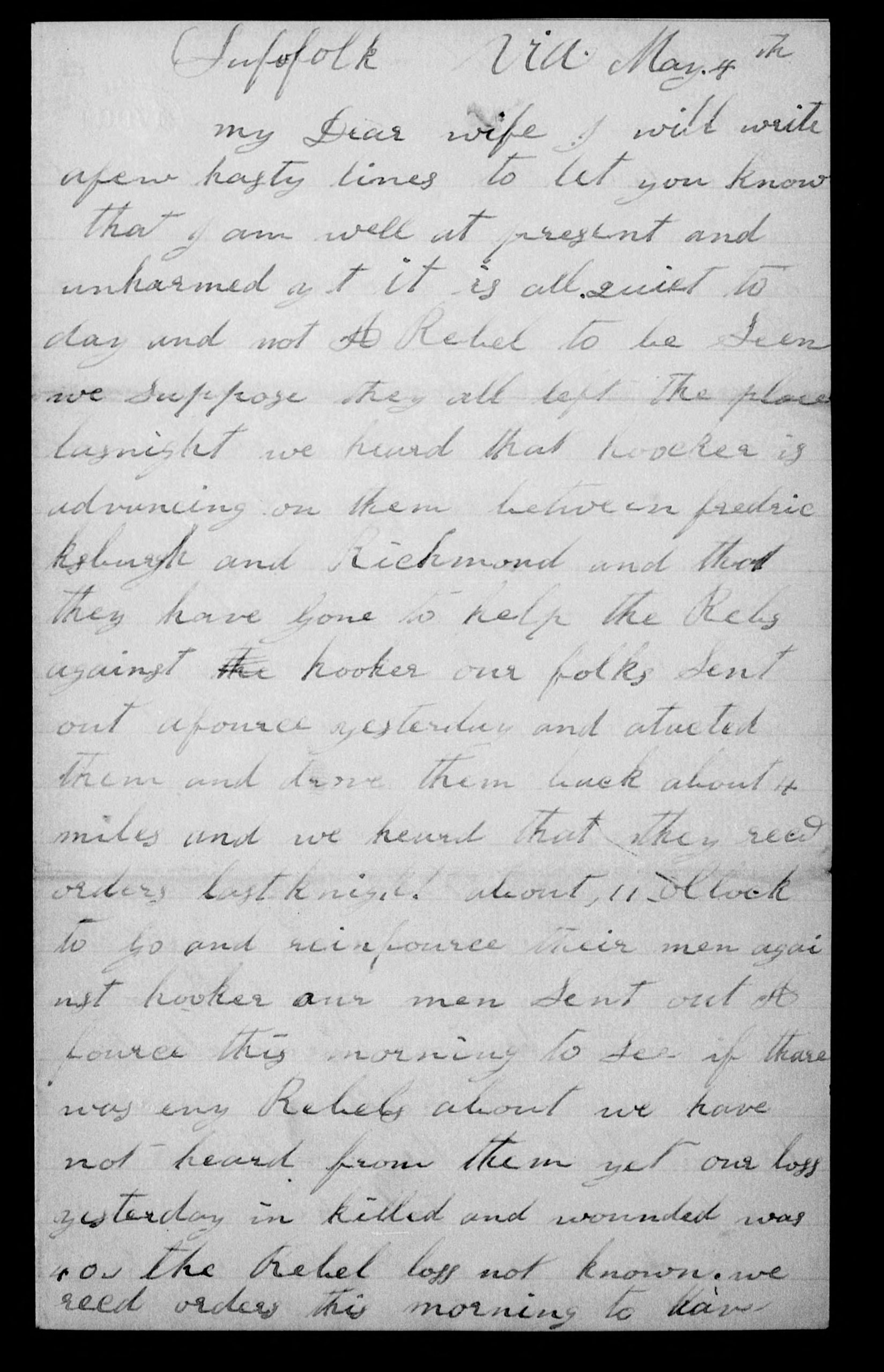
Suffolk Vill May 4th
my Dear wife I will write a few hasty lines to let you know that I am well at present and unharmed yet it is all quiet to day and not a Rebel to be Seen we suppose they all left the place lasnight we heard that hooker is advancing on them between fredricksburgh and Richmond and that they have gone to help the Rebs against hooker our folks Sent out a fource yesterday and atacted them and drove them back about 4 miles and we heard that they recd orders lastknight about 11 Oclock to go and reinfource their men against hooker our men Sent out a fource this morning to see if thare was eny Rebels about we have not heard from them yet our loss yesterday in killed and wounded was 40 the Rebel loss not known we recd orders this morning to hav
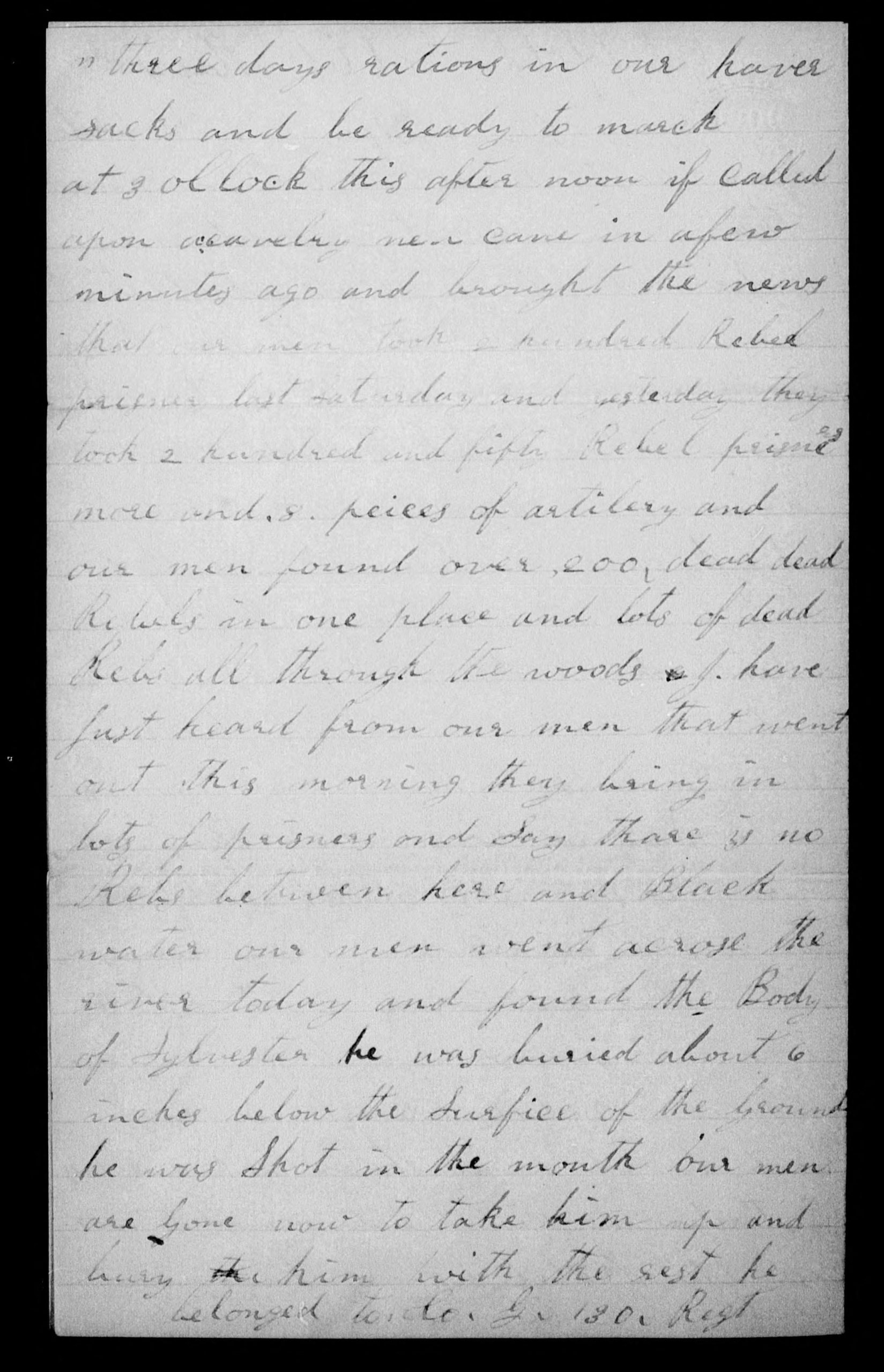
three days rations in our haversacks and be ready to march at 3 oclock this after noon if called upon cavelry men came in afew minutes ago and brought the news that our men took a hundred Rebel prisners last Saturday and yesterday they took 2 hundred and fifty Rebel prisners more and 8 peices of artilery and our men found over 200 dead Rebels in one place and lots of dead Rebs all through the woods I have just heard from our men that went out this morning they bring in lots of prisners and Say thare is no Rebs between here and Black water our men went across the river today and found the Body of Sylvester he was buried about 6 inches below the Surfice of the Ground he was Shot in the mouth our men are gone now to take him up and bury him with the rest he belonged to Co. G, 130 Regt
The man he calls Sylvester is Private Allington Sylvester of Conesus, killed at Suffolk on 19 April 1863 — a fortnight before this letter. His brother Christopher served in the same company and lived to muster out.
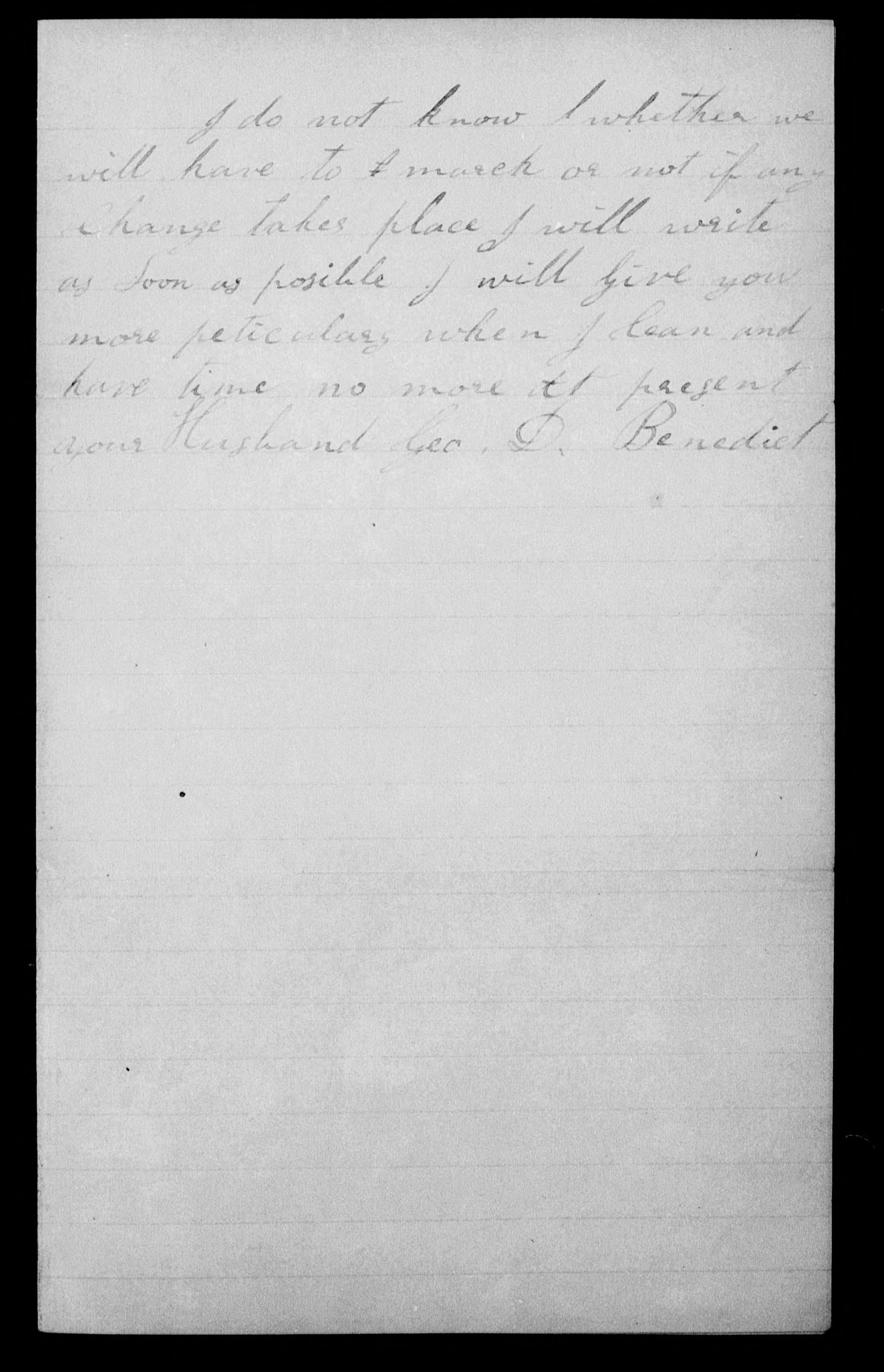
I do not know whether we will have to march or not if any change takes place I will write as Soon as posible I will give you more peticulars when I lean and have time no more at present your Husband Geo. D. Benedict
Suffolk, 11 May 1863 — “I miss you very much when my close want washing”
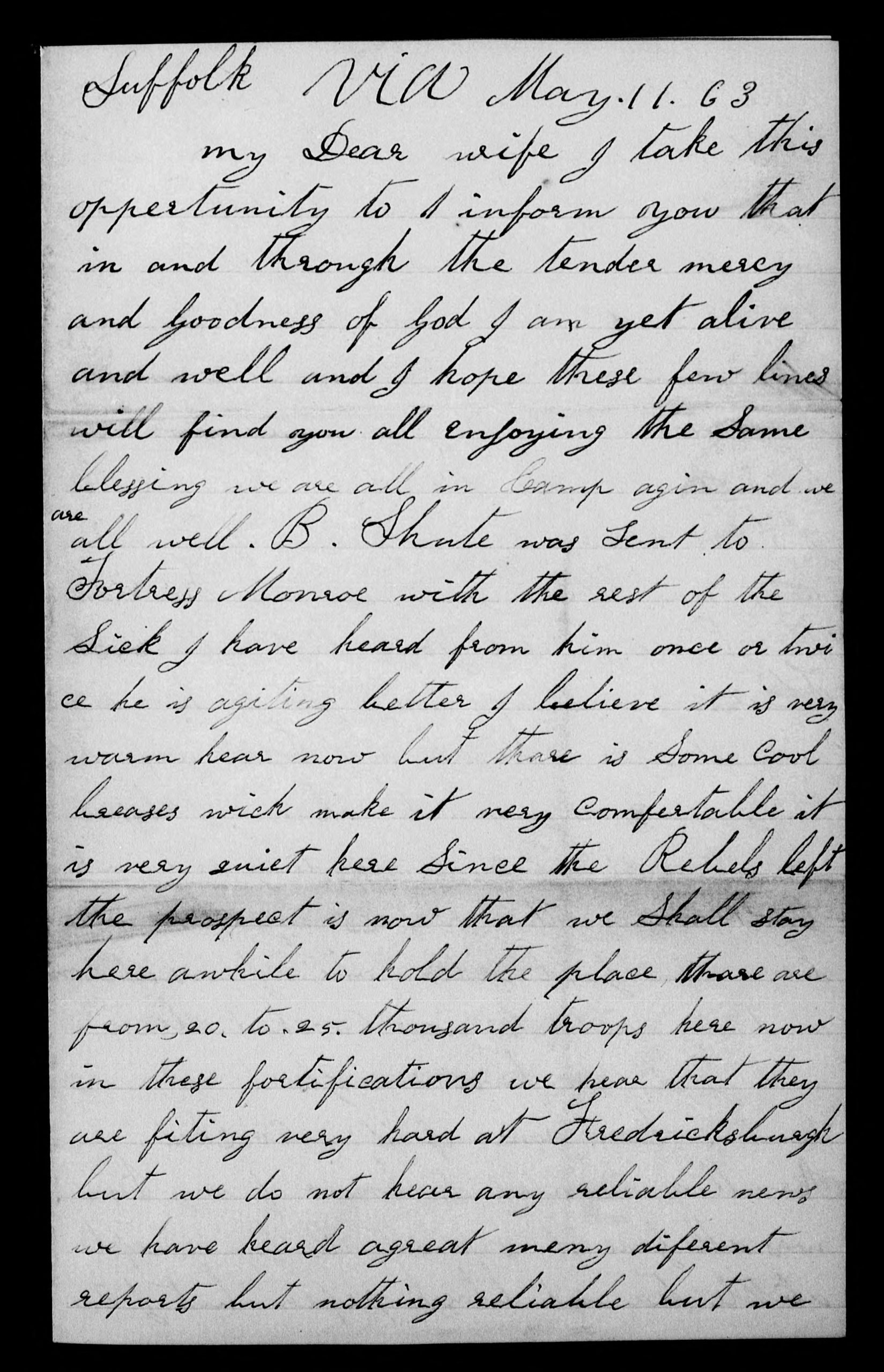
Suffolk VA May 11 63
my Dear wife I take this oppertunity to inform you that in and through the tender mercy and goodness of God I am yet alive and well and I hope these few lines will find you all enjoying the Same blessing we are all in Camp agin and we are all well. B. Shute was Sent to Fortress Monroe with the rest of the Sick I have heard from him once or twice he is agiting better I believe it is very warm hear now but thare is Some Cool breases wich make it very Comfertable it is very quiet here Since the Rebels left the prospect is now that we Shall stay here awhile to hold the place thare are from 20 to 25 thousand troops here now in these fortifications we hear that they are fiting very hard at Fredricksburgh but we do not hear any reliable news we have heard a great meny diferent reports but nothing reliable but we
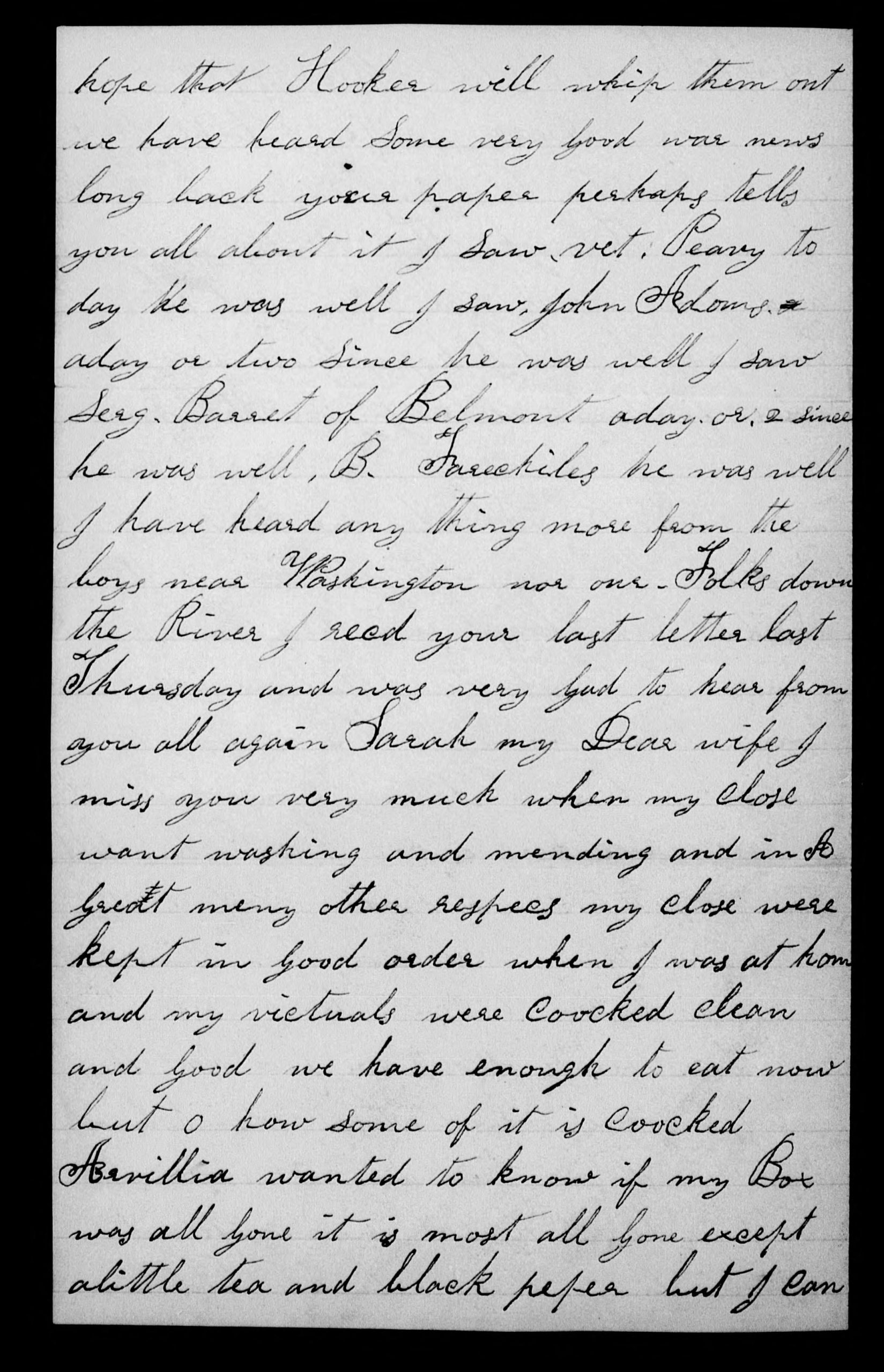
hope that Hooker will whip them out we have heard Some very good war news long back your paper perhaps tells you all about it I Saw Vet. Peavy to day he was well I Saw John Adams a day or two Since he was well I Saw Serg. Barret of Belmont a day or 2 since he was well, B. Freeckiles he was well I have heard any thing more from the boys near Washington nor our Folks down the River I recd your last letter last Thursday and was very Gad to hear from you all again Sarah my Dear wife I miss you very much when my close want washing and mending and in a great meny other respecs my close were kept in good order when I was at home and my victuals were Coocked clean and good we have enough to eat now but o how Some of it is Coocked Arvillia wanted to know if my Box was all gone it is most all gone except a little tea and black peper but I Can
Much of a soldier’s letter was a casualty report in reverse: a list of neighbours seen alive. Sergeant Benjamin Shute was Benedict’s own townsman from Amity in Company G; he never returned to the regiment, and was transferred that November to the Veteran Reserve Corps. “Serg. Barret of Belmont” is Alonzo D. Barrett, Company H, aged forty-five and the only Barrett of Belmont mustered in as a sergeant. “John Adams” is John J. Adams, the blacksmith of Company H. “Vet. Peavy” is almost certainly Sylvester J. Peavy of Company F, the regiment’s farrier — the man who doctored the horses, and so “the vet.” “B. Freeckiles” has not been identified on the roll.
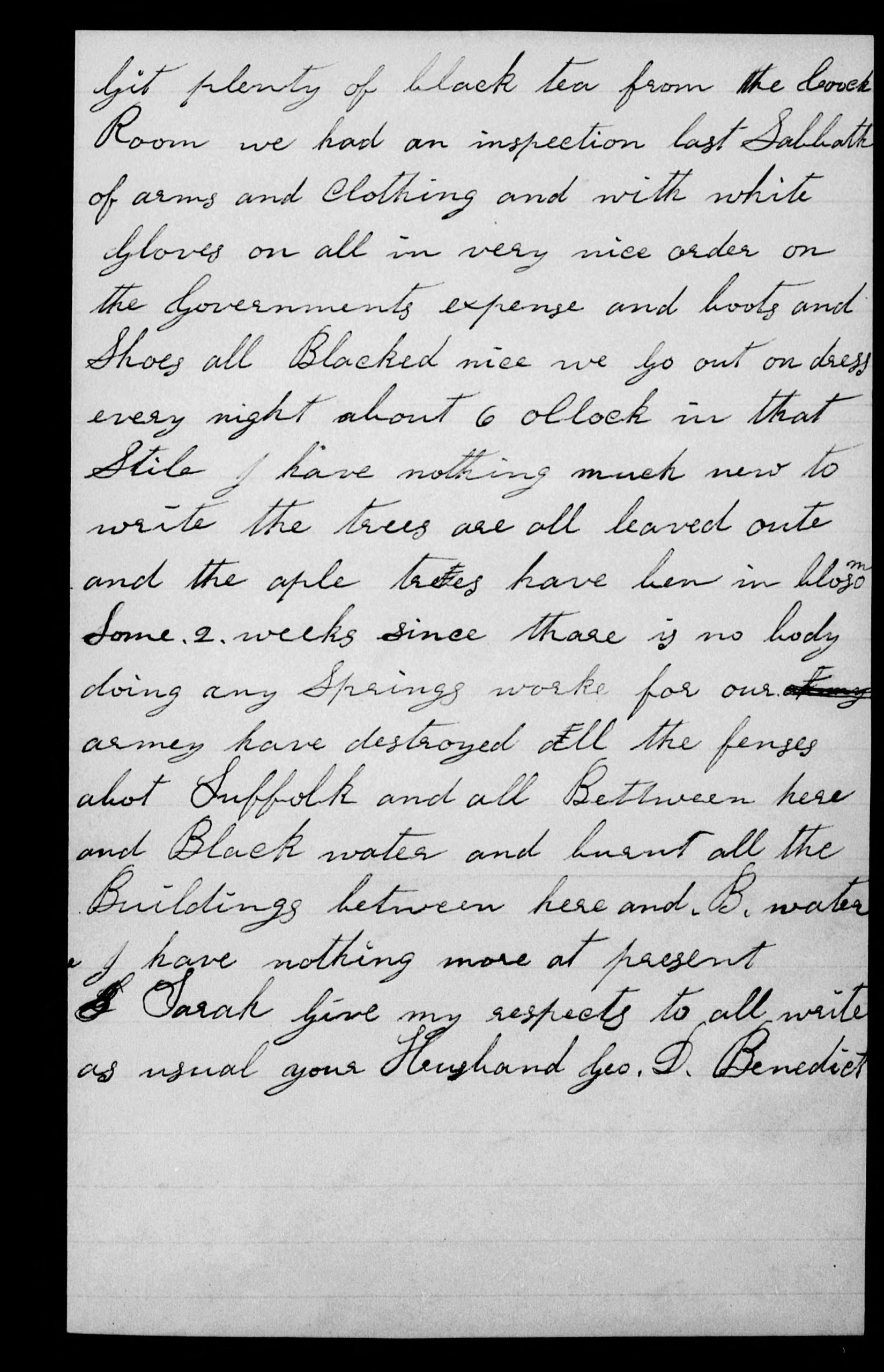
git plenty of black tea from the Cook Room we had an inspection last Sabbath of arms and Clothing and with white Gloves on all in very nice order on the Governments expense and boots and Shoes all Blacked nice we go out on dress every night about 6 oClock in that Stile I have nothing much new to write the trees are all leaved oute and the aple trees have ben in blosom Some 2 weeks since thare is no body doing any Springs worke for our armey have destroyed all the fenses about Suffolk and all Between here and Black water and burnt all the Buildings between here and B. water I have nothing more at present Sarah give my respects to all write as usual your Husband Geo. D. Benedict
These two halves of one paragraph are worth reading together. In the first the regiment parades in white gloves at the government’s expense, boots blacked, every evening at six. In the second, nobody is planting a spring crop for twenty miles, because the army has pulled down every fence and burned every building between Suffolk and the Blackwater. He sets the two down in the same breath, and passes no comment on either.
The cover it came in
Mrs. Geo. Benedict
Belvidere
Allegany Co
N. Y.
The envelope that carried the letter of 11 May, posted at Norfolk the following day and franked with a three-cent stamp. He addressed it himself. Two hundred and forty miles to the north, in a farmhouse at Belvidere, this is what arriving news of her husband looked like to Sarah Benedict — before she opened it and learned he was still alive.
Suffolk, 14 May 1863 — news of three brothers
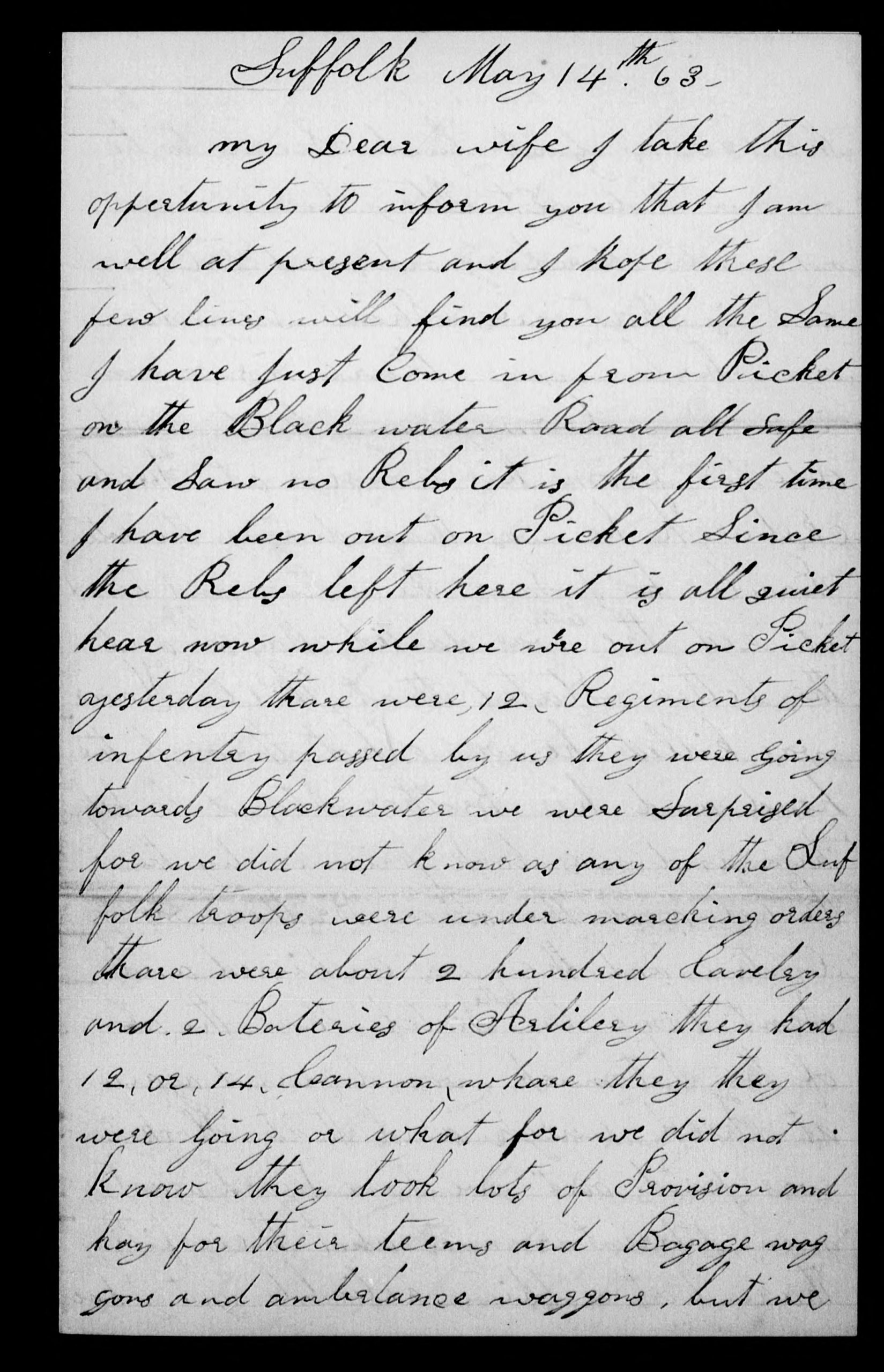
Suffolk May 14th 63
my Dear wife I take this oppertunity to inform you that I am well at present and I hope these few lines will find you all the Same I have just Come in from Picket on the Black water Road all Safe and Saw no Rebs it is the first time I have been out on Picket Since the Rebs left here it is all quiet hear now while we were out on Picket ayesterday thare were 12 Regiments of infentry passed by us they were Going towards Blackwater we were Surprised for we did not know as any of the Suffolk troops were under marching orders thare were about 2 hundred Cavelry and 2 Bateries of Artilery they had 12 or 14 Cannon whare they were Going or what for we did not know they took lots of Provision and hay for their teems and Bagage waggons and ambelance waggons, but we
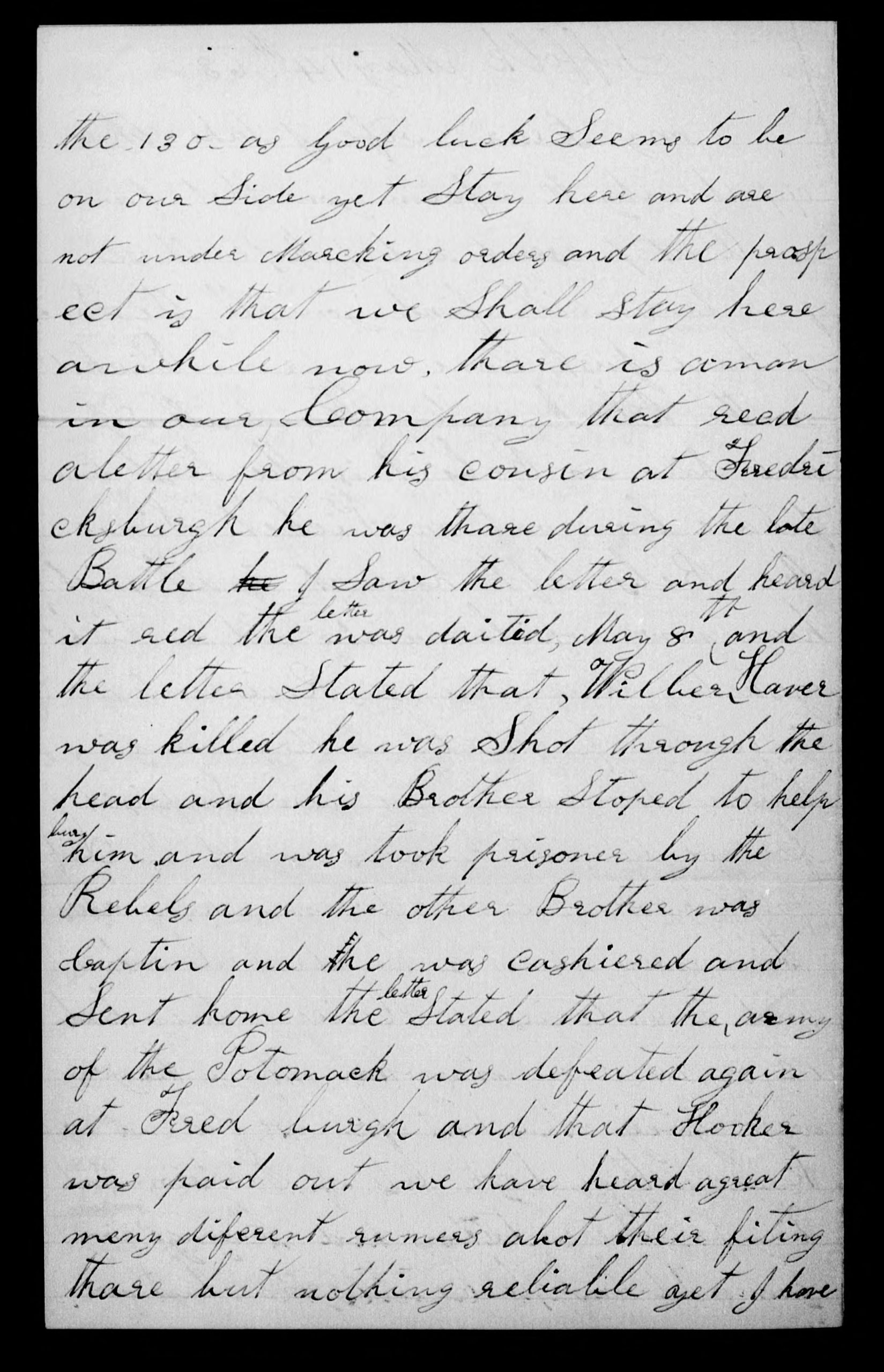
the 130 as good luck Seems to be on our Side yet Stay here and are not under Marching orders and the prospect is that we Shall Stay here awhile now, thare is a man in our Company that recd a letter from his cousin at Fredricksburgh he was thare during the late Battle I Saw the letter and heard it red the letter was daited May 8th and the letter Stated that, Wilber Haver was killed he was Shot through the head and his Brother Stoped to help bury him and was took prisoner by the Rebels and the other Brother was Captin and he was cashiered and Sent home the letter Stated that the army of the Potomack was defeated again at Fredburgh and that Hooker was paid out we have heard a great meny diferent rumers about their fiting thare but nothing reliable ayet I have
This is how news travelled. A man in Benedict’s company received a letter from a cousin who had been at Fredericksburg during Chancellorsville; the letter was read aloud, and Benedict copied its contents to his wife the same day. In three lines it carries the fate of three brothers — one shot through the head, one taken prisoner while stopping to bury him, and the third, a captain, cashiered and sent home.
Wilber Haver was not a Dragoon. The regiment was at Suffolk, not Fredericksburg, and he does not appear on its roll. Two Havers did serve in the Dragoons — James H. Haver of Portage and Myron H. Haver of Nunda — but whether they were kin to the brothers in this letter is not established, and is recorded here only as an open question.
“Hooker was paid out” is Benedict’s phrase for the Union defeat at Chancellorsville, which had ended eight days earlier.
“My old chums are all alive and well” — 14–15 May 1863
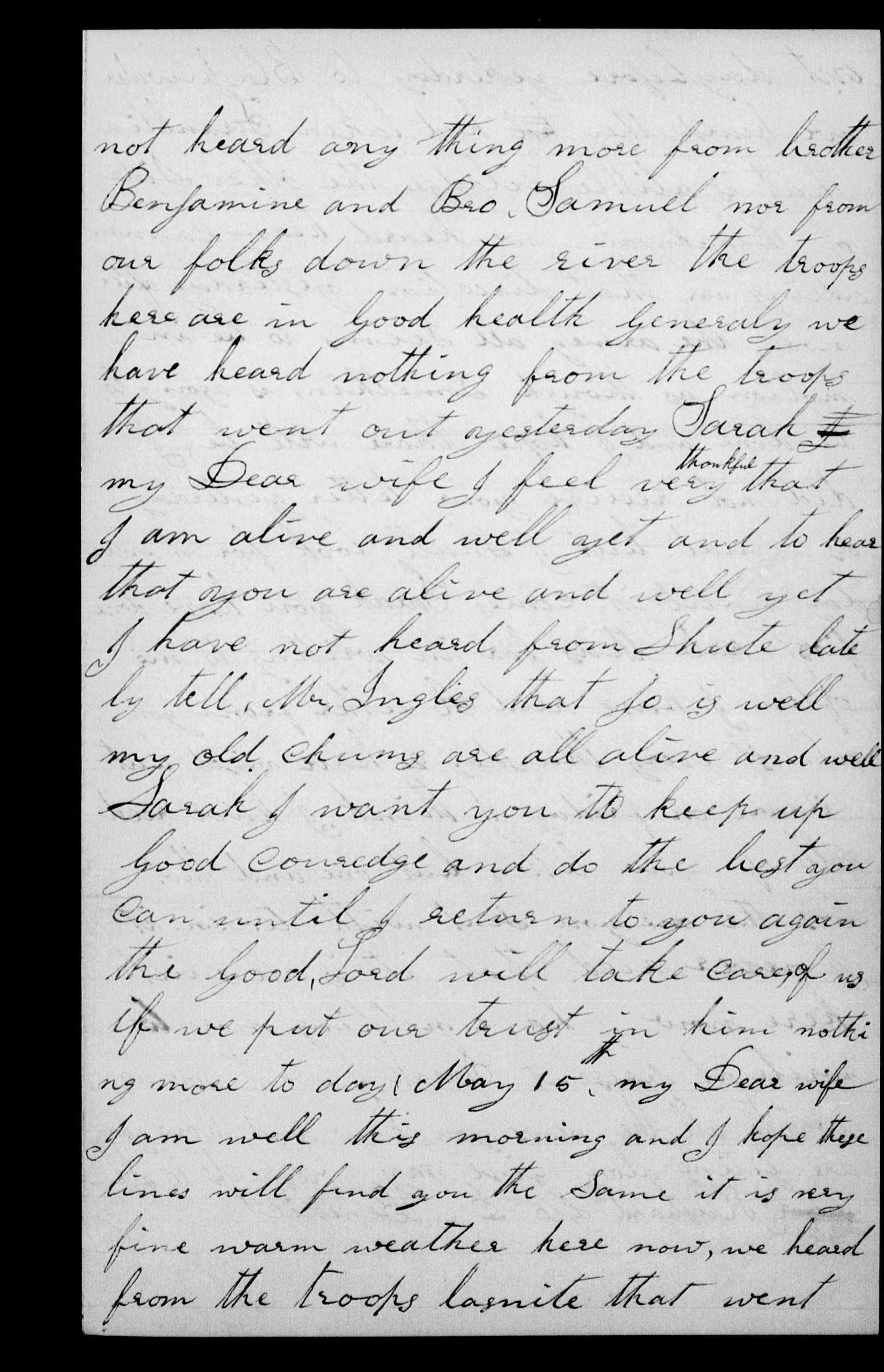
not heard any thing more from brother Benjamine and Bro. Samuel nor from our folks down the river the troops here are in good health generaly we have heard nothing from the troops that went out yesterday Sarah my Dear wife I feel very thankful that I am alive and well ayet and to hear that you are alive and well yet I have not heard from Shute lately tell Mr. Ingles that Jo is well my old chums are all alive and well Sarah I want you to keep up Good couredge and do the best you Can until I return to you again the Good Lord will take Care of us if we put our trust in him nothing more to day
May 15th, my Dear wife I am well this morning and I hope these lines will find you the Same it is very fine warm weather here now, we heard from the troops lasnite that went
“Brother Benjamine” and “Bro. Samuel” are his own brothers; neither appears on the Dragoons’ roll, so they were serving elsewhere — he calls them “our folks down the river.” George Benedict is the only Benedict on this regiment’s rolls. “Mr. Ingles” and “Jo” have not been identified.
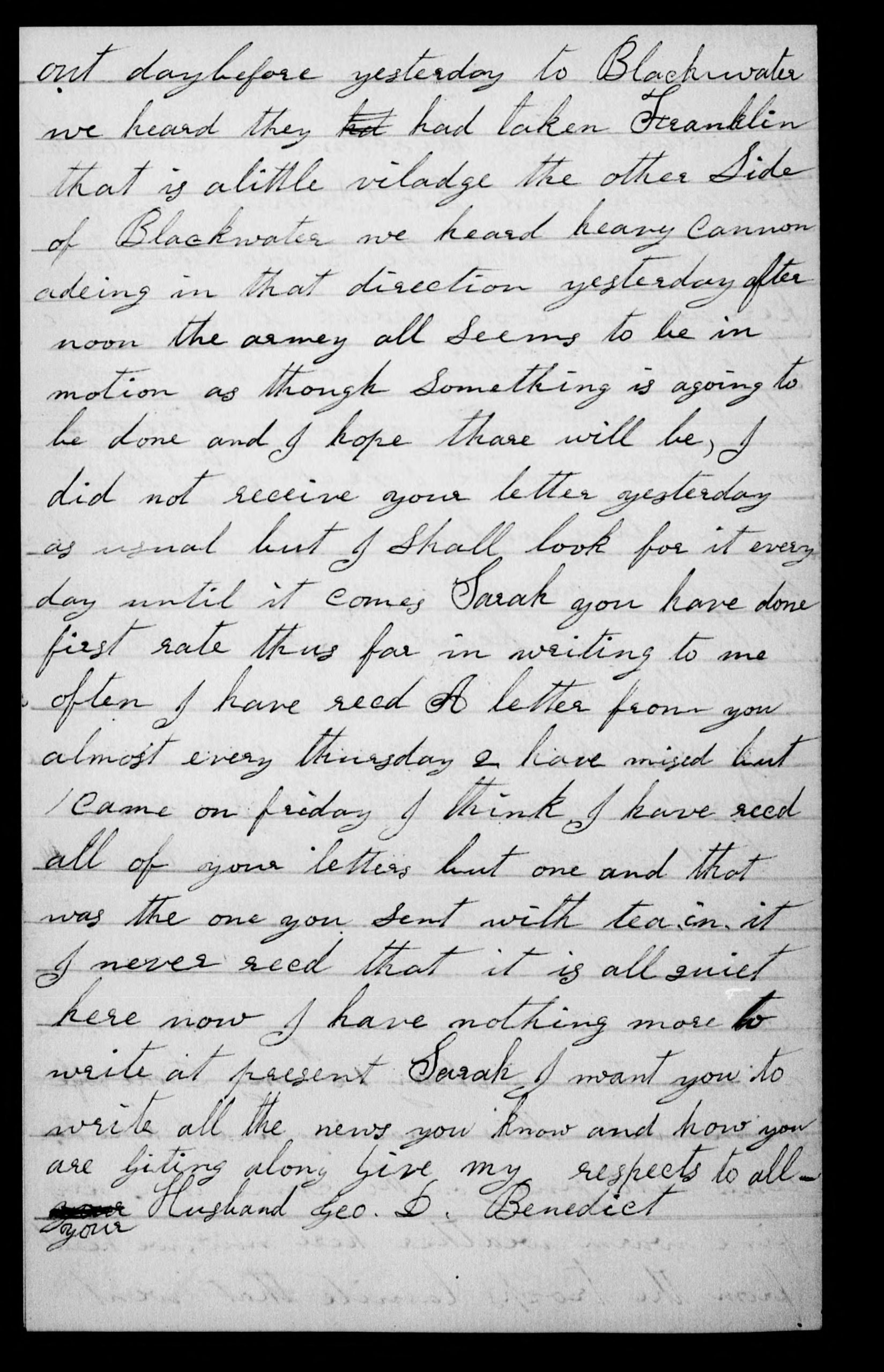
out day before yesterday to Blackwater we heard they had taken Franklin that is a little viladge the other Side of Blackwater we heard heavy Cannonadeing in that direction yesterday afternoon the armey all Seems to be in motion as though Something is agoing to be done and I hope thare will be, I did not receive your letter yesterday as usual but I Shall look for it every day until it comes Sarah you have done first rate thus far in writing to me often I have recd a letter from you almost every thursday 2 have missed but 1 Came on friday I think I have recd all of your letters but one and that was the one you Sent with tea in it I never recd that it is all quiet here now I have nothing more to write at present Sarah I want you to write all the news you know and how you are giting along give my respects to all your Husband Geo. D. Benedict
He was keeping count. A letter from Sarah came almost every Thursday; two had gone missing and one had arrived late, on a Friday. Of everything she sent him, only one thing never came at all — the letter with the tea in it.
Suffolk, 16 May 1863 — the last regiment left
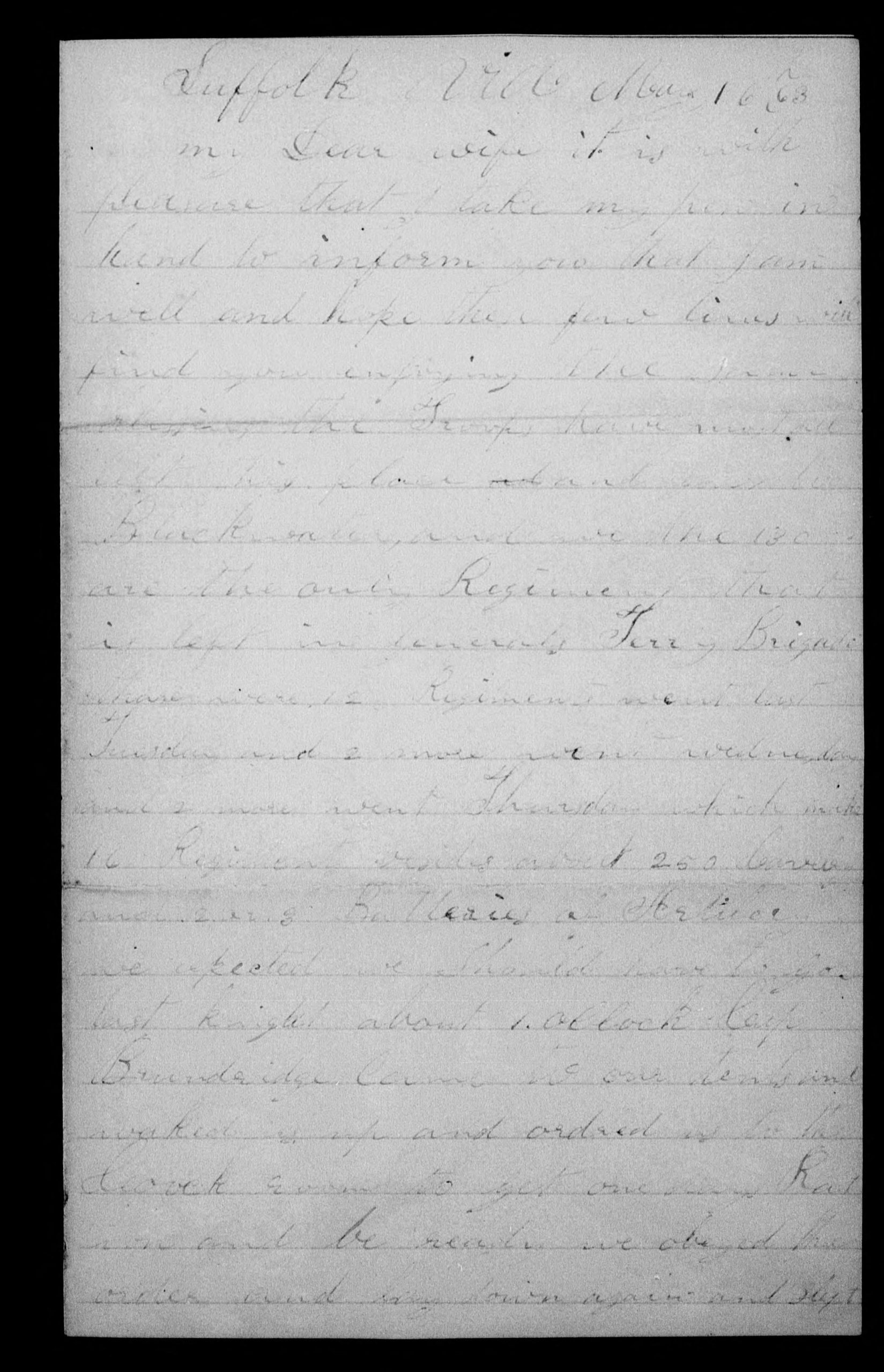
Suffolk Vill May 16 63
my Dear wife it is with pleasure that I take my pen in hand to inform you that I am well and hope thee few lines will find you enjoying the Same blessing the Troops have marched off this place about and to Blackwater and we the 130 are the only Regiment that is left in Generals Terry Brigade thare were 12 Regiments went last Tuesday and 2 more went wedensday and 2 more went Thursday which makes 16 Regiments beside about 250 Cavelry and 3 Batteries of Artilery we expected we Should have to go last knight about 1 oClock Capt Brundidge Came to our tent and waked us up and ordered us to be ready to get our Rations and be ready we obeyed the order and lay down again and slept
Sixteen regiments, two hundred and fifty cavalry and three batteries marched out of Suffolk over three days, and the 130th New York was the only regiment left in General Terry’s brigade. “Capt Brundidge” is Captain Charles L. Brundage of Portage, who commanded Benedict’s own Company G from October 1862 until he was discharged for disability that August — the man who came to the tent at one in the morning and told them to draw rations and be ready.
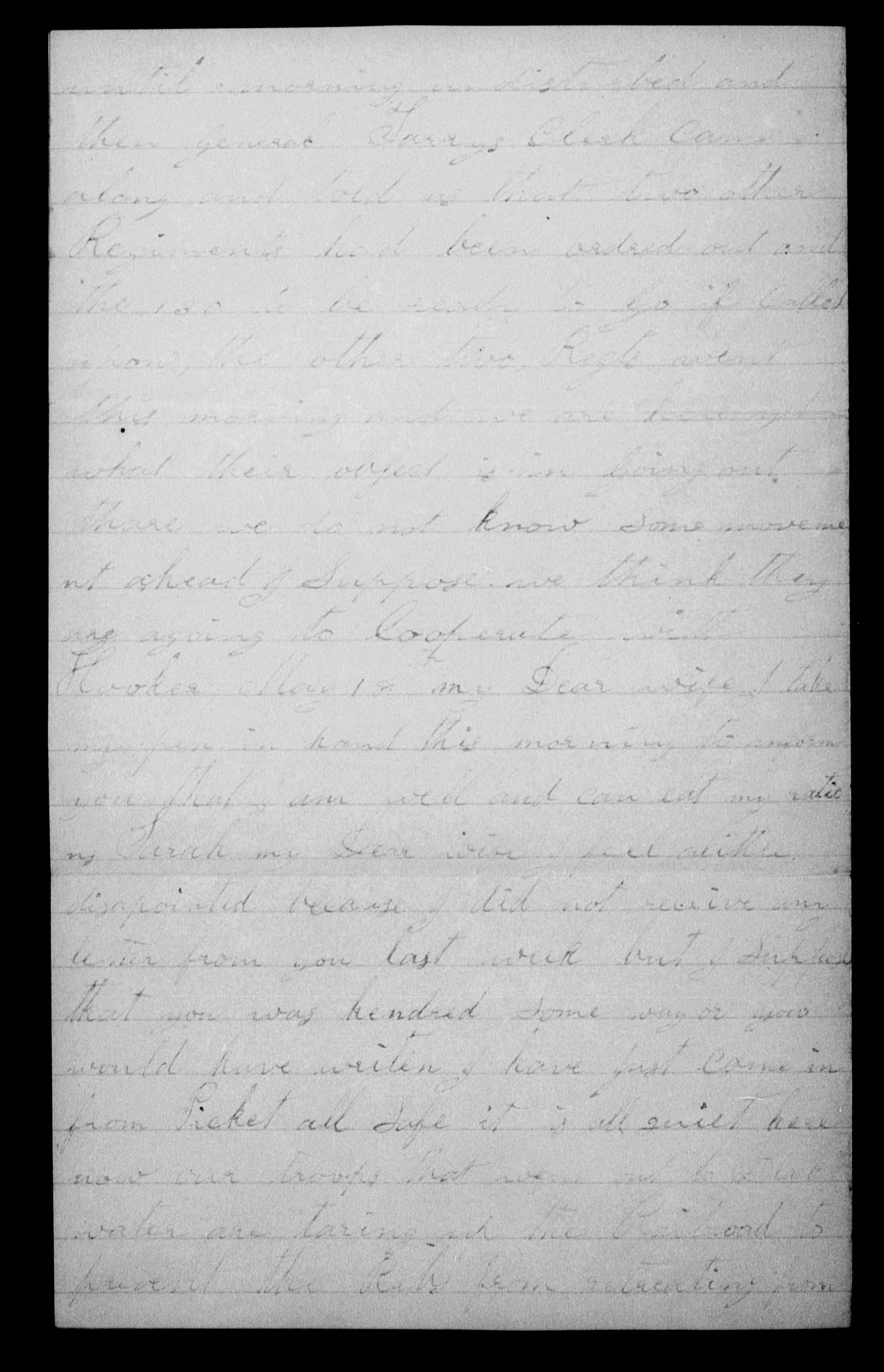
until morning undisturbed and then General Terrys Clerk Came along and told us that two other Regiments had been ordered out and the 130 to be ready to go if Called upon, the other two Regts went this morning and we are here yet what their object is in going out thare we do not know Some movement ahead I Suppose we think they are agoing to Cooperate with Hooker
May 17 my Dear wife I take my pen in hand this morning to inform you that I am well and can eat my rations my Dear wife I feel a little disapointed because I did not receive any letter from you last week but I Suppose that you was hendred Some way or you would have writen I have just Come in from Picket all Safe it is all quiet here now our troops that went out to Blackwater are tareing up the Railroad to prevent the Rebs from getting from
Two things worth noticing. “I am well and can eat my rations” was a soldier’s whole medical report. And when Sarah’s letter failed to arrive he did not reproach her — he assumed she had been “hendred Some way, or you would have writen.” The troops sent to the Blackwater were tearing up the railroad to stop the Confederates using it.
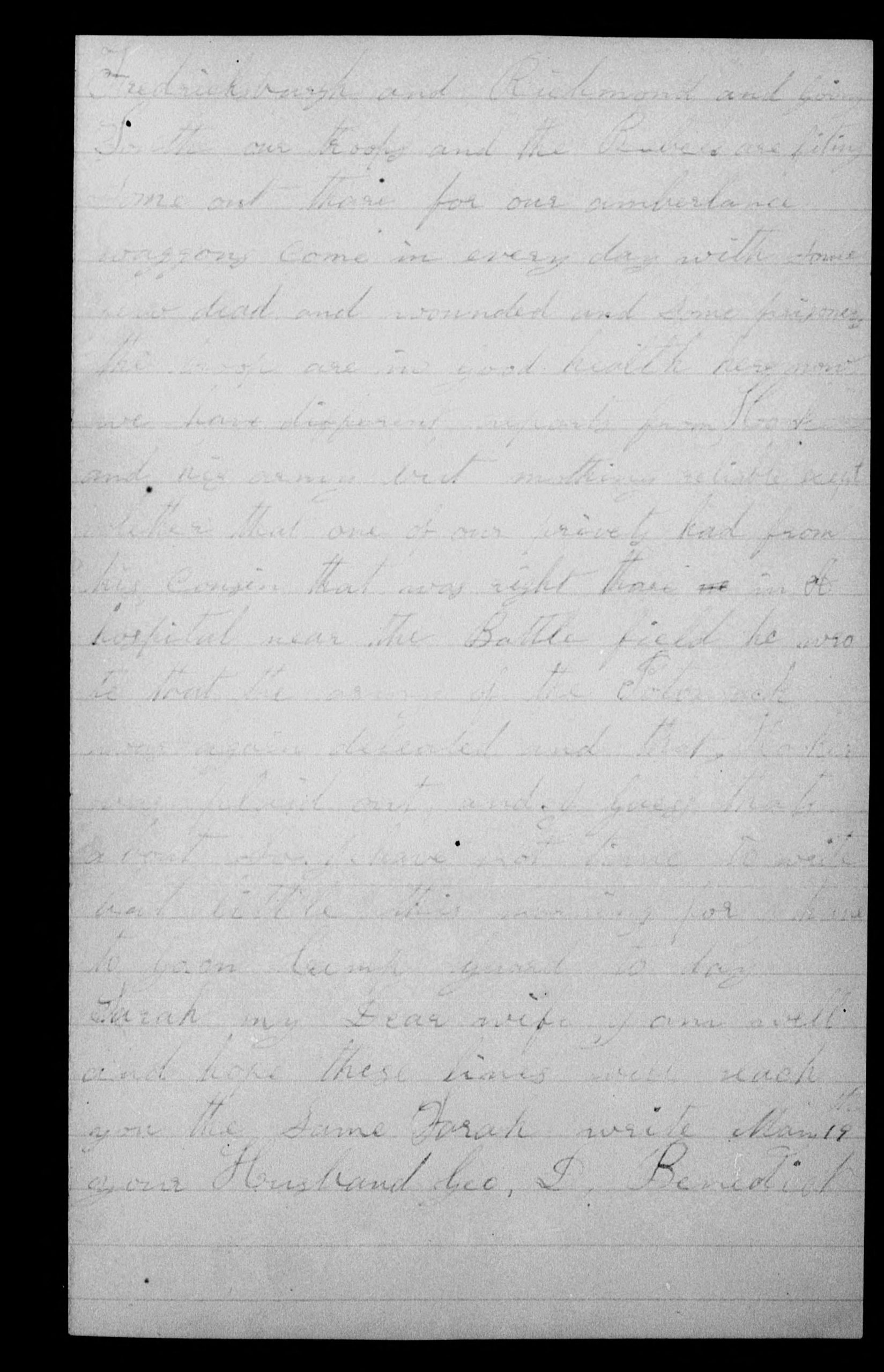
Fredricksburgh and Richmond and going South our troops and the Rebels are fiting Some out thare for our ambulance waggons Come in every day with Some few dead and wounded and Some prisners the troops are in good health here now we have diferent reports from Hooker and his army but nothing reliable except a letter that one of our privets had from his Cousin that was right thare in a hospital near the Battle field he wrote to that he was one of the Colonels men again defeated and that Hooker was played out and I gues that is about all I have time to write a little this morning for I have to go on Camp guard to day
Sarah my Dear wife I am well and hope these lines will reach you the Same Sarah write May 19 your Husband Geo. D. Benedict
The cousin’s letter from the hospital near the Chancellorsville battlefield — the one Benedict first mentioned on 14 May — was still being passed from hand to hand in camp five days later. It was the only account of the battle the regiment trusted. Meanwhile the ambulance wagons came in every day “with Some few dead and wounded and Some prisners.”
Suffolk, 20 May 1863 — carrying the railroad away
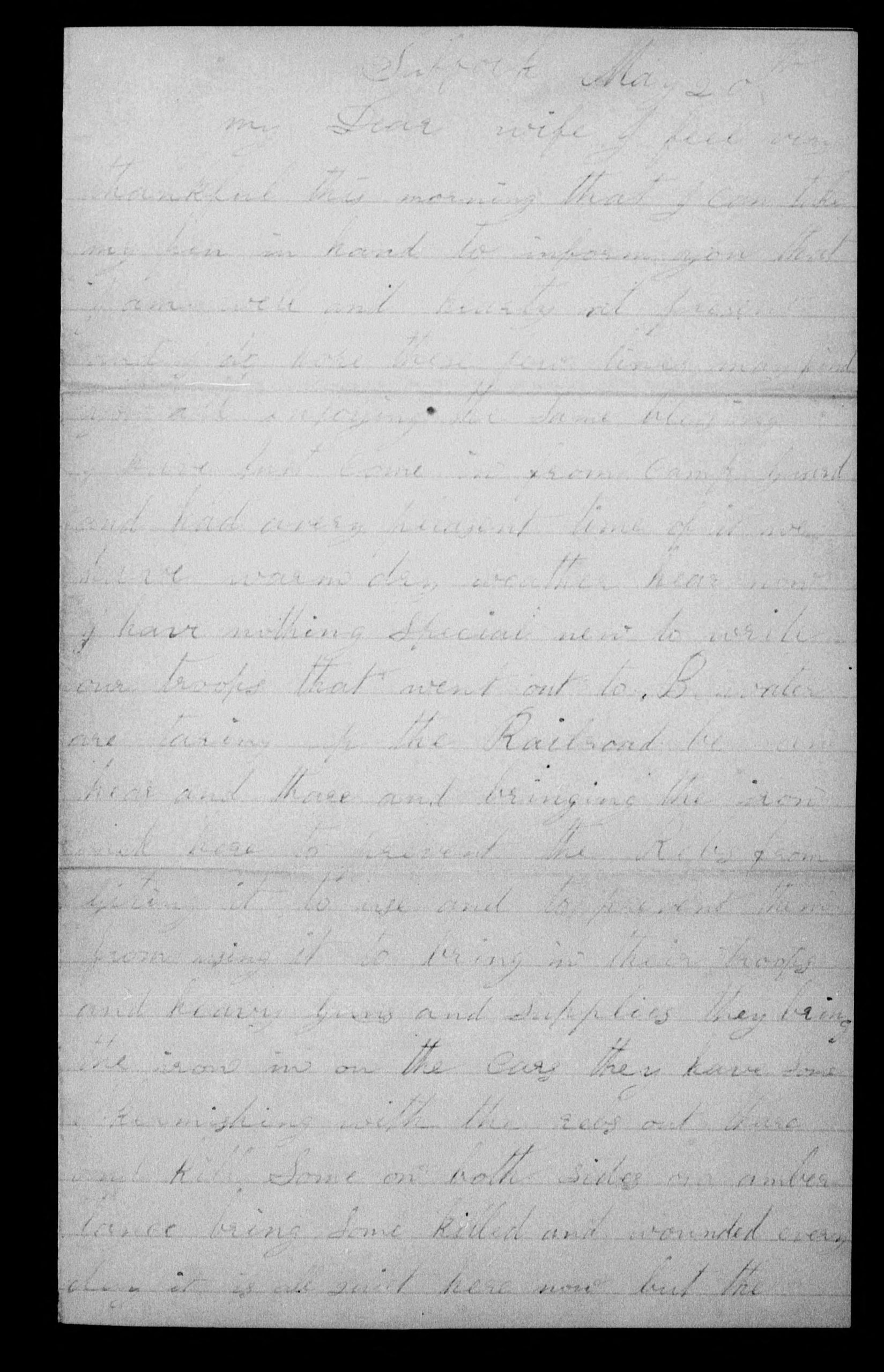
Suffolk May 20th
my Dear wife I feel very thankful this morning that I can take my pen in hand to inform you that I am well and hearty at present and hope these few lines may find you all enjoying the Same blessing I have just Come in from Camp guard and had a very pleasant time of it we have warm dry weather hear now I have nothing Special new to write our troops that went out to B. water are tareing up the Railroad between hear and thare and bringing the iron in here to prevent the Rebs from giting it to use and to prevent them from using it to bring in their troops and heavy guns and supplies they bring the iron in on the Cars they have Some Skirmishing with the rebs out thare and kill Some on both Sides our ambulance bring Some killed and wounded every day it is all quiet here now but the
This is a precise piece of logistics reporting. The troops on the Blackwater were not merely tearing up the track — they were loading the rails onto cars and hauling the iron back into Suffolk, so that the Confederates could neither relay the line nor melt the metal down. Benedict understood exactly why: to stop them moving “their troops and heavy guns and supplies.” The cost of that work reached him daily, in the ambulances.
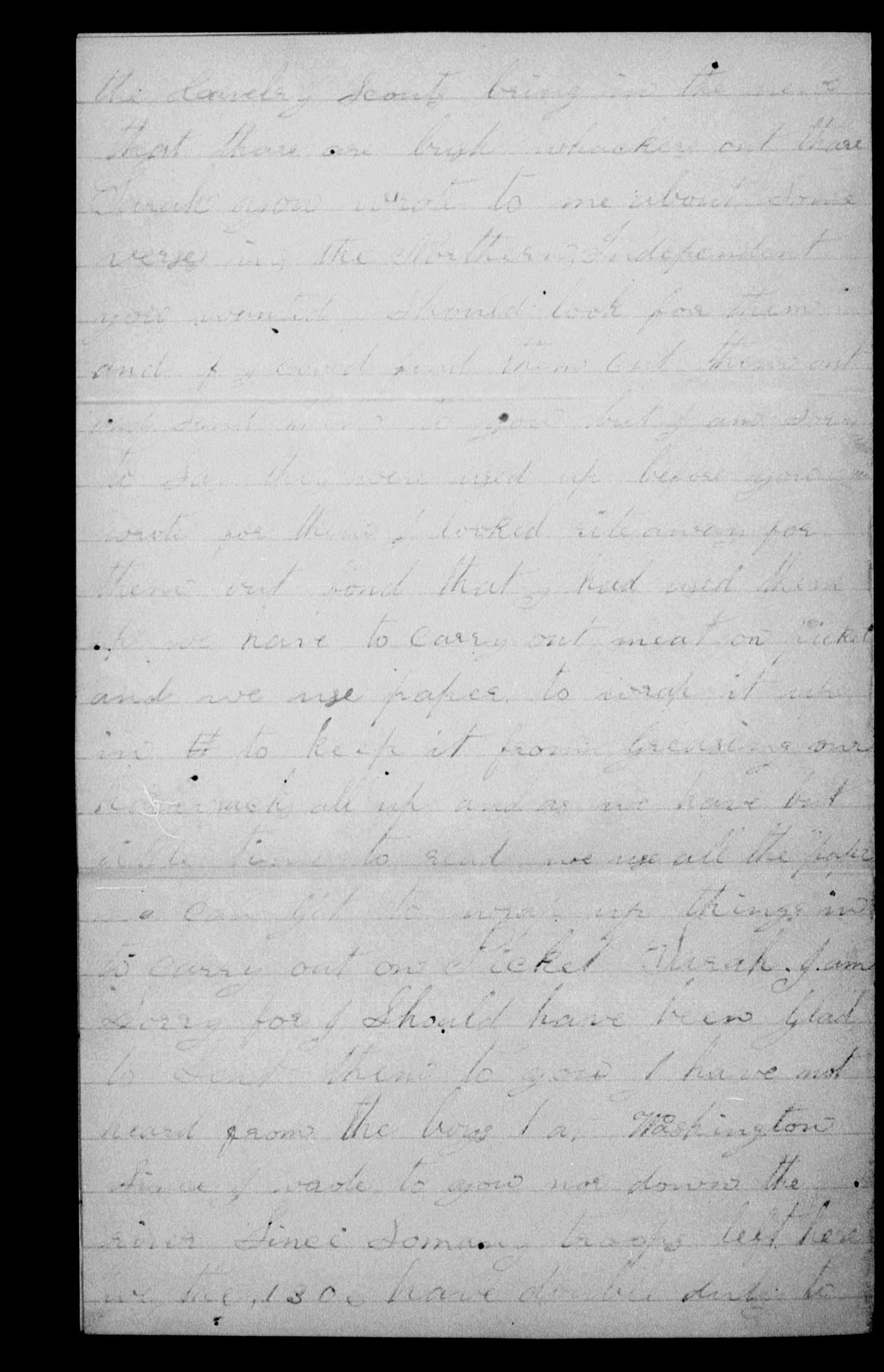
the Cavelry Scouts bring in the news that thare are bush whackers out thare Sarah you wrot to me about Some verses in the Northern Independent you would Should look for them and if I could find them cut them out and Send them to you but I am Sorry to Say they was used up before you wrote for them I looked all over for them but found that I had used them if we have to carry out meat on Picket and we use paper to wrap it up in to keep it from greasing our haversack all up and as we have but little time to eat we use all the paper we can git to wrap up things in to carry out on Picket Sarah I am Sorry for I Should have been glad to Send them to you I have not heard from the boys at Washington Since I wrote to you nor down the river Since Some troops left here we the 130 have double duty to
Sarah had asked him to cut some verses out of the Northern Independent — a Methodist paper published at Auburn, New York — and post them to her. He looked all through his things and could not find the sheet. Paper had a use in camp: the men wrapped their meat in it to carry out on picket, so that the grease would not ruin a haversack, and there was rarely time to sit and eat. He had used it. Half of this paragraph is an apology to his wife for a newspaper cutting.
The “bush whackers” the cavalry scouts reported were irregulars operating beyond the picket line — the reason meat had to be carried out rather than eaten in camp.
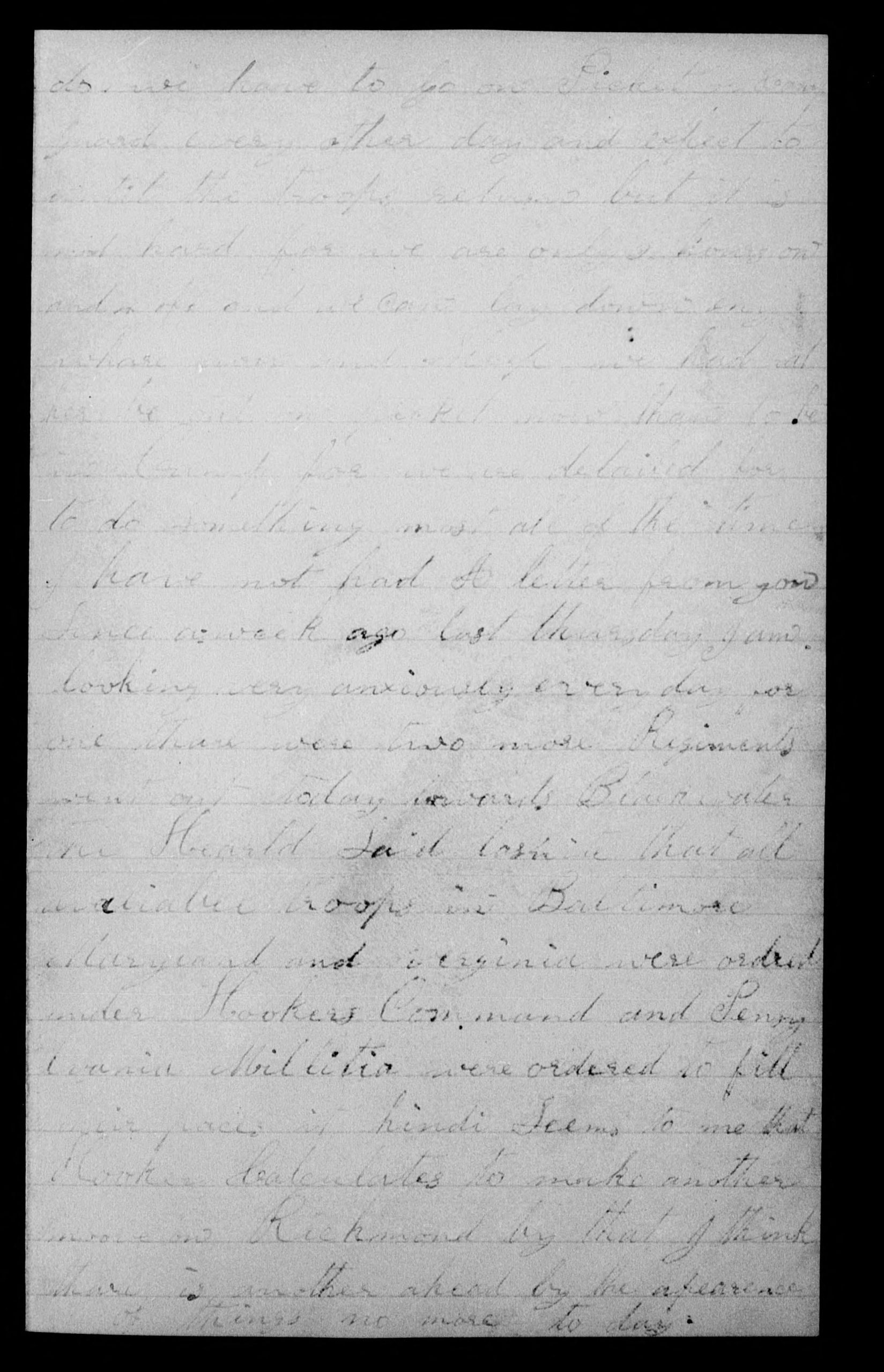
do we have to go on Picket or Camp guard every other day and expect to until the troops return but it is not hard for we are only 2 hours on and 4 off and we Can lay down on Some hay and Sleep we had all our tents on Picket now that is Some Comfort for we are detailed to do Something most all of the time I have not had a letter from you Since a week ago last thursday I am looking very anxiously every day for one thare were two more Regiments went out today towards Blackwater the Herald Said today that all available troops in Baltimore Maryland and Virginia were ordered under Hookers Command and Pennsylvania Militia were ordered to fill their place it kinde Seems to me that Hooker calculates to make another move on Richmond by that I think there is another ahead by the aperance of things no more to day
Two things sit side by side here. The first is the texture of duty: picket or camp guard every other day, two hours on and four off, sleeping on hay, tents carried out to the picket line as “Some Comfort.” The second is a private soldier reading the New York Herald and reasoning about strategy — troops from Baltimore, Maryland and Virginia concentrating under Hooker, Pennsylvania militia called up to fill their places. He concluded Hooker meant “to make another move on Richmond.”
He was right that something large was coming and wrong about its direction. Within three weeks Lee would be moving north, and the campaign that followed ended at Gettysburg. And still, underneath the strategy: “I have not had a letter from you Since a week ago last thursday. I am looking very anxiously every day for one.”
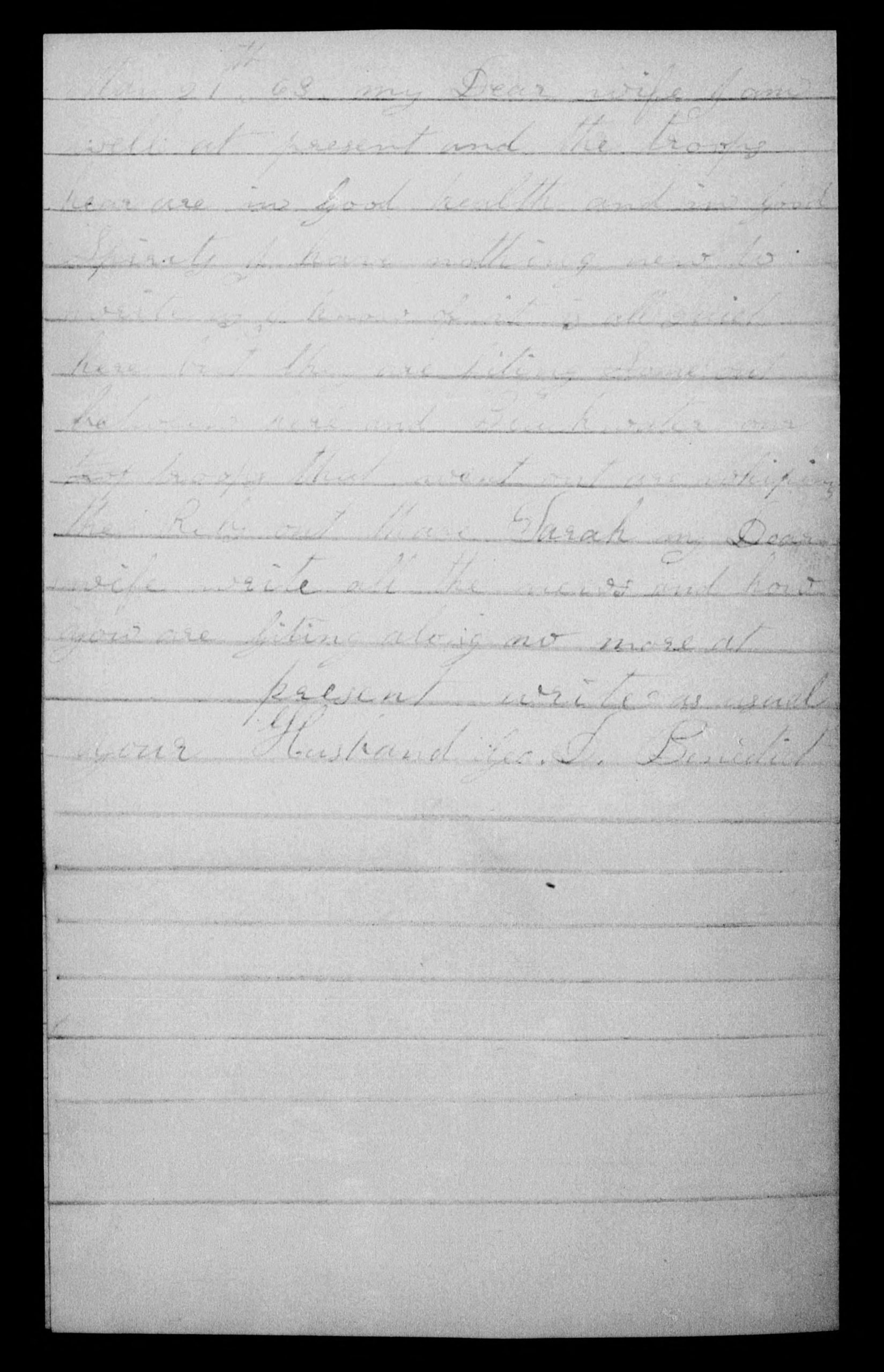
May 21st 63 my Dear wife I am well at present and the troops here are in good health and in good Spirits I have nothing new to write only that it is all quiet here but they are fiting Some at Blackwater our folks that went out are whiping the Rebs out thare Sarah my Dear wife write all the news and how you are giting along no more at present write as usual your Husband Geo. D. Benedict
He kept this letter open for five days, adding to it as news came — 16, 17, 19, 20 and finally 21 May — and then closed it the way he closed almost all of them: asking her to write all the news, and how she was getting along.
Suffolk, 23 May 1863 — “a place Called Jacksons”
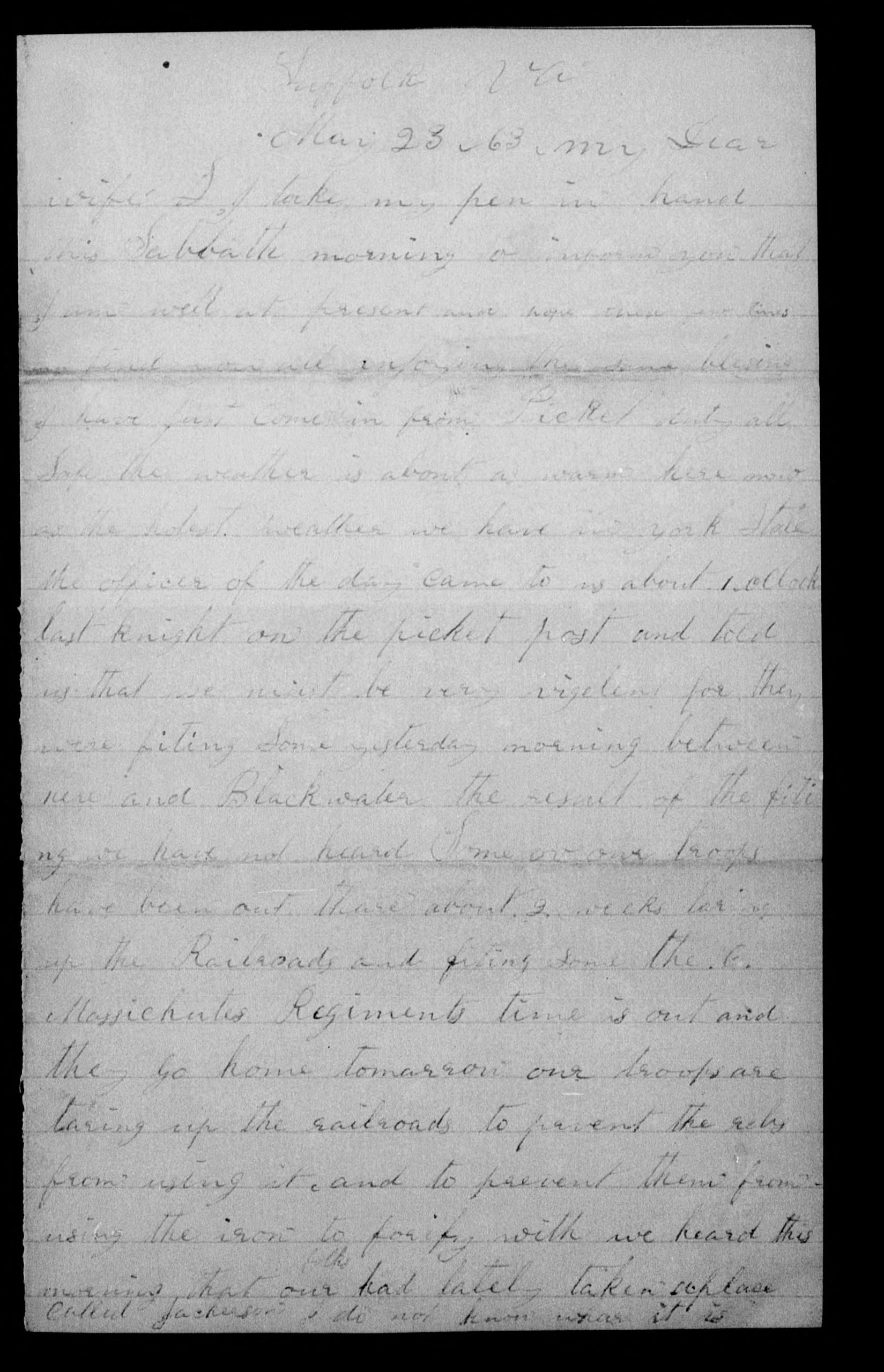
Suffolk VA May 23 63
my Dear wife I take my pen in hand this Sabbath morning to inform you that I am well at present and hope these few lines may find you all enjoying the Same blessing I have just Come in from Picket duty all Safe the weather is about as warm here now as the hotest weather we have in York State the officer of the day Came to us about 1 oClock last knight on the picket post and told us that we must be very vigelent for they were fiting Some yesterday morning between here and Blackwater the result of the fiting we have not heard Some of our troops have been out thare about 3 weeks tearing up the Railroads and fiting Some the 6 Massichutes Regiments time is out and they go home tomarrow our troops are tearing up the railroads to prevent the rebs from using it and to prevent them from using the iron to forify with we heard this morning that our folks had lately taken a place Called Jacksons I do not know whare it is
The place called “Jacksons” was Jackson, Mississippi, the state capital, taken by Grant on 14 May 1863 during the campaign that would end at Vicksburg. The news had taken nine days to reach a picket post in Virginia, and the man writing it down had no idea where Mississippi’s capital was. This is what the war looked like from inside it — a decisive event in the west arriving as a rumour about somewhere he could not place.
The 6th Massachusetts, whose nine months were up, went home the next day. Benedict had two more years to serve, and would not finish them.
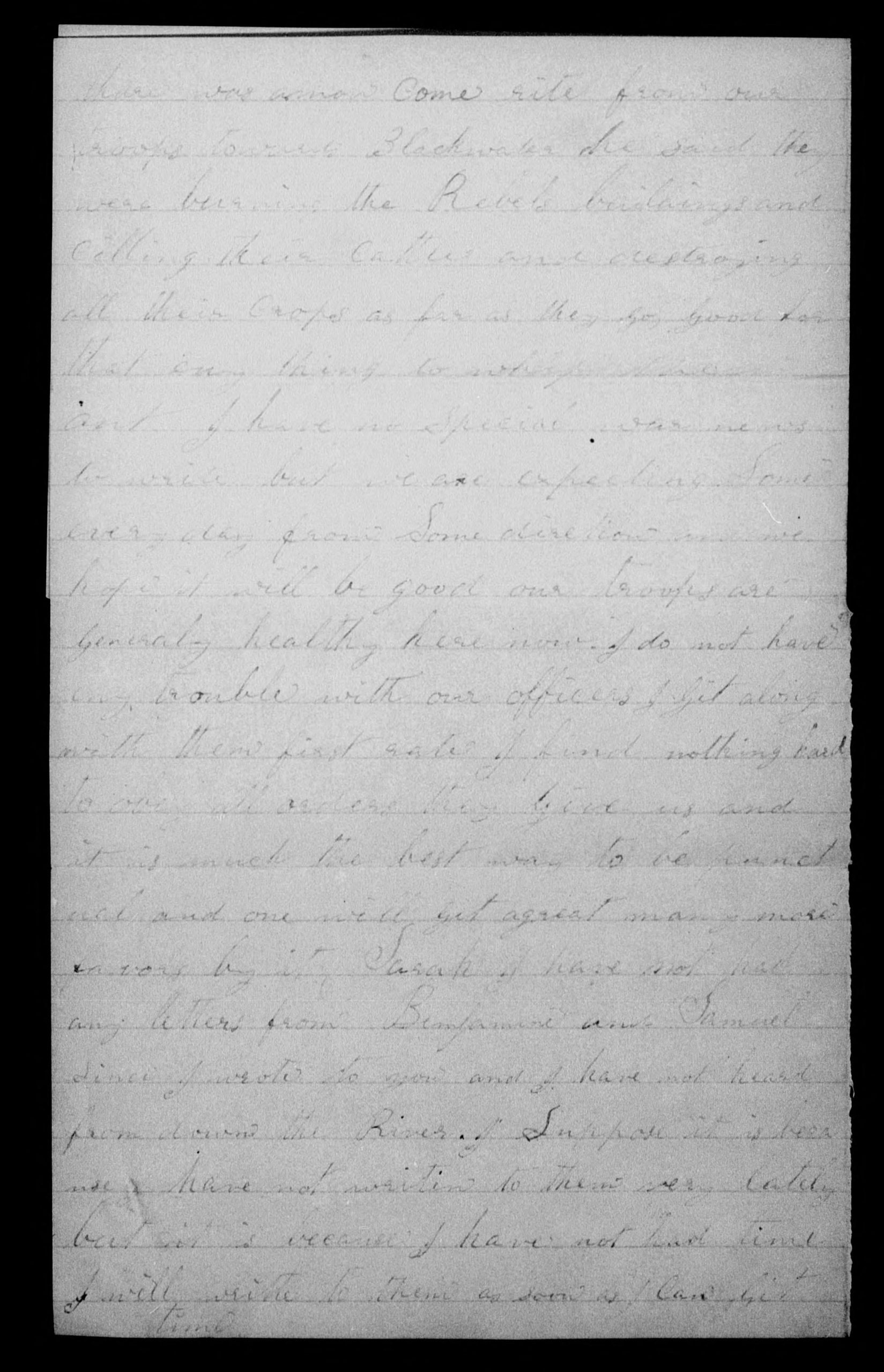
thare was a man Come rite from our troops toward Blackwater he said they were burning the Rebels buildings and Cilling their Cattle and destroying all their Crops as far as they go good for that eny thing to whip them out I have no Special war news to write but we are expecting Some every day from Some direction and we hope it will be good our troops are generaly healthy here now I do not have any trouble with our officers I git along with them first rate I find nothing hard to obey all orders they give us and it is much the best way to be punctial and one will git a great many more favors by it Sarah I have not had any letters from Benjamine and Samuel Since I wrote to you and I have not heard from down the River I Suppose it is because I have not writen to them very lately but it is because I have not had time I will write to them as soon as I Can git time
This is the hardest passage in the letters, and it is given without flinching. The war on the Blackwater had moved from tearing up railroads to burning houses, killing livestock and destroying standing crops — and Benedict approved: “good for that, eny thing to whip them out.” He is describing what would later be called hard war, a year before Sheridan made it policy in the Shenandoah, and he is describing it about the farms of people much like himself. It is recorded here as he wrote it, without softening.
Directly beneath it sits the counsel of a forty-two-year-old who had run a farm: obey the orders, be punctual, and you will be granted more favours. He was managing his officers the way he had once managed a season.
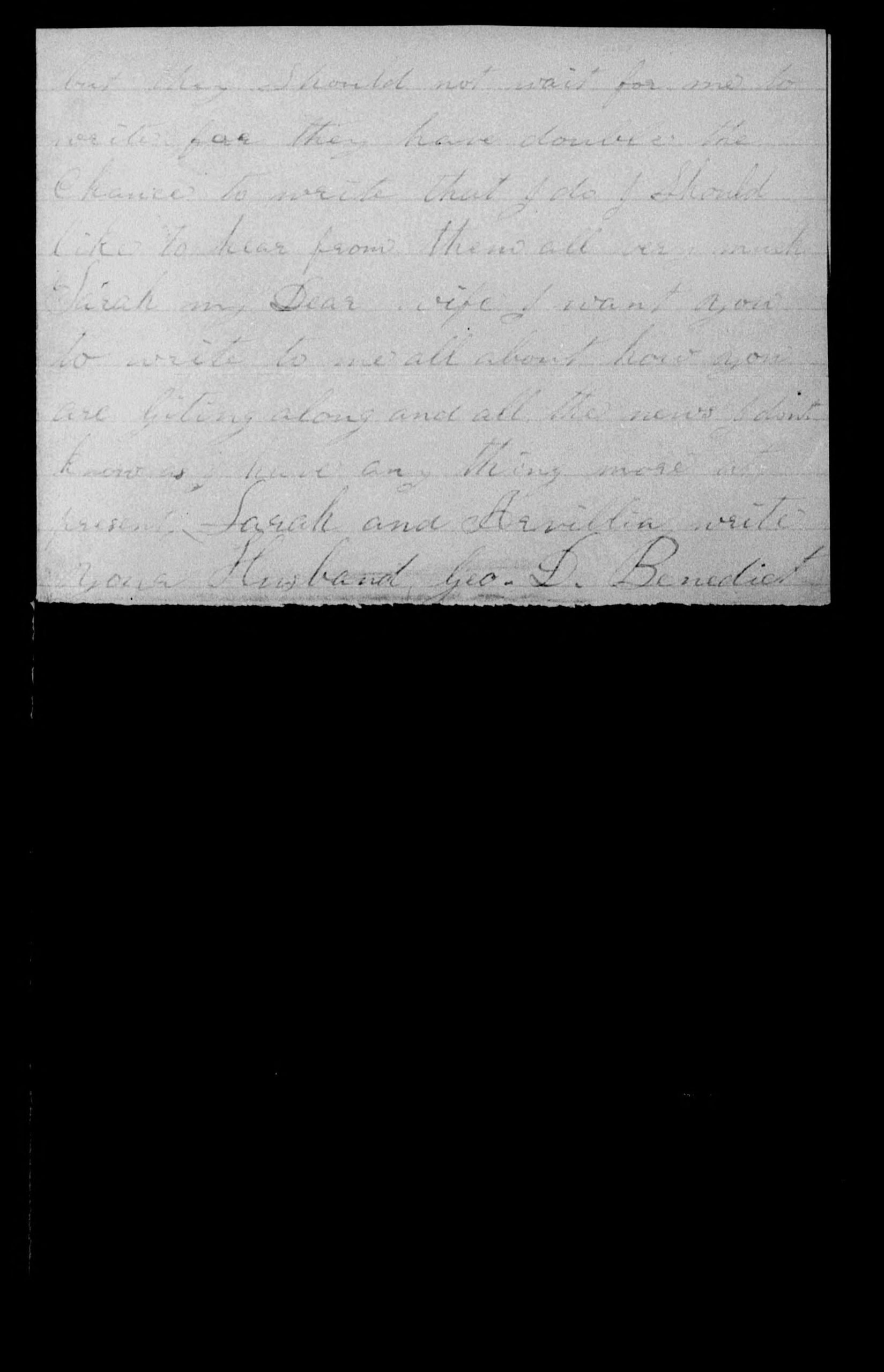
but they Should not wait for me to write for they have double the Chance to write that I do I Should like to hear from them all very much Sarah my Dear wife I want you to write to me all about how you are giting along and all the news I dont know I have any thing more at present Sarah and Arvillia write Your Husband Geo. D. Benedict
A note on the child’s name. Benedict’s daughter is named three times in these letters, and his hand is not consistent. On this sheet it reads most clearly as Arvillia, and that spelling has been adopted throughout. On other pages the same name could be read as Avillia or Amellia. Anyone descended from this family who knows the correct form is invited to correct us.
Suffolk, 26 May 1863 — “we did not believe the reports”
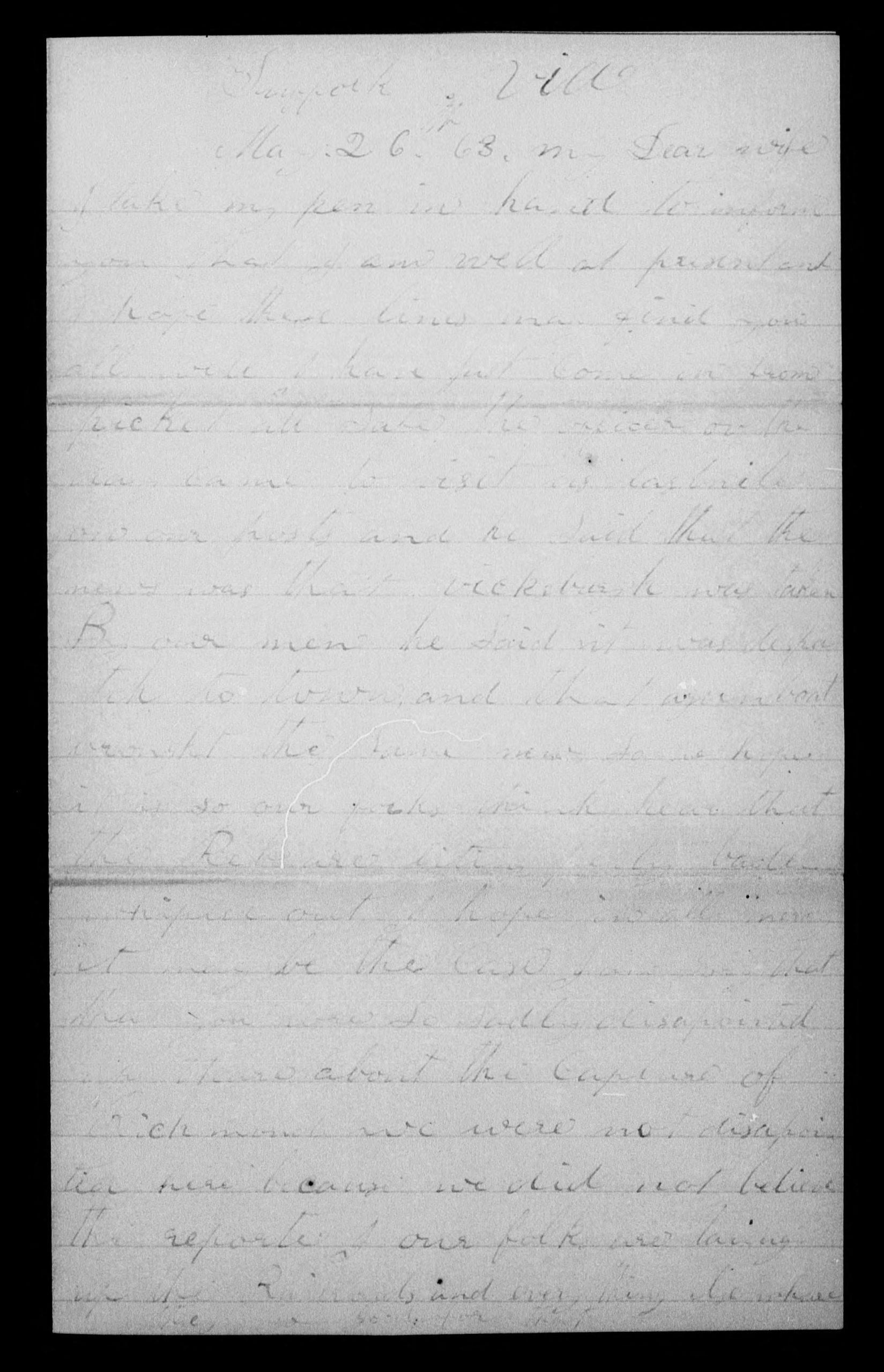
Suffolk Vill May 26th 63
my Dear wife I take my pen in hand to inform you that I am well at present I hope these lines may find you all well I have just Come in from picket all Safe the officer on the line Came to visit us awhile on our post and he Said that the news was that Vicksburgh was taken by our men he Said it was despatched to town, and that a gunboat brought the news So we hope it is So our folks think here that the Rebs are to be all wiped out I hope it will now it may be the Case for we were So bad disapointed another time about the Capture of Richmond we were not disapointed now because we did not believe the reports our folks are taring up the Railroads and every thing else whare they go
The report was false. Vicksburg did not surrender until 4 July 1863, six weeks after this letter. What makes the page valuable is not the rumour but Benedict’s response to it. He had been told once before that Richmond had fallen, and had believed it, and had been “So bad disapointed.” This time he wrote down the news and declined to trust it. It is a small record of how a soldier’s relationship with official optimism changed over a year of war.
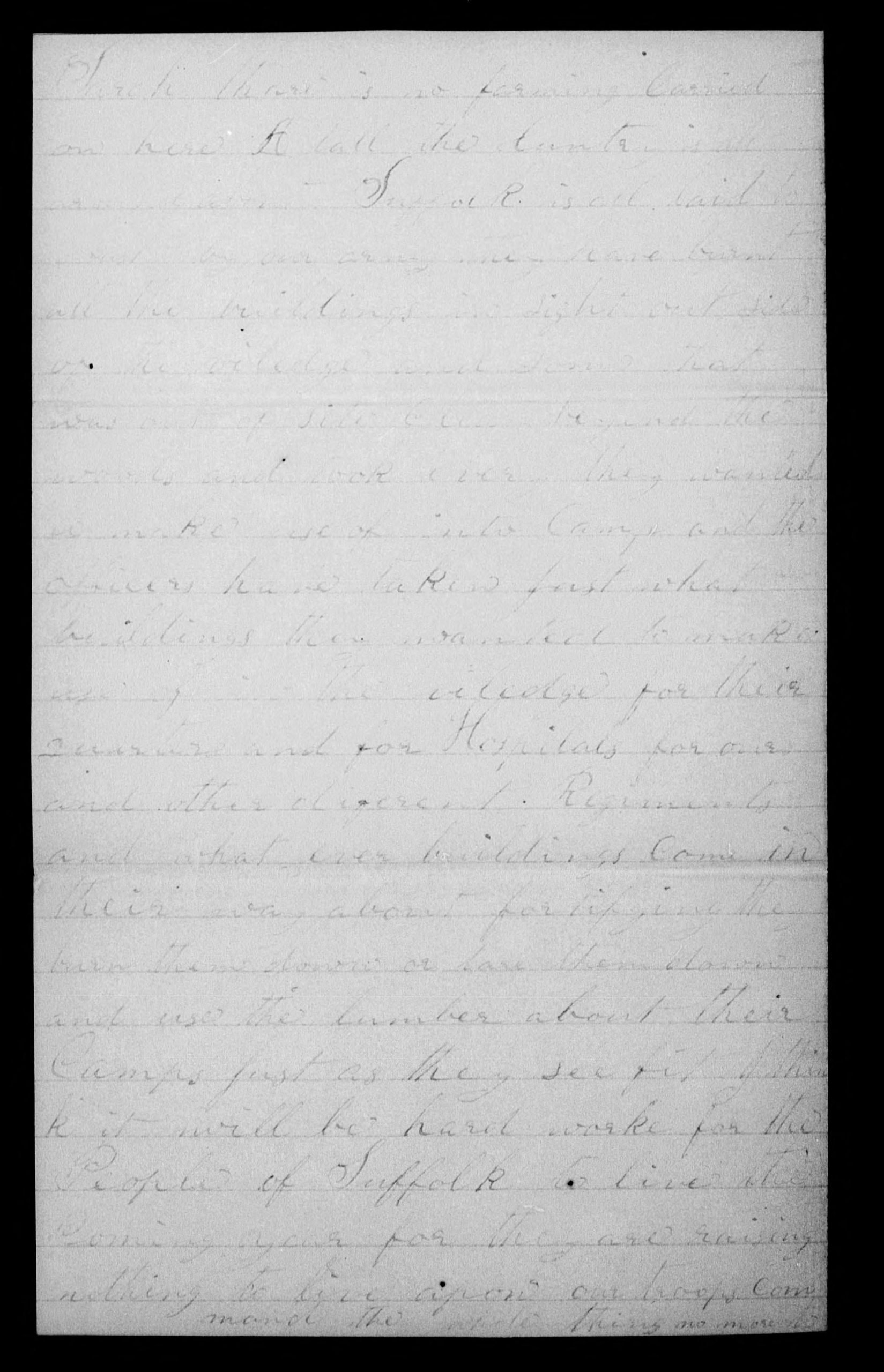
Sarah thare is no farming Carried on here at all the Cuntry is all wasted Suffolk is all laid to waste by our army they have burnt all the buildings in sight or nigh on the viledge and Some that was out of Site even beyond their works and took every thing they wanted to make use of into Camp and the officers have taken just what buildings they wanted to make use of in the viledge for their quarters and for Hospitals for our and other diferent Regiments and what ever buildings Come in their way about fortifying they burn them down or tare them down and use the lumber about their Camps just as they see fit I think it will be hard worke for the People of Suffolk to live the Coming year for they are raising nothing to live upon our troops Command the whole thing no more
Read this beside the page above it. Three days earlier Benedict had heard of houses burned and crops destroyed out toward the Blackwater and written “good for that, eny thing to whip them out.” Here he is describing the same policy where he can see it — a town stripped of its buildings for lumber and quarters, the country around it wasted, no crop going in. And he follows the thought to its end: “I think it will be hard worke for the People of Suffolk to live the Coming year, for they are raising nothing to live upon.”
He does not retract the earlier sentence and he does not reconcile the two. Both are left standing, three days apart, in the same man’s hand. That is what the record actually contains.
29 May 1863 — under Colonel Thorp and Major Scott
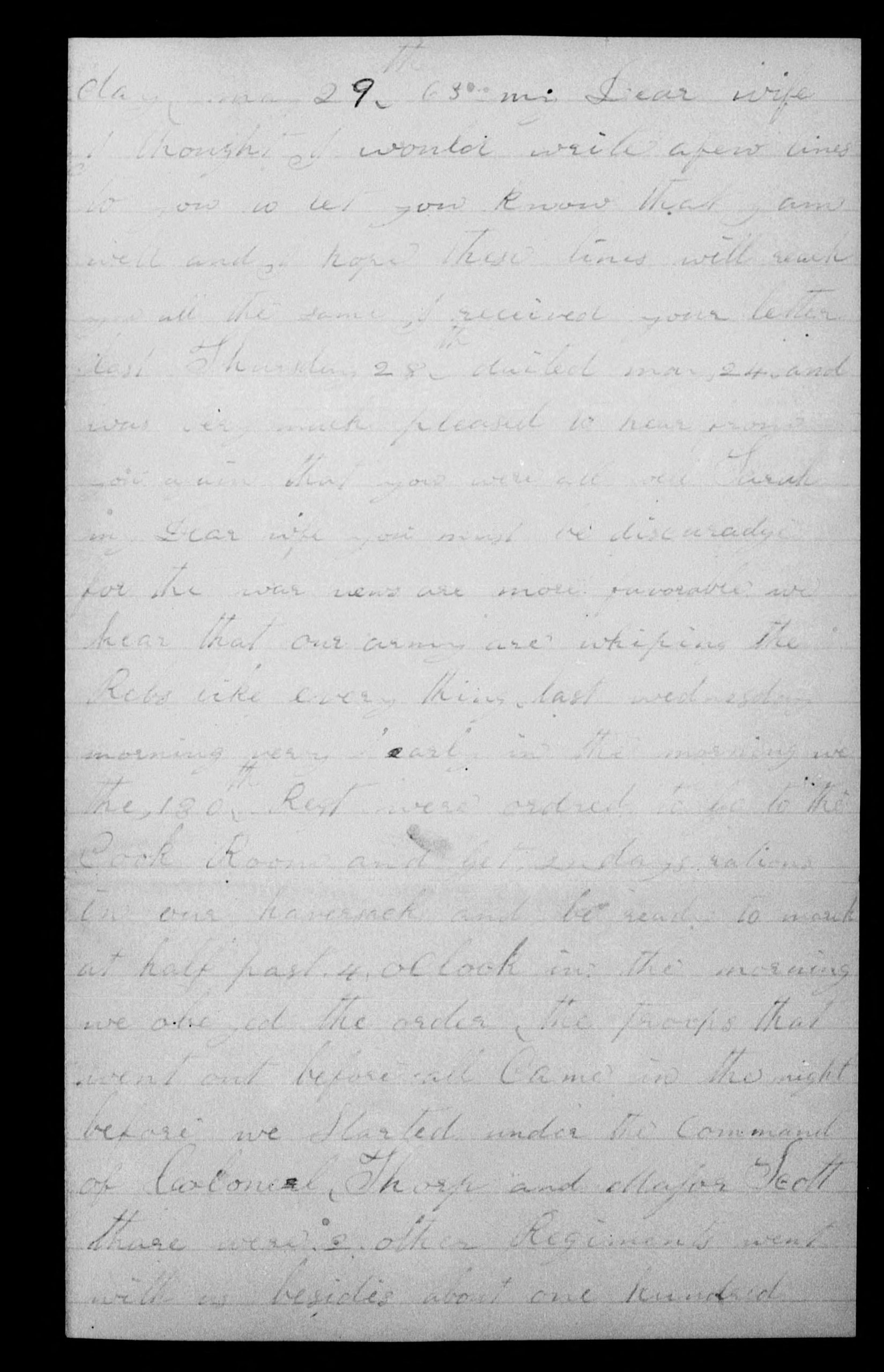
day may 29th 63
my Dear wife I thought I would write a few lines to you to let you know that I am well and I hope these lines will reach you all the same I received your letter last Thursday 28th dated may 24 and was very much pleased to hear from you again that you were all well Sarah my Dear wife you must not discouradge for the war news are more favorable we hear that our army are whiping the Rebs like every thing last wednesday morning very early in the morning we the 130th Regt were ordered to go to the Cook Room and get 5 days rations in our haversack and be ready to march at half past 4 oClock in the morning we obeyed the order the troops that went out before all Came in the night before we Started under the Command of Colonel Thorp and Major Scott thare were 2 other Regiments went with us besides about one hundred
This is the regiment’s command seen from the ranks. Thomas J. Thorp was lieutenant colonel at this date, though the men called him colonel; he would be wounded five times and taken prisoner at Trevilian Station the following June, and end the war a brevet brigadier general. Rufus Scott was the major, already carrying a wound from Fair Oaks and with five more ahead of him. Here they are simply the two officers who got a column onto the road at half past four in the morning with five days’ rations in the haversacks.
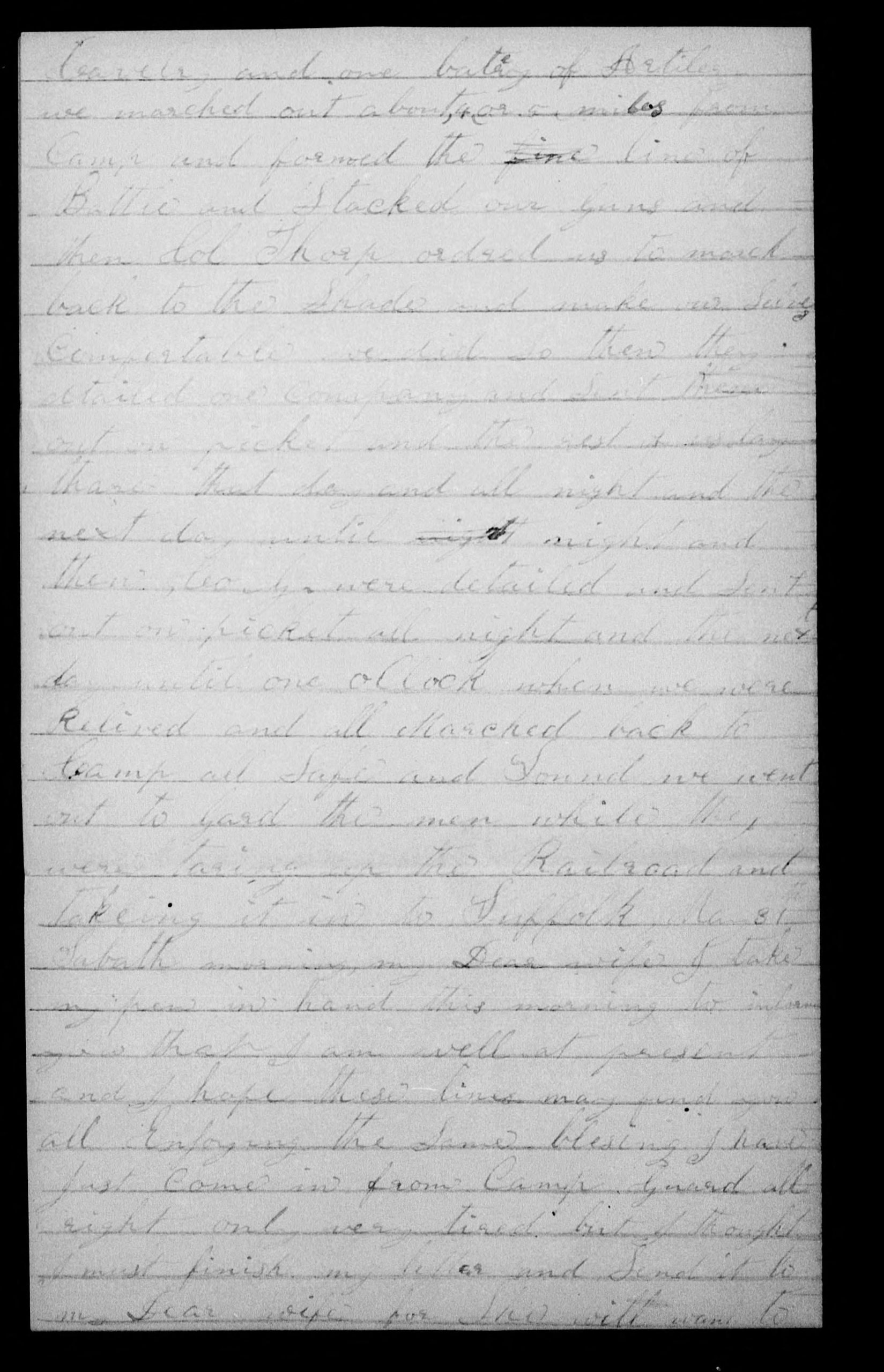
Cavelry and one battery of Artilery we marched out about 4 or 5 miles from Camp and formed the line of Battle and Stacked our guns and then Col Thorp ordered us to march back to the Shade and make our Selves Comfertable we did so then they detailed one Company and Sent them out on picket and the rest to stay thare that day and all night and the next day until night and then Co. G were detailed and Sent out on picket all night and the next day until one oClock when we were Relieved and all Marched back to Camp all Safe and Sound we went out to gard the men while they were tareing up the Railroad and takeing it in to Suffolk
May 31 Sabath morning
my Dear wife I take my pen in hand this morning to inform you that I am well at present and I hope these lines may find you all Enjoying the Same blesing I have just Come in from Camp Guard all night and very tired but I thought I must finish my letter and Send it to my Dear wife for She will want to
There is a small portrait of command here. The regiment marched five miles, formed line of battle and stacked arms — and then Colonel Thorp ordered them back into the shade to make themselves comfortable. The work itself was guarding the men who were tearing up the railroad and hauling the iron into Suffolk. Company G, Benedict’s own, drew the night picket.
He finished the letter on Sunday morning after a whole night on camp guard, “very tired, but I thought I must finish my letter and Send it to my Dear wife, for She will want to” hear. He had been awake for twenty-four hours and wrote anyway.
Late May 1863 — Grant at Vicksburg, as the newspapers had it
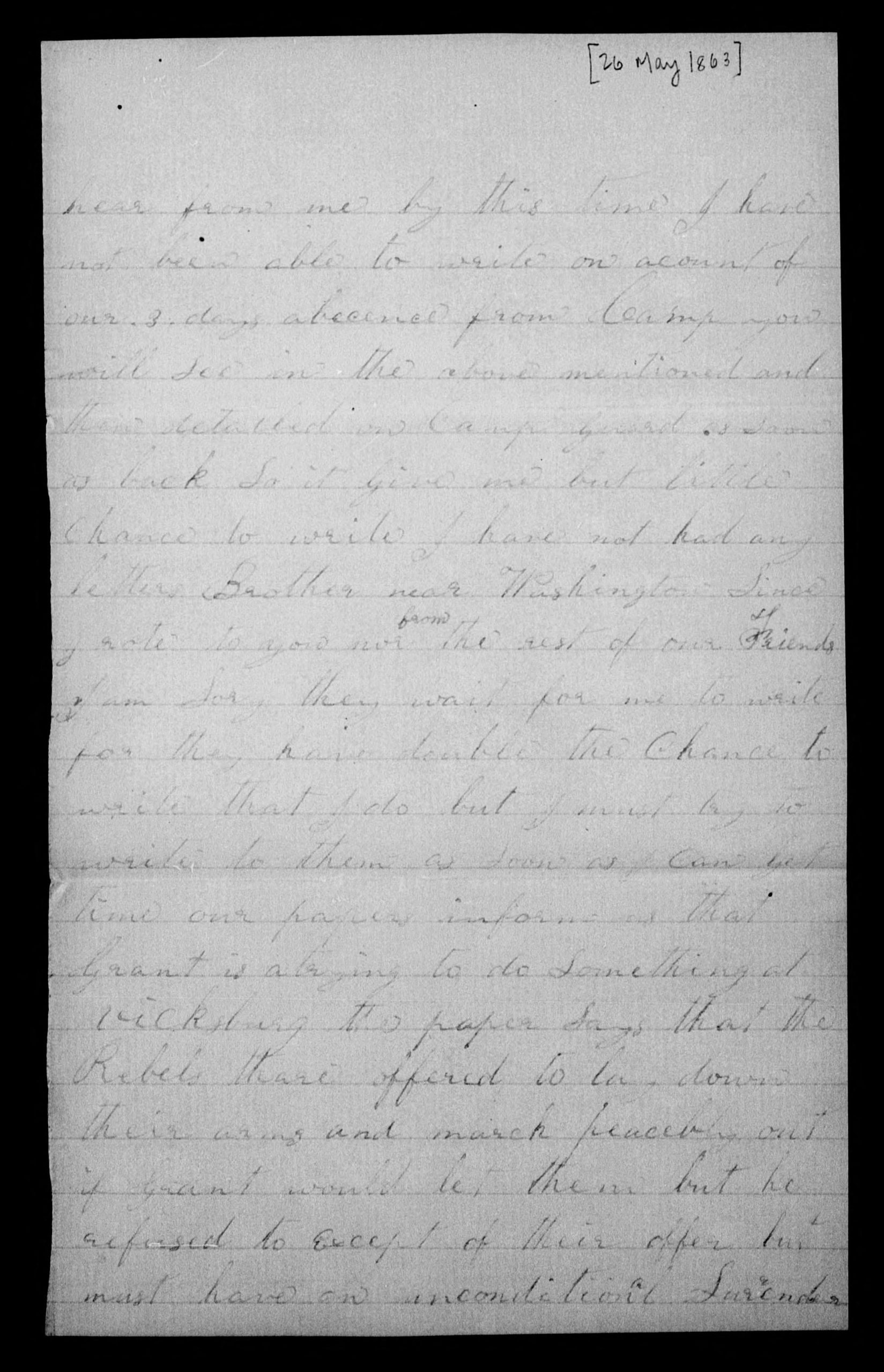
[archivist’s date: 26 May 1863]
hear from me by this time I have not been able to write on acount of our 3 days abcence from Camp you will See in the above mentioned and then detailed on Camp guard as Soon as back So it give me but little Chance to write I have not had any letters Brother near Washington Since I wrote to you nor from the rest of our Friends I am Sory they wait for me to write for they have double the Chance to write that I do but I must try to write to them as Soon as I Can get time our papers inform us that Grant is a trying to do Something at Vicksburg the paper Says that the Rebels thare offered to lay down their arms and march peaceably out if Grant would let them but he refused to Except of their offer but must have an unconditional Surrender
The story reaching Suffolk was that the garrison of Vicksburg had offered to lay down their arms and march out, and that Grant had refused anything short of unconditional surrender. It is the “Unconditional Surrender” Grant of the newspapers, and it was not what happened. Vicksburg held until 4 July 1863, and when Pemberton did surrender it was on terms: his men were paroled rather than taken into captivity. What the page preserves is not the fact but the story — what a soldier in Virginia was being told about a siege a thousand miles away.
The bracketed date at the top of the sheet is an archivist’s estimate, not Benedict’s. The three days’ absence he refers to was the expedition of 27–29 May described in the previous letter.
“You need not give yourself uneasiness about my being led astray”
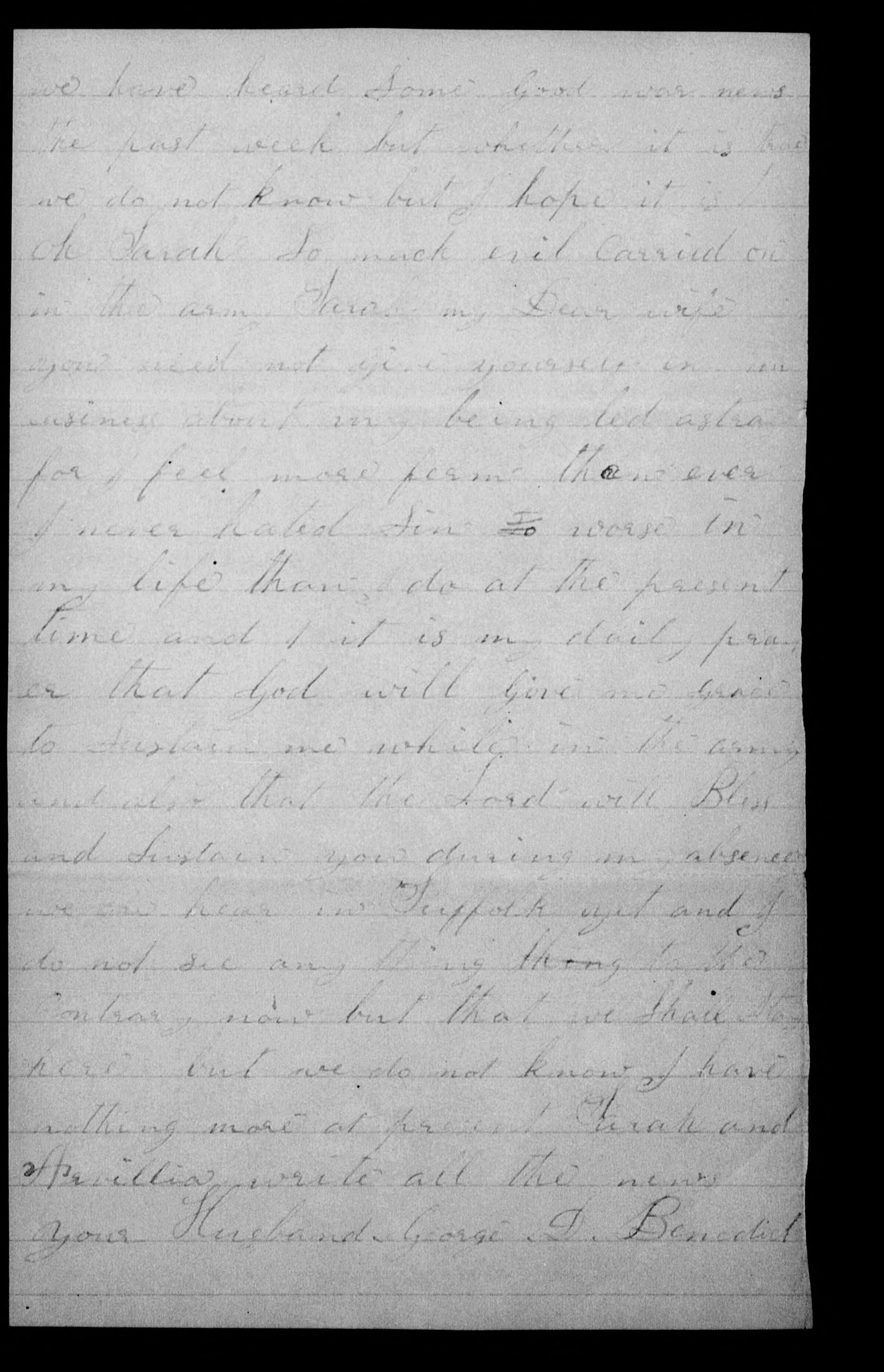
we have heard Some Good war news the past week but whether it is true we do not know but I hope it is Oh Sarah So much evil Carried on in the army Sarah my Dear wife you need not give yourself uneasiness about my being led astray for I feel more firm than ever I never hated Sin worse in my life than I do at the present time and it is my daily prayer that God will Give me grace to Sustain me while in the army and it is that the Lord will Bless and Sustain you during my absence we are here in Suffolk yet and I do not See any thing strong to the Contrary now but that we Shall Stay here but we do not know I have nothing more at present Sarah and Arvillia write all the news Your Husband George D. Benedict
Sarah’s side of this correspondence does not survive, but it can be heard through his answer. She had written that she was afraid the army would change him. A camp of twenty thousand men held drink, cards, prostitution and blasphemy, and a farmer’s wife in a Methodist household at Belvidere knew it. His reply is the whole of a marriage in four lines: he does not dismiss the fear, he answers it — he feels firmer than ever, he has never hated sin worse, and he prays daily for grace to sustain him. Then he turns the prayer round and asks the same for her.
He signs off, as he almost always does, to both of them: “Sarah and Arvillia, write all the news.”
Suffolk, 2 June 1863 — a change of tents
Suffolk VA June 2nd 63
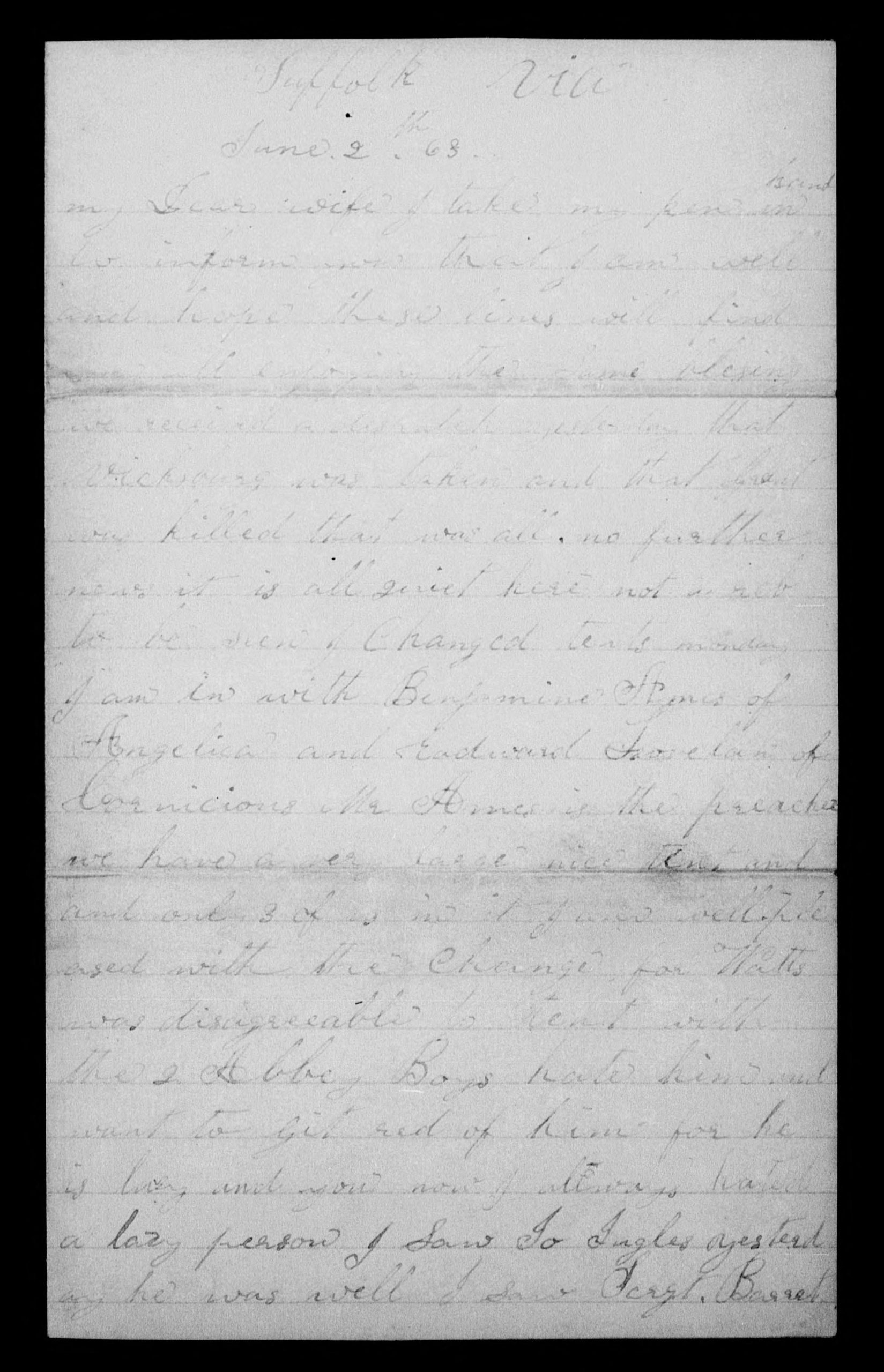
my Dear wife I take my pen in hand to inform you that I am well and hope these lines will find you all enjoying the Same blesing we received a despatch yesterday that Vicksburg was taken and that Grant was killed that was all no further news it is all quiet here not a reb to be seen I Changed tents monday I am in with Benjamine Ames of Angelica and Edward Sinclair of Cornicious Mr Ames is the preacher we have a very large nice tent and only 3 of us in it I was well pleased with the Change for Watts was disagreeable to tent with the 2 Abbey Boys hate him and want to git red of him for he is lazy and you now I always hated a lazy person I Saw Jo Ingles ayesterday he was well I Saw Sergt. Barret
The despatch was doubly false. Vicksburg did not fall until 4 July, and Grant was not killed — he outlived the war by twenty years and became president. This is the third false report of Vicksburg’s capture in these letters in eight days.
The tent politics are worth having. The man Benedict was glad to be rid of is John Watts of Angelica, Company G — and note that the Abbey boys wanted him gone too, “for he is lazy, and you now I always hated a lazy person.” His new tent mates were Benjamin A. Ames, the Close Baptist preacher of Angelica, and Edward Sinclair, who does not appear on this regiment’s roll and remains unidentified. “Jo Ingles”, named here for the second time, is likewise not on the roll.
A correction. In the earliest letter reproduced above, this same disagreeable tent mate was first transcribed here as “Wells.” This page shows the name clearly as Watts, and the earlier transcription has been corrected to match.
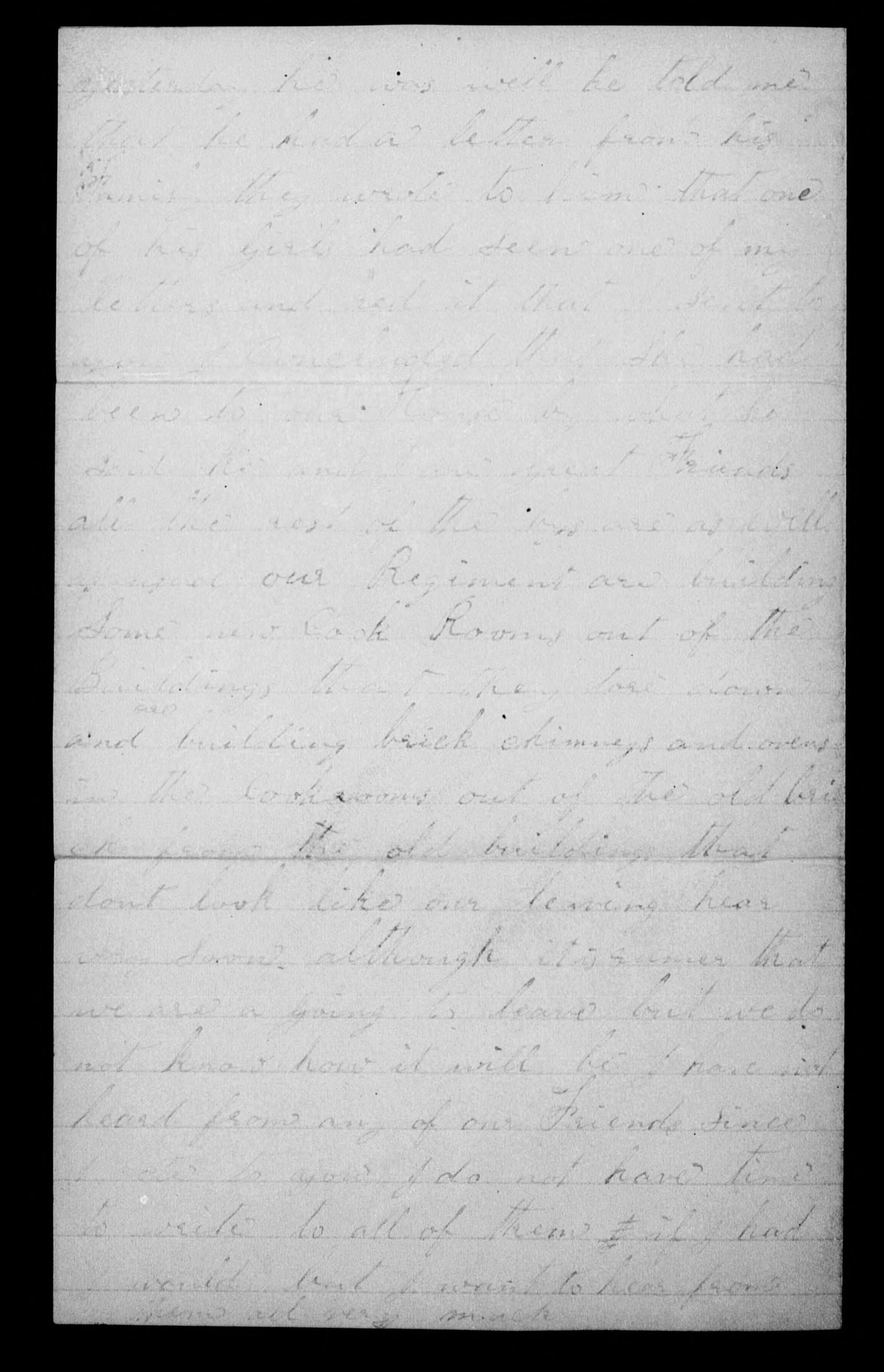
ayesterday he was well he told me that he had a letter from his family they wrote to him that one of his girls had seen one of my letters and read it that I sent to you I acknoledged that he had been to me but he and I are great friends all the rest of the boys are as well as usual our Regiment are building Some new Cook Rooms out of the buildings that they tore down and building brick chimneys and ovens in the Cookrooms out of the old brick from the old buildings that dont look like our leaving hear soon although it is rumer that we are agoing to leave but we do not know how it will be I have not heard from any of our Friends Since I wrote to you I do not have time to write to all of them if I had I would but I want to hear from them all very much
Sergeant Alonzo D. Barrett of Belmont had heard from home that one of his daughters had read a letter Benedict wrote to Sarah. These letters did not stay private. They were carried round the neighbourhood, read aloud and passed between families as the only reliable news of what had become of the county’s men. Benedict seems to have been slightly embarrassed by it, and notes that he and Barrett are great friends regardless.
The second half is the sequel to the destruction he described a week earlier. The regiment was building its cook rooms out of the houses it had pulled down, and laying the ovens and chimneys with Suffolk’s own brick. Nobody builds brick ovens in a camp they expect to leave: “that dont look like our leaving hear soon.”
June 1863 — “we are agoing to be turned into Cavelry”
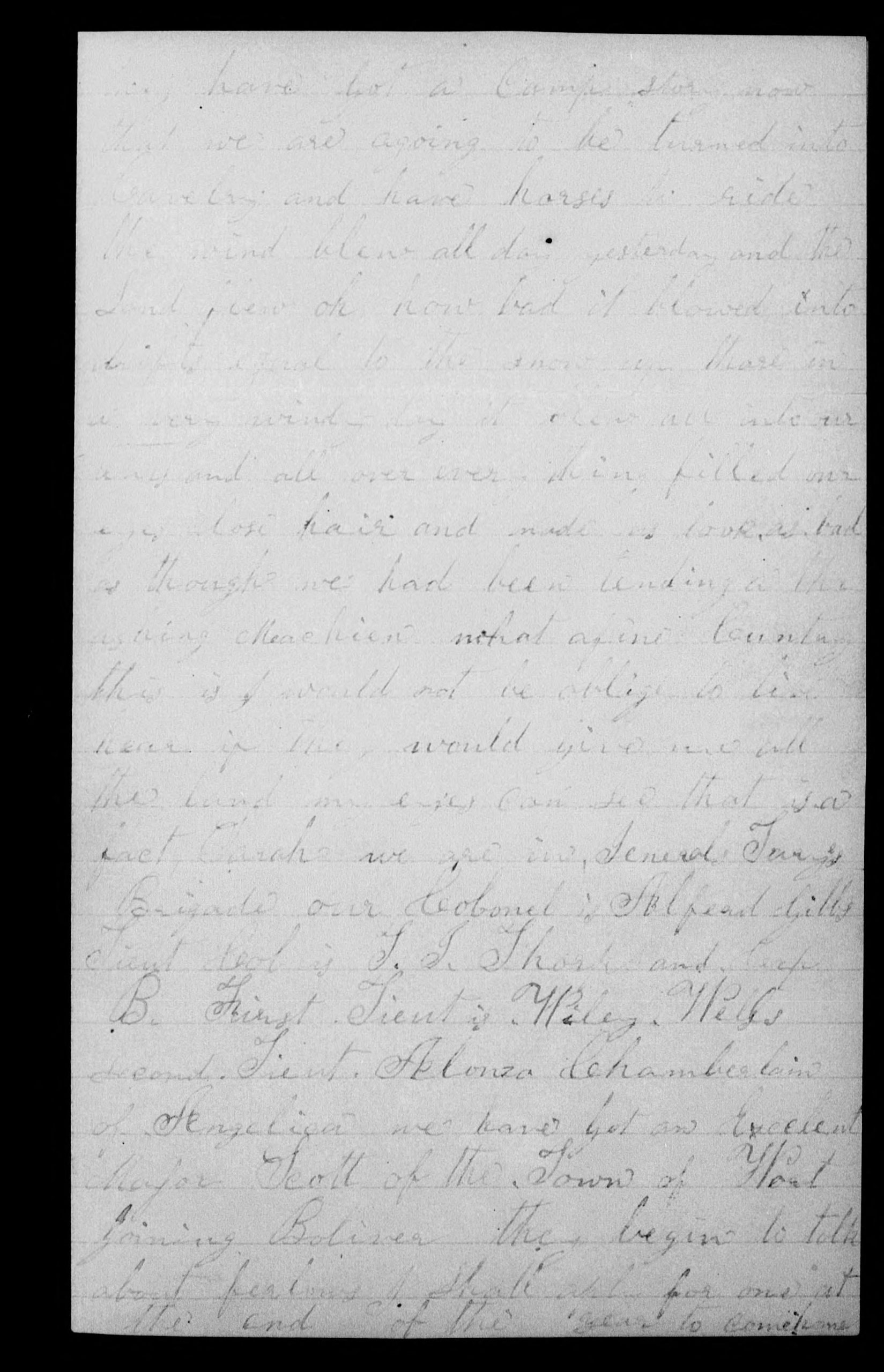
we have got a Camp Story now that we are agoing to be turned into Cavelry and have horses to ride the wind blew all day yesterday and the Sand flew oh how bad it blowed into all equal to the snow up thare in a Snow wind it came all into our tents and all over every thing filled our eyes nose hair and made us look as bad as though we had been tending a threshing Machiene what a fine Cuntry this is I would not be oblige to live hear if they would give me all the land my eyes Can See that is a fact
Sarah we are in Generals Terry Brigade our Colonel is Alfred Gibbs Lieut Col is T. J. Thorp and Capt B. First Lieut is Wiley Wells Second Lieut Alonzo Chamberlain of Angelica we have got an Excellent Major Scott of the Town of West joining Bolivar they begin to talk about furlows I Shall try for one at the end of this year to Come home
This is the regiment’s future arriving as gossip. The 130th New York Volunteer Infantry was converted to cavalry that summer and redesignated the First New York Dragoons in September 1863. Here, in June, it is still only “a Camp Story” — that they are to be given horses to ride.
He then sets out the whole chain of command as a private understood it: the brigade under General Terry, the regiment under Colonel Alfred Gibbs, Lieutenant Colonel T. J. Thorp, and “an Excellent Major” Rufus Scott. His own Company G was under Captain Brundage, First Lieutenant G. Wiley Wells and Second Lieutenant Alonzo W. Chamberlain.
One detail here is new to the record. The regimental roster gives Chamberlain’s residence as “not stated.” Benedict supplies it: Angelica. A private’s letter to his wife fills a blank the muster roll left empty.
And in between, a farmer’s verdict on Virginia: a sandstorm that filled their eyes and hair until they looked like men who had been feeding a threshing machine, and “what a fine Cuntry this is — I would not be oblige to live hear if they would give me all the land my eyes Can See.”
3 June 1863 — “do not go hungry”
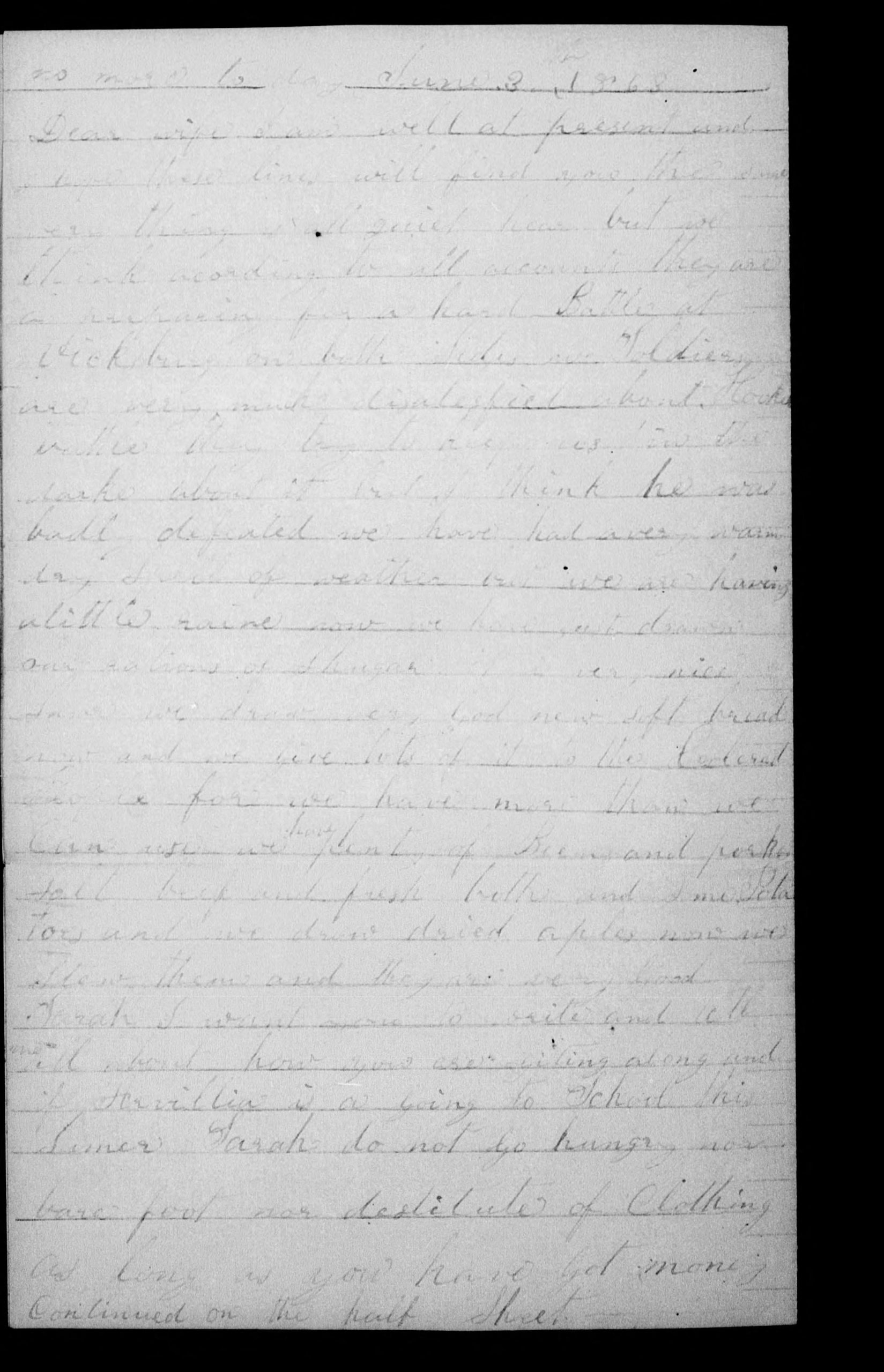
no more to day
June 3rd 1863
Dear wife I am well at present and hope these lines will find you the Same every thing is all quiet here but we think according to all accounts they are a preparing for a hard Battle at Vicksburg on both Sides we Soldiers are very much disatisfied about Hooker rather than to say he is in the dark about it but I think he was badly defeated we have had very warm dry Spell of weather but we are having a little raine now we have got drawn our rations of Sugar it is very nice now we drawd very good new soft bread now and we give lots of it to the Contrabands here for we have more than we Can use we have plenty of Beef and pork Salt beef and fresh beef and Some Potatoes and we draw dried apples now we Stew them and they are very good Sarah I want you to write and tell me all about how you are giting along and if Arvillia is a going to School this Somer
Sarah do not go hungry nor bare foot nor destitute of Clothing as long as you have got money
Continued on the half Sheet
“Sarah do not go hungry nor bare foot nor destitute of Clothing as long as you have got money.”
He is on picket duty in Virginia, and what worries him is that his wife is economising herself into hunger. He had sent twenty dollars home a few weeks earlier. This is the sentence of a man who knows exactly how his wife will behave with it.
Two other things are recorded here. The first is the army’s verdict on its own commander after Chancellorsville: “we Soldiers are very much disatisfied about Hooker … I think he was badly defeated.” The second is that when the regiment drew fresh soft bread, they gave much of it away to the contrabands — the self-emancipated men and women working around Suffolk — because they had more than they could use. He mentions it in the same breath as the dried apples, as an ordinary fact of camp life.
And he wants to know whether his daughter is going to school this summer.
5 June 1863 — a father writes to his daughter
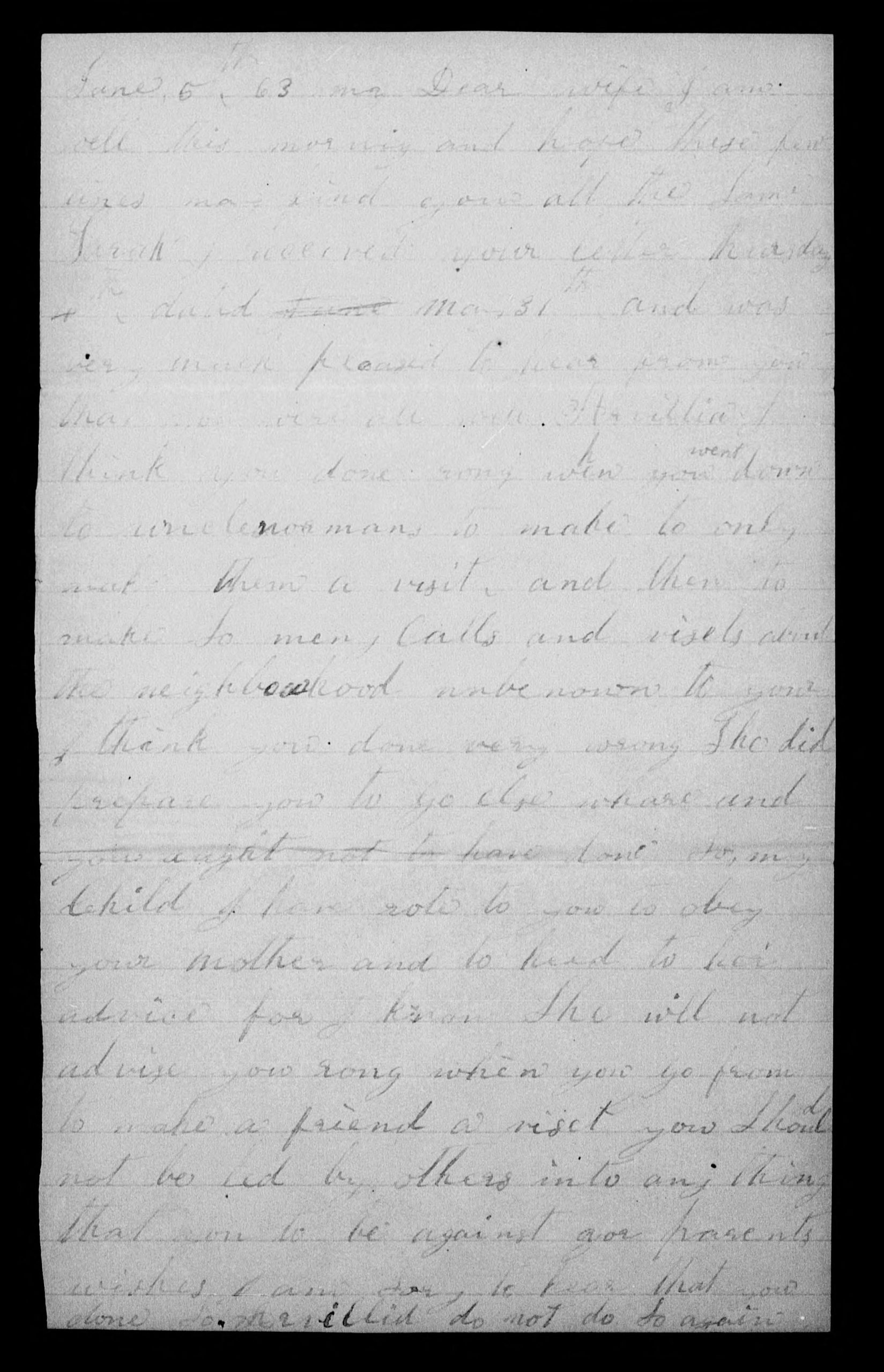
June 5th 63
my Dear wife I am well this morning and hope these few lines may find you all the Same Sarah I received your letter Thursday 4th dated may 31st and was very much pleased to hear from you that you were all well
Arvillia I think you done rong wen you went down to uncle Noamans to make them a visit and then to make so meny Calls and visets about the neighborhood unbenown to your mother I think you done very wrong She did prepare you to go else whare and you aught not to have done so my child I have rote to you to obey your mother and to heed to her advice for I know She will not advise you rong when you go from to make a friend a visit you Should not be led by others into any thing that is to be against your parents wishes I am Sory to hear that you done So Arvillia do not do so again
Halfway through a letter to his wife, Benedict turns and addresses his daughter by name. Arvillia had gone to visit an uncle and then made a round of calls about the neighbourhood without telling her mother. Sarah wrote about it; the letter took five days to reach Suffolk; and her father sat down in camp and answered it.
What is remarkable is the tone. He does not thunder. He tells her she was wrong, tells her why — that her mother had made other arrangements for her, and that she let herself be led by others against her parents’ wishes — and reminds her that he has written before asking her to heed her mother’s advice, “for I know She will not advise you rong.” Then: “I am Sory to hear that you done So. Arvillia, do not do so again.”
This is a man trying to father a child by post from four hundred miles away, in the eleven months he had left. Direct address to a child is rare in soldiers’ letters; most write about their children rather than to them.
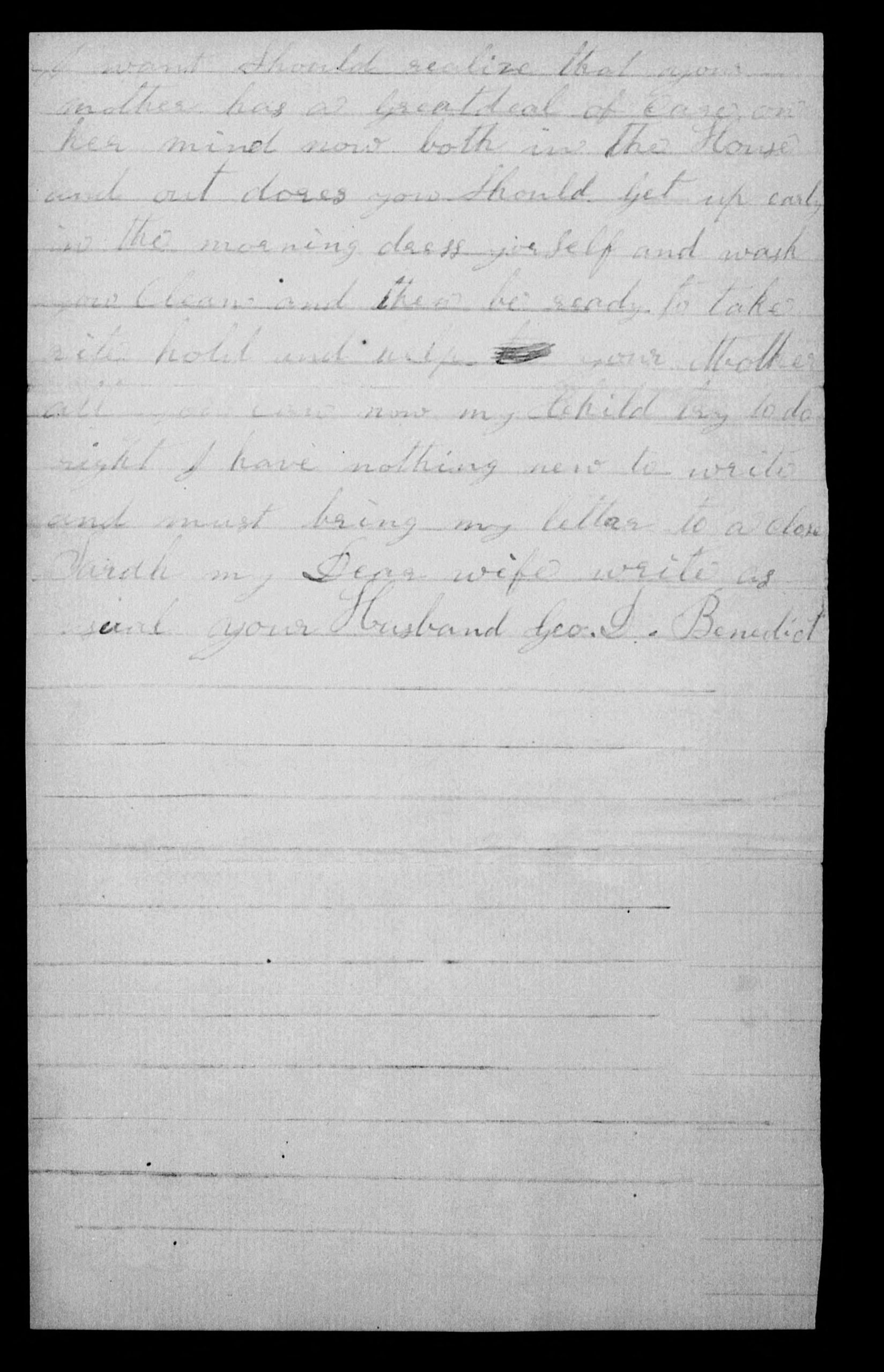
I want you Should realize that your mother has a greatdeal of Care on her mind now both in the House and out dores you Should get up early in the morning dress yourself and wash you Clean and then be ready to take rite hold and help your Mother all you Can now my Child try to do right I have nothing new to write and must bring my letter to a close Sarah my Dear wife write as usual your Husband Geo. D. Benedict
This is why he wrote the rebuke, and it was never really about the visiting. Sarah was running the farm and the household alone — “a greatdeal of Care on her mind now, both in the House and out dores” — and he wanted his daughter to see it and take hold. The instructions are a farmer’s: be up early, dressed and washed, and ready to work.
Then, with nothing further to say, he closes the way he always closes, to his wife: “Sarah my Dear wife, write as usual. Your Husband, Geo. D. Benedict.”
7 June 1863 — the pocket Testament
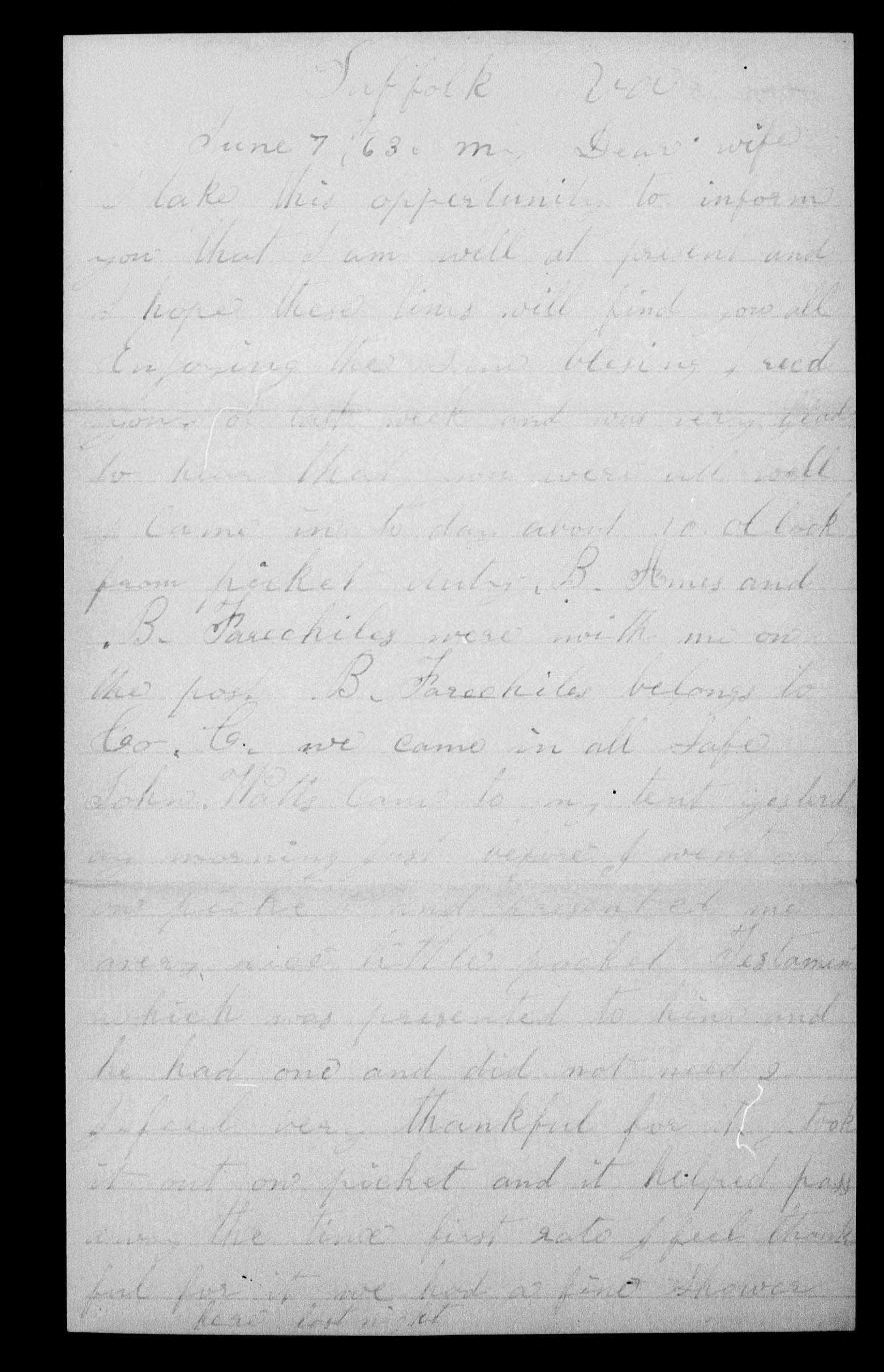
Suffolk VA June 7 63
my Dear wife I take this oppertunity to inform you that I am well at present and I hope these lines will find you all Enjoying the Same blesing I recd yours of last week and was very glad to hear that we were all well I Came in to day about 10 oClock from Picket duty B. Ames and B. Fairchilds were with me on the post B. Fairchilds belongs to Co. C we came in all Safe John Watts Came to my tent yesterday morning just before I went out on picket and presented me a very nice little pocket Testament which was presented to him and he had one and did not need 2 I feel very thankful for it I took it out on picket and it helped pass away the time first rate I feel thankful for it we had a fine Shower here last night
Two identifications close here. “B. Fairchilds” — the man transcribed on an earlier page as the unidentifiable “B. Freeckiles” — is Benjamin Fairchild of Belfast, aged thirty-three, and Benedict conveniently supplies his company: C. And “B. Ames” is Benjamin A. Ames, the preacher, his own tent mate.
And John Watts deserves a second hearing. Five days earlier Benedict had been glad to be rid of him as a tent mate — lazy, and disliked by the Abbey boys. Here Watts walks over to his tent the morning he is going out on picket and gives him a pocket Testament, because he has been given one and already had another. Benedict carried it out on the post and it “helped pass away the time first rate.” He says he is thankful twice in three lines.
There is a hard coincidence in Fairchild’s record. He was wounded on 7 May 1864 — the same day Benedict was shot at Todd’s Tavern. Fairchild lived, and was transferred to the Veteran Reserve Corps that October. Benedict died of his wound eighteen days later.
8 June 1863 — “we have no Chaplin”
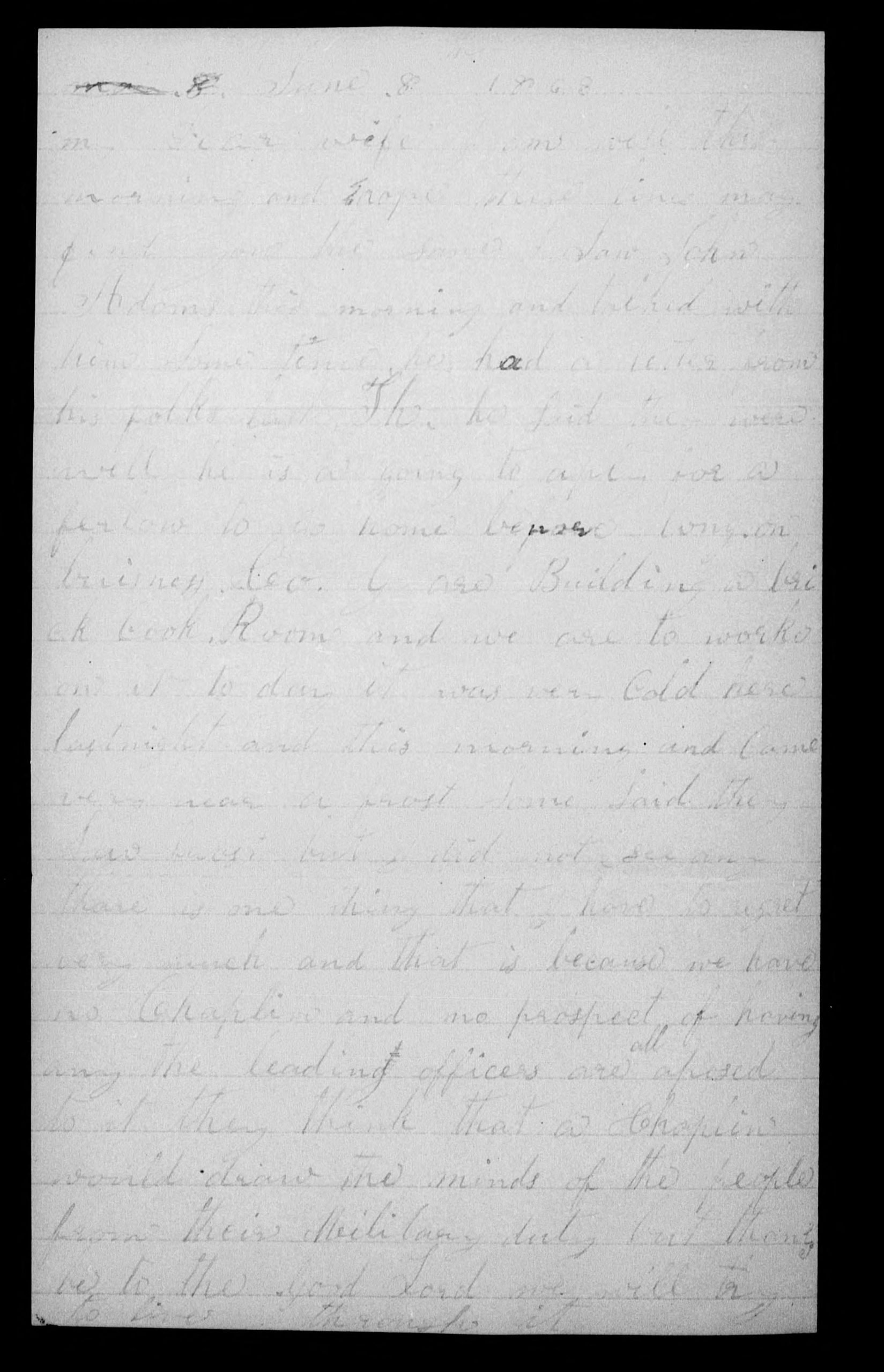
June 8 1863
my Dear wife I am well this morning and hope these lines may find you the Same I Saw John Adams this morning and talked with him Some time he had a letter from his folks last Thursday he said they were well he is agoing to apply for a ferlow to go home before long on business Co. G are Building a brick Cook Room and we are to worke on it to day it was very Cold here lastnight and this morning and Came very near a frost Some Said they Saw frost but I did not see any thare is one thing that I have to regret very much and that is because we have no Chaplin and no prospect of having any the leading officers are all apposed to it they think that a Chaplin would draw the minds of the people from their Military duty but thanks be to the good Lord we will try to live through it
This is a grievance, and a revealing one. The regiment had no chaplain and no prospect of one, because its own senior officers were opposed — they held that a chaplain “would draw the minds of the people from their Military duty.” Benedict, who a fortnight earlier had told his wife he never hated sin worse in his life, records it and lets it go with “but thanks be to the good Lord, we will try to live through it.”
The John Adams here is John J. Adams, the blacksmith of Company H, applying for a furlough to go home on business. And Company G spent that day building the brick cook room — laid, as Benedict had noted a week before, with brick from the Suffolk houses the army had pulled down.
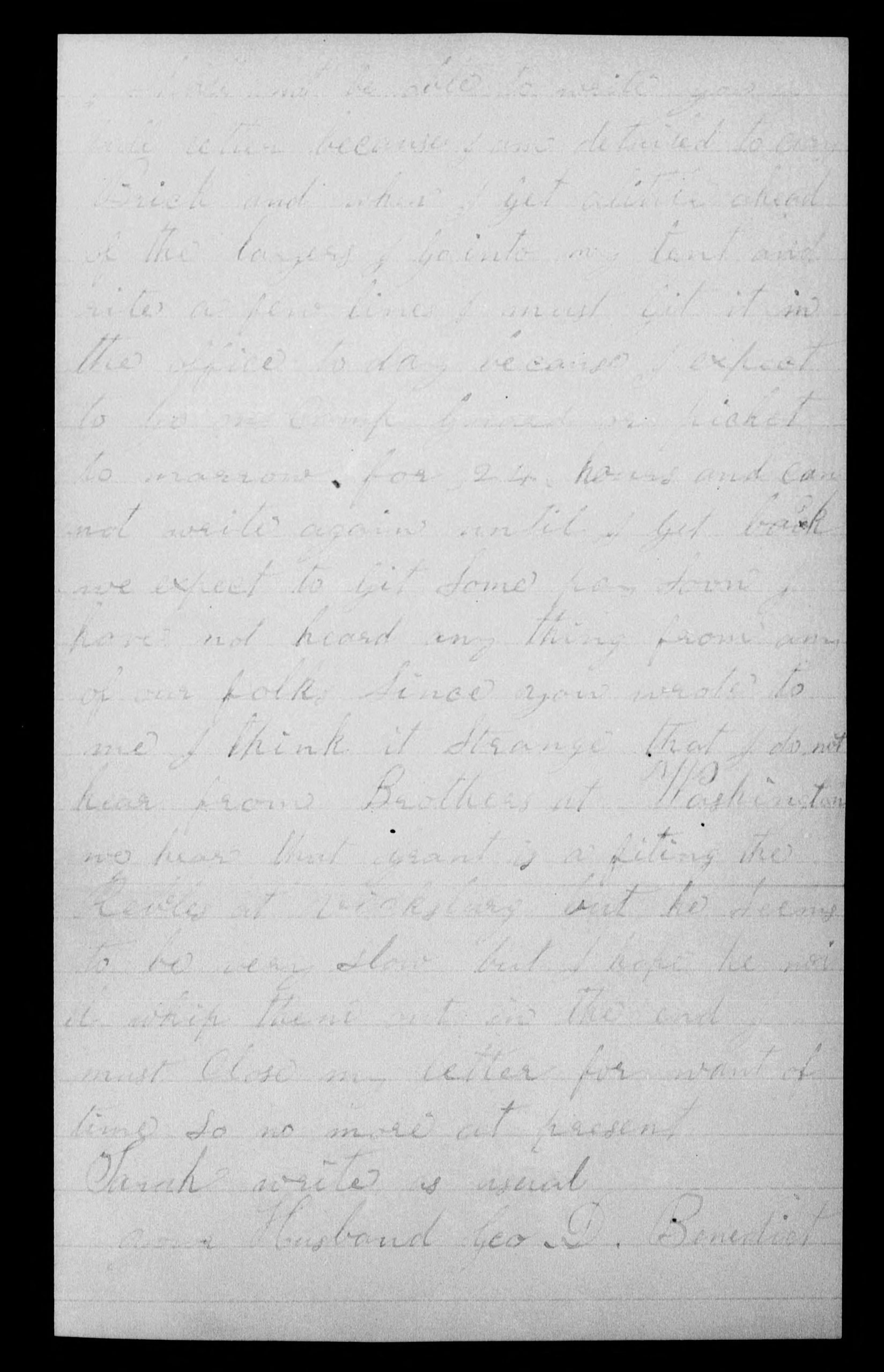
I could not be able to write you a full letter because I was detained to lay Brick and when I git a little ahead of the layers I go into my tent and rite a few lines I must git it in the office to day because I expect to be on Camp guard or on picket to marrow for 24 hours and Can not write again until I get back we expect to git Some pay soon I have not heard any thing from any of our folks Since you wrote to me I think it Strange that I do not hear from Brother at Washington we hear that Grant is a fiting the Rebels at Vicksburg but he Seems to be very Slow but I hope he will whip them out in the end I must Close my letter for want of time So no more at present Sarah write as usual your Husband Geo. D. Benedict
This explains how the letters were physically made. Benedict was labouring on the brick cook room, carrying and setting brick for the masons, and whenever he got a little ahead of the layers he went into his tent and wrote a few lines. He had to get this one into the office the same day, because he was down for twenty-four hours of guard or picket the next morning and would not be able to write again until he came back in.
On Vicksburg he has stopped believing the despatches altogether. Three false reports of its capture had reached him in a fortnight. What he writes now is flat and correct: Grant is fighting there, “he Seems to be very Slow, but I hope he will whip them out in the end.” The city fell on 4 July.
11–12 June 1863 — the bushwhackers, and orders to march
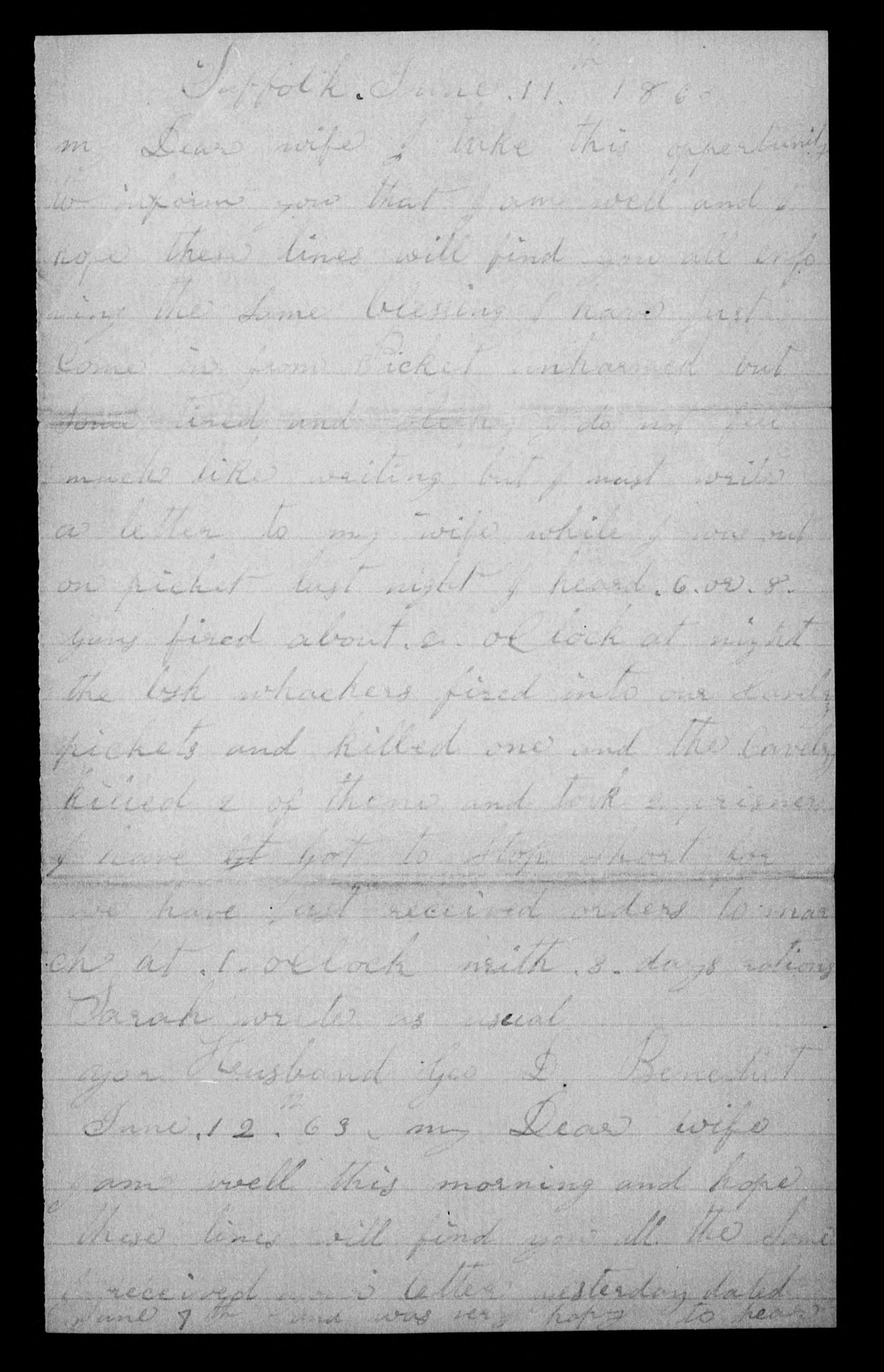
Suffolk June 11th 1863
my Dear wife I take this oppertunity to inform you that I am well and I hope these lines will find you all Enjoying the Same blessing I have just Come in from Picket unharmed but very tired and Sleepy I do not feel much like writing but I must write a letter to my wife while I was out on picket last night I heard 6 or 8 guns fired about 2 oClock at night the bush whackers fired into our Cavelry pickets and killed one and the Cavelry killed 4 of them and took 2 prisoners I have got to Stop short for we have just received orders to march at 1 oClock with 3 days rations Sarah write as usual your Husband Geo. D. Benedict
June 12 63
my Dear wife I am well this morning and hope these lines will find you all the Same I received your letter yesterday dated June 7th and was very happy to hear
Benedict was on the picket line when it happened. At two in the morning he heard six or eight shots: irregulars firing into the cavalry pickets, one Union man killed, four of the attackers killed and two taken. He came in at daylight “unharmed but very tired and Sleepy”, did not feel like writing, and wrote anyway — “but I must write a letter to my wife.”
The letter then stops in the middle of itself. Orders came to march at one o’clock with three days’ rations, and he signed off in one line. He picked it up again the following morning. Sarah would have received both halves in the same envelope, and read the abrupt ending before she reached the resumption.
12 June 1863 — “it would only worry you”
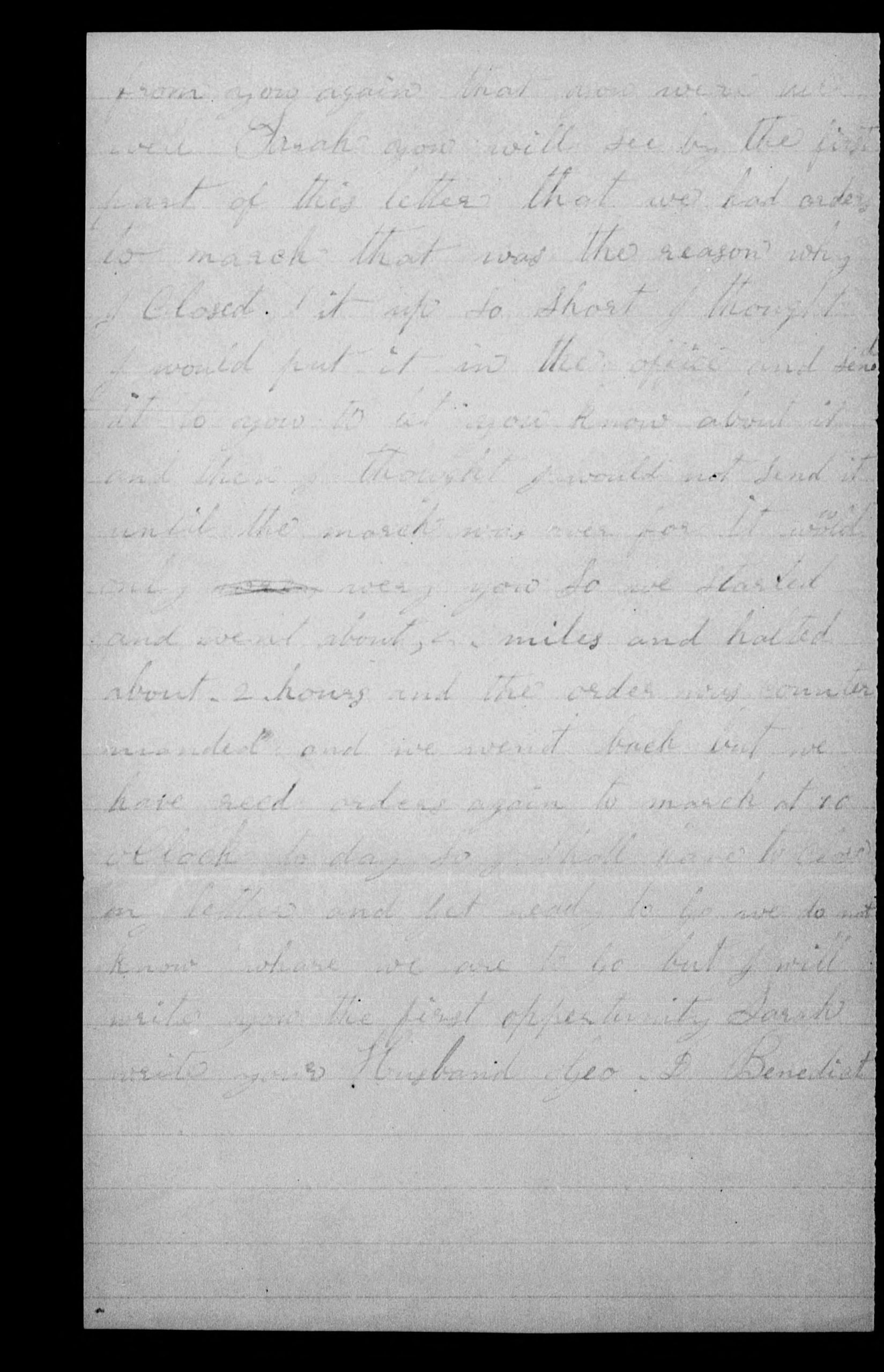
from you again that you were well Sarah you will see by the first part of this letter that we had orders to march that was the reason why I Closed it up so Short I thought I would put it in the office and Send it to you to let you know about it and then I thought I would not Send it until the march was over for it would only worry you So we Started and went about 2 miles and halted about 2 hours and the order was countermanded and we went back but we have recd orders again to march at 10 oClock to day so I Shall have to Close my letter and let it lay to go we do not know whare we are to go but I will write you the first oppertunity Sarah write your Husband Geo. D. Benedict
This is the other half of the abrupt ending on the previous page, and it shows Benedict deciding what his wife would be told. He had broken off mid-letter when the order came to march. He first meant to post it as it stood, so she would know — and then changed his mind: “I thought I would not Send it until the march was over, for it would only worry you.” The column went two miles, halted two hours, and was turned round.
By the time Sarah read the broken-off sentence, the danger it recorded was four days gone and its resolution was in the same envelope. He was editing the war down to what she could bear at four hundred miles’ distance — and then fresh orders came for ten o’clock and he had to close and let the letter lie, not knowing where they were going.
18 June 1863 — ordered north
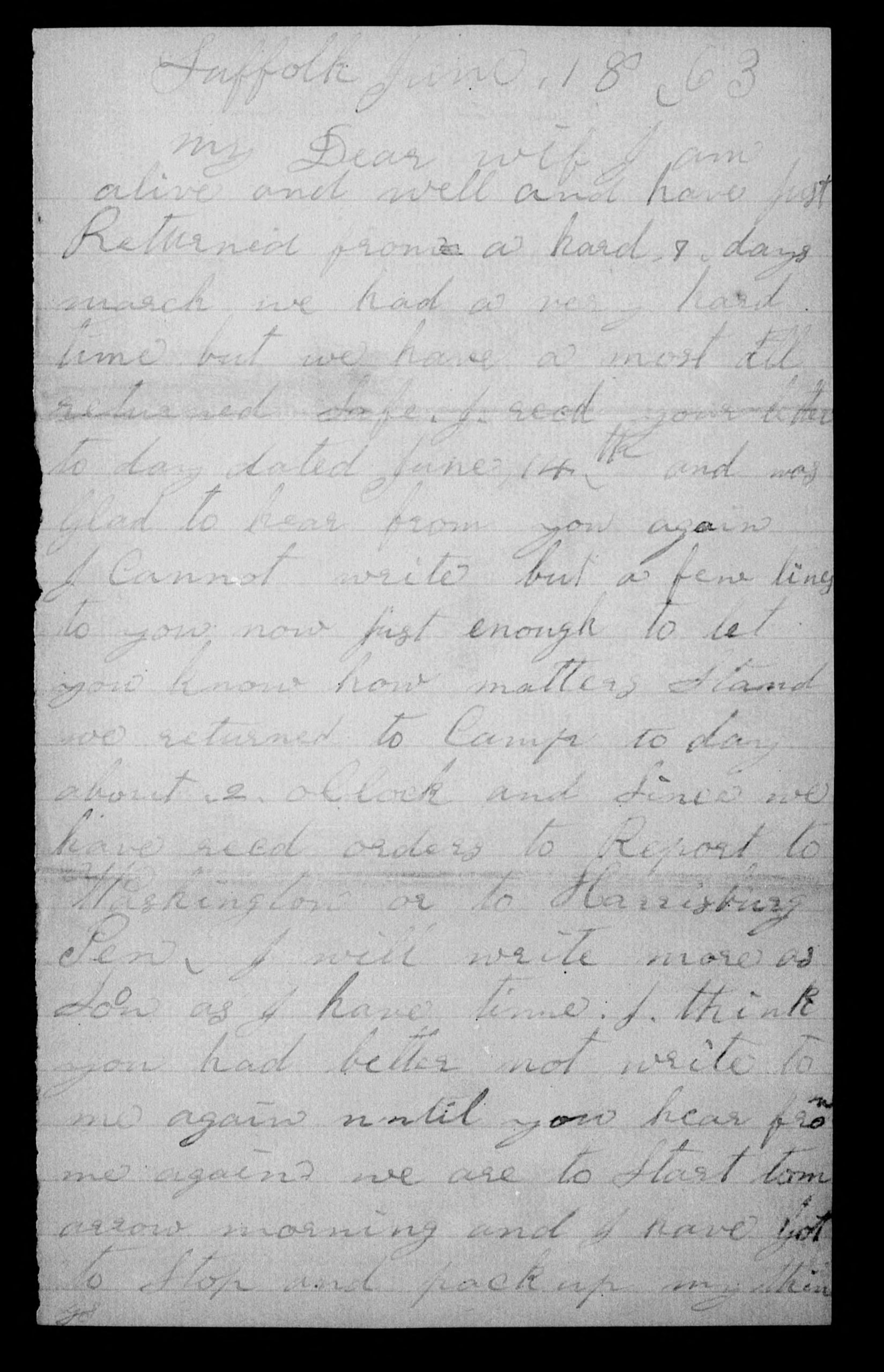
Suffolk June 18 63
my Dear wife I am alive and well and have just Returned from a hard 4 days march we had a very hard time but we have a most all returned Safe I recd your letter to day dated June 14th and was glad to hear from you again I Cannot write but a few lines to you now just enough to let you know how matters Stand we returned to Camp to day about 2 oClock and Since we have recd orders to Report to Washington or to Harrisburg Pen I will write more as Son as I have time I think you had better not write to me again until you hear from me again we are to Start tomarrow morning and I have got to Stop and pack up my things
This is the Gettysburg campaign reaching Suffolk. Lee had crossed the Potomac and was moving north through the Shenandoah; by mid-June the Confederate advance was in Pennsylvania and Harrisburg itself was threatened. Troops were being stripped out of the Virginia garrisons and sent to meet the invasion. Benedict came in off a four-day march at two in the afternoon and found the regiment under orders for Washington or Harrisburg, to start the next morning.
The line that would have frightened Sarah most is the practical one: “I think you had better not write to me again until you hear from me again.” The regiment was leaving Suffolk after nine months and nobody knew where it was going. Two weeks later the armies met at Gettysburg.
He ends by stopping to pack. This is the last letter in the collection written from Suffolk.
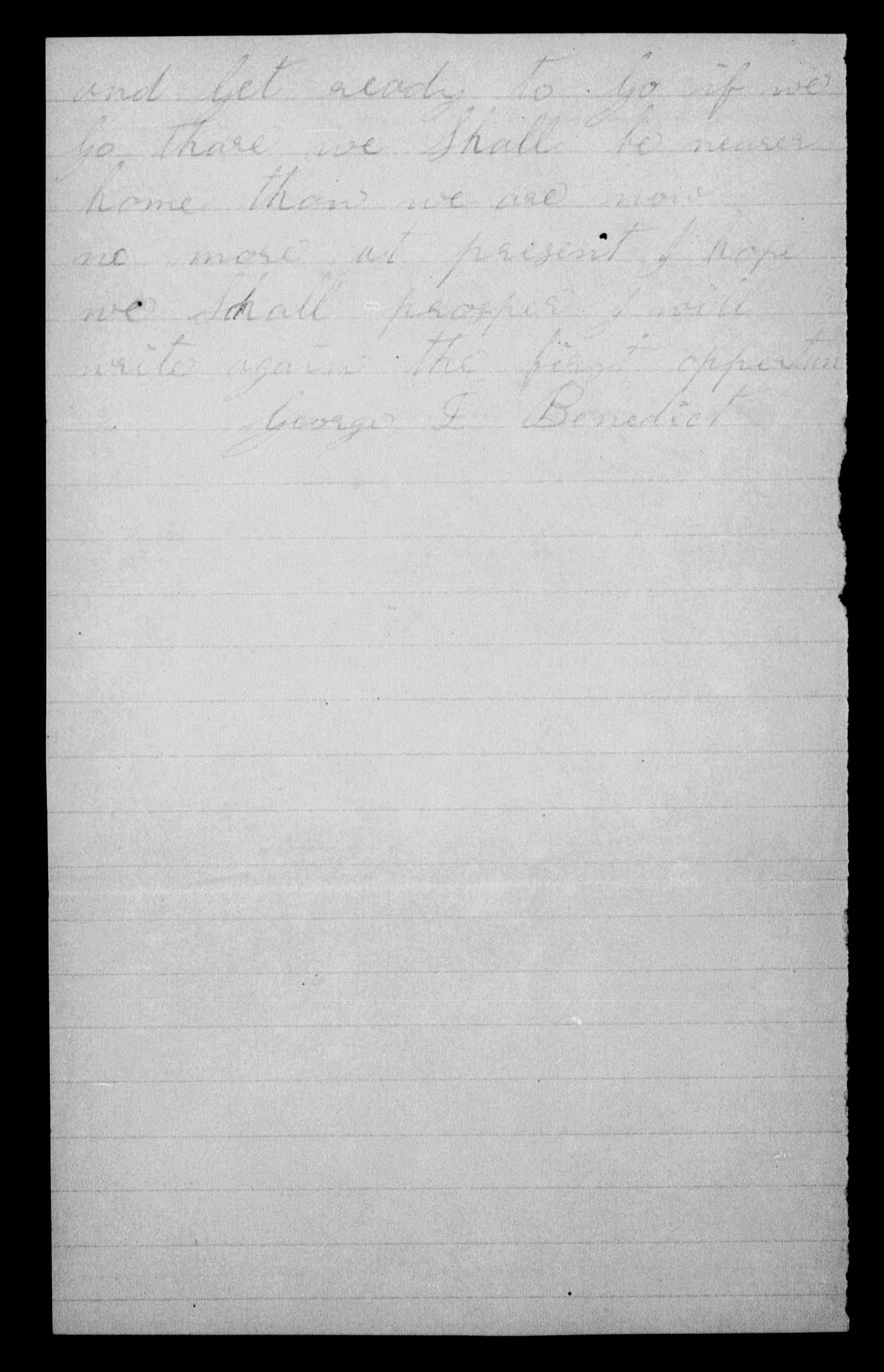
and get ready to go if we go thare we Shall be nearer home than we are now no more at present I hope we Shall prosper I will write again the first oppertunity
George D. Benedict
“if we go thare we Shall be nearer home than we are now.”
He is packing to march, he does not know where the regiment is being sent, and the comfort he offers his wife is geography: Pennsylvania is closer to Allegany County than Virginia is. It was true. It was also the direction of Gettysburg.
He signs this one with his full name rather than the usual “your Husband Geo. D. Benedict.” It is the last letter in the collection written from Suffolk, where the regiment had been since the previous autumn. Within three months the 130th New York would be mounted and redesignated the First New York Dragoons; within eleven, Benedict would be dead of a wound taken at Todd’s Tavern.
The cover of the last Suffolk letter
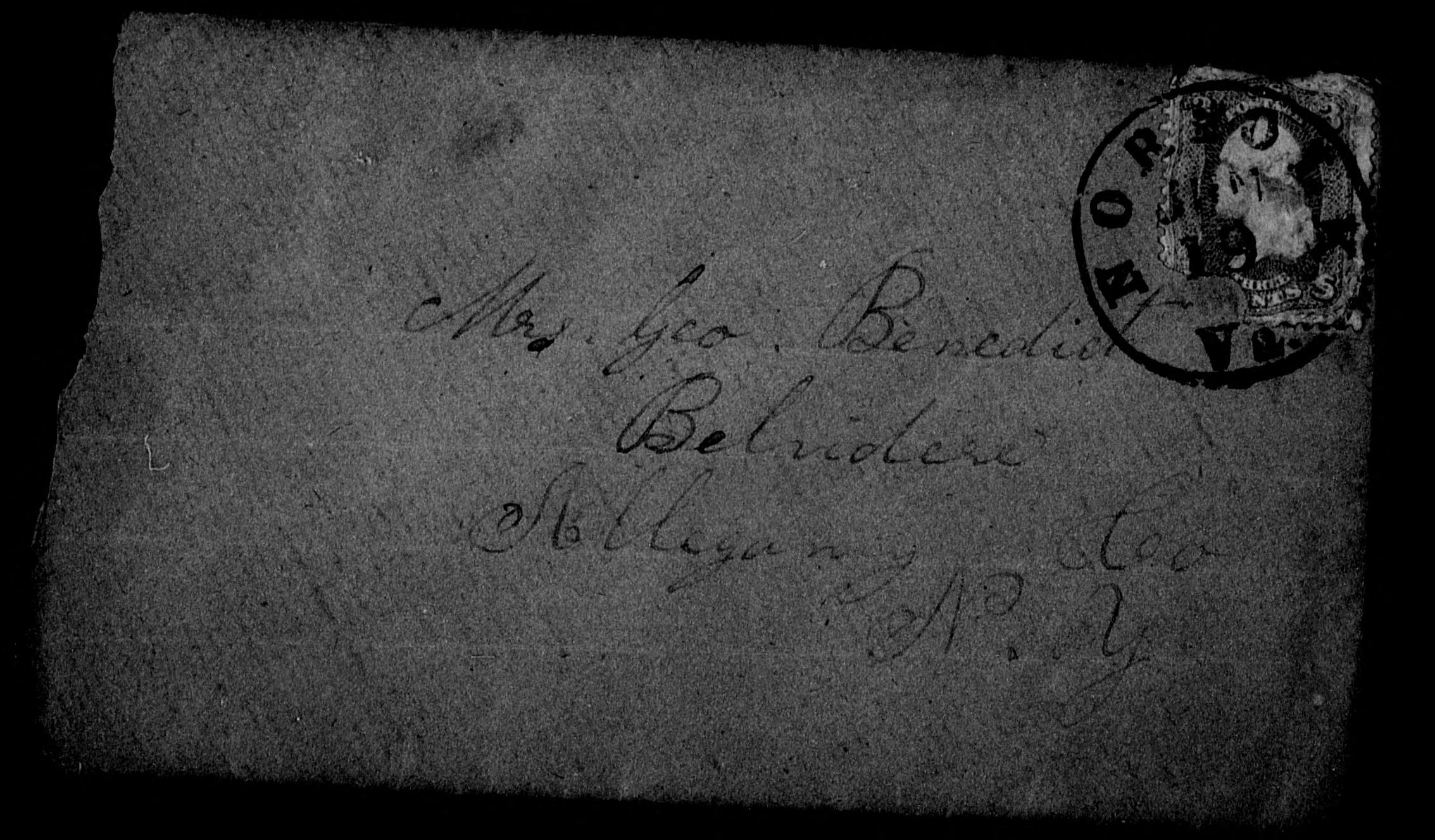
The address, in his hand
Mrs. Geo. Benedict
Belvidere
Allegany Co
N. Y.
[postmarked Norfolk, Va.; three-cent United States postage stamp]
This is the cover that carried the letter of 18 June — the one telling Sarah the regiment was ordered to Washington or Harrisburg, that she should not write until she heard from him again, and that going north would put him nearer home.
Mail from the Suffolk garrison went out through Norfolk. The stamp is the three-cent Washington, the ordinary domestic rate. He addressed it himself, as he addressed all of them, and it is the last envelope in the collection posted from Virginia before the regiment marched.
Yorktown, 21 June 1863 — out of Suffolk at last
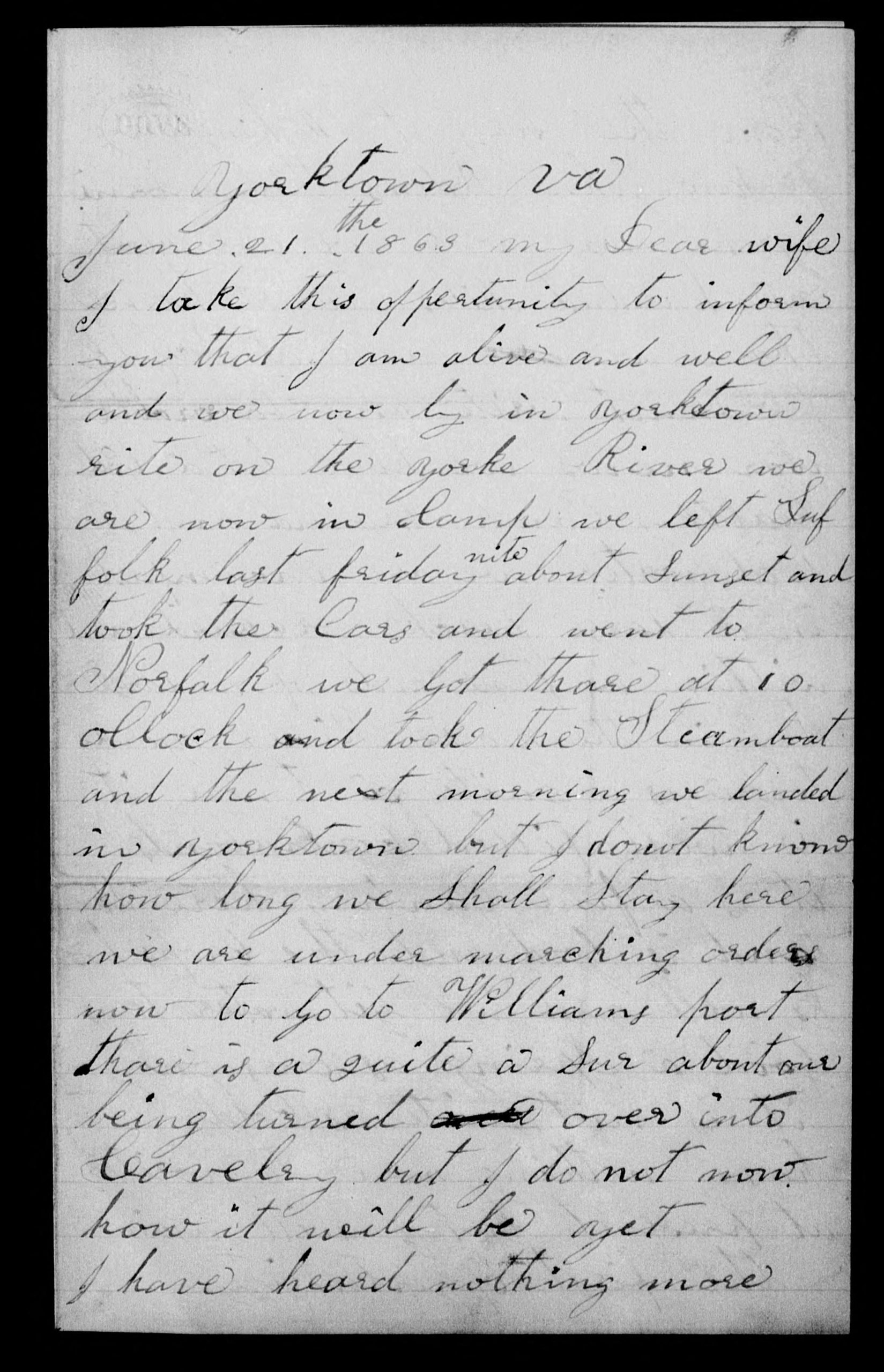
Yorktown VA June 21 the 1863
my Dear wife I take this oppertunity to inform you that I am alive and well and we now ly in Yorktown rite on the Yorke River we are now in Camp we left Suffolk last friday nite about Sunset and took the Cars and went to Norfolk we got thare at 10 oClock and took the Steamboat and the next morning we landed in Yorktown but I dont know how long we Shall Stay here we are under marching orders now to go to Williamsport thare is quite a Sur about our being turned over into Cavelry but I do not now how it will be ayet I have heard nothing more
The move is set down hour by hour: out of Suffolk on the Friday evening, cars to Norfolk arriving at ten at night, straight onto a steamboat, and ashore at Yorktown the next morning. After nine months in one place the regiment covered the length of Hampton Roads in a night.
Two things are moving here at once. The first is the campaign: they are under orders for Williamsport on the Potomac, one of the crossings Lee’s army would use, as the Confederate invasion of Pennsylvania ran toward Gettysburg. The second is the regiment’s own future — what was “a Camp Story” a fortnight earlier is now “quite a Sur[e] about our being turned over into Cavelry.” That September the 130th New York Volunteer Infantry became the First New York Dragoons.
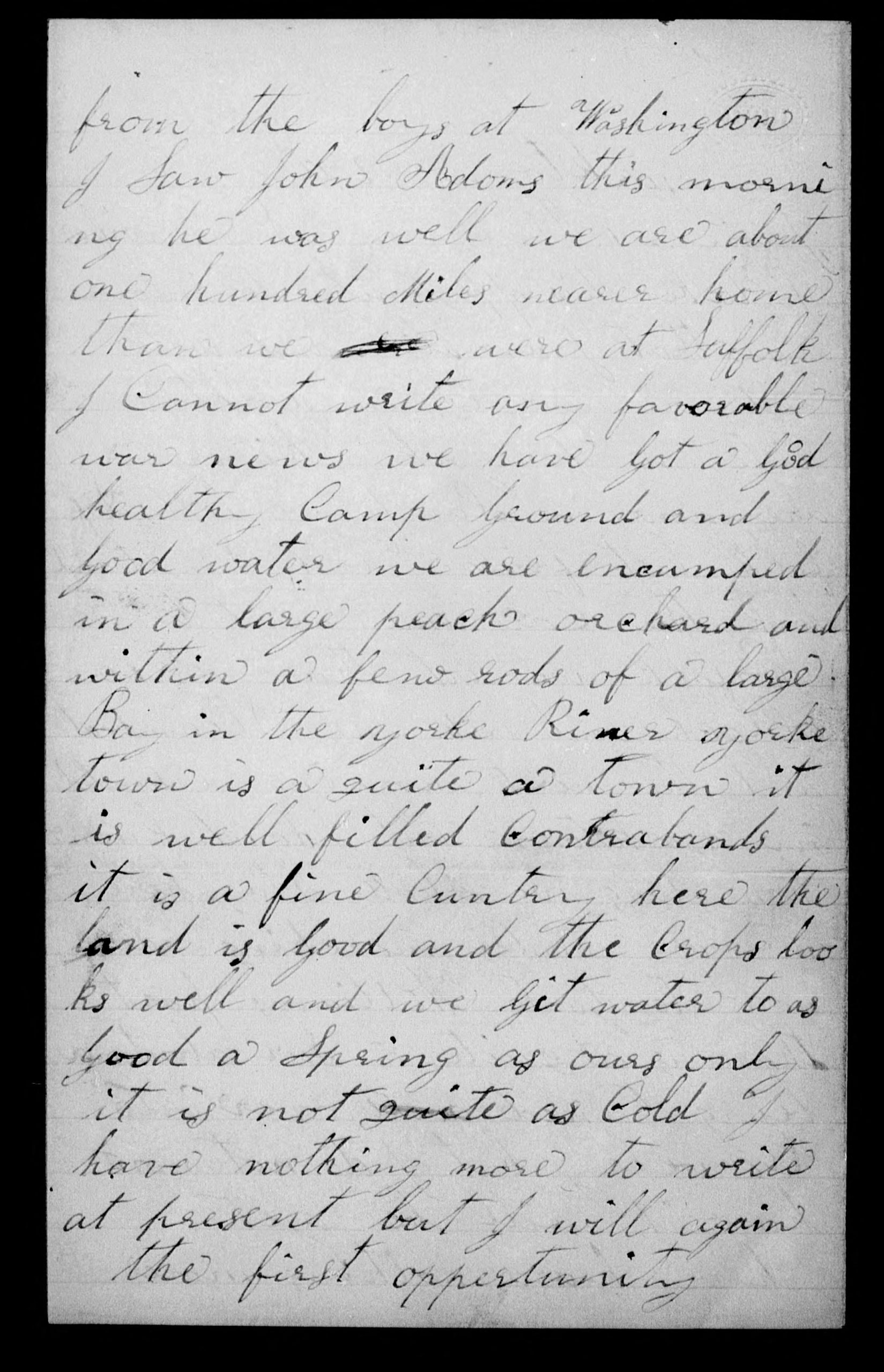
from the boys at Washington I Saw John Adams this morning he was well we are about one hundred Miles nearer home than we were at Suffolk I Cannot write any favorable war news we have got a God healthy Camp Ground and good water we are Encamped in a large peach orchard and within a few rods of a large Bay in the Yorke River Yorketown is quite a town it is well filled Contrabands it is a fine Cuntry here the land is Good and the Crops looks well and we git water to as Good a Spring as ours only it is not quite as Cold I have nothing more to write at present but I will again the first oppertunity
He keeps the promise from the last Suffolk letter and measures it: “about one hundred Miles nearer home than we were at Suffolk.” The camp is in a peach orchard a few rods from the York River, the ground is healthy and the water is good — and a farmer cannot help comparing it to his own: as good a spring as ours, “only it is not quite as Cold.”
John J. Adams of Company H appears here for the third time in these letters — seen well in May, talked with at length in early June about a furlough, and seen again the morning after the regiment landed at Yorktown.
And for the third time he records the contrabands — the self-emancipated men and women who had reached Union lines. At Suffolk they were working the fortifications and being given the regiment’s spare bread. At Yorktown, he says simply, the town “is well filled” with them.
A postscript: where to write to him now
“Sarah Direct your next letters to Washington D. C. Yorktown”
This is the practical crisis underneath everything else. The regiment had left Suffolk after nine months in one place and was under orders that might take it to Washington, to Harrisburg, or to Williamsport. Benedict did not know which, so he gave his wife both addresses and hoped one of them would hold.
A few days earlier he had told her not to write at all until she heard from him again. A soldier on the move could lose his letters for weeks, and a wife four hundred miles away had no way of knowing whether silence meant a lost address or something worse. He wrote this on a sheet otherwise left blank, as though it were too important to bury at the end of a page.
25 June 1863 — over McClellan’s old ground
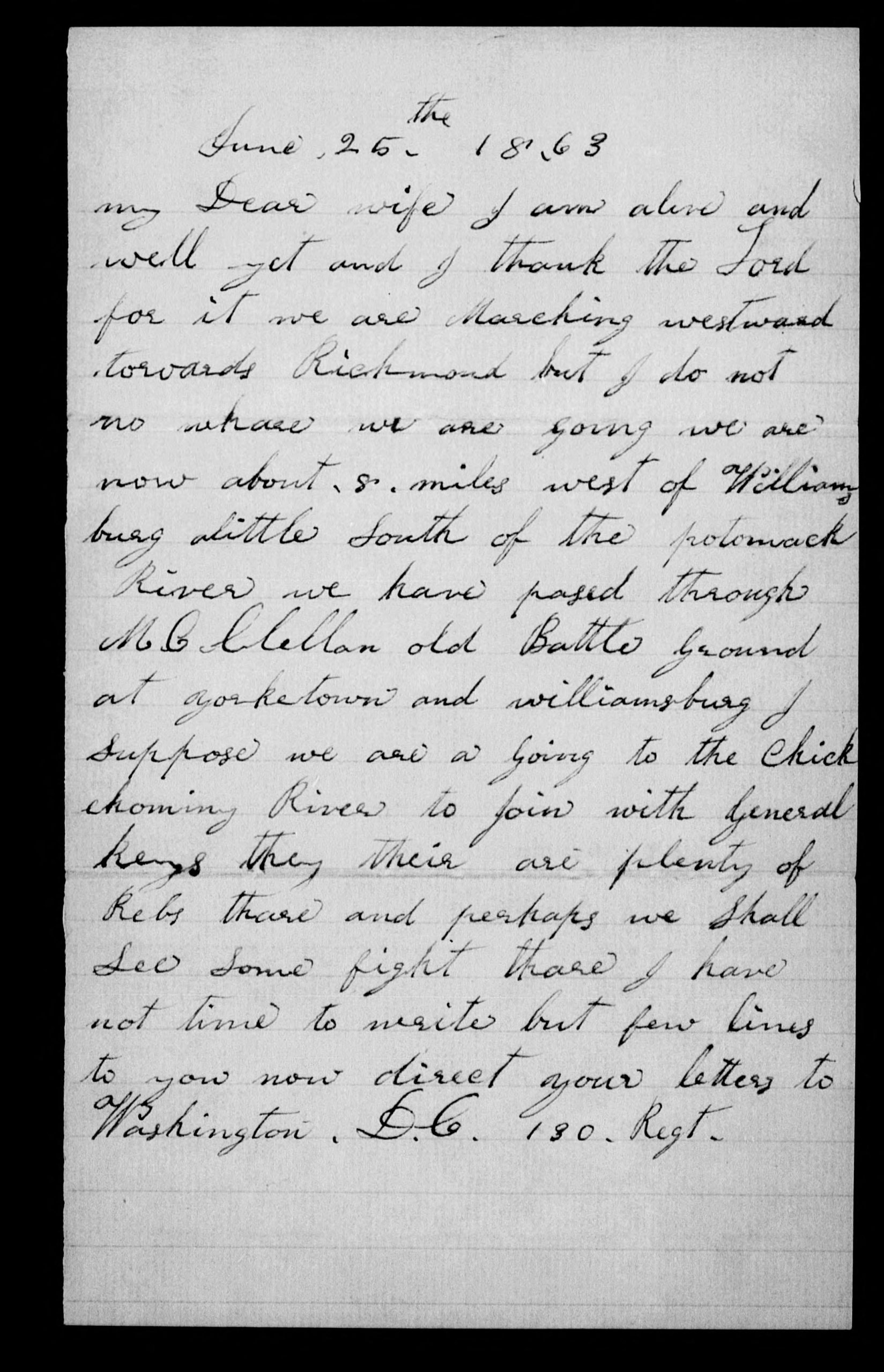
June 25th 1863
my Dear wife I am alive and well yet and I thank the Lord for it we are Marching westward towards Richmond but I do not no whare we are going we are now about 8 miles west of Williamsburg alittle South of the Potomack River we have pased through McClellan old Battle Ground at Yorketown and Williamsburg I Suppose we are agoing to the Chickahominy River to join with General Keys they their are plenty of Rebs thare and perhaps we Shall See Some fight thare I have not time to write but few lines to you now direct your letters to Washington D. C. 130 Regt.
While Lee marched north into Pennsylvania, the Union command pushed what troops it had up the Peninsula to threaten Richmond from the east and pull Confederate strength back. That is the movement Benedict is describing: west from Yorktown toward the Chickahominy, to join General Erasmus D. Keyes. He expects a fight and says so plainly.
The detail that carries weight is the ground itself. They marched over McClellan’s old battlefields at Yorktown and Williamsburg from the Peninsula campaign of 1862. Benedict had not been there — but his own colonels had. Thomas J. Thorp and Rufus Scott both fought through that campaign with the 85th New York and both were wounded in it; Scott’s first wound, at Fair Oaks on 31 May 1862, was taken within a few miles of the road his regiment was now marching along.
He gives the address again, more precisely this time: Washington D. C., 130th Regiment. He would not be writing under that number much longer.
The Gettysburg Campaign
July 1863 · 13 letters3 July 1863 — the day of Pickett’s Charge, two hundred miles south
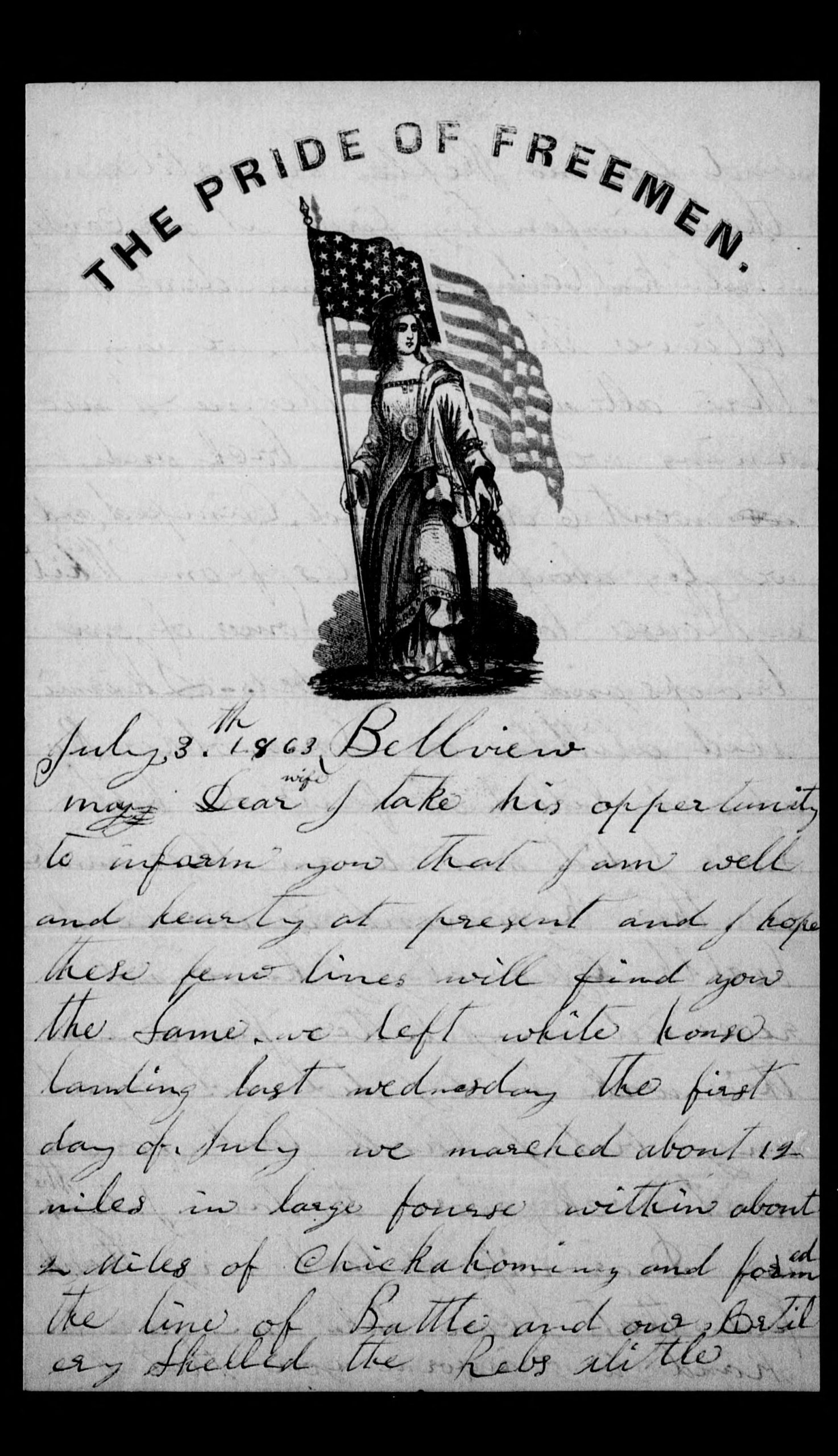
[Printed patriotic letterhead: an engraved figure of Columbia holding the United States flag, captioned THE PRIDE OF FREEMEN.]
July 3rd 1863 Bellview
my Dear wife I take this oppertunity to inform you that I am well and hearty at present and I hope these few lines will find you the Same we left White House Landing last wednesday the first day of July we marched about 14 miles in large fource within about 2 miles of Chickahominy and formed the line of Battle and our Artilery Shelled the Rebs alittle
Read the date again. On the afternoon of 3 July 1863, twelve thousand Confederate infantry crossed the open ground at Gettysburg toward Cemetery Ridge. Benedict knew nothing of it. He was two hundred miles to the south, on the Chickahominy, in the movement up the Peninsula meant to threaten Richmond while Lee was away — marching fourteen miles from White House Landing, forming line of battle, and watching his own artillery shell the Confederate position.
This is what the war looked like from inside it. The battle that would be remembered as the turning point of the war was fought on the same day, and the man writing this letter had no idea it was happening.
The sheet itself is worth a look. Soldiers bought commercially printed patriotic covers and letterheads by the packet, and this one carries an engraved Columbia with the national flag over the motto “The Pride of Freemen.” It is the first decorated sheet in the collection — every earlier letter was written on plain ruled paper.
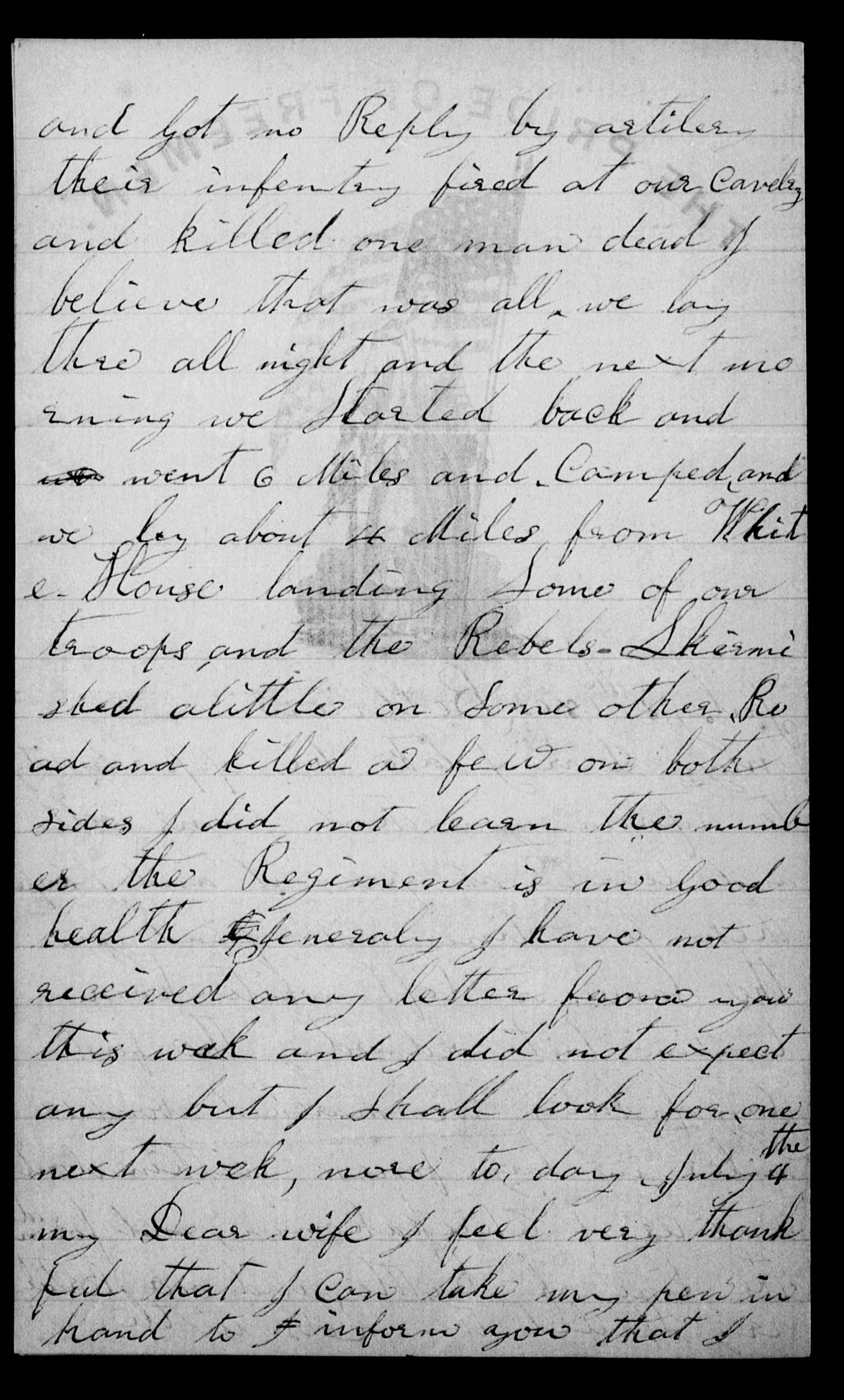
and got no Reply by artilery their infentry fired at our Cavelry and killed one man dead I believe that was all we lay thre all night and the next morning we Started back and went 6 Miles and Camped and we lay about 4 Miles from White House landing Some of our troops and the Rebels Skirmished alittle on Some other Road and killed a few on both sides I did not learn the number the Rejiment is in good health generaly I have not received any letter from you this wek and I did not expect any but I Shall look for one next wek, no more to day
July 4th
my Dear wife I feel very thankful that I Can take my pen in hand to inform you that I
The fighting he describes is the small change of the Peninsula demonstration: artillery firing with no reply, Confederate infantry shooting into the cavalry and killing one man outright, a night lying in line of battle, and a withdrawal of six miles in the morning. On another road that day other troops skirmished and “killed a few on both sides — I did not learn the number.” That sentence is the war as most soldiers experienced it: men died nearby and nobody told you how many.
Then he begins a new entry: 4 July 1863. On that day Vicksburg surrendered to Grant — the event Benedict had been told three separate times had already happened, and had finally stopped believing. On the same day Lee began his retreat from Gettysburg. Benedict, four miles from White House Landing, knew of neither, and opened his entry by saying he was thankful he could still take a pen in hand.
4 July 1863 — a man of Company G shot on the picket line
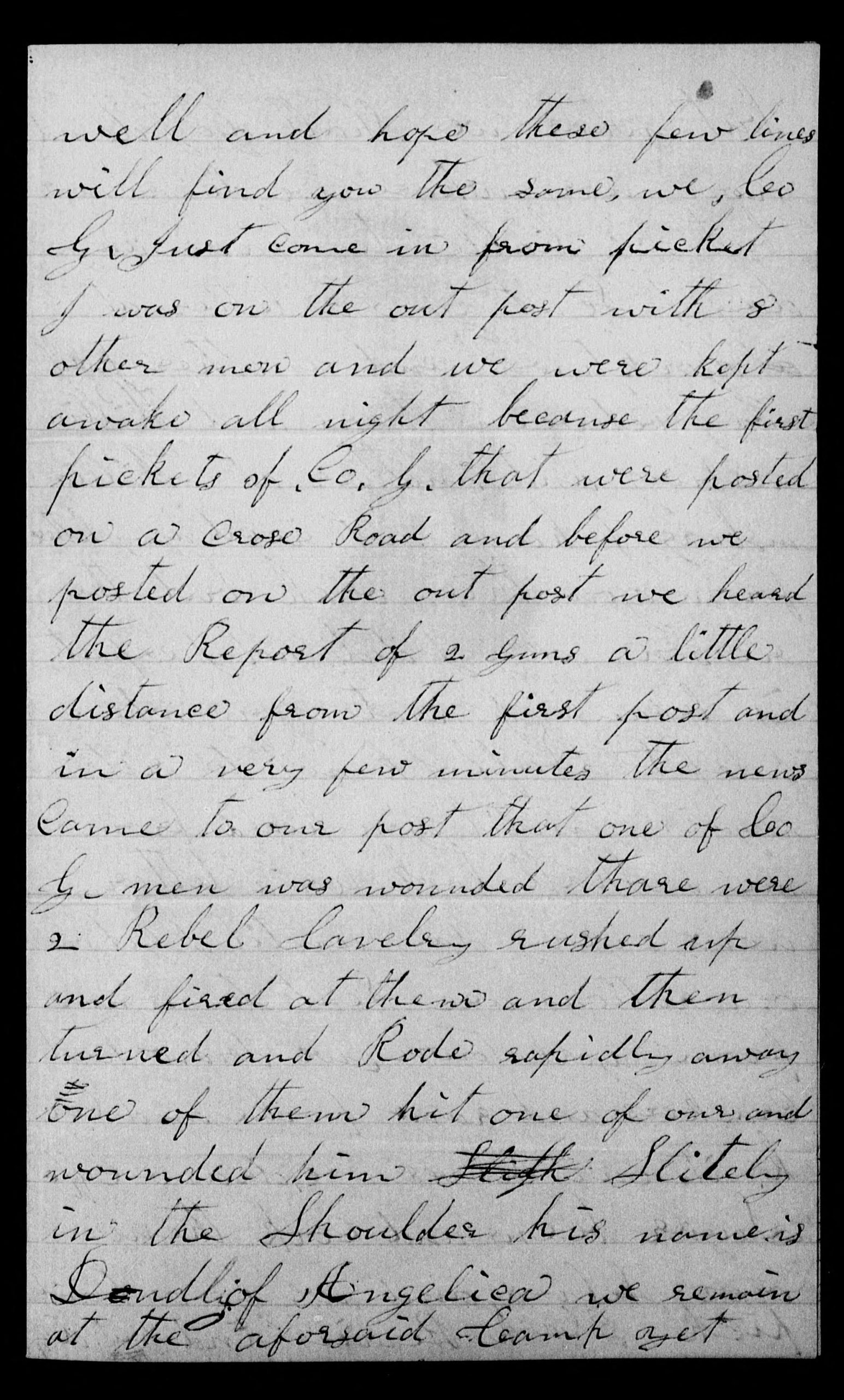
well and hope these few lines will find you the same, we, Co G, just come in from picket I was on the out post with 8 other men and we were kept awake all night because the first pickets of Co. G that were posted on a Cross Road and before we posted on the out post we heard the Report of 2 guns a little distance from the first post and in a very few minutes the news Came to our post that one of Co. G men was wounded thare were 2 Rebel Cavelry rushed up and fired at them and then turned and Rode rapidly away one of them hit one of our and wounded him Slitely in the Shoulder his name is Dudley of Angelica we remain at the aforsaid Camp yet
Benedict was on the outpost with eight other men and they were kept awake all night. Two Confederate cavalrymen rode up on the cross-road picket, fired, and rode off. One shot told.
The wounded man can be named. Two Dudleys of Angelica served in Company G, but John L. Dudley did not transfer into the regiment until February 1864, seven months after this. The man hit in the shoulder on 4 July 1863 is Horace E. Dudley, aged twenty-two, in the company since August 1862. He was afterwards made sergeant, and in September was transferred to the Veteran Reserve Corps — the corps to which men no longer fit for the field were sent.
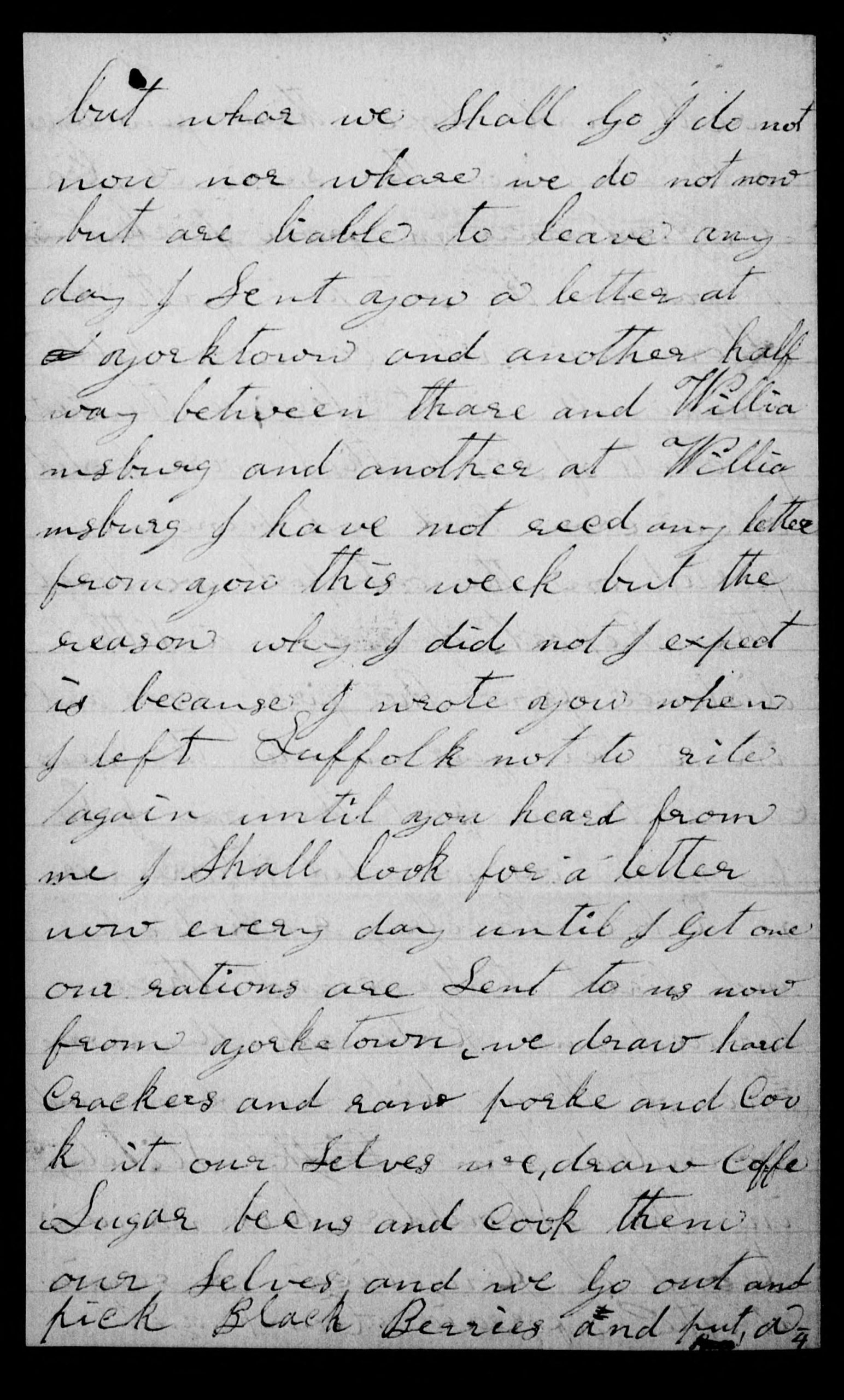
but whare we Shall go I do not now nor whare we do not now but are liable to leave any day I Sent you a letter at Yorktown and another half way between thare and Williamsburg and another at Williamsburg I have not recd any letter from you this week but the reason why I did not I expect is because I wrote you when I left Suffolk not to rite again until you heard from me I Shall look for a letter now every day until I get one our rations are Sent to us now from Yorketown we draw hard Crackers and raw porke and Cook it our Selves we draw Coffe Sugar beens and Cook them our Selves and we go out and pick Black Berries and put a
The blackberries are not a stray detail. The operation Benedict was marching on — the Union push up the Peninsula in late June and early July 1863, while Lee was in Pennsylvania — became known to the men who made it as the Blackberry Raid. The berries were ripe along the roads and the columns picked them as they went. Here is a soldier recording the practice as it happened, without knowing it would give the campaign its name.
The ration list is worth having plainly: hard crackers and raw pork, with coffee, sugar and beans, all of it cooked by the men themselves. Supplies came up from Yorktown.
And he is now caught in a tangle of his own making. He had told Sarah not to write until she heard from him; he has since posted letters from Yorktown, from the road, and from Williamsburg; and no reply has reached him. “I Shall look for a letter now every day until I get one.”
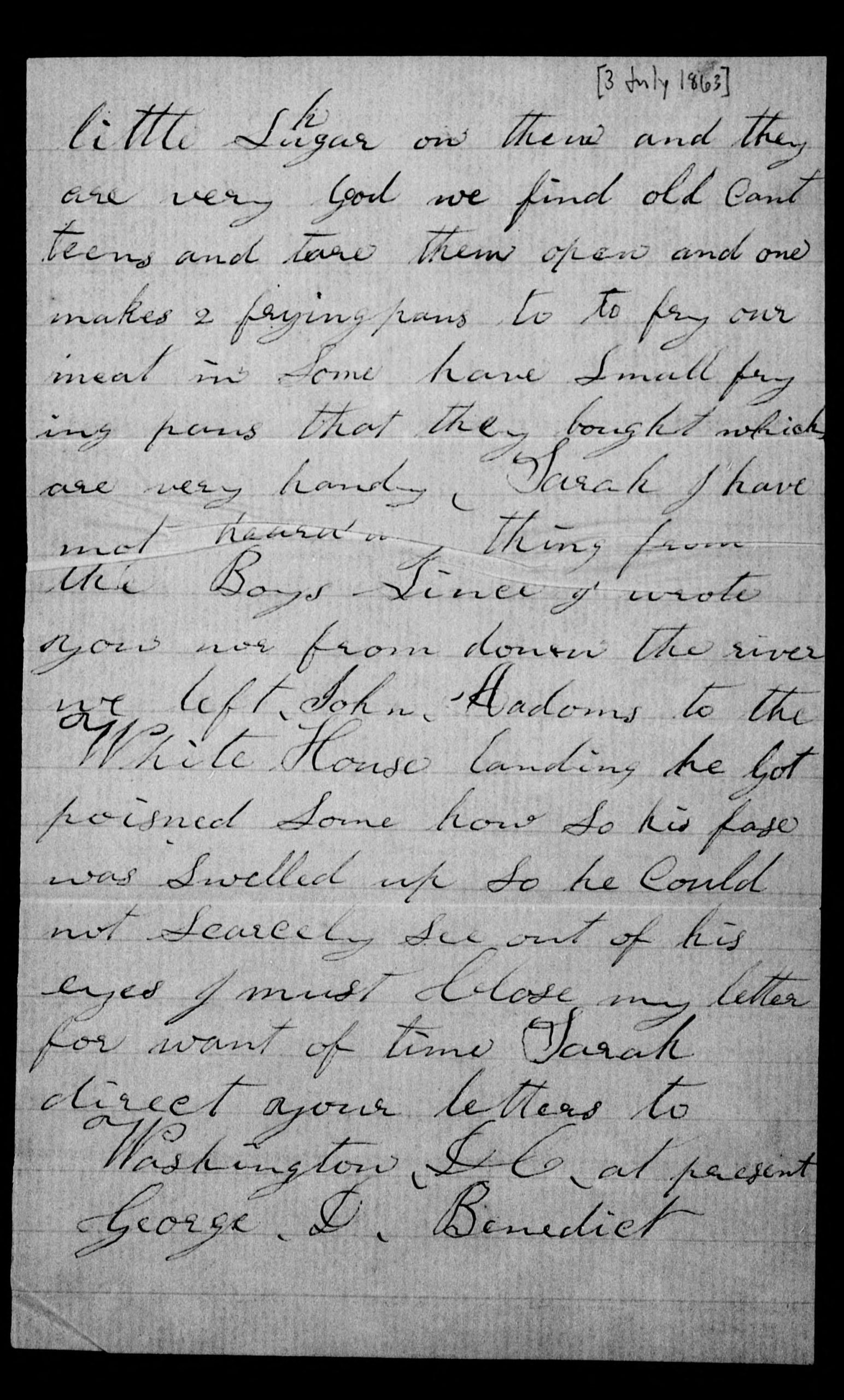
little Sugar on them and they are very God we find old Canteens and tare them open and one makes 2 frying pans to fry our meat in Some have Small frying pans that they bought which are very handy Sarah I have not heard any thing from the Boys Since I wrote you nor from down the river we left John Adams to the White House landing he got poisned Some how So his fase was Swelled up So he Could not Scarcely See out of his eyes I must Close my letter for want of time Sarah direct your letters to Washington D. C. at pesent
George D. Benedict
The canteen detail is the kind of thing that never reaches an official record. A tin canteen split along its seam gives two shallow pans, and a man on the march with no cooking kit has something to fry his pork in. Those who could afford it bought proper frying pans, “which are very handy.”
John J. Adams is named for the fourth time in these letters, and for the first time he is in trouble. He was left behind at White House Landing, “poisned Some how, So his fase was Swelled up So he Could not Scarcely See out of his eyes.” Benedict does not know the cause. On a march through Virginia in July it was as likely to have been poison ivy or sumac as anything he ate. Adams survived it: he mustered out with the company in June 1865.
6 July 1863 — “the best of all, thare Came a Chaplin”
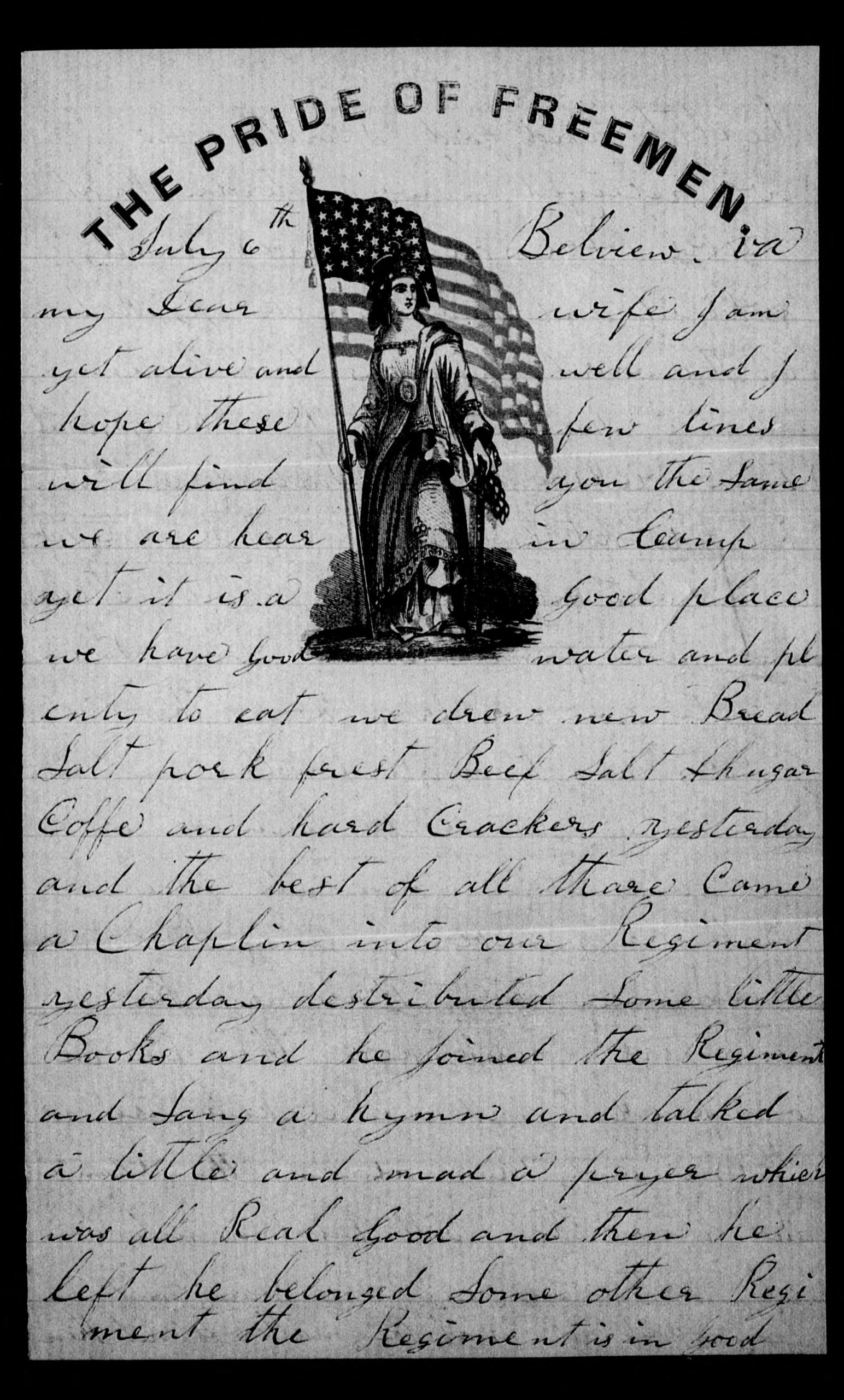
[Printed patriotic letterhead: Columbia with the United States flag, captioned THE PRIDE OF FREEMEN. The letter is written around the engraving.]
July 6th Beliview VA
my Dear wife I am yet alive and well and I hope these few lines will find you the Same we are hear in Camp yet it is a Good place we have good water and plenty to eat we drew new Bread Salt pork frest Beef Salt Shugar Coffe and hard Crackers yesterday and the best of all thare Came a Chaplin into our Regiment yesterday destributed Some little Books and he joined the Regiment and Sang a hymn and talked a little and mad a prayer which was all Real Good and then he left he belonged Some other Regiment the Regiment is in good
This answers something he wrote a month earlier. On 8 June, from Suffolk, Benedict set down the one thing he had to regret: the regiment had “no Chaplin and no prospect of having any — the leading officers are all apposed to it, they think that a Chaplin would draw the minds of the people from their Military duty.”
On 5 July a chaplain belonging to some other regiment walked into their camp, handed out tracts, sang a hymn, spoke a little and prayed. He then left. It was the first service the regiment had had, it lasted perhaps half an hour, it was borrowed from another unit — and Benedict, listing fresh bread, salt pork, fresh beef, sugar and coffee, calls it “the best of all.”
He wrote it on a printed patriotic sheet, fitting his lines around the engraving of Columbia and her flag.
The news arrives — and he does not believe it
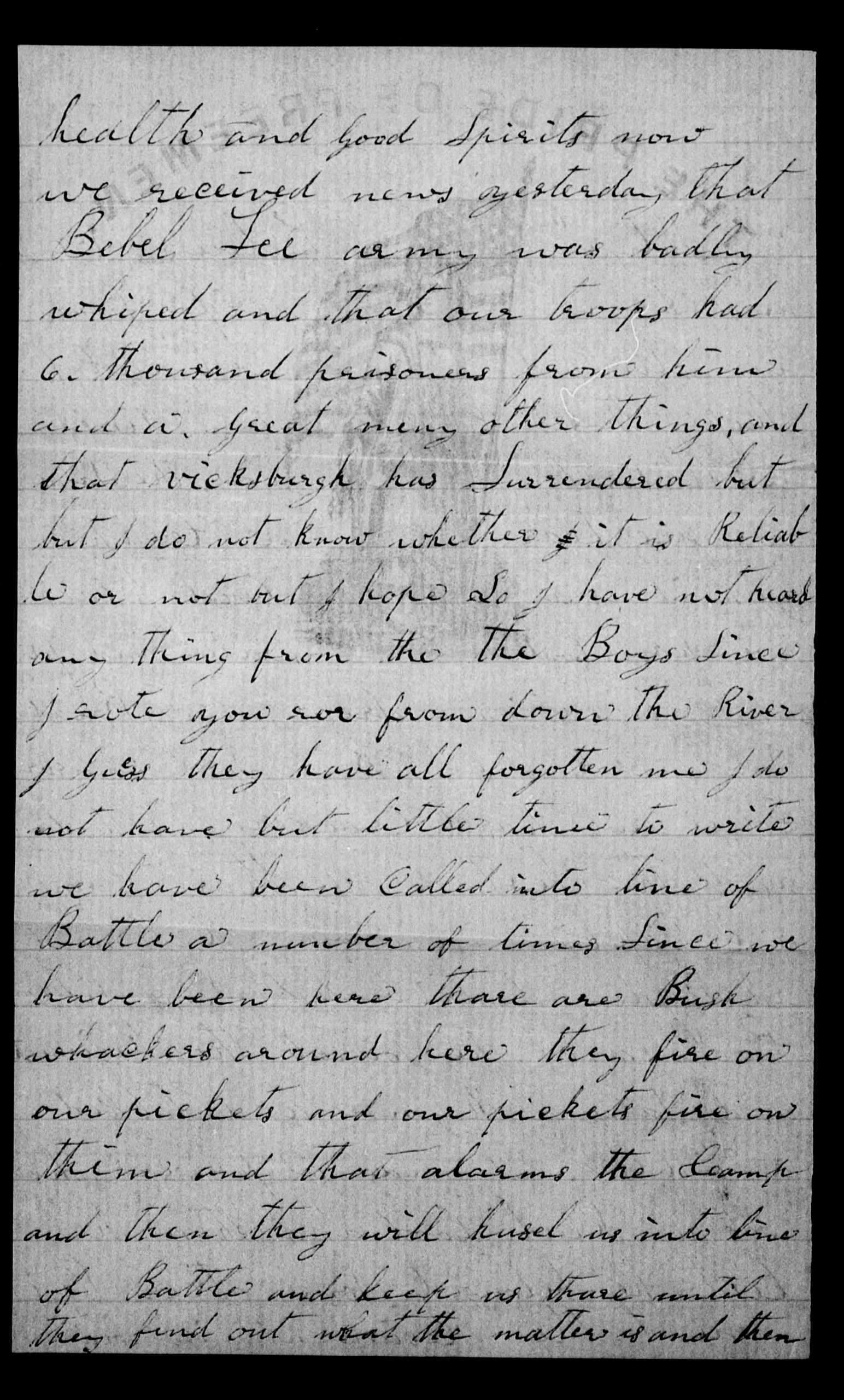
health and good Spirits now we received news yesterday that Rebel Lee army was badly whiped and that our troops had 6 thousand prisoners from him and a great meny other things, and that Vicksburgh has Surrendered but I do not know whether it is Reliable or not but I hope So I have not heard any thing from the Boys Since I wrote you nor from down the River I gess they have all forgotten me I do not have but little time to write we have been Called into line of Battle a number of times Since we have been here thare are Bush whackers around here they fire on our pickets and our pickets fire on them and that alarms the Camp and then they will husel us into line of Battle and keep us thare until they find out what the matter is and then
“that Vicksburgh has Surrendered — but I do not know whether it is Reliable or not, but I hope So.”
Both reports were true. Lee had been beaten at Gettysburg on 1–3 July and was retreating toward the Potomac. Vicksburg had surrendered to Grant on 4 July. Together they are the turning point of the war, and this is the moment the news reached a private soldier on the Virginia Peninsula — two days late, second hand, and mixed in with the day’s rations.
And he cannot trust it. Three separate times in the previous six weeks he had been told Vicksburg had fallen — once with the added detail that Grant had been killed — and each time it was false. He had written on 26 May that the men “did not believe the reports” because they had been so badly disappointed before. He had trained himself out of believing good news at precisely the moment it became true.
Underneath the great events, two smaller things. The bushwhackers were still working the picket line, and every exchange of shots turned the whole camp out into line of battle until somebody established what had happened. And he had heard from nobody at home in weeks: “I gess they have all forgotten me.”
7 July 1863 — eighteen miles from Richmond
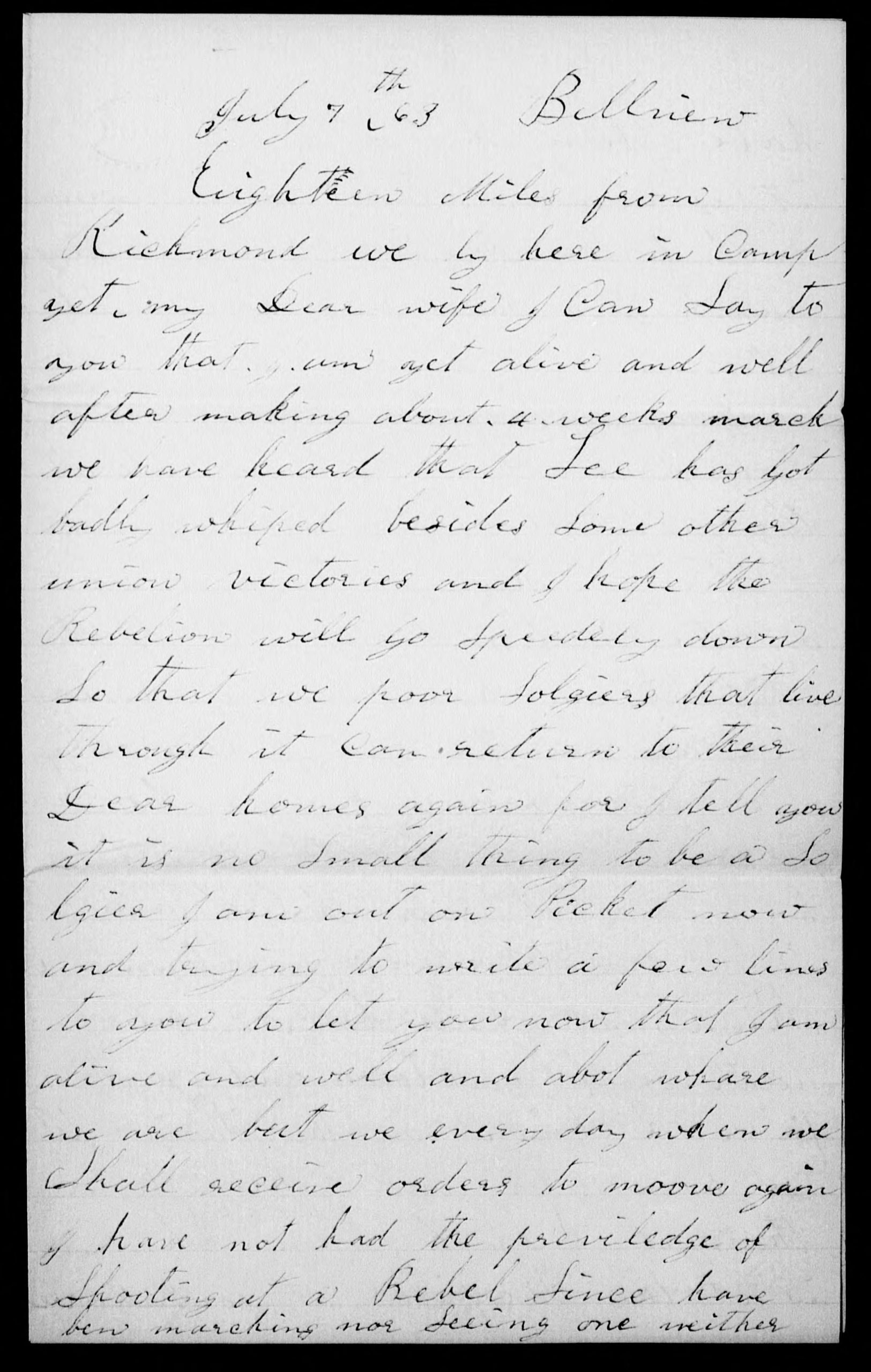
July 7th 63 Bellview Eighteen Miles from Richmond
we ly here in Camp yet my Dear wife I Can Say to you that I am yet alive and well after making about 4 weeks march we have heard that Lee has got badly whiped besides Some other union victories and I hope the Rebelion will go Speedely down So that we poor Solgiers that live through it Can return to their Dear homes again for I tell you it is no Small thing to be a Solgier I am out on Picket now and trying to write a few lines to you to let you now that I am alive and well and abot whare we are but we every day when we Shall receive orders to moove again I have not had the previledge of Shooting at a Rebel Since have ben marching nor Seeing one wither
“I hope the Rebelion will go Speedely down, so that we poor Solgiers that live through it Can return to their Dear homes again — for I tell you it is no Small thing to be a Solgier.”
A day after refusing to believe the reports, he has accepted them. Lee was beaten, there were other Union victories, the war might end. And in the same breath comes the qualification every soldier carried: those that live through it. He had ten months left.
He wrote this standing picket, eighteen miles from Richmond, after four weeks of marching — and notes drily that in all that time he has not had “the previledge of Shooting at a Rebel … nor Seeing one wither.” The war he had actually experienced was marching, guard duty, bad cooking, and men shot at by people they never saw.
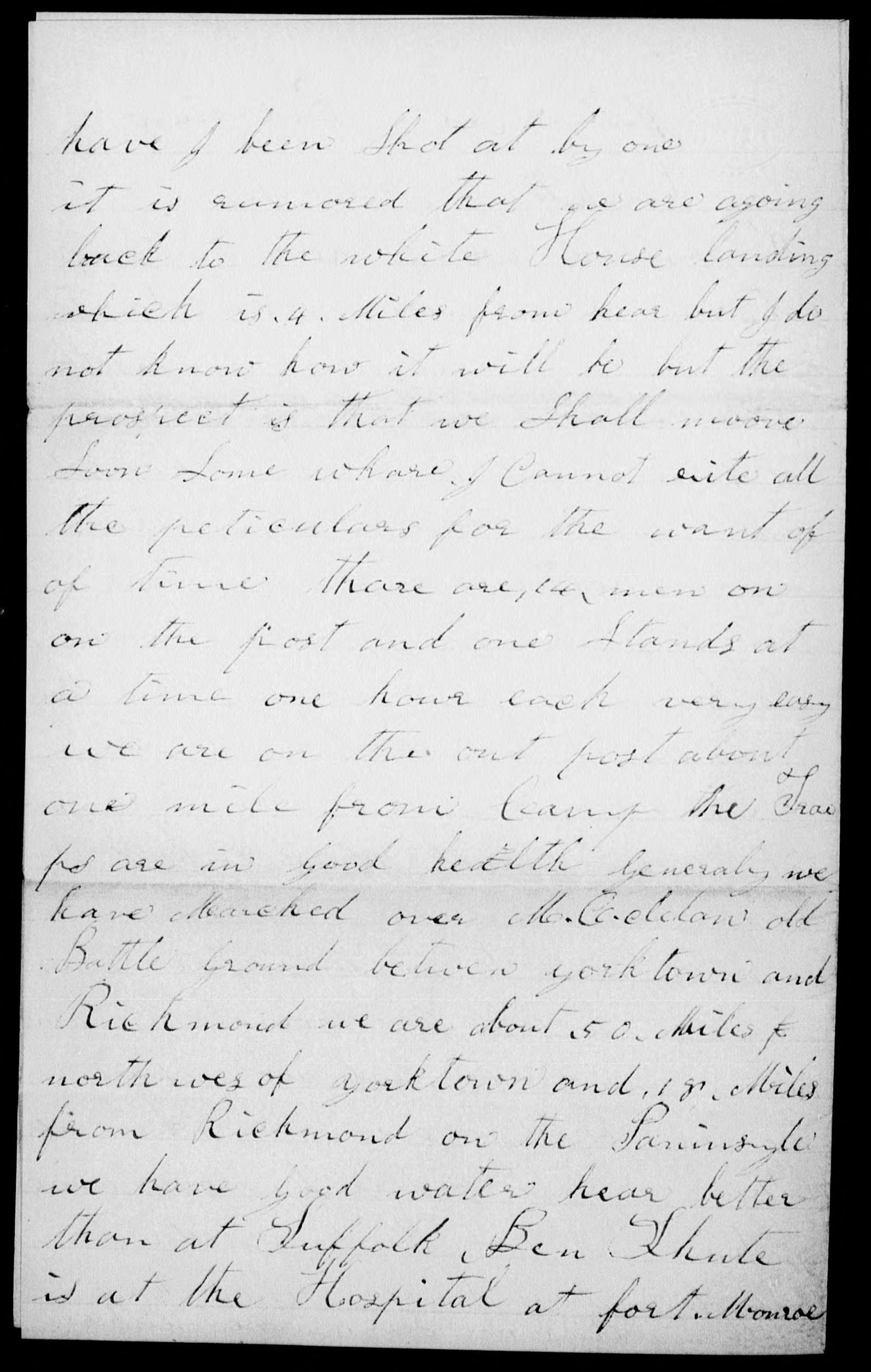
have I been Shot at by one it is rumored that we are agoing back to the White House landing which is 4 Miles from hear but I do not know how it will be but the prospect is that we Shall moove Soon Some whare I Cannot rite all the peticulars for the want of time thare are 4 men on the post and one Stands at a time one hour each very easy we are on the out post about one mile from Camp the Traps are in good health generaly we have Marched over McClelan old Battle Ground between Yorktown and Richmond we are about 50 Miles north west of Yorktown and 18 Miles from Richmond on the Paninsyla we have good water hear better than at Suffolk Ben Shute is at the Hospital at fort Monroe
He fixes his position for his wife as precisely as he can: fifty miles north-west of Yorktown, eighteen from Richmond, on the Peninsula, and four miles from White House Landing. He also gives the arithmetic of picket duty — four men to a post, one standing at a time, an hour each. He calls it “very easy.”
The last line is a small tragedy in six words. Sergeant Benjamin Shute of Amity — Benedict’s own townsman in Company G — had been sent down to Fortress Monroe with the sick back on 11 May, and Benedict had written then that “he is agiting better I believe.”Two months later he is still in that hospital. In November he was transferred to the Veteran Reserve Corps. He never came back to the regiment.
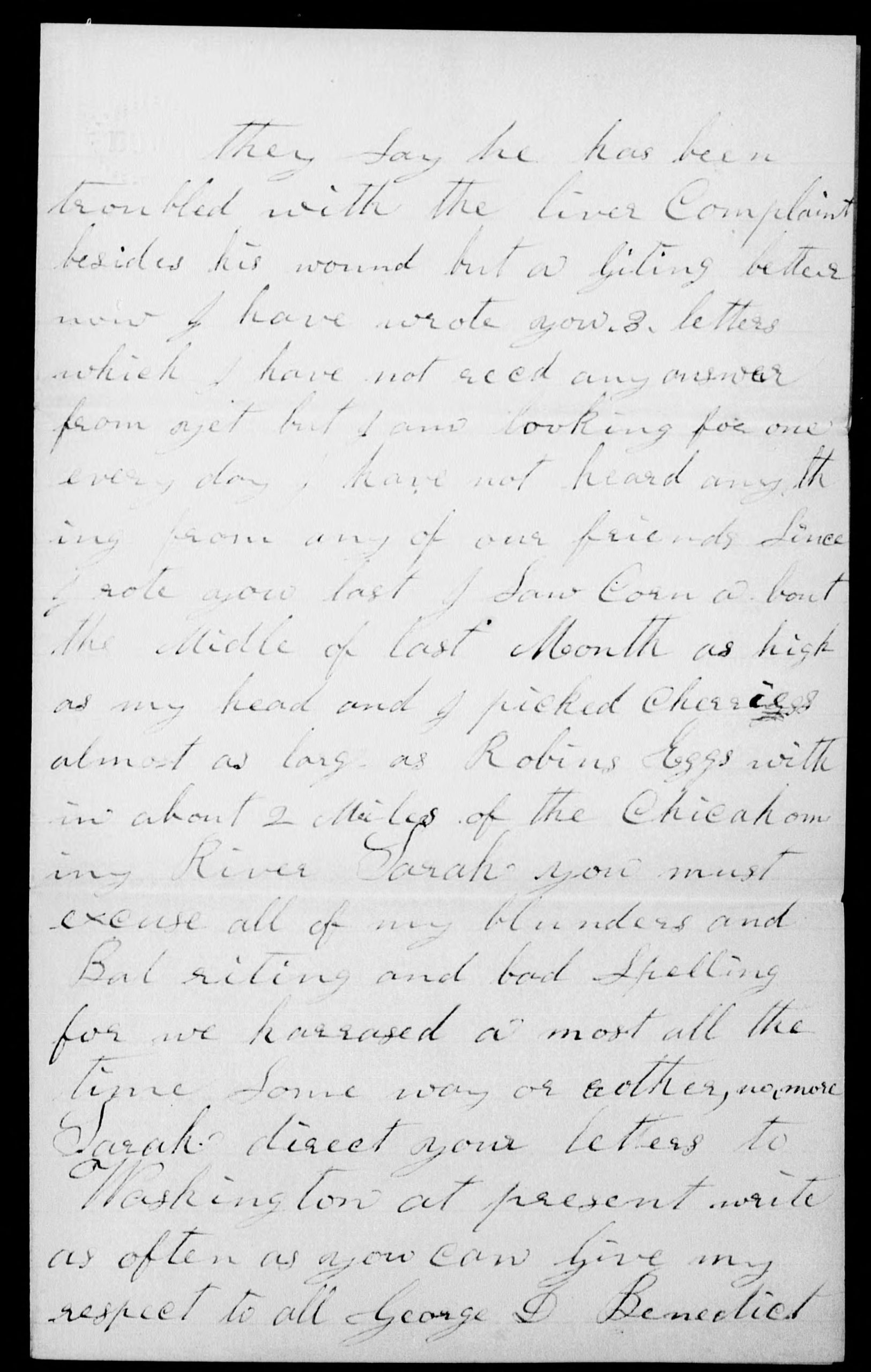
they say he has been troubled with the liver Complaint besides his wound but a giting better now I have wrote you 3 letters which I have not recd any answer from ayet but I am looking for one every day I have not heard any thing from any of our friends Since I rote you last I Saw Corn about the Middle of last Month as high as my head and I picked Cherries almost as large as Robins Eggs within about 2 Miles of the Chickahominy River Sarah you must excuse all of my blunders and Bad riting and bad Spelling for we harased a most all the time Some way or other, no more Sarah direct your letters to Washington at present write as often as you can give my respect to all
George D. Benedict
This page adds a fact the official record does not contain. He is still writing about Sergeant Benjamin Shute, in hospital at Fort Monroe: “they say he has been troubled with the liver Complaint besides his wound.” The regimental roster records only that Shute was mustered in as corporal, made sergeant, and transferred to the Veteran Reserve Corps on 3 November 1863. It says nothing about a wound. A comrade’s letter home is the only surviving evidence that he carried one.
Then, in the middle of a war, a farmer notices the crops: corn as high as his head by mid-June, and cherries “almost as large as Robins Eggs” picked within two miles of the Chickahominy.
And he apologises for his handwriting. “Sarah you must excuse all of my blunders and Bad riting and bad Spelling, for we [are] harased a most all the time Some way or other.” He had been marching for four weeks, standing picket every other night, and writing on his knee. It is the only complaint he makes about any of it.
15 July 1863, Frederick City — twenty miles from Lee
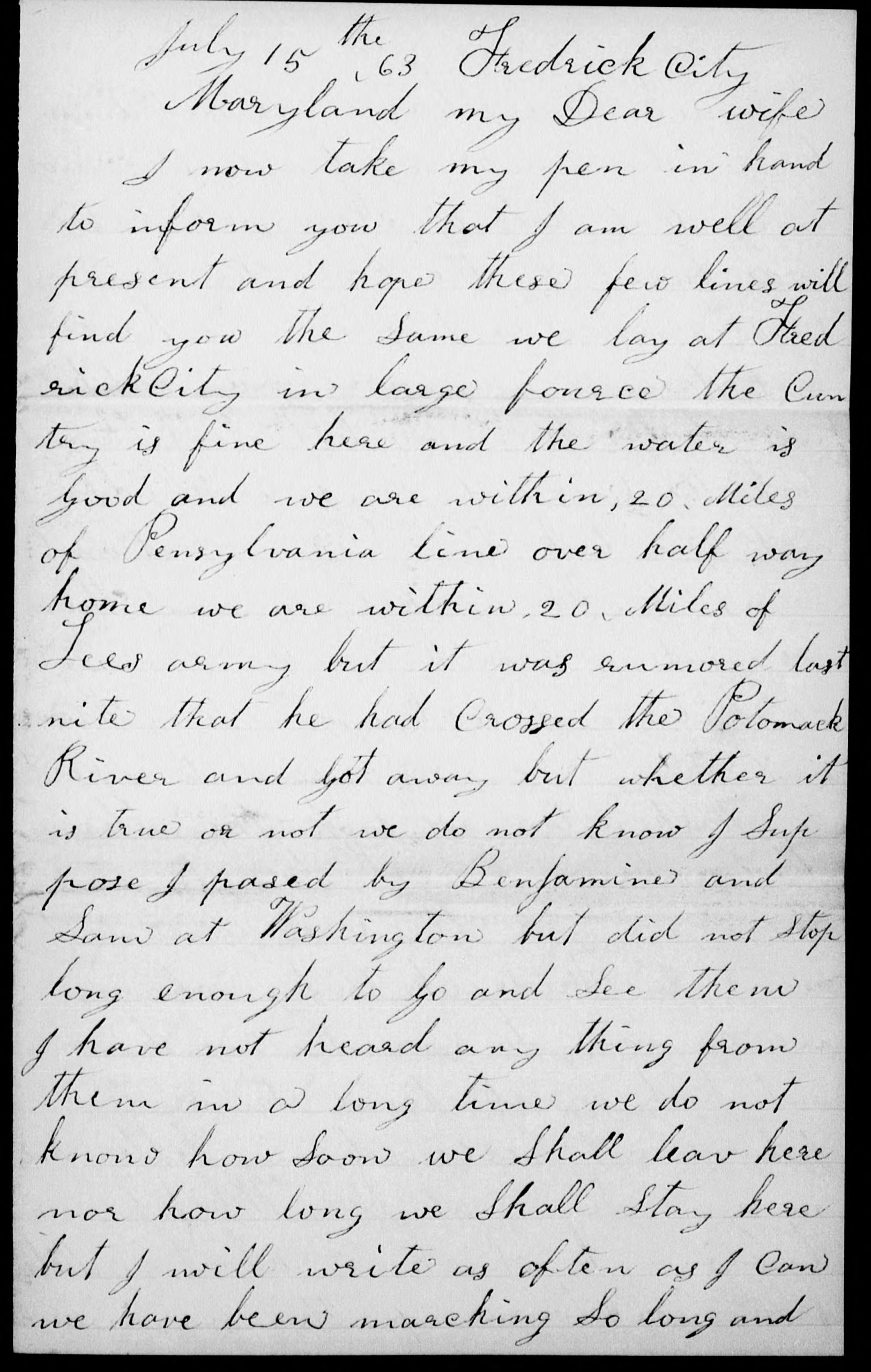
July 15th 63 Fredrick City Maryland
my Dear wife I now take my pen in hand to inform you that I am well at present and hope these few lines will find you the Same we lay at Fredrick City in large fource the Cuntry is fine here and the water is Good and we are within 20 Miles of Pensylvania line over half way home we are within 20 Miles of Lees army but it was rumored last nite that he had Crossed the Potomack River and got away but whether it is true or not we do not know I Suppose I pased by Benjamine and Sam at Washington but did not Stop long enough to go and See them I have not heard any thing from them in a long time we do not know how Soon we Shall leav here nor how long we Shall Stay here but I will write as often as I Can we have been marching So long and
The regiment has come north into the pursuit after Gettysburg. Three weeks earlier Benedict was on the Chickahominy; now he is at Frederick, in Maryland, within twenty miles of the Pennsylvania line and twenty miles of Lee’s retreating army.
The rumour he could not confirm was correct. Lee crossed the Potomac at Williamsport and Falling Waters on the night of 13–14 July 1863, and got his army back into Virginia. Benedict, writing on the 15th, had it right — “he had Crossed the Potomack River and got away” — and, as usual, would not commit to it.
The saddest line has nothing to do with the campaign. His brothers Benjamin and Samuel were serving near Washington. The regiment passed through the city on its way north, and he believes he went right by them: “I pased by Benjamine and Sam at Washington but did not Stop long enough to go and See them.” He had not heard from either of them in a long time. Neither brother appears on this regiment’s rolls; George is the only Benedict in the First New York Dragoons.
And once again, the measure that matters to a man from Allegany County: twenty miles from the Pennsylvania line, “over half way home.”
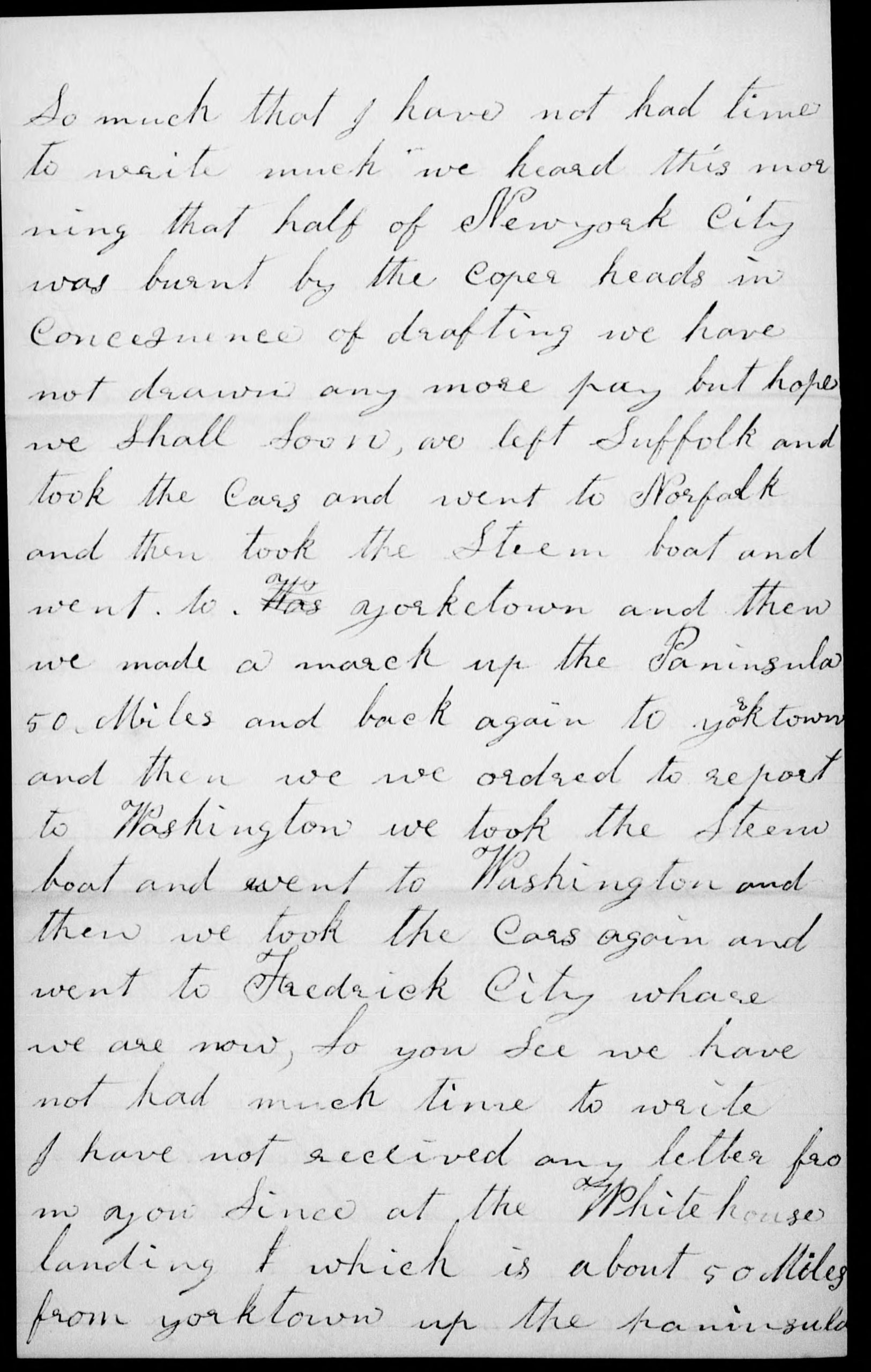
So much that I have not had time to write much we heard this morning that half of New york City was burnt by the Coper heads in Concequence of drafting we have not drawn any more pay but hope we Shall Soon, we left Suffolk and took the Cars and went to Norfolk and then took the Steem boat and went to Yorktown and then we made a march up the Paninsula 50 Miles and back again to Yorktown and then we we ordred to report to Washington we took the Steem boat and went to Washington and then we took the Cars again and went to Fredrick City whare we are now, so you See we have not had much time to write I have not received any letter from you Since at the White house landing which is about 50 Miles from Yorktown up the paninsula
“we heard this morning that half of New york City was burnt by the Coper heads in Concequence of drafting”
The New York City draft riots. They began on 13 July 1863, days after Gettysburg, when the first names were drawn under the new conscription act, and ran for four days — the worst civil disorder in American history. Buildings were burned, the coloured orphan asylum among them, and black New Yorkers were hunted and murdered in the streets. Troops were pulled from the army that had just fought Gettysburg to put it down.
Half the city was not burnt. But this is how it reached a soldier in Maryland two days in: as a rumour of catastrophe, blamed on the Copperheads — the anti-war Democrats. For a man who had spent a year being shot at while others rioted rather than be drafted, the blame is not neutral.
He then sets out the whole month in a single sentence, to explain why he has written so seldom: Suffolk, cars to Norfolk, steamboat to Yorktown, fifty miles up the Peninsula and fifty back, steamboat to Washington, cars to Frederick City. And still no letter from Sarah since White House Landing — and no pay.
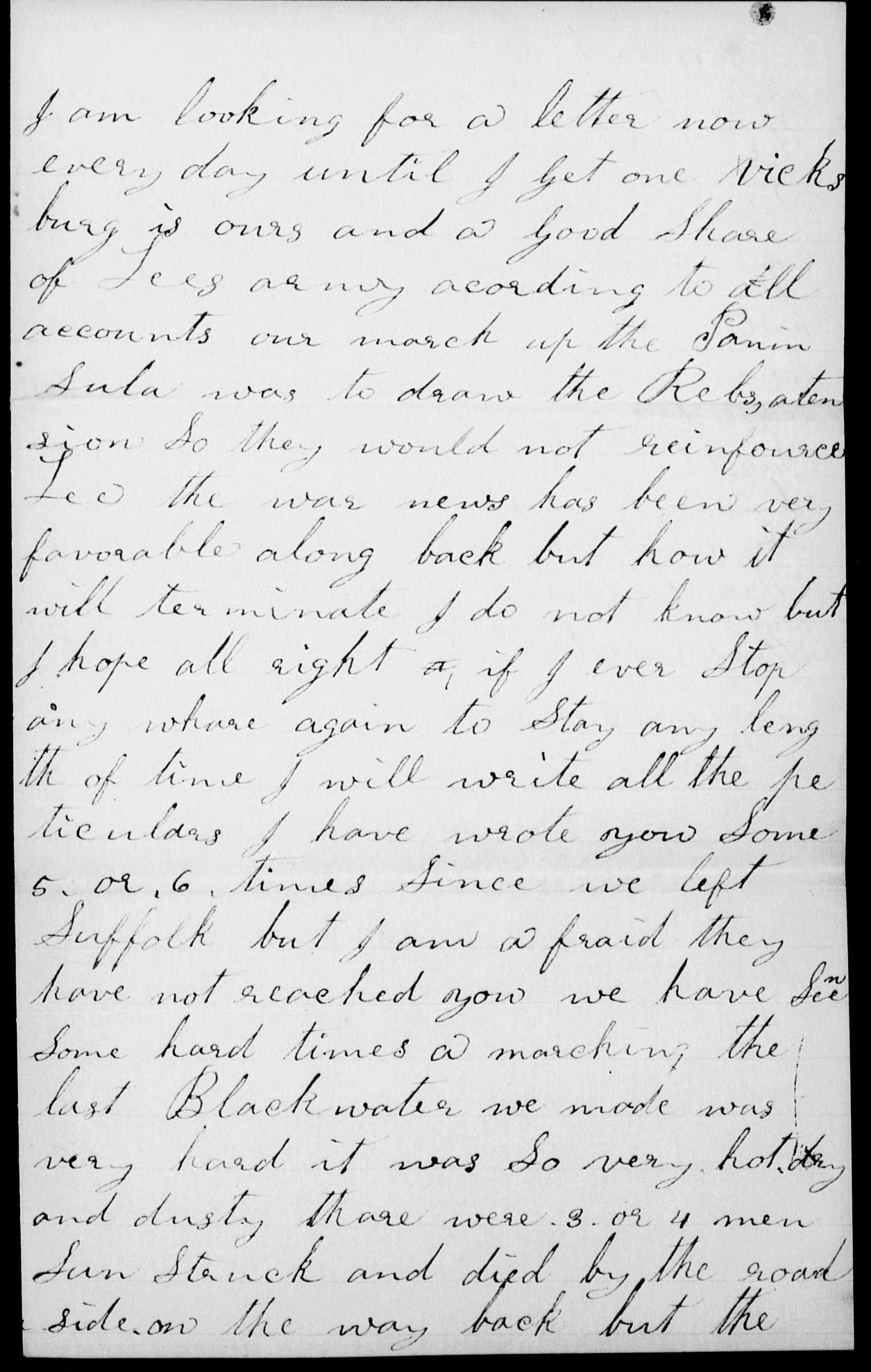
I am looking for a letter now every day until I get one Vicksburg is ours and a good Share of Lees army acording to all accounts our march up the Paninsula was to draw the Rebs atension So they would not reinfource Lee the war news has been very favorable along back but how it will terminate I do not know but I hope all right if I ever Stop any whare again to Stay any length of time I will write all the peticulars I have wrote you Some 5 or 6 times Since we left Suffolk but I am afraid they have not reached you we have Seen Some hard times a marching the last Blackwater we made was very hard it was So very hot dry and dusty thare were 3 or 4 men Sun Struck and died by the road side on the way back but the
“Vicksburg is ours.” No hedge, no “if it is Reliable.” Eleven days after the surrender and six weeks after the first false report, he finally states it as fact. It is the end of a small arc that runs through five of these letters: three false reports, a refusal to believe the true one, and now acceptance.
He has also worked out what his own regiment was doing on the Peninsula, and he is right: “our march up the Paninsula was to draw the Rebs atension so they would not reinfource Lee.” The advance toward Richmond in late June was a diversion, meant to hold Confederate troops in Virginia while the armies met in Pennsylvania. A private soldier, three weeks later, had the strategy correct.
And then the cost, recorded without emphasis: the last march to the Blackwater was so hot, dry and dusty that three or four men were sunstruck and died by the roadside on the way back. They do not appear in any battle return. This is how a great many soldiers died — walking.
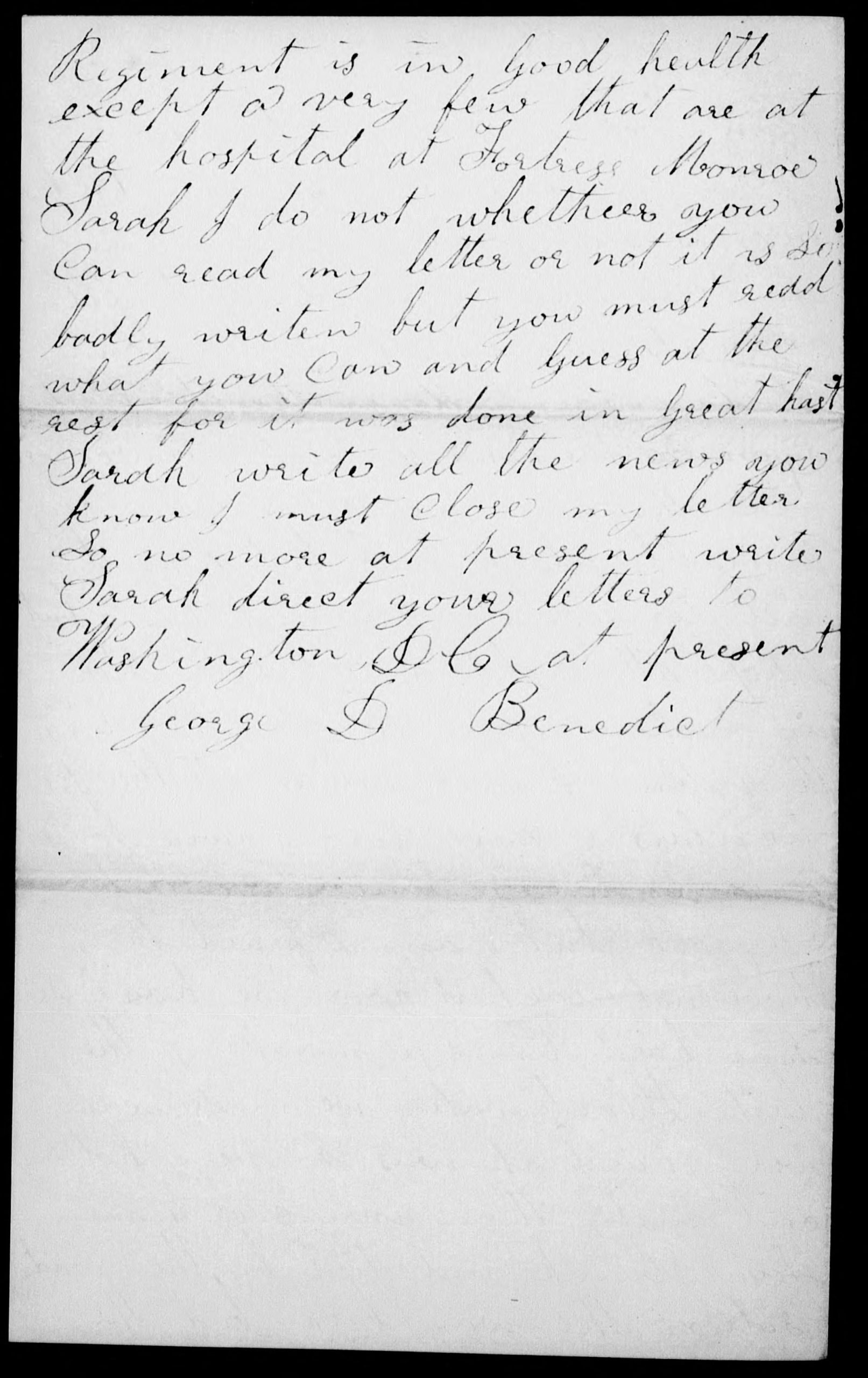
Regiment is in good health except a very few that are at the hospital at Fortress Monroe Sarah I do not [know] whether you Can read my letter or not it is So badly writen but you must redd what you Can and guess at the rest for it was done in great hast Sarah write all the news you know I must Close my letter So no more at present write Sarah direct your letters to Washington D. C. at present
George D. Benedict
“Sarah I do not [know] whether you Can read my letter or not, it is So badly writen — but you must redd what you Can and guess at the rest, for it was done in great hast.”
It is the second time in a week he has apologised for his hand. He had been marching almost continuously since leaving Suffolk a month before, had written five or six letters he suspected had never arrived, and was writing this one in haste at Frederick City with Lee’s army twenty miles off.
The instruction he gave his wife is the one that has been followed in preparing these pages. Read what you can, and guess at the rest. Where a word here is genuinely uncertain it is marked in square brackets; where the ink has faded past reading, the scan is shown so that anyone may check the guess.
18 July 1863, Berlin, Maryland — eleven miles from Lee
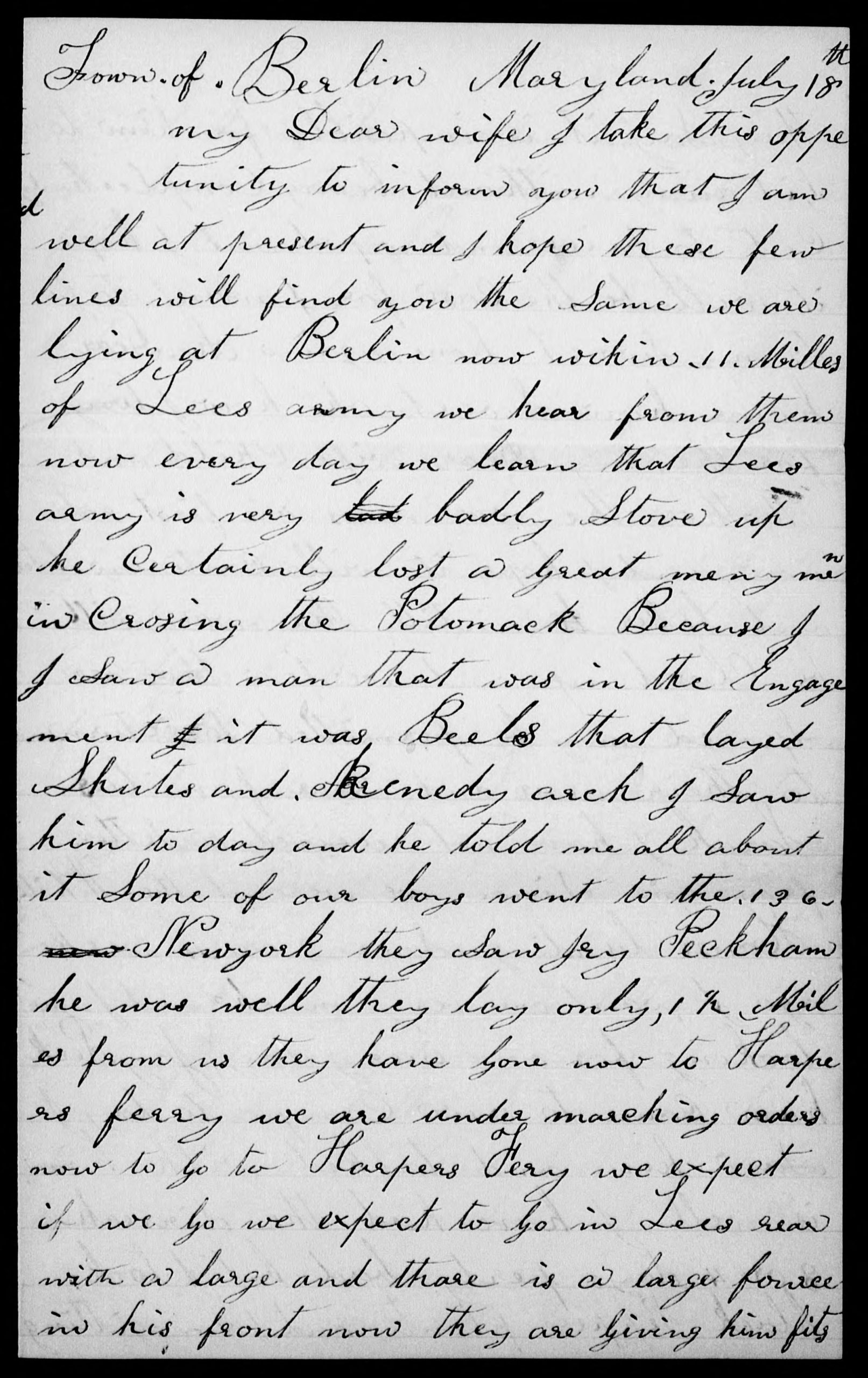
Town of Berlin Maryland July 18th
my Dear wife I take this oppertunity to inform you that I am well at present and I hope these few lines will find you the Same we are lying at Berlin now within 11 Milles of Lees army we hear from them now every day we learn that Lees army is very badly Stove up he Certainly lost a great meny men in Crosing the Potomack Because I Saw a man that was in the Engagement it was Beels that layed Shutes and Kenedy ark I Saw him to day and he told me all about it Some of our boys went to the 136 Newyork they Saw Jry Peckham he was well they lay only 1 1/2 Miles from us they have gone now to Harpers ferry we are under marching orders now to go to Harpers Fery we expect if we go we expect to go in Lees rear with a large and thare is a large fource in his front now they are giving him fits
Berlin, Maryland — today Brunswick — sits on the Potomac just below Harpers Ferry. Benedict is eleven miles from Lee’s army, hearing about it daily, and the regiment is under orders for Harpers Ferry expecting to come in on Lee’s rear while another force holds his front. “Now they are giving him fits.”
His information is first hand for once: he had spoken that day with a man who was in the engagement at the crossing, and reports that Lee “Certainly lost a great meny men in Crosing the Potomack.” That was the fighting at Falling Waters on 14 July, as the Confederate rearguard got the last of the army over the river.
On the names. None of “Beels”, “Shutes”, “Kenedy” or “Jry Peckham” appears on the rolls of this regiment. Peckham is explicitly placed in the 136th New York, camped a mile and a half away — men from the same corner of New York State, sought out by Benedict’s messmates for news. The others read as people or places from home rather than soldiers, and are left unidentified here rather than forced onto the nearest similar surname.
18 July 1863, second sheet — “oh Dear home how Sweet”
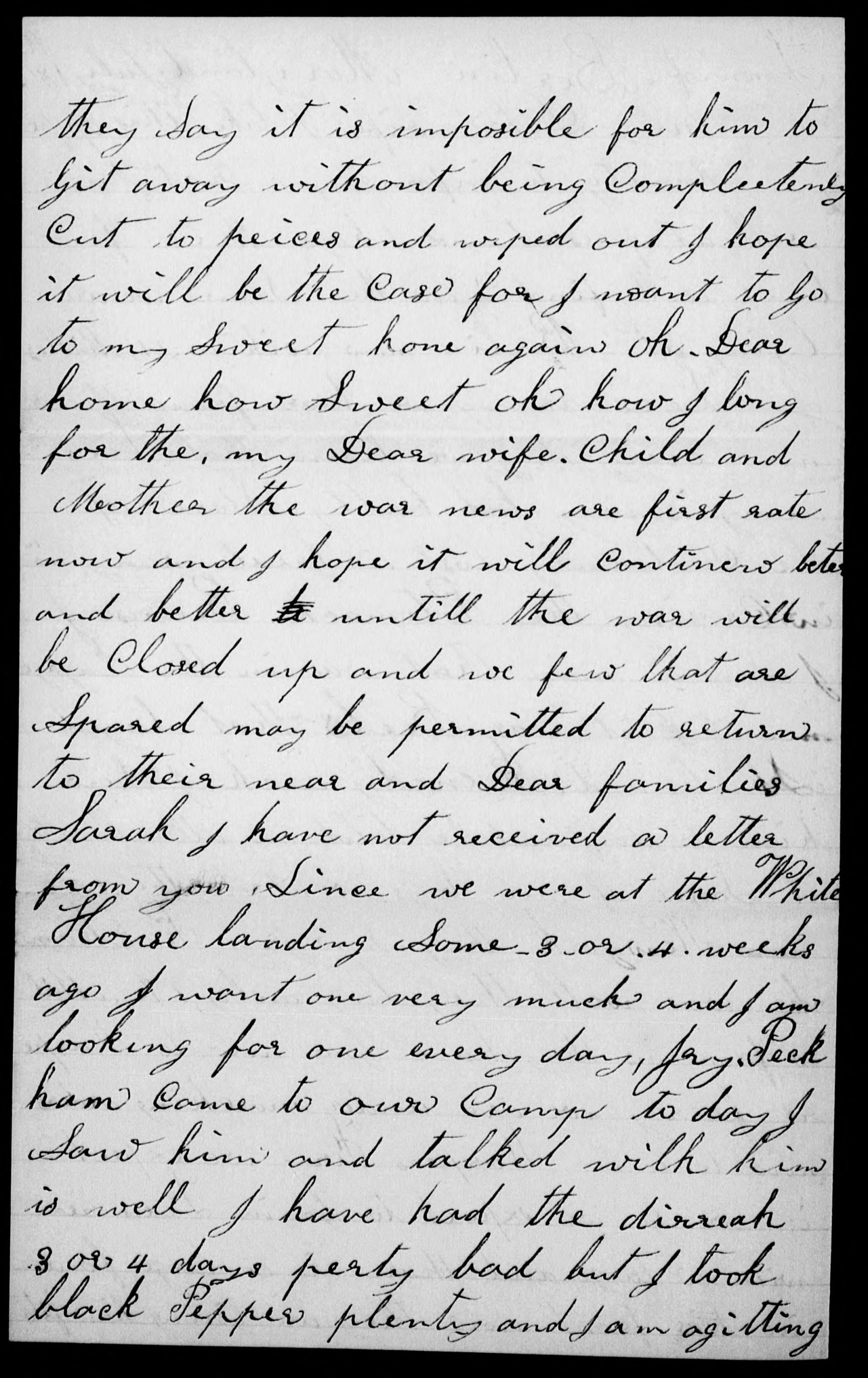
they Say it is imposible for him to git away without being Compleetenly Cut to peices and wiped out I hope it will be the Case for I want to go to my Sweet home again oh Dear home how Sweet oh how I long for the, my Dear wife, Child and Mother
the war news are first rate now and I hope it will Continew beter and better untill the war will be Closed up and we few that are Spared may be permitted to return to their near and Dear families
Sarah I have not received a letter from you Since we were at the White House landing Some 3 or 4 weeks ago I want one very much and I am looking for one every day, Jay Peckham Come to our Camp to day I Saw him and talked with him is well I have had the dirreah 3 or 4 days perty bad but I took black Pepper plenty and I am agitting
The sentence he cannot finish quickly enough runs straight from the destruction of Lee’s army into his own kitchen: he wants Lee wiped out because he wants to go home. Then the line that gives this page its weight — “we few that are Spared may be permitted to return to their near and Dear families.” Benedict was not spared. He was shot at Todd’s Tavern on 7 May 1864 and died of the wound on 25 May.
He has had no letter from Sarah since White House Landing, three or four weeks back, and says so twice. And the visitor named on the previous sheet arrives in person: Jay Peckham walked over to the Dragoons’ camp that day. This page settles the reading — the earlier sheet’s cramped “Jry” is Jay. He is of the 136th New York, not this regiment, and does not appear on the Dragoon rolls.
The last lines are ordinary soldiering: four days of dysentery, treated with black pepper, and getting better. Camp remedies like this are why so many of these men died of disease rather than of shot.
18 July 1863, third sheet — the night march to Berlin
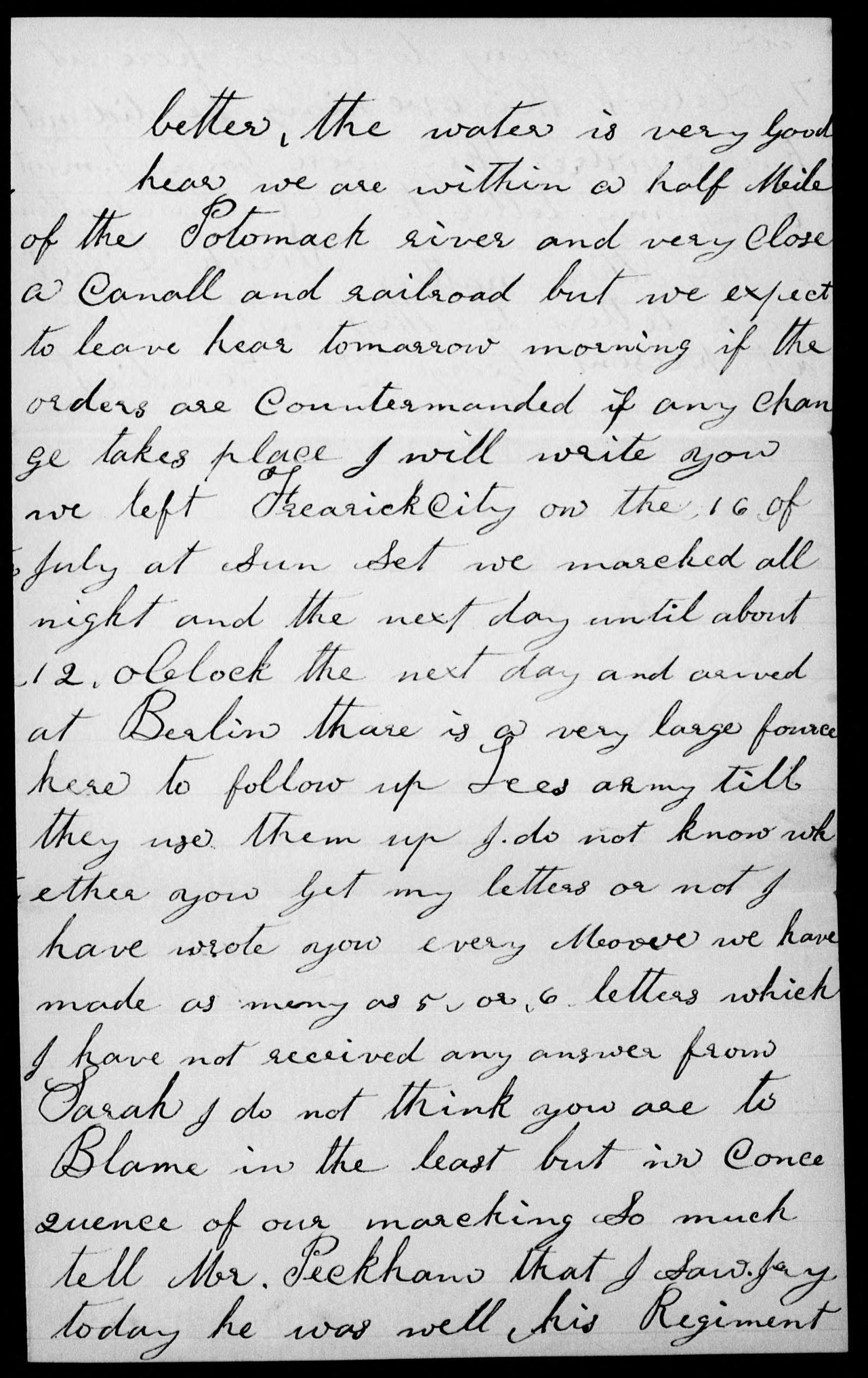
better, the water is very good hear we are within a half Mile of the Potomack river and very Close a Canall and railroad but we expect to leave hear tomarrow morning if the orders are Countermanded if any Change takes place I will write you
we left Frearick City on the 16 of July at Sun Set we marched all night and the next day until about 12 oClock the next day and arved at Berlin thare is a very large fource here to follow up Lees army till they use them up
I do not know whether you get my letters or not I have wrote you every Moove we have made as meny as 5 or 6 letters which I have not received any answer from Sarah I do not think you are to Blame in the least but in Concequence of our marching So much
tell Mr. Peckham that I Saw Jay today he was well his Regiment
Here is the march itself, dated and timed: out of Frederick City at sunset on 16 July, marching all that night and on until about noon the next day, into Berlin. Roughly twenty hours in the saddle. He notes the practical things a cavalryman notices — good water, half a mile to the Potomac, close to the canal and the railroad.
Then the ache that runs through the whole page: he has written “every Moove we have made, as meny as 5 or 6 letters,” and had nothing back. What he does with that is characteristic — “Sarah I do not think you are to Blame in the least.” He blames the marching, not his wife. The mail was chasing a cavalry division that never stopped moving.
The last line shows how this news network actually worked. “Tell Mr. Peckham that I Saw Jay today he was well.” Jay Peckham of the 136th New York could not get word to his own father, so it travelled in Benedict’s letter to Sarah at Belvidere, to be carried down the road by hand. Neither Peckham is on the Dragoon rolls; they are neighbours, not comrades.
18 July 1863, closing sheet — signed in full
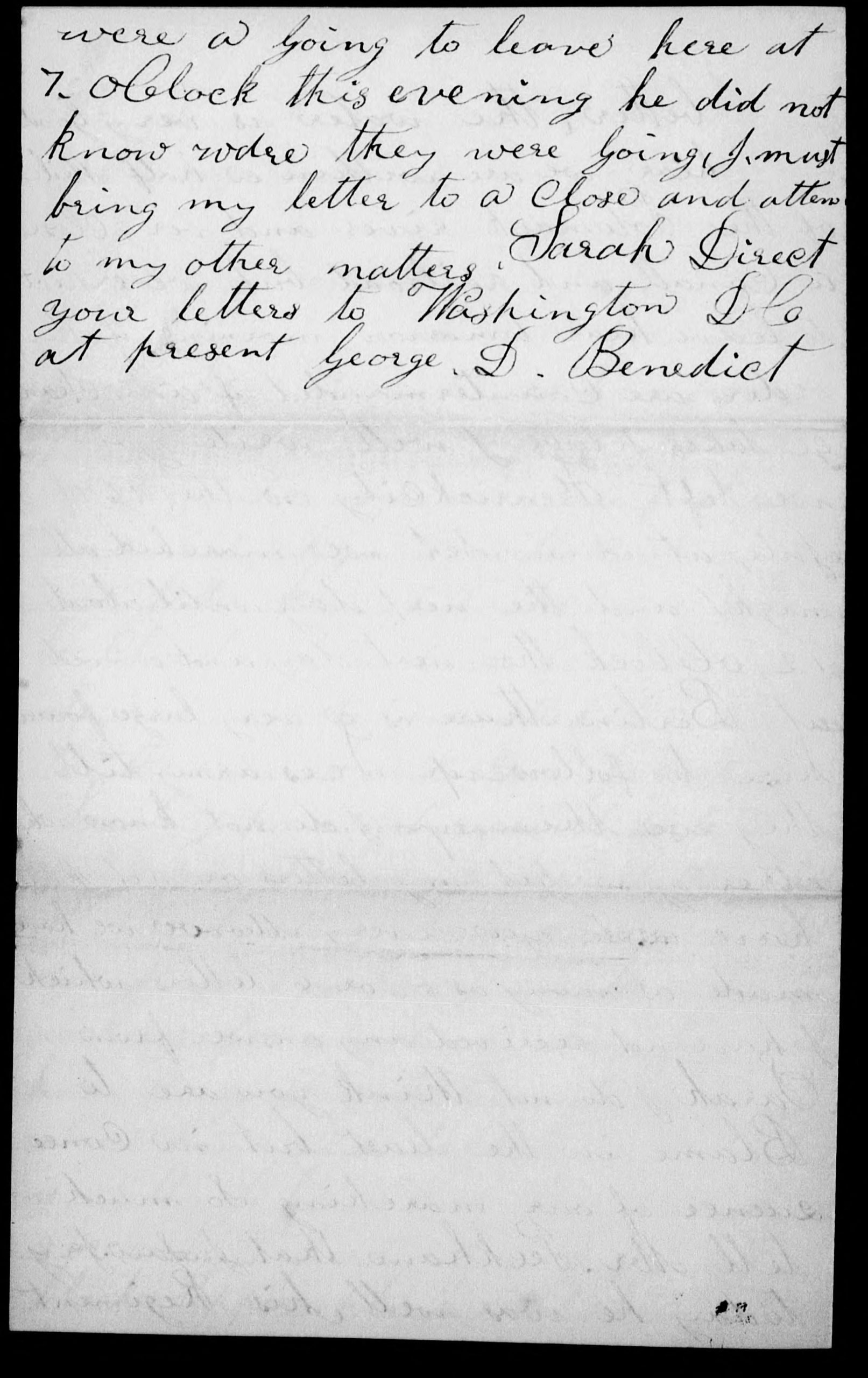
were a going to leave here at 7 oClock this evening he did not know wdre they were going, I must bring my letter to a Close and attend to my other matters
Sarah Direct your letters to Washington D C at present
George D. Benedict
The remainder of the sheet is blank. The faint lines visible on the scan are show-through from the sheet behind it, not writing on this page.
The last thing he reports is Jay Peckham’s regiment moving out at seven that evening, and the honest ending: “he did not know wdre they were going.” Neither did anyone. That is what these letters record more faithfully than any campaign history — men marching hard toward an objective nobody had told them.
He breaks off because there are “other matters” to attend to, tells Sarah to direct her letters to Washington, D.C. rather than to any camp, and signs his full name. He rarely does. Most of these letters close with initials or nothing at all. This is one of the few sheets that carries George D. Benedict in his own hand, entire.
28–29 July 1863, Warrenton, Virginia — four men named
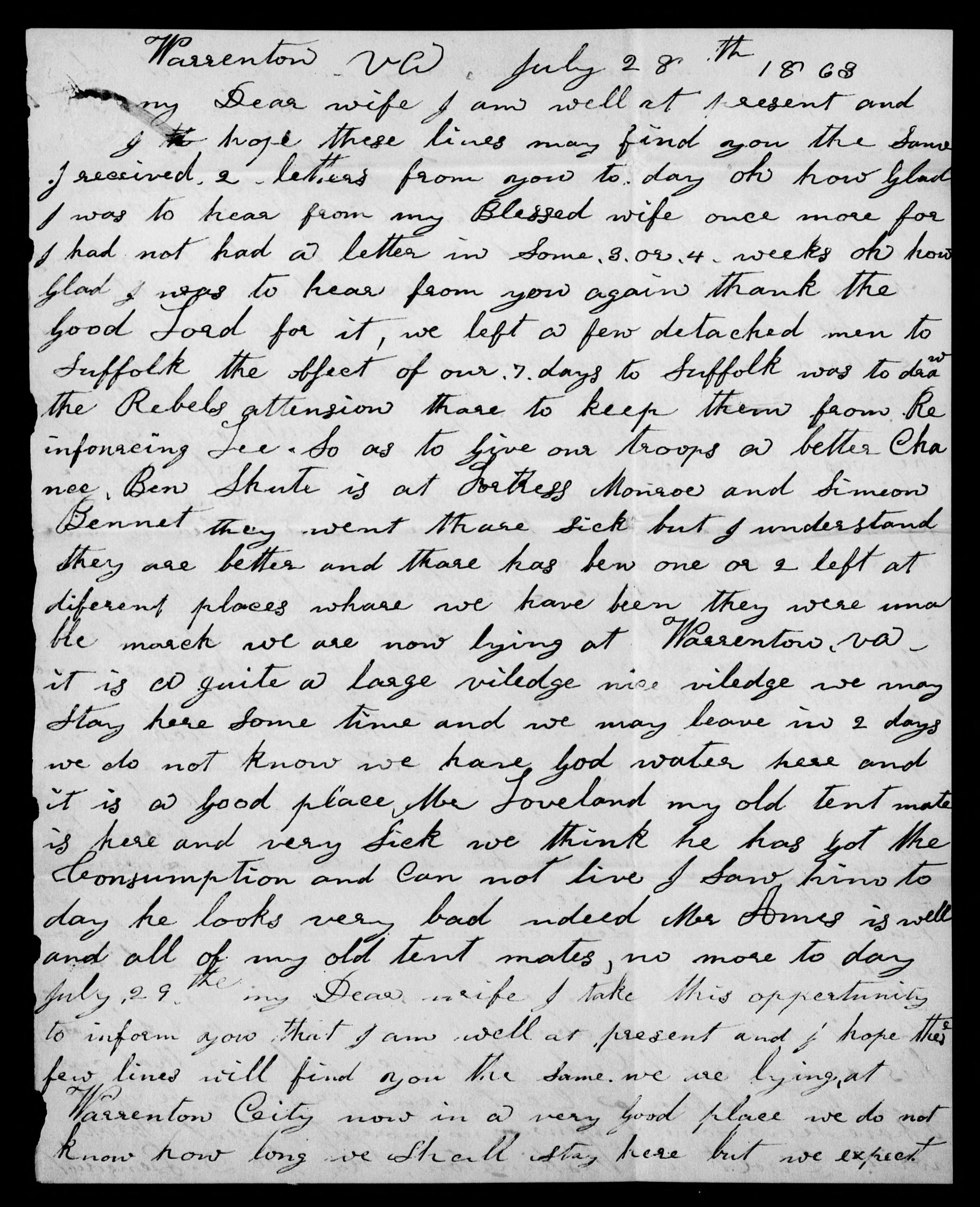
Warrenton VA July 28th 1863
my Dear wife I am well at present and I hope these lines may find you the Same I received 2 letters from you to day oh how glad I was to hear from my Blessed wife once more for I had not had a letter in Some 3 or 4 weeks oh how glad I was to hear from you again thank the good Lord for it,
we left a few detached men to Suffolk the affect of our 7 days to Suffolk was to draw the Rebels attension thare to keep them from Reinforceing Lee So as to give our troops a better Chance.
Ben Shute is at Fortress Monroe and Simeon Bennet they went thare Sick but I understand they are better and thare has ben one or 2 left at diferent places whare we have been they were unable march
we are now lying at Warrenton Va it is quite a large viledge nice viledge we may Stay here Some time and we may leave in 2 days we do not know we have god water here and it is a good place,
Mr Loveland my old tent mate is here and very Sick we think he has got the Consumption and Can not live I Saw him to day he looks very bad indeed Mr Ames is well and all of my old tent mates, no more to day
July 29th my Dear wife I take this oppertunity to inform you that I am well at present and I hope these few lines will find you the Same we are lying at Warrenton City now in a very good place we do not know how long we Shall Stay here but we expect
Two letters from Sarah arrived at last, ending the three-or-four-week silence he had complained of from Berlin. Then a private explains his own army’s strategy, and gets it right: the seven days toward Suffolk were “to draw the Rebels attension thare to keep them from Reinforceing Lee.” A demonstration, not an advance.
Four men of Company G are named. Ben Shute and Simeon Bennett are at Fortress Monroe, sent there sick and reported mending. Benjamin Ames, the preacher, is well. And Edwin Loveland, an earlier tent mate, is at Warrenton dying — “we think he has got the Consumption and Can not live … he looks very bad indeed.”
Benedict was wrong, and the record says so.Edwin M. Loveland did not die. He mustered out with the company at Cloud’s Mills, Virginia, on 30 June 1865, having served to the end of the war. The man who wrote his death sentence in July 1863 was shot at Todd’s Tavern the following May and died of the wound on 25 May 1864. Loveland outlived him by two years.
The dating is unusual: Benedict closed the sheet on the 28th with “no more to day,” then picked up the same page on the 29th and began again. Both days are on one leaf.
29 July 1863, Warrenton, second sheet — a death the record does not describe
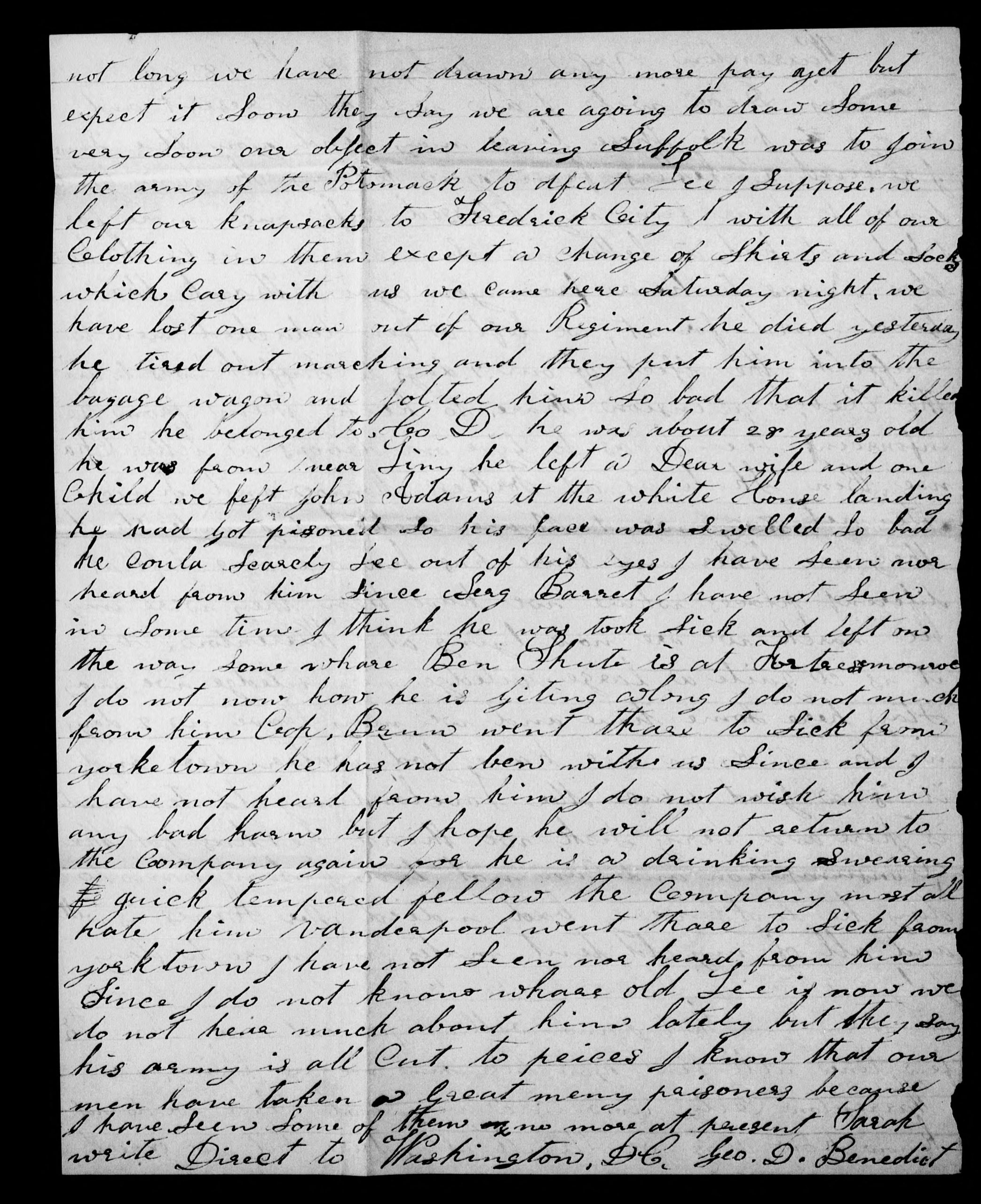
not long we have not drawn any more pay yet but expect it Soon they Say we are agoing to draw Some very Soon our object in leaving Suffolk was to join the army of the Potomack to defeat Lee I Suppose,
we left our knapsacks to Fredrick City with all of our Clothing in them except a change of Shirts and Socks which Cary with us we came here Saturday night,
we have lost one man out of our Regiment he died yesterday he tired out marching and they put him into the bagage wagon and jolted him So bad that it killed him he belonged to Co D he was about 28 years old he was from near Liny he left a Dear wife and one Child
we left John Adams at the white house landing he had got pisoned So his face was Swelled So bad he could Scarcly See out of his eyes I have Seen nor heard from him Since
Serg Barret I have not Seen in Some time I think he was took Sick and left on the way Some whare
Ben Shute is at Fortress monroe I do not now how he is giting along I do not much from him
Corp. Benn went thare to Sick from yorketown he has not ben with us Since and I have not heard from him I do not wish him any bad harm but I hope he will not return to the Company again for he is a drinking Swearing quick tempered fellow the Company most all hate him
Vanderpool went thare to Sick from yorktown I have not Seen nor heard from him Since
I do not know whare old Lee is now we do not hear much about him lately but they Say his army is all Cut to peices I know that our men have taken a Great meny prisoners because I have Seen Some of them
no more at present Sarah write Direct to Washington, D C
Geo. D. Benedict
The man in the baggage wagon. Benedict does not give his name. The regimental record does: one man of this regiment died at Warrenton, Virginia, and only one — Alonzo Hodge of Company D, on 29 July 1863. Company, place and date all match, and no other death in the regiment comes within a week of it.
The muster roll disposes of him in two words: “of disease.” Benedict says what actually happened. Hodge gave out on the march, was loaded into a baggage wagon, and the jolting of the wagon over Virginia roads killed him. He adds what no official record anywhere preserves — that the man left a wife and a child.
One conflict, stated plainly. Benedict puts him at “about 28 years old”; Bowen’s roster gives Hodge’s enlistment age as 18. Benedict was guessing at a man from another company whom he likely did not know, and enlistment ages in 1862 were often wrong in both directions. The identification rests on company, place and date, which are unique in the regiment. The age does not fit, and we say so rather than quietly dropping it.
The others named.John Adams was left at White House Landing, poisoned, his face so swollen he could barely see. Sergeant Barrett has not been seen in some time and Benedict supposes he fell sick on the march. Ben Shute is still at Fortress Monroe. Corporal Vanderpool of Angelica went sick from Yorktown and never rejoined — the roster confirms it, discharging him for disability on 19 January 1864.
One man left unnamed on purpose. Benedict also writes of a corporal he hopes never returns: “a drinking Swearing quick tempered fellow, the Company most all hate him.” The name is written “Corp. Benn” and stops there. The only Company G corporal whose surname begins that way is Simeon Bennett — but Benedict calls Bennett “a good boy” elsewhere and had written warmly of him on the previous sheet of this same letter. The reading is not secure enough to attach a judgement like this to any living man’s name, so it is recorded here and nowhere else.
31 July 1863, Warrenton — “it is Colonel Gibbses doings”
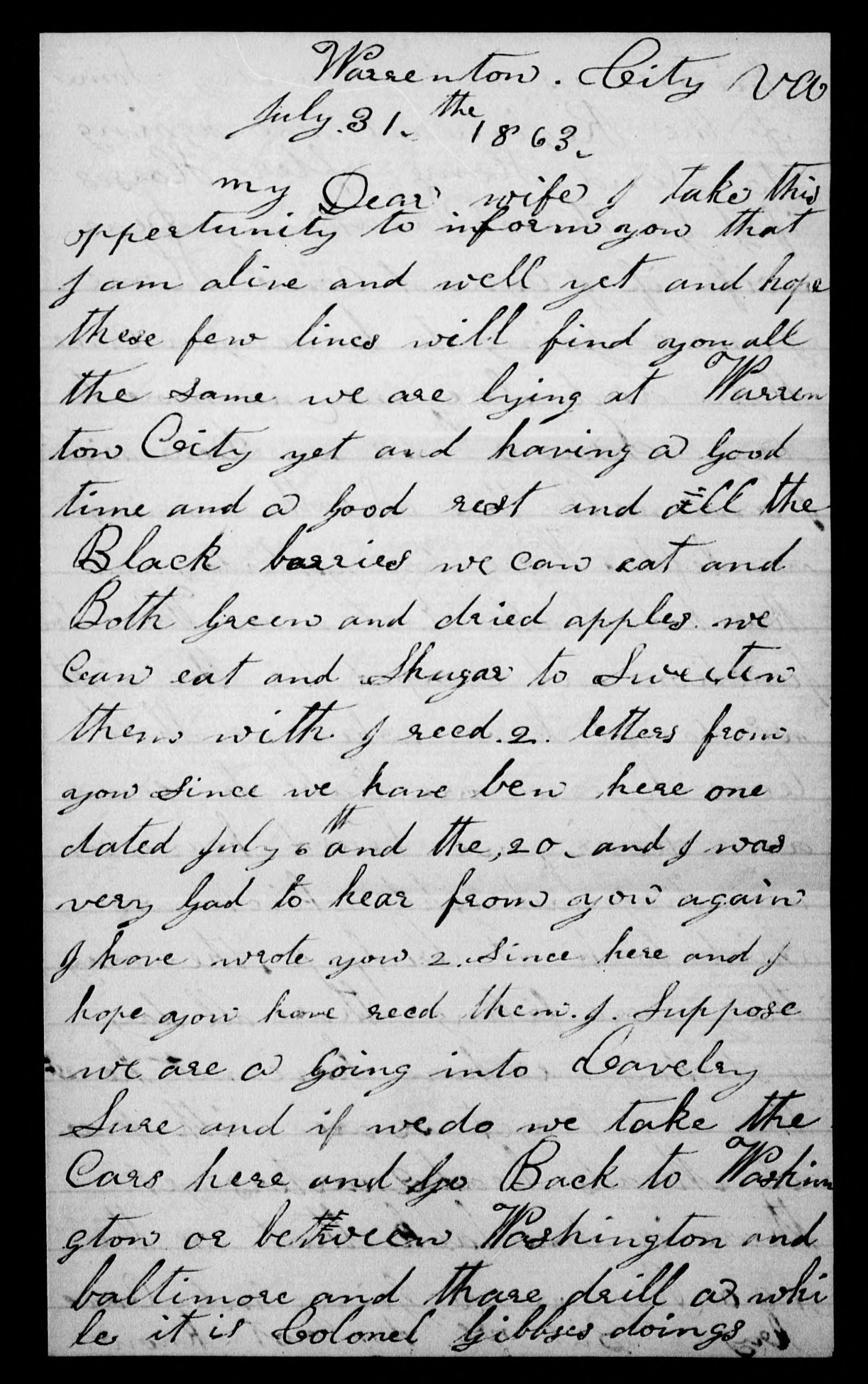
Warrenton City Va July 31st 1863
my Dear wife I take this oppertunity to inform you that I am alive and well yet and hope these few lines will find you all the Same
we are lying at Warrentow City yet and having a good time and a good rest and all the Black barries we can eat and Both green and dried apples we Can eat and Shugar to Sweeten them with
I recd 2 letters from you Since we have ben here one dated July 6th and the 20 and I was very gad to hear from you again I have wrote you 2 Since here and I hope you have recd them.
I Suppose we are a going into Cavelry Sure and if we do we take the Cars here and go Back to Washington or between Washington and baltimore and thare drill a while it is Colonel Gibbses doings
The last line is the important one. On 31 July 1863 a private in Company G tells his wife the regiment is going into the cavalry, names the destination, and names the man responsible: “it is Colonel Gibbses doings.”
This is corroboration from inside the ranks for what the official record shows on paper. The 130th New York Volunteers became the First New York Dragoons that August, and the War Department paperwork traces the change to Colonel Alfred Gibbs and his repeated applications — the story told in full at At His Solicitation: How the 130th New York Became the First Dragoons. What Benedict adds is that the men themselves knew whose doing it was, weeks before the order was issued, and said so in letters home.
The rest of the page is a rare few days of ease: rest at Warrenton, blackberries, green and dried apples, and sugar to sweeten them. Two letters from Sarah reached him here, dated 6 and 20 July. After the silence he complained of all through the Gettysburg marches, the mail had finally caught up.
The Regiment Turns Cavalry
August–December 1863 · 22 letters31 July and 2 August 1863 — sent home after horses
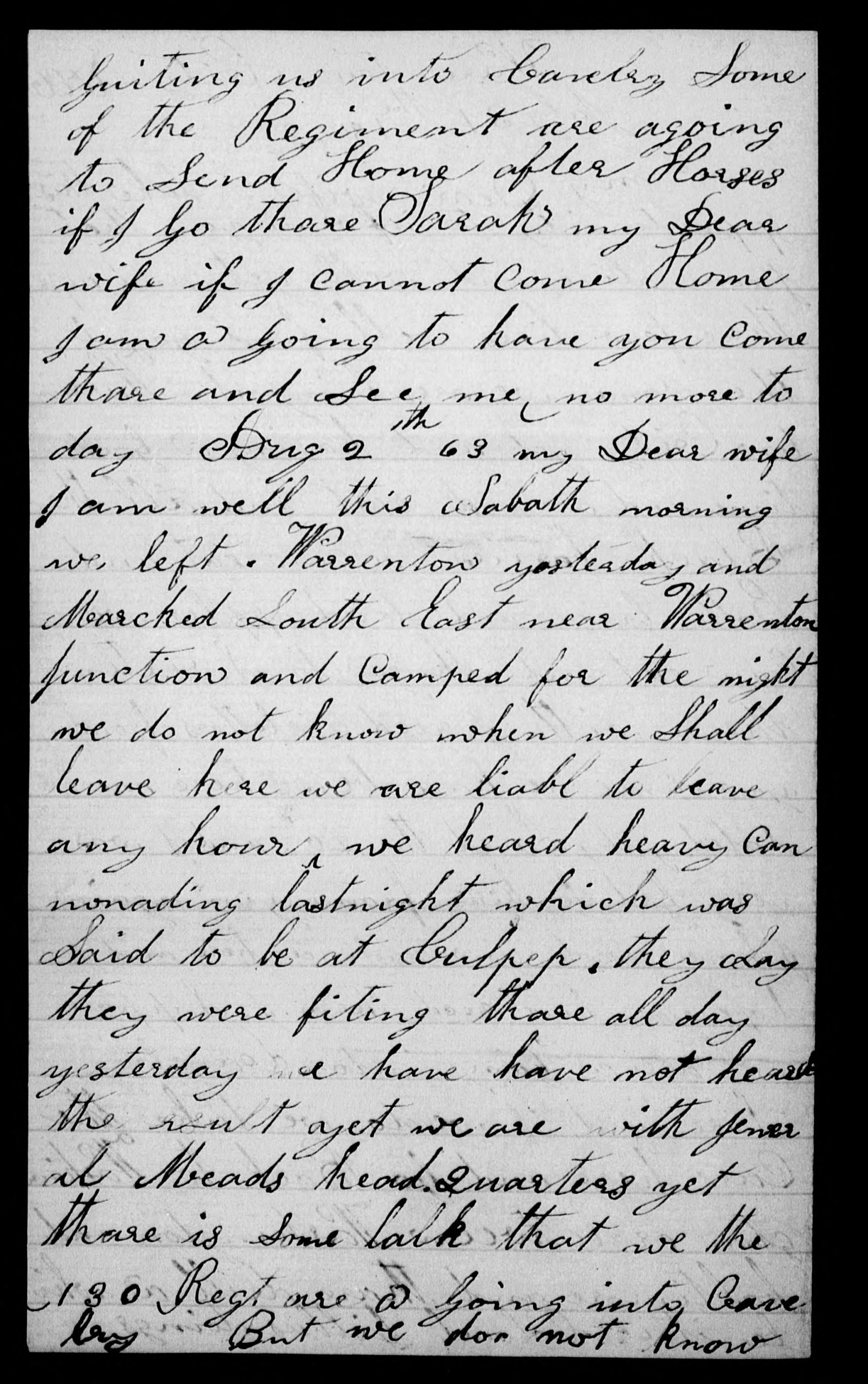
giting us into Cavelry Some of the Regiment are agoing to Send Home after Horses if I go thare Sarah my Dear wife if I cannot Come Home I am a going to have you Come thare and See me no more to day
Aug 2th 63 my Dear wife I am well this Sabath morning we left Warrenton yesterday and Marched South East near Warrenton Junction and Camped for the night we do not know when we Shall leave here we are liabl to leave any hour,
we heard heavy Cannonading last night which was Said to be at Culpep, they Say they were fiting thare all day yesterday we have not heard the reult yet
we are with General Meads head Quarters yet thare is Some talk that we the 130 Regt are a going into Cavelry But we do not know
The conversion is becoming concrete. Men of the regiment are being sent home to New York after horses — the practical business of turning infantry into cavalry — and Benedict is angling to be one of them. Then the line that stops you: “if I cannot Come Home I am a going to have you Come thare and See me.” He is trying to arrange for Sarah to travel to a remount depot to meet him. There is no evidence in these letters that it ever happened.
Two days later the regiment is at Warrenton Junction, liable to move at any hour, camped with General Meade’s headquarters. They can hear heavy cannonading toward Culpeper and have no idea what it means — a reminder of how little of a war a soldier in it actually sees.
And here the regiment names itself: “thare is Some talk that we the 130 Regt are a going into Cavelry But we do not know.” Two days earlier he had been certain and had credited Colonel Gibbs by name; now it is back to rumour. The order had still not come. The full story of the change is at At His Solicitation: How the 130th New York Became the First Dragoons.
2 August 1863, second sheet — “you get war news perhaps more Correct than we do”
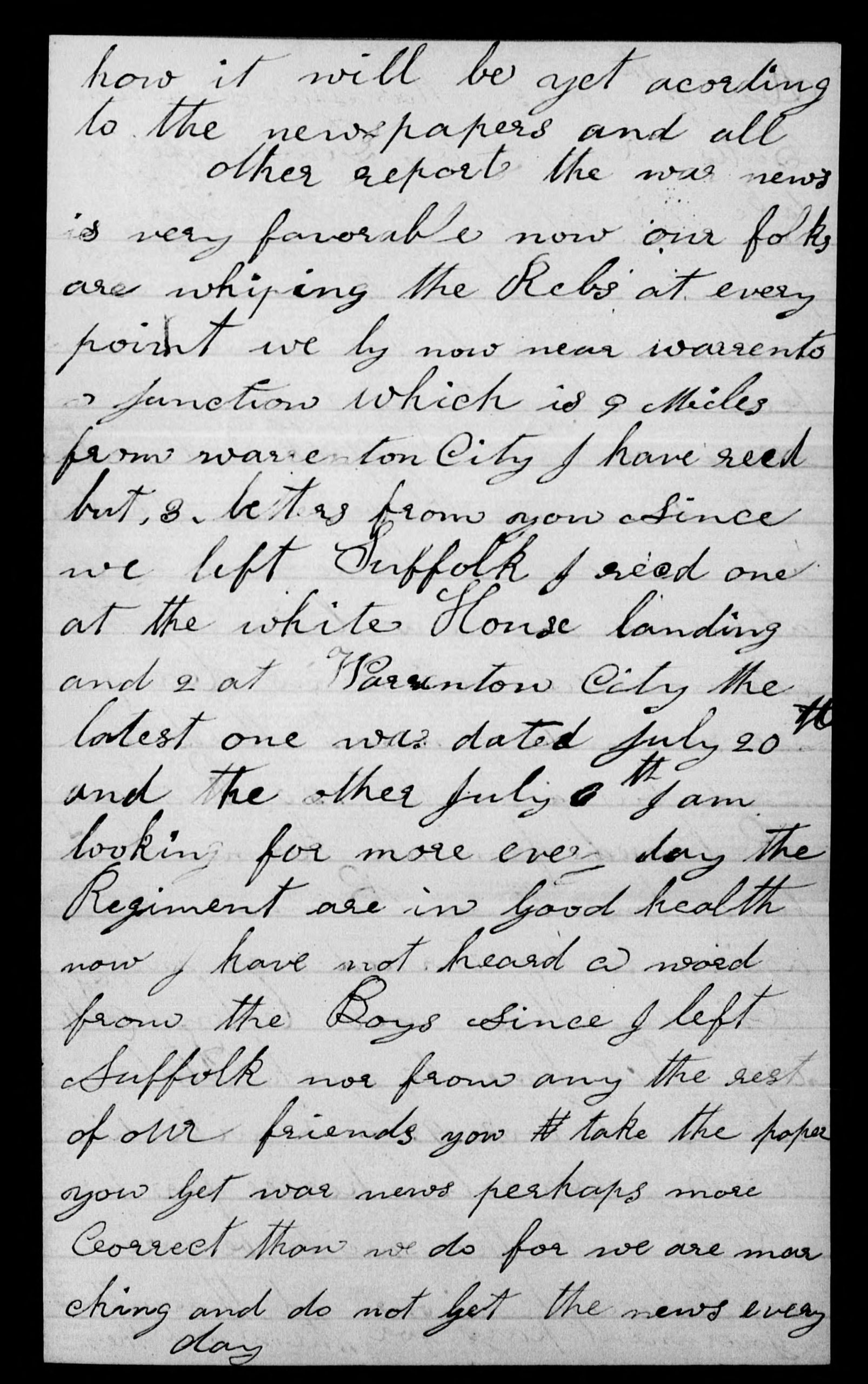
how it will be yet acording to the newspapers and all other report
the war news is very favorable now our folks are whiping the Rebs at every point
we ly now near Warrenton Junction which is 9 Miles from Warrenton City
I have recd but 3 letters from you Since we left Suffolk I recd one at the white House landing and 2 at Warrenton City the latest one was dated July 20th and the other July 6th I am looking for more ever day
the Regiment are in good health now I have not heard a word from the Boys Since I left Suffolk nor from any the rest of our friends
you take the paper you get war news perhaps more Correct than we do for we are marching and do not get the news every day
The most quotable line in the whole run of these letters is here, and it is a warning to anyone who uses soldiers’ correspondence as evidence: “you take the paper, you get war news perhaps more Correct than we do, for we are marching and do not get the news every day.” A man at the front telling his wife at home that she is better informed about the war than he is.
It explains a great deal about these letters. When Benedict reports that Lee’s army is “all Cut to peices” or that “our folks are whiping the Rebs at every point,” he is not reporting what he saw. He is repeating camp rumour and stale newspapers. What he witnesses directly — a man jolted to death in a baggage wagon, a tent mate dying of consumption, the twenty-hour march out of Frederick City — is exact. What he relays second hand should be read as what soldiers were being told, not as what happened.
He also keeps a careful ledger of Sarah’s letters: three since Suffolk, one at White House Landing and two at Warrenton, the latest dated 20 July and the other the 6th. He counts them because there are so few.
8 August 1863, Manassas Junction — Colonel Thorp goes home for horses
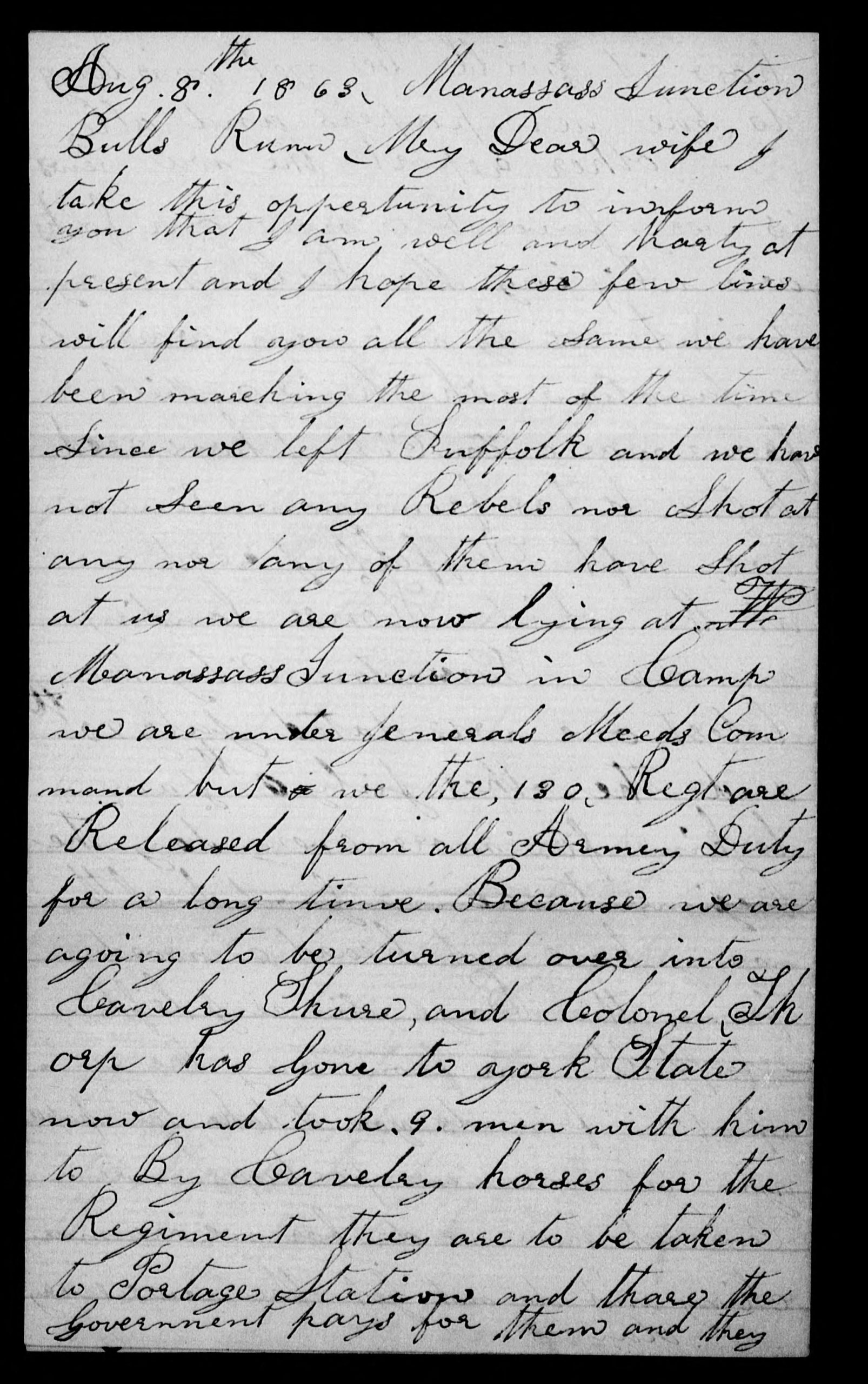
Aug 8th 1863 Manassass Junction Bulls Run
My Dear wife I take this oppertunity to inform you that I am well and harty at present and I hope these few lines will find you all the Same
we have been marching the most of the time Since we left Suffolk and we have not Seen any Rebels nor Shot at any nor any of them have Shot at us we are now lying at Manassass Junction in Camp
we are under Generals Meeds Command but we the 130 Regt are Released from all Army Duty for a long time Because we are agoing to be turned over into Cavelry Shure,
and Colonel Thorp has gone to York State now and took 9 men with him to By Cavelry horses for the Regiment they are to be taken to Portage Station and thare the Government pays for them and they
This page dates the conversion. On 8 August 1863 the regiment is camped on the old Bull Run battlefield, formally “Released from all Army Duty” under Meade, and the change everyone had been guessing at is settled: “we are agoing to be turned over into Cavelry Shure.” On 31 July Benedict credited Colonel Gibbs; on 2 August it was back to rumour; here it is fact.
And here is the machinery of it, in one sentence: Colonel Thomas J. Thorp has gone back to New York State with nine men to buy the regiment’s horses, to be delivered and paid for at Portage Station. That is a specific, dated, named account of how the First New York Dragoons got mounted, written by a private who watched it happen. The full story of the change is at At His Solicitation: How the 130th New York Became the First Dragoons.
Worth noting what he says about the campaign just past. Through all the marching since Suffolk — Gettysburg, the pursuit to the Potomac, Berlin, Warrenton — “we have not Seen any Rebels nor Shot at any nor any of them have Shot at us.” The regiment marched the length of the campaign without once coming into action.
8 August 1863, second sheet — twenty-six dollars, and two to the sutler
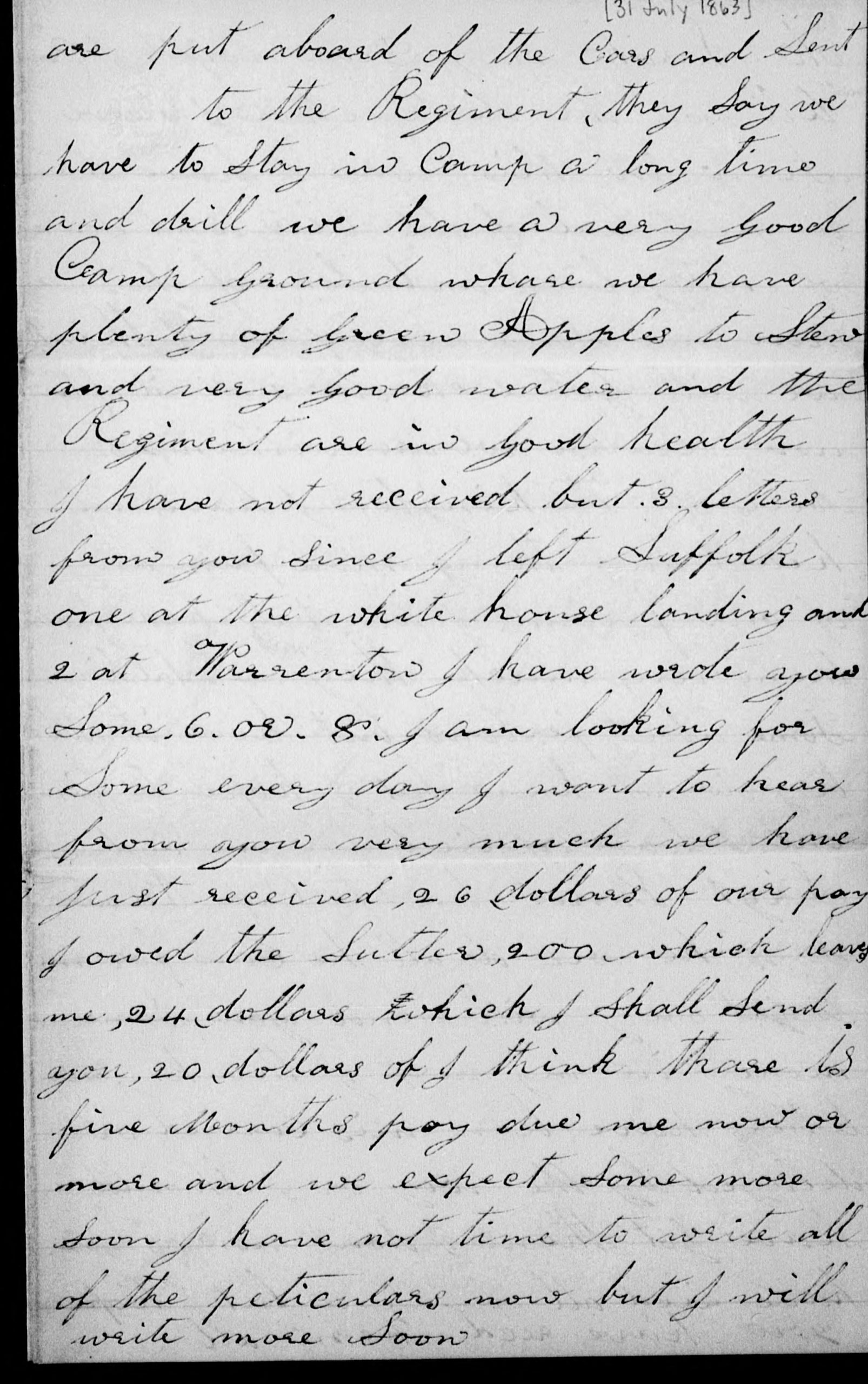
are put aboard of the Cars and Sent to the Regiment,
they Say we have to Stay in Camp a long time and drill we have a very good Camp ground whare we have plenty of green Apples to Stew and very good water and the Regiment are in good health
I have not received but 3 letters from you Since I left Suffolk one at the white house landing and 2 at Warrenton I have wrote you Some 6 or 8 I am looking for Some every day I want to hear from you very much
we have just received 26 dollars of our pay I owed the Sutler 2.00 which leavs me 24 dollars which I Shall Send you 20 dollars of I think thare is five Months pay due me now or more and we expect Some more Soon
I have not time to write all of the peticulars now but I will write more Soon
The first line finishes the sentence begun on the previous sheet: the horses Colonel Thorp went to New York to buy are “put aboard of the Cars and Sent to the Regiment.” Bought at home, delivered by rail to Virginia. The regiment will now sit in camp and drill.
A note on the date. Someone has pencilled [31 July 1863] at the head of this sheet in square brackets — a later archival dating, not Benedict’s. The content places it after the 8 August letter, not before it: it completes that letter’s unfinished sentence about the horses. We follow the text rather than the pencil, and note the discrepancy here so that anyone working from the original can weigh it.
Then a private’s household accounts, exact to the dollar. He drew $26 in pay, settled $2.00 with the sutler, and of the $24 left is sending $20 home to Sarah — keeping four dollars for himself. He reckons five months’ pay or more still owing. A private’s wage was thirteen dollars a month, so twenty-six dollars was two months, and the arrears he describes were real. Most of what he was paid went straight to Belvidere.
August 1863 — applying for a furlough
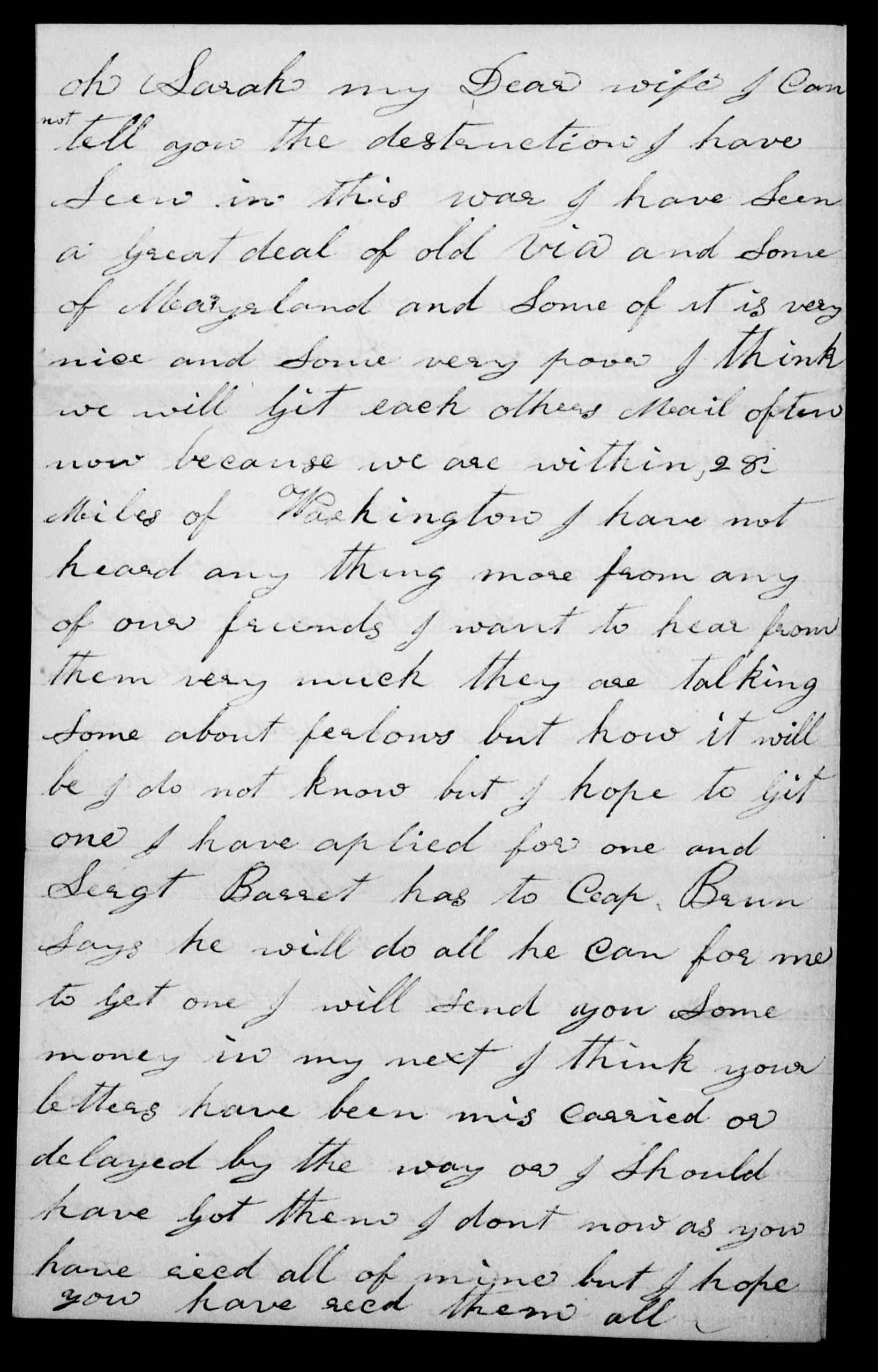
oh Sarah my Dear wife I Cannot tell you the destruction I have Seen in this war I have Seen a great deal of old Virginia and Some of Maryland and Some of it is very nice and Some very poor
I think we will git each others Mail often now because we are within 28 Miles of Washington I have not heard any thing more from any of our friends I want to hear from them very much
they are talking Some about ferlows but how it will be I do not know but I hope to git one I have aplied for one and Sergt Barret has to Ceap. Brun Says he will do all he Can for me to get one
I will Send you Some money in my next
I think your letters have been mis Carried or delayed by the way or I Should have got them I dont now as you have recd all of mine but I hope you have recd them all
Benedict has applied for a furlough and so has Sergeant Barrett, both through Captain Brundage, who “Says he will do all he Can for me to get one.” Read this beside the letter of 29 July, where Benedict hoped Brundage would never rejoin the company. Ten days later he is asking him for a favour and getting a decent answer. Both are on Brundage’s page.
The opening line is the closest he comes to writing about the war as a whole: “I Cannot tell you the destruction I have Seen in this war.” He does not elaborate. He turns immediately to how nice some of the country is and how poor the rest, and then to the mail.
9 August 1863, Manassas Junction — the captain returns, and a verdict on Ben Shute
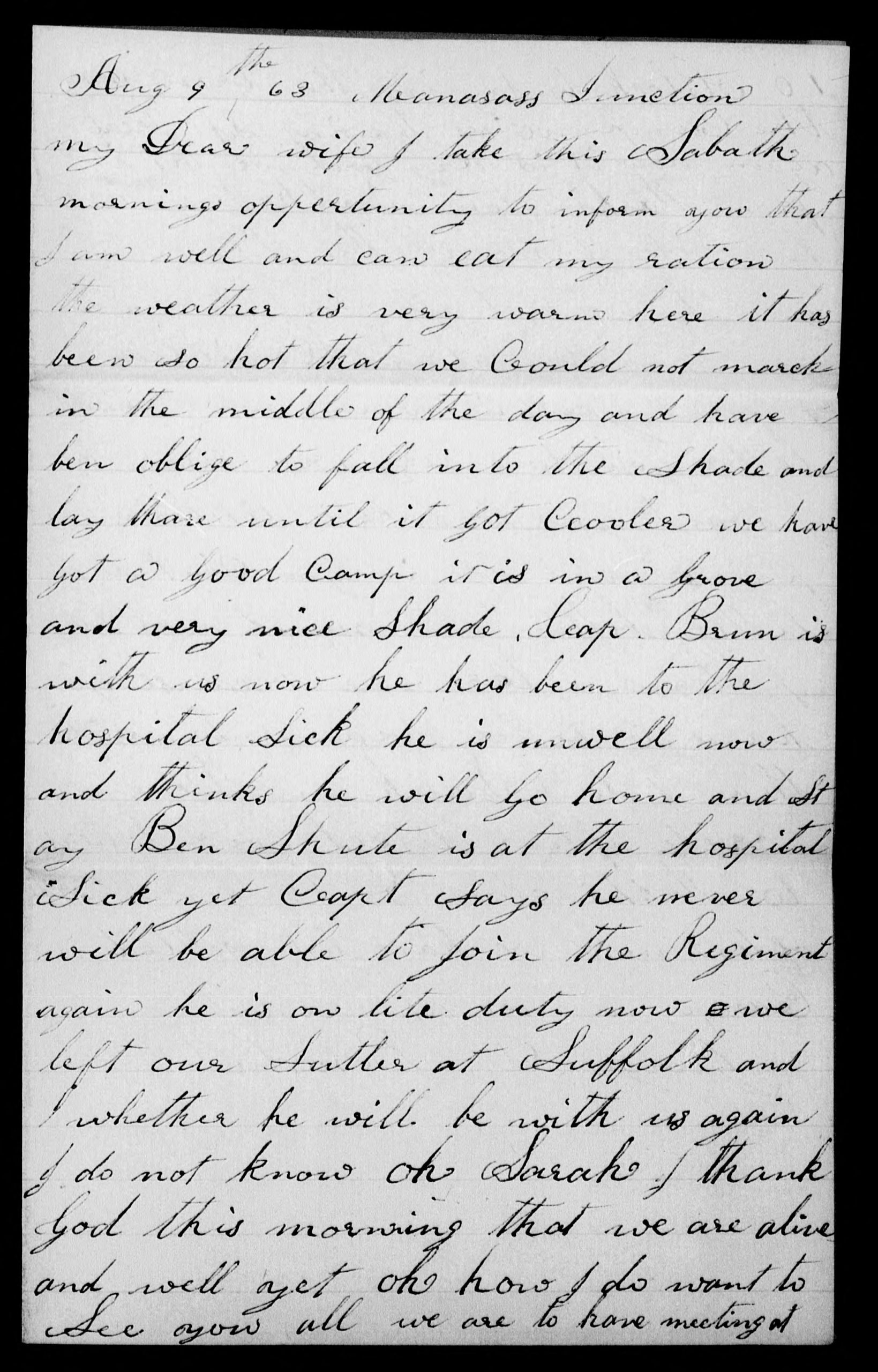
Aug 9th 63 Manasass Junction
my Dear wife I take this Sabath mornings oppertunity to inform you that I am well and can eat my ration
the weather is very warm here it has been So hot that we Could not march in the middle of the day and have ben oblige to fall into the Shade and lay thare until it got Cooler we have got a good Camp it is in a grove and very nice Shade,
Ceap. Brun is with us now he has been to the hospital Sick he is unwell now and thinks he will go home and Stay
Ben Shute is at the hospital Sick yet Ceapt Says he never will be able to join the Regiment again he is on lite duty now
we left our Sutler at Suffolk and whether he will be with us again I do not know
oh Sarah I thank God this morning that we are alive and well yet oh how I do want to See you all we are to have meeting at
Captain Brundage is back. He had been in hospital sick since Yorktown, is “unwell now,” and “thinks he will go home and Stay.” He was right: Brundage was discharged for disability that same month, ending his command of Company G.
And here is the company commander’s own verdict on Ben Shute, which the muster roll only implies: “Ceapt Says he never will be able to join the Regiment again he is on lite duty now.” Through May, June and July Benedict had passed on hopeful reports that Shute was mending. This is the moment the hope ends, and it comes from the captain. The record bears him out — Shute was transferred to the Veteran Reserve Corps on 3 November 1863 and never returned.
The heat is bad enough that the column cannot march at midday and falls out into the shade until it cools. And the sutler, to whom Benedict had paid two dollars a day earlier, was left behind at Suffolk.
Update note — 20 July 2026: a name corrected
The letter of 29 July 1863 above was first published here reading “Corp. Benn”, and the passage about a drinking, swearing officer was left unattributed because no such corporal could be identified. That reading was wrong. The letters of 8 and 9 August use the identical abbreviation in a context that names the man plainly — “Ceap. Brun”, Captain Charles L. Brundage, commander of Company G. Compared side by side the two words are the same. The passage has been attributed accordingly and now appears on Captain Brundage’s page together with the more favourable account Benedict wrote of him ten days later. The original error is recorded here rather than quietly removed.
9 August 1863, closing sheet — a letter to Arvillia
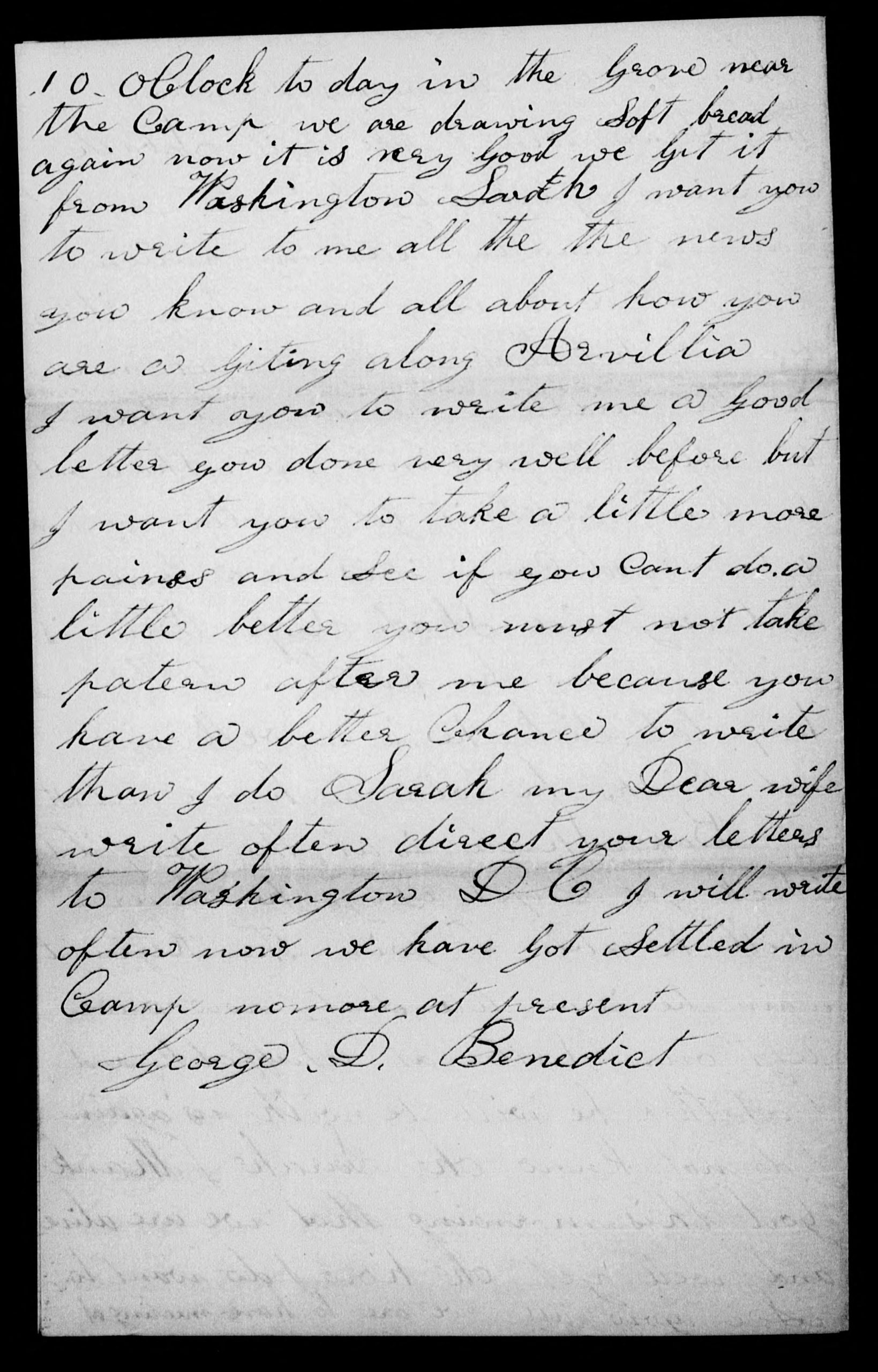
10 oClock to day in the grove near the Camp
we are drawing Soft bread again now it is very good we git it from Washington
Sarah I want you to write to me all the news you know and all about how you are a giting along
Arvillia I want you to write me a good letter you done very well before but I want you to take a little more pains and See if you Cant do a little better you must not take patern after me because you have a better Chance to write than I do
Sarah my Dear wife write often direct your letters to Washington D C I will write often now we have got Settled in Camp no more at present
George D. Benedict
He turns from his wife to his daughter and writes to her directly. She had sent him a letter and he is proud of it and not quite satisfied: she did very well, but she is to take a little more pains and see if she cannot do better. Then the line that gives the whole thing away — “you must not take patern after me because you have a better Chance to write than I do.” A man who spells by ear, telling his child not to learn her letters from his.
The name is settled here. This sheet gives the clearest writing of his daughter’s name in the whole collection: Arvillia. Earlier pages, in a more hurried hand, were read on this site first as “Amellia” and then as “Avillia” before being corrected. This page confirms the correction. If a descendant of the family knows the spelling that was used at home, we would be glad to hear it and will amend the pages accordingly.
Soft bread again, drawn from Washington, instead of hard tack. Settled in camp, he promises to write often now. He had nine months to live.
23 October 1863 — first blood as cavalry, and three men, now named
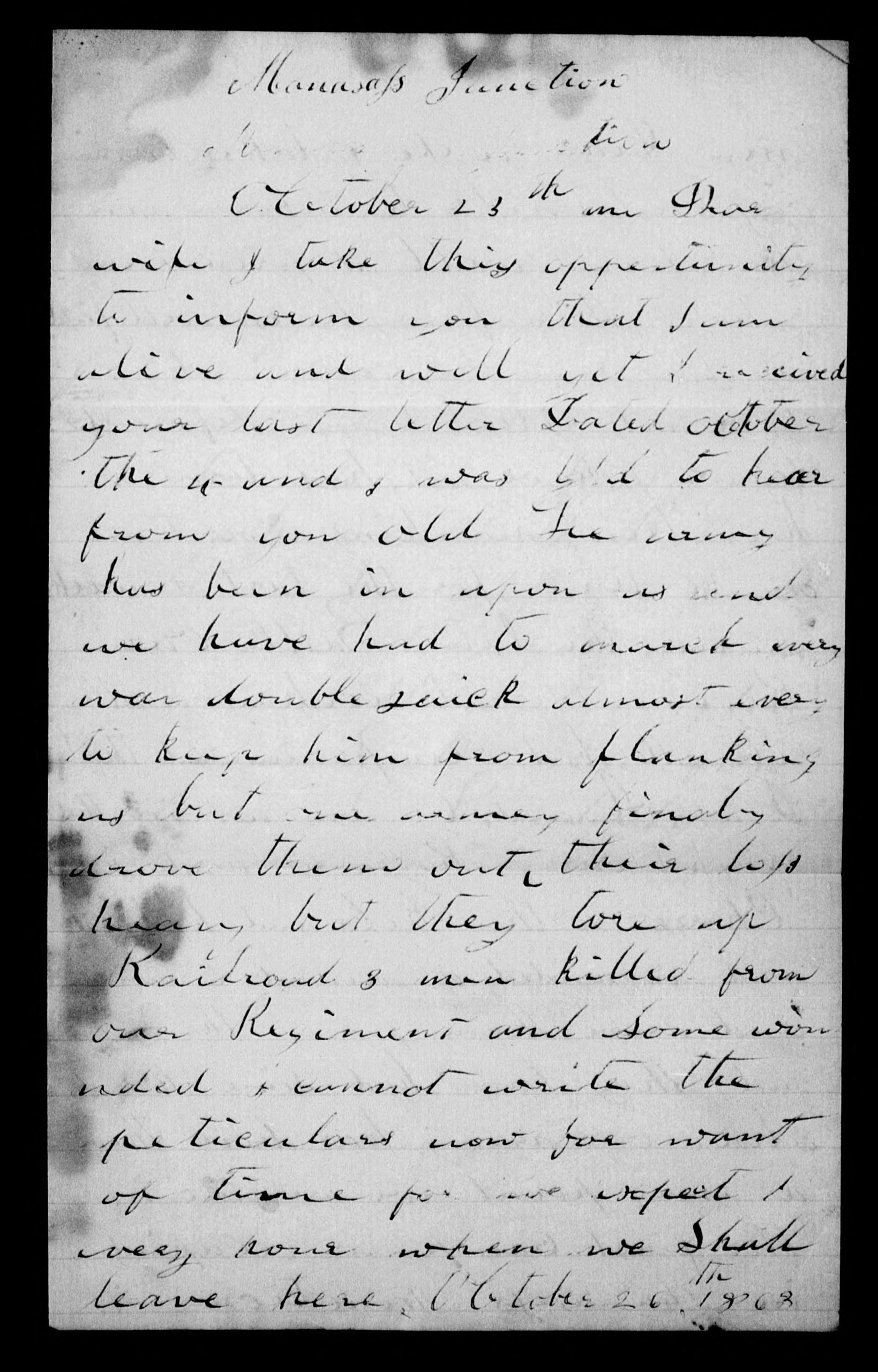
Manasass Junction October 23th
my Dear wife I take this oppertunity to inform you that I am alive and well yet I received your last letter dated October the 4 and I was glad to hear from you
old Lee army has been in upon us and we have had to march very war double quick almost every to keep him from flanking us but we finaly drove them out their loss heavy but they tore up Railroad
3 men killed from our Regiment and Some wounded I cannot write the peticulars now for want of time for we expect every hour when we Shall leave here
October 26th 1863
This is the regiment in action for the first time. Ten weeks earlier Benedict had written that through the whole Gettysburg campaign the regiment had never seen a Rebel nor been shot at. Now, newly mounted, it is marching at the double to keep Lee from flanking it, and it has dead.
The 1865 regimental history — compiled at muster-out and certified by Colonel Thorp — describes the same days from the other end of the telescope. The Reserve Cavalry Brigade took the lead, Colonel Alfred Gibbs commanding, his own regiment having the advance of the brigade. Crossing Bull Run on the night of 17 October it met the enemy’s cavalry on the Plains of Manassas, sheltered behind earthworks Beauregard had thrown up in 1861, charged them, drove them to Bristoe Station and saved four miles of the Orange and Alexandria Railroad from destruction.
The printed history gives the charge and the four miles of saved track. Benedict gives what it cost: “3 men killed from our Regiment and Some wounded.” He is writing in haste, expecting to move within the hour, and cannot stop for the particulars.
We cannot name them, and that is worth stating plainly. The regimental roster printed in Bowen’s history records no death, wound or casualty anywhere in the regiment dated October 1863 — not one entry in more than fifteen hundred mentions that month at all. Three men of this regiment were killed and their names are not in the book that is supposed to hold them. Until they can be identified from other records they are named here only as Benedict named them. If a descendant or researcher can supply a name, we will build them each a page.
Update, 2 November 2026: the three men are named. This page first said that Benedict’s three dead could not be named, and that statement is kept above as it was published. They can be named. They are Private Edwin Wight of Company F, eighteen at enlistment, from Centreville, N.Y.; Corporal Thomas Pendergast of Company F, from Hume; and Private Charles Wolf of Company C, from Java. Their entries were in Bowen’s roster all along, each with the full date: “killed, Oct. 17, 1863, at Manassas Junction, Va.” (Wight, p. 455; Pendergast, p. 417) and “killed in action, Oct. 17, 1863, at Manassas Junction, Va.” (Wolf, p. 458). [Correction, 20 November 2026: this note first said that Bowen’s printed lines leave off the year, so that a search for October 1863 could not find them. They do not leave it off; the scans of pp. 417, 455 and 458 print 1863. The yearless wording came from this site’s Killed in Action list, which drops the year from every date.] The New York Adjutant General’s register, reproduced on this site’s full roster, gives each of them the year 1863. The army’s own count agrees: General Wesley Merritt’s list of casualties in the Reserve Brigade “during the engagement at Bull Run, October 17, 1863” shows the First New York Dragoons with three enlisted men killed, one officer and two men wounded, and one missing (Official Records, Ser. I, Vol. 29, Pt. 1, p. 354). Pendergast’s father later swore that his son “was killed at the battle of Manassas Junction the 17th day of October 1863.” Each already has a page on this site. The heading of this letter has been changed from “three men we cannot name” to “three men, now named.”
26 October 1863 — the particulars, and why they must be weighed
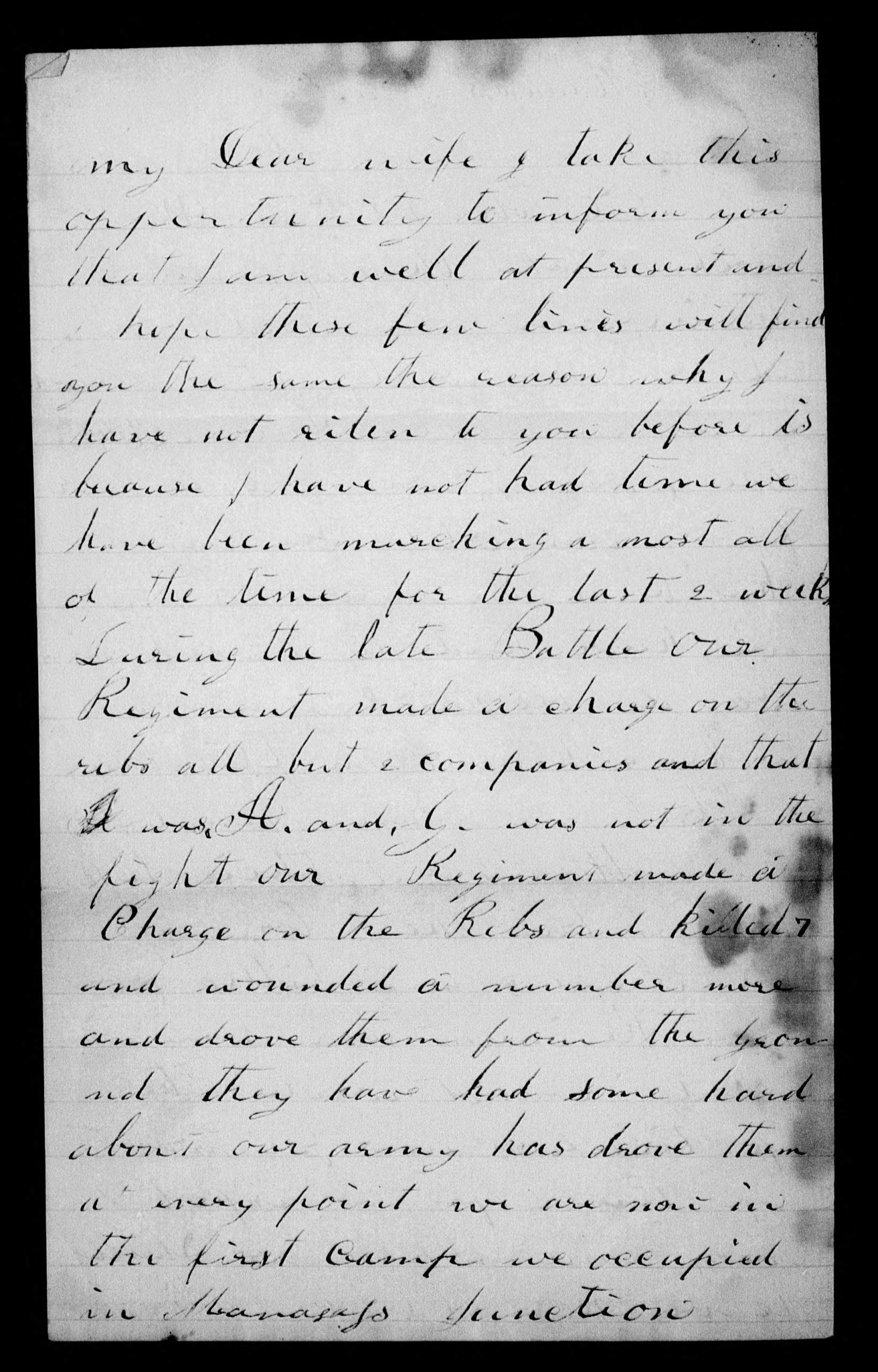
my Dear wife I take this oppertunity to inform you that I am well at present and I hope these few lines will find you the same
the reason why I have not riten to you before is because I have not had time we have been marching a most all of the time for the last 2 weeks
During the late Battle our Regiment made a charge on the rebs all but 2 companies and that was A and G was not in the fight
our Regiment made a Charge on the Rebs and killed 7 and wounded a number more and drove them from the ground they have had some hard about our army has drove them at every point
we are now in the first Camp we occupied in Manasass Junction
Three days on, he has the particulars he had no time for. The regiment charged, “killed 7 and wounded a number more and drove them from the ground” — that is the enemy’s loss, not the regiment’s. Set beside the printed account of the same action, in which the Reserve Brigade under Colonel Gibbs drove Confederate cavalry off the Plains of Manassas and saved four miles of railroad, the two agree.
But this page changes how the last one should be read.“Our Regiment made a charge on the rebs all but 2 companies, and that was A and G — was not in the fight.”Company G was Benedict’s own. He was not in the charge. Everything he reports of it, including the three men killed he wrote of on 23 October, reached him from other men in camp.
That does not make it false. It makes it testimony at one remove, and he told us himself how to treat that: “you take the paper, you get war news perhaps more Correct than we do.” His own regiment’s losses were the kind of news that travelled accurately round a camp. But the reader is entitled to know he did not see it, and now does.
Two companies held out of the charge is itself worth recording. It is the sort of detail no regimental history bothers with, and it means that for the men of A and G the regiment’s first cavalry action was something they watched.
26 October 1863, closing sheet — “I have Seen the Battle field”
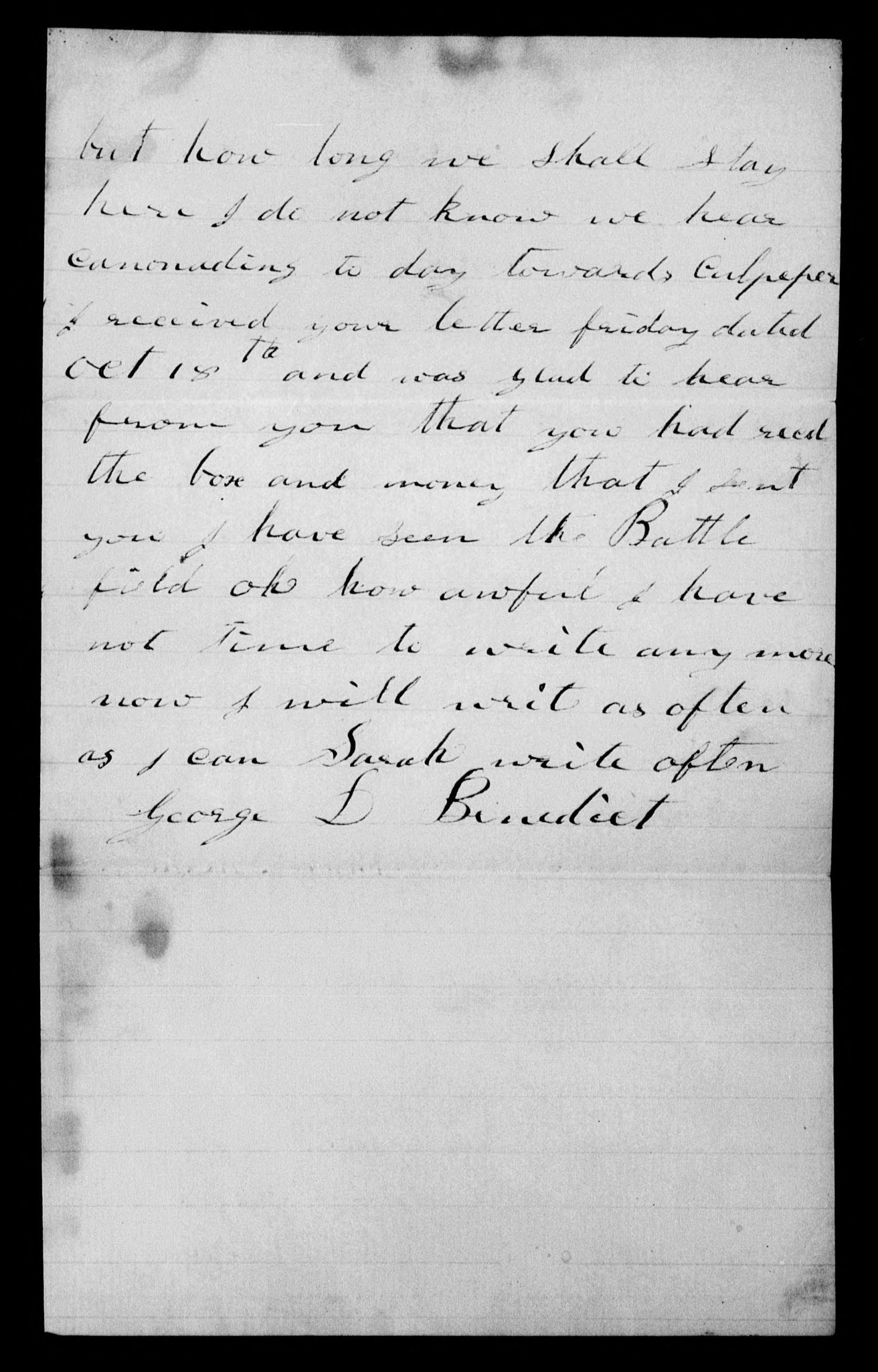
but how long we Shall Stay here I do not know we hear Canonading to day towards Culpeper
I received your letter friday dated Oct 18th and was glad to hear from you that you had recd the box and money that I sent you
I have Seen the Battle field oh how awful
I have not Time to write any more now I will writ as often as I can Sarah write often
George D. Benedict
Five words, and then he stops: “I have Seen the Battle field oh how awful.” His company was held out of the charge, but he walked the ground afterwards. In eighty pages of these letters it is the only time he tries to say what the war looked like, and he does not finish the thought. He says he has not time, and signs his name.
The domestic news in the same breath is what makes it land. Sarah has received the box and the money he sent — the twenty dollars out of twenty-four, from the pay drawn in August. A man confirms his wife got the money, records that he has seen a battlefield, and rides on.
13 November 1863, Culpeper — under orders at a moment’s warning
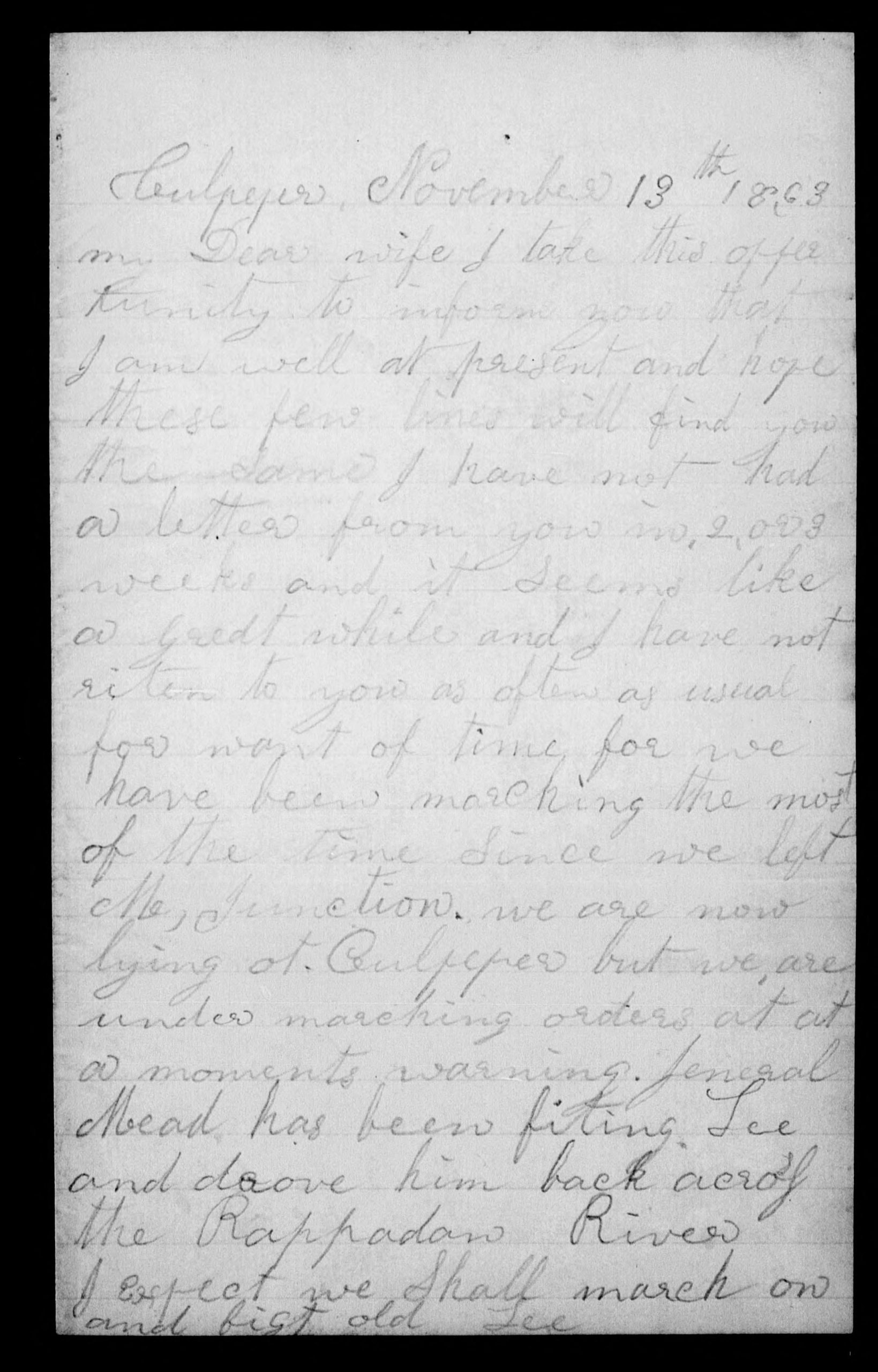
Culpeper November 13th 1863
my Dear wife I take this offertunity to inform you that I am well at present and hope these few lines will find you the Same
I have not had a letter from you in 2 or 3 weeks and it Seems like a great while and I have not riten to you as often as usual for want of time for we have been marching the most of the time Since we left M Junction
we are now lying at Culpeper but we are under marching orders at a moments warning
General Mead has been fiting Lee and drove him back acrofs the Rappadan River I expect we Shall march on and fight old Lee
Three weeks of marching since Manassas Junction, and the regiment is at Culpeper under orders to move at a moment’s warning. Meade has driven Lee back across the Rapidan — the close of the Bristoe campaign — and Benedict expects to march on and “fight old Lee.”
The complaint that opens the letter is the one that never leaves it: no word from Sarah in two or three weeks, “and it Seems like a great while.” He apologises for his own silence in the same sentence and blames the marching, as he always does.
November 1863 — written in pencil, for want of ink
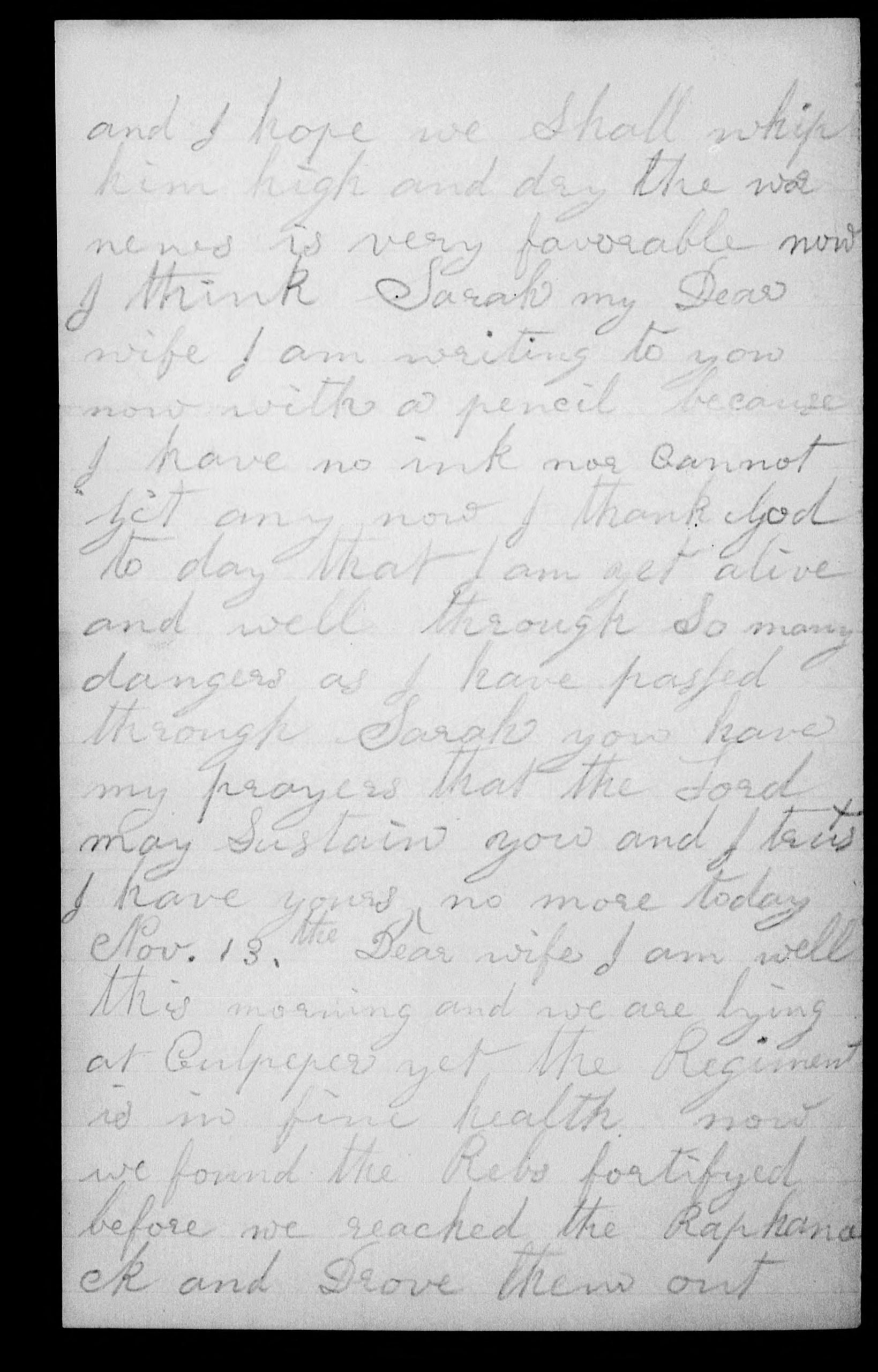
and I hope we Shall whip him high and dry the war news is very favorable now I think
Sarah my Dear wife I am writing to you now with a pencil because I have no ink nor Cannot git any
now I thank God to day that I am yet alive and well through So many dangers as I have pased through Sarah you have my prayers that the Lord may Sustain you and I trust I have yours no more today
Nov 13th Dear wife I am well this morning and we are lying at Culpeper yet the Regiment is in fine health now
we found the Rebs fortifyed before we reached the Raphanack and Drove them out
The faintness of these autumn leaves is explained here in his own words: “I am writing to you now with a pencil because I have no ink nor Cannot git any.” The pencil has survived a hundred and sixty years better than it deserved, but it is why these pages had to be read from darkened scans rather than the plain image.
Then the thanksgiving of a man who has just walked a battlefield: “I thank God to day that I am yet alive and well through So many dangers as I have pased through.” And the exchange he assumes without asking — “Sarah you have my prayers that the Lord may Sustain you, and I trust I have yours.”
13 November 1863 — the sutlers, the cold, and four men accounted for
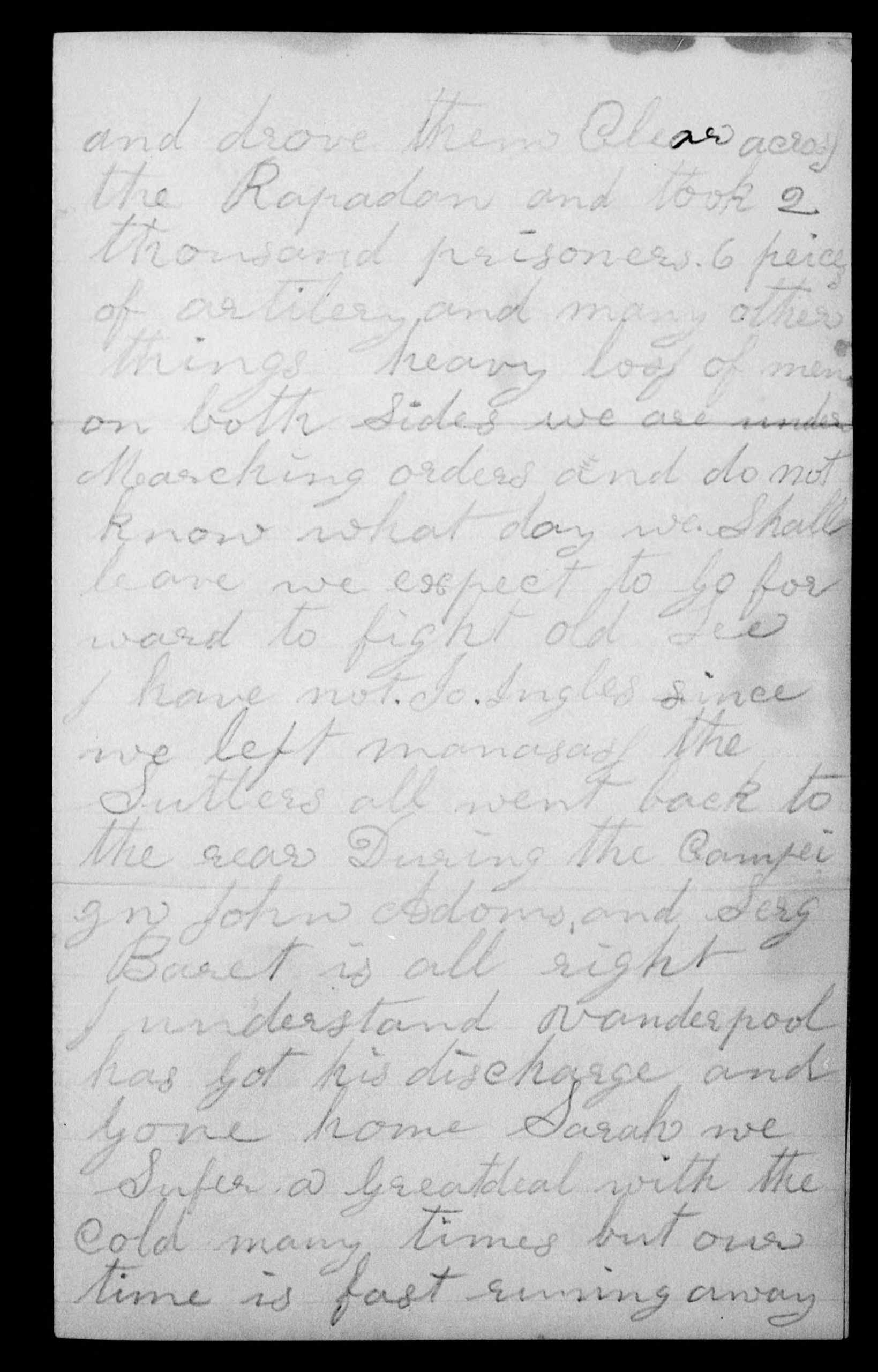
and drove them Clear across the Rapadan and took 2 thousand prisoners 6 pieces of artilery and many other things heavy loss of men on both Sides
we are Marching orders and do not know what day we Shall leave we expect to go forward to fight old Lee
I have not So Ingles Since we left Manasas the Sutlers all went back to the rear During the Campeign
John Adams and Serg Baret is all right
I understand Vanderpool has got his discharge and gone home
Sarah we Sufer a greatdeal with the Cold many times but our time is fast runing away
He gives the Rappahannock Station result as two thousand prisoners and six guns. The regiment’s own printed history, compiled at muster-out, says a thousand. Benedict is again passing on what camp was saying, and again it runs high — exactly as he warned Sarah it would.
Four men are accounted for. John Adams and Sergeant Barrett are “all right” — both had gone missing from Benedict’s view in July, Adams left behind poisoned at White House Landing and Barrett fallen sick somewhere on the march. Here they are, four months later, safe.
And Corporal Vanderpool has “got his discharge and gone home.” Note the date. Benedict writes this on 13 November 1863; the muster roll dates Vanderpool’s discharge for disability to 19 January 1864, two months later. Benedict prefaces it with “I understand,” so this may be camp report running ahead of fact — or the roster may be recording the date the paperwork was completed rather than the day the man went home. Both are set down here without choosing between them.
The fourth name, “Jo Ingles,” cannot be matched to this regiment’s rolls. The nearest surname is Joseph Englert of Company K, which is not close enough to assert across companies, so he is left unidentified rather than forced.
November is closing in: “we Sufer a greatdeal with the Cold many times, but our time is fast runing away.” He means the enlistment. He had six months.
November 1863, closing sheet — “Your Husband”
the Good Lord Bless you and me to no more at Present
Your Husband Geo. Benedict
The remainder of the sheet is blank.
Three lines in pencil, and a signature he almost never uses. Through eighty-odd pages he signs himself George D. Benedict or Geo. D. Benedict — his full name, the way a man signs a document. Here, at the end of a letter written after the first fighting the regiment had seen, he signs “Your Husband, Geo. Benedict.”
The blessing he asks is careful and characteristic: not for himself, not for her, but “the Good Lord Bless you and me to.”
18 and 21 November 1863, Culpeper — near the Rapidan
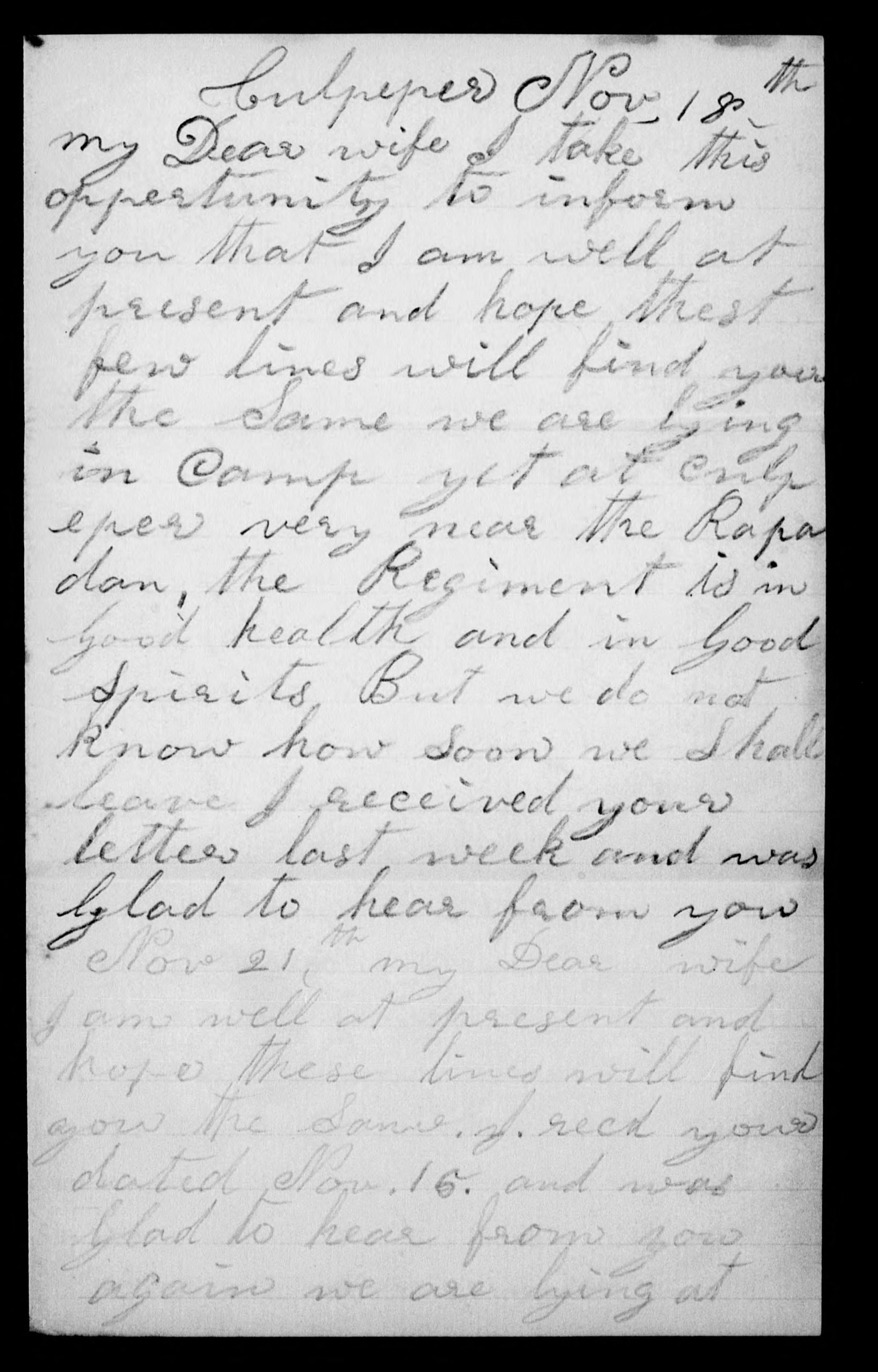
Culpeper Nov 18th
my Dear wife I take this oppertunity to inform you that I am well at present and hope these few lines will find you the Same
we are lying in Camp yet at Culpeper very near the Rapadan, the Regiment is in good health and in good Spirits But we do not know how Soon we Shall leave
I received your letter last week and was glad to hear from you
Nov 21th my Dear wife I am well at present and hope these lines will find you the Same I recd your dated Nov 16 and was glad to hear from you again we are lying at
Two letters begun on one sheet, three days apart. The regiment is still in camp at Culpeper, very near the Rapidan, “in good health and in good Spirits, But we do not know how Soon we Shall leave.” That sentence, in one form or another, appears in almost every letter he wrote.
The mail has finally steadied. After the autumn of silences he receives one letter last week and another dated 16 November, and says both times that he was glad. The army was in winter quarters and the letters could find it.
November 1863 — “we are in Beauford division”
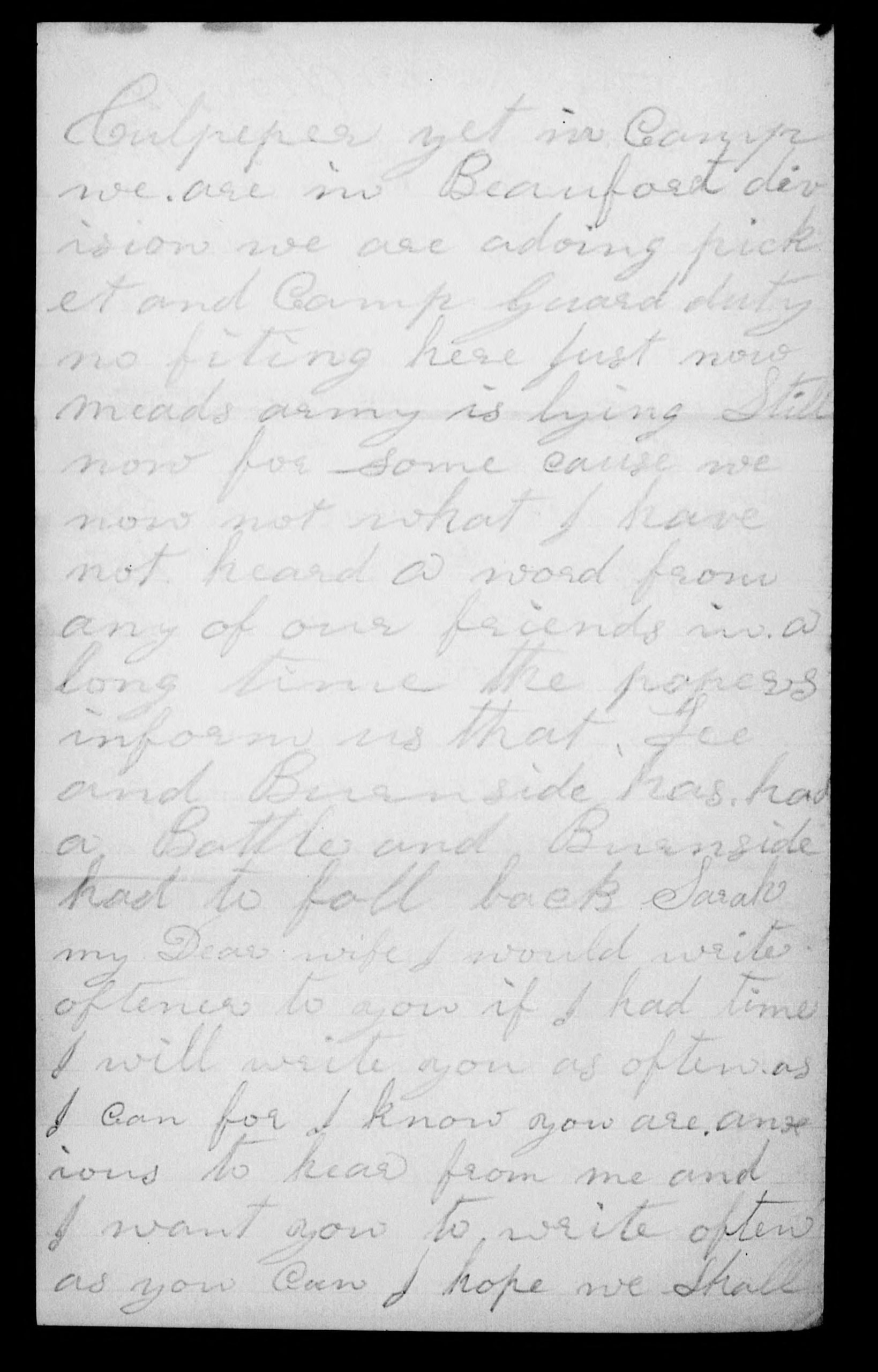
Culpeper yet in Camp we are in Beauford division we are adoing picket and Camp guard duty no fiting here just now
Meads army is lying Still now for Some cause we now not what
I have not heard a word from any of our friends in a long time
the papers inform us that Lee and Burnside has had a Battle and Burnside had to fall back
Sarah my Dear wife I would write oftener to you if I had time I will write you as often as I Can for I know you are anxious to hear from me and I want you to write often as you Can I hope we Shall
Benedict names his division commander, and the name is Buford — John Buford, who had opened the fight at Gettysburg five months earlier. The regiment is doing picket and camp guard under him, “no fiting here just now.” Buford had less than a month to live; he died of typhoid at Washington on 16 December 1863.
The war news comes from newspapers again, and again it is about somewhere else: Burnside beaten back by Longstreet in East Tennessee. Meade’s army lies still “for Some cause we now not what.”
November 1863 — two frying pans out of one canteen
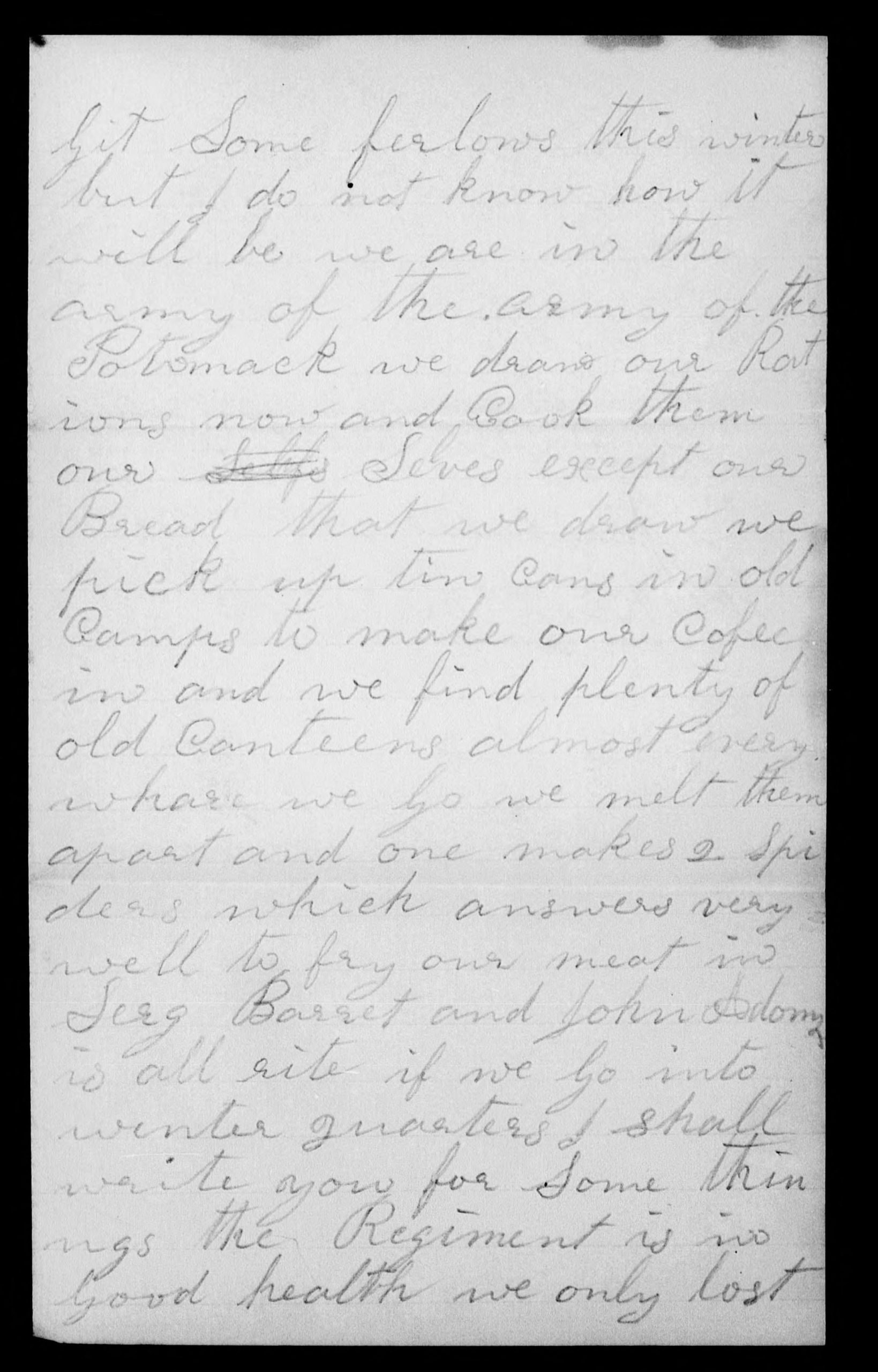
git Some ferlows this winter but I do not know how it will be we are in the army of the Potomack
we draw our Rations now and Cook them our Selves except our Bread that we draw we pick up tin Cans in old Camps to make our Cofee in and we find plenty of old Canteens almost every whare we go we melt them apart and one makes 2 Spiders which answers very well to fry our meat in
Serg Barret and John Adams is all rite
if we go into winter quarters I Shall write you for Some things
the Regiment is in good health we only lost
This is the best page in the collection for how these men actually lived. Rations are drawn raw and cooked by the men themselves. For want of utensils they “pick up tin Cans in old Camps to make our Cofee in,” and they find discarded canteens everywhere they go: “we melt them apart and one makes 2 Spiders which answers very well to fry our meat in.”
A canteen of the period was two shallow tin dishes soldered rim to rim. Held to a fire, the solder runs and it falls into halves — two ready-made pans. A “spider” was the common name for a frying pan. Nothing in a quartermaster’s return records this. It is the kind of knowledge that passed from man to man and would have vanished entirely if one of them had not explained it to his wife.
The camps they scavenge are the debris of two years of armies crossing the same ground. And again the roll of neighbours: Sergeant Barrett and John Adams are all right.
21 November 1863, closing sheet — the three dead, confirmed a second time
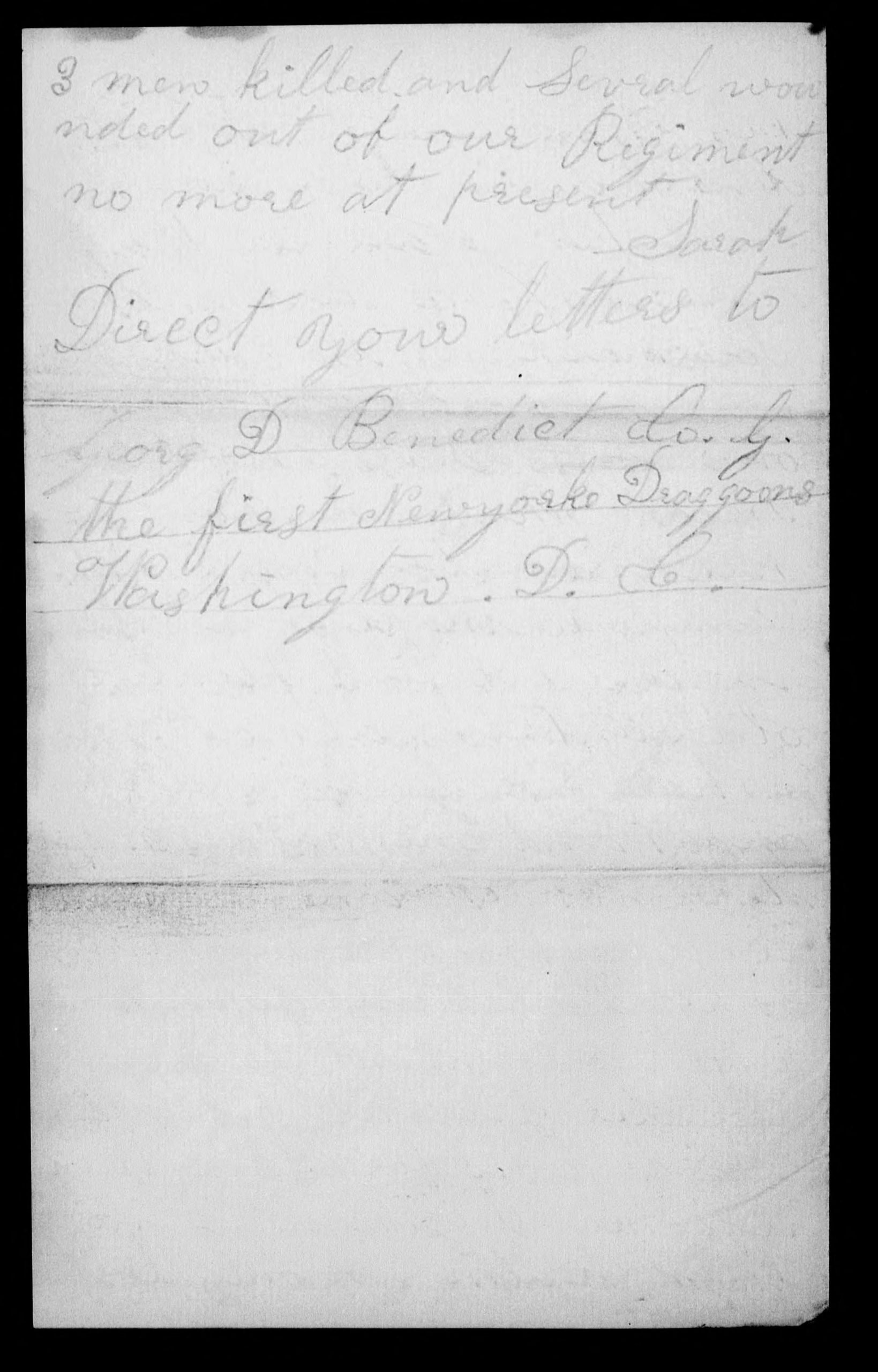
3 men killed and Sevral wounded out of our Regiment no more at present
Sarah Direct your letters to
Georg D Benedict Co. G the first Newyorke Draggoons Washington D. C.
He says it again. On 23 October, writing in haste, Benedict reported “3 men killed from our Regiment and Some wounded.” A month later, unhurried, in winter camp, closing a long letter, he sets down the same figure: “3 men killed and Sevral wounded out of our Regiment.”
Two independent statements a month apart, from a man whose own company was held out of the charge but who lived among the men who made it. The regimental roster printed in Bowen’s history still records no death, wound or casualty anywhere in the regiment dated October 1863 — not one entry among more than fifteen hundred. Three men of the First New York Dragoons were killed in the regiment’s first action as cavalry and their names are not in the book that is supposed to hold them. If anyone can supply a name, we will build each of them a page.
Update, 2 November 2026. The three men Benedict counted are now named: Private Edwin Wight of Company F, eighteen at enlistment, from Centreville, N.Y.; Corporal Thomas Pendergast of Company F, from Hume; and Private Charles Wolf of Company C, from Java. See the update under his letter of 23 October above for how they were found.
He closes with the address Sarah was to write to: Georg D Benedict, Co. G, the first Newyorke Draggoons, Washington D. C. He spells his own regiment two ways in three words, and it is the only place in these letters where he writes its name out in full.
13 December 1863 — picket in sight of the Rebel camp fires
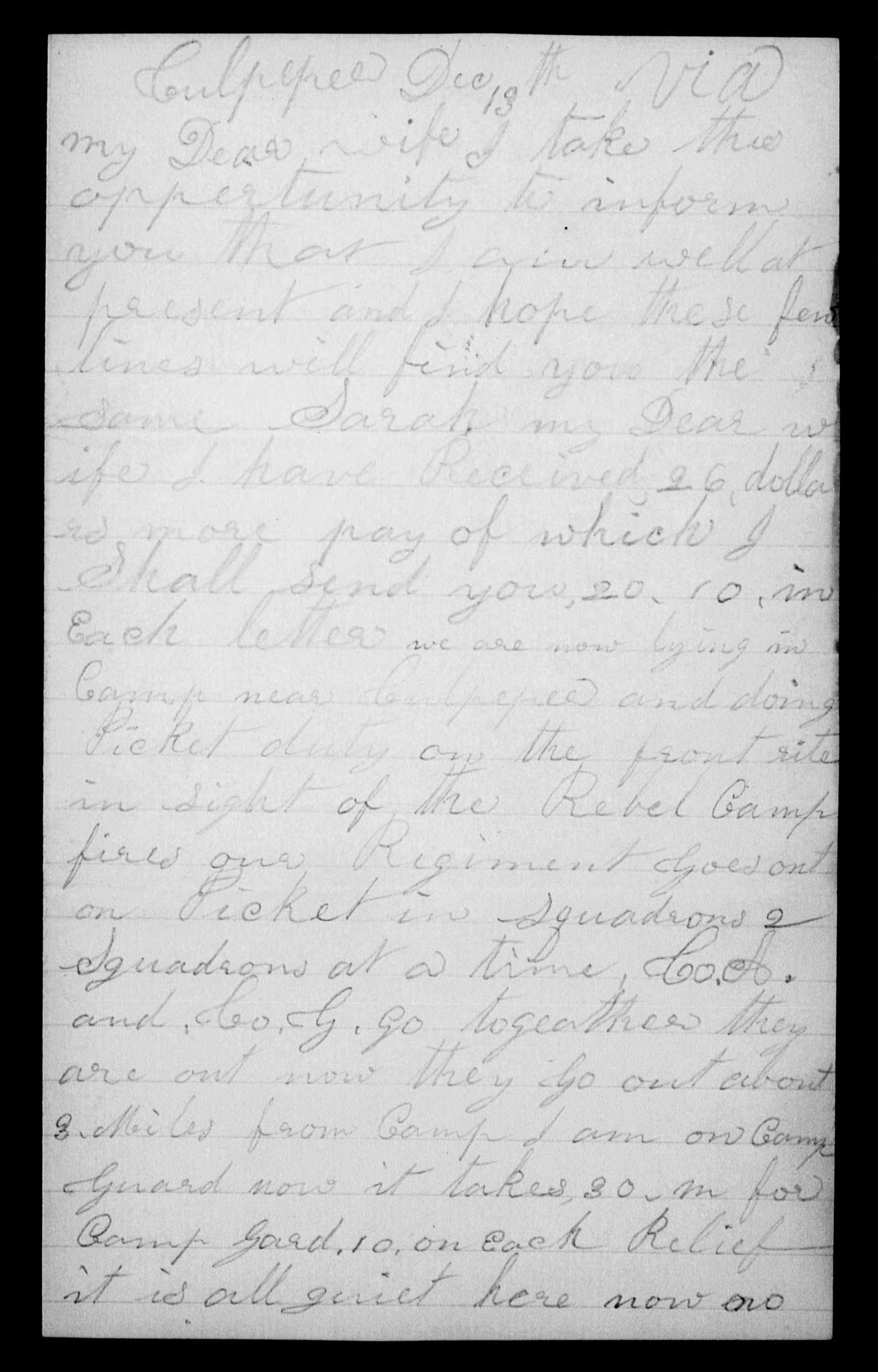
Culpeper Dec 13th Va
my Dear wife I take this oppertunity to inform you that I am well at present and I hope these few lines will find you the Same
Sarah my Dear wife I have Received 26 dollars more pay of which I Shall Send you 20, 10 in Each letter
we are now lying in Camp near Culpeper and doing Picket duty on the front rite in sight of the Rebel Camp fires
our Regiment goes out on Picket in Squadrons 2 Squadrons at a time, Co. A and Co. G go togeather they are out now they go out about 3 Miles from Camp
I am on Camp Guard now it takes 30 m for Camp gard, 10 on Each Relief
it is all quiet here now no
The regiment pickets the front “rite in sight of the Rebel Camp fires,” three miles out from camp, two squadrons at a time. Companies A and G go together — the same pairing that saw both companies held out of the October charge. Camp guard takes thirty men, ten to a relief. This is the granular working detail of a cavalry regiment in winter that no history records.
Another twenty-six dollars of pay, and another twenty going home — but this time “10 in Each letter.” He splits it across two envelopes rather than risk the whole sum to one. Currency travelled in the post at the sender’s risk, and a man on thirteen dollars a month did not gamble a fortnight’s pay on the mail.
14 December 1863 — what to put in the box
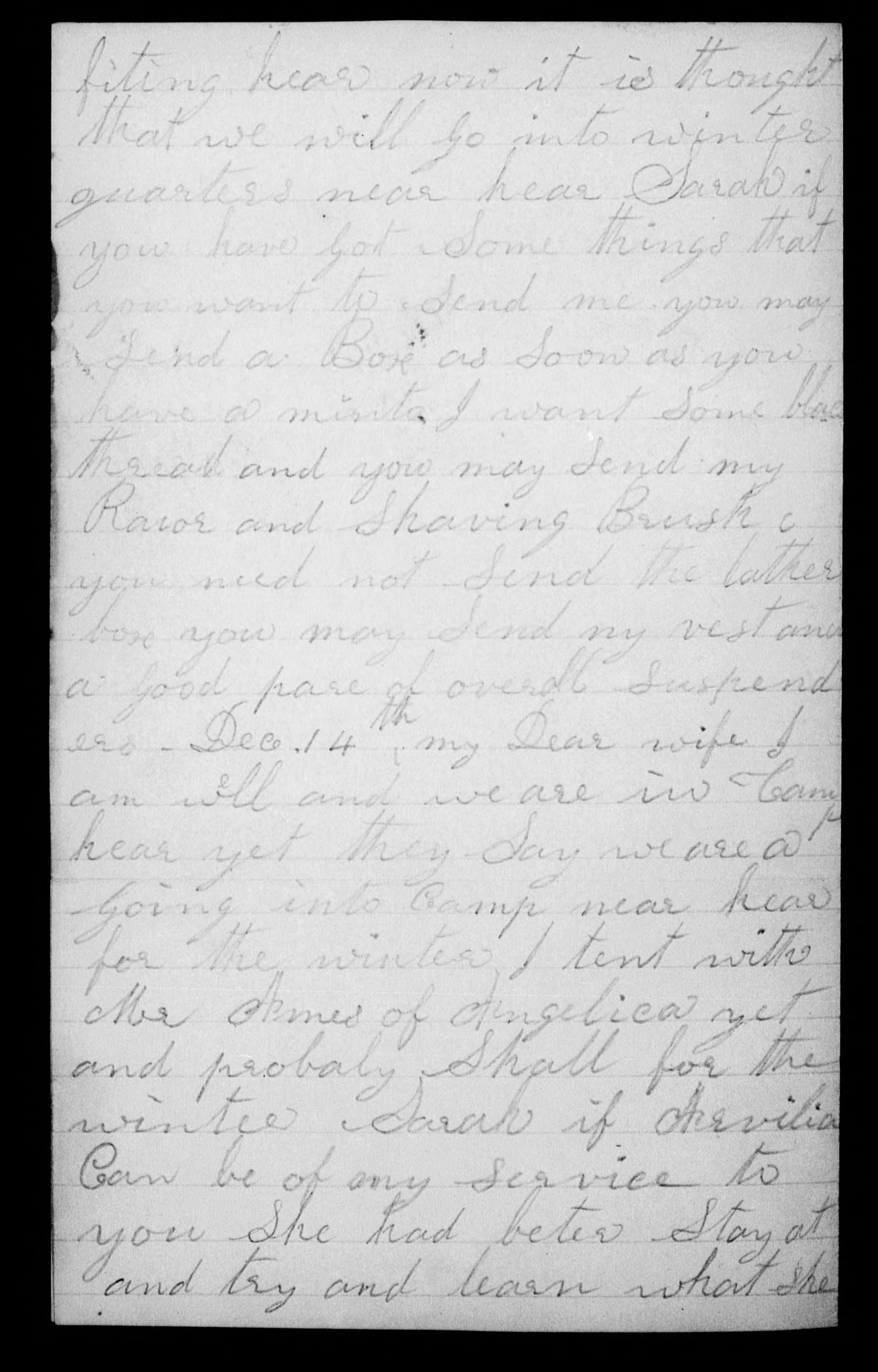
fiting hear now it is thought that we will go into winter quarters near hear
Sarah if you have got Some things that you want to Send me you may Send a Box as Soon as you have a minite I want Some black thread and you may Send my Razor and Shaving Brush you need not Send the lather box you may Send my vest and a good pare of overall Suspenders
Dec 14th my Dear wife I am well and we are in Camp hear yet they Say we are a going into Camp near hear for the winter
I tent with Mr Ames of Angelica yet and probaly Shall for the winter
Sarah if Arvillia Can be of any Service to you She had beter Stay at and try and learn what She
An inventory of what a soldier actually wanted from home going into winter: black thread, his razor and shaving brush — “you need not Send the lather box” — his vest, and a good pair of overall suspenders. Nothing sentimental, nothing wasteful, and a specific instruction to leave out the one item that would take up space.
“I tent with Mr Ames of Angelica yet and probaly Shall for the winter.” Ames, the Close Baptist preacher, had been his tent mate the previous spring. Nine months and a campaign later they are still sharing a tent and expect to share one all winter. Of all the men in these letters, Ames is the constant.
And a father managing his household from Virginia: if Arvillia can be of service, she is to stay at home — the sentence runs on to the next sheet.
15 December 1863 — “keep her at home”
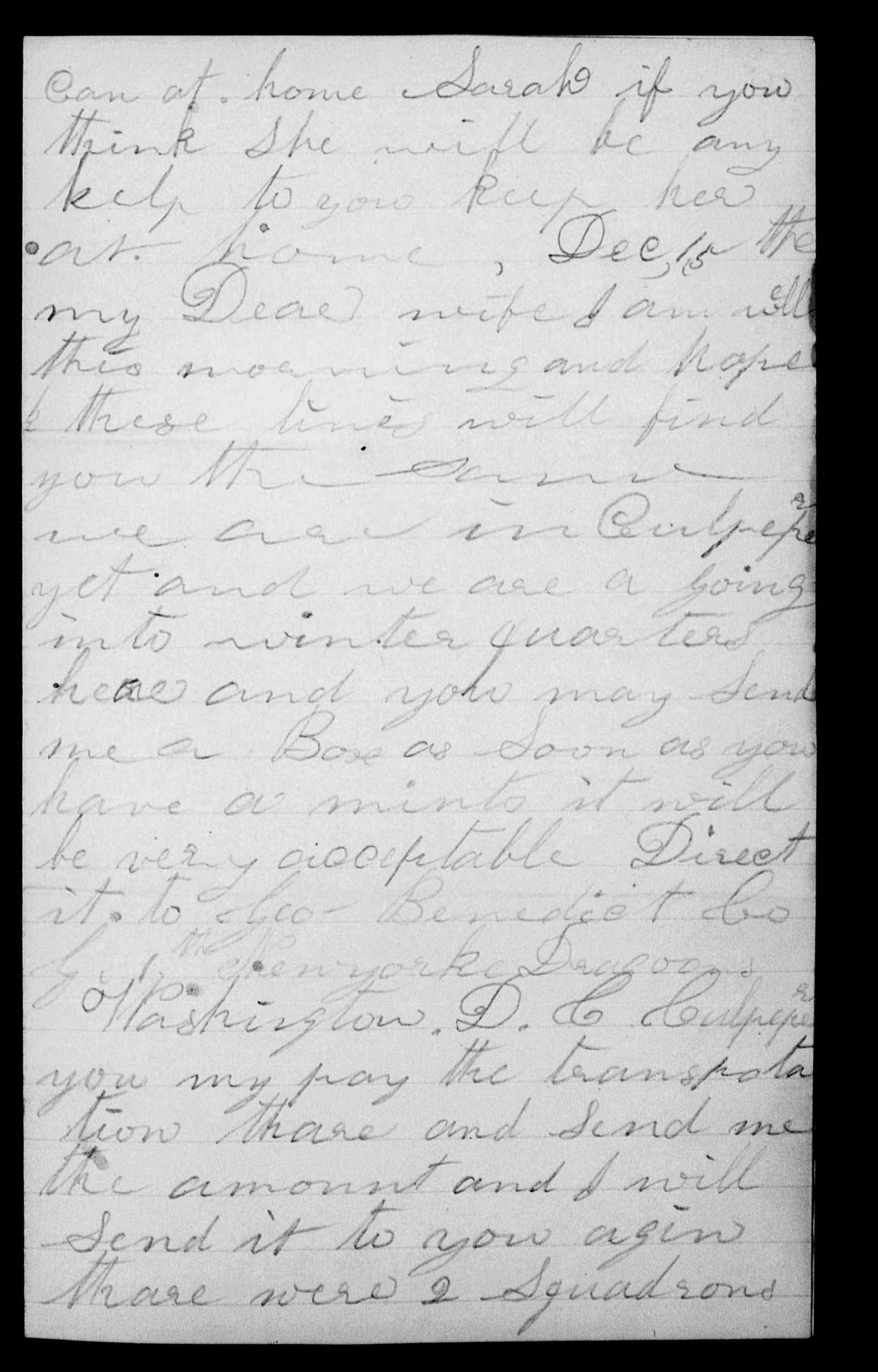
Can at home Sarah if you think She will be any help to you keep her at home
Dec 15th my Dear wife I am well this morning and hope these lines will find you the Same
we are in Culpeper yet and we are a going into winter quarters hear
and you may Send me a Box as Soon as you have a minite it will be very acceptable Direct it to Geo Benedict Co G 1st Newyorke Dragoons Washington D. C. Culpeper
you may pay the transpotation thare and Send me the amount and I will Send it to you agin
thare were 2 Squadrons
The thought begun on the previous sheet finishes here, and it is a decision about his daughter’s life made from three hundred miles away: “if you think She will be any help to you keep her at home.” Girls of Arvillia’s age were commonly sent out to work in another household. Benedict leaves the judgement to Sarah and tells her to keep the girl if she is useful — and, on the previous sheet, to let her “try and learn what She Can at home.”
Then the practical arrangements for the box, including the courtesy that says most about the household’s finances: Sarah is to pay the carriage at her end and send him the amount, and he will send it back to her. He will not have her out of pocket for his razor and his vest.
He also writes out his address in full a second time — Geo Benedict, Co G, 1st Newyorke Dragoons, Washington D. C. — the regiment now settling into winter quarters at Culpeper.
December 1863, closing sheet — a scout, and ten dollars
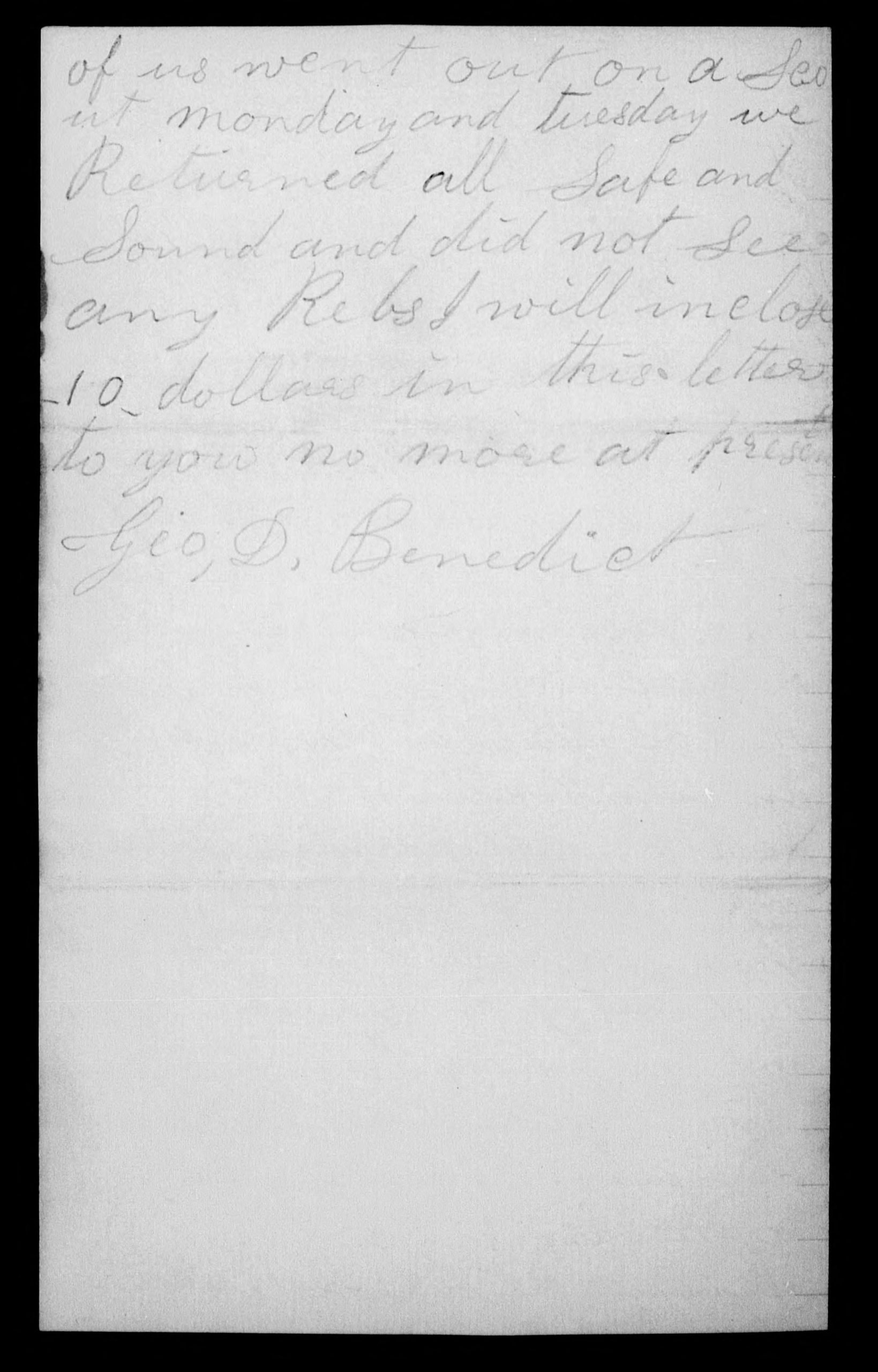
of us went out on a Scout monday and tuesday we Returned all Safe and Sound and did not See any Rebs
I will inclose 10 dollars in this letter to you no more at present
Geo D. Benedict
Two squadrons out on a scout Monday and Tuesday, back “all Safe and Sound and did not See any Rebs.” Then the ten dollars, the first half of the twenty he had promised to split between two letters. The remainder of the sheet is blank.
Winter Quarters on the Rapidan
January–February 1864 · 24 lettersFolder 3 of 3 — 1864

The library’s own separator sheet, filmed between the folders. Everything above this point is 1863. Everything below it is the last four months of his life.
It also corrects our citation. The collection is numbered #4943-z — the -z suffix is part of the Southern Historical Collection’s call number and had been omitted from earlier notes on this site, which gave it as #4943-z. Later exhibits cite it in full.
17 January 1864, the Rapidan — three quarters of a mile apart
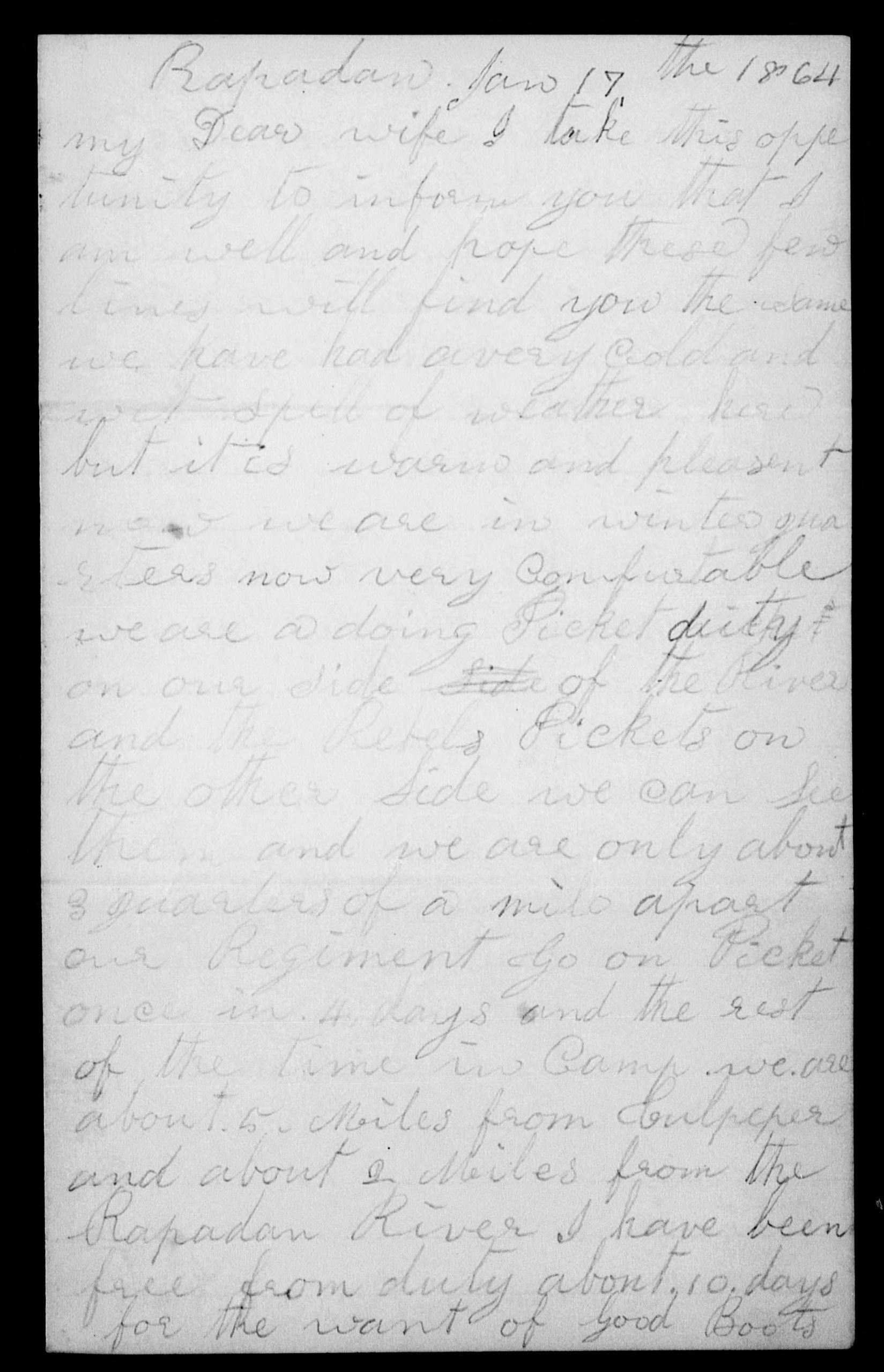
Rapadan Jan 17th 1864
my Dear wife I take this oppertunity to inform you that I am well and hope these few lines will find you the Same
we have had a very Cold and wet spell of weather here but it is warm and pleasent now
we are in winter quarters now very Comfrtable we are a doing Picket duty on our side of the River and the Rebels Pickets on the other Side we can See them and we are only about 3 quarters of a mile apart
our Regiment go on Picket once in 4 days and the rest of the time in Camp
we are about 5 Miles from Culpeper and about 2 Miles from the Rapadan River
I have been free from duty about 10 days for the want of good Boots
Winter quarters at last, and comfortable. The regiment pickets one side of the Rapidan and the Confederates the other: “we can See them and we are only about 3 quarters of a mile apart.” Two armies in plain sight of one another across a river, going on picket once in four days and spending the rest of the time in camp. Five miles from Culpeper, two from the river.
And the small indignity that keeps a cavalryman out of the saddle: “I have been free from duty about 10 days for the want of good Boots.” Ten days off duty in January in Virginia because the army had not supplied him with boots that would keep his feet.
This is the first letter of 1864. He had four months to live.
January 1864 — “the Boots that we draw from Government are worthless”
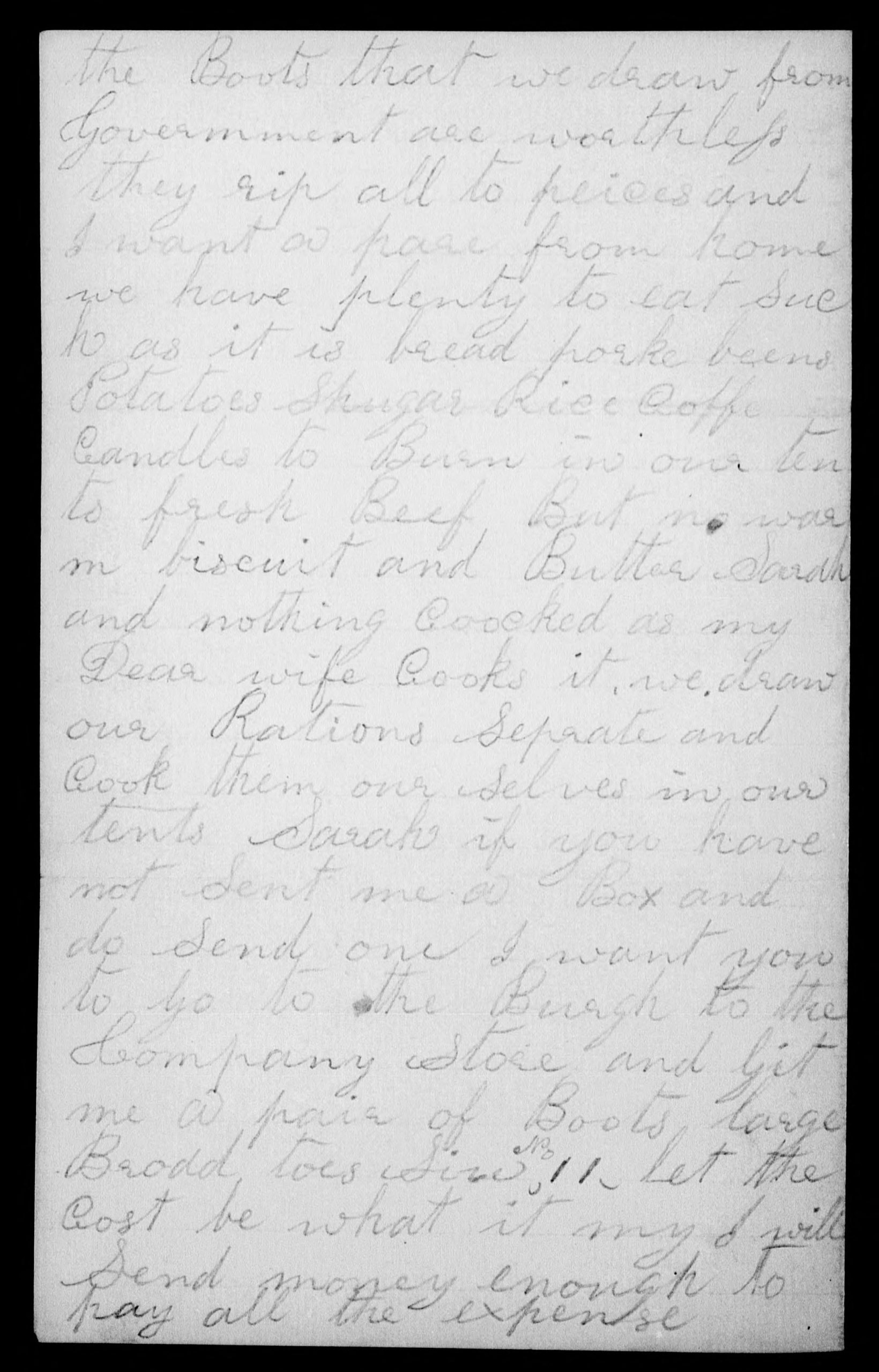
the Boots that we draw from Government are worthless they rip all to peices and I want a pare from home
we have plenty to eat Such as it is bread porke beens Potatoes Shugar Rice Coffe Candles to Burn in our tent to fresh Beef But no warm biscuit and Butter Sarah and nothing Cooked as my Dear wife Cooks it we draw our Rations Sepate and Cook them our Selves in our tents
Sarah if you have not Sent me a Box and do Send one I want you to go to the Burgh to the Company Store and git me a pair of Boots large Broadd toes Siz No 11 let the Cost be what it my I will Send money enough to pay all the expense
Here is why he had been ten days off duty. “The Boots that we draw from Government are worthless, they rip all to peices.” A contract-goods complaint from the man wearing them, in January, in Virginia.
The remedy is a full ration list and a shopping order. They draw bread, pork, beans, potatoes, sugar, rice, coffee, candles to burn in the tent, and fresh beef — “plenty to eat Such as it is” — but “no warm biscuit and Butter, Sarah, and nothing Cooked as my Dear wife Cooks it.”
And the order itself, which tells us something no muster roll does: Sarah is to go to the Company Store at the Burgh and get him boots, large, broad toes, size 11, “let the Cost be what it my, I will Send money enough to pay all the expense.” A big-footed man in bad boots.
18 January 1864 — bread and milk
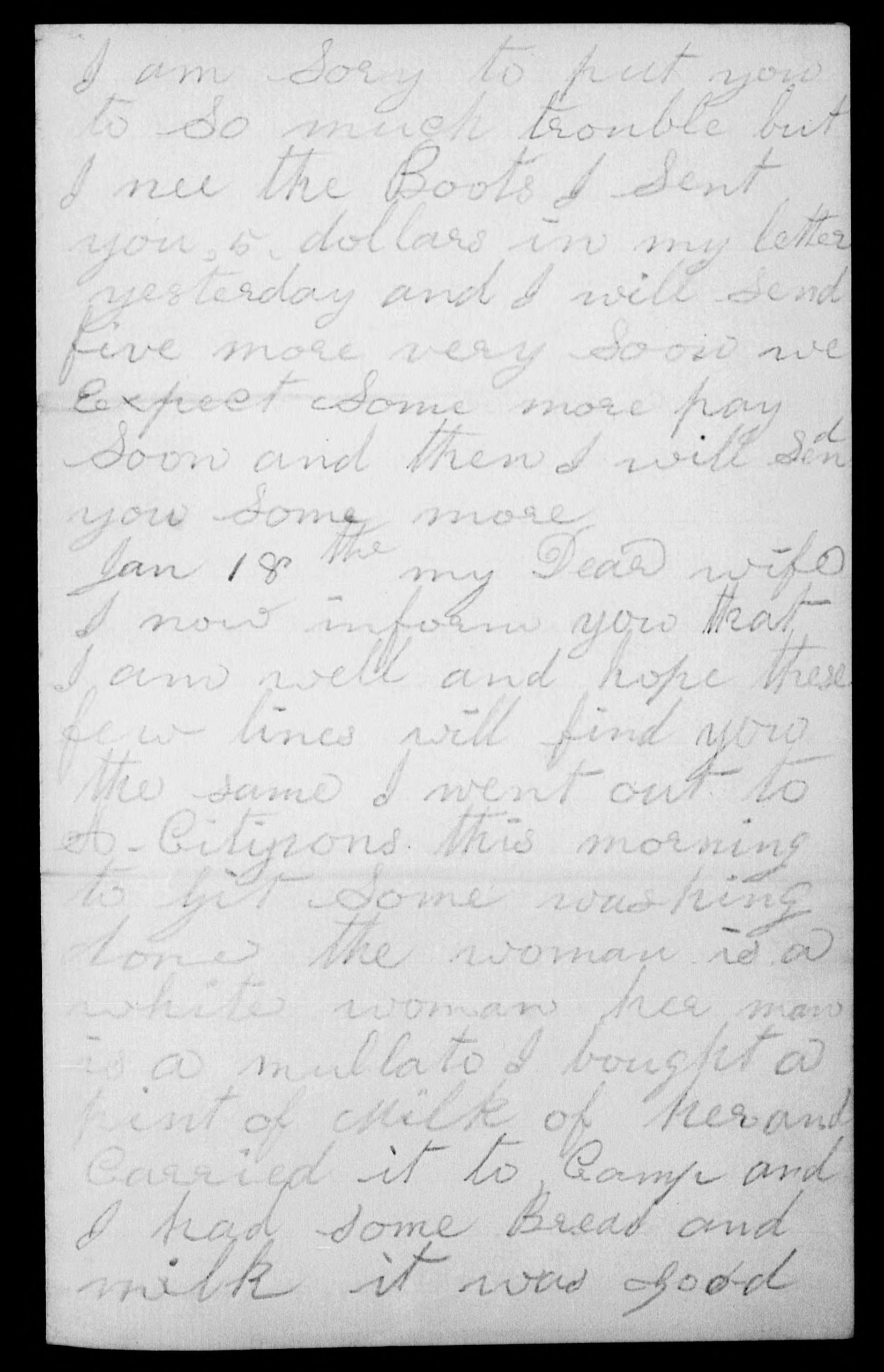
I am Sory to put you to So much trouble but I nee the Boots
I Sent you 5 dollars in my letter yesterday and I will Send five more very Soon we Expect Some more pay Soon and then I will Send you Some more
Jan 18th my Dear wife I now inform you that I am well and hope these few lines will find you the Same
I went out to a Citizons this morning to git Some washing done the woman is a white woman her man is a mulato I bought a pint of Milk of her and Carried it to Camp and I had some Bread and milk it was good
He walks out to a civilian house to get his washing done and comes back with a pint of milk. “I had some Bread and milk, it was good.” After two years of pork and hard bread, that is what a good day amounted to.
He also records, without comment or judgement, the household he bought it from: “the woman is a white woman, her man is a mulato.” An interracial couple keeping a house and selling milk and taking in washing in occupied Virginia in the winter of 1864 — a marriage that Virginia law did not permit and that no census would have described accurately. Benedict notes it as he notes the price of the milk, and moves on. The term is his, in 1864, and is left as he wrote it.
The money keeps going home: five dollars yesterday, five more soon, and more when the pay comes.
January 1864 — “my time will be half out”
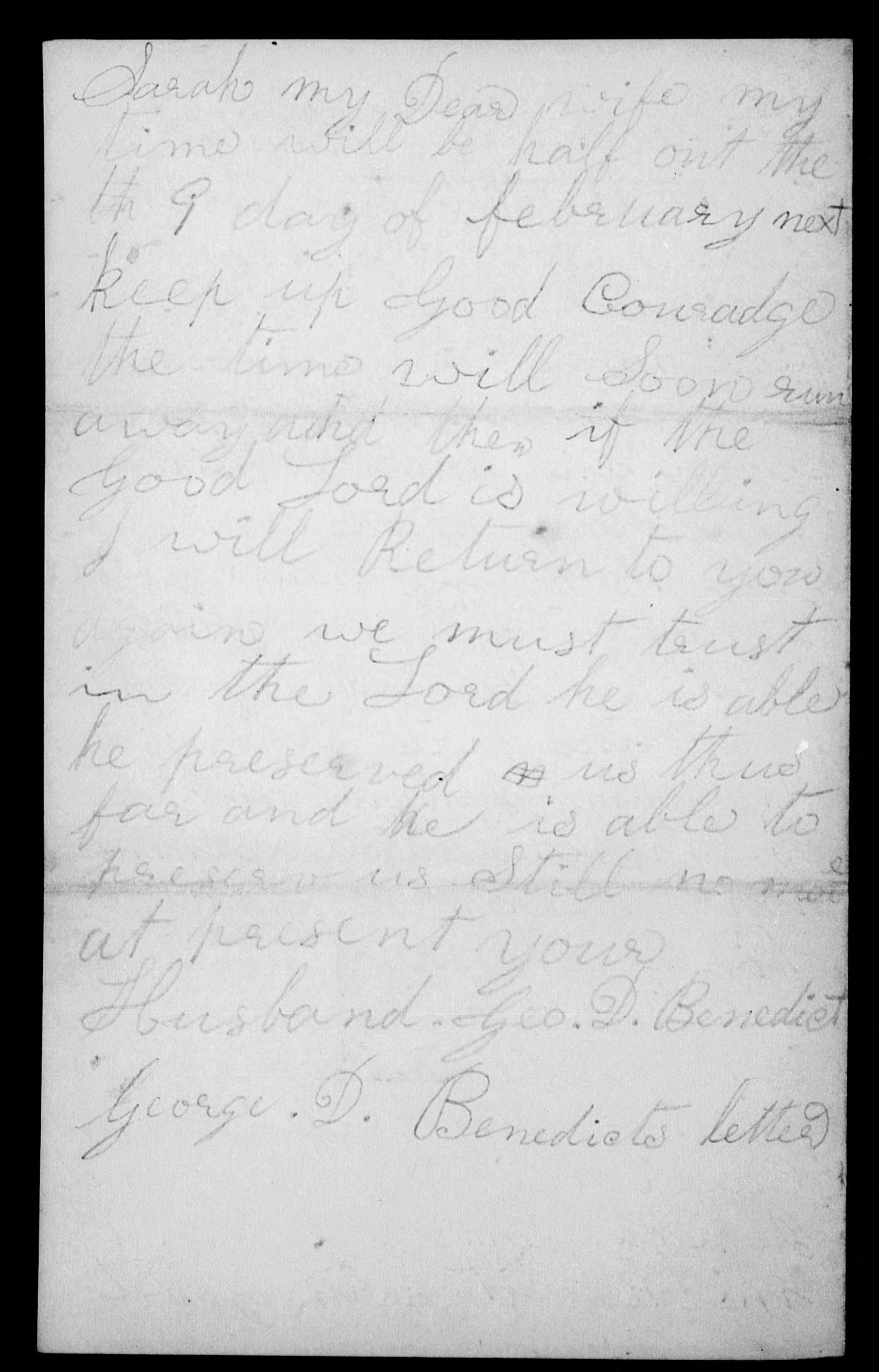
Sarah my Dear wife my time will be half out the 9 day of february next keep up good Courage the time will Soon run away and then if the good Lord is willing I will Return to you again
we must trust in the Lord he is able he preserved us thus far and he is able to preserve us Still
no more at present your Husband Geo. D. Benedict
[In a later hand:] George D. Benedicts letter
He is counting. “My time will be half out the 9 day of february next.” Half of a three-year enlistment, and he tells Sarah to keep up good courage because “the time will Soon run away, and then if the good Lord is willing I will Return to you again.”
Then the sentence that is hard to read knowing what came next: “we must trust in the Lord, he is able, he preserved us thus far and he is able to preserve us Still.” He was shot at Todd’s Tavern on 7 May 1864, fifteen weeks after writing it, and died of the wound on 25 May. He never reached the second half of his time.
At the foot of the sheet, in a larger and later hand, someone has written “George D. Benedicts letter.” It is a docket — the note a person makes when they are sorting papers that matter and want to know whose they are without unfolding them. Almost certainly it was written after his death, and quite possibly by Sarah.
26 January 1864 — what the men said about Colonel Thorp
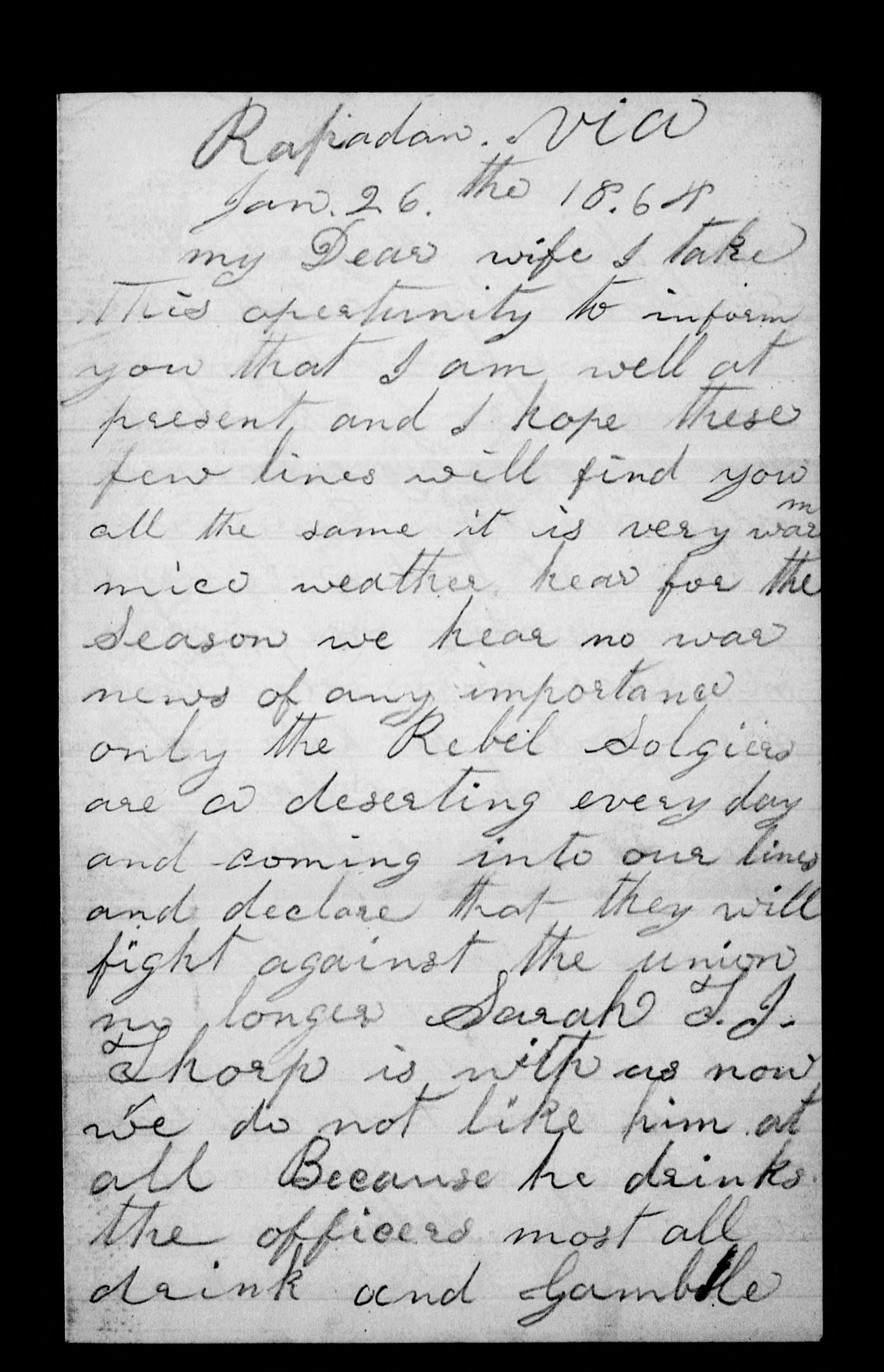
Rapadan Va Jan 26th 1864
my Dear wife I take this opertunity to inform you that I am well at present and I hope these few lines will find you all the same
it is very warm nice weather hear for the Season
we hear no war news of any importance only the Rebel Solgiers are a deserting every day and coming into our lines and declare that they will fight against the union ny longer
Sarah T. J. Thorp is with us now we do not like him at all Because he drinks the officers most all drink and Gamble
This page is the counterweight to everything else this site holds about Thomas J. Thorp, and it is published here for that reason. “Sarah, T. J. Thorp is with us now, we do not like him at all Because he drinks. The officers most all drink and Gamble.”
Five months earlier this same correspondent had reported Thorp going home to New York with nine men to buy the regiment’s horses. Both statements are from the same private, in the same series of letters to the same wife, and both are on Thorp’s page. A regiment’s colonel can organise its mounting and still be disliked by the men in its ranks.
The rest of the page is winter quiet: warm weather for the season, no war news, and Confederate soldiers deserting into the Union lines every day and declaring they will not fight for the Confederacy any longer.
26 January 1864, second sheet — “So much evil in the army”
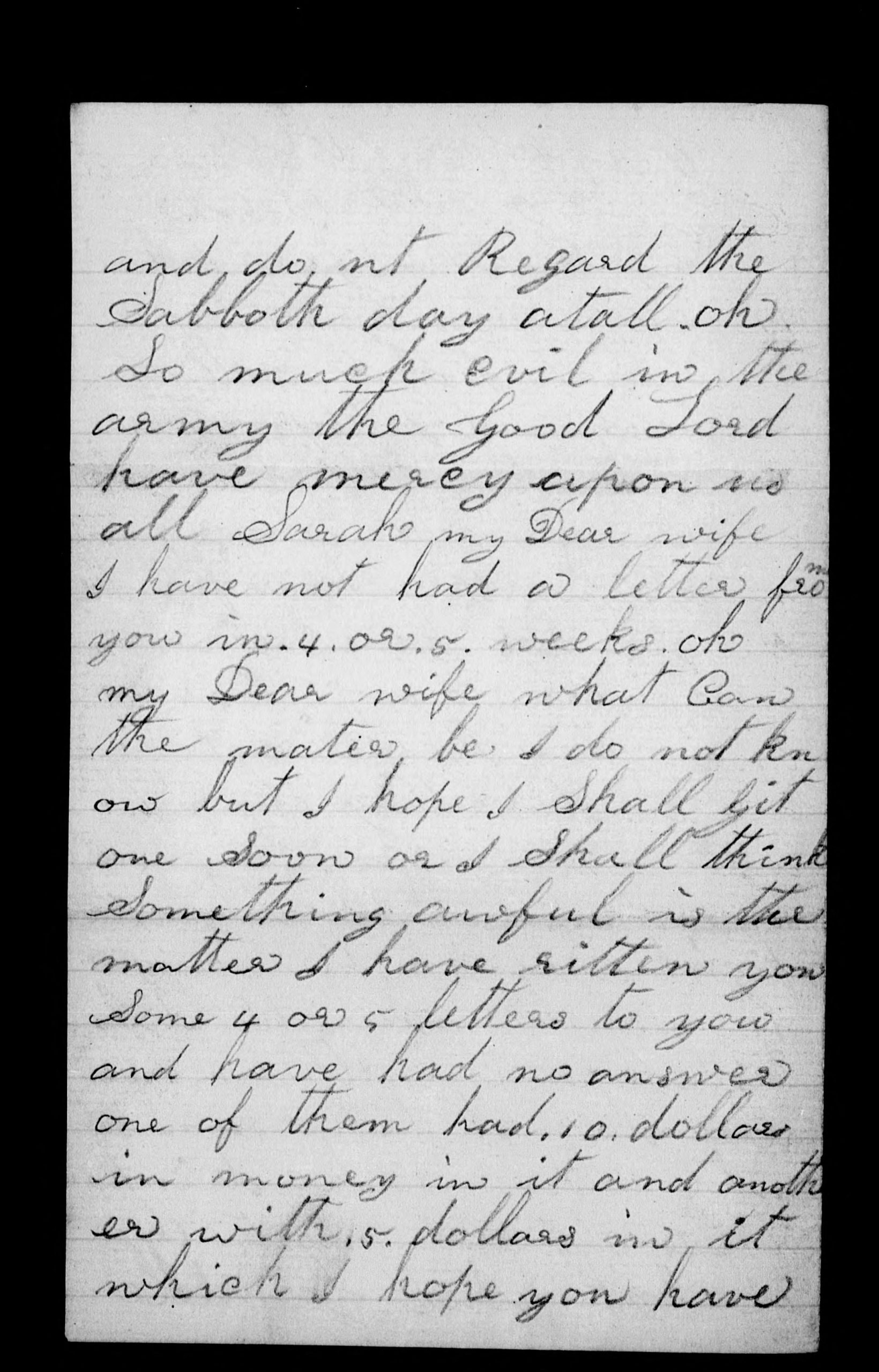
and dont Regard the Sabboth day at all oh So much evil in the army the Good Lord have mercy upon us all
Sarah my Dear wife I have not had a letter from you in 4 or 5 weeks oh my Dear wife what Can the mater be I do not know but I hope I Shall git one Soon or I Shall think Something awful is the matter
I have ritten you Some 4 or 5 letters to you and have had no answer one of them had 10 dollars in money in it and another with 5 dollars in it which I hope you have
The sentence about Thorp runs on into this sheet and shows what kind of complaint it was: the officers drink, gamble, “and dont Regard the Sabboth day at all. oh So much evil in the army, the Good Lord have mercy upon us all.”
It is a devout man’s indictment of an officer corps, not a soldier’s grudge against one colonel. Benedict tented for nine months with a Close Baptist preacher, thanked God in nearly every letter, and asked his wife for prayers. That does not make his testimony less true. It does mean the charge should be read as what it is — a religious objection to army manners, in which Thorp is named as an instance rather than singled out.
Then the fear underneath the whole letter. No word from Sarah in four or five weeks: “what Can the mater be, I do not know, but I hope I Shall git one Soon or I Shall think Something awful is the matter.” He has written four or five times, and two of those letters carried money — ten dollars in one, five in another. He does not know whether any of it arrived.
26 January 1864 — a brother at Washington
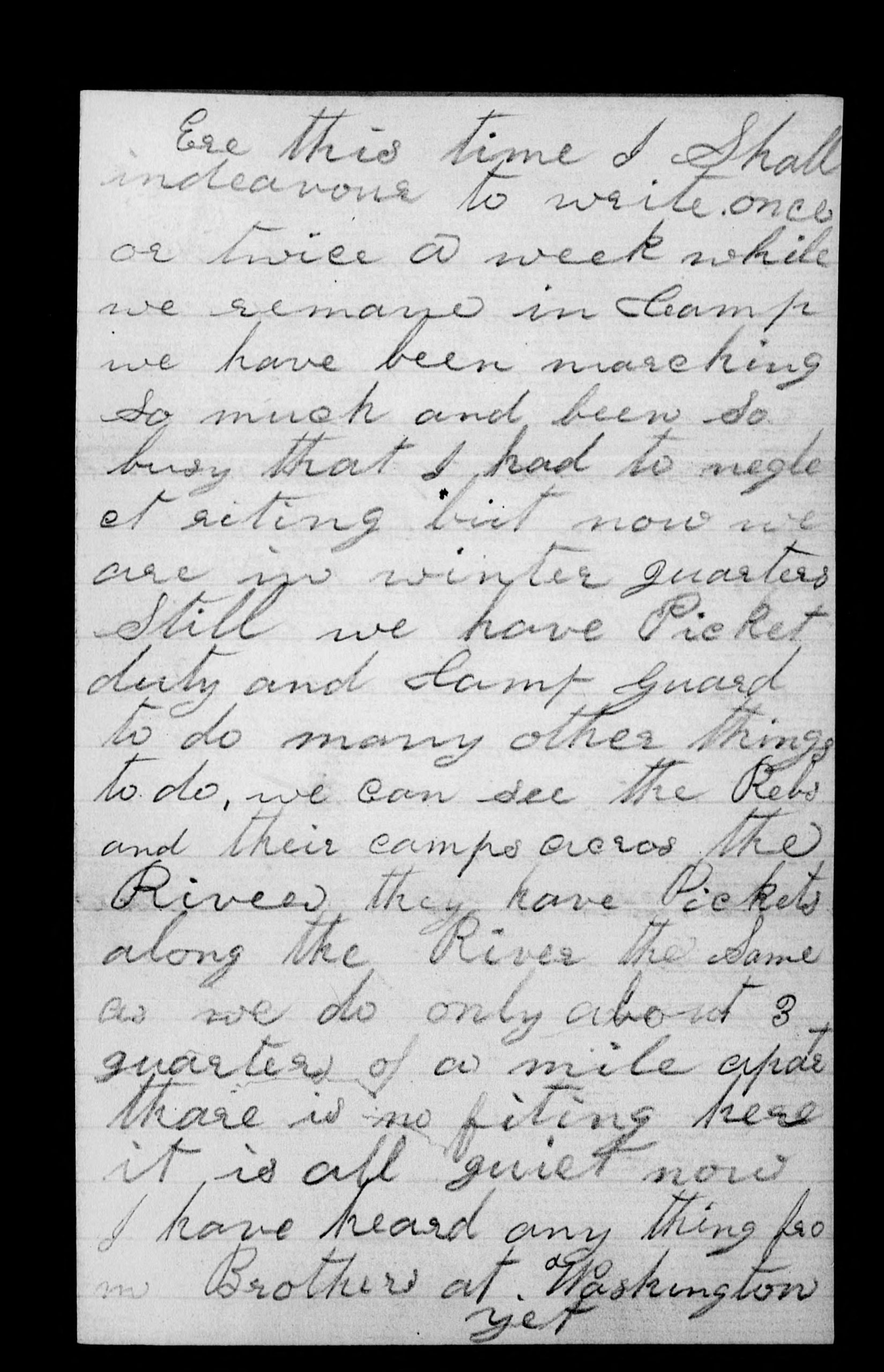
Ere this time I Shall indeavour to write once or twice a week while we remane in Camp
we have been marching So much and been so busy that I had to neglect riting but now we are in winter quarters
Still we have Picket duty and Camp guard to do many other things to do,
we can see the Rebs and their camps acros the River they have Pickets along the River the Same as we do only about 3 quarters of a mile apart thare is no fiting here it is all quiet now
I have [not] heard any thing from Brother at Washington yet
A promise to write once or twice a week now the marching has stopped, and the two armies watching each other across three quarters of a mile of river.
A new person, and an open question.“I have [not] heard any thing from Brother at Washington yet.” This is the only mention of a brother anywhere in the collection. He is not in this regiment — George D. Benedict is the only Benedict on the rolls of the First New York Dragoons. So the brother was in another unit, or in hospital at Washington, or there on civilian business. We do not know which, and we record the question rather than invent an answer. A descendant of the Belvidere Benedicts may well know.
27 January 1864 — “I do not want you to go to too much trouble”
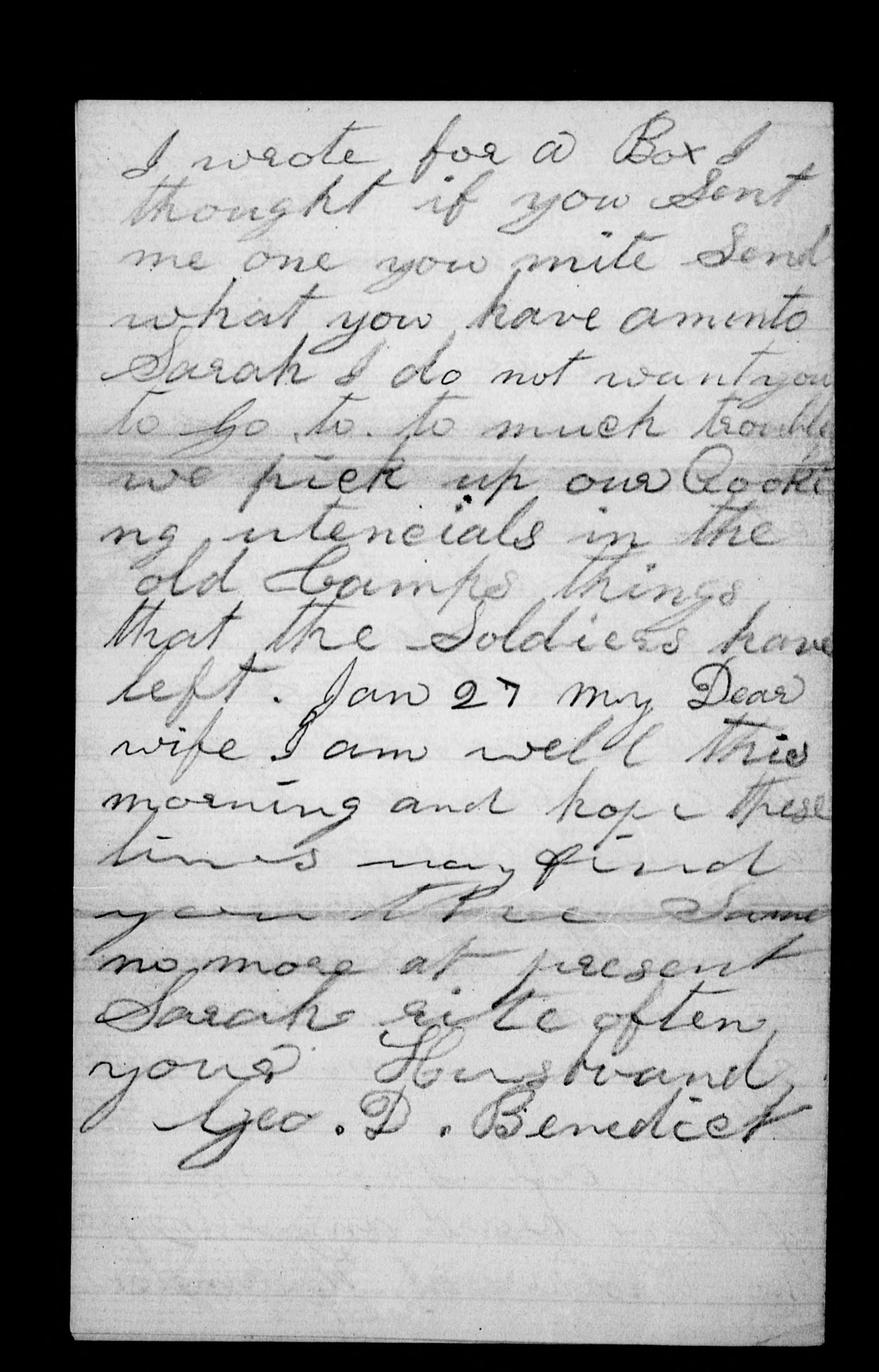
I wrote for a Box I thought if you Sent me one you mite Send what you have a minute
Sarah I do not want you to go to to much trouble we pick up our Cooking utencials in the old Camps things that the Soldiers have left
Jan 27 my Dear wife I am well this morning and hope these lines may find you all the Same
no more at present Sarah rite often
your Husband Geo. D. Benedict
He walks back the request for a box almost as soon as he has made it. Send what you have a minute for, and no more: “Sarah I do not want you to go to to much trouble.” A man on thirteen dollars a month, asking for size 11 boots, worrying that his wife is put out.
And he tells her not to bother with the cooking gear at all, because they scavenge it: “we pick up our Cooking utencials in the old Camps, things that the Soldiers have left.” The same economy as the melted canteens — an army supplying itself from the leavings of the armies that camped there before it.
1 February 1864 — three letters at once, and the money accounted for
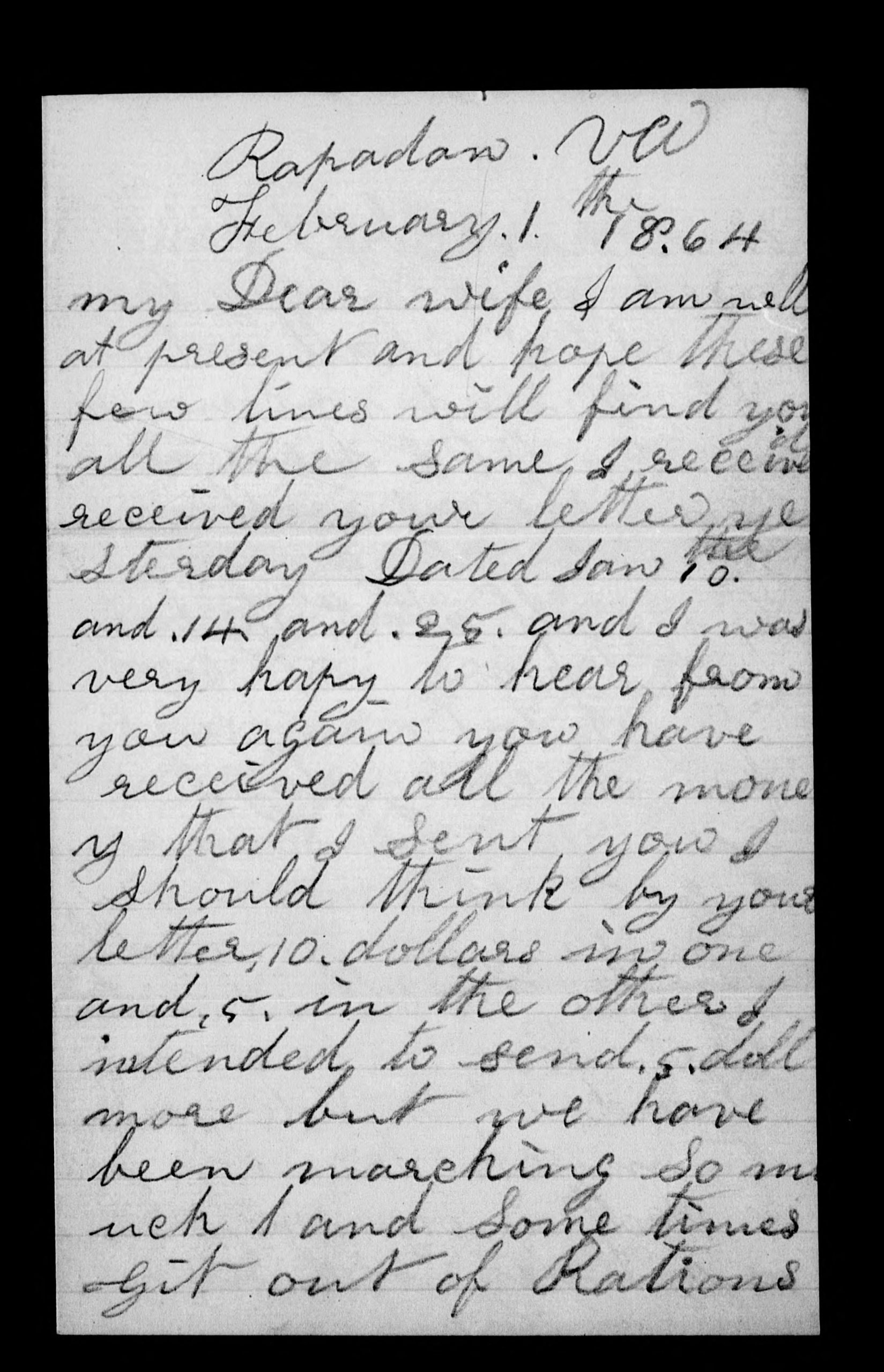
Rapadan Va February 1st 1864
my Dear wife I am well at present and hope these few lines will find you all the Same
I received your letter yesterday Dated Jan 10 and 14 and 25 and I was very hapy to hear from you again
you have received all the money that I Sent you I Should think by your letter 10 dollars in one and 5 in the other I intended to send 5 doll more but we have been marching So much I and Some times git out of Rations
The drought breaks. Three of Sarah’s letters arrive together — dated 10, 14 and 25 January — after the four or five weeks of silence that had him fearing “Something awful is the matter.” Nothing was the matter. The mail had simply been chasing the regiment.
And the money arrived: ten dollars in one letter, five in the other, exactly as he had sent it. His system of splitting cash across separate envelopes worked. He had meant to send five more and could not, because they had been marching so much — and, he adds almost in passing, “Some times git out of Rations.”
February 1864 — the officers of Company G
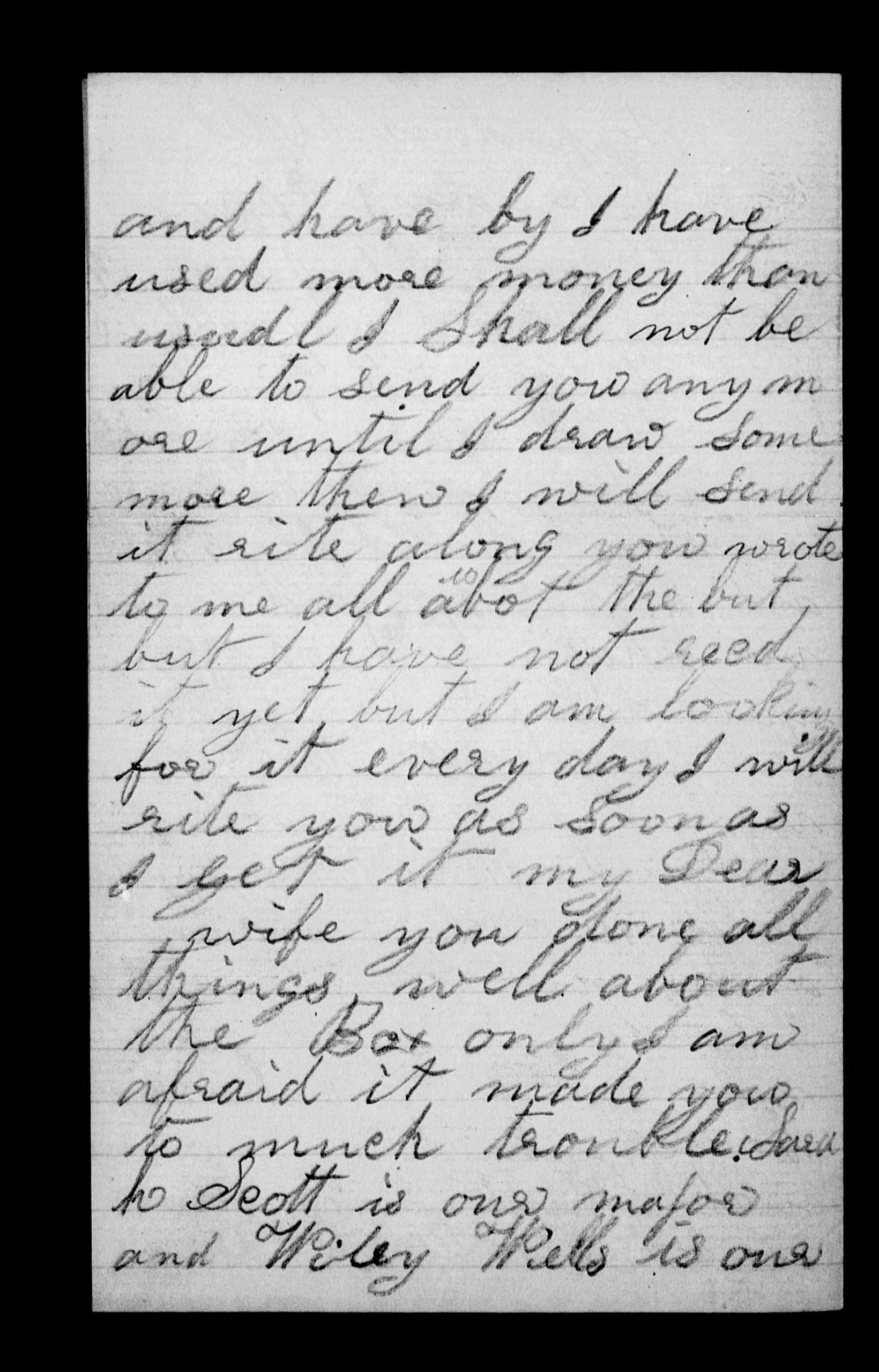
and have by I have used more money than usual I Shall not be able to send you any more until I draw Some more then I will Send it rite along
you wrote to me all about the but but I have not recd it yet but I am looking for it every day I will rite you as soon as I get it
my Dear wife you gone all things well about the Box only I am afraid it made you to much trouble
Rufus Scott is our major and Wiley Wells is our
Benedict names his officers: Rufus Scott is major of the regiment and Wiley Wells is captain of Company G. Both are on this site, and both had remarkable careers — Scott was wounded five times with this regiment and later wrote the Dragoons’ chapter in the Allegany County history; Wells enrolled at Portage at eighteen years old and rose to lieutenant colonel.
Portage is worth a second look. It is the same Portage Station where, six months earlier, Colonel Thorp had the regiment’s horses delivered and paid for. These men came from a handful of villages along the Genesee, and the regiment was recruited, officered and remounted out of the same few miles of country.
He has overspent and says so plainly: no more money home until the next pay. And the box has not arrived, though Sarah has written all about it.
February 1864 — 180 pounds, and four dollars fourteen
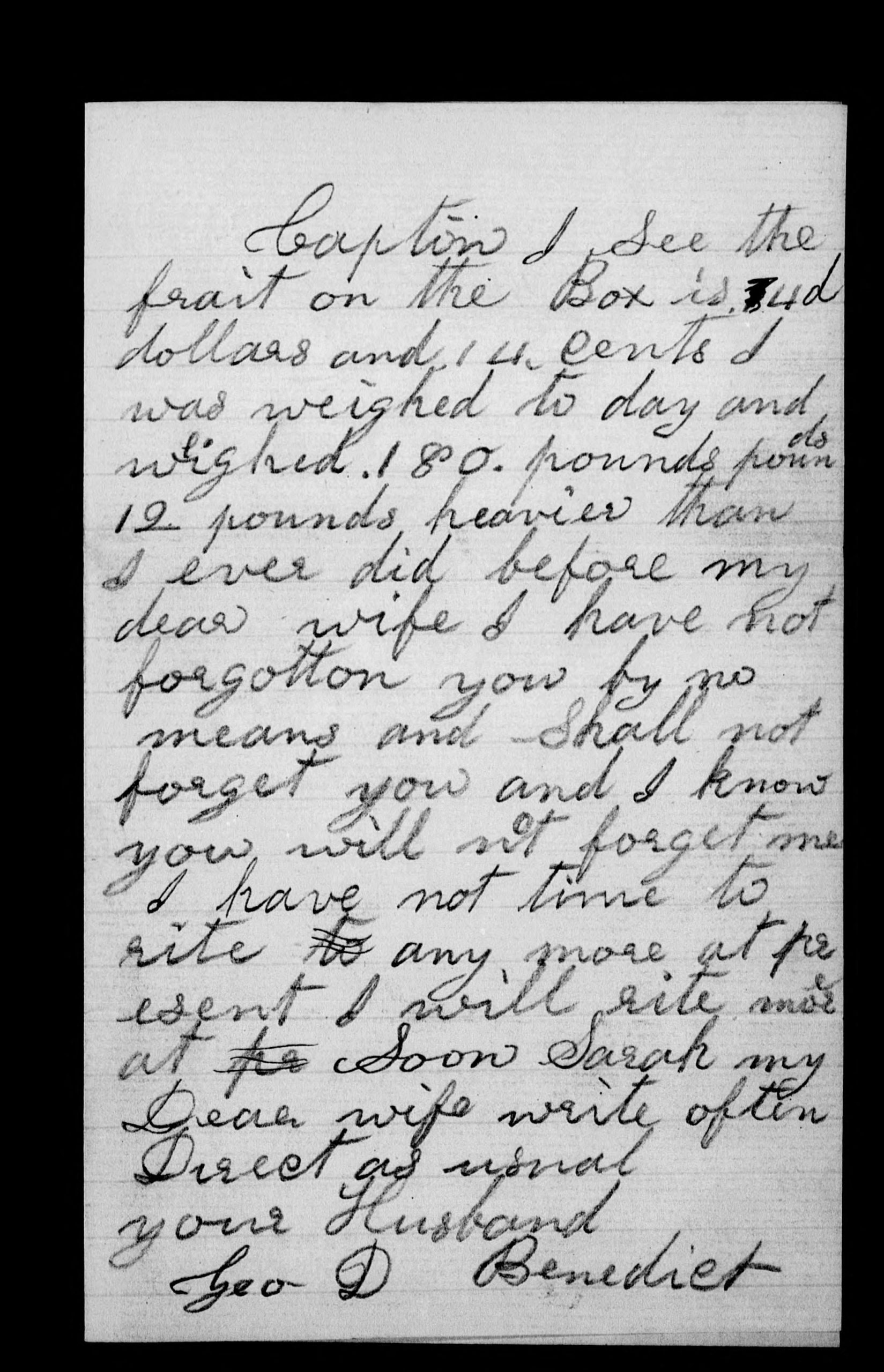
Captin
I See the frait on the Box is 4 dollars and 14 cents
I was weighed to day and wighed 180 pounds 12 pounds heavier than I ever did before
my dear wife I have not forgotton you by no means and Shall not forget you and I know you will not forget me
I have not time to rite any more at present I will rite more at Soon
Sarah my Dear wife write often Direct as usual
your Husband Geo D Benedict
Here is the man himself.“I was weighed to day and wighed 180 pounds, 12 pounds heavier than I ever did before.” Put that beside the boots he ordered from home — large, broad toes, size 11 — and the roster’s note that he enlisted at forty-two years of age, and a physical portrait appears that no photograph of him survives to give us: a big, broad-footed, middle-aged farmer, heavier in the army than he had ever been at home.
That last part is worth dwelling on. Army rations made him gain weight. Whatever life at Belvidere had been, it had not been as well fed as a soldier’s winter camp.
The freight on the box came to four dollars and fourteen cents — nearly a third of a month’s pay to send one parcel from Allegany County to Virginia.
Then, with no lead-in: “my dear wife I have not forgotton you by no means and Shall not forget you, and I know you will not forget me.” It reads like an answer to something she had written. He had three months to live.
One name on an empty sheet
“Sarah A. Benedict”
An otherwise blank sheet carrying nothing but her name, written in a careful, even hand quite unlike her husband’s hurried pencil. It may be the address panel of a folded letter, or it may be Sarah practising her own signature.
Either way it gives us something no roster, census or pension index in our hands has yet supplied: her middle initial. She is Sarah A. Benedict of Belvidere, Allegany County — the woman these hundred and more pages were written to.
12 February 1864 — the box arrives, and trouble at Belvidere
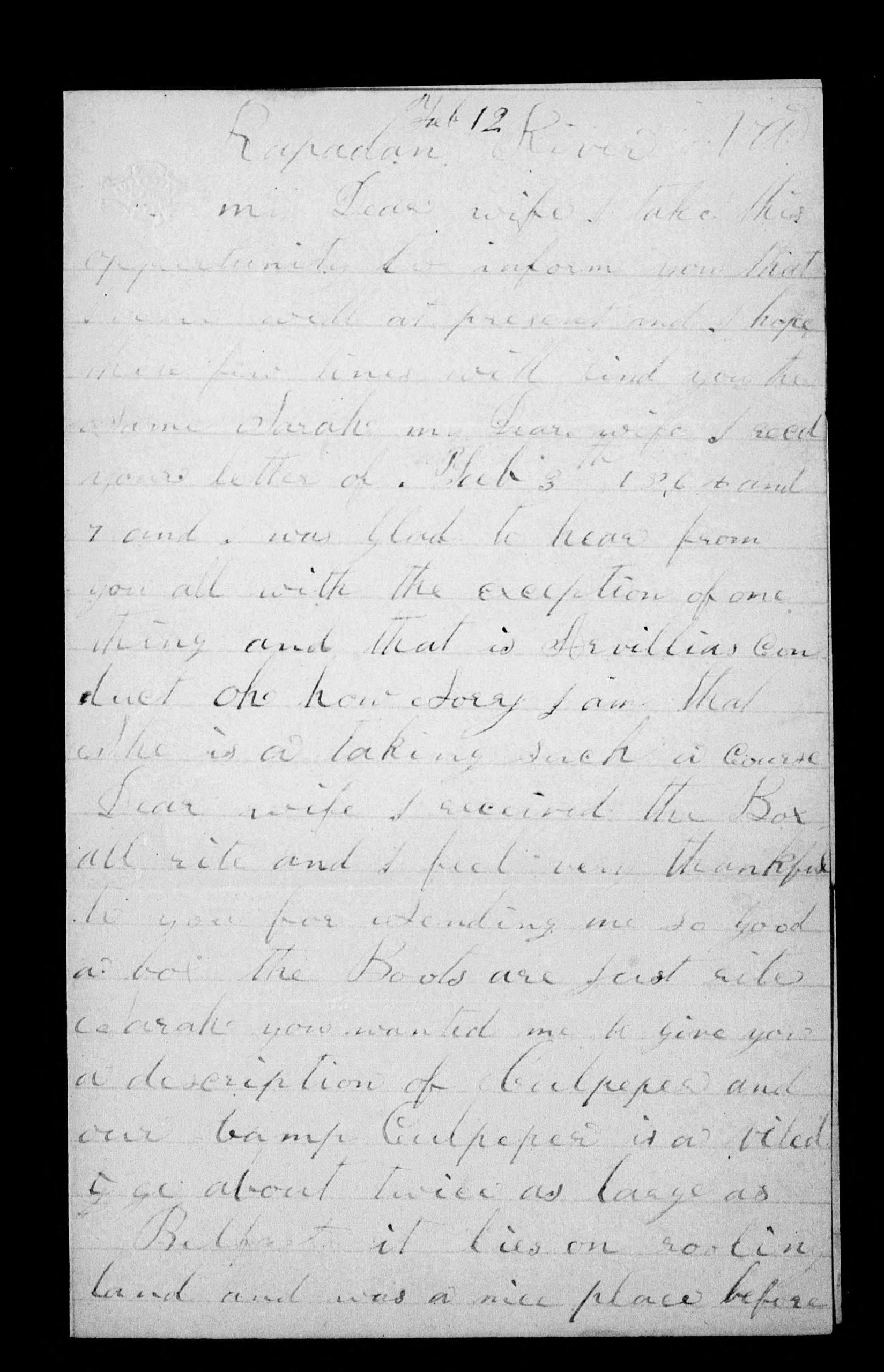
Rapadan River Feb 12 1864
my Dear wife I take this oppertunity to inform you that I am well at present and I hope these few lines will find you the Same
Sarah my Dear wife I recd your letter of Feb 3th 6 and 7 and I was glad to hear from you all with the exception of one thing and that is Arvillias Conduct oh how sory I am that She is a taking Such a Course
Dear wife I received the Box all rite and I feel very thankful to you for sending me so good a box the Boots are just rite
Sarah you wanted me to give you a description of Culpeper and our Camp Culpeper is a viledge about twice as large as Belfast it lies on rooling land and was a nice place before
The box got through, and the boots fit: “the Boots are just rite.” After ten days off duty in January for want of serviceable footwear, a farmer’s wife in Allegany County had solved what the United States Army could not.
Three of Sarah’s letters arrived together, and he was glad of all of them “with the exception of one thing, and that is Arvillias Conduct. oh how sory I am that She is a taking Such a Course.” Something has happened at home. The next sheet explains it, and it is the only family trouble anywhere in this collection.
Sarah had asked him to describe where he was, and he does it the way anyone does — by measuring it against home. Culpeper is “about twice as large as Belfast” — Belfast, New York, a few miles up the Genesee from Belvidere.
16 February 1864 — “But Arvillia, I must write a little to you”
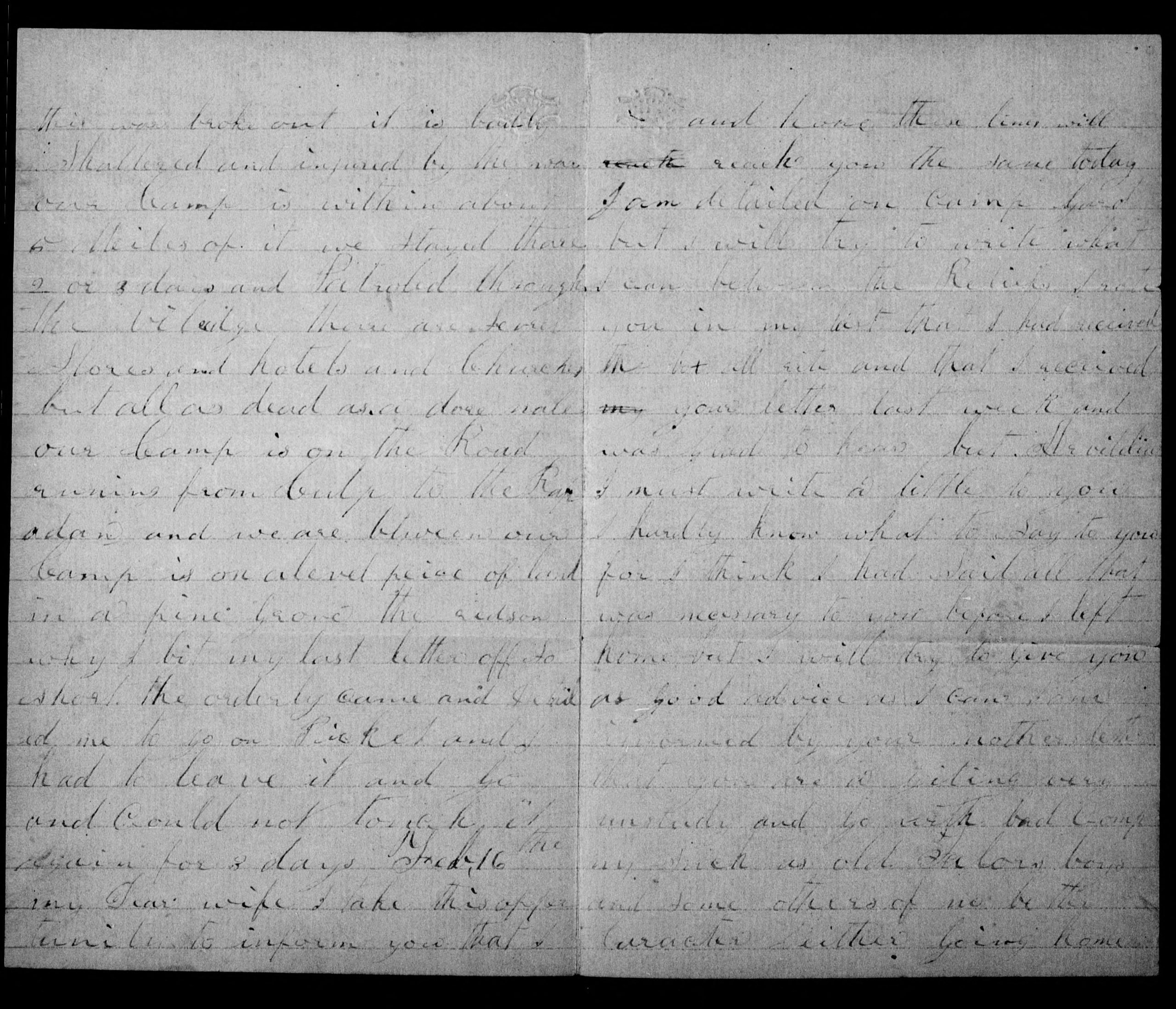
this war broke out it is badly Shattered and injured by the war
our Camp is within about 5 Miles of it we stayed there 2 or 3 days and Patroled through the vilage thare are several Stores and hotels and Churches but all as dead as a dore nale
our Camp is on the Road runing from Culp to the Rapadan and we are between our Camp is on a level piece of land in a pine grove
the reason why I bit my last letter off so short the orderly came and ordered me to go on Picket and I had to leave it and go and Could not touch it again for 3 days
Feb 16th my Dear wife I take this oppertunity to inform you that I am well and hope these lines will reach you the same today I am detailed on Camp Gard but I will try to write what I can between the Reliefs
I wrote you in my last that I had received the box all rite and that I received your letter last week and was glad to hear
but Arvillia I must write a little to you I hardly know what to say to you for I think I had said all that was necessary to you before I left home but I will try to give you as good advice as I can
I am informed by your mothers letter that you are a citing very unstedy and go with bad Company Such as old T[a]ylors boys and some others of no beter Caracter either going home
First the rest of the description she asked for. Culpeper is “badly Shattered and injured by the war” — stores, hotels and churches still standing but “all as dead as a dore nale.” Their camp is in a pine grove on the road between Culpeper and the Rapidan. And an apology for the last letter breaking off mid-sentence: the orderly came, he was sent on picket, and he could not get back to the page for three days.
Then he stops writing to his wife and starts writing to his child.“But Arvillia, I must write a little to you. I hardly know what to say to you, for I think I had said all that was necessary to you before I left home, but I will try to give you as good advice as I can.”
Sarah’s letter had told him their daughter was “a citing very unstedy and go with bad Company” — keeping company with local youths he does not think much of. This is a man managing an adolescent from three hundred miles and a war away, with no authority but a pencil, and knowing it. The advice itself runs on to the next sheet.
On the names. The surname of the family he complains of is hard to read in this pencil and is given here as T[a]ylors with the uncertainty marked. They were civilian youths at home in Allegany County, not soldiers of this regiment, and no attempt is made here to identify them further.
18 February 1864 — “my life is at Stake”
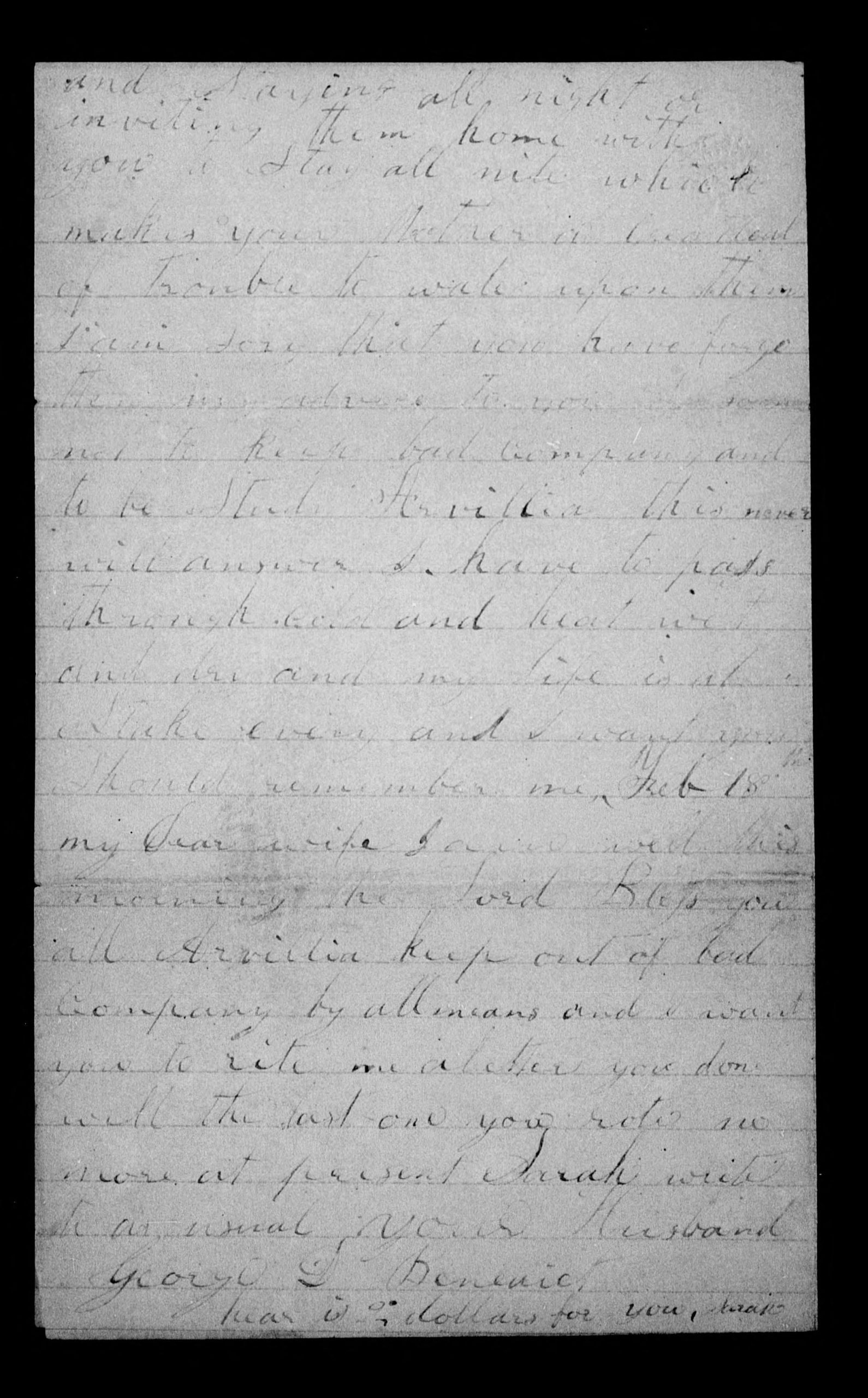
and Staying all night or inviting them home with you and Stay all nite which makes your Mother a great deal of trouble to wate upon them
I am very Sory that you have forgot my advice to you not to keep bad Company and to be Stedy
Arvillia this never will answer I have to pass through cold and heat wet and dry and my life is at Stake every [day] and I want you Should remember me
Feb 18th my Dear wife I am well this morning the Lord Bless you all
Arvillia keep out of bad Company by all means and I want you to rite me a letter you don well the last one you rote
no more at present Sarah write as usual
Your Husband George D Benedict
hear is 5 dollars for you Sarah
The complaint, when it finally comes, is smaller than the dread that has been building for two sheets. Arvillia has been staying out all night, or bringing company home to stay the night, “which makes your Mother a great deal of trouble to wate upon them.” A teenage girl keeping late hours and filling the house with friends while her mother runs a farm alone. That is the whole of it.
His argument is not discipline. It is one sentence, and it is the most direct thing he ever wrote:
“Arvillia this never will answer. I have to pass through cold and heat, wet and dry, and my life is at Stake every [day], and I want you Should remember me.”
He is not asking her to behave because it is right. He is asking her to behave because he might not come back, and he wants her to be someone who remembers him. He was killed eleven weeks later.
Then, two days on, he softens it without withdrawing it — “Arvillia keep out of bad Company by all means, and I want you to rite me a letter. You don well the last one you rote.” He ends the scolding with praise for her handwriting. And the last line of the letter is five dollars for Sarah.
A note on the reading: the word after “every” is abraded and is supplied here as [day] in brackets. Everything else on this page was read from the darkened scan and is legible with confidence.
22 February 1864 — how a Dragoon fought, and what he carried
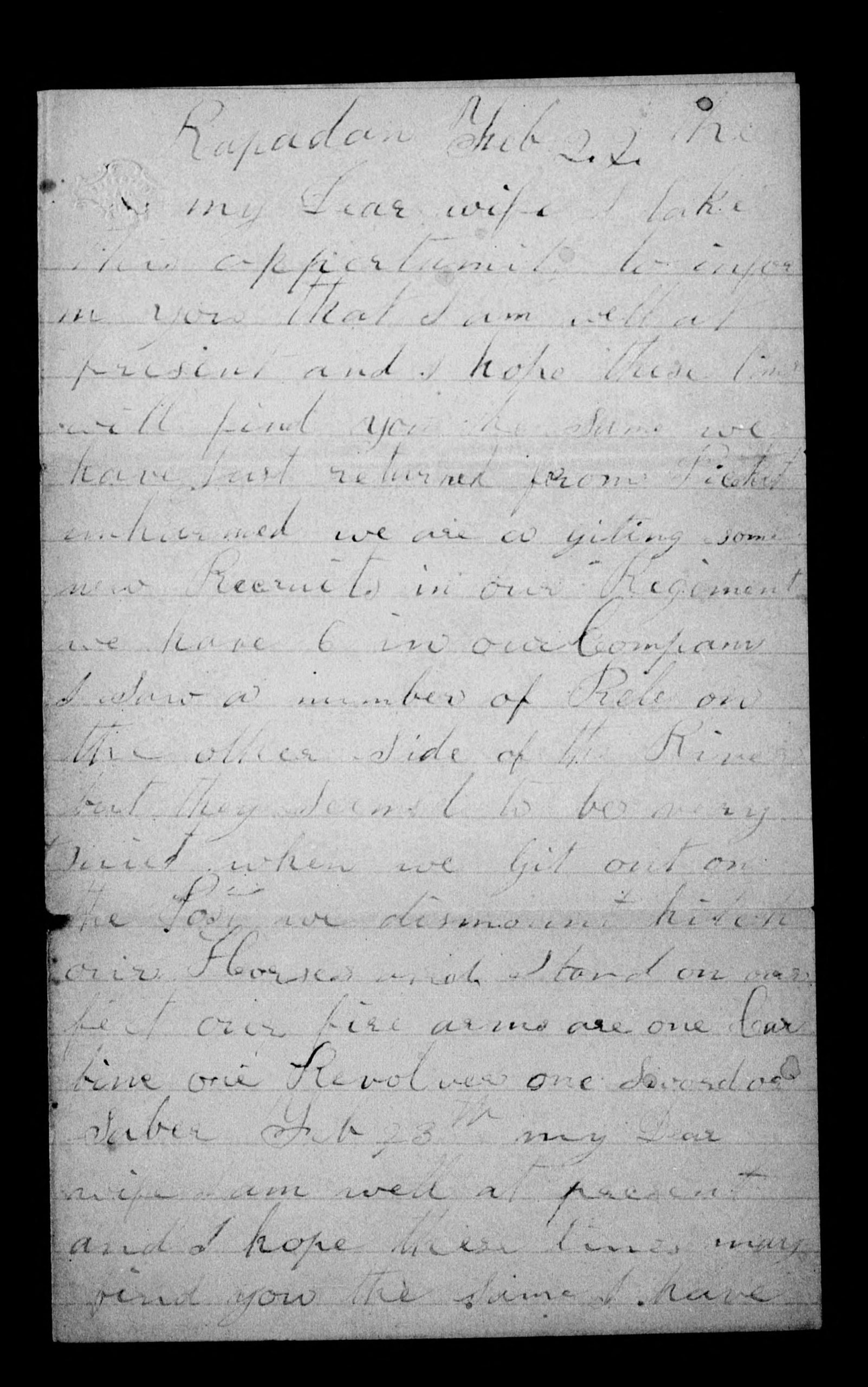
Rapadan Feb 22th
my Dear wife I take this oppertunity to inform you that I am well at present and I hope these lines will find you the Same
we have just returned from Picket unharmed we are a gitting some new Recruits in our Regiment we have 6 in our Company
I Saw a number of Rebs on the other side of th River but they seemed to be very quiet
when we git out on the Post we dismount hitch our Horses and Stand on our feet our fire arms are one Carbine one Revolver one Sword
Feb 23th my Dear wife I am well at present and I hope these lines may find you the same I have
A rare technical page. Benedict describes exactly how the regiment did picket duty as cavalry and exactly what he carried. On the post “we dismount, hitch our Horses, and Stand on our feet” — these were mounted men who fought and watched on foot, the horse a means of getting there.
And his weapons, itemised: “our fire arms are one Carbine, one Revolver, one Sword.” That is the full armament of a Union cavalryman in three words — a breech-loading carbine for the fight at a distance, a revolver for close work, and a sabre. Very few soldiers ever wrote down their own kit; here it is from a man who carried it.
Six new recruits have come to Company G, and across the river the enemy is quiet.
25 February 1864 — a grand review, and the pay accounted for
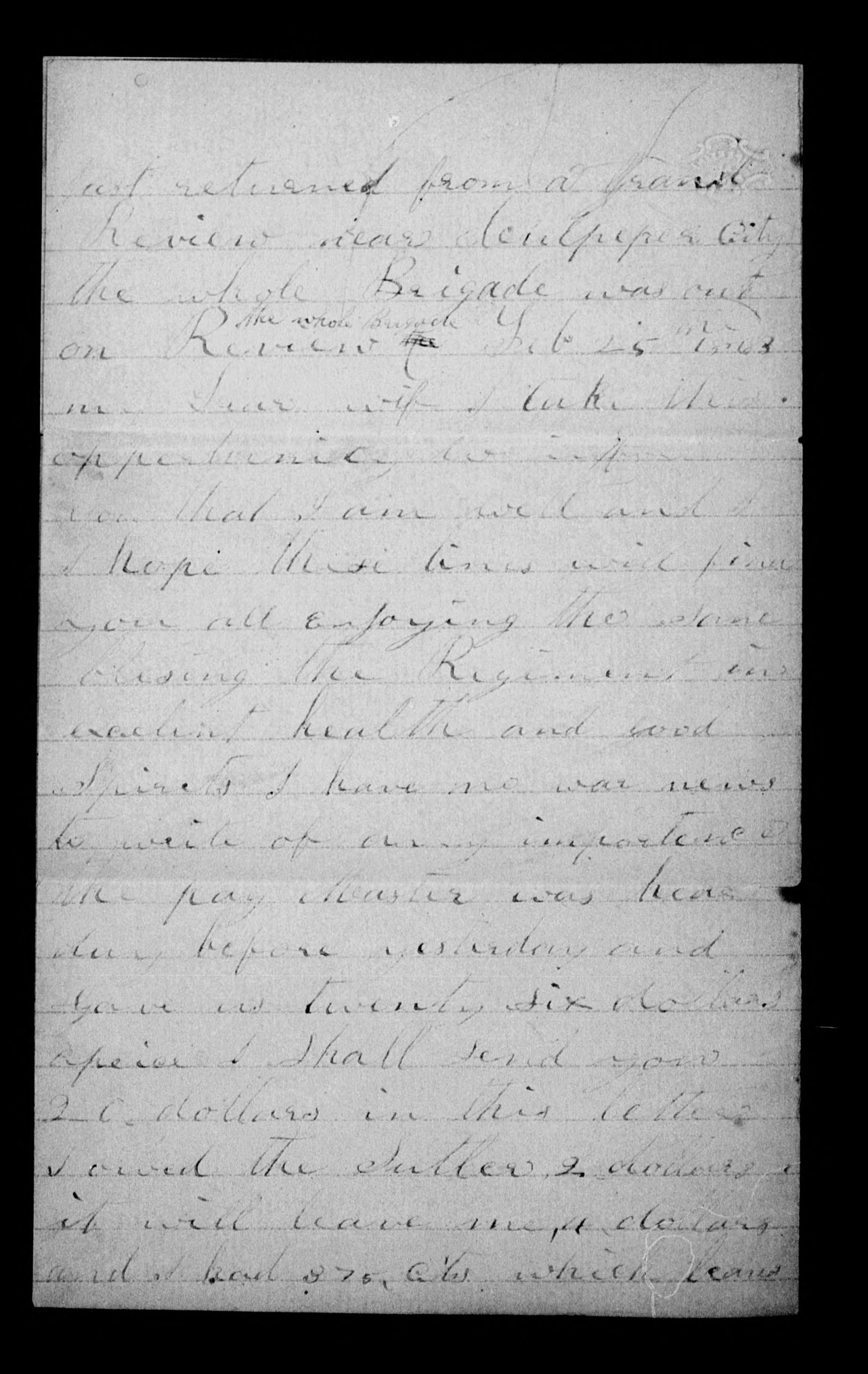
just returned from a Grand Review near Culpeper City the whole Brigade was out on Review
Feb 25th my Dear wife I take this oppertunity to inform you that I am well and I hope these lines will find you all Enjoying the same
leaving the Regiment in exelent health and good Spirits
I have no war news to write of any importance
the pay Master was hear day before yesterday and gave us twenty six dollars apeice I Shall send you 20 dollars in this letter
I owed the Sutler 2 dollars it will leave me 4 dollars and I had 3 75 cts which leaves
The whole brigade turned out for a grand review near Culpeper — the winter army being counted and inspected. The regiment is in “exelent health and good Spirits.”
Then the household ledger, kept to the cent. The paymaster came and gave twenty-six dollars apiece. He is sending twenty home. He owed the sutler two, which leaves four, and he had three dollars seventy-five already — seven seventy-five in hand, part of which he means to send Sarah later. A man on a private’s wage, accounting for every dollar to the wife who would spend it.
February 1864 — the threat, and the praise
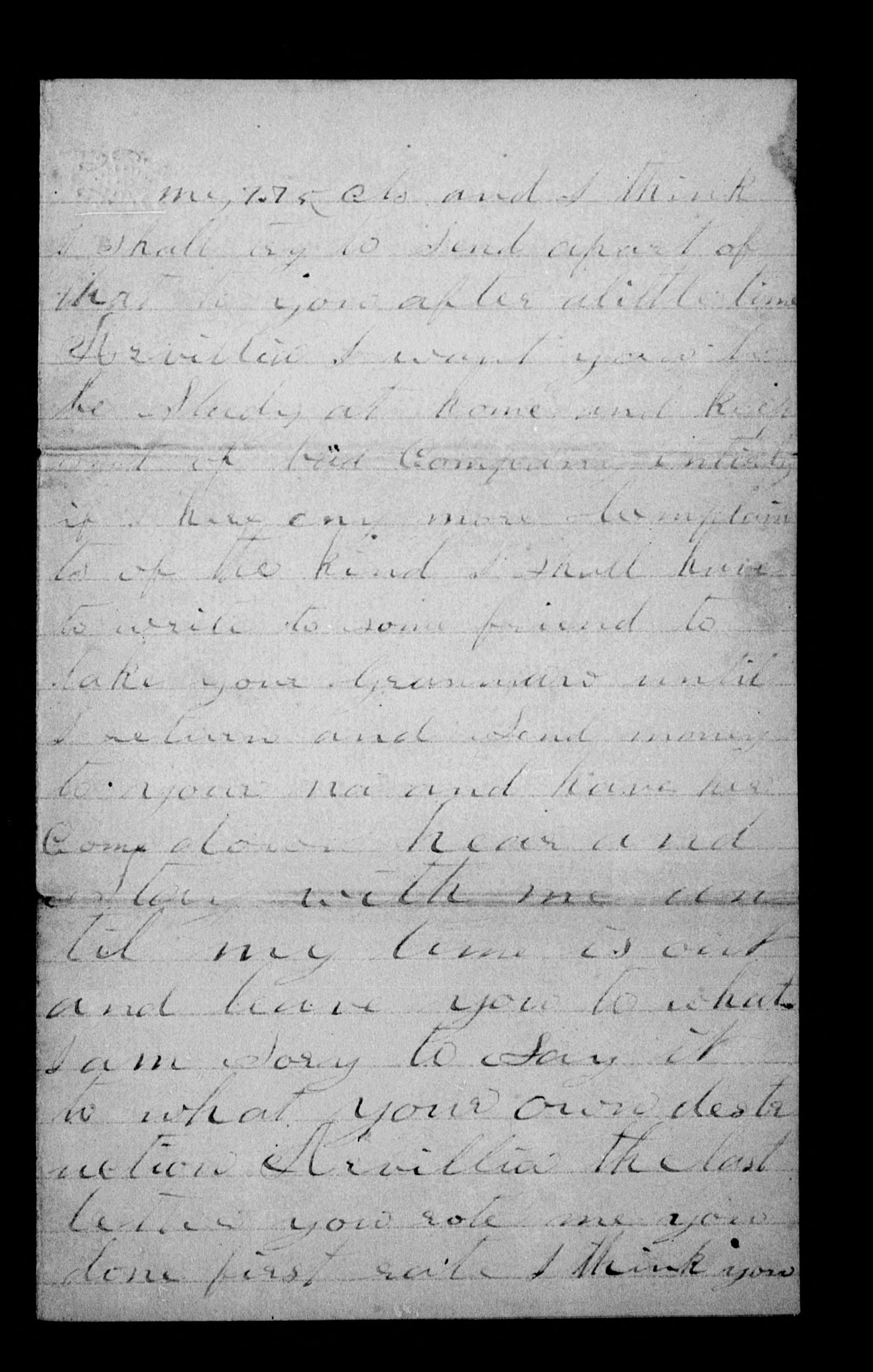
me 7 75 cts and I think I shall try to Send a part of that to you after a little time
Arvillia I want you to be Stedy at home and keep out of bad Company entirely
if I hear any more Complaints of the kind I Shall have to write to some friend to take your Grandmar until I return and Send money to your ma and have my Company home hear and Stay with me until my time is out
and leave you to what I am Sory to Say it to what your own destruction
Arvillia the last letter you rote me you done first rate I think you
He tells his daughter what will happen if she does not stop. This is the sternest passage in the collection, and it reveals how the household was held together. If he hears any more complaints of the kind, he writes, he will “write to some friend to take your Grandmar until I return, and Send money to your ma, and have my [mother] Company home hear and Stay with me until my time is out.”
Unpack that and a whole family economy appears. Benedict’s own mother was living in the household, helping Sarah run it. His threat is to break it up: farm the grandmother out to a friend, send Sarah cash instead of a grandmother’s labour, and bring his mother down to Virginia to live in camp with him — leaving Arvillia, he says, “to what I am Sory to Say it, to what your own destruction.” It is the threat of a man with almost no power, reaching for the one lever he has.
And then, unable to end on it, he praises her again in the very next breath: “Arvillia, the last letter you rote me you done first rate.” Every time he scolds this girl he closes by telling her she writes a good letter.
February 1864, closing sheet — the prayer meeting
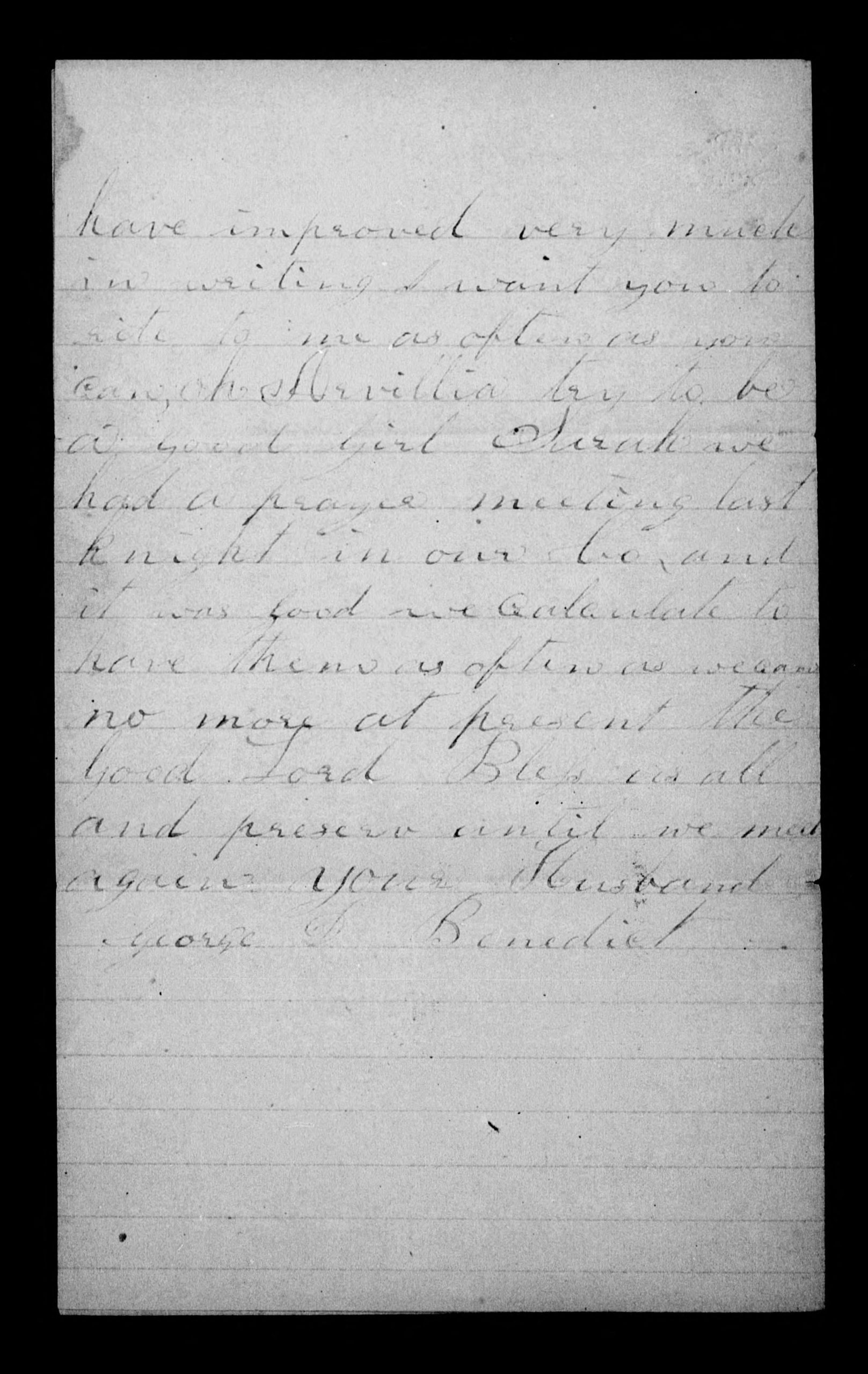
have improved very much in writing I want you to rite to me as often as you can
oh Arvillia try to be a good girl
Sarah we had a prayer meeting last knight in our Co and it was good we Calculate to have them as often as we can
no more at present the Good Lord Bless us all and preserve until we met again
your Husband George D Benedict
This closing sheet answers a question raised earlier in these letters. When Benedict complained that Colonel Thorp and the officers drank, gambled and did not keep the Sabbath, was that a sour man’s grievance or a real account of camp? Here is the other side of the same camp: “we had a prayer meeting last knight in our Co and it was good, we Calculate to have them as often as we can.”
Company G held its own prayer meetings. Benedict was not a scold inventing sins; he was a religious man in a company that met to pray, describing an officer class that did the opposite. Both are true, and both are now on the record.
And once more to his daughter, gentler this time: “oh Arvillia, try to be a good girl.”
February 1864 — the box in the Colonel’s tent, and Joseph Ingles found
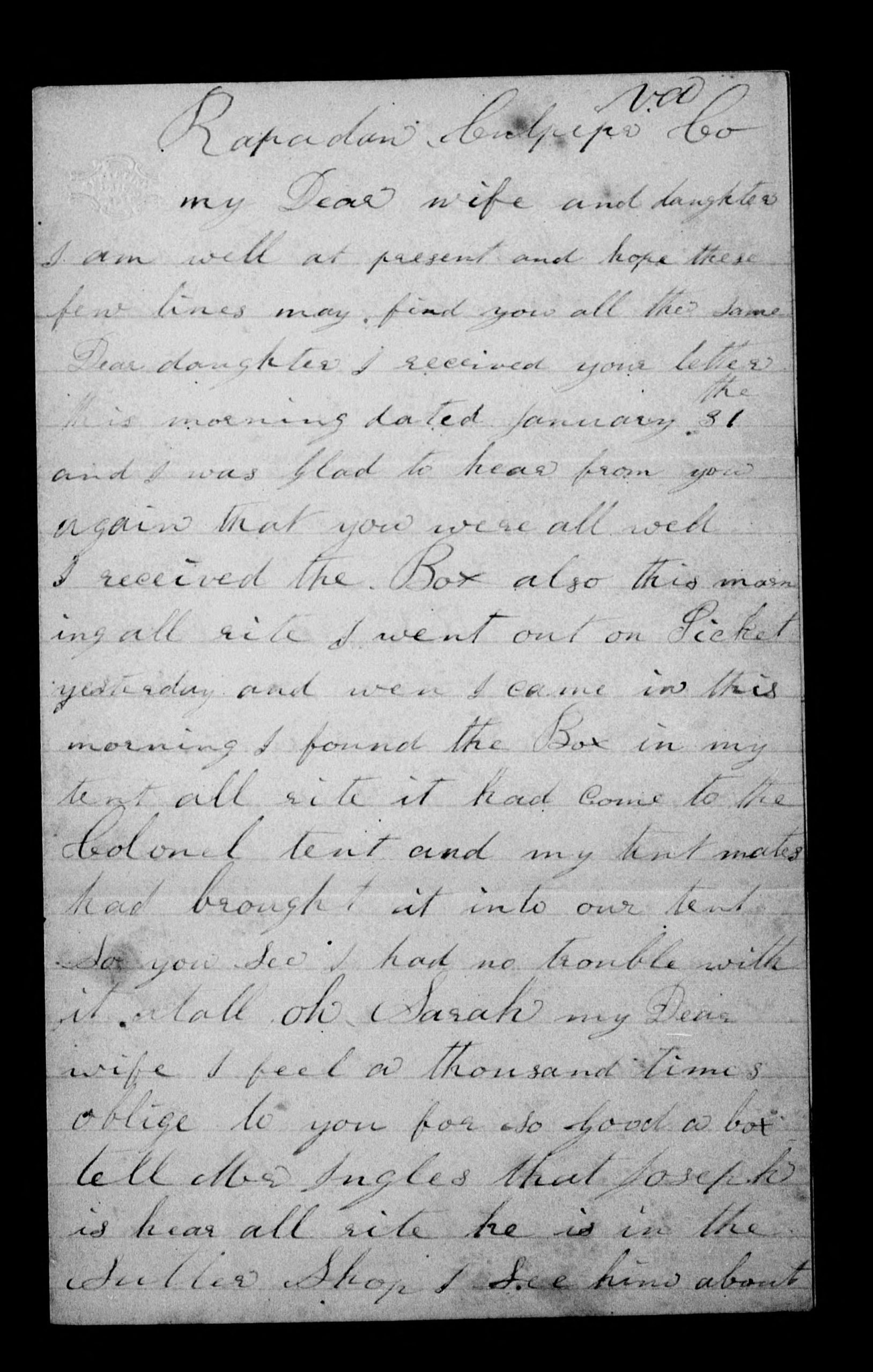
Rapadan Culpepr Co Va
my Dear wife and daughter I am well at present and hope these few lines may find you all the same
Dear daughter I received your letter this morning dated January 31 and I was glad to hear from you again that you were all well
I received the Box also this morning all rite I went out on Picket yesterday and wen I came in this morning I found the Box in my tent all rite it had Come to the Colonel tent and my tent mates had brought it into our tent so you see I had no trouble with it at all
oh Sarah my Dear wife I feel a thousand times oblige to you for so good a box
tell Mrs Ingles that Joseph is hear all rite he is in the Sutler Shop I See him about
A whole letter addressed “my Dear wife and daughter” — the quarrel of the last week evidently past. The box had been delivered to the Colonel’s tent and Benedict’s tent mates carried it over to his own, so “I had no trouble with it at all.” He is a thousand times obliged.
A name recovered. Back in November Benedict had written of a “Jo Ingles” whom this site could not identify, because no such man appears on the regiment’s combatant rolls. Here he is explained: “tell Mrs Ingles that Joseph is hear all rite, he is in the Sutler Shop, I See him about every day.”Joseph Ingles worked in the sutler’s shop — a civilian trader’s establishment attached to the regiment, which is why he is not on the muster roll. The roster was right and so was Benedict; the two simply describe different populations of the same camp.
February 1864 — the roll of neighbours, and a warning of the move
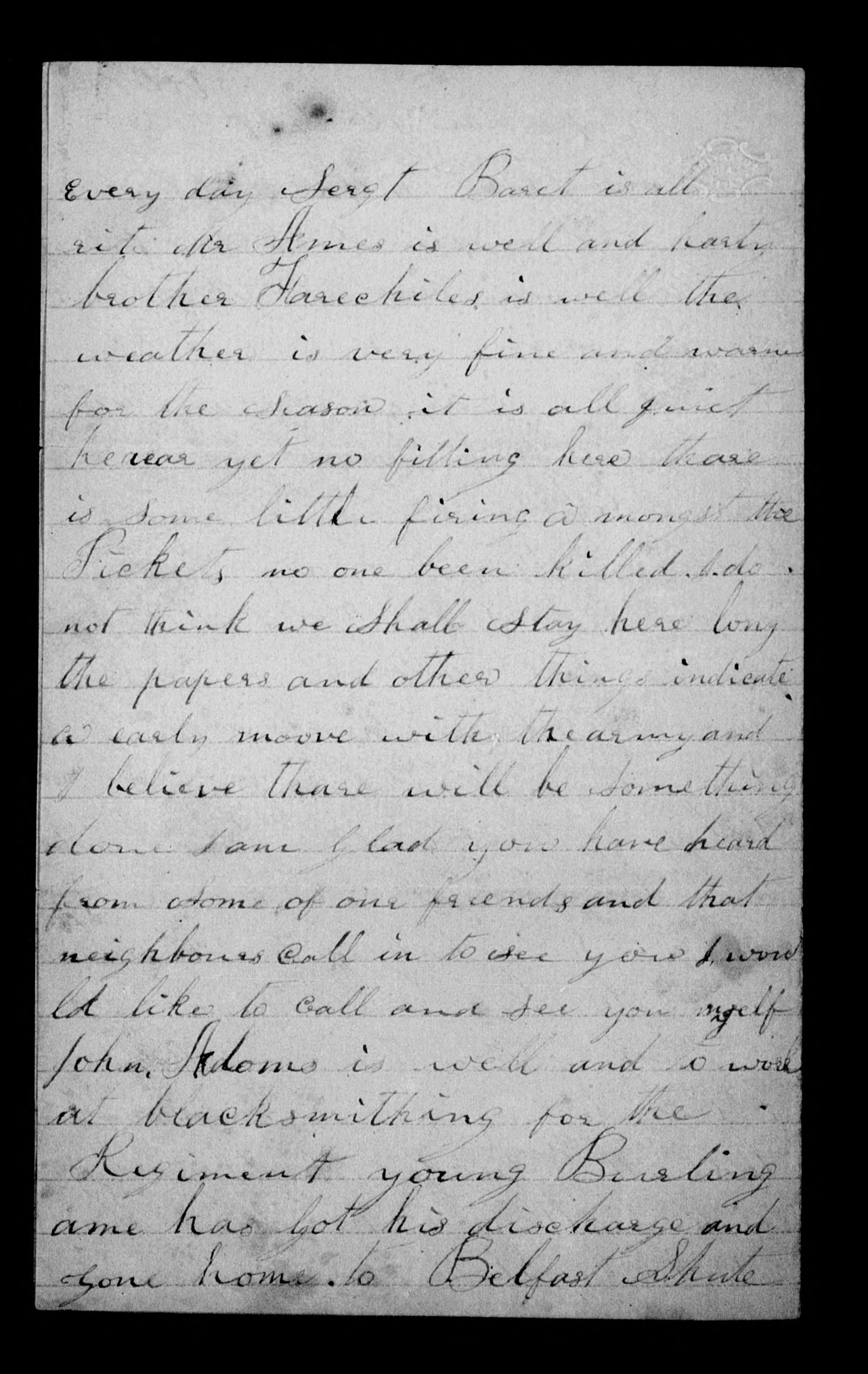
every day
Sergt Baret is all rite Mr Ames is well and harty brother Farechiles is well
the weather is very fine and warm for the Season it is all quiet herear yet no fitting here thare is some little firing amongst the Pickets no one been killed
I do not think we Shall Stay here long the papers and other things indicate a early moove with the army and I believe thare will be Something done
I am glad you have heard from Some of our friends and that neighbours Call in to see you I would like to call and see you myself
John Adams is well and to work at blacksmithing for the Regiment
young Burlingame has got his discharge and gone home to Belfast Shute
The usual roll of men from home, all well: Sergeant Barrett, Ames, “brother Fairchild”, and John Adams, still “at work at blacksmithing for the Regiment.” And a departure: “young Burlingame has got his discharge and gone home to Belfast.”
And then the shadow. There is picket firing but no one killed, and the camp is quiet — but “I do not think we Shall Stay here long, the papers and other things indicate a early moove with the army, and I believe thare will be Something done.” This is late February 1864. The “something” was Grant’s Overland Campaign. It opened at the Wilderness in the first week of May, and Benedict was shot at Todd’s Tavern on 7 May. He saw it coming.
The homesickness is plain and undramatic: neighbours call in to see Sarah, and “I would like to call and see you myself.”
8 February 1864 — rations to the poor, and a discharge confirmed
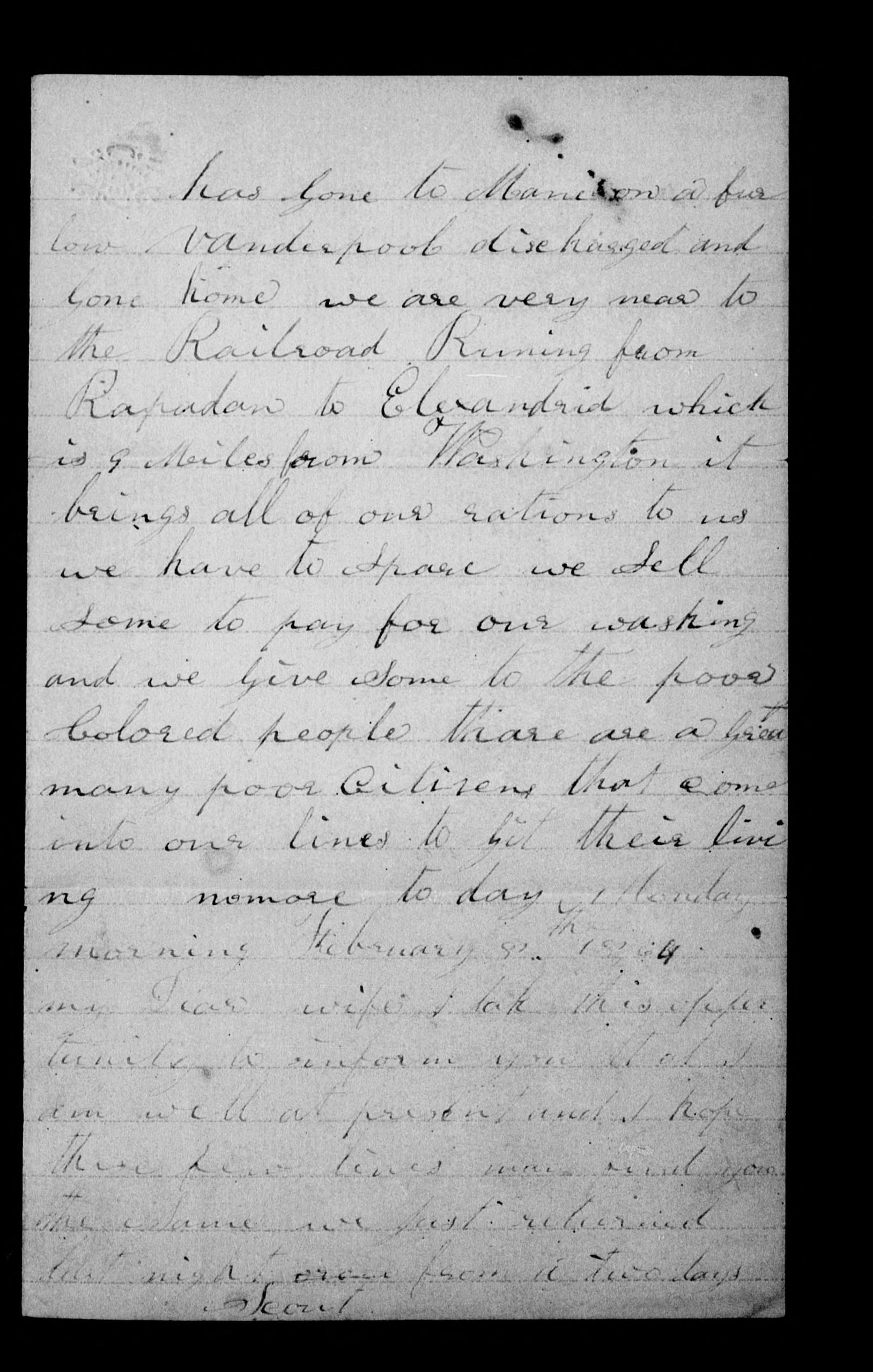
[Shute] has gone to Manitou a furlow, Vanderpool discharged and gone home
we are very near to the Railroad Runing from Rapadan to Elexandria which is 9 Miles from Washington it brings all of our rations to us we have to Spare we Sell Some to pay for our washing and we give Some to the poor colored people thare are a great many poor Citizens that come into our lines to git their living
no more to day
Monday morning February 8th 1864 my Dear wife I take this oppertunity to inform you that I am well at present and I hope these few lines may find you the same we just returned last night over from a two days Scout
Two men accounted for at the head of the page: someone gone to Manitou on furlough, and Corporal Vanderpool“discharged and gone home” — the second time Benedict reports this, and a further sign that Vanderpool’s long illness ended his war well before the roster’s formal discharge date of 19 January 1864.
Then a page that shows the war’s human edge. The railroad from the Rapidan to Alexandria — nine miles from Washington — brings the regiment more rations than it can eat. What do they do with the surplus? “We Sell Some to pay for our washing, and we give Some to the poor colored people. Thare are a great many poor Citizens that come into our lines to git their living.”
This is the ground-level reality of emancipation and displacement in wartime Virginia: freed and destitute people, black and white, coming into the Union lines to survive, fed from the spare rations of a New York cavalry regiment. Benedict records it without fanfare, as one more fact of camp, and in doing so preserves something the official record does not.
8 February 1864, closing sheet — the brigade out, the regiment held back
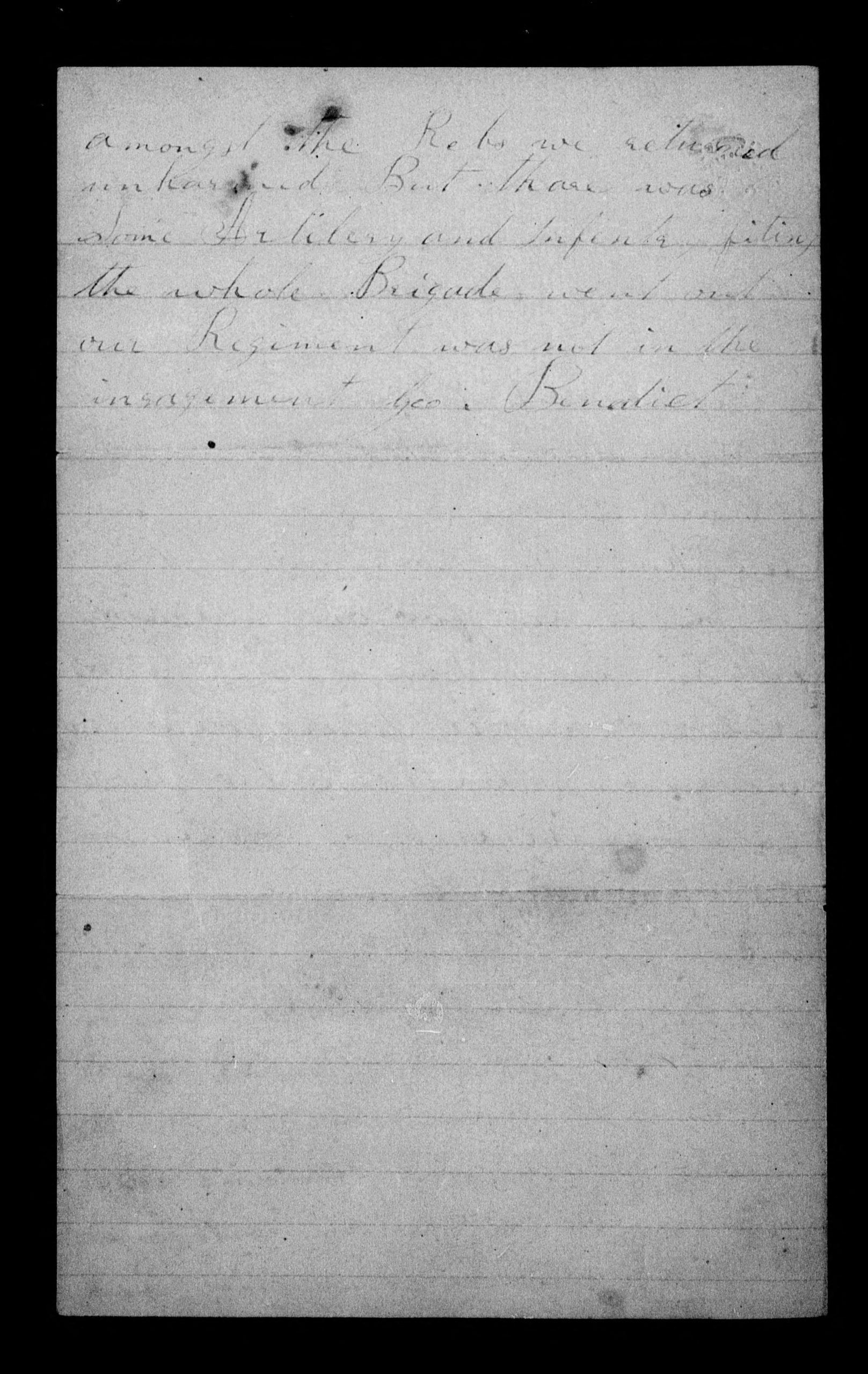
amongst the Rebs we returned unharmed But thare was Some Artillery and Infantry fiting the whole Brigade went out our Regiment was not in the ingagement
Geo Benedict
The regiment had just come in from a two-day scout among the enemy, “unharmed.” The whole brigade went out and there was some artillery and infantry fighting, but “our Regiment was not in the ingagement.” Another action watched rather than fought — the pattern of this regiment’s quiet winter, before the spring that would end it.
A note on the film: the library’s scan captures this closing sheet twice, on two consecutive frames. Only the one page exists; it was simply photographed a second time. We show it once.
The Overland Campaign & Todd’s Tavern
April–May 1864 · 7 letters24 April 1864 — “who do you suppose Came”: Brother Samuel
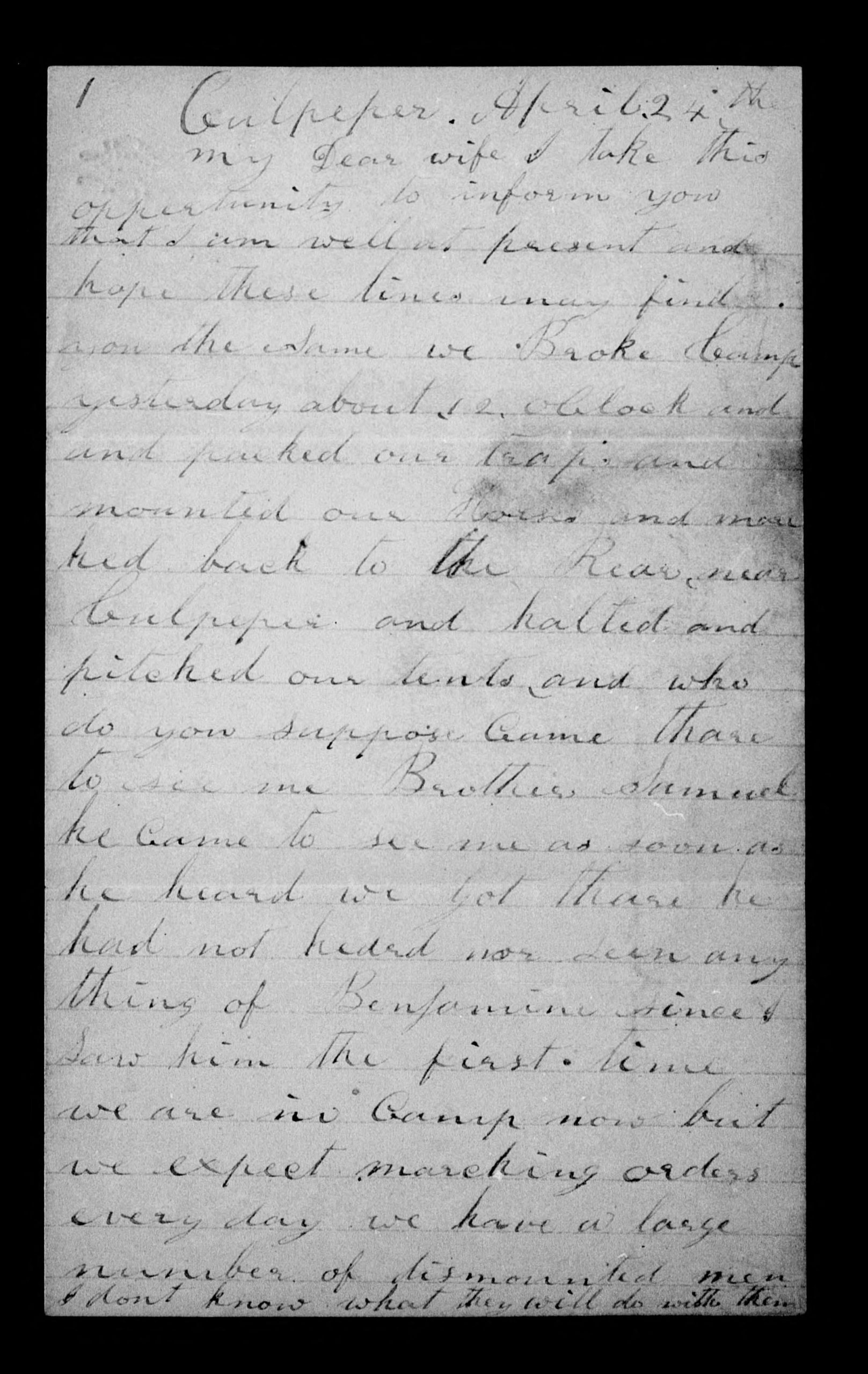
Culpeper April 24th
my Dear wife I take this oppertunity to inform you that I am well at present and hope these lines may find you the same
we Broke Camp yesterday about 12 oclock and packed our traps and mounted our Horses and marched back to the Rear near Culpeper and halted and pitched our tents
and who do you suppose Came thare to see me Brother Samuel he Came to see me as soon as he heard we got thare he had not heard nor seen anything of Benjamine Since I Saw him the first time
we are in Camp now but we expect marching orders every day we have a large number of dismounted men I dont know what they will do with them
The brother has a name. Back in January, Benedict had written that he had “not heard any thing from Brother at Washington yet,” and this site could only record the question. Here is the answer, and it is a good one. The regiment marched back near Culpeper and pitched tents, “and who do you suppose Came thare to see me — Brother Samuel. He Came to see me as soon as he heard we got thare.”
And a second brother surfaces in the same breath: Samuel “had not heard nor seen anything of Benjamine since I Saw him the first time.” Benedict had two brothers in the army — Samuel and Benjamin — and the three of them were trying to find each other in the vast machine of the Army of the Potomac.
The unease underneath is plain: marching orders expected every day, and “a large number of dismounted men, I dont know what they will do with them.” An army being sorted and readied. This is two weeks before the Wilderness.
24 April 1864 — three brothers in one army, and the peach trees in bloom
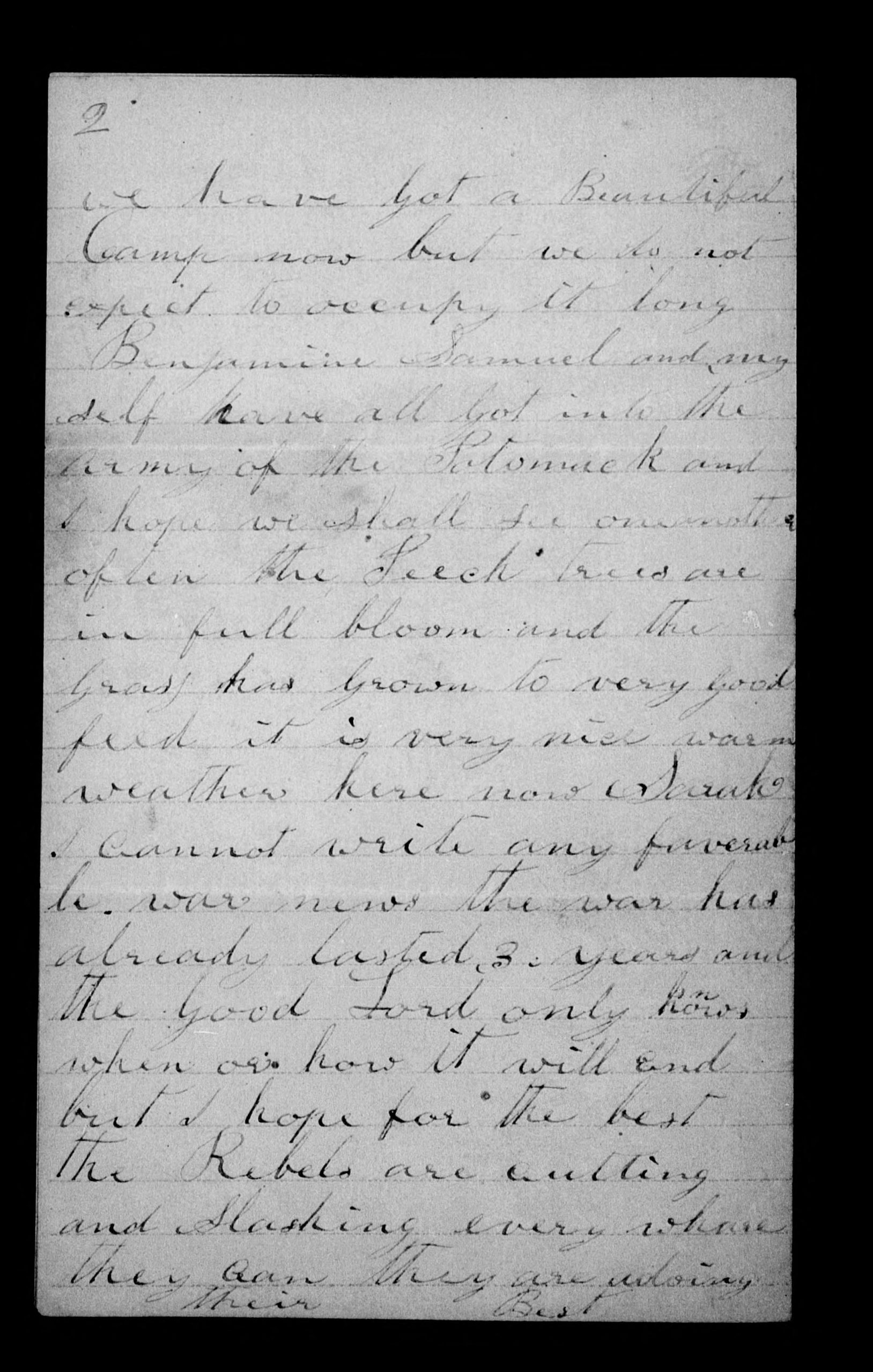
we have got a Beautiful Camp now but we do not expect to occupy it long
Benjamine Samuel and myself have all got into the Army of the Potomack and I hope we Shall See one another often
the Peech trees are in full bloom and the grass has grown to very good feed it is very nice warm weather here now
Sarah I Cannot write any faverable war news the war has already lasted 3 years and the Good Lord only knows when or how it will end but I hope for the best
the Rebels are cutting and Slashing every whare they can they are adoing their Best
The reunion, stated plainly: “Benjamine, Samuel and myself have all got into the Army of the Potomack, and I hope we Shall See one another often.” Three Benedict brothers under one army in the spring of 1864. Whether they ever did see one another often, these letters do not say.
Around the sorting of men for a campaign, spring comes on regardless: “the Peech trees are in full bloom and the grass has grown to very good feed, it is very nice warm weather here now.” A cavalryman notices grass because grass is what his horse eats. The peach blossom he notices for its own sake.
And the weariness of a man three years into it: “the war has already lasted 3 years, and the Good Lord only knows when or how it will end, but I hope for the best.” He had two weeks.
26 April 1864 — the enemy fishing within thirty rods
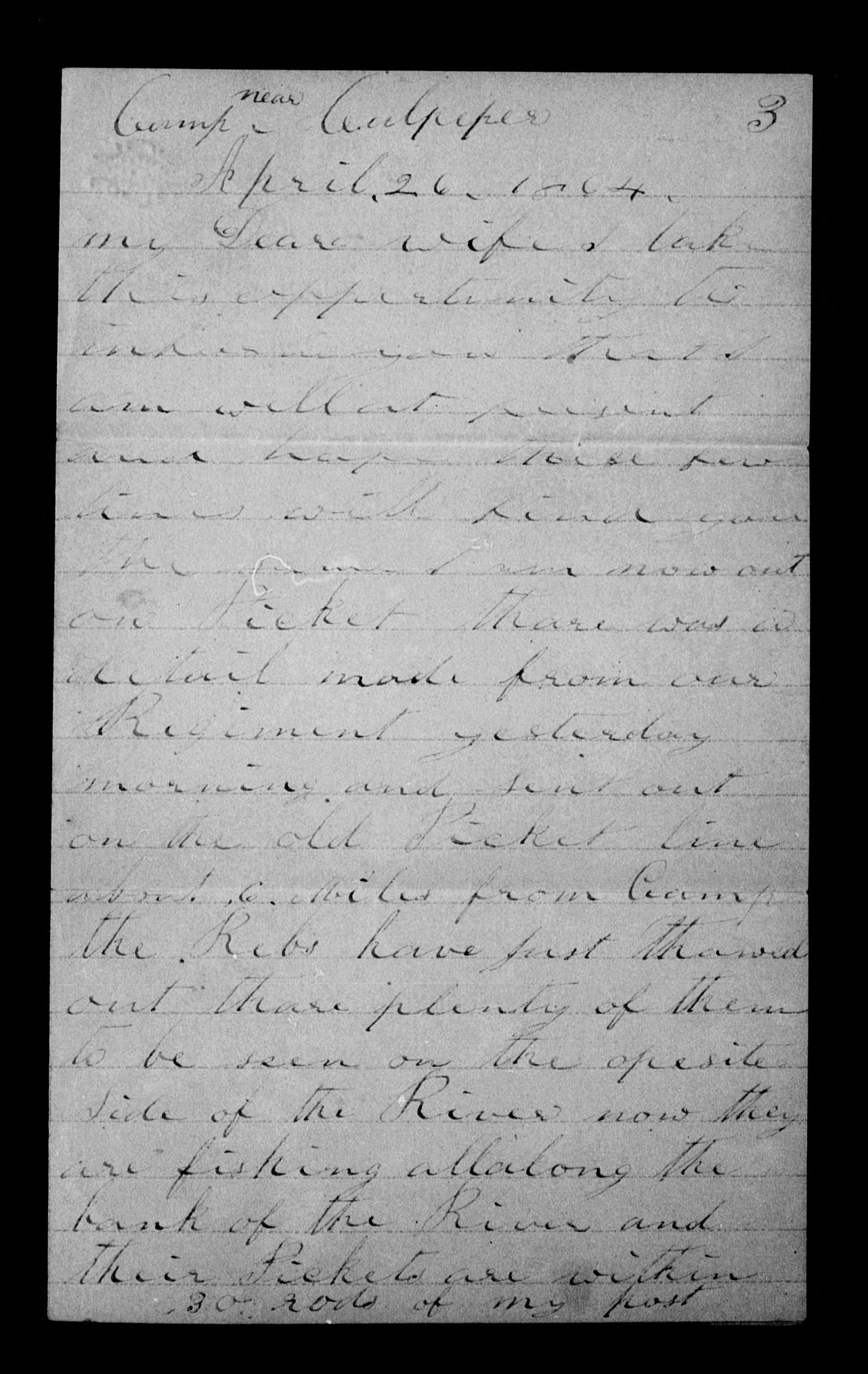
Camp near Culpeper April 26 1864
my Dear wife I take this oppertunity to inform you that I am well at present and hope these few lines will find you the Same
I am now out on Picket thare was a detail made from our Regiment yesterday morning and sent out on the old Picket line about 6 Miles from Camp
the Rebs have just thawed out thare plenty of them to be seen on the oposite side of the River now they are fishing all along the bank of the River and their Pickets are within 30 rods of my post
One of the strangest and quietest images in the whole collection. Out on the old picket line six miles from camp, Benedict watches the enemy across the river with the spring thaw: “the Rebs have just thawed out, thare plenty of them to be seen on the oposite side of the River, now they are fishing all along the bank of the River, and their Pickets are within 30 rods of my post.”
Thirty rods is about a hundred and sixty-five yards. The men he would be sent to kill in a week’s time are close enough to see plainly, and they are fishing. The informal truce of the picket line — two armies within earshot, leaving each other be — is a thing veterans wrote about often and historians can rarely date. Here it is, dated: 26 April 1864, on the Rapidan, eleven days before the Wilderness.
26 April 1864 — a soldier’s verdict: cavalry over infantry
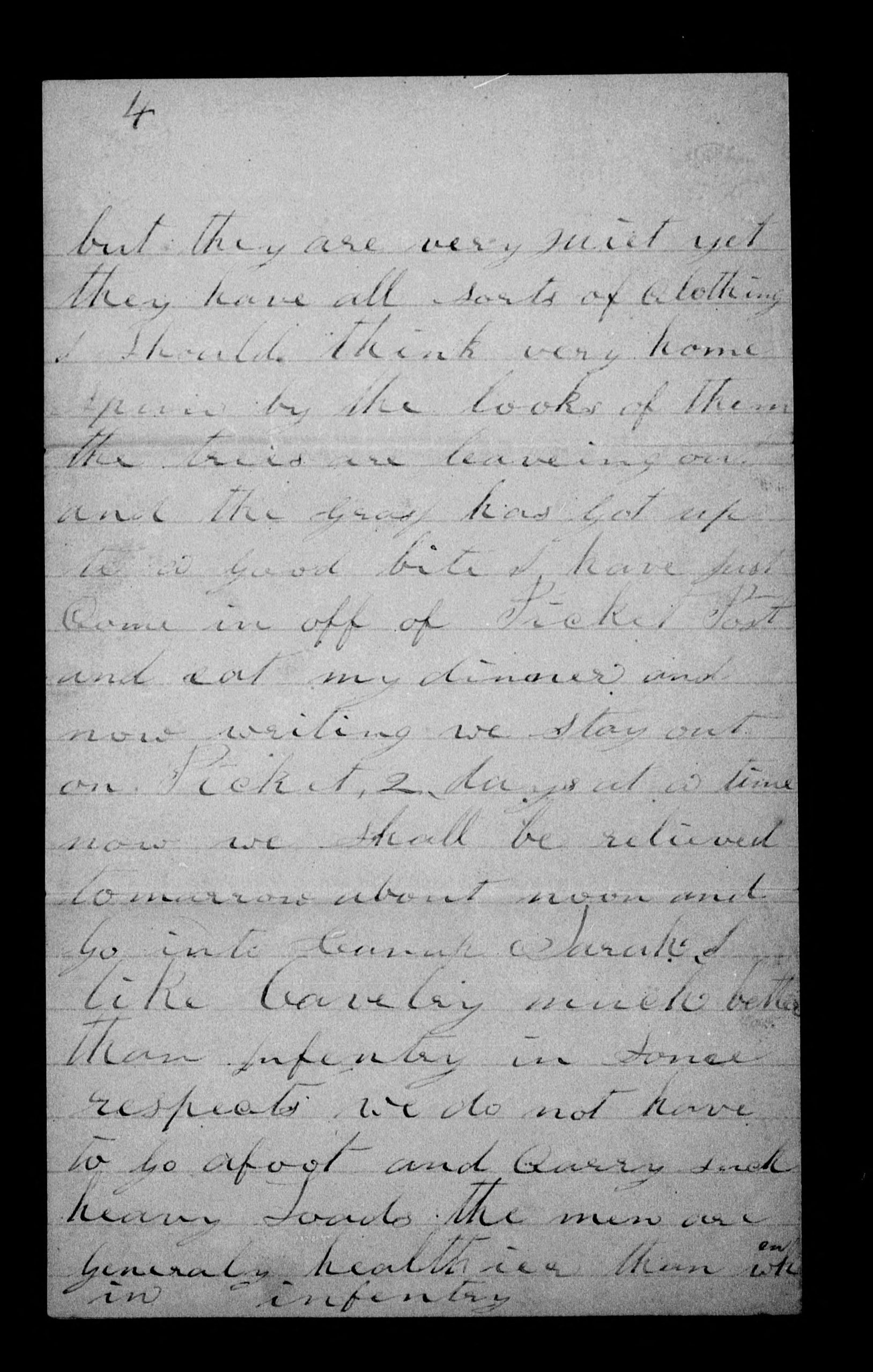
but they are very quiet yet they have all sorts of Clothing I Should think very home Spun by the looks of them
the trees are leaveing out and the gras has got up to a good bite
I have just Come in off of Picket Post and eat my dinner and now writing we Stay out on Picket 2 days at a time now we Shall be relieved tomarrow about noon and go into Camp
Sarah I like Cavelry much beter than Infentry in Some respects we do not have to go afoot and Carry Such heavy loads the men are generaly healthier than in Infentry
He looks across at the enemy and sees not an army but poor men: “they have all sorts of Clothing, I Should think very home Spun by the looks of them.” By the spring of 1864 the Confederacy could no longer uniform its soldiers, and a New York private notices it from a hundred and sixty-five yards.
Then his own considered judgement, after eight months mounted, on the choice that Colonel Gibbs had made for the regiment: “I like Cavelry much beter than Infentry in Some respects. We do not have to go afoot and Carry Such heavy loads. The men are generaly healthier than in Infentry.” The man who lived the conversion thought it was the right one.
27 April 1864 — dead horses in all directions, and a great battle expected
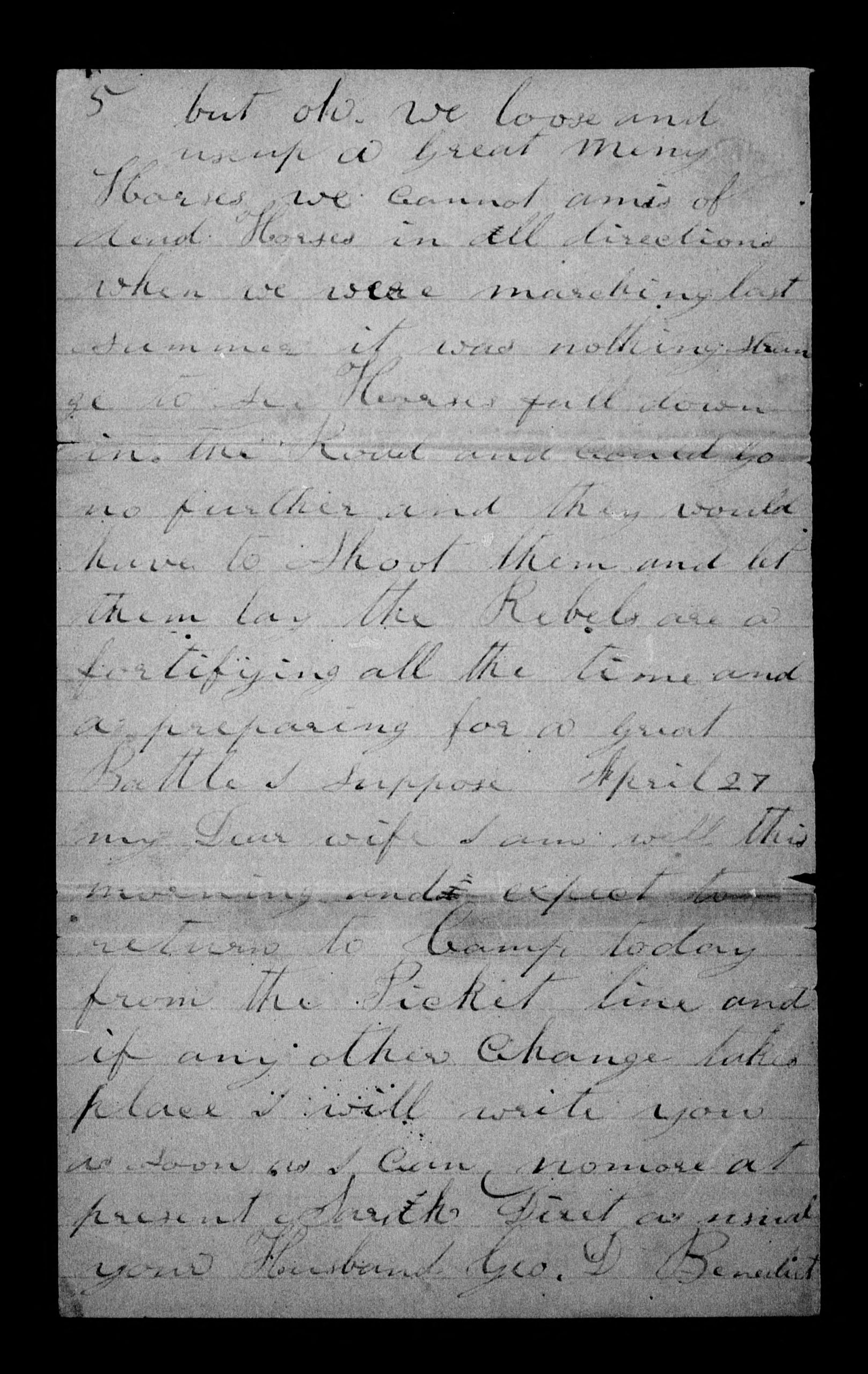
but old we loose and use up a great meny Horses we Cannot amis of dead Horses in all directions
when we were marching last summer it was nothing Strange to See Horses fall down in the Road and could go no further and they would have to Shoot them and let them lay
the Rebels are a fortifying all the time and a preparing for a great Battle I Suppose
April 27 my Dear wife I am well this morning and expect to return to Camp today from the Picket line and if any other Change takes place I will write you as soon as I Can
no more at present Sarah Direct as usual
your Husband Geo. D. Benedict
He finishes the thought honestly, with the cost the cavalry paid that the infantry did not: horses. “We loose and use up a great meny Horses, we Cannot amis of dead Horses in all directions.” On last summer’s marches it was “nothing Strange to See Horses fall down in the Road and could go no further, and they would have to Shoot them and let them lay.” The roadside of a cavalry campaign, described plainly.
And then the sentence that hangs over everything after it: “the Rebels are a fortifying all the time and a preparing for a great Battle I Suppose.” He was right. Grant crossed the Rapidan on 4 May. The Wilderness opened on the 5th. Benedict was shot at Todd’s Tavern on the 7th.
This is the last full letter in the collection. He signs it, as he signed so many, “your Husband, Geo. D. Benedict,” and tells Sarah to direct her next as usual. There would be little time for another.
The envelope — Mrs Geo. Benedict, Belvidere
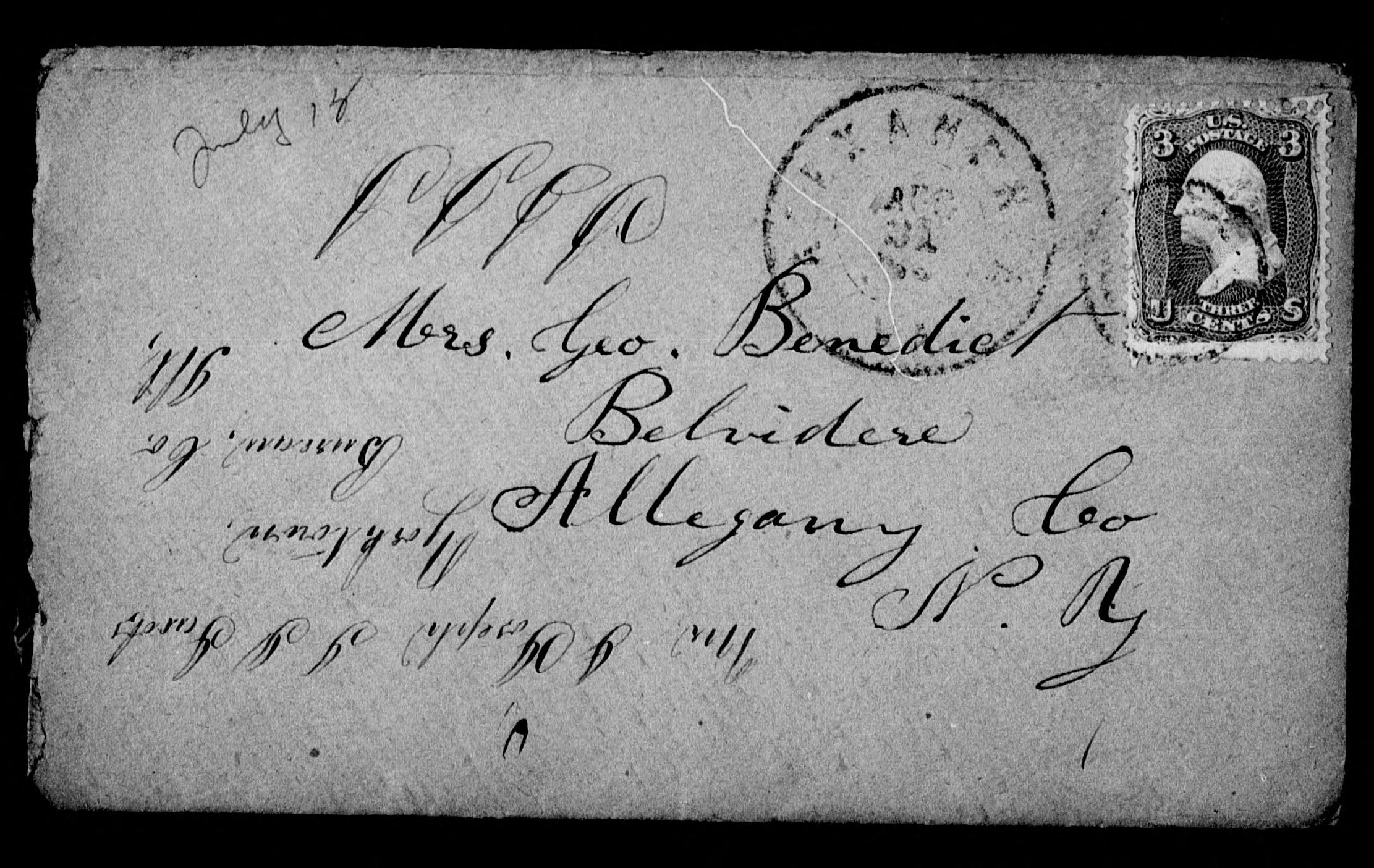
[Envelope, postmarked Alexandria] Mrs Geo. Benedict, Belvidere, Allegany Co, N. Y. [three-cent Washington stamp; a later pencil docket reads] July 18
Among the sheets the collection preserves one of the envelopes, and it is worth showing whole. In his own careful hand: “Mrs Geo. Benedict, Belvidere, Allegany Co, N. Y.” The three-cent rose Washington stamp, the standard Civil War letter rate, and a postmark.
This is the physical object at the far end of every one of these letters: the address he wrote a hundred times, the wife who kept them, the town on the Genesee they travelled to. A pencil docket in a later hand reads July 18. The envelope outlived the marriage — Sarah kept it, with the letters, for the rest of her life.
18 May 1864 — The News from Fredericksburg
The News from Fredericksburg
A letter to Sarah Benedict from the hospital where her husband lay wounded — not in his hand, but about him. 18 May 1864.
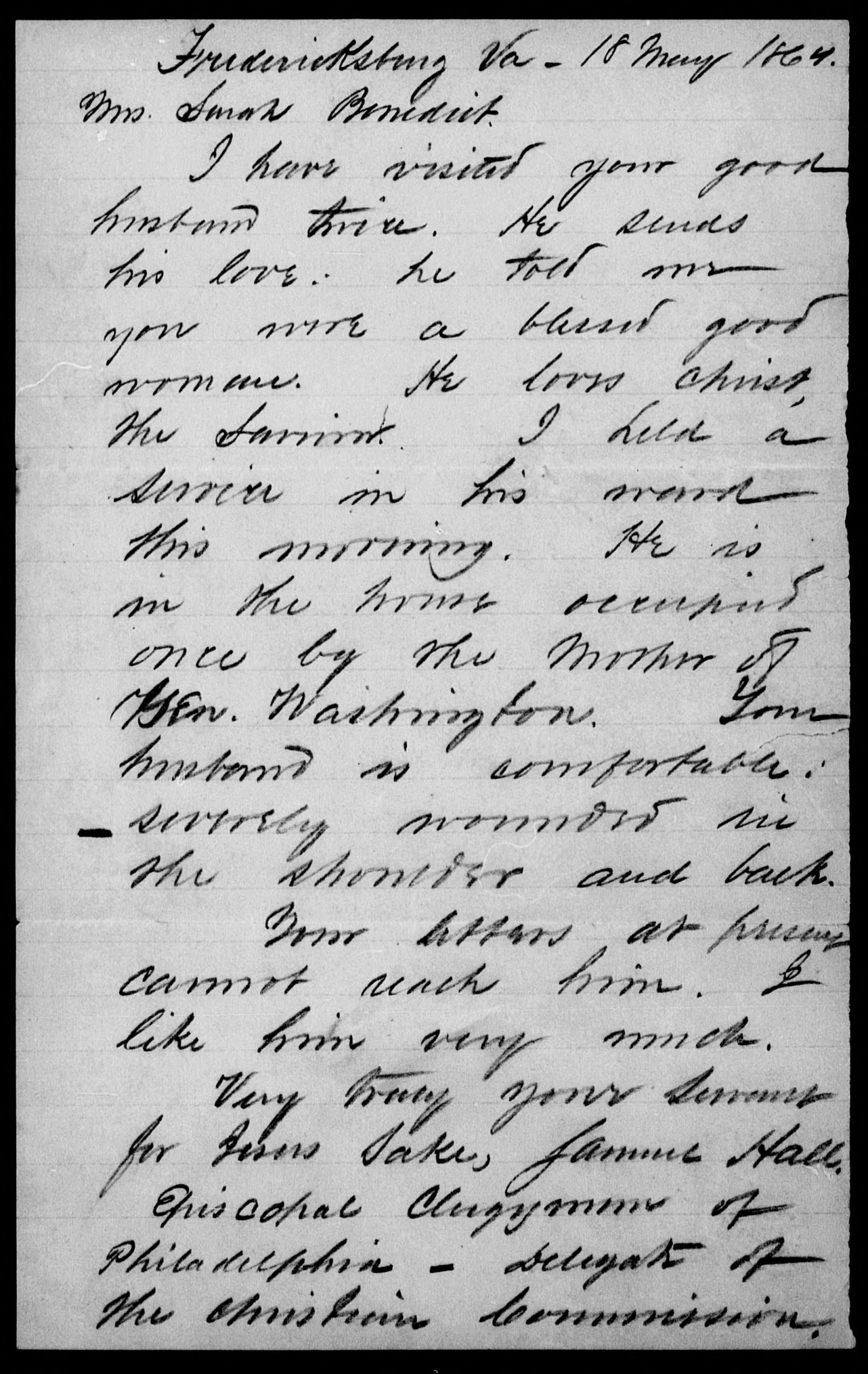
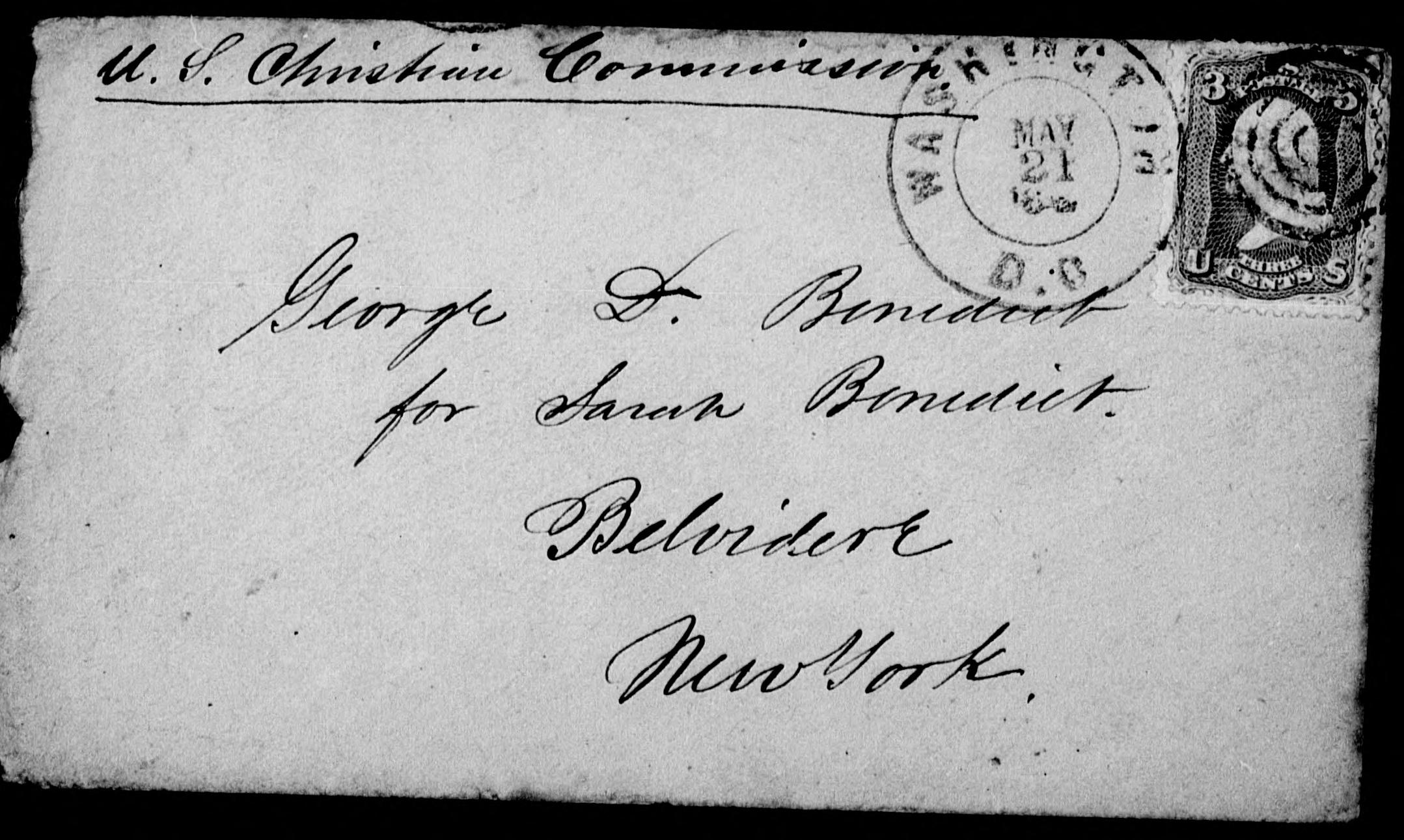
The letter, transcribed in full
Fredericksburg Va – 18 May 1864
Mrs. Sarah Benedict.
I have visited your good husband twice. He sends his love. He told me you were a blessed good woman. He loves Christ, the Saviour. I held a service in his ward this morning. He is in the house occupied once by the Mother of Gen. Washington. Your husband is comfortable – severely wounded in the shoulder and back.
Your letters at present cannot reach him. I like him very much.
Very truly your servant for Jesus’ Sake, James Hall, Episcopal Clergyman of Philadelphia – Delegate of the Christian Commission,
Pension File — National Archives
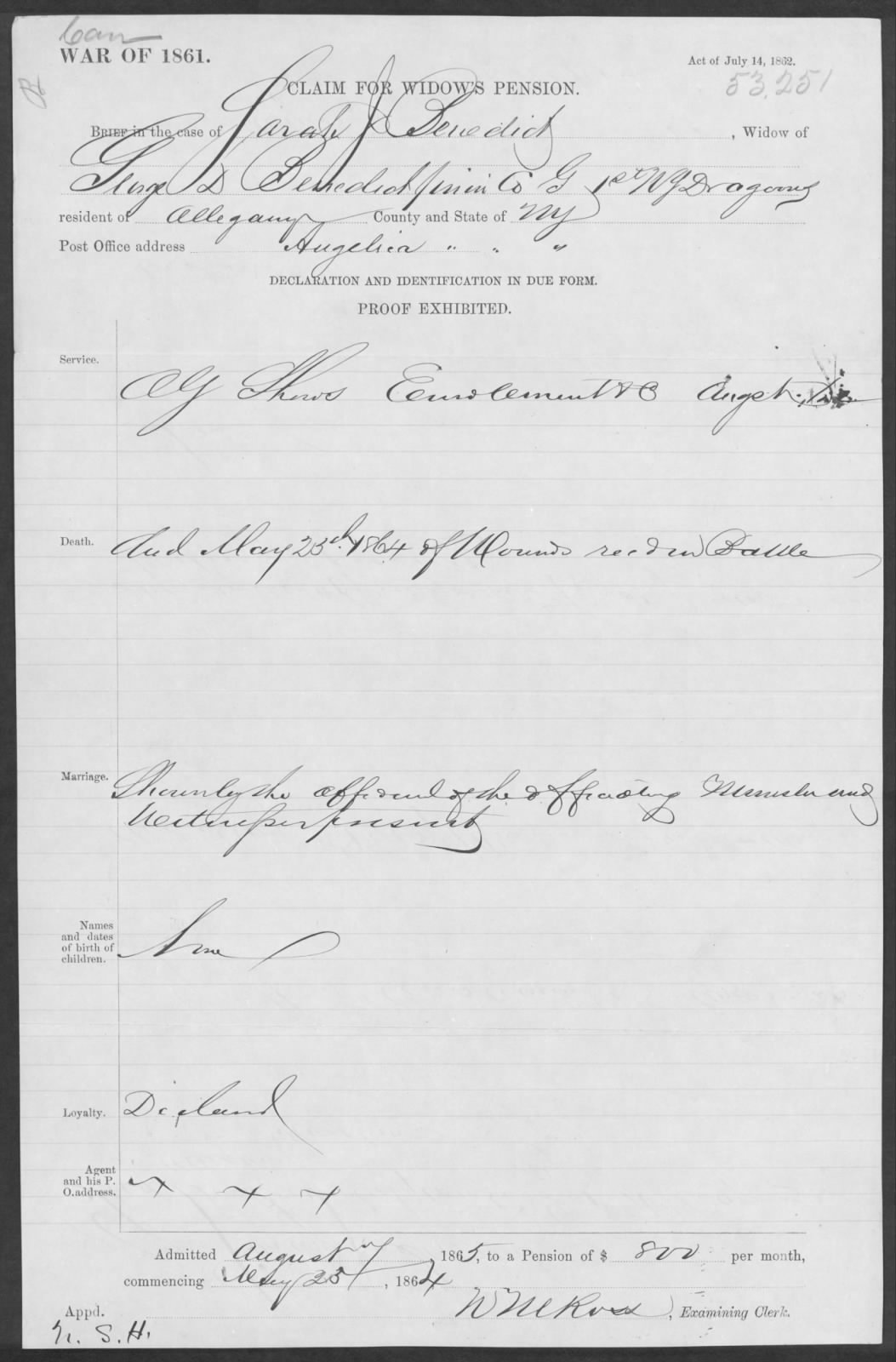
Transcription (read from the manuscript):
War of 1861 — Act of July 14, 1862 — No. 53,251 — Claim for Widow's Pension.
Brief in the case of Sarah J. Benedict, widow of George D. Benedict [Jun'r], Co. G, 1st N.Y. Dragoons, resident of Allegany County and State of N.Y. Post-office address: Angelica.
Declaration and identification in due form. Proof exhibited.
Service. — A.G. [Report] shows enlistment &c., August [1862], [Angelica].
Death. — Died May 25th, 1864, of wounds received in battle.
Marriage. — Shown by the affidavit of the officiating Minister and witnesses present.
Names and dates of birth of children. — None.
Loyalty. — Declared.
Admitted August 7, 1865, to a pension of $8.00 per month, commencing May 25, 1864. Appd. [initials] Jn. S. H. N. W. Rose, Examining Clerk.
Source: Declaration for a Widow’s Pension of Sarah J. Benedict, widow of Private George D. Benedict, Co. G, 1st New York Dragoons, 1865. U.S. Civil War Widows’ Pension file no. WC 53,251; Records of the Department of Veterans Affairs (Record Group 15), National Archives. National Archives Identifier 115942209 (catalog.archives.gov/id/115942209). Digitized through the National Archives / FamilySearch / Fold3 partnership; fold3.com/image/271016642.
This is the letter a family dreaded and waited for. It is the only sheet in the collection not written by George Benedict, and it is about him. The Rev. James Hall, an Episcopal clergyman of Philadelphia serving as a delegate of the United States Christian Commission — the wartime volunteer body that ministered to the sick and wounded — had visited Benedict twice in hospital at Fredericksburg and wrote to his wife to tell her so.
Benedict had been shot at Todd’s Tavern on 7 May 1864, in the opening days of Grant’s Overland Campaign — the “great Battle” he had told Sarah, from picket, that he supposed was coming. He was carried back to Fredericksburg, which the army had turned into one vast hospital, and laid in the house once occupied by Mary Washington, the mother of George Washington — a building that still stands. There a Philadelphia minister held a service in his ward, found him “comfortable, severely wounded in the shoulder and back,” and carried his love home in a letter because “your letters at present cannot reach him.”
The minister was gentle and he was hopeful, and he was wrong. George D. Benedict died of his wounds on 25 May 1864, one week after this letter was written, and never came home to the wife and daughter whose letters could not reach him. The comfort in these lines — he sends his love, he loves Christ, he told me you were a blessed good woman — was the last word Sarah would have of her husband alive.
A note on a companion cover. The collection also preserves the flap of a second envelope, in another hand, bearing the return address of a “Mrs Joseph Jacobs, Yorktown, Bureau Co., Illinois.” Its connection to the family is not established here, and it is left as an open question for descendants who may recognise the name.
The men he names
Every man Benedict mentions can be identified on the regiment’s roll, and every one of them served in his own Company G:
- Benjamin A. Ames— Co. G, Angelica. “Mr Ames of Angelica … is a preacher and belongs to the Close Baptis”
- Simeon Bennett— Co. G, Granger. “Simeon Bennet of Short tract … he is a good boy”
- Calvin Buckley— Co. G, Angelica. “Calvin Buckley of Angelica”
- David B. Abbey— Co. G, Angelica. one of “the Abbey Boys … god boys and agreeable”
- Gehiel Abbey— Co. G, Genesee Falls. one of “the Abbey Boys”
- George N. Briggs— Co. G, Springwater. “Geo. Briggs”
Source. Benedict, G. D. (1863–1864). George D. Benedict Papers (Collection #4943-z). Southern Historical Collection, Louis Round Wilson Special Collections Library, University of North Carolina at Chapel Hill. Transcribed from the digitised manuscript; spelling and punctuation are the writer’s own.
His Pension File
23 sheets · National Archives · every one transcribed in full
Approved Pension Application File for Sarah J Jacobs Benedict, Widow of George D Benedict, Company G, 19th New York Cavalry Regiment (Application No. WC53251)
Expand allSheet 1 · The Pension Office Brief — “of Wounds recd in Battle”
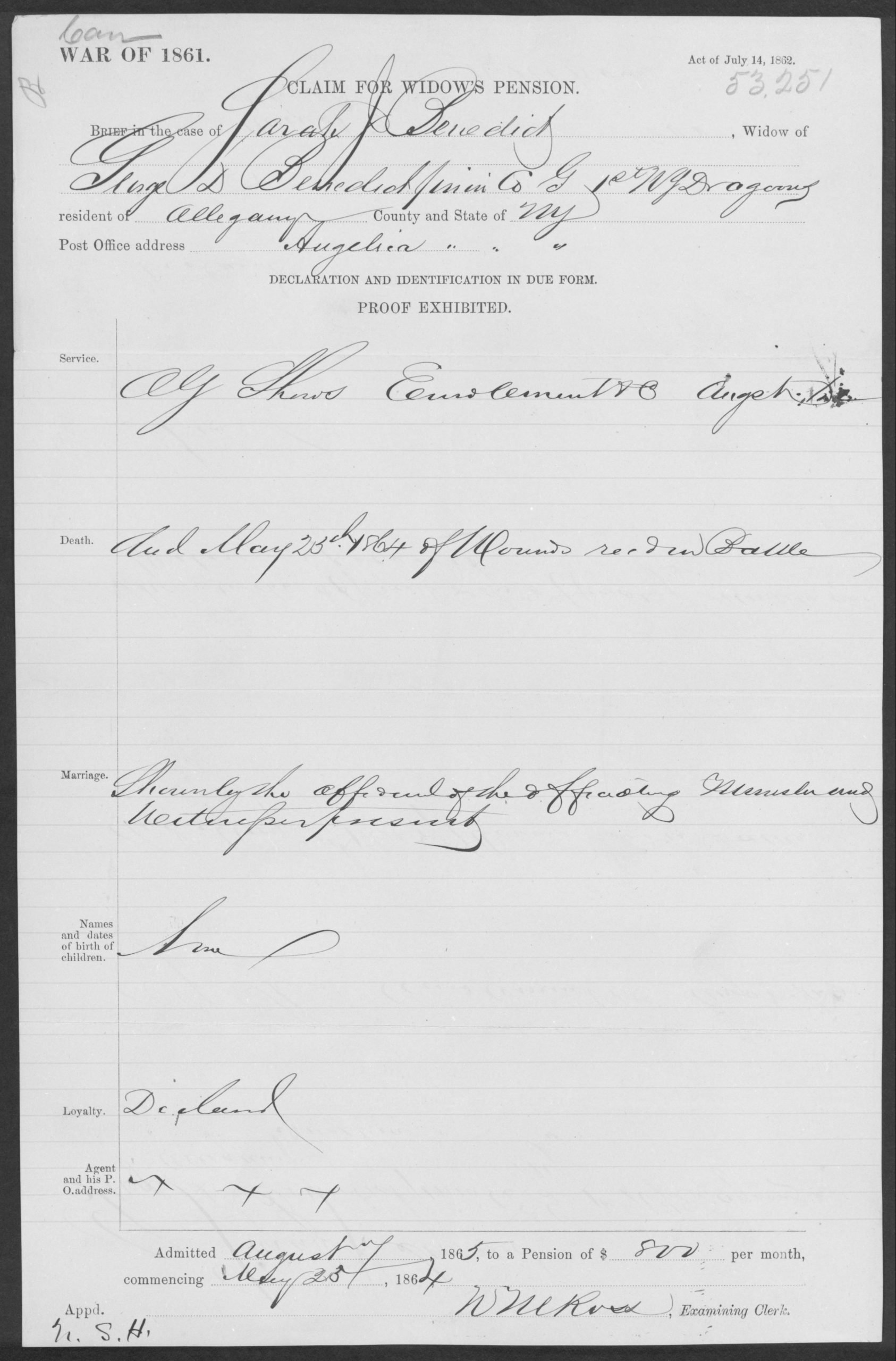
[The Pension Office Brief, the clerk’s abstract of the whole claim on one printed sheet. Sarah J. Benedict of Angelica, Allegany County, widow of George D. Benedict, private of Company G, First New York Dragoons. He died on 25 May 1864 of wounds received in battle. There were no children. The claim was admitted on 7 August 1865 at eight dollars a month, running from the day he died. An ink blot has taken the day of his enrolment. The pencilled numbers at the head are the certificate number, 53,251, and the examining clerk’s marks.]
WAR OF 1861. Act of July 14, 1862.
53,251
CLAIM FOR WIDOW’S PENSION.
BRIEF in the case of Sarah J Benedict , Widow of
Geo. D. Benedict, Priv. Co. G 1st N.Y. Dragoons
resident of Allegany County and State of N.Y.
Post Office address Angelica ” ” “
DECLARATION AND IDENTIFICATION IN DUE FORM.
PROOF EXHIBITED.
Service.
A.G. Shows Enrolement &c Augst [blot]
Death.
And May 25th 1864 of Wounds recd in Battle
Marriage.
Shown by the affidavit of the officiating Minister and Witnesses present
Names and dates of birth of children.
None
Loyalty.
Deposed
Agent and his P. O. address.
x x x
Admitted August 7, 1865, to a Pension of $ 8.00 per month,
commencing May 25, 1864.
Appd. N. S. H. W M Ross, Examining Clerk.
Sheet 2 · Her declaration, 9 Jan 1865 — “died at Fredericksburgh”
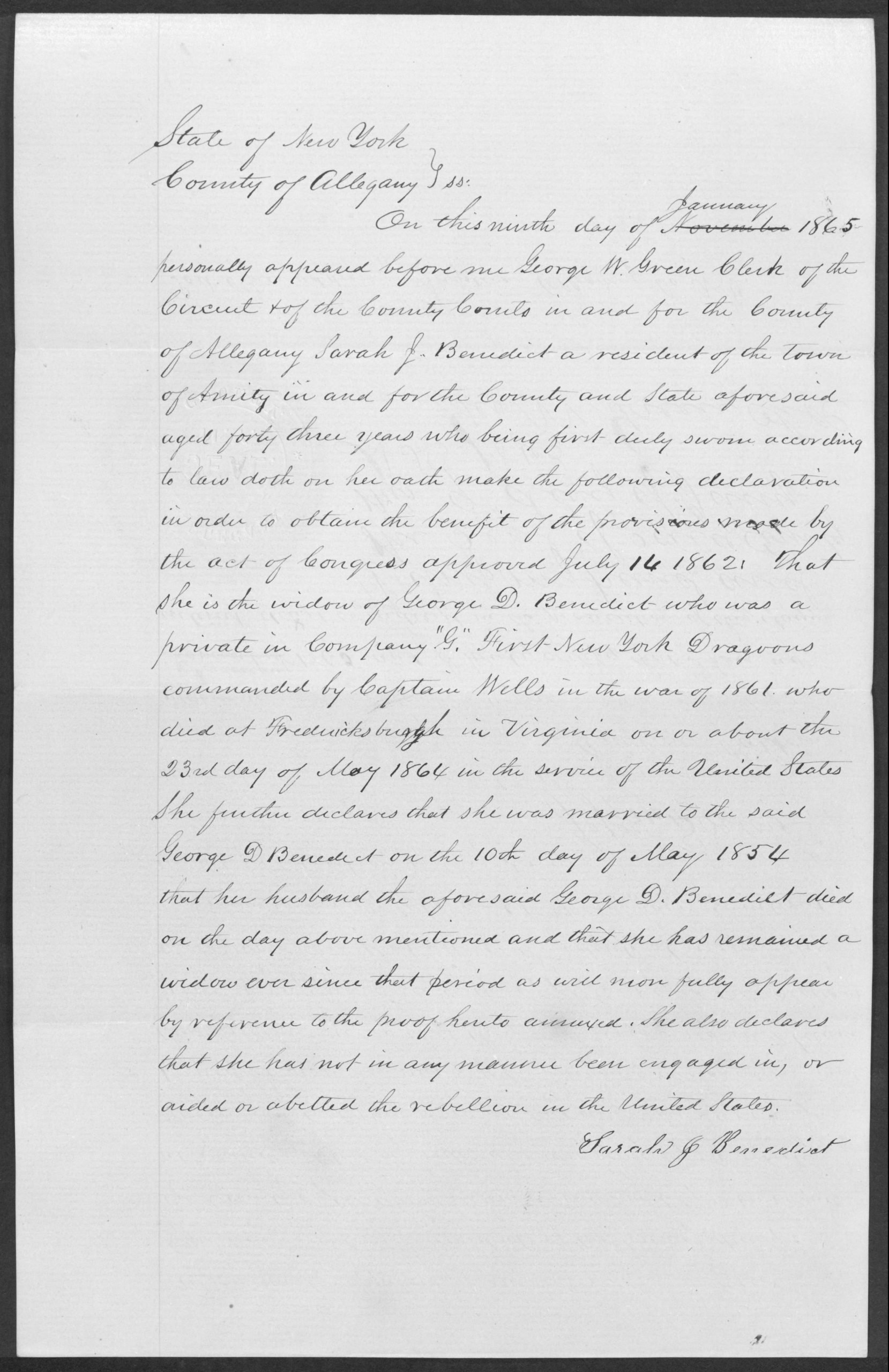
[Her declaration, sworn at Angelica on 9 January 1865. The clerk first wrote November and corrected it to January above the line. Sarah J. Benedict was forty three and had been married eleven years; unlike most of the young widows in these files she could write, and signs her own name in a firm hand. She names the company commander as Captain Wells and gives the place of death as Fredericksburg, the hospital town behind Grant’s Overland battles, and the date as on or about 23 May 1864. The Pension Office Brief settled instead on 25 May, and the pension was paid from that day. The officer who took the oath was the clerk of the Allegany County courts, George W. Green.]
State of New York }
County of Allegany } ss.
On this ninth day of January [written over “November”] 1865 personally appeared before me George W. Green Clerk of the Circuit & of the County Courts in and for the County
of Allegany Sarah J. Benedict a resident of the town
of Amity in and for the County and State aforesaid
aged forty three years who being first duly sworn according to law doth on her oath make the following declaration
in order to obtain the benefit of the provisions made by
the act of Congress approved July 14 1862. That
she is the widow of George D. Benedict who was a
private in Company “G.” First New York Dragoons
commanded by Captain Wells in the war of 1861. who
died at Fredericksburgh in Virginia on or about the
23rd day of May 1864 in the service of the United States
She further declares that she was married to the said
George D Benedict on the 10th day of May 1854
that her husband the aforesaid George D. Benedict died
on the day above mentioned and that she has remained a
widow ever since that period as will more fully appear
by reference to the proof hereto annexed. She also declares
that she has not in any manner been engaged in, or
aided or abetted the rebellion in the United States.
Sarah J Benedict
Sheet 3 · Declaration — the witnesses, and the county clerk’s jurat
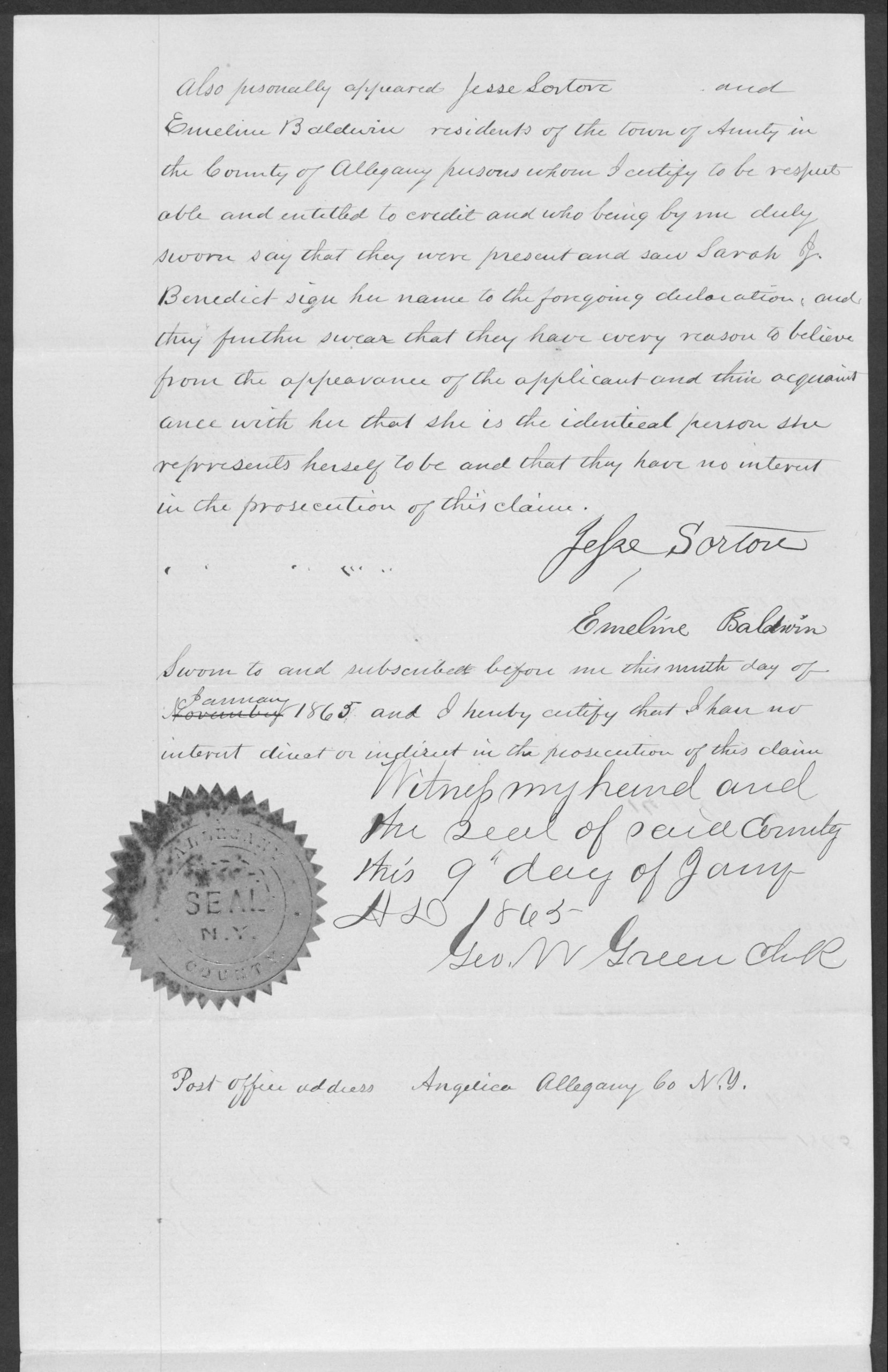
[The second leaf of her declaration: the two identifying witnesses, Jesse Sorton and Emeline Baldwin of the town of Amity, and the clerk’s jurat under the seal of Allegany County. Here too November has been struck and January written above it. The county seal is impressed at the lower left. The last line gives her post office, Angelica, which is where the certificate would be sent.]
Also personally appeared Jesse Sorton and
Emeline Baldwin residents of the town of Amity in
the County of Allegany persons whom I certify to be respect able and entitled to credit and who being by me duly
sworn say that they were present and saw Sarah J.
Benedict sign her name to the foregoing declaration, and
they further swear that they have every reason to believe
from the appearance of the applicant and their acquaint
ance with her that she is the identical person she
represents herself to be and that they have no interest
in the prosecution of this claim.
Jesse Sorton
Emeline Baldwin
Sworn to and subscribed before me this ninth day of
January [written over “November”] 1865 and I hereby certify that I have no interest direct or indirect in the prosecution of this claim Witness my hand and
the Seal of said County
this 9th day of Jany
A.D. 1865-
Geo. W. Green Clerk
Post Office address Angelica Allegany Co N.Y.
Sheet 4 · A second copy of the same leaf, left unfinished
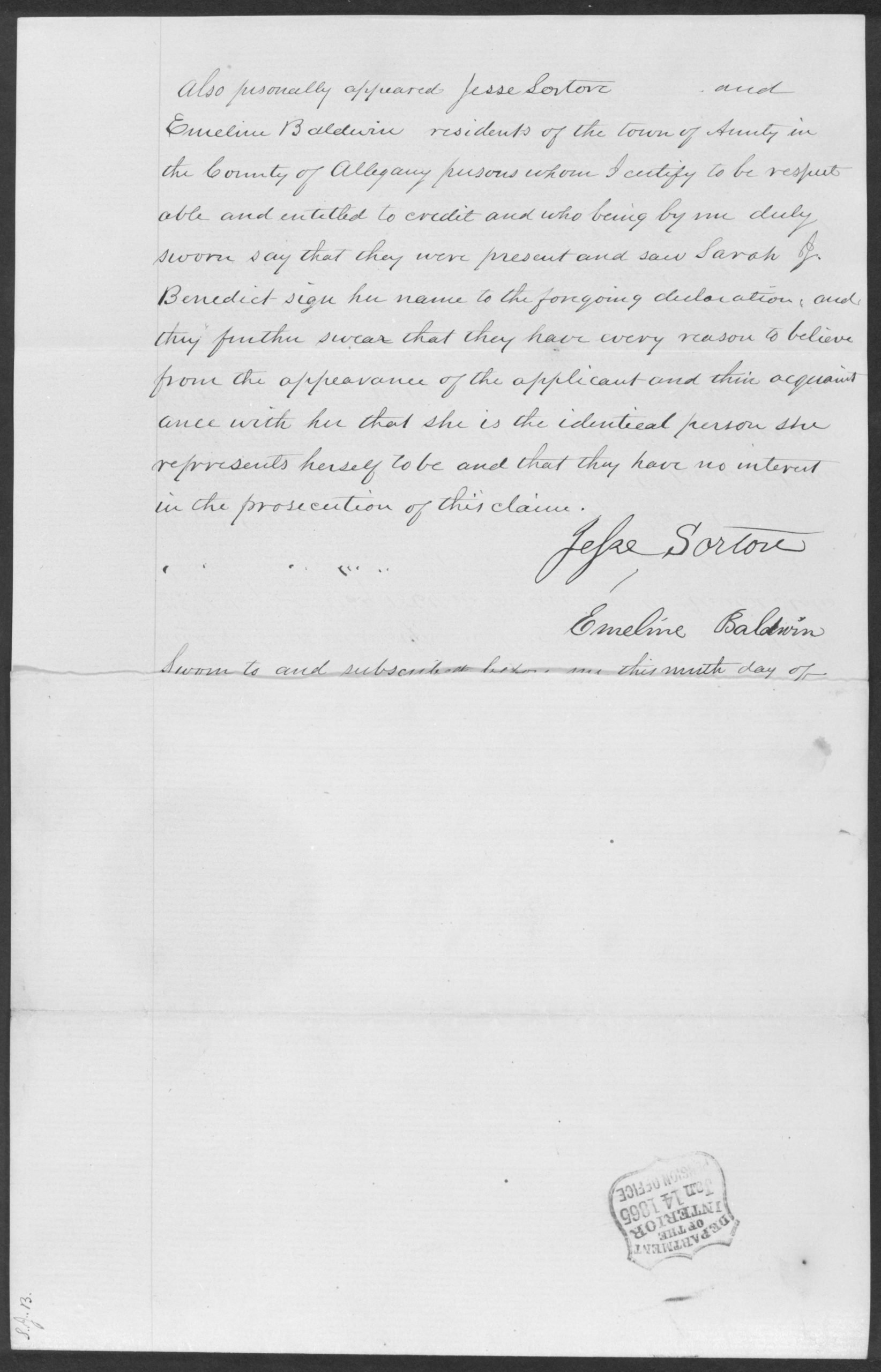
[A duplicate of the identifying witness leaf, written out a second time in the same hand. The wording is word for word the same as sheet 3, but this copy stops in the middle of the jurat, after “this ninth day of”, and was never finished: no month, no seal, no signature. The Pension Office kept it anyway. The receiving stamp in the lower corner is struck upside down and reads 14 January 1865, five days after she swore the declaration. Pencil initials are written at the bottom left corner.]
Also personally appeared Jesse Sorton and
Emeline Baldwin residents of the town of Amity in
the County of Allegany persons whom I certify to be respect able and entitled to credit and who being by me duly
sworn say that they were present and saw Sarah J.
Benedict sign her name to the foregoing declaration, and
they further swear that they have every reason to believe
from the appearance of the applicant and their acquaint
ance with her that she is the identical person she
represents herself to be and that they have no interest
in the prosecution of this claim.
Jesse Sorton
Emeline Baldwin
Sworn to and subscribed before me this ninth day of
[The sheet ends here.]
[Receiving stamp, inverted:]
DEPARTMENT OF THE INTERIOR JAN 14 1865 PENSION OFFICE
Sheet 5 · Adjutant General: “Killed May 7th at Todds Tavern Va”
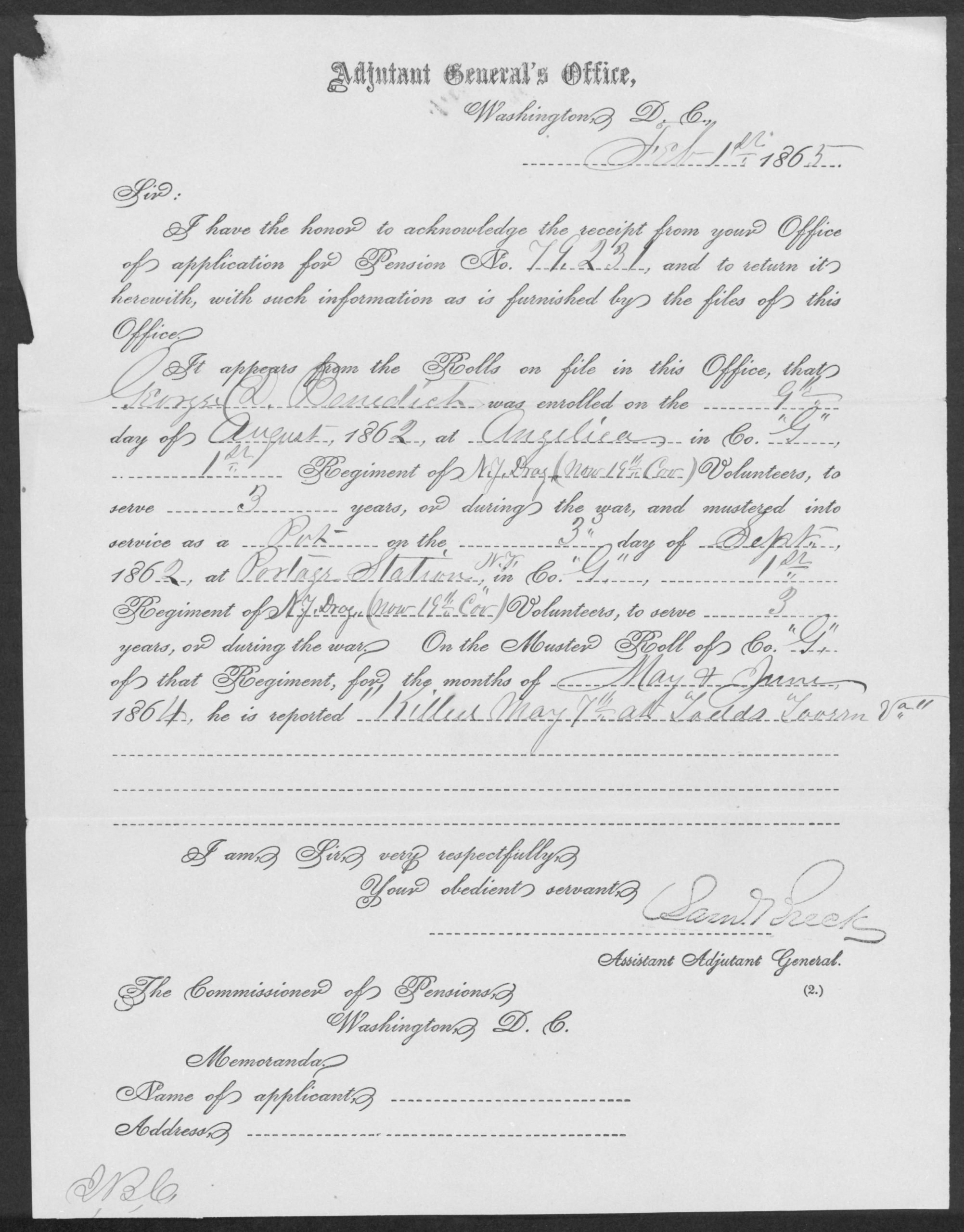
[The Adjutant General’s report of service, 1 February 1865. It gives the regiment under both of its names, First New York Dragoons and now 19th Cavalry, and it contradicts the widow. The muster roll for May and June 1864 reports him “Killed May 7th at Todds Tavern Va.” She had sworn he died at Fredericksburg on or about 23 May. Todd’s Tavern was a cavalry fight on the road below the Wilderness; Fredericksburg was where the wounded from those days were carried. The rest of the file is the work of reconciling the two, and the Pension Office settled at last on death from wounds on 25 May. He enrolled at Angelica, his own town, on 9 August 1862 and was mustered in at Portage Station on 3 September, with the rest of the regiment. Italics mark the clerk’s handwriting on the printed form.]
Adjutant General’s Office,
Washington, D. C.,
Feb 1st 1865
Sir:
I have the honor to acknowledge the receipt from your Office of application for Pension No. 77,231, and to return it
herewith, with such information as is furnished by the files of this Office.
It appears from the Rolls on file in this Office, that George D. Benedict was enrolled on the 9th
day of August, 1862, at Angelica in Co. “G”,
1st Regiment of N.Y. Drag. (now 19th Cav.) Volunteers, to
serve 3 years, or during the war, and mustered into
service as a Prvt on the 3d day of Sept.,
1862, at Portage Station N.Y., in Co. “G”, 1st
Regiment of N.Y. Drag. (now 19th Cav.) Volunteers, to serve 3 years, or during the war. On the Muster Roll of Co. “G”
of that Regiment, for the months of May & June
1864, he is reported “Killed May 7th at Todds Tavern Va.”
I am, Sir, very respectfully,
Your obedient servant,
Saml Breck
Assistant Adjutant General. (2.)
The Commissioner of Pensions,
Washington, D. C.
Memoranda.
Name of applicant, …………….
Address, …………….
Sheet 6 · Capt. Chamberlain reconciles the two — shot at Todd’s Tavern, died the 25th
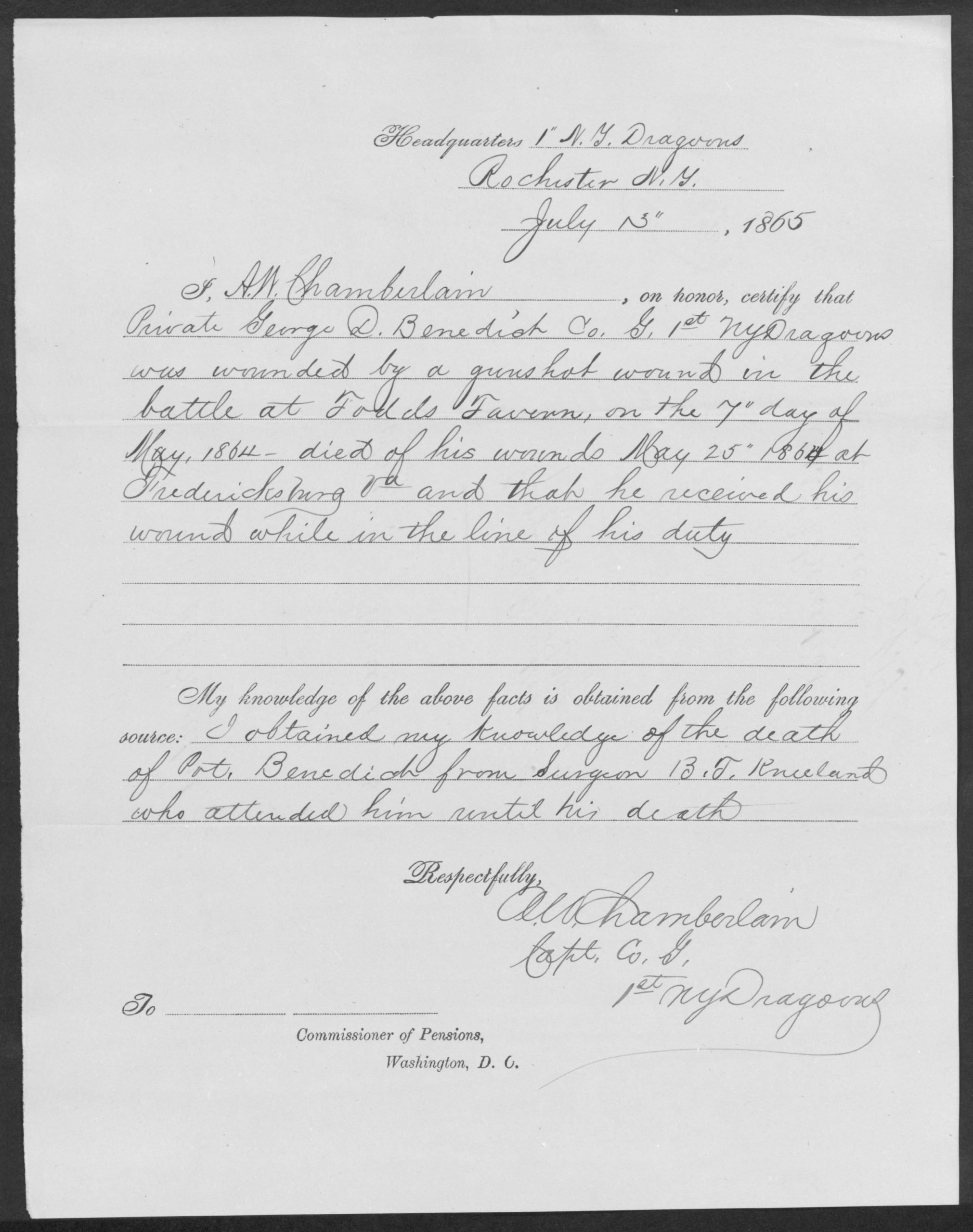
[The paper that reconciled the muster roll with the widow, written on regimental headquarters paper at Rochester on 13 July 1865, six weeks after the Dragoons came home to be mustered out. Captain A. W. Chamberlain of Company G certifies both halves of the story: George Benedict was shot at Todd’s Tavern on 7 May 1864 and died of that wound at Fredericksburg on 25 May. The roll had simply entered him as killed on the day he fell. Chamberlain also names his source, and it is the regimental surgeon, B. T. Kneeland, who attended Benedict until his death and whose name appears in other Dragoon pension files. The date the Pension Office paid from, 25 May 1864, comes from this sheet.]
Headquarters 1st N.Y. Dragoons
Rochester N.Y.
July 13th, 1865
I, A W Chamberlain, on honor, certify that
Private George D. Benedict Co. G, 1st N.Y. Dragoons
was wounded by a gunshot wound in the
battle at Todds Tavern, on the 7th day of
May, 1864 – died of his wounds May 25th 1864 at
Fredericksburg Va and that he received his
wound while in the line of his duty
My knowledge of the above facts is obtained from the following source: I obtained my knowledge of the death
of Pvt. Benedict from Surgeon B. T. Kneeland
who attended him until his death
Respectfully,
A W Chamberlain
Capt, Co. G,
1st N.Y. Dragoons
To …………….
Commissioner of Pensions,
Washington, D. C.
Sheet 7 · The office sends her a blank certificate of death, June 1865
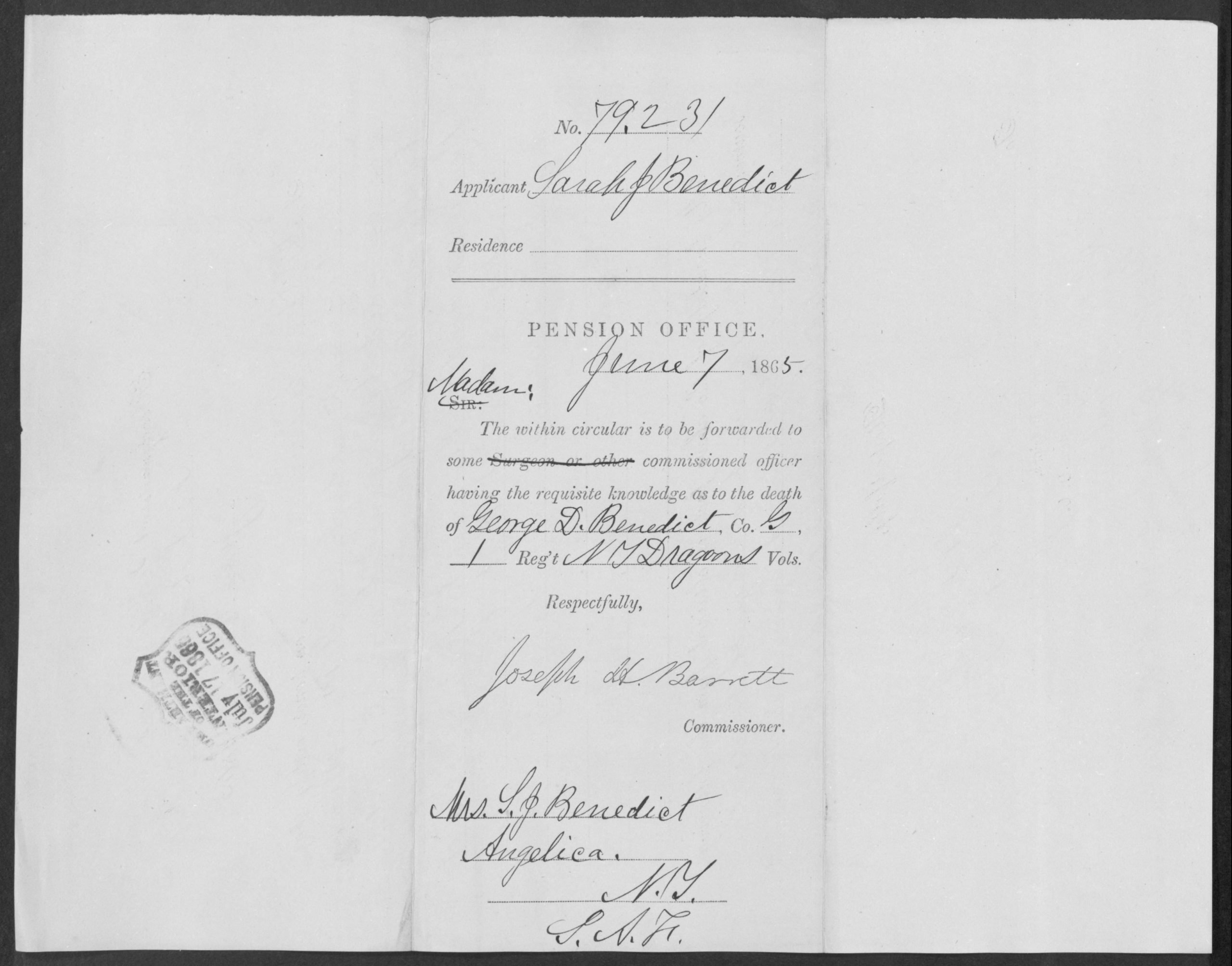
[The Pension Office’s covering slip for the blank circular it sent to the widow on 7 June 1865, telling her what she had to go and get. The printed “Sir” is struck out and “Madam” written above it. The office wanted the form put into the hands of a commissioned officer who knew how her husband died, and Chamberlain’s certificate of 13 July, sheet 6, is the answer that came back. The word “Surgeon or other” is struck from the printed sentence. The receiving stamp on the left leaf, JULY 17 1865, is the day the answer arrived. Italics mark the handwriting on the printed form.]
No. 79,231
Applicant Sarah J Benedict
Residence …………….
PENSION OFFICE,
June 7, 1865.
Madam: [replacing “SIR:”, struck out]
The within circular is to be forwarded to
some [struck out: Surgeon or other] commissioned officer
having the requisite knowledge as to the death
of George D. Benedict, Co. G,
1 Reg’t N.Y. Dragoons Vols.
Respectfully,
Joseph H. Barrett
Commissioner.
Mrs. S. J. Benedict
Angelica.
N.Y.
S. A. F.
[Receiving stamp on the facing leaf:]
DEPARTMENT OF THE INTERIOR JULY 17 1865 PENSION OFFICE
Sheet 8 · THE MARRIAGE CERTIFICATE — Belfast and Granger, 10 May 1854
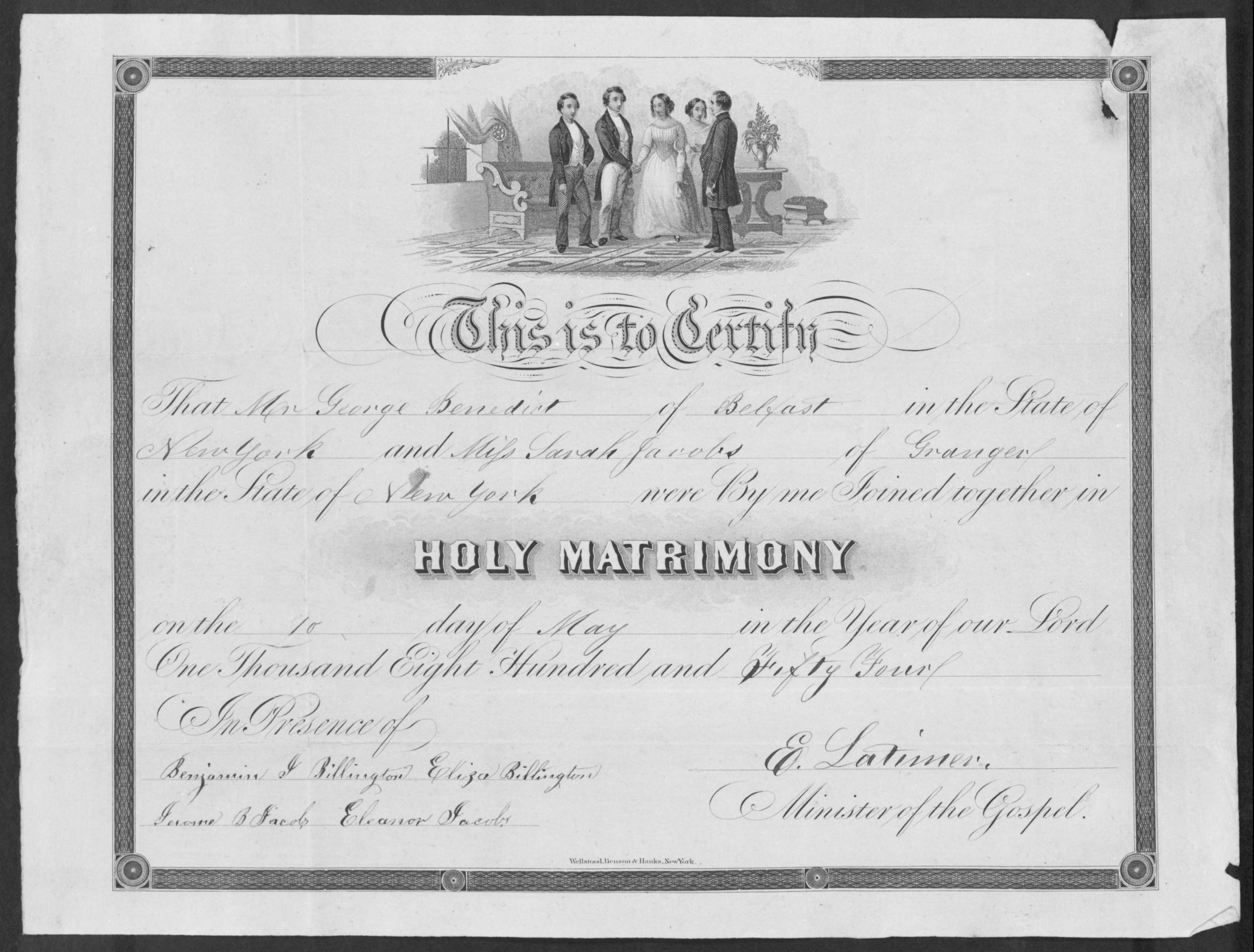
[Her marriage certificate, and the only thing in these forty two pension files that was made to be looked at. It is an engraved keepsake with a steel plate vignette of a wedding party at the top, printed by Wellstood, Benson & Hanks of New York, filled in by the minister in 1854 and kept for eleven years in a house in Allegany County. To prove she had been his wife she had to give it up to the Pension Office, and it has been in a government file ever since. George Benedict of Belfast married Sarah Jacobs of Granger on 10 May 1854. Two of the witnesses are her own family, Jerome B. Jacobs and Eleanor Jacobs.]
This is to Certify
That Mr George Benedict of Belfast in the State of
New York and Miss Sarah Jacobs of Granger
in the State of New York were By me Joined together in
HOLY MATRIMONY
on the 10 day of May in the Year of our Lord
One Thousand Eight Hundred and Fifty Four
In Presence of
Benjamin J Billington Eliza Billington
Jerome B Jacobs Eleanor Jacobs
E. Latimer.
Minister of the Gospel.
Wellstood, Benson & Hanks, New York.
Sheet 9 · Wrapper — “Admitted Augst 7 65”
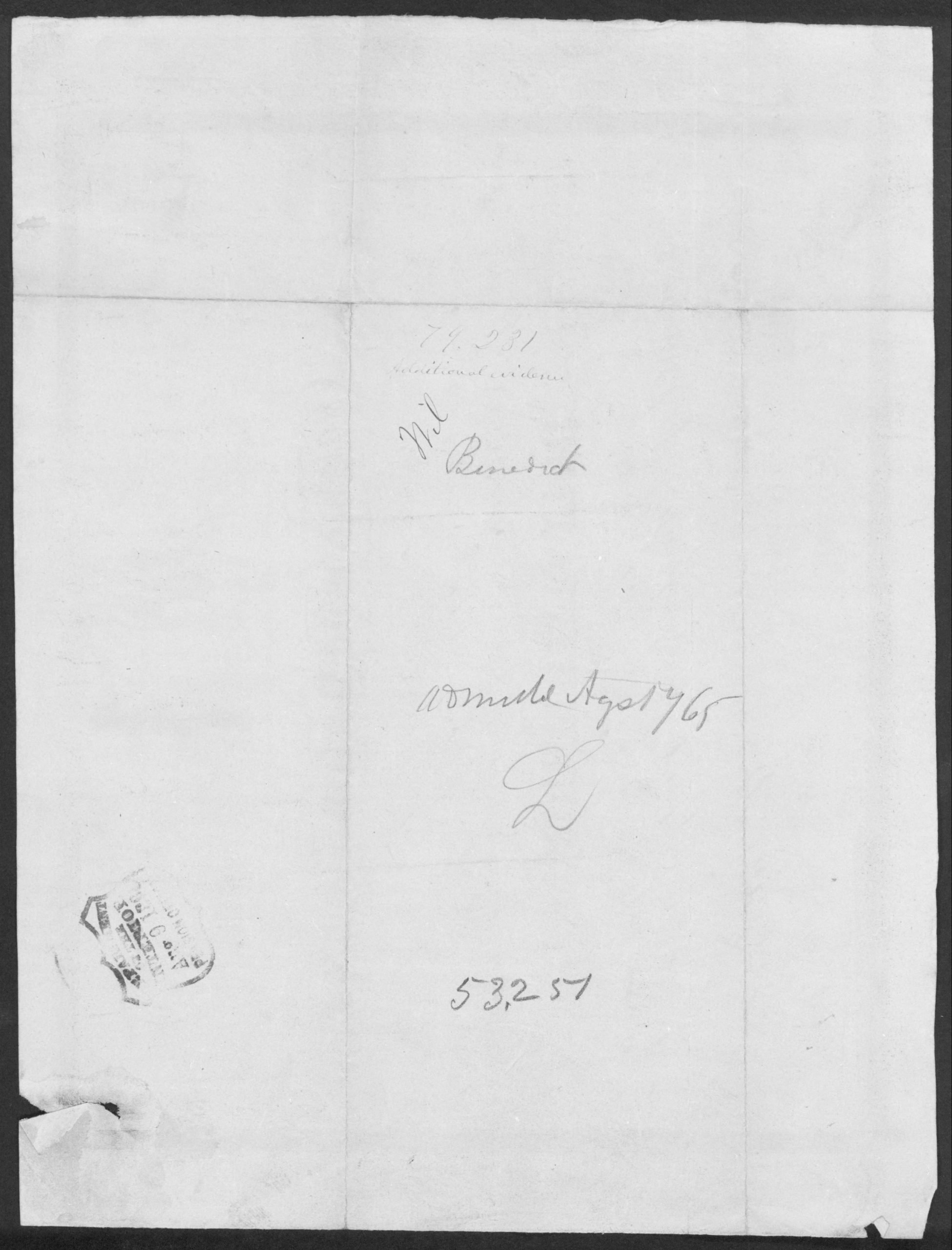
[The back of the wrapper the additional evidence came in, endorsed in pencil by the office. It carries the application number, the words the clerk used to file it, the widow’s name, and, in a different hand, the decision: Admitted Augst 7 65, with an initial. Below that, the number the claim became when it was allowed, 53,251. A receiving stamp is struck at the left edge, most of it off the sheet.]
79,231
additional evidence
Wid
Benedict
Admitted Augst 7 65
L
53,251
Sheet 10 · PENSIONER DROPPED — she died 22 February 1903
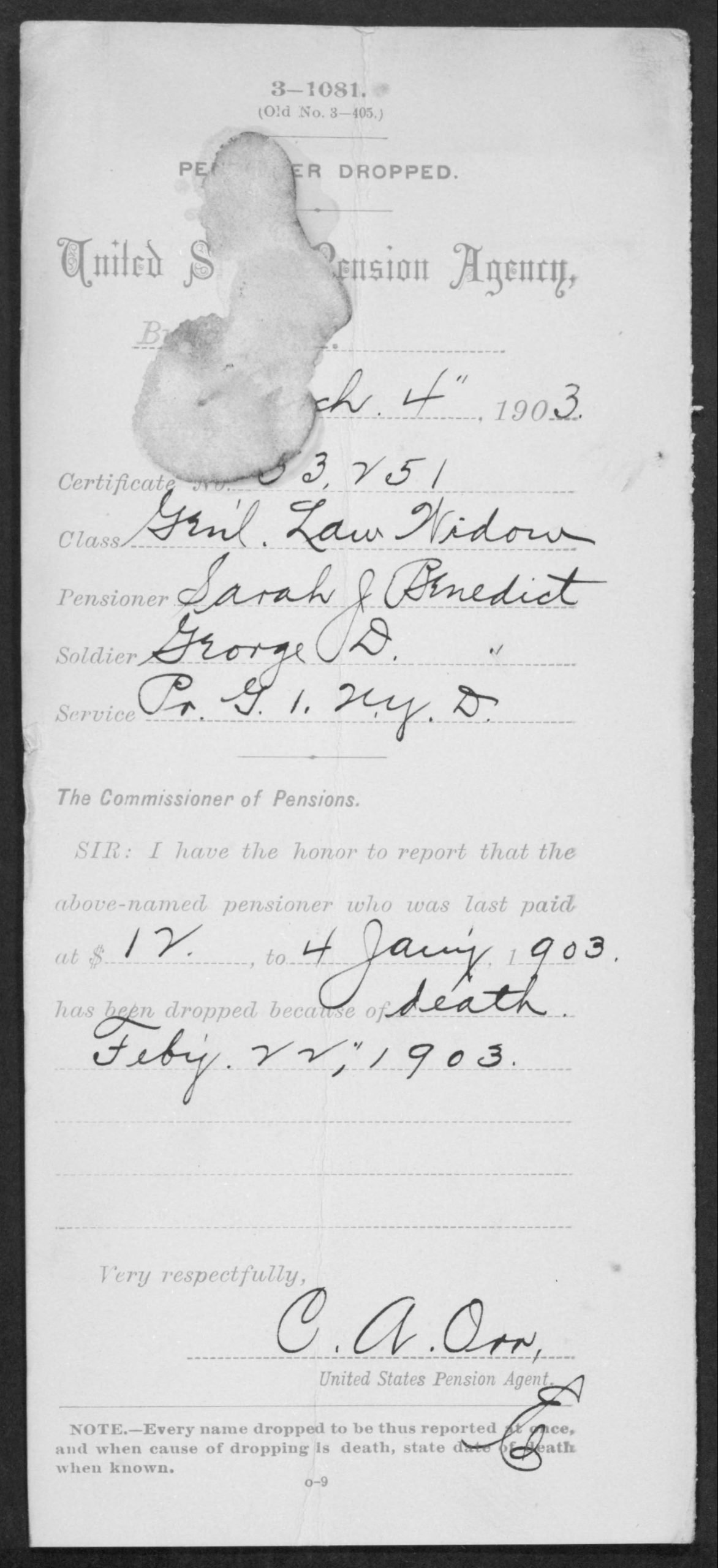
[The last act, thirty eight years later. A large ink blot has eaten the name of the agency, which begins with B, and part of the date line. Sarah J. Benedict died on 22 February 1903, having drawn a widow’s pension since 1865; by the end the rate had risen from eight dollars a month to twelve. She was widowed at forty three and never remarried, and the file that begins with her wedding certificate ends with this form.]
3-1081.
(Old No. 3-405.)
PENSIONER DROPPED.
United States Pension Agency,
B[…]
[Mar]ch. 4th, 1903.
Certificate No. 53,251
Class Genl. Law Widow
Pensioner Sarah J Benedict
Soldier George D. “
Service Pr. G. 1. N.Y. D.
The Commissioner of Pensions.
SIR: I have the honor to report that the
above-named pensioner who was last paid
at $ 12, to 4 Jany, 1903.
has been dropped because of death.
Feby. 22, 1903.
Very respectfully,
C. A. Orr,
United States Pension Agent.
NOTE.–Every name dropped to be thus reported at once,
and when cause of dropping is death, state date of death
when known.
o-9
Sheet 11 · Verso — Bureau of Pensions stamps, March 1903

[The back of the dropping report, blank but for two stamps that track the form through the Bureau of Pensions in the first week of March 1903: received at the Pension Office on the 5th, passed to the Finance Division on the 6th. The sheet is split down the middle by an old fold.]
U. S. BUREAU OF PENSIONS
FINANCE DIVISION
MAR 6 1903
U. S. PENSION OFFICE
MAR 5 1903
[No other text on this side.]
Sheet 12 · Docket slip — referred to the Adjutant General, January 1865
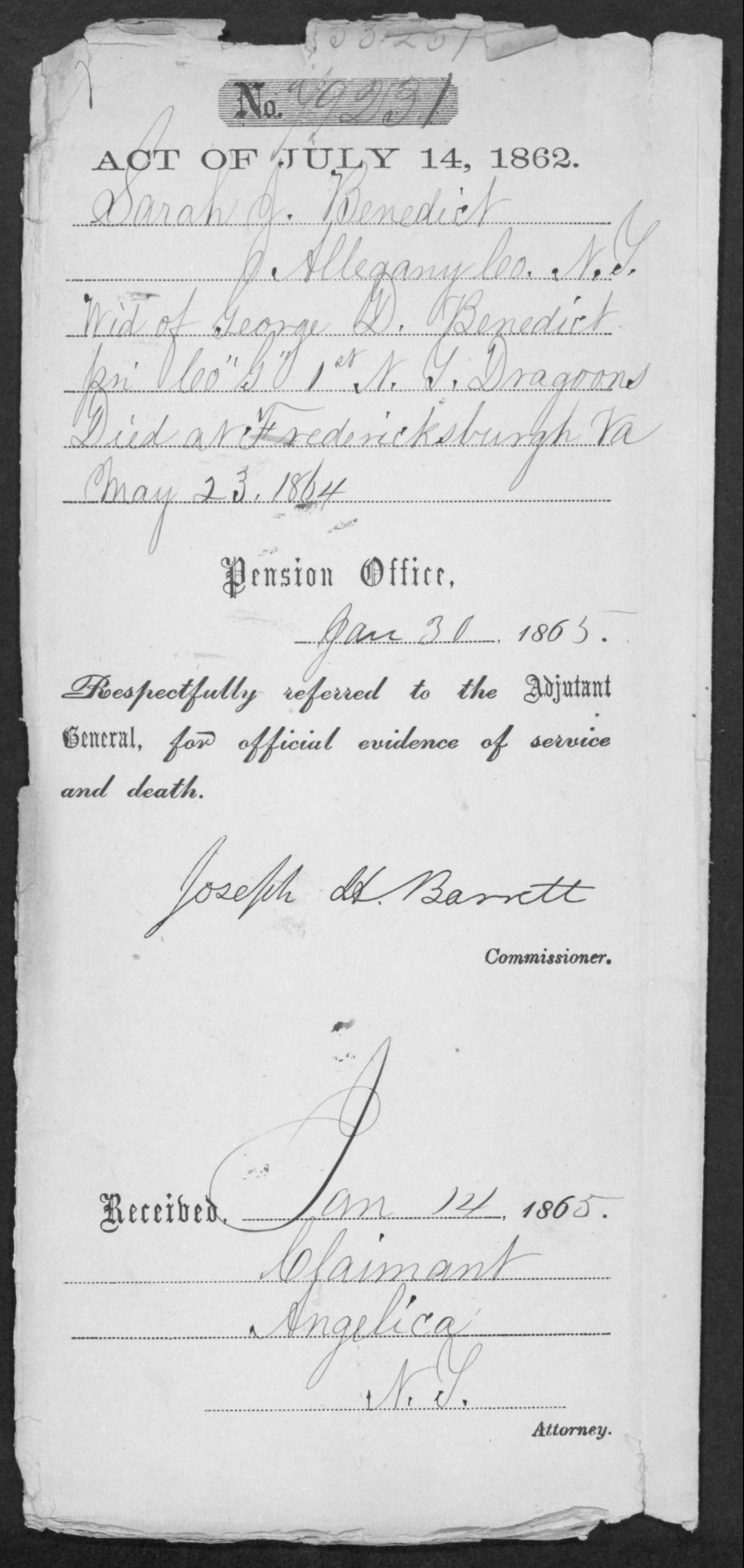
[The Pension Office docket slip. Her claim reached Washington on 14 January 1865, five days after she swore it, and was referred to the Adjutant General on the 30th; the answer, sheet 5, came back two days later reporting him killed at Todd’s Tavern. The slip repeats her version, died at Fredericksburgh 23 May 1864, because that is what the office had been told at the time. The certificate number 53,251 is pencilled at the top edge, above the application number.]
53,251 [in pencil]
No. 79,231
ACT OF JULY 14, 1862.
Sarah J. Benedict
of Allegany Co. N.Y.
Wid of George D. Benedict
Pri. Co “G” 1st N.Y. Dragoons
Died at Fredericksburgh Va
May 23. 1864
Pension Office,
Jan 30, 1865.
Respectfully referred to the Adjutant
General, for official evidence of service
and death.
Joseph H. Barrett
Commissioner.
Received, Jan 14, 1865.
Claimant
Angelica
N.Y.
Attorney.
Sheet 13 · Verso — the circulars sent, June and July 1865
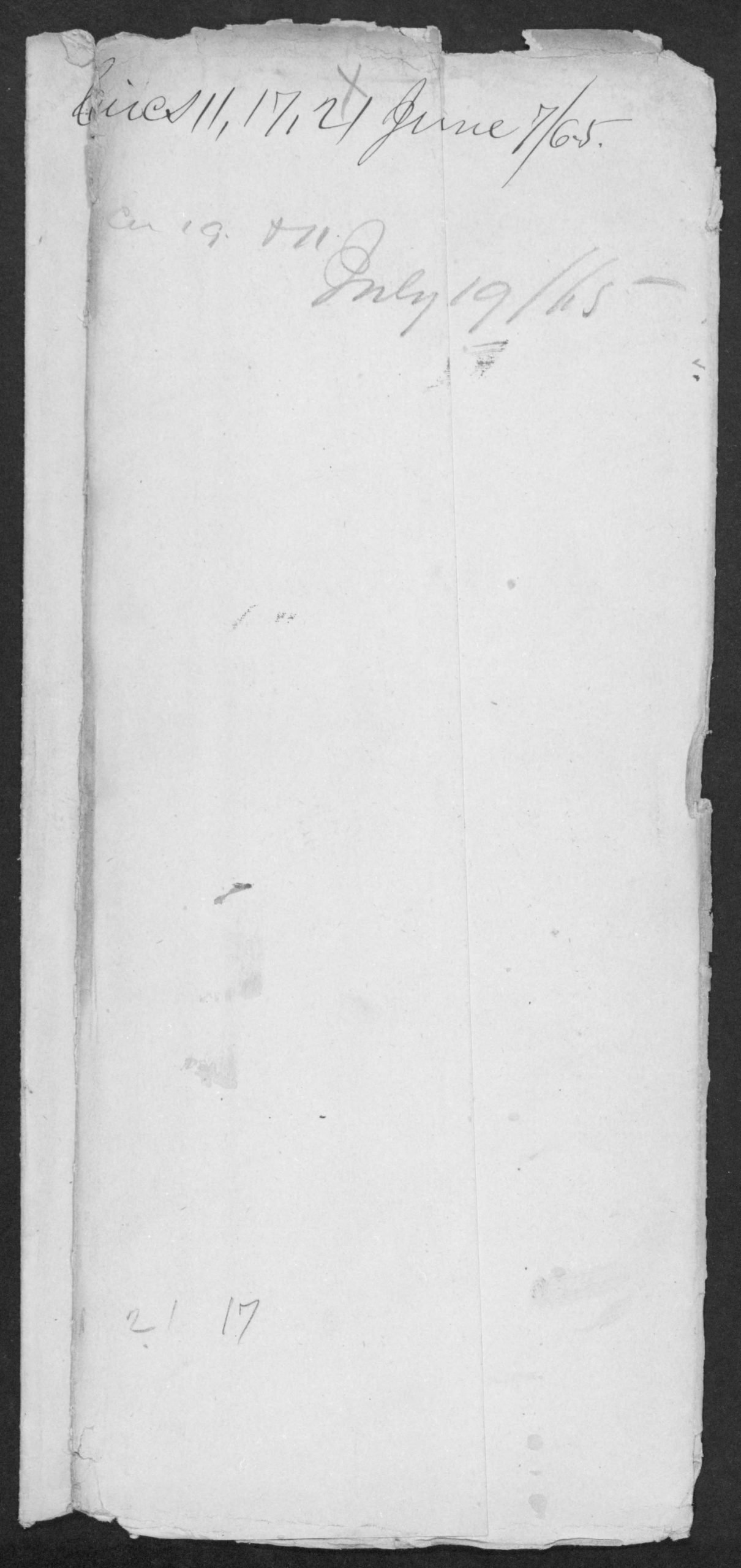
[The back of the docket slip, carrying the office’s pencil note of which printed circulars it sent her and when. The first line, 7 June 1865, is the day the covering slip on sheet 7 went out with the blank certificate of death for an officer to fill in. The second, 19 July, is eleven days after Captain Chamberlain wrote his certificate at Rochester. The numbers at the foot are repeated from the line above.]
Circs 11, 17, 21 June 7/65.
Cir 19. & 11
July 19/65 –
2/ 17
Sheet 14 · Certificate record slip — $8 from 25 May 1864, stamped DEAD
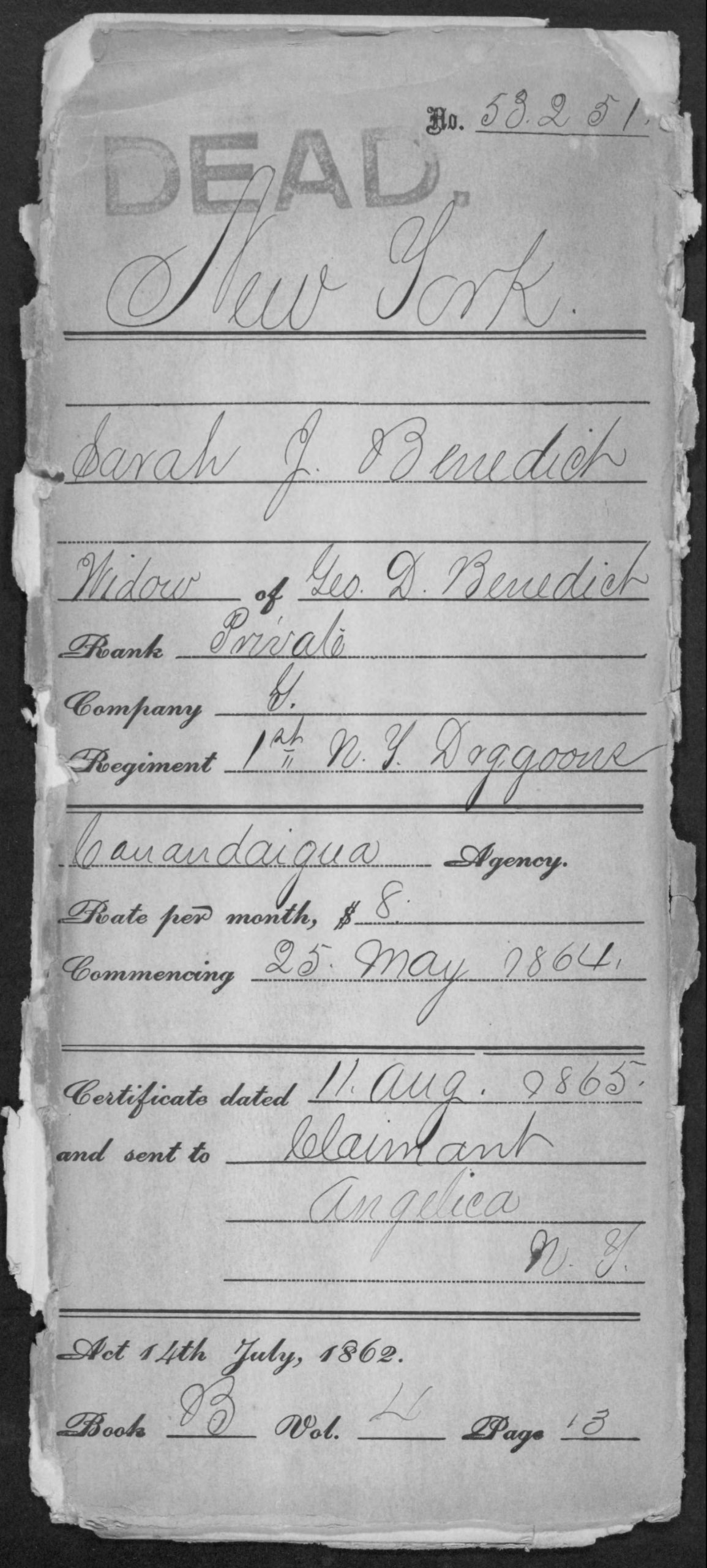
[The certificate record slip, with DEAD stamped across it in large letters when her name came off the rolls in 1903. The certificate was made out on 11 August 1865 and sent to her at Angelica, eight dollars a month payable at the Canandaigua agency, running from 25 May 1864, the day Captain Chamberlain gave for the death. The book, volume and page at the foot are the ledger entry.]
No. 53,251
DEAD [stamped]
New York.
Sarah J. Benedict
Widow of Geo. D. Benedict
Rank Private
Company G.
Regiment 1st N.Y. Dragoons
Canandaigua Agency.
Rate per month, $ 8.
Commencing 25. May 1864.
Certificate dated 11. Aug. 1865.
and sent to Claimant
Angelica
N.Y.
Act 14th July, 1862.
Book B Vol. 4 Page 13
Sheet 15 · Verso — DROPPED, and a letter about reimbursement
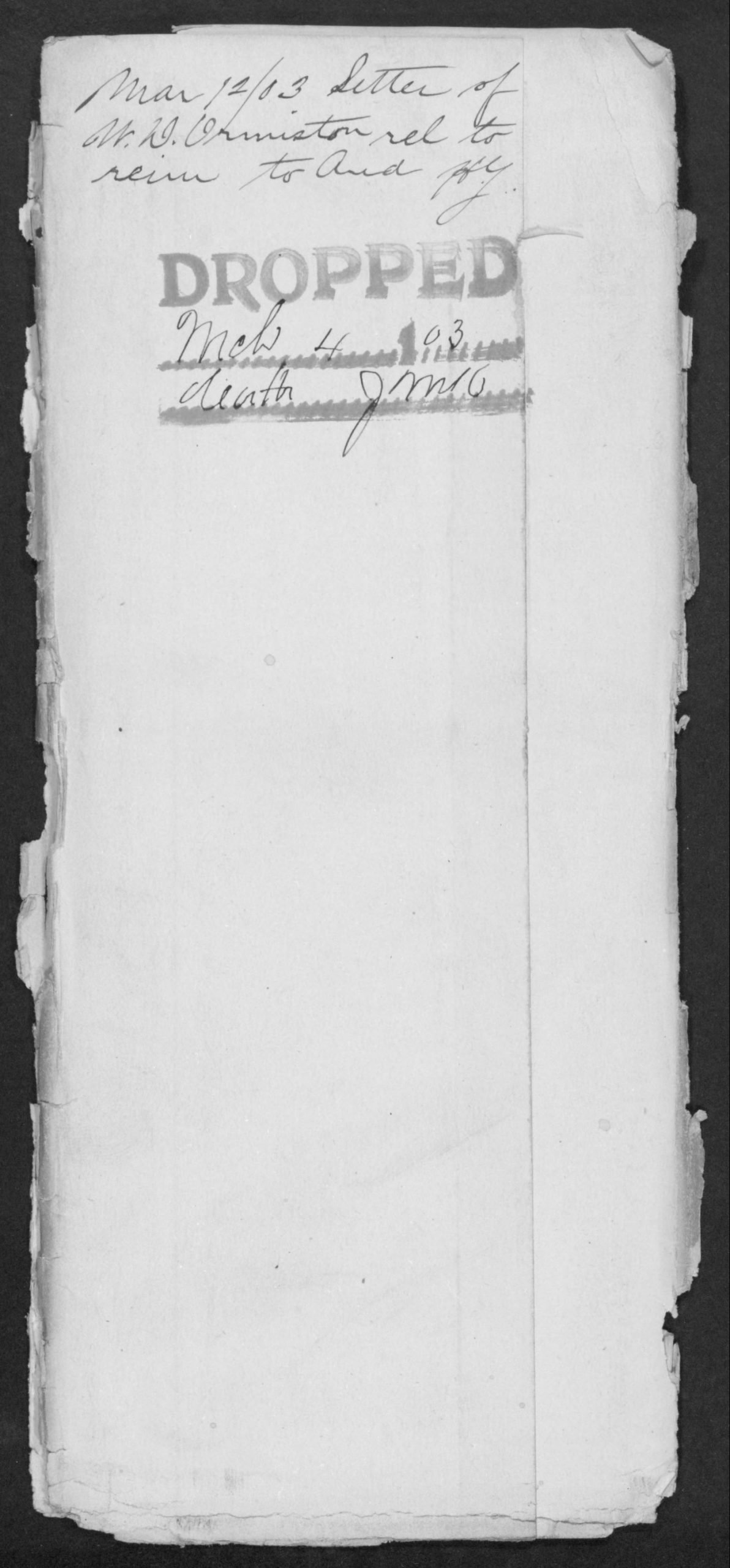
[The back of the record slip, endorsed when she died. The word DROPPED is stamped across it and the clerk has written the date and the reason through the stamp. Above it, a note of a letter received on 12 March 1903 from W. D. Ormiston about reimbursement, the last claim anyone made on this file: after a pensioner’s death whoever had paid the burial could ask the government for the money. The abbreviations are the office’s own and some are worn.]
Mar 12/03 Letter of
W. D. Ormiston rel to
reim to Aud fy.
DROPPED [stamped]
Mch 4 1/03
death J M C
Sheet 16 · Ontario County certifies the justice of the peace
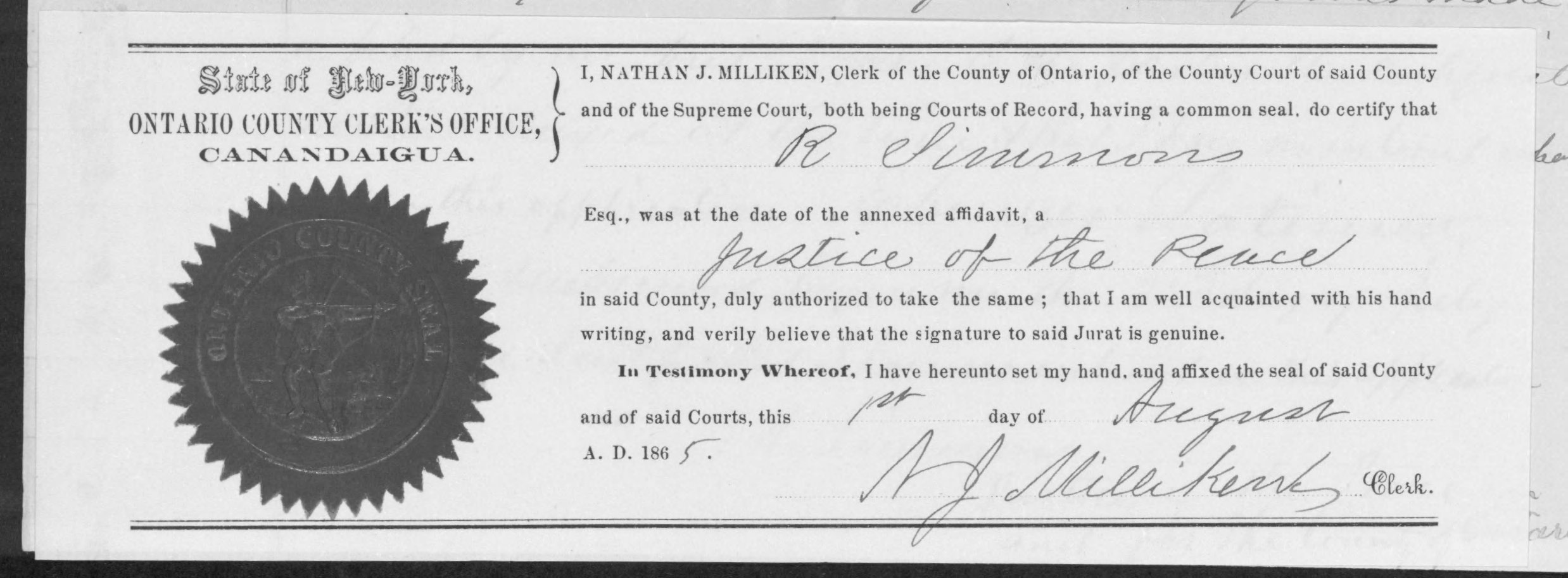
[An Ontario County clerk’s certificate, 1 August 1865, vouching that R. Simmons was a justice of the peace at the date of the affidavit it travels with. The county seal is impressed at the left. Canandaigua, where this was issued, is the same town whose pension agency later paid her. The edge of the affidavit it certifies shows along the right of the frame.]
State of New-York, }
ONTARIO COUNTY CLERK’S OFFICE, }
CANANDAIGUA. }
I, NATHAN J. MILLIKEN, Clerk of the County of Ontario, of the County Court of said County and of the Supreme Court, both being Courts of Record, having a common seal, do certify that R Simmons
Esq., was at the date of the annexed affidavit, a
Justice of the Peace
in said County, duly authorized to take the same; that I am well acquainted with his hand writing, and verily believe that the signature to said Jurat is genuine.
In Testimony Whereof, I have hereunto set my hand, and affixed the seal of said County and of said Courts, this 1st day of August
A. D. 1865.
N J Milliken Clerk.
Sheet 17 · The minister found — Ebenezer Latimer, of Bristol
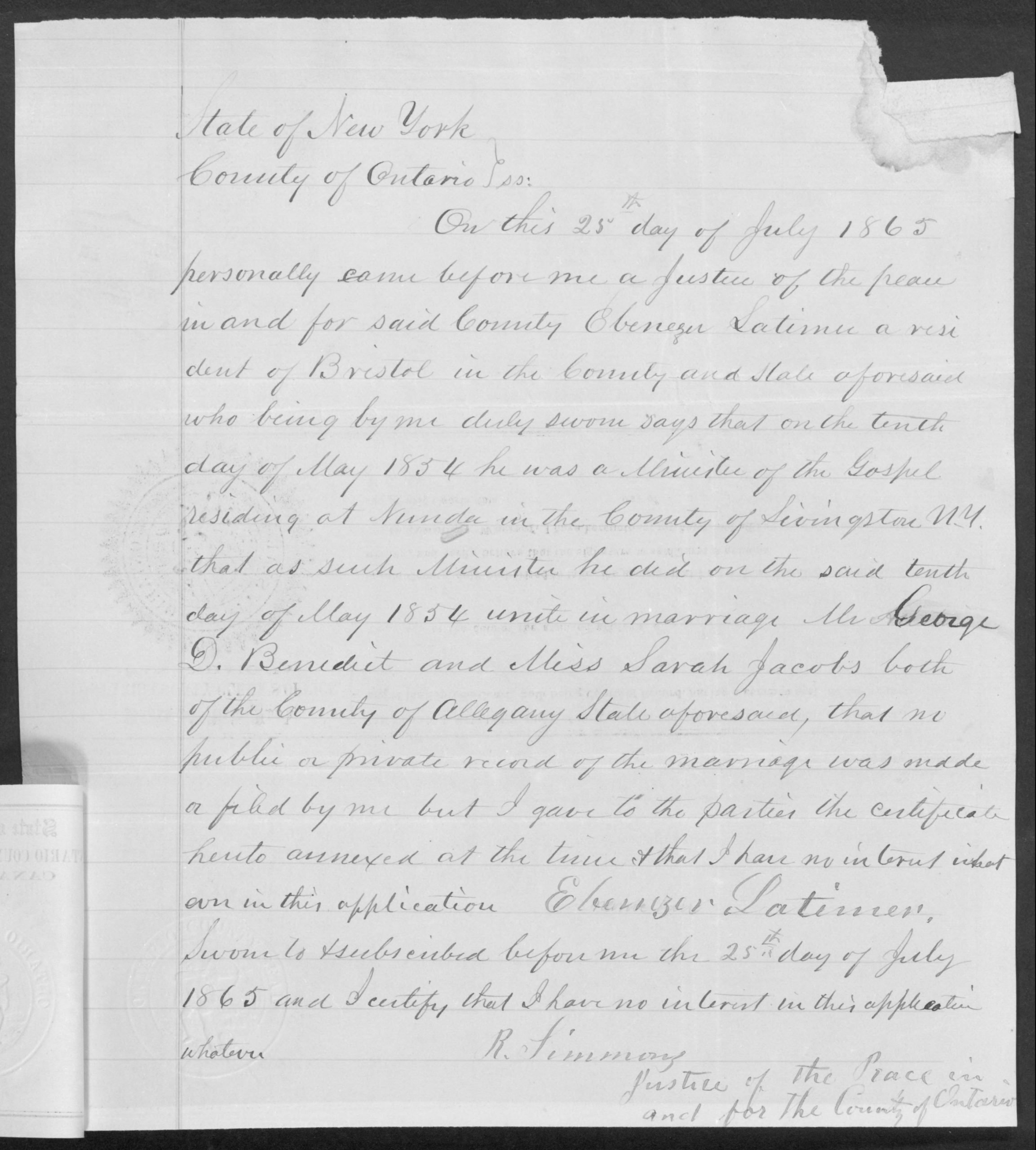
[The minister found and sworn, eleven years after the wedding. Ebenezer Latimer, who signed her certificate simply as E. Latimer, was living at Bristol in Ontario County by 1865; in 1854 he had been a minister at Nunda in Livingston County. He swears he married George D. Benedict and Sarah Jacobs on 10 May 1854, and then says the thing that made the engraved certificate on sheet 8 the only evidence there was: no public or private record of the marriage was made or filed by him. What he gave the couple that day was the certificate itself, and it is annexed to this affidavit. The word “George” was left out and squeezed in above the line.]
State of New York }
County of Ontario } ss:
On this 25th day of July 1865
personally came before me a justice of the peace
in and for said County Ebenezer Latimer a resi
dent of Bristol in the County and State aforesaid
who being by me duly sworn says that on the tenth
day of May 1854 he was a Minister of the Gospel
residing at Nunda in the County of Livingston N.Y.
that as such Minister he did on the said tenth
day of May 1854 unite in marriage Mr George
D. Benedict and Miss Sarah Jacobs both
of the County of Allegany State aforesaid, that no
public or private record of the marriage was made
or filed by me but I gave to the parties the certificate
hereto annexed at the time & that I have no interest what
ever in this application
Ebenezer Latimer
Sworn to & subscribed before me this 25th day of July
1865 and I certify that I have no interest in this application whatever
R. Simmons
Justice of the Peace in
and for the County of Ontario
Sheet 18 · Verso — “Additional evidence”, Pension Office 5 Aug 1865
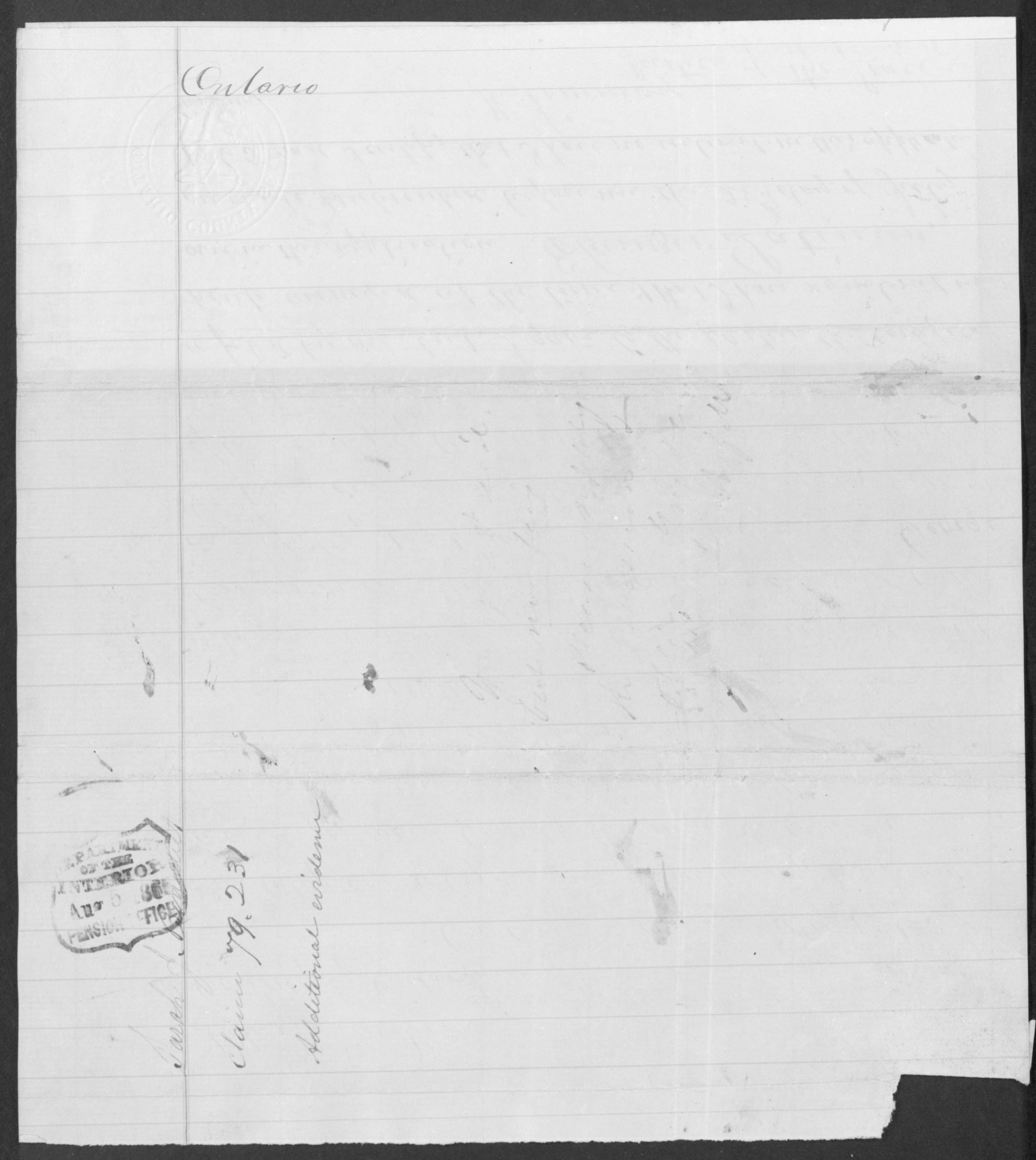
[The back of the minister’s affidavit, folded into an endorsement panel and read with the sheet turned sideways. The county name is written across the top, the Ontario County clerk’s embossed seal shows below it, and the writing of the other side comes through the paper in mirror. The Pension Office receiving stamp of 5 August 1865 is at the foot: six days later the certificate was issued.]
Ontario
[Sideways, in the lower left corner:]
Sarah J. Benedict
Claim 79,231
Additional evidence
[Receiving stamp:]
DEPARTMENT OF THE INTERIOR AUG 5 1865 PENSION OFFICE
Sheet 19 · Ransom Lloyd returns the certificate that was detached
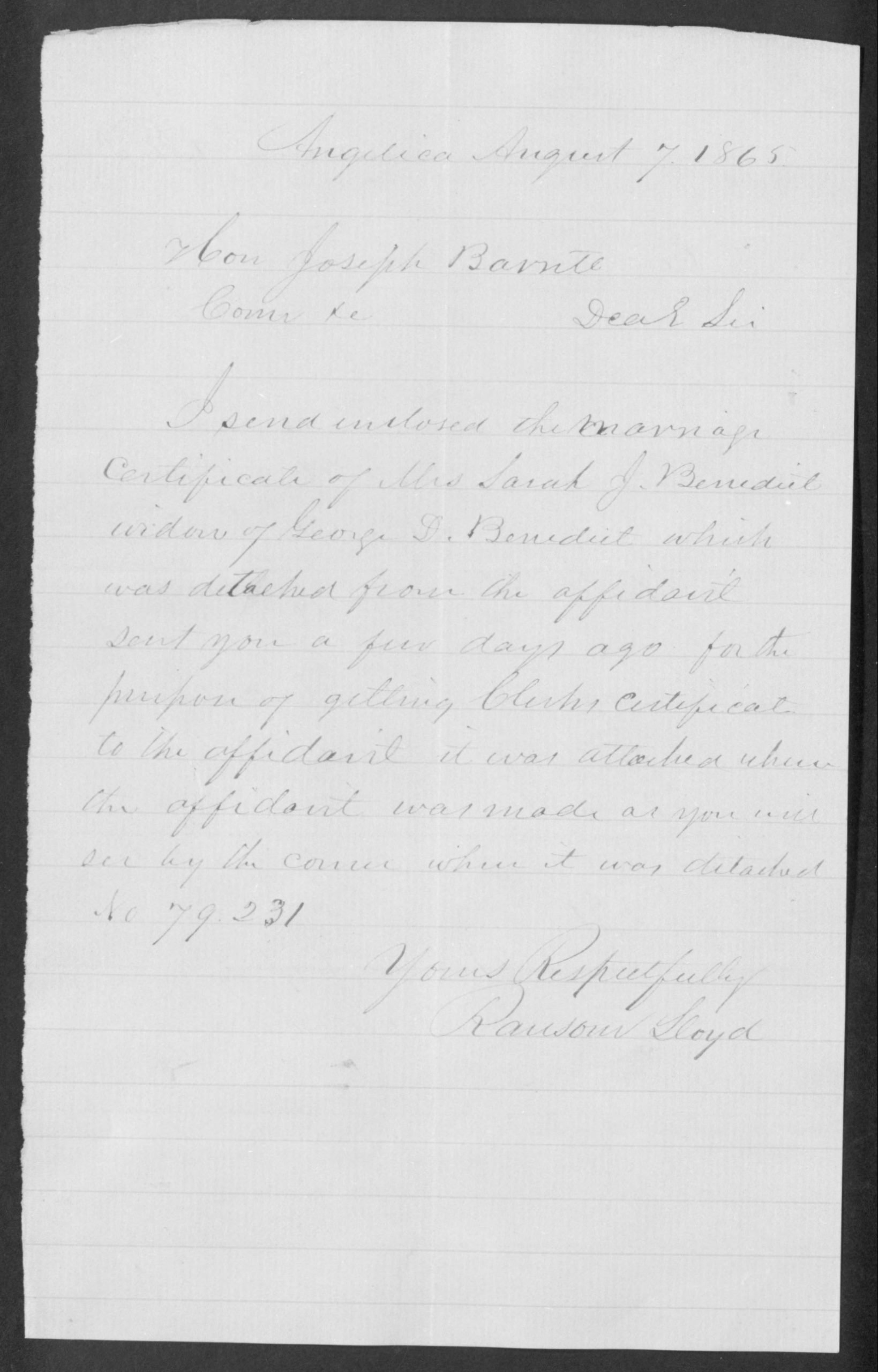
[A letter from Angelica to the Commissioner of Pensions, written on the very day the claim was admitted. Ransom Lloyd is sending on the marriage certificate itself. It had been pinned to the minister’s affidavit, taken off so that the county clerk could certify the affidavit, and left behind; this letter puts it back in the file where it has stayed ever since. He is careful to say the certificate was attached when the affidavit was sworn, because a marriage proof that arrived loose might have been doubted.]
Angelica August 7. 1865
Hon Joseph Barrett
Commr &c Dear Sir
I send enclosed the Marriage
Certificate of Mrs Sarah J. Benedict
widow of George D. Benedict which
was detached from the affidavit
sent you a few days ago for the
purpose of getting Clerks Certificate
to the affidavit It was attached when
the affidavit was made as you will
see by the corner where it was detached
No 79.231
Yours Respectfully
Ransom Lloyd
Sheet 20 · Verso of the marriage certificate
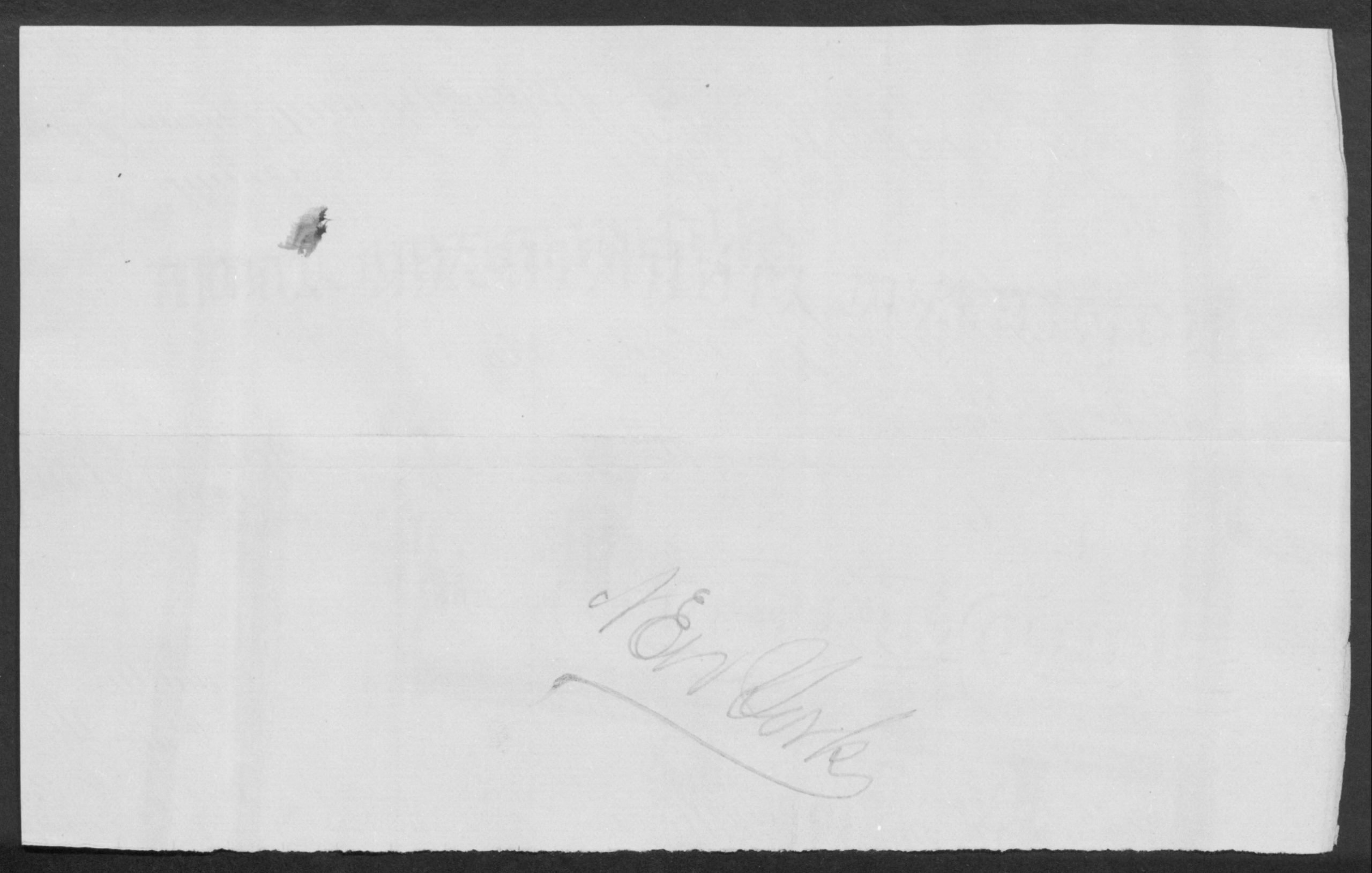
[The back of the engraved marriage certificate. It is blank: the words HOLY MATRIMONY and the ruled lines of the front show through the paper in mirror image, there is one small ink stain near the top, and a pencil endorsement runs across the lower half in a hand too faint and too looped to read with any confidence. Nothing else was ever written on this side.]
[No legible text on this side.]
Sheet 21 · Allegany County certifies the justice of the peace
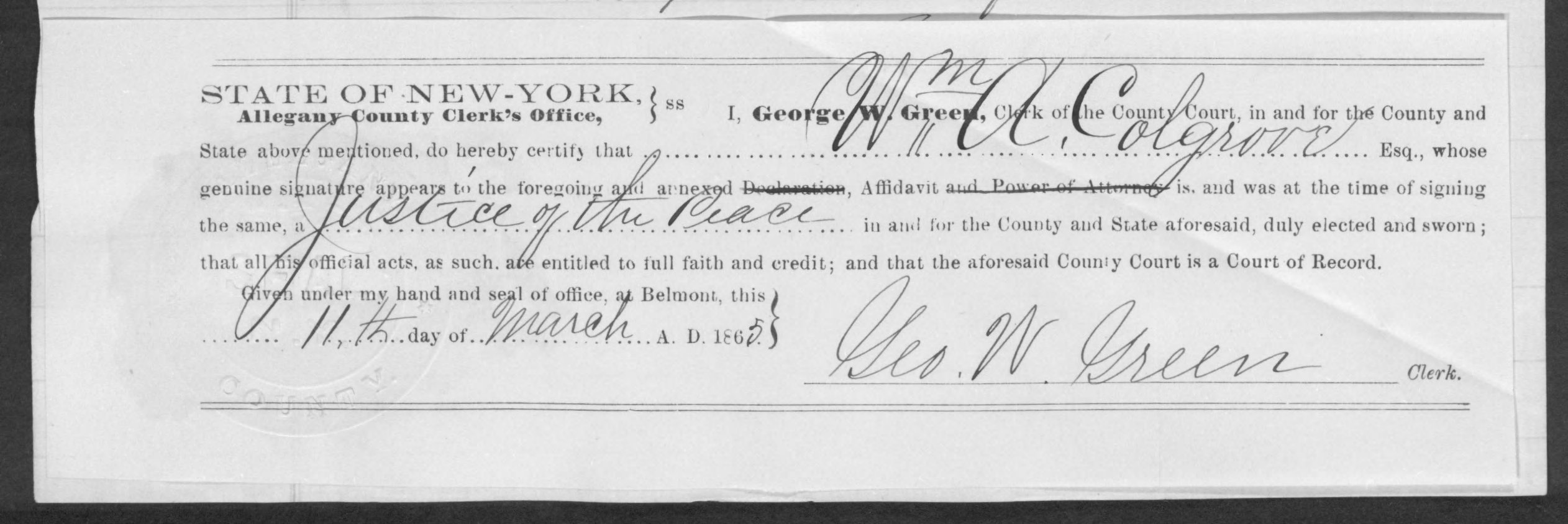
[An Allegany County clerk’s certificate, given at Belmont on 11 March 1865, vouching for William A. Colgrove as a justice of the peace. The printed form has his own name in it, George W. Green, the clerk who took her declaration in January. Two of the three printed words naming what is certified, Declaration and Power of Attorney, are struck out, leaving Affidavit: the paper this travels with is an affidavit sworn before Colgrove. The county seal is embossed at the left.]
STATE OF NEW-YORK, } ss
Allegany County Clerk’s Office, }
I, George W. Green, Clerk of the County Court, in and for the County and State above mentioned, do hereby certify that Wm A. Colgrove Esq., whose
genuine signature appears to the foregoing and annexed [struck out: Declaration,] Affidavit and [struck out: Power of Attorney] is, and was at the time of signing the same, a Justice of the Peace in and for the County and State aforesaid, duly elected and sworn;
that all his official acts, as such, are entitled to full faith and credit; and that the aforesaid County Court is a Court of Record.
Given under my hand and seal of office, at Belmont, this 11th day of March A. D. 1865.
Geo. W. Green Clerk.
Sheet 22 · Two women swear to the wedding — but the minister had moved on
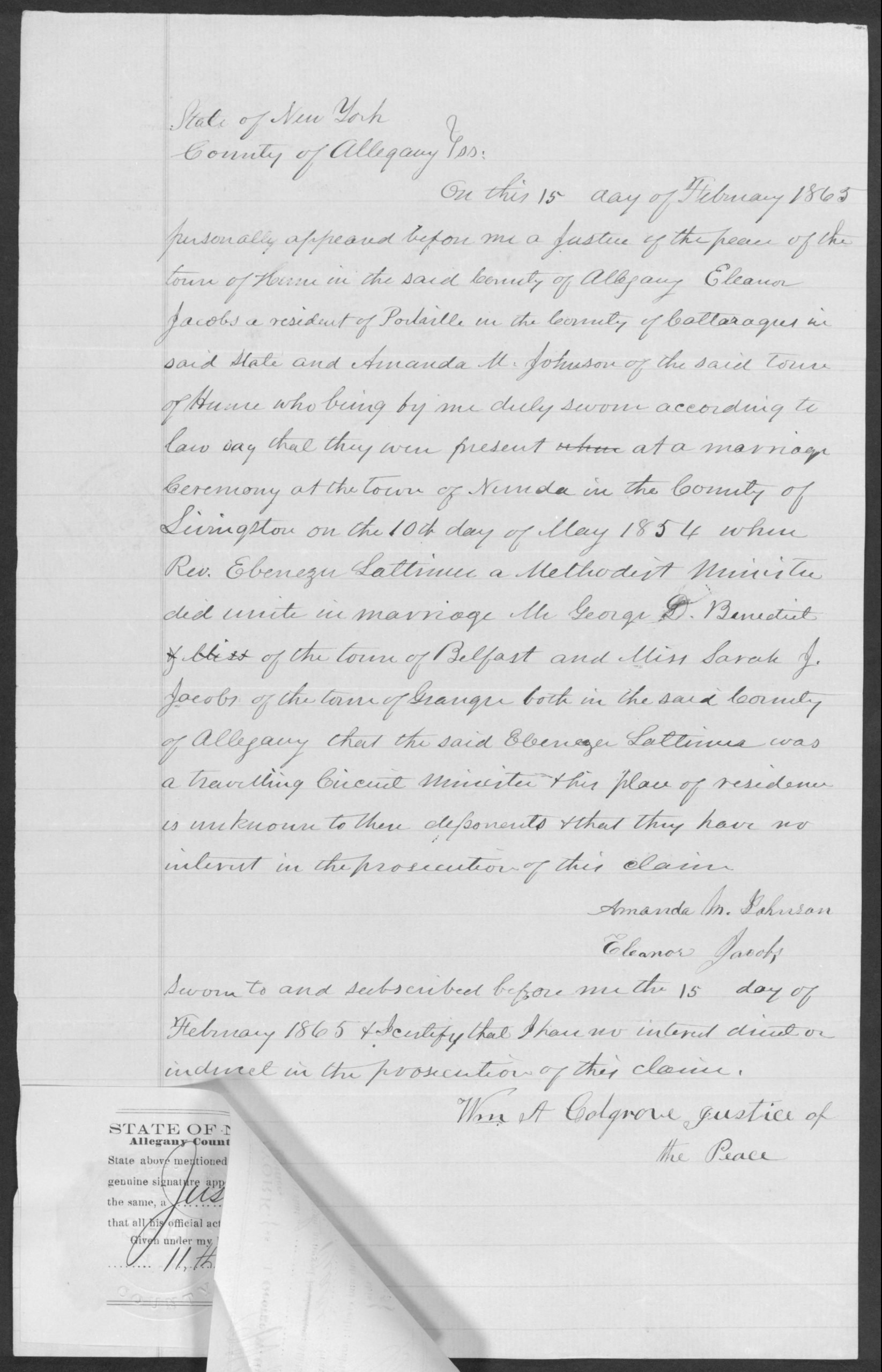
[The first attempt at proving the marriage, sworn 15 February 1865, five months before the minister was found. Two women who were in the room in 1854 swear to what they saw: Eleanor Jacobs, who signed the certificate as a witness and is of the bride’s family, and Amanda M. Johnson. They name the minister, Ebenezer Latimer, a Methodist, and then explain why he could not be produced. He was a travelling circuit minister and his place of residence is unknown to these deponents. That is the whole difficulty of these files in one line. He was found at Bristol in July and swore his own affidavit, sheet 17. The clerk’s certificate for the justice who took this oath lies across the corner of the frame.]
State of New York }
County of Allegany } ss:
On this 15 day of February 1865
personally appeared before me a justice of the peace of the town of Hume in the said County of Allegany Eleanor
Jacobs a resident of Portville in the County of Cattaraugus in said State and Amanda M. Johnson of the said town
of Hume who being by me duly sworn according to
law say that they were present at a marriage
Ceremony at the town of Nunda in the County of
Livingston on the 10th day of May 1854 when
Rev. Ebenezer Lattimer a Methodist Minister
did unite in marriage Mr George D. Benedict
of the town of Belfast and Miss Sarah J.
Jacobs of the town of Granger both in the said County
of Allegany that the said Ebenezer Lattimer was
a travelling Circuit Minister & his place of residence
is unknown to these deponents & that they have no
interest in the prosecution of this claim
Amanda M. Johnson
Eleanor Jacobs
Sworn to and subscribed before me the 15 day of
February 1865 & I certify that I have no interest direct or indirect in the prosecution of this claim.
Wm A Colgrove Justice of
the Peace
Sheet 23 · Wrapper — “Additional evidence”, Pension Office 16 Mar 1865
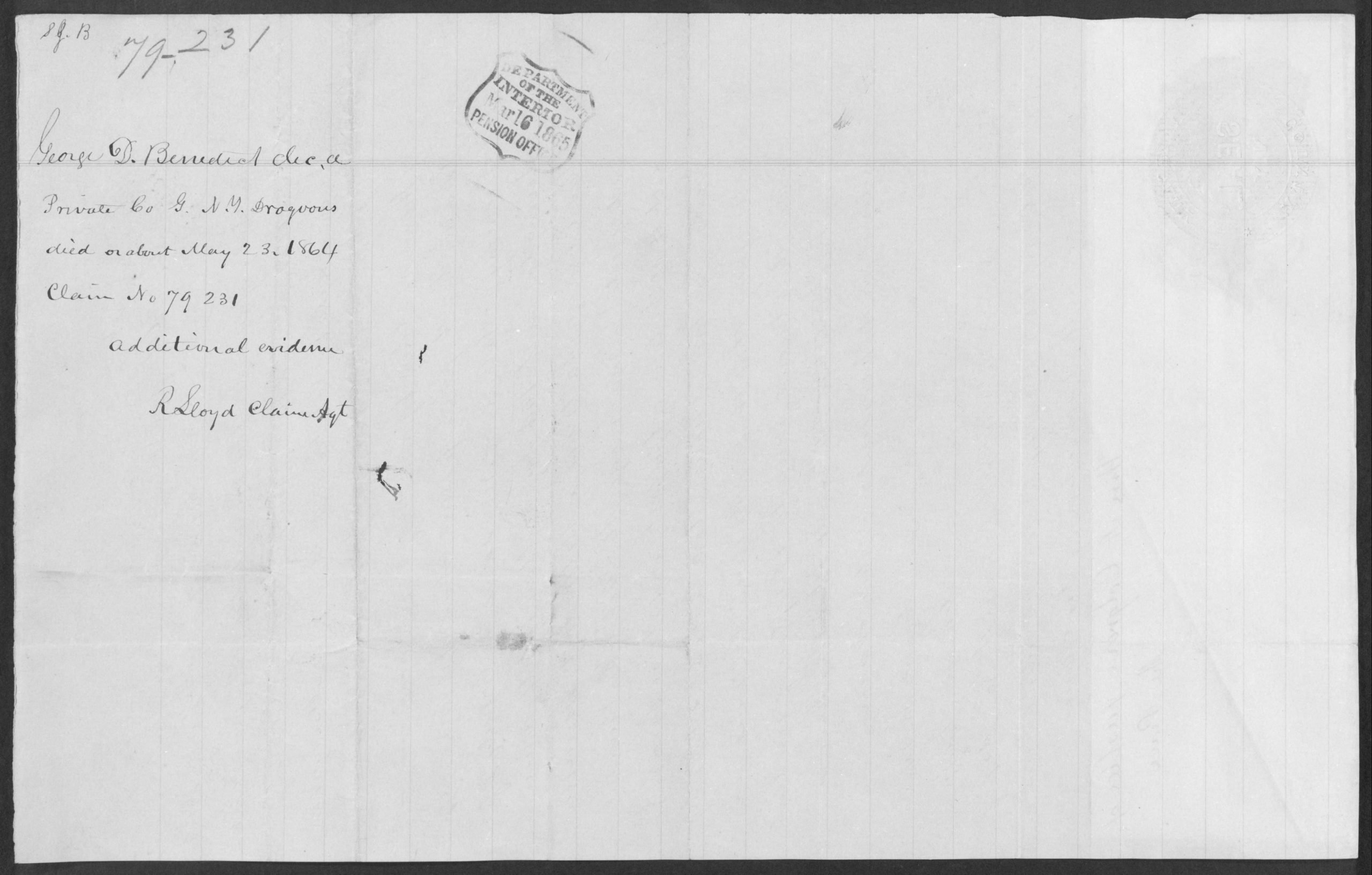
[The last sheet: the endorsement panel of the wrapper the February evidence came in, docketed by the claim agent who sent it. Ransom Lloyd of Angelica signs himself here as claim agent, though the Brief records no attorney and no fee. The Pension Office stamp gives the day it arrived, 16 March 1865. The date of death is still her date, on or about 23 May 1864, because the Adjutant General’s answer contradicting it had not yet been reconciled.]
S. J. B. 79,231
George D. Benedict dec’d
Private Co G. N.Y. Dragoons
died or about May 23. 1864
Claim No 79 231
Additional evidence
R Lloyd Claim Agt
[Receiving stamp:]
DEPARTMENT OF THE INTERIOR MAR 16 1865 PENSION OFFICE
Reference. Approved Pension Application File for Sarah J Jacobs Benedict, Widow of George D Benedict, Company G, 19th New York Cavalry Regiment (Application No. WC53251) National Archives, Record Group 15. Reproduced here in full, scan beside transcription.
Views: 20