Blacksmith John J. Adams
Blacksmith John J. Adams
John J. Adams of Alfred, New York, enlisted in Company H of the regiment that became the First New York Dragoons, originally the 130th New York Volunteer Infantry, in August 1862, at the age of 33. He served through to the close of the war and mustered out with the regiment in 1865.
The Service Record
Enlisted: August 1862, at Alfred, N.Y.; age 33.
Company: Company H, 130th New York Volunteers → First New York Dragoons.
Rank: Blacksmith.
Mustered out: June 30, 1865 — Clouds Mills, Va.
Source: New York Adjutant-General’s register of the First New York Dragoons; Bowen, J. R. (1900). Regimental History of the First New York Dragoons.
From the Regimental Register
“John J. Adams. Mustered in as Private, Co. H, Sept. 3, to serve three years; appointed blacksmith, date Not Stated; mustered out with company, June 30, at Clouds Mills, Va.”
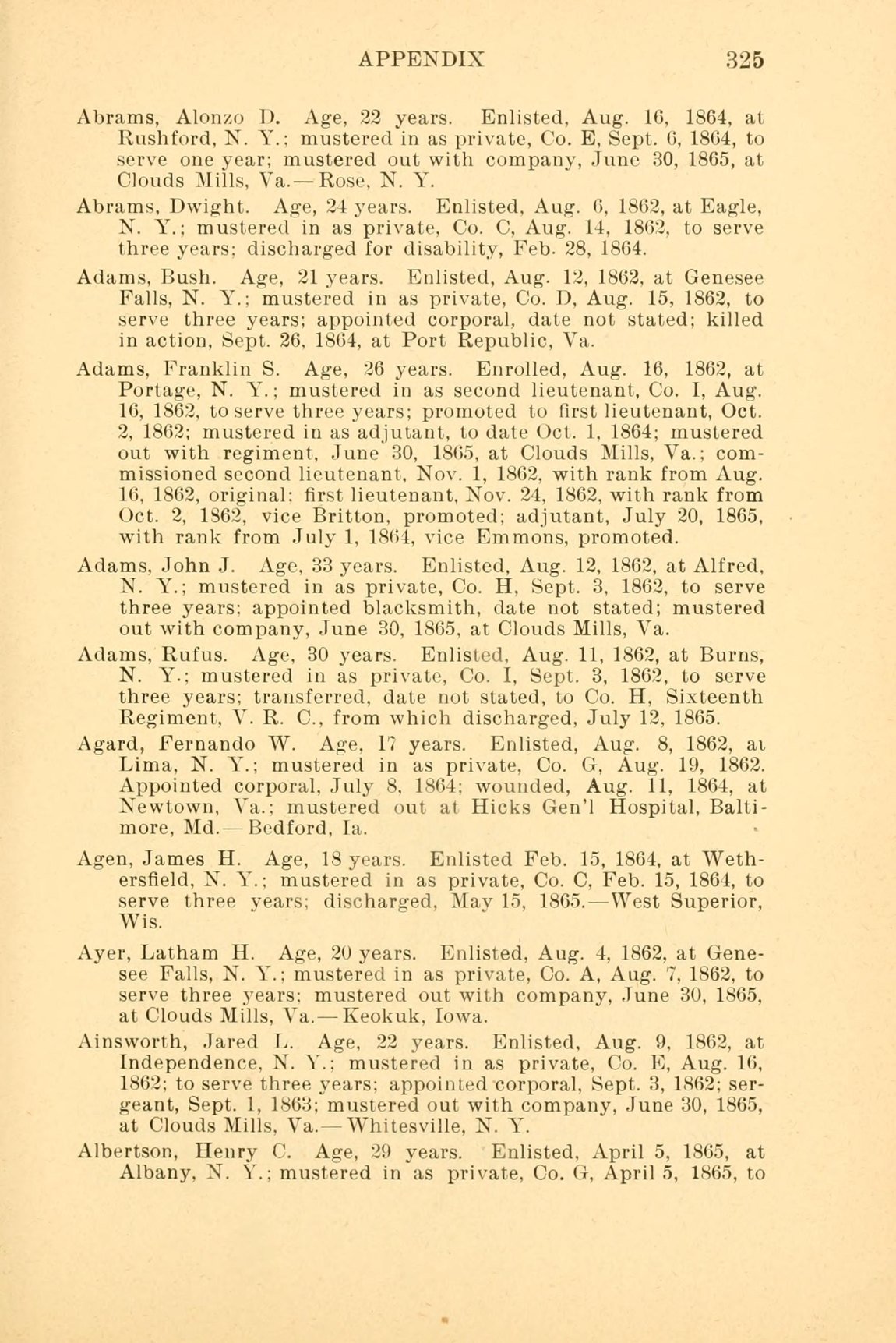
Verbatim from the roster of the First New York Dragoons in the New York Adjutant-General’s report. The page reproduced above is from Bowen, J. R. (1900). Regimental History of the First New York Dragoons (originally the 130th N.Y. Vol. Infantry) (p. 325). Internet Archive. archive.org/details/regimentalhistor00bowe
Terms on this page, from brevet and mustered out to the classes of the Roll of Honor, are defined in the site Glossary.
Named in a Comrade’s Letter
Private George D. Benedict of Company G wrote home to his wife Sarah at Belvidere. His letters survive, and they name this man.
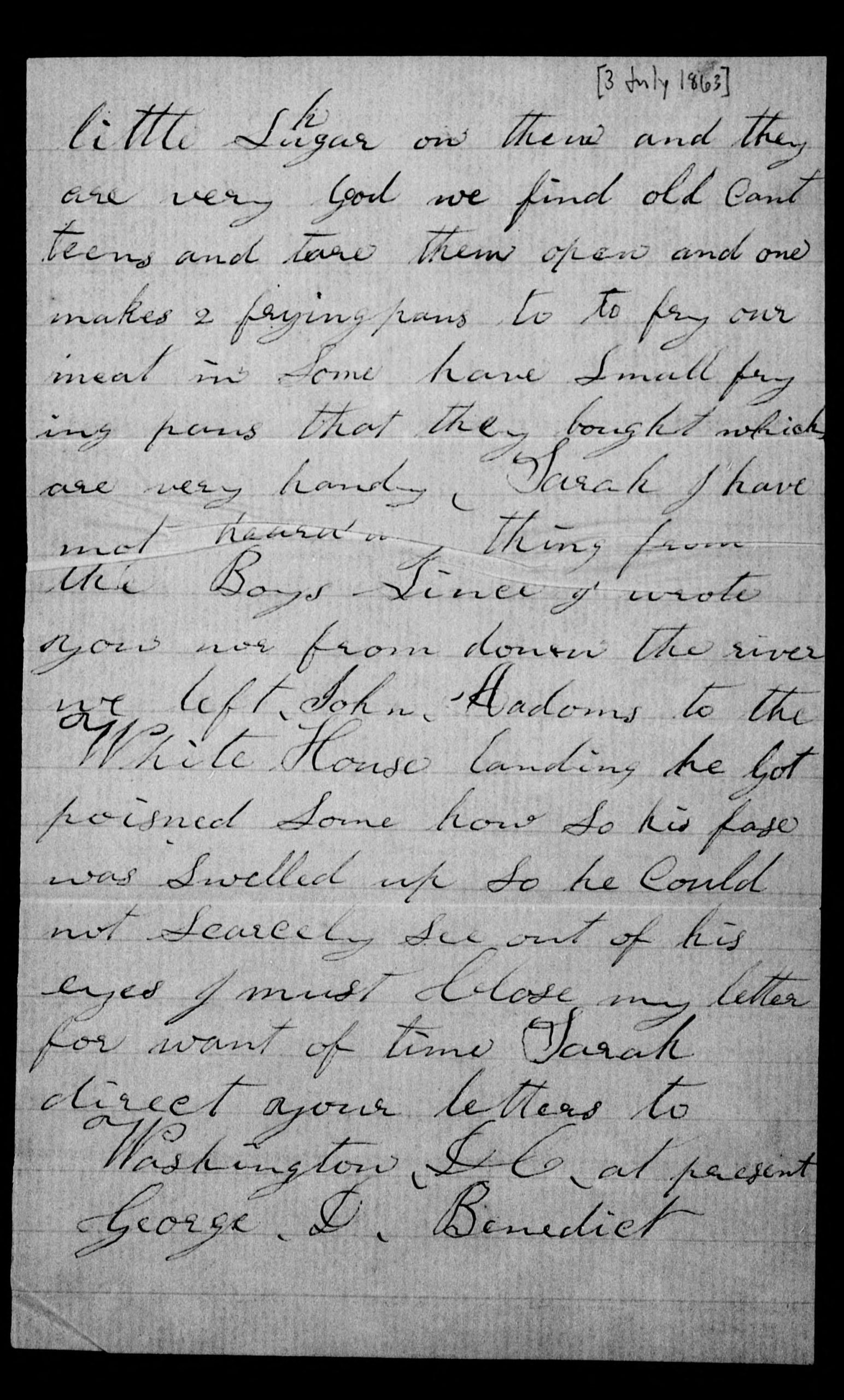
The manuscript. Click to enlarge.
Southern Historical Collection, UNC Chapel Hill, #4943-z.
The passage that names him
“I Saw John Adams a day or two Since. He was well. … [8 June] I Saw John Adams this morning and talked with him Some time. he had a letter from his folks last Thursday, he said they were well. he is agoing to apply for a ferlow to go home before long on business. … [21 June, at Yorktown] I Saw John Adams this morning, he was well. … [3 July] we left John Adams to the White House landing — he got poisned Some how, So his fase was Swelled up So he Could not Scarcely See out of his eyes.”
— George D. Benedict, 11 May to 3 July 1863
Adams was the blacksmith of Company H, from Alfred. Much of a soldier’s letter was a casualty list in reverse: a roll of neighbours seen alive. Benedict names him four times across eight weeks — seen well in May; talked with at length on 8 June, when Adams said he meant to apply for a furlough home on business; seen again on 21 June, the morning after the regiment landed at Yorktown; and finally on 3 July, when the column moved on up the Peninsula and Adams was left behind sick at White House Landing, his face so swollen he could barely see. Benedict did not know the cause; on a Virginia march in July, poison ivy or sumac is as likely as anything he ate. Adams recovered and mustered out with the company in June 1865.
The whole page, transcribed
little Sugar on them and they are very God we find old Canteens and tare them open and one makes 2 frying pans to fry our meat in Some have Small frying pans that they bought which are very handy Sarah I have not heard any thing from the Boys Since I wrote you nor from down the river we left John Adams to the White House landing he got poisned Some how So his fase was Swelled up So he Could not Scarcely See out of his eyes I must Close my letter for want of time Sarah direct your letters to Washington D. C. at pesent
George D. Benedict
Transcribed from the manuscript, in Benedict’s own spelling and punctuation.
Men he served beside
Named alongside him in the same letters, or standing on the same post:
The letters themselves, transcribed page by page, are on the page of Private George D. Benedict, Company G, who wrote them.
Source. Benedict, G. D. (1863–1864). George D. Benedict Papers (Collection #4943-z). Southern Historical Collection, Louis Round Wilson Special Collections Library, University of North Carolina at Chapel Hill.
Named in a Comrade’s Letter — Warrenton, 29 July 1863
Private George D. Benedict of Company G wrote home to his wife Sarah at Belvidere through 1863 and 1864. His letters survive, and this one records this man.
“we left John Adams at the white house landing he had got pisoned So his face was Swelled So bad he could Scarcly See out of his eyes I have Seen nor heard from him Since”
— George D. Benedict, Warrenton, Virginia, 29 July 1863
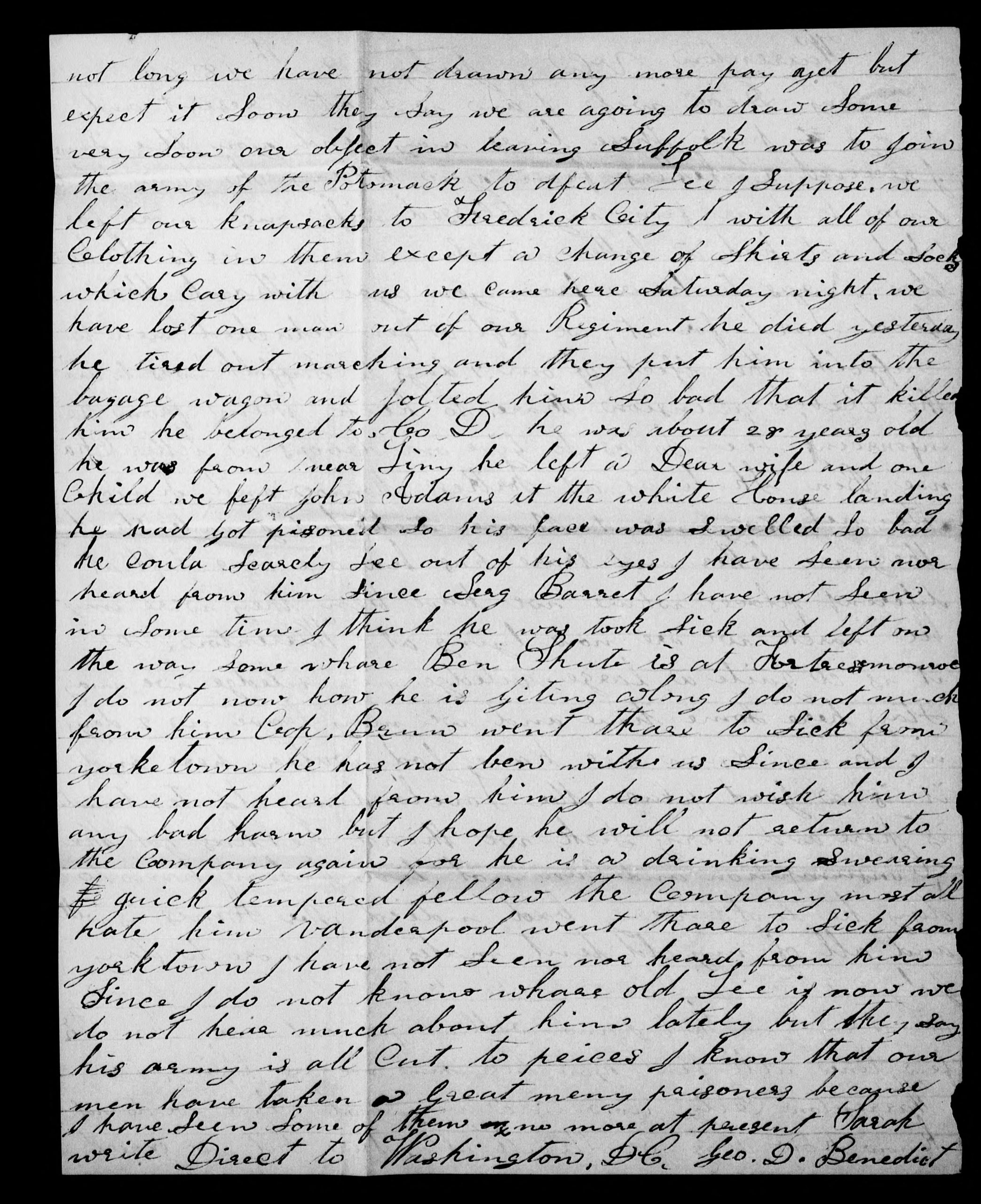
The whole page, transcribed
not long we have not drawn any more pay yet but expect it Soon they Say we are agoing to draw Some very Soon our object in leaving Suffolk was to join the army of the Potomack to defeat Lee I Suppose,
we left our knapsacks to Fredrick City with all of our Clothing in them except a change of Shirts and Socks which Cary with us we came here Saturday night,
we have lost one man out of our Regiment he died yesterday he tired out marching and they put him into the bagage wagon and jolted him So bad that it killed him he belonged to Co D he was about 28 years old he was from near Liny he left a Dear wife and one Child
we left John Adams at the white house landing he had got pisoned So his face was Swelled So bad he could Scarcly See out of his eyes I have Seen nor heard from him Since
Serg Barret I have not Seen in Some time I think he was took Sick and left on the way Some whare
Ben Shute is at Fortress monroe I do not now how he is giting along I do not much from him
Corp. Benn went thare to Sick from yorketown he has not ben with us Since and I have not heard from him I do not wish him any bad harm but I hope he will not return to the Company again for he is a drinking Swearing quick tempered fellow the Company most all hate him
Vanderpool went thare to Sick from yorktown I have not Seen nor heard from him Since
I do not know whare old Lee is now we do not hear much about him lately but they Say his army is all Cut to peices I know that our men have taken a Great meny prisoners because I have Seen Some of them
no more at present Sarah write Direct to Washington, D C
Geo. D. Benedict
Adams was the blacksmith of Company H, from Alfred. Benedict had reported him alive and well on 11 May 1863. Ten weeks later he is left behind at White House Landing, blinded by swelling.
“Poisoned” in 1863 usually meant a bad plant — poison ivy or poison sumac, which a cavalryman sleeping rough in Virginia met constantly — or spoiled rations. Severe enough that he could not see, and severe enough to be left behind by a moving column.
He recovered. Adams served to the end and mustered out with his company at Cloud’s Mills on 30 June 1865. None of this episode appears in his service record; it survives only in Benedict’s letter.
Men named on this same page.Alonzo Hodge · Albert D. Vanderpool · Alonzo D. Barrett · Benjamin Shute. The full run of Benedict’s letters, transcribed page by page, is on his own page.
Source. Benedict, G. D. (1863–1864). George D. Benedict Papers (Collection #4943-z). Southern Historical Collection, Louis Round Wilson Special Collections Library, University of North Carolina at Chapel Hill.
Named in a Comrade’s Letter — Culpeper, 13 November 1863
Private George D. Benedict of Company G to his wife Sarah at Belvidere. Written in pencil, for want of ink.
“John Adams and Serg Baret is all right”
— George D. Benedict, Culpeper, Virginia, 13 November 1863
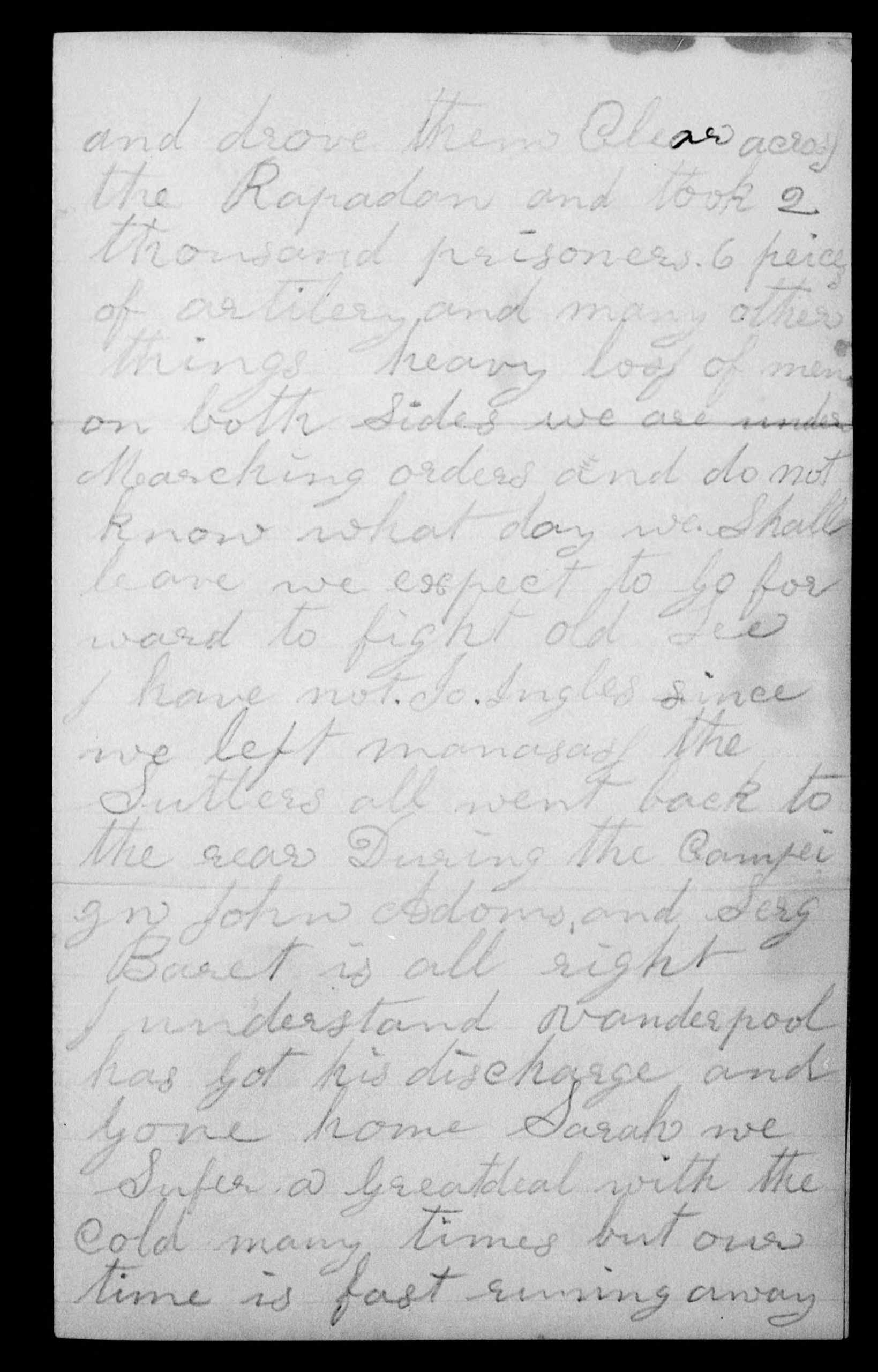
The whole page, transcribed
and drove them Clear across the Rapadan and took 2 thousand prisoners 6 pieces of artilery and many other things heavy loss of men on both Sides
we are Marching orders and do not know what day we Shall leave we expect to go forward to fight old Lee
I have not So Ingles Since we left Manasas the Sutlers all went back to the rear During the Campeign
John Adams and Serg Baret is all right
I understand Vanderpool has got his discharge and gone home
Sarah we Sufer a greatdeal with the Cold many times but our time is fast runing away
In July 1863 Benedict had left Adams behind at White House Landing, poisoned, his face so swollen he could scarcely see, and had heard nothing of him since. Four months later, from Culpeper, comes the entry that closes the story: “John Adams and Serg Baret is all right.”
Five words, and they are the reason letters like this are worth transcribing in full. The muster roll shows Adams mustering out with his company on 30 June 1865 and nothing in between. It cannot tell you that he was blinded by swelling in July, or that his friends spent four months not knowing, or the day the word came back that he was all right.
Men named on this same page.Alonzo D. Barrett · Albert D. Vanderpool. The full run of Benedict’s letters, transcribed page by page, is on his own page.
Source. Benedict, G. D. (1863–1864). George D. Benedict letters, 1863–1864 (Collection #4943-z). Southern Historical Collection, Louis Round Wilson Special Collections Library, University of North Carolina at Chapel Hill.
Named in a Comrade’s Letter — the Rapidan, February 1864
Private George D. Benedict of Company G to his wife Sarah at Belvidere, from winter quarters on the Rapidan.
“John Adams is well and to work at blacksmithing for the Regiment”
— George D. Benedict, February 1864
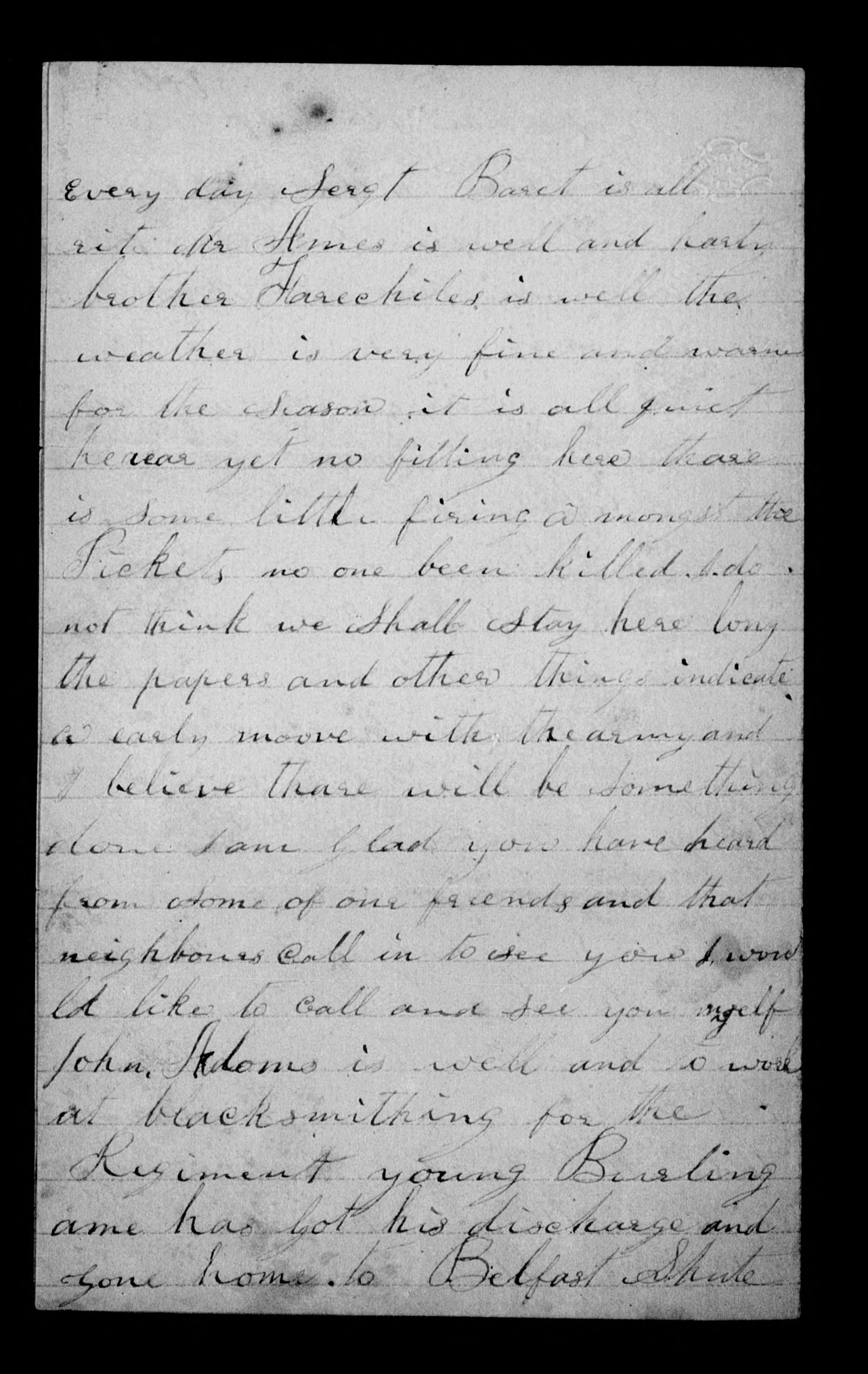
The whole page, transcribed
every day
Sergt Baret is all rite Mr Ames is well and harty brother Farechiles is well
the weather is very fine and warm for the Season it is all quiet herear yet no fitting here thare is some little firing amongst the Pickets no one been killed
I do not think we Shall Stay here long the papers and other things indicate a early moove with the army and I believe thare will be Something done
I am glad you have heard from Some of our friends and that neighbours Call in to see you I would like to call and see you myself
John Adams is well and to work at blacksmithing for the Regiment
young Burlingame has got his discharge and gone home to Belfast Shute
This letter gives John Adams a trade. Benedict reports him “well and to work at blacksmithing for the Regiment” — the roster records that Adams was appointed blacksmith of Company H, and here he is doing the work, shoeing and mending for a cavalry regiment in winter camp.
It is a quiet correction to the picture of a soldier as only a man with a rifle. A cavalry regiment ran on its blacksmiths, and Adams — who had been left behind poisoned and half-blind the previous July — was back at his forge.
Men named on this same page.Albert Burlingame · Benjamin Fairchild · Benjamin A. Ames · Alonzo D. Barrett. The full run of Benedict’s letters, transcribed page by page, is on his own page.
Source. Benedict, G. D. (1863–1864). George D. Benedict Papers (Collection #4943-z). Southern Historical Collection, Louis Round Wilson Special Collections Library, University of North Carolina at Chapel Hill.
Views: 13