The Mexican War: A Journey Through the Gibbs Papers
The Gibbs Papers · Journey No. 1
The Mexican War
1846–1848
One lieutenant’s war, told in his own papers — a summons, a battle map, a depot ledger, a Christmas Eve in a conquered capital, and now his own published battle letters and the letters his family wrote back.
How a Journey Works
A Journey walks an era of the archive in the order the paper was made. Every document appears as a station on the road: the scan, a transcription, the moment in history it belongs to — and a Researcher’s Note that grows as we dig. When a name on a receipt turns out to be a Nauvoo sheriff, or a signature turns out to belong to the future Confederate chief of ordnance, the note records the find and the next question. This page will never be finished. That is the point.
A word on provenance before the road begins: the folder these papers live in bears a small octagonal label — “No 1313 / Alfred Gibbs / Class of 1846.” Number 1313 is Gibbs’s entry in Cullum’s register of West Point graduates, and the Class of 1846 is the most famous class the Academy ever produced: George B. McClellan, Thomas “Stonewall” Jackson, George Pickett — and Alfred Gibbs.
This Journey grew in July 2026, and grew enormously: the Wisconsin family papers yielded nine letters written to the lieutenant in Mexico by his mother and brothers, and those letters led this archive to the newspapers — where Alfred’s own published battle accounts, unsigned for 179 years, got their byline back. The road now runs from the summons of 1846 to the homecoming of 1848, in his own words and his family’s.
Prologue — A State of War Exists
The war reached the Gibbs family the way it reached every American family — by proclamation. On May 13, 1846, President Polk declared that “a state of war exists” with Mexico; six days later Congress authorized the Regiment of Mounted Riflemen, the regiment that would carry Alfred Gibbs to Vera Cruz. For newcomers to this era, the half-hour overview below is one of the best introductions to the war Gibbs and the Class of 1846 fought; then walk the stations, where his own papers take over the telling.

Full transcription
BY THE PRESIDENT OF THE UNITED STATES OF AMERICA.
A PROCLAMATION.
Whereas the Congress of the United States, by virtue of the constitutional authority vested in them, have declared by their act, bearing date this day, that, “by the act of the Republic of Mexico, a state of war exists between that Government and the United States:”
Now, therefore, I, JAMES K. POLK, President of the United States of America, do hereby proclaim the same to all whom it may concern; and I do specially enjoin on all persons holding offices, civil or military, under the authority of the United States, that they be vigilant and zealous in discharging the duties respectively incident thereto: and I do moreover exhort all the good people of the United States, as they love their country, as they feel the wrongs which have forced them on the last resort of injured nations, and as they consult the best means, under the blessing of Divine Providence, of abridging its calamities, that they exert themselves in preserving order, in promoting concord, in maintaining the authority and the efficacy of the laws, and in supporting and invigorating all the measures which may be adopted by the constituted authorities for obtaining a speedy, a just, and an honorable peace.
In testimony whereof, I have hereunto set my hand, and caused the seal of the United States to be affixed to these presents. Done at the City of Washington the thirteenth day of May, one thousand eight hundred and forty-six, and of the independence of the United States the seventieth.
JAMES K. POLK.
By the President: JAMES BUCHANAN, Secretary of State.
“Whereas the Congress of the United States… have declared by their act, bearing date this day, that, ‘by the act of the Republic of Mexico, a state of war exists between that Government and the United States:’ Now, therefore, I, JAMES K. POLK, President of the United States of America, do hereby proclaim the same to all whom it may concern… that they exert themselves in preserving order, in promoting concord… and in supporting and invigorating all the measures which may be adopted by the constituted authorities for obtaining a speedy, a just, and an honorable peace.”Proclamation of war, May 13, 1846 · James K. Polk
The Moment
Two days before the proclamation, Congress had voted the war into existence on news of the Rio Grande clashes; within the year Scott’s army would land at Vera Cruz. At West Point, the Class of 1846 — McClellan, Jackson, Pickett, Gibbs — graduated in June straight into it.
Researcher’s Notes
This station preserves the site’s original Mexican War page, which carried the proclamation and the video overview from the archive’s earliest days; that page now points here, so the war’s front door and its documents live together.
❦ These notes grow. As research answers a question or opens a new one, an entry is added here — the document stays, the story deepens.
The Summons
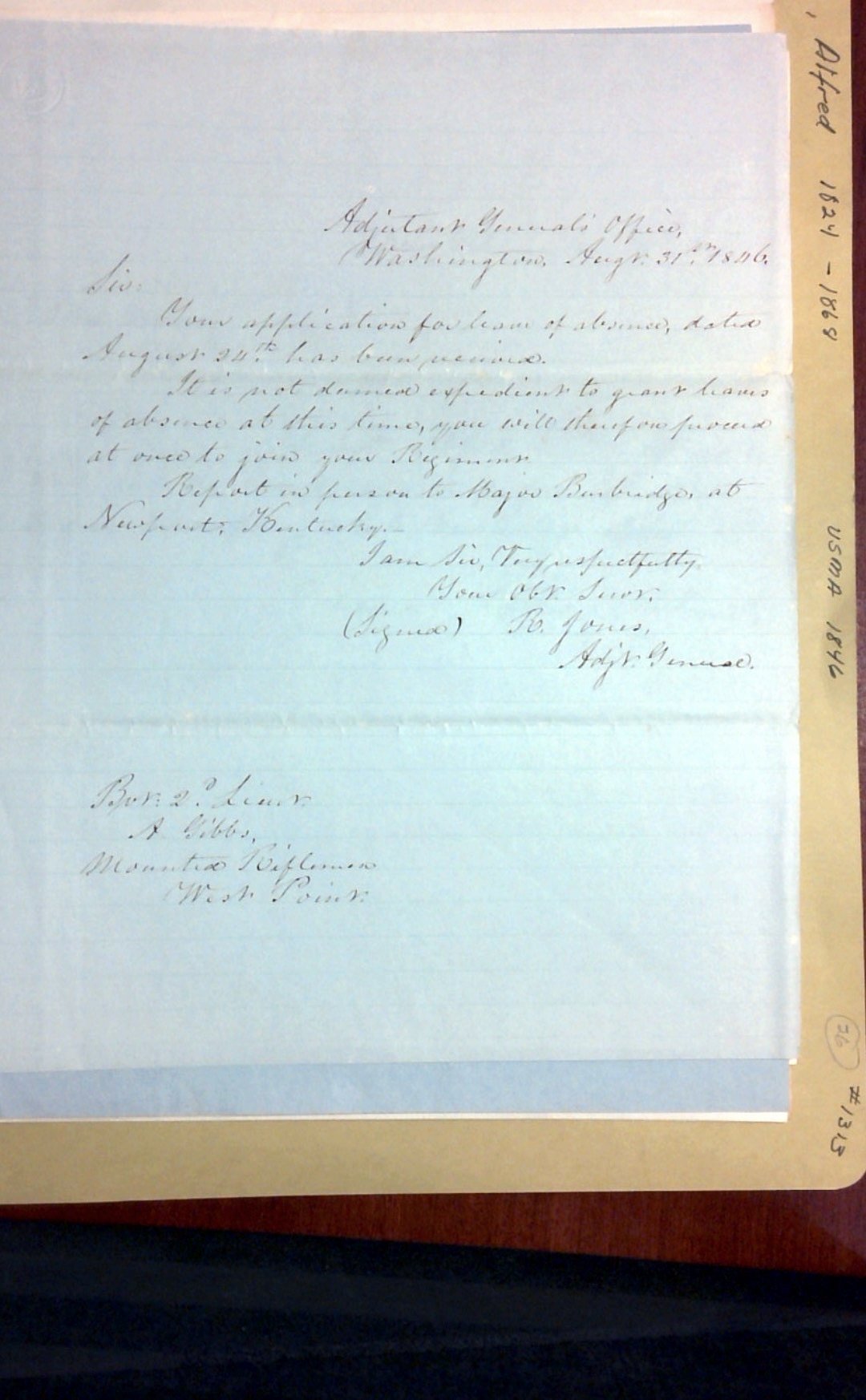
Full transcription
Adjutant General’s Office,
Washington, Augt. 31st 1846.
Sir:
Your application for leave of absence, dated
August 24th has been received.
It is not deemed expedient to grant leave
of absence at this time, you will therefore proceed
at once to join your Regiment.
Report in person to Major Burbridge, at
Newport, Kentucky.—
I am Sir, Very respectfully,
Your Obt. Servt.
(Signed) R. Jones,
Adjt. General.
Bvt. 2d Lieut.
A. Gibbs,
Mounted Riflemen
West Point.
[Archival marginalia, right/left edges (modern pencil/ink, not part of the original letter): “Alfred 1624 – 1868” (top edge, vertical); “USMA 1842” (right edge, vertical); “56” and “#1313” (lower right corner). A file/blind-stamp is visible at the upper-left corner.]
—
All four transcribed. Notes for the record:
– The combat-resume (mw-gibbs-combat-resume.jpg) is in Gibbs’s own hand and is cut off at the bottom; the list continues past this leaf. Several late-war dates carry interlined corrections and heavy red/blue underlining of place names.
– The Cullum entry (mw-cullum-entry-marginalia.jpg) is printed No. 1313 with pencil marginalia. The two most substantive annotations are next to the Mexican War brevets: an addition reading “and charge on Garita de San Antonio,” and a Kearny note (best read as “under Genl Phil Kearny,” though the ink is ambiguous and could read “not for Phil Kearny” — flagging as uncertain). “over.” at the foot confirms the printed entry continues on the reverse.
– The 1859 Carlisle Barracks letter contains an internal inconsistency worth noting: Gibbs writes his aide-de-camp service to P. F. Smith as “from March 24 1847 to July 1st 1858,” which does not square with the Cullum record (aide from Mar. 27, 1848); likely a slip of memory, which he himself explains by being “seperated from all my private papers.” It also ends mid-sentence — a continuation leaf is missing.
– The 1846 Jones letter is a clean file copy; edge annotations (“Alfred 1624–1868”, “USMA 1842”, “#1313”) are modern archival finding marks, not original.
Two months out of West Point, brevet 2nd Lieutenant Gibbs applied for leave. His application was dated August 24, 1846. A week later the Adjutant General of the United States answered him personally, refusing the leave and ordering him at once to his regiment. That refusal sent him to war.
“It is not deemed expedient to grant leave of absence at this time; you will therefore proceed at once to join your Regiment. Report in person to Major Burbridge, at Newport, Kentucky.”Adjutant General R. Jones, Washington, Aug. 31, 1846 · Doc #210
The Moment
Congress had authorized the Regiment of Mounted Riflemen on May 19, 1846 — days after the declaration of war with Mexico — and it was recruiting and organizing that summer. Whatever the 22-year-old wanted leave for, the Army had other plans: from Newport, Kentucky the regiment’s road led to Jefferson Barracks, and then to the beaches of Vera Cruz.
Researcher’s Notes
The folder tab beside this letter reads “# 1313” — Gibbs’s number in Cullum’s Register of West Point graduates, which tells us how the collection was originally organized. Open questions: who was Major Burbridge at Newport, Kentucky in 1846, does Gibbs’s August 24 leave application survive at the National Archives, and why did a 22-year-old fresh from graduation want leave — family business at Sunswick?
❦ These notes grow. As research answers a question or opens a new one, an entry is added here — the document stays, the story deepens.
Cerro Gordo — The Map of His Own Battle
Ten of the scans in this era resolve into a single sheet: a folded, engraved, hand-colored map — “Battle of Cerro Gordo, April 17th & 18th 1847, from Surveys made by Major Turnbull & Capt McClellan, Topl Engs” — with American positions in orange, Mexican works in blue, complete orders of battle, and a casualty table totaling 430. In the legend of Twiggs’s division stands the Mounted Rifle Regiment: Gibbs kept a map of a battle he personally fought, charting his own regiment’s ground. He was slightly wounded there, and brevetted first lieutenant “for gallant and meritorious conduct.”
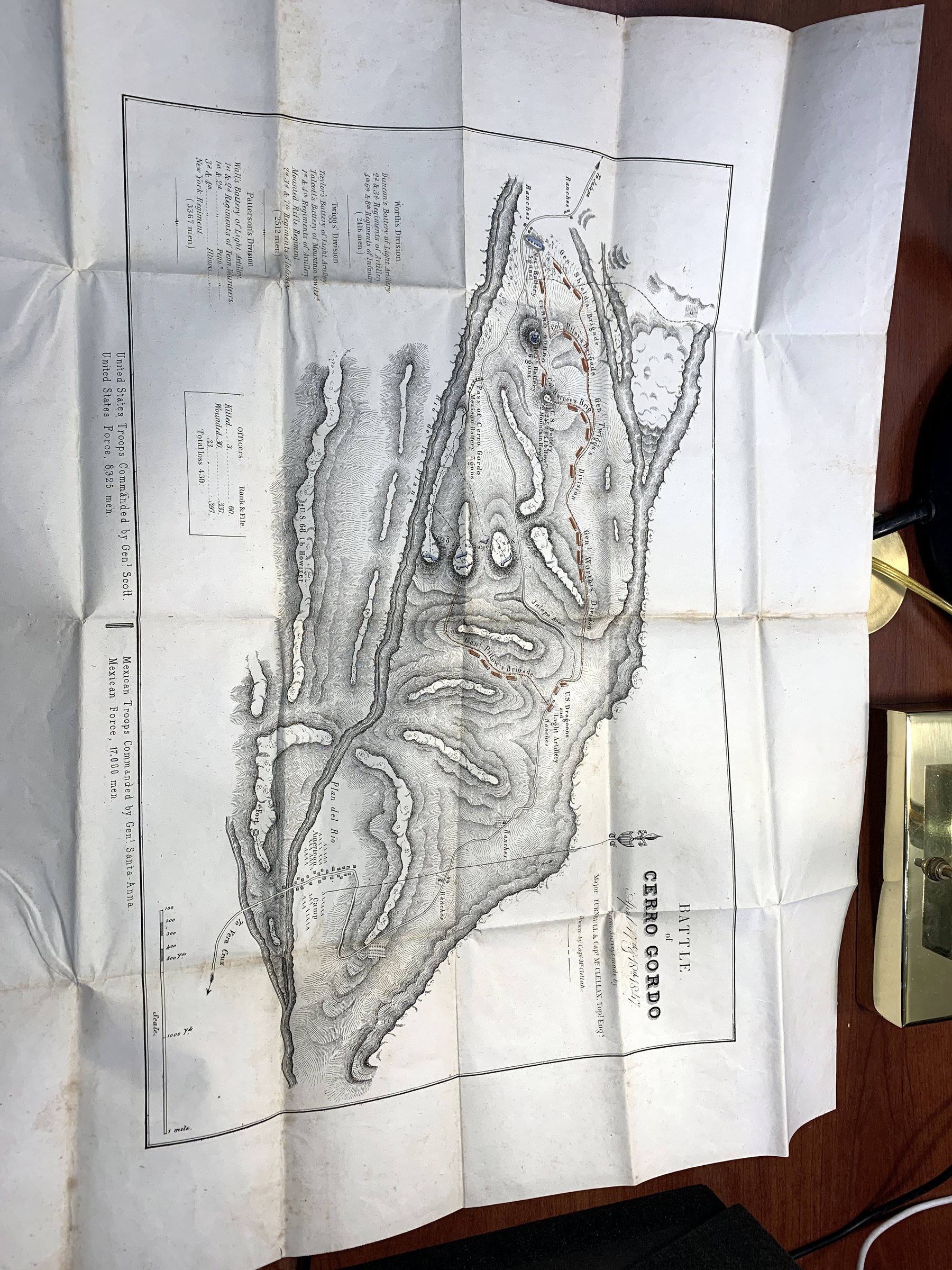
Full transcription
Title cartouche (lower right of sheet), verbatim:
> BATTLE
> of
> CERRO GORDO
> *April 17th & 18th 1847* [script]
> from Surveys made by
> Major TURNBULL & Cap.t M.c CLELLAN. Top.l Eng.s
> Drawn by Cap.t M.cClellan.
Order-of-battle / statistics panel (left side of sheet), verbatim as legible:
> Worth’s Division
> Duncan’s Battery of Light Artillery. ______
> 2.d & 3.d Regiments of Artill.y ______
> 5.th & 8.th Regiments of Infantry ______
> (2416 men)
>
> Twiggs’s Division
> Taylor’s Battery of Light Artillery ______
> Talcott’s Battery of Mountain Howitzer[s] ______
> 1.st & 4.th Regiments of Artillery ______
> Mounted Rifle Regiment ______
> 2.d 3.d & 7.th Regiments of Infantry ______
> (2892 men)
>
> Patterson’s Division
> Wall’s Battery of Light Artillery ______
> 1.st & 2.d Regiments of Tenn.e Volunteers ______ Penn.a ______ [state labels at right]
> 3.d & 4.th ______ Illinois ______
> New York Regiment ______
> (3367 men)
Casualty table:
> ______ | Officers | Rank & File
> Killed __ 3 | 60
> Wounded 30 | 337 [30?]
> Total loss 430 | Total 397
Force summary lines (bottom):
> United States Troops Commanded by Gen.l Scott.
> United States Force, 8325 men.
> Mexican Troops Commanded by Gen.l Santa-Anna.
> Mexican Force, 17,000 men.
Scale bars: one graduated bar reading “100 / 200 / 300 / 400 / 500 Y.ds … 1000 Y.ds” labeled “Scale”; a second bar labeled “1 mile.”
Place/feature labels on the map body (as legible): “Rio del Plan” / “Plan del Rio,” “Rancho’s” (several), “Pass of Cerro Gordo,” “National Road,” “to Vera Cruz” (arrow at road, lower left), “Jalapa Road,” “Camp” (Mexican camp near the fort, lower left), “Fort” (twice, left), “Gen.l Pillow’s Brigade,” “US Dragoons and Light Artillery,” “Gen.l Worth’s Division,” “Gen.l Twiggs’s Division,” plus the battery/brigade labels also seen in the Telegrafo detail. North arrow ornament near the title.
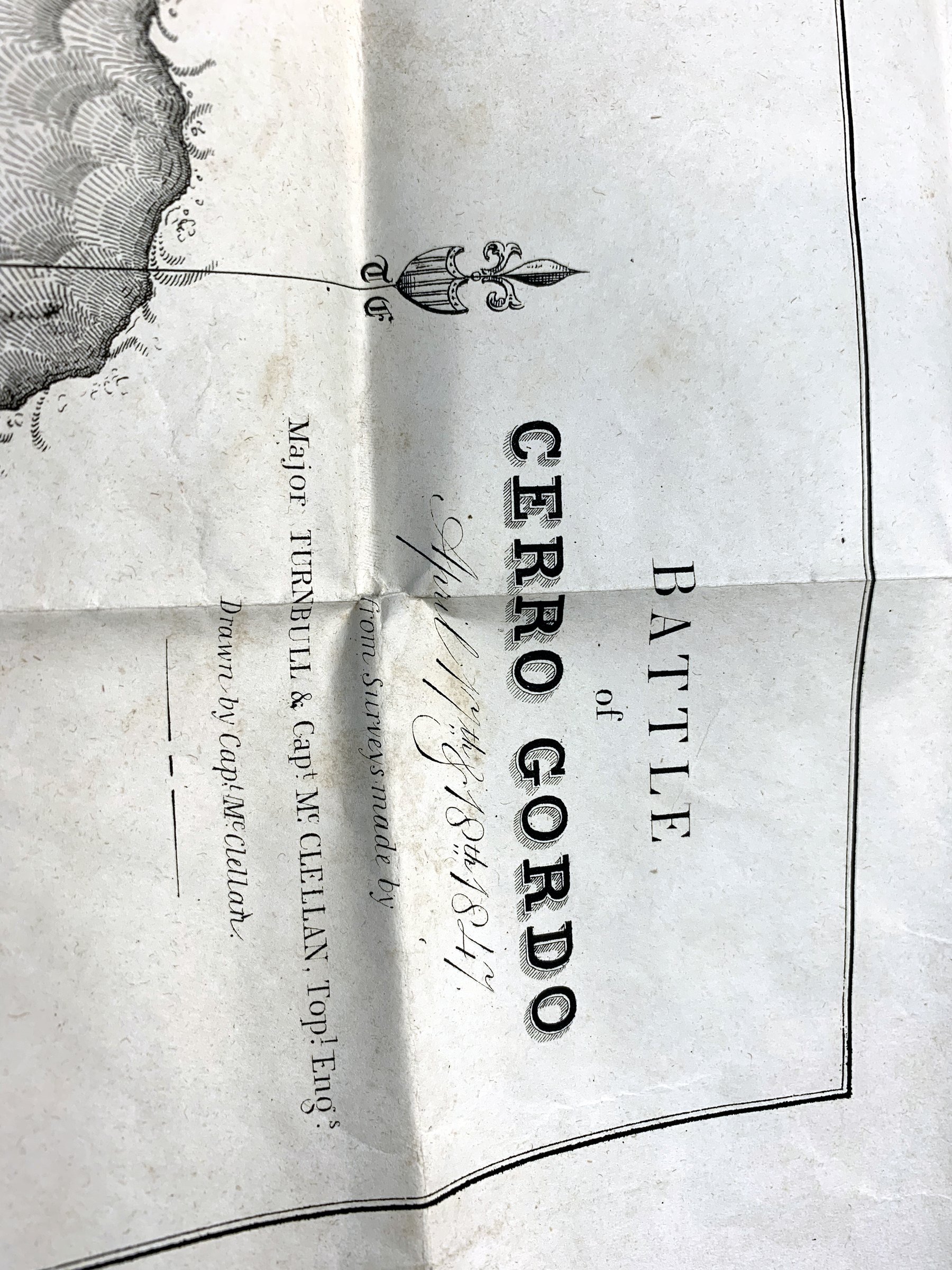
Full transcription
Title cartouche, verbatim:
> BATTLE
> of
> CERRO GORDO
> *April 17th & 18th 1847* [engraved in script within the title block]
> from Surveys made by
> Major TURNBULL & Cap.t M.c CLELLAN. Top.l Eng.s
> Drawn by Cap.t M.cClellan.
Below the credit line is an engraved scale bar (unlabeled dashes in this crop). At the fold above the title is a decorative engraved compass/direction ornament (fleur-de-lis north arrow). Left edge shows the hachured hill terrain of the map proper.
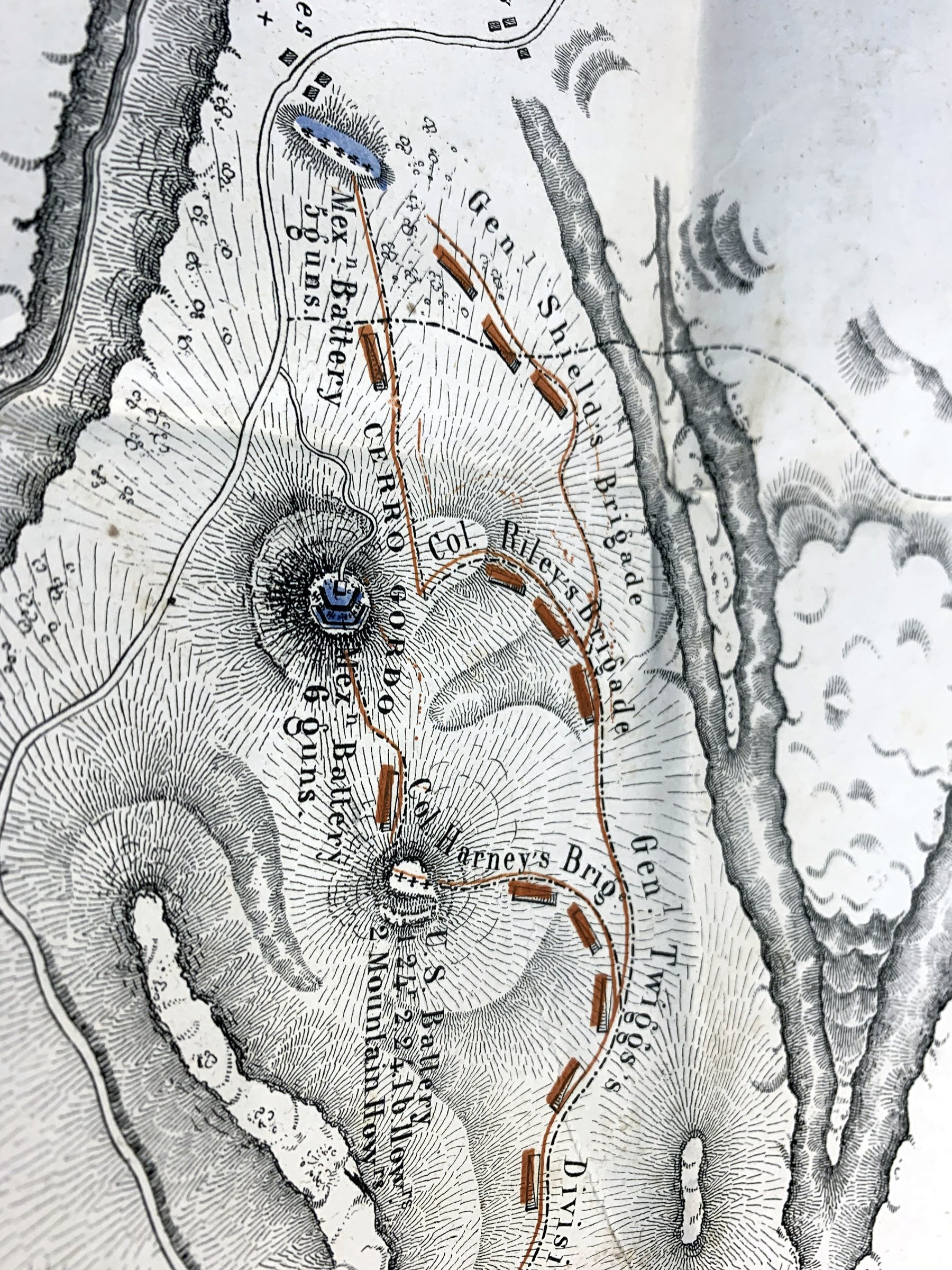
Full transcription
mw-cerro-gordo-map-telegrafo.jpg
DOC TYPE: Map, battle-detail inset (the El Telegrafo / Cerro Gordo hill area, hand-colored)
INSCRIPTIONS (troop-position and battery labels, verbatim as legible):
– “Gen.l Shield’s Brigade”
– “Col. Riley’s Brigade”
– “Gen.l Twiggs’s Division”
– “Col. Harney’s Brig.” [Brigade]
– “CERRO GORDO” (running vertically up the central peak)
– “Mex.n Battery / 5 guns.” (upper battery)
– “Mex.n Battery / 6 guns.” (lower battery)
– “U.S. Battery / 21. 24. 12. 24 Mort. / 2 Mountain How.rs” [Howitzers] (partly obscured by fold; the battery on Harney’s line)
– “…Division” (Twiggs’s, lower right)
Graphic: finely hachured conical hills; blue hand-coloring marks the fortified Mexican gun emplacements/redoubts (the blue oval at top and the blue fortwork on the central summit), brown/ochre bars mark U.S. and Mexican gun positions and the assault lines; a brown line traces the flanking route around Cerro Gordo.
The Moment
Cerro Gordo was Winfield Scott’s first battle after Vera Cruz fell: on April 17–18, 1847 his army swung around Santa Anna’s left on the National Road and stormed El Telégrafo hill, routing a larger Mexican force and opening the road toward Mexico City. The official battlefield survey was made immediately afterward and published with Scott’s reports.
Researcher’s Notes
The old catalogue credited this map to “Capt. Gossmann” and even a “Hog’s Division.” Reading the sheet itself: it is “Drawn by Capt McClellan” — Capt. John McClellan of the Topographical Engineers (George B. McClellan was only a 2nd lieutenant of Engineers in 1847), and the phantom general dissolves into “[Tw]iggs’s Division” cut off at the photo edge. Still to do: match this impression against Library of Congress copies of the Turnbull–McClellan map, and examine the sheet’s verso for a Gibbs ownership inscription.
❦ These notes grow. As research answers a question or opens a new one, an entry is added here — the document stays, the story deepens.
The Valley of Mexico — In His Own Words
The battle record gives the dates; the general’s own pen gives the war. Eleven days after Contreras and Churubusco, Lt. Gibbs sat down at San Angel and wrote his brother a complete account of the campaign — the drenched midnight before Contreras, the dawn charge, the storm of Churubusco, Kearny’s ride to the very gate of the city. Brother George put it into print, unsigned, in the New York Courier & Enquirer, and the Washington papers copied it. In July 2026 this archive identified it and gave it back its byline: it is the longest first-person account of Alfred Gibbs’s war in existence, and it is exhibited complete, with its attribution, in The War Correspondent.
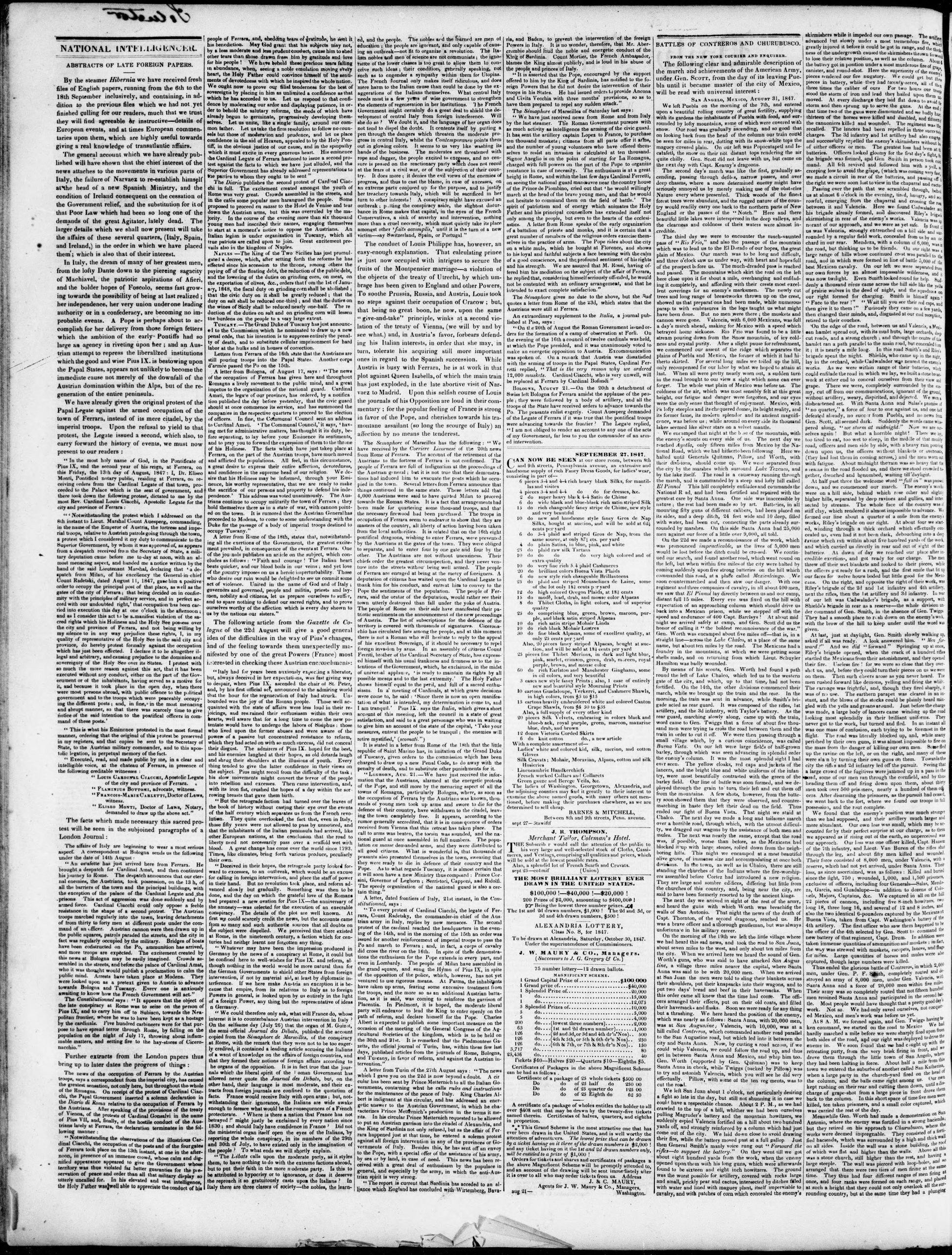
Full transcription
Gibbs’s letter is transcribed in full as its own exhibit — read it complete →
“There we lay, too tired to eat, too wet to sleep, in the middle of that muddy road, officers and men side by side, with a heavy rain pouring down upon us… and the first smile that lit up our faces for twelve hours boded but little good for the Mexicans.”The night before Contreras, in his own words · published Oct. 13, 1847
“Gen. Smith slowly walking up, asked if all was ready. A look answered him. ‘Men forward!’ And we did ‘forward.’”The dawn assault at Contreras · the same letter
The Moment
On August 19-20, 1847, Scott’s army fought its way across the Pedregal and broke two Mexican armies in twenty-four hours — Valencia’s at Contreras, Santa Anna’s at Churubusco. Gibbs fought both actions with the Rifles in Smith’s brigade of Twiggs’s division, and wrote them down while the army camped at the gates of the capital under an armistice.
Researcher’s Notes
The attribution is documentary, not stylistic: George’s Oct. 25, 1847 letter (found on Reel 2 of the family papers and exhibited on this site) confesses the publication and names the two papers that copied it; both copies exist, both of Oct. 13; and the letter itself knows what only Alfred knew — Schuyler Hamilton’s wounding, Van Buren of the Rifles, Smith’s brigade from the inside. The complete letter, all three newspaper pages, and the full nine-point proof: The War Correspondent.
The letter also speaks to this journey’s oldest question. Its climax is Kearny’s charge to the very gate of the city — the action Gibbs spent his life penciling into his own record (see Station X below). The man who kept correcting the history had already written it, anonymously, in 1847.
❦ These notes grow. As research answers a question or opens a new one, an entry is added here — the document stays, the story deepens.
The Home Front Reads His Letters
What happened when the letter reached New York is a story the family papers tell in their own hand. George published it against Alfred’s orders and confessed by return mail; the officers’ families came to the Gibbs house to learn the fate of their sons; and when the December general orders passed Alfred over, the family opened a second front — the brevet war — that ran all winter.

Full transcription
[Heavy show-through of page 2 is visible across the top margin; not separately transcribed.]
Newyork October 25th 1847
My dear Alfred
Your letter giving an account of the taking of Mexico arrived on Saturday afternoon and although the reception of the accounts of the killed and wounded had previously relieved us of our worst [?] anxiety, still it was no little gratification to receive [?] your own [illegible] that you were alive and kicking. Your letter giving an account of the battles at Contreras & Churubusco had previously arrived and I wrote by Macalister [?] acknowledging it and explaining the reasons [?] for violating your injunction & publishing some extracts. The letter has been copied by the National Intelligencer & the Union & Capt Kenny [?] says it is the best account that has been given of any battle. Wetmore was delighted with it. Now to make you growl still more I have extracted and published part of your last. It was important [underlined] in the highest degree. In the first place to show the actual force of Scott’s, second to show what your division did, for Kendall is chiefly Worth’s historian, third to let the country feel how murderous the policy of a small army fed only by driblets is, and lastly to let the friends of the officers you mentioned know of their safety or fate. I called immediately on Mrs Hamilton who had no letter from Schuyler & who with the family were greatly relieved by hearing of his convalescence. I also sent a note to Col Thorn who called this morning to thank me & say that he had a letter from his son which was very gratifying. The Morrises had of course heard of poor Blakely’s [?] death. Their distress was terrible. Mrs Morris bears it with more strength than her husband who is dreadfully broken. Mother took the letter up and went with Wolcott. They had desired to see him but were very much overcome at the recollections he revived. Mrs Van [?] dared not inform her father of the particulars which are
horrible. But for that alarm he might have recovered. Maury was down to see me a few days ago. He looked well but will never recover the use of his arm. The surgeons told him that using [?] it again would be at the risk of his life. He is the pet of West point. I sent him your letter to read, and he was much affected by the mention of him by his old comrades. He is a fine fellow as ever breathed. All West Point was in a blaze at the letter as I published it, officers & cadets. Mr Stewart has requested of me a copy of that part of your letter which relates to poor Rodgers to send to his mother. Give Palmer a hug for me. I’m glad he’s shot. Wolcott is looking famously. He was ill [three or four words illegible] before he came back. He has improved in his carriage and lost his embarrassment of manner. Your mother & Laura are both well. they are staying at present at Mrs Dunevay’s [?] in 4th Street. I am at Mrs Randolph’s & Wolcott at another place. We are thus scattered until we get into a house we have taken in Broadway. Eliza & Lucius well. The baby is the same, if any thing rather better. Dr Kearns [?] happened to be in when I brought up your letter & was very much excited by it. He swears that if he was not married he would have gone to Mexico on Scott’s staff. You know he is much attached to you. All the Stevenses [?] desire to be remembered. J.A.S. was very indignant at what you mention. Touching that matter it was in train before you wrote but nothing can be done until after the meeting of Congress when if necessary I shall go on to Washington. There is another person more powerful than I am who is mad [?] enough. I am in hopes to have it set right but you & the rest must [underlined] keep quiet. D. cannot be relied on & W. would forget between now & then. The Secretary is blameless. The thing was done in his absence & against his will. Let nothing persuade any of you to resign & tell the rest I shall work for them as heartily as for you. Maury has been treated still worse
four [underlined] civilians have been put over his head.
I learn that Macalister has been transferred to the Ordnance[.] the transfer however arrived after the vessel sailed & he must [?] go to Vera Cruz at any rate. I wrote by him and sent a pair of spurs to you. But what has become of the “Mustangs”. I was in great hopes that that corps would continue to distinguish itself on horseback. As to your sword I shall send out to Bob LeRoy or Edw Delafield for it as Wolcott has come back [illegible]. Your aunts are pretty well. William Channing has returned from [two or three words illegible] here, but afflicted with dyspepsia. Francis still at Newport. Mrs Murray has not yet got back ^from Europe [interlined]. I saw the remaining rabbit at a little party at Mrs McCracken’s & she blushed guilty when I told her that her name was circulated round the camp fire. Schmidt as usual, peripatetic & saltatory. I presume the fair Laura is a shade paler at her hero’s danger. (Munroe is your fast friend — he will do much as well as Wetmore) I sent Mrs Scott a copy of your letter to day. She will be gratified [at?] the expressions of admiration of the General. He is [is underlined] a hero — no General & no army since Nimrod invented fighting have ever done more. An English gentleman of distinction mentioned the other day at the Navy department that shortly before he left England he heard the duke of Wellington express in company his admiration of General Scott, in exalted terms — He said he was wonderful [underlined]. This speech to the rifles is perfectly Napoleonic. It will tell through the country. My dear Alfred, I cannot tell you how anxiously we watch every thing that concerns the army & you. God bless you always & grant that you come safe out of this most murderous of all wars. Do not unnecessarily throw yourself in the way of danger. You have already won distinction enough. I hope the worst is over but I fear. If Scott had 50000 men he could settle it in a week.
[Upper portion — close of the letter:]
I am probably fixed for the winter at least. I have been advised to hold on. I wish things would have allowed me to go to Mexico at the beginning of the war. It is now too late for [me?] on all accounts.
Affy your brother George
[Address panel, written at right angles across the folded cover:]
Belonging to the Army [underlined]
Lieut Alfred Gibbs
U.S. Rifle Regiment
Mexico
[Circular postmark: NEW-YORK — OCT 25]
[Vertically along the left fold:] Via Vera Cruz
[Faint mark at foot of leaf, partly legible: U.S. Mss Y [?] — archival/collection marking]
[Lower portion — postscript below the address panel:]
I write this in my office. Your mother & Laura will write in a day or two. Do you get our letters?
I understand that all the captains are ordered to Mexico. Capt Haney [?] goes in the middle of November and I shall write again by him. Stone [?] has been asking after you. He is grown fat as a porpoise. Remember me to Hamilton, Palmer and the rest. and all love to yourself.
[Heavy mirrored show-through of the inner pages crosses the middle of the leaf; not separately transcribed.]

Full transcription
Newyork Dec 20th [?] 1847
My dear Alfred
I mailed you a letter from Laura a day or two ago which I presume will give you the news of the gay world up to that time. Mrs J. A. Stevens gave a very handsome party last night at which [three or four words illegible] [Laura?] Schmidt & Miss Agnes Murray figured & shone with others of your friends. The holidays are gay as usual this year but there is desperate disappointment among the makers of presents about the loss of the [new?] Louis Philippe packet & the non-arrival of the French steamer which had all the [bijouterie?] on board. The latter has now been out 34 days and every one is alarmed about her safety. I wish we had you with us for a week if it were only to let you know what a distinguished person you are. All the officers here speak of you with the greatest praise. Wayne who has got back from Washington says that you love fighting better than any one he ever saw. You will have seen the general orders of December [numeral illegible] probably before you get this. I am deeply disappointed that you are not promoted as you should have been, but I know you will bear it well in the consciousness that you have better earned it than most who have got it and that the army and your brother officers all feel [word struck out] it. Wetmore tells me that the promotions take place in accordance with the recommendations of the respective commanders. Is it possible that you have escaped men
[A long diagonal pen or fold stroke crosses the passage beginning “I am deeply disappointed.”]
tion. Your conduct in Kearny’s charge which has every where been mentioned [?] & spoken of in private, ought to have secured you one step at least & I have been mortified that the reports did not state that you were in it. As to Carson’s appointment I have every assurance that it will be stopped. Munroe has the matter in charge & I wrote under cover to him to most of the Senators whom I thought it desireable to speak to on the subject. Wayne also [three or four words illegible] Military Committee about it.
On looking again at the appointments in the list I am glad to find myself mistaken — they are only the promotions in course & not by recommendation, so that I still hope to see a brevet for you.
We are all horribly mortified at a certain general order. It is inexcusable & must injure us abroad exceedingly. I have no doubt there was reason enough for censure but this manifests personal feeling: The dissentions in the army are much to be lamented. This d—d political feeling is the ruin of every thing in the country — it seems to involve in its vortex every man of note in every profession. My impression is that Taylor will be the whig candidate for President — If not he will at any rate run either from the democratic party or as an independent. In the last case he would throw the election into the house where the devil only could tell its fate — but if run by either regular party his
success is certain. We have no letters from you at [Tacubaya?]. Kendall and the rest tell us that you were down there in command of a company which brought the train & Kendall says you were wider [?] awake than any man there. He seems to be a jolly character. He was at the New England Society’s dinner the other day where I made his acquaintance. You should have heard the cheers we gave [two or three words illegible]. I proposed Smith myself & bigger hurrahs you never gave in the great square when Scott rode up. Keep me in the general’s [“Scott’s” interlined] remembrance. I one time hoped to have the pleasure of voting for him next fall, but I fear that hope is vain — still as he has a good constitution he may serve one term yet when this muss is over.
The family are all well. Eliza will be again confined this week. She is perfectly comfortable — Francis is down on Long Island for the holidays with Frank Stout. Laura as usual running to parties & the opera & we even get the Doctor out occasionally. Mother is very happy at being at housekeeping again — the servants are tolerable. Mrs Bell who is wintering in town has lent us one of her train [?] conditioned on being returned in the spring sound in wind & limb. Your friend Miss Mary is as German as usual & she and Wolcott talk immense quantities of Dutch together. Mr & Mrs Gerard Morris & Miss M. were at the party last night & asked after you.
I have ordered the Weekly Courier to be sent you regu
larly. It is better than sending occasionally & more certain. Let me know however if you get it. Your traps have not yet come on. They are with Wayne’s things on board the Clifton. Kearny [?] has not been here. Young Ward is on his return from California & when he gets here I shall probably make up my mind as to some future movements. Have you seen McAllister & Capt Haney [?] yet. Tell Palmer I met his brother [?] at the N. E. dinner [?] the other day. Remember me to him, Frost & the rest, & happy new Year to you all. Did you have turkies or g——- for your Christmas dinner? I must go to court [?] so fare well
George
If you ever get back — remember that George Anthon my particular friend is at the St Charles Hotel [underlined] [two words struck out] New Orleans. & stop & see him — Do you intend asking for a leave
FLAG: This scan contains a period ethnic slur for Mexicans in the Christmas-dinner jest (“turkies or g——-“); rendered first letter + dashes per house style. Requires an editorial note before any site display.
[Lower half of the leaf shows mirrored show-through of scan 1326; not separately transcribed.]
NOTES:
– Index grouping CONFIRMED by catchwords across every page break: 1319→1320 (“particulars which are / horrible”), 1320→1321 (“treated still worse / four civilians have been put over his head”), 1324→1325 (“escaped men / tion”), 1325→1326 (“party his / success is certain”), 1326→1327 (“regu / larly”). Scan 1323 was skipped as a duplicate exposure of 1322, per the index.
– “Perfectly Napoleonic” (1321): the sentence attaches to Scott’s speech to the Rifles (“This speech to the rifles is perfectly Napoleonic”), immediately following the Wellington anecdote. It reads as George’s own comment rather than Wellington’s verbatim phrase; the collection-index summary (“Wellington called Scott’s campaign perfectly Napoleonic”) slightly overstates what the page says.
– December dateline numeral is smudged; it could read 20th or 22nd. Kept as Dec 20 per the index, marked [?].
– A horizontal fold-line band on the microfilm obscures roughly one manuscript line at mid-page on most scans; those words are marked [illegible] rather than guessed.
– Identifications for the site (not part of the verbatim text): Kendall = George Wilkins Kendall of the New Orleans Picayune; Maury = Dabney Herndon Maury, Mounted Rifles, arm shattered at Cerro Gordo; Palmer = Innis N. Palmer, Mounted Rifles, wounded at Chapultepec; Schuyler = Schuyler Hamilton, Scott’s aide; “Smith” toasted at the New England Society dinner = Gen. Persifor F. Smith; Anthon = George Anthon, family friend. “Kearny’s charge” = Capt. Philip Kearny’s charge at the San Antonio garita, Aug 20, 1847.
– Uncertain proper names flagged [?] and worth checking against the cleaned canonical texts before publication: “Capt Kenny” (1319), “Blakely” (1319), “Mrs Dunevay’s” (1320), “Dr Kearns” (1320), “Capt Haney” (1322, 1327), “Stone” (1322), “Tacubaya” (1326).
“All West Point was in a blaze at the letter as I published it, officers & cadets… The letter has been copied by the National Intelligencer & the Union.”George Gibbs to Alfred, Oct. 25, 1847 · exhibited on this site
“I am deeply disappointed that you are not promoted as you should have been, but I know you will bear it well in the consciousness that you have better earned it than most who have got it.”George Gibbs to Alfred, Dec. 20, 1847 · exhibited on this site
The Moment
A wartime household in New York: the mother carrying Alfred’s letter to the Morrises, who had lost their son; George sending word to Mrs. Hamilton that Schuyler was recovering; Wetmore and Munroe enlisted for the brevet campaign; and a nephew arriving that winter who would be christened Alfred. The letters, every page transcribed, are exhibited in The Alfred Gibbs Letters.
Researcher’s Notes
Nine letters from the family to Lt. Gibbs in Mexico, 1847-48, surfaced on Reel 2 of the Wisconsin papers and were exhibited on this site this month, every page beside its complete transcription. They are indexed in The Alfred Gibbs Letters, section IV. The Oct. 25 letter and the printed battle letter prove each other — the private manuscript supplies the byline the newspapers never carried.
❦ These notes grow. As research answers a question or opens a new one, an entry is added here — the document stays, the story deepens.
The Depot at Vera Cruz
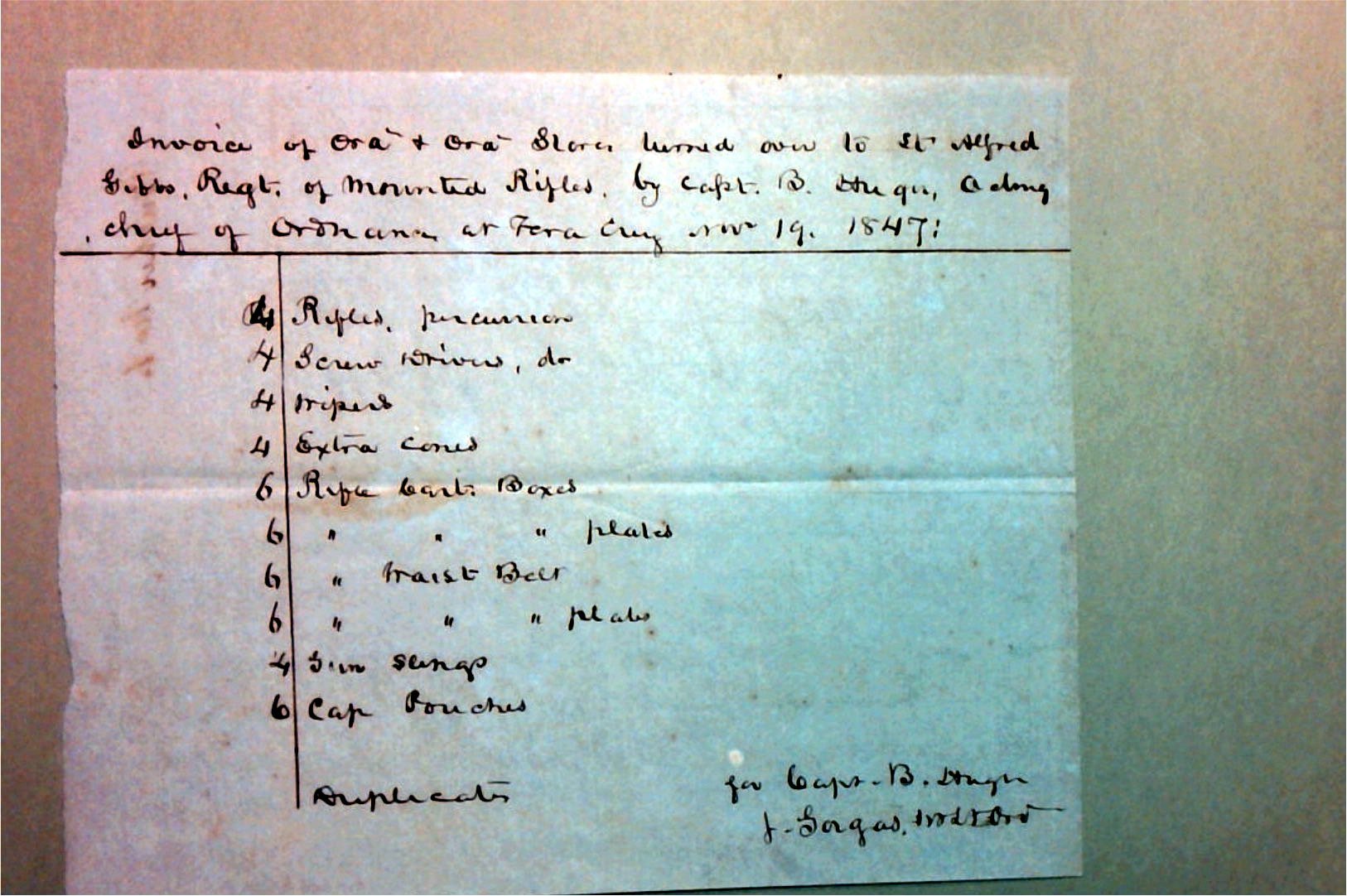
Full transcription
Invoice of Ord.[nance] & Ord.[nance] Stores turned over to Lt. Alfred
Gibbs, Regt. of Mounted Rifles, by Capt. B. Huger, Act[in]g.
Chief of Ordnance at Vera Cruz Nov. 19. 1847.
[ruled column, quantity — item]
4 [?] | Rifles, percussion
4 | Screw drivers, do
4 | Wipers
4 | Extra cones
6 | Rifle Cart.[ridge] Boxes
6 | ” ” ” plates
6 | ” Waist Belt
6 | ” ” ” plates
4 | Gun slings
6 | Cap Pouches
Duplicate
for Capt. B. Huger
J. Gorgas, 1st Lt. Ord.
(Note: the top quantity is smudged/overwritten; the ordnance return, doc 5 below, lists the Nov. 19 receipt as 4 rifles, 4 gun slings, 4 extra cones, 4 screw drivers, 4 wipers, 6 waist belts, 6 waist-belt plates, 6 cartridge boxes, 6 cartridge-box plates, 6 cap pouches — consistent with these entries.)
—
By November 1847 Mexico City had fallen and Vera Cruz was the army’s great supply depot. Gibbs drew a complete small-arms outfit for his detachment — and three days later exchanged four rifles bracketed “damaged” for fresh ones: campaign-worn equipment formally condemned at the depot.
“4 Rifles, percussion · 4 Screw drivers · 4 Wipers · 4 Extra cones · 6 Rifle Cart. Boxes… for Capt. B. Huger — J. Gorgas, 1st Lt Ordce”Invoice, Vera Cruz, Nov. 19, 1847 · Doc #684
“Received… of Lt Alfred Gibbs… 4 Percussion Rifles, 1 Waist belt, 3 Cartridge Boxes, 3 Bullet Pouches — damaged.”Receipt, Vera Cruz, Nov. 22, 1847 · Doc #620
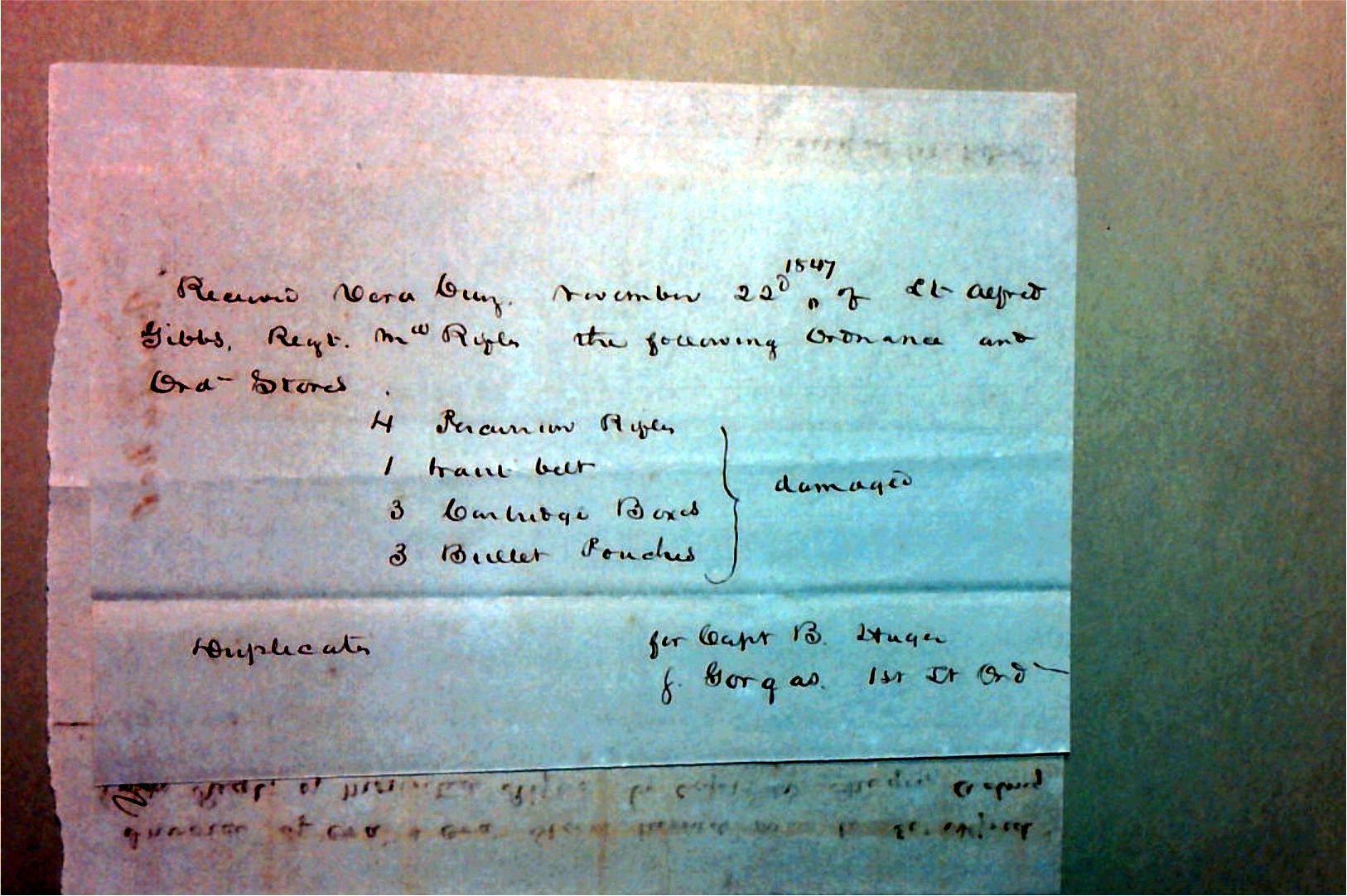
Full transcription
“Received Vera Cruz. November 22d 1847 of Lt. Alfred
Gibbs, Regt. Md. Rifles the following Ordnance and
Ord.[nance] Stores.
4 Percussion Rifles
1 Waist belt
3 Cartridge Boxes } damaged
3 Bullet Pouches
Duplicate
for Capt. B. Huger
J. Gorgas. 1st Lt. Ord.
[faint offset/bleed-through text at bottom edge, illegible]
—
The Moment
The issuing officer named on every slip is Capt. Benjamin Huger, chief of ordnance of Scott’s army — but the pen belongs to his lieutenant, Josiah Gorgas. Huger became a Confederate major general; Gorgas became the Confederacy’s Chief of Ordnance, the man who armed the rebellion. In these papers, the two future heads of Confederate ordnance are equipping a future Union cavalry general.
Researcher’s Notes
Every slip in this cluster is signed “for Capt B. Huger — J. Gorgas, 1st Lt Ord.” The autographs are Josiah Gorgas’s. Fourteen years later Gorgas ran the entire Confederate ordnance system and Huger was a Confederate major general; in November 1847 they were re-arming a future Union cavalry general’s detachment. Worth pursuing: Gorgas’s published journals for his Vera Cruz depot service, and a comparison of this signature against authenticated Gorgas autographs.
The November 22 exchange asks a question the paper doesn’t answer: Gibbs turned in four rifles bracketed “damaged” and drew four fresh ones the same day — and his quarterly return separately writes off four rifles as “expended in service” on November 19, the very day of the first issue. Equipment “expended” the day it was issued suggests loss in action or accident on the guerrilla-harassed National Road. What happened between Vera Cruz and Mexico City that week?
❦ These notes grow. As research answers a question or opens a new one, an entry is added here — the document stays, the story deepens.
Christmas Eve in the Conquered City
Scott’s army had held Mexico City since September. On Christmas Eve, with the quarterly property deadline a week away, Lt. Gibbs closed his accounts: four receipts, signed in duplicate by four company commanders of the Mounted Rifles — Lt. R. M. Morris, Capt. J. B. Backenstos, Lt. A. J. Lindsay, and Capt. John S. Simonson — passing every remaining rifle, belt, tent, and brass plate out of his hands. His Fourth Quarter return balances to zero, voucher for voucher.
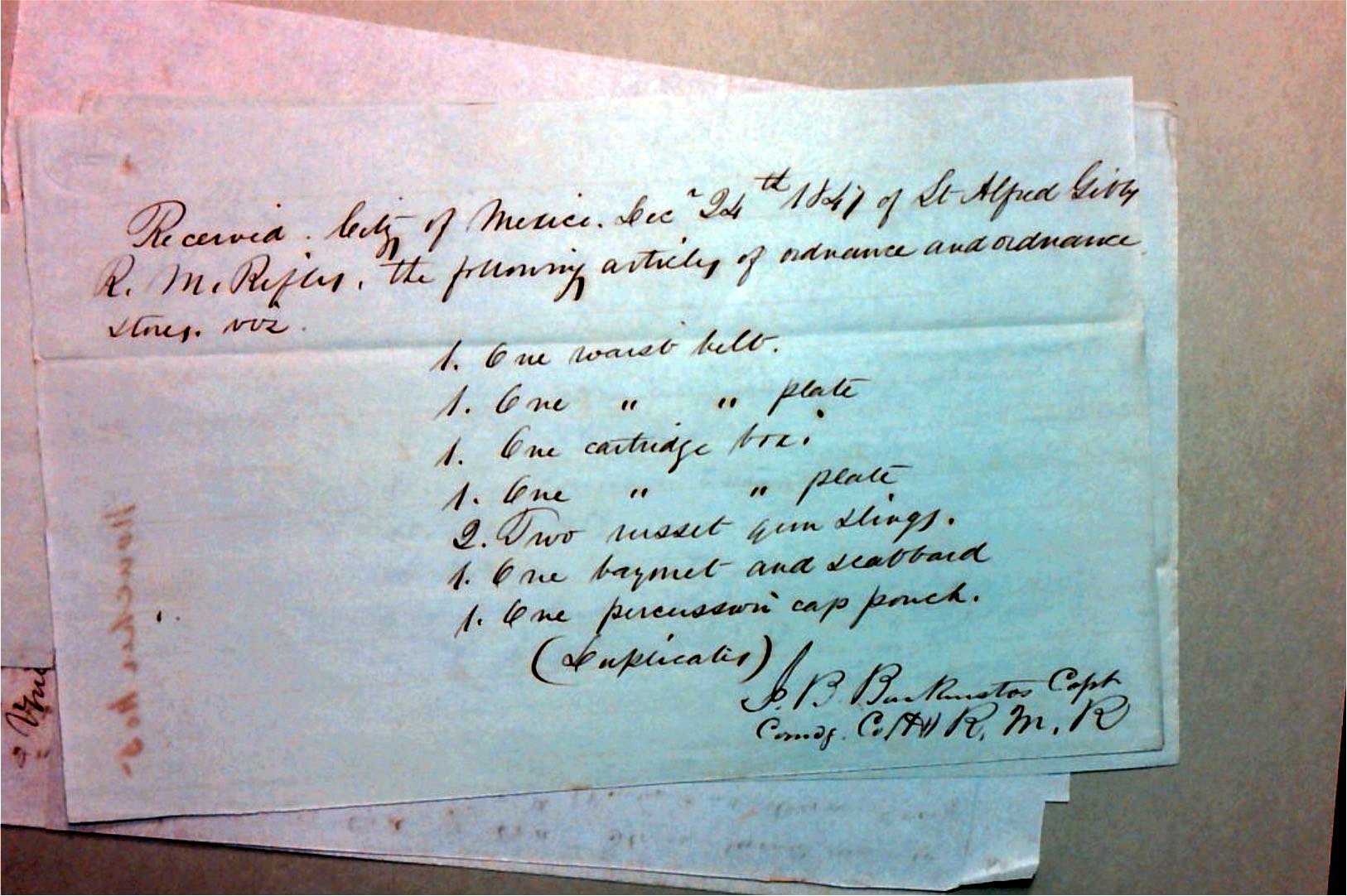
Full transcription
Received. City of Mexico. Dec.r 24th 1847 of Lt. Alfred Gibbs
R. M. Rifles. the following articles of ordnance and ordnance
stores. viz.
1. One waist belt.
1. One ” ” plate
1. One cartridge box.
1. One ” ” plate
2. Two russet Gun slings.
1. One bayonet and scabbard
1. One percussion cap pouch.
(Duplicate)
J. B. Backenstos Capt.
Com[an]dg. Co. [H?] R. M. R.
—
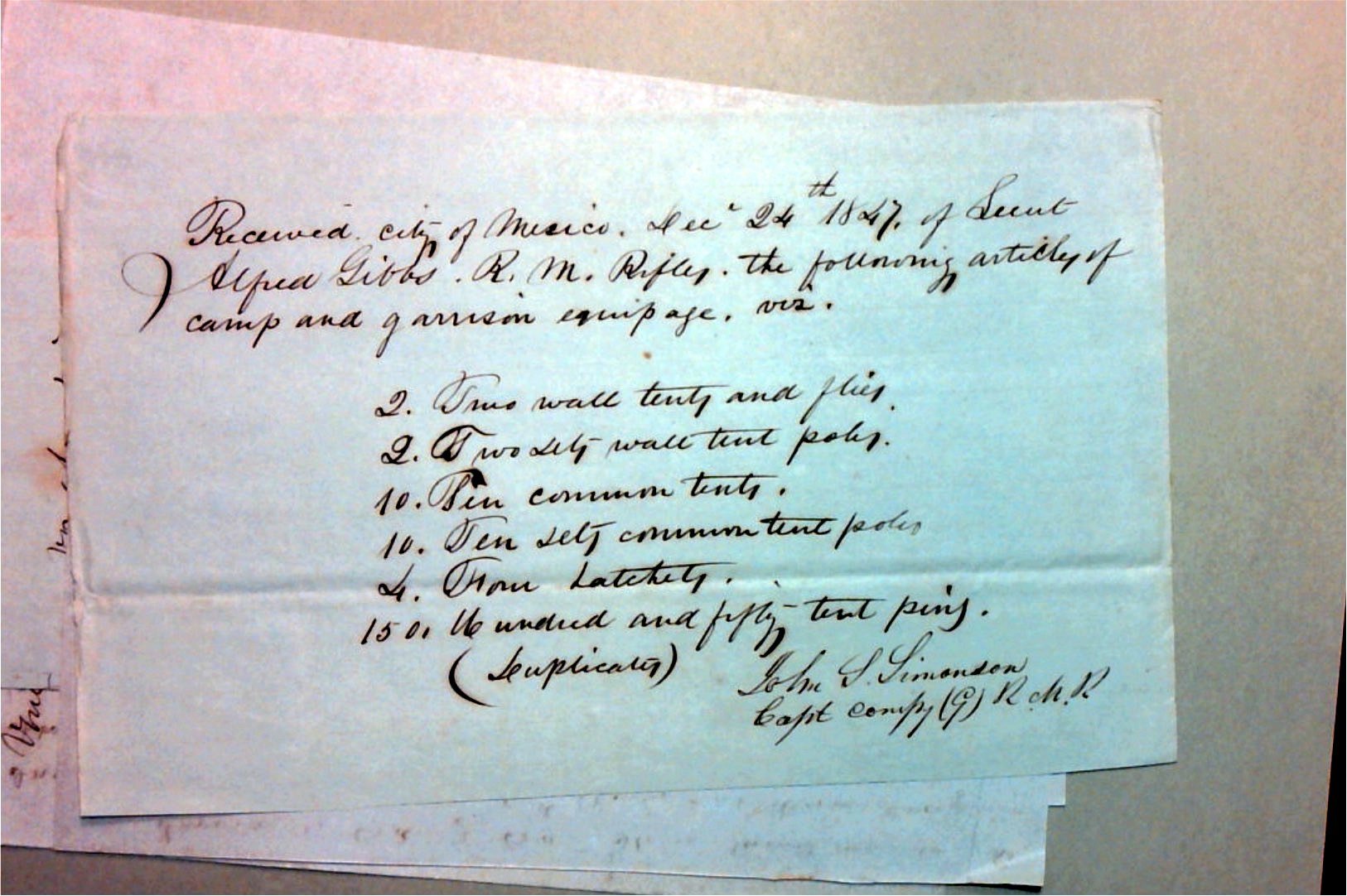
Full transcription
Received. city of Mexico. Dec.r 24th 1847. of Lieut.
Alfred Gibbs. R. M. Rifles. the following articles of
camp and garrison equipage. viz.
2. Two wall tents and flies.
2. Two sets wall tent poles.
10. Ten common tents.
10. Ten sets common tent poles
4. Four hatchets.
150. One hundred and fifty tent pins.
(Duplicate)
John S. Simonson
Capt. comdg. (G) R. M. R.
—
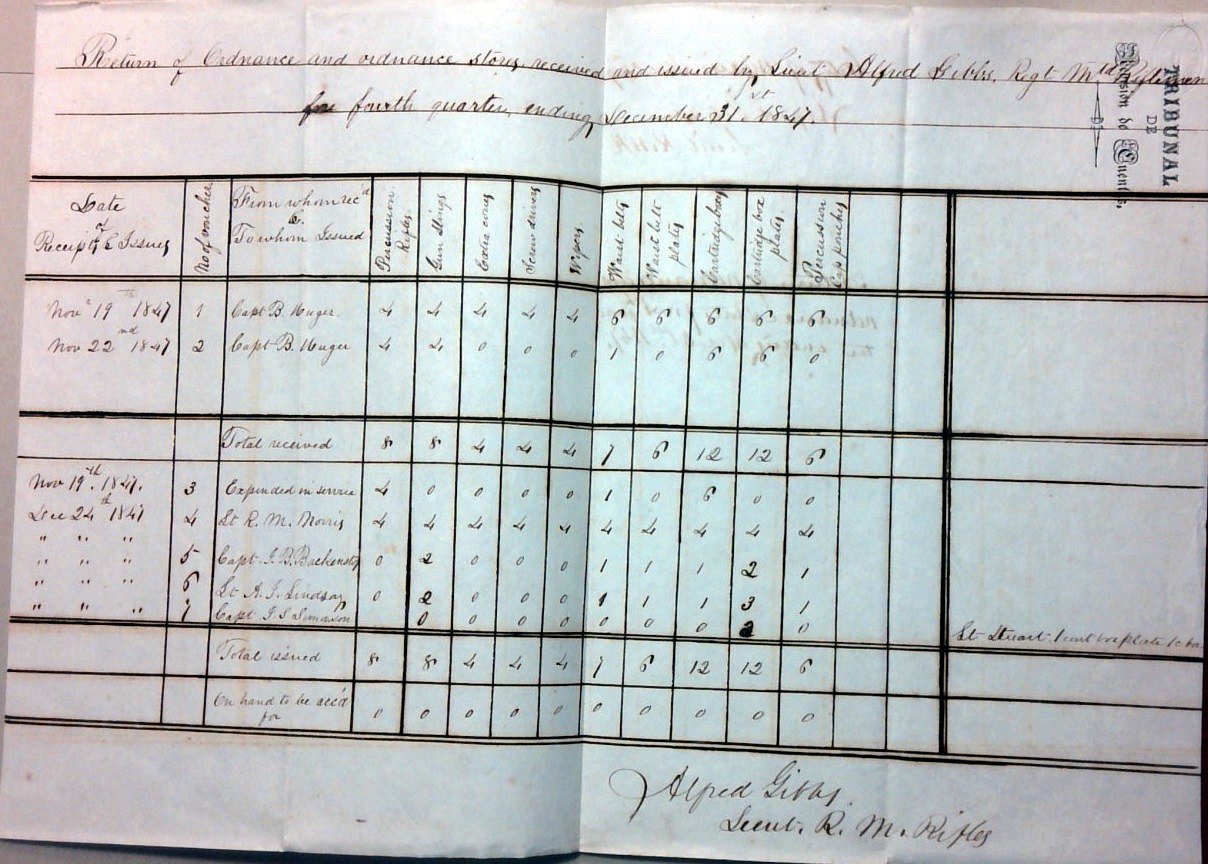
Full transcription
Return of Ordnance and ordnance stores, received and issued by Lieut. Alfred Gibbs, Regt. M[ounte]d. Rifle[men]
for fourth quarter, ending December 31, 1847.
Column headings (left to right):
Date of Receipt & of Issues | No. of Vouchers | From whom rec.d & To whom Issued | Percussion Rifles | Gun Slings | Extra cones | Screw drivers | Wipers | Waist belts | Waist belt plates | Cartridge boxes | Cartridge box plates | Percussion cap pouches | [wide remarks column]
RECEIVED:
Nov.r 19th 1847 | 1 | Capt. B. Huger | 4 | 4 | 4 | 4 | 4 | 6 | 6 | 6 | 6 | 6
Nov. 22nd 1847 | 2 | Capt. B. Huger | 4 | 4 | 0 | 0 | 0 | 1 | 0 | 6 | 6 | 0
Total received | | | 8 | 8 | 4 | 4 | 4 | 7 | 6 | 12 | 12 | 6
ISSUED:
Nov 19th 1847 | 3 | Expended in service | 4 | 0 | 0 | 0 | 0 | 1 | 0 | 6 | 0 | 0
Dec 24 1847 | 4 | Lt. R. M. Morris | 4 | 4 | 4 | 4 | 4 | 4 | 4 | 4 | 4 | 4
” ” ” | 5 | Capt. J. B. Backensto[s] | 0 | 2 | 0 | 0 | 0 | 1 | 1 | 1 | 2 | 1
” ” ” | 6 | Lt. A. S. Lindsay | 0 | 2 | 0 | 0 | 0 | 1 | 1 | 1 | 3 | 1
” ” ” | 7 | Capt. J. S. Simonson | 0 | 0 | 0 | 0 | 0 | 0 | 0 | 0 | 2 | 0
Total issued | | | 8 | 8 | 4 | 4 | 4 | 7 | 6 | 12 | 12 | 6
On hand to be acc[ounte]d for | | | 0 | 0 | 0 | 0 | 0 | 0 | 0 | 0 | 0 | 0
Remarks column (right): “Lt. Stuart. 1 cent bx plate [1 to be?] [illegible]” (faint, partly illegible)
Signature (bottom):
Alfred Gibbs
Lieut. R. M. Rifles
—
Note on the return’s arithmetic: the tabulated issues balance the receipts exactly (8 rifles, 8 gun slings, 4 extra cones, 4 screw drivers, 4 wipers, 7 waist belts, 6 waist-belt plates, 12 cartridge boxes, 12 cartridge-box plates, 6 cap pouches received and all issued, 0 on hand), so the individual receipts above (Backenstos doc 5, Simonson doc 4/7) are the supporting vouchers cross-referenced by voucher number in the “No. of Vouchers” column. Voucher 4 is credited on the return to Lt. R. M. Morris, though the physical Dec. 24 receipt in this exhibit is signed by Simonson (voucher 7, camp/garrison equipage — a separate class of stores not tallied in these ordnance columns).
Key readings I’m confident on: all five sheets are Alfred Gibbs’s Mexico-1847 ordnance paperwork; Huger and Gorgas sign the Vera Cruz invoices/receipts; Backenstos and Simonson sign the City of Mexico receipts; Gibbs personally signs the quarterly return. Uncertain items are flagged with [?] / [illegible] above — chiefly the smudged top quantity on the Huger-Gorgas invoice, Backenstos’s company letter (“H”?), and the faint remarks-column note on the return.
“Received, City of Mexico, Dec’r 24th 1847 of Lt Alfred Gibbs… One waist belt… One bayonet and scabbard… (Duplicates) — J. B. Backenstos, Capt, Comdg. Co (H) R.M.R.”Receipt, Christmas Eve 1847 · Doc #813
The Moment
The occupation was in its fourth month; the negotiations that became the Treaty of Guadalupe Hidalgo were weeks away. An army that had fought its way in from the sea now ran on paperwork — and a 23-year-old lieutenant spent his second Christmas at war getting receipts, in duplicate, so his books would balance to the penny.
Researcher’s Notes
The captain signing for Company H is almost certainly Jacob B. Backenstos — the Hancock County, Illinois sheriff at the center of the 1845–46 Mormon/Nauvoo conflict, who took a Mounted Rifles captaincy. The old OCR read him as “Buckminster.” His receipt also lists a bayonet and scabbard — an odd item in a rifle regiment whose Model 1841s took no bayonet. What arm did it belong to?
The quarterly return itself is written on captured or locally bought Mexican government stationery — the sheet carries an embossed “Tribunal de… [de Cuentas]” fiscal mark: a U.S. Army property return drawn up on the Mexican accounting court’s own paper. And a marginal note names a “Lt Stuart” — plausibly Lt. James Stuart, Gibbs’s 1846 classmate, killed in Oregon in 1851. Both threads are open.
The “Lt Stuart” thread is closed — and it closed spectacularly: Stuart is Lt. James Stuart, and in June 1848 Gibbs defended him in print, over the pen name “Two and two make four,” as the first man over the breastwork at the Garita de Belen. See Station VIII below.
❦ These notes grow. As research answers a question or opens a new one, an entry is added here — the document stays, the story deepens.
The Winter of the Brevet War
While the army wintered in the capital and Fremont’s court-martial transfixed the country, the family fought Alfred’s promotion war at home — and kept him supplied with everything from newspapers to a regimental band. Four letters of that winter survive, exhibited complete: the account balance a soldier lives on, the compliment that made the rounds of the army, and a mother’s reception with the trunks from Mexico arriving mid-letter.
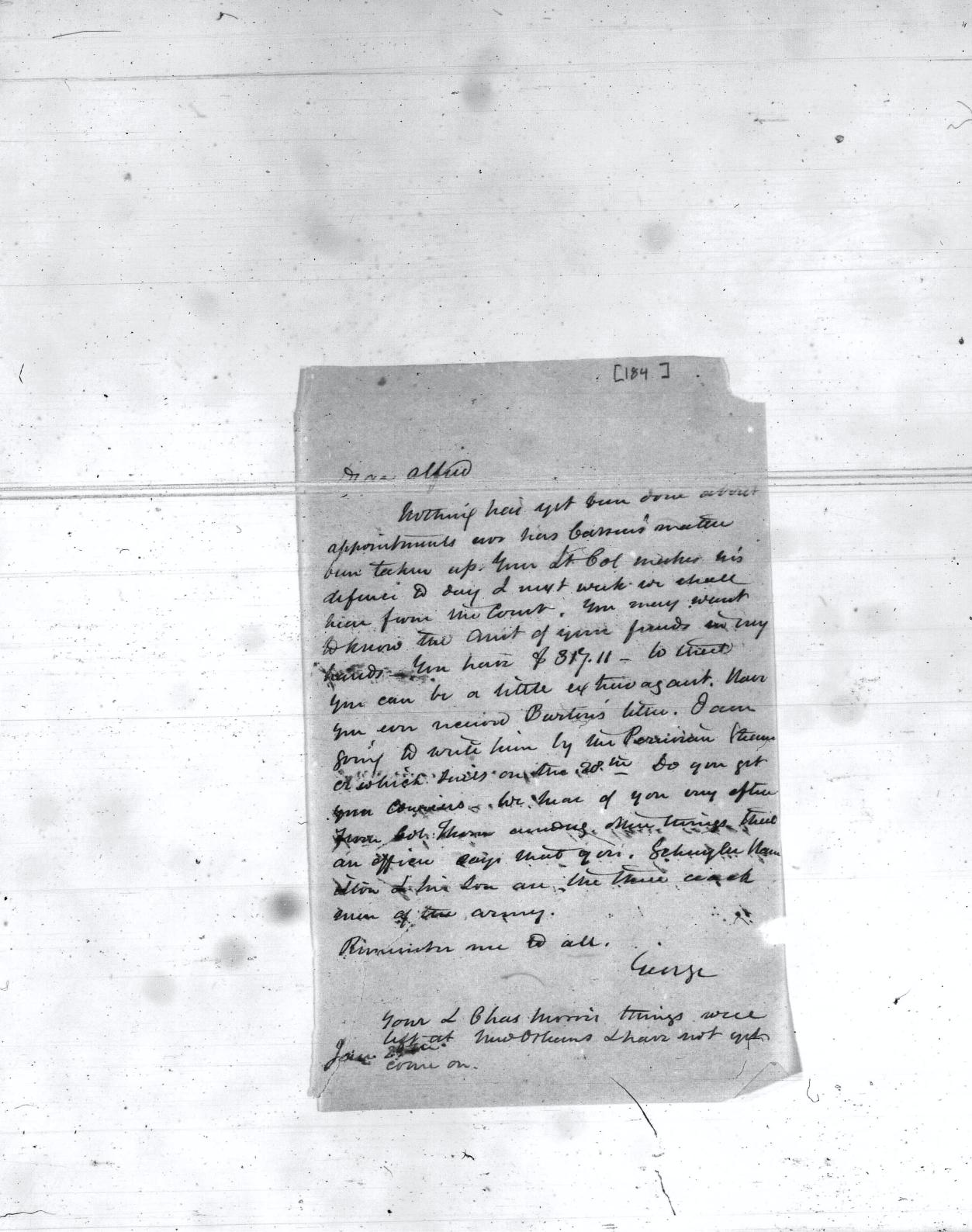
Full transcription
[archivist’s bracket number, top right:] [184]
Dear Alfred
Nothing has yet been done about appointments nor has Cassius’ [?] matter been taken up. Your Lt Col makes his defence to day & next week we shall hear from the Court. You may want to know the amt of your funds in my hands — You have $317.11 — so that you can be a little extravagant. Have [?] you ever [?] received Barton’s [?] letter. I am going to write him by the Peruvian steamer which sails on the 28th. Do you get your Couriers — We hear of you very often from Col. Thorn among other things that an officer says that you, Schuyler Hamilton & his son are the three crack men of the army.
Remember me to all.
George
Your & Chas Morris things were left at New Orleans & have not yet come on.
[left margin, small, beside the postscript:] Jan 28 [?] [illegible]
NOTES: “Your Lt Col” is John C. Fremont, lieutenant colonel of Alfred’s Regiment of Mounted Riflemen, whose court-martial defence summation came in the last days of January 1848 — which, with the marginal “Jan 28 [?],” dates this note. “his son” = Col. Thorn’s son (the officer rated Alfred, Schuyler Hamilton and young Thorn the three crack men). Microfilm shows this to be a small half-sheet, complete in itself.
struments — If nothing better occurs I shall pay for them myself & send you the account, which you can get from the regimental fund.
[one line badly faded:] I [illegible] in her [?] new [?] [illegible] —
I imagine it is much faster than the New York [?].
The treaty will undoubtedly pass, but in a much modified form. The empresario grants will not be allowed & John Bull will find himself closely watched. Your friends here are all well & ask after you constantly. The Racket court ball, the affair of the season went off splendidly. The great room was tented from one end to the other in white & gold — The supper capital — The fancy ball at the Opera it seems now will succeed also —
Do you get your newspapers
[lower third of the frame: faint show-through of writing from the verso, not legible]
NOTES: The opening “struments” completes the word “in-struments” broken at the foot of scan 1377 — 1377 precedes 1376 in reading order. The racket-court ball spoken of as past, and the treaty pending in the Senate, place this page in the first week of March 1848 (Guadalupe Hidalgo was ratified March 10).
Kearny is retransferred to the rifles. There was some hesitation about the propriety [struck: but] of giving him his former rank, but as there were precedents found in [struck: its] favor of it, and the friendship of those valued [?] by him was known, it was deemed that there would be no objection. You and Stuart I have reason to know have in particular been highly recommended to the department from a quarter that has great weight, & will be taken care of. Gen Kearny has applied for orders & will receive them. This will render Benton furious. Fremont persists in his resignation. Benton’s influence at Washington is destroyed; his insolence & tyranny have been too great & I have reason to think he will be thrown over soon. You may rely upon it I think, that matters are generally well understood at Washington & that a disposition exists to take care of the army proper, though why no appointments for merit have been made I cant learn —
I shall get your band business on as fast as possible. The order from Jones has not come yet, but I am to see Capt. Knowlton about the preliminaries to day. He is recruiting here. The sticking point will be that they cant pay for their ins-
NOTES: Page ends mid-word (“ins-“), completed as “-struments” at the head of scan 1376. INDEX GROUPING FLAG: L08 as indexed appears to combine TWO separate items. Scan 1375 is a complete short note — salutation, signature “George,” and postscript — datable to c. January 28, 1848 (Fremont’s defence “to day”). Scans 1377 → 1376 are a continuous unsigned fragment of a DIFFERENT, later letter (early March 1848: treaty before the Senate, the racket-court ball past, Fremont’s resignation persisting), whose opening page(s) are missing from the film at this point. Frame order here (1375, 1376, 1377) matches neither note-then-letter nor reading order within the fragment; true reading order of the fragment is 1377 then 1376.
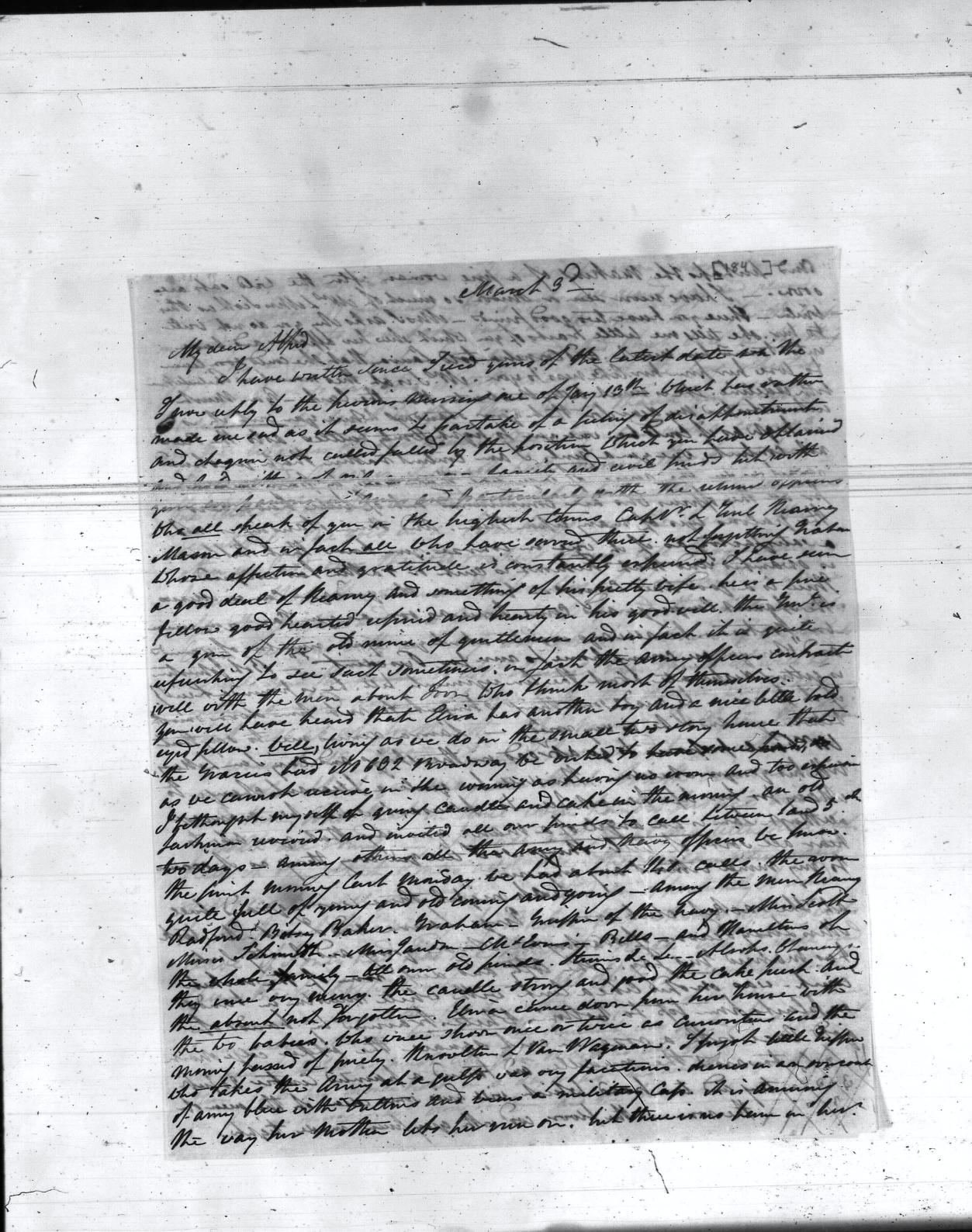
Full transcription
[two faint ghost lines at the head of the frame are offset ink from the facing page (they duplicate the opening words of scan 1367) and are not part of this page]
March 3 —
My dear Alfred,
I have written since I recd yours of the latest date and the [illegible] reply to the [illegible] receiving [?] one of Jany 13th — that [?] has rather [?] made me sad as it seems to partake of a feeling of disappointment and chagrin not called for by the position which you have obtained and [illegible] will not [illegible] — [illegible] and evil friends but with [one line badly faded] you [illegible] with the returnd officers [?] they all speak of you in the highest terms. Capt W— [?] & Genl Kearny, Mason and in fact all who have served there, not forgetting Graham whose affection and gratitude is constantly expressed. I have seen a good deal of Kearny and something of his pretty wife. he is a fine fellow good hearted spirited and hearty in his good will. the Genl is a gem of the old mine of gentlemen and in fact it is quite refreshing to see such sometimes. in fact the army officers contrast well with the men about town who think most of themselves. You will have heard that Eliza has another boy and a nice little bold eyed fellow. Well, living as we do in the small two story house that the Wards had at No 102 Broadway we decided [?] to have some [?] [illegible], as we cannot receive in the evening as heavy [?] as we were [?] and too expensive [?]. I therefore bethought [?] myself of giving candles and cakes in the morning — an old fashion revived — and invited all our friends to call between 12 and 3 for two days — among others all the army and navy officers we know. the first morning last Monday we had about 150 calls. the room quite full of young and old coming and going — among the men Kearny, Radford, Bobby Baker, Graham — Gustin [?] of the navy — Miss Scott, Misses Schmidt [?] — Mrs Jaudon — McEvers — Bells — and Moultons [?] etc. the whole family — all our old friends. [illegible name] etc [?]. Chauncey [?] — they were very merry, the candles etc [?] and found [?] the cake fresh, and the absent not forgotten. Anna came down from her house with the two babies who were shown once or twice as curiosities and the morning passed off gaily. Knowlton & Van Wagenen. I forgot little Kate [?] Nispen [?] who takes the Army at a gulp; was very facetious. dressed in an overcoat of army blue with buttons and wears a military cap. It is amusing the way her Mother lets her run on, but there is no harm in her
NOTES: Heavy show-through from the verso makes several passages fragmentary; the film’s splice band crosses lines 4-8. “Capt [W?] & Genl Kearny” — Capt. Philip Kearny (whose “pretty wife” follows) and Gen. Stephen W. Kearny; first word uncertain on the film.
and perhaps the making of a fine woman after the wild oats are sown. — I have never seen or known so much of Mrs & Miss Scott as this winter — there you have two good friends — Mrs S. asks why you do not write to her. she tells me little traits of you which show her affection and have entertained her much, and Cornelia told Laura that she could soon learn to love her from her likeness to you. Mrs S. is at this moment in Philadelphia, both [?] Adeline [?]. she is much better this winter than the last — you must not doubt [?] her [?] my dear son that your standing where you earnd [?] it is as high as it could be were you to fight twenty battles. as to the President [?] not content — were you a Genl. I am content rather that you should remain [?] under the surge [?] of [one line badly faded] for all the officers who are commissiond [?] [illegible] have also the jealous eyes of many upon them, and their standing is not as satisfactory as if it were in course. you know that Bill C—— [?] is disbanded and that Fremont is cast, or rather has resigned. there is a good time coming — get all the good you can in Mexico, the Spanish language, and come home as soon as you can. you remember Fontana. he allways inquires about you, your number of wounds, and “then you are coming home to run for President.” — Bob Johnston is getting desperate about the ten regiment bill. he is promised a Lieutcy if it passes [?]. he needs something stringent [?] to put him down smooth [?] if it comes. — between you and I, he is very ready. — Laura desires me to say that Mrs Toone [?] purposes to go abroad in the spring and carry Sam & Mary with his younger children. This will be quite a pleasant change to Mary for her life has not been too pleasant since her marriage although Sam is an angel of a man. you say that you like to hear all sorts of little things so I tell you every thing as it occurs to my mind without any connexion. — Last night there was a grand ball at the racket club rooms. George Laura and I went. he took Miss Lucy Pearson [?] of Washington whose young and pretty sister has married Ned Jay. — the lofty and deep room of the racket court was draped like a tent with white muslin in bands or plaits from top to bottom, white traversd by bands of gold lace with a rose in each square, the sides edge drawn towards the middle and toward a painted centre so [?] [illegible] and the head [?] which will give some idea of the area of the room — the floor covd with grey linen made tight.
[in the lower left margin: a small pen diagram of the tent-draped ceiling, crosshatched squares with figures]
NOTES: “Fremont is cast” — convicted by the court-martial; he resigned rather than accept President Polk’s remission, dating this letter to early March 1848. The sentence around the marginal diagram is disordered where the sketch interrupts the text; readings there are uncertain.
the bowling alley transformed into a splendid supper room. most abundant & elegant supper — 27 musicians — 250 guests all dressed gay and pleased. on Monday there is to be a paying ball at the opera house for the benefit of the opera (which has been mismanaged) and which will be the thing. I have just got so far and Wolcott arrives with the long expected trunks — We wait to open them and to thank you first for the likeness of our dear soldier boy. and such a comical though good likeness. I cannot help kissing the funny face. the [illegible] shall be [illegible] [one line badly faded] beautiful. one [?] goes in a [?] over the piano. the other is laid over the old rocking chair till George comes home. Wolcott admires the knifes of obsidian. I admire after the picture and views of the battle ground, the little baskets. Eliza [?] dines with us today and take her choice of the baskets. I shall send the [?] to Mrs [illegible] but think it will be rather a hard dose — the trunk for the Morris’ was left here but will go up forthwith. this morning I recd from the [illegible] a remarkable letter which I shall send to you within this envelope that you may see that truth will out now and then, and that in time even handed justice will be dealt all round. — I shall not finish my letter now but keep it open that I may add all the exclamations and messages from all parties. — I had an opportunity to send to the Point this morning by Baker who returns after 6 weeks leave. If I only had had the things for Reese — but I will send them the first opportunity. — I left off to see Mrs & Miss Bell who came in to see us [?]. they both kissed the Rowdy [?] face of the soldier and knew it immediately — also the trunks — the President [?] was quite friendly with it and said it looked as much like John Wolcott as like you. — [illegible name] sails for Monte Video in a day or two. his health is very delicate. he has his baggage on [?] board [?] [illegible] to him and the prospect of some practice
NOTES: The “remarkable letter” enclosed is evidently the anonymous pamphlet George calls the “Socdollager” in his note on scan 1369. Show-through from the verso is severe on this leaf; bracketed doubts mark where it defeated the film.
Wolcott await [?] your Aunt Sarah who is coming on to [illegible] [illegible]. [?] Peck [?] calld to see me and sat an hour. he has gone to see his Mother, his Father being dead — he will come again on his return — George and Wolcott await this letter — I will write you again — [illegible] my letter [?] and regards to all the boys — Thorn and the Hamiltons desire you to remember to speak of their sons when you write. With — Hotham [?] — Palmer and the rest — anything of your gayings [?] or doings will be well received —
aff. yr. Mother.
Dear Alfred
The enclosure may be considered a Socdollager — No one here conjectures the author. He puts Worth in a very bad position — as to Pillow, poor devil it is kicking not a dead lion but a dead ass. Your trunks & Charles Morris’s arrived yesterday. The blankets are both very handsome. As to the beauty of the Mexican images the less said the better, but they are very curious & interesting & remarkable for their good preservation. Some of them were partly broken but I can have them mended easily & they will not be disfigured. I intend to show them to Mr. Gallatin who is much interested in such matters & is now writing upon the very subject. If it is not too much trouble I wish you would send a quantity of them even if broken — wherever in fact heads or parts showing different figures are shown & particularly where forms of cups & vases are exhibited, or there is any approach to hieroglyphical writing. The porphyry even if defaced, & pieces of obsidian are valuable. Any expenses you may be at upon these I will pay for myself. Is there any resemblance between clay figures made at present day & these?
Charles Morris’ body arrived & was privately buried yesterday.
[archivist’s pencil, lower left:] US Mss Y [?]
NOTES: “Mr. Gallatin” is Albert Gallatin, then president of the American Ethnological Society and writing on Mexican antiquities. George’s note is unsigned but unmistakably his hand and matter. INDEX CAUTION RESOLVED: the frames are NOT jumbled — the true reading order is the frame order 1366 (dateline “March 3 —” and salutation) → 1367 → 1368 → 1369 (close plus George’s note). Each junction is continuous: 1366’s last sentence completes on 1367 (“…no harm in her / and perhaps the making of a fine woman…”), 1367’s ballroom description continues onto 1368 (“…the floor covd with grey linen made tight. / the bowling alley transformed into a splendid supper room”), and 1369 carries the closing and George’s note. The faint lines atop 1366 that suggested a misordered opening are offset ink from 1367’s first lines.
“We hear of you very often from Col. Thorn among other things that an officer says that you, Schuyler Hamilton & his son are the three crack men of the army.”George Gibbs to Alfred, c. Jan. 28, 1848 · exhibited on this site
“I therefore bethought myself of giving candles and cakes in the morning — an old fashion revived… the first morning last Monday we had about 150 calls.”Laura Wolcott Gibbs to Alfred, March 3, 1848 · exhibited on this site
The Moment
The Senate that winter rejected outside appointments on the principle that a deserving officer “deserved his regular promotion” — the family’s brevet argument exactly. The treaty of Guadalupe Hidalgo went to the Senate in February; George predicted its passage “in a much modified form” and, in the same letter, applied for despatches to the Pacific — the first stirring of the journey that made him an ethnologist.
Researcher’s Notes
The four winter letters are exhibited in full: the January note and March fragment ($317.11; the three crack men; the regimental band George would pay for himself), Feb. 8 (Kearny’s withheld challenge to Benton; the Senate’s Carson principle), Feb. 23 (the treaty; George dreaming of the Pacific he would reach in 1849), and his mother’s March 3 letter — candles and cakes at 102 Broadway, and Alfred’s Mexican antiquities promised to Albert Gallatin.
❦ These notes grow. As research answers a question or opens a new one, an entry is added here — the document stays, the story deepens.
Honor to Whom Honor Is Due
Alfred published twice more before the army came home. From the occupied capital, over the pen name “Two and two make four,” he corrected a published claim from a private letter of Major Loring of his own regiment — establishing, as an eyewitness, that the first man over the breastwork at the Garita de Belen on September 13, 1847 was his classmate Lt. James Stuart of the Rifles. Gibbs himself was brevetted captain for that assault; he knew exactly who went over the wall first. The complete item is exhibited in The Stuart Letter.
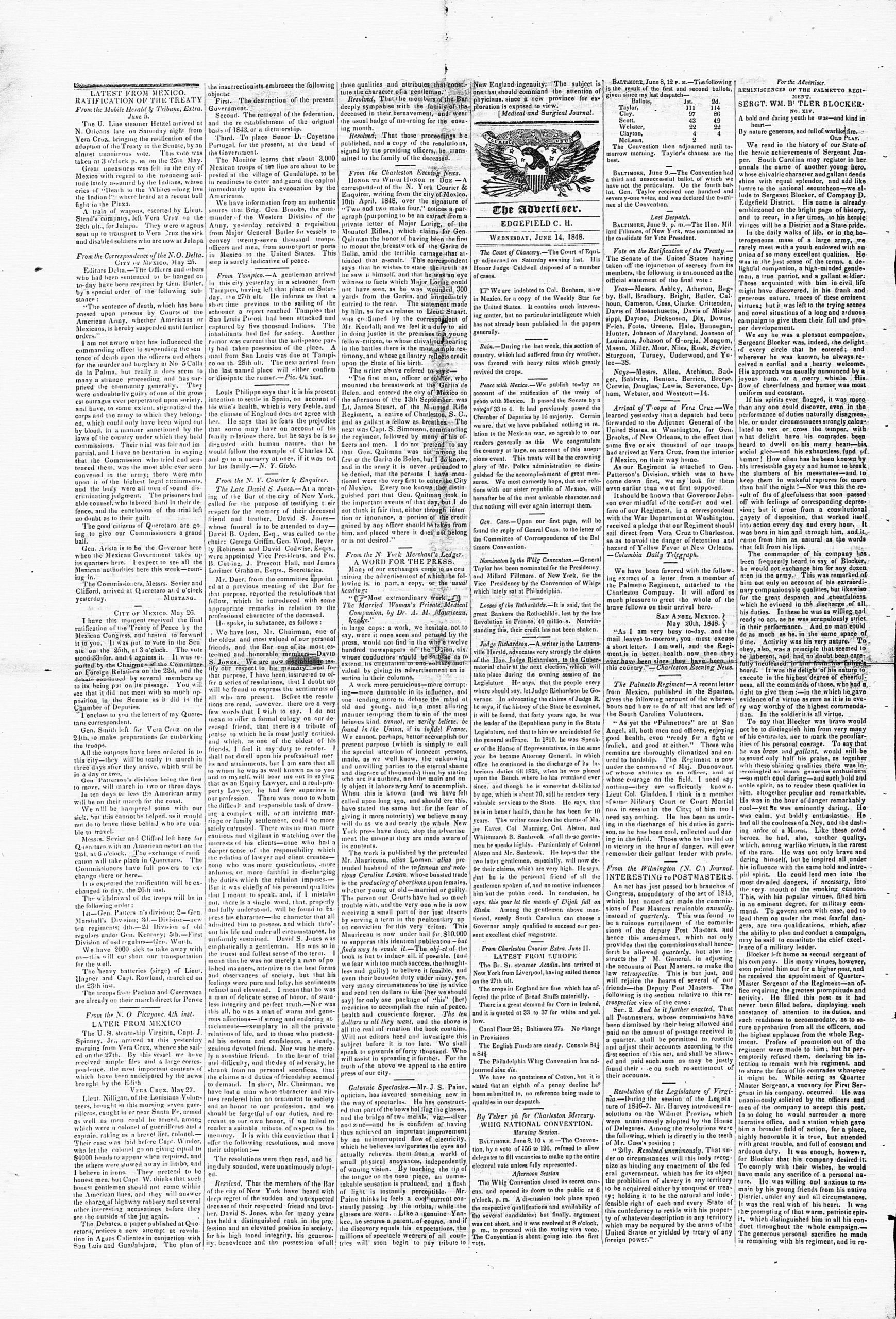
Full transcription
This reprints Gibbs’s letter, transcribed in full as its own exhibit — read it complete →
“The first man, officer or soldier, who mounted the breastwork at the Garita de Belen, and entered the city of Mexico on the afternoon of the 13th September, was Lt. James Stuart, of the Mounted Rifle Regiment, a native of Charleston, S. C., and as gallant a fellow as breathes.”“Two and two make four,” City of Mexico, April 10, 1848
“Your letter about Stuart only arrived here and was published a few days ago — It was perfectly proper but I doubt if your friend Loring will much like it.”George Gibbs to Alfred, June 7, 1848 · the attribution, exhibited on this site
The Moment
Loring, the letter notes acidly, “could not have seen” the moment he described: he was wounded 300 yards from the garita and carried to the rear. Kendall’s correspondent confirmed the correction. Stuart, twice brevetted in Mexico, was killed by an arrow on the Rogue River in Oregon three years later; this letter is the defense of his honor that outlived him.
Researcher’s Notes
Found and exhibited this month: the complete item, with the attribution. The “Lt Stuart” in the margin of the Christmas-Eve return (Station VI) and the classmate defended here are the same man: James Stuart of South Carolina, killed by an arrow on the Rogue River in 1851. Gibbs defended his honor in print; three years later there was no one left to defend.
❦ These notes grow. As research answers a question or opens a new one, an entry is added here — the document stays, the story deepens.
Peace, and the Sentence of His Career
The war ended the way it had run — in letters. On a single day, June 7, 1848, his mother reported the brevets passing the Senate, and George rode the steamboat down the harbor to bring Winfield Scott home and carried back the finest testimonial Alfred Gibbs ever received. He remained with the army in Mexico until August, and came home a brevet captain, twice honored, twenty-five years old.
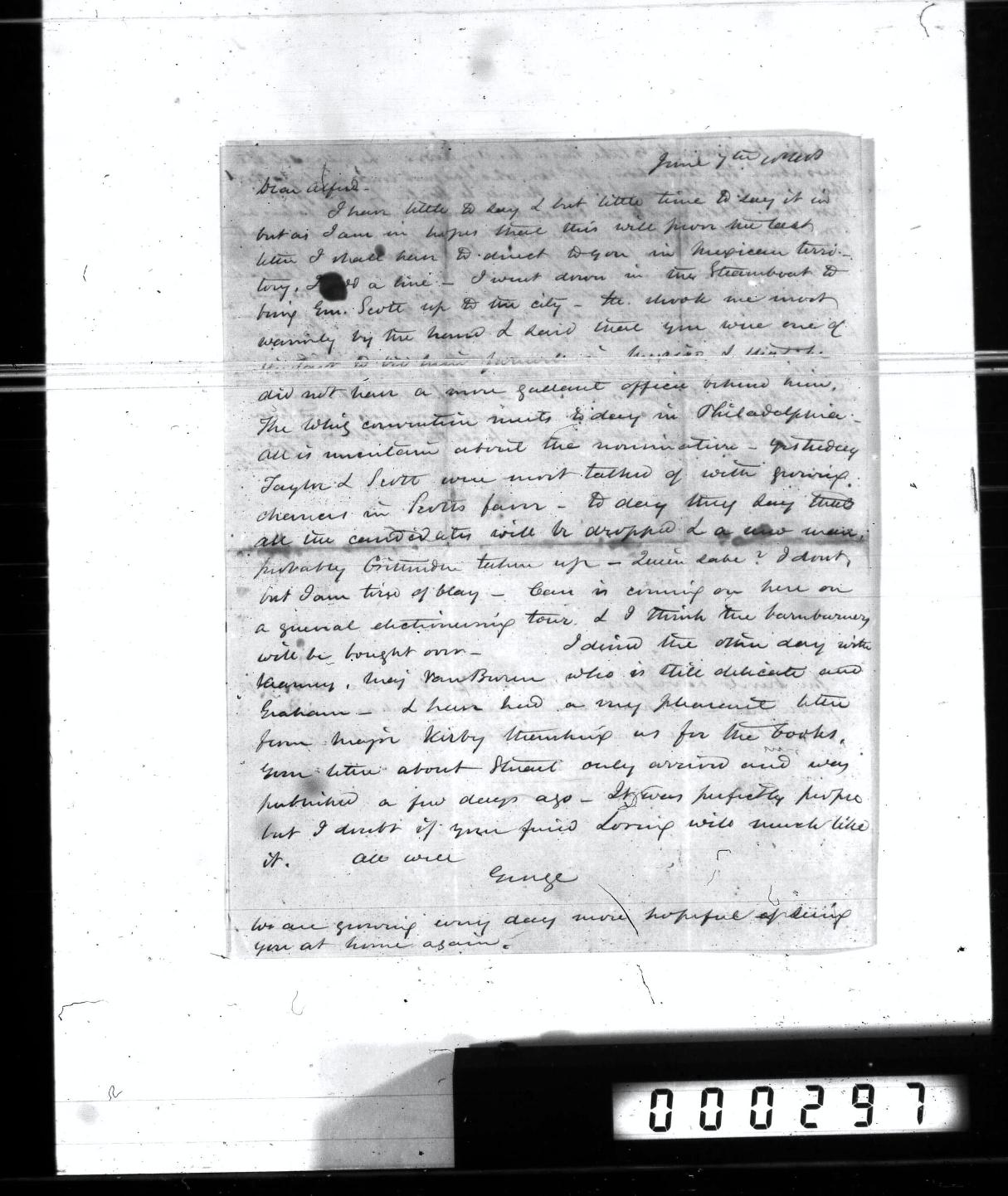
Full transcription
June 7th 1848 [?]
Dear Alfred —
I have little to say & but little time to say it in but as I am in hopes that this will prove the last letter I shall have to direct to you in Mexican terri-tory, I [ink blot: send?] a line — I went down in the Steamboat to bring Gen. Scott up to the city — He shook me most warmly by the hand & said that you were one of [faint line: the [?] [?] his [?] main [?] favorites [?] in Mexico & that [?] he [?]] did not leave [?] a more gallant officer behind him. The Whig convention meets to day in Philadelphia — All is uncertain about the nomination — Yesterday Taylor & Scott were most talked of with growing chances in Scotts favor — To day they say that all the candidates will be dropped & a new man, probably Crittenden taken up — Quien sabe? I dont, but I am tired of blay [?] — Cass is coming on here on a general electioneering tour, & I think the barnburners will be bought over — I dined the other day with Kearny, Maj Van Buren who is still delicate and Graham — & have had a very pleasant letter from Major Kirby thanking us for the books. Your letter about Stuart only arrived [interlined: here?] and was published a few days ago — It was perfectly proper but I doubt if your friend Loring will much like it. All well
George
We are growing every day more hopeful of seeing you at home again.
NOTES: Film counter 000297. Single-page letter; the postscript (“We are growing every day…”) stands below the signature. The dateline day “7th” is clear; the year is a scrawl read as 1848 (consistent with content: Scott’s return, the June 7-9 Philadelphia Whig convention). The line carrying Scott’s exact phrase about Alfred is faded where a fold crosses it; the recoverable close is “did not leave a more gallant officer behind him.” “blay” is transcribed as written (possibly a slip for “delay”). “Loring” is Col. W. W. Loring, Mounted Rifles. No slurs occur anywhere in this batch; no FLAG lines required.
## BATCH NOTES
– Index grouping CONFIRMED for all three letters by catchwords: 1342→1343 (“was / able”), 1343→1344 (“Jen / nings”), 1344→1345 (“this treaty / which Trist”), 1346→1347L (“I will / speak just of myself”), 1347L→1347R (“mouth of the / [river] La Plata”), 1347R→1348 (“speaks of you / with warm friendship”). Scan 1347 is a single photograph of TWO letter pages (pages 2-3 of L07).
– L07 date: index says Feb 25, 1848; the dateline and internal evidence (J. Q. Adams stricken but not yet dead) indicate Feb 23, 1848.
– No cross-writing in the batch; the interference on 1346-1348 is ink show-through from the opposite side of each leaf, not a second writing layer.
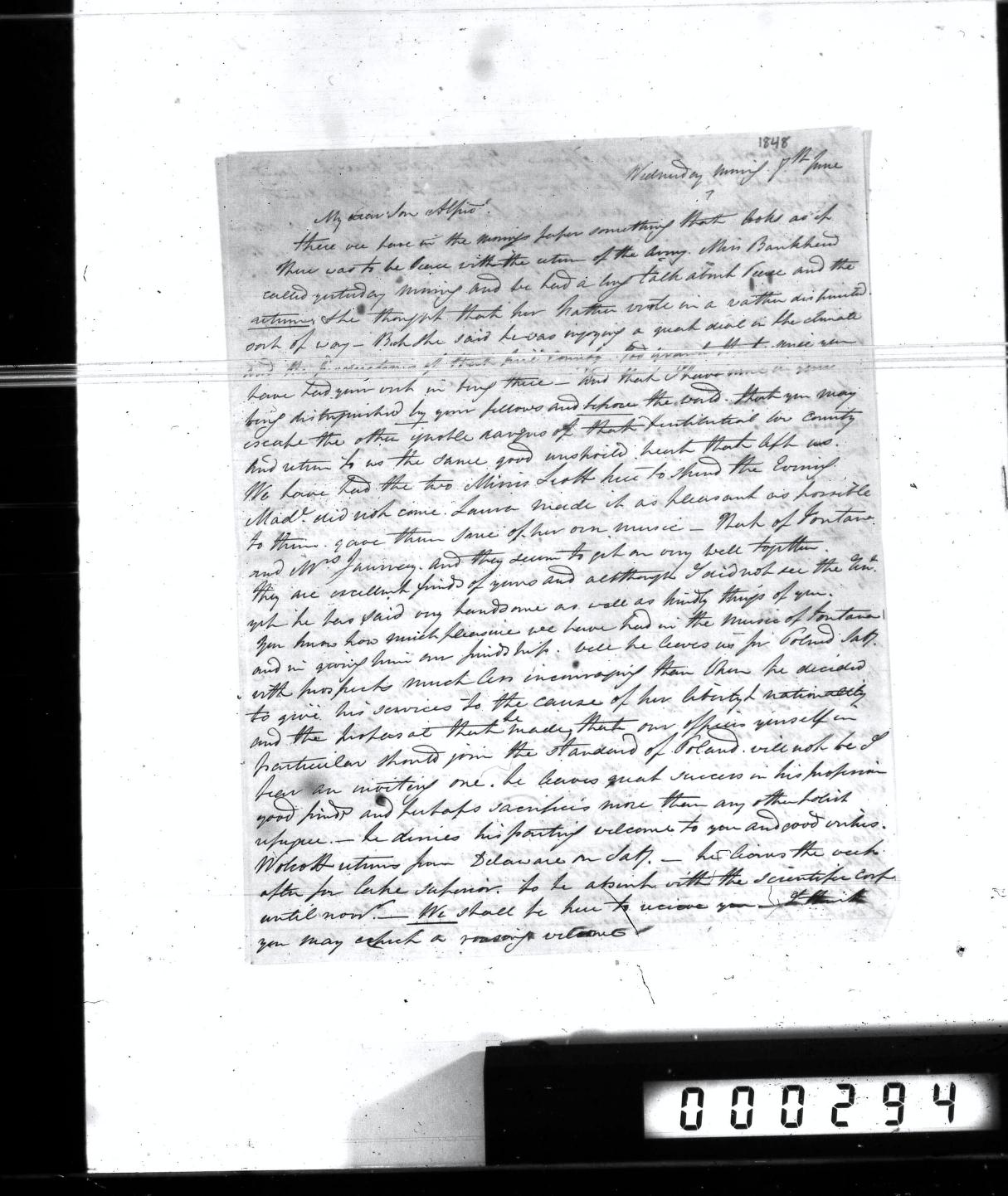
Full transcription
[docketed at top in a later hand:] 1848
Wednesday morng 7th June
My dear Son Alfred
There we have in the mornings papers something that looks as if there was to be Peace with the return of the Army. Miss Bankhead called yesterday morning and we had a long talk about Peace and the returning. She thought that her Father wrote in a rather dispirited [?] sort of way — But she said he was enjoying [?] a great deal in the climate and Mr [illegible] at that [illegible] country [?] too grave [?] [one line badly faded] have had your visit in being there — and that I have [illegible] in [?] your being distinguished by your fellows and before the world, that you may escape the other ignoble dangers of that pestilential low country and return to us the same good unspoiled heart that left us. We have had the two Misses Scott here to spend the Evening. Madme [?] did not come. Laura made it as pleasant as possible to them, gave them some of her own music — that of Fontana and Mrs Jauncey [?], and they seem to get on very well together. They are excellent friends of yours and although I did not see the Genl. yet he has said very handsome as well as kindly things of you. You know how much pleasure we have had in the Music of Fontana and in giving him our friendship. Well he leaves us for Poland Saty. with prospects much less encouraging than when he decided to give his services to the cause of her liberty so nationally [?], and the hopes we at that time [?] had [?] that our officers, yourself in particular, should join the Standard of Poland, will not be I fear an inviting one. He leaves great success in his profession, good friends, and perhaps sacrifices more than any other Polish refugee. — He desires his parting welcome to you and good wishes. Wolcott returns from Delaware on Saty. — He leaves the week after for Lake Superior, to be absent with the scientific corps until Novr! — We shall be here to receive you — I think you may expect a rousing welcome [?]
NOTES: One mid-page line (5th-7th lines) is badly washed out on the film where a splice/scratch band crosses the frame; readings there are fragmentary. “Fontana” is Julian Fontana, the Polish pianist (Chopin’s friend), then leaving New York for Europe. Microfilm frame counter 000294.
I see allmost all the young officers. Gordon called twice. his hand improves and he shuts the finger and thumb. George dines often with Nanny. they are now at housekeeping. I shall cultivate [?] her as she is a very pleasing person. this morng I shall go to see Mrs Pinkney Stewart [?] whose Brother was drownd off Huston [?]. allmost every one has something sad connected with Mexico. let me have you home once more and I shall be most thankful. The Hamiltons are very happy. Schuyler quite well [?]; he has gone to Washington with the Genl. to the trial —
I believe that I have not mentiond Miss Norah Bankheads marriage to Mr Guest [?]. It is a very agreable match, but he goes to Europe on business this Summer and she is quite unwilling to leave in this unsettled state of Europe. As for me I think that monarchy was the charm of Europe and I shall allways be sorry that I have not seen the real Aristocracy.
the Morris’ are more tranquil and Mrs Vanden H— [?] goes again to the Springs this summer. — Mrs M. has been much refreshed and comforted by a stay in Jersey with Mrs Kirk [?] and the house seems more as it used to, but the sunsets [?] never shine [?] as it has done to Mr & Mrs Morris. — he looks ten years older since Charles’s death. Laura is to spend a week with the Mc’Evers’ and another with Annie Jaudon, while I shall remain to keep Francis at work. perhaps keep all my pence to go to West Point with you and see how the boys receive you. — Mr [?] Sheldon has come back from abroad and has improved I think. Wolcott likes him very well. Mr Brevoort is dead, and Carson [?] executor. Kitty James engaged again to Robt Emmet — last year to G. Jorden [?]. If she does not get married soon, she may be free again. I wish I had some more gossip for you — but George comes
NOTES: “the trial” is the Pillow court of inquiry, to which Schuyler Hamilton accompanied Gen. Scott. “Mr Brevoort is dead” — Henry Brevoort Jr. died in April 1848. Microfilm frame counter 000295.
back from the university to take this in his way down. — he will add the news about the convention. Mrs Van. who has just come in says the whigs think of Crittenden; if they do he will be beaten by that [illegible] Cass [?] whom I hope now to see President. however you will get the papers as soon as this letter. yesterday was the regatta. a large party and fine weather, only too much wind. Maria (Storms) took a mash [?]. the Cornelia (Edgars) won. the Syren next. — your Aunt Sarah made us a short but pleasant visit on her return from Philadelphia. She left on Friday with two kinds [?], three servants, innumerable bundles, and took on cooks and hens [?] for Philada — [one line badly faded: … and takes Francis at] that time. — Eliza purposes to spend the [struck: winter] summer in town, I expect she will however have to take the babies out of it. They are all now well and Pitkin walks about much pleased with his accomplishment. your namesake not yet christend is a hearty merry chap, a good fellow for the South. and now with good wishes to all the good fellows your
most affte mother
LWG.
[postscript, lower on the page:]
The brevets have passed the Senate but are not yet published — I hear that neither [?] Graham nor [?] Hamilton are promoted for their affair.
NOTES: The Whig national convention opened at Philadelphia this very day, June 7, 1848; “Cass” (reading uncertain) was the Democratic nominee. The regatta of June 6, 1848 was the New York Yacht Club’s — the Cornelia was William Edgar’s yacht, the Syren John C. Stevens’s circle’s. The word before “Cass [?]” and the faded line mid-page defeated the film. Lower half of the leaf is blank except the postscript. Microfilm frame counter 000296.
“He shook me most warmly by the hand & said that you were one of his main favorites in Mexico & that he did not leave a more gallant officer behind him.”Gen. Winfield Scott, as reported by George Gibbs, June 7, 1848 · exhibited on this site
“The brevets have passed the Senate but are not yet published.”Laura Wolcott Gibbs, postscript, June 7, 1848 · exhibited on this site
The Moment
George’s July 3 letter closed the war’s ledger the family’s way: a warning against the vomito (“a small business to be killed off… after scaling Chapultepec & storming the Garita of Belen”), and a marble monument by Launitz at Greenwood Cemetery, raised by civilians for the New York regulars who did not come home. Fifteen days later came the next summons: the Riflemen were ordered to Oregon.
Researcher’s Notes
Both June 7 letters — George’s, with Scott’s handshake, and their mother’s, with the brevets passing the Senate — and George’s July 3 letter (the vomito warning; the Greenwood monument to the New York regulars) are exhibited in full. Fifteen days after the July letter, George wrote again: the Riflemen were ordered to Oregon — where the next journey begins.
❦ These notes grow. As research answers a question or opens a new one, an entry is added here — the document stays, the story deepens.
The Long Tail of a War
Wars end; accounts don’t. The papers that follow the peace tell what the battle record leaves out: that Gibbs stayed in the conquered capital as Military Secretary to the Governor of Mexico City and a Judge Advocate in 1848; that he paid two doctors out of his own pocket for his wartime care and fought the Treasury over the balance; that six years on, the Third Auditor was still dunning him for $25.70 in occupation-court fines; and that for the rest of his life he kept correcting his own record — penciling into his printed register entry the words the official history left out.
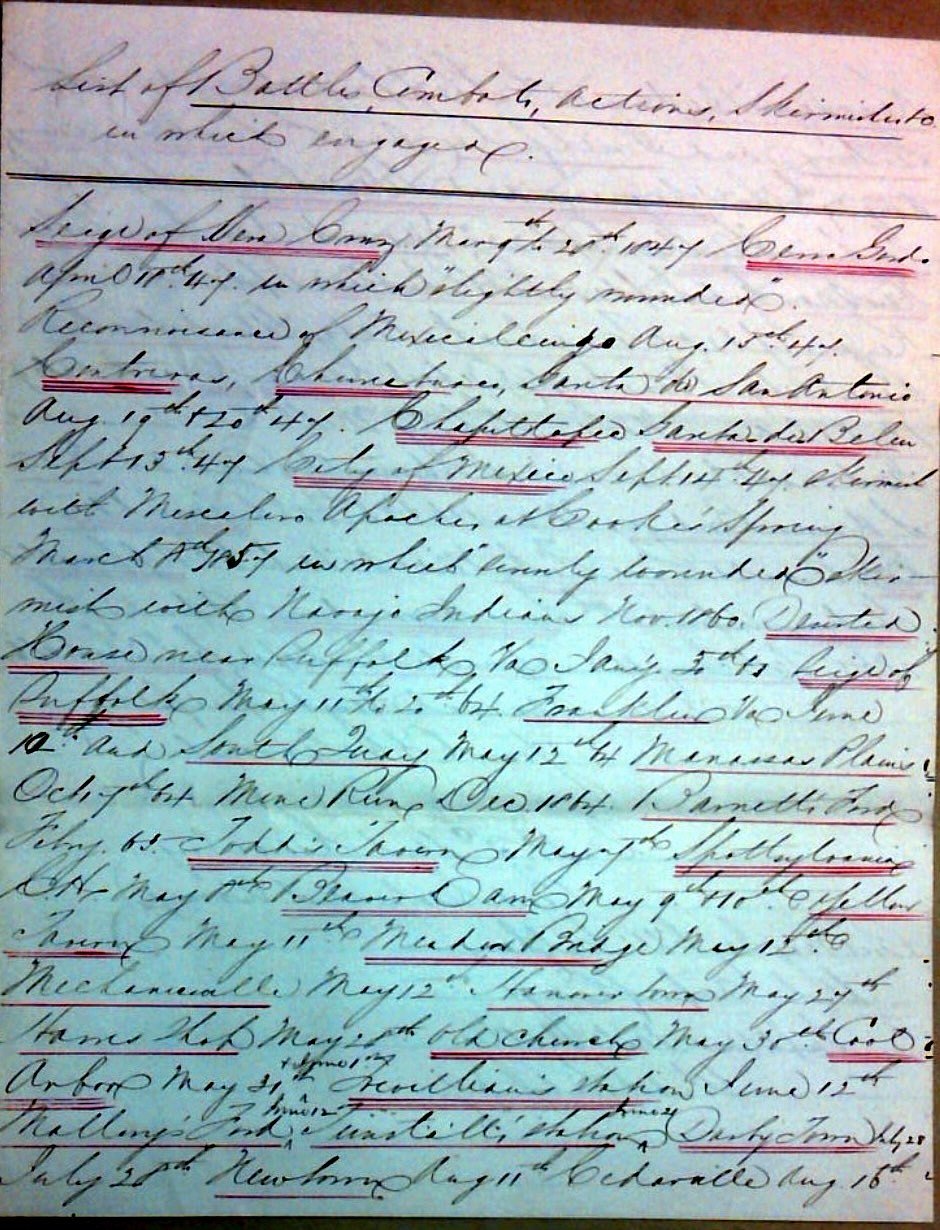
Full transcription
List of Battles, Combats, Actions, Skirmishes,
in which engaged.
Seige of Vera Cruz March 9th to 28th 1847. Cerro Gordo
Apr. 18th 47. in which “slightly wounded”.
Reconnoisance of Mexicalcingo Aug. 15th 47.
Contreras, Churubusco, Garita de San Antonio
Aug. 19th & 20th 47. Cheputtepec Garita del Belen
Sept 13th 47. City of Mexico Sept 14th 47. Skirmish
with Mescalero Apache, at Cooke’s Spring
March 6th 1857 in which “severely wounded”. Skir-
mish with Navajo Indians Nov. 1860. Deserted
House near Suffolk Va. Jany 30 44 [1863]. Seige of
Suffolk May 11th to 20th 63. Franklin Va. June
10th and South Quay May 12th 44 [63]. Manassas Plains
Oct. 17 & 63. Mine Run Dec. 1863. Barnett’s Ford
Feby. 6th [64]. Todd’s Tavern May 7th. Spottsylvania
C.H. May 8th & Beaver Dam May 9th & 10th. Yellow
Tavern May 11th & Meadow Bridge May 12th &
Mechanicsville May 12th. Hanover town May 27th &
Hawes Shop May 28th. Old Church May 30th. Cool
Arbor May 31st & [June 1st] Trevillian’s Station June 12th
Mallory’s Ford [& Trevillian’s Station] Twice, Sunett’s [?] [& Louisa C.H.?] Darby Town July 28th
July 28th. Newtown Aug 11th. Cedarville Aug 16th […]
[Note: numerous words are underlined in red/blue ink throughout (place names such as Vera Cruz, Cerro Gordo, Contreras, Churubusco, Santa [Garita] de San Antonio, Chapultepec, Garita del Belen, City of Mexico, Cooke’s Spring, Deserted House, Suffolk, Franklin, South Quay, Manassas Plains, Mine Run, Barnett’s Ford, Todd’s Tavern, Spottsylvania, Beaver Dam, Yellow Tavern, Meadow Bridge, Mechanicsville, Hanover town, Hawes Shop, Old Church, Cool Arbor, Trevillian’s Station, Mallory’s Ford, Darby Town, Newtown, Cedarville). Some dates appear to have interlined corrections. The page is cut off at the bottom — the list continues beyond this leaf.]
“Seige of Vera Cruz March 9th–29th 1847. Cerro Gordo April 17th ’47, in which ‘slightly wounded’. Reconnoissance of Mexicalcingo Aug. 15th ’47. Contreras, Churubusco, Garita de San Antonio Aug. 19th & 20th ’47. Chapultepec, Garita de Belen Sept 13th ’47. City of Mexico Sept 14th ’47…”Gibbs’s own hand, the Mexican War lines of his battle list · Doc #35
“Wounded in the battle of Cerro Gordo… Bvt 1st Lieut April 18th 1847 ‘for gallant and meritorious conduct in the Battle of Cerro Gordo.’ Bvt Captain Sept 14, 1847 ‘for gallant and meritorious conduct at the Garita de Belen.’”Gibbs, writing his own history from memory, Carlisle Barracks, Aug. 17, 1859 · Doc #76
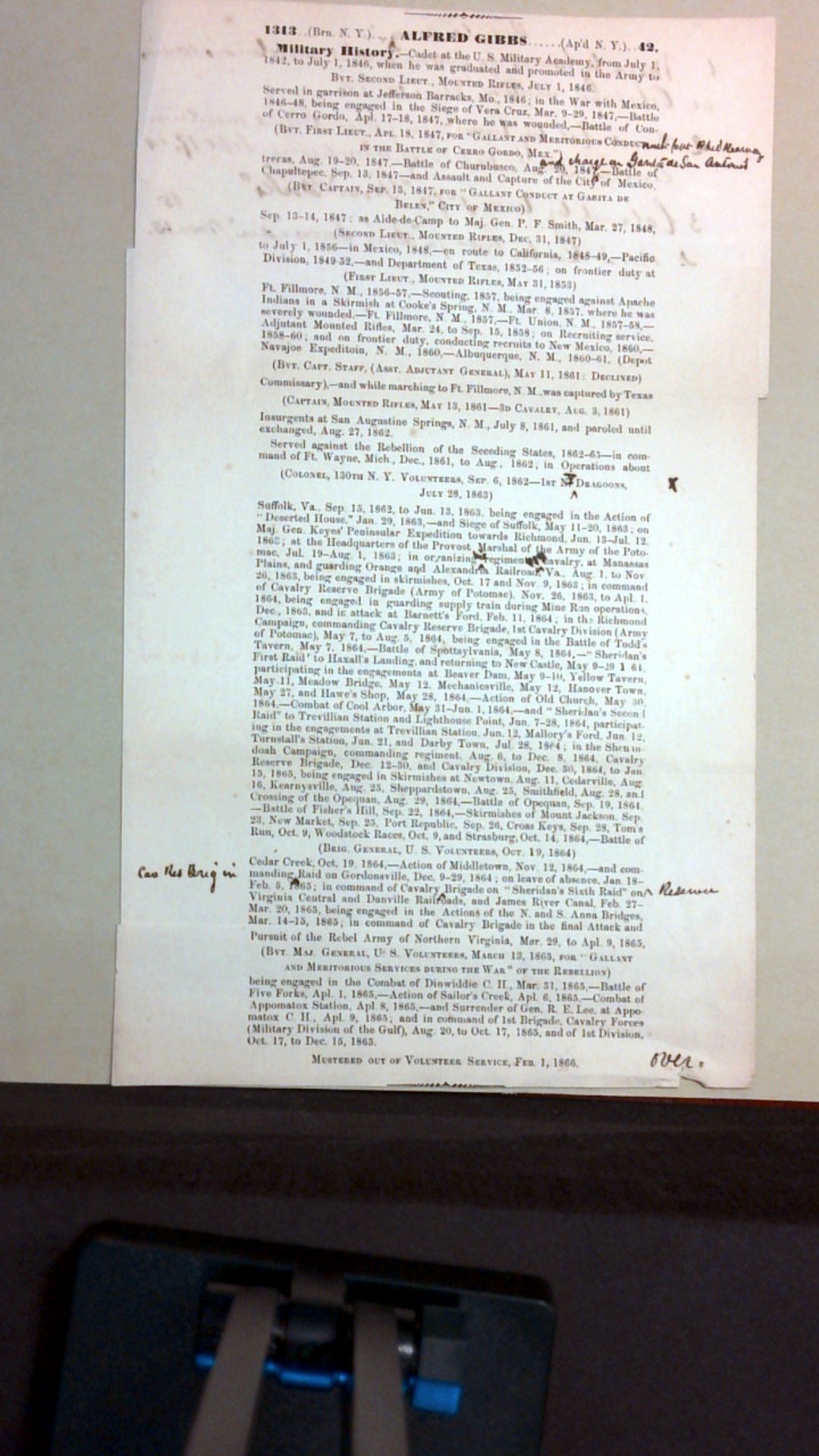
Full transcription
mw-cullum-entry-marginalia.jpg
DOC TYPE: Printed Cullum’s Register of Graduates entry (No. 1313, Class of 1846) for Alfred Gibbs, with handwritten pencil marginalia.
TRANSCRIPTION (printed text):
1313. (Born N. Y.) ….. ALFRED GIBBS ….. (Ap’d N. Y.) . 42.
Military History.—Cadet at the U. S. Military Academy, from July 1, 1842, to July 1, 1846, when he was graduated and promoted in the Army to
Bvt. Second Lieut., Mounted Rifles, July 1, 1846.
Served in garrison at Jefferson Barracks, Mo., 1846; in the War with Mexico, 1846–48, being engaged in the Siege of Vera Cruz, Mar. 9–29, 1847,—Battle of Cerro Gordo, Apl. 17–18, 1847, where he was wounded,—Battle of Con-
(Bvt. First Lieut., Apl. 18, 1847, for “Gallant and Meritorious Conduct in the Battle of Cerro Gordo, Mex.”)
treras, Aug. 19–20, 1847,—Battle of Churubusco, Aug. 20, 1847,—Battle of Chapultepec, Sep. 13, 1847,—and Assault and Capture of the City of Mexico.
(Bvt. Captain, Sep. 13, 1847, for “Gallant Conduct at Garita de Belen,” City of Mexico)
Sep. 13–14, 1847; as Aide-de-Camp to Maj. Gen. P. F. Smith, Mar. 27, 1848,
(Second Lieut., Mounted Rifles, Dec. 31, 1847)
to July 1, 1856—in Mexico, 1848,—en route to California, 1848–49,—Pacific Division, 1849-52,—and Department of Texas, 1852–56; on frontier duty at
(First Lieut., Mounted Rifles, May 31, 1853)
Ft. Fillmore, N. M., 1856–57,—Scouting, 1857, being engaged against Apache Indians in a Skirmish at Cooke’s Spring, N. M., Mar. 8, 1857, where he was severely wounded,—Ft. Fillmore, N. M., 1857,—Ft. Union, N. M., 1857–58,— Adjutant Mounted Rifles, Mar. 24, to Sep. 15, 1858; on Recruiting service, 1858–60; and on frontier duty, conducting recruits to New Mexico, 1860,— Navajoe Expeditoin, N. M., 1860,—Albuquerque, N. M., 1860–61. (Depot
(Bvt. Capt. Staff, (Asst. Adjutant General), May 11, 1861. Declined)
Commissary),—and while marching to Ft. Fillmore, N. M., was captured by Texas
(Captain, Mounted Rifles, May 13, 1861—3d Cavalry, Aug. 3, 1861)
Insurgents at San Augustine Springs, N. M., July 8, 1861, and paroled until exchanged, Aug. 27, 1862.
Served against the Rebellion of the Seceding States, 1862–65:—in command of Ft. Wayne, Mich., Dec., 1861, to Aug., 1862; in Operations about
(Colonel, 130th N. Y. Volunteers, Sep. 6, 1862—1st N. Y. Dragoons, July 28, 1863)
Suffolk, Va., Sep. 15, 1862, to Jun. 13, 1863, being engaged in the Action of “Deserted House,” Jan. 29, 1863,—and Siege of Suffolk, May 11–20, 1863; on Maj. Gen. Keyes’ Peninsular Expedition towards Richmond, Jun. 13–Jul. 12, 1863; at the Headquarters of the Provost Marshal of the Army of the Potomac, Jul. 19–Aug. 1, 1863; in organizing regiment of Cavalry at Manassas Plains, and guarding Orange and Alexandria Railroad, Va., Aug. 1 to Nov. 26, 1863, being engaged in skirmishes, Oct. 17 and Nov. 9, 1863; in command of Cavalry Reserve Brigade (Army of Potomac), Nov. 26, 1863, to Apl. 1, 1864, being engaged in guarding supply train during Mine Run operations, Dec., 1863, and in attack at Barnett’s Ford, Feb. 11, 1864; in the Richmond Campaign, commanding Cavalry Reserve Brigade, 1st Cavalry Division (Army of Potomac), May 7, to Aug. 5, 1864, being engaged in the Battle of Todd’s Tavern, May 7, 1864,—Battle of Spottaylvania, May 8, 1864,—”Sheridan’s First Raid” to Haxall’s Landing, and returning to New Castle, May 9–29 1 64, participating in the engagements at Beaver Dam, May 9–14, Yellow Tavern, May 11, Meadow Bridge, May 12, Mechanicsville, May 12, Hanover Town, May 27, and Hawe’s Shop, May 28, 1864,—Action of Old Church, May 30, 1864,—and “Sheridan’s Second Raid” to Trevillian Station and Lighthouse Point, Jun. 7–28, 1864, participating in the engagements at Trevillian Station, Jun. 12, Mallory’s Ford, Jun. 12, Turnstall’s Station, Jun. 21, and Darby Town, Jul. 28, 1864; in the Shenandoah Campaign, commanding regiment. Aug. 6, to Dec. 8, 1864, Cavalry Reserve Brigade, Dec. 12–30, and Cavalry Division, Dec. 30, 1864, to Jan. 15, 1865, being engaged in Skirmishes at Newtown, Aug. 11, Cedarville, Aug. 16, Kearnysville, Aug. 25, Sheppardstown, Aug. 25, Smithfield, Aug. 28, and Crossing of the Opequan, Aug. 29, 1864,—Battle of Opequan, Sep. 19, 1864,— Battle of Fisher’s Hill, Sep. 22, 1864,—Skirmishes of Mount Jackson. Sep. 23, New Market, Sep. 25, Port Republic, Sep. 26, Cross Keys, Sep. 28, Tom’s Run, Oct. 9, Woodstock Races, Oct. 9, and Strasburg, Oct. 14, 1864,—Battle of
(Brig. General, U. S. Volunteers, Oct. 19, 1864)
Cedar Creek, Oct. 19, 1864,—Action of Middletown, Nov. 12, 1864,—and commanding Raid on Gordonsville, Dec. 29–29, 1864; on leave of absence, Jan. 18– Feb. 5, 1865; in command of Cavalry Brigade on “Sheridan’s Sixth Raid” on Virginia Central and Danville Railroads, and James River Canal, Feb. 27– Mar. 20, 1865, being engaged in the Actions of the N. and S. Anna Bridges, Mar. 14–15, 1865, in command of Cavalry Brigade in the final Attack and Pursuit of the Rebel Army of Northern Virginia, Mar. 29, to Apl. 9, 1865.
(Bvt. Maj. General, U. S. Volunteers, March 13, 1865, for “Gallant and Meritorious Services during the War” of the Rebellion)
being engaged in the Combat of Dinwiddie C. H., Mar. 31, 1865,—Battle of Five Forks, Apl. 1, 1865,—Action of Sailor’s Creek, Apl. 6, 1865,—Combat of Appomatox Station, Apl. 8, 1865,—and Surrender of Gen. R. E. Lee, at Appomatox C. H., Apl. 9, 1865; and in command of 1st Brigade, Cavalry Forces (Military Division of the Gulf), Aug. 20, to Oct. 17, 1865, and of 1st Division, Oct. 17, to Dec. 15, 1865.
Mustered out of Volunteer Service, Feb. 1, 1866.
HANDWRITTEN MARGINALIA (pencil):
– [Right margin, beside the “Battle of Con-treras / Bvt. First Lieut.” lines, top]: “under Genl Phil Kearny” [reading uncertain — “not for Phil Kearny”?]
– [Right margin, just below, beside the Contreras/Churubusco/San Antonio lines]: “and charge on Garita de San Antonio”
– [Right margin, beside the “(Colonel, 130th N. Y. Volunteers … 1st N. Y. Dragoons)” line]: an “X” mark
– [Left margin, beside the “(Brig. General, U. S. Volunteers, Oct. 19, 1864)” line]: “Cav Res Brig in” [Cavalry Reserve Brigade in]
– [Right margin, beside the “Sheridan’s Sixth Raid” lines]: “Reserve”
– [Lower right, below “Mustered out of Volunteer Service” line]: “over.” (indicating text continues on the reverse)
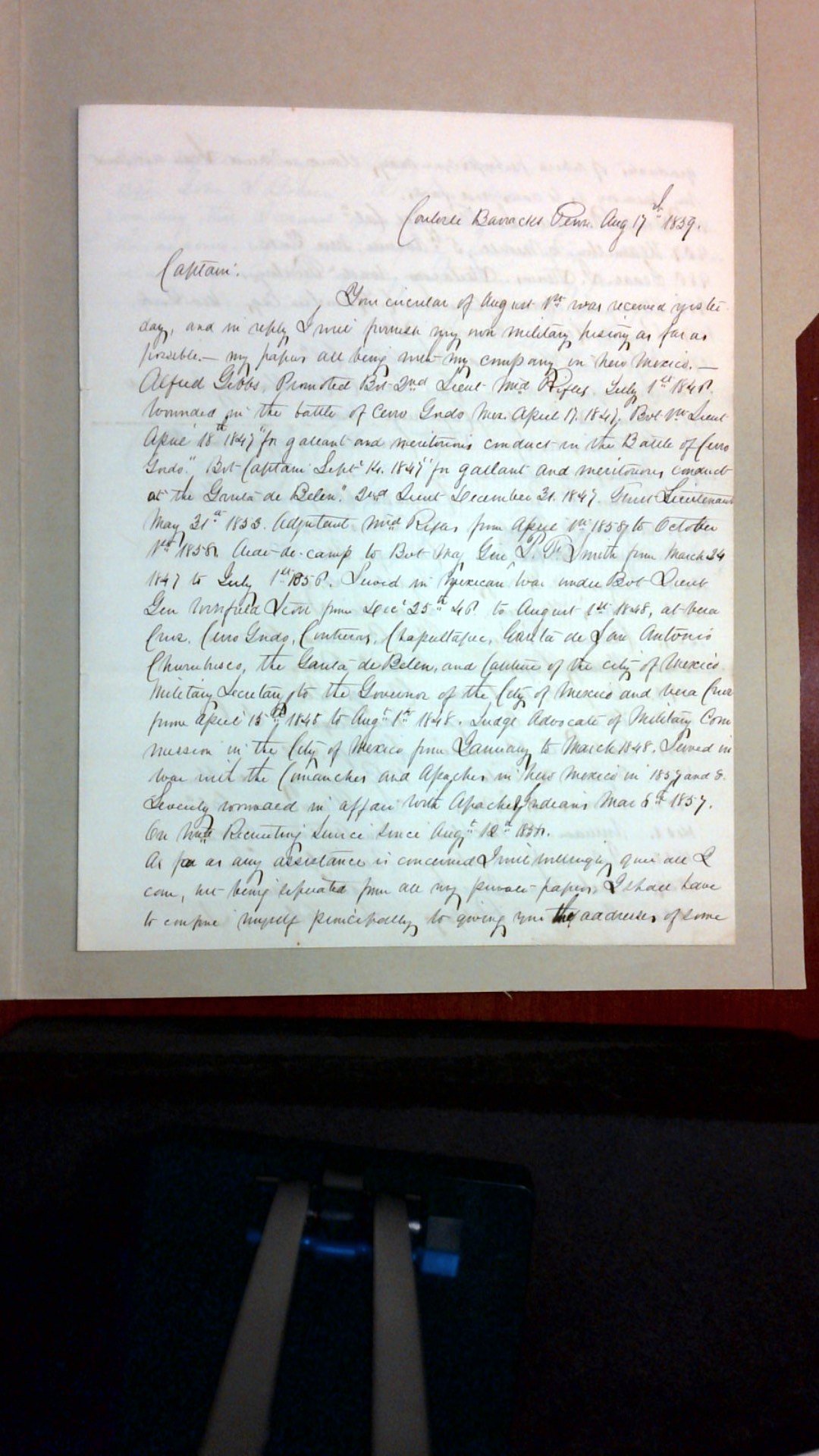
Full transcription
Carlisle Barracks Penn. Aug 17th 1859.
Captain:
Your circular of August 1st was received yester-
day, and in reply I will furnish my own military history as far as
possible.— my papers all being with my company in New Mexico.—
Alfred Gibbs, Promoted Bvt 2nd Lieut Med [Mtd] Rifles July 1st 1846.
Wounded in the battle of Cerro Gordo Mex. April 17. 1847, Bvt 1st Lieut
April 18 1847 “for gallant and meritorius conduct in the Battle of Cerro
Gordo.” Bvt Captain Sept 14. 1847 “for gallant and meritorius conduct
at the Garita de Belen”. 2nd Lieut December 31. 1847. First Lieutenant
May 31st 1853. Adjutant Med [Mtd] Rifles from April 1st 1858 to October
1st 1858. Aide-de-camp to Bvt Maj Genl. P. F. Smith from March 24
1847 to July 1st 1858. Served in Mexican War under Bvt Lieut
Genl Winfield Scott from Sept 25th 46 to August 1st 1848, at Vera
Cruz. Cerro Gordo, Contreras, Chapultepec, Garita de San Antonio
Churubusco, the Garita de Belen, and Capture of the City of Mexico.
Military Secretary to the Governor of the City of Mexico and Vera Cruz
from April 15th 1848 to Augt 1st 1848. Judge Advocate of Military Com-
mission in the City of Mexico from January to March 1848. Served in
War with the Comanches and Apaches in New Mexico in 1857 and 8.
Severely wounded in affair with Apache Indians March 6th 1857.
On Med [Mtd] Recruiting Service since Augt 12th 1858 [or 1859].
As far as any assistance is concerned I will manage, quite all I
can, me being seperated from all my private papers, I shall have
to confine myself principally, to giving you the addresses of some
[Note: page is a single leaf; text ends mid-sentence at the bottom — the letter continues on a following leaf not shown. Faint show-through of writing from another page is visible at top. Original spellings (“meritorius,” “seperated,” abbreviation “Med” for Mtd/Mounted) preserved.]
The Moment
In 1859, Capt. George W. Cullum was circularizing West Point graduates for the service histories that became his famous Register. Gibbs answered from Carlisle Barracks — from memory, his papers a thousand miles away in New Mexico — and produced the only first-person prose account of his war in this archive.
Researcher’s Notes
Document #384 was catalogued as a letter to “Dr. Alfred Gibbs, M.D.” The scan actually reads “Lt. Alfred Gibbs, Mtd Rifles” — and the medical accounts are the general’s own: he paid two physicians $40 out of pocket for his wartime care in 1847, and in 1849 the Treasury credited the bills, set them against a paymaster’s overpayment, and billed him $50.83. The physicians’ names (readings “A. B. Stout,” “J. Mora”) and the treatment window — possibly following his Cerro Gordo wound — are open questions.
The $25.70 thread: in 1854 the Treasury’s Third Auditor billed Gibbs for fines collected in March 1848 in the office of Maj. P. H. Galt, Lieutenant Governor of occupied Mexico City, and advanced to Gibbs on his own receipt. Gibbs’s draft rebuttal (written at Corpus Christi, mid-1850s) invokes Gen. Persifor Smith’s military-contribution-fund settlement — and his 1859 Carlisle letter confirms why he was involved at all: he had served as Military Secretary to the Governor of Mexico City and as a Judge Advocate in 1848. Whether the Treasury ever closed the claim is still to be traced.
Three separate documents — his handwritten battle list, his 1859 Carlisle summary, and the marginalia on his printed Cullum entry — all insist on the same point the printed record omits: Gibbs at the Garita de San Antonio, alongside a reference to Phil Kearny, whose dragoon squadron made the famous charge there on August 20, 1847. The general kept correcting his own record. Was he in that charge? This is the journey’s biggest open question.
Answered — the margin won. The marginalia on Doc #107 was Gibbs’s reply to General Cullum’s printed circular of June 1, 1867 (Doc #172 in this archive), which asked every graduate to “correct all errors” in the proof of his Register entry. We have now read the 1879 and 1891 editions of Cullum’s Register: both print, as settled fact, “and in Kearny’s charge on the San Antonio Garita, Aug. 20, 1847.” Cullum accepted the correction, and it has stood in the official record ever since. The full story, told from the documents in this archive, is here: The Margin That Won.
And now the first-person account exists after all: Alfred’s own published battle letter of 1847, identified this month (Station III), narrates the campaign — including Kearny’s charge — in the very voice the 1859 Carlisle summary could only remember. The record he kept correcting, he had already written.
❦ These notes grow. As research answers a question or opens a new one, an entry is added here — the document stays, the story deepens.
A Map From Another War
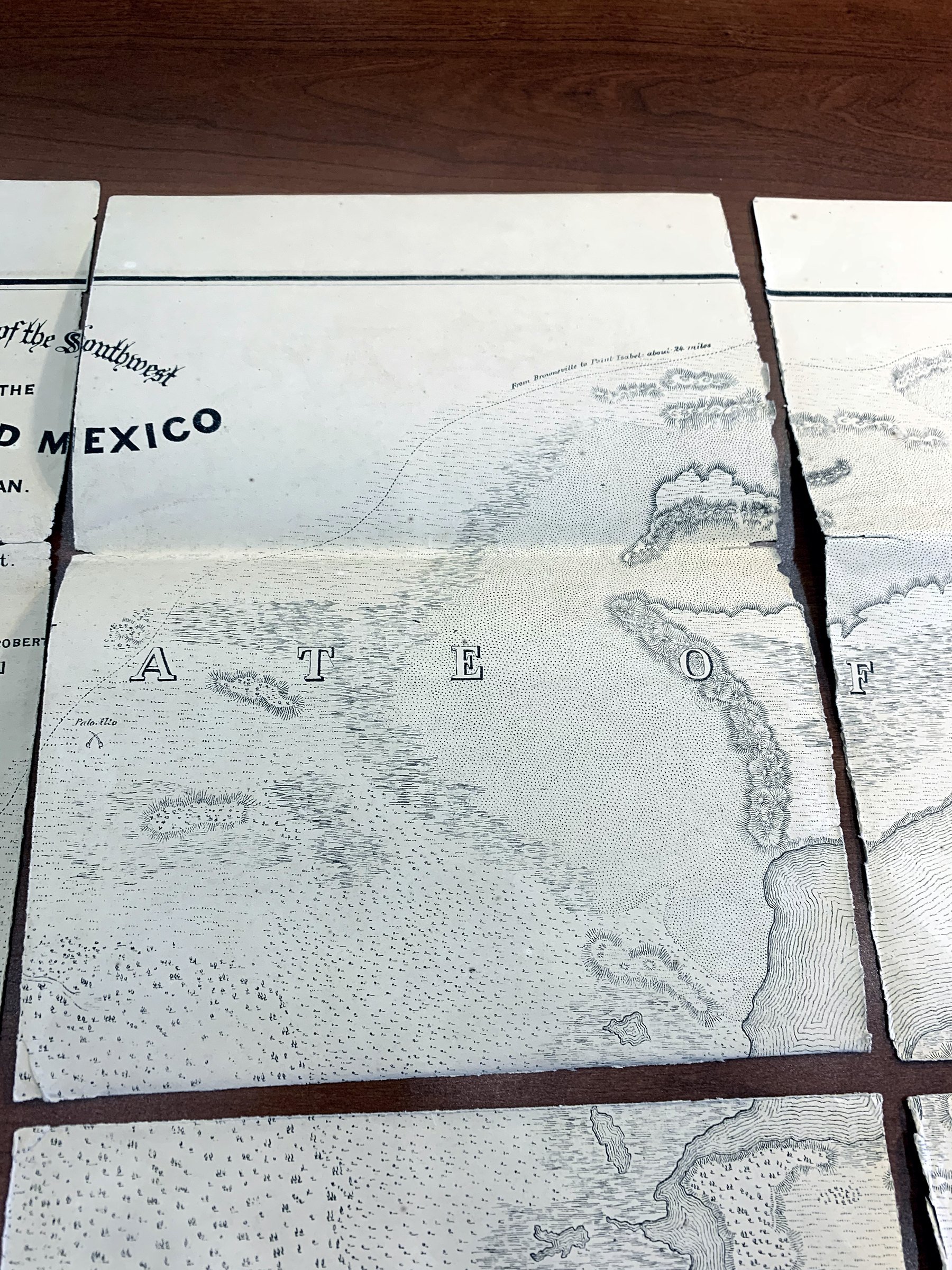
Full transcription
mw-boundary-map-panels.jpg
DOC TYPE: Map, lithographed sheet shown in torn fragments/panels (lower Rio Grande boundary region); mostly graphic (stippled terrain), sparse text
INSCRIPTIONS (verbatim as legible across the fragments):
– Title fragments at upper left (the cartouche is torn; only right ends of lines survive): “…of the Southwest” / “…THE” / “…D MEXICO” / “…AN.” / “…t.” / “…obert” [likely a surveyor/engineer credit, e.g. a “Robert…” name] / “…n”
– Note along a dotted road line: “From Brownsville to Point Isabel about 24 miles”
– Battlefield marker at lower left: “Palo Alto” (with crossed-flags/engagement symbol)
– Large spaced display lettering marching across the sheet (a big engraved regional label): “A T E O F” on the middle band and “… O F” continuing at right — i.e. the tail of “[ST]ATE OF …” reading across the map.
Graphic content: extensive stippling for the coastal chaparral/prairie flats, hachured brush and lomas (low hills), a lagoon/laguna shoreline and small islands at right (the Laguna Madre / Gulf coast near Point Isabel), and dashed lines for roads. The sheet is physically torn into several rectangular panels laid edge to edge on a wood table; gaps between fragments interrupt the linework.
Note: On the boundary map the title cartouche is largely lost to the tear; the surviving fragments (“…of the Southwest,” “…D MEXICO”) indicate a title on the order of “Map of the Southwest / [Frontier of Texas and] Mexico” but the full wording cannot be recovered from this image, and the apparent “…obert” credit is a best-guess partial reading.
One last sheet was filed with these papers for years: a lithographed map of the lower Rio Grande — Palo Alto, Fort Brown, Matamoros — catalogued as “circa 1846,” the opening ground of the war. But the map names Brownsville, a town that did not exist until 1848, and its damaged title block traces to the Chief Engineer’s Office, Military Division of the Southwest — Sheridan’s border command of 1865–66, watching Maximilian’s Mexico. It belongs to the end of Gibbs’s story, not the beginning: a souvenir of the general he followed through the Shenandoah, filed with the war where he earned his first brevet.
Researcher’s Notes
This torn map was catalogued “circa 1846,” but it names Brownsville — a town founded in 1848 — and reading the ink show-through of its title block in mirror image recovers “[Chief Engine]er’s Office, Mil. Div. of the Southwest… MAJOR GENL P. H [Sheridan?].” That command faced Maximilian’s Mexico in 1865–66 — so this is likely a keepsake of Gibbs’s service under Sheridan, filed with the wrong war for years. Next step: re-photograph the title panel face-on to confirm the reading.
❦ These notes grow. As research answers a question or opens a new one, an entry is added here — the document stays, the story deepens.
Walk the Rest of the Archive
This is Journey No. 1 of the Gibbs Papers — 866 documents, eight eras, from a grandfather’s letters in 1824 to Fort Leavenworth in 1868.
The Gibbs Papers Enter the Reading Room Exhibit: The Family PapersGo Deeper
Siege of Vera Cruz Battle of Cerro Gordo The Battle of Chapultepec The Aztec Club of 1847 Clash of Cavalry at Cerro Gordo The War Correspondent (his 1847 letter) The Stuart Letter (1848) The Alfred Gibbs Letters The Margin That Won — correcting the Mexican War record, 1859–1891 Epilogue, 17 years on: The Making of a General (1864) — Scott’s regard, redeemed with a starViews: 41