The War Correspondent: Alfred Gibbs’s “Battles of Contreras and Churubusco,” 1847
The Alfred Gibbs Letters · Written by Alfred Gibbs · Published Unsigned, 1847 · Identified July 2026
The War Correspondent: Alfred Gibbs’s “Battles of Contreras and Churubusco,” 1847
Alfred Gibbs wrote every word below. Published unsigned by his brother in the New York Courier & Enquirer and copied by the National Intelligencer and the Union, his San Angel account of August 31, 1847 – the letter that set West Point “in a blaze” – gets its byline back after 179 years.
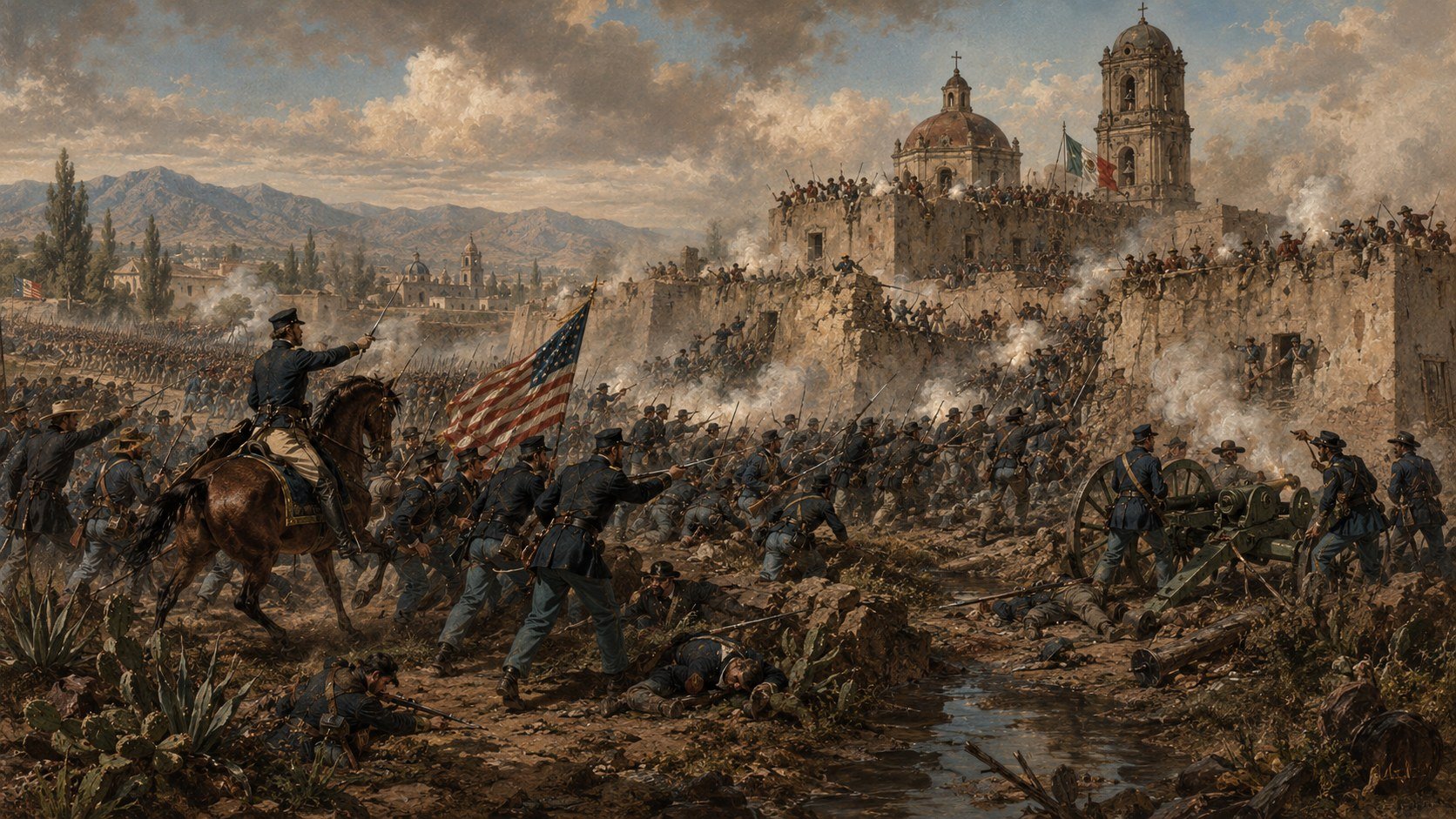
The storm of the fortified convent of San Mateo Churubusco, August 20, 1847, the Mexican colors flying above the works as United States infantry press the assault. A modern illustration created for AlfredGibbs.com to accompany Gibbs’s account — an interpretation of the scene, not a contemporary painting.
On October 25, 1847, George Gibbs confessed to his brother, in a letter now exhibited on this site: he had published Alfred’s private account of the battles for Mexico City against his explicit instruction – “It was important in the highest degree” – and “All West Point was in a blaze at the letter as I published it, officers & cadets… The letter has been copied by the National Intelligencer & the Union.” This page is that letter, found in both Washington papers of October 13, 1847, exactly where George said it would be. Datelined San Angel, August 31, 1847, and published unsigned, it is the twenty-four-year-old adjutant’s own narrative of the campaign: the army winding up from Puebla under Popocatepetl, the “boldest reconnoissance of the war” (Scott’s phrase) by 400 men who walked thirty miles out and back through an enemy country, the drenched midnight before Contreras – “too tired to eat, too wet to sleep… the first smile that lit up our faces for twelve hours boded but little good for the Mexicans” – Gen. Persifor Smith at dawn (“A look answered him. ‘Men forward!’ And we did ‘forward.’”), the storm of Churubusco with the San Patricio deserters fighting under the walls, Kearny’s charge to the very gate of the city, and the casualty roll that let a hundred families learn the fate of their sons. His mother, brothers, and the Scotts read it in New York; the country read it everywhere; and no reader knew the author’s name until now.
Who wrote this · the attribution
Bvt. Capt. Alfred Gibbs, adjutant, Regiment of Mounted Riflemen – aged 24, writing from his regiment’s quarters at San Angel.
The letter was printed without a signature, as an officer’s letter had to be. The attribution rests on three interlocking documents, each checkable on this site:
1. His brother’s confession. George Gibbs to Alfred, Oct. 25, 1847 (exhibited here, from the family papers): he published Alfred’s Contreras/Churubusco letter against his orders – and “the letter has been copied by the National Intelligencer & the Union.”
2. One letter, both papers, exactly on time. A search of both Washington papers finds exactly one Courier & Enquirer account of these battles – this one – printed in both, the same day, Oct. 13, 1847, twelve days before George wrote “has been copied.”
3. The letter knows what Alfred knew. It marches with Smith’s brigade of Twiggs’s division (Alfred’s own), reports Schuyler Hamilton’s wounding – the very news George carried to Mrs. Hamilton – and names Lieut. Van Buren of the Rifles, the brother officer Alfred later mourned by name. The full nine-point proof is in the researcher’s notes below.
The Letter
Alfred Gibbs’s letter, first part – Daily National Intelligencer, Oct. 13, 1847, p. 2
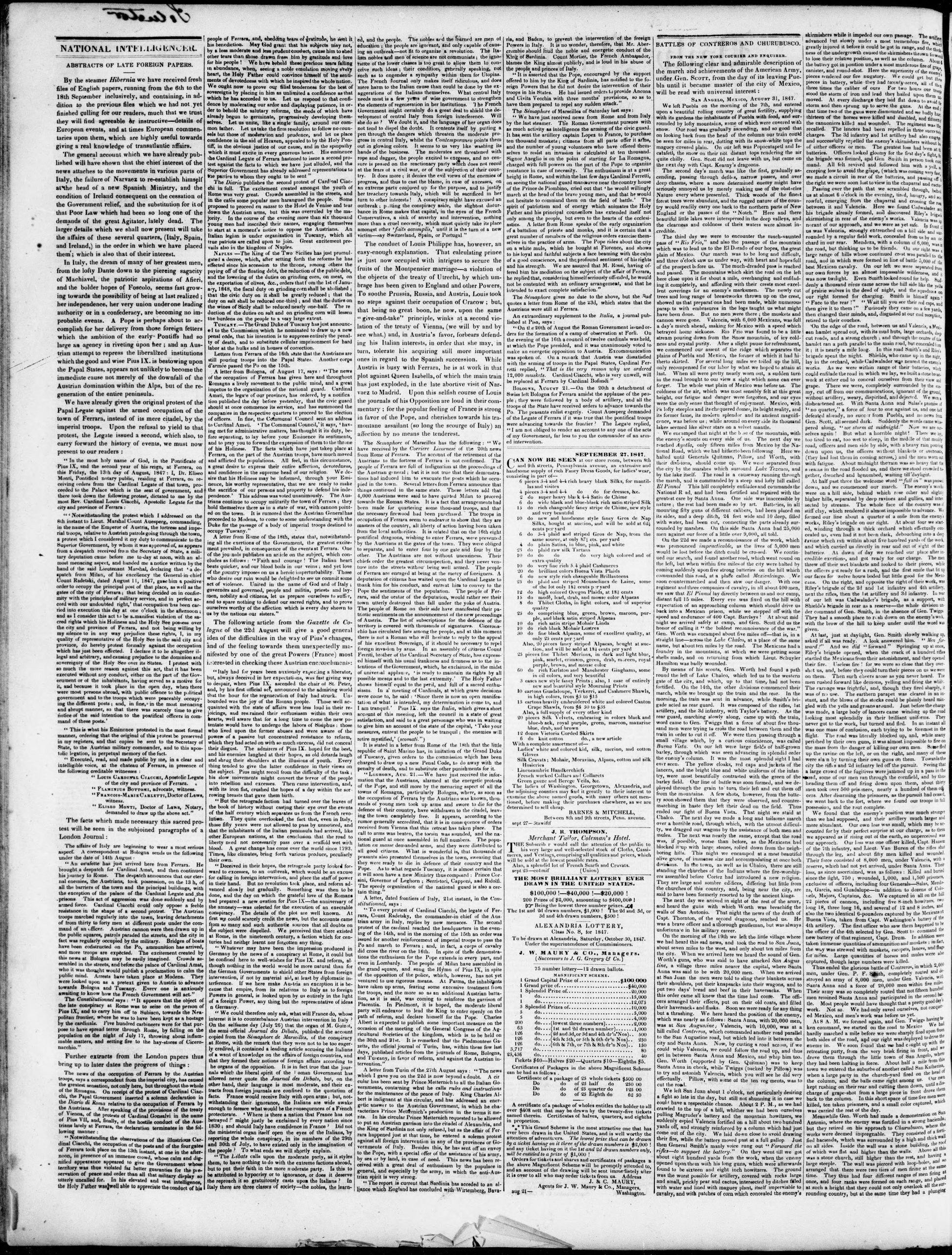
BATTLES OF CONTREROS AND CHURUBUSCO.
FROM THE NEW YORK COURIER AND ENQUIRER.
The following clear and admirable description of the march and achievements of the American Army, under Gen. Scott, from the day of its leaving Puebla until it became master of the city of Mexico, will be read with universal interest:
SAN ANGELO, Mexico, August 31, 1847.
We left Puebla on the morning of the 7th, and entered upon a beautiful rolling country of great fertility, supplying with its gardens the inhabitants of Puebla with food, and surrounded by lofty mountains, some of which were covered with snow. Our road was gradually ascending, and so good that on looking back from the head of the column our train could be seen for miles in rear, dotting with its snow-white tops the maguey covered plain. On our left was Popocatapetl and Iscatafetl [?], the snow on their not distant tops rendering the air quite chilly. Gen. Scott did not leave with us, but came on the next day with Capt. Kearny’s dragoons. The second day’s march was like the first, gradually ascending, passing through defiles, narrow passes, and over deep chasms, where a more determined enemy might have seriously annoyed us by merely making use of the obstacles Nature every where presented. Thick woods of the finest forest trees were abundant, and the rugged nature of the country would readily carry one back to the northern parts of New England or the passes of the “Notch.” Here and there beautiful little lakes were interspersed in the deep valleys, and the clearness and coldness of their waters were almost incredible.
The third day we were to encounter the much-vaunted pass of “Rio Frio,” and also the passage of the mountain which was to lead us to the El Dorado of our hopes, the great plain of Mexico. Our march was to be long and difficult, and three o’clock saw us under way, with heart and hopes full of the prospect before us. The much-dreaded pass is reached and passed. The mountains which skirt the road on the left here close upon it for about a mile, overhanging and enfilading it completely, and affording with their crests most excellent coverings for an enemy’s marksmen. The newly cut trees and long range of breastworks thrown up on the crest, showed us that preparations had been made, while numerous parapets with embrasures in the logs taught us what might have been done. But no men were there the muskets and cannon were gone. Valencia, with 6,000 Mexicans, was full a day’s march ahead, making for Mexico with a speed which betrayed home sickness. Rio Frio was found to be a little stream pouring down from the Snow mountain, of icy coldness and crystal purity. After a slight pause for refreshment, we commenced our ascent of the ridge which separates the plains of Puebla and Mexico, the former of which it had hitherto skirted. For several long miles we toiled up the hill, only recompensed for our labor by what we hoped to attain at last. When all were pretty nearly worn out, a sudden turn in the road brought to our view a sight which none can ever forget. The whole vast plain of Mexico was before us. The coldness of the air, which was most sensibly felt at this great height, our fatigue and danger were forgotten, and our eyes were the only sense that thought of enjoyment. Mexico, with its lofty steeples and its chequered domes, its bright reality, and its former fame, its modern splendor and its ancient magnificence, was before us while around on every side its thousand lakes seemed like silver stars on a velvet mantle.
We encamped that night at the base of the mountain, with the enemy’s scouts on every side of us. The next day we reached Ayotla, only fifteen miles from Mexico by the National Road, which we had hitherto been following. Here we halted until Generals Quitman, Pillow, and Worth, with their divisions, should come up. We were separated from the city by the marshes which surround Lake Tezcuco, and by the lake itself. The road is a causeway running through the marsh, and is commanded by a steep and lofty hill called El Pinnol. This hill completely enfilades and commands the National Road, and had been fortified and repaired with the greatest care by Santa Anna. One side was inaccessible by nature; the rest had been made so by art. Batteries, in all mounting fifty guns of different calibers, had been placed on its sides, and a deep ditch, 24 feet wide and 10 deep, filled with water, had been cut, connecting the parts already surrounded by marshes. On this side Santa Anna had 25,000 men against our force of a little over 9,000, all told.
On the 22d we made a reconnoissance of the work, which was pronounced impracticable, as the lives of 5,000 men would be lost before the ditch could be crossed. We continued our search, and found another road, which went round on the left, but when within five miles of the city were halted by coming suddenly upon five strong batteries on the hill which commanded this road, at a place called Mexicalringo [?]. We soon countermarched and then saw our danger. With one regiment and three companies of cavalry, in all about 400 men, we saw that El Pinnol lay directly between us and our camp, distant full 15 miles. Every eye was fixed on the hill with expectation of an approaching column which should drive us back into a Mexican prison, while we stepped off with the speed and endurance of 400 Capt. Barclays. At about midnight we arrived safely at camp, and Gen. Scott did us the honor of calling it “the boldest reconnoissance of the war.” Gen. Worth was encamped about five miles off-that is, in a straight line-across the Lake Chalco, at a place of the same name, but about ten miles by the road. The Mexicans had a foundry in the mountains, at which we were getting some shells made, and on returning from which Lieut. Schuyler Hamilton was badly wounded.
By means of his scouts, Gen. Worth had found a path round the left of Lake Chalco, which led us to the western gate of the city, and which, up to that time, had not been fortified. On the 14th, the other divisions commenced their march, while we brought up the train and the rear. In the morning, the train was sent in advance, while Smith’s brigade acted as rear guard. It was composed of the rifles, 1st artillery, and the 3d infantry, with Taylor’s battery. As the rear guard, marching slowly along, came up with the train, word came to Gen. Twiggs that a force of about five thousand men were trying to cross the road between them and the train in order to cut it off. We were then passing through a small village which, by a curious coincidence, was called Buena Vista. On our left were large fields of half-grown barley, through which the enemy’s column was seen advancing in splendid order. It was the most splendid sight I had ever seen. The yellow cloaks, red caps and jackets of the lancers, and the bright blue and white uniforms of the infantry, were most beautifully contrasted with the green of the barley field. Our line of battle was soon formed, and we deployed through the grain to turn their left and cut them off from the mountains. A few shots, however, from the battery soon showed them that they were observed, and countermarching in haste they left their dead on the field. Thus ended our fight of Buena Vista. That night we staid at Chalco. The next day we made a long and toilsome march over a horrible road, through which, with the utmost difficulty, we dragged our wagons by the assistance of both men and mules. The next was nearly the same, except that the road was, if possible, worse than before, as the Mexicans had blocked it up with large stones, rolled down from the neighboring hills. This night we encamped at a most beautiful olive grove, of immense size and accommodating at once both divisions. In the town, as well as in Chalco, there are still standing the churches of the Indians where the fire-worshippers assembled before Cortez had introduced a new religion. They are large and sombre edifices, differing but little from the churches of this country, and, being near the city, are said to have been formerly resorted to by the ancient kings. The next day we arrived in sight of the rest of the army, and heard the guns with which Worth was breaching the walls of San Antonio. That night the news of the death of Capt. Thornton, of the second dragoons, reached us. He was a brave officer and a thorough gentleman, but was always unfortunate in his military career.
On the morning of the 19th we left the little village where we had heard this sad news, and took the road to San Juan, about seven miles to the west, and only about ten miles from the city. When we arrived here we heard the sound of Gen. Worth’s guns, who was said to have attacked San Augustine, a village three miles nearer the capital, where Santa Anna was said to be with 20,000 men. When we arrived at San Juan the men were told to sling their blankets across their shoulders, put their knapsacks into their wagons, and to put two days’ bread and beef in their haversacks. When this order came all knew that the time had come. The officers arranged their effects, put on their old coats, and filled their haversacks and flasks. Soon we were ready for any thing but a thrashing. We here heard the position of the enemy, which was nearly as follows: Santa Anna, with 20,000 men, was at San Augustine; Valencia, with 10,000, was at a hill called Contreras, which commanded another road parallel to the San Augustine road, but which led into it between the city and Santa Anna. Now, by cutting a road across, if we could whip Valencia, we could follow the road up, and thus get in between Santa Anna and Mexico, and whip him too. Gen. Worth (supported by Gen. Quitman) was to keep Santa Anna in check, while Twiggs (backed by Pillow) was to try and astonish Valencia, which you will see he did very effectually. Pillow, with some of the ten regiments, was to cut the road.
We left San Juan about 1 o’clock, not particularly desiring a fight so late in the day, but still not shunning it in case we could have a respectable chance. About 2 P. M., as we had crawled to the top of a hill, whither we had been ourselves pulling Magruder’s battery and the mountain howitzers, we suddenly espied Valencia fortified on a hill about two hundred yards off, and strongly reinforced by a column which had just come out of the city. We laid down close to avoid drawing their fire, while the battery moved past at a full gallop. Just then General Smith’s manly voice rung out “Forward the rifles-to support the battery.” On they went till we got about eight hundred yards from the work, when the enemy opened upon them with his long guns, which were afterwards found to be sixteen and eight inch howitzers. The ground was the worst possible for artillery, covered with rocks large and small, prickly pear and cactus, intersected by ditches filled with water and lined with maguey plant, itself imperviable to cavalry, and with patches of corn which concealed the enemy’s skirmishers while it impeded our own passage. The artillery advanced but slowly under a most tremendous fire, which greatly injured it before it could be got in range, and the thickness of the undergrowth caused the skirmishers thrown forward to lose their relative position, as well as the column. About 4 the battery got in position under a most murderous fire of grape, canister, and round-shot. Here the superiority of the enemy’s pieces rendered our fire nugatory. We could get but three pieces in battery, while they had twenty-seven, all of them three times the caliber of ours. For two hours our troops stood the storm of iron and lead they hailed upon them unmoved. At every discharge they laid flat down to avoid the storm and then sprung up to serve the guns. At the end of that time two of the guns were dismounted and one badly hurt [?]; thirteen of the horses were killed and disabled, and fifteen of the cannoneers killed and wounded. The regiment was then recalled. The lancers had been repelled in three successive charges. The 3d infantry and 1st artillery had also engaged and successfully repelled the enemy’s skirmishers without loss of either officers or men. The greatest loss had been at the batteries. Officers looked gloomy for the first day’s fight, but the brigade was formed, and Gen. Smith in person took command. All felt revived and followed him with a yell, as, creeping low to avoid the grape, (which was coming very fast,) we made a circuit in rear of the batteries, and passing off to the right we were soon lost to view in the chaparral and cactus.
Passing over the path that we scrambled through, behold us at almost 6 o’clock in the evening, tired, hungry, and sorrowful, emerging from the chaparral and crossing the road between it and Valencia. Here we found Cadwalader and his brigade already formed, and discovered Riley’s brigade skirmishing in rear of the enemy’s works. Valencia was ignorant of our approach, and we were as yet safe. In front of us was Valencia, strongly entrenched on a hill side and surrounded by a regular field work, concealed from us by an orchard in our rear. Mendoza, with a column of 6,000, was in the road, but thinking us to be friends. On our right was a large range of hills whose continued crest was parallel to the road, and in which were formed in line of battle 5,000 of the best Mexican cavalry. On our left we were separated from our own forces by an almost impassable wilderness, and it was now twilight. Even Smith looked round for help. Suddenly a thousand vivas came across the hill side like the yells of prairie wolves in the dead of night, and the squadron on our right formed for charging. Smith is himself again: “Face to the rear! Wait till you see their red caps, and then give it to them.” Furiously they came on a few yards, then changed their minds, and, disgusted at our cool reception, retired to their couches.
On the edge of the road, between us and Valencia, a Mexican hamlet spread out, with its mud huts, large orchards, deep cut roads, and a strong church and through the centre of this hamlet ran a path parallel to the main road, but concealed from it; it is nearly a mile long. In this road Smith’s and Riley’s brigades spent the night. Shields, who came up in the night, lay in the orchard, while Cadwalader was nearest the enemy’s works. As we were within range of their batteries, which could enfilade the road in which we lay, we built a stone breastwork at either end to conceal ourselves from their view and grape. There we were, completely surrounded by the enemy, cut off from our communications, ignorant of the ground, without artillery, weary, dispirited, and dejected. We were a disheartened set. With Santa Anna and Salas’s promise of “no quarter,” a force of four to one against us, and one half defeated already, no succor from Puebla, and no news from Gen. Scott, all seemed dark. Suddenly the words came whispered along, “we storm at midnight.” Now we are ourselves again. But what a horrible night! There we lay, too tired to eat, too wet to sleep, in the middle of that muddy road, officers and men side by side, with a heavy rain pouring down upon us, the officers without blankets or overcoats, (they had lost them in coming across,) and the men worn out with fatigue. About midnight the rain was so heavy that the streams in the road flooded us, and there we stood crowded together, drenched and benumbed, waiting till daylight.
At half-past three the welcome word “fall in” was passed down, and we commenced our march. The enemy’s works were on a hill side, behind which rose other and slightly higher hills, separated by deep ravines and gullies, and intersected by streams. The whole face of the country was of stiff clay, which rendered it almost impossible to advance. We formed our line about a quarter of a mile from the enemy’s works, Riley’s brigade on our right. At about four we started, winding through a thick orchard which effectually concealed us, even had it not been dark, debouching into a deep ravine which ran within about five hundred yards of the work, and which carried us directly in rear and out of sight of their batteries. At dawn of day we reached our place after incredible exertions, and got ready for our charge. The men threw off their wet blankets and looked to their pieces, while the officers got ready for a rush, and the first smile that lit up our faces for twelve hours boded but little good for the Mexicans. On the right, and opposite the right of their work, was Riley’s brigade of the 2d and 7th [?] infantry and 4th artillery, next the rifles, then the 1st artillery and 3d infantry. In rear of our left was Cadwalader’s brigade, as a support, with Shields’s brigade in rear as a reserve – the whole division under command of Gen. Smith, in the absence of Gen. Twiggs. They had a smooth place to rush down on the enemy’s work, with the brow of the hill to keep under until the word was given.
At last, just at daylight, Gen. Smith slowly walking up, asked if all was ready. A look answered him. “Men forward!” And we did “forward.” Springing up at once, Riley’s brigade opened, when the crack of a hundred rifles startled the Mexicans from their astonishment, and they opened their fire. Useless fire! for we were so close that they overshot us, and, before they could turn their pieces on us we were on them. Then such cheers arose as you never heard. The men rushed forward like demons, yelling and firing the while. The carnage was frightful, and, though they fired sharply, it was of no use. The earthen parapet was cleared in an instant, and the blows of the stocks could be plainly heard mingled with the yells and groans around. Just before the charge was made, a large body of lancers came winding up the road looking most splendidly in their brilliant uniforms. They never got to the work, but turned and fled. In an instant all was one mass of confusion, each trying to be foremost in the flight. The road was literally blocked up, and, while many perished by their own guns, it was almost impossible to fire on the mass from the danger of killing our own men. Some fled up the ravine on the left, or on the right, and many of these were slain by turning their own guns on them.
Towards the city the rifles and 2d infantry led off the pursuit. Seeing that a large crowd of the fugitives were jammed up in a pass in the road, some of our men ran through the cornfield, and, by thus heading them off and firing down upon them, about thirty men took over 500 [?] prisoners, nearly a hundred of them officers. After disarming the prisoners, as the pursuit had ceased, we went back to the fort, where we found our troops in full possession, and the rout complete. We found that the enemy’s position was much stronger than we had supposed, and their artillery much larger and more abundant. Our own loss was small, which may be accounted for by their perfect surprise at our charge, as [several words illegible] perceived was our approach. Our loss was one officer killed, (Capt. Hanson, of the 7th infantry,) and Lieut. Van Buren, of the rifles, shot through the leg, and about fifty men killed and wounded. Their force consisted of 8,000 men, under Valencia, with a reserve, which had not yet arrived, under Santa Anna. Their loss, as since ascertained, was as follows: Killed, and buried since the fight, 750 [?]; wounded [illegible], and [illegible] prisoners, exclusive of officers, including four generals – Salas, Mendoza, Garcia, and Guadalupe – in addition to dozens of colonels, majors, captains, &c. We captured in all on the hill 22 pieces of cannon, including five 8-inch howitzers, two long 18s, three long 16s, and several of 12 and 8 inches, and also the two identical 6-pounders captured by the Mexicans at Buena Vista, taken from Capt. Washington’s battery of the 4th artillery. The first officer who saw them happened to be the officer of the 4th selected by Gen. Scott to command the new battery of that regiment, Capt. Drum. In addition were taken immense quantities of ammunition and muskets. In fact, the way was strewed with muskets, escopets, lances, and flags, for miles. Large quantities of horses and mules were also captured, though large numbers were killed. Thus ended the glorious battle of Contreras, in which 2,000 men, under Gen. P. F. Smith, completely routed and destroyed an army of 8,000 men, under Gen. Valencia, with Santa Anna and a force of 20,000 within five miles. Their army was so completely routed, that not fifteen hundred men rejoined Santa Anna and participated in the second battle. Most people would have thought that a pretty good day’s work. Not so. We had only saved ourselves, not conquered Mexico, and men’s work was before us yet. At 8 A. M. we formed again, and Gen. Twiggs having taken command, we started on the road to Mexico. We had hardly marched a mile before we were sharply fired upon from both sides of the road, and our right was deployed to drive the enemy in. We soon found that we had caught up with the retreating party, from the very brisk firing in front, and we drove them through the little town of San Angel, where they had been rallying [?] in force. About a half a mile from this town we entered the suburbs of another called San Catarina, when a large party in the church-yard fired on the head of the column, and the balls came right among us. Our men kept rushing on their rear and cutting them down, until a discharge of grape-shot from a large piece in front drove them back to the column. In this short space of time five men were killed, ten taken prisoners, and a small color captured, which was carried the rest of the day.
Alfred Gibbs’s letter, concluded – Daily National Intelligencer, Oct. 13, 1847, p. 3
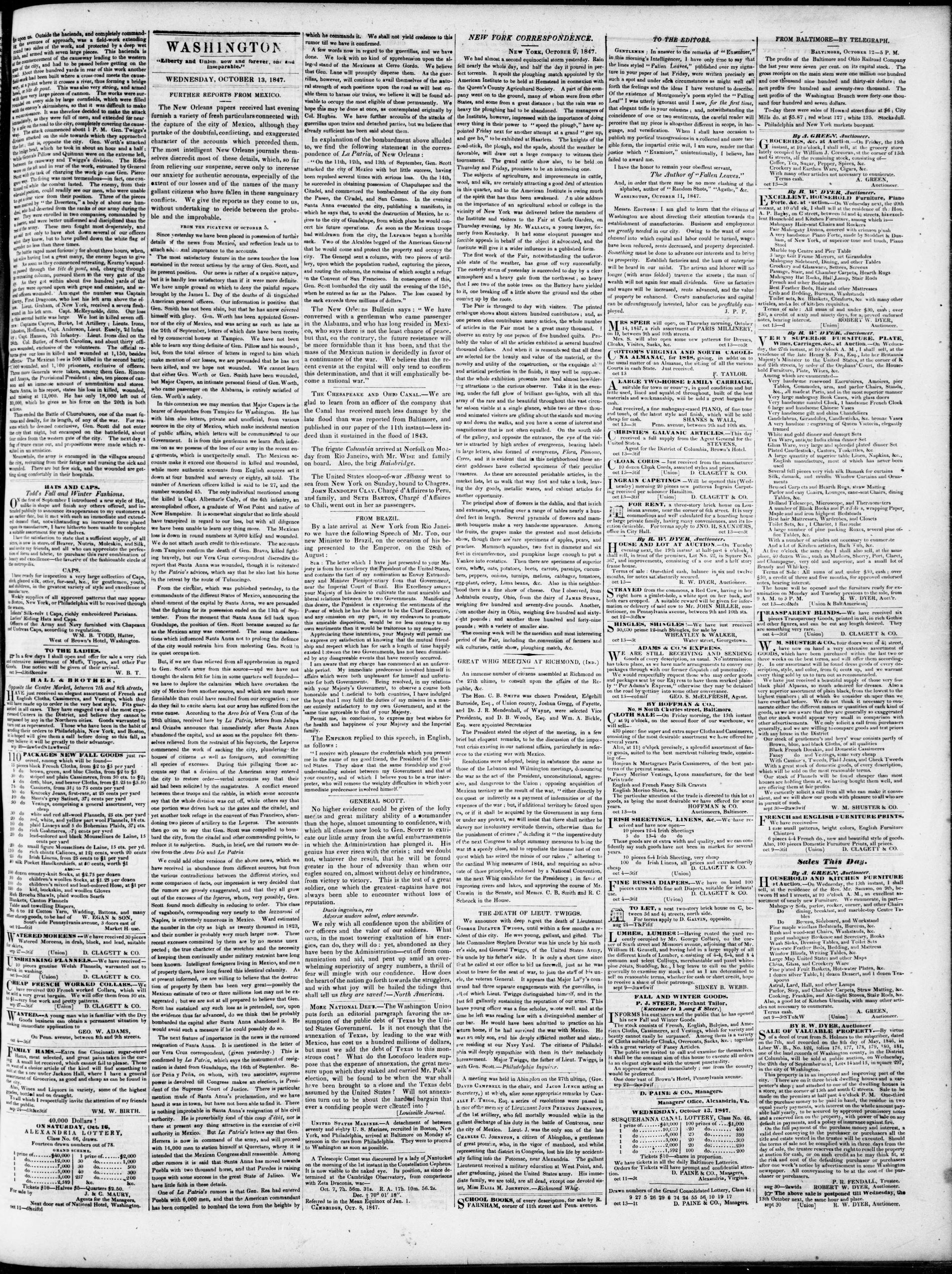
Meanwhile Gen Worth had made a demonstration on San Antonio, where the enemy was fortified in a strong hacienda, but they retired on his approach to Churubusco, where the works were deemed impregnable. They consisted of a fortified hacienda, which was surrounded by a high and thick wall on all sides. Inside the wall was a stone building, the roof of which was flat and higher than the walls. Above all this was a stone church, still higher than the rest, and having a large steeple. The wall was pierced with loop- holes, and so arranged that there were two tiers of men firing at the same time. They thus had four different ranges of men firing at once, and four ranks were formed on each range, and placed at such a height that they could not only overlook all the surrounding country, but at the same time they had a plunging fire upon us. Outside the hacienda, and completely commanding the avenues of approach, was a field-work extending around two sides of the work, and protected by a deep wet ditch, and armed with seven large pieces. This hacienda is at the commencement of the causeway leading to the western gate of the city, and had to be passed before getting on the road. About three hundred yards in rear of this work another field-work had been built, where a cross-road meets the causeway, at a point where it crosses a river, thus forming a bridge head, or tete de pont. This was also very strong, and armed with three very large pieces of cannon. The works were surrounded on every side by large cornfields, which were filled with the enemy’s skirmishers, so that it was difficult to make a reconnoissance. It was therefore decided to make the attack immediately, as they were full of men, and extended for nearly a mile on the road to the city, completely covering the causeway.
The attack commenced about 1 P. M. General Twiggs’s division attacked on the side towards which they approached the fort – that is, opposite the city. General Worth’s attacked the bridge head, which he took in about an hour and a half; while Gens. Pillow and Quitman were on the extreme left, between the causeway and Twiggs’s division. The rifles were on the left, and in the rear of the work, intrusted by Gen. Scott with the task of charging the work in case General Pierce gave way. The firing was most tremendous – in fact, one continued roll while the combat lasted. The enemy, from their elevated position, could readily see our men, who were unable to get a clear view from their position. Three of the pieces were manned by “the deserters,” a body of about one hundred, who had deserted from the ranks of our army during the war. They were enrolled in two companies, commanded by a deserter, and were better uniformed and disciplined than the rest of the. army. These men fought most desperately, and are said not only to have shot down several of our officers whom they knew, but to have pulled down the white flag of surrender no less than three times.
The battle raged most furiously for about three hours when, both sides having lost a great many, the enemy began to give way. As soon as they commenced retreating, Kearny’s squadron passed through the tete de pont and, charging through the retreating column, pursued them to the very gate of the city. As they got within about five hundred yards of the gate, they were opened upon with grape and canister, and several officers wounded. Amongst the number was Capt. Kearny, first dragoons, who lost his left arm above the elbow. Lieut. Graham, of New York, received a severe flesh-wound in his left arm. Capt. McReynolds, ditto.
Our loss in this second battle was large. We lost in killed seven officers: Captains Capron, Burke, 1st artillery; Lieuts. Irons, Johnston, Hoffman, Capt. Anderson, Lieut. Easely, 2d infantry; Capt. Hanson, 7th infantry. Lieut. Irons died on the 28th. Col. Butler, of South Carolina, and about thirty officers wounded, exclusive of the volunteers. The official returns give our loss in killed and wounded at 1,150, besides officers. The Mexican loss is 500 killed in the second battle, 1,000 wounded, and 1,100 prisoners, exclusive of officers. Three more generals were taken, among them Gen. Rincon and Anaya, the Provisional President; also ten pieces of cannon and an immense amount of ammunition and stores. Santa Anna, in his report, states his loss in killed, wounded, and missing at 12,000. He has only 18,000 left out of 30,000, which he gives as his force on the 20th in both actions. Thus ended the battle of Churubusco – one of the most furious and deadly, for its length, of any of the war. For reasons which he deemed conclusive, Gen. Scott did not enter the city that night, but encamped on the battle-field, about four miles from the western gate of the city. The next day a flag of truce came out, and propositions were made which resulted in an armistice. Meanwhile, the army is encamped in the villages around the city, recruiting from their fatigue, and nursing the sick and wounded. There are but few sick, and the wounded are getting along comfortably in their hospitals.
The same Gibbs letter – The Daily Union, Oct. 13, 1847, p. 2
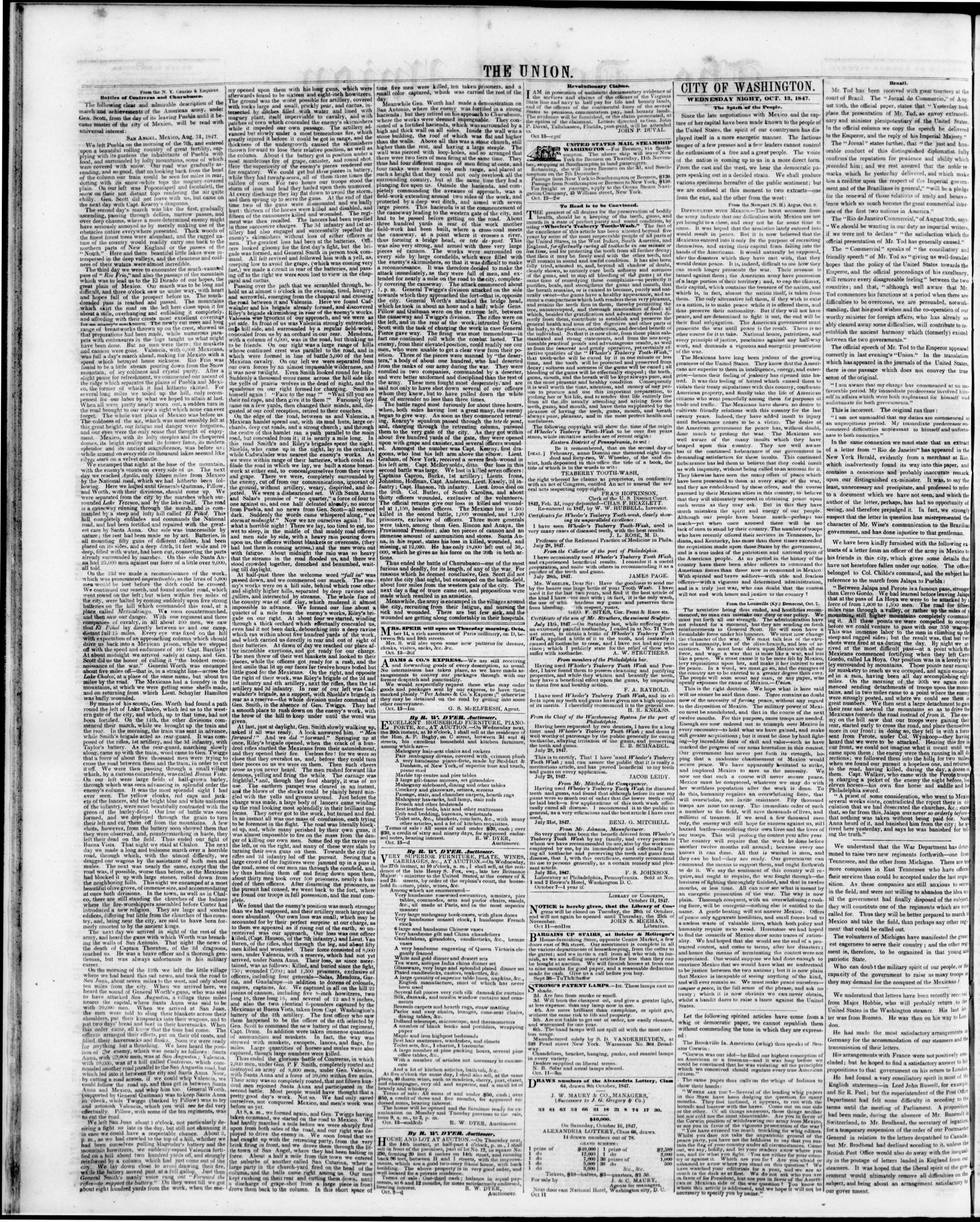
The Union printed the same letter the same day – the second of the two copies George named to Alfred a fortnight later. The text above is collated against this printing; where the Intelligencer’s type or microfilm is damaged, the Union supplied the reading. Both papers credited the New York Courier & Enquirer, where George placed the extracts; the Courier’s own issue of early October 1847 is not yet digitized anywhere and remains this archive’s open hunt.
1. THE CONFESSION. George to Alfred, Oct. 25, 1847 (Gibbs Family Papers, Reel 2, exhibited on this site): he published extracts of Alfred’s Contreras/Churubusco letter, explained his four reasons – to show Scott’s actual force; to show what Alfred’s division did, “for Kendall is chiefly Worth’s historian”; to indict the small-army policy; and “to let the friends of the officers you mentioned know of their safety or fate” – and reported it “copied by the National Intelligencer & the Union.” The letter above answers all four, and both copies exist, both of October 13.
2. THE INTERNAL EVIDENCE. The narrative speaks as Smith’s brigade of Twiggs’s division (“Smith’s brigade acted as rear guard. It was composed of the rifles…”); it names Lieut. Schuyler Hamilton’s wounding – the very passage that sent George to reassure Mrs. Hamilton, as his Oct. 25 letter records; it narrates the 400-man reconnaissance Scott honored, a Rifles operation; it stands beside Persifor Smith at the Contreras dawn – Alfred was of Smith’s military family; and it reports “Lieut. Van Buren, of the rifles, shot through the leg” – the brother officer whose death Alfred would mourn in his 1854 letter, also exhibited here.
3. THE VOICE. “Its thousand lakes seemed like silver stars on a velvet mantle” is the same eye that wrote, of a hold full of redfish seven years later, “a few square yards of a glorious sunset after a summer shower” (Wry-Full, Spirit of the Times, 1854).
4. THE HEADLINE reads “CONTREROS” in the Intelligencer’s type – preserved above as printed. The letter was published unsigned, as an officer’s letter had to be; the private correspondence on this site returns the byline to Bvt. Capt. Alfred Gibbs, Regiment of Mounted Riflemen, 179 years on.
Archival citation
Gibbs Family Papers, 1763-1918. U.S. Mss Y; Micro 1117; Photo Lots 3696-3697. Wisconsin Historical Society, Division of Library, Archives, and Museum Collections, Madison, Wis. Digitized research copy (Green collection), Reel 2. Scans Library of Congress, Chronicling America: Daily National Intelligencer (sn83026172) and The Daily Union (sn82003410), both Oct. 13, 1847; microfilm frames full page images preserved in this archive. Every page of the letter is shown above; duplicate microfilm exposures are noted in the reel index.
Suggested citation (Chicago): [Gibbs, Alfred]. “Battles of Contreras and Churubusco.” New York Courier and Enquirer, ca. Oct. 8-11, 1847; as copied in Daily National Intelligencer, Oct. 13, 1847, 2-3, and The Daily Union, Oct. 13, 1847, 2. Authorship established by George Gibbs to Alfred Gibbs, Oct. 25, 1847, Gibbs Family Papers, Wisconsin Historical Society. Accessed via AlfredGibbs.com.
Related in the Record
References
[Gibbs, A.] (1847, October 13). Battles of Contreras and Churubusco [Letter dated San Angel, August 31, 1847, from the New York Courier and Enquirer]. Daily National Intelligencer, pp. 2-3. https://www.loc.gov/resource/sn83026172/1847-10-13/ed-1/
[Gibbs, A.] (1847, October 13). [Same letter]. The Daily Union, p. 2. https://www.loc.gov/resource/sn82003410/1847-10-13/ed-1/
Gibbs, G. (1847, October 25). [Letter to Alfred Gibbs]. Gibbs Family Papers, 1763-1918 (U.S. Mss Y, Micro 1117, reel 2) [Manuscript]. Wisconsin Historical Society, Madison, WI.
Accuracy review: transcription checked against the full-resolution scans, July 11, 2026. Original spelling and punctuation are preserved; editorial matter appears in square brackets and uncertain readings are marked [?] rather than guessed. Corrections are made openly; this page will be updated, never silently, if better readings are established.
Views: 12