George Gibbs to Alfred Gibbs – New York, February 8, 1848
The Gibbs Family Papers · Reel 2 · The Alfred Gibbs Correspondence · Mexico, 1847-1848
George Gibbs to Alfred Gibbs – New York, February 8, 1848
The Fremont verdict awaited, Kearny’s withheld challenge to Benton, Quitman “glorifying” Alfred – and the family news that a new nephew “is to be named Alfred.”
New York in February 1848 waits on two verdicts – Fremont’s court-martial and the rumored Trist treaty – and George Gibbs writes his brother the city’s whole conversation. The lieutenant colonel of Alfred’s own regiment dominates the news: the finding “not yet announced,” a report that Fremont “will be made Governor of California,” and the astonishing intelligence that “Gen Kearny it is understood had written a challenge to Benton but was persuaded to withhold it, & Benton has promised his wife not to fight.” A duel between the conqueror of New Mexico and the most powerful man in the Senate, stopped in the writing. Around it: Gen. Quitman feted at the Broadway theatre and “glorifying” Alfred to the Kean connection, Phil Kearny “eloquent in your praise” at the DePeysters’ dinner, Kit Carson’s appointment rejected by the Senate on the principle that a deserving officer “deserved his regular promotion,” Taylor’s “peppery” letter against General Order No. 21 – and, softly in the middle of it all, Eliza’s new baby: “The new one I hear is to be named Alfred.”
❦The Letter
Page 1 (scan 1342)
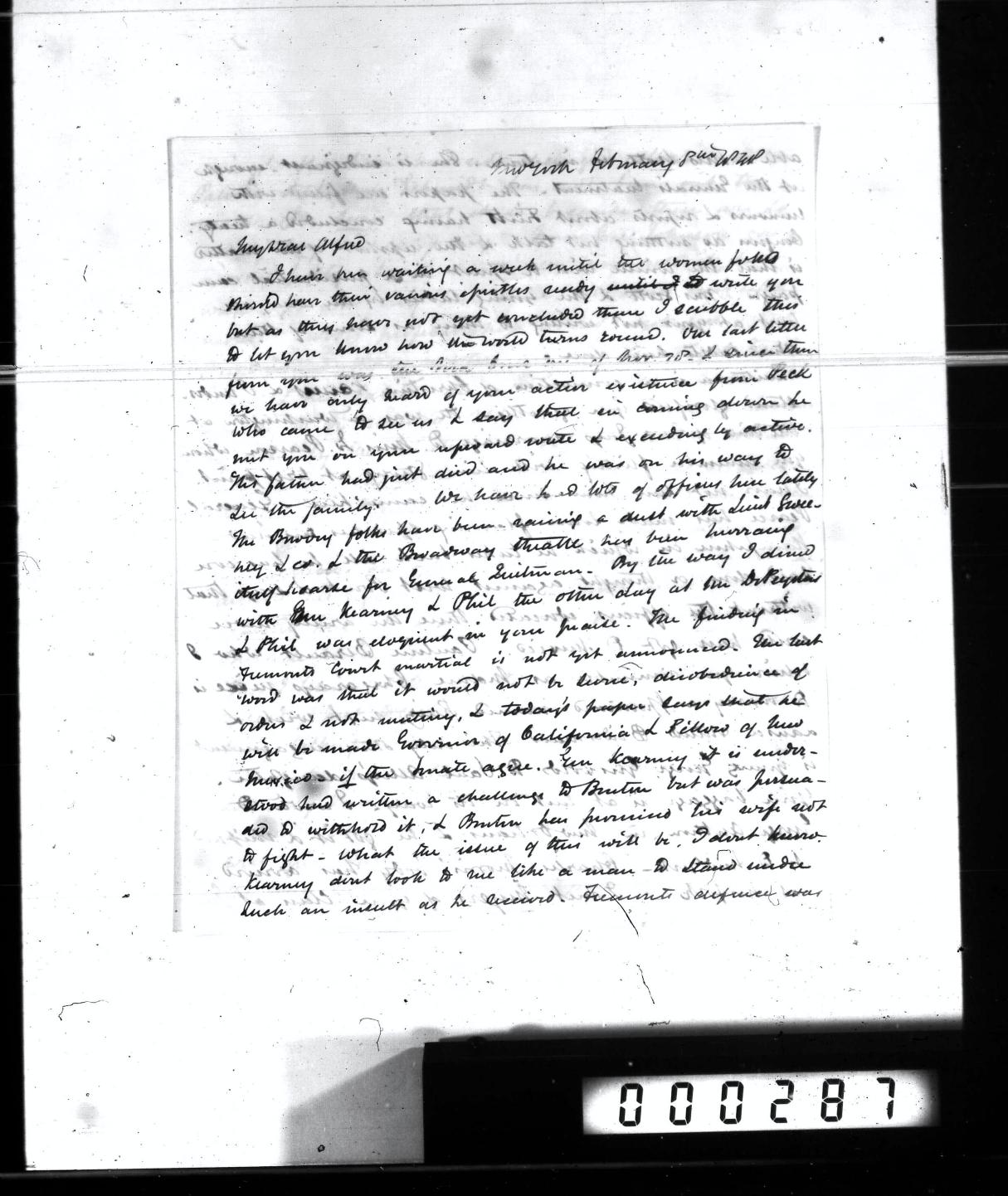
NewYork February 8th 1848
My Dear Alfred
I have been waiting a week until the women folks should have their various epistles ready [struck out: until I] to write you but as they have not yet concluded them I scribble this to let you know how the world turns round. Our last letter from you was [illegible] [illegible] [illegible] of Nov 28 [?] & since then we have only heard of your active existence from Peck [?] who came to see us & says that in coming down he met you on your upward route & exceedingly active. His father had just died and he was on his way to see the family. We have had lots of officers here lately The Bowery folks have been raising a dust with Lieut Swee-ney & co. & the Broadway theatre has been hurraing itself hoarse for General Quitman – By the way I dined with Gen Kearny & Phil the other day at Mr DePeysters & Phil was eloquent in your praise. The finding in Fremonts Court martial is not yet announced. The last word was that it would not be heavy [?], disobedience of orders & not mutiny, & todays paper says that he will be made Governor of California & Pillow [?] of New Mexico – if the Senate agree. Gen Kearny it is understood had written a challenge to Benton but was persua-ded to withhold it, & Benton has promised his wife not to fight – what the issue of this will be, I dont know. Kearny dont look to me like a man to stand under such an insult as he received. Fremonts defence was
Page 2 (scan 1343)
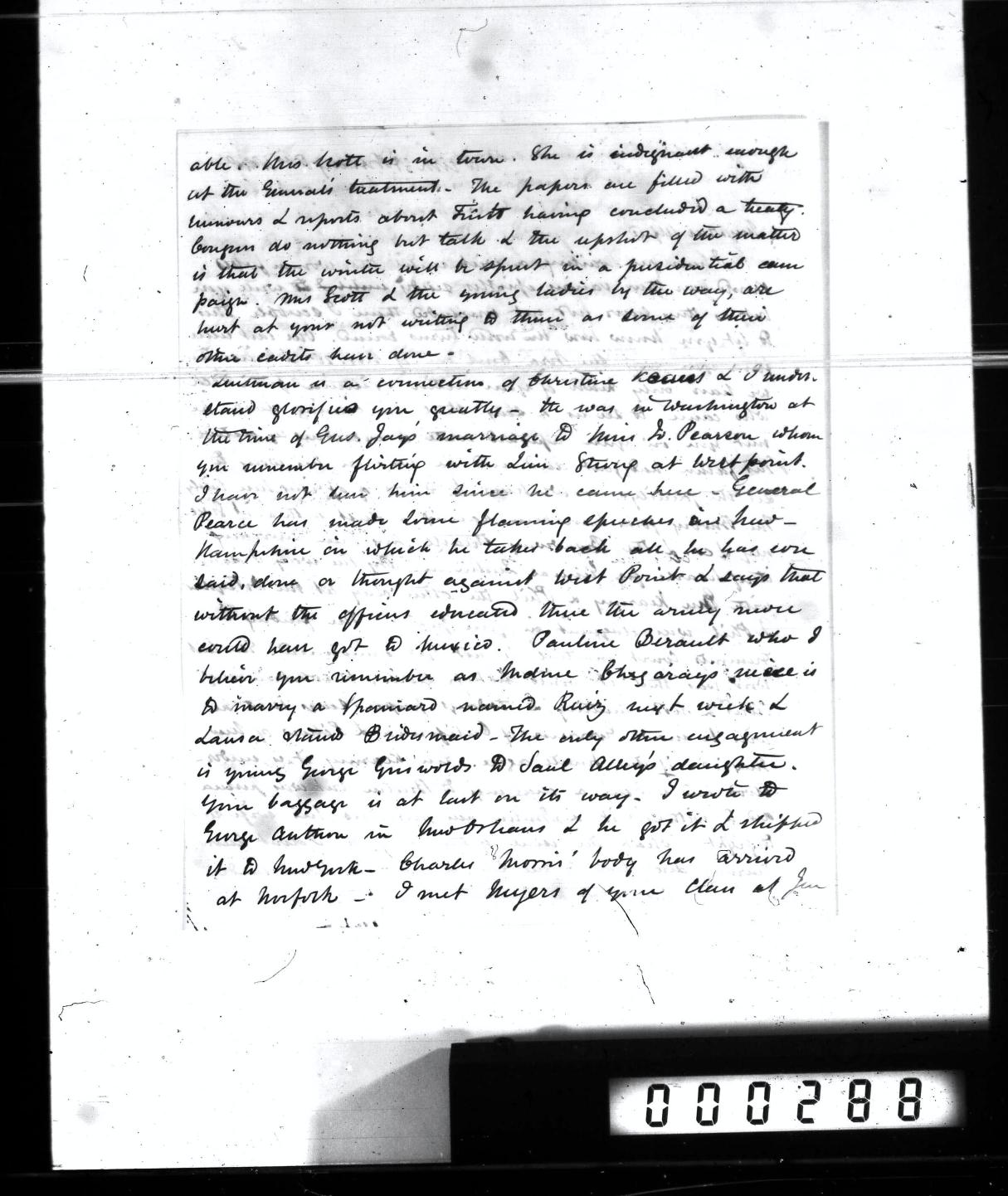
able. Mrs Scott is in town. She is indignant enough at the Generals treatment – The papers are filled with rumours & reports about Trist having concluded a treaty [underlined?]. Congress do nothing but talk & the upshot of the matter is that the winter will be spent in a presidential cam-paign. Mrs Scott & the young ladies by the way, are hurt at your not writing to them as some of their other cadets have done –
Quitman is a connection of Christine Kean’s [?] [word overwritten and blotted] & I under-stand glorifies you greatly – He was in Washington at the time of Gus. Jay’s marriage to Miss D. Pearson whom you remember flirting with Lieut [?] Strong at West point. I have not seen him since he came here – General Pearce has made some flaming speeches in New-Hampshire in which he takes back all he has ever said, done or thought against West Point & says that without the officers educated there the army never could have got to Mexico. Pauline Berault who I believe you remember as Mdme Chegaray’s niece is to marry a Spaniard named Ruiz next week & Laura stands Bridesmaid – The only other engagement is young George Griswolds to Saul Alley’s daughter. Your baggage is at last on its way. I wrote to George Anthon in New Orleans & he got it & shipped it to New York – Charles Morris’ body has arrived at Norfolk – I met Myers of your class at Jen
Page 3 (scan 1344)
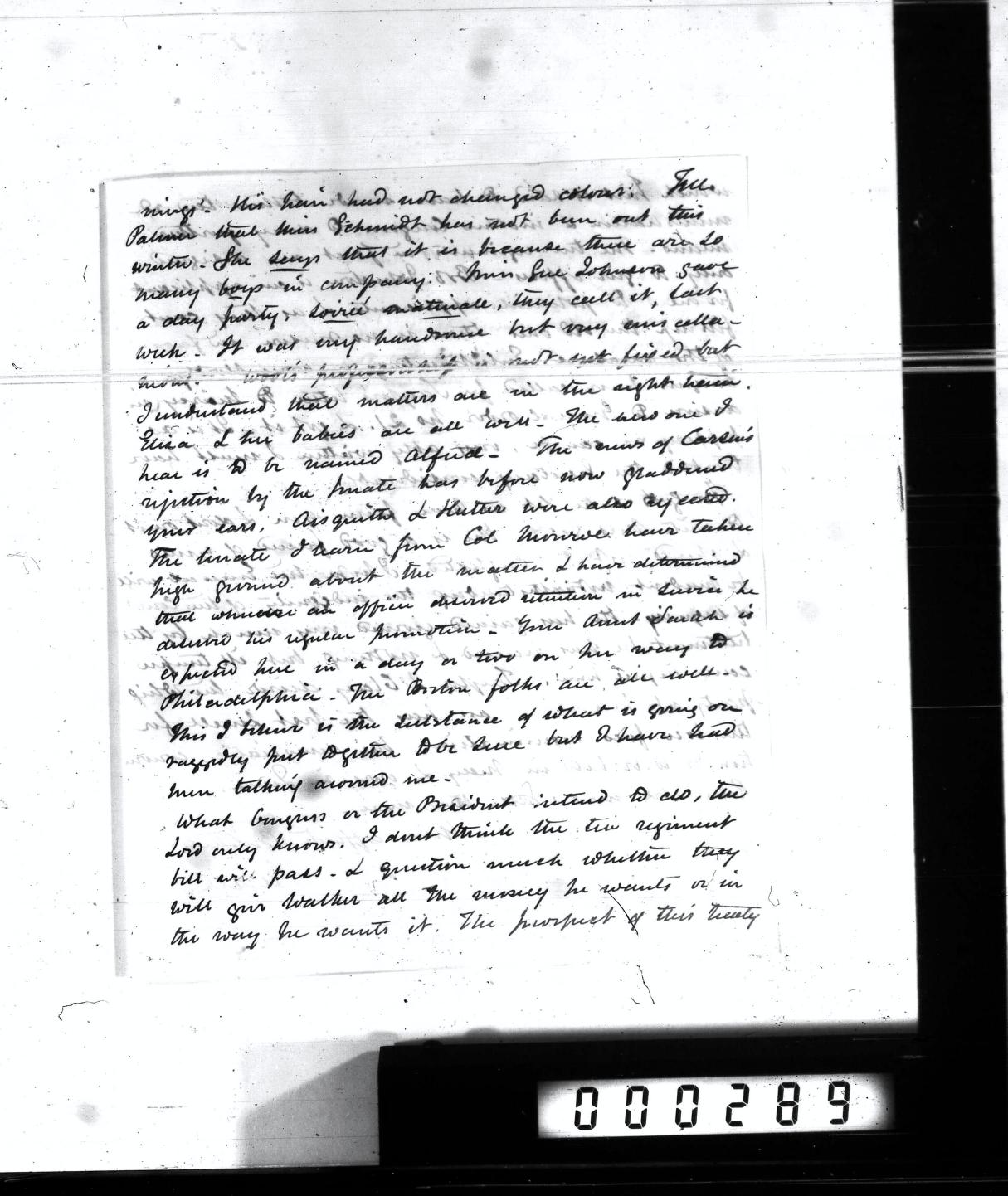
nings. His hair had not changed colour. Tell Palmer that Miss Schmidt has not been out this winter. She says [underlined] that it is because there are so many boys in company. Miss Sue Johnson gave a day party, soiree matinale [underlined], they call it, last week. It was very handsome but very miscella-neous [?]. Wool’s [?] professorship is not yet filled but I understand that matters are in the right train [?]. Eliza & her babies are all well – The new one I hear is to be named Alfred – The news of Carson’s rejection by the Senate has before now gladdened your ears, Aisquith & Hutter were also rejected. The Senate I learn from Col Monroe have taken high ground about the matter & have determined that whenever an officer deserved retention [?] in service he deserved his regular promotion – Your Aunt Sarah is expected here in a day or two on her way to Philadelphia. The Boston folks are all well. – This I think is the substance of what is going on raggedly put together to be sure but I have had men talking around me –
What Congress or the President intend to do, the Lord only knows. I dont think the ten regiment bill will pass. & question much whether they will give Walker all the money he wants or in the way he wants it. The prospect of this treaty
Page 4 (scan 1345)
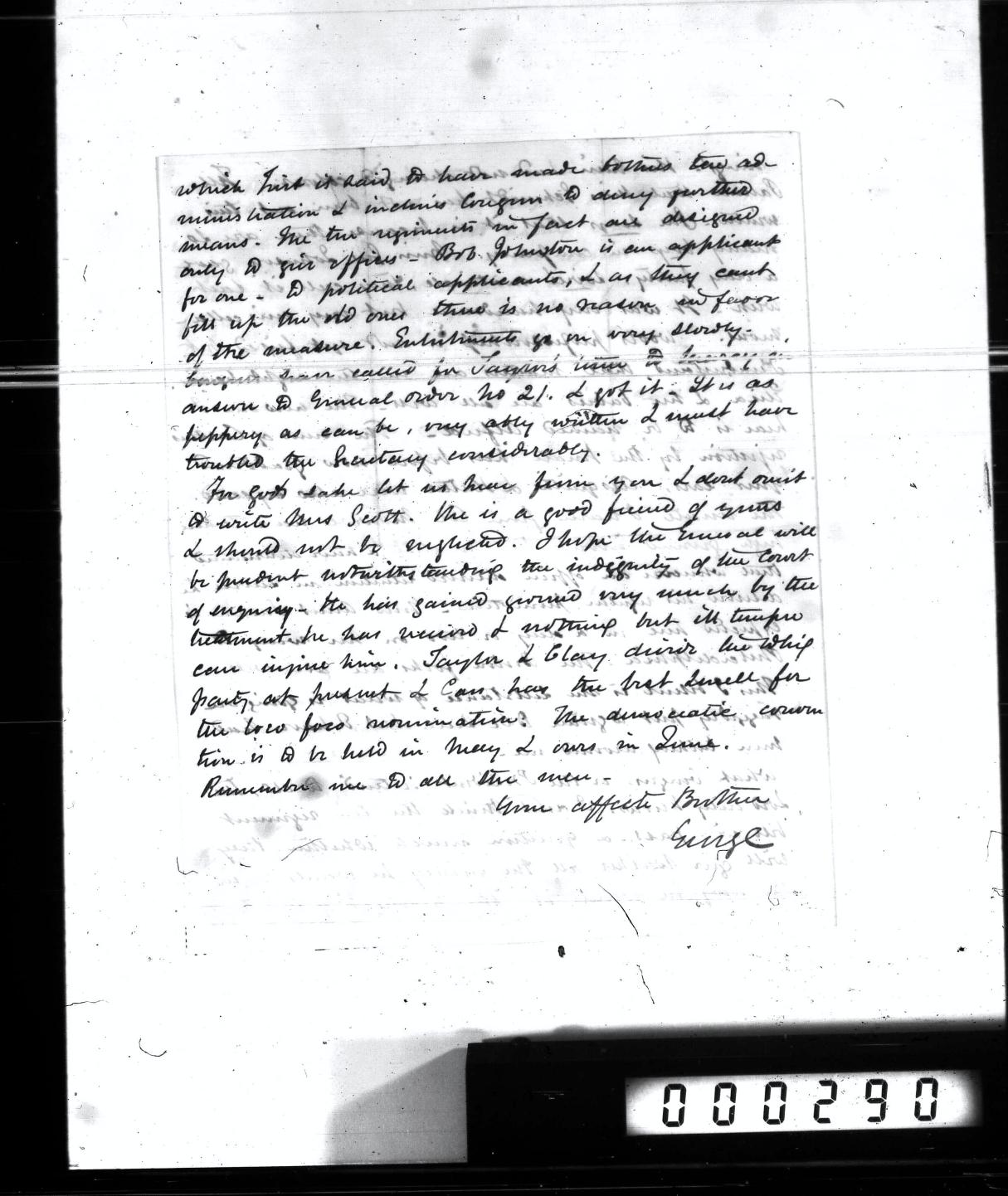
which Trist is said to have made bothers [?] the ad-ministration & inclines Congress to deny further means. The ten regiments in fact are designed only to give offices – Bob Johnston is an applicant for one – to political applicants, & as they cant fill up the old ones there is no reason in favor of the measure. Enlistments go on very slowly – Congress [?] have called for Taylors’ letter [?] in [?] answer to General order No 21. & got it – It is as peppery as can be, very ably written & must have troubled the Secretary considerably.
For gods sake let us hear from you & dont omit to write Mrs Scott. She is a good friend of yours & should not be neglected. I hope the General will be prudent notwithstanding the indignity of the Court of enquiry – He has gained ground very much by the treatment he has received & nothing but ill temper can injure him. Taylor & Clay divide the Whig party at present & Cass has the best smell [?] for the loco foco nomination. The democratic conven-tion is to be held in May & ours in June.
Remember me to all the men –
Your affecte Brother
George
1. The Carson-rejection passage completes the story George opened in December 1847: the Senate’s stand – regular promotion for deserving officers over outside appointments – was the very principle the family was arguing in Alfred’s brevet case.
2. The Kearny-Benton withheld challenge is reported here as New York understood it in real time, weeks after the court-martial’s close – a period source for one of the war’s famous feuds.
3. “General Pearce” making “flaming speeches in New-Hampshire” taking back all he ever said against West Point is Franklin Pierce, the future president; George’s spelling is preserved.
4. The namesake nephew is Eliza Tuckerman’s son Alfred – the first of the family’s Alfreds named for the soldier then in Mexico City.
Archival citation
Gibbs Family Papers, 1763-1918. U.S. Mss Y; Micro 1117; Photo Lots 3696-3697. Wisconsin Historical Society, Division of Library, Archives, and Museum Collections, Madison, Wis. Digitized research copy (Green collection), Reel 2. Scans 1342-1345 (microfilm frames 000287-000290); microfilm frames 000287-000290. Every page of the letter is shown above; duplicate microfilm exposures are noted in the reel index.
Suggested citation (Chicago): George Gibbs to Alfred Gibbs, February 8, 1848. Gibbs Family Papers, 1763-1918, U.S. Mss Y, Micro 1117, reel 2. Wisconsin Historical Society, Madison, WI. Accessed via AlfredGibbs.com.
Related in the Record
References
Gibbs, G.. (1848, February 8). [Letter to Alfred Gibbs]. Gibbs Family Papers, 1763-1918 (U.S. Mss Y, Micro 1117, reel 2) [Manuscript]. Wisconsin Historical Society, Madison, WI.
Gibbs family. (1763-1918). Gibbs Family Papers (U.S. Mss Y; Micro 1117; Photo Lots 3696-3697) [Manuscript collection]. Wisconsin Historical Society, Madison, WI.
Accuracy review: transcription checked against the full-resolution scans, July 11, 2026. Original spelling and punctuation are preserved; editorial matter appears in square brackets and uncertain readings are marked [?] rather than guessed. Corrections are made openly; this page will be updated, never silently, if better readings are established.
Views: 9