“Honor to Whom Honor Is Due”: Alfred Gibbs’s Stuart Letter, 1848
The Alfred Gibbs Letters · Written by Alfred Gibbs · Signed “Two and Two Make Four” · Identified July 2026
“Honor to Whom Honor Is Due”: Alfred Gibbs’s Stuart Letter, 1848
Alfred Gibbs wrote this letter under the pen name “Two and two make four”: from the occupied City of Mexico, an eyewitness corrects his own major in print – the first man over the breastwork at the Garita de Belen was Lt. James Stuart of the Rifles.
On June 7, 1848, George Gibbs told Alfred: “Your letter about Stuart only arrived here and was published a few days ago – It was perfectly proper but I doubt if your friend Loring will much like it.” This page is that letter, found in the South Carolina press, which reprinted it because its hero was a Charleston man. Writing from the City of Mexico on April 10, 1848, over the arithmetic pen name “Two and two make four,” the correspondent answers a published claim from a private letter of Major Loring of his own regiment – and does it with an eyewitness’s quiet devastation: Loring “could not have seen” who was first at the Garita de Belen, having been “wounded 300 yards from the Garita, and immediately carried to the rear.” The first man over the breastwork and into the City of Mexico on September 13, 1847, he testifies, was Lt. James Stuart of the Mounted Rifles, “as gallant a fellow as breathes.” George called it perfectly proper, and it is – the letter takes nothing from Gen. Quitman it can verify, and gives Stuart only what the army “never pretended to be denied.” Kendall’s correspondent confirmed it. The writer stood at that gate himself: Alfred Gibbs was brevetted captain for the Garita de Belen.
Who wrote this · the attribution
Bvt. Capt. Alfred Gibbs, Regiment of Mounted Riflemen, writing from the occupied City of Mexico over the pen name “Two and two make four.”
1. His brother names the letter. George Gibbs to Alfred, June 7, 1848 (exhibited here): “Your letter about Stuart only arrived here and was published a few days ago – It was perfectly proper but I doubt if your friend Loring will much like it.”
2. Every particular matches. Same paper (the Courier & Enquirer), same date window (published in New York days before June 7), same subject (Stuart), and the one detail George could not have invented: the letter publicly corrects Maj. Loring – the thing Loring “will not much like.”
3. The writer stood at that gate. The letter claims eyewitness knowledge of who was first over the breastwork at the Garita de Belen; Alfred Gibbs was brevetted captain for that very assault.
The Letter
Edgefield Advertiser, June 14, 1848, p. 2 – complete item
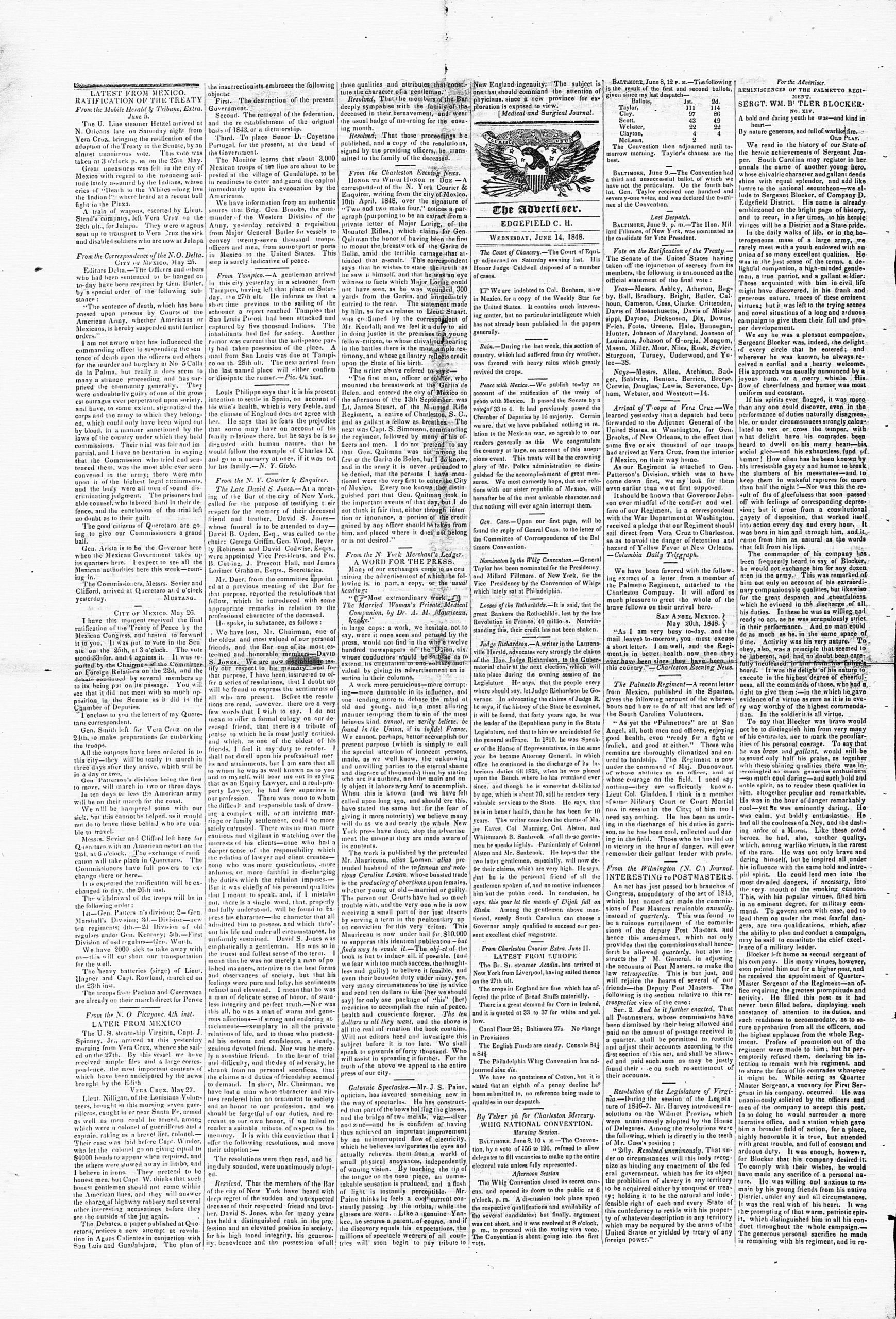
From the Charleston Evening News.
HONOR TO WHOM HONOR IS DUE.
A correspondent of the N. York Courier & Enquirer, writing from the city of Mexico, 10th April, 1848, over the signature of “Two and two make four,” notices a paragraph (purporting to be an extract from a private letter of Major Loring, of the Mounted Rifles,) which claims for Gen. Quitman the honor of having been the first to mount the breastwork of the Garita de Belen, amid the terrible carnage that attended that assault. This correspondent says that he wishes to state the truth as he saw it himself, and that he was an eye witness to facts which Major Loring could not have seen, as he was wounded 300 yards from the Garita, and immediately carried to the rear. The statement made by him, so far as relates to Lieut. Stuart, was confirmed by the correspondent of Mr. Kendall; and we feel it a duty to aid in doing justice in the premises to a young fellow-citizen, to whose chivalrous bearing in the battles there is the most ample testimony, and whose gallantry reflects credit upon the State of his birth. The writer above referred to says:
“The first man, officer or soldier, who mounted the breastwork at the Garita de Belen, and entered the city of Mexico on the afternoon of the 13th September, was Lt. James Stuart, of the Mounted Rifle Regiment, a native of Charleston, S. C., and as gallant a fellow as breathes. The next was Capt. S. Simonson [?], commanding the regiment, followed by many of his officers and men. I do not pretend to say that Gen. Quitman was not among the first at the Garita de Belen, but I do know, and in the army it is never pretended to be denied, that the persons I have mentioned were the very first to enter the City of Mexico. Every one knows the distinguished part that Gen. Quitman took in the important events of that day, but I do not think it fair that, either through inattention or ignorance, a portion of the credit gained by any officer should be taken from him, and placed where it does not belong or is not desired.”
1. THE PROOF. Every particular of George’s June 7, 1848 letter (exhibited on this site) fits: the timing (“published a few days ago” in New York = early June; this South Carolina reprint follows on June 14); the venue (the N.Y. Courier & Enquirer, the same paper that carried Alfred’s 1847 battle letter); the subject (Stuart); the propriety George praised; and the sting Loring would not like – which George predicted before the reprint reached him. George’s winter 1848 dispatch, also exhibited, pairs “You and Stuart” as the regiment’s recommended men.
2. THE PEN NAME. “Two and two make four” – a statement of plain fact as a signature, by the same officer who signed his sporting letters “Wry-Full.” The General liked a pun with an argument in it.
3. THE PEOPLE. Lt. James Stuart of South Carolina, Mounted Rifles, twice brevetted in Mexico, was killed by an arrow on the Rogue River, Oregon, in 1851 – three years after this defense of his honor. “Capt. S. Simonson” as printed is Capt. John S. Simonson, then commanding the regiment at the garita; Maj. W. W. Loring, the regiment’s wounded major, lost his arm at the Belen gate and later commanded the regiment. The original Courier & Enquirer printing and the Loring paragraph it answers remain open hunts.
Archival citation
Gibbs Family Papers, 1763-1918. U.S. Mss Y; Micro 1117; Photo Lots 3696-3697. Wisconsin Historical Society, Division of Library, Archives, and Museum Collections, Madison, Wis. Digitized research copy (Green collection), Reel 2. Scans Library of Congress, Chronicling America: Edgefield Advertiser (sn84026897), June 14, 1848; microfilm frames full page image preserved in this archive. Every page of the letter is shown above; duplicate microfilm exposures are noted in the reel index.
Suggested citation (Chicago): [Gibbs, Alfred] “Two and two make four.” Letter from the City of Mexico, April 10, 1848, New York Courier and Enquirer, ca. early June 1848; as quoted in “Honor to Whom Honor Is Due,” Charleston Evening News, reprinted Edgefield Advertiser, June 14, 1848, 2. Authorship established by George Gibbs to Alfred Gibbs, June 7, 1848, Gibbs Family Papers, Wisconsin Historical Society. Accessed via AlfredGibbs.com.
Related in the Record
References
[Gibbs, A.] “Two and two make four.” (1848, June 14). Honor to whom honor is due [Charleston Evening News item quoting the letter of April 10, 1848]. Edgefield Advertiser, p. 2. https://www.loc.gov/resource/sn84026897/1848-06-14/ed-1/
Gibbs, G. (1848, June 7). [Letter to Alfred Gibbs]. Gibbs Family Papers, 1763-1918 (U.S. Mss Y, Micro 1117, reel 2) [Manuscript]. Wisconsin Historical Society, Madison, WI.
Accuracy review: transcription checked against the full-resolution scans, July 11, 2026. Original spelling and punctuation are preserved; editorial matter appears in square brackets and uncertain readings are marked [?] rather than guessed. Corrections are made openly; this page will be updated, never silently, if better readings are established.
Views: 4