The George Gibbs Archive
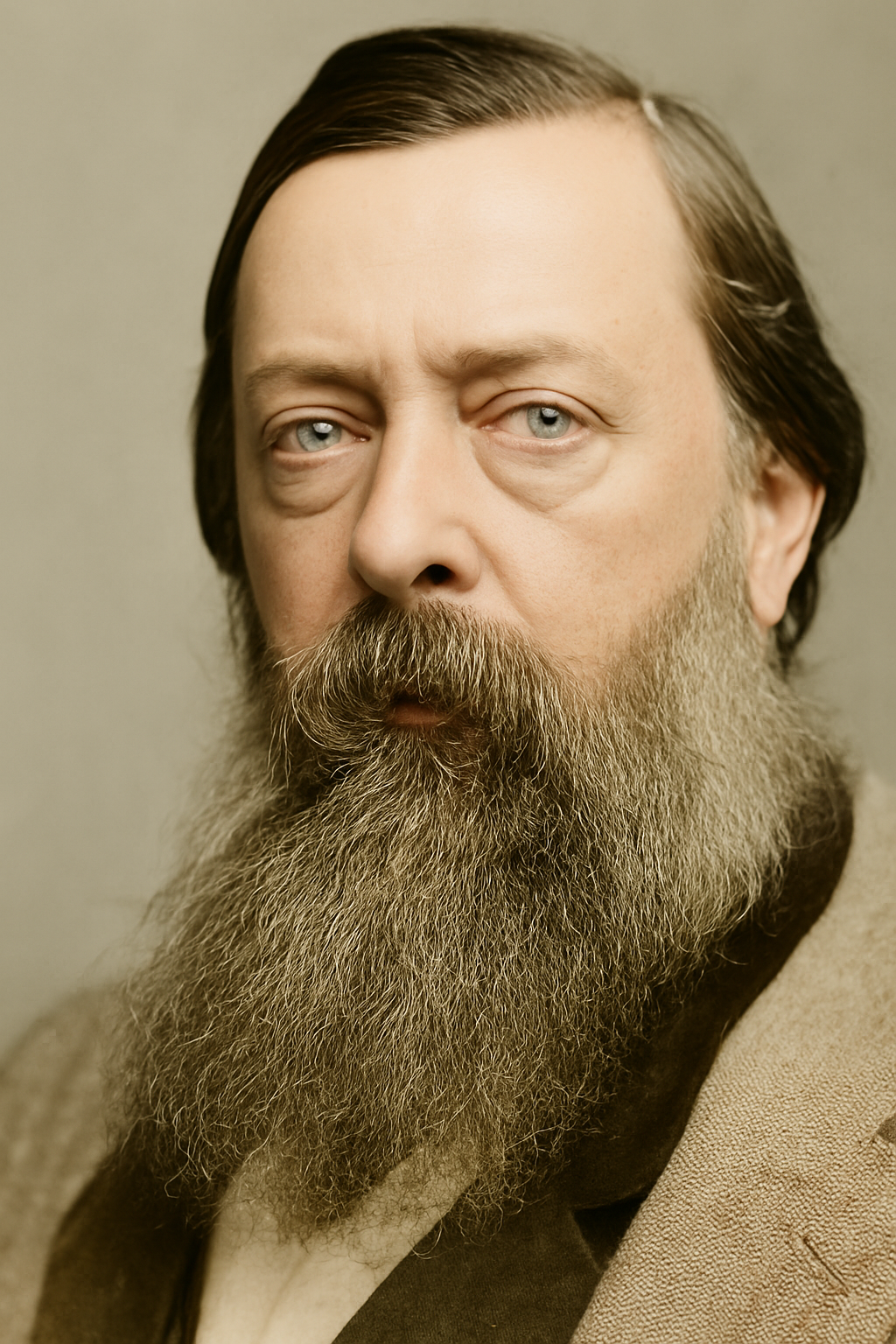
A Person Hub of the Gibbs Archive · Eldest brother of the General
George Gibbs IV
1815 – 1873
Lawyer, historian, forty niner, ethnologist, and his brother’s fiercest advocate. He wrote more than anyone else in this family, and this hub is about to grow: a major body of his papers is now entering the archive.
This page is the archival home for George Gibbs IV. As the scanning and cataloguing of the family’s papers continues, every document in this archive that touches George is indexed here: first the holdings themselves, then the pages built from them, then the open questions still being hunted. Expect this hub to grow.
IIn This Archive
What we hold on George Gibbs IV today, and where each piece is exhibited.

His letters to Alfred, 1847-1852 – nine documents, fully transcribed
The brother’s side of the General’s file, every page shown with complete transcription: Oct. 25, 1847 (‘All West Point was in a blaze at the letter as I published it’), Dec. 20, 1847, two winter 1848 dispatches, Feb. 8, Feb. 23, June 7 (Scott: ‘he did not leave a more gallant officer behind him’), July 3, July 18, 1848 (the Persifor Smith cover), and the nine-page Astoria letter of Dec. 22, 1852 (the temperance pledge; the Rifle Regiment journal promised). Part of The Alfred Gibbs Letters correspondence file.
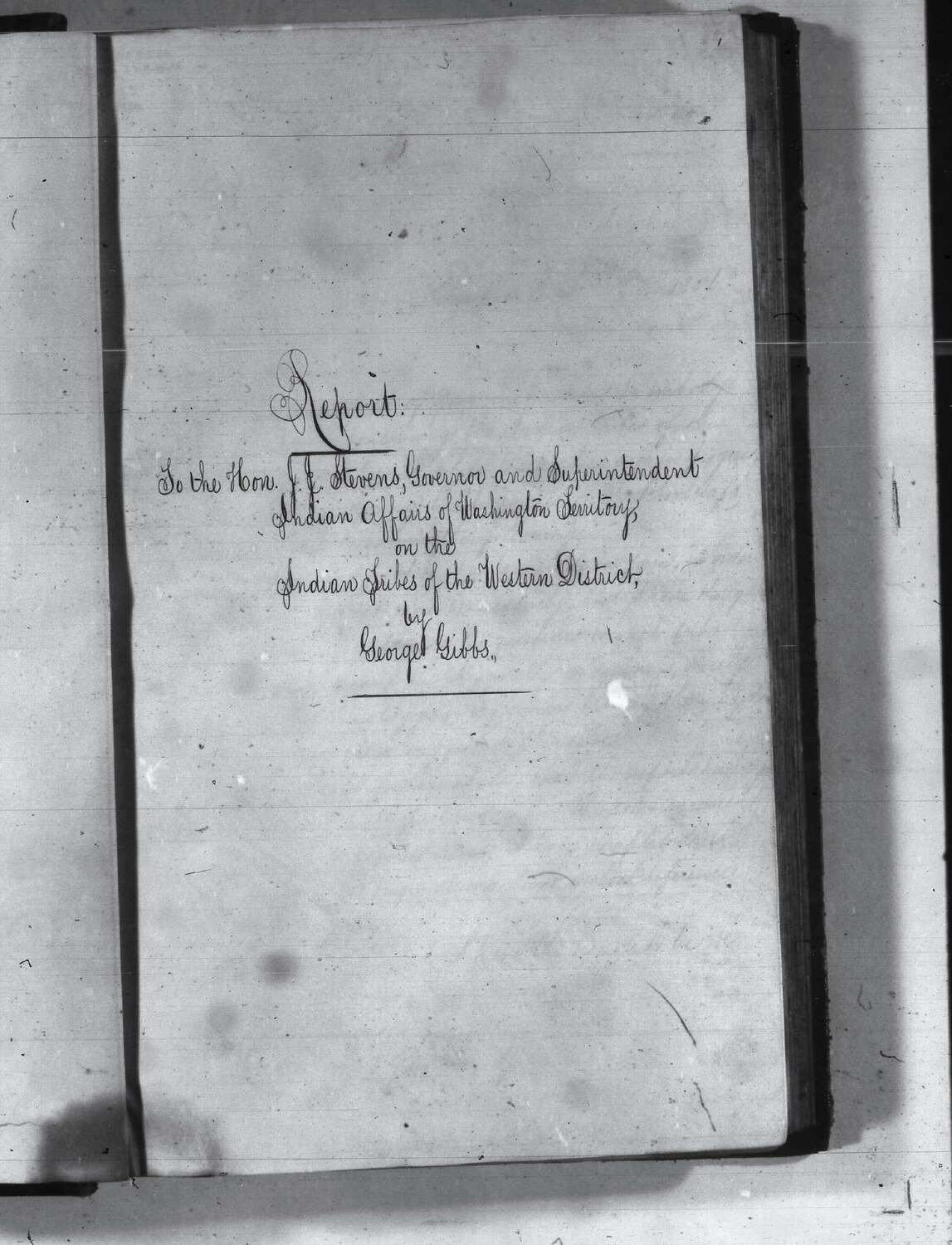
The Indian Tribes of the Western District, 1856
His landmark ethnography of Washington Territory, reported to Gov. Stevens from Olympia – the tribes, the mythology, and the tales taken from named Native informants. Four pages shown in full, the whole catalogued, with its 1877 (Powell) and 1950s (Ella Clark) publication history. Read the exhibit →
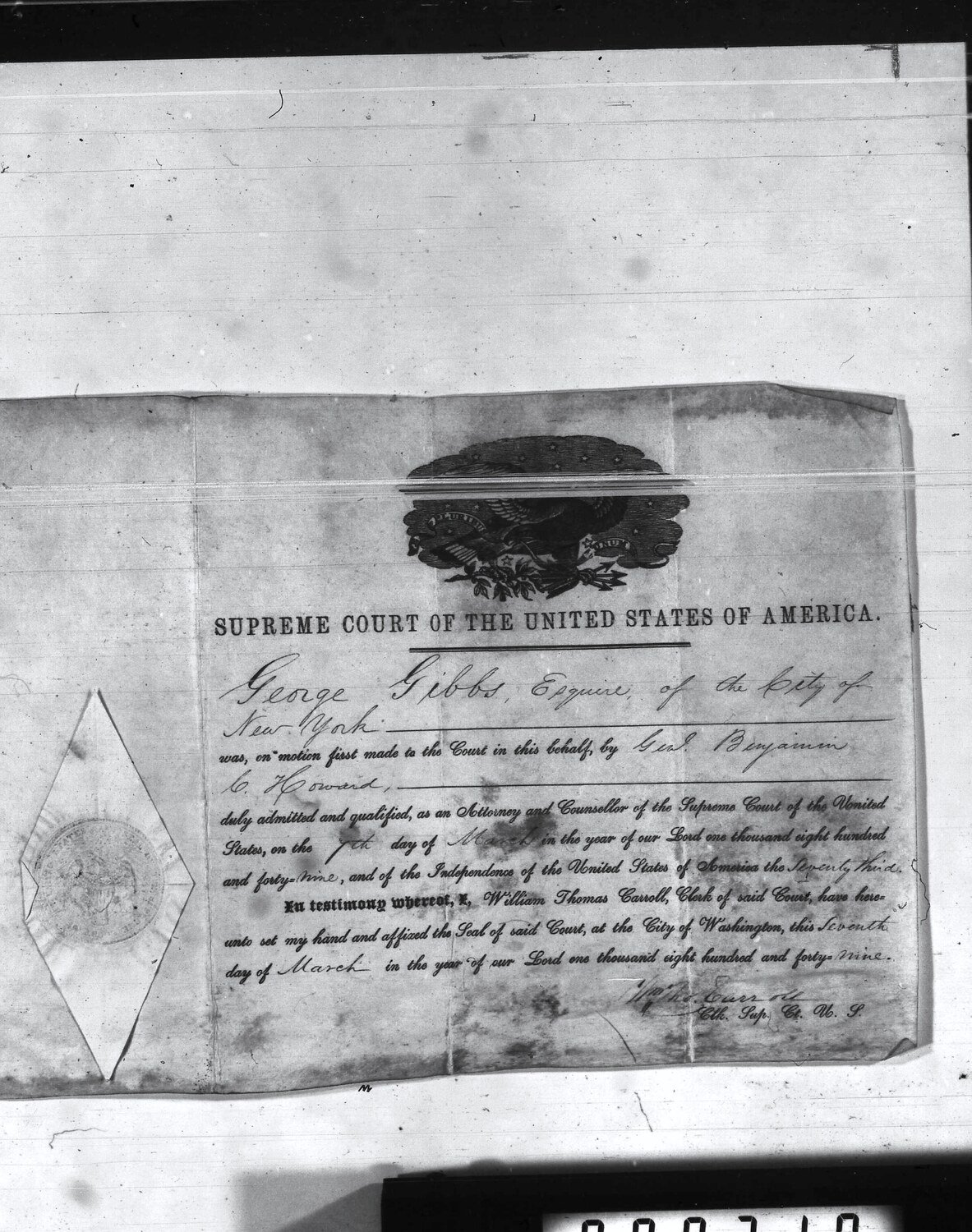
Setting his affairs in order: before Oregon, 1849
Three pages of memoranda in his own hand – the Wolcott plate and bust, the unfinished volumes, the maps, the rents, and his letters left “to Alfred’s care” – with his U.S. Supreme Court admission certificate of March 7, 1849, on the eve of the Mounted Riflemen march. Read the documents →
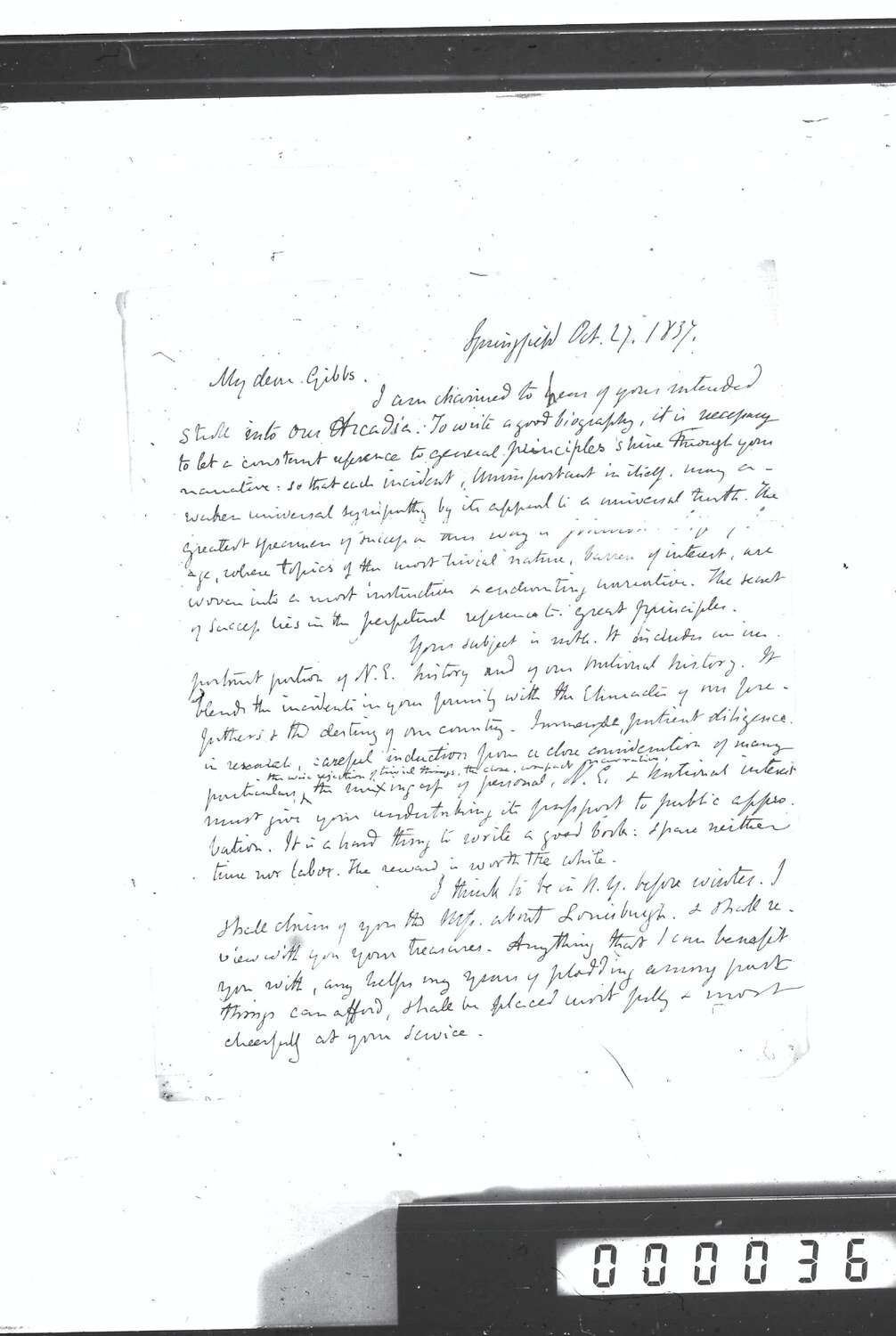
George Bancroft to George Gibbs, 1837 & 1840
The most celebrated historian in America on how to write a good book – “Spare neither time nor labor” – and borrowing Gibbs’s manuscripts for his chapter on the Louisbourg expedition, as Gibbs edited the Wolcott Memoirs. Read the letters →
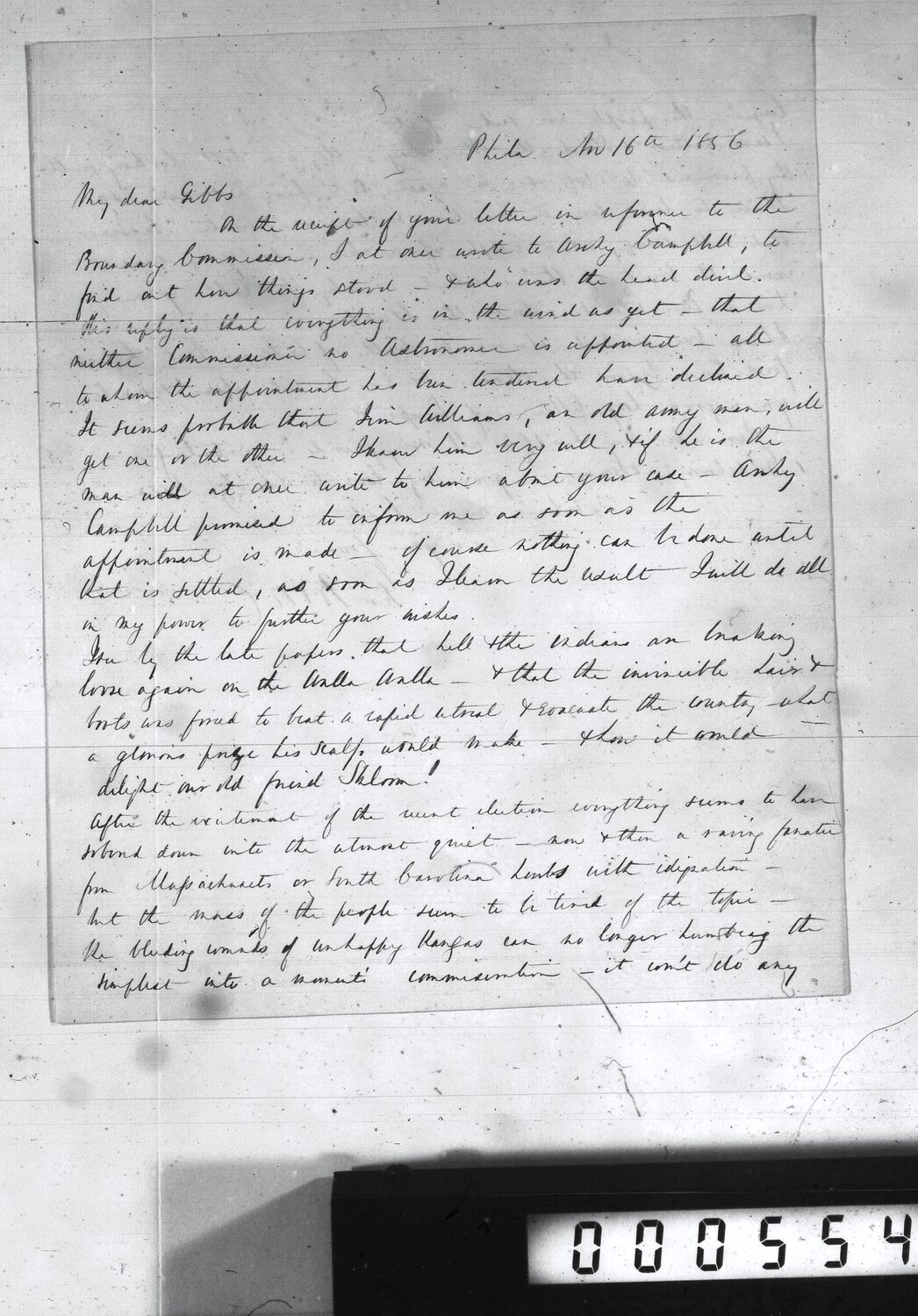
George B. McClellan to George Gibbs, 1856
Five years before he commanded the Army of the Potomac, young Captain McClellan writes “my dear Gibbs” about the Northwest Boundary Commission, the Walla Walla outbreak and their “old friend Skloom,” and a country weary of bleeding Kansas. Read the letter →
His own voice, 1850-1854
The collection already transcribed on this site, page by page, from the Oregon Historical Quarterly publication (the original 1953 article is held here as a PDF): to Wolcott, June 26, 1850; to his mother from Mt. Shasta, Oct. 23, 1851; Forks of the Salmon, July 17, 1852; to J. Austin Stevens Jr., Sept. 4, 1852; Gullion’s Bar, Oct. 8, 1852; Astoria, Dec. 19, 1852; Dec. 22, 1852; Portland, Dec. 31, 1852; Jan. 20, 1853; Feb. 15, 1853; March 4, 1853; to ALFRED, Fort Vancouver, March 18, 1853; April 13, 1853; April 29, 1853; May 10, 1853; May 23, 1853; Masouruk, May 25, 1853; June 14, 1853; and to Dr. John Torrey, Dec. 12, 1854. The full dated index lives on the biography page.
The schoolboy and the law student
All exhibited in full on this page, below: the 1827 composition On Death and future punishment (scans 659-661), the Round Hill Plutarch letter (771, 775), and the first-weeks-at-Harvard-Law letter (889-891). George Bancroft’s Round Hill prospectus (scan 506) is exhibited on his father’s page; see also the Round Hill School and the Prescott Hall law office where he trained.
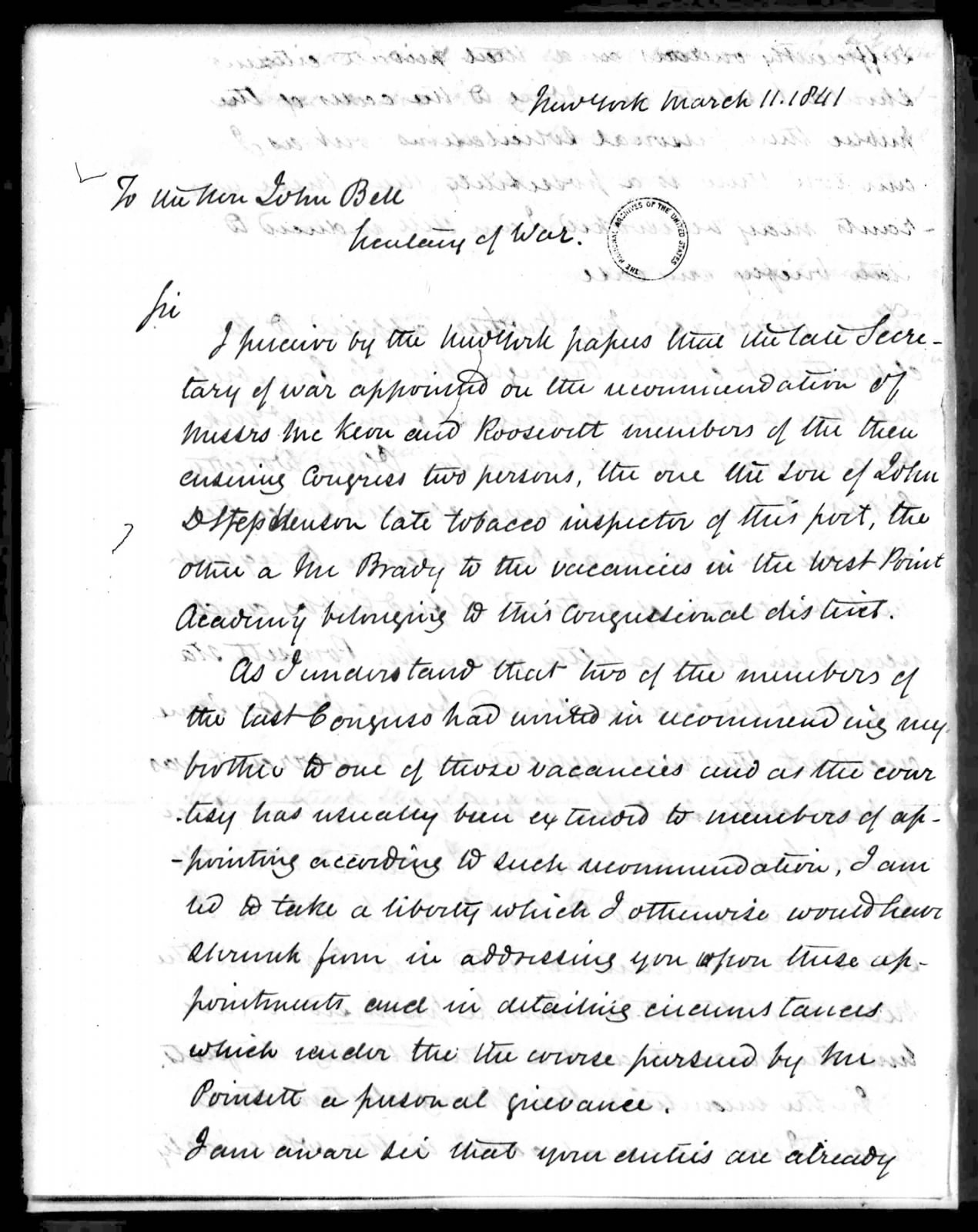
The brother’s war, 1839-1841
His letters fighting the revoked warrant: the substitution request, and the great lineage letter to Secretary Bell, “I cannot view with indifference a war upon women or boys.” Exhibited in The Cadet File.
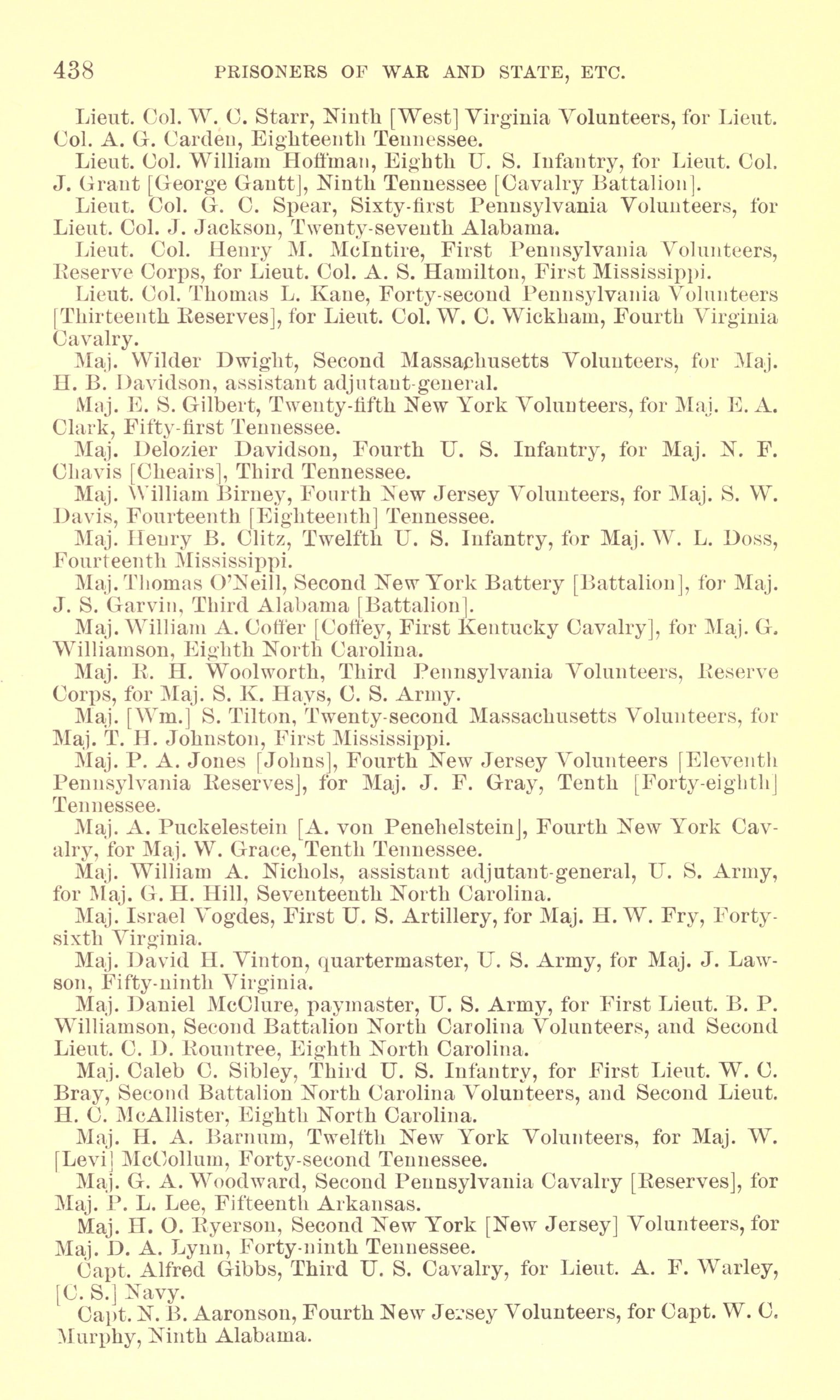
The 1862 exchange correspondence
The documented campaign that freed Alfred from parole limbo in 1862, traced through the Official Records on the Parole & Exchange page.
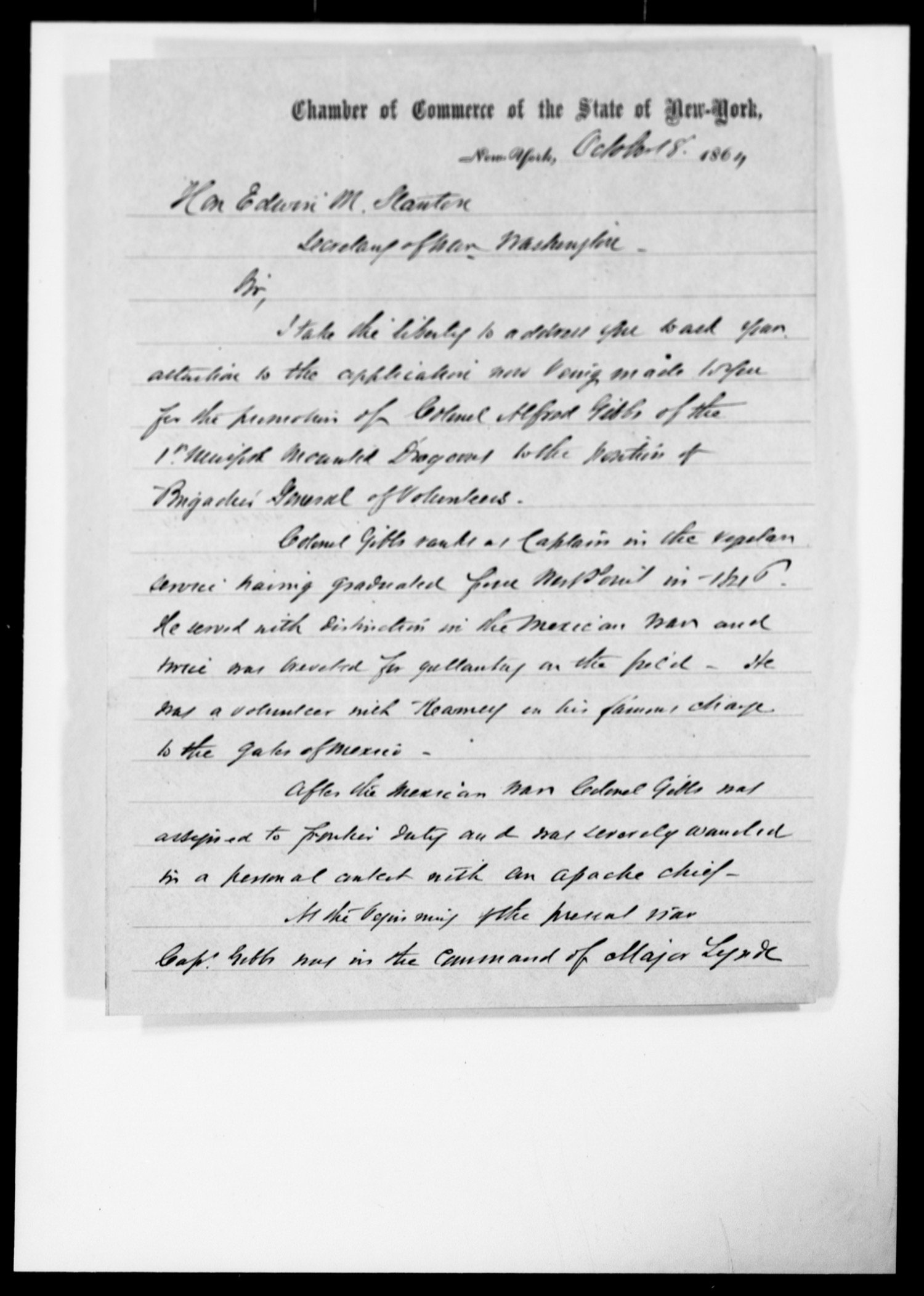
The 1864 campaign for the star
His letters mobilizing Scott, Lieber, Evarts, Pierrepont, and the Chamber of Commerce for Alfred’s brigadier appointment: exhibited in The Making of a General.
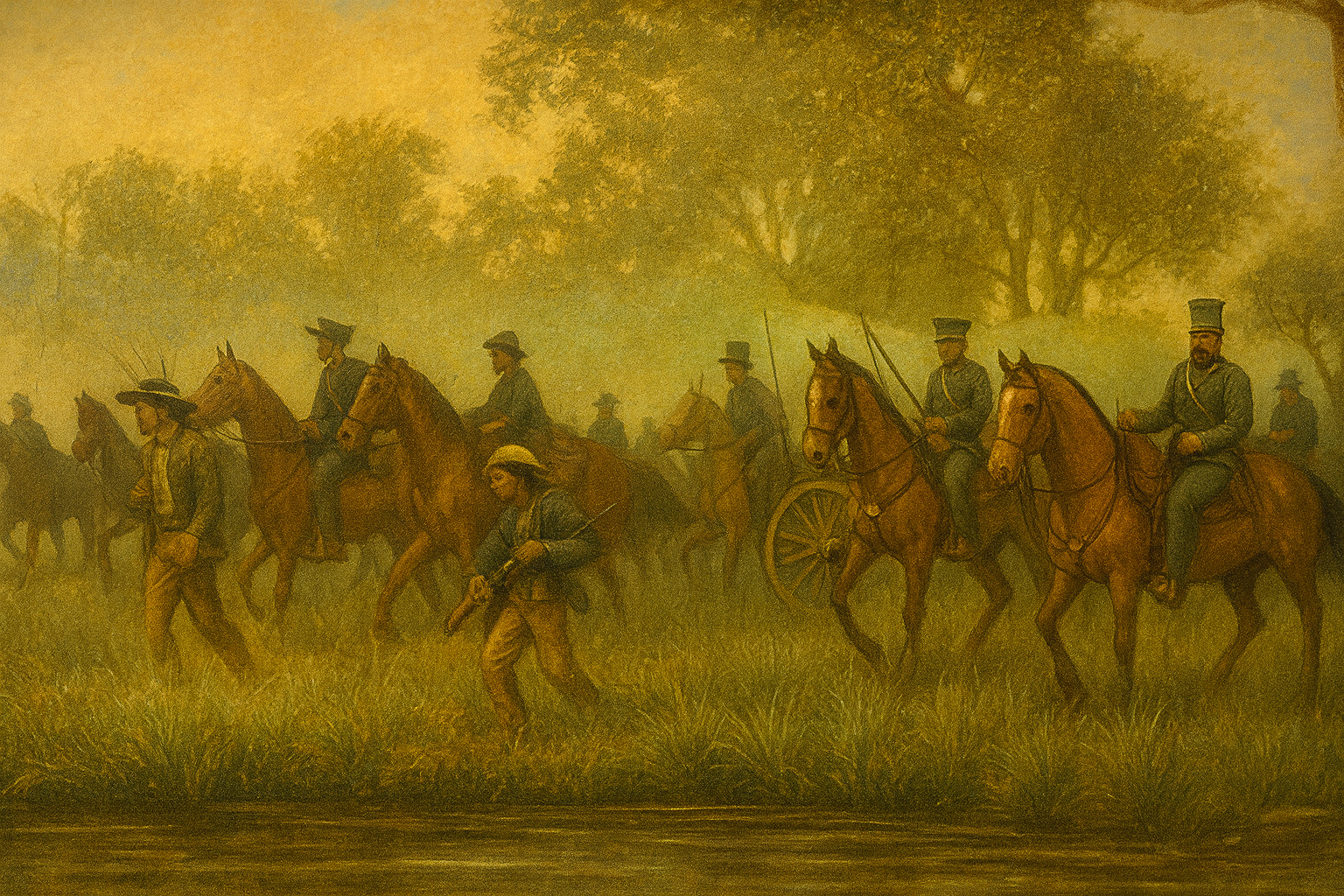
The March of the Mounted Riflemen
His published account of the 1849 crossing, with the enhanced cover image and portraits (including the buckskin photograph from his Mounted Rifles years) on the biography page, which also carries a video deep dive.
The George Gibbs papers
A substantial body of his own writings is now being scanned and catalogued for this archive. This hub is their designated home; expect it to grow considerably.
IIStories & Essays
The pages of this site built from, or featuring, these papers.
IIIIn the Family Record
Chapter II, Part 6
His life in the family Record, with John Austin Stevens’s 1873 memorial address; note this site’s correction on the Astoria collectorship dates.
IVStill Hunting
Research Ledger: Open Threads
- THE BIG ONE: the incoming George Gibbs papers; scan, catalogue, and exhibit here as they land.
- His Smithsonian ethnology and Chinook jargon work: a dedicated essay is warranted.
- His 1846 Memoirs and the Wolcott papers: where his working materials ended up.
- The Civil War years in New York: Loyal National League and draft riots service, per Stevens.
Gibbs Archives · Reel 1The Reel 1 Papers
From the Gibbs Family Papers at the Wisconsin Historical Society, scanned frame by frame from the microfilm by the editor: the future ethnologist before ethnology — the twelve-year-old’s composition on death, the schoolboy judging Plutarch at Round Hill, the first weeks at Harvard Law, and the young naturalist calling on Audubon with a moth that Dorothea Dix rescued. Four documents, 1827 to 1833, each shown whole with its complete verbatim transcription.
“On Death and Future Punishment”: A Schoolboy’s Composition 
Round Hill School, December 30, 1827
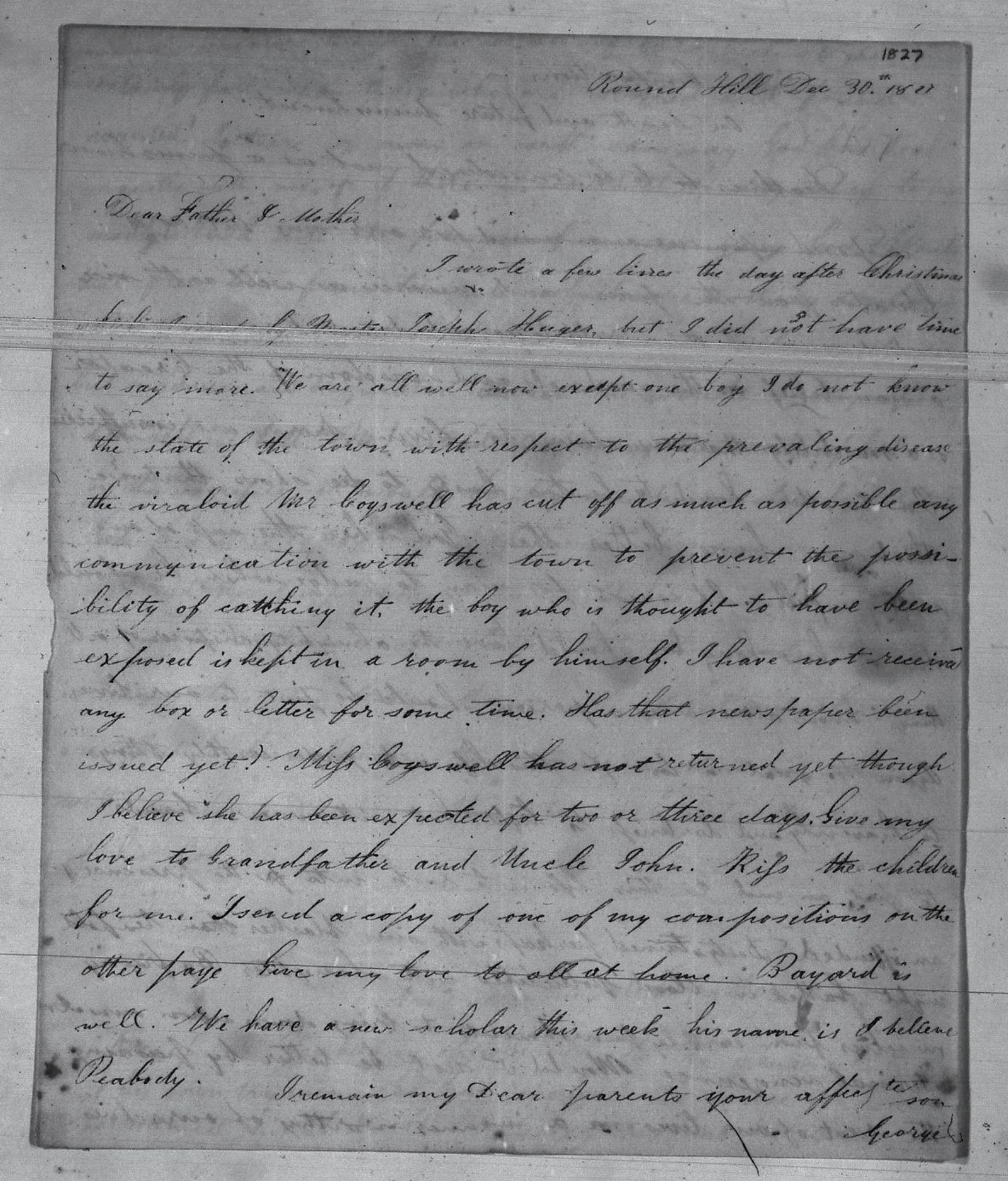
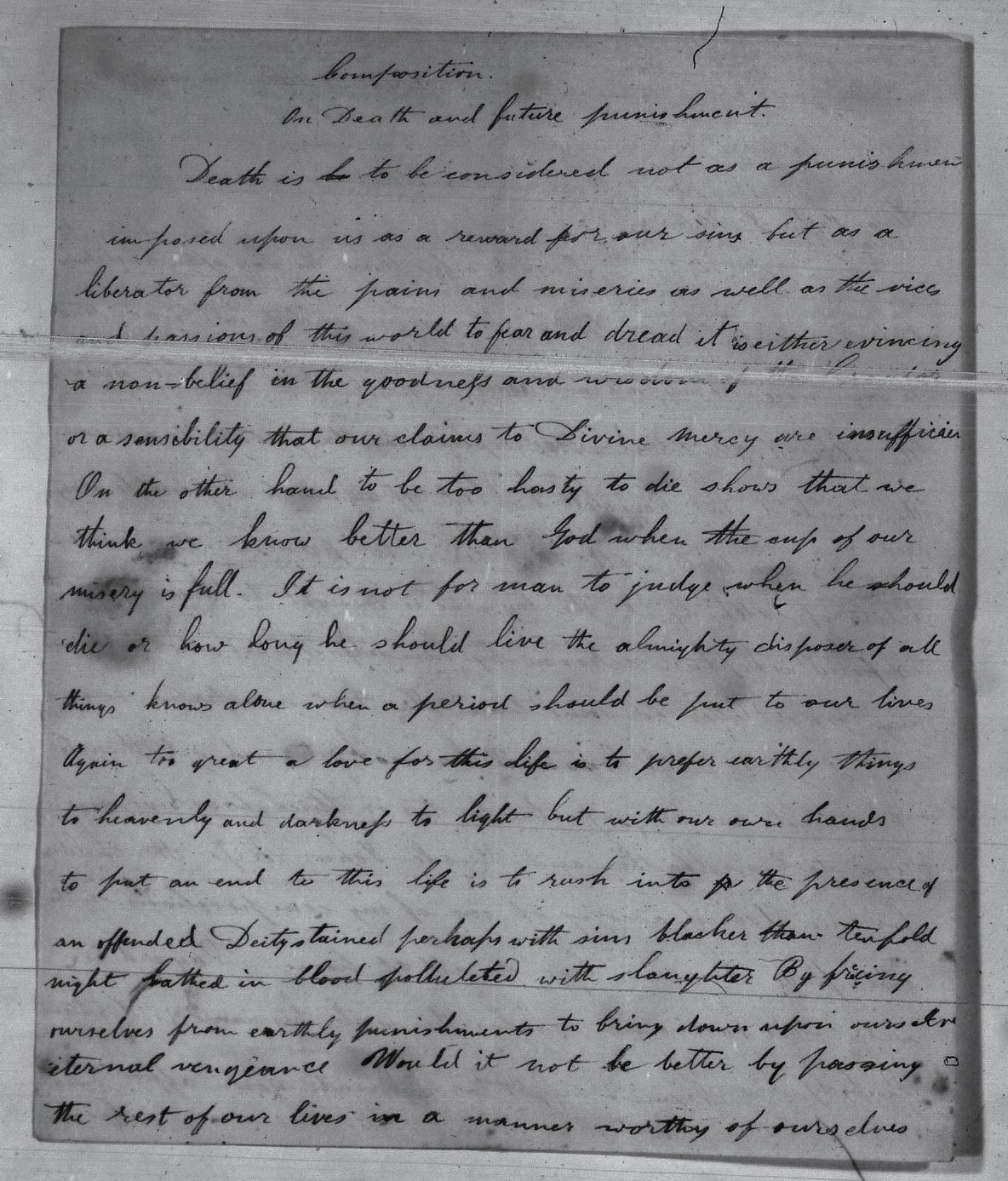
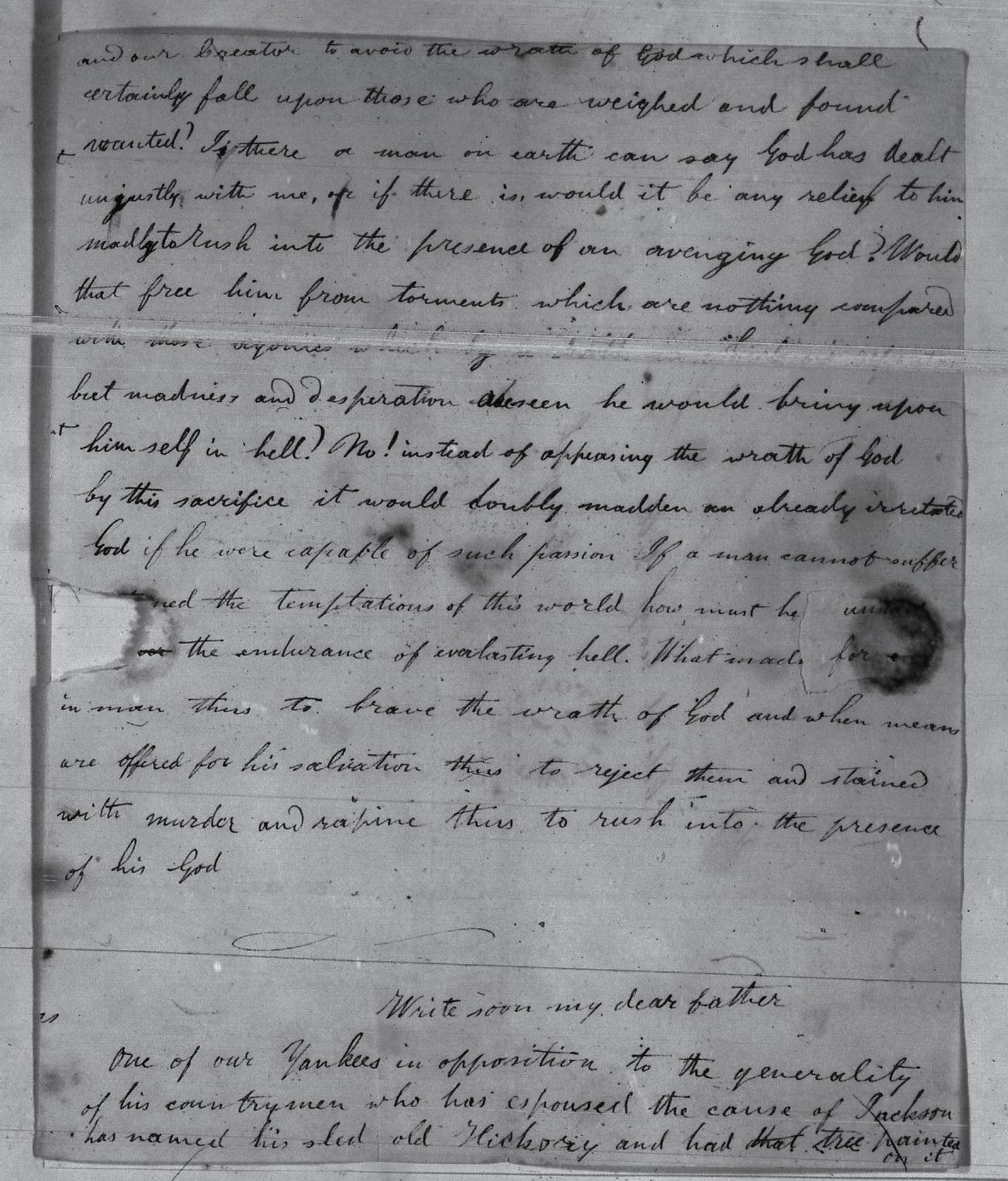
The earliest writing of his on this site: George at twelve, sending his parents a letter and, folded inside it, a school composition on death and future punishment — the varioloid in the town, the composition’s solemn argument in a boy’s spelling (“prevaling,” “found wanted”), and then, in the last breath after the flourish, pure twelve-year-old: a Yankee Jackson man in Northampton “has named his sled old Hickory and had that tree painted on it.”
The Letter (scan 659)
1827 [archivist’s pencil, upper right]
Dear Father & Mother
I wrote a few lines the day after Christmas [illegible: one line lost in splice] Mr[?] Joseph Huger, but I did not have time to say more. We are all well now except one boy I do not know the state of the town with respect to the prevaling disease the varioloid[?] Mr Cogswell has cut off as much as possible any communication with the town to prevent the possibility of catching it. the boy who is thought to have been exposed is kept in a room by himself. I have not received any box or letter for some time. Has that newspaper been issued yet? Miss Cogswell has not returned yet though I believe she has been expected for two or three days. Give my love to grandfather and Uncle John. Kiss the children for me. I send a copy of one of my compositions on the other page Give my love to all at home. Bayard is well. We have a new scholar this week his name is I believe Peabody.
I remain my Dear parents your affecte son — George
The Enclosed Composition (scans 660 and 661)
Composition. — On Death and future punishment.
Death is [struck: illegible] to be considered not as a punishment imposed upon us as a reward for our sins but as a liberator from the pains and miseries as well as the vices and passions of this world to fear and dread it is either evincing a non-belief in the goodness and wisdom of [illegible: remainder of line lost in splice] or a sensibility that our claims to Divine mercy are insufficient On the other hand to be too hasty to die shows that we think we know better than God when the cup of our misery is full. It is not for man to judge when he should die or how long he should live the almighty disposer of all things knows alone when a period should be put to our lives Again too great a love for this life is to prefer earthly things to heavenly and darkness to light but with our own hands to put an end to this life is to rush into [struck: p] the presence of an offended Deity stained perhaps with sins blacker than tenfold night bathed in blood polluleted with slaughter By freeing ourselves from earthly punishments to bring down upon ourselves eternal vengeance Would it not be better by passing the rest of our lives in a manner worthy of ourselves
and our Creator to avoid the wrath of God which shall certainly fall upon those who are weighed and found wanted! Is there a man on earth can say God has dealt unjustly with me, or if there is, would it be any relief to him madly to rush into the presence of an avenging God? Would that free him from torments which are nothing compared with those agonies which [illegible: remainder of line lost in splice] but madness and desperation [struck: illegible] he would bring upon himself in hell! No! instead of appeasing the wrath of God by this sacrifice it would doubly madden an already irritated God if he were capable of such passion If a man cannot suffer [illegible]ed[?] the temptations of this world how must he [illegible] [struck: illegible] the endurance of everlasting hell. What madness[?] for [illegible] in man thus to brave the wrath of God and when means are offered for his salvation thus to reject them and stained with murder and rapine thus to rush into the presence of his God
[flourish rule drawn across the page]
Write soon my dear father
One of our Yankees in opposition to the generality of his countrymen who has espoused the cause of Jackson has named his sled old Hickory and had that tree painted on it
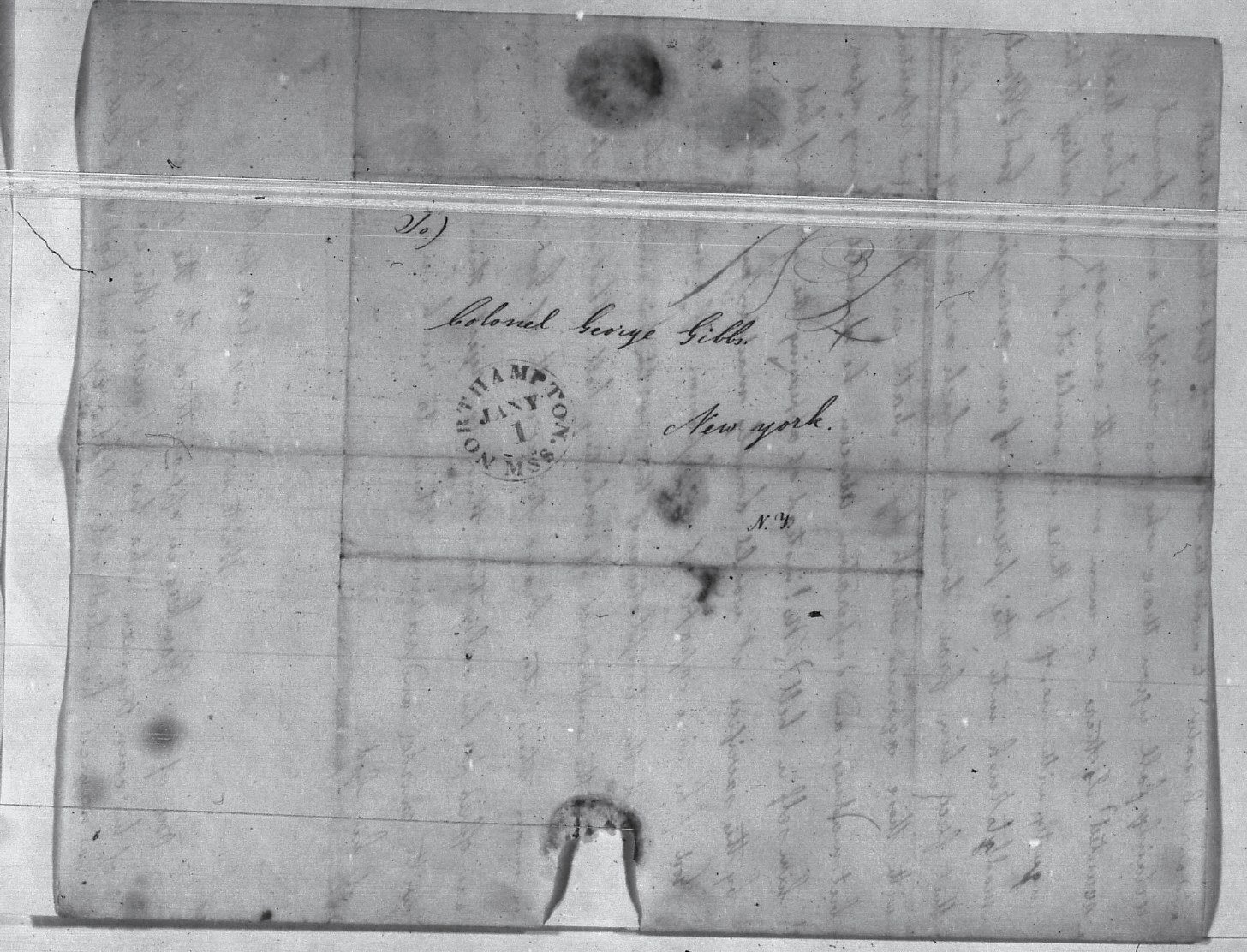
Transcribed verbatim from the scans, keeping the original spelling, capitalization, and punctuation; the manuscript’s own dashes are kept, bracketed words are interlineations or uncertain readings, and [illegible] marks passages lost to the film. Condition: Each scan carries a horizontal microfilm splice band that destroys about one line of text: on 659 it takes most of the letter’s second line (the phrase naming how the Christmas note went, ending ‘…Mr[?] Joseph Huger’); on 660 it takes the line after ‘goodness and wisdom of’ (almost certainly ‘of the Deity’ or similar); on 661 it takes the line after ‘nothing compared with those agonies which’. ‘varioloid’ (the mild smallpox then in Northampton) is written in the boy’s hand and could be read ‘viraloid’; rendered varioloid[?]. ‘Cogswell’ = Joseph Green Cogswell, Round Hill’s co-founder; the initial C in George’s hand resembles a lowercase b, same letterform in ‘Creator’. Boy’s spellings preserved: ‘prevaling’, ‘polluleted’, ‘found wanted’ (for ‘found wanting’). ‘affecte’ is written with superscript ‘te’. Scan 661 is cropped at the bottom edge immediately after ‘painted on it’ (‘on it’ squeezed at the right margin); any further text of the Old Hickory sled anecdote is off-frame and would need a rescan of frame 661 or the following frame (662).
Gibbs Family Papers, Wisconsin Historical Society, Reel 1, scans 659–661 with the wrapper at 662. Autograph letter of George Gibbs, aged twelve, to his parents, enclosing his school composition. A microfilm splice band destroys about one line on each scan, marked [illegible] above; scan 661 is cropped at the bottom edge, so any further text of the Old Hickory anecdote is off-frame. Digitized from the microfilm by this site; transcribed in full above.
Plutarch at Round Hill 
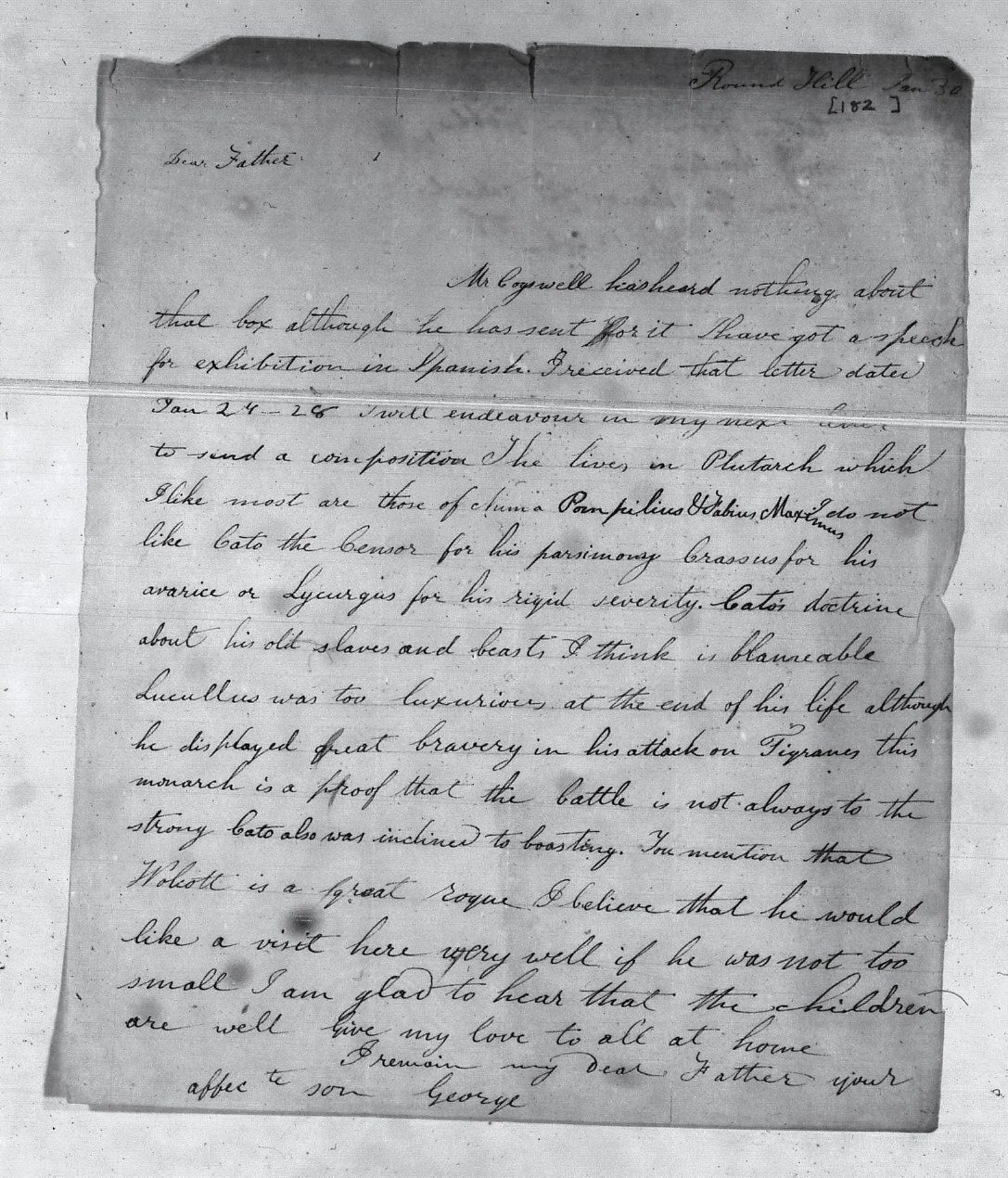
Round Hill School, Northampton, January 30 [1830]
The schoolboy at Bancroft and Cogswell’s famous Round Hill School, about fourteen, reports to his father: a speech for exhibition in Spanish, and his own verdicts on Plutarch’s lives. He admires Numa and Fabius Maximus, condemns Crassus for avarice and Lycurgus for severity, and of Cato the Censor writes that his doctrine about his old slaves and beasts “I think is blameable.” The future ethnologist’s moral eye, already open. Little brother Wolcott, he teases, “would like a visit here very well if he was not too small.”
Dear Father
Mr Cogswell has heard nothing about that box although he has sent for it I have got a speech for exhibition in Spanish. I received that letter dated Jan 24—28[?] I will endeavour in my next letter[?] to send a composition
The lives in Plutarch which I like most are those of Numa Pompilius & Fabius Maximus I do not like Cato the Censor for his parsimony Crassus for his avarice or Lycurgus for his rigid severity. Catos doctrine about his old slaves and beasts I think is blameable Lucullus was too luxurious at the end of his life although he displayed great bravery in his attack on Tigranes this monarch is a proof that the battle is not always to the strong Cato also was inclined to boasting.
You mention that Wolcott is a great rogue I believe that he would like a visit here very well if he was not too small I am glad to hear that the children are well Give my love to all at home
I remain my dear Father your affecte son George
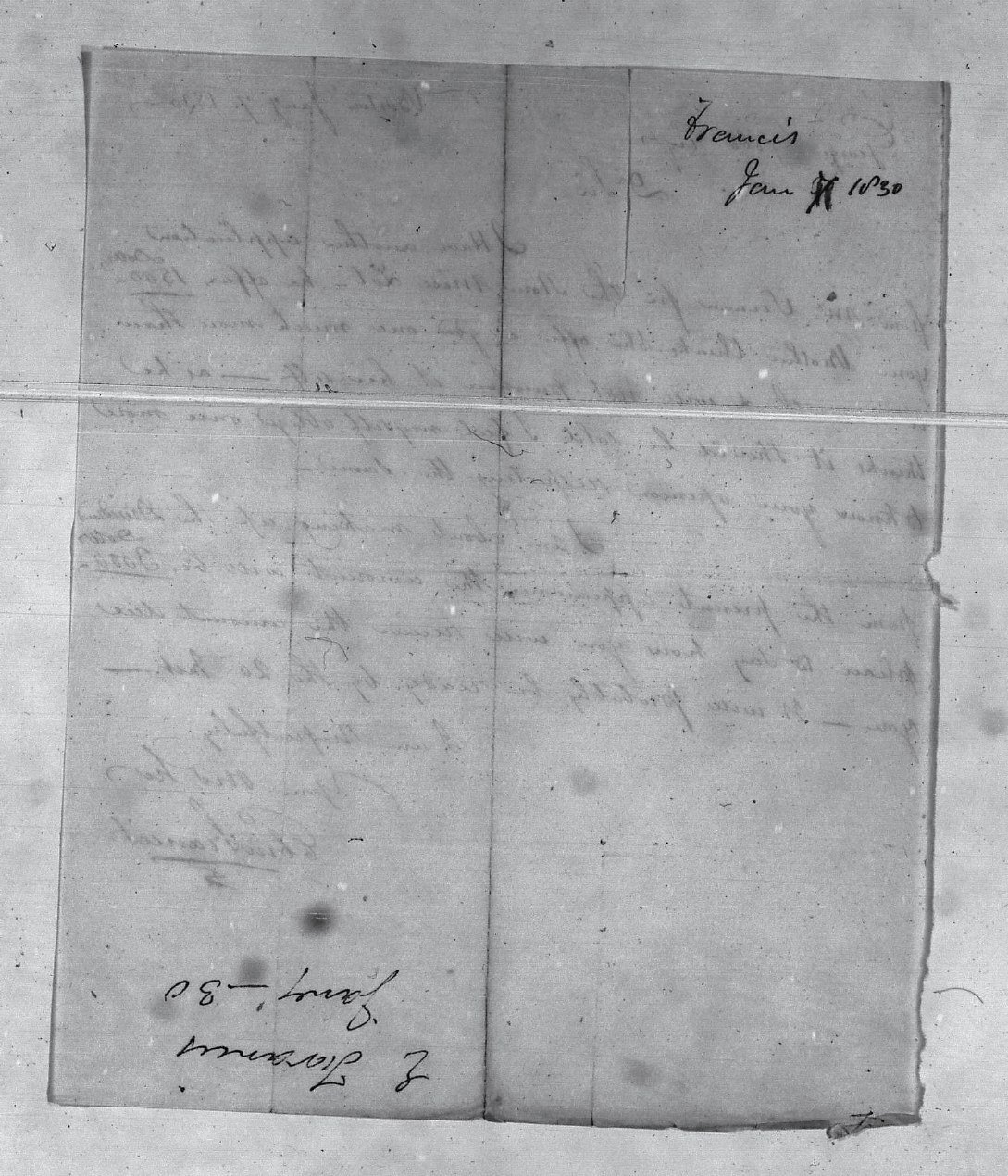
[scan 775 — verso / outer leaf of the folded letter]
[annotation in later dark ink, upper right:] Francis / Jan [struck: 11[?]] 1830
[docket written at right angles, lower left, badly faded:] Jany—30 / [illegible — a name, possibly ‘G Gibbs’ or ‘George’]
[faint dateline fragment, upper left, from the offset text described below:] [illegible] Jany 7[?] 1830
[remainder of the leaf carries the mirror/offset ink transfer of an UNRELATED business letter, largely illegible; recoverable fragments only:] I have another [illegible] … he offers 1500[?] — … Brother think[?] the off[er?] … [illegible] at hand[?] — as he … [illegible] the amount … $500[?] … from the present [illegible] the amount due[?] … please to say have you ever received[?] [illegible] by the 20 inst[?] … you — I will forward it [illegible] … I am Yours faithfully / [signature, illegible]
Transcribed verbatim from the scans, keeping the original spelling, capitalization, and punctuation; the manuscript’s own dashes are kept, bracketed words are interlineations or uncertain readings, and [illegible] marks passages lost to the film. Condition: Scan 771 (recto, the letter; scan 772 is a duplicate frame of this leaf): single page in young George Gibbs’s schoolboy running hand, dated ‘Round Hill Jan 30’ with no year; the later ink annotation on the verso supplies 1830 (George, b. July 1815, would be 14). An archivist’s pencil number ‘[182]’ sits below the dateline at upper right ~~ not part of the letter. The boy writes with almost no punctuation and several words run together on the page (‘hasheard’, ‘Iwill’); word divisions have been normalized silently but every spelling is his, including ‘endeavour’, ‘Catos’ (no apostrophe), ‘blameable’. ‘Maximus’ is written with ‘mus’ raised above the line as a superscript completion, and the valediction ‘affecte’ carries a superscript ‘te’. A horizontal microfilm scratch/scan seam crosses the fourth line: ‘Jan 24~~28’ is clear up to the dash but the second figure could read 26 or 28 (28 preferred; marked [?]), and the faded word after ‘in my next’ shows only ascender traces consistent with ‘letter’ (marked letter[?]). The manuscript is one unbroken paragraph; the three-paragraph division above is editorial for display and drops no words. Scan 775 (verso/outer leaf): the reported December 1896 family annotation identifying the letter as written from ‘Geo. Bancroft’s school’ could NOT be verified verbatim on this microfilm frame ~~ the only clearly legible later annotation is the dark-ink ‘Francis / Jan [struck figure] 1830’ at upper right (possibly the 1890s family sorter’s hand, and note it misattributes the writer: the letter is signed George, and ‘Wolcott’, not Francis, is the small brother teased inside). If the 1896 Bancroft note exists it is either on a frame not supplied or lost in the heavy offset ink transfer that covers this leaf: a mirror-image transfer of an unrelated money letter (fragments about an offer of $1500[?], an amount due, $500, ‘by the 20 inst’, closing ‘I am Yours faithfully’) from a document that lay against this leaf in the bound volume. Fragments of that offset text are transcribed only so far as genuinely readable; everything else is marked [illegible]. The rotated lower-left docket ‘Jany~~30’ over an illegible name is in period ink and is likely the original filing docket.
Gibbs Family Papers, Wisconsin Historical Society, Reel 1, scans 771 and 775 (772 is a duplicate frame). Autograph letter of the young George Gibbs to his father Col. George Gibbs; the year 1830 is supplied by a later ink annotation on the verso, which misattributes the letter to “Francis” though it is signed George. A reported 1896 family note identifying the school could not be verified on the film and is not claimed here. Digitized from the microfilm by this site; transcribed in full above.
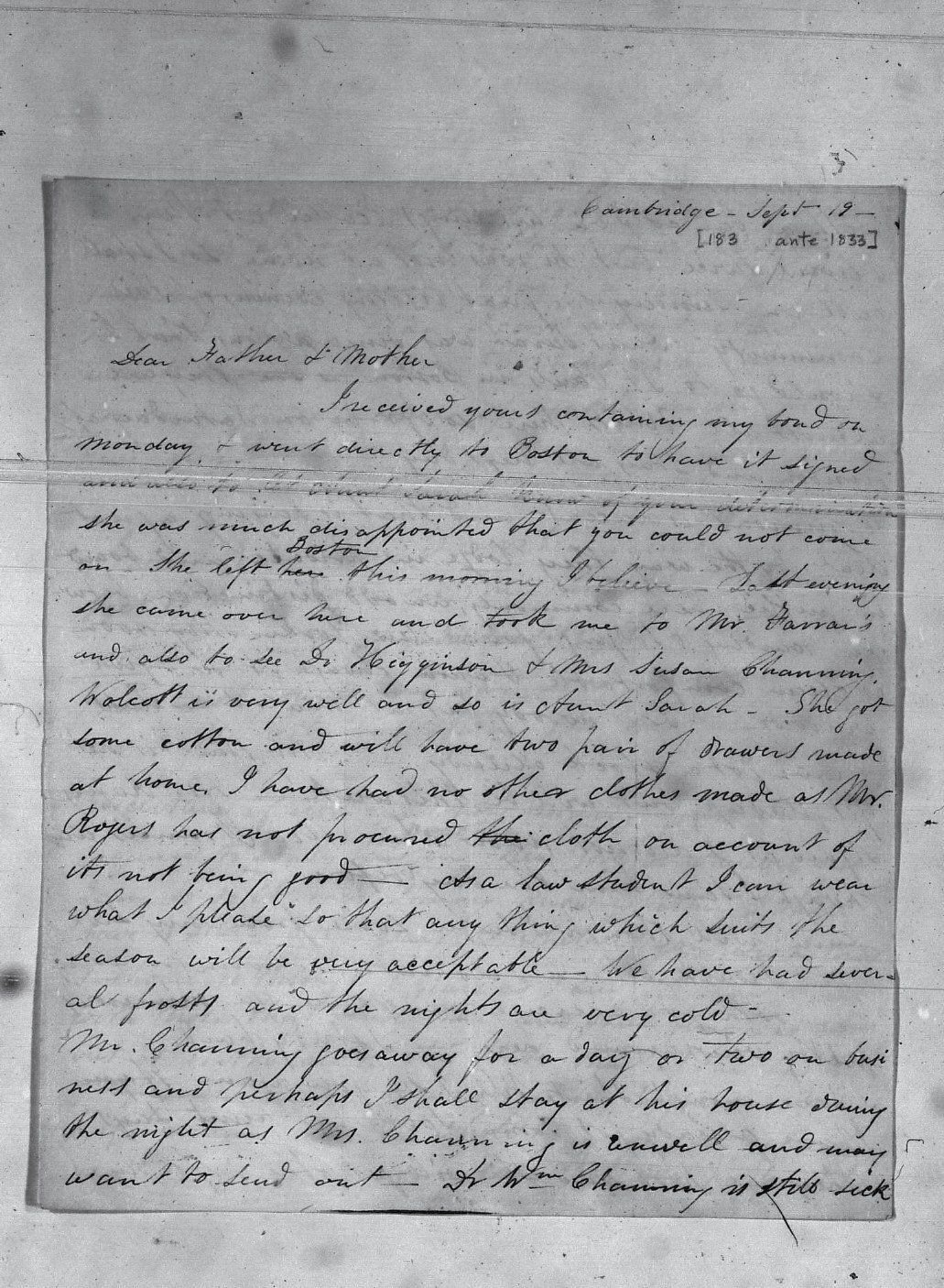
First Weeks at Harvard Law 
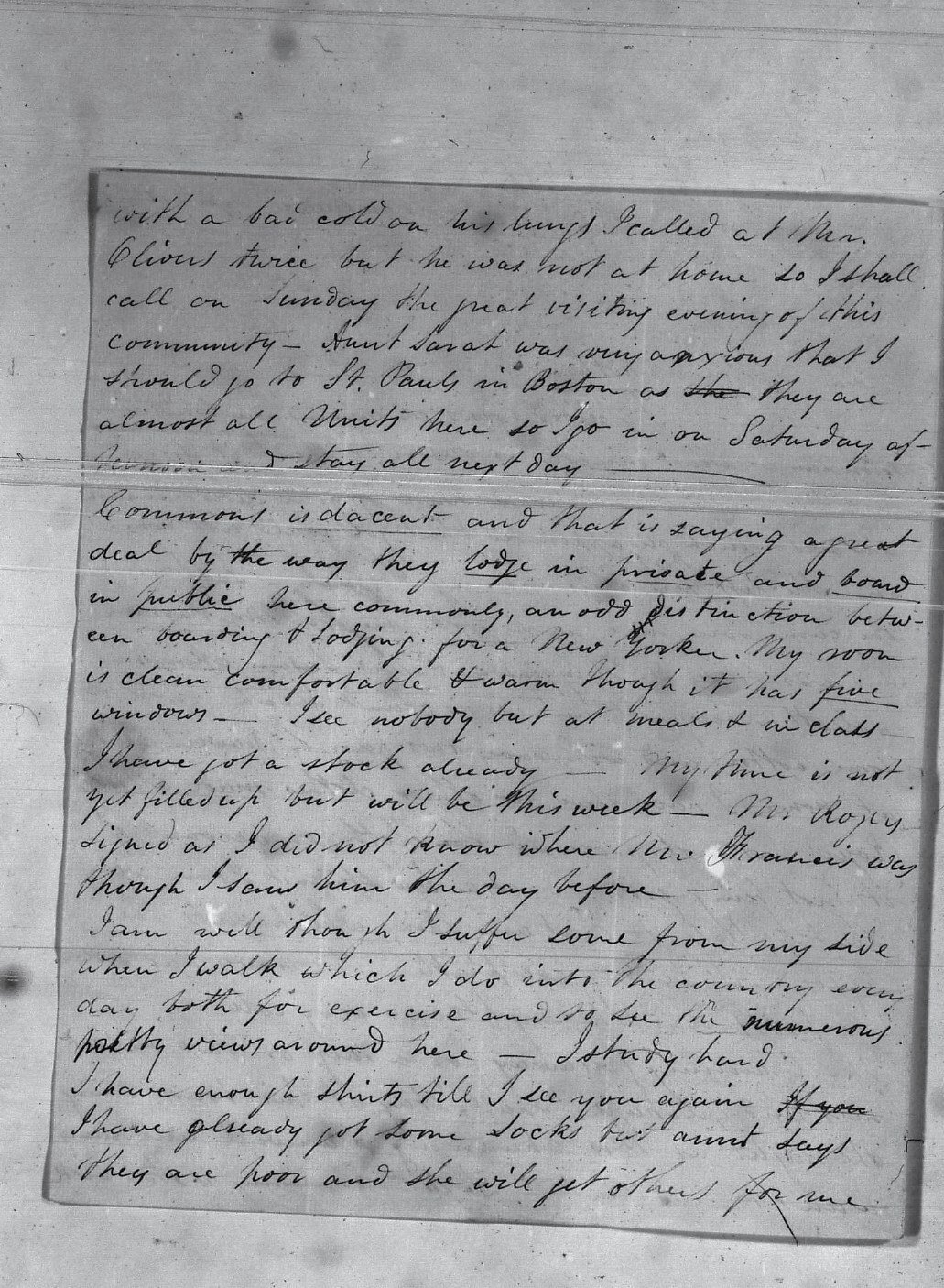
Cambridge, September 19 [1832]
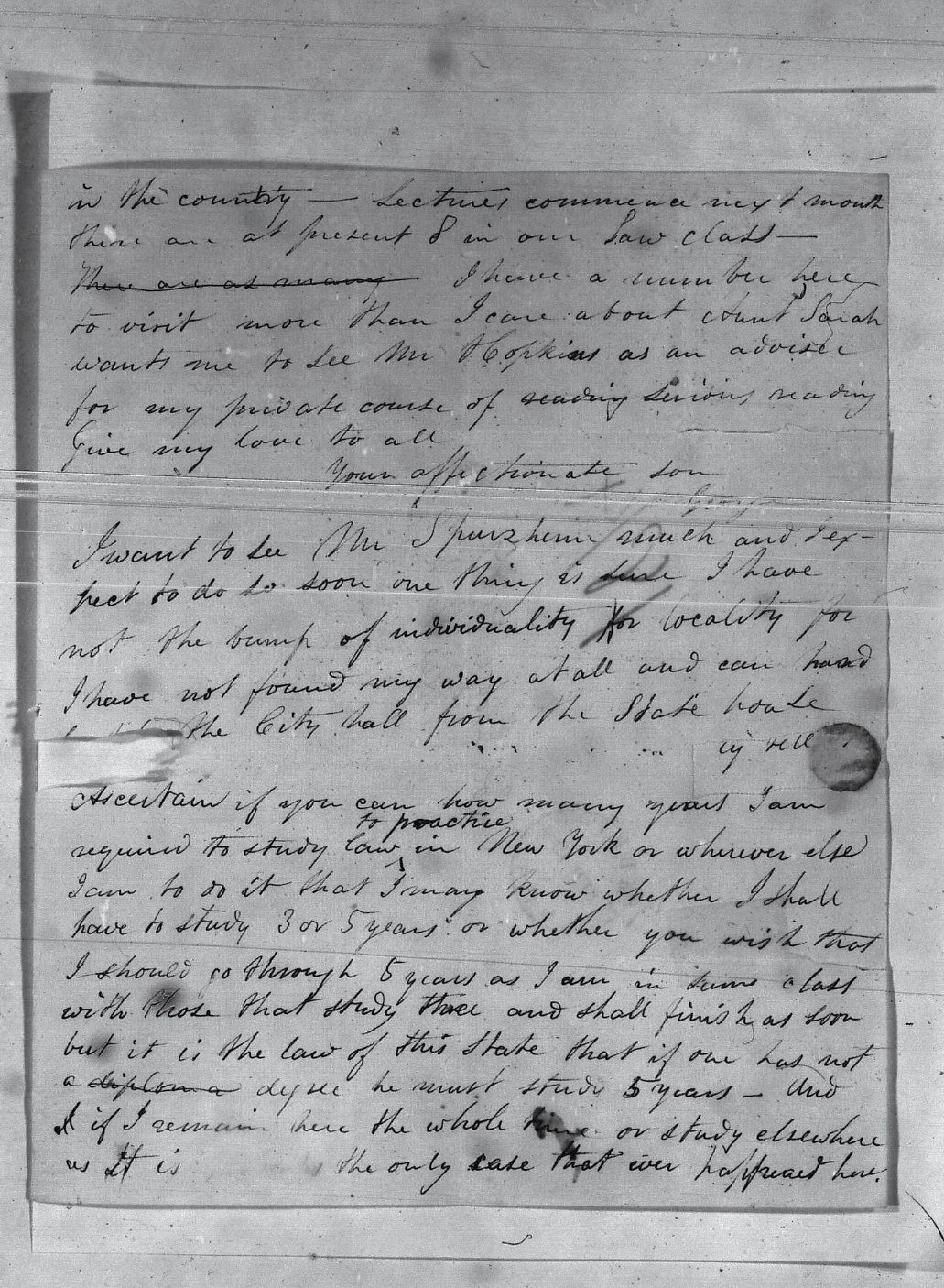
Seventeen and just installed at Cambridge: the bond signed in Boston, Aunt Sarah’s disappointment, the Channing household’s illnesses, and a New Yorker’s puzzled report that Cambridge men “lodge in private and board in public.” He wants to see Spurzheim the phrenologist and jokes that he lacks “the bump of… locality, for I have not found my way at all.” The closing question — whether he must study law three years or five to practice in New York — is the door to the legal career he later abandoned for ethnology.
Dear Father & Mother
I received yours containing my bond on Monday & went directly to Boston to have it signed and also to let[?] Aunt Sarah know of your determination[?] she was much disappointed that you could not come on — She left [struck: here] Boston this morning I believe — Last evening she came over here and took me to Mr. Farrar’s and also to see Dr Higginson & Mrs Susan Channing. Wolcott is very well and so is Aunt Sarah — She got some cotton and will have two pair of drawers made at home. I have had no other clothes made as Mr. Rogers has not procured [struck: the] cloth on account of its not being good — As a law student I can wear what I please so that any thing which suits the season will be very acceptable — We have had several frosts and the nights are very cold —
Mr. Channing goes away for a day or two on business and perhaps I shall stay at his house during the night as Mrs. Channing is unwell and may want to send out — Dr Wm Channing is still sick with a bad cold on his lungs I called at Mr. Oliver’s twice but he was not at home so I shall call on Sunday the great visiting evening of this community — Aunt Sarah was very anxious that I should go to St. Pauls in Boston as [struck: the] they are almost all Units here so I go in on Saturday af[ternoon?] [illegible] & stay all next day —
Commons is decent and that is saying a great deal by the way they lodge in private and board in public here commonly, an odd distinction between boarding & lodging for a New Yorker. My room is clean comfortable & warm though it has five windows — I see nobody but at meals & in class I have got a stock already — My time is not yet filled up but will be this week — Mr Rogers signed as I did not know where Mr. Francis was though I saw him the day before —
I am well though I suffer some from my side when I walk which I do into the country every day both for exercise and to see the [struck: numerous] pretty views around here — I study hard. I have enough shirts till I see you again [struck: If you] I have already got some socks but aunt says they are poor and she will get others for me in the country — Lectures commence next month there are at present 8 in our Law class — [struck: There are as many] I have a number here to visit more than I care about Aunt Sarah wants me to see Mr Hopkins as an adviser for my private course of [struck: reading] serious reading Give my love to all
Your affectionate son
George
I want to see Mr Spurzheim much and I expect to do so soon one thing is sure I have not the bump of individuality [struck: for] locality for I have not found my way at all and can hardly [illegible] the City hall from the State house [illegible]ry well[?]
Ascertain if you can how many years I am required to study law to practice in New York or wherever else I am to do it that I may know whether I shall have to study 3 or 5 years or whether you wish that I should go through 5 years as I am in same[?] class with those that study three and shall finish as soon but it is the law of this State that if one has not a [struck: diploma] degree he must study 5 years — And [struck: it] if I remain here the whole time or study elsewhere as it is [illegible] the only case that ever happened here.
Transcribed verbatim from the scans, keeping the original spelling, capitalization, and punctuation; the manuscript’s own dashes are kept, bracketed words are interlineations or uncertain readings, and [illegible] marks passages lost to the film. Condition: Scan 889 carries a later archivist’s pencil note beside the date: ‘[183_ ante 1833]’; internal evidence (Spurzheim in Boston, first weeks of Harvard Law study, ‘lectures commence next month’) dates the letter to Sept 19, 1832. The third line of scan 889 runs under a heavy horizontal crease and is largely lost; ‘let … know of your determination’ is a confident but partial reading. ‘Boston’ in ‘She left Boston’ is interlined above a cancelled ‘here’. ‘Units’ = Unitarians (so written). On scan 890 the writer underlined ‘decent’, ‘lodge’, ‘private’, ‘board’, and ‘five’ for emphasis; the word following ‘Saturday af-‘ at the line turn is struck/faded. On scan 891 the signature is badly faded (‘George’ partly visible); ‘to practice’ is interlined above ‘study law’ and is here run into the text; a blot obscures a word after ‘can hardly’ and a short faded fragment (‘…ry well’) follows ‘State house’. ‘same class’ partly obscured; ‘the only case that ever happened here’ preceded by an illegible word or two.
Gibbs Family Papers, Wisconsin Historical Society, Reel 1, scans 889–891. Autograph letter of George Gibbs to his parents from Cambridge; an archivist’s pencil note reads “[183_ ante 1833],” and the internal evidence (Spurzheim in Boston, the first weeks of law study) fixes it to September 19, 1832. Digitized from the microfilm by this site; transcribed in full above.
“A Visit to Mr Audubon — The Audubon” 
Boston, March 17, 1833
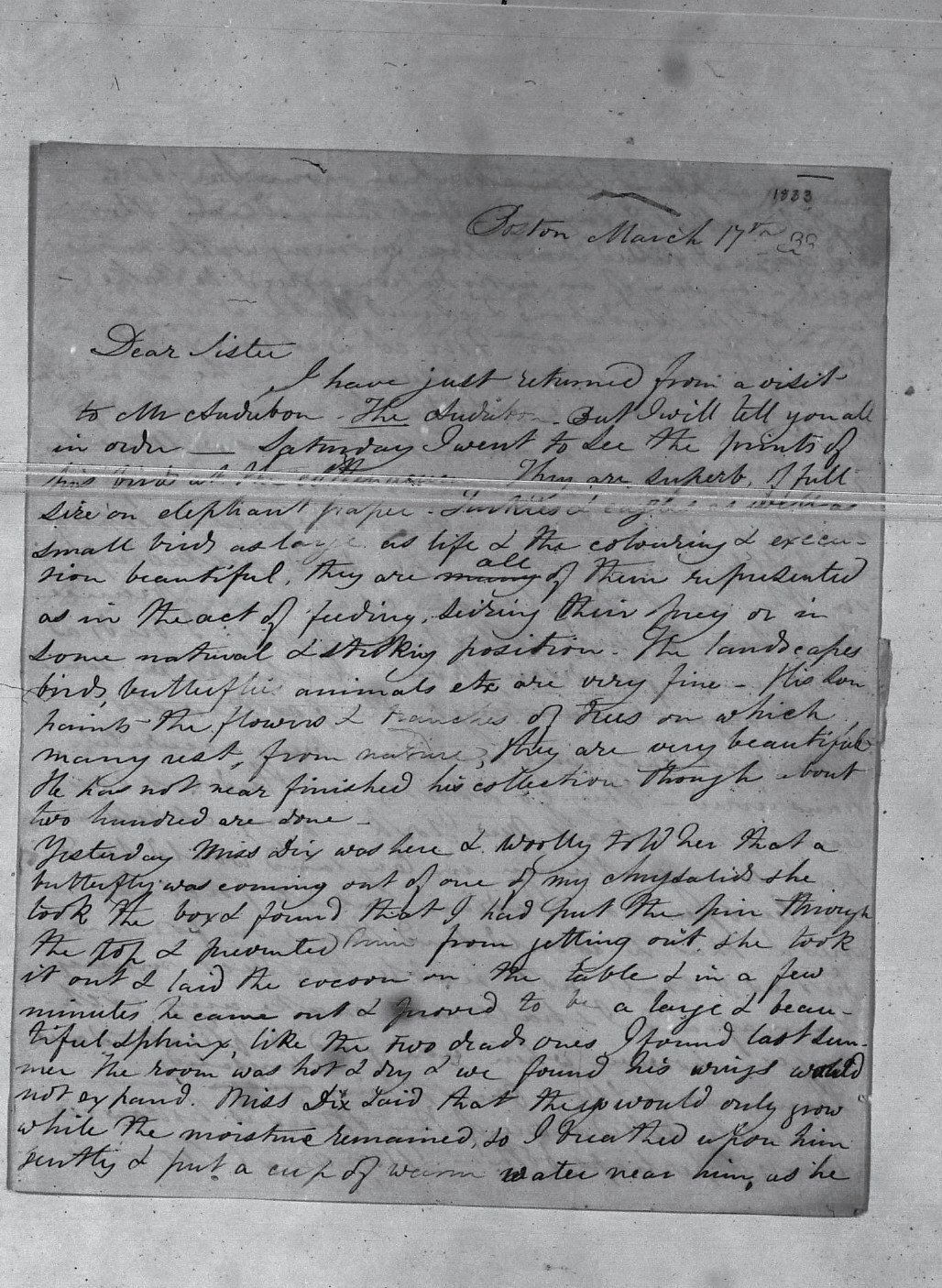
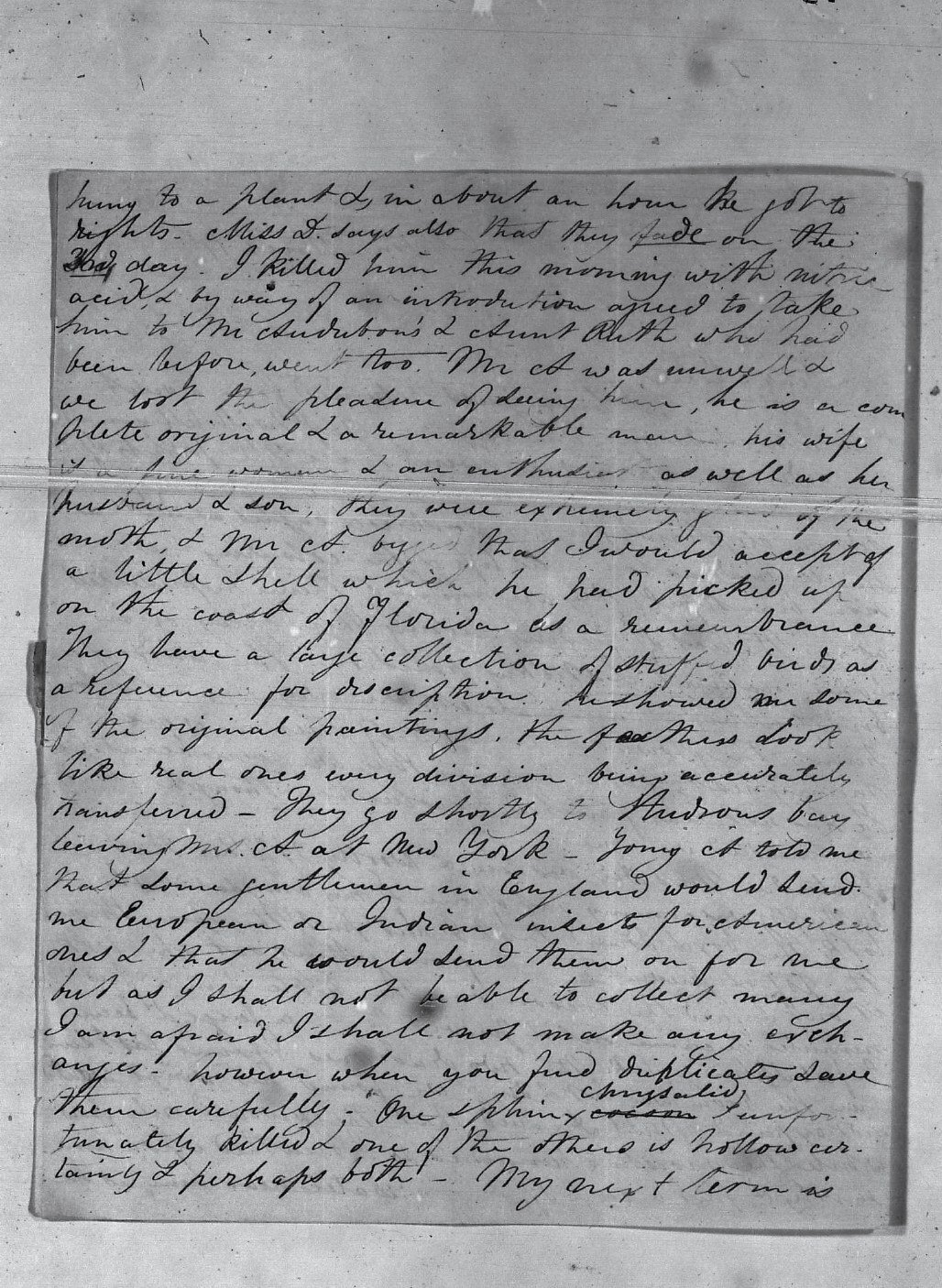
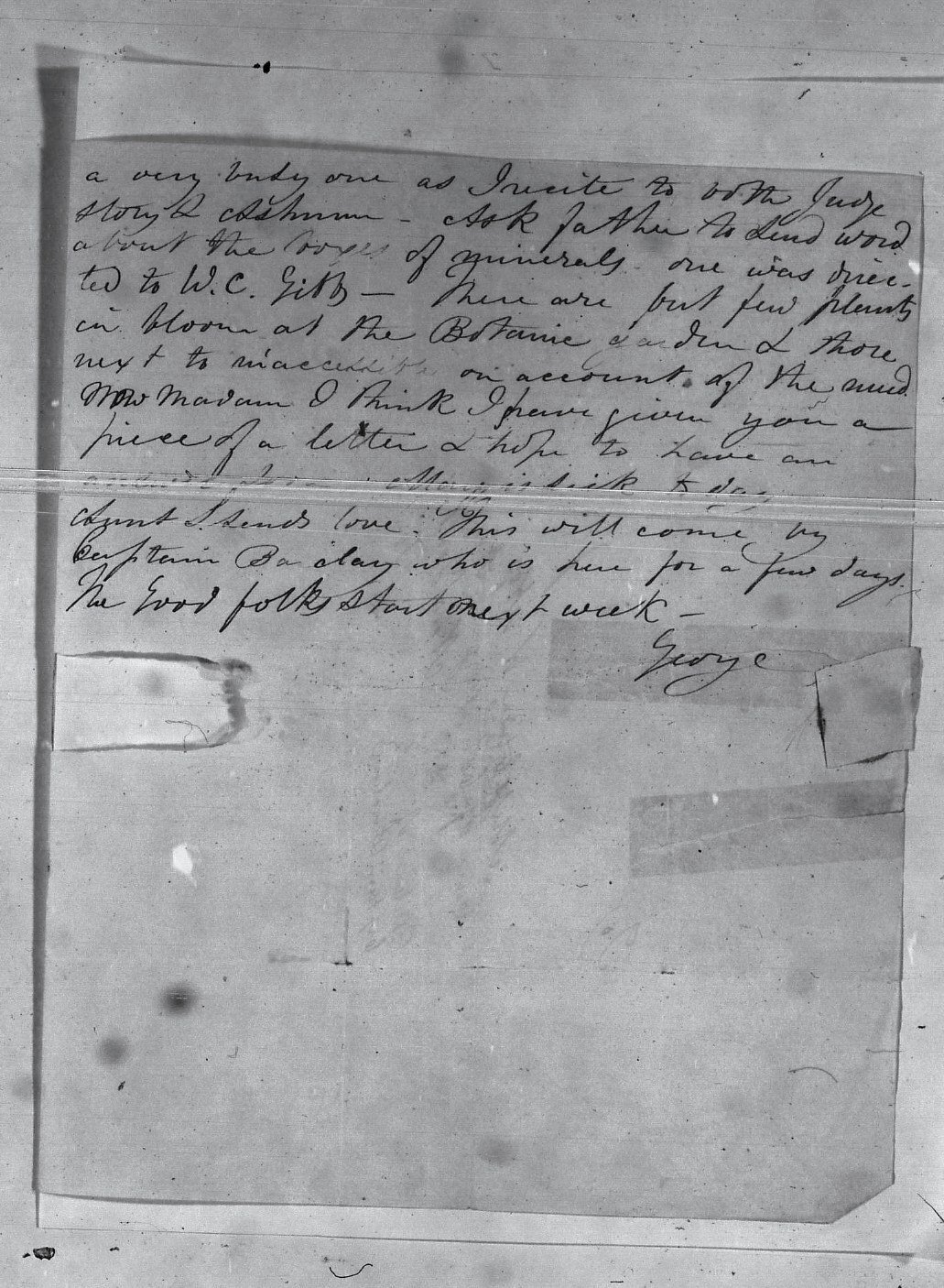
The eighteen-year-old Harvard law student writes his sister Eliza a letter that catches half of scientific Boston in three pages. He has seen the Birds of America plates at the Athenaeum, “superb, of full size on elephant paper.” Dorothea Dix, visiting the day before, freed the sphinx moth he had pinned wrong and taught him to revive its wings with warm breath. The moth, dispatched with nitric acid, became his introduction to the Audubon household, where he came away with a Florida shell and an offer of insect exchanges with English collectors. He recites to Judge Story; the boxes of minerals are his father’s; and “Mother is sick to day” is Laura. The whole family, one letter.
Dear Sister
I have just returned from a visit to Mr Audubon — The Audubon — But I will tell you all in order — Saturday I went to see the prints of his birds at the Athenaeum[?]. They are superb, of full size on elephant paper — Turkies & eagles[?] as well as small birds as large as life & the colouring & execution beautiful, they are all of them represented as in the act of feeding, seizing their prey or in some natural & striking position — The landscapes birds, butterflies animals etc are very fine — His son paints the flowers & branches of trees on which many rest, from nature; they are very beautiful. He has not near finished his collection though about two hundred are done —
Yesterday Miss Dix was here & when[?] I[?] told her that a butterfly was coming out of one of my chrysalids she took the box & found that I had put the pin through the top & prevented him from getting out. She took it out & laid the cocoon on the table & in a few minutes he came out & proved to be a large & beautiful sphinx, like the two dead ones I found last summer. The room was hot & dry & we found his wings would not expand. Miss Dix said that they would only grow while the moisture remained, so I breathed upon him gently & put a cup of warm water near him, as he hung to a plant &, in about an hour he got to rights — Miss D. says also that they fade on the 3d[?] day. I killed him this morning with nitric acid, & by way of an introduction agreed to take him to Mr Audubon’s & Aunt Ruth who had been before, went too. Mr A was unwell & we lost the pleasure of seeing him, he is a complete original & a remarkable man — his wife is a fine woman & an enthusiast as well as her husband & son, they were extremely glad[?] of the moth, & Mr A. begged that I would accept of a little shell which he had picked up on the coast of Florida as a remembrance — They have a large collection of stuffed birds as a reference for description. He showed me some of the original paintings, the feathers look like real ones every division being accurately transferred — They go shortly to Hudsons bay leaving Mrs. A at New York — Young A told me that some gentlemen in England would send me European or Indian insects for American ones & that he would send them on for me but as I shall not be able to collect many I am afraid I shall not make any exchanges — however when you find duplicates save them carefully — One sphinx chrysalid I unfortunately killed & one of the others is hollow certainly & perhaps both —
My next term is a very busy one as I recite to both Judge Story & Ashmun — Ask father to send word about the boxes of minerals — one was directed to W. C. Gibbs — There are but few plants in bloom at the Botanic garden & those next to inaccessible on account of the mud. Now Madam I think I have given you a piece of a letter & hope to have an answer[?] soon[?] — Mother[?] is sick to day. Aunt S sends love. This will come by Captain Barclay who is here for a few days. The good folks start next week —
George
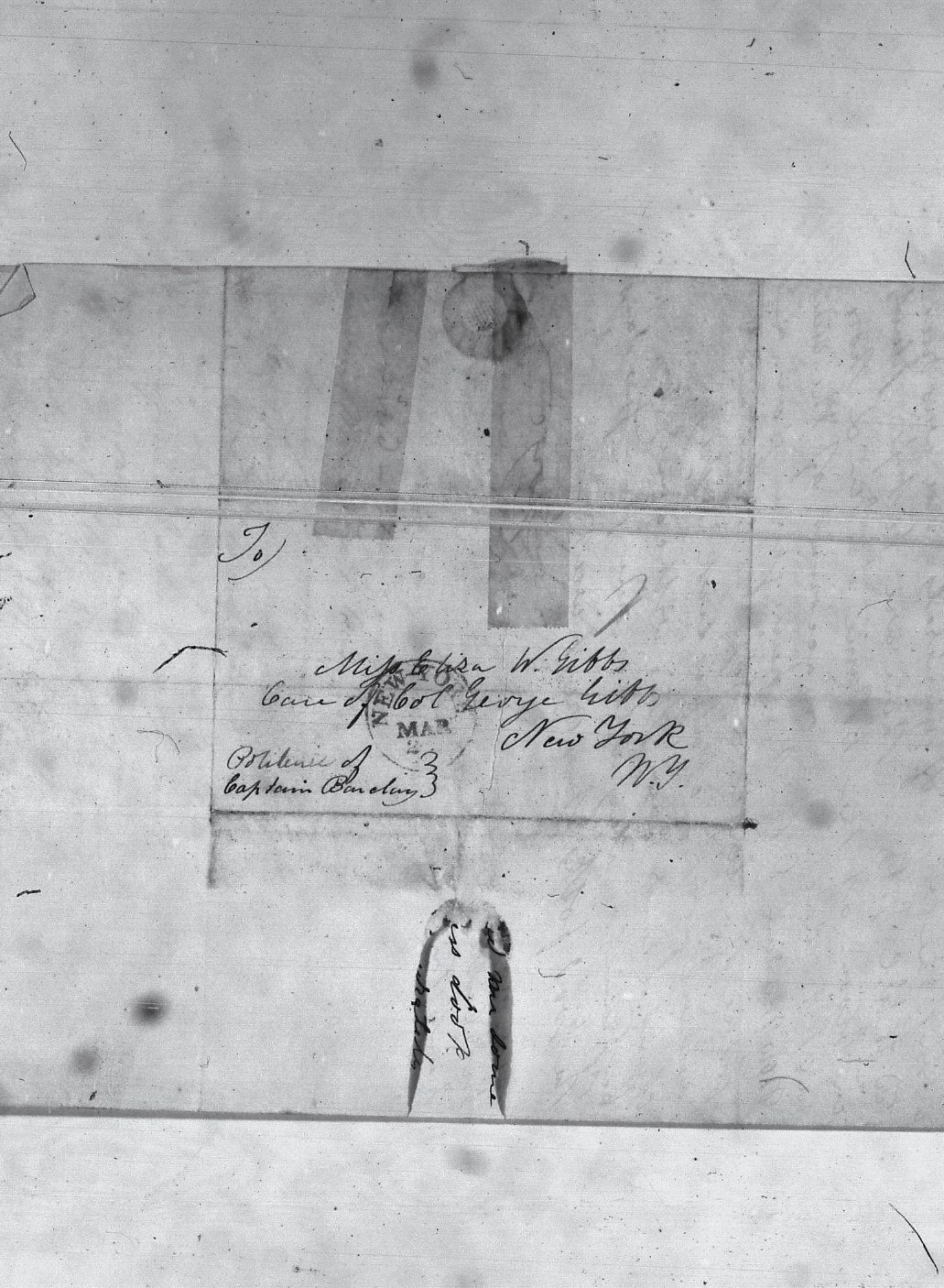
[Wrapper, scan 854]
To
Miss Eliza W. Gibbs
Care of Col George Gibbs
New York
N. Y.
Politeness of Captain Barclay
[Circular postmark, in manuscript-address area:] NEW-YORK MAR [day illegible]
[Near the torn seal, a few words of letter text carried away on the wafer, written vertically, largely illegible:] [illegible] we love[?] [illegible]
Transcribed verbatim from the scans, keeping the original spelling, capitalization, and punctuation; the manuscript’s own dashes are kept, bracketed words are interlineations or uncertain readings, and [illegible] marks passages lost to the film. Condition: Single folio sheet, three written pages plus integral address wrapper; a horizontal fold-crease crosses every scan and damages one line on each written page. Scan 851 (p.1): the line after ‘Saturday I went to see the prints of’ runs through the crease, so ‘his birds at the Athenaeum’ is a confident reading but ‘Athenaeum’ is marked [?]; likewise ‘Turkies & eagles as well as’ is partly crease-obscured. The word ‘many’ is struck out and ‘all’ interlined in ‘they are all of them represented.’ The opening of the Miss Dix passage is smudged; ‘when I told her’ is a contextual reading marked [?]. An archivist’s ‘1833’ is pencilled at top right. Scan 852 (p.2): in ‘they fade on the 3d day’ the numeral is written over a struck first attempt; in ‘One sphinx chrysalid’ the word ‘cocoon’ is struck out and ‘chrysalid’ interlined; the crease obscures ‘is a fine woman & an enthusiast,’ read with fair confidence. ‘We lost the pleasure of seeing him’ is the manuscript reading (Audubon being unwell, the shell was conveyed by the family). Scan 853 (p.3): the crease runs through ‘answer soon ~~ Mother is sick to day,’ making ‘answer soon’ and ‘Mother’ partly conjectural (marked [?]); ‘Aunt S’ initial could also be read ‘L.’ Lower two-thirds of the page blank; two paper repairs/tape shadows visible. Scan 854 (wrapper): New-York circular datestamp with MAR legible, day unreadable; the seal tear removed a strip of letter text (a few vertical words, illegible); a flourish beside ‘Captain Barclay’ resembles a numeral 3 (ratemark or flourish). Manuscript dashes rendered as ~~ throughout; original spelling (Turkies, colouring, to day, Hudsons bay) retained.
Gibbs Family Papers, Wisconsin Historical Society, Reel 1, scans 851–854. Autograph letter of George Gibbs to his sister Eliza W. Gibbs, with its wrapper. Written five months before their father’s death. Digitized from the microfilm by this site; transcribed in full above.
A hub page of the Gibbs Archive, AlfredGibbs.com. Holdings listed here follow the archive’s standing rule: any document displayed on this site appears with its complete verbatim transcription at the linked exhibit. Hub updated July 10, 2026; it will be revised, never silently, as holdings grow.
Views: 23