
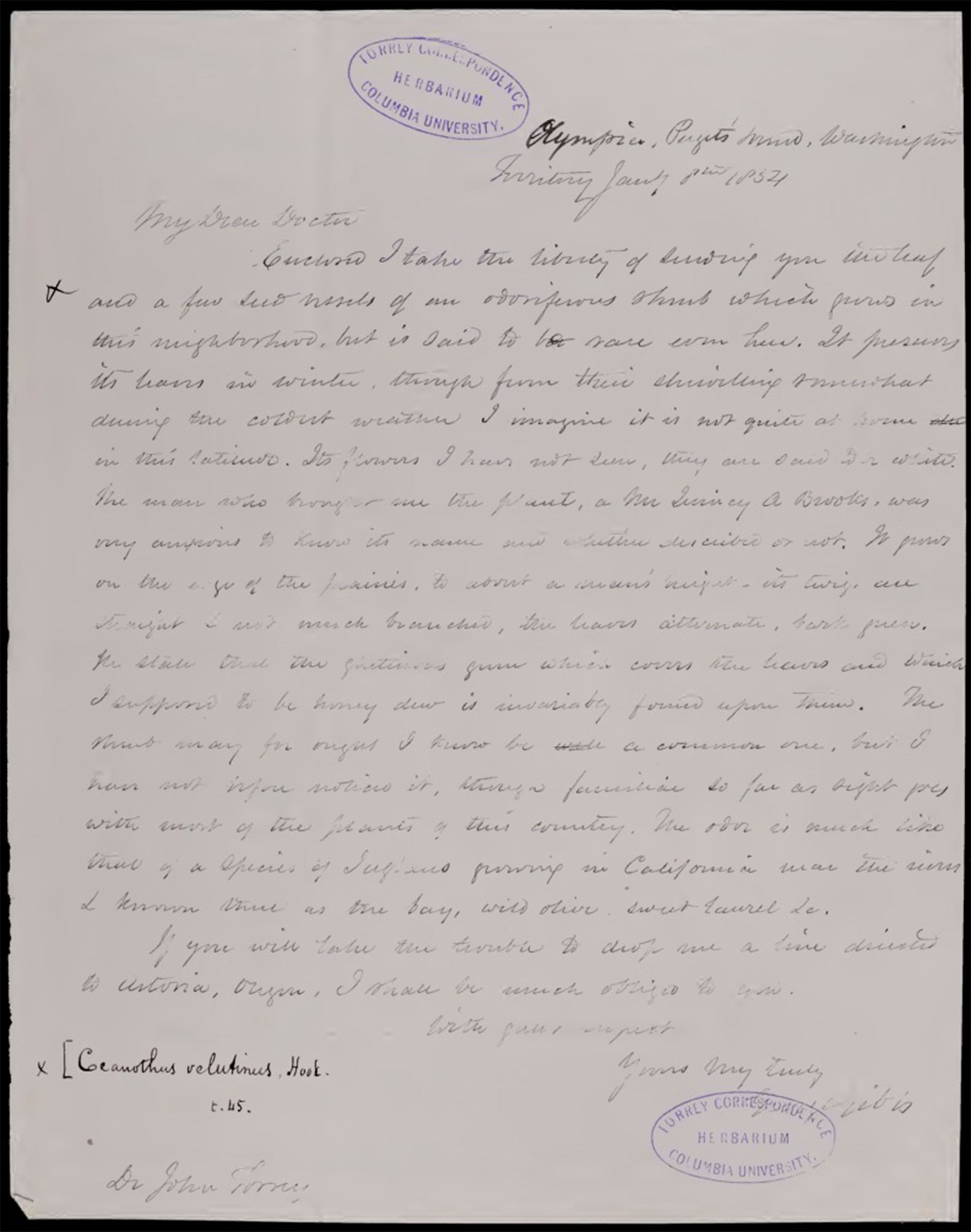
My Dear Doctor
I take the liberty of sending you a few specimens of the odoriferous shrub which grows in this neighborhood, but is said to be rare elsewhere. It preserves its leaves in winter, though from their shrivelling somewhat during the coldest weather I imagine it is not quite at home in this latitude. Its flowers I have not seen; they are said to be white.
A gentleman of the plant, a [Sissincy?] Brooks, was very anxious to know its name. It grows on the edge of the prairies, and is a small shrub with many branches; leaves alternate, and [?]. I should state that the glutinous resin which covers the leaves and branch and is thought to be honey dew is invariably found upon it. No one whom I have [asked?] noticed it, although familiar so far as [?] goes with most of the plants of this country. The odor is much like that of a species of [Sapium?] growing in California the bay, with other sweet laurel etc.
I hope you will take time to drop me a line … to Astoria, I shall be much obliged.
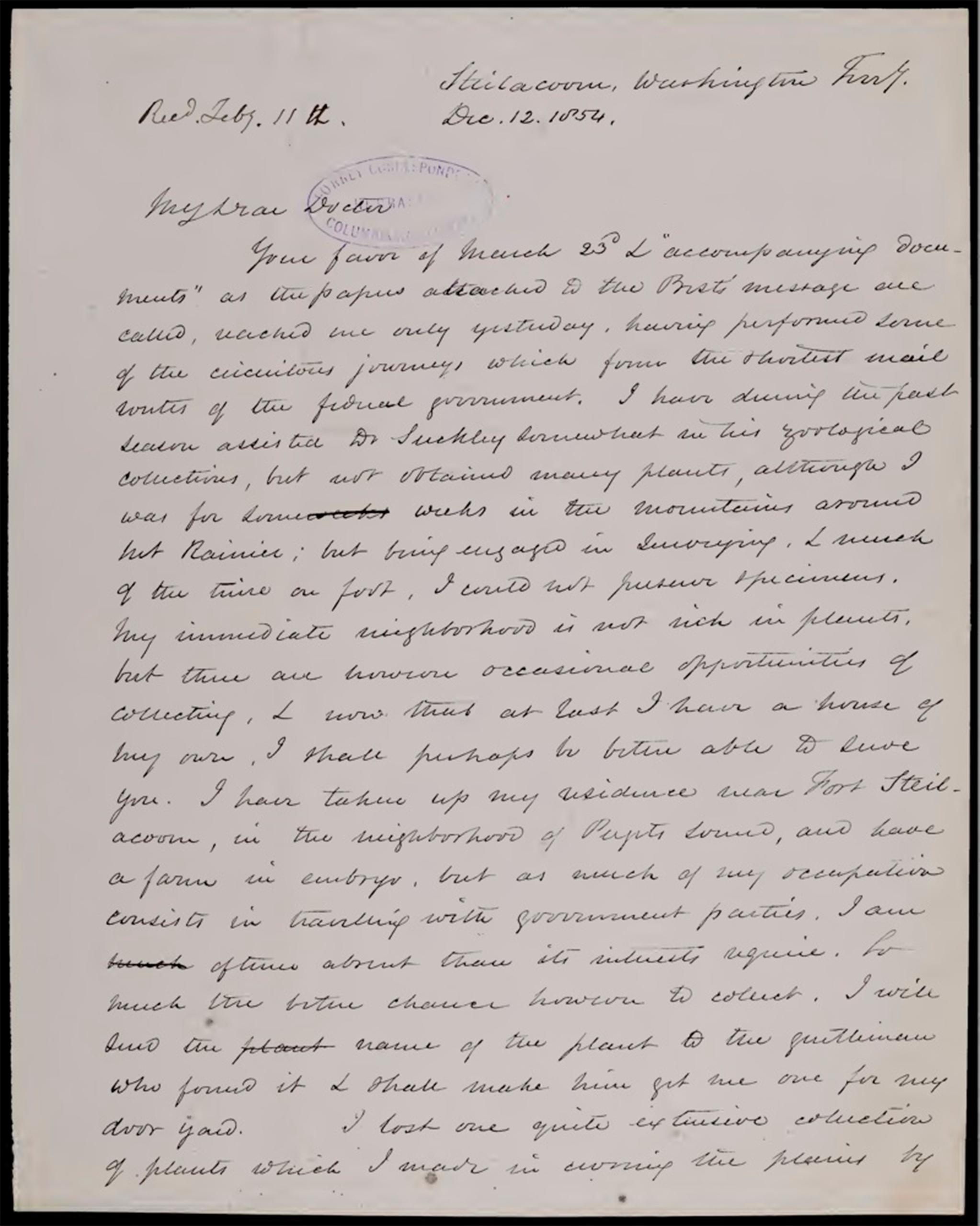
Your favor of March 25th accompanying “documents,” as the papers attached to the President’s message are called, reached me only yesterday, having performed some of the circuitous journeys which form the shortest mail routes of the federal government.
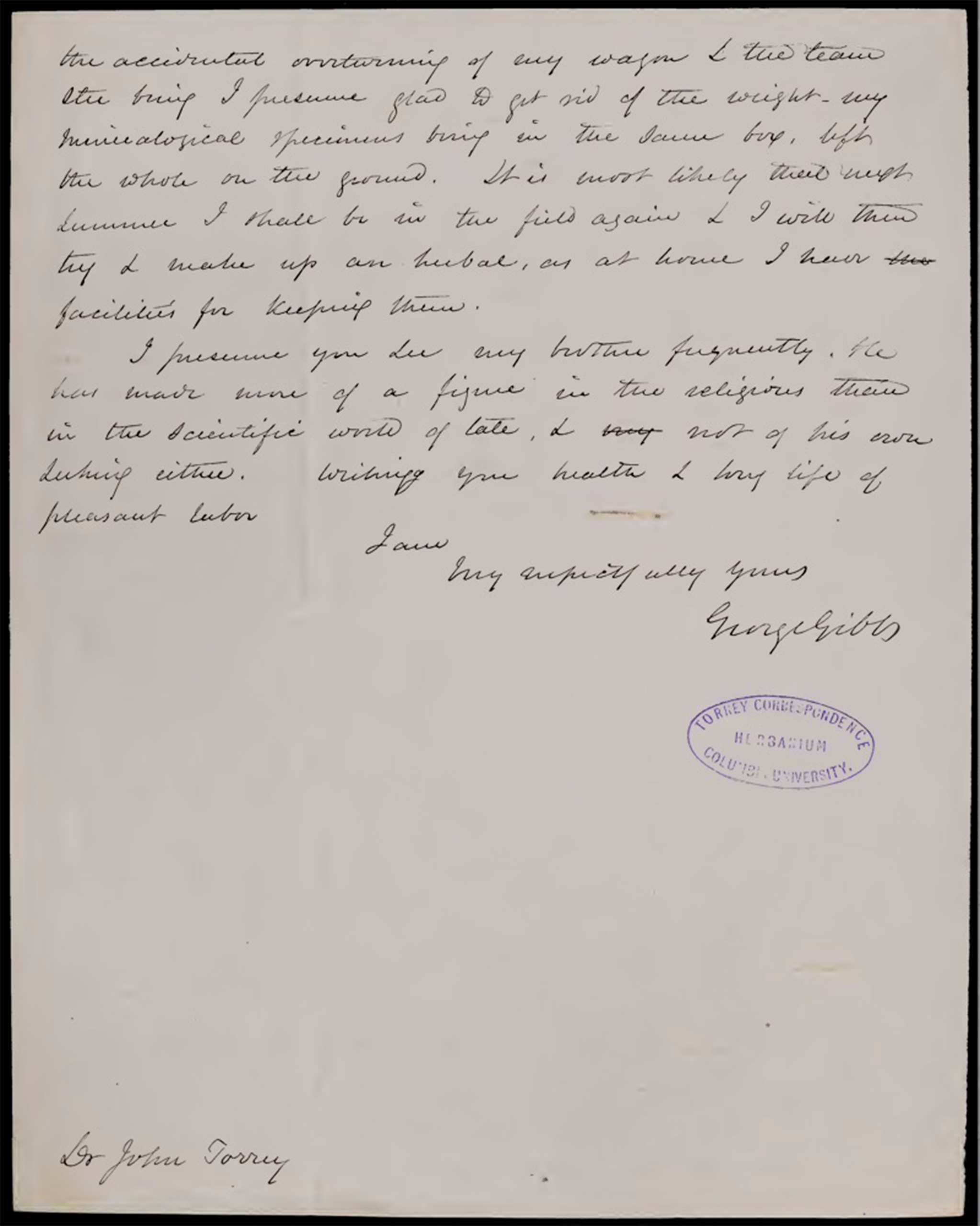
But as much of my occupation consists in traveling with government parties, I am more of times absent than its interests require. I have much the better chance however to collect. I will send the botanical name of the plant to the gentleman who found it and shall make him get more for you. I lost one quite extensive collection of plants which I made on the plains by the accidental overturning of my wagon. The teamster being I presume glad to get rid of the weight—my mineralogical specimens being in the same box—left the whole on the ground. It is most likely that next summer I shall be in the field again and I will then [collect more].
At home I have the facilities for keeping an herbal. I presume you see my brother frequently; he has made more of a figure in the religious than in the scientific world of late.
Wishing you health and a life of pleasant labor.
Most respectfully yours, George Gibbs
To: Dr. John Torrey
RESEARCHER’S NOTE: John Torrey and George Gibbs shared a close relationship rooted in scientific collaboration and mutual respect.
Relationship Between John Torrey and George Gibbs
While they were not biological relatives, their relationship was described as that of a mentor and assistant, and in many ways, Torrey viewed the younger George Gibbs as a “surrogate son”.
- Scientific Collaboration: In 1822, John Torrey named the mineral Gibbsite in honor of Colonel George Gibbs (the father of the George Gibbs in your letters and General Alfred Gibbs) to recognize the Colonel’s massive contributions to mineralogy.
- Professional Connection: Torrey often engaged the younger George Gibbs as an assistant, particularly during botanical collecting trips, such as one to the New Jersey pine barrens.
- Correspondence: As seen in the uploaded letters below from 1854, the younger George Gibbs (Alfred’s brother not George Gibbs the father) regularly sent Torrey botanical specimens from his travels in the Washington Territory, seeking Torrey’s expert identification (e.g., the Ceanothus velutinus).
Colonel George Gibbs and General Alfred Gibbs
Colonel George Gibbs (the mineralogist) is the father of General Alfred Gibbs.
- Paternal Relationship: Colonel George Gibbs (1776–1833) and his wife, Laura Wolcott, were the parents of seven children, including:
- George Gibbs (the Ethnologist/Artist): The author of the letters you provided.
- Wolcott Gibbs: A noted chemist and professor at Harvard.
- Alfred Gibbs: A Brigadier-General who served in the Civil War.
- The “II” vs. “III” Distinction: In many historical records, the mineralogist is referred to as Colonel George Gibbs III. His father (the shipping merchant) was George Gibbs II, and his grandfather was George Gibbs I. This means General Alfred Gibbs’ father is the man for whom the mineral Gibbsite is named.
This report introduces the 1854 correspondence of George Gibbs and establishes the historical and scientific context surrounding his family’s relationship with Dr. John Torrey.
Let’s Start With George Gibbs
George Gibbs (1815–1873) was a multifaceted 19th-century figure, an ethnologist, naturalist, and artist who made significant contributions to the exploration of the American West. While he is often overshadowed by his brother, the chemist Wolcott Gibbs, or his father, the mineralogist Colonel George Gibbs, his correspondence reveals a man deeply embedded in the scientific networks of his time.
The Relationship Between Gibbs and Torrey
The relationship between George Gibbs and the recipient of these letters, Dr. John Torrey, was one of professional mentorship and personal affection. Torrey, a titan of American botany and chemistry, had a long-standing history with the Gibbs family; in 1822, he named the mineral Gibbsite in honor of George’s father, Colonel George Gibbs, to recognize the Colonel’s massive mineralogical collection.
By the 1850s, the younger George Gibbs served as a vital field correspondent for Torrey. Operating from the Washington Territory, Gibbs acted as a “surrogate son” and assistant, collecting botanical specimens in rugged terrains that Torrey could not visit personally.
Analysis of the December 1854 Letter
In the letter dated December 12, 1854, from Steilacoom, Washington Territory, Gibbs provides a window into the challenges of frontier science.
Botanical Discovery and Observations
- The “Odoriferous Shrub”: Gibbs meticulously describes a shrub found on the “edge of the prairies” characterized by a “glutinous resin” and a scent similar to Californian laurel.
- Scientific Identification: A marginal note in the correspondence identifies this specimen as Ceanothus velutinus (commonly known as Snowbrush Ceanothus or Tobacco Brush).
- Environmental Notes: Gibbs observes the plant’s winter hardiness, noting that while it preserves its leaves, they “shrivel somewhat” during extreme cold.
The Hardships of Fieldwork
The correspondence highlights the physical risks to scientific data in the mid-19th century. Gibbs recounts the loss of an “extensive collection of plants” due to the “accidental overturning of my wagon”. He poignantly notes that the teamster, likely frustrated by the weight of accompanying mineralogical specimens, abandoned the entire collection on the ground.
The Gibbs Family Legacy
George Gibbs was part of a prominent American lineage. His father, Colonel George Gibbs, was the same man who fathered the Civil War Brigadier-General Alfred Gibbs. This connection tethers the scientific curiosity found in these letters to the broader military and social history of the United States.
References
Primary Source
Gibbs, G. (1854, December 12). Letter to Dr. John Torrey. George Gibbs to Johnson Gibbs Letter 2 [Manuscript]. Torrey Correspondence, Herbarium, Columbia University.
Secondary Sources
Columbia University. (n.d.). The Torrey Papers. Herbarium Collections Research.
Museum of Natural History. (n.d.). Biographical sketches of the Gibbs Family.
Smithsonian Institution. (n.d.). George Gibbs: Ethnologist and Naturalist of the Pacific Northwest.
Torrey, J. (1822). Description of the Gibbsite, a new mineral. The American Journal of Science and Arts.
Original Letter Below
Views: 20