The Indian Tribes of the Western District: George Gibbs’s 1856 Ethnography
The Gibbs Family Papers · Reel 2 · A Landmark Ethnography
The Indian Tribes of the Western District
George Gibbs’s 1856 report to Governor Stevens – the first systematic ethnography of Washington Territory, and the myths its Native tellers gave him.
George Gibbs first went west in 1849, marching to Oregon with the Mounted Riflemen; by the mid-1850s he was the geologist and ethnologist of Isaac Stevens’s Pacific railroad and treaty surveys, and a founder of what would become American anthropology of the Northwest Coast. In 1856, from Olympia, he handed Governor Stevens a manuscript of some two hundred and fifty pages: a systematic account of the tribes of Puget Sound and the lower Columbia – their geography and numbers, government, slavery and war, food, marriage and burial, the potlatch, medicine, houses, canoes and dress – and, at its heart, the mythology and the tales he had written down from named Native informants. Part of it went into John Wesley Powell’s great survey volumes in 1877; the tales themselves waited nearly a century, reaching print only in the 1950s. It is one of the most important things in the Gibbs Family Papers. Four of its pages are shown here in full; the whole is catalogued below.
❦The Report
The title page (1856)
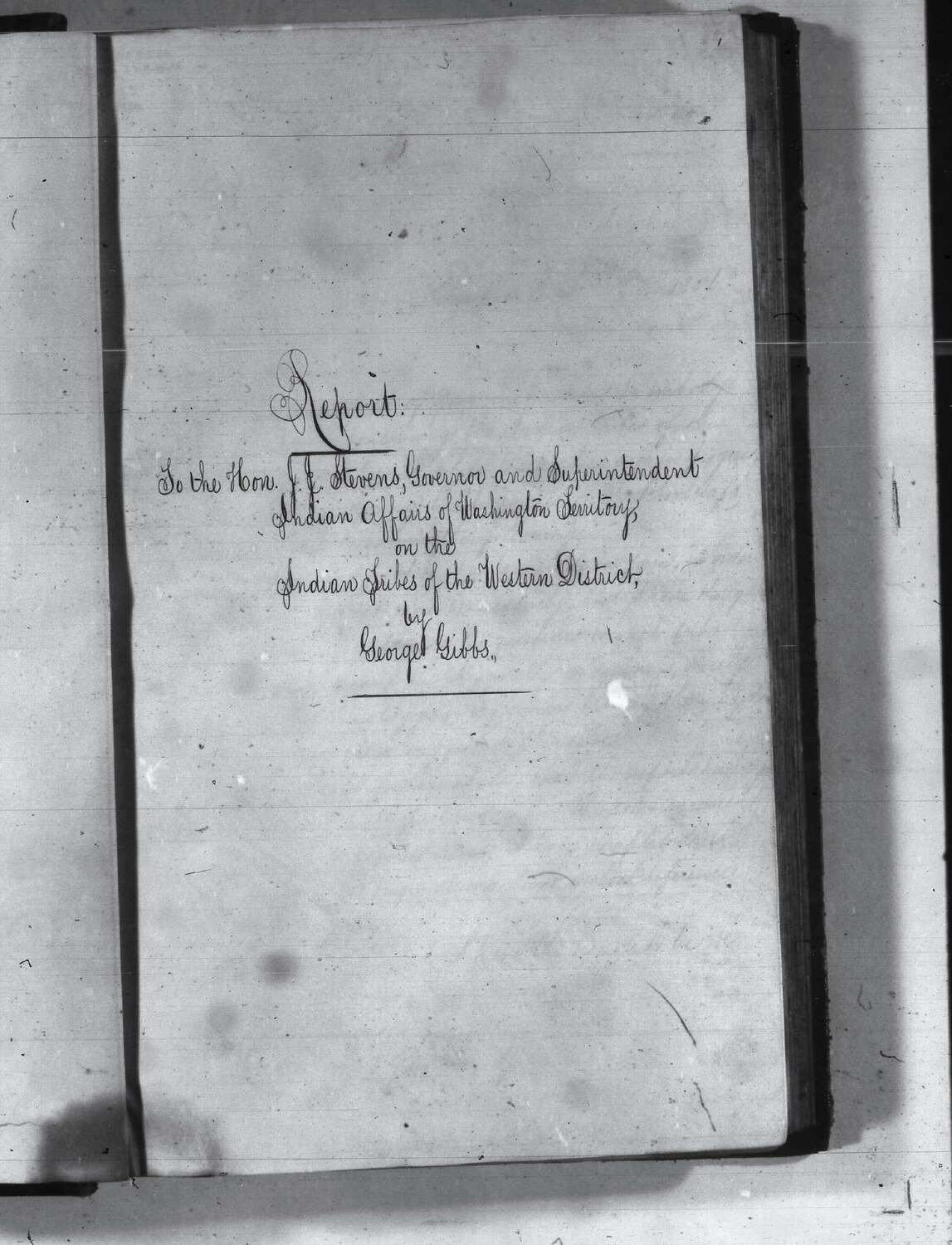
Report:
To the Hon. I. I. Stevens, Governor and Superintendent Indian Affairs of Washington Territory,
on the
Indian Tribes of the Western District,
by
George Gibbs.
The archivist’s note on where it was printed
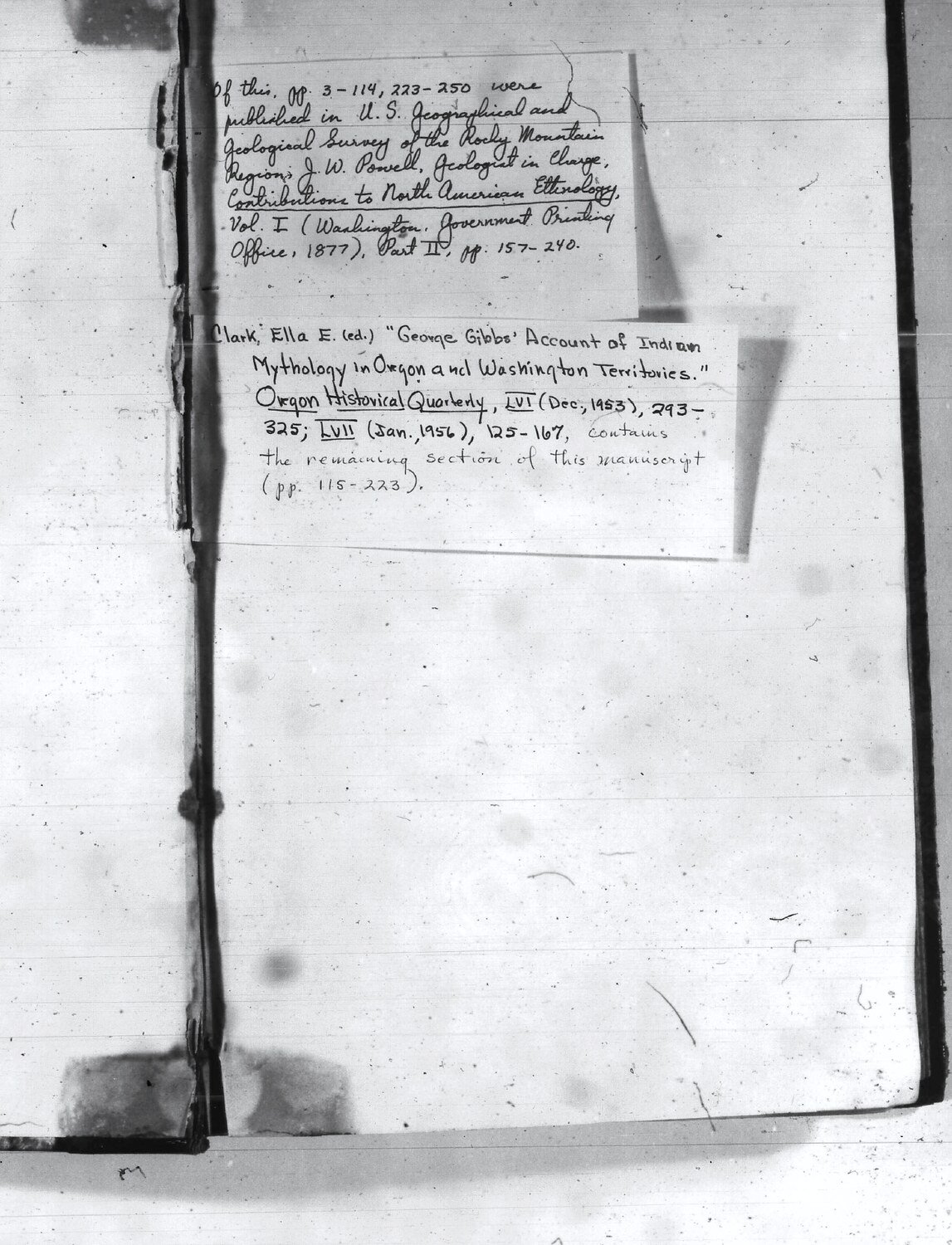
[Two archivist's slips pasted to the leaf.]
Of this, pp. 3-114, 223-250 were published in U.S. Geographical and Geological Survey of the Rocky Mountain Region; J. W. Powell, Geologist in Charge, Contributions to North American Ethnology, Vol. I (Washington, Government Printing Office, 1877), Part II, pp. 157-240.
Clark, Ella E. (ed.) "George Gibbs' Account of Indian Mythology in Oregon and Washington Territories." Oregon Historical Quarterly, LVI (Dec., 1953), 293-325; LVII (Jan., 1956), 125-167, contains the remaining section of this manuscript (pp. 115-223).
The Method
Gibbs did not simply retell stories; he compared them across tribes, matching the names of the same beings from language to language – the beginning of a comparative mythology of the Northwest. On this page (manuscript p. 118, near the opening of the section the tales belong to) he lines up the trickster-creator across half a dozen peoples: the Chinook Italipus, the Klikatat Spilyai, the Spokane Smeow, the Nisqually Whunneh – “both signifying prairie-wolf.”
Comparative mythology, p. 118
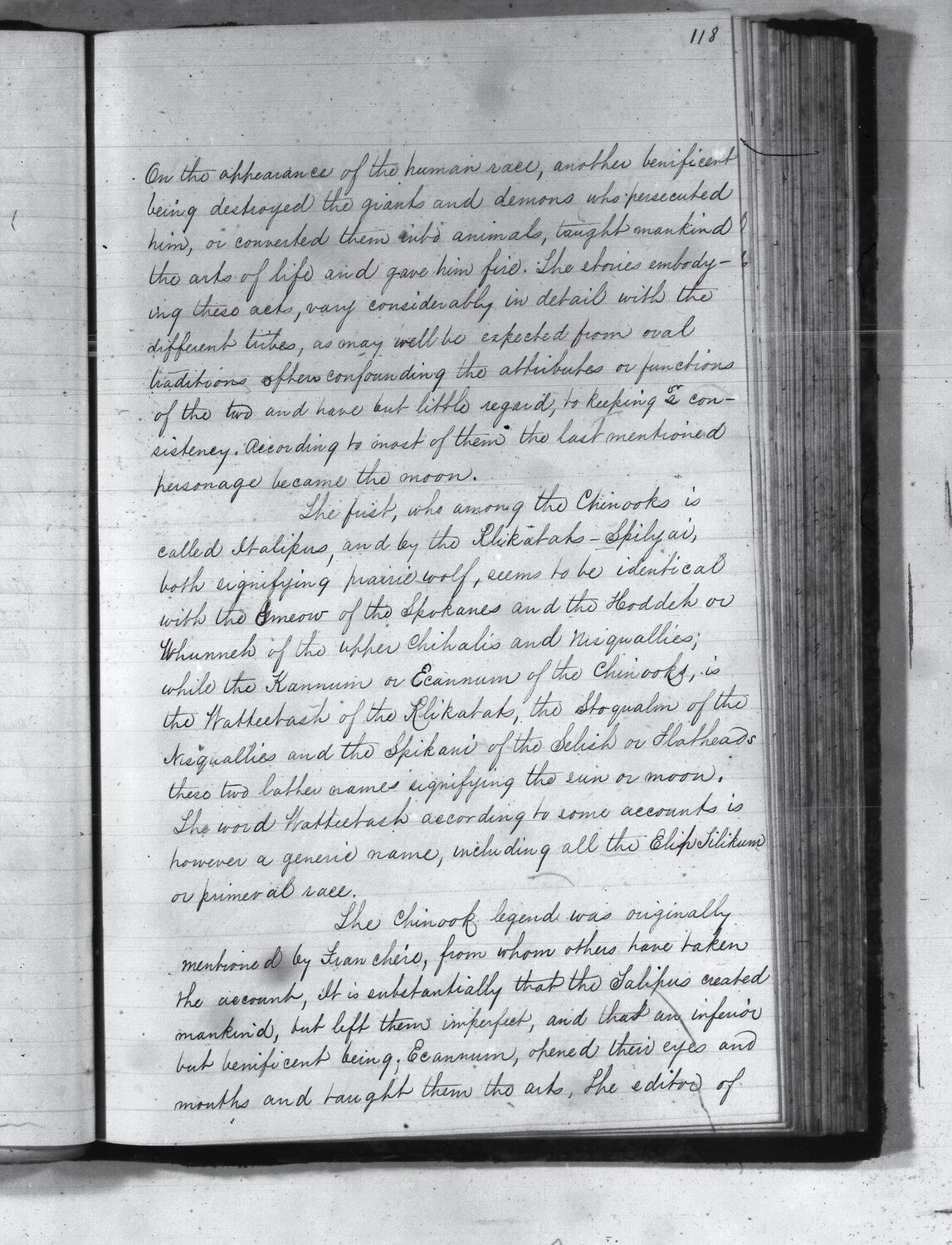
On the appearance of the human race, another benificent being destroyed the giants and demons who persecuted him, or converted them into animals, taught mankind the arts of life and gave him fire. The stories embodying these acts, vary considerably in detail with the different tribes, as may well be expected from oral traditions often confounding the attributes or functions of the two and have but little regard, to keeping up consistency. According to most of them the last mentioned personage became the moon.
The first, who among the Chinooks is called Italipus, and by the Klikatats – Spilyai, both signifying prairie-wolf, seems to be identical with the Smeow of the Spokanes and the Hoddeh or Whunneh of the upper Chihalis and Nisquallies; while the Kannum or Ecannum of the Chinooks, is the Watteetash of the Klikatats, the Stoqualm of the Nisquallies and the Spikani of the Selish or Flatheads these two latter names signifying the sun or moon. The word Wattetash according to some accounts is however a generic name, including all the Elip Tilikum or primeval race.
The Chinook legend was originally mentioned by Franchere, from whom others have taken the account, It is substantially that the Italipus created mankind, but left them imperfect, and that an inferior but benificent being, Ecannum, opened their eyes and mouths and taught them the arts. The editor of […]
A Tale: The Snow Peaks
Among the tales is a Klikatat account of how the great volcanoes of the Cascades came to be. Three brothers – Pahtoo (Mount St. Helens), Weeit (Mount Hood), and Wacheum (Mount Rainier) – quarrel and behead one another; the flying heads become Mount Adams (Tahoma) and a peak in the Winatshapum country, and the brothers themselves become the mountains that stand along the sky today. Here is the heart of it, in Gibbs’s hand, on manuscript page 202.
“The Snow Peaks. (Klikatat.)” – p. 202
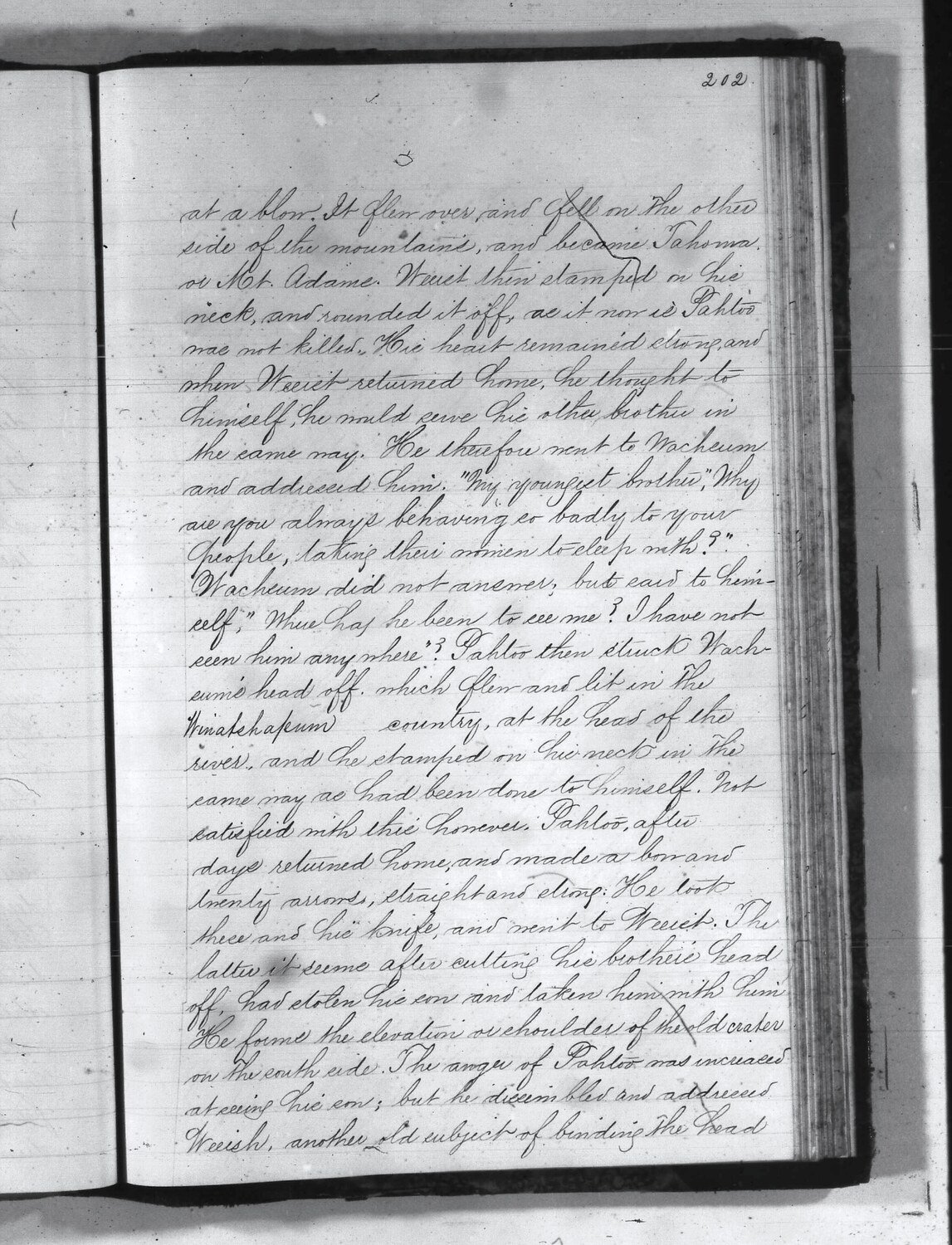
[ms p. 202; continuing the tale of the Snow Peaks (Klikatat).]
[…] at a blow. It flew over, and fell on the other side of the mountains, and became Tahoma, or Mt. Adams. Weeit then stamped on his neck, and rounded it off, as it now is. Pahtoo was not killed. His heart remained strong, and when Weeit returned home, he thought to himself, he would serve his other brother in the same way. He therefore went to Wacheum and addressed him. "My youngest brother, Why are you always behaving so badly to your people, taking their women to sleep with?" Wacheum did not answer, but said to himself, "Where has he been to see me? I have not seen him anywhere"? Pahtoo then struck Wacheum's head off. which flew and lit in the Winatshapum country, at the head of the river. and he stamped on his neck in the same way as had been done to himself. Not satisfied with this however. Pahtoo, after days returned home, and made a bow and twenty arrows, straight and strong. He took these and his knife, and went to Weeit. The latter it seems after cutting his brother's head off, had stolen his son and taken him with him. He found the elevation or shoulder of the old crater on the south side. The anger of Pahtoo was increased at seeing his son; but he dissembled and addressed Weeish, another old subject of binding the head […]
What the Manuscript Contains
Beyond the four pages above, the report runs to roughly two hundred and fifty manuscript pages. Its major parts, as filmed on Reel 2 (scans 1633-1737 and 3738-3902):
| Section | What it covers |
|---|---|
| The tribes | Geography, numbers and censuses, government, rank and slavery, war, food, marriage, burial, the potlatch, medicine and the tamahnous doctors, houses, canoes, and dress of the peoples of Puget Sound and the lower Columbia. |
| Mythology | The trickster-creators Italipus / Spilyai and the being Ecannum / Wahteetash; Do-kwe-butl, creator of the Sound tribes; the Skookooms; the Tamahnous (spirit power), the spirit quest, and the medicine doctors; Flathead cosmology taken from Fr. Gregory Mengarini. |
| The Tales (ms pp. 115-223) | The History of Spilyai (Coyote) and the freeing of the salmon; the Wattetash; Sloqualm the moon; the Snow Peaks; Yahpohalla the water-spider; Josup; the Seal Hunters; transformed-rock legends of the coast; the land of the dead; the origins of sun, moon and stars. This is the section Ella Clark printed in the 1950s. |
The People Who Told It
What lifts this manuscript above the travel-writing of its day is that Gibbs names his sources – Native and settler alike. Among the Native tellers are Laeh-kanam, a S’Klallam, and Winapat, a Snohomish chief, whose account of the five peoples grown like trees Gibbs sets down under his own name. He also draws on the settler observers James G. Swan and Judge Sidney Ford of the upper Chehalis, and on the Jesuit Gregory Mengarini for the Flathead material – a web of testimony, credited, in a period when Native informants usually went unnamed.
Archival citation
Gibbs Family Papers, 1763-1918. U.S. Mss Y; Micro 1117; Photo Lots 3696-3697. Wisconsin Historical Society, Madison, Wis. Digitized research copy (Green collection), Reel 2. Two manuscript copies are filmed on Reel 2 (scans 1633-1737 and 3738-3902); the four pages exhibited above are shown with complete transcription, and the remainder is catalogued, not reproduced, here.
Suggested citation (Chicago): George Gibbs, “Report to Hon. I. I. Stevens… on the Indian Tribes of the Western District” (Olympia, W.T., 1856). Gibbs Family Papers, 1763-1918, U.S. Mss Y, Micro 1117, reel 2. Wisconsin Historical Society, Madison, WI. Accessed via AlfredGibbs.com.
Where It Was Published
Related in the Record
References
Gibbs, G. (1856). Report to Hon. I. I. Stevens… on the Indian tribes of the Western District [Manuscript]. Gibbs Family Papers, 1763-1918. U.S. Mss Y; Micro 1117; Photo Lots 3696-3697. Wisconsin Historical Society, Madison, Wis. Digitized research copy (Green collection), Reel 2.
Gibbs, G. (1877). Tribes of western Washington and northwestern Oregon. In J. W. Powell (Ed.), Contributions to North American ethnology (Vol. 1, Part II, pp. 157-240). Washington, DC: Government Printing Office.
Clark, E. E. (Ed.). (1953-1956). George Gibbs’ account of Indian mythology in Oregon and Washington Territories. Oregon Historical Quarterly, LVI (Dec. 1953), 293-325; LVII (Jan. 1956), 125-167.
Accuracy review: transcription checked against the full-resolution scans, July 11, 2026. Original spelling and punctuation are preserved; editorial matter appears in square brackets and uncertain readings are marked [?] rather than guessed. Corrections are made openly; this page will be updated, never silently, if better readings are established.
Views: 19