Blackwater, Va., December 2 and 28, 1862
The Civil War · The Blackwater Line · December 2 & 28, 1862
Blackwater, December 1862
The regiment’s first entry on its roll of engagements: a night march out of Suffolk, a Confederate cavalry charge at breakfast, and the famous Petersburg Rocket Battery — taken from McClellan’s army on the Peninsula — brought back into Union hands.
Update, July 14, 2026: this page was rebuilt from primary sources — Bowen’s regimental history and the Official Records, both shown below — replacing an earlier AI-assisted draft that did not meet the site’s sourcing standards.
On the night of December 1, 1862, the 130th New York marched out of Suffolk on the Franklin road under Colonel Alfred Gibbs, one regiment in an expedition of about 3,100 men commanded by Colonel Samuel P. Spear of the 11th Pennsylvania Cavalry. By morning the column stood near Franklin, on ground the enemy had just abandoned, and the men who would one day be the First New York Dragoons were about to watch their first fight.
Why They Marched
Bowen admits the object of the Blackwater marches was “somewhat of a mystery” to the men in the ranks, and answers it from the official record: General Dix had told Halleck, “I have directed Major-General Peck to keep his forces constantly in motion, so as to accustom them to marching instead of resting in camp.” Peck himself gave a twofold reason — to cooperate with General Foster in North Carolina by drawing off the enemy, and to keep himself informed of what forces threatened Suffolk. Dix’s report of this expedition, exhibited below, says exactly that.
Spear’s Charge
While the column was breakfasting near Franklin, its pickets were driven in by a charge of about five hundred Confederate cavalry with a section of a rocket battery. Spear met it at the head of three hundred of his Pennsylvanians; the enemy recoiled in confusion and was chased across the Blackwater’s floating bridge under the heavy guns at Franklin. The 130th, formed in line of battle, watched the whole spectacle; as Bowen wrote, “to us at that time this splendid charge was a thrilling spectacle, although later on in our experiences cavalry charges ceased to be a novelty.”
Within twenty minutes our men commenced bringing in prisoners and spoils. Among the trophies was the recapture of the famous Rocket Battery, taken from McClellan during the seven-days’ fight before Richmond. Twelve of the enemy were killed, and twenty-one prisoners captured, besides horses, saddles, guns, etc. … Our boys also had the satisfaction of witnessing the working of the rocket battery. Among the prisoners were the gunners who worked it, and for a joke they were ordered to return the fire, in answer to the rebel guns across the Blackwater.— James R. Bowen, Regimental History of the First New York Dragoons (1900), ch. IV, pp. 51–52. Read the chapter on this site.
Bowen’s tally — twelve killed, twenty-one prisoners — sits within a nod of the official count: Dix reported “ten or 12 of the enemy were killed and 20 were taken prisoners,” with fourteen horses, seven saddles, forty-two rifles, and seventy rockets of twelve and fifteen pounds. The regimental memory and the official record, written thirty-eight years apart, agree.
The Second Affair: December 28
The regiment’s roll carries a second entry, “Near Blackwater, Va., Dec. 28, 1862.” It is a quiet one. Bowen’s narrative passes over it, and no report of a December 28 affair was printed in the Official Records volume covering these operations. It survives as a line in the roll — one of the many marches to the river’s edge that December — and this page does not invent more than the record holds.
The Official Record
The skirmish of December 2 was reported up the chain twice — by General Dix at Fort Monroe and by General Peck at Suffolk — and both reports name the 130th New York and Colonel Gibbs in the expedition’s order of battle. All three pages of the record are shown whole, scanned from the original printing.
Dix to Halleck: “The Celebrated Petersburg Rocket Battery”
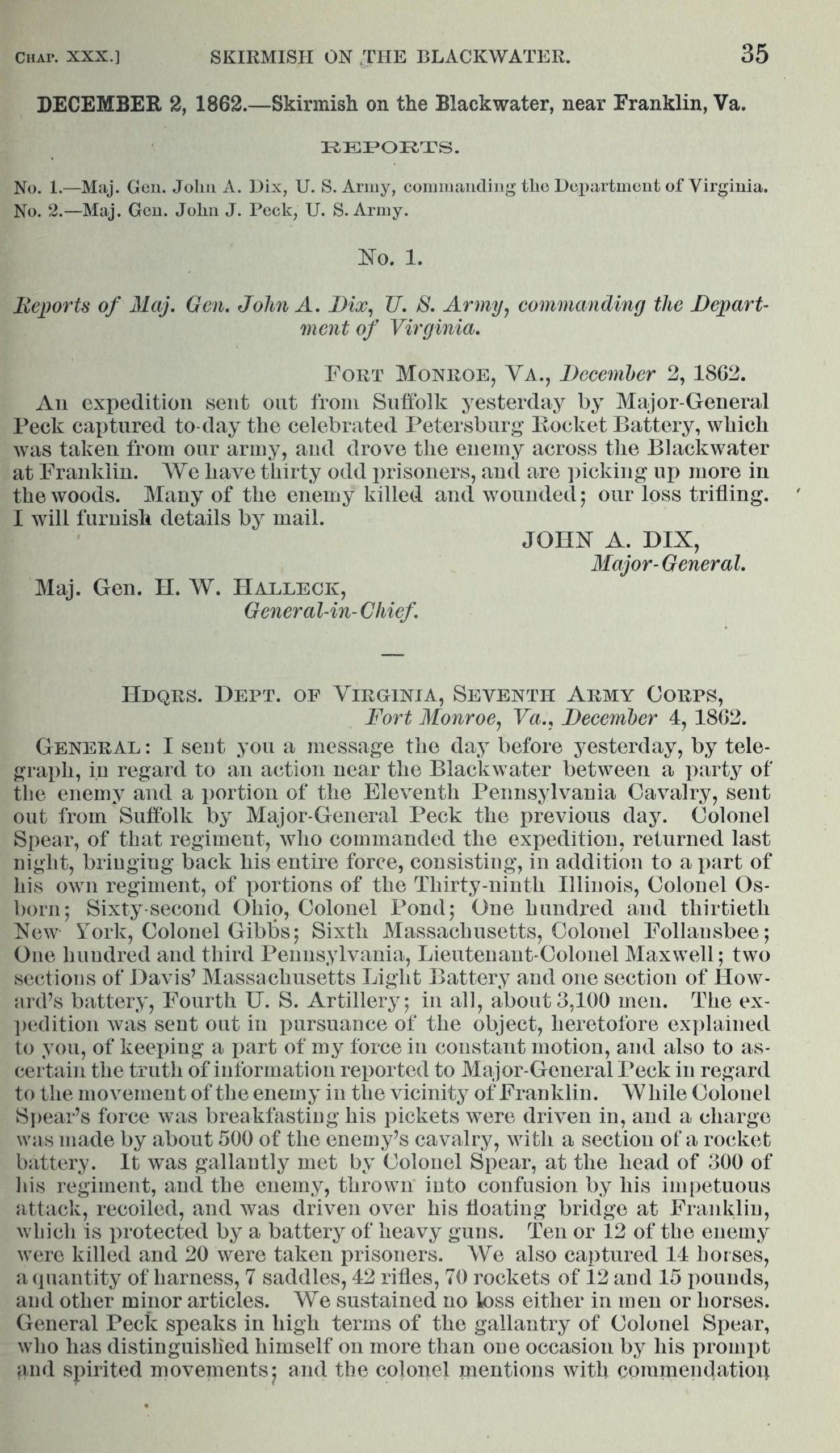
DECEMBER 2, 1862.—Skirmish on the Blackwater, near Franklin, Va.
No. 1. Reports of Maj. Gen. John A. Dix, U. S. Army, commanding the Department of Virginia.
FORT MONROE, VA., December 2, 1862.
An expedition sent out from Suffolk yesterday by Major-General Peck captured to-day the celebrated Petersburg Rocket Battery, which was taken from our army, and drove the enemy across the Blackwater at Franklin. We have thirty odd prisoners, and are picking up more in the woods. Many of the enemy killed and wounded; our loss trifling. I will furnish details by mail.
JOHN A. DIX,
Major-General.
Maj. Gen. H. W. HALLECK, General-in-Chief.
HDQRS. DEPT. OF VIRGINIA, SEVENTH ARMY CORPS,
Fort Monroe, Va., December 4, 1862.
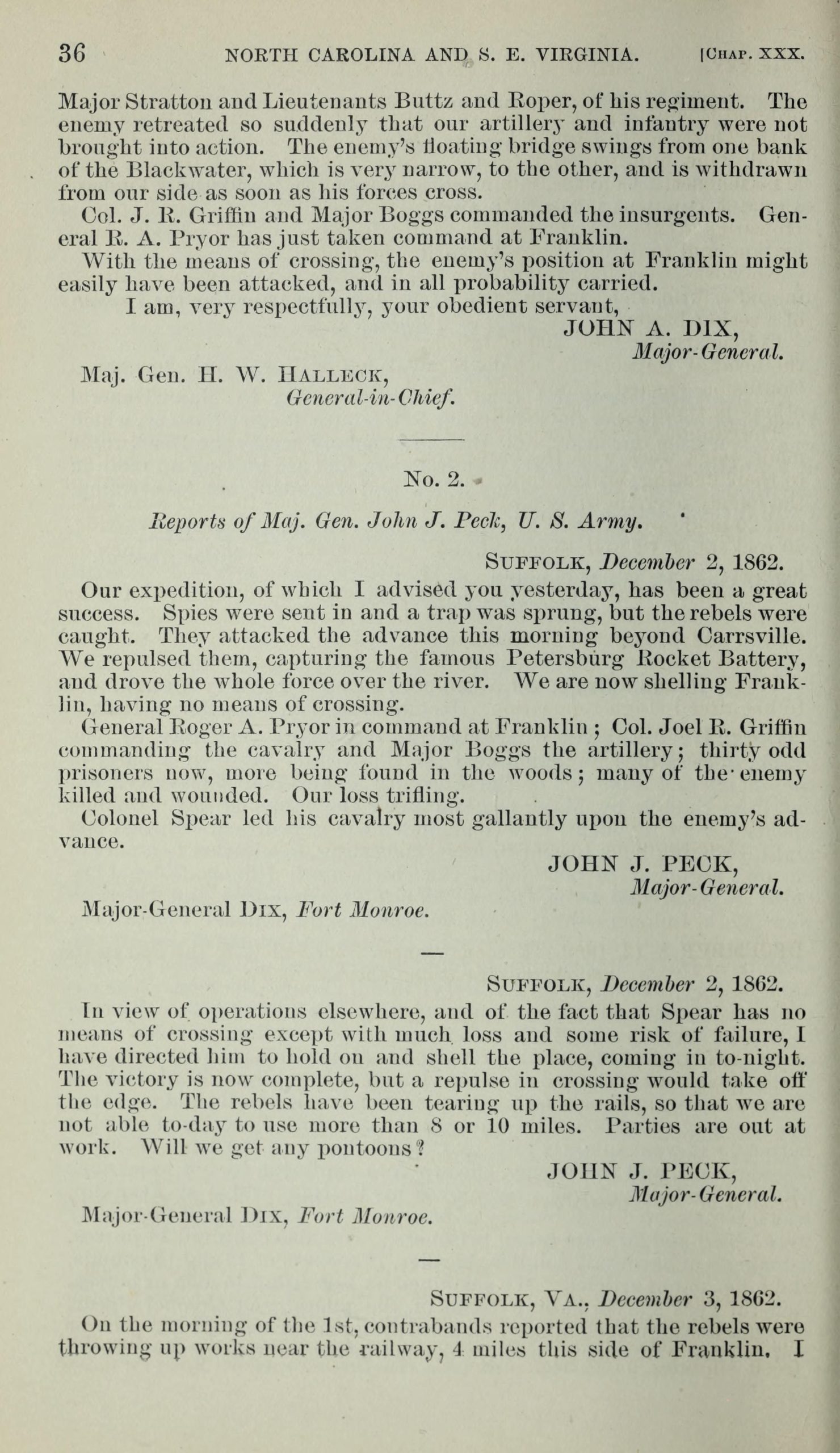
GENERAL: I sent you a message the day before yesterday, by telegraph, in regard to an action near the Blackwater between a party of the enemy and a portion of the Eleventh Pennsylvania Cavalry, sent out from Suffolk by Major-General Peck the previous day. Colonel Spear, of that regiment, who commanded the expedition, returned last night, bringing back his entire force, consisting, in addition to a part of his own regiment, of portions of the Thirty-ninth Illinois, Colonel Osborn; Sixty-second Ohio, Colonel Pond; One hundred and thirtieth New York, Colonel Gibbs; Sixth Massachusetts, Colonel Follansbee; One hundred and third Pennsylvania, Lieutenant-Colonel Maxwell; two sections of Davis’ Massachusetts Light Battery and one section of Howard’s battery, Fourth U. S. Artillery; in all, about 3,100 men. The expedition was sent out in pursuance of the object, heretofore explained to you, of keeping a part of my force in constant motion, and also to ascertain the truth of information reported to Major-General Peck in regard to the movement of the enemy in the vicinity of Franklin. While Colonel Spear’s force was breakfasting his pickets were driven in, and a charge was made by about 500 of the enemy’s cavalry, with a section of a rocket battery. It was gallantly met by Colonel Spear, at the head of 300 of his regiment, and the enemy, thrown into confusion by his impetuous attack, recoiled, and was driven over his floating bridge at Franklin, which is protected by a battery of heavy guns. Ten or 12 of the enemy were killed and 20 were taken prisoners. We also captured 14 horses, a quantity of harness, 7 saddles, 42 rifles, 70 rockets of 12 and 15 pounds, and other minor articles. We sustained no loss either in men or horses. General Peck speaks in high terms of the gallantry of Colonel Spear, who has distinguished himself on more than one occasion by his prompt and spirited movements; and the colonel mentions with commendation Major Stratton and Lieutenants Buttz and Roper, of his regiment. The enemy retreated so suddenly that our artillery and infantry were not brought into action. The enemy’s floating bridge swings from one bank of the Blackwater, which is very narrow, to the other, and is withdrawn from our side as soon as his forces cross.
Col. J. R. Griffin and Major Boggs commanded the insurgents. General R. A. Pryor has just taken command at Franklin.
With the means of crossing, the enemy’s position at Franklin might easily have been attacked, and in all probability carried.
I am, very respectfully, your obedient servant,
JOHN A. DIX,
Major-General.
Maj. Gen. H. W. HALLECK, General-in-Chief.
U.S. War Dept., The War of the Rebellion: Official Records of the Union and Confederate Armies, Series I, Vol. 18 (Washington: GPO, 1887), pp. 35–36. Page scans hosted by this site from the original printing; transcribed in full above.
Peck’s Reports: “A Trap Was Sprung”
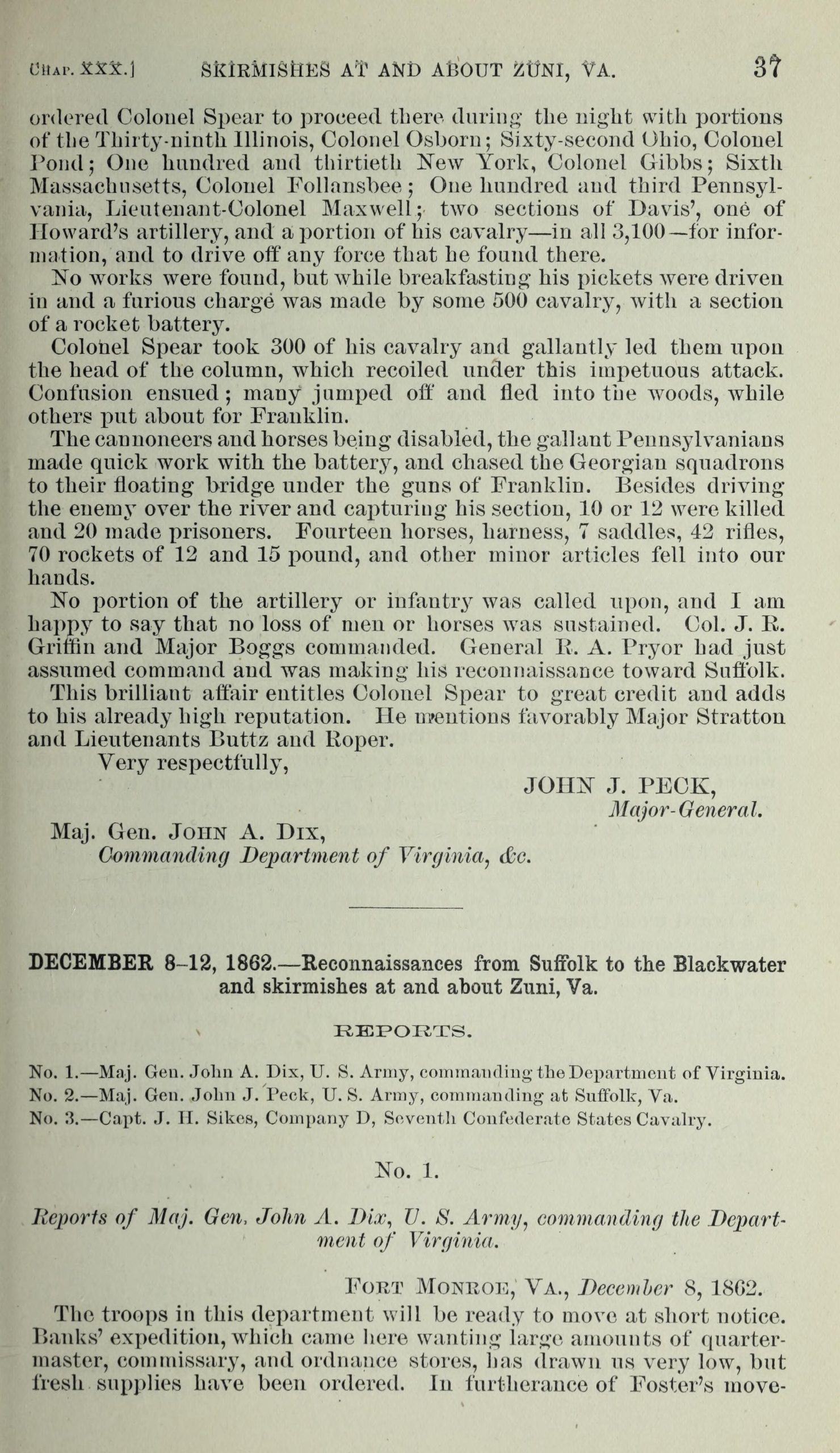
No. 2. Reports of Maj. Gen. John J. Peck, U. S. Army.
SUFFOLK, December 2, 1862.
Our expedition, of which I advised you yesterday, has been a great success. Spies were sent in and a trap was sprung, but the rebels were caught. They attacked the advance this morning beyond Carrsville. We repulsed them, capturing the famous Petersburg Rocket Battery, and drove the whole force over the river. We are now shelling Franklin, having no means of crossing.
General Roger A. Pryor in command at Franklin; Col. Joel R. Griffin commanding the cavalry and Major Boggs the artillery; thirty odd prisoners now, more being found in the woods; many of the enemy killed and wounded. Our loss trifling.
Colonel Spear led his cavalry most gallantly upon the enemy’s advance.
JOHN J. PECK,
Major-General.
Major-General DIX, Fort Monroe.
SUFFOLK, December 2, 1862.
In view of operations elsewhere, and of the fact that Spear has no means of crossing except with much loss and some risk of failure, I have directed him to hold on and shell the place, coming in to-night. The victory is now complete, but a repulse in crossing would take off the edge. The rebels have been tearing up the rails, so that we are not able to-day to use more than 8 or 10 miles. Parties are out at work. Will we get any pontoons?
JOHN J. PECK,
Major-General.
Major-General DIX, Fort Monroe.
SUFFOLK, VA., December 3, 1862.
On the morning of the 1st, contrabands reported that the rebels were throwing up works near the railway, 4 miles this side of Franklin. I ordered Colonel Spear to proceed there during the night with portions of the Thirty-ninth Illinois, Colonel Osborn; Sixty-second Ohio, Colonel Pond; One hundred and thirtieth New York, Colonel Gibbs; Sixth Massachusetts, Colonel Follansbee; One hundred and third Pennsylvania, Lieutenant-Colonel Maxwell; two sections of Davis’, one of Howard’s artillery, and a portion of his cavalry—in all 3,100—for information, and to drive off any force that he found there.
No works were found, but while breakfasting his pickets were driven in and a furious charge was made by some 500 cavalry, with a section of a rocket battery.
Colonel Spear took 300 of his cavalry and gallantly led them upon the head of the column, which recoiled under this impetuous attack. Confusion ensued; many jumped off and fled into the woods, while others put about for Franklin.
The cannoneers and horses being disabled, the gallant Pennsylvanians made quick work with the battery, and chased the Georgian squadrons to their floating bridge under the guns of Franklin. Besides driving the enemy over the river and capturing his section, 10 or 12 were killed and 20 made prisoners. Fourteen horses, harness, 7 saddles, 42 rifles, 70 rockets of 12 and 15 pound, and other minor articles fell into our hands.
No portion of the artillery or infantry was called upon, and I am happy to say that no loss of men or horses was sustained. Col. J. R. Griffin and Major Boggs commanded. General R. A. Pryor had just assumed command and was making his reconnaissance toward Suffolk.
This brilliant affair entitles Colonel Spear to great credit and adds to his already high reputation. He mentions favorably Major Stratton and Lieutenants Buttz and Roper.
Very respectfully,
JOHN J. PECK,
Major-General.
Maj. Gen. JOHN A. DIX,
Commanding Department of Virginia, &c.
U.S. War Dept., The War of the Rebellion: Official Records of the Union and Confederate Armies, Series I, Vol. 18 (Washington: GPO, 1887), pp. 36–37. Peck’s December 3 report opens on page 36 and concludes on page 37, where his order of battle names the 130th New York under Colonel Gibbs. Page scans hosted by this site; transcribed in full above.
Sources & Further Reading
- Primary James R. Bowen, Regimental History of the First New York Dragoons (originally the 130th N.Y. Vol. Infantry) (1900), ch. IV, “Black Water Marches,” pp. 50–52 — the eyewitness account and the verbatim quotation above. Read the chapter in full on this site. Bowen’s roll lists both “Blackwater, Va., Dec. 2, 1862” and “Near Blackwater, Va., Dec. 28, 1862” in the regiment’s official roll of engagements.
- Primary U.S. War Dept., The War of the Rebellion: Official Records of the Union and Confederate Armies, Series I, Vol. 18, pp. 35–37 — the two reports of the skirmish, exhibited in full above. No December 28 report appears in the volume.
- Note on this page: an earlier version was drafted with AI assistance in 2024 and carried no primary sources; it was retired on July 14, 2026 and replaced with this rebuild. The regiment fought over this same ground again in June 1863: see South Quay, Franklin, and the Blackwater, June 16–17.
Deserted House · Siege of Suffolk · How the 130th Became Cavalry · The Audiobook
Views: 64