Battle Near Franklin, Va., June 13, 1863.
The Civil War · Suffolk Campaign · June 13, 1863
Near Franklin
A skirmish on the Blackwater — the last shots the 130th New York fired in the Suffolk country before the regiment left for the Peninsula and its transformation into cavalry.
On June 13, 1863, the men who would one day become the First New York Dragoons were still foot soldiers — the 130th New York Volunteer Infantry, Colonel Alfred Gibbs commanding. The great Siege of Suffolk had lifted a month before, and in the idle weeks that followed the regiment was sent out on a six-days’ reconnaissance along the Blackwater River. Near Franklin, in Southampton County, the 130th drove Confederate skirmishers from their rifle-pits, captured a set of works and a rebel mail, and traded shots with sharpshooters posted in the treetops. It was a small affair — two men killed and three wounded over the whole expedition — but it closed the regiment’s long service in the Suffolk lines. Six days later the men struck their tents and marched away to the Peninsula.
After the Siege
Confederate Lt. Gen. James Longstreet lifted the Siege of Suffolk in the first days of May 1863, and for the next seven weeks the 130th New York remained in the works around the town. Bowen recalled that during “the forty-seven days we remained at Suffolk after close of the siege, nothing of special importance occurred except a six-days’ reconnoissance on the Blackwater.” That expedition — the regiment’s last active service in the Suffolk country — marched out on June 12, 1863, by way of Holland’s Corners, under the command of Brig. Gen. Michael Corcoran.
Across the River at South Quay
Reaching South Quay on the morning of the 13th, the column found the enemy holding the far bank of the Blackwater. The 130th New York was put in advance, deployed as skirmishers, and drove the Confederates across the river. Near the bank stood two large residences owned by rebel officers; in them the regiment seized a captured Confederate mail — letters, Bowen noted, that had been smuggled out of Suffolk “through our picket lines by innocent-appearing old farmers.” After the men had taken what they wanted, the houses, together with several thousand pounds of pork, were burned.
Skirmishing at Franklin
From South Quay the regiment marched by way of Carsville for Franklin, where it had more skirmishing and carried a line of rebel works, the defenders “skipping out” as the 130th came on. One of Bowen’s comrades remembered a moment of pure incongruity: as the men tumbled into the captured rifle-pits, a soldier of the regiment found a fiddle and, with the fight still going on around him, fell to playing and dancing.
After days of marching and countermarching by Carsville and Blackwater Bridge, the regiment came back to Franklin a second time. There, in a sharp engagement on June 17, Confederate sharpshooters firing from treetops and from behind breastworks inflicted the expedition’s only serious loss — two of the 130th killed and three wounded across the six days out.
“Next we marched via Carsville for Franklin, where we had more skirmishing, and captured some rebel works, the occupants skipping out as we approached. Comrade A. F. Robinson relates that as we entered the captured pits, one of our regiment found a violin, and while the fight was in progress, commenced playing and dancing.”— James R. Bowen, Regimental History of the First New York Dragoons (1900), ch. V, “Siege of Suffolk,” p. 81.
Off to the Peninsula
The march home, some twenty miles in intense summer heat, became a point of pride: not a man of the 130th New York fell out, though half the men of some regiments dropped by the roadside. Even General Corcoran — whom Bowen otherwise despised — admitted the regiment’s superiority over his own vaunted Legion. Back at Suffolk the men found orders waiting. On June 19, 1863 they bade farewell to their camps and, to the tune of “The Girl I Left Behind Me,” marched to the cars for Norfolk, Yorktown, and the Peninsula. Their days as infantry were nearly over; before the year was out the 130th New York would be converted to cavalry — designated at first the Nineteenth New York Cavalry, and then, by the name adopted on dress parade that October 10 and confirmed by the governor of New York, the First New York Dragoons. The story of that conversion is told on its own page.
Update, July 14, 2026: an earlier version of this page said the regiment was remounted as the “First New York (Lincoln) Cavalry.” That was wrong: the Lincoln Cavalry was the 1st New York Volunteer Cavalry, a different regiment raised in 1861. Bowen (pp. 98–99) is explicit that the 130th became the Nineteenth New York Cavalry and then the First New York Dragoons. The Official Records citation below was also corrected from Vol. 18 to Vol. 27.
The Official Record
The expedition left almost no official paper trail — which is why this page leans on Bowen — but it is not quite silent. Two reports were printed in the Official Records, and both are shown here whole, scanned from the original 1889 printing — followed by the correspondence that explains why the expedition marched at all.
The Union Record: Col. McEvily’s Itinerary
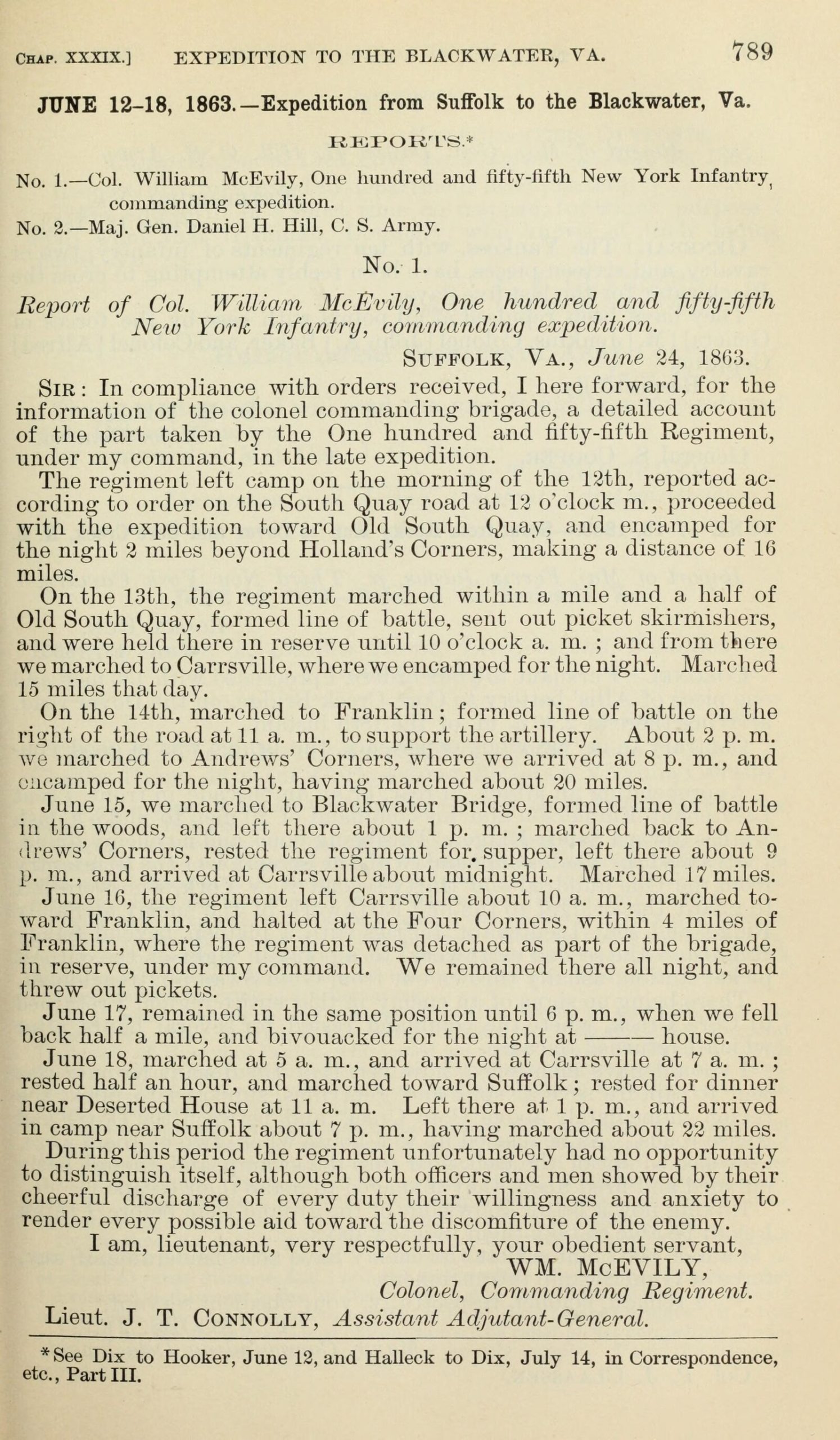
Only two reports of the expedition were printed in the Official Records, and neither is by the 130th New York; the Union report is the day-by-day itinerary of Col. William McEvily of the 155th New York — a regiment of Corcoran’s own Irish Legion — and it confirms Bowen’s route march for march: the South Quay road on the 12th, camp beyond Holland’s Corners, Old South Quay on the 13th, Franklin on the 14th, Blackwater Bridge on the 15th, Franklin again on the 16th and 17th, and home past the Deserted House on the 18th. Transcribed in full:
JUNE 12–18, 1863.—Expedition from Suffolk to the Blackwater, Va.
No. 1. Report of Col. William McEvily, One hundred and fifty-fifth New York Infantry, commanding expedition.
SUFFOLK, VA., June 24, 1863.
SIR: In compliance with orders received, I here forward, for the information of the colonel commanding brigade, a detailed account of the part taken by the One hundred and fifty-fifth Regiment, under my command, in the late expedition.
The regiment left camp on the morning of the 12th, reported according to order on the South Quay road at 12 o’clock m., proceeded with the expedition toward Old South Quay, and encamped for the night 2 miles beyond Holland’s Corners, making a distance of 16 miles.
On the 13th, the regiment marched within a mile and a half of Old South Quay, formed line of battle, sent out picket skirmishers, and were held there in reserve until 10 o’clock a. m.; and from there we marched to Carrsville, where we encamped for the night. Marched 15 miles that day.
On the 14th, marched to Franklin; formed line of battle on the right of the road at 11 a. m., to support the artillery. About 2 p. m. we marched to Andrews’ Corners, where we arrived at 8 p. m., and encamped for the night, having marched about 20 miles.
June 15, we marched to Blackwater Bridge, formed line of battle in the woods, and left there about 1 p. m.; marched back to Andrews’ Corners, rested the regiment for supper, left there about 9 p. m., and arrived at Carrsville about midnight. Marched 17 miles.
June 16, the regiment left Carrsville about 10 a. m., marched toward Franklin, and halted at the Four Corners, within 4 miles of Franklin, where the regiment was detached as part of the brigade, in reserve, under my command. We remained there all night, and threw out pickets.
June 17, remained in the same position until 6 p. m., when we fell back half a mile, and bivouacked for the night at —— house.
June 18, marched at 5 a. m., and arrived at Carrsville at 7 a. m.; rested half an hour, and marched toward Suffolk; rested for dinner near Deserted House at 11 a. m. Left there at 1 p. m., and arrived in camp near Suffolk about 7 p. m., having marched about 22 miles.
During this period the regiment unfortunately had no opportunity to distinguish itself, although both officers and men showed by their cheerful discharge of every duty their willingness and anxiety to render every possible aid toward the discomfiture of the enemy.
I am, lieutenant, very respectfully, your obedient servant,
WM. McEVILY,
Colonel, Commanding Regiment.
Lieut. J. T. CONNOLLY, Assistant Adjutant-General.
[Footnote to the report:] *See Dix to Hooker, June 12, and Halleck to Dix, July 14, in Correspondence, etc., Part III.
U.S. War Dept., The War of the Rebellion: Official Records of the Union and Confederate Armies, Series I, Vol. 27, Part 2 (Washington: GPO, 1889), p. 789. The Official Records’ heading styles McEvily “commanding expedition”; his own signature reads “Colonel, Commanding Regiment,” and Bowen names Corcoran in command of the column. Page scan hosted by this site from the original printing; transcribed in full above.
The Confederate Record: D. H. Hill Waves It Away
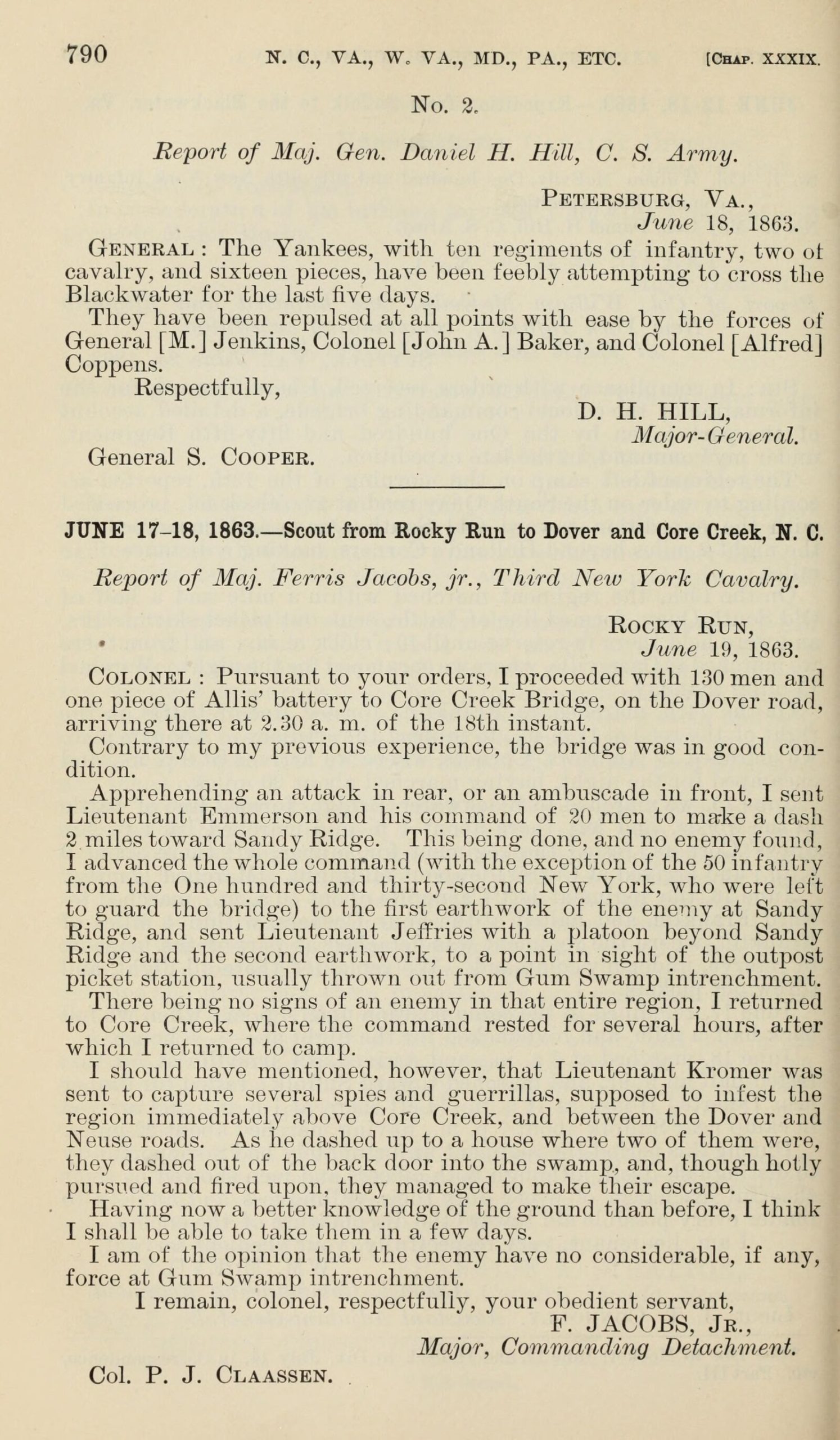
The other side of the river, in three sentences. Hill’s dispatch is dismissive — “feebly attempting” — but it is also the document that names the Confederate force the 130th was trading shots with: the brigade of Gen. Micah Jenkins, with Col. John A. Baker’s North Carolina cavalry and Col. Alfred Coppens’s Louisiana Zouave battalion. Transcribed in full:
No. 2. Report of Maj. Gen. Daniel H. Hill, C. S. Army.
PETERSBURG, VA., June 18, 1863.
GENERAL: The Yankees, with ten regiments of infantry, two of cavalry, and sixteen pieces, have been feebly attempting to cross the Blackwater for the last five days.
They have been repulsed at all points with ease by the forces of General [M.] Jenkins, Colonel [John A.] Baker, and Colonel [Alfred] Coppens.
Respectfully,
D. H. HILL,
Major-General.
General S. COOPER.
U.S. War Dept., The War of the Rebellion: Official Records of the Union and Confederate Armies, Series I, Vol. 27, Part 2 (Washington: GPO, 1889), p. 790. Hill wrote from Petersburg on the expedition’s last full day in the field; the bracketed first names are the Official Records editors’. Whether the crossing was ever seriously attempted — Bowen describes a reconnaissance, not an invasion — the reader may judge between the two accounts. Page scan hosted by this site; transcribed in full above.
Why the Expedition Marched — and How It Ended
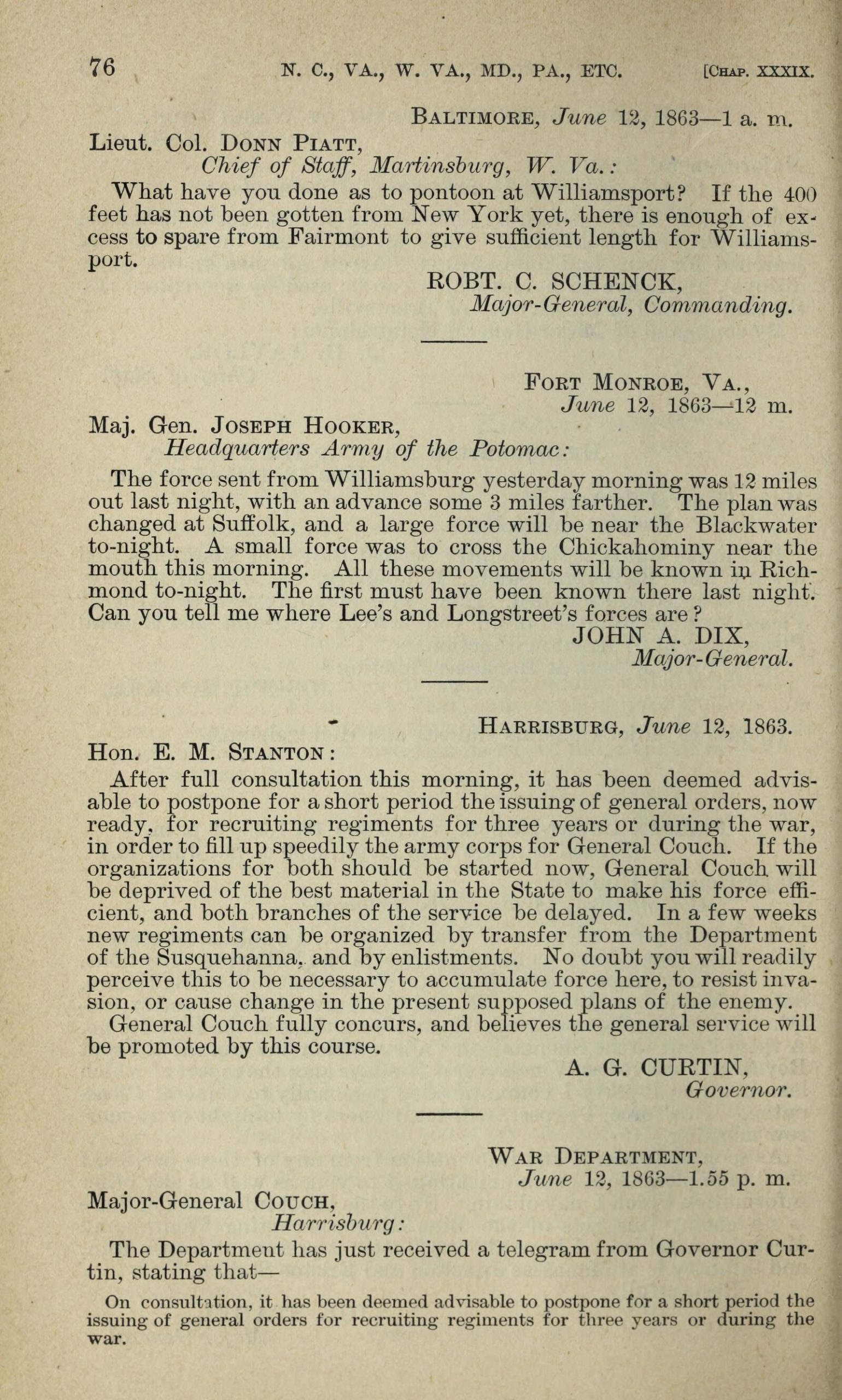
The reports’ own footnote points into the correspondence volume, and there the expedition’s purpose is written plainly: with Lee marching north toward Pennsylvania, Gen. John A. Dix threw columns at the Blackwater and up the Peninsula as a demonstration — and as a way of finding out what had left Richmond. The four dispatches below, each shown whole from the scanned page, carry the story from the plan to its quiet administrative end. Transcribed in full:
1. Dix announces the plan (p. 44, view the page):
JUNE 9, 1863.
Major-General HOOKER, Commanding Army of the Potomac:
I shall move up the Peninsula from Williamsburg and on the Blackwater from Suffolk on Thursday [June 11]. My forces are not large, and on the Peninsula the enemy has appeared in some strength within two days, so that I do not know how far I can go in that direction.
JOHN A. DIX,
Major-General.
2. The dispatch the reports cite — Dix to Hooker, the day the 130th marched (p. 76):
FORT MONROE, VA., June 12, 1863—12 m.
Maj. Gen. JOSEPH HOOKER, Headquarters Army of the Potomac:
The force sent from Williamsburg yesterday morning was 12 miles out last night, with an advance some 3 miles farther. The plan was changed at Suffolk, and a large force will be near the Blackwater to-night. A small force was to cross the Chickahominy near the mouth this morning. All these movements will be known in Richmond to-night. The first must have been known there last night. Can you tell me where Lee’s and Longstreet’s forces are?
JOHN A. DIX,
Major-General.
3. Richmond asks what is happening, and Hill answers (p. 901, view the page; Confederate correspondence):
RICHMOND, June 17, 1863.
General D. H. HILL, Petersburg, Va.:
What is the particular movement on the Blackwater to which your dispatch refers?
S. COOPER,
Adjutant and Inspector General.
PETERSBURG, June 17, 1863.
General S. COOPER:
The movement referred to has been an attempt, for the last five days, to break through the line of the Blackwater.
D. H. HILL,
Major-General.
4. The other letter the reports cite — Halleck to Dix, the campaign’s quiet end (p. 700, view the page):
WASHINGTON, D. C., July 14, 1863—10.15 a. m.
Major-General DIX, Fort Monroe, Va.:
It was not deemed advisable to assign General Keyes to duty with the Army of the Potomac, as all re-enforcements were assigned to existing army corps there. As he is ordered to report to you, it is expected that he will remain on duty in your command till further orders.
H. W. HALLECK,
General-in-Chief.
U.S. War Dept., The War of the Rebellion: Official Records of the Union and Confederate Armies, Series I, Vol. 27, Part 3 (Washington: GPO, 1889), pp. 44, 76, 700, and 901. The June 9 and June 12 Dix letters and the July 14 Halleck letter are the correspondence cited by the reports’ footnote; the Cooper–Hill telegrams of June 17 are added because they concern this expedition directly. The Halleck letter is administrative — by mid-July the Gettysburg campaign was over, Dix was days from transfer to New York, and the Blackwater file simply closes; it is shown because the footnote points to it, and the reader should see exactly what it says. Page scans hosted by this site from the original printing; transcribed in full above.
Sources & Further Reading
- Primary James R. Bowen, Regimental History of the First New York Dragoons (originally the 130th N.Y. Vol. Infantry) (1900), ch. V, “Siege of Suffolk,” pp. 80–81 — the regiment’s own historian and an eyewitness; the source of this account and the verbatim quotation above. Read the chapter in full on this site. Bowen also lists “Franklin, Va., June 13, 1863” in the regiment’s official roll of engagements.
- Primary U.S. War Dept., The War of the Rebellion: Official Records of the Union and Confederate Armies, Series I, Vol. 27, Part 2, pp. 789–790 — the two reports of the expedition, exhibited in full above; the related correspondence (Dix to Hooker, June 9 and 12; the Cooper–Hill telegrams of June 17; Halleck to Dix, July 14) is in Part 3, pp. 44, 76, 700, and 901, also exhibited above. The expedition falls in the Gettysburg-campaign volume, which opens June 3, 1863; Vol. 18, which closes on that date, covers the earlier Blackwater actions of 1862–spring 1863, including those in the note below.
- Note on the record: the June 1863 skirmishing near Franklin was part of a minor reconnaissance, not a named battle, and has no National Park Service / CWSAC or American Battlefield Trust battle summary of its own; it survives chiefly in the Dragoons’ own regimental history. It should not be confused with the earlier and larger actions at Franklin and on the Blackwater in October–December 1862 (including the December 1862 crossing when Sam Spear’s cavalry recaptured the “Rocket Battery”), which were distinct engagements.
Trevilian Station · The Shenandoah Valley Campaign · The Audiobook
Views: 99