Sunswick investigation · Document
The Title of Sunswick
An abstract of title from the Newport Historical Society, and the deed that corrects the printed histories by six years.
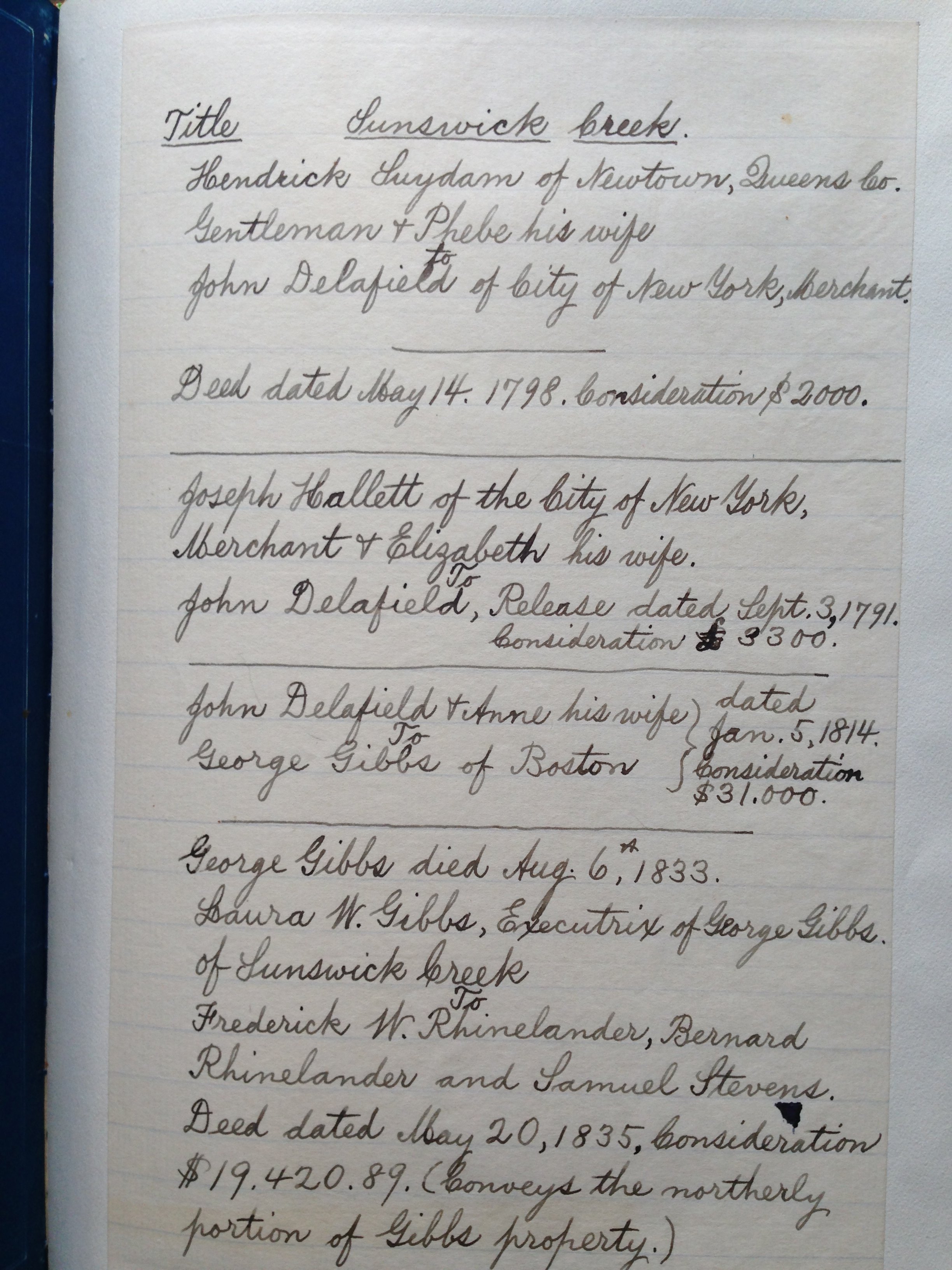
Among the Gibbs papers at the Newport Historical Society is a single sheet in a clear nineteenth century hand, headed simply Title Sunswick Creek. It is an abstract of title: the chain of conveyances by which the ground passed from one owner to the next. It is the plainest document in this investigation and it does more work than any of the pictures.
The chain, as the sheet gives it
- Joseph Hallett of the City of New York, Merchant, and Elizabeth his wife, to John Delafield. Release dated 3 September 1791. Consideration £3,300.
- Hendrick Suydam of Newtown, Queens County, Gentleman, and Phebe his wife, to John Delafield of the City of New York, Merchant. Deed dated 14 May 1798. Consideration $2,000.
- John Delafield and Anne his wife to George Gibbs of Boston. Dated 5 January 1814. Consideration $31,000.
- George Gibbs died 6 August 1833.
- Laura W. Gibbs, Executrix of George Gibbs of Sunswick Creek, to Frederick W. Rhinelander, Bernard Rhinelander and Samuel Stevens. Deed dated 20 May 1835. Consideration $19,420.89. (Conveys the northerly portion of Gibbs property.)
What it settles
The printed Delafield family history, and the account in the New York Genealogical and Biographical Record that follows from it, both say Sunswick was sold to Colonel George Gibbs in 1820. The deed says 5 January 1814. The abstract is the better authority, and it is six years earlier than the books.
It also gives the two figures that frame the family’s tenure. George Gibbs bought at $31,000 in 1814. Twenty-one years later his widow, selling as executrix, conveyed the northerly portion of the property for $19,420.89. Alfred Gibbs was twelve years old.
Seen ten days before the deed
The abstract dates the conveyance to 5 January 1814. On 26 December 1813, ten days before it was signed, Laura’s father Oliver Wolcott Jr. wrote to his son-in-law about the property he was buying. This is the earliest eyewitness description of Sunswick this site holds, and the only one from the moment the family took it.
“The buildings are a two story Farm House built of stone, large enough for a large family – with kitchens & back buildings of wood. The farm house &c. will require some but not expensive repairs—one large and good Barn & other buildings with it, in tolerable order. Poultry Houses, Corn Cribs &c. &c. suff.
The House is a Gentlemans Dwelling House [Delafield’s house, Sunswick] of the first order, built in the best manner, elegant, but not finical & disposed in all its arrangements for comfort, & security:—It will require but little expense to put every thing in what I should call really good order:—in the whole for the Farm House Barns&c. & Dwelling House—say 1500 Doll,s—The foundations of the House are excellent, with spacious dry arced Vaults &c. &.c”
Transcribed and supplied by Deb Dodge. The bracketed gloss identifying the Gentleman’s Dwelling House as Sunswick is hers.
Three things this letter settles
There were two houses on the property. A two storey stone farmhouse with wooden kitchens and back buildings, and separately the mansion. The stone farmhouse was Jacob Blackwell’s, and its door survives in storage at the Greater Astoria Historical Society; the mansion does not survive at all. Any account that treats Sunswick as a single building is missing half the estate.
The mansion had a basement, and Wolcott walked through it. “The foundations of the House are excellent, with spacious dry arced Vaults.” Newton had said the same when he built it in 1791, a stone basement storey nine feet high. That is two independent witnesses, twenty-two years apart, against the drawing that shows the house sitting flush on the ground. See The Pictures of Sunswick.
The house was in good order in 1813. Not a bargain wreck. Wolcott reckoned about $1,500 would put the whole estate, farmhouse and mansion together, into really good order, and his son-in-law paid $31,000 for it a few days later.
What the house was, as the record describes it
Deb Dodge typed out the fuller account from the New York Genealogical and Biographical Record. It is a description of Delafield’s house, written some fifty years after the Gibbs family had left it, and it is the best word picture we have.
“The picture accompanying this article gives a correct view of Mr. Delafield’s country seat on Long Island, a mansion still standing on the East River bank and opposite more modern Yorkville in this city. It was built by him in 1791, and began to be his family residence in the spring of 1792. And as it was so for many years and was regarded as the most spacious and elegant of all such seats in the vicinity of New York, if not anywhere in this country, we offer no apology for introducing here some particulars respecting old ‘Sunswick,’ for that was its name, of far-back English origin…
Sunswick was built partly in copy of an English manor house. Its builder and architect was a Mr. Newton, and its cost, discovered from old account books, was $27,629.90, an immense outlay on a house at an era when millionaires were scarce… The dining-room contained the large ‘horse-shoe table’ of which many old New Yorkers of the elite class must have had knowledge. It was built specially to accommodate the members of the ‘Dinner Club,’ and was also used on other occasions. For many years the Club were invited to meet at Sunswick, once a fortnight during the summer months… The gardens were famous for the new fruits, flowers, and vegetables, which were received from England as soon as they appeared there, all things now common enough, but at the time unknown in this country. The place, about one hundred and forty acres, now covers numerous house-lots and streets in the faded village of Ravenswood.
In the East River, nearly in front of Sunswick House, John Delafield had built a large stone basin, which was always kept supplied with live turtle from the West Indies. The ruins of this old basin, or of its foundation, some years ago greatly puzzled certain local antiquarians, who, it is believed, never got at its real use.
Sunswick, which its first master claimed to be ‘a bit of old England in America,’ was sold in 1820 to Colonel George Gibbs, in whose day it is said also to have had a brilliant record. Subsequently it became a Roman Catholic religious house, but of late years has been generally unoccupied…”
Where this leads
The 1834 map on the next page is the physical expression of the 1835 deed: the farm drawn up as building lots, ready to be sold off. Read the two together and the end of the Gibbs family’s Sunswick is fully documented, in figures and in ink.
How this page has changed
This is an open investigation, so the page is dated rather than presented as settled. Every substantive change is recorded here, including the corrections.
14 August 2026
Published. The abstract of title transcribed, establishing the purchase as 5 January 1814 for $31,000 and correcting the printed histories, which say 1820.
15 August 2026
Oliver Wolcott Jr.’s letter to George Gibbs of 26 December 1813 added, transcribed and supplied by Deb Dodge. Written ten days before the deed, it is the earliest eyewitness account of the property on this site and establishes that two houses stood on it.
Views: 9