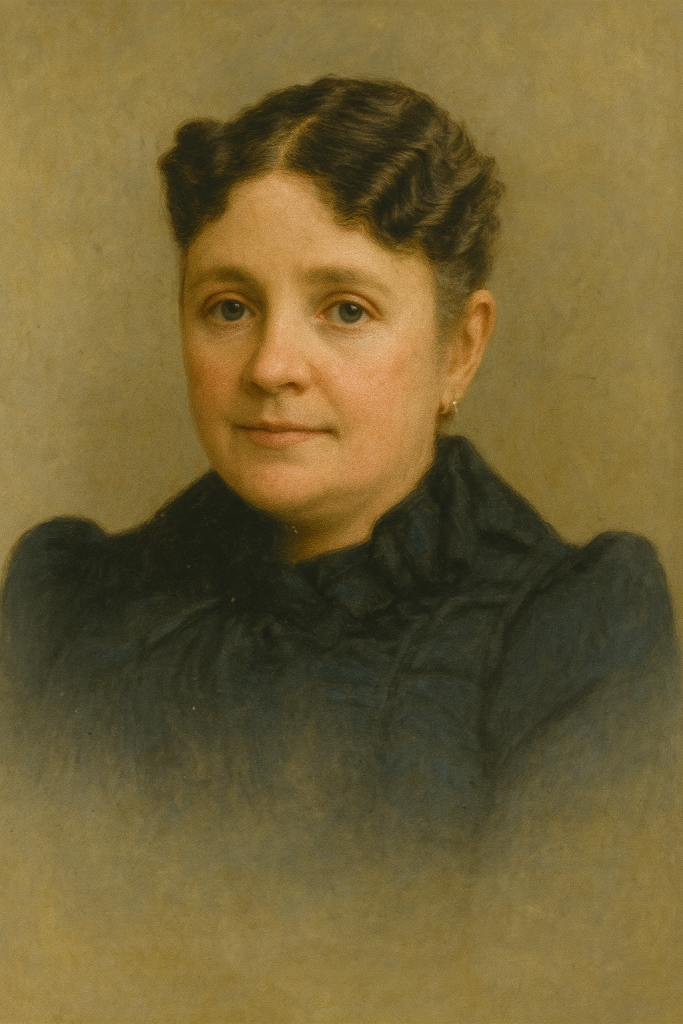
Mandana Coleman Thorp (née Major), born on January 25, 1843, in Karr Valley, Almond, Allegany County, New York, exemplified a life of service and dedication to her country. She was the daughter of Colonel John Major, and her mother was a descendant of Major Moses Van Campen, a prominent Revolutionary War patriot. With her deep family roots in patriotism, it was no surprise that Mandana would play a significant role during the American Civil War. This webpage honors her work, particularly her contributions to the 1st New York Dragoons Regiment, her service as a Civil War nurse, and her post-war efforts in public service.
Early Life and Education
Mandana grew up in a patriotic household, receiving a home education from her mother. Later, she attended and graduated from Alfred University, an institution known for providing a liberal education. During the stirring events leading up to the Civil War, Mandana’s musical talents became a tool for inspiring and rallying support for the Union. She sang patriotic songs and battle hymns at various meetings held across New York, helping to boost the morale of both soldiers and civilians.
Marriage and Civil War Service
In 1862, as the Civil War raged on, President Abraham Lincoln called on the Governor of New York to raise and equip new regiments. It was during this period of heightened patriotism in Allegany, Livingston, and Wyoming counties that Mandana met and married Lieutenant Colonel Thomas Jones Thorp. They were wed on September 6, 1862, at a military rendezvous near the Genesee River in Portage, New York. Her husband, Lt. Col. Thorp, had already served in several significant battles of the Potomac Army and had been wounded at the battles of Fair Oaks and Malvern Hill. Despite his injuries, he refused to be hospitalized, a testament to his dedication to the Union cause.
CHAPTER 1
We do not forget the thousands of visitors who over whelmed us with good things to refresh the inner man, nor our evening campfires, where we listened to the yarns spun by the champion storytellers of the Regiment. We recall the romantic marriage of Lieutenant-Colonel Thorp, performed on the battalion line, backed up by the Regiment at “parade rest,”thus presenting us with one more “major” than the blue book provided. (Mrs. Thorp’s maiden name was Mandana Major.) At last, the eventful day (Sept. 6, 1862) came, with it the order to break camp and go to the front. With knapsacks in place, a thousand newly made soldiers were in line of march for the railway station at Portage Bridge. Not less than ten thousand visitors were present to witness our departure. Who, present upon that occasion, will ever forget the touching scene, when for a short time the Regiment broke ranks, that the boys might speak their last good-bye, or receive the parting embrace or kiss from fathers, mothers, wives, or sweethearts.
Col. Thorp was soon assigned to the newly formed 1st New York Dragoons Regiment, a cavalry regiment that would go on to distinguish itself in the war. During the years of the conflict, Mandana accompanied her husband and provided invaluable support to the regiment. As a nurse, she worked tirelessly to gather and distribute supplies to the sick and wounded, both in camps and in hospitals. Her role in caring for injured soldiers was critical during the Siege of Suffolk, Virginia, where she remained with the Dragoons.
In 1865, at the Grand Review of the Armies in Washington, D.C., Mandana rode at the head of the 1st New York Dragoons Regiment, a powerful symbol of her unwavering support and commitment to the Union cause. As her husband was several times wounded and taken prisoner, Mandana never suggested he leave the service. Instead, she stood by his side, encouraging him through every challenge. Their dedication culminated in the honor of riding together at the head of their regiment during the Grand Review, symbolizing their shared contributions to the war effort.
Post-War Life and Public Service
After the war, Mandana and Thomas Thorp settled in Northern Michigan, where they were among the early pioneers of the region. In Michigan, Mandana became a public official, serving as deputy clerk and register of deeds. Her role in public service continued as they moved west, eventually relocating to the Arizona Territory, where they were involved in the sheep and wool industry. Mandana even took on the responsibility of guarding their camp near the Navajo Nation reservation while her husband was away on business, further showcasing her bravery and resourcefulness.
The couple later moved to Oregon, first living in Forest Grove before settling in Corvallis around 1899 or 1900. In Oregon, Mandana remained actively involved in civic life, particularly through the Woman’s Relief Corps (W.R.C.), an auxiliary to the Grand Army of the Republic (G.A.R.). The W.R.C. was a prominent organization dedicated to supporting veterans and promoting patriotic education. Over the years, Mandana took on several leadership roles within the W.R.C., including serving as a delegate to the national gatherings in 1897, 1902, and 1907. She was also appointed as a state inspector for the corps and held the title of Patriotic Instructor of Oregon, where she worked to instill a sense of patriotism in future generations.
Community Leadership and Civic Involvement
In addition to her work with the W.R.C., Mandana was a prominent figure in the Woman’s Christian Temperance Union (W.C.T.U.), an organization advocating for the prohibition of alcohol. Her leadership in these organizations reflected her commitment to the causes she believed in, particularly those related to veterans and moral reform.
Throughout her life, Mandana remained deeply connected to her faith, and she and her husband were active members of the Presbyterian Church. Politically, the couple was staunchly Republican, reflecting their strong beliefs in the values of the Union they had fought to preserve.
Final Years and Legacy
Thomas J. Thorp, her husband of over 50 years, passed away in July 1915. Following his death, Mandana spent the last year of her life in Portland, Oregon, living with her daughter, Bessie. Mandana Thorp passed away on July 7, 1916, at the age of 73, due to heart disease. She was survived by her two children, Montgomery and Bessie, while three of her children—Simeon, Annie, and another child—had predeceased her.
Mandana was laid to rest at River View Cemetery in Portland, where, in 2013, her grave and that of her husband were finally marked with headstones by the Sons of Union Veterans of the Civil War, honoring their service and dedication.
Honoring Mandana Thorp’s Contributions to the 1st New York Dragoons
Mandana Coleman Thorp’s contributions to the 1st New York Dragoons and her service during the Civil War stand as a testament to her unwavering patriotism and dedication. Her work as a nurse and her efforts in rallying troops through music were vital to the morale and well-being of the soldiers she supported. Her presence at the Grand Review of the Armies in Washington, D.C., riding at the head of the Dragoons, symbolizes her remarkable contributions to the Union cause.
Her post-war efforts in public service, particularly her leadership in the W.R.C., ensured that the sacrifices made by veterans like her husband were not forgotten. Her work as Patriotic Instructor of Oregon, along with her dedication to the W.C.T.U., showcases her commitment to shaping a better society for future generations.
Through this webpage, we remember and honor Mandana Thorp’s legacy. Her story is a reminder of the critical role women played during the Civil War and the lasting impact they had on their communities long after the conflict ended.
Views: 31