
Introduction
When the smoke of battle began to clear in the latter years of the American Civil War, it was not just tactics and tenacity that had shifted the tide, it was technology. One of the most revolutionary tools of the time was the Spencer repeating rifle, a seven-shot lever-action firearm that gave Union forces a formidable advantage. Developed by Christopher Spencer in 1860, the weapon wasn’t merely an invention, it was a game-changer.
A Weapon Ahead of Its Time
The Spencer rifle and carbine were the first widely adopted military firearms to use metallic cartridges in a repeating configuration. Each weapon featured a tubular magazine in the buttstock that held seven rounds of .56-56 Spencer rimfire ammunition. Capable of delivering 14–20 rounds per minute, the Spencer’s rate of fire dwarfed that of the standard-issue muzzle-loading rifled musket, which typically managed just two to three shots in the same time.
Yet for all its advantages, the rifle faced initial resistance. Army leadership feared the logistical burden of keeping soldiers supplied with ammunition. It wasn’t until Christopher Spencer personally demonstrated the rifle to President Lincoln on the White House lawn that it began to see widespread adoption.
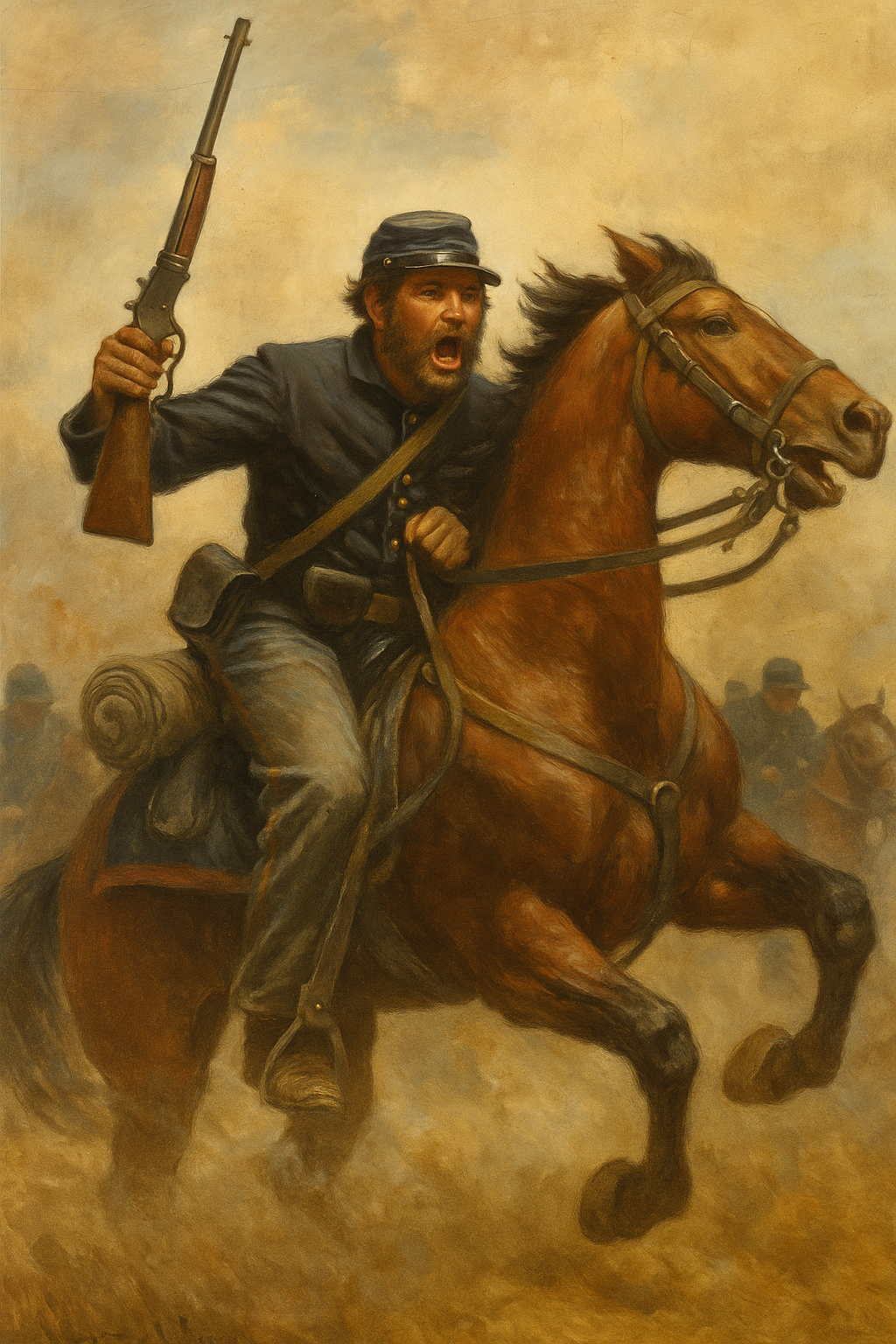
In the Field with the First New York Dragoons
The men of the First New York Dragoons, originally formed as the 130th New York Infantry—were among those who carried Spencers into combat. James R. Bowen’s The Regimental History of the First New York Dragoons offers powerful testimony to the rifle’s impact.
“This exchange occurred a few days later, the regiment being armed with the then famous Spencer seven-shooters, thus increasing our effectiveness sevenfold.” (p. 139)
This wasn’t hyperbole. In engagements throughout 1864 and 1865, the firepower advantage of the Spencer was clearly felt by both Union soldiers and their Confederate adversaries.
“…having a salutary respect for the Spencer carbine, [the enemy] quickly complied with the demand to surrender, and came in on the trot.” (p. 276)
A Cavalryman’s Confidence
Beyond raw firepower, the Spencer gave its wielders a morale boost. Bowen recounts an incident where a soldier, confronted by three enemy soldiers at close range, instinctively trusted in the speed and reliability of his repeater:
“You bet my mind worked quick, my Spencer repeater was already cocked, and quicker than it can be told I aimed, fired, and jumped for the bushes.” (p. 242)
In another vivid account:
“The enemy opened upon us with a severe determination, but when the Dragoons and the brave Michigan men of Custer’s line opened upon them with their Spencers, they broke, as on previous occasions.” (p. 312)
Such stories are repeated throughout Bowen’s regimental history. The Spencer was not only a tactical advantage, it was a psychological one.
Saving the Horses and the Honor
Bowen details how Colonel Alfred Gibbs defended his regiment’s right to retain their Spencer-armed cavalry status when dismounted service was proposed due to a horse shortage:
“This unjust proposition exasperated the men, and was indignantly resented by Colonel Gibbs. His steadfastness triumphed, and we were saved the humiliation of ‘hoofing it,’ in order to let men ride whose chief characteristic was cowardice and blackguardism.” (p. 139)
In this, the Spencer rifle stood as both a symbol of dignity and an enabler of distinction.
Ammunition and Innovation
One of the most forward-thinking aspects of the Spencer system was its ammunition. The metallic cartridges could withstand the hardships of wartime storage and transport. Unlike the paper cartridges used in Sharps rifles, Spencer rounds remained viable after months of jostling in wagons or exposure to rain.
Additionally, the development of the Blakeslee Cartridge Box enabled troops to rapidly reload, each box could hold up to thirteen tubes pre-loaded with seven rounds each, allowing a soldier to reload in seconds rather than minutes.
Legacy
Though the Spencer Repeating Rifle Company folded shortly after the war (eventually absorbed by Winchester), the impact of its invention was lasting. Surplus Spencers found their way into international conflicts from South America to Southeast Asia. They were even used during the Franco-Prussian War and in the suppression of Native American resistance in the American West.
At Beecher Island in 1868, Major Forsyth’s men, heavily outnumbered by Cheyenne warriors, held their ground. Bowen’s implied logic holds true for them too—firepower, when multiplied sevenfold, becomes force multiplied by resolve.
Final Thoughts
The Spencer repeating rifle wasn’t just another weapon—it was the embodiment of industrial ingenuity meeting battlefield necessity. For the First New York Dragoons and countless others, it meant the difference between retreat and resistance, between defeat and decisive action.

Views: 455