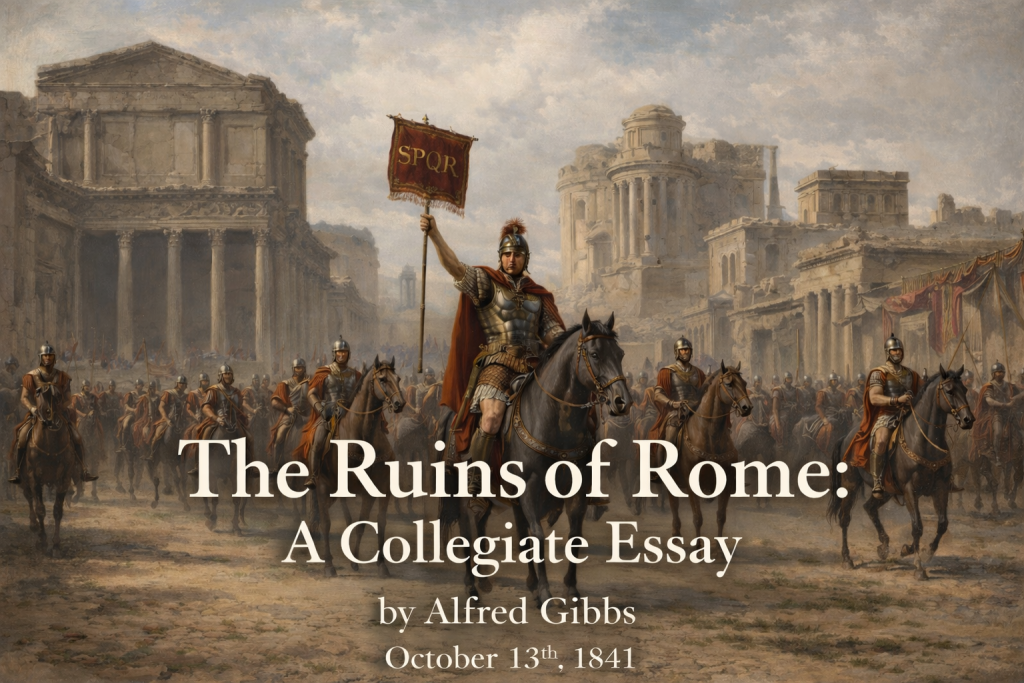
RESEARCHER’S NOTE: This document, dated October 1841, is a reflective essay on the rise and fall of the Roman Empire. The author (identified as Gibbs) muses on how the “relentless hand of time” has reduced the once-mighty “mistress of the world” to the seat of the Catholic prince.
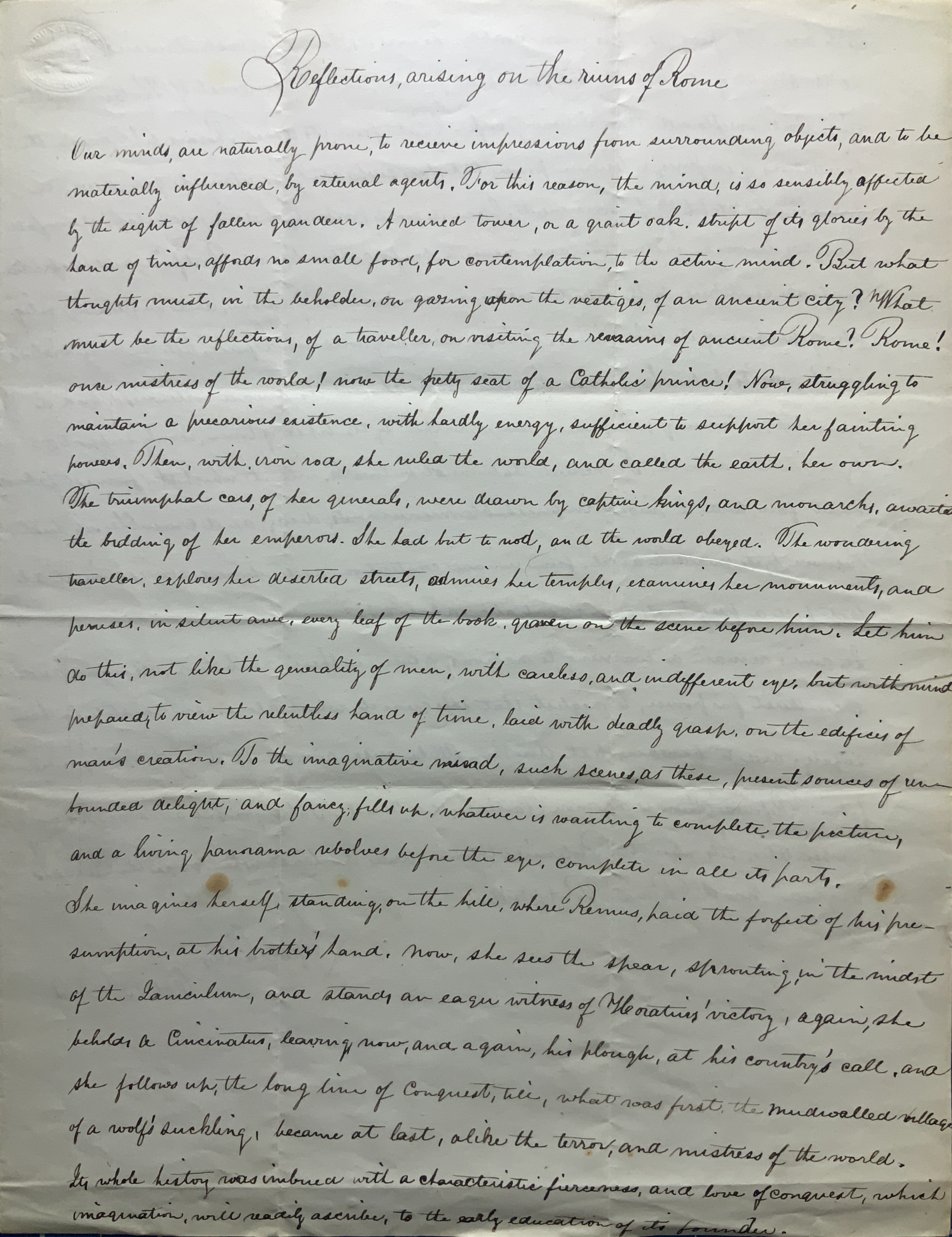
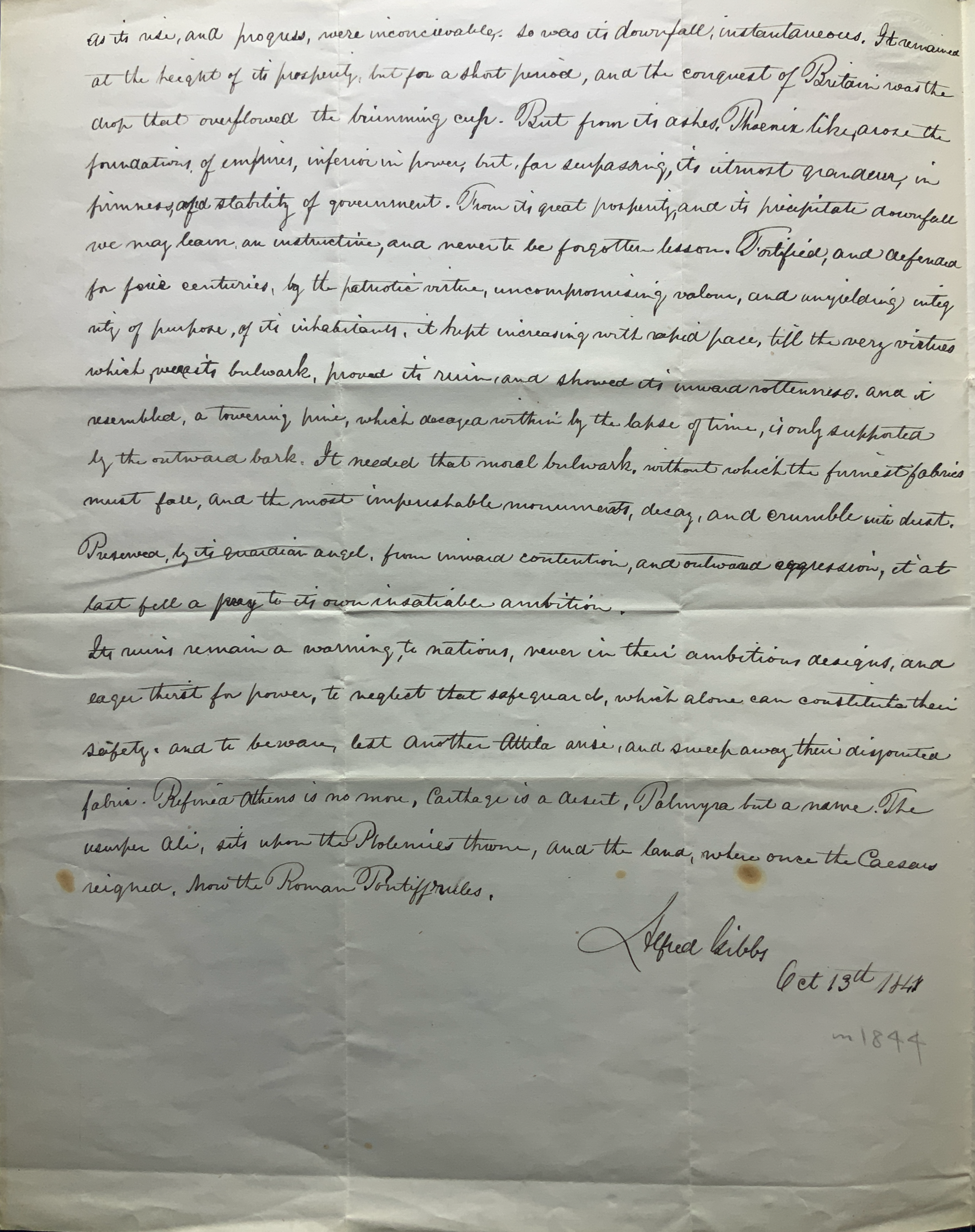
Below is the transcription of the cursive text:
Reflections, Arising on the Ruins of Rome
by Alfred Gibbs
Page 1
Reflections, arising on the ruins of Rome and to be our minds are naturally prone, to receive impressions from surrounding objects, materially influenced, by external agents, For this reason, the mind, is so sensibly affected the sight of fallen grandeur, A ruined tower, or a giant oak stript of its glories by the lance of time, affords no small food, for contemplation, to the active mind.
But what thoughts must, in the beholder, on gazing upon the vestiges, of an ancient city? What must be the reflections, of a traveller, on visiting the remains [of] ancient Rome? Rome! once mistress of the world! now the petty seat of [a] Catholic prince! Now, struggling to maintain a precarious existence, with hardly energy, sufficient to support her fainting powers, Then, with iron rod, she ruled the world, and called the earth, her own.
The triumphal cars, of her generals, were drawn by captive kings, and monarchy awaited the bidding of her emperors. She had but to nod, and the world obeyed. The wondering traveller, explores her deserted streets, admires her temples, examines her monuments, and in silent awe, every leaf of the book, graven on the scene before him. Let him do this, not like the generality of men, with careless, and indifferent eyes but with mind prepared to view the relentless hand of time, laid with deadly grasp on the edifices of man’s creation.
To the imaginative mind, such scenes, as these, present sources of unbounded delight, and to complete the picture, and a living panorama revolves before the eye, complete in all its parts. She imagines herself, standing on the hill, where Remus, paid the forfeit of his presumption, at his brother’s hand fancy, fills up whatever is wanting and, now, she sees the sheaf, sprouting in in the midst of the Janiculum, and stands an eager witness of Horatii’s victory, again, she beholds a Cincinnatus, leaving now, and again, again, his plough, at his country’s call, and she follows up, the long line of conquest, till, what was first the mud-walled village of a wolf’s suckling, whose history became at last, alike the terror, and mistress of the world. [The author notes a] characteristic fierceness, and love of conquest, which imagination, will readily ascribe, to the early education of its…
Page 2
…as to [its] rise, and progress, were inconceivable to witness its downfall, instantaneous, maintenance at the height of its prosperity, but for a short period, and the conquest of Britain was the drop that overflowed the brimming cup. That from its ashes, Phoenix like rose the foundations, of empires, inferior in power, but far surpassing, its utmost grandeur, in permanence and stability of government.
From its great prosperity and its precipitate downfall we may learn an instructive, and never to be forgotten lesson. Fortified, and defended for five centuries, by the patriotic virtue, uncompromising valour, and unyielding integrity of purpose, of its inhabitants, it kept increasing with rapid pace, till the very virtues which formed its bulwark, proved its ruin and showed the inward rottenness, and it resembled, a towering pine, which decayed within by the lapse of time, is only supported by the outward bark.
It needed that moral bulwark, without which the firmest fabrics must fail, and the most imperishable monuments, decay, and crumble with dust. Preserved, by the guardian angel, from inward contention, and outward aggression, it at last fell a prey to its own insatiable ambition.
May its ruins remain a warning to nations, never in their ambitious designs, and eager thirst for power, to neglect that safeguard, which alone can constitute their safety, and to beware, lest another Attila arise, and sweep away their disjointed fabric. Refined Athens is no more, Carthage is a desert, Palmyra but a name. The usurper Ali, sits upon the Ptolemies’ throne, and the land, where once the Caesars reigned, now the Roman Pontiff rules.
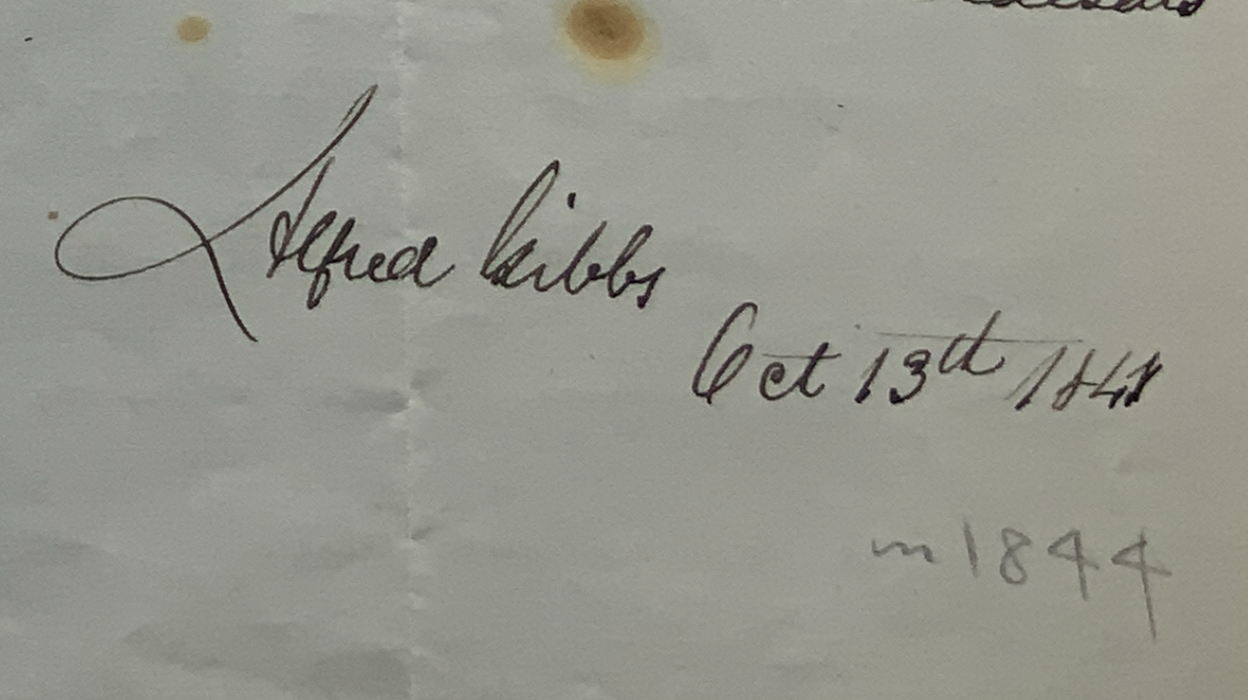
RESEARCHER’S NOTE: The date of 1844 is not right. Why? Because Alfred Gibbs entered the United States Military Academy at West Point on July 1, 1842, where he would later graduate in the class of 1846. Therefore, Gibbs would have been a member of the historic graduating class, and could not be in two places at the same time. Given that the date of 1844 is written in pencil, I believe that the person who added that data erred in reading the date that was originally put on that document by Gibbs himself.
Views: 20