
Introduction
During the U.S. Civil War, farriers played a crucial role in maintaining the mobility and functionality of both the Union and Confederate armies. The term “farrier” typically refers to individuals responsible for the care and shoeing of horses, which were vital to military operations. Horses served multiple purposes in the war, including transportation of troops, artillery, and supplies. Consequently, the expertise of farriers in maintaining the health and usability of these animals was indispensable to the war effort.
Farriers were particularly valuable because the military relied heavily on horses for mobility across different terrains and in various climates. Farriers were responsible not only for shoeing horses but also for identifying and treating hoof-related ailments, as these could significantly impair a horse’s ability to carry out its duties. As one historian observed, “Every horse was like a piece of military equipment, and maintaining their health was as critical as maintaining the condition of weapons or artillery” (Fran Jurga’s Hoofcare + Lameness, 2019). This perspective highlights the essential role farriers played in ensuring that horses could continue to serve effectively throughout the war.
Training and Requirements for Farriers in the Civil War
Becoming a farrier during the Civil War required specialized training. According to records from Fort Riley, Kansas, one of the primary training locations, recruits were instructed in various techniques necessary for working with horses, including shoeing and treating minor injuries (Jurga, 2019). The skill set needed by a Civil War farrier extended beyond simply attaching horseshoes; it included an understanding of horse anatomy and disease, as well as practical skills in working with metal. This training often took place in facilities like Fort Riley, where soldiers learned skills essential for the care and management of horses under wartime conditions (Fran Jurga’s Hoofcare + Lameness, 2019).
In addition to practical skills, farriers had to understand the types of horseshoes that would be most effective in different environments. For instance, horses used in mountainous areas required different shoes than those used on flat, muddy battlefields. This knowledge was crucial, as improperly shod horses could become lame, leading to logistical delays that could impact military operations. As Bowen (1900) notes, “The attention given to horses and mules, especially in terms of proper hoof care, was a determining factor in the success or failure of many military campaigns” (Regimental History of the First New York Dragoons).
Duties and Responsibilities of Farriers in Military Campaigns
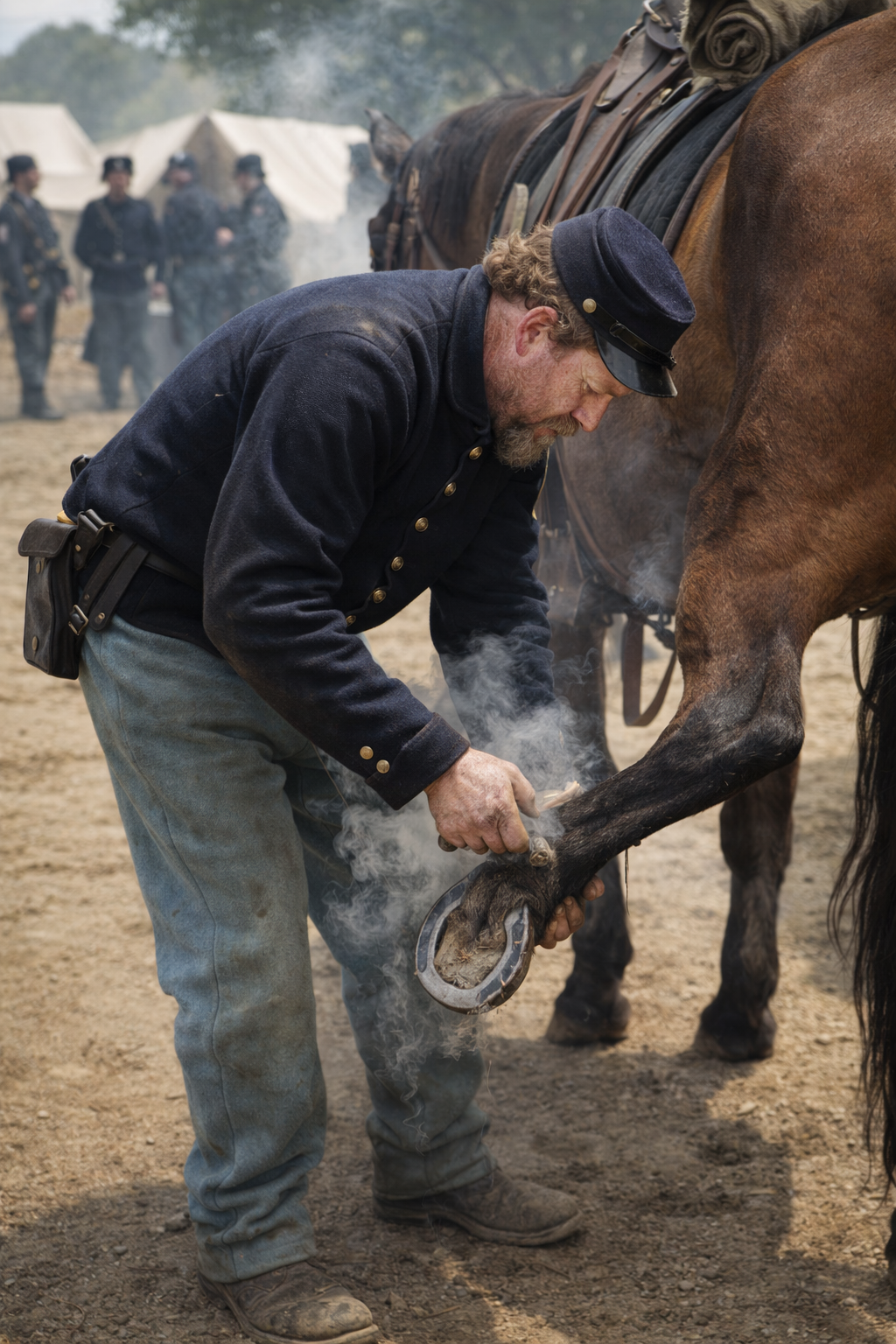
Farriers’ duties were not limited to shoeing horses; they were also responsible for ensuring the overall health of the animals. As detailed by the War Department’s Ordnance Manual, each regiment typically had access to a “traveling forge,” which allowed farriers to perform their duties in the field, regardless of location (Masur, 2012). These traveling forges, essentially mobile blacksmith workshops, were stocked with essential tools, coal, and iron. This setup allowed farriers to respond quickly to emergencies, such as a thrown horseshoe or damaged hoof, without needing to bring the horse back to a stable.
According to Majewski (2003), farriers were often on the front lines, as they were needed wherever horses were deployed. This meant that, although they were not direct combatants, farriers faced the same risks as soldiers. They worked close to battle zones and were sometimes the targets of enemy forces. Confederate forces, for example, recognized the strategic importance of Union supply lines and often targeted them to disrupt the availability of farriers and supplies essential for horse care (Fran Jurga’s Hoofcare + Lameness, 2019). The critical role of horses and, by extension, farriers was underscored by the fact that “a regiment without functional horses was essentially immobilized,” as noted by Einhorn (2010).
Challenges Faced by Farriers
Farriers in the Civil War faced numerous challenges, ranging from a lack of adequate supplies to the constant risk of disease. The War Department’s Ordnance Manual details the standard equipment for a farrier, but in practice, farriers often had to work with limited resources (Jurga, 2019). Supplies like horseshoes and nails were valuable commodities, especially in the Confederacy, where industrial production capabilities were limited. As such, Union supply wagons carrying these items were high-priority targets, and the capture or destruction of these supplies could significantly disrupt military operations.
Disease was another significant threat. Horses and mules were highly susceptible to diseases, especially in the crowded and unsanitary conditions of army camps. Farriers had to be vigilant about the signs of disease and take preventative measures whenever possible. Disease outbreaks could devastate the equine population of a regiment, leading to a loss of mobility and a potential disadvantage in battle. “The loss of horses to disease was as crippling to the army’s effectiveness as a shortage of ammunition,” Bowen (1900) emphasizes, highlighting the high stakes involved in equine care during wartime.
Farriers as Unsung Heroes of the War
Despite their essential role, farriers were often overlooked in military histories. The focus on combat roles has meant that the contributions of logistical and support personnel, like farriers, have been underappreciated. Farriers operated in the background, ensuring that the army’s mobility remained intact. They worked long hours under difficult conditions, often putting their own lives at risk to maintain the functionality of the army’s most essential resource: its horses. Jurga (2019) points out that many farriers lost their lives due to exposure to harsh conditions or in direct attacks on supply lines, underscoring their sacrifice and dedication.
Farriers in the Civil War embodied the resilience and determination necessary to keep an army moving forward. Though they rarely received the accolades granted to combat soldiers, their contributions were invaluable to both the Union and Confederate armies. The extensive reliance on horses throughout the war placed farriers in a position of critical importance. Without them, the armies would have struggled to transport troops, artillery, and supplies effectively, ultimately impacting the outcomes of numerous campaigns.
Final Thoughts
The role of farriers in the Civil War was far more than a simple support position; it was a vital component of military operations. Farriers not only maintained the health and functionality of the army’s horses but also adapted to challenging conditions, managed supply shortages, and faced the same dangers as other soldiers. As Einhorn (2010) and others have documented, the contributions of these skilled tradesmen were essential to the effectiveness of Civil War armies. Their dedication and resilience, often in the face of adversity, ensured that the soldiers and artillery could continue to move forward, making farriers indispensable to the war effort.
References
• Bowen, J. R. (1900). Regimental History of the First New York Dragoons. Retrieved from https://books.google.com/books?id=4YsvAAAAYAAJ
• Einhorn, D. (2010). Civil War Blacksmithing. CreateSpace Publishers.
• Fran Jurga’s Hoofcare + Lameness. (2019, May 27). Heroes on the Hoof: Remembering military farriers who lost their lives. Retrieved from https://hoofcare.blogspot.com/2019/05/heroes-on-hoof-military-farriers-killed.html
• Jurga, F. (2019). Fran Jurga’s Hoofcare + Lameness: Heroes on the Hoof. Retrieved from https://hoofcare.blogspot.com
Views: 543