
Introduction
In the sun-scorched hills of Guantánamo Bay, Cuba, the Spanish-American War claimed two of its earliest U.S. military casualties: Private James McColgan of the U.S. Marine Corps and Dr. John Blair Gibbs, Naval Surgeon. Their deaths, separated by less than 24 hours in June 1898, stand as somber testaments to the cost of early American intervention abroad. Both men served with the First Marine Battalion and both died with honor, their sacrifices largely unheralded outside military circles. Yet their stories, when told side by side, provide powerful insight into courage, duty, and quiet foreboding in the opening days of war.
A Marine’s Final March
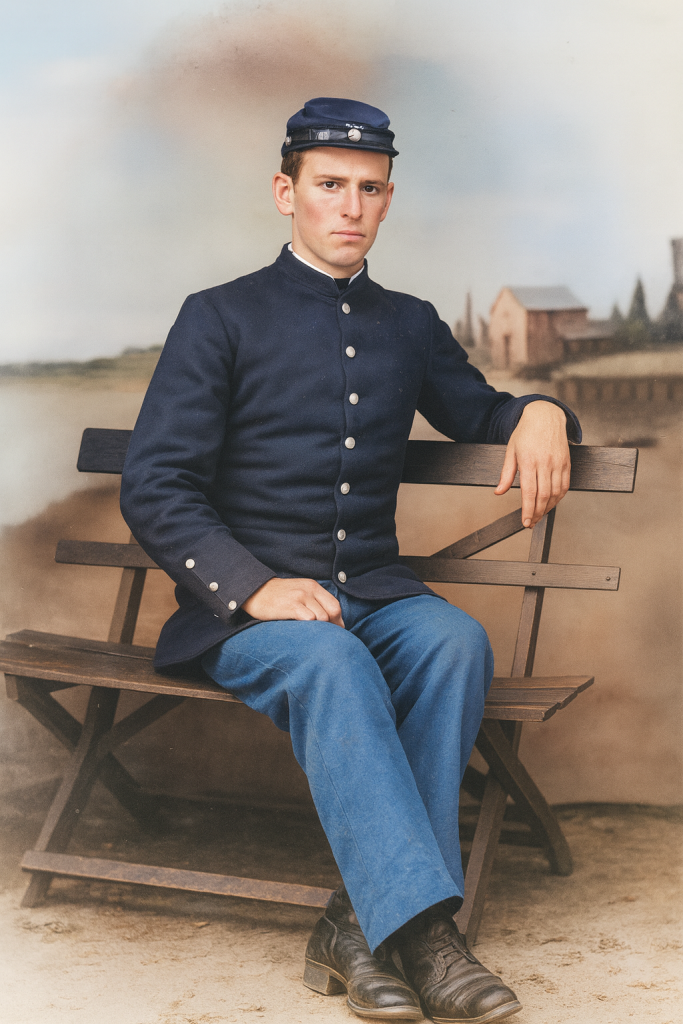
Private James McColgan enlisted in the Marine Corps during the winter of 1896–97 and was assigned to Company D, First Marine Battalion. A native of Stoneham, Massachusetts, McColgan shipped out from Brooklyn on April 21, 1898, aboard the U.S.S. Panther along with other Marines preparing to secure a foothold in Cuba. There were “no bands, no fuss, no scenes nor no friends to see us off,” recalled fellow Marine and friend Olin Fay Johnson. “We had come from all over the country and we just left” (Johnson, as cited in SpanAmWar.com, n.d.).
McColgan and Johnson had trained together as recruits and later served in the same battalion. Though placed in different companies, they remained close. By the time they arrived at Guantánamo Bay on June 10, 1898, McColgan was already gripped by a growing sense of fatalism. Johnson noted a marked change: “He became more morose and depressed, doing no more skylarking and keeping to himself as much as possible. Some of us finally got it out of him that he was sure that he would not come back, and no amount of argument could change his attitude” (Johnson, as cited in SpanAmWar.com, n.d.).
That eerie premonition proved accurate. On June 11, while stationed at the outermost picket post, McColgan and Private William Dunphy were ambushed by a well-concealed enemy force. The attackers, believed to number at least 50, crept through thick underbrush and fired a point-blank volley. McColgan was hit by 23 bullets; Dunphy by 18. Neither Marine had time to fire, though both were found gripping their rifles with bolts drawn back. “Our men were not caught wholly unawares,” Johnson wrote. “Both were lying with their rifles in hand, blocks drawn back, but neither had been able to fire” (Johnson, as cited in SpanAmWar.com, n.d.).
Commemorating McColgan
Today, McColgan is buried in Lindenwood Cemetery in Stoneham, Massachusetts. His memorial stone bears the simple honor of a man who gave his life in service: “Private, U.S. Marine Corps, Co. D, 1st Marine Battalion” (Find A Grave, n.d.). A later monument was erected at the very site of his death in Guantánamo, bearing the inscription:
Here
Private William Dunphy, U.S.M.C.
and
Private James McColgan, U.S.M.C.
Were Killed
While on outpost duty
June 11, 1898
This site was photographed in 1923 by a fellow Marine who had returned to Cuba and located the exact position where both men were killed. Johnson noted that he had two empty cartridge shells from the scene, humble relics of a sudden and brutal moment in the war.

The Surgeon’s Fate
But McColgan’s was not the first life lost on Cuban soil during the war. That sorrowful distinction belongs to Dr. John Blair Gibbs, the battalion’s senior medical officer. Dr. Gibbs was shot and killed by a Spanish sniper on June 10, just one day before McColgan, while tending to the wounded. His death marked the first fatality of an American serviceman in the Spanish-American War.
A graduate of Columbia Medical School and seasoned surgeon, Dr. Gibbs had volunteered to serve aboard the USS Panther in support of the Marine landing at Guantánamo. He was described as “a young man of brilliant promise, earnest purpose, and high attainments” (AlfredGibbs.com, n.d.).
According to family sources, “he was shot through the temple and died instantly, without uttering a word. He was attending to his duties when shot and fell in the performance of his work” (AlfredGibbs.com, n.d.).
A Shared Legacy
Though separated by rank, experience, and profession, McColgan and Gibbs shared the same battlefield, the same datebook of fate, and the same unit insignia. Their connection lies in more than coincidence. They represented the twin pillars of military readiness: the warfighter and the caretaker.
Gibbs’s presence at Guantánamo was more than symbolic, it was critical. As the first American physician killed in the war, his loss was felt deeply. The Navy lauded his actions, and he was honored posthumously for his courage. Likewise, McColgan’s loss was felt among the enlisted men, especially those who knew him not only as a Marine, but as a vibrant spirit among them, until war took its toll.
It is notable that both deaths were not the result of long, drawn-out battles, but of stealth, of ambush, and of proximity. They were among the earliest to fall, before the Army had even deployed in full strength, and their names are rarely seen in the more sweeping narratives of the war.
The Cost of First Sacrifices
McColgan’s and Gibbs’s deaths challenge our notions of glory and timing in military history. It’s easy to romanticize victories, to recount grand campaigns, but the first to fall often do so in silence, with no monuments beyond the ones placed by their comrades or remembered by their families.
In Johnson’s words, “nobody wanted to be left behind to do guard duty at the home station” (SpanAmWar.com, n.d.). They all longed to serve, even with the knowledge of risk. The eagerness of young McColgan, tempered by his quiet dread before the landing, highlights a painful paradox: the thrill of service, coupled with an unshakable sense of mortality. That dichotomy is not unique to McColgan, it lives in the mind of every soldier who ships out knowing they may not return.
Today, their stories remain preserved not in textbooks, but in photographs, veteran recollections, and grave site inscriptions. The website Find A Grave offers perhaps the simplest, most enduring tribute: “He served in the U.S. Marine Corps during the Spanish-American War. He was killed in action during a surprise attack while on outpost duty” (Find A Grave, n.d.).
Final Thoughts
Private James McColgan’s death, and that of Dr. John Blair Gibbs, marks not just the opening moments of a brief war, but the enduring cost of readiness. They were not casualties of strategy, nor victims of misjudged maneuvers. They were among the first Americans to stand for their country in Cuba, and among the first to die for it.
Their stories deserve more than a line in military rosters. They deserve remembrance, spoken aloud, written down, and passed on. They remind us that the beginnings of war are paid for in blood just as much as its endings. In remembering them, we honor not only their individual courage but the quiet valor of those who walk first into the unknown.
References
AlfredGibbs.com. (n.d.). Dr. John Blair Gibbs (Son). Retrieved from https://alfredgibbs.com/dr-john-blair-gibbs-son/
Find A Grave. (n.d.). James McColgan (1875–1898). Retrieved from https://www.findagrave.com/memorial/196875858/james-mccolgan
SpanAmWar.com. (n.d.). Private James McColgan, First Marine Battalion. Retrieved from https://www.spanamwar.com/1stmarinemccolgan.html

Views: 195