
Family Background and Lineage
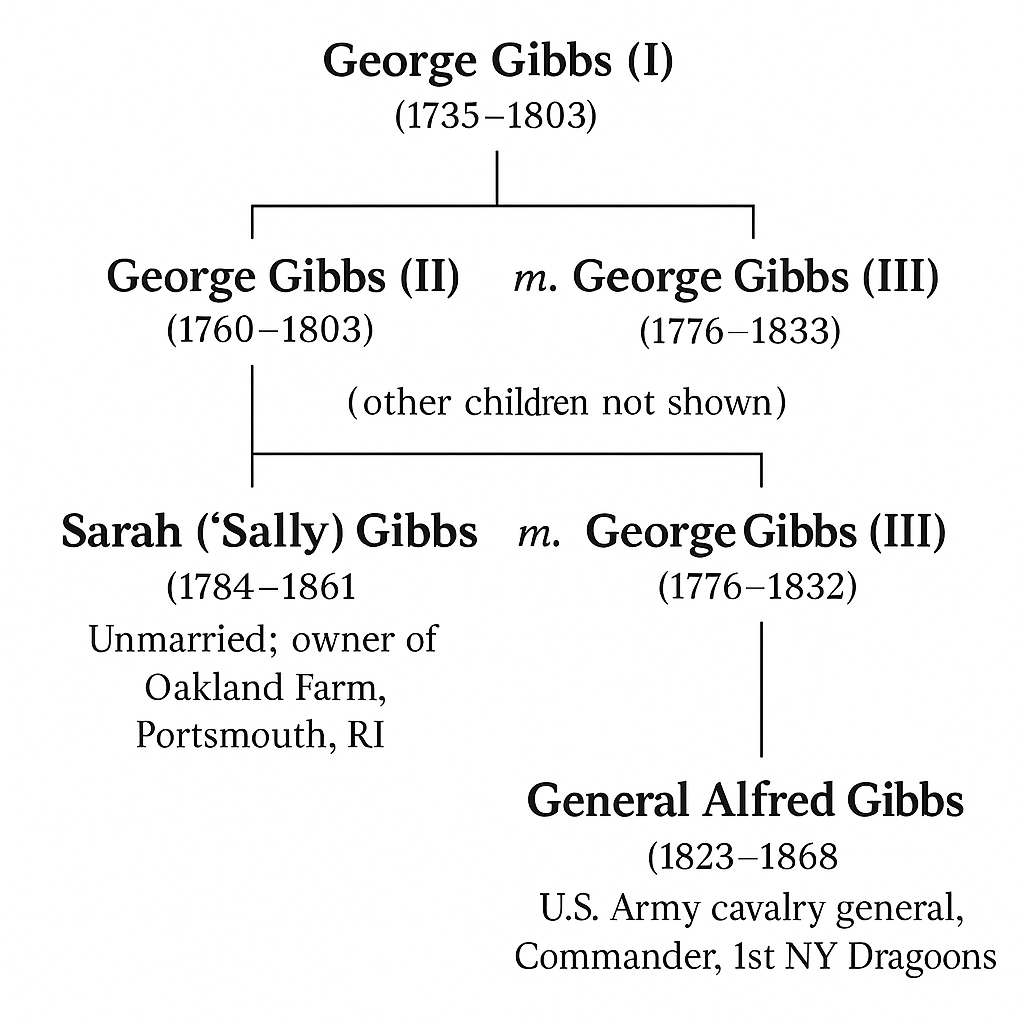
Sarah Gibbs was born in 1784 in Newport, Rhode Island, into a family of significant social and economic standing. Her father, George Gibbs, was a successful grain merchant, co-owning the firm Gibbs and Channing, which managed a fleet of up to seventy-five vessels sailing out of Newport. This firm was a crucial part of Newport’s maritime trade in the late 18th century(portsmouthhistorynotes).
Sarah’s mother, Mary Channing, was connected to another influential family in Newport. She was the sister of Walter Channing, George Gibbs’s business partner. The Channing family was well-known in New England, not only for their business ventures but also for their religious influence. Sarah’s sister, Ruth Gibbs, further cemented the family’s prominence by marrying William Ellery Channing, a leading Unitarian minister and a central figure in American religious life during the 19th century (portsmouthhistorynotes).

Despite her close family ties to Unitarianism through her sister’s marriage, Sarah Gibbs remained a devout Episcopalian throughout her life. Her religious devotion set the stage for her significant contributions to the Episcopal Church in Portsmouth, Rhode Island.
Founding of St. Mary’s Episcopal Church
In 1843, Sarah Gibbs sought to establish an Episcopal presence closer to her home in Portsmouth. She invited Reverend Hobart Williams to conduct Episcopal services in the area, initially held in temporary quarters. Sarah then took decisive steps to create a permanent church. In 1844, she donated 88 acres of land, known as Potter Farm, for the construction of both a church and a seminary(SAH ARCHIPEDIA).
Richard Upjohn, a prominent architect known for his Gothic Revival designs, was commissioned to design the church. The cornerstone of St. Mary’s Episcopal Church was laid on September 2, 1847, and the building was completed and consecrated on May 20, 1852. The church’s construction cost approximately $11,000, a considerable investment at the time, funded by Sarah Gibbs herself. Although the seminary envisioned by Sarah never materialized, the church became a central place of worship for the local Episcopal community(SAH ARCHIPEDIA).

Architectural Details and Historical Significance
St. Mary’s Episcopal Church is a notable example of Gothic Revival architecture, reflecting the principles of the English Ecclesiological Society, which advocated for a return to medieval church designs. The church’s structure is built from local fieldstone, with features such as a chancel, porch, and sacristy that are characteristic of the style. The west end of the church is particularly distinguished by its intricate buttressing and bell cote, which are integral to the overall design(SAH ARCHIPEDIA).
Inside, the church has a plaster interior supported by wooden gable rafters, maintaining the simplicity and authenticity of the Gothic Revival style. The church also houses a marble relief memorial commissioned by Sarah Gibbs in memory of her parents. This memorial, created by Horatio Greenough, a neoclassical sculptor, was completed in 1843 before the church itself was built. Sarah Gibbs is buried in the churchyard, in a memorial designed by Richard Morris Hunt, another prominent American architect(SAH ARCHIPEDIA).
Final Thoughts
Sarah Gibbs’s efforts in founding St. Mary’s Episcopal Church reflect her deep commitment to her faith and her community. Her contributions not only established a place of worship but also left a lasting impact on the architectural and religious landscape of Portsmouth, Rhode Island. The church remains a significant historical and cultural landmark, embodying the rich history of the Gibbs and Channing families and their influence on the region.
Views: 73