
Table of Contents
Introducton
James Richard Bowen was born on April 26, 1834, in Nunda, Livingston County, New York. Raised in a large family, he was the second of six children born to Richard Bowen and Lovinia Bennett. His upbringing in rural upstate New York prepared him well for a life of service, sacrifice, and spiritual resilience. Though largely absent from major public historical discourse, Bowen’s life and contributions, as a Civil War soldier, minister, and historian; tell a powerful story of conviction and character.
Soldier and Bugler in the First New York Dragoons
In 1862, Bowen enlisted in the Union Army during the American Civil War. At age 28, he joined the 130th New York Infantry Regiment, which was later converted to a cavalry regiment and renamed the First New York Dragoons. He began his service as chief musician, a role that eventually shifted to regimental bugler. In both positions, he found himself not only performing his musical duties but also documenting the life around him with a keen eye and careful pen.
Bowen’s wartime experiences were grueling and formative. He was wounded during action in Newtown, Virginia, in August 1864, but survived. In his Regimental History of the First New York Dragoons, Bowen later reflected on the vividness with which the memories of war remained with him:
“Like the successive presentations of a moving panorama, their scenes have vividly seemed to pass in review. Names of comrades, with their forms and faces, are recalled after the lapse of more than a third of a century, as if but yesterday” (Bowen, 1900, p. iii).
He served through some of the war’s hardest-fought battles, including the Trevilian Raid and the Shenandoah Valley Campaign. Bowen was not simply a passive observer. He lived the war and was shaped by its suffering and chaos, and by its brief moments of camaraderie and humanity.
The Historian’s Calling
After the war, Bowen took up the considerable task of preserving the legacy of the Dragoons. At a reunion in Buffalo, New York, he listened to fellow veterans express dismay that their regiment’s story had never been properly recorded. When no one else stepped forward, Bowen volunteered to write the full history. The project consumed years of his life and demanded Herculean effort.
He wrote more than 2,300 letters and personal appeals, combed through official reports, newspaper clippings, and diaries, and gathered firsthand recollections from across the country. The result was the 1900 publication of Regimental History of the First New York Dragoons, a detailed, personal, and richly textured narrative of the regiment’s three years of service.
Bowen’s wife played a key role in his success. In the preface to his history, he acknowledged her unwavering support:
“Last, but not least, am I indebted to my faithful wife, without whose sympathy and co-operation during the weary weeks and months, I should have given up in despair” (Bowen, 1900, p. v).
Bowen’s storytelling avoided the common pitfalls of overly formal military histories. He chose instead to interlace battle reports with anecdotes, letters, humorous incidents, and reflections on army life. He believed history should remember both the generals and the common soldiers, writing:
“It is also impartial, giving credit and honor not only to the gallant officers who led us, but also to the brave boys in blue who composed the rank and file” (Bowen, 1900, p. v).
A Soldier’s Brush With Death
One of the more compelling episodes from his history involves Bowen’s near-death experience following a severe illness. After a taxing march to Yorktown, he became critically ill. Colonel Alfred Gibbs ordered Bowen taken to the hospital. The regimental surgeon, Dr. Kneeland, candidly told Bowen, “You’re a mighty sick man… I’m afraid you’re past saving” (Bowen, 1900, p. 93).
He was taken to a hospital in Frederick, Maryland, where, according to Bowen, a priest attempted to administer last rites before learning Bowen was a Methodist. His request for milk was met by a local woman, Lucy Reich, who brought him nourishment and comfort. Years later, she wrote to Bowen:
“I was moved to tears to think that after so many years have passed your grateful heart still cherishes a kindly feeling for old Frederick” (as cited in Bowen, 1900, p. 465).
Despite his illness, Bowen refused to be permanently reassigned to the Invalid Corps. In a letter to Colonel Gibbs, he wrote:
“I emphatically protest against being taken from our regiment… I am on the gain, and think I can go to the regiment without danger now” (Bowen, 1900, p. 95).
He was soon retrieved by Captain Thorp and brought back to the Dragoons.
Ministry and Legacy
After the war, Bowen became a Methodist minister, serving congregations in towns such as Sears, Elmhall, Sheridan, Coral, Freeport, Fowler, and Coleman in Michigan. He combined the resilience of a soldier with the compassion of a pastor, leading quietly but firmly. When he died on September 3, 1905, the Ionia Daily Standard noted, “He was a retired Methodist minister and had held pastorates at Sears, Elmhall, Sheridan, Coral, Freeport, Fowler and Coleman” (Ionia Daily Standard, 1905).
Bowen was buried in Lyons Township Cemetery, Ionia County, Michigan. His obituary and the burial record tie together the final chapter of a man who had carried both bugle and Bible, musket and manuscript.
In his final reflections, Bowen acknowledged the passing of time and the thinning ranks of those who had once stood beside him. He wrote:
“We are but the rear guard, the main body having crossed the dark river and pitched their shining tents ‘where glory guards with solemn rounds the bivouac of the dead’” (Bowen, 1900, p. iv).
Today, Bowen’s name lives on not through statues or grand memorials, but through the words he left behind, a monument in print. His book remains one of the most complete and heartfelt Civil War regimental histories, a testament to one man’s devotion to truth, memory, and his fellow soldiers.
References
Bowen, J. R. (1900). Regimental history of the First New York Dragoons (Originally the 130th N.Y. Vol. Infantry) during three years of active service in the Great Civil War. Self-published.
Ionia Daily Standard. (1905, September 5). Obituary: Rev. J. R. Bowen. Lyons, Michigan
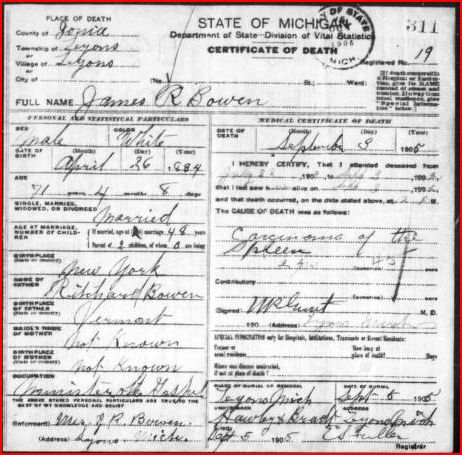
Primary Sources & Records
Original documents located in federal and state archives that name this soldier. Each is shown with its full transcription and citation.
The Regimental Register (Bowen, 1900)
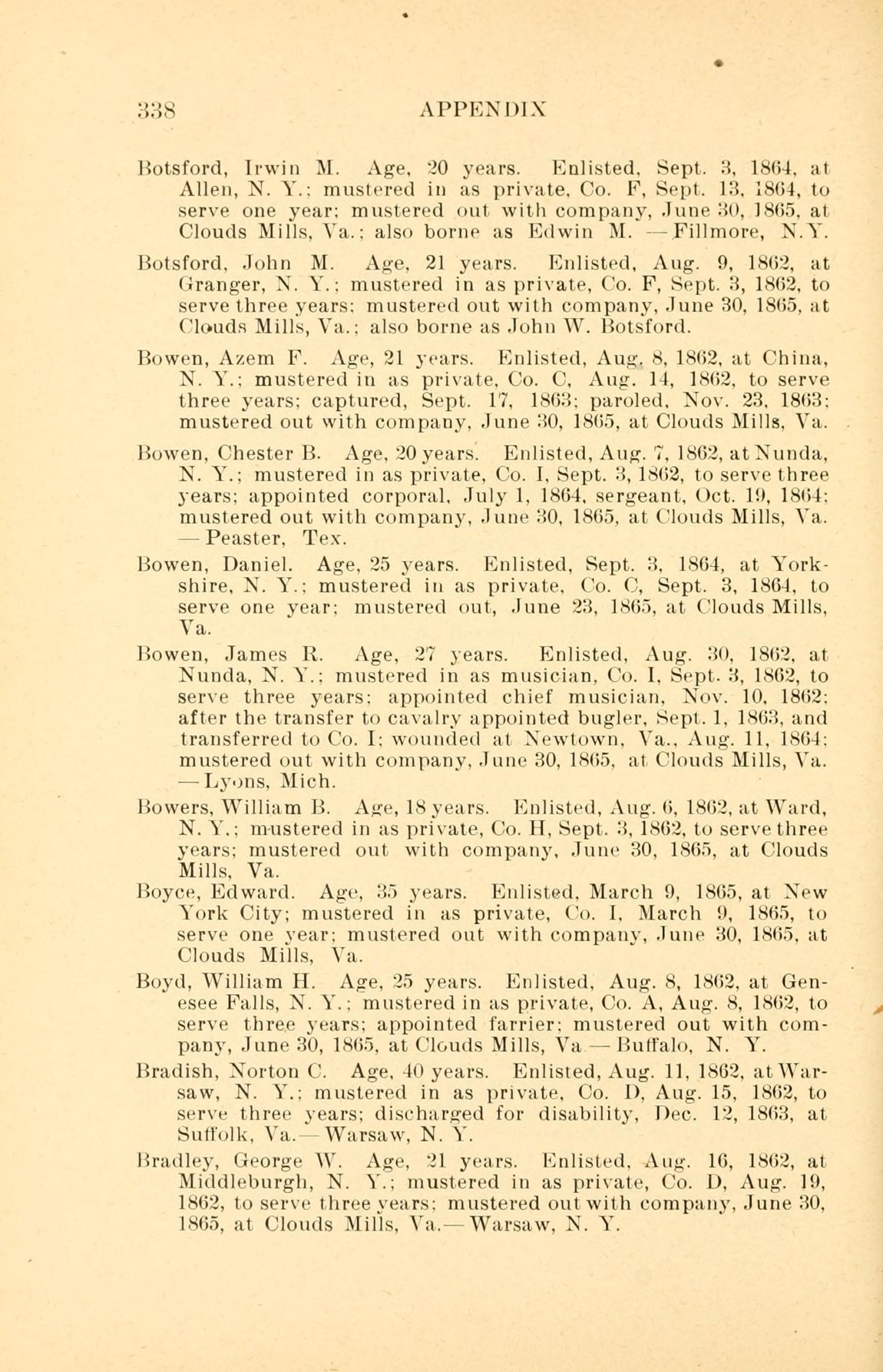
“James R Bowen. Mustered in as Musician, Co. I, Sept. 3, to serve three years; appointed chief Musician, Nov. 10. 1862; after the transfer to cavalry appointed bugler, Sept. 1, and transferred to Co. I; wounded at Newtown, Va. , Aug. 11, 1864; mustered out withcompany, June 30, at Clouds Mills, Va. — Byons, Mich.”
Source. Bowen, J. R. (1900). Regimental History of the First New York Dragoons (originally the 130th N.Y. Vol. Infantry) (p. 338). Internet Archive. archive.org/details/regimentalhistor00bowe
Views: 204