About This Article
This article provides a detailed examination of the Indian Removal Act of 1830 and the debates surrounding its passage during the 21st Congress. It explores the ethical, legal, and political implications of the act, which authorized the forced relocation of Native American tribes to lands west of the Mississippi River. The article delves into the key arguments raised during congressional debates, highlighting concerns over coercion, treaty enforcement, and the valuation of Native American lands.
The article also captures the conflicting perspectives of lawmakers, including arguments from figures like Mr. Kane and Mr. Sprague, who voiced concerns about ethical land acquisition practices and the protection of Native American autonomy. Despite significant opposition, the Indian Removal Act was passed, leading to devastating consequences for Native Americans, most notably the Trail of Tears.
Through references to historical debates and legislative texts, the article sheds light on the cultural and political tensions of the era, offering insights into the broader implications of U.S. expansionism and its impact on Native American tribes.
TWENTY-FIRST CONGRESS. SESS. I. CH. 148. 1830.
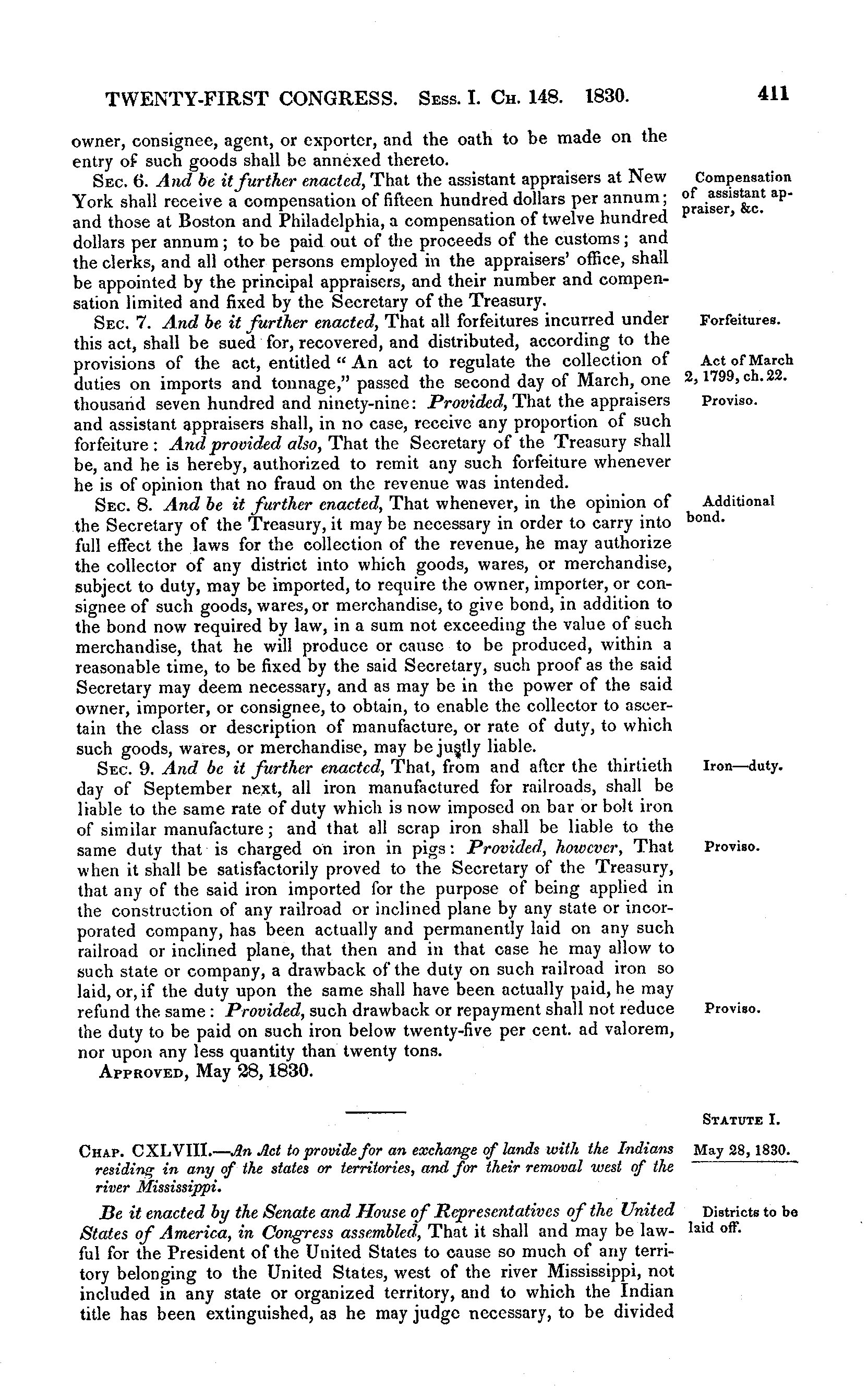
Sec. 6. And be it further enacted, That the assistant appraisers at New York shall receive a compensation of fifteen hundred dollars per annum; and those at Boston and Philadelphia, a compensation of twelve hundred dollars per annum; to be paid out of the proceeds of the customs; and the clerks, and all other persons employed in the appraisers’ office, shall be appointed by the principal appraisers, and their number and compensation limited and fixed by the Secretary of the Treasury.
Sec. 7. And be it further enacted, That all forfeitures incurred under this act, shall be sued for, recovered, and distributed, according to the provisions of the act, entitled “An act to regulate the collection of duties on imports and tonnage,” passed the second day of March, one thousand seven hundred and ninety-nine: Provided, That the appraisers and assistant appraisers shall, in no case, receive any proportion of such forfeiture: And provided also, That the Secretary of the Treasury shall be, and he is hereby, authorized to remit any such forfeiture whenever he is of opinion that no fraud on the revenue was intended.
Sec. 8. And be it further enacted, That whenever, in the opinion of the Secretary of the Treasury, it may be necessary in order to carry into full effect the laws for the collection of the revenue, he may authorize the collector of any district into which goods, wares, or merchandise, subject to duty, may be imported, to require the owner, importer, or consignee of such goods, wares, or merchandise, to give bond, in addition to the bond now required by law, in a sum not exceeding the value of such merchandise, that he will produce or cause to be produced, within a reasonable time, to be fixed by the said Secretary, such proof as the said Secretary may deem necessary, and as may be in the power of the said owner, importer, or consignee, to obtain, to enable the collector to ascertain the class or description of manufacture, or rate of duty, to which such goods, wares, or merchandise, may be justly liable.
Sec. 9. And be it further enacted, That, from and after the thirtieth day of September next, all iron manufactured for railroads, shall be liable to the same rate of duty which is now imposed on bar or bolt iron of similar manufacture; and that all scrap iron shall be liable to the same duty that is charged on iron in pigs: Provided, however, That when it shall be satisfactorily proved to the Secretary of the Treasury, that any of the said iron imported for the purpose of being applied in the construction of any railroad or inclined plane by any state or incorporated company, has been actually and permanently laid on any such railroad or inclined plane, that then and in that case he may allow to such state or company, a drawback of the duty on such railroad iron so laid, or, if the duty upon the same shall have been actually paid, he may refund the same: Provided, such drawback or repayment shall not reduce the duty to be paid on such iron below twenty-five per cent. ad valorem, nor upon any less quantity than twenty tons.
APPROVED, May 28, 1830.
STATUTE I.
CHAP. CXLVIII.—An Act to provide for an exchange of lands with the Indians residing in any of the states or territories, and for their removal west of the river Mississippi.
Be it enacted by the Senate and House of Representatives of the United States of America, in Congress assembled, That it shall and may be lawful for the President of the United States to cause so much of any territory belonging to the United States, west of the river Mississippi, not included in any state or organized territory, and to which the Indian title has been extinguished, as he may judge necessary, to be divided—
Debate on Indian Affairs in the 21st Congress (1830)
Table of Contents
On April 26, 1830, during the 21st Congress, discussions concerning the Indian Removal Act were prominent. The debates focused on the removal of Native American tribes and their lands’ transfer to U.S. settlers. The dialogue highlighted conflicting perspectives on the ethical and legal implications of such a policy.
Key Arguments:
Ethical Concerns on Land Acquisition: Several Congress members, including Mr. Kane from Illinois, raised concerns about the ethical implications of negotiating treaties with Native American tribes. He criticized the pressure placed on Native American leaders to cede their lands, arguing that such practices represented undue influence and dishonesty. He said, “It is no infringement of the constitutional power to buy Indian lands… but the mild manner of secret presents tells us they are not used to induce the chiefs to do wrong but to induce them to do right.” This indicates the prevailing sentiment that gifts or bribes may have been employed during negotiations.
Opposition to Coercion: Mr. Sprague supported a proviso that would protect Native American tribes from being coerced into relinquishing their lands or possessions. His amendment sought to safeguard the rights and property of the tribes until they voluntarily chose to remove themselves from their lands. Though this amendment was rejected, it demonstrated the concern among some members of Congress for the tribes’ autonomy and welfare.
The Role of the U.S. Government in Enforcing Treaties: Mr. Frelinghuysen added another proviso aimed at ensuring that no treaty between the United States and Native American tribes would be violated or nullified by non-observance or non-compliance. His amendment reiterated the importance of adhering to previously agreed-upon treaties to maintain trust and fairness.
Valuation of Indian Lands: An amendment by Mr. McKinley aimed to ensure that the valuation of improvements made by Native Americans to their lands would be compensated by the U.S. government, further reflecting the government’s intent to fairly compensate tribes being forced to relocate.
Outcome of the Debate:
The Indian Removal Act ultimately passed despite the strong opposition from several members of Congress. The act authorized the President to negotiate treaties with Native American tribes to exchange their lands east of the Mississippi for lands west of the river. The removal policy was justified as a necessary measure to ensure peace and expansion, though it ignored the tribes’ deep cultural connections to their ancestral lands.
Aftermath:
Following the passage of the act, thousands of Native Americans were forcibly removed from their lands, leading to the infamous “Trail of Tears,” where many perished during the long, arduous journey westward.
Reference:
This summary is based on the “Register of Debates, Senate, 21st Congress, 1st Session,” specifically focusing on the April 26, 1830, debate on Indian removal.

Views: 25