GENERAL AFFIDAVIT In the Matter of Marvin W. Green Oath of William Schilling
GENERAL AFFIDAVIT
State of Wisconsin, County of Eau Claire
In the Matter of Marvin W. Green
Co. E 19th Regt. N.Y. Inf.
On this 24th day of February, A.D. 1902, personally appeared before me, a Notary Public, in and for the aforesaid County, duly authorized to administer oaths, William Schilling, aged 55 years, a resident of Altoona, in the County of Eau Claire, and State of Wisconsin, whose Post-office address is Altoona, Eau Claire Co., Wisconsin, well known to me to be reputable, and entitled to credit, and who, being duly sworn, declares in relation to the aforesaid case as follows:
Cursive writing:
“I have been acquainted with the claimant for six years, that is, six years. I know of my own personal knowledge that in April, nineteen hundred and one, he had a stroke of paralysis or nervous prostration which has completely unfitted him for manual labor, and that he has to depend upon his relatives and friends for his support. It is my firm belief that he will never be able to do further days’ work. He is now totally incapacitated for manual labor.”
Typed portion continues:
Post-office address is Altoona, Eau Claire Co., Wisconsin.
I further declare that I have no interest in said case and am not concerned in its prosecution.
Signature:
William Schilling
(Signature of affiant)
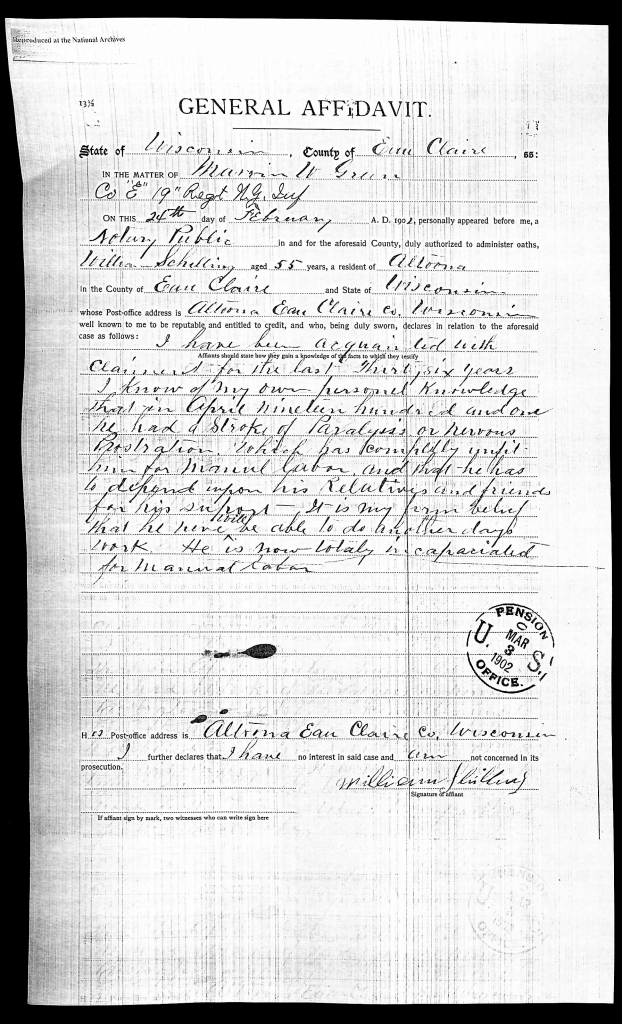
This document is a General Affidavit related to the pension application for Marvin W. Green, a veteran of the Civil War who served in Company E, 19th New York Cavalry. It is part of his effort to secure a pension under U.S. laws that provided benefits for disabled veterans.
Key Points:
Purpose of the Affidavit:
- The affidavit is a sworn statement made by William Schilling, a resident of Altoona, Eau Claire County, Wisconsin, attesting to Marvin W. Green’s condition.
- Schilling confirms that Green suffered a stroke of paralysis or nervous prostration in April 1901, rendering him completely incapable of performing manual labor.
- Schilling also states that Green is dependent on his relatives and friends for support and believes that Green’s condition is permanent.
Context:
- This affidavit supports Green’s claim that he is disabled and cannot work, which is a requirement to qualify for a pension under the Act of June 27, 1890. This act allowed veterans to receive pensions if they were disabled, regardless of whether the disability was directly caused by their military service.
Legal Weight:
- The affidavit is notarized, meaning it was sworn under oath before a notary public, adding legal credibility to the claim.
- Affidavits like this were commonly used to provide third-party testimony about a claimant’s condition or circumstances.
Implications:
- The document demonstrates how veterans relied on personal acquaintances or community members to testify about their disabilities and living conditions to support their pension applications.
- It also reflects the bureaucratic process veterans had to navigate to secure financial assistance.
Why This Matters:
This affidavit is part of Marvin W. Green’s broader effort to prove his eligibility for a Civil War pension. It highlights both his physical incapacity and his reliance on others, fulfilling the requirements of the pension system at the time. It also shows the role of community testimony in verifying a veteran’s claims.
Views: 39