Table of Contents
Edmund Randolph (1819–1861) was an American jurist and politician who played a significant role in the legal and political development of California during its formative years. Born into a distinguished Virginia family, Randolph’s career spanned various regions and included notable contributions to both state and international affairs.
Early Life and Education
Edmund Randolph was born in 1819 in Richmond, Virginia, to Peyton and Maria Ward Randolph. He was the grandson of Edmund Jennings Randolph, the first U.S. Attorney General and a prominent figure in early American history (Shuck, 1889). This lineage placed him within a family deeply entrenched in the political and legal fabric of the nation.
Randolph pursued higher education at the College of William and Mary, one of the nation’s oldest institutions, where he completed his undergraduate studies. He then advanced to the University of Virginia to study law, following in the footsteps of his esteemed grandfather (Shuck, 1889). This academic foundation equipped him with a robust understanding of legal principles and practices.
Legal Career in New Orleans
After completing his legal education, Randolph relocated to New Orleans, Louisiana, where he began his professional career. He served as a clerk for the U.S. Circuit Court for Louisiana, gaining practical experience in the judicial system (Shuck, 1889). During his time in New Orleans, he also engaged in private legal practice, establishing himself within the local legal community.
Migration to California and Political Involvement
In 1849, amid the California Gold Rush, Randolph moved to San Francisco, California. The rapid population growth and economic expansion presented numerous opportunities for legal professionals. Randolph quickly became an influential figure in the burgeoning state. That same year, he was elected to represent San Francisco in California’s first State Assembly, which convened in San Jose on December 15, 1849 (Shuck, 1889). His election to the assembly underscored his prominence in the state’s early political landscape.
Legal Practice in San Francisco
Beyond his legislative role, Randolph was a prominent attorney in San Francisco. He notably represented the United States in the significant Almaden mine case, a complex legal battle over mining rights. His dedication to this case was so intense that it reportedly affected his health (Shuck, 1889). This case highlighted his legal acumen and commitment to upholding the law during a period of rapid economic development and legal ambiguity.
Involvement in Filibustering Expeditions
In the mid-1850s, Randolph became involved in international affairs through his association with William Walker, a notorious filibuster who led unauthorized military expeditions in Latin America. Randolph collaborated with Walker during his expedition to seize control of Nicaragua in 1855 and 1856. He played a pivotal role in securing support from agents of the Accessory Transit Company, facilitating transportation for mercenaries and supplies to aid Walker’s campaign (Stiles, 2009). This involvement in filibustering activities reflects the complex and often controversial nature of American expansionist endeavors during that era.
Oratory and Historical Contributions
Randolph was also an accomplished orator and historian. On September 10, 1860, he delivered an address titled “Address on the History of California, from the Discovery of the Country to the Year 1849” before the Society of California Pioneers in San Francisco. This address demonstrated his deep understanding of California’s history and his ability to articulate it compellingly (Shuck, 1889).
Death and Legacy
Edmund Randolph passed away in San Francisco on September 8, 1861, at the age of 42. His contributions to California’s early statehood and legal system left a lasting impact on the region’s development. As a jurist, politician, and historian, Randolph’s multifaceted career reflects the dynamic and often tumultuous nature of mid-19th-century America.
References
Shuck, O. T. (1889). Bench and Bar in California: History, Anecdotes, Reminiscences. San Francisco: The Occident Printing House.
This book provides a detailed account of the lives and careers of prominent legal figures in California, including Edmund Randolph.
Stiles, T. J. (2009). The First Tycoon: The Epic Life of Cornelius Vanderbilt. New York: Alfred A. Knopf.
This book discusses the broader economic and political contexts of 19th-century America, including references to filibustering and Randolph’s role in international affairs.
Alfred Gibbs Appointed Power of Attorney for a Sale of Land to William Montgomery Boggs (1826–1911)
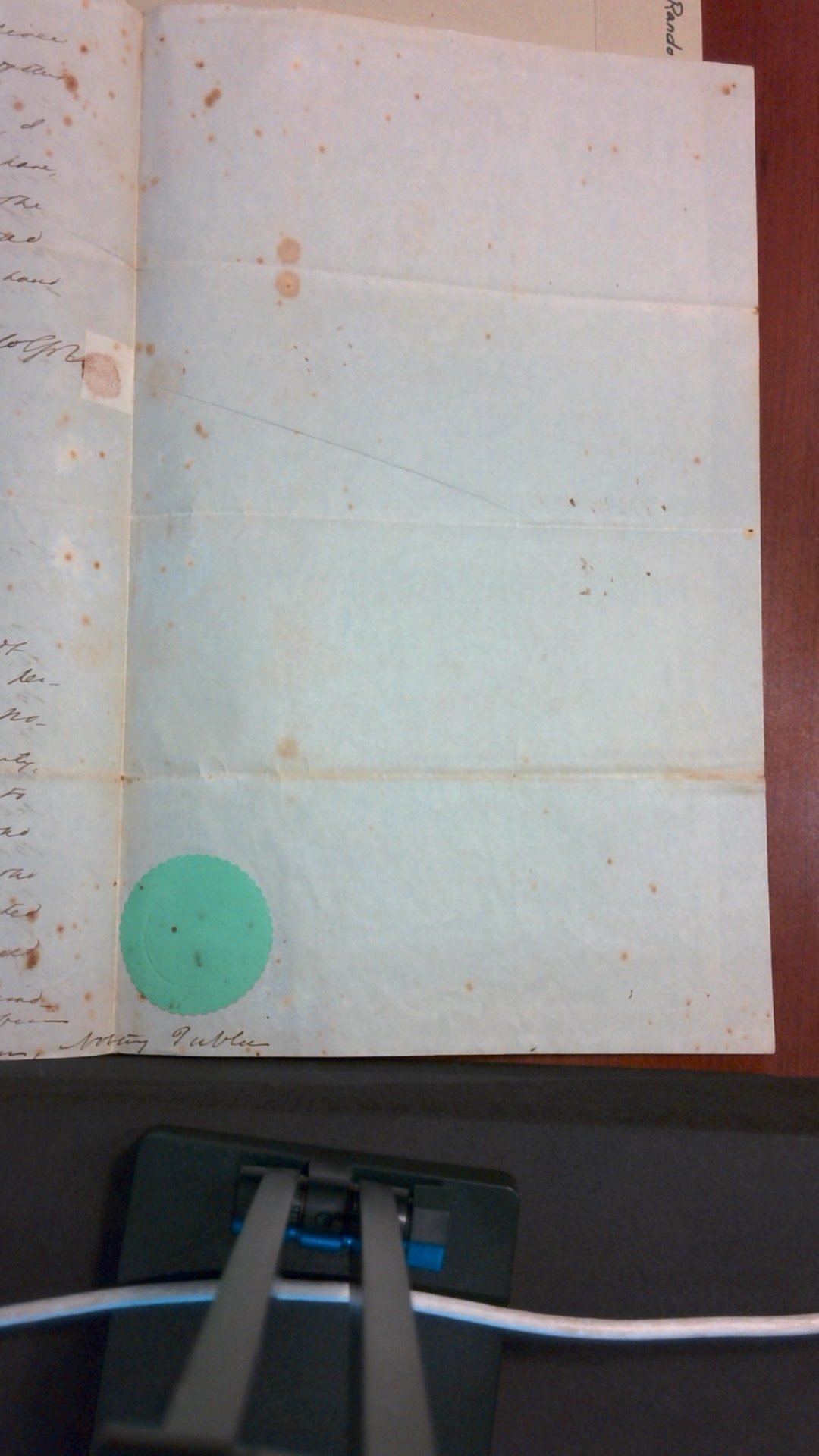
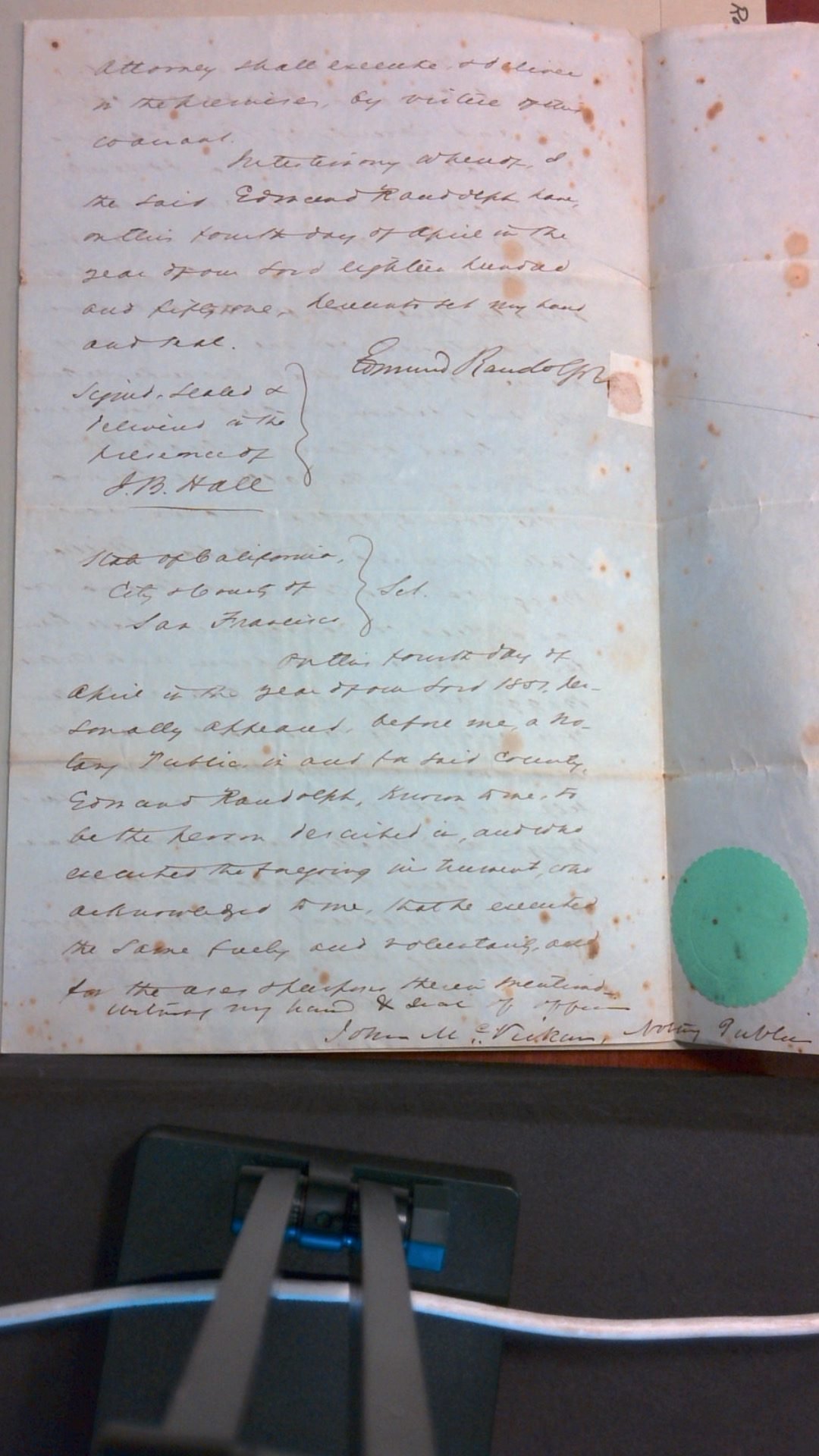
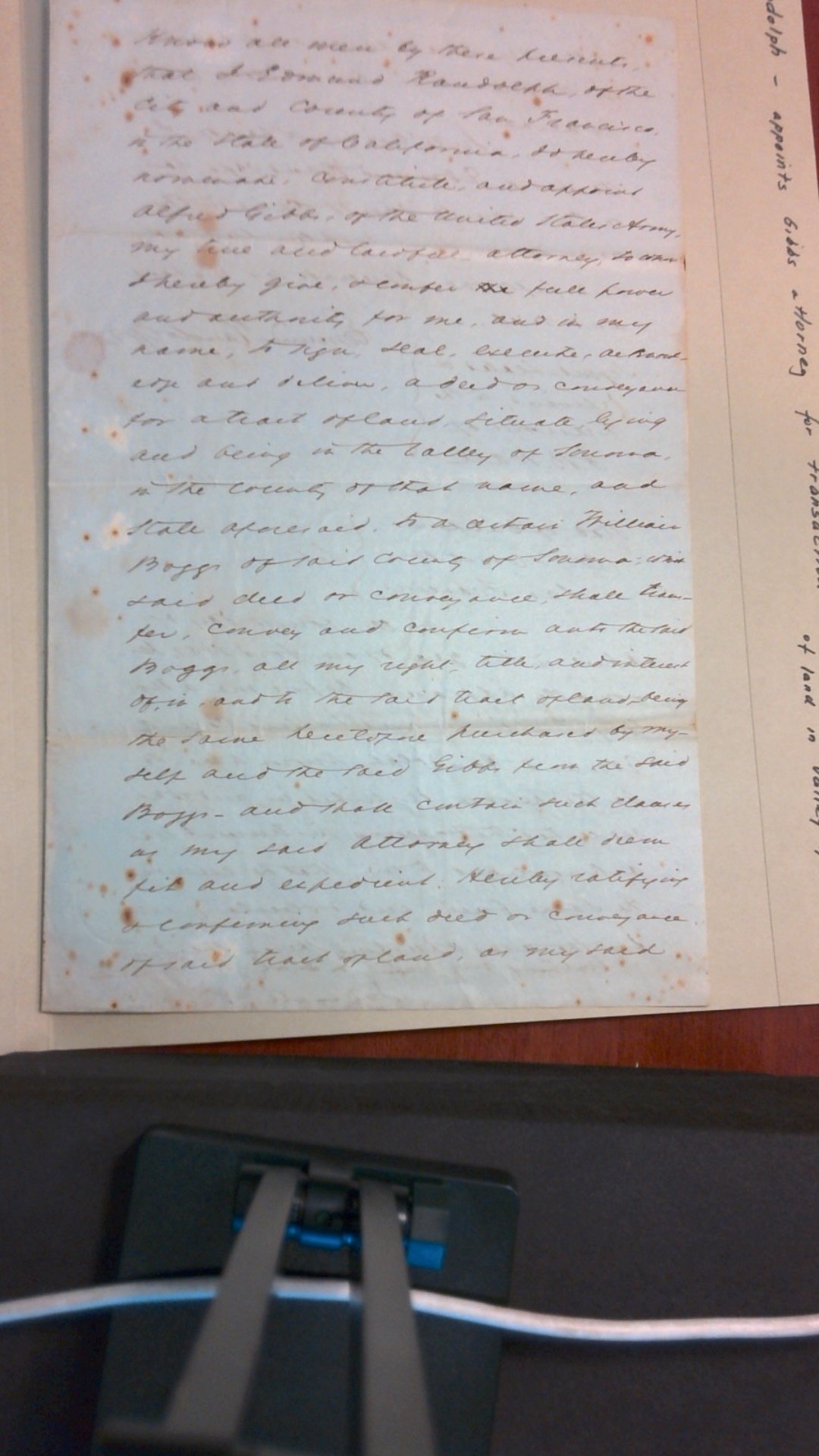
Know all men by these presents
That I, Edmund Randolph, of the city and county of San Francisco, in the State of California, do hereby nominate, constitute, and appoint Alfred Gibbs, of the United States Army, my true and lawful attorney, to have and hereby do confer upon him the full power and authority for me and in my name, to sign, seal, execute, acknowledge, and deliver a deed or conveyance for a tract of land situate and being in the Valley of Sonoma, in the County of that name, and the State aforesaid, to a certain William Boggs of said County of Sonoma, which deed or conveyance shall transfer, convey, and confirm unto the said Boggs all my right, title, and interest of, in, and to the said tract of land that he, the said Boggs, has heretofore purchased of my self and the said Gibbs from the said Boggs; and shall contain such clauses as my said Attorney shall deem fit and expedient.
Hereby ratifying and confirming such deed or conveyance as my act.
My said Attorney shall execute and deliver in the premises, by virtue of this covenant, ratifying my authority.
I, the said Edmund Randolph, have hereunto set my hand this fourth day of April in the year of our Lord eighteen hundred and fifty-seven, as evidence of my love and trust.
(Signed)
Edmund Randolph
Sealed, signed, and delivered in the presence of:
J.B. Hall
State of California
City and County of San Francisco
On this fourth day of April in the year of our Lord 1857, personally appeared before me a Notary Public in and for said County, Edmund Randolph, known to me to be the person described in and who executed the foregoing instrument and acknowledged to me that he executed the same freely and voluntarily.
In witness thereof, I have hereunto set my hand and seal of office.
(Signed)
John M. Wickersham
Notary Public
Image and Data Resource
Gibbs, A. (1841–1868). Alfred Gibbs papers. U.S. Military Academy Library, Manuscripts Collection (CU # 1313). Examined on November 25, 2024.
Views: 97