The Battle of Rhode Island
This is the battle our ancestor fought in. William Greene of Westerly (1732–1790), a private in Capt. Philip Traffarn’s company of Col. John Topham’s regiment of Rhode Island State Troops, was with his company at Tiverton and on the island in August 1778. He is the fifth-great-grandfather of the compiler of this archive, and the father of Coggeshall Greene, through whom the Green family of this site descends. This page tells the story of his battle from the records of the time. Where a source is silent the page says so.
William Greene of Westerly at Quaker Hill
William was a soldier of the regiment that fought here. He enlisted on 14 June 1778 in Capt. Philip Traffarn’s company of Col. John Topham’s regiment, Rhode Island State Troops, for service until 16 March 1779. His company was mustered at Tiverton in July, and again on 13 September, two weeks after the battle.
His company was in the battle. Two privates of Traffarn’s company swore to it in 1832. Jonathan Bushee said the regiment “went on to Rhode Island at the time of the battle,” and that he “with said Company pursued the enemy.” Chaffey Green, who served that year “under Captain Traffin,” said he “was in the engagement on Rhodeisland.”
His brigade held the first line. Topham’s regiment belonged to Brig. Gen. Ezekiel Cornell’s brigade. General Sullivan’s report names “Varnum’s, Glover’s, Cornell’s, and Greene’s” as the brigades of the first line that “behaved with great firmness,” on the right wing commanded by Maj. Gen. Nathanael Greene.
A caution. No record names William himself on the field. He was on his company’s rolls before and after the battle, so he was very probably there with it, but that is an inference, and this page says so.
His line, from Quaker Hill to this archive
- William Greene of Westerly (1732–1790), private, Topham’s regiment, 1778–1779, and his second wife Sarah Chesebrough
- Coggeshall Greene (1787–1864), born at Westerly nine years after the battle
- William Erastus Green (1816–1884)
- Lorenzo Erastus Green, whose brothers Marvin, Levi and John Sterns Green wrote the Green Family Letters from the Civil War
- Herbert Levi Green, and through two more generations to Garland H. Green Jr., who compiles this archive
The generations after Coggeshall are from the family’s own records and the pages linked above; they are documented there, not on this page.
Two of the eight cards of William’s compiled service record in the National Archives, copied from the muster rolls of Capt. Philip Traffarn’s company. The first, for the roll of 11 July 1778, gives his enlistment on 14 June. The second is the roll of 13 September 1778, the first taken after the battle. All eight cards, with their transcriptions, are on William’s page. Handwritten entries are in italics.
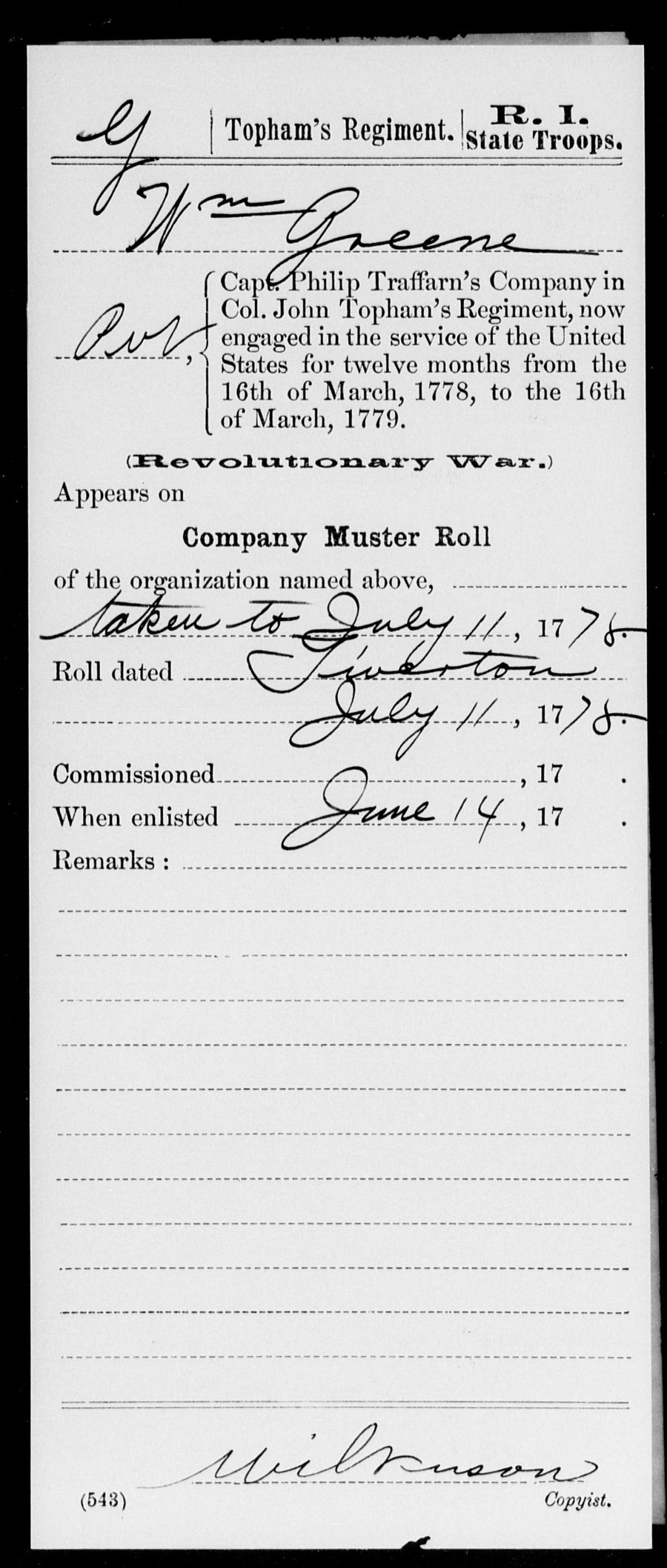
Wm Greene
Pvt, Capt. Philip Traffarn’s Company in Col. John Topham’s Regiment, now engaged in the service of the United States for twelve months from the 16th of March, 1778, to the 16th of March, 1779.
(Revolutionary War.)
Appears on Company Muster Roll of the organization named above, taken to July 11, 1778.
Roll dated Tiverton July 11, 1778.
Commissioned ……, 17 .
When enlisted June 14, 17 .
Remarks:
(543) Wilkinson, Copyist.
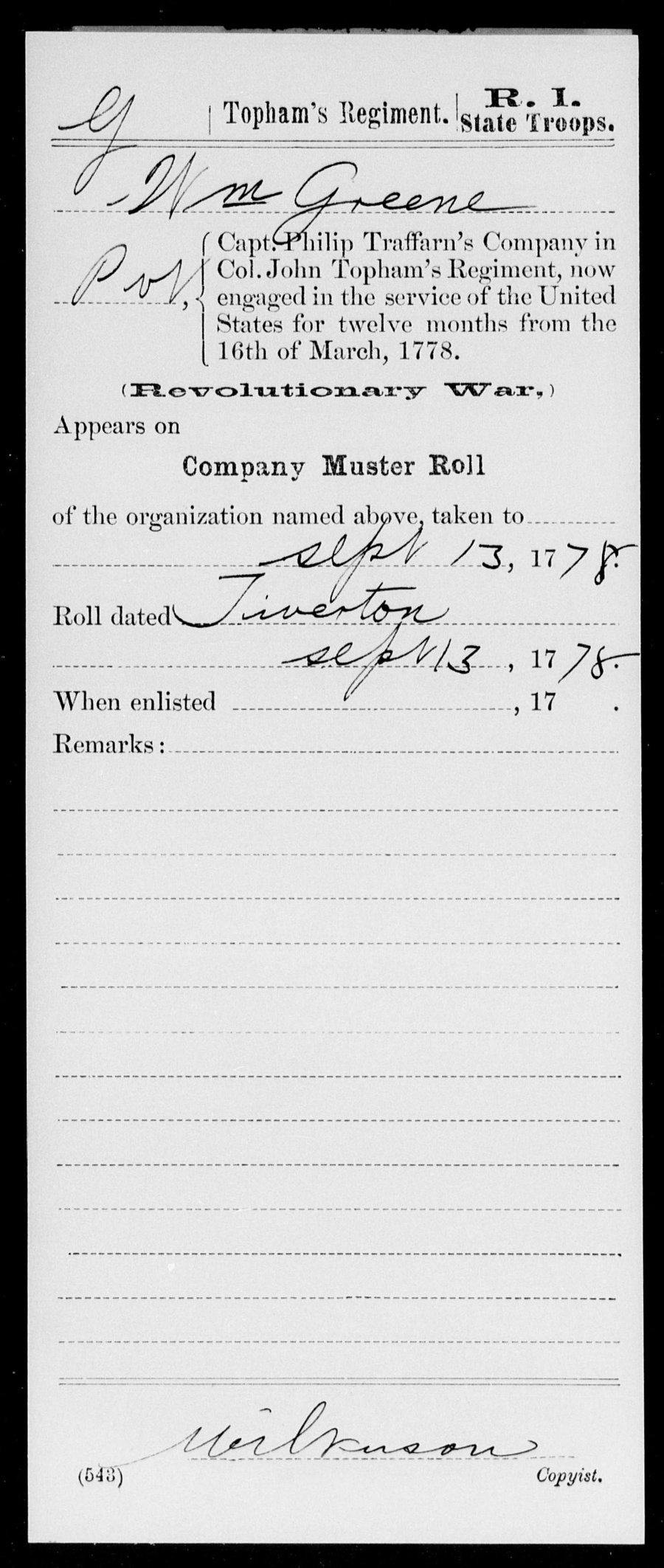
Wm Greene
Pvt, Capt. Philip Traffarn’s Company in Col. John Topham’s Regiment, now engaged in the service of the United States for twelve months from the 16th of March, 1778.
(Revolutionary War.)
Appears on Company Muster Roll of the organization named above, taken to Sept 13, 1778.
Roll dated Tiverton Sept 13, 1778.
When enlisted ……, 17 .
Remarks:
(543) Wilkinson, Copyist.
National Archives, M881, compiled service record, “Greene, William, Rhode Island, Topham’s Regiment, State Troops,” catalog.archives.gov/id/142047337.
The battle
Why there was a battle. British and Hessian troops had held the island of Rhode Island, with the town of Newport, since December 1776. In the summer of 1778 France entered the war, and a French fleet under the Comte d’Estaing arrived off Newport on 29 July. General John Sullivan gathered an American army at Tiverton, Continental regiments, Rhode Island State troops and thousands of New England militia and volunteers, to take the island with French help.
What went wrong. The Americans crossed to the island in August and laid siege to Newport. A British fleet appeared, d’Estaing sailed out to meet it, and a great storm scattered both fleets. The French went to Boston for repairs. Without them the siege could not succeed, and the volunteers went home in their thousands.
The battle. On the night of 28 August Sullivan fell back to the north end of the island, to Butts’s Hill. On the morning of the 29th the British and Hessians came after him. After hours of cannonade and skirmishing they attacked the American right three times, and were driven back to Quaker Hill. On the night of the 30th the whole American army crossed back to the mainland without the loss of a man, just before British reinforcements arrived.
“1778: Battle of Rhode Island,” a film presented by the Battle of Rhode Island Association (YouTube). A modern documentary, shown here for orientation; it is not one of the sources cited on this page.
The battle was fought on 29 August 1778 at the north end of the island, between the American lines on Butts’s Hill and the British on Quaker and Turkey Hills, about a mile apart.
The heaviest fighting was on the American right, which the British tried three times to turn, with help from their ships in the bay, and were driven back.
The army left the island on the night of 30 August, crossing to Tiverton and Bristol without loss. William’s company was back at its post near Howland’s Ferry, Tiverton, for the rest of his year.
Other Greenes in the battle
William was not the only Greene on the field. Maj. Gen. Nathanael Greene of Coventry commanded the right wing; his letter to Washington is among the documents below. Col. Christopher Greene of Warwick commanded the 1st Rhode Island Regiment, filled that spring with men freed by an act of the General Assembly on “passing muster before Col. Christopher Greene”; Arnold’s history says it “distinguished itself by deeds of desperate valor.” Fourteen Greenes, William among them, are on the 1785 pay list of Topham’s regiment. How any of these men were related to William is not established here.
The documents
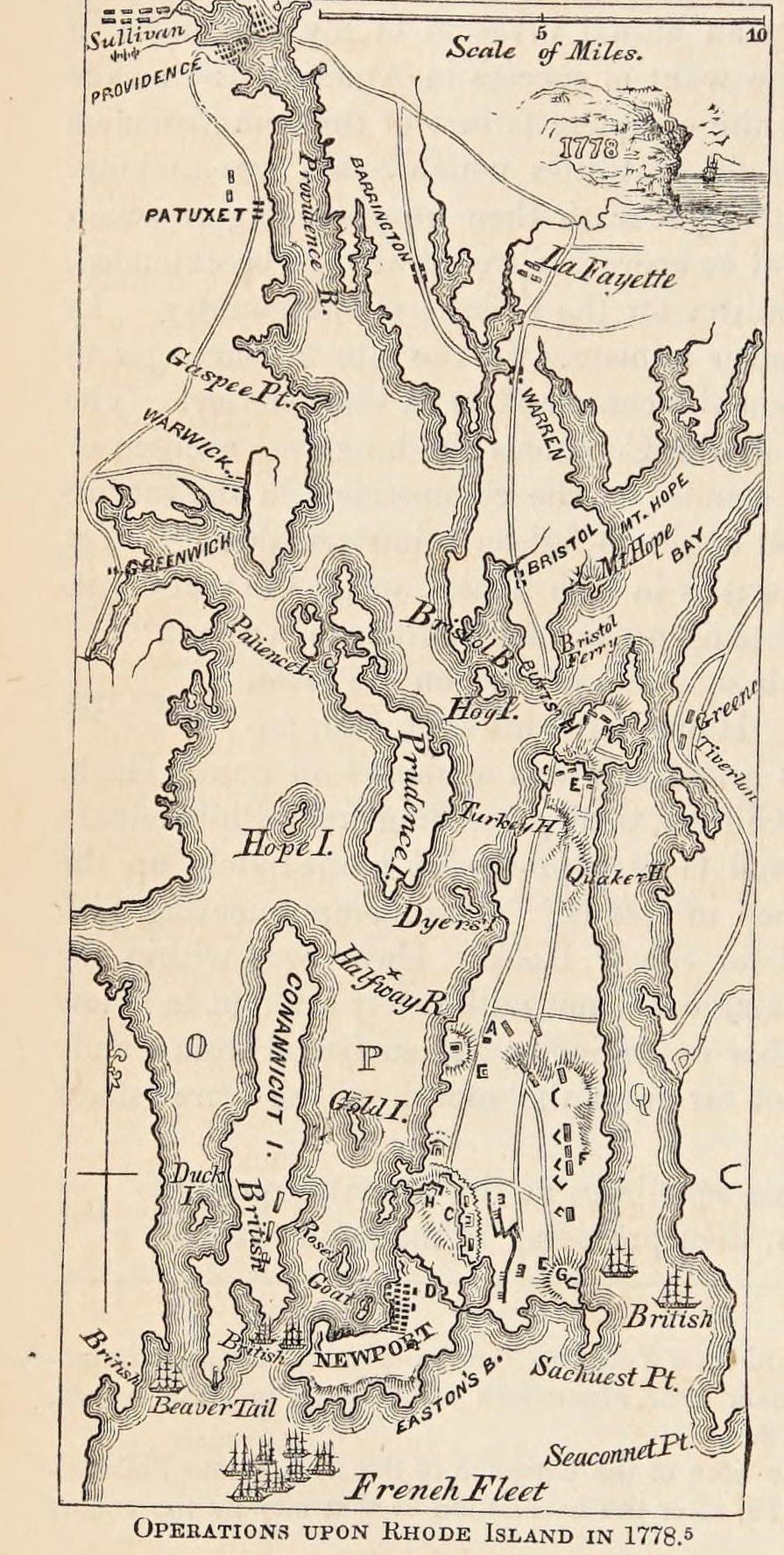
Benson Lossing’s map of the campaign, drawn for his Pictorial Field-Book of the Revolution (1860). Newport is at the foot of the island; Butts’s Hill (“Butts”), Quaker Hill and Turkey Hill are at the north end, near Bristol Ferry. Tiverton, where the American army gathered and to which it retreated, is across the channel on the right. The map’s key is transcribed from Lossing’s note 5, shown in the next card.
[Map, with the lettering:] Sullivan · Providence · Patuxet · Gaspee Pt. · Warwick · Greenwich · Barrington · Warren · La Fayette · Bristol · Mt. Hope Bay · Bristol Ferry · Butts · Hog I. · Prudence I. · Patience I. · Hope I. · Turkey H. · Quaker H. · Dyer’s I. · Halfway R. · Conannicut I. · Gould I. · Rose I. · Goat I. · Newport · Easton’s B. · Sachuest Pt. · Seaconnet Pt. · Beaver Tail · Duck I. · British · French Fleet · 1778 · Scale of Miles
OPERATIONS UPON RHODE ISLAND IN 1778.5
Lossing’s note explaining the map. It begins at the foot of page 648 and continues on page 649.
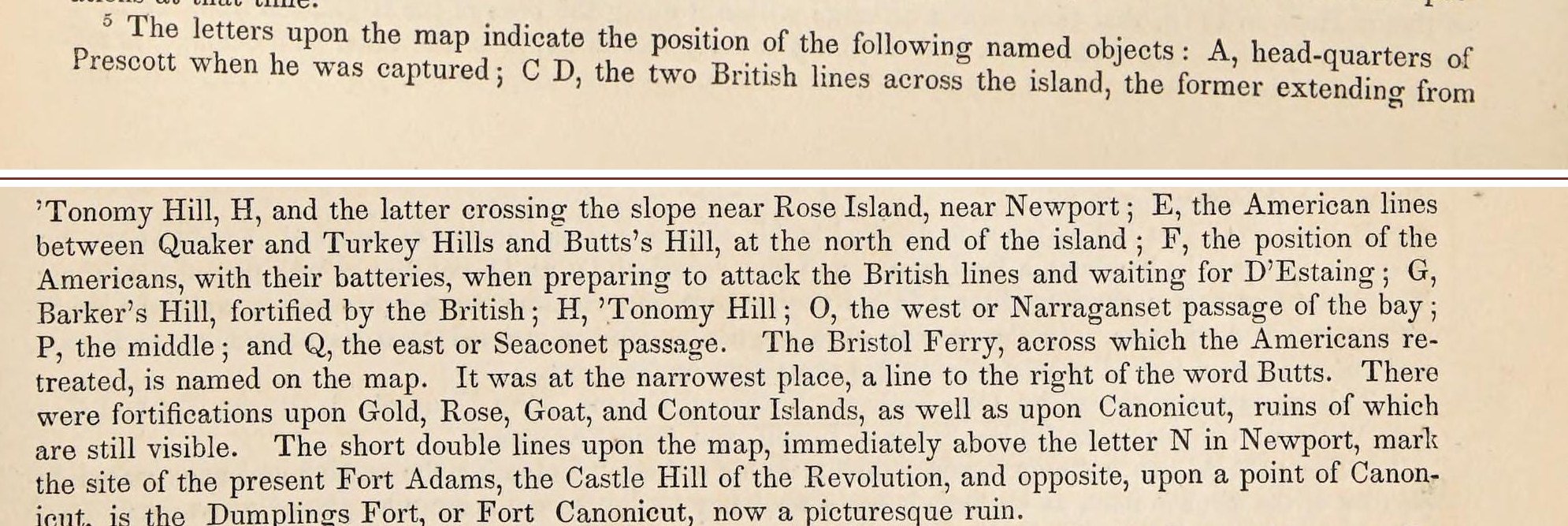
5 The letters upon the map indicate the position of the following named objects: A, head-quarters of Prescott when he was captured; C D, the two British lines across the island, the former extending from
’Tonomy Hill, H, and the latter crossing the slope near Rose Island, near Newport; E, the American lines between Quaker and Turkey Hills and Butts’s Hill, at the north end of the island; F, the position of the Americans, with their batteries, when preparing to attack the British lines and waiting for D’Estaing; G, Barker’s Hill, fortified by the British; H, ’Tonomy Hill; O, the west or Narraganset passage of the bay; P, the middle; and Q, the east or Seaconet passage. The Bristol Ferry, across which the Americans retreated, is named on the map. It was at the narrowest place, a line to the right of the word Butts. There were fortifications upon Gold, Rose, Goat, and Contour Islands, as well as upon Canonicut, ruins of which are still visible. The short double lines upon the map, immediately above the letter N in Newport, mark the site of the present Fort Adams, the Castle Hill of the Revolution, and opposite, upon a point of Canonicut, is the Dumplings Fort, or Fort Canonicut, now a picturesque ruin.
Lossing’s engraving, after a print in the Gentleman’s Magazine. His footnote identifies the three hills. Lossing titles it a scene of the engagement of 29 August and dates the print 1778; the original print, shown in the next card, was published in 1779 and is titled a view of the siege on 25 August, four days before the battle. The picture below is a modern rendition of Lossing’s engraving, made for this page. It is not a historical image: its colour, the soldiers’ uniforms, the tents, walls and buildings are the rendition’s, not details recorded by the engraver, and its re-lettered footnote has a copying slip (“on the left. The its slopes”). The transcription is of Lossing’s printed page. See Lossing’s original engraving.
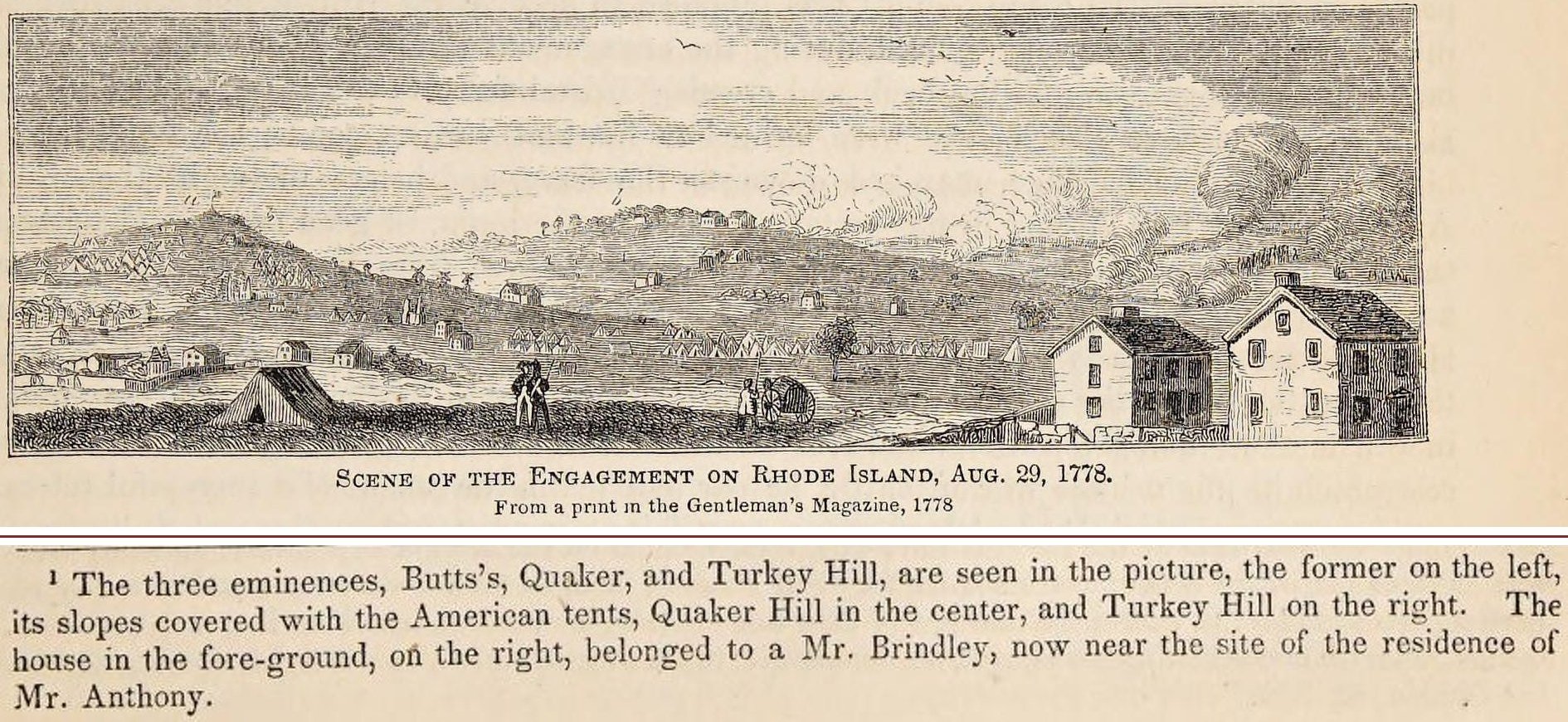
SCENE OF THE ENGAGEMENT ON RHODE ISLAND, AUG. 29, 1778.
From a print in the Gentleman’s Magazine, 1778
1 The three eminences, Butts’s, Quaker, and Turkey Hill, are seen in the picture, the former on the left, its slopes covered with the American tents, Quaker Hill in the center, and Turkey Hill on the right. The house in the fore-ground, on the right, belonged to a Mr. Brindley, now near the site of the residence of Mr. Anthony.
The original of Lossing’s engraving: a copper-plate view published in the Gentleman’s Magazine in London in 1779, now in the Library of Congress. Its own title dates the scene to 25 August 1778, during the siege of Newport, four days before the battle, so it shows the American lines and batteries in the siege, not the battle itself. The letters a, b, c and d on the plate were keyed to a description in the magazine that is not reproduced here. On the right is a modern digital enhancement of the same print, added for the reader’s eye. It is not a historical image: its colour, sky, fences and buildings are the enhancement’s, and details such as the flag on the hill and the shape of the tent in the foreground were supplied by it, not by the 1779 engraver.
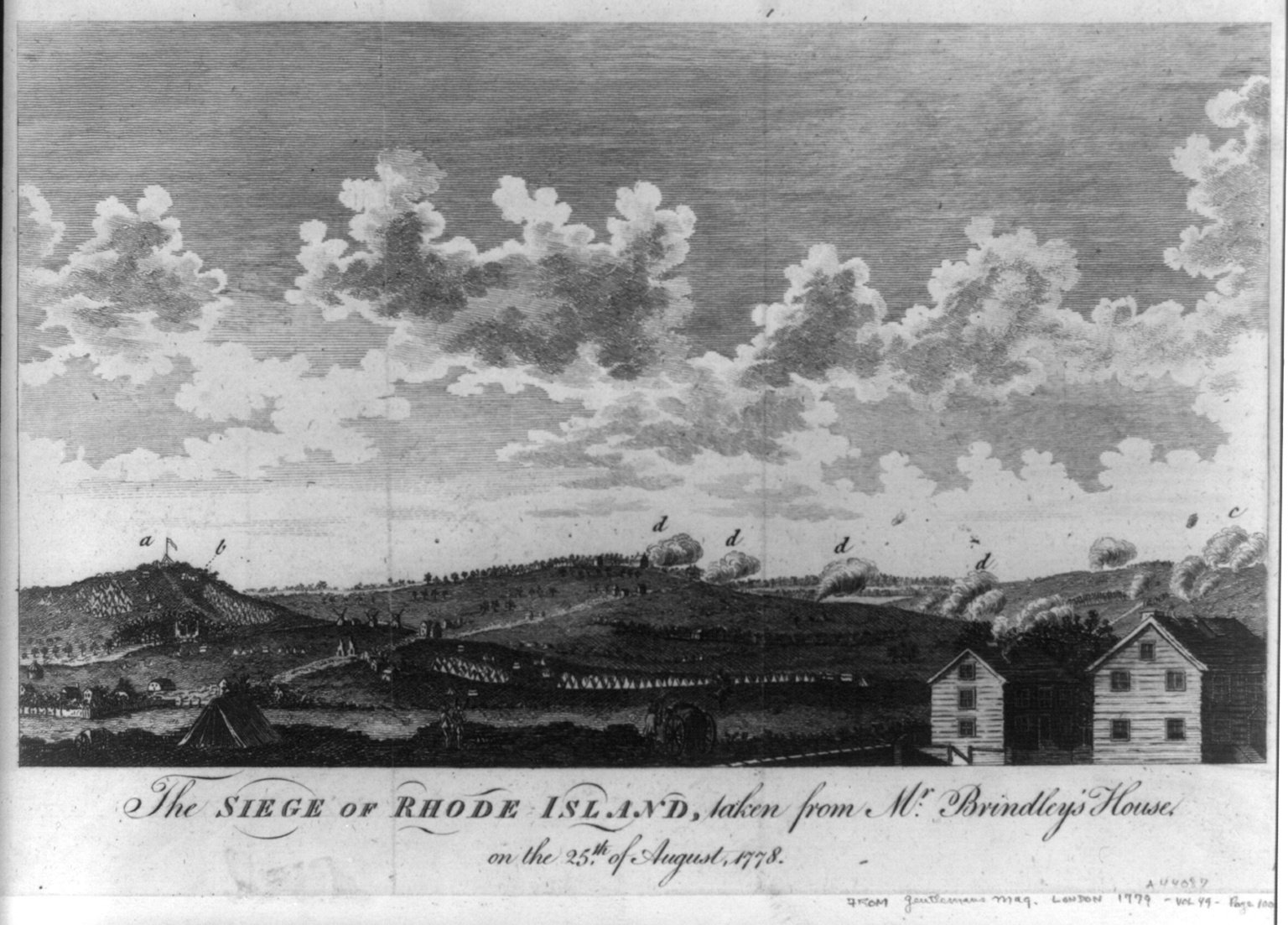
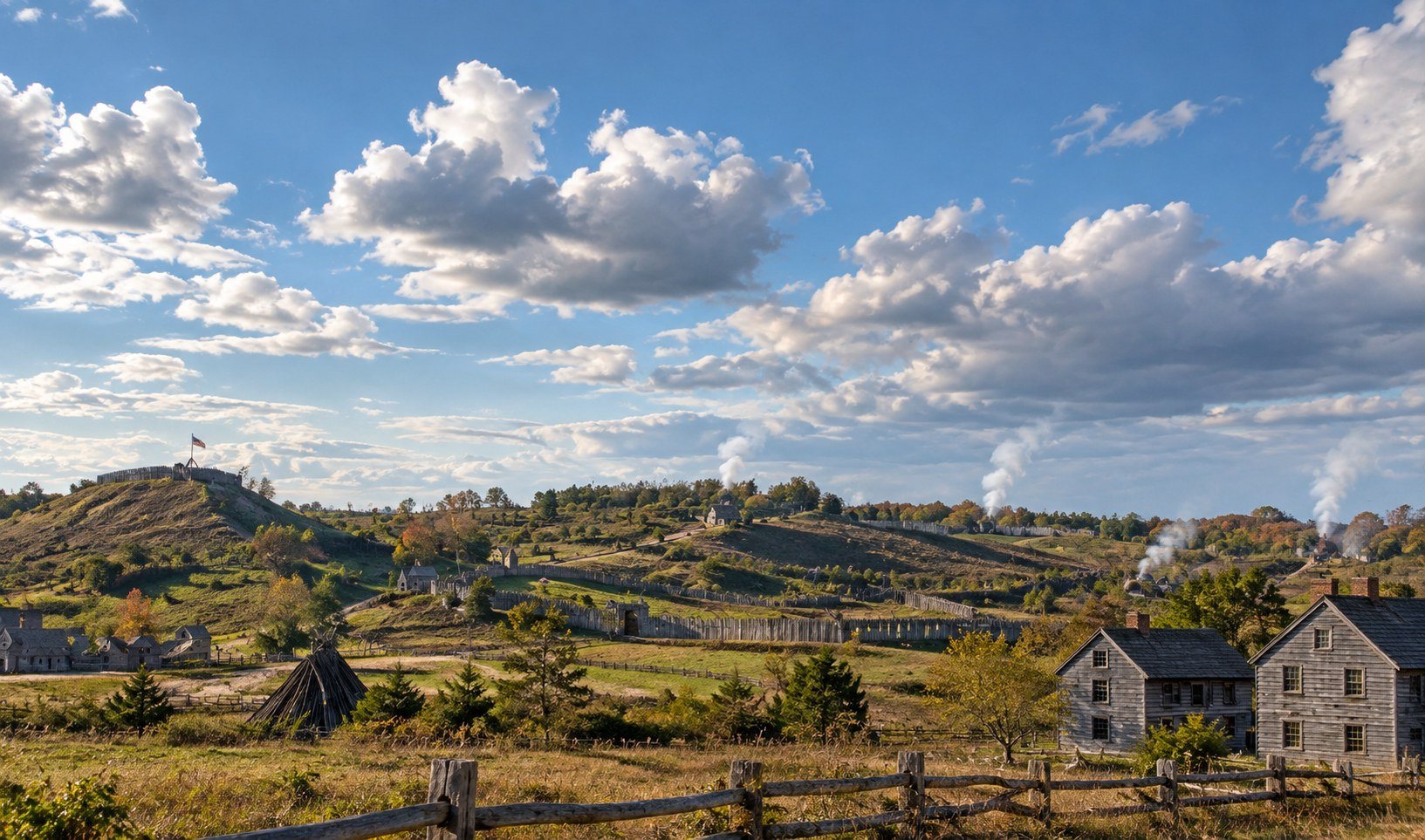
[Plate letters:] a · b · d · d · d · d · c
The SIEGE of RHODE ISLAND, taken from Mr. Brindley’s House on the 25th. of August, 1778.
[Library of Congress mount, handwritten:] A 44037 · From Gentlemans Mag. London 1779 – Vol. 49 – Page 100
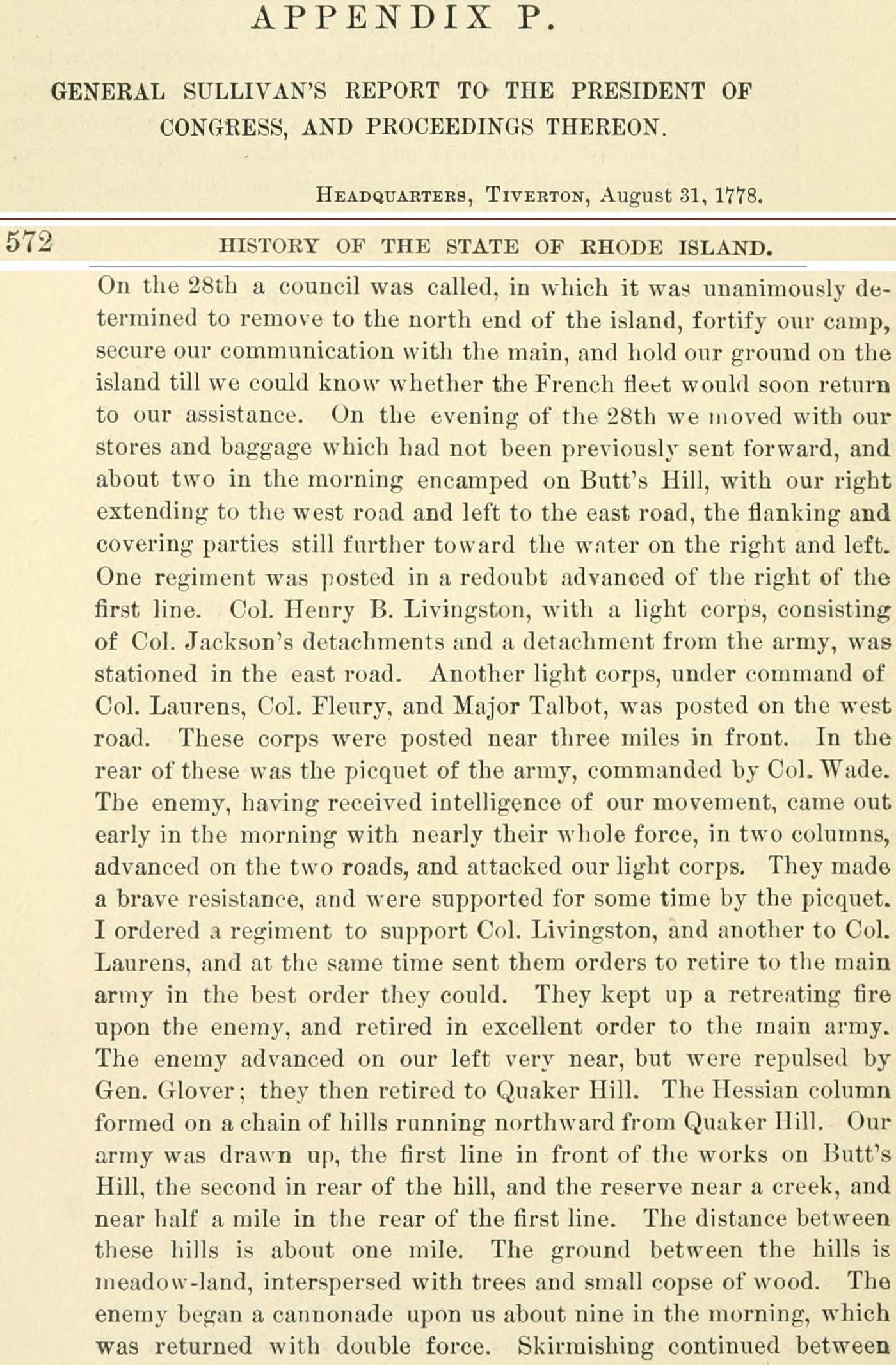
Sullivan wrote to the President of Congress the day after the army left the island. Samuel Greene Arnold printed the whole report as an appendix to his History of the State of Rhode Island. The opening, on the siege and the storm, is omitted here; the extract begins with the council of 28 August.
APPENDIX P.
GENERAL SULLIVAN’S REPORT TO THE PRESIDENT OF CONGRESS, AND PROCEEDINGS THEREON.
Headquarters, Tiverton, August 31, 1778.
[…]
572 HISTORY OF THE STATE OF RHODE ISLAND.
On the 28th a council was called, in which it was unanimously determined to remove to the north end of the island, fortify our camp, secure our communication with the main, and hold our ground on the island till we could know whether the French fleet would soon return to our assistance. On the evening of the 28th we moved with our stores and baggage which had not been previously sent forward, and about two in the morning encamped on Butt’s Hill, with our right extending to the west road and left to the east road, the flanking and covering parties still further toward the water on the right and left. One regiment was posted in a redoubt advanced of the right of the first line. Col. Henry B. Livingston, with a light corps, consisting of Col. Jackson’s detachments and a detachment from the army, was stationed in the east road. Another light corps, under command of Col. Laurens, Col. Fleury, and Major Talbot, was posted on the west road. These corps were posted near three miles in front. In the rear of these was the picquet of the army, commanded by Col. Wade. The enemy, having received intelligence of our movement, came out early in the morning with nearly their whole force, in two columns, advanced on the two roads, and attacked our light corps. They made a brave resistance, and were supported for some time by the picquet. I ordered a regiment to support Col. Livingston, and another to Col. Laurens, and at the same time sent them orders to retire to the main army in the best order they could. They kept up a retreating fire upon the enemy, and retired in excellent order to the main army. The enemy advanced on our left very near, but were repulsed by Gen. Glover; they then retired to Quaker Hill. The Hessian column formed on a chain of hills running northward from Quaker Hill. Our army was drawn up, the first line in front of the works on Butt’s Hill, the second in rear of the hill, and the reserve near a creek, and near half a mile in the rear of the first line. The distance between these hills is about one mile. The ground between the hills is meadow-land, interspersed with trees and small copse of wood. The enemy began a cannonade upon us about nine in the morning, which was returned with double force. Skirmishing continued between
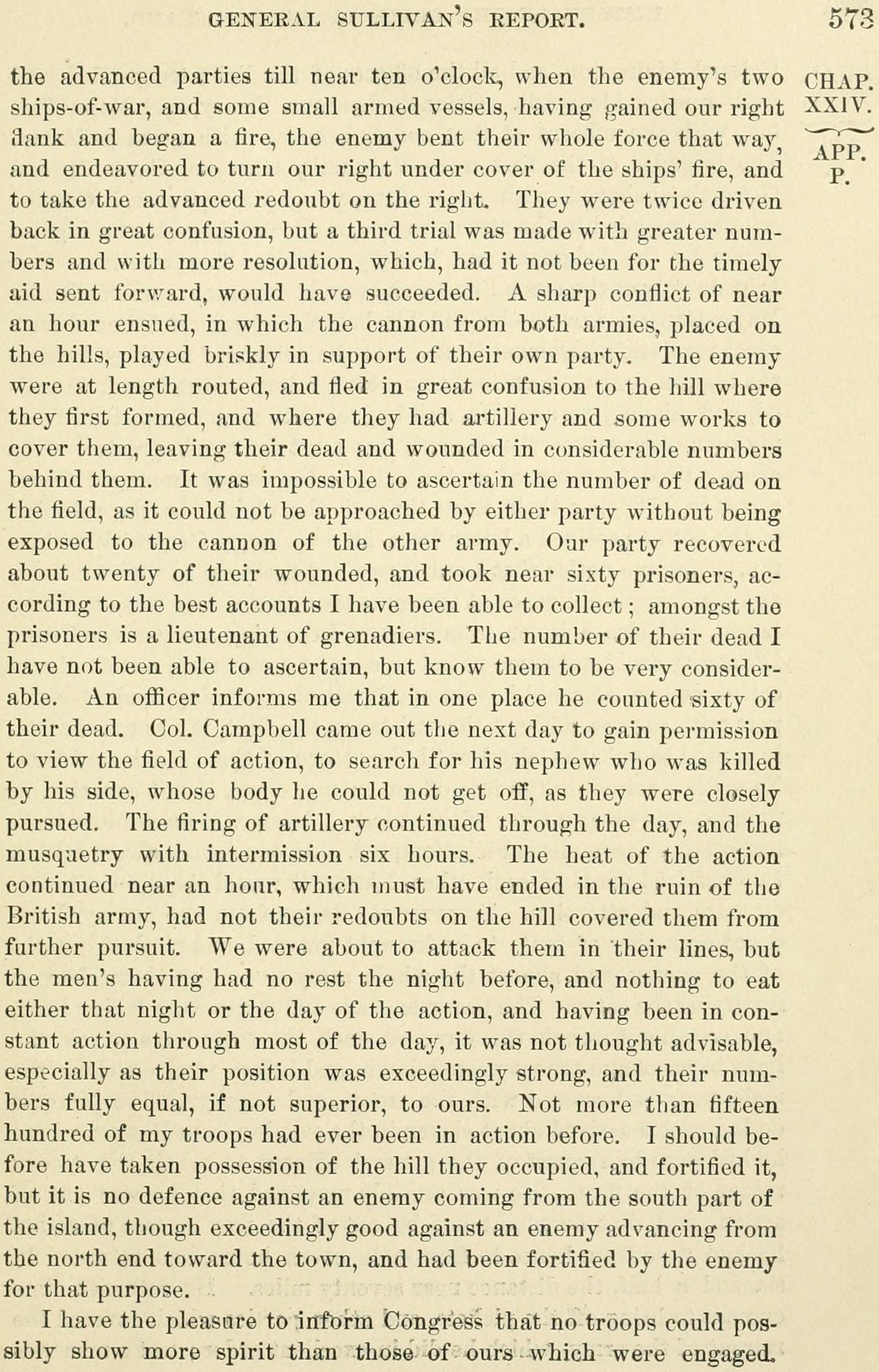
The heart of the battle, on the American right.
GENERAL SULLIVAN’S REPORT. 573
the advanced parties till near ten o’clock, when the enemy’s two ships-of-war, and some small armed vessels, having gained our right flank and began a fire, the enemy bent their whole force that way, and endeavored to turn our right under cover of the ships’ fire, and to take the advanced redoubt on the right. They were twice driven back in great confusion, but a third trial was made with greater numbers and with more resolution, which, had it not been for the timely aid sent forward, would have succeeded. A sharp conflict of near an hour ensued, in which the cannon from both armies, placed on the hills, played briskly in support of their own party. The enemy were at length routed, and fled in great confusion to the hill where they first formed, and where they had artillery and some works to cover them, leaving their dead and wounded in considerable numbers behind them. It was impossible to ascertain the number of dead on the field, as it could not be approached by either party without being exposed to the cannon of the other army. Our party recovered about twenty of their wounded, and took near sixty prisoners, according to the best accounts I have been able to collect; amongst the prisoners is a lieutenant of grenadiers. The number of their dead I have not been able to ascertain, but know them to be very considerable. An officer informs me that in one place he counted sixty of their dead. Col. Campbell came out the next day to gain permission to view the field of action, to search for his nephew who was killed by his side, whose body he could not get off, as they were closely pursued. The firing of artillery continued through the day, and the musquetry with intermission six hours. The heat of the action continued near an hour, which must have ended in the ruin of the British army, had not their redoubts on the hill covered them from further pursuit. We were about to attack them in their lines, but the men’s having had no rest the night before, and nothing to eat either that night or the day of the action, and having been in constant action through most of the day, it was not thought advisable, especially as their position was exceedingly strong, and their numbers fully equal, if not superior, to ours. Not more than fifteen hundred of my troops had ever been in action before. I should before have taken possession of the hill they occupied, and fortified it, but it is no defence against an enemy coming from the south part of the island, though exceedingly good against an enemy advancing from the north end toward the town, and had been fortified by the enemy for that purpose.
I have the pleasure to inform Congress that no troops could possibly show more spirit than those of ours which were engaged.
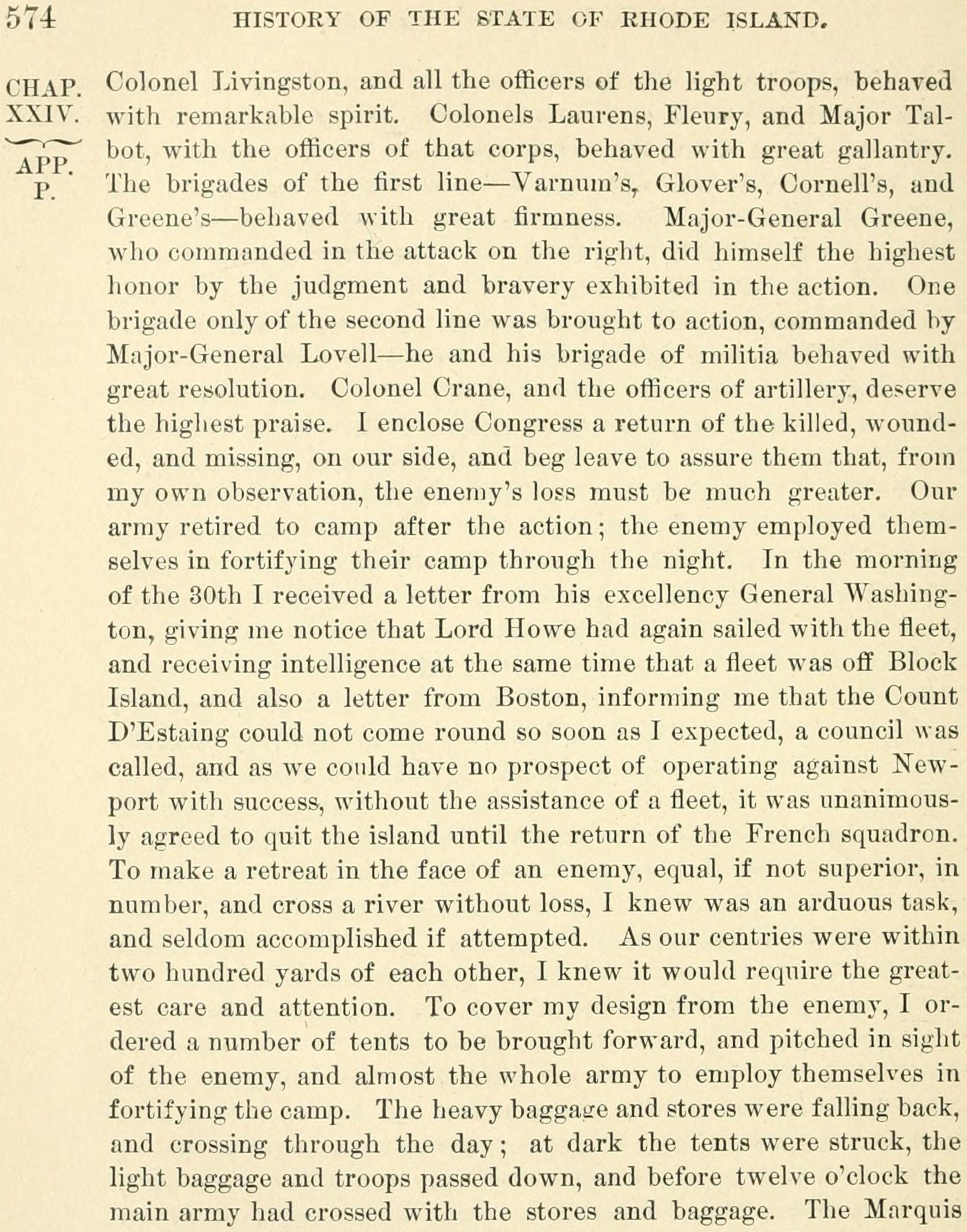
Sullivan’s praise of the troops, and the retreat from the island. Cornell’s brigade, named here, was the Rhode Island State brigade in which Topham’s regiment served. The report continues on the next page with Lafayette’s return and Sullivan’s closing.
574 HISTORY OF THE STATE OF RHODE ISLAND.
Colonel Livingston, and all the officers of the light troops, behaved with remarkable spirit. Colonels Laurens, Fleury, and Major Talbot, with the officers of that corps, behaved with great gallantry. The brigades of the first line – Varnum’s, Glover’s, Cornell’s, and Greene’s – behaved with great firmness. Major-General Greene, who commanded in the attack on the right, did himself the highest honor by the judgment and bravery exhibited in the action. One brigade only of the second line was brought to action, commanded by Major-General Lovell – he and his brigade of militia behaved with great resolution. Colonel Crane, and the officers of artillery, deserve the highest praise. I enclose Congress a return of the killed, wounded, and missing, on our side, and beg leave to assure them that, from my own observation, the enemy’s loss must be much greater. Our army retired to camp after the action; the enemy employed themselves in fortifying their camp through the night. In the morning of the 30th I received a letter from his excellency General Washington, giving me notice that Lord Howe had again sailed with the fleet, and receiving intelligence at the same time that a fleet was off Block Island, and also a letter from Boston, informing me that the Count D’Estaing could not come round so soon as I expected, a council was called, and as we could have no prospect of operating against Newport with success, without the assistance of a fleet, it was unanimously agreed to quit the island until the return of the French squadron. To make a retreat in the face of an enemy, equal, if not superior, in number, and cross a river without loss, I knew was an arduous task, and seldom accomplished if attempted. As our centries were within two hundred yards of each other, I knew it would require the greatest care and attention. To cover my design from the enemy, I ordered a number of tents to be brought forward, and pitched in sight of the enemy, and almost the whole army to employ themselves in fortifying the camp. The heavy baggage and stores were falling back, and crossing through the day; at dark the tents were struck, the light baggage and troops passed down, and before twelve o’clock the main army had crossed with the stores and baggage. The Marquis […]
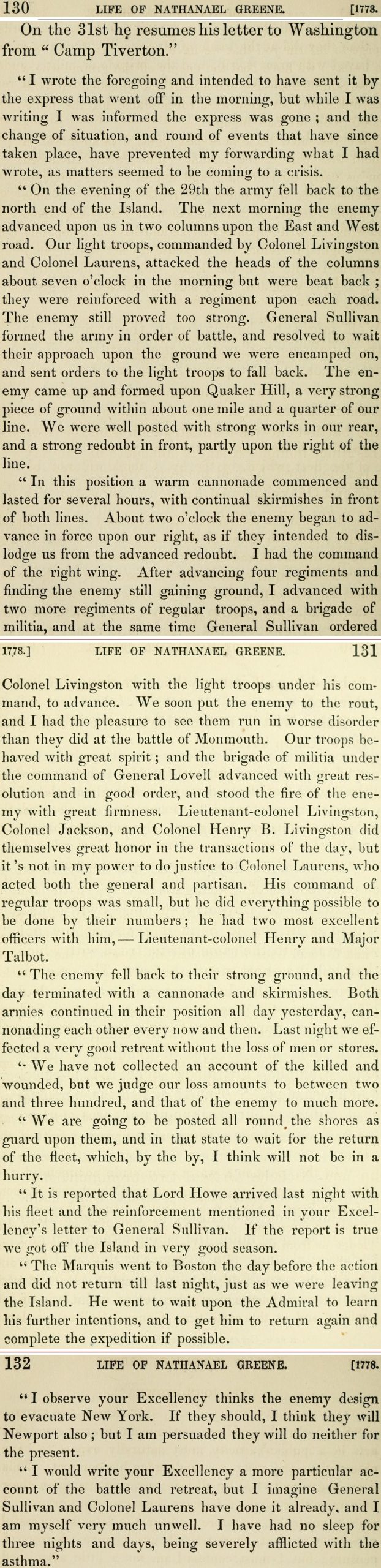
Greene’s own account, finished at Camp Tiverton the day after the retreat, as printed by his grandson George Washington Greene. Greene writes that the army fell back “on the evening of the 29th” and was attacked “the next morning”; Sullivan’s report places the retreat on the evening of the 28th and the battle on the 29th. The words are Greene’s as printed; the page does not correct them.
130 LIFE OF NATHANAEL GREENE. [1778.
On the 31st he resumes his letter to Washington from “Camp Tiverton.”
“I wrote the foregoing and intended to have sent it by the express that went off in the morning, but while I was writing I was informed the express was gone; and the change of situation, and round of events that have since taken place, have prevented my forwarding what I had wrote, as matters seemed to be coming to a crisis.
“On the evening of the 29th the army fell back to the north end of the Island. The next morning the enemy advanced upon us in two columns upon the East and West road. Our light troops, commanded by Colonel Livingston and Colonel Laurens, attacked the heads of the columns about seven o’clock in the morning but were beat back; they were reinforced with a regiment upon each road. The enemy still proved too strong. General Sullivan formed the army in order of battle, and resolved to wait their approach upon the ground we were encamped on, and sent orders to the light troops to fall back. The enemy came up and formed upon Quaker Hill, a very strong piece of ground within about one mile and a quarter of our line. We were well posted with strong works in our rear, and a strong redoubt in front, partly upon the right of the line.
“In this position a warm cannonade commenced and lasted for several hours, with continual skirmishes in front of both lines. About two o’clock the enemy began to advance in force upon our right, as if they intended to dislodge us from the advanced redoubt. I had the command of the right wing. After advancing four regiments and finding the enemy still gaining ground, I advanced with two more regiments of regular troops, and a brigade of militia, and at the same time General Sullivan ordered
1778.] LIFE OF NATHANAEL GREENE. 131
Colonel Livingston with the light troops under his command, to advance. We soon put the enemy to the rout, and I had the pleasure to see them run in worse disorder than they did at the battle of Monmouth. Our troops behaved with great spirit; and the brigade of militia under the command of General Lovell advanced with great resolution and in good order, and stood the fire of the enemy with great firmness. Lieutenant-colonel Livingston, Colonel Jackson, and Colonel Henry B. Livingston did themselves great honor in the transactions of the day, but it’s not in my power to do justice to Colonel Laurens, who acted both the general and partisan. His command of regular troops was small, but he did everything possible to be done by their numbers; he had two most excellent officers with him, – Lieutenant-colonel Henry and Major Talbot.
“The enemy fell back to their strong ground, and the day terminated with a cannonade and skirmishes. Both armies continued in their position all day yesterday, cannonading each other every now and then. Last night we effected a very good retreat without the loss of men or stores.
“We have not collected an account of the killed and wounded, but we judge our loss amounts to between two and three hundred, and that of the enemy to much more.
“We are going to be posted all round the shores as guard upon them, and in that state to wait for the return of the fleet, which, by the by, I think will not be in a hurry.
“It is reported that Lord Howe arrived last night with his fleet and the reinforcement mentioned in your Excellency’s letter to General Sullivan. If the report is true we got off the Island in very good season.
“The Marquis went to Boston the day before the action and did not return till last night, just as we were leaving the Island. He went to wait upon the Admiral to learn his further intentions, and to get him to return again and complete the expedition if possible.
132 LIFE OF NATHANAEL GREENE. [1778.
“I observe your Excellency thinks the enemy design to evacuate New York. If they should, I think they will Newport also; but I am persuaded they will do neither for the present.
“I would write your Excellency a more particular account of the battle and retreat, but I imagine General Sullivan and Colonel Laurens have done it already, and I am myself very much unwell. I have had no sleep for three nights and days, being severely afflicted with the asthma.”
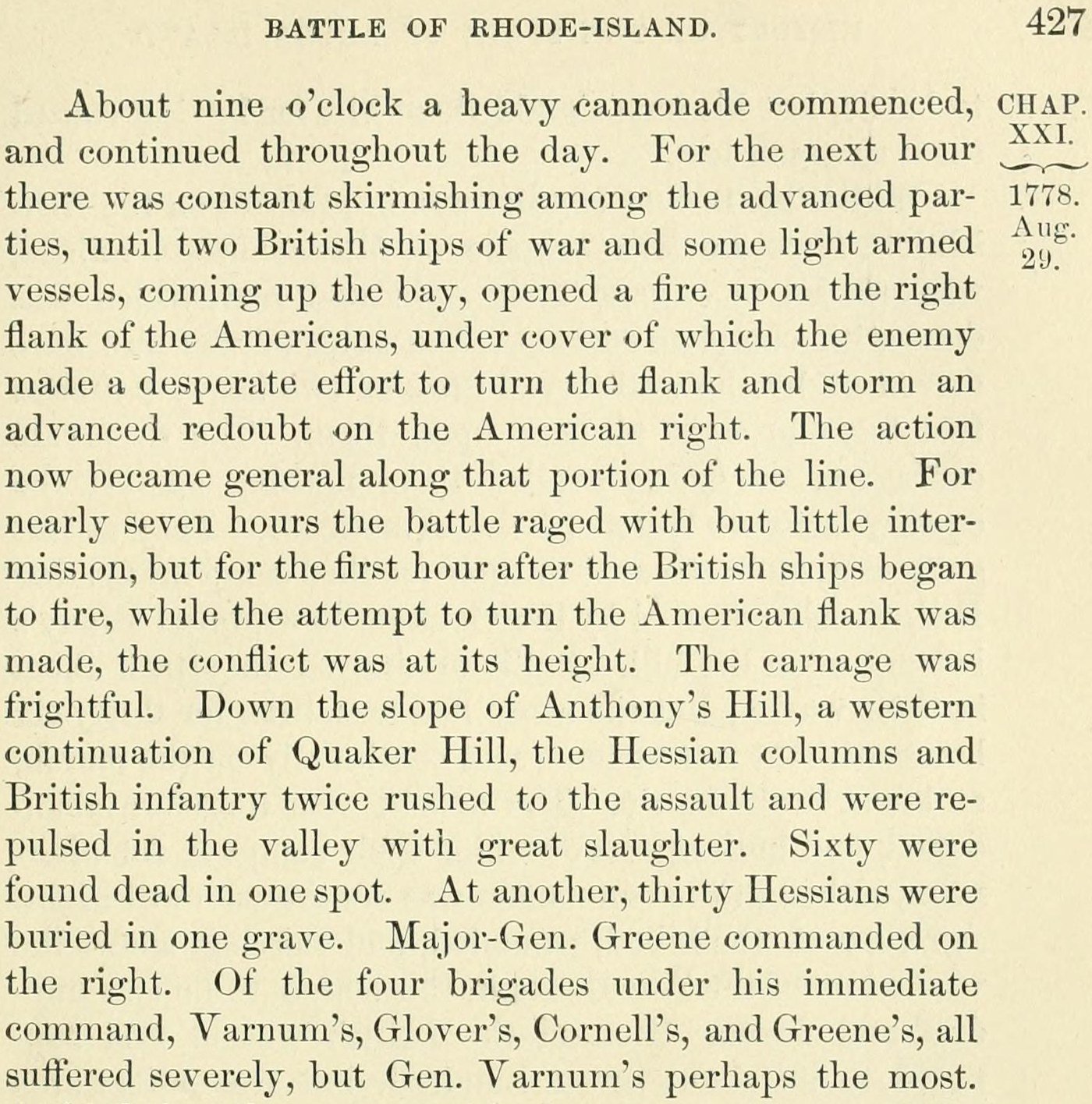
Samuel Greene Arnold’s narrative of the battle, written in 1859 from Sullivan’s and other accounts. It is the source for the stand of Col. Christopher Greene’s regiment; his account continues overleaf with the Hessian colonel who “dared not lead his regiment again.”
BATTLE OF RHODE-ISLAND. 427
[margin:] CHAP. XXI. 1778. Aug. 29.
About nine o’clock a heavy cannonade commenced, and continued throughout the day. For the next hour there was constant skirmishing among the advanced parties, until two British ships of war and some light armed vessels, coming up the bay, opened a fire upon the right flank of the Americans, under cover of which the enemy made a desperate effort to turn the flank and storm an advanced redoubt on the American right. The action now became general along that portion of the line. For nearly seven hours the battle raged with but little intermission, but for the first hour after the British ships began to fire, while the attempt to turn the American flank was made, the conflict was at its height. The carnage was frightful. Down the slope of Anthony’s Hill, a western continuation of Quaker Hill, the Hessian columns and British infantry twice rushed to the assault and were repulsed in the valley with great slaughter. Sixty were found dead in one spot. At another, thirty Hessians were buried in one grave. Major-Gen. Greene commanded on the right. Of the four brigades under his immediate command, Varnum’s, Glover’s, Cornell’s, and Greene’s, all suffered severely, but Gen. Varnum’s perhaps the most.
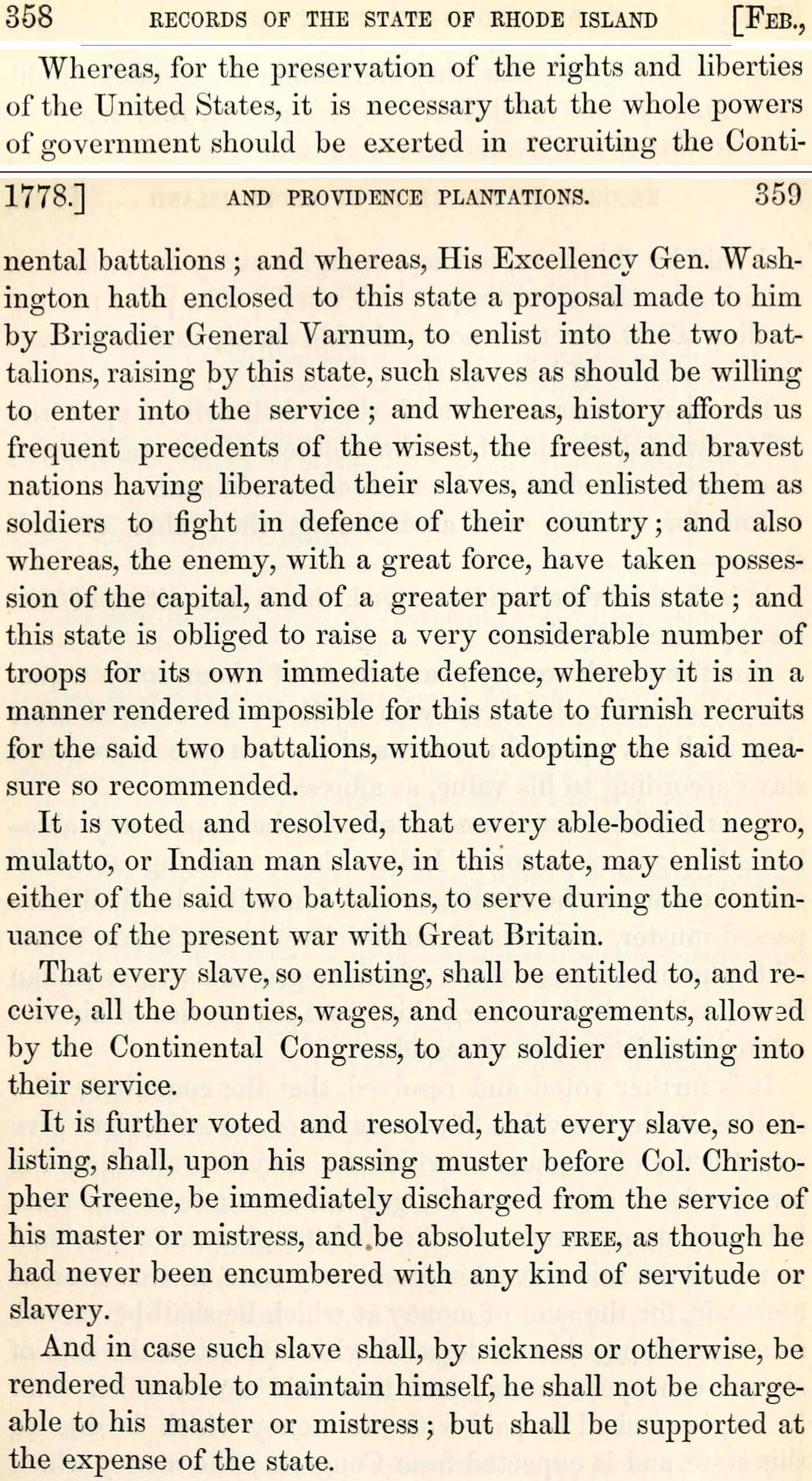
The General Assembly’s vote allowing enslaved men to enlist in Rhode Island’s two Continental battalions, with freedom on passing muster before Col. Christopher Greene. The act goes on to compensate owners, up to £120 for each man; that part is not shown here.
358 RECORDS OF THE STATE OF RHODE ISLAND [Feb.,
Whereas, for the preservation of the rights and liberties of the United States, it is necessary that the whole powers of government should be exerted in recruiting the Conti-
1778.] AND PROVIDENCE PLANTATIONS. 359
nental battalions; and whereas, His Excellency Gen. Washington hath enclosed to this state a proposal made to him by Brigadier General Varnum, to enlist into the two battalions, raising by this state, such slaves as should be willing to enter into the service; and whereas, history affords us frequent precedents of the wisest, the freest, and bravest nations having liberated their slaves, and enlisted them as soldiers to fight in defence of their country; and also whereas, the enemy, with a great force, have taken possession of the capital, and of a greater part of this state; and this state is obliged to raise a very considerable number of troops for its own immediate defence, whereby it is in a manner rendered impossible for this state to furnish recruits for the said two battalions, without adopting the said measure so recommended.
It is voted and resolved, that every able-bodied negro, mulatto, or Indian man slave, in this state, may enlist into either of the said two battalions, to serve during the continuance of the present war with Great Britain.
That every slave, so enlisting, shall be entitled to, and receive, all the bounties, wages, and encouragements, allowed by the Continental Congress, to any soldier enlisting into their service.
It is further voted and resolved, that every slave, so enlisting, shall, upon his passing muster before Col. Christopher Greene, be immediately discharged from the service of his master or mistress, and be absolutely free, as though he had never been encumbered with any kind of servitude or slavery.
And in case such slave shall, by sickness or otherwise, be rendered unable to maintain himself, he shall not be chargeable to his master or mistress; but shall be supported at the expense of the state.
Lossing’s figures for the losses of the two armies. They differ from Nathanael Greene’s first estimate of “between two and three hundred” Americans, made before the returns were collected; see “What is not known” below.
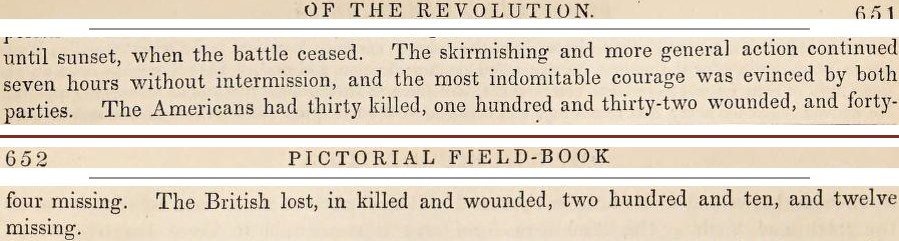
OF THE REVOLUTION. 651
[…] until sunset, when the battle ceased. The skirmishing and more general action continued seven hours without intermission, and the most indomitable courage was evinced by both parties. The Americans had thirty killed, one hundred and thirty-two wounded, and forty-
652 PICTORIAL FIELD-BOOK
four missing. The British lost, in killed and wounded, two hundred and ten, and twelve missing.
Benson Lossing sketched the battlefield on 23 October 1848 from the remains of the American fort on Butts’s Hill, the ground on which William’s army formed its lines. His text on the same page: “In the hollow at the foot of these hills the hottest of the battle was waged.” The picture below is a modern digital enhancement of Lossing’s engraving, made for this page. It is not a historical image: its colour, light, cannon, fences, cattle and buildings are the enhancement’s rendering, not details recorded by Lossing. See Lossing’s original engraving, or the page of his book.
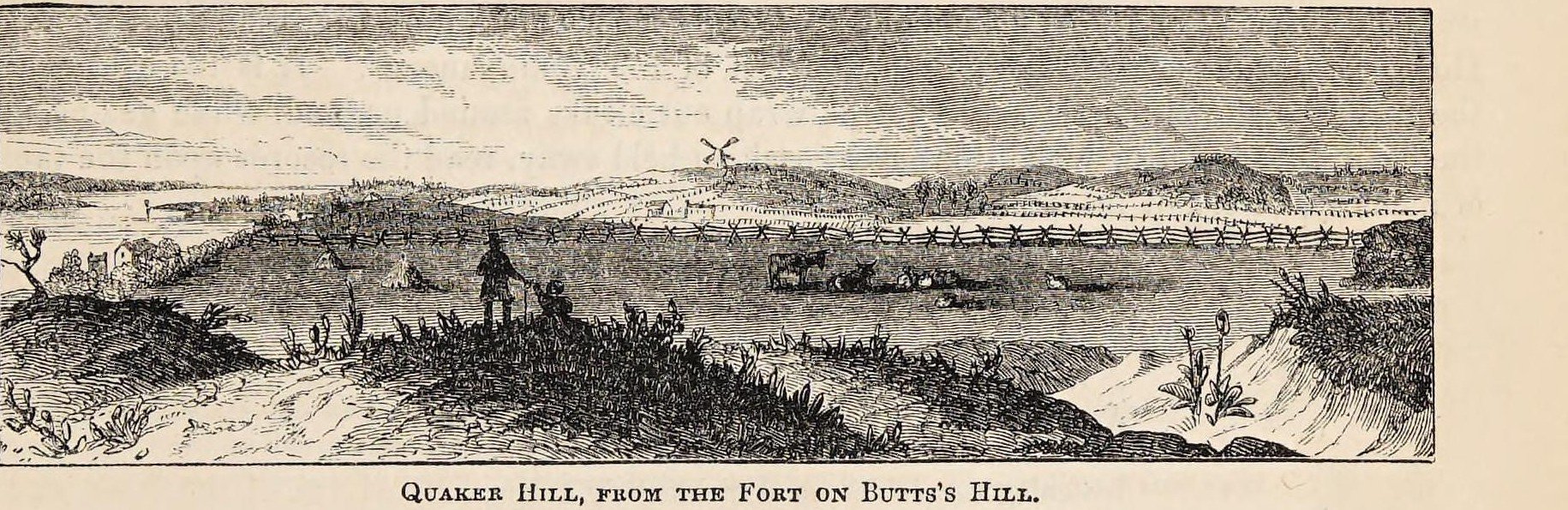
QUAKER HILL, FROM THE FORT ON BUTTS’S HILL.
What is not known
- The losses. Lossing gives 30 Americans killed, 132 wounded and 44 missing, and 210 British killed and wounded with 12 missing. Nathanael Greene’s first estimate, before any return was made, was two to three hundred Americans. Sullivan’s enclosed return of casualties is not printed with his report.
- Where Topham’s regiment stood in the line. Sullivan places Cornell’s brigade in the first line, and Arnold under Greene on the right, but no record found here places Topham’s regiment, or Traffarn’s company, at a particular point of the field.
- Whether William Greene of Westerly was on the field by name. His company was, by the oaths of two of its men, and he was on its rolls before and after; no record names him in the battle itself.
- How the Greenes of the battle were related. Nathanael, Christopher, William of Westerly and the Greenes of Topham’s regiment were all Rhode Island Greenes, but their kinship is not worked out on this page.
References
Arnold, S. G. (1894). History of the State of Rhode Island and Providence Plantations (Vol. 2, 1700–1790). Preston & Rounds. https://archive.org/details/historyofstateof02arno
Bartlett, J. R. (Ed.). (1863). Records of the State of Rhode Island and Providence Plantations in New England (Vol. 8, 1776–1779). Cooke, Jackson & Co. https://archive.org/details/recordsofcolonyo08rhod
Battle of Rhode Island Association. (n.d.). 1778: Battle of Rhode Island [Video]. YouTube. https://www.youtube.com/watch?v=Mypdtf24GVI
The siege of Rhode Island, taken from Mr. Brindley’s house on the 25th of August, 1778 [Engraving]. (1779). In The Gentleman’s Magazine (Vol. 49, p. 100). Library of Congress Prints and Photographs Division, cph.3a19034. http://hdl.loc.gov/loc.pnp/cph.3a19034
Greene, G. W. (1871). The life of Nathanael Greene, major-general in the army of the Revolution (Vol. 2). G. P. Putnam and Son. https://archive.org/details/lifeofnathanaelg02gree2
Lossing, B. J. (1860). The pictorial field-book of the Revolution (Vol. 1). Harper & Brothers. https://archive.org/details/pictorialfieldbo0001loss
Drafted 23 September 2026 from the printed records above. Every transcription was checked against the page image beside it, and the original spelling is kept. Nothing has been supplied where a source is silent.
Views: 14