Table of Contents
Andersonville Prison Part 1: Foundations of Horror
Introduction
The Andersonville Prison Camp, officially known as Camp Sumter, stands as one of the most harrowing examples of the human cost of the Civil War. Established in February 1864 by the Confederacy to house Union prisoners of war, the prison was a grim solution to mounting logistical and security concerns. Situated in rural Georgia, Andersonville was selected for its isolation, proximity to railroads, and presumed abundance of local resources. However, these advantages were outweighed by severe mismanagement, resource shortages, and the inability to address the sheer scale of the war’s demands.
The decision to centralize prisoners at Andersonville reflected broader Confederate challenges in managing resources and infrastructure. Already suffering from limited supplies, the South struggled to sustain its armies, let alone care for captured Union soldiers. What began as a practical attempt to alleviate overcrowding in Richmond quickly devolved into one of the most infamous sites of suffering in American history, with nearly 13,000 of the 45,000 prisoners held there perishing by the war’s end.
Establishment of Andersonville
The establishment of Andersonville Prison Camp was rooted in Confederate concerns about overcrowding and security in existing facilities. By mid-1863, Union prisoners in Richmond posed a dual threat: they strained the city’s limited food supply and presented a potential risk for escape or rescue by advancing Northern forces (Percoco, 1993). In response, Confederate authorities sought a remote location where prisoners could be securely held. Captain W. S. Winder, under orders from General John H. Winder, selected a site near Americus, Georgia. The area’s isolation and access to railroads made it a logical choice, but local resistance to the project and logistical challenges undermined these perceived advantages (Hesseltine, 1949).
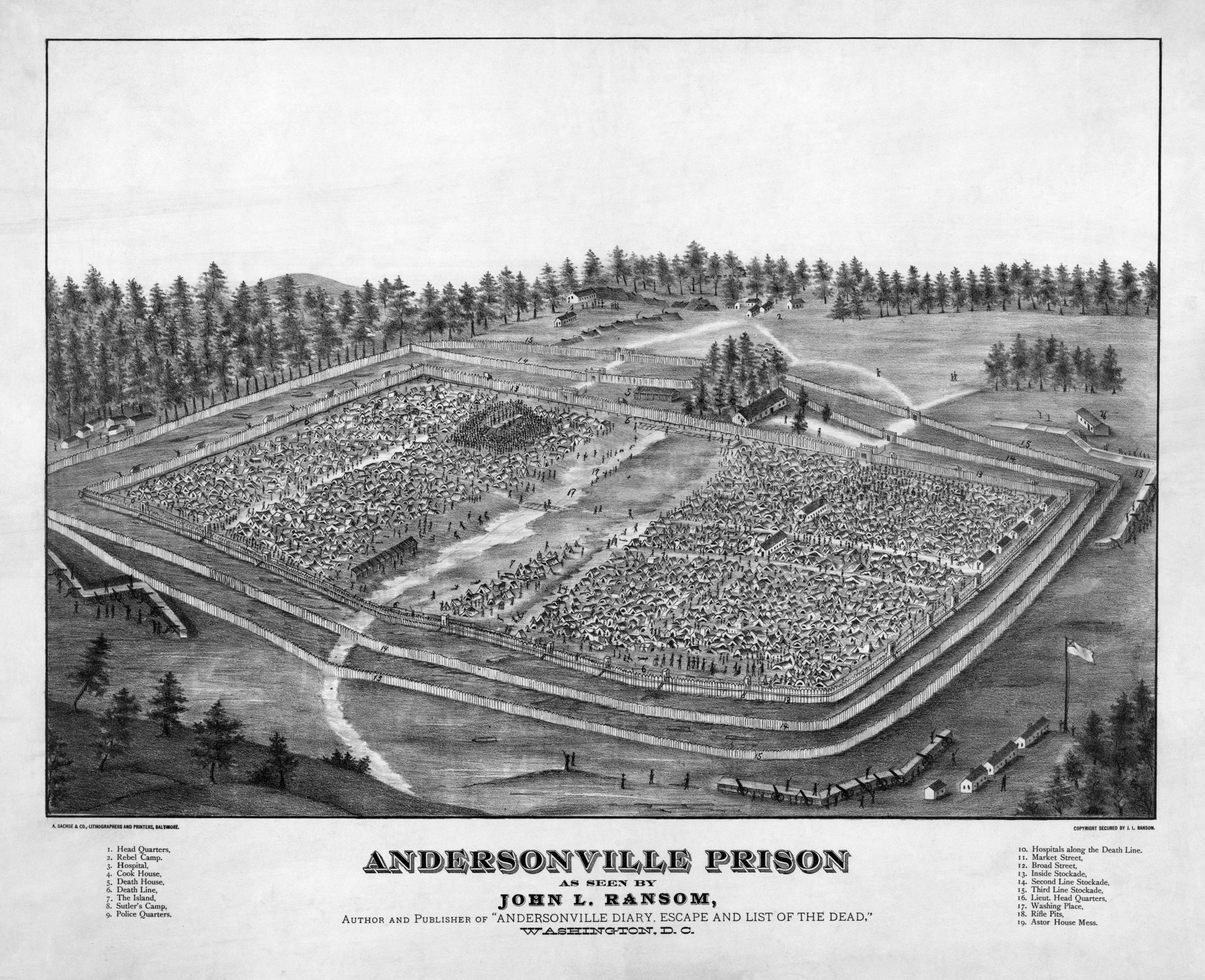
Construction began in late 1863, with plans for a stockade designed to hold 10,000 prisoners. The stockade consisted of pine logs arranged vertically, creating a 15-foot-tall wall enclosing 16.5 acres. A small stream, intended to provide water and sanitation, bisected the camp. Approximately 19 feet from the inner walls was the “deadline,” a boundary that prisoners were forbidden to cross under penalty of death (Hesseltine, 1949; Percoco, 1993).
Despite its initial design, the camp faced severe construction delays and shortages. Laborers struggled to secure adequate supplies of nails, timber, and tools, while the Confederacy’s strained transportation network made it difficult to deliver essentials like food and medical supplies. Local residents were reluctant to assist, fearing the proximity of the camp would bring disease and unrest. By the time the first prisoners arrived in February 1864, the camp was far from complete, with no proper barracks or sanitation systems in place (Hesseltine, 1949).
Leadership and Bureaucracy
At the heart of Andersonville’s administration was General John H. Winder, a veteran officer tasked with overseeing the Confederacy’s military prisons. Winder, described as a disciplinarian with limited administrative skills, faced an unenviable task: managing an overburdened system with insufficient resources and little support from higher authorities (Hesseltine, 1949). His leadership style, marked by rigidity and a lack of innovation, only exacerbated the challenges at Andersonville.
One of Winder’s key decisions was delegating the construction and daily management of the camp to his son, Captain W. S. Winder. The younger Winder’s poor judgment and inexperience contributed to several critical missteps, including the inadequate design of the prison’s drainage and sanitation systems (Percoco, 1993). These flaws would later play a significant role in the camp’s high mortality rate.
Compounding these issues was the Confederacy’s broader administrative failure to address the needs of its prisoners of war. Unlike the Union, which had established a centralized bureau for managing prisons, the Confederacy relied on a fragmented and ad hoc system. Local commanders were often left to their own devices, resulting in inconsistent policies and uneven conditions across different camps (Hesseltine, 1949). This lack of coordination was evident at Andersonville, where requests for additional supplies and personnel were frequently ignored or delayed.
Moreover, the suspension of prisoner exchanges in mid-1863 placed additional strain on Confederate prisons. The policy, initiated by Union Secretary of War Edwin Stanton, aimed to deny the South the manpower advantage of returning exchanged soldiers to the battlefield. However, it also left the Confederacy responsible for a growing population of Union prisoners, many of whom were already in poor health when they arrived at Andersonville (Hesseltine, 1949).
Despite these obstacles, Confederate officials attempted to mitigate the camp’s deficiencies. Captain Henry Wirz, appointed as commandant in March 1864, implemented measures to improve sanitation and distribute rations more equitably. However, his efforts were largely undermined by systemic issues beyond his control, including chronic shortages of food, medicine, and manpower (Percoco, 1993).
Initial Prisoner Experiences
The first prisoners arrived at Andersonville in February 1864, bringing with them a mix of hope and apprehension. Many had endured long, grueling marches from the battlefields or existing prison camps, arriving in a weakened state both physically and mentally. Accounts from survivors reveal their initial shock at the camp’s conditions: overcrowded quarters, minimal shelter, and inadequate rations quickly dispelled any illusions of humane treatment (Percoco, 1993).
Letters and memoirs from prisoners offer poignant glimpses into their early experiences. William Willson, a Union soldier captured at Spotsylvania, described his deteriorating health in a letter home, lamenting the lack of food and medical care (King, 1954). Another prisoner, Sylvester Ferry, expressed cautious optimism about a possible exchange, while detailing the hardships of daily life (King, 1954). These personal narratives highlight the resilience of the prisoners, who found ways to adapt to their environment despite the immense challenges.
One of the most immediate concerns for new arrivals was the lack of shelter. With no barracks available, prisoners were forced to construct makeshift tents from scraps of wood and cloth or dig holes in the ground for protection. This lack of adequate housing exposed them to the elements, exacerbating the spread of disease and further weakening their already fragile health (Hesseltine, 1949).
Prisoners also struggled with the camp’s rudimentary sanitation system. The stream intended to provide drinking water quickly became contaminated with human waste, turning it into a breeding ground for disease. Efforts to construct a proper drainage system were delayed by competing priorities and limited resources, leaving prisoners to endure unsanitary conditions for months on end (Percoco, 1993).
Final Thoughts
The foundations of Andersonville Prison Camp were laid amidst a perfect storm of war-driven challenges, administrative failures, and logistical constraints. What began as a pragmatic response to the Confederacy’s need for a centralized prison quickly spiraled into a humanitarian disaster. The combination of poor planning, insufficient resources, and ineffective leadership created an environment where suffering became the norm.
As the next report will explore, these initial conditions set the stage for the unimaginable horrors that unfolded within the camp’s walls. From disease and starvation to psychological torment, the daily lives of Andersonville’s prisoners offer a stark reminder of the human cost of war. By examining their experiences, we can gain a deeper understanding of the resilience and tragedy that defined this dark chapter in American history.
References
- Hesseltine, W. B. (1949). Andersonville. The Georgia Review, 3(1), 103–114.
- King, S. B. Jr. (1954). Yankee Letters from Andersonville Prison. The Georgia Historical Quarterly, 38(4), 394–398.
- Percoco, J. A. (1993). The Space Beyond the Gates: Andersonville Prison. OAH Magazine of History, 8(1), 37–43.
o.
Views: 36