Letter from the First N. Y. Dragoons
IN CAMP NEAR CULPEPPER, Nov. 13, 1863.
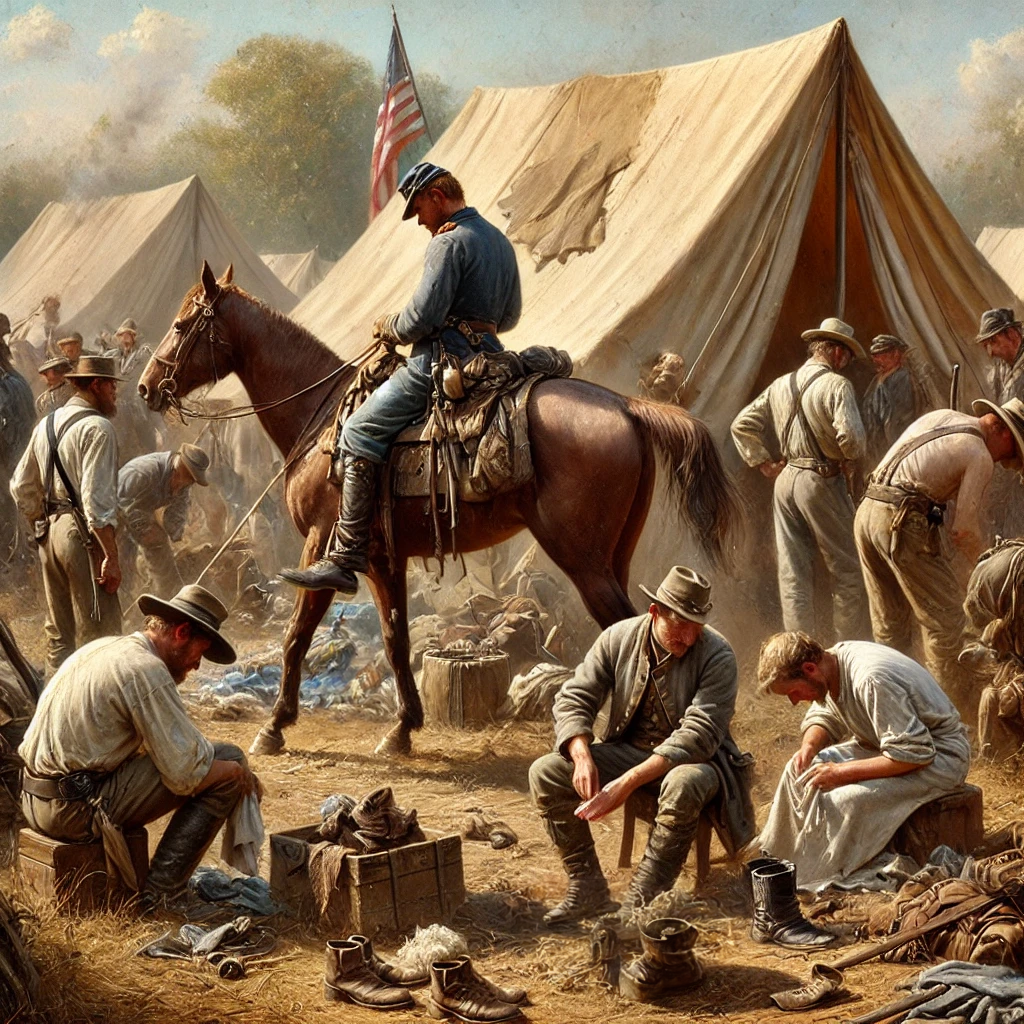
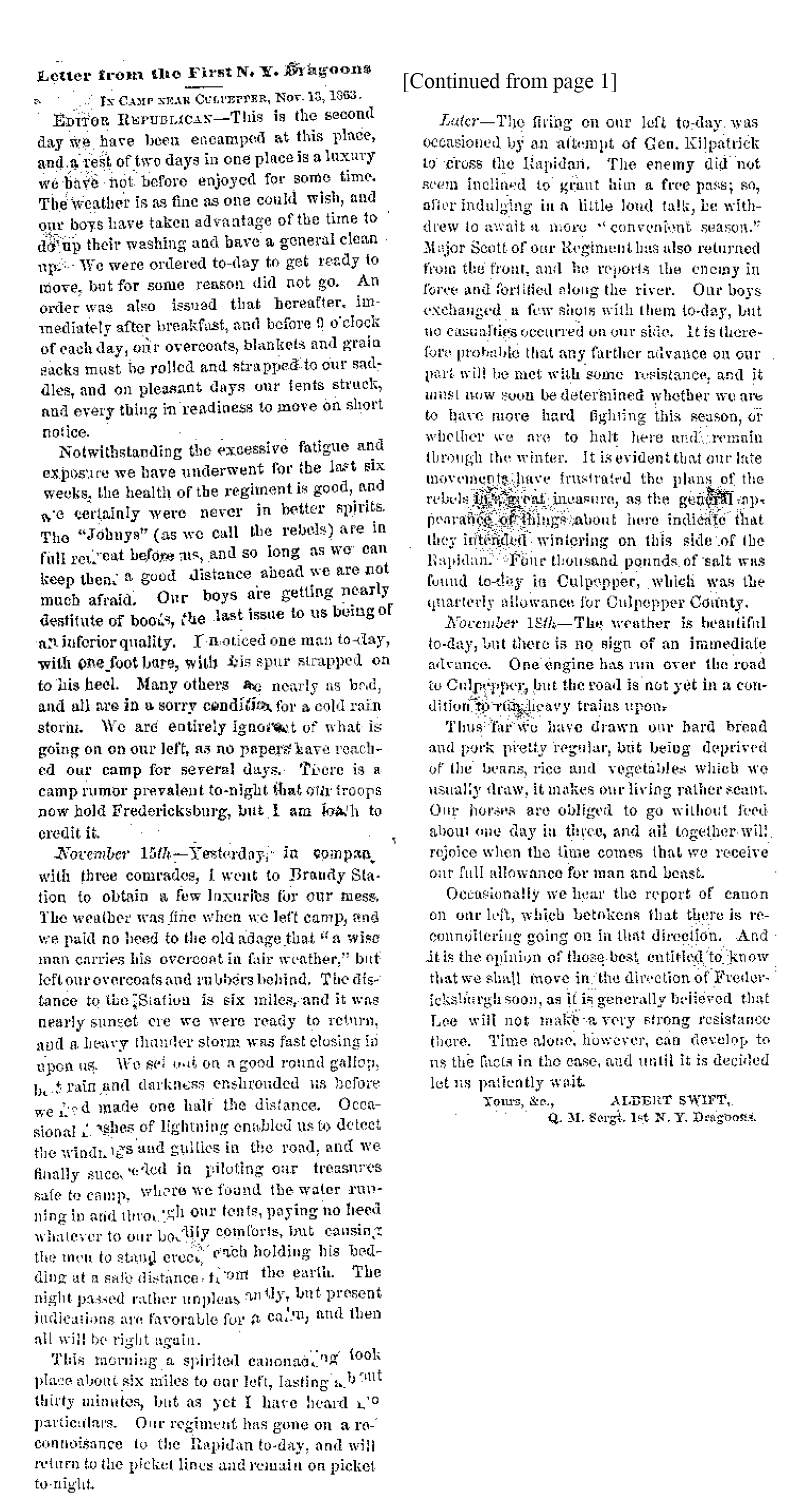
EDITOR REPUBLICAN—This is the second day we have been encamped at this place, and a rest of two days in one place is a luxury we have not before enjoyed for some time. The weather is as fine as one could wish, and our boys have taken advantage of the time to do up their washing and have a general clean-up. We were ordered today to get ready to move, but for some reason did not go. An order was also issued that hereafter, immediately after breakfast, and before 9 o’clock of each day, our overcoats, blankets and grain sacks must be rolled and strapped to our saddles, and on pleasant days our tents struck, and everything in readiness to move on short notice.
Notwithstanding the excessive fatigue and exposure we have undergone for the last six weeks, the health of the regiment is good, and we certainly were never in better spirits. The “Johnys” (as we call the rebels) are in full retreat before us, and so long as we can keep them a good distance ahead we are not much afraid. Our boys are getting nearly destitute of boots, the last issue to us being of inferior quality. I noticed one man today, with one foot bare, with his spur strapped onto his heel. Many others are nearly as bad, and all are in a sorry condition for a cold rainstorm. We are entirely ignorant of what is going on on our left, as no papers have reached our camp for several days. There is a camp rumor prevalent tonight that our troops now hold Fredericksburg, but I am loath to credit it.
November 15th—Yesterday, in company with three comrades, I went to Brandy Station to obtain a few luxuries for our mess. The weather was fine when we left camp, and we paid no heed to the old adage that “a wise man carries his overcoat in fair weather,” but left our overcoats and rubbers behind. The distance to the Station is six miles, and it was nearly sunset ere we were ready to return, and a heavy thunderstorm was fast closing in upon us. We set out on a good round gallop, but rain and darkness enshrouded us before we made one half the distance. Occasional flashes of lightning enabled us to detect the windings and gullies in the road, and we finally succeeded in piloting our treasures safe to camp, where we found the water running in and through our tents, paying no heed whatever to our bodily comforts, but causing the men to stand erect, each holding his bedding at a safe distance from the earth. The night passed rather unpleasantly, but present indications are favorable for a calm, and then all will be right again.
This morning a spirited cannonading took place about six miles to our left, lasting about thirty minutes, but as yet I have heard no particulars. Our regiment has gone on a reconnaissance to the Rapidan today, and will return to the picket lines and remain on picket tonight.
Later—The firing on our left today was occasioned by an attempt of Gen. Kilpatrick to cross the Rapidan. The enemy did not seem inclined to grant him a free pass, so after indulging in a little loud talk, he withdrew to await a more “convenient season.” Major Scott of our Regiment has also returned from the front, and he reports the enemy in force and fortified along the river. Our boys exchanged a few shots with them today, but no casualties occurred on our side. It is therefore probable that any further advance on our part will be met with some resistance, and it must now soon be determined whether we are to have more hard fighting this season, or whether we are to halt here and remain through the winter. It is evident that our late movements have frustrated the plans of the rebels in a great measure, as the general appearance of things about here indicates that they intended wintering on this side of the Rapidan. Four thousand pounds of salt was found today in Culpepper, which was the quarterly allowance for Culpepper County.
November 18th—The weather is beautiful today, but there is no sign of an immediate advance. One engine has run over the road to Culpepper, but the road is not yet in a condition to run heavy trains upon. Thus far we have drawn our hard bread and pork pretty regular, but being deprived of the beans, rice and vegetables which we usually draw, it makes our living rather scant. Our horses are obliged to go without feed about one day in three, and altogether will rejoice when the time comes that we receive our full allowance for man and beast.
Occasionally we hear the report of a cannon on our left, which betokens that there is reconnaissance going on in that direction. And it is the opinion of those best entitled to know that we shall move in the direction of Fredericksburgh soon, as it is generally believed that Lee will not make a very strong resistance there. Time alone, however, can develop to us the facts in the case, and until it is decided let us patiently wait.
Yours, &c., ALBERT SWIFT, Q. M. Sergt., 1st N. Y. Dragoons.
This is taken from Findagrave.com:
He was instrumental in organizing the Henry Rogers Post, of Brownsdale, and mustered in the posts at Austin, Kasson and Grand Meadow. In 1882 he became the first commander of the Rogers post, and since then has taken a deep interest in its affairs, doing much work such as making out reports to headquarters and other details, performing the duties of adjutant.
Albert Swift was born in Chautauqua county, New York, February 20, 1830, son of Samuel and Anna (McArthur) Swift. He learned the carpenter’s trade, and in August, 1862, enlisted in the Civil war, serving in the First New York Dragoons until July 11, 1865, when he received his honorable discharge at Clouds Mills, Va.
At the close of the war in 1865 he located in Missouri, and in 1874 came to Brownsdale, where he has since resided.
He married Ann J., daughter of William and Elizabeth (Bennett) Ray, and to this union have been born five children: Lillie, deceased; Ida L., deceased; Frank E., Edwin M. and Nina R., the latter a teacher in Gas City, Ind. Frank E. has for many year been in the employ of the Minneapolis & Sault Ste. Marie road. He lives at Sault St. Marie and runs a passenger train between that place and Escanaba, Mich. Edwin M. lives at Seattle, Wash., and is in the employ of the Seattle and Everett Traction Company.
William Ray and his wife were natives of Dutchess county, New York, of English descent. Mr. Ray was treasurer and bookkeeper for one of the large foundries at Poughkeepsie, N. Y., and retained that position for many years. He died in 1841. His wife died in 1853.
Samuel Swift died in 1859 and his wife in 1853.
Views: 21