This is the document General Grant told Secretary Stanton to read. When Grant recommended Lynde’s restoration, he wrote, “I respectfully refer you to the statement of Bvt. Maj. Gen. Canby for the justice of this recommendation.” Here is that statement, five pages in Canby’s hand. It is the source of the phrase every later account repeats — that from the moment Lynde believed his own men had fired on him, he “experienced a mental paralysis that rendered him incapable of acting with judgment or energy” — and it names, in order, the circumstances Canby thought had unmade him: ten months’ unpaid troops, Longstreet’s letter urging desertion, a rebel judge’s circular, the contractor Simeon Hart, and Colonel Loring’s correspondence with the enemy.
Archival citation
Repository
National Archives and Records Administration (NARA), Washington, D.C.
Record Group
RG 94, Records of the Adjutant General’s Office, 1762–1984 (naId 423)
Series
Letters Received by the Commission Branch of the Adjutant General’s Office, 1863–1870 (National Archives Microfilm Publication M1064)
File Unit
“Lynde, Isaac — 1866” (file L736 CB 1866), naId 70339343
Item
Canby to the Adjutant General, March 16, 1866 (docketed C792 CB 1866, filed with L736 CB 1866; images 0375–0379)
GET https://catalog.archives.gov/api/v2/records/search?naId=70339343
Digitized & transcribed
AlfredGibbs.com, July 8, 2026. Reproduced from the National Archives digital copies (public domain).
Suggested citation (Chicago): E. R. S. Canby to the Adjutant General, March 16, 1866, file “Lynde, Isaac, 1866” (L736 CB 1866), Letters Received by the Commission Branch of the Adjutant General’s Office, 1863–1870, M1064, Record Group 94, National Archives, Washington, D.C. Digitized copy and transcription at AlfredGibbs.com.
❦
The document
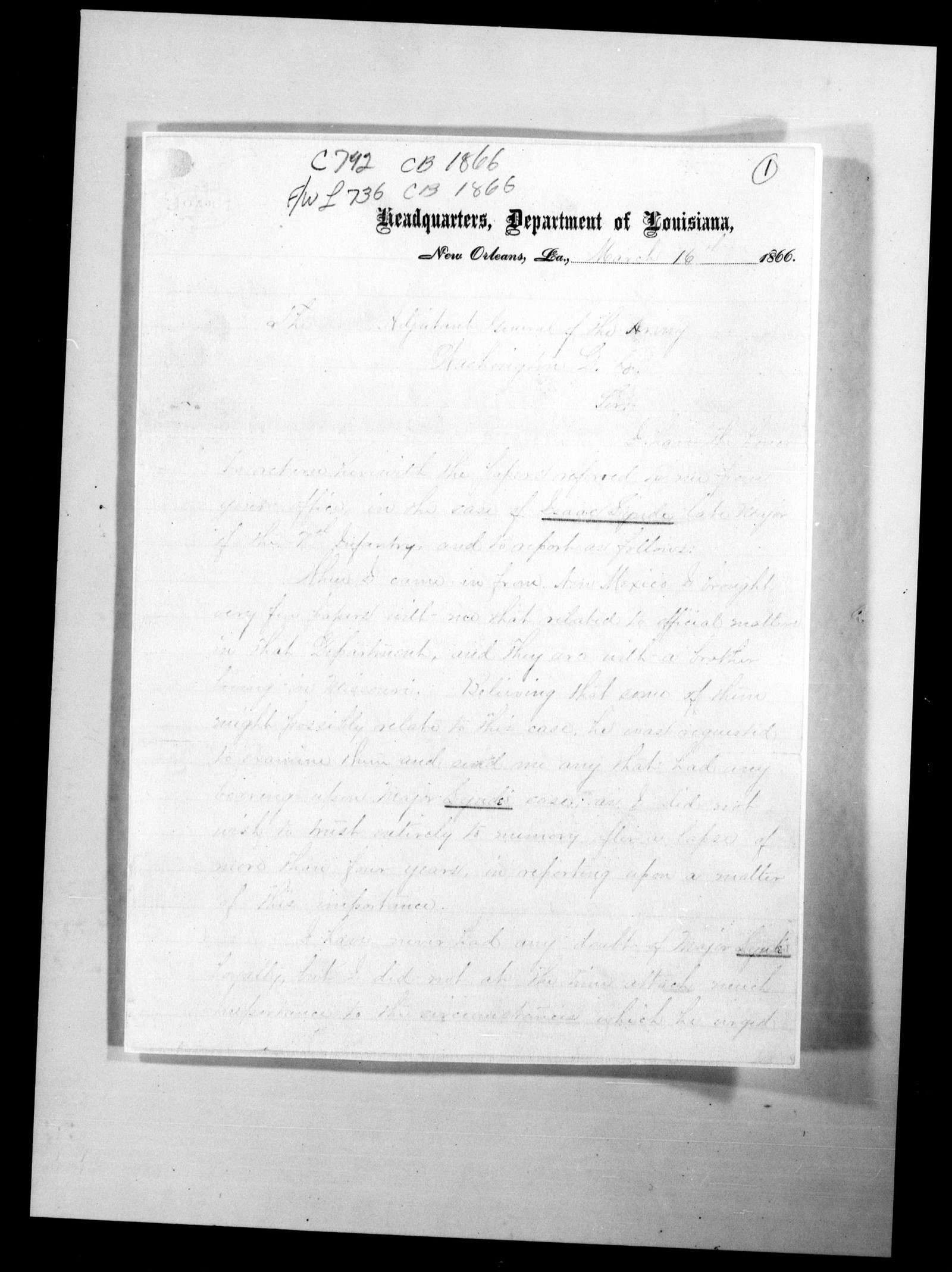
Page 1: return of the papers; Canby’s judgment that the force was “sufficiently ample.” · view full size
Transcription
C 792 CB 1866 F/w L 736 CB 1866 (1)
[printed letterhead:] Headquarters, Department of Louisiana, New Orleans, La., March 16th 1866.
The Adjutant General of the Army Washington D. C. Sir: I have the honor to return herewith the papers referred to me from your office in the case of Isaac Lynde, late Major of the 7th Infantry, and to report as follows:
When I came in from New Mexico I brought very few papers with me that related to official matters in that Department, and they are with a brother living in Missouri. Believing that some of them might possibly relate to this case, he was requested to examine them and send me any that had any bearing upon Major Lynde’s case; as I did not wish to trust entirely to memory after a lapse of more than four years, in reporting upon a matter of this importance.
I have never had any doubt of Major Lynde’s loyalty, but I did not at the time attach much importance to the circumstances which he urged
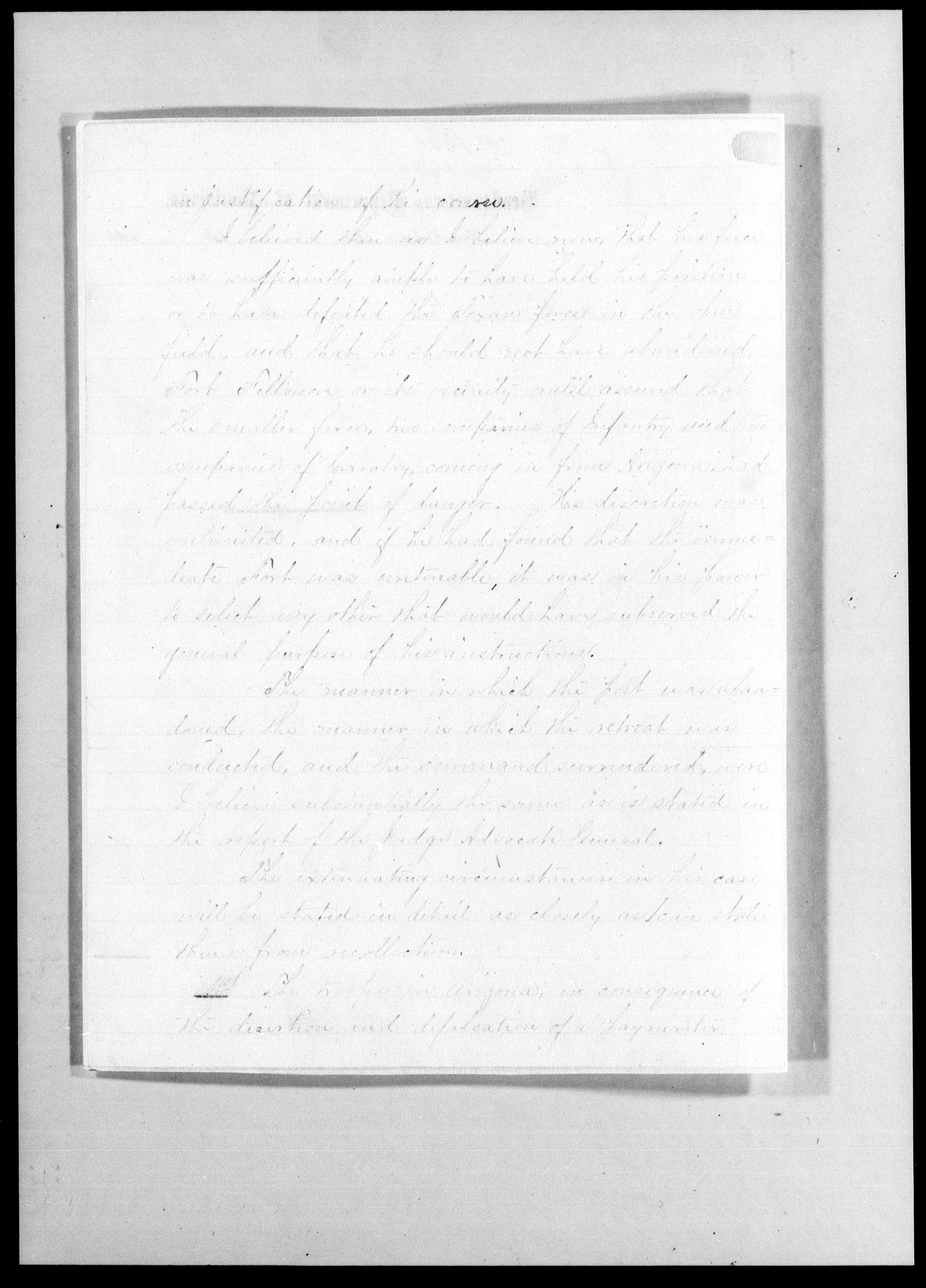
Page 2: the manner of the abandonment, retreat, and surrender. · view full size
Transcription
in justification of his course.
I believed then as I believe now, that his force was sufficiently ample to have held his position or to have defeated the Texan force in the open field, and that he should not have abandoned Fort Fillmore or its vicinity until assured that the smaller force, two companies of Infantry and two companies of Cavalry, coming in from Arizona, had passed the point of danger. His discretion was unlimited, and if he had found that the immediate Fort was untenable, it was in his power to select any other that would have subserved the general purpose of his instructions.
The manner in which the fort was abandoned, the manner in which the retreat was conducted, and the command surrendered, were I believe substantially the same as is stated in the report of the Judge Advocate General.
The extenuating circumstances in his case will be stated in detail as closely as I can state them from recollection.
1st. The troops in Arizona, in consequence of the desertion and defalcation of a paymaster,
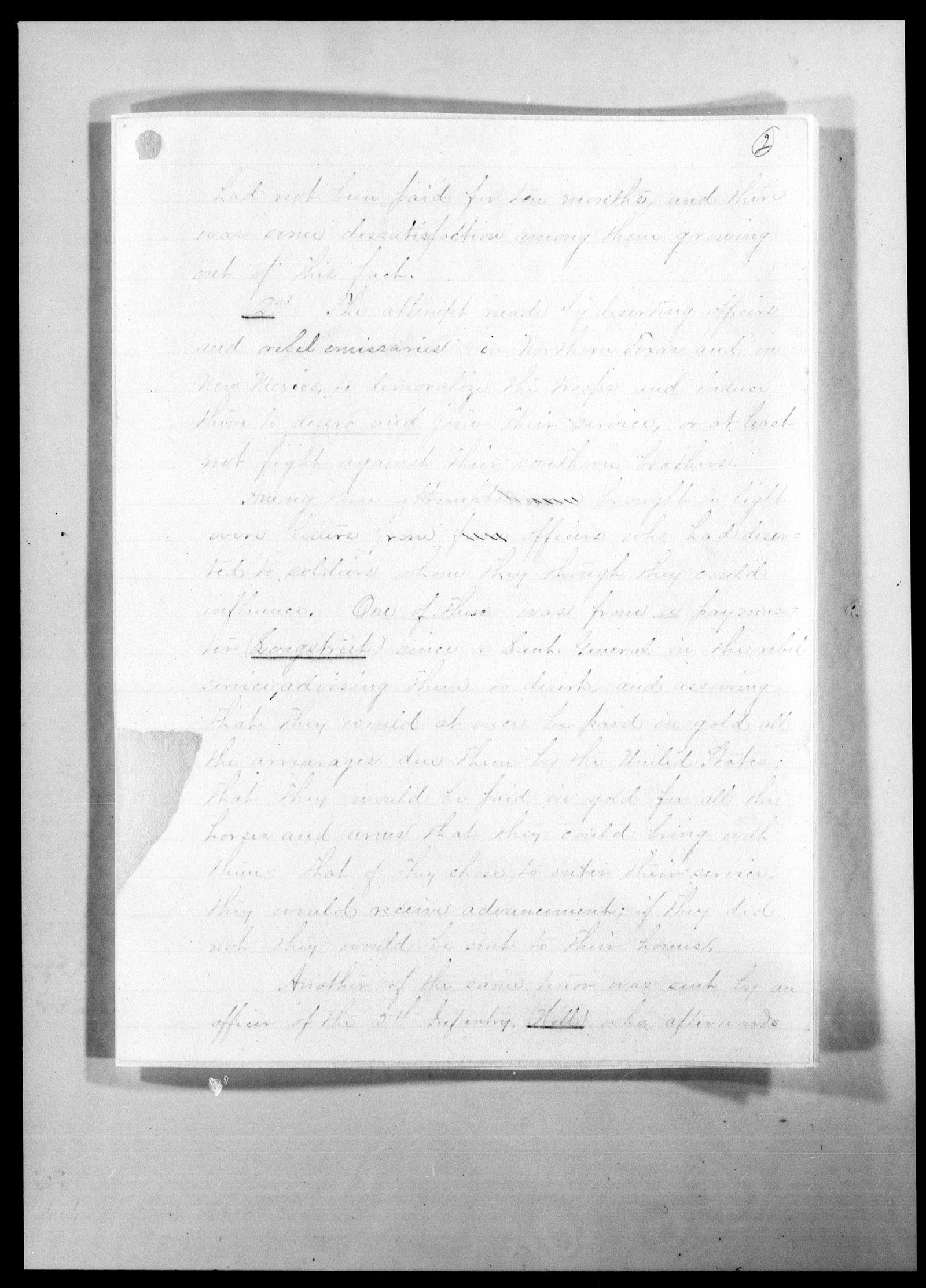
(2)
had not been paid for ten months, and there was some dissatisfaction among them growing out of this fact.
2nd. The attempt made by deserting officers and rebel emissaries in Northern Texas and in New Mexico, to demoralize the troops and induce them to desert and join their service, or at least not fight against their southern brothers.
Among these attempts [words struck out] brought to light were letters from [word struck out] officers who had deserted to soldiers whom they thought they could influence. One of these was from a paymaster (Longstreet) since a Lieut. General in the rebel service, advising them to desert, and assuring that they would at once be paid in gold all the arrearages due them by the United States; that they would be paid in gold for all the horses and arms that they could bring with them. That if they chose to enter their service, they would receive advancement; if they did not they would be sent to their homes.
Another of the same tenor was sent by an officer of the 5th Infantry, (Hill) who afterwards
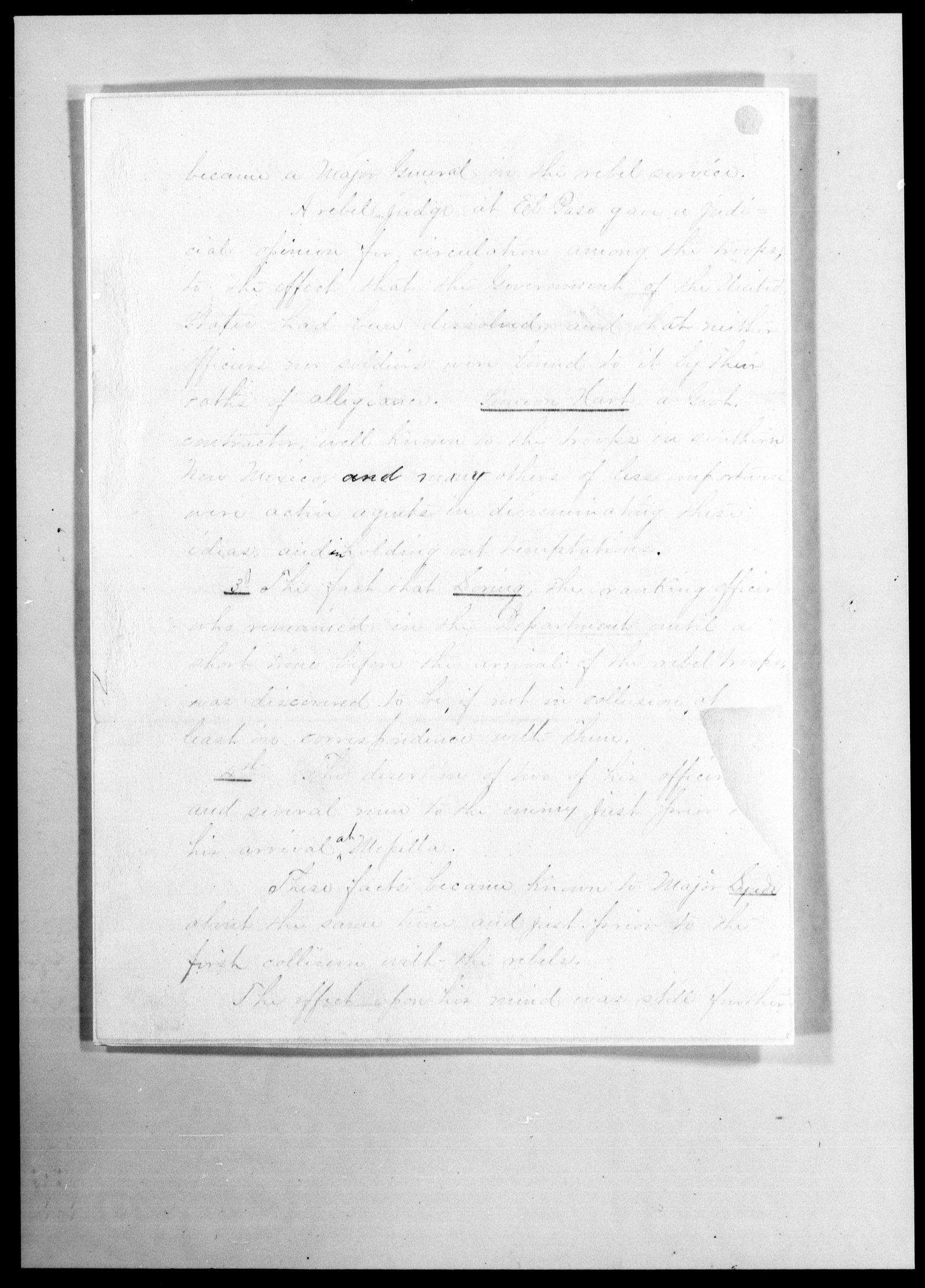
Page 4: the rebel judge at El Paso; Simeon Hart; Loring’s correspondence with the enemy. · view full size
Transcription
became a Major General in the rebel service.
A rebel judge at El Paso gave a judicial opinion for circulation among the troops, to the effect that the Government of the United States had been dissolved and that neither officers nor soldiers were bound to it by their oaths of allegiance. Simeon Hart, a Govt. contractor, well known to the troops in southern New Mexico, and many others of less importance were active agents in disseminating these ideas, and in holding out temptations.
3d The fact that Loring, the ranking officer who remained in the Department until a short time before the arrival of the rebel troops, was discovered to be, if not in collusion, at least in correspondence with them.
4th The desertion of two of his officers and several men to the enemy just prior [to] his arrival at Mesilla.
These facts became known to Major Lynde about the same time and just prior to the first collision with the rebels.
The effect upon his mind was still further
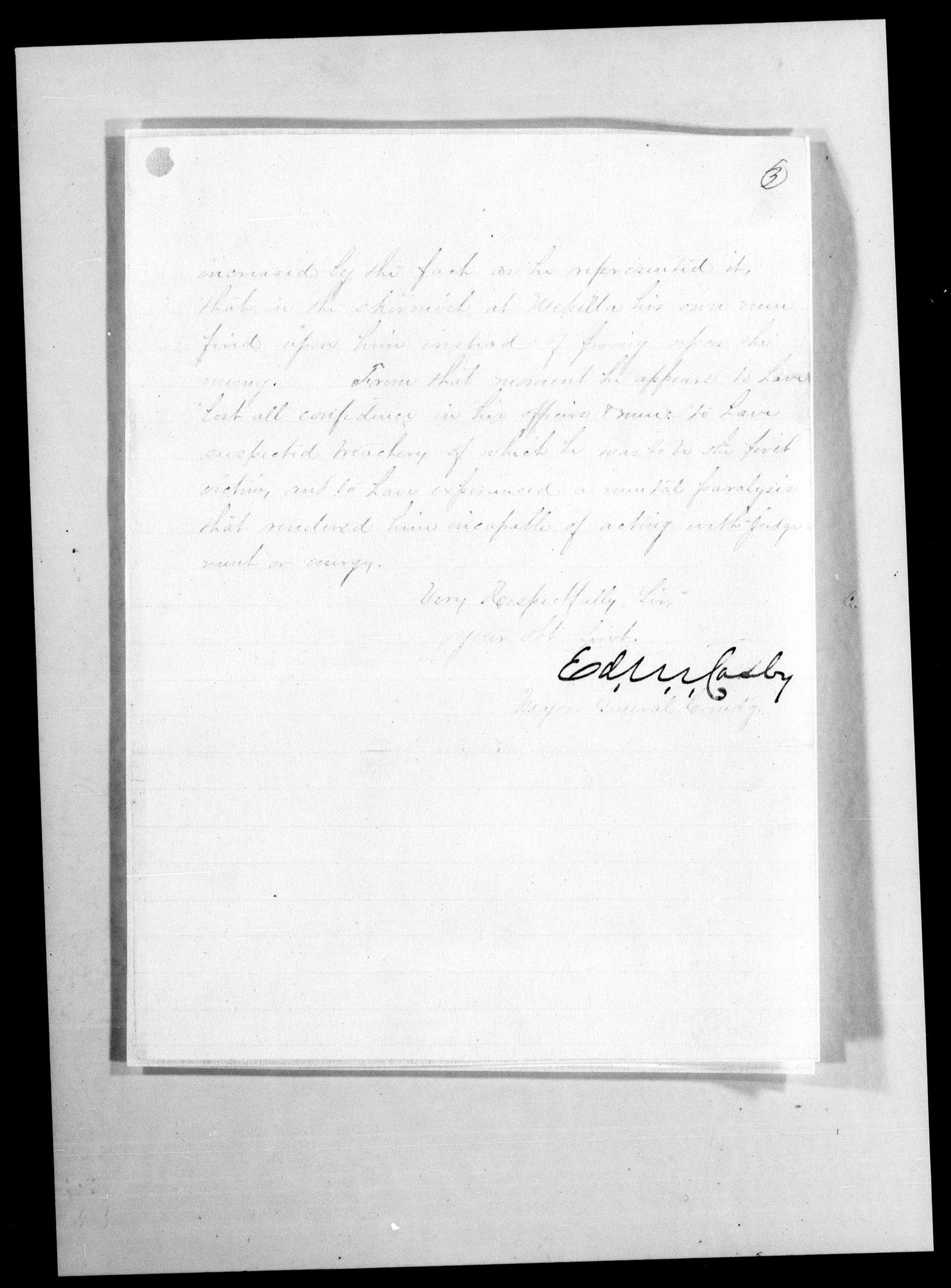
Page 5: the “mental paralysis” passage and Canby’s signature. · view full size
Transcription
(3)
increased by the fact as he represented it, that in the skirmish at Mesilla his own men fired upon him instead of firing upon the enemy. From that moment he appears to have lost all confidence in his officers & men: to have suspected treachery of which he was to be the first victim, and to have experienced a mental paralysis that rendered him incapable of acting with judgment or energy.
Very Respectfully Sir your obt. Servt. Ed. R. S. Canby Major General Comd’g.
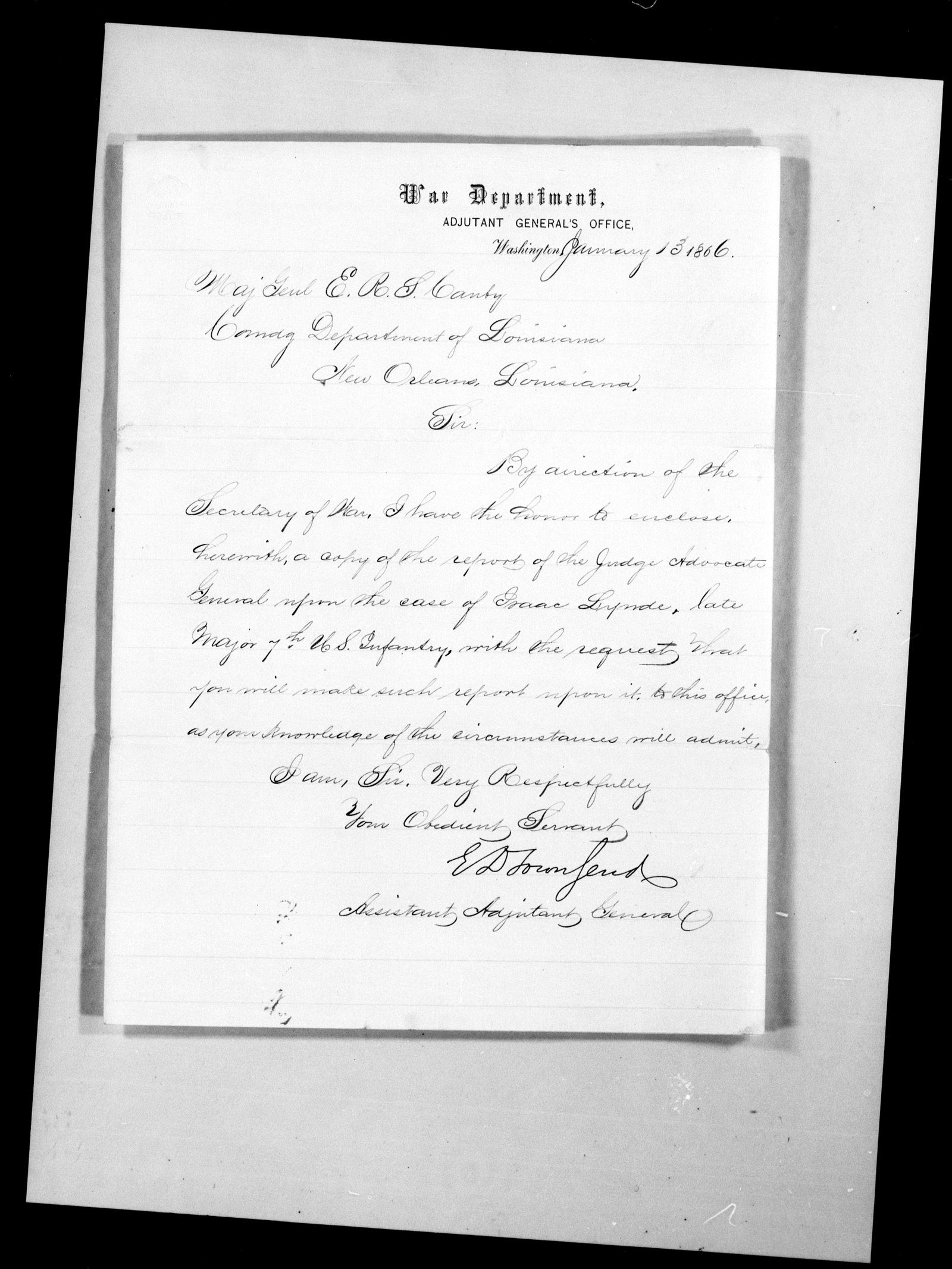
Canby did not volunteer this statement; the War Department asked for it. On January 13, 1866, by direction of the Secretary of War, E. D. Townsend sent Canby a copy of the Judge Advocate General’s report with the request that he report upon it “as your knowledge of the circumstances will admit.” Canby’s statement above, dated March 16, is his answer. Added to this page July 10, 2026.
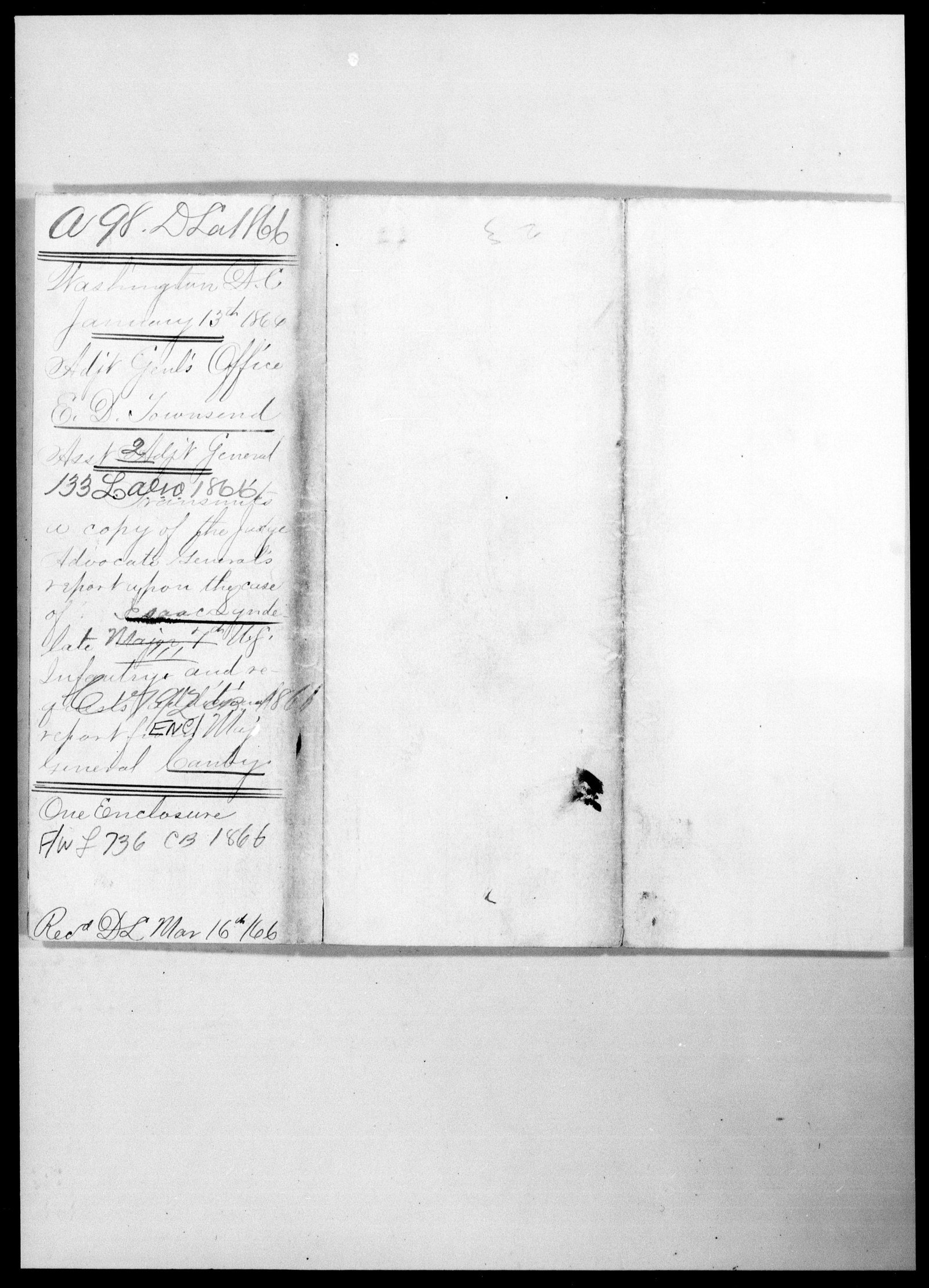
The docket panel: Townsend ‘Transmits a copy of the Judge Advocate General’s report upon the case of Isaac Lynde… and requests the report of Maj General Canby.’ Received Dept. of Louisiana March 16, 1866. · view full size
Transcription
[wrapper/docket panel]
A 98. D.La 1866
Washington D.C.
January 13th 1866
Adjt Genl’s Office
E. D. Townsend
Asst 2 Adjt General
133 L. A.G.O. 1866
Transmits
a copy of the Judge
Advocate General’s
report upon the case
of Isaac Lynde
late Major 7th U.S.
Infantry, and re-
quests [struck/overwritten: A.G.O. … 1861] the
report [pencil: ENC] of Maj
General Canby.
One Enclosure F/w L 736 CB 1866
Rec’d D.L. Mar 16th /66
The letter, January 13, 1866: ‘By direction of the Secretary of War… the request that you will make such report upon it, to this office, as your knowledge of the circumstances will admit.’ Signed E. D. Townsend. · view full size
Transcription
[printed form heading: War Department, ADJUTANT GENERAL’S OFFICE, Washington]
War Department,
Adjutant General’s Office,
Washington, January 13, 1866.
Maj. Genl. E. R. S. Canby
Comdg Department of Louisiana
New Orleans, Louisiana.
Sir:
By direction of the Secretary of War, I have the honor to enclose, herewith, a copy of the report of the Judge Advocate General upon the case of Isaac Lynde, late Major 7th U.S. Infantry, with the request that you will make such report upon it, to this office, as your knowledge of the circumstances will admit.
I am, Sir, Very Respectfully
Your Obedient Servant
E D Townsend
Assistant Adjutant General
References (APA)
Canby, E. R. S. (1866, March 16). [Letter to the Adjutant General: remarks on the Judge Advocate General’s report in the case of Isaac Lynde]. File L736 CB 1866, Letters Received by the Commission Branch of the Adjutant General’s Office, 1863–1870 (Microfilm Publication M1064; Record Group 94; National Archives Identifier 70339343), National Archives, Washington, DC. https://catalog.archives.gov/id/70339343
Townsend, E. D. (1866, January 13). [Letter to Maj. Gen. E. R. S. Canby transmitting the Judge Advocate General’s report and requesting his remarks]. File L736 CB 1866, Letters Received by the Commission Branch of the Adjutant General’s Office, 1863–1870 (Microfilm Publication M1064; Record Group 94; National Archives Identifier 70339343), National Archives, Washington, DC. https://catalog.archives.gov/id/70339343
Holt, J. (1866, January 4). Report to the Secretary of War in the case of Isaac Lynde [Manuscript copy]. File L736 CB 1866, Letters Received by the Commission Branch of the Adjutant General’s Office, 1863–1870 (Microfilm Publication M1064; Record Group 94; National Archives Identifier 70339343), National Archives, Washington, DC. https://catalog.archives.gov/id/70339343 (Published in full at https://alfredgibbs.com/doc-holt-jag-report-lynde-1866/)
Transcribed from the National Archives digital copy on July 8, 2026. The transcription follows the manuscript; uncertain readings are marked with (?). Corrections against better readings will be noted rather than made silently.