M. W. GREEN TO DEAR BROTHER – JANUARY 25, 1864
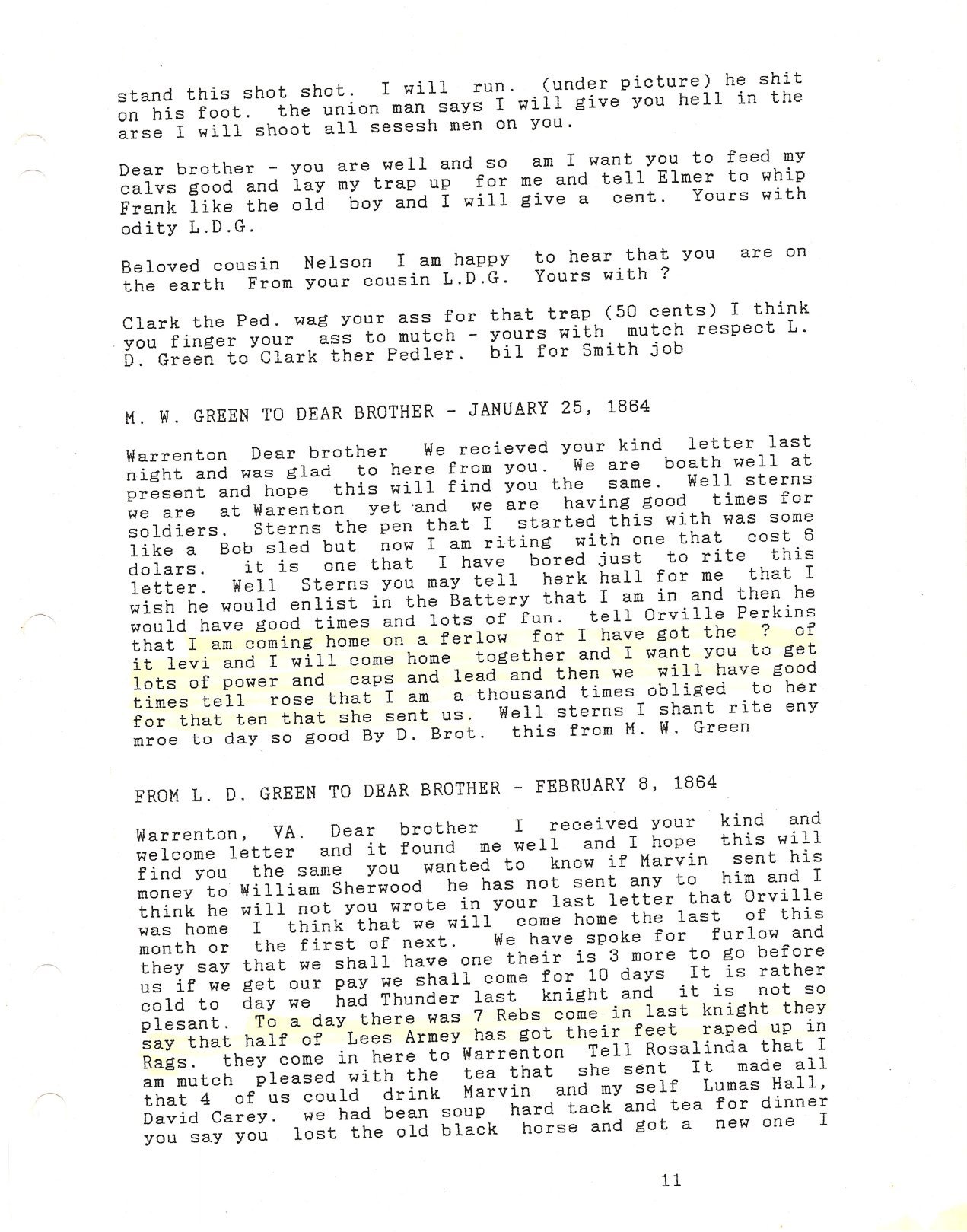
The letter as it survives in the family typescript prepared by Marjorie Kuski, scanned from the complete typescript PDF held on this site.
About this Letter
The last week of January 1864 found the armies frozen in their winter quarters, the roads too deep in mud for campaigning. It was a lull before the hardest year of the war, the spring in which Grant would come east and Sheridan would take the cavalry into the Overland Campaign.
Marvin and Levi were still detached to Battery K, 1st United States Artillery, wintering near Warrenton, Virginia. Neither brother could know that in a few months the 1st New York Dragoons would ride into Todd’s Tavern on May 7, where the regiment would suffer the heaviest single-engagement loss of any Union mounted regiment in the war.
For now the camp is quiet and Marvin is in high spirits, joking about his writing tools. The pen he started with was “some like a Bob sled,” so he borrowed a fine one that “cost 6 dolars” just to write this letter home. He dreams aloud of a furlough with his brother, promising Sterns to gather powder and caps and lead so “we will have good times,” and he writes those fateful words, “levi and I will come home together.” He closes with thanks to Rose, Sterns’s wife: “tell rose that I am a thousand times obliged to her for that ten that she sent us.”
They would not come home together. Within five months Levi was a prisoner, and by that fall he was dead in Georgia, while Marvin lived on to make the journey alone. Marvin’s war and his long life afterward are told on Marvin’s own page. The pages below are the family typescript prepared by Marjorie Kuski; the transcription keeps his spelling exactly as he set it down.
The Letter
Warrenton Dear brother We recieved your kind letter last night and was glad to here from you. We are boath well at present and hope this will find you the same. Well sterns we are at Warenton yet -and we are having good times for soldiers. Sterns the pen that I started this with was some like a Bob sled but now I am riting with one that cost 6 dolars. it is one that I have bored just to rite this letter. Well Sterns you may tell herk hall for me that I wish he would enlist in the Battery that I am in and then he would have good times and lots of fun. tell Orville Perkins that I am coming home on a ferlow for I have got the ? of it levi and I will come home together and I want you to get lots of power and caps and lead and then we will have good times tell rose that I am a thousand times obliged to her for that ten that she sent us. Well sterns I shant rite eny mroe to day so good By D. Brot. this from M. W. Green
Researchers Note: In this letter, Levi speaks of the unit’s initial steps to move from infantry to cavalry. What follows is a snippet taken from Bowen’s book.
Transcribed from Marjorie Kuski’s family typescript, preserving the original spelling and punctuation.
Researcher’s Notes
But the circumstance, which above all others occurring at Warrenton and which aroused the regiment to a high pitch of enthusiasm and rejoicing, was the welcome announcement that the long-talked-of and hoped-for transfer from infantry to cavalry had been made. The strenuous efforts of Colonel Gibbs had at length been rewarded with success, and our regiment was the recipient of honors bestowed upon no other in the history of the war. There were regiments of mounted infantry but no other instance in which an absolute transference from infantry to cavalry occurred. The special orders from the war department touching this transfer bears date July 28, 1863, and five days later, the following order of instructions was received:-
Researcher’s Note: Special Order No. 335 is a military order issued on August 27, 1863, by Union General George G. Meade, commanding the Army of the Potomac. The order transferred the 130th New York Infantry to full cavalry, converting the infantry regiment into a mounted unit.
Special Order No. 335 was issued as part of a larger effort by the Union Army to increase the number of cavalry units available. At the time, the Union Army faced significant challenges in effectively gathering and acting on intelligence about Confederate forces. The conversion of the 130th New York Infantry into a cavalry unit was seen as a way to help address these challenges.
The conversion of the 130th New York Infantry into a cavalry unit was significant, as it marked a major change in the structure and composition of the Union Army. The formation of new cavalry units was a key component of the Union Army’s strategy during the Civil War. It helped to increase the Army’s mobility and ability to gather intelligence.
Views: 276