Joan, wife of John Greene of Quidnessett
The Narragansett-side record. Nothing on this page comes from Salem, Boston, Providence, or Warwick. Joan was not Alice Daniell, called Mrs. Beggarly, of Salem: the Providence records show that Alice was the second wife of John Greene the surgeon of Warwick. This is what the records of Kings Towne and the Rhode Island Land Evidences say about the woman who was John Greene of Quidnessett’s wife and the mother of his sons.
Until today this page and its companion followed the family’s identification of Joan with Alice Daniell, called Mrs. Beggarly, of Salem, and carried an appendix on her Salem farm and cottage and two films. Two Providence town records settle the question. In a letter to the town of 27 January 1682/3 the surgeon’s son, signing “John Greene ser,” wrote of the lot “Layd out to my motherinlawe before my father Mr John Greene ser maried her who was at that time called Mrs Alse Daniell”; the deed of that lot, recorded in 1659, was made by “John Greene of Warwick Senr” and confirmed by his widow Philip. Alice Daniell was the second wife of John Greene the surgeon.
Joan, the wife of John Greene of Quidnessett, is therefore known only from the Narragansett records on this page: named in 1682, mother of James and Daniel, alive in March 1682. Her maiden name, birth and origin are unknown. The films have been withdrawn and the Salem appendix removed from this page; the Salem material, which belongs to Alice, remains on Alice Daniell, called Mrs. Beggarly, with both Providence records reproduced and transcribed.
Her name was Joan. The deed of 24 March 1681/2, recorded in the Rhode Island Land Evidences, names her three times: the thirty shillings a year is to be paid to John Green “and after his decease to Joane Greene, his wife”; James is “the natural son of John and Joan Greene”; and the land passes to James “at the decease of John and Joane Greene.” That is the only document in which her name is written, and it is written by the family itself.
She was the mother of at least James and Daniel. James by the words of his deed; Daniel by the parallel deed of the same day with the same provision for “the father or mother,” abstracted by Huling from the North Kingstown records. Edward, Benjamin, and Lieutenant John are her sons on the family’s reckoning and on the land they held from their father, but no document found calls them her children by name.
She was alive on 24 March 1681/2 and provided for in her widowhood. Nothing records her death. John died between 13 May 1692, when he witnessed a deed, and 8 March 1694/5, when Edward sold land that “fell to me by will of my honored father, lately deceased.” Whether Joan outlived him is not recorded; the will itself has not been found.
Nothing in these records gives her a maiden name, a birth date, a marriage date, a place of origin, or any life before Quidnessett. The marriage is dated only by the sons’ ages: four sons old enough to be freemen in 1671, so a marriage in the 1640s. No Narragansett record mentions Beggarly, Beckley, Daniell, Alice, Salem, or Massachusetts in connection with her. The identification of Joan with Mrs. Beggarly of Salem, first printed by La Mance in 1904 and followed by this site until 23 September 2026, is disproved: Providence town records show that Mrs. Beggarly, Alice Daniell, married John Greene the surgeon. Joan was a different woman, and nothing is known of her before 1682.
The documents, in order
Huling’s opening of the family’s history, from Smith’s own affidavit of 1679 (below). No wife is mentioned at this date.
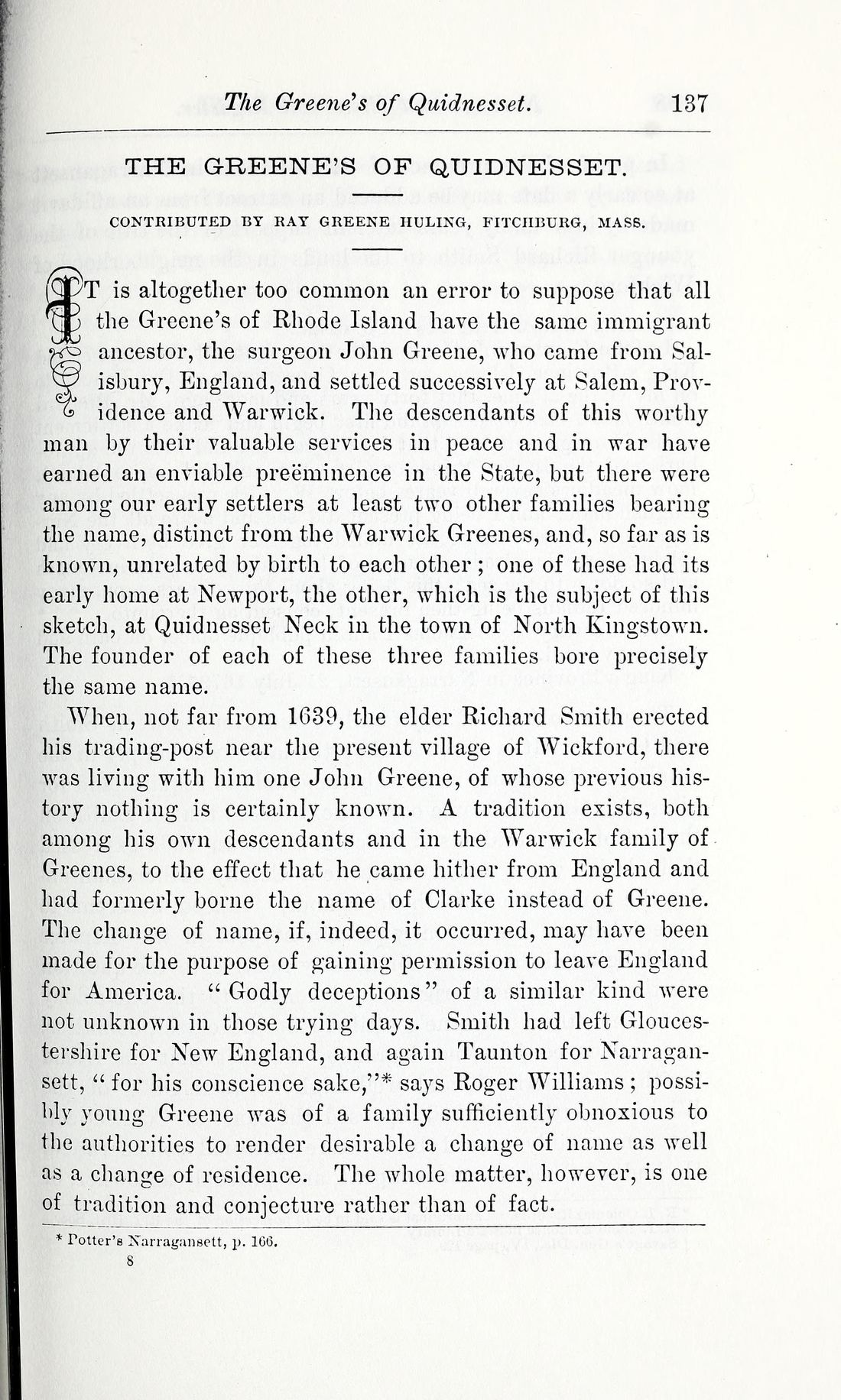
When, not far from 1639, the elder Richard Smith erected his trading-post near the present village of Wickford, there was living with him one John Greene, of whose previous history nothing is certainly known. A tradition exists, both among his own descendants and in the Warwick family of Greenes, to the effect that he came hither from England and had formerly borne the name of Clarke instead of Greene. … The whole matter, however, is one of tradition and conjecture rather than of fact.
Source: Huling, Narragansett Historical Register 2 (Oct. 1883), 137. https://archive.org/details/narragansetthistv1v2rhod
The proprietors’ own copy of the declaration for Connecticut that brought the Rhode Island warrant of May 1664 (next card), printed from the Fones Record in 1894. The subscribers are the Atherton partners and the Wickford inhabitants. On the printed page a “marke” is set only against the men who could not write their names, Tibbits, Waite, the two Eldreds, Sewell, Willis, Leach, House, and Palmer; John Green signs without one, in the middle column of the printed page, so he wrote his own name. Eight years later the witness “Henry Greene” to the deed of 1671/2 is entered with “his marke”: if Henry was John’s son, the father wrote and the son did not.
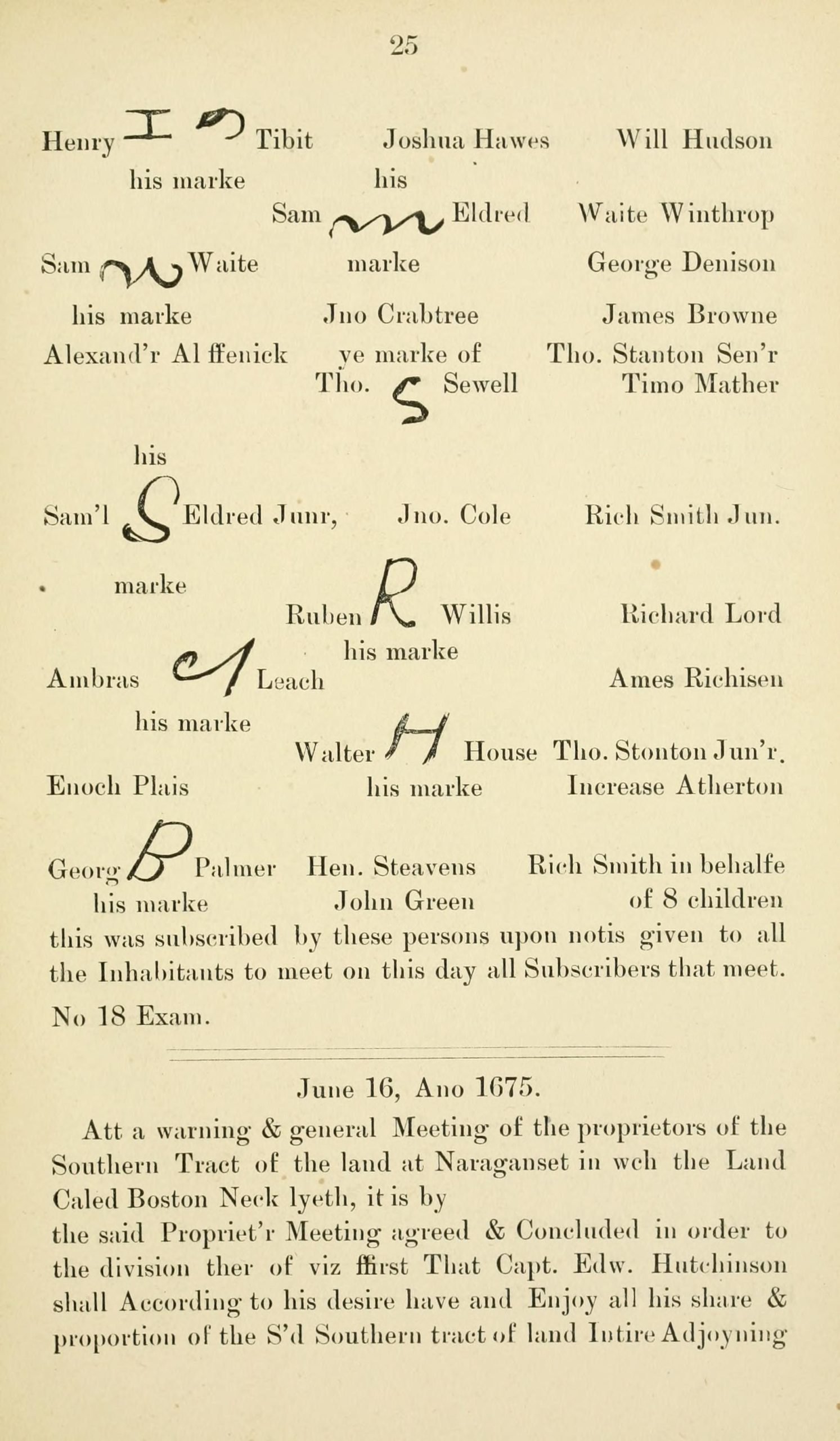
Naraganset 3, July 1663. We whose names are under written being the Inhabitants & the proprietors of the lands lying in the Naraganset have & doe desire (according to his Majesties grente) to be under the Govern’tt of Conecticot Collony & Request there protection according to a letter sent in June last. mr. Bradstreet & others have desired the same in ye Letter formerly Mentioned. Richard Smith, Edw. Hutchinson and for his son Elisha … Hen. Steavens, John Green, Rich Smith in behalfe of 8 children. this was subscribed by these persons upon notis given to all the Inhabitants to meet on this day all Subscribers that meet. No 18 Exam.
No wife, and no household, is named for him. A caution on the printed page: “Rich Smith in behalfe of 8 children” is a two-line entry in the right-hand column beside “John Green,” and a machine reading of the page runs them together as “John Green of 8 children.” The eight children are Smith’s.
Source: Arnold, J. N. (ed.), The Records of the Proprietors of the Narragansett, otherwise called the Fones Record (1894), 24–25. https://archive.org/details/recordsofproprie00arno
The Wickford men, John Greene among them, declared for Connecticut in 1663. Rhode Island answered with a warrant. Richard Smith wrote to Captain Hutchinson on 14 May 1664:
Three days since they came to John Green’s house att Aquidnesett with a warrant from theyre court, under the Governor’s hand, and forceably fetched him awaye to Rode Island where he yet remaynes. His goeing was also not known to any here.
John Greene, Sen’r, living at Narragansitt, or Aquidnesitt, having ben called before the Court for to answer … for his adhearing to the goverment of Connecticut … the Court doe pass by his offence; and doe promise to the aforesayd John Greene all lawful protexion and doe declare that he is still looked on as a freeman of the Collony.
The first record of a house at Quidnessett. It is his house, and the record does not say who was in it.
Source: Records of the Colony of Rhode Island, II (1857), 45–51. https://archive.org/details/recordsofcolonyo02rhod
The plat of 1666 assigns 151 acres to “John Greene and Son.” On 19 and 20 May 1671 the Governor, Deputy Governor and Assistants held a court at Aquidnesset, confirmed thirteen proprietors including John Greene in their possessions, and took their engagement as freemen. On 1 January 1671/2 a John Greene with John Fones, Henry Tibbitts, John Andrew, John Briggs and Thomas Waterman bought the Devil’s Foot tract of the sachem Awashawett.
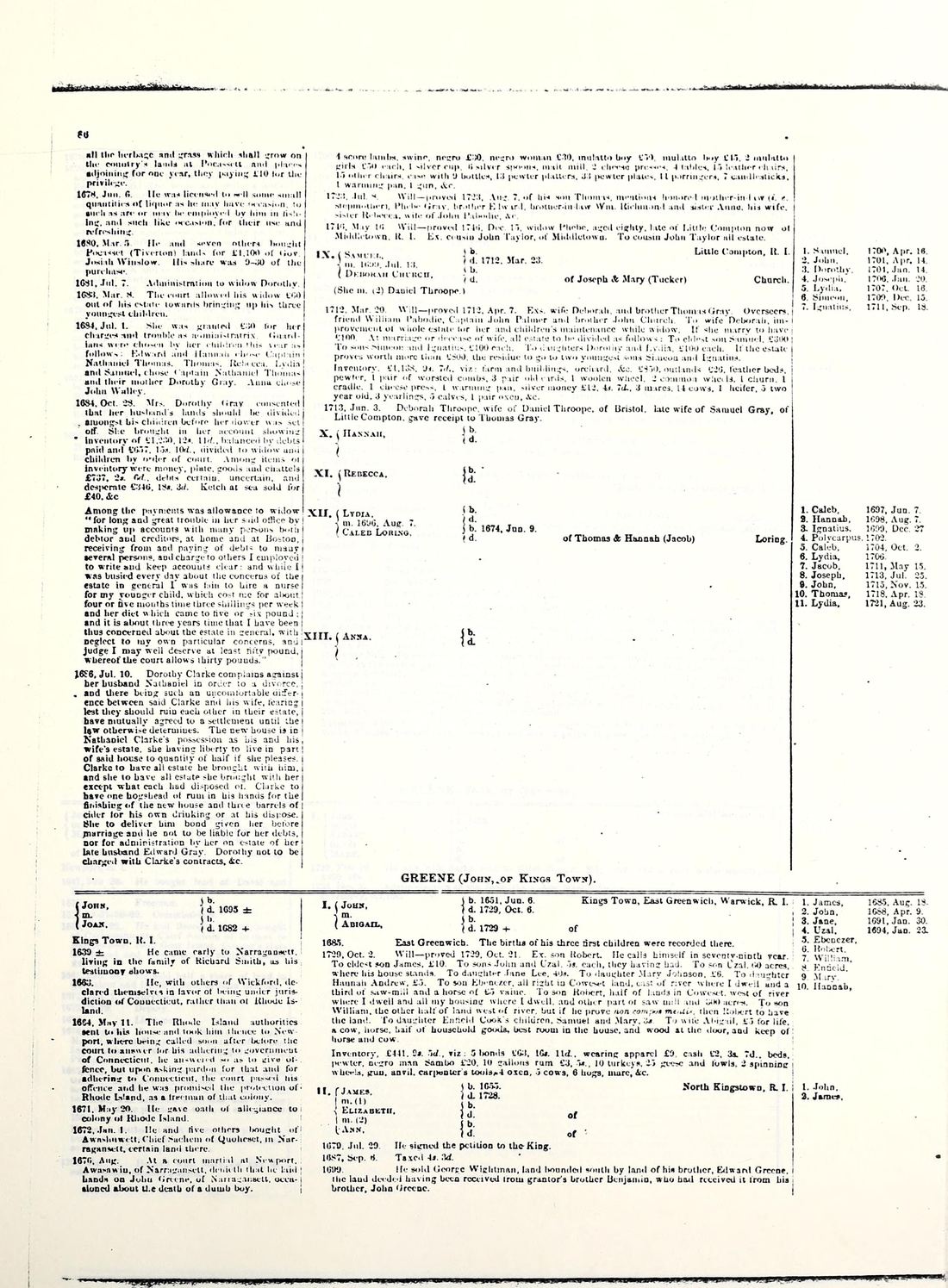
[1671, May 20] He gave oath of allegiance to colony of Rhode Island. [1672, Jan. 1] He and five others bought of Awashuwett, Chief Sachem of Quoheset, in Narragansett, certain land there.
Source: Huling, 140–141 (plat of 1666, from the Spink copy of 1780/1 of the plat of 1717/8; court of 1671 from Potter’s Narragansett, 75; Fones Purchase from R. I. Land Evidences 2:189 and N. K. Records 2:54); Austin, Genealogical Dictionary of Rhode Island (1887), 86. https://archive.org/details/genealogicaldict00aust
The Fones Purchase of the preceding card, printed in full from the Fones Record. Huling spells the sachem Awashawett and Austin Awashuwett; the printed deed has Anashuecot, Anashusett and Awashueset in one document. John Greene is the first named of the six purchasers. This is the land from which the deeds of 1682 to James and Daniel were carved.
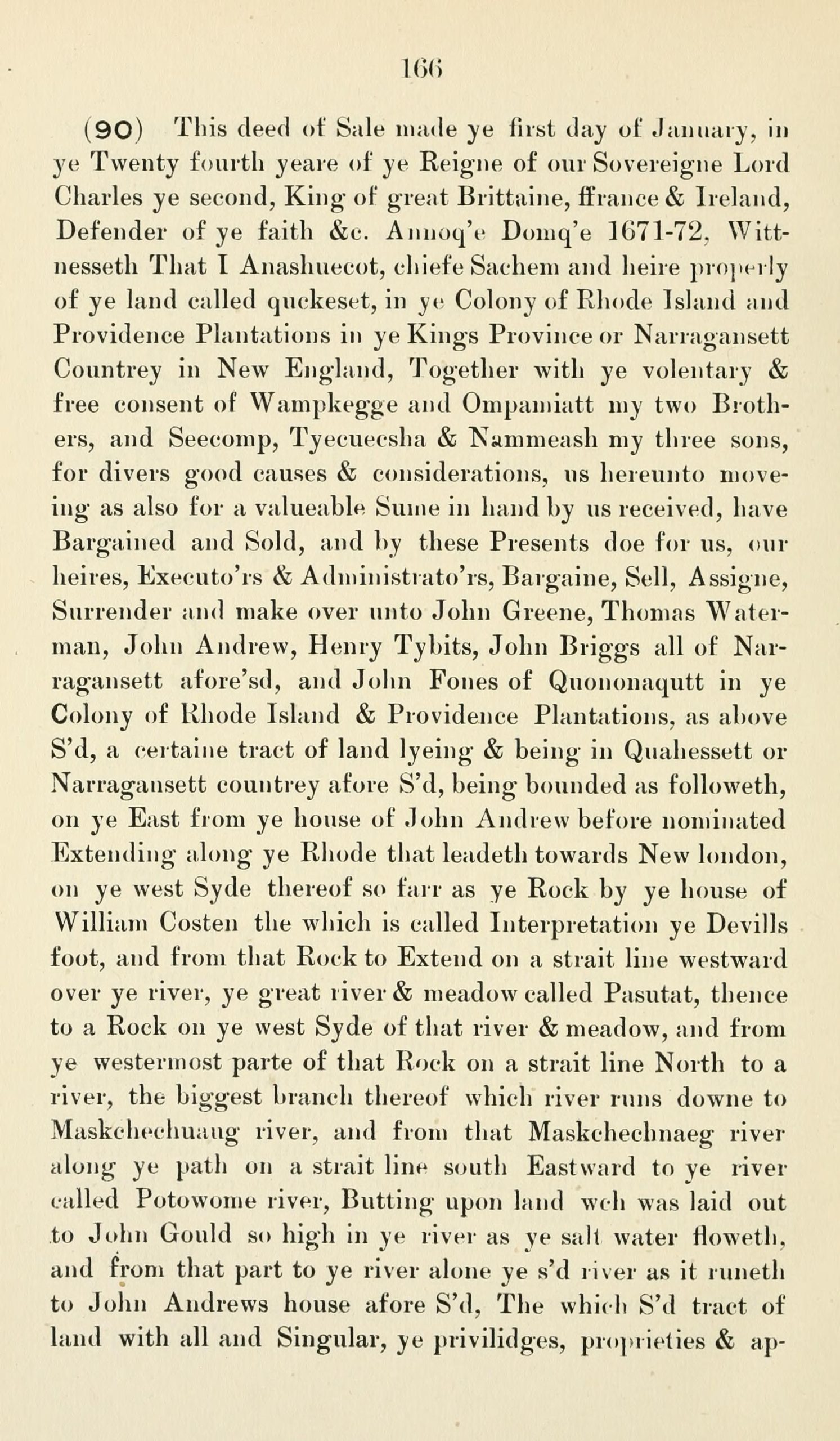
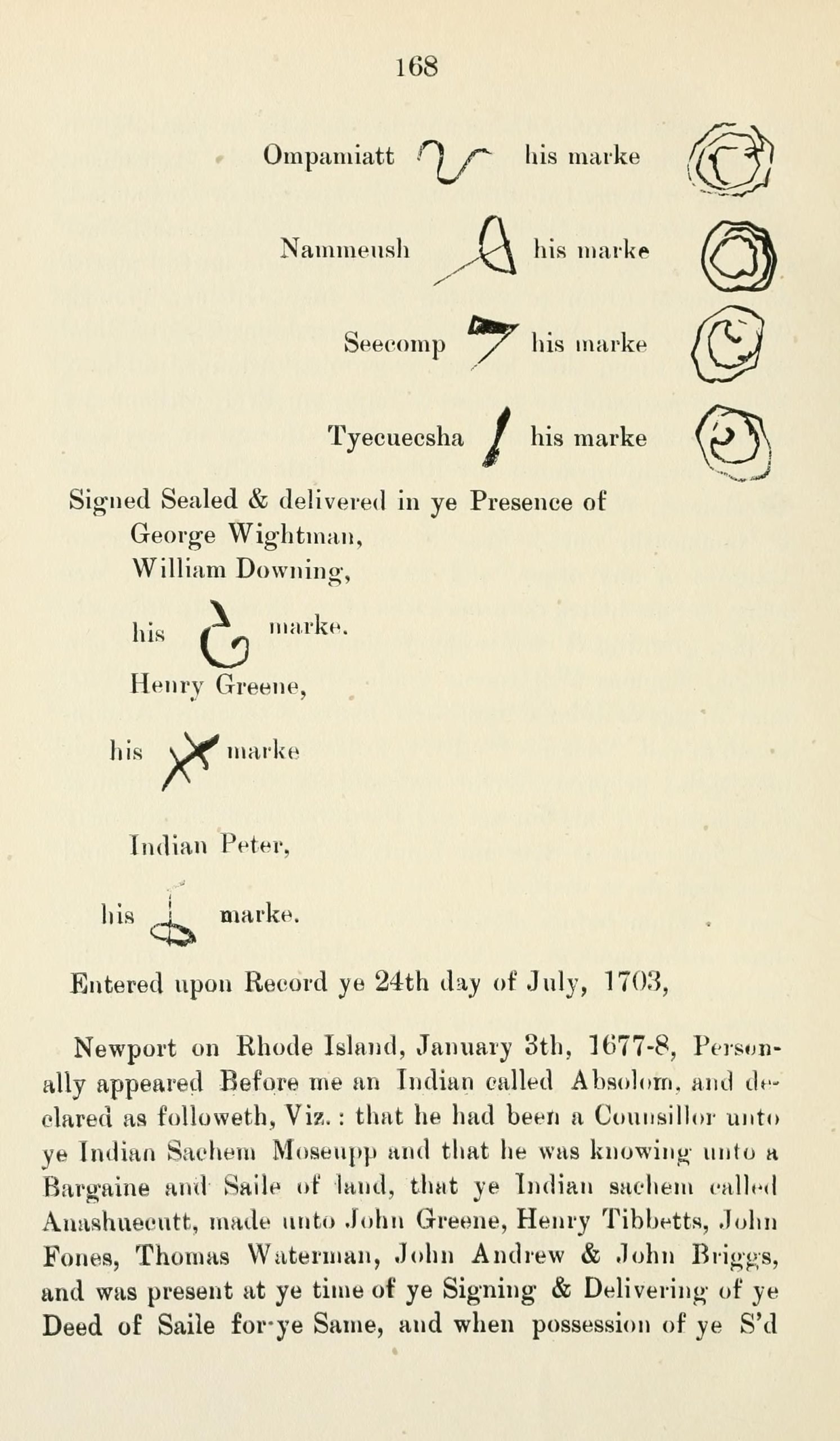
This deed of Sale made ye first day of January, in ye Twenty fourth yeare of ye Reigne of our Sovereigne Lord Charles ye second … Annoq’e Domq’e 1671-72, Wittnesseth That I Anashuecot, chiefe Sachem and heire properly of ye land called quckeset, in ye Colony of Rhode Island and Providence Plantations in ye Kings Province or Narragansett Countrey in New England, Together with ye volentary & free consent of Wampkegge and Ompamiatt my two Brothers, and Seecomp, Tyecuecsha & Nammeash my three sons … have Bargained and Sold, and by these Presents doe … Bargaine, Sell, Assigne, Surrender and make over unto John Greene, Thomas Waterman, John Andrew, Henry Tybits, John Briggs all of Narragansett afore’sd, and John Fones of Quononaqutt in ye Colony of Rhode Island & Providence Plantations, as above S’d, a certaine tract of land lyeing & being in Quahessett or Narragansett countrey afore S’d, being bounded as followeth, on ye East from ye house of John Andrew before nominated Extending along ye Rhode that leadeth towards New london …
Signed Sealed & delivered in ye Presence of George Wightman, William Downing, his marke. Henry Greene, his marke. Indian Peter, his marke. Entered upon Record ye 24th day of July, 1703.
Newport on Rhode Island, January 3th, 1677-8, Personally appeared Before me an Indian called Absolom, and declared as followeth, Viz.: that he had been a Counsillor unto ye Indian Sachem Moseupp and that he was knowing unto a Bargaine and Saile of land, that ye Indian sachem called Anashuecutt, made unto John Greene, Henry Tibbetts, John Fones, Thomas Waterman, John Andrew & John Briggs, and was present at ye time of ye Signing & Delivering of ye Deed of Saile for ye Same …
Neither the deed nor Absolom’s declaration of 1677/8 names a wife. Among the witnesses is “Henry Greene, his marke.” The family’s account makes Henry a son of John and Joan who engaged as a freeman with his father in 1671; he is not in Austin’s list of the children, and this is the one record found in which he appears. The deed was entered upon record only on 24 July 1703, after John’s death.
Source: Arnold, J. N. (ed.), The Records of the Proprietors of the Narragansett, otherwise called the Fones Record (1894), 166–168. https://archive.org/details/recordsofproprie00arno
Sworn as a Conservator of the Peace, in support of the younger Richard Smith’s title:
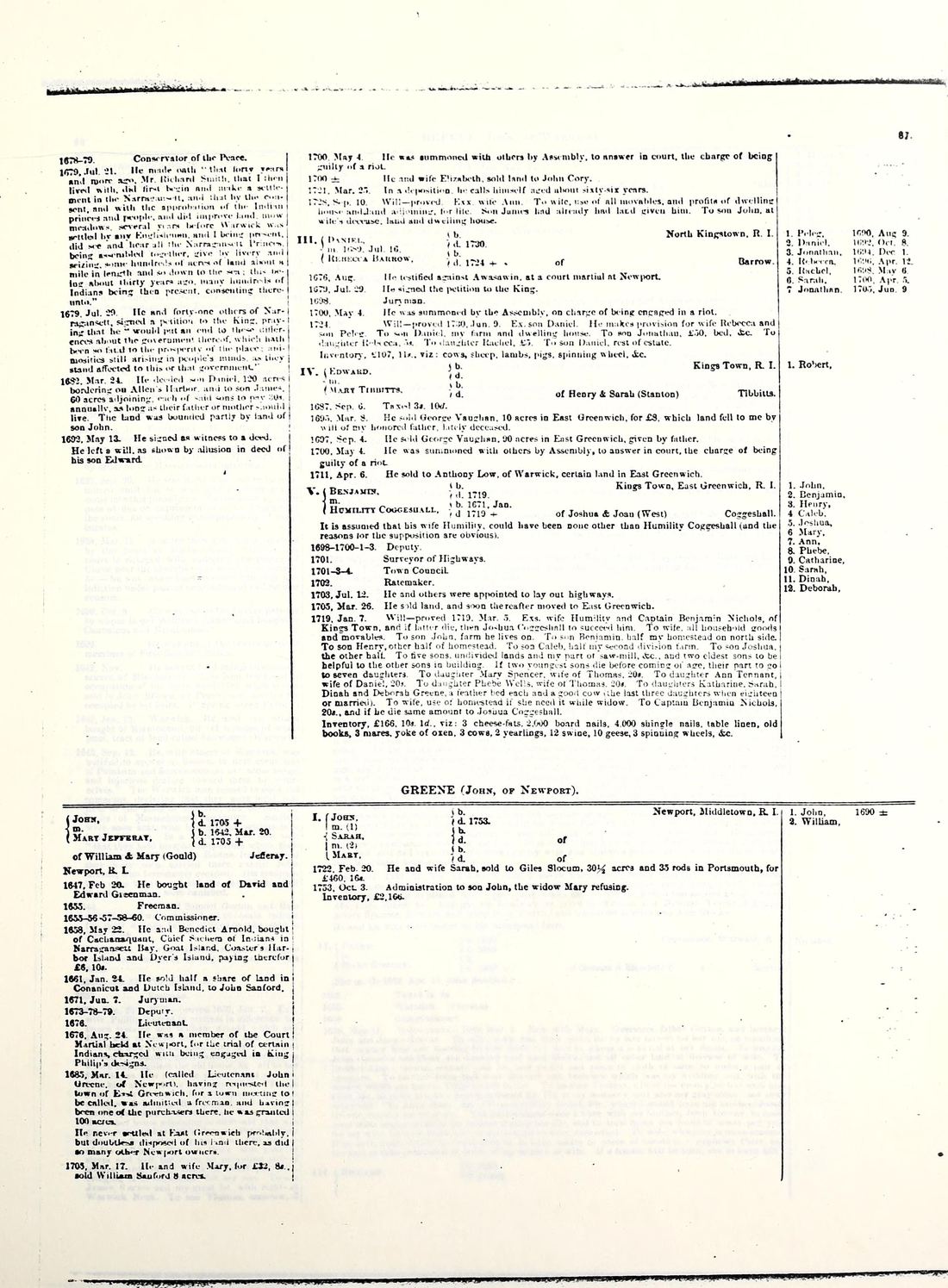
I, John Greene, inhabiting in the Narragansett Countiy, called King’s Province, I being sworn a Conservator of the Peace, do on my Oathe affirme, that forty years and more ago, Mr. Richard Smith that I then lived with did first begin and make a settlement in the Narragansett … and I being present did see and heare all the Narragansett Princes being assembled together give by livery and seizin some hundreds of acres of land about a mile in length and so down to the sea; this being about thirty years agoe, many hundred Indians being then present, consenting thereunto. … This I certify to be true as I am in publique office, on oath and under my hand. King’s Province in Narragansett, 21 July 1679
The one document in his own words. It places him at Wickford by 1639, unmarried so far as it says, and in Smith’s employ or household. Eight days later he signed the petition of forty-two Narragansett men to the King.
Source: Huling, 138, from the Rhode Island Colonial Records; the original said to be at the Rhode Island Historical Society. Austin, 87.
Recorded in the colony’s Land Evidences at Newport, book I, entry 260, and abstracted in the 1921 printing. This is the only surviving document that names her.
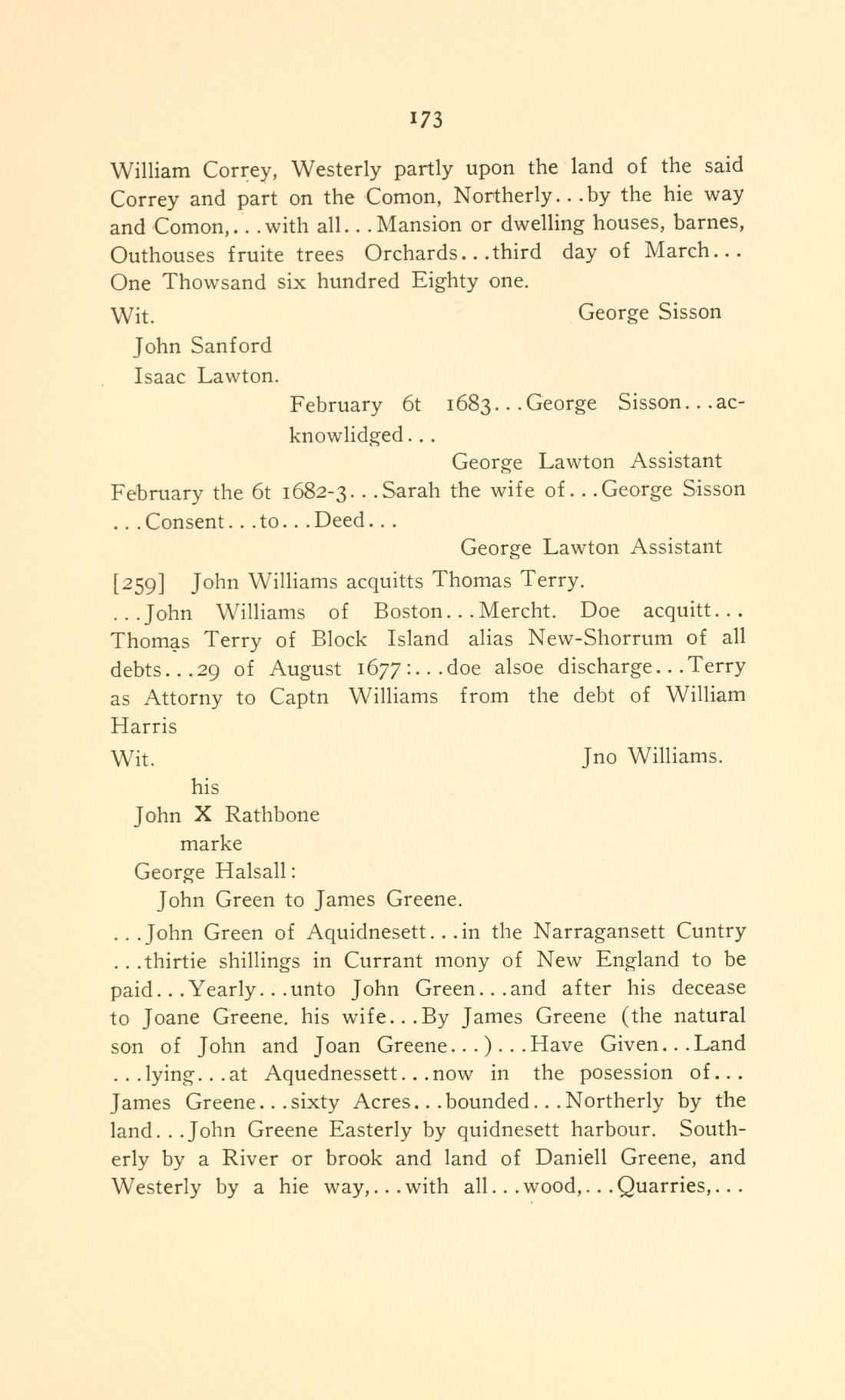
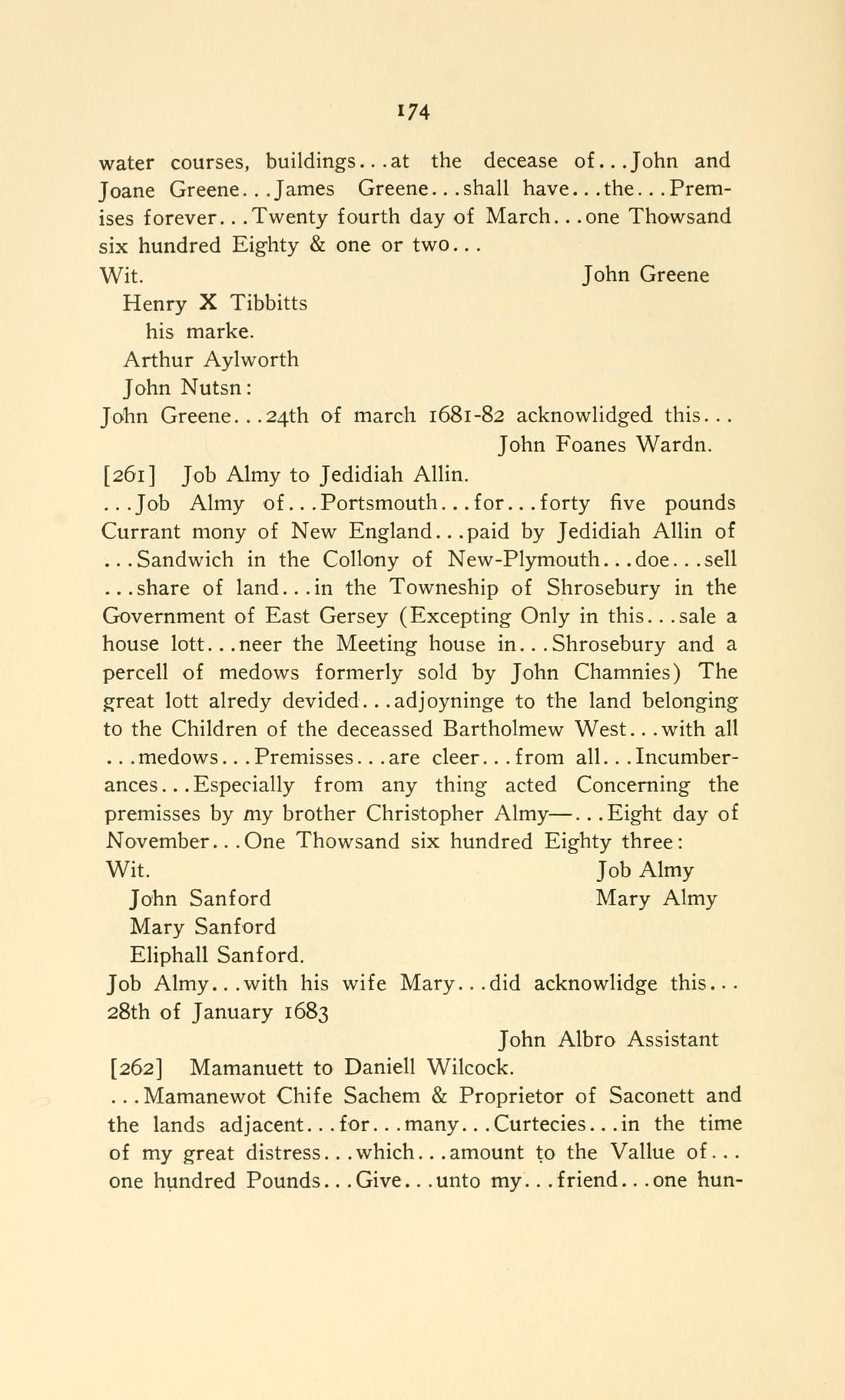
John Green to James Greene. … John Green of Aquidnesett … in the Narragansett Cuntry … thirtie shillings in Currant mony of New England to be paid … Yearly … unto John Green … and after his decease to Joane Greene, his wife … By James Greene (the natural son of John and Joan Greene …) … Have Given … Land … lying … at Aquednessett … now in the posession of … James Greene … sixty Acres … bounded … Northerly by the land … John Greene Easterly by quidnesett harbour. Southerly by a River or brook and land of Daniell Greene, and Westerly by a hie way, … with all … wood, … Quarries, … water courses, buildings … at the decease of … John and Joane Greene … James Greene … shall have … the … Premises forever … Twenty fourth day of March … one Thowsand six hundred Eighty & one or two …
Wit. Henry X Tibbitts his marke. Arthur Aylworth. John Nutsn: John Greene. John Greene … 24th of march 1681-82 acknowlidged this … John Foanes Wardn.
Read closely: the thirty shillings is an annuity for the parents’ lives, hers after his; James is their “natural son,” the phrase of the time for a son of the body; the land is bounded by Daniel’s. Daniel’s own deed of the same day, 120 acres bordering Allen’s Harbor with the same provision “as long as the father or mother should live,” is in the North Kingstown records and has not been printed in full. The witnesses are Quidnessett neighbours: Henry Tibbitts, whose daughter Mary married Edward Greene; Arthur Aylworth; and the warden John Fones. The 1921 abstract omits words at each “…”; the full text, which may carry more about her, is in the original book at the Rhode Island State Archives.
Source: Rhode Island Land Evidences, vol. I, 1648–1696, abstracts (Providence: R. I. Historical Society, 1921), 173–174. https://archive.org/details/rhodeislandlande00wort
Austin and Huling from the North Kingstown records:
[1682, Mar. 24] He deeded son Daniel, 120 acres bordering on Allen’s Harbor, and to son James, 60 acres adjoining, each of said sons to pay 30s. annually, as long as their father or mother should live. The land was bounded partly by land of son John.
[1692, May 13] He signed as witness to a deed. He left a will, as shown by allusion in deed of his son Edward.
[Edward, 1695, Mar. 8] He sold George Vaughan, 10 acres in East Greenwich, for £8, which land fell to me by will of my honored father, lately deceased.
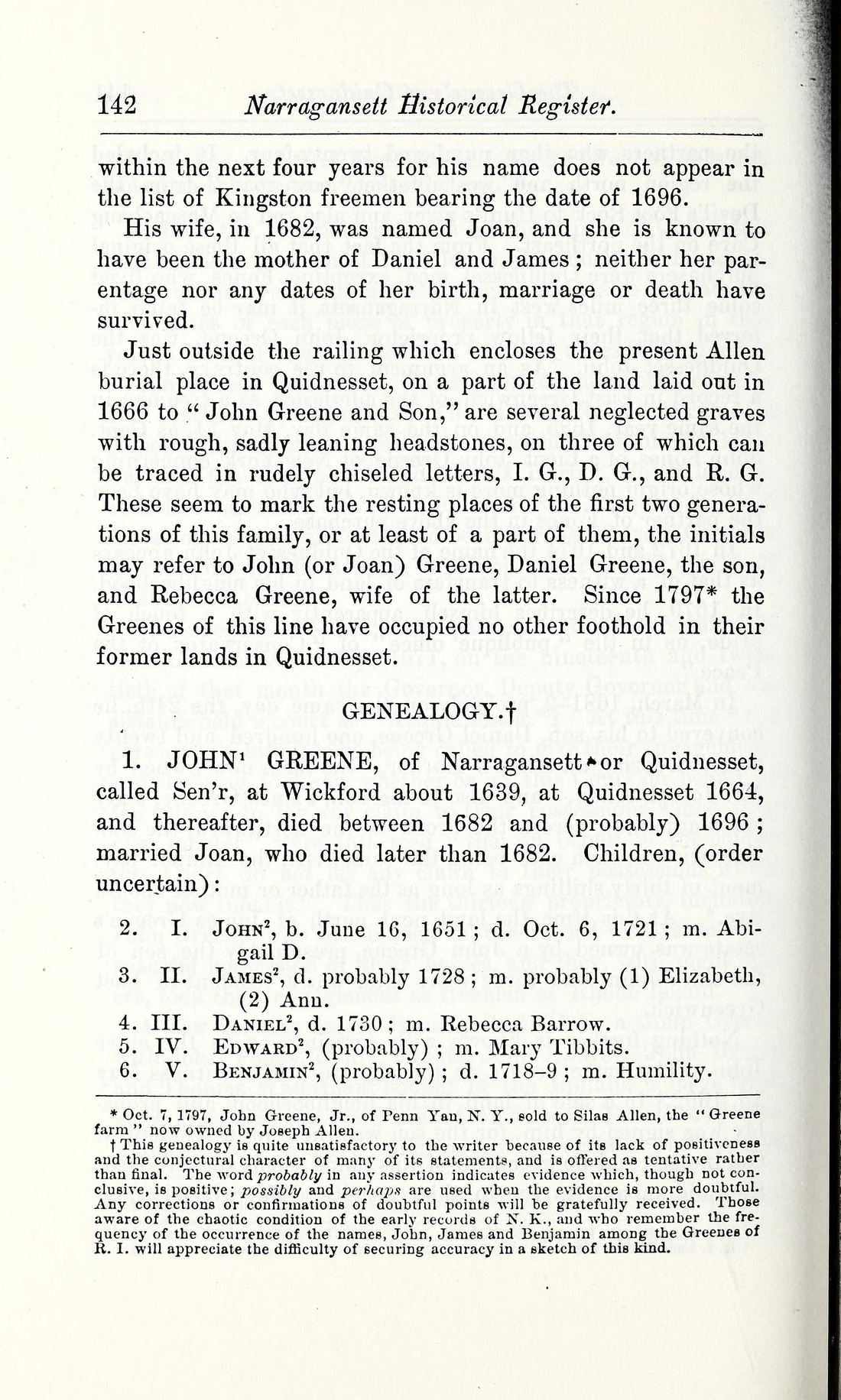
His wife, in 1682, was named Joan, and she is known to have been the mother of Daniel and James; neither her parentage nor any dates of her birth, marriage or death have survived.
So John died between May 1692 and March 1694/5, leaving a will. The will is the document most likely to name Joan, if she survived him, and to set out her dower. It has not been found in print; the Kings Towne council and probate books of the 1690s are the place to look, and Huling warned in 1883 of “the chaotic condition of the early records of N. K.” Just outside the Allen burial ground, on the 1666 land, Huling saw three headstones lettered I. G., D. G., and R. G., which he took for John or Joan, Daniel, and Daniel’s wife Rebecca.
Source: Austin, 86–87; Huling, 141–142. https://archive.org/details/narragansetthistv1v2rhod
Her children, as the Quidnessett records give them
| Child | Record | Names his mother? |
|---|---|---|
| James | Deed of 24 March 1681/2, “the natural son of John and Joan Greene”; b. 1655 per Huling; d. 1728; m. (1) Elizabeth, (2) Ann; Lieut.; signed the petition to the King 1679. | Yes, as Joan. |
| Daniel | Deed of 24 March 1681/2, 120 acres, “as long as the father or mother should live”; m. 16 July 1689 Rebecca Barrow; d. 1730, will proved 9 June 1730. | Implicitly (“the mother”). |
| John, “Lieut.,” of East Greenwich and Coventry | Land next north of James’s in 1682, “presumably the son” (Huling); of East Greenwich 1685; m. Abigail; will proved 21 Oct. 1729. Austin gives his birth as 6 June 1651, which La Mance says is the birth date of the Warwick Lieut.-Governor, confused for his. | No. |
| Edward, “Capt.” | Sold land in 1695 that “fell to me by will of my honored father, lately deceased”; m. Mary Tibbitts, daughter of Henry and Sarah (Stanton) Tibbitts. | No. |
| Benjamin | Deputy 1698–1703; m. Humility (Coggeshall); d. 1719, will proved 5 March 1719. | No. |
| Henry | Engaged as freeman with his father and brothers, 1671 (La Mance); not in Austin’s list. Witnessed the deed of 1 January 1671/2 by his mark (Fones Record, 168), the one record found in which he appears. | No. |
| “Joan Greene, 1649–1715” | Was listed as a daughter on this site’s John Greene of Quidnessett page until 22 September 2026, when the entry was removed with a dated correction note. No record of a daughter Joan found in Austin, Huling, or the Land Evidences, and none attached to the WikiTree profile for John (Greene-950), which lists seven sons. The nine-child list with its years has the form of the online family trees and cites no record; a search on 22 September 2026 found nothing for her. | Not found. |
Austin’s summary of the family, from the Kings Town records: “John, d. 1695 ±; m. Joan, d. 1682 +. Kings Town, R. I.” He could give her no more than that.
What is not in the Narragansett record
- Any mention of Joan before 24 March 1681/2. She does not appear in the subscription of 1663, the 1664 arrest, the 1671 court, the purchase of 1671/2, the 1679 affidavit, or the petition to the King, all of which name only John.
- Her maiden name, parentage, birth, marriage, or death.
- Any tie to Massachusetts, Salem, Providence, Beggarly, Beckley, or Daniell. No Kings Towne or Land Evidence entry uses any of those names.
- A daughter Joan.
- Any record of a step-son.
Where the unprinted records are
Everything above is from printed abstracts and printed transcripts. A search on 22 September 2026 found no further printed or online copies: the books below remain in manuscript, with microfilm at FamilySearch that requires an account and was not consulted. The originals, in order of promise:
- Rhode Island Land Evidences, book I, entry 260 (State Archives, Providence): the full text of the James deed, of which the 1921 printing gives only an abstract with omissions at every “…”.
- North Kingstown Land Evidence, book 2 (North Kingstown Town Hall, Wickford): the companion deed to Daniel of 24 March 1681/2, never printed; the Fones Purchase deed of 1671/2 at p. 54, now printed in full in the Fones Record (1894), 166–168; and Edward’s 1695 deed reciting his father’s will.
- Kings Towne Council and Probate records, 1692 to 1696: John’s will, alluded to by Edward, and any inventory or division naming “Joan Greene, widow.” Huling in 1883 did not find it; the early books are damaged.
- The wills of the sons: Daniel (proved 1730), James (1728), Benjamin (1719), Lieut. John (1729), for any mention of “my mother.” Austin’s abstracts of Daniel’s and Benjamin’s wills name no mother, which suggests she was dead by 1719.
- The Rhode Island Historical Society: the original of the 1679 affidavit; the Updike (Cocumscussoc) papers, for Smith’s household in the 1640s.
- Connecticut State Archives: the Wickford petitions of 1663 and 1664 to Hartford, signed by John Greene, and Richard Smith’s letters. The proprietors’ copy of the subscription of 3 July 1663 is printed in the Fones Record (1894), 24–25.
- The East Greenwich and Coventry records for Lieut. John, who recorded his children’s births at East Greenwich from 1685.
If Joan’s origin survives anywhere, it is in items 1, 3, and 4: the full deed, her husband’s will, and her sons’ wills.
The Salem appendix, removed 23 September 2026
An appendix on “her” Salem farm at Skelton’s Neck and her cottage near Skelton’s house stood here from 22 September 2026, on the family’s identification of Joan with Alice Daniell. That identification is disproved, so the appendix does not belong on Joan’s page. Every plan, map and document in it remains on Alice Daniell, called Mrs. Beggarly: second wife of John Greene the Surgeon.
The search for her: every source checked, 23 September 2026
Added 23 September 2026. This section records the whole search for Joan’s identity, so that no one has to repeat it: what was found, what was proved wrong, and what was searched with nothing to show. Every page image below was read directly before it was transcribed.
Proved: her name was Joan (Joane); she was the mother of James and Daniel; she was alive on 24 March 1681/2. One deed says so, and no other document names her.
Proved wrong: that she was Mrs. Beggarly (Alice Daniell), who married John Greene the surgeon (Alice Daniell, called Mrs. Beggarly); that she was a daughter of Richard Smith; and that she was “Mary” or “Joane Tibbitts” of Rowington, Warwickshire.
Still unknown: her maiden name, her parents, where she came from, when she married, and when she died. Every historian who has written about the family, from 1883 to 1919, says the same.
Best remaining leads: the original of the 1682 deed; John’s sale of his Conanicut land, in the Jamestown records (checked 25 September 2026: she is not named); and the North Kingstown and East Greenwich books that mention his lost will.
Updated 25 September 2026: the Jamestown deeds. The Jamestown Historical Society (Rosemary Enright) photographed John Greene’s two sales of his Conanicut share in the Jamestown town records, Book 1, pages 22 and 31, and sent them on 24 September 2026. Neither deed names his wife, and the Society “could find no record of the name of John Green’s wife.” The sale to John Sanford is dated 24 January “1661,” probably 1661/2 in modern reckoning. The deeds, with photographs and transcriptions, are on John Greene of Quidnessett. This lead is closed.
The historians, 1883 to 1919: “nothing further is known about her”
Ray Greene Huling’s study, the foundation of every later account, is plain that nothing is known of her beyond her name. His list of the children gives the son Edward’s wife as Mary Tibbits.
His wife, in 1682, was named Joan, and she is known to have been the mother of Daniel and James; neither her parentage nor any dates of her birth, marriage or death have survived.
… 1. JOHN1 GREENE, of Narragansett or Quidnesset, called Sen’r, at Wickford about 1639, at Quidnesset 1664, and thereafter, died between 1682 and (probably) 1696; married Joan, who died later than 1682. … 5. IV. EDWARD2, (probably); m. Mary Tibbits.
Source: Huling, R. G. (1883). The Greenes of Quidnesset. Narragansett Historical Register, 2, 142.
Frederic L. Greene’s genealogy of the Westerly line, the book behind this family’s own descent, reaches the same point.
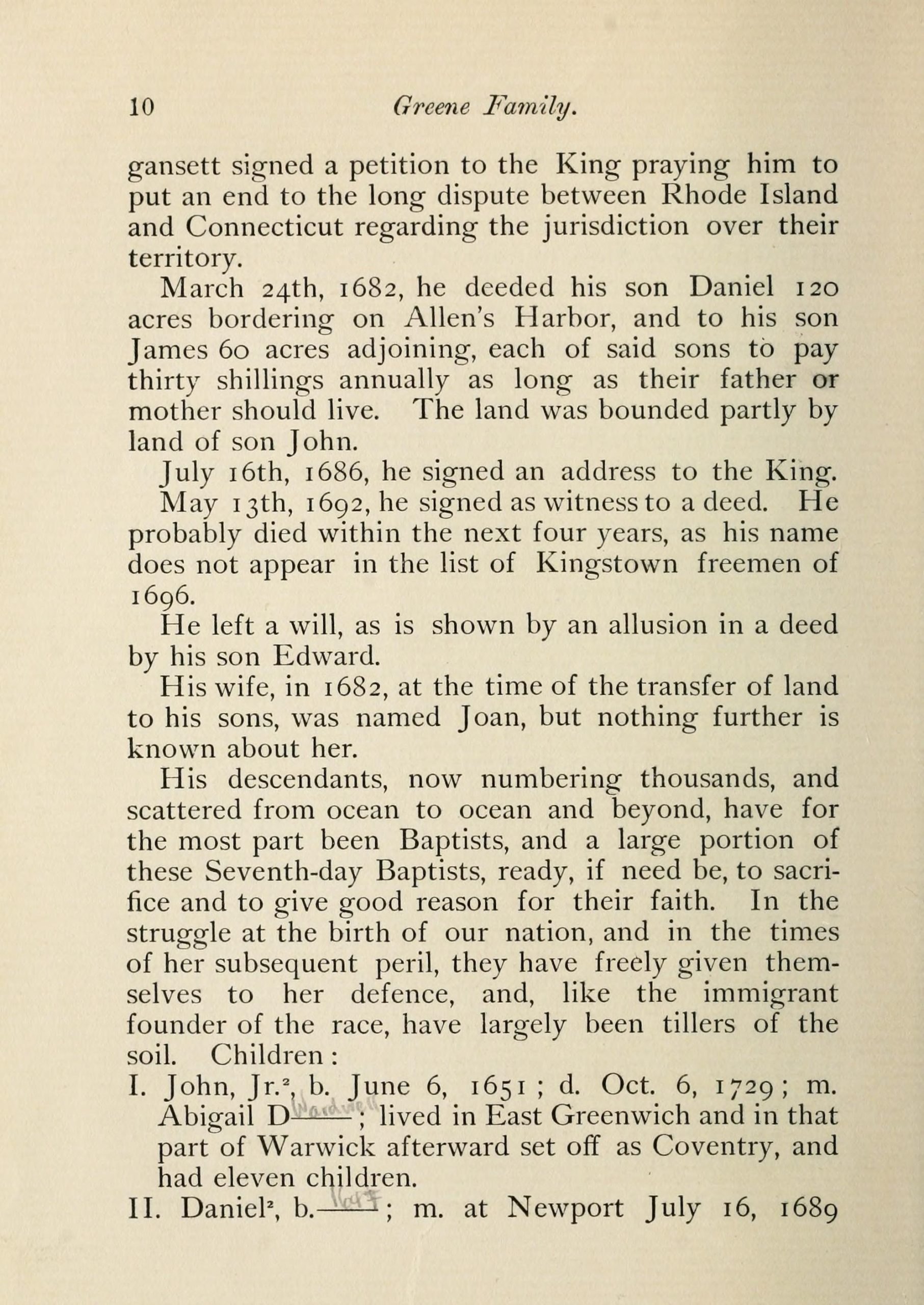
March 24th, 1682, he deeded his son Daniel 120 acres bordering on Allen’s Harbor, and to his son James 60 acres adjoining, each of said sons to pay thirty shillings annually as long as their father or mother should live. The land was bounded partly by land of son John.
July 16th, 1686, he signed an address to the King.
May 13th, 1692, he signed as witness to a deed. He probably died within the next four years, as his name does not appear in the list of Kingstown freemen of 1696.
He left a will, as is shown by an allusion in a deed by his son Edward.
His wife, in 1682, at the time of the transfer of land to his sons, was named Joan, but nothing further is known about her.
Source: Greene, F. L. (1894). Descendants of Joseph Greene of Westerly, R.I. (p. 10). Joel Munsell’s Sons.
Louise Prosser Bates worked from the town records of Newport, Jamestown, North Kingstown and Portsmouth. She calls the couple “John and Joan Greene” but found no other record of Joan than the deed of 1682, and she believed John’s will had burned.
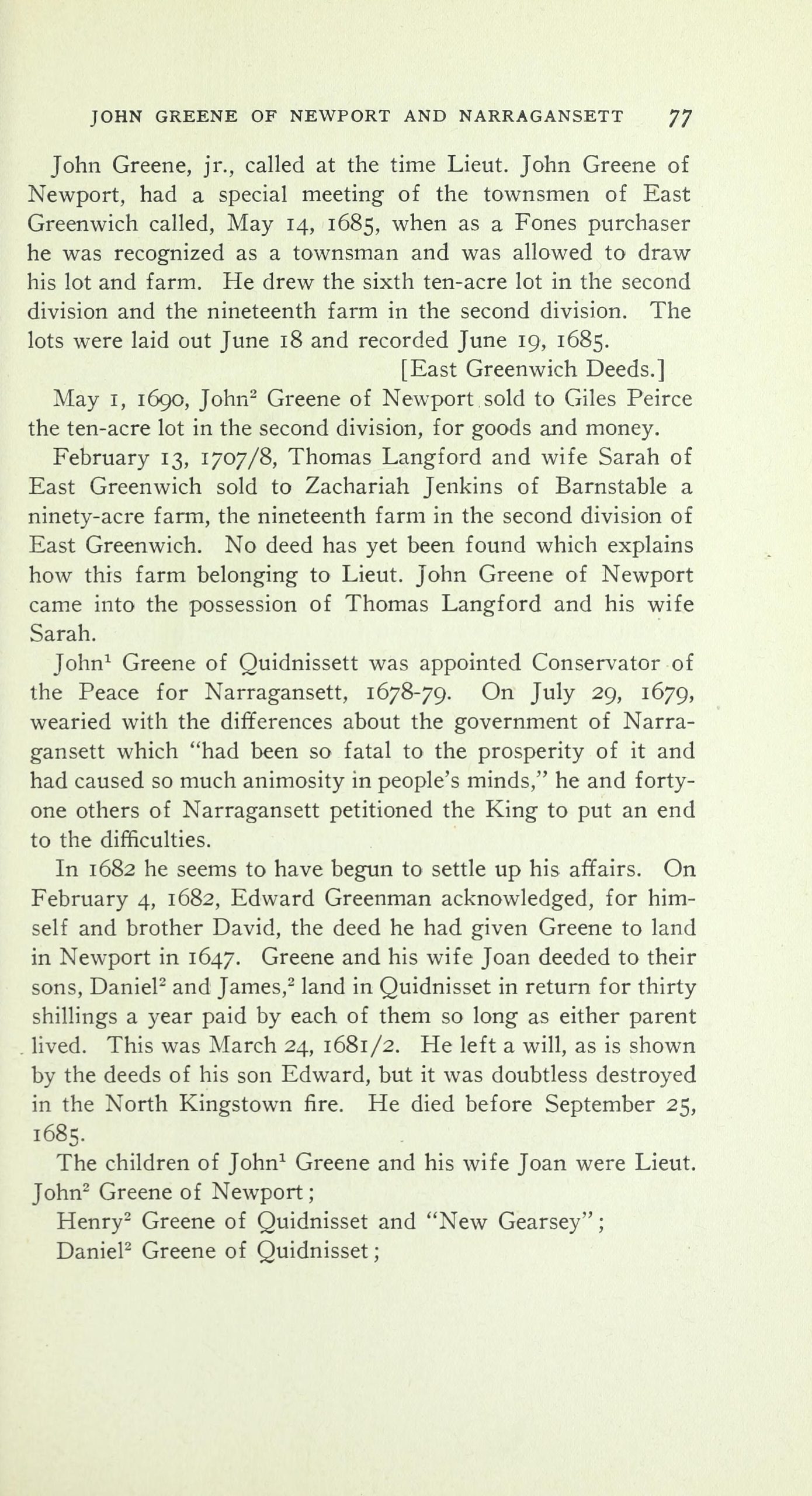
In 1682 he seems to have begun to settle up his affairs. On February 4, 1682, Edward Greenman acknowledged, for himself and brother David, the deed he had given Greene to land in Newport in 1647. Greene and his wife Joan deeded to their sons, Daniel2 and James,2 land in Quidnisset in return for thirty shillings a year paid by each of them so long as either parent lived. This was March 24, 1681/2. He left a will, as is shown by the deeds of his son Edward, but it was doubtless destroyed in the North Kingstown fire. He died before September 25, 1685.
The children of John1 Greene and his wife Joan were Lieut. John2 Greene of Newport; Henry2 Greene of Quidnisset and “New Gearsey”; Daniel2 Greene of Quidnisset;
Source: Bates, L. P. (1918). John Greene of Newport and Narragansett. Rhode Island Historical Society Collections, 11, 77. Note: Bates’s “before September 25, 1685” conflicts with the deed John witnessed on 13 May 1692 (Greene, 1894, above).
Newport, 1647 to 1661: the deeds that might name her
Bates showed that John Greene of Quidnessett had first been John Greene of Newport, a husbandman at the hamlet of Greenend, from 1647 to about 1660, and that their son James was “born at Newport in 1655.” A wife is most often named in a deed when her husband sells land, because she signs to give up her rights in it. So the Newport deeds were searched.
Bates’s account of his Newport and Narragansett land, with the record books she used in brackets.
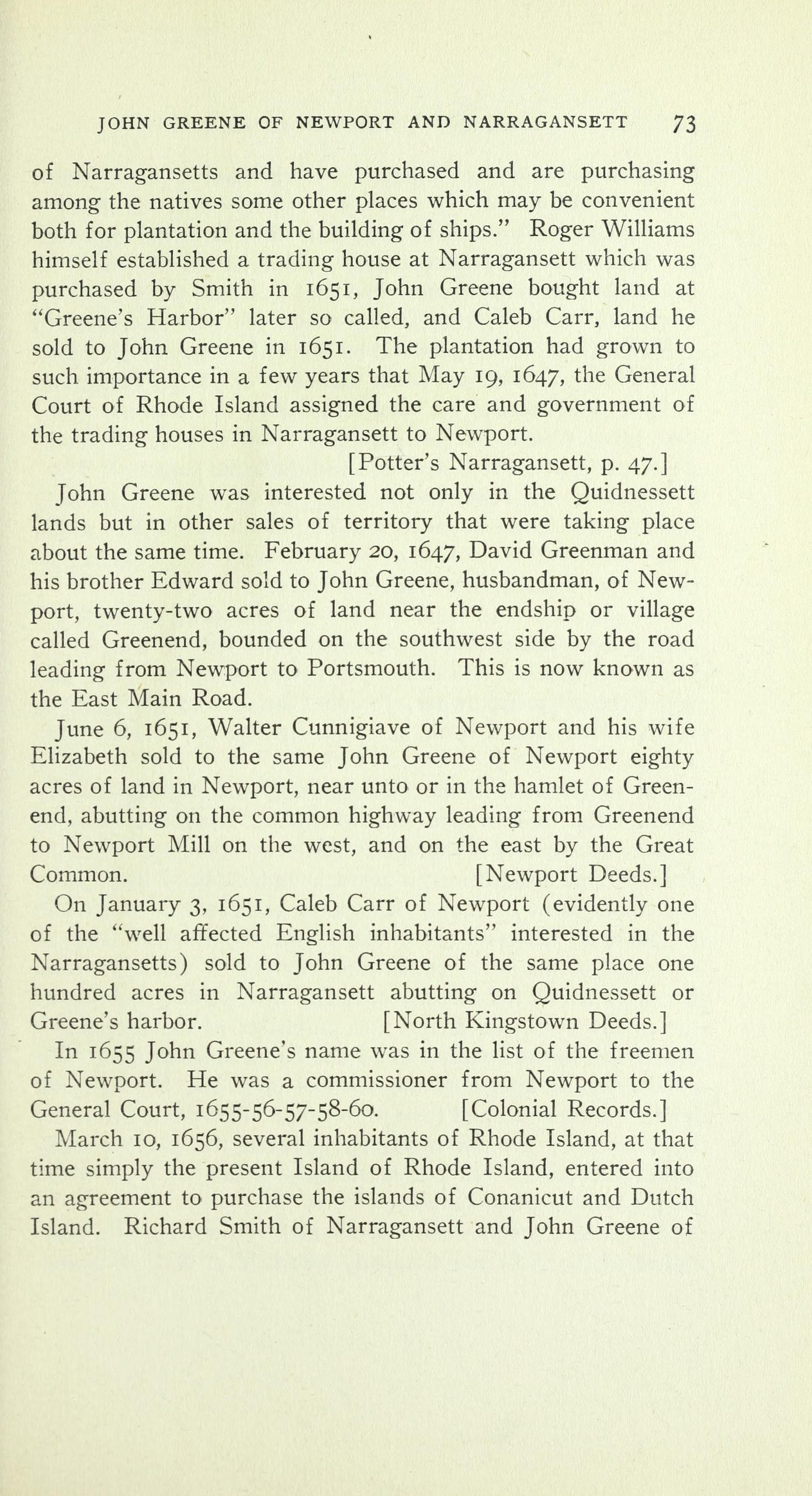
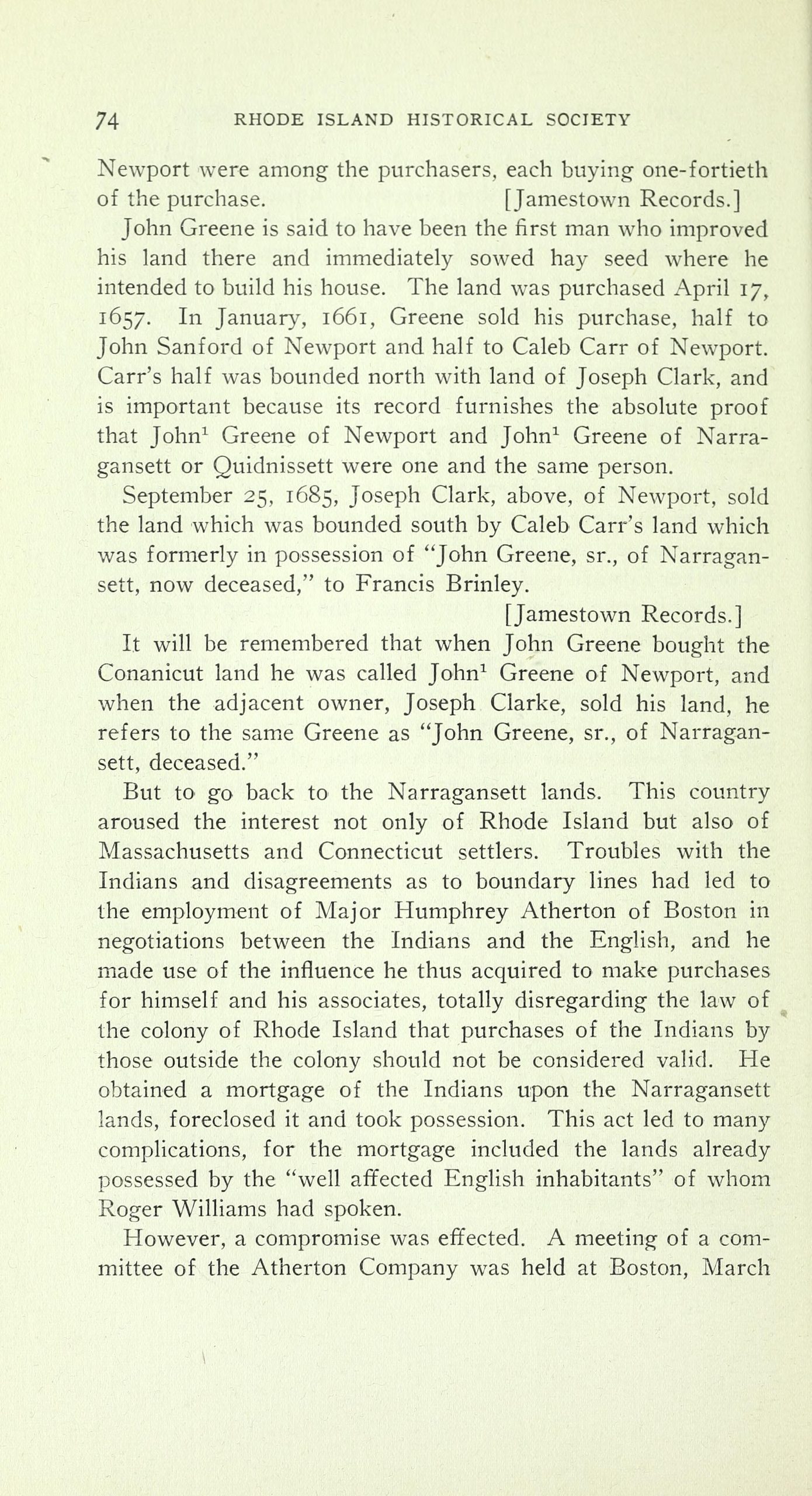
February 20, 1647, David Greenman and his brother Edward sold to John Greene, husbandman, of Newport, twenty-two acres of land near the endship or village called Greenend, bounded on the southwest side by the road leading from Newport to Portsmouth. This is now known as the East Main Road.
June 6, 1651, Walter Cunnigiave of Newport and his wife Elizabeth sold to the same John Greene of Newport eighty acres of land in Newport, near unto or in the hamlet of Greenend, abutting on the common highway leading from Greenend to Newport Mill on the west, and on the east by the Great Common. [Newport Deeds.]
On January 3, 1651, Caleb Carr of Newport … sold to John Greene of the same place one hundred acres in Narragansett abutting on Quidnessett or Greene’s harbor. [North Kingstown Deeds.]
In 1655 John Greene’s name was in the list of the freemen of Newport. He was a commissioner from Newport to the General Court, 1655-56-57-58-60. [Colonial Records.]
… Richard Smith of Narragansett and John Greene of Newport were among the purchasers, each buying one-fortieth of the purchase. [Jamestown Records.]
John Greene is said to have been the first man who improved his land there and immediately sowed hay seed where he intended to build his house. The land was purchased April 17, 1657. In January, 1661, Greene sold his purchase, half to John Sanford of Newport and half to Caleb Carr of Newport. Carr’s half was bounded north with land of Joseph Clark, and is important because its record furnishes the absolute proof that John1 Greene of Newport and John1 Greene of Narragansett or Quidnissett were one and the same person.
September 25, 1685, Joseph Clark, above, of Newport, sold the land which was bounded south by Caleb Carr’s land which was formerly in possession of “John Greene, sr., of Narragansett, now deceased,” to Francis Brinley. [Jamestown Records.]
Source: Bates, L. P. (1918). John Greene of Newport and Narragansett. Rhode Island Historical Society Collections, 11, 73–74.
Both purchases survive in the colony’s Land Evidences, abstracted in 1921. John is the buyer in both, so his wife had no reason to sign. The only wife named is the seller’s, Elisabeth Cunygrave. The Greenman deed was acknowledged again on 4 February 1681/2, seven weeks before John’s deeds to his sons.
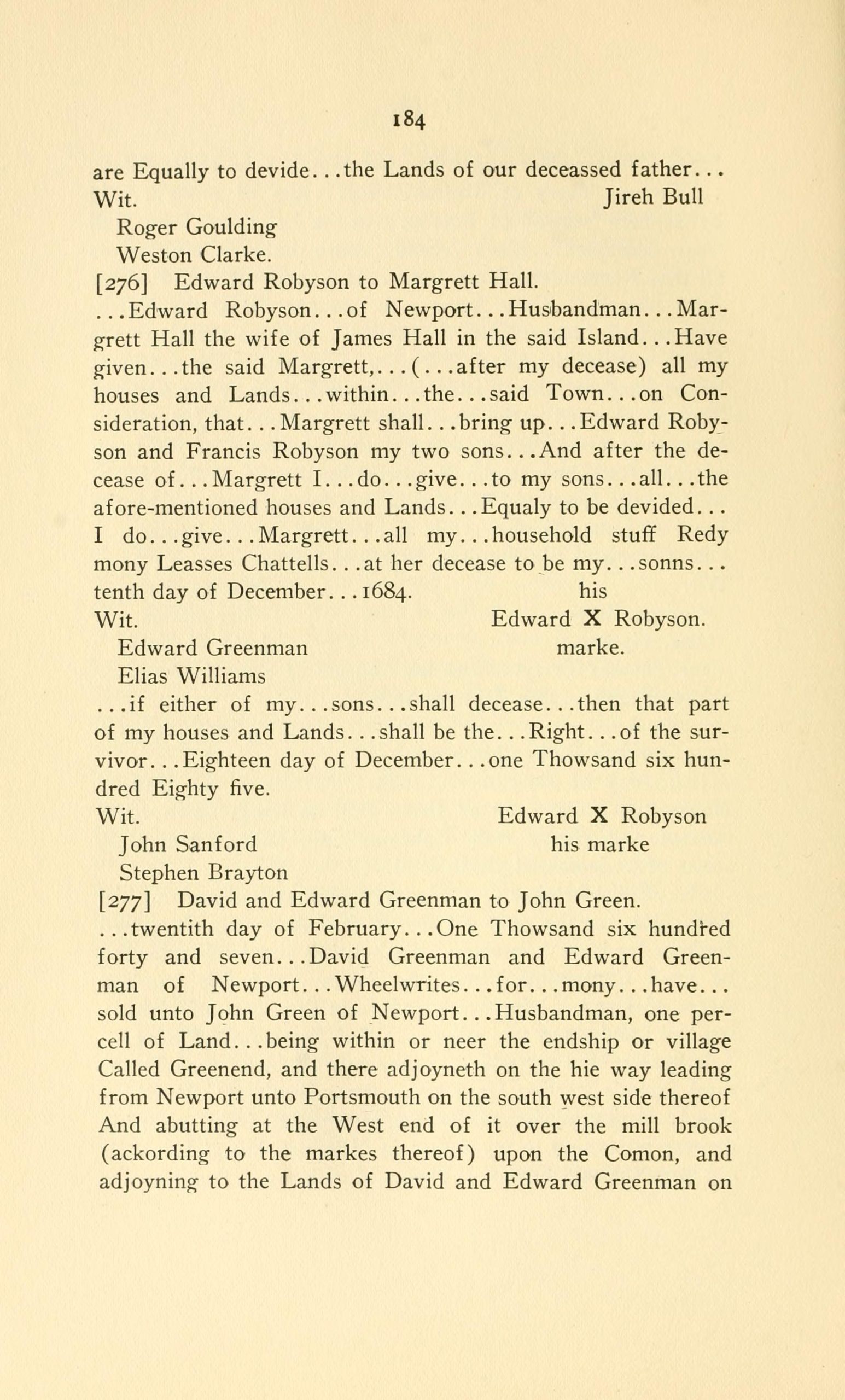
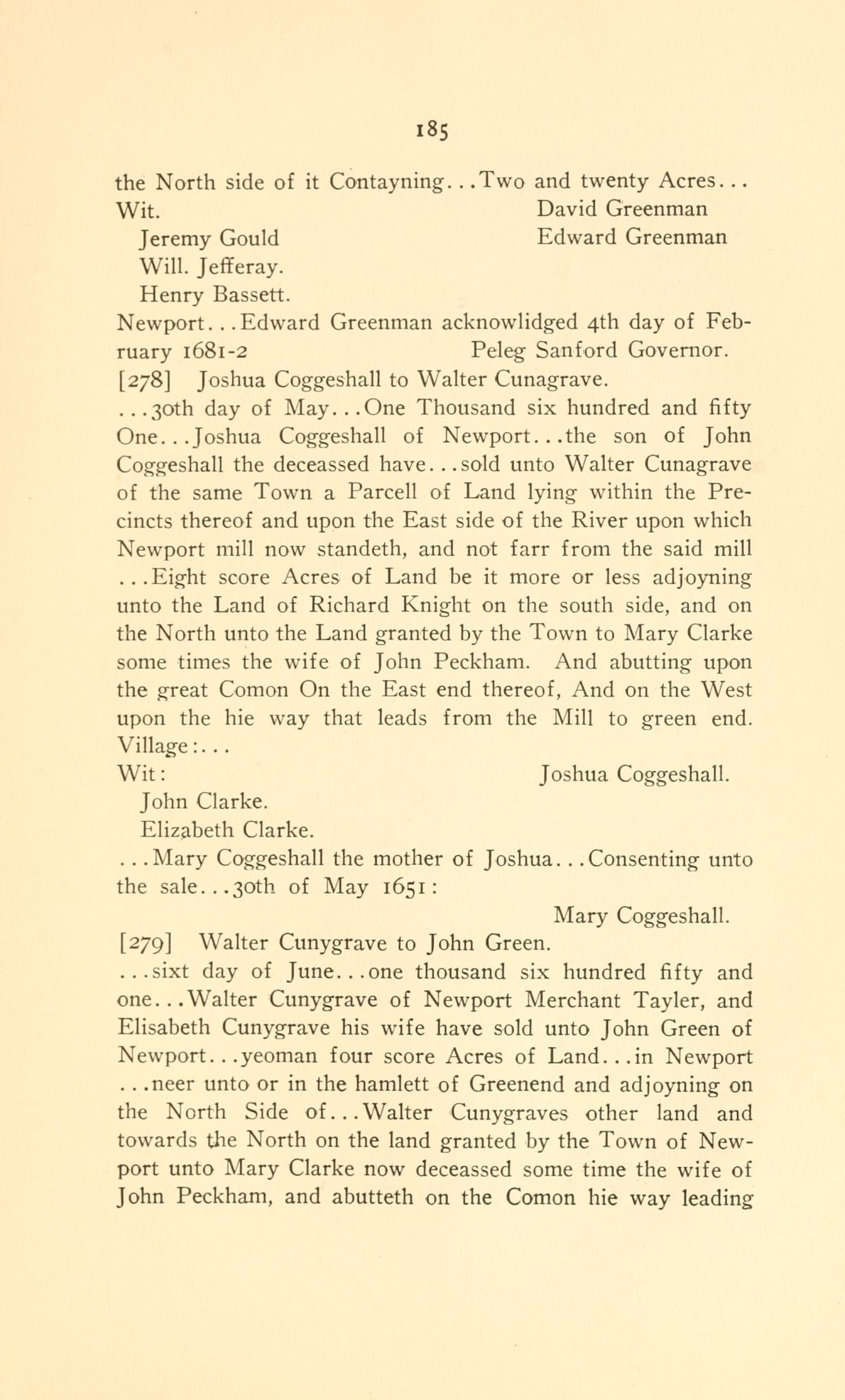
[277] David and Edward Greenman to John Green. …twentith day of February…One Thowsand six hundred forty and seven…David Greenman and Edward Greenman of Newport…Wheelwrites…for…mony…have… sold unto John Green of Newport…Husbandman, one percell of Land…being within or neer the endship or village Called Greenend, and there adjoyneth on the hie way leading from Newport unto Portsmouth on the south west side thereof And abutting at the West end of it over the mill brook (ackording to the markes thereof) upon the Comon, and adjoyning to the Lands of David and Edward Greenman on the North side of it Contayning…Two and twenty Acres…
Wit. Jeremy Gould, Will. Jefferay, Henry Bassett. David Greenman, Edward Greenman.
Newport…Edward Greenman acknowlidged 4th day of February 1681-2 Peleg Sanford Governor.
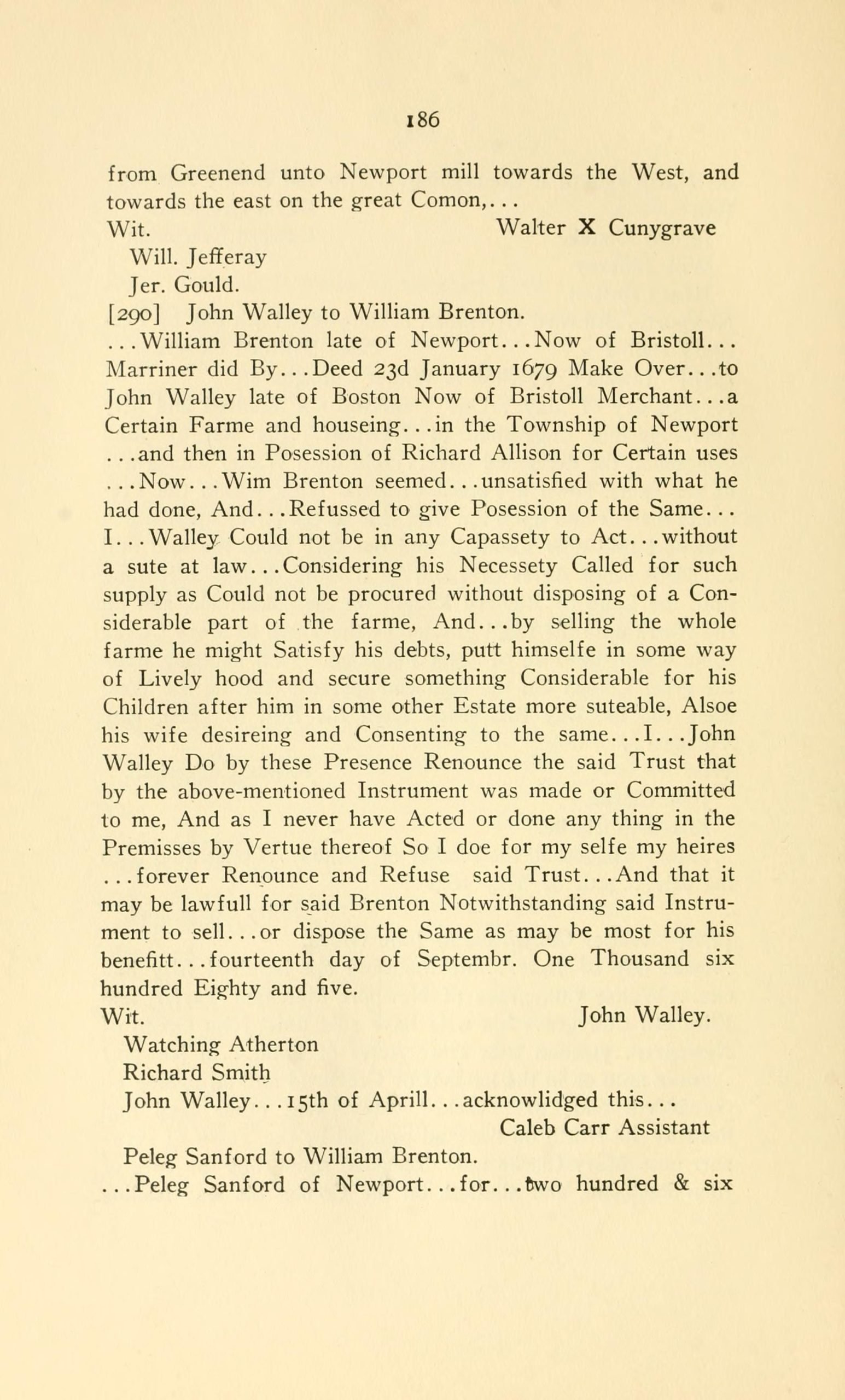
[279] Walter Cunygrave to John Green. …sixt day of June…one thousand six hundred fifty and one…Walter Cunygrave of Newport Merchant Tayler, and Elisabeth Cunygrave his wife have sold unto John Green of Newport…yeoman four score Acres of Land…in Newport …neer unto or in the hamlett of Greenend and adjoyning on the North Side of…Walter Cunygraves other land and towards the North on the land granted by the Town of Newport unto Mary Clarke now deceassed some time the wife of John Peckham, and abutteth on the Comon hie way leading from Greenend unto Newport mill towards the West, and towards the east on the great Comon,…
Wit. Will. Jefferay, Jer. Gould. Walter X Cunygrave.
Source: Rhode Island Historical Society. (1921). Rhode Island land evidences, vol. I, 1648–1696, abstracts (pp. 184–186, entries 277 and 279).
| Date | Deed | Where it is | Could it name his wife? |
|---|---|---|---|
| 20 Feb 1647/8 | Greenman brothers to John Green of Newport, 22 acres at Greenend | Land Evidences I, 184–185 (above) | No: he is the buyer |
| 6 Jun 1651 | Walter and Elisabeth Cunygrave to John Green of Newport, 80 acres | Land Evidences I, 185–186 (above) | No: he is the buyer |
| 3 Jan 1651/2 | Caleb Carr to John Greene, 100 acres at Quidnessett | North Kingstown deeds (Bates); not printed | No: he is the buyer |
| 1657 | John Greene of Newport buys a fortieth share of Conanicut | Jamestown records (Bates); not printed | No: he is the buyer |
| 24 Jan 1661 [1661/2] | John Greene sells his Conanicut land, half to John Sanford, half to Caleb Carr | Jamestown Town Records, Book 1, pp. 22 and 31 (photographs) | Checked 25 Sep 2026: she is not named |
| 25 Sep 1685 | Joseph Clark to Francis Brinley, land beside what was “John Greene, sr., of Narragansett”’s | Jamestown records (Bates); not printed | No |
Newport’s own early town records were largely destroyed or damaged when the British carried them off during the Revolution (Bates, 1918, p. 71).
Theories tested and set aside
Mrs. Beggarly. Disproved on 23 September 2026 by two Providence town records: Alice Daniell, called Mrs. Beggarly, was the second wife of John Greene the surgeon of Warwick. The records are on Alice Daniell, called Mrs. Beggarly: second wife of John Greene the Surgeon.
John Greene lived in Richard Smith’s household from about 1639, and some writers have made his wife Smith’s daughter Joan. Smith’s will of 1666 shows that his daughter Joan, wife of Thomas Newton, was already dead. Greene’s wife was alive in 1682.
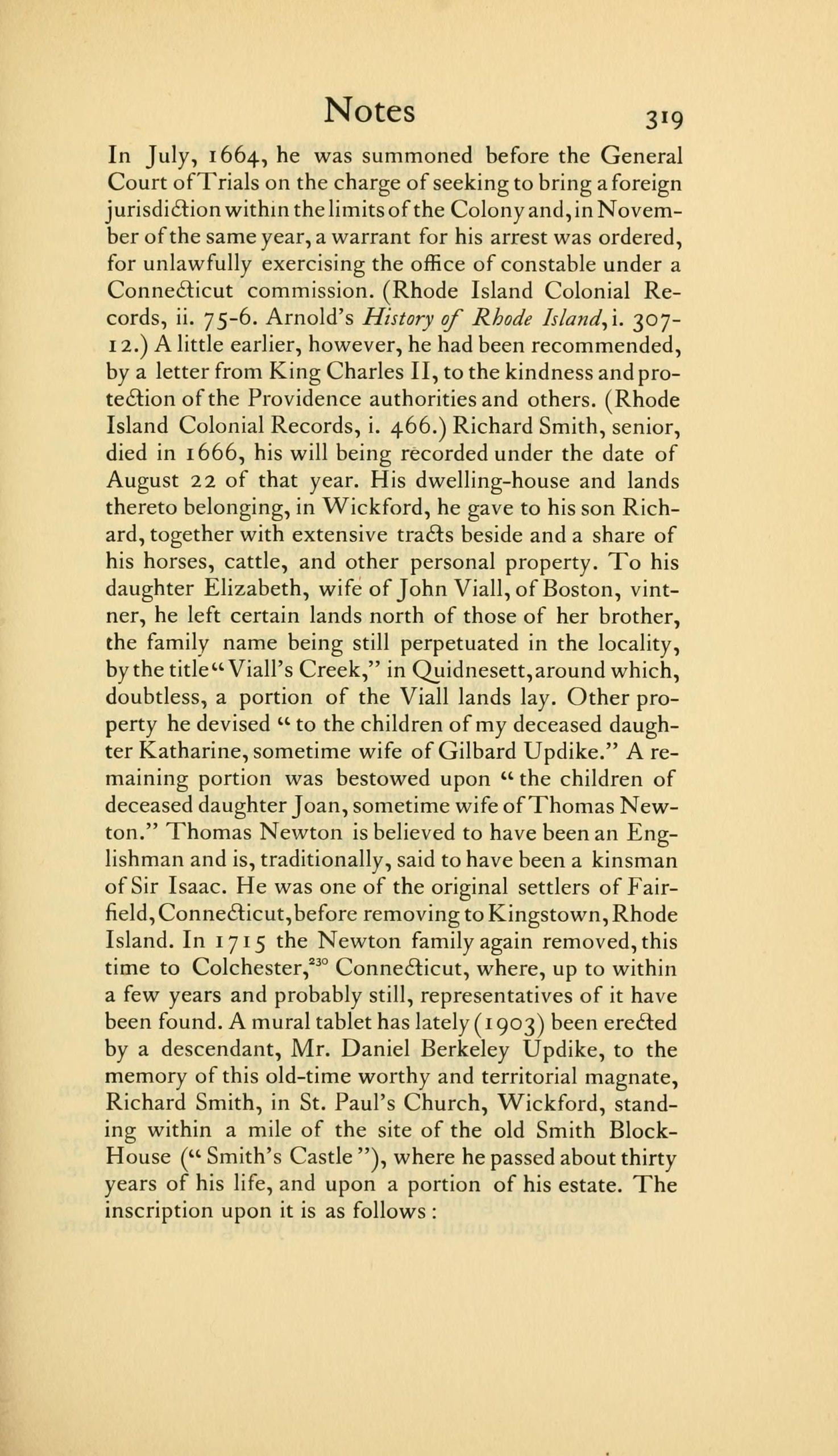
Richard Smith, senior, died in 1666, his will being recorded under the date of August 22 of that year. His dwelling-house and lands thereto belonging, in Wickford, he gave to his son Richard, together with extensive tracts beside and a share of his horses, cattle, and other personal property. To his daughter Elizabeth, wife of John Viall, of Boston, vintner, he left certain lands north of those of her brother … Other property he devised “to the children of my deceased daughter Katharine, sometime wife of Gilbard Updike.” A remaining portion was bestowed upon “the children of deceased daughter Joan, sometime wife of Thomas Newton.”
Source: Updike, W. (1907). A history of the Episcopal Church in Narragansett, Rhode Island (2nd ed., D. Goodwin, Ed., Vol. 1, p. 319). Merrymount Press.
“Mary Tibbett” or “Joane Tibbitts” of Rowington. Some online family trees now give John Greene a birth at Rowington, Warwickshire, in 1606 and a wife “Joane Tibbitts,” married about 1639 (FamilySearch Family Tree); the Find a Grave memorial that once stood for Mrs. Beggarly now reads “Mary Tibbett Greene,” born 1610 at Rowington, “the youngest sister of John Greene’s neighbour, Henry Tibbett.” Neither gives a source. The printed records say otherwise.
A family memoir of 1911 is the only printed source found for a Tibbitts origin in Warwickshire. It names no town, no parents and no sisters, and gives no source. It says Henry married in December 1661, so he belongs to the generation of Joan’s children, not hers.
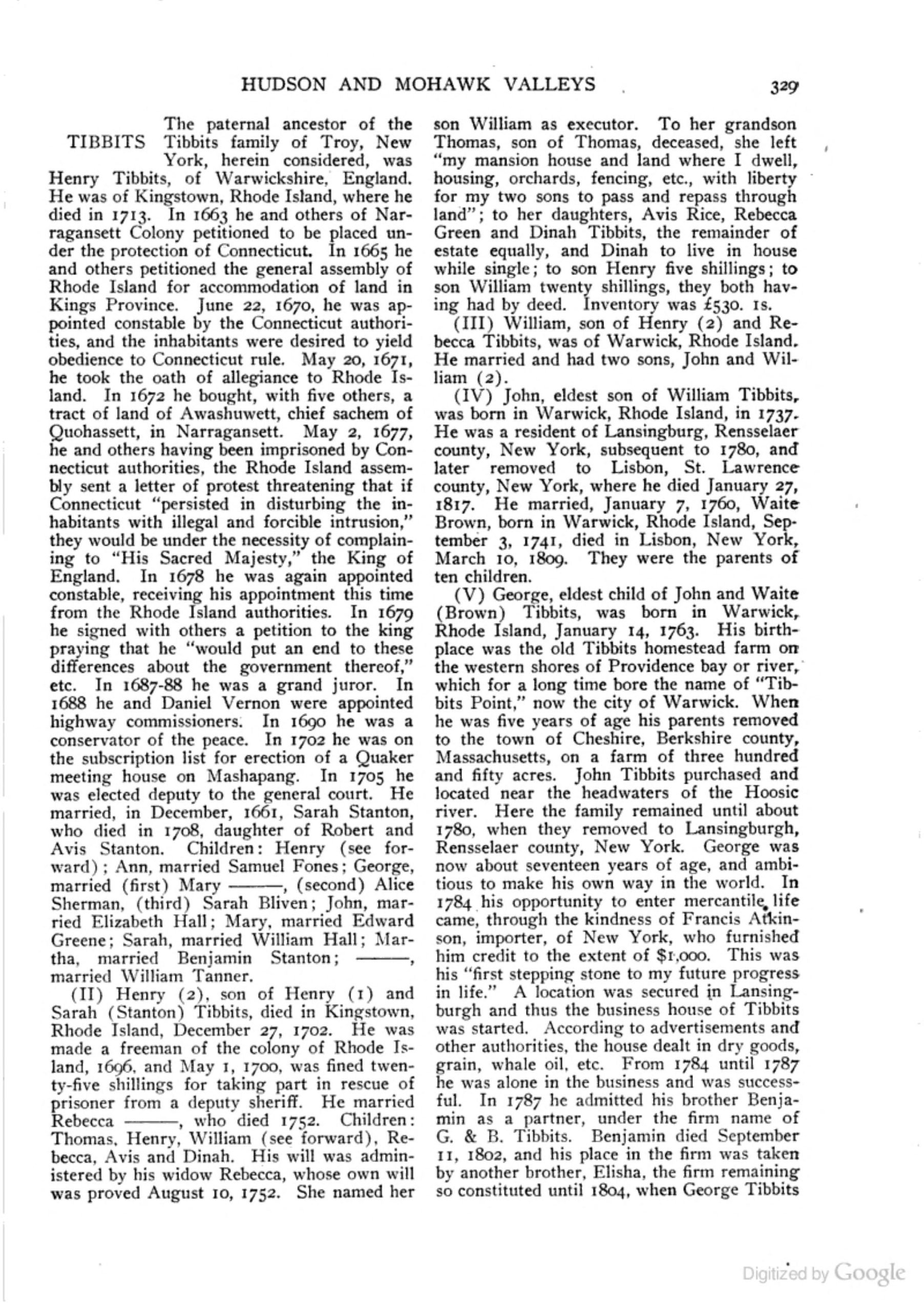
The paternal ancestor of the Tibbits family of Troy, New York, herein considered, was Henry Tibbits, of Warwickshire, England. He was of Kingstown, Rhode Island, where he died in 1713. … He married, in December, 1661, Sarah Stanton, who died in 1708, daughter of Robert and Avis Stanton. Children: Henry (see forward); Ann, married Samuel Fones; George, married (first) Mary ——, (second) Alice Sherman, (third) Sarah Bliven; John, married Elizabeth Hall; Mary, married Edward Greene; Sarah, married William Hall; Martha, married Benjamin Stanton; ——, married William Tanner.
Source: Reynolds, C. (Ed.). (1911). Hudson-Mohawk genealogical and family memoirs (Vol. 1, p. 329). Lewis Historical Publishing Company.
Henry Tibbitts witnessed John Greene’s deed to James in 1682, which is likely how the idea began that he was Joan’s brother. His own will explains it: his eldest daughter Mary was the wife of John’s son Edward. Austin lists her as the wife of “Edward Greene, of John & Joan ( ) Greene.”
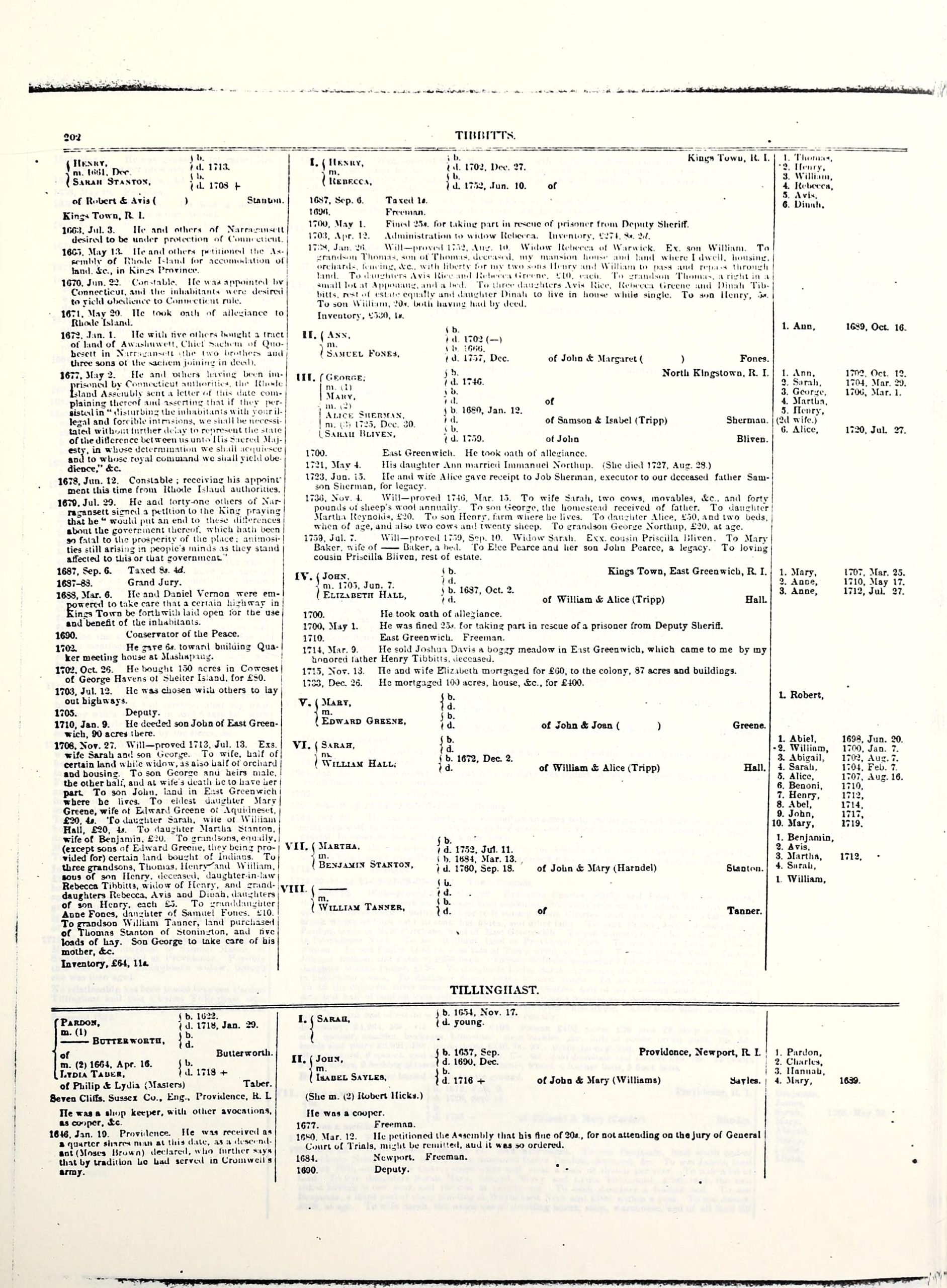
170[6 or 8], Nov. 27. Will—proved 1713, Jul. 13. Exs. wife Sarah and son George. … To eldest daughter Mary Greene, wife of Edward Greene of Aquidneset, £20, 4s. To daughter Sarah, wife of William Hall, £20, 4s. … To grandsons, equally, (except sons of Edward Greene, they being provided for) certain land bought of Indians. …
V. MARY, m. EDWARD GREENE, … of John & Joan ( ) Greene.
Source: Austin, J. O. (1887). The genealogical dictionary of Rhode Island (p. 202). J. Munsell’s Sons. The last figure of the year the will was made is unclear in the scan; it is printed after an entry of 1710, and may be 1706 or 1708.
The Quaker marriage record, as printed by Arnold from a manuscript copy, dates Henry’s marriage to Sarah Stanton. His children, including Mary, wife of Edward Greene, were born after it.
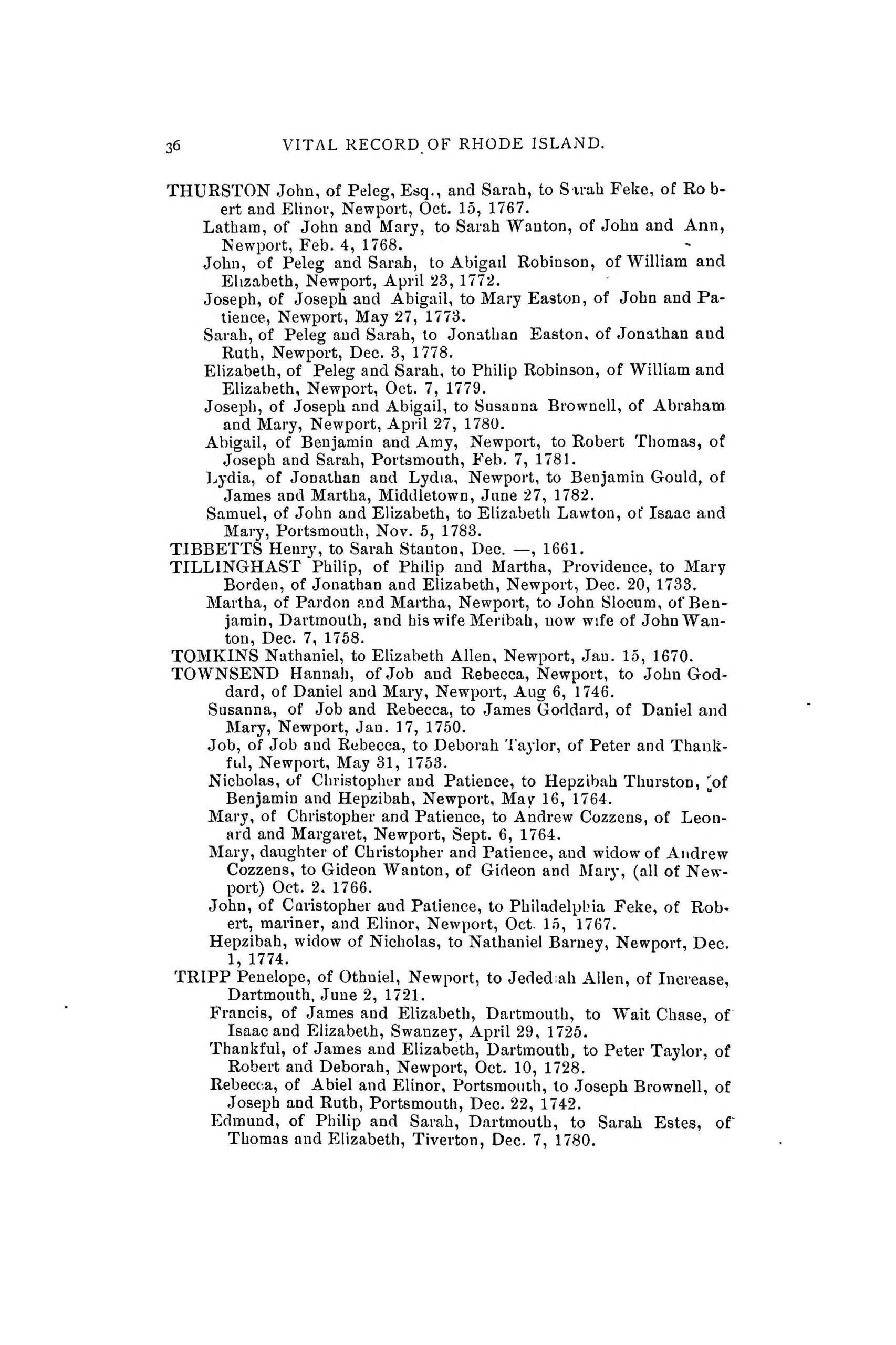
TIBBETTS Henry, to Sarah Stanton, Dec. —, 1661.
Source: Arnold, J. N. (1895). Vital record of Rhode Island, 1636–1850 (Vol. 7, Friends and ministers, p. 36). Narragansett Historical Publishing Company.
The trees give Rowington baptisms for John Greene in 1606 and his wife in 1610. The register of Rowington begins in 1638, and the bishop’s copies only in 1616. No record of either birth can survive there.
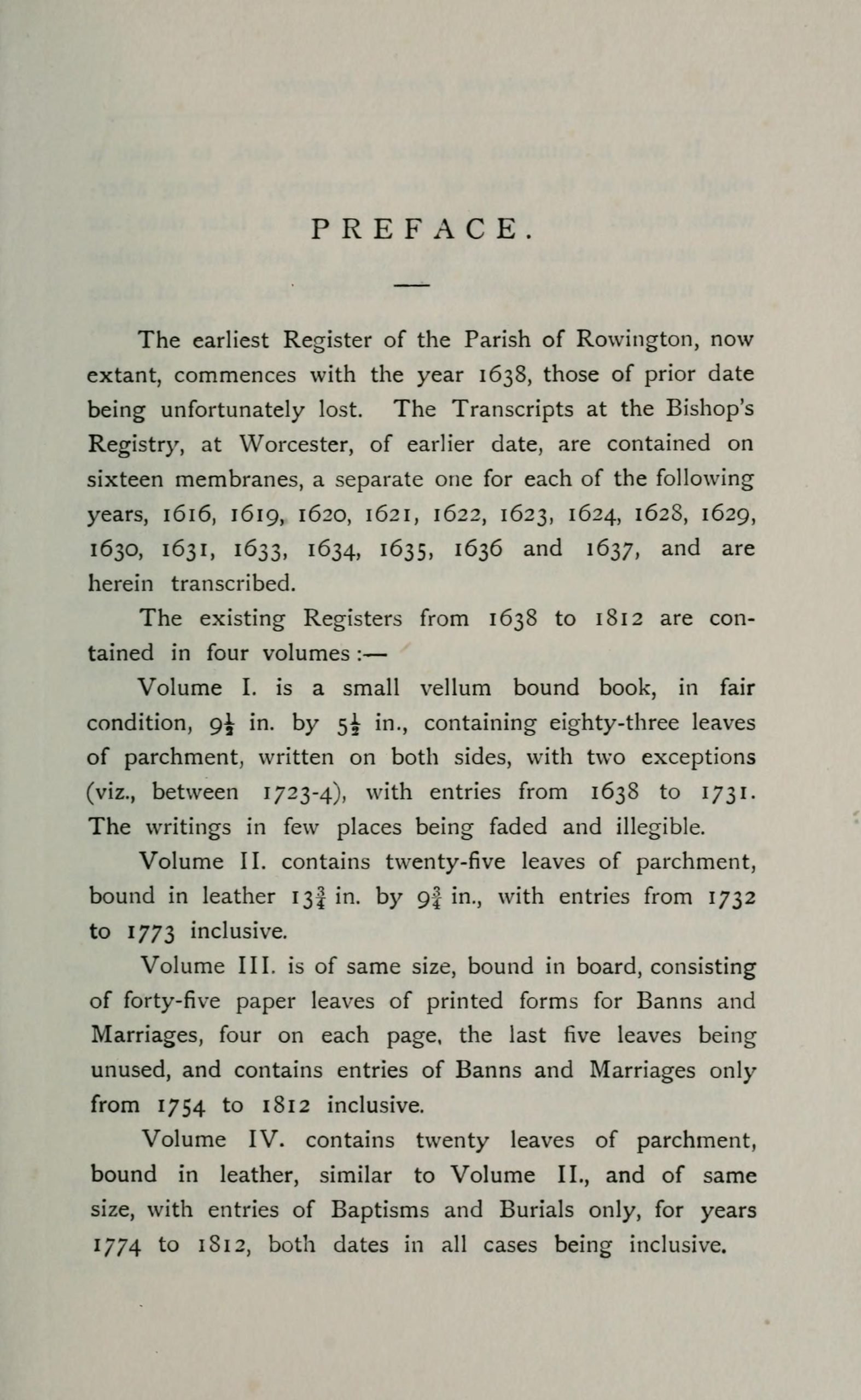
The earliest Register of the Parish of Rowington, now extant, commences with the year 1638, those of prior date being unfortunately lost. The Transcripts at the Bishop’s Registry, at Worcester, of earlier date, are contained on sixteen membranes, a separate one for each of the following years, 1616, 1619, 1620, 1621, 1622, 1623, 1624, 1628, 1629, 1630, 1631, 1633, 1634, 1635, 1636 and 1637, and are herein transcribed.
Source: Ryland, J. W. (Ed.). (1899). The register of Rowington, Warwickshire (preface). Parish Register Society.
The register shows who the Rowington Tibbats were. A Henry (“harry”) Tibbats and his wife Ann were baptising children there from 1634 to 1650, long after John Greene was settled in Rhode Island. Nothing shows that he was the Henry who married Sarah Stanton in Rhode Island in 1661, whose children were born after that year. A Nicholas Tibbats had a wife named Mary. The register has no Joan or Jone Tibbatts at all, and its only Mary Tibbatts baptisms are of 1622 and 1623/4.
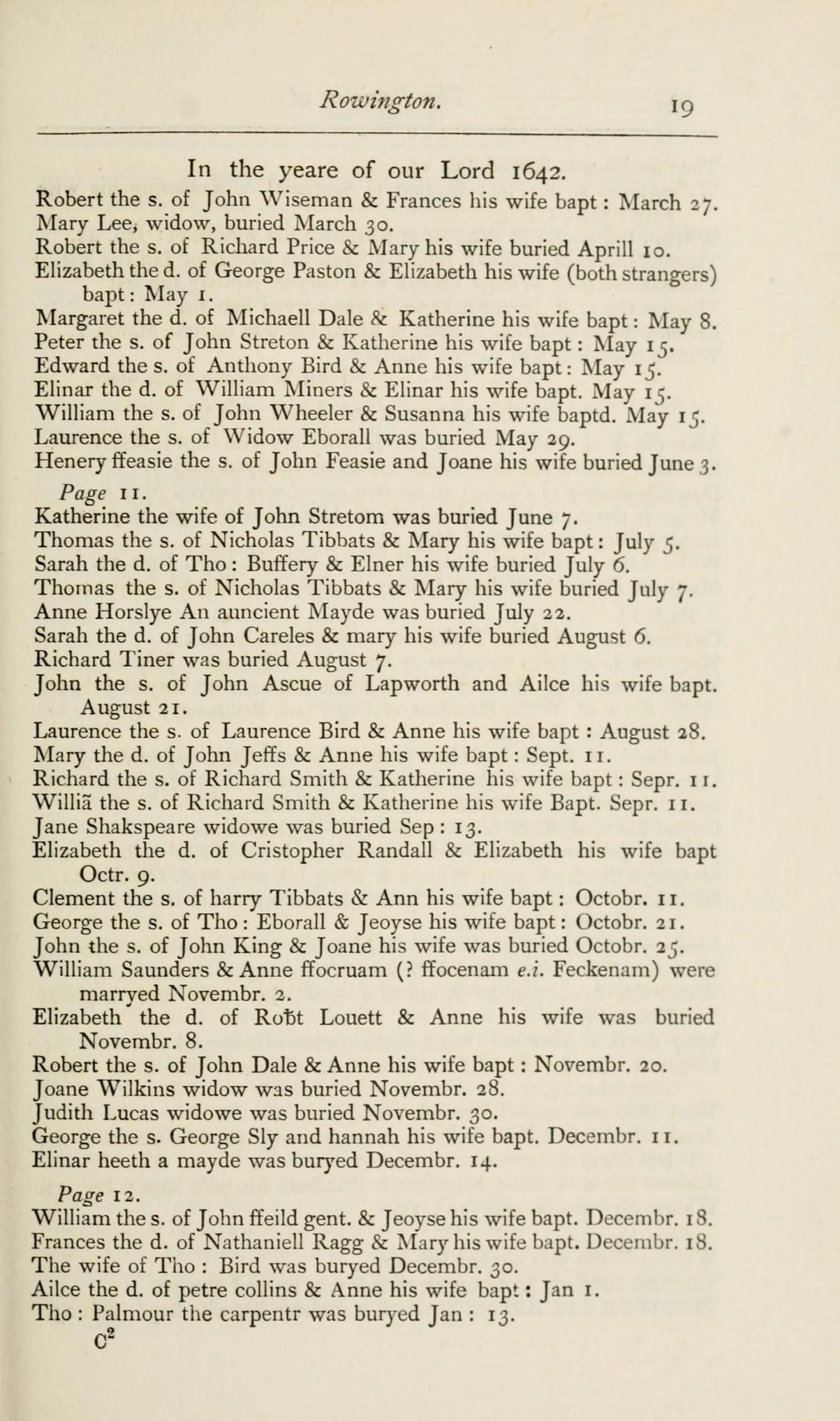
In the yeare of our Lord 1642. …
Thomas the s. of Nicholas Tibbats & Mary his wife bapt: July 5. …
Thomas the s. of Nicholas Tibbats & Mary his wife buried July 7. …
Clement the s. of harry Tibbats & Ann his wife bapt: Octobr. 11.
Source: Ryland, J. W. (Ed.). (1899). The register of Rowington, Warwickshire (p. 19). Parish Register Society. https://archive.org/details/theregistersofro00rowi
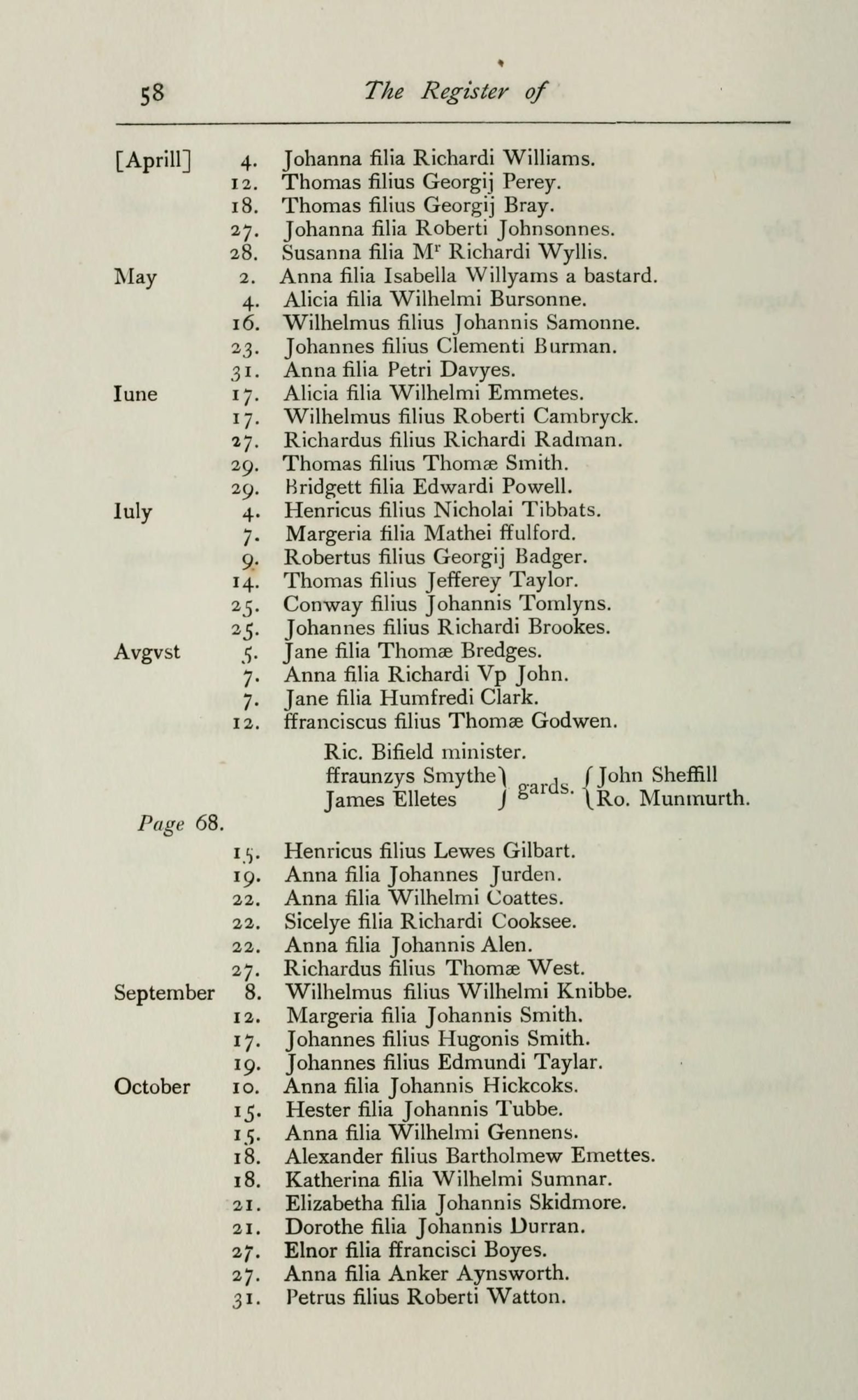
The Find a Grave story names a “Nicholas Tibbetts” of Rowington. The only Nicholas found is at Stratford-on-Avon, where a son Henry was baptised in 1596, forty years before Henry of Kingstown was born. No daughter Mary or Joan of Nicholas appears in the Stratford register.
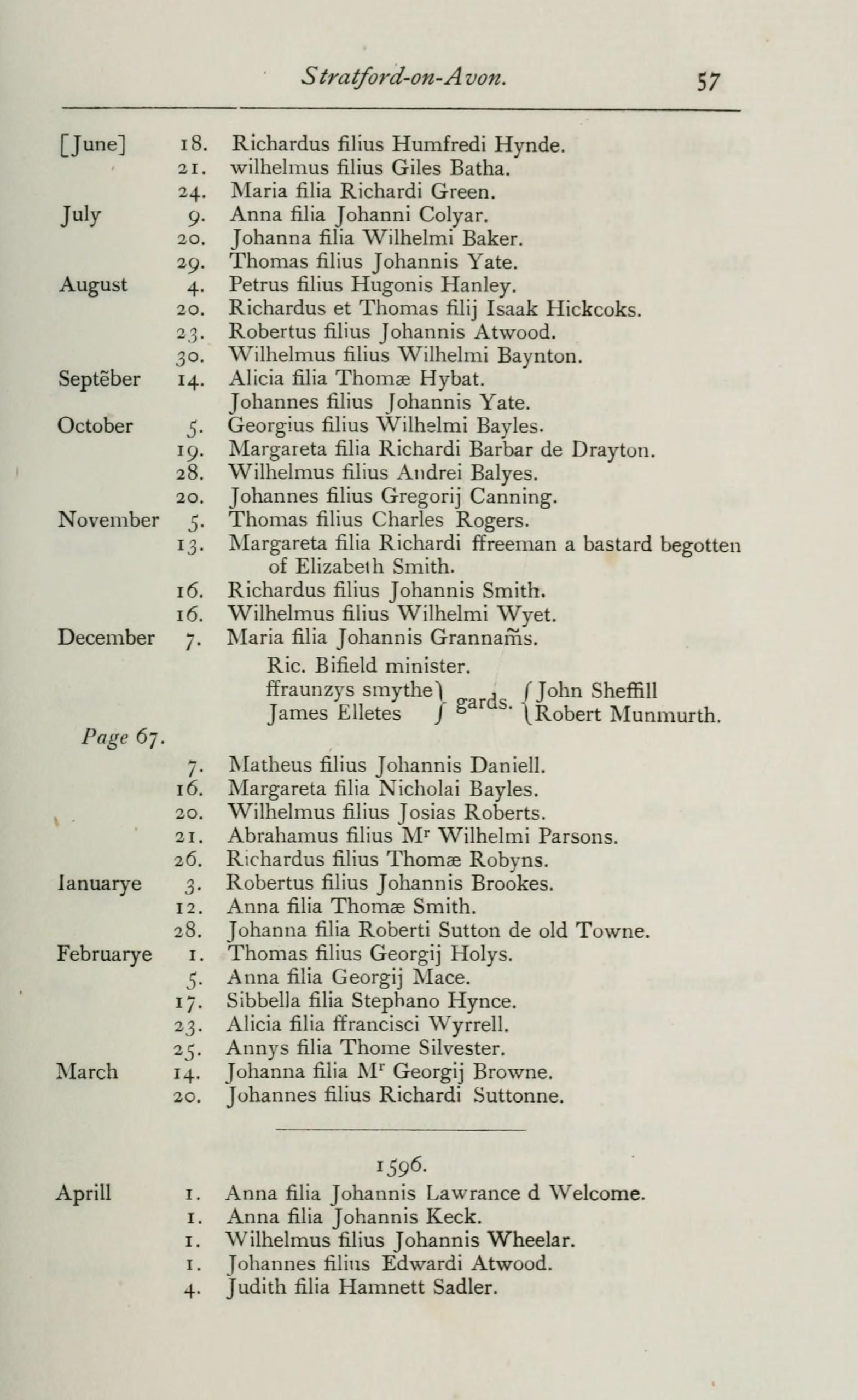
[p. 57] 1596.
[p. 58, July] 4. Henricus filius Nicholai Tibbats.
Source: Savage, R. (Ed.). (1897). The registers of Stratford-on-Avon, in the county of Warwick: Baptisms, 1558–1652 (pp. 57–58). Parish Register Society.
The story also says Henry “came to America with his two youngest sisters.” That describes a different man, Henry Tibbetts of Dover, New Hampshire, who sailed in 1635 with his sister Remembrance (Anderson, The Great Migration, 1634–1635, VII, 38). Nothing places a John Greene and a Tibbitts family together at Rowington or anywhere else before Henry’s marriage in 1661.
Not a record of the wife, but the one hint that anyone saw John Greene’s will before the fire. It is secondhand: Robinson reports J. Warren Gardiner’s statement and guesses at his source.
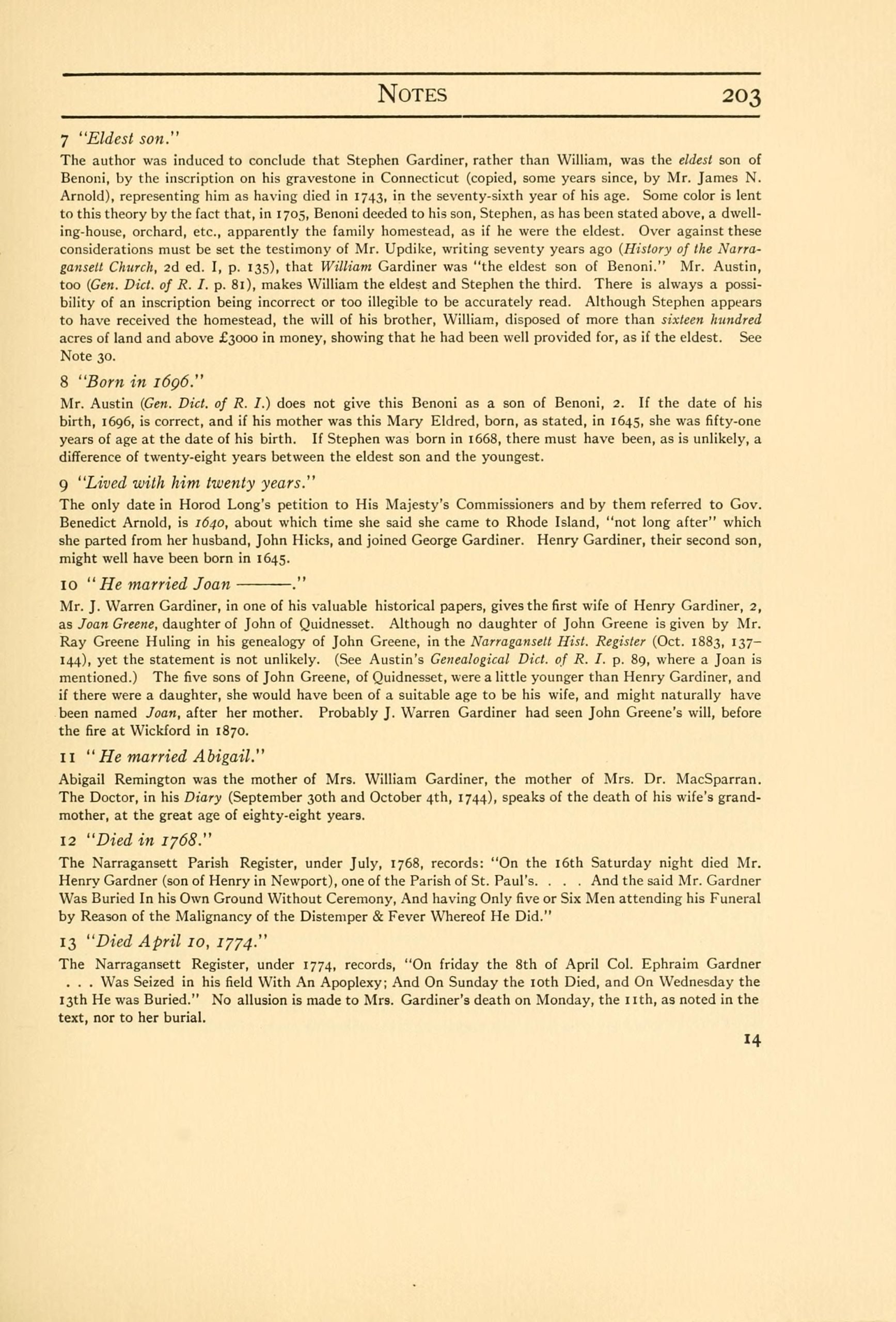
10 “He married Joan ——.” Mr. J. Warren Gardiner, in one of his valuable historical papers, gives the first wife of Henry Gardiner, 2, as Joan Greene, daughter of John of Quidnesset. Although no daughter of John Greene is given by Mr. Ray Greene Huling in his genealogy of John Greene, in the Narragansett Hist. Register (Oct. 1883, 137–144), yet the statement is not unlikely. (See Austin’s Genealogical Dict. of R. I. p. 89, where a Joan is mentioned.) The five sons of John Greene, of Quidnesset, were a little younger than Henry Gardiner, and if there were a daughter, she would have been of a suitable age to be his wife, and might naturally have been named Joan, after her mother. Probably J. Warren Gardiner had seen John Greene’s will, before the fire at Wickford in 1870.
Source: Robinson, C. E. (1919). The Gardiners of Narragansett (p. 203, note 10). Providence.
Family tradition says John first bore the name Clarke. Huling set it down as tradition only; Bates later tied it to a different John Greene, of East Greenwich. No record connects it with Joan.
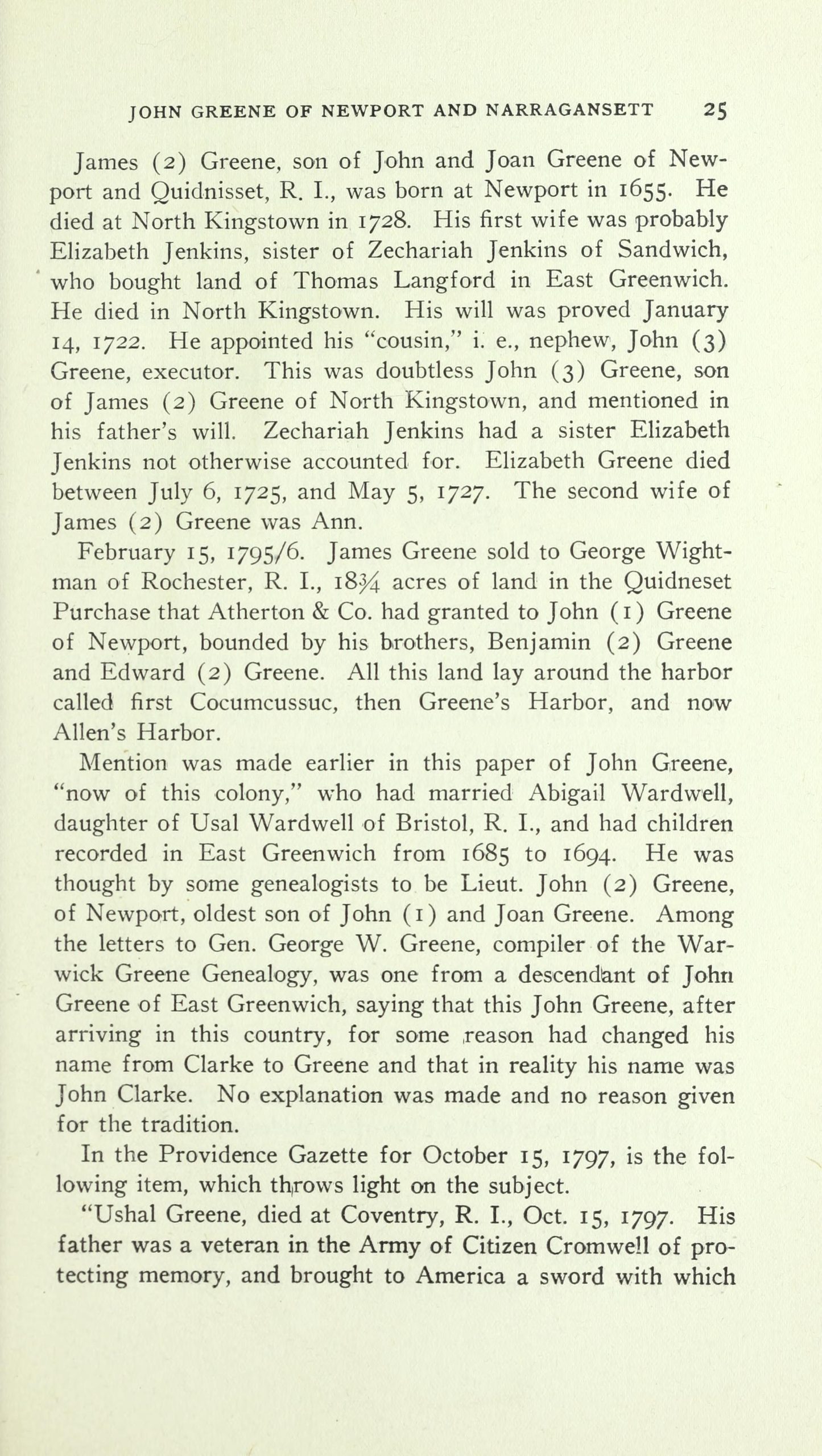
[Huling, p. 137] A tradition exists, both among his own descendants and in the Warwick family of Greenes, to the effect that he came hither from England and had formerly borne the name of Clarke instead of Greene. … The whole matter, however, is one of tradition and conjecture rather than of fact.
[Bates, p. 25] James (2) Greene, son of John and Joan Greene of Newport and Quidnisset, R. I., was born at Newport in 1655. … Among the letters to Gen. George W. Greene, compiler of the Warwick Greene Genealogy, was one from a descendant of John Greene of East Greenwich, saying that this John Greene, after arriving in this country, for some reason had changed his name from Clarke to Greene and that in reality his name was John Clarke. No explanation was made and no reason given for the tradition.
Source: Huling (1883), p. 137; Bates, L. P. (1919). John Greene of Newport and Narragansett (concluded). Rhode Island Historical Society Collections, 12, 25. (Bates prints “February 15, 1795/6” on this page for James’s sale to George Wightman; the date is 1695/6.)
Searched, nothing found
| Source | Result |
|---|---|
| Arnold, Vital Record of Rhode Island, vol. 5 (Kings County) and vol. 4 (Newport) | North Kingstown marriages begin in the 1700s; no Joan Greene |
| Records of the Colony of Rhode Island, vols. 1–3 and 5 | John’s arrest and pardon, 1664; the Flounders estate, 1670 (the widow named only “Sarah”); no wife |
| Rhode Island Land Evidences, vol. I (1921), every Greene entry | Joan named only in entry 260 (1682) |
| Narragansett Historical Register, vols. 1–9 | Huling’s study and notes; nothing on her origin |
| Austin, Genealogical Dictionary (1887), the sons’ wills: Lt. John 1729, James 1728, Daniel 1730, Benjamin 1719 | None names their mother or her family |
| Edward Greene’s deeds to George Vaughan, 1694/5 and 1697 (Austin’s abstracts) | Land “fell to me by will of my honored father”; the will’s terms not given |
| Potter, Early History of Narragansett (1835); Updike (1847 and 1907); the Fones Record (1894) | No wife named |
| Richard Smith’s will (1666) and D. B. Updike, Richard Smith (1937) | Every Joan in Smith’s family accounted for; none is Greene’s wife |
| NEHGR, The American Genealogist, Rhode Island Roots, Rhode Island History | No article on John of Quidnessett or his wife |
| Anderson, Great Migration series | No sketch of John of Quidnessett |
| The printed register of Rowington (1899) | Begins 1638; no John Greene before 1708 |
| The printed register of Stratford-on-Avon, baptisms 1558–1652 | No Mary, Joan or Remembrance, daughter of Nicholas Tibbats |
| About 25 full-text searches of archive.org | Every hit was the 1682 deed or a later book repeating Huling, Austin or La Mance |
Where her name could still be
Jamestown town records: John Greene’s deeds selling his Conanicut land to John Sanford and to Caleb Carr.Checked 25 September 2026: Book 1, pages 22 and 31; she is not named. Page 32, the end of the Carr deed, has not yet been seen. The deeds.- Rhode Island State Archives: the original of Land Evidences book I, entry 260. The 1921 printing cuts words at every “…”.
- East Greenwich land records, book 1: Edward Greene’s deeds to George Vaughan, which recite his father’s will and may say what it left to the widow.
- North Kingstown town records: land evidence book 2 (Daniel’s deed of 24 March 1681/2) and the earliest probate and council books. The town clerk wrote in 1883 that they were “very badly damaged by fire” in 1870, not destroyed. Microfilmed by FamilySearch.
- Rhode Island Historical Society manuscripts: General George S. Greene’s papers and the Root collection, where the family traditions of the 1860s and 1870s were collected.
References
Arnold, J. N. (1895). Vital record of Rhode Island, 1636–1850 (Vol. 7). Narragansett Historical Publishing Company. https://archive.org/details/cu31924098819992
Arnold, J. N. (Ed.). (1894). The records of the proprietors of the Narragansett, otherwise called the Fones record. Narragansett Historical Publishing Co. https://archive.org/details/recordsofproprie00arno
Austin, J. O. (1887). The genealogical dictionary of Rhode Island. J. Munsell’s Sons. https://archive.org/details/genealogicaldict00aust
Bartlett, J. R. (Ed.). (1857). Records of the Colony of Rhode Island and Providence Plantations (Vol. 2). A. C. Greene. https://archive.org/details/recordsofcolonyo02rhod
Bates, L. P. (1918). John Greene of Newport and Narragansett. Rhode Island Historical Society Collections, 11(3), 69–78. https://archive.org/details/rhodeislandhisto11prov
Bates, L. P. (1919). John Greene of Newport and Narragansett (concluded). Rhode Island Historical Society Collections, 12, 15–26. https://archive.org/details/rhodeislandhisto12prov
The early records of the town of Providence, Vol. 1. (1892). Snow & Farnham. (p. 105: John Greene of Warwick Senr to Valentine Whittman, 1659.) https://archive.org/details/cu31924092202393
The early records of the town of Providence, Vol. 17. (1903). Snow & Farnham. (p. 9: letter of John Greene ser, 27 January 1682/3.) https://archive.org/details/cu31924092200694
Greene, F. L. (1894). Descendants of Joseph Greene of Westerly, R.I. Joel Munsell’s Sons. https://archive.org/details/descendantsofjos00gree
Huling, R. G. (1883). The Greene’s of Quidnesset. Narragansett Historical Register, 2(2), 137–142. https://archive.org/details/narragansetthistv1v2rhod
Potter, E. R. (1835). The early history of Narragansett. Marshall, Brown. https://archive.org/details/earlyhistoryofna00pott
Reynolds, C. (Ed.). (1911). Hudson-Mohawk genealogical and family memoirs (Vol. 1). Lewis Historical Publishing Company. https://archive.org/details/bub_gb_b4k-AAAAYAAJ
Rhode Island Historical Society. (1921). Rhode Island land evidences, vol. I, 1648–1696, abstracts. https://archive.org/details/rhodeislandlande00wort
Robinson, C. E. (1919). The Gardiners of Narragansett. Providence. https://archive.org/details/gardinersofnarra00robi
Ryland, J. W. (Ed.). (1899). The register of Rowington, Warwickshire. Parish Register Society. https://archive.org/details/registersofrowin21rowi
Savage, R. (Ed.). (1897). The registers of Stratford-on-Avon, in the county of Warwick: Baptisms, 1558–1652. Parish Register Society. https://archive.org/details/registersofstrat06stra
Updike, W. (1847). A history of the Episcopal Church in Narragansett. H. M. Onderdonk. https://archive.org/details/historyofepiscop00updi_0
Updike, W. (1907). A history of the Episcopal Church in Narragansett, Rhode Island (2nd ed., D. Goodwin, Ed., Vol. 1). Merrymount Press. https://archive.org/details/historyofepisc01updi
Compiled 21 September 2026 from the printed sources above; the Fones Record entries of 1663 and 1671/2 were added 22 September 2026; corrected 23 September 2026, when the Salem appendix was removed. Every quotation was checked against the page image. Nothing has been supplied where a source is silent.