Before the Dragoons · The Mexican War · March 1847
The Siege of Vera Cruz
The first great amphibious landing in American history — and the first battle honor on Alfred Gibbs’s list, written in his own hand: “Seige of Vera Cruz March 9th–29th 1847.”
The Siege of Vera Cruz opened Winfield Scott’s campaign for Mexico City. On March 9, 1847, more than 8,600 American soldiers went ashore at Collado Beach in specially built surf-boats — the first major amphibious landing in United States history — and within days had thrown a seven-mile line of investment around the walled city and its fortress of San Juan de Ulúa. Twenty days of siege work and a four-day bombardment followed; on March 29 the garrison marched out and stacked arms. Scott had his base on the Gulf, and the road to the interior — through Cerro Gordo — lay open.
The Landing at Collado Beach
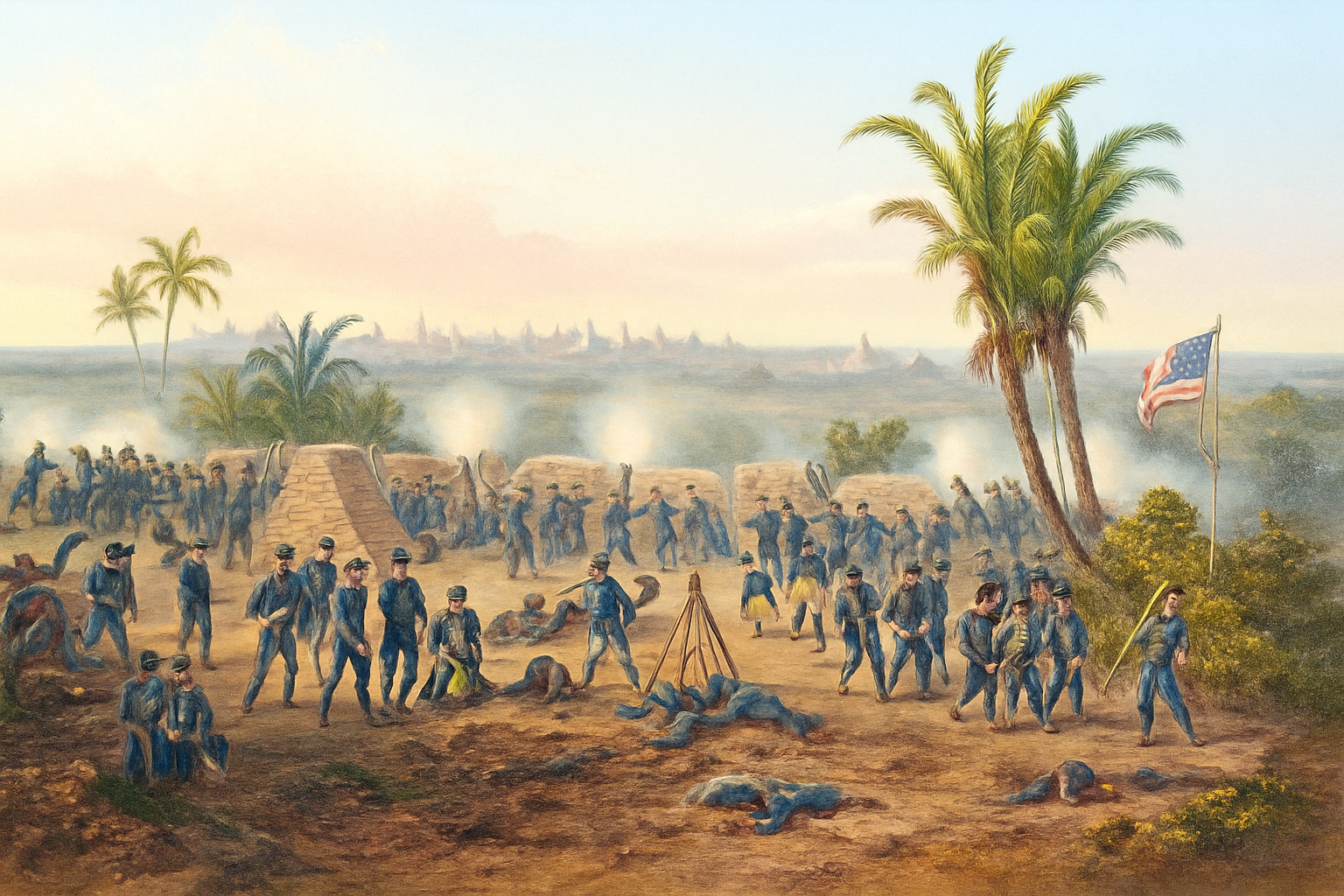
Scott’s plan depended on taking Vera Cruz before the yellow-fever season reached the coast. On the afternoon of March 9, 1847, the army’s first wave rowed ashore in sixty-five purpose-built surf-boats under the guns of the fleet — regulars of Worth’s division first, Twiggs’s regulars behind them, more than 8,600 men landed by midnight without the loss of a single soldier. The Regiment of Mounted Riflemen, serving dismounted after losing most of its horses at sea, went ashore with the army and took its place in the investing line.
Twenty Days Before the Walls
Rather than storm the walls, Scott formally besieged them: a line of investment sealed the city by March 13, naval guns were dragged ashore and dug into batteries, and on March 22 the bombardment opened. For four days army and navy guns — including a battery of heavy ship’s guns worked by sailors ashore — broke the city’s defenses while the garrison’s return fire slackened. Foreign consuls asked a truce for the evacuation of civilians; Scott, having demanded surrender before the first shot, pressed the siege instead. On March 26 Morales’s successor asked terms; on March 29 the garrison of more than 3,000 marched out, stacked arms, and was paroled. American losses in the whole operation were fewer than seventy.
Lieutenant Gibbs at Vera Cruz
Gibbs came ashore a twenty-two-year-old brevet second lieutenant and left the siege with the first entry on the battle record he would keep, correct, and defend for the rest of his life. Vera Cruz stands first in the autograph “List of Battles, Combats, Actions, Skirmishes in which engaged” preserved in the Gibbs Papers on this site, and first in his Cullum register entry. Eight months later he was back — the city had become the army’s great depot, and the papers he signed there, countersigned by a future chief of Confederate ordnance, are a station of the Mexican War Journey.
“Seige of Vera Cruz March 9th–29th 1847. Cerro Gordo April 17th ’47, in which ‘slightly wounded’…”— Alfred Gibbs, autograph “List of Battles, Combats, Actions, Skirmishes in which engaged,” Gibbs Papers, Doc #35 — see the document.
“… in the War with Mexico, 1846–48, being engaged in the Siege of Vera Cruz, Mar. 9–29, 1847, — Battle of Cerro Gordo, Apr. 17–18, 1847, where he was wounded …”— George W. Cullum, Biographical Register of the Officers and Graduates of the U.S. Military Academy, entry for Alfred Gibbs (No. 1313, Class of 1846).
Sources & Further Reading
- Primary Alfred Gibbs, autograph battle list and 1859 Carlisle service summary, the Gibbs Papers — exhibited in The Mexican War Journey.
- Primary George W. Cullum, Biographical Register, entry No. 1313 (Alfred Gibbs). Online: penelope.uchicago.edu — Cullum No. 1313.
- “Siege of Veracruz,” Wikipedia (landing, siege operations, casualties): en.wikipedia.org/wiki/Siege_of_Veracruz.
- “Mexican-American War,” Encyclopaedia Britannica: britannica.com/event/Mexican-American-War.
- National Park Service, “The Mexican-American War”: nps.gov/articles/the-mexican-american-war.htm.
The Mexican War Journey · Battle of Cerro Gordo · The Battle of Chapultepec
Views: 104