Private Benjamin A. Ames
Private Benjamin A. Ames
Benjamin A. Ames of Angelica, New York, enlisted in Company G of the regiment that became the First New York Dragoons, originally the 130th New York Volunteer Infantry, in August 1862, at the age of 37. He served through to the close of the war and mustered out with the regiment in 1865.
The Service Record
Enlisted: August 1862, at Angelica, N.Y.; age 37.
Company: Company G, 130th New York Volunteers → First New York Dragoons.
Rank: Private.
Mustered out: June 30, 1865 — Clouds Mills, Va.
Source: New York Adjutant-General’s register of the First New York Dragoons; Bowen, J. R. (1900). Regimental History of the First New York Dragoons.
The Record & the County History
The regiment’s own muster roll and the county history that remembered him, shown side by side.
From the Regimental Register
The regiment kept its own account of every man; his entry in the muster roll, printed in Bowen’s history, is reproduced below.
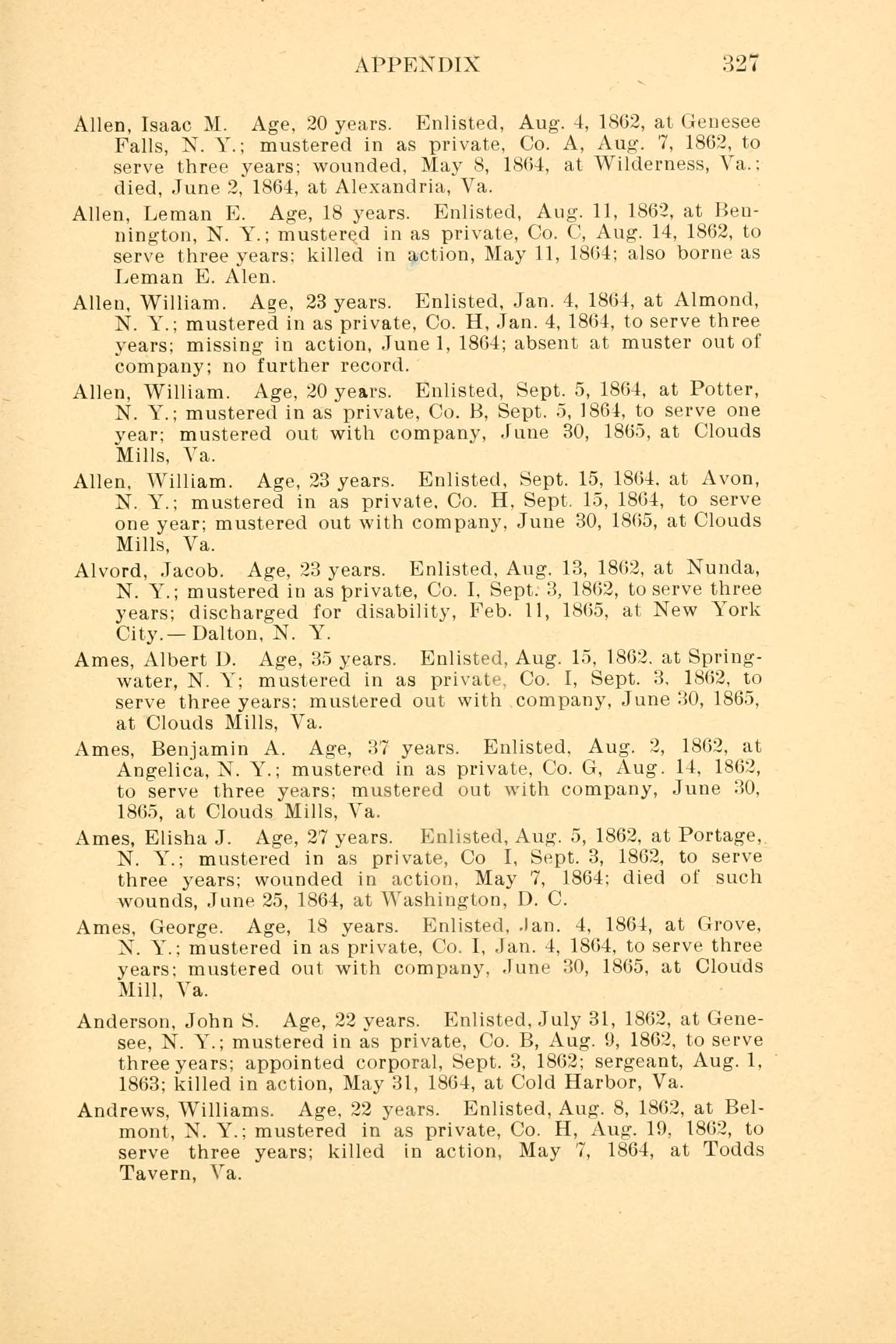
“Benjamin A. Ames. Mustered in as Private, Co. G, Aug. 14, to serve three years; mustered out with company, June 30, at Clouds Mills, Va.”
Verbatim from the roster of the First New York Dragoons in the New York Adjutant-General’s report. The page reproduced above is from Bowen, J. R. (1900). Regimental History of the First New York Dragoons (originally the 130th N.Y. Vol. Infantry) (p. 327). Internet Archive. archive.org/details/regimentalhistor00bowe
In the County Histories
The county histories compiled within twenty years of the war named the men who went, and often recorded what became of them. His name appears on the page reproduced below.
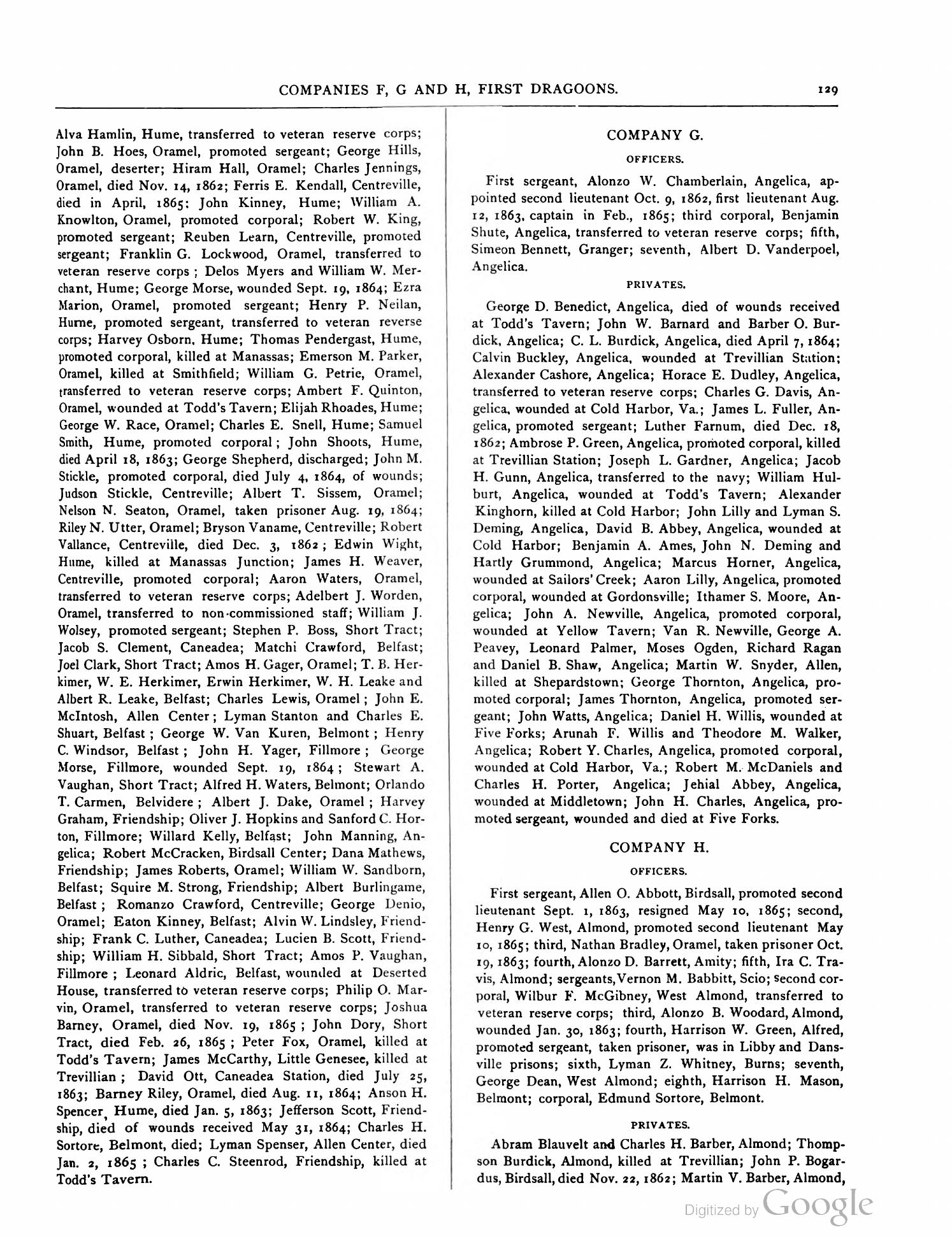
“Benjamin A. Ames, John N. Deming and tly Grummond, Angelica”
Source. F. W. Beers & Co. (1879). History of Allegany County, N.Y. (p. 129). New York, NY: F. W. Beers & Co.. Public domain; digitised copy held in the archive of this site.
Terms on this page, from brevet and mustered out to the classes of the Roll of Honor, are defined in the site Glossary.
Named in a Comrade’s Letter
Private George D. Benedict of Company G wrote home to his wife Sarah at Belvidere. His letters survive, and they name this man.
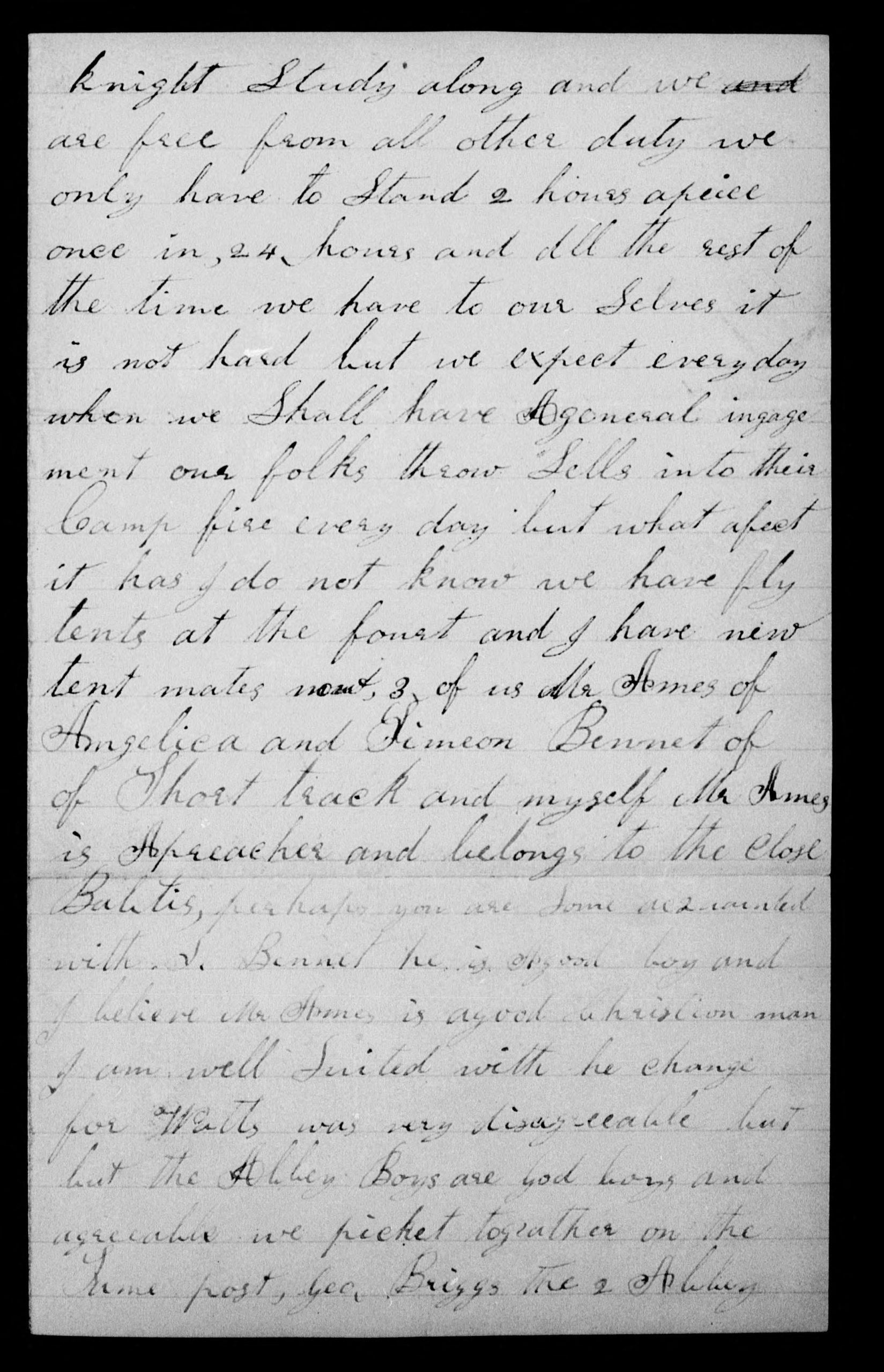
The manuscript. Click to enlarge.
Southern Historical Collection, UNC Chapel Hill, #4943-z.
The passage that names him
“I have new tent mates now 3 of us Mr Ames of Angelica and Simeon Bennet of Short tract and myself. Mr Ames is a preacher and belongs to the Close Baptis.”
— George D. Benedict, undated, spring 1863
Ames shared a tent with Benedict through the spring of 1863 and was still with him in June, when the two stood picket together. Benedict calls him simply “the preacher.”
The whole page, transcribed
knight I study along and we [and] are free from all other duty we only have to Stand 2 hours apiece once in 24 hours and all the rest of the time we have to our Selves it is not hard but we expect every day when we Shall have a general ingagement our folks throw Shells into their Camp fire every day but what afect it has I do not know we have fly tents at the fount and I have new tent mates now 3 of us Mr Ames of Angelica and Simeon Bennet of Short tract and myself Mr Ames is a preacher and belongs to the Close Baptis, perhaps you are some acquainted with S. Bennet he is a good boy and I believe Mr Ames is a good Christian man I am well Suited with the change for Watts was very disagreeable but but the Abbey Boys are god boys and agreeable we picket together on the Same post, Geo. Briggs the 2 Abbey
Transcribed from the manuscript, in Benedict’s own spelling and punctuation.
Men he served beside
Named alongside him in the same letters, or standing on the same post:
The letters themselves, transcribed page by page, are on the page of Private George D. Benedict, Company G, who wrote them.
Source. Benedict, G. D. (1863–1864). George D. Benedict Papers (Collection #4943-z). Southern Historical Collection, Louis Round Wilson Special Collections Library, University of North Carolina at Chapel Hill.
Named in a Comrade’s Letter — Warrenton, 28 July 1863
Private George D. Benedict of Company G wrote home to his wife Sarah at Belvidere through 1863 and 1864. His letters survive, and this one names this man.
“Mr Ames is well and all of my old tent mates”
— George D. Benedict, Warrenton, Virginia, 28 July 1863
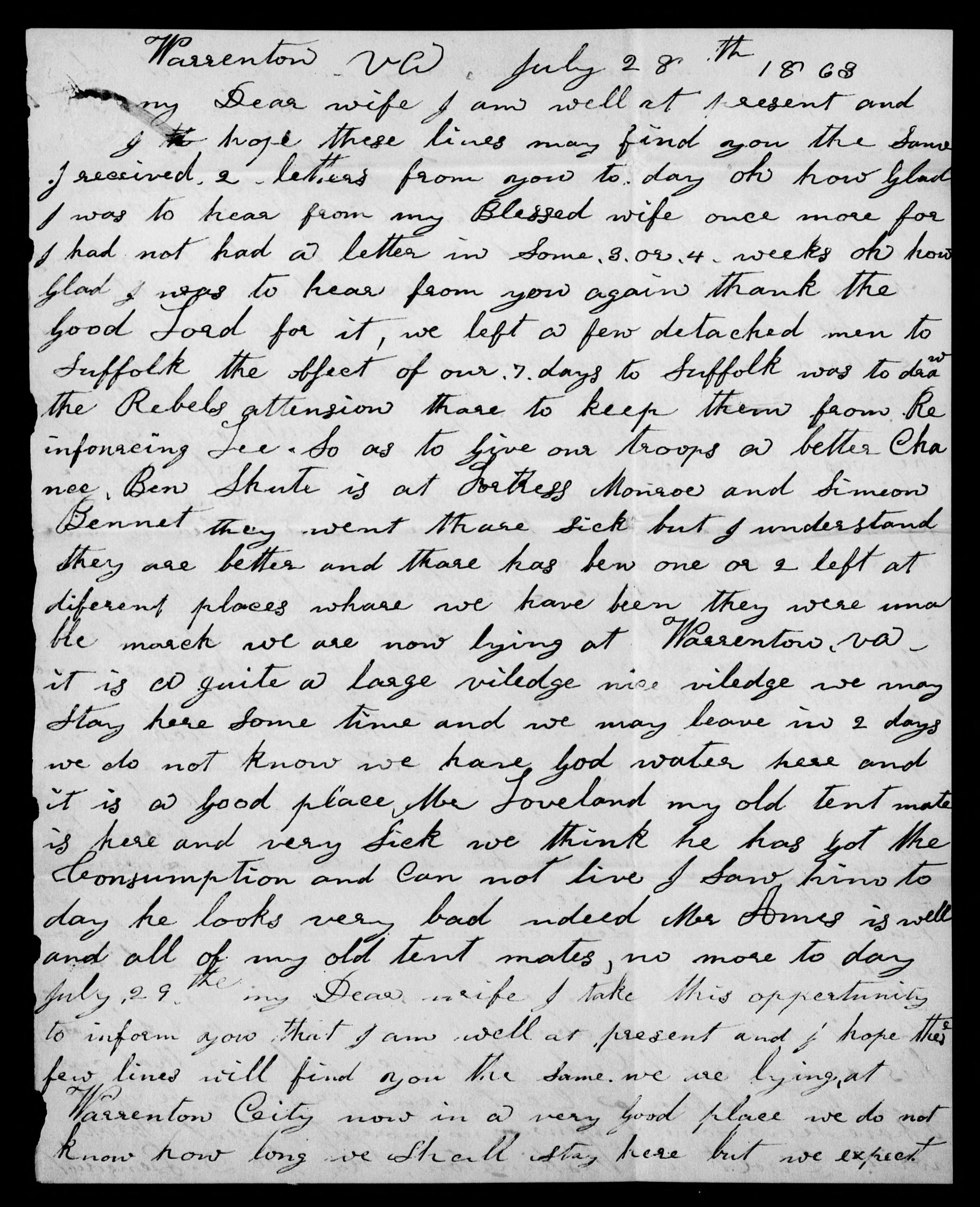
The whole page, transcribed
Warrenton VA July 28th 1863
my Dear wife I am well at present and I hope these lines may find you the Same I received 2 letters from you to day oh how glad I was to hear from my Blessed wife once more for I had not had a letter in Some 3 or 4 weeks oh how glad I was to hear from you again thank the good Lord for it,
we left a few detached men to Suffolk the affect of our 7 days to Suffolk was to draw the Rebels attension thare to keep them from Reinforceing Lee So as to give our troops a better Chance.
Ben Shute is at Fortress Monroe and Simeon Bennet they went thare Sick but I understand they are better and thare has ben one or 2 left at diferent places whare we have been they were unable march
we are now lying at Warrenton Va it is quite a large viledge nice viledge we may Stay here Some time and we may leave in 2 days we do not know we have god water here and it is a good place,
Mr Loveland my old tent mate is here and very Sick we think he has got the Consumption and Can not live I Saw him to day he looks very bad indeed Mr Ames is well and all of my old tent mates, no more to day
July 29th my Dear wife I take this oppertunity to inform you that I am well at present and I hope these few lines will find you the Same we are lying at Warrenton City now in a very good place we do not know how long we Shall Stay here but we expect
Ames — the Close Baptist preacher of Angelica who shared Benedict’s tent through the spring of 1863 — comes through this letter untouched. In a paragraph that reports one tent mate dying of consumption and two more in hospital at Fortress Monroe, the last line is simply that Ames is well.
He is named again and again across Benedict’s letters: tenting together, standing picket together at Berlin and on the Rappahannock. Of all the men in these letters, Ames is the one {B} kept nearest.
Men he served beside. This one page names four men of Company G: Edwin M. Loveland · Benjamin Shute · Simeon Bennett. The full run of Benedict’s letters, transcribed page by page, is on his own page.
Source. Benedict, G. D. (1863–1864). George D. Benedict Papers (Collection #4943-z). Southern Historical Collection, Louis Round Wilson Special Collections Library, University of North Carolina at Chapel Hill.
“I Tent With Mr Ames of Angelica Yet” — 14 December 1863
Private George D. Benedict of Company G to his wife Sarah at Belvidere, from winter camp at Culpeper.
“I tent with Mr Ames of Angelica yet and probaly Shall for the winter”
— George D. Benedict, Culpeper, Virginia, 14 December 1863
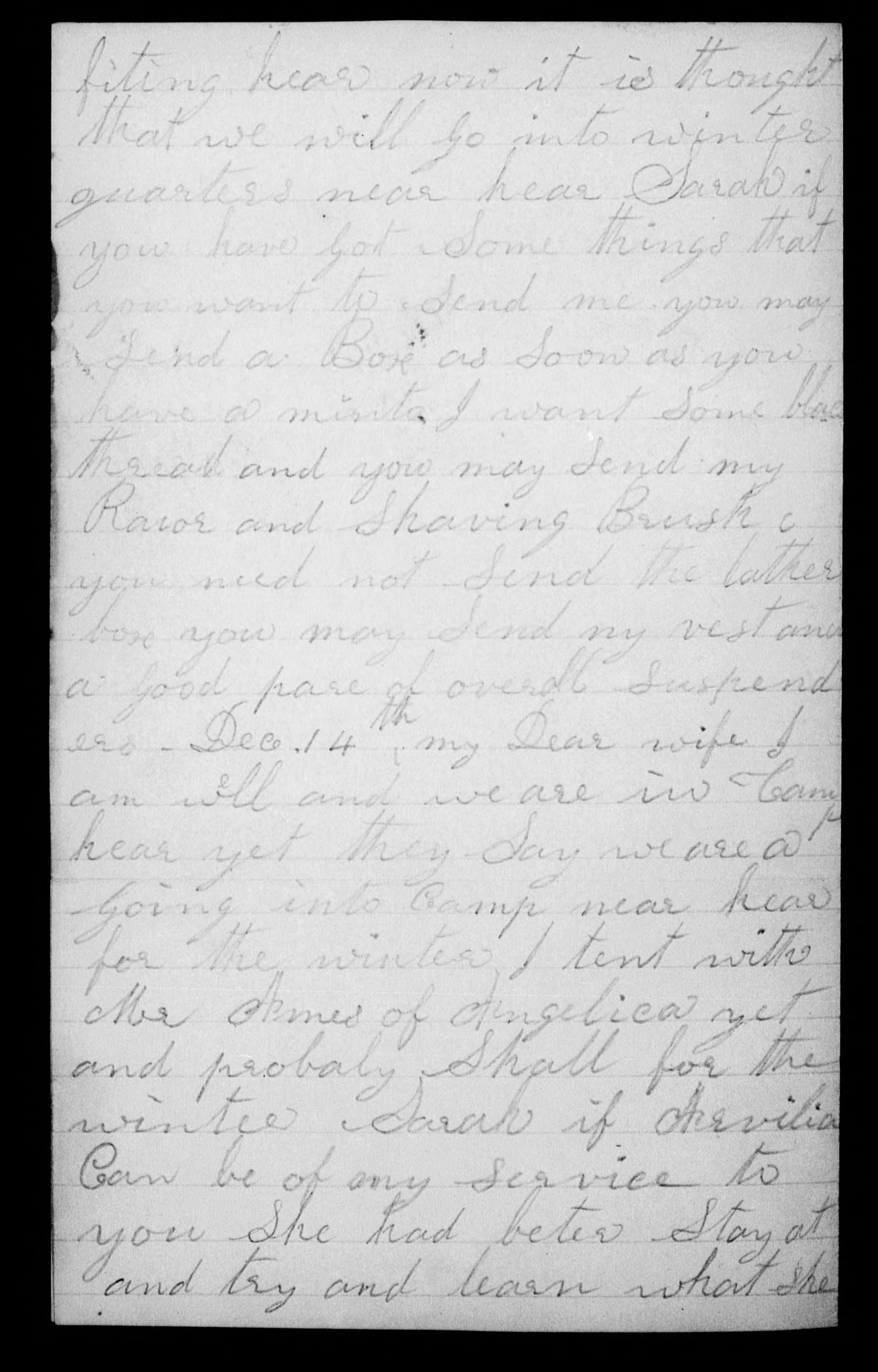
The whole page, transcribed
fiting hear now it is thought that we will go into winter quarters near hear
Sarah if you have got Some things that you want to Send me you may Send a Box as Soon as you have a minite I want Some black thread and you may Send my Razor and Shaving Brush you need not Send the lather box you may Send my vest and a good pare of overall Suspenders
Dec 14th my Dear wife I am well and we are in Camp hear yet they Say we are a going into Camp near hear for the winter
I tent with Mr Ames of Angelica yet and probaly Shall for the winter
Sarah if Arvillia Can be of any Service to you She had beter Stay at and try and learn what She
Nine months in the same tent.Benedict first names Ames in the spring of 1863, when they were three to a tent with Simeon Bennett: “Mr Ames is a preacher and belongs to the Close Baptis.” Bennett went to hospital at Fortress Monroe that summer and never came back to the tent. Ames stayed.
Between those two sentences lie the Gettysburg marches, the twenty-hour night march out of Frederick City, Berlin, Warrenton, the regiment’s conversion to cavalry, and its first action on the Plains of Manassas. Through all of it the two men shared a shelter. In the letter of 28 July, in a paragraph reporting one tent mate dying of consumption and two more in hospital, the last line was simply that Ames was well.
Of every man named in these letters, Ames is the one Benedict kept nearest and the one he never once complains of. The full run of the letters, transcribed page by page, is on his own page.
Source. Benedict, G. D. (1863–1864). George D. Benedict letters, 1863–1864 (Collection #4943-z). Southern Historical Collection, Louis Round Wilson Special Collections Library, University of North Carolina at Chapel Hill.
Named in a Comrade’s Letter — the Rapidan, February 1864
Private George D. Benedict of Company G to his wife Sarah at Belvidere, from winter quarters on the Rapidan.
“Mr Ames is well and harty”
— George D. Benedict, February 1864
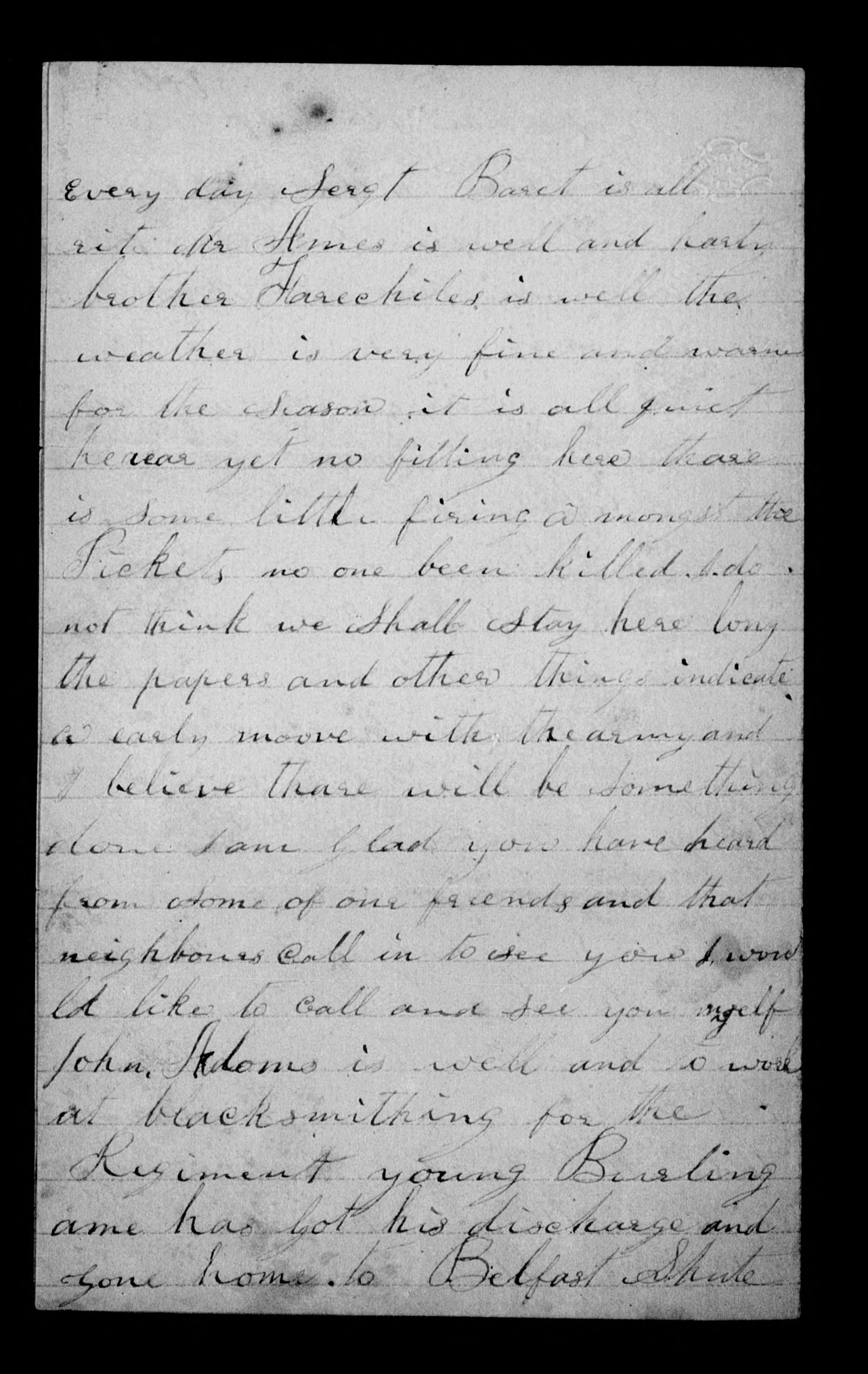
The whole page, transcribed
every day
Sergt Baret is all rite Mr Ames is well and harty brother Farechiles is well
the weather is very fine and warm for the Season it is all quiet herear yet no fitting here thare is some little firing amongst the Pickets no one been killed
I do not think we Shall Stay here long the papers and other things indicate a early moove with the army and I believe thare will be Something done
I am glad you have heard from Some of our friends and that neighbours Call in to see you I would like to call and see you myself
John Adams is well and to work at blacksmithing for the Regiment
young Burlingame has got his discharge and gone home to Belfast Shute
One more entry in the long record of Benedict’s tent mate. Through the whole winter of 1863–64 they shared a shelter on the Rapidan, and in nearly every letter home the preacher of Angelica is reported well. Here, February 1864: “Mr Ames is well and harty.”
Of all the men in these letters, Ames is the steadiest presence — named from the first spring to this last winter, always alongside Benedict, never once the subject of a complaint.
Men named on this same page.Albert Burlingame · Benjamin Fairchild · Alonzo D. Barrett · John J. Adams. The full run of Benedict’s letters, transcribed page by page, is on his own page.
Source. Benedict, G. D. (1863–1864). George D. Benedict Papers (Collection #4943-z). Southern Historical Collection, Louis Round Wilson Special Collections Library, University of North Carolina at Chapel Hill.
Views: 9