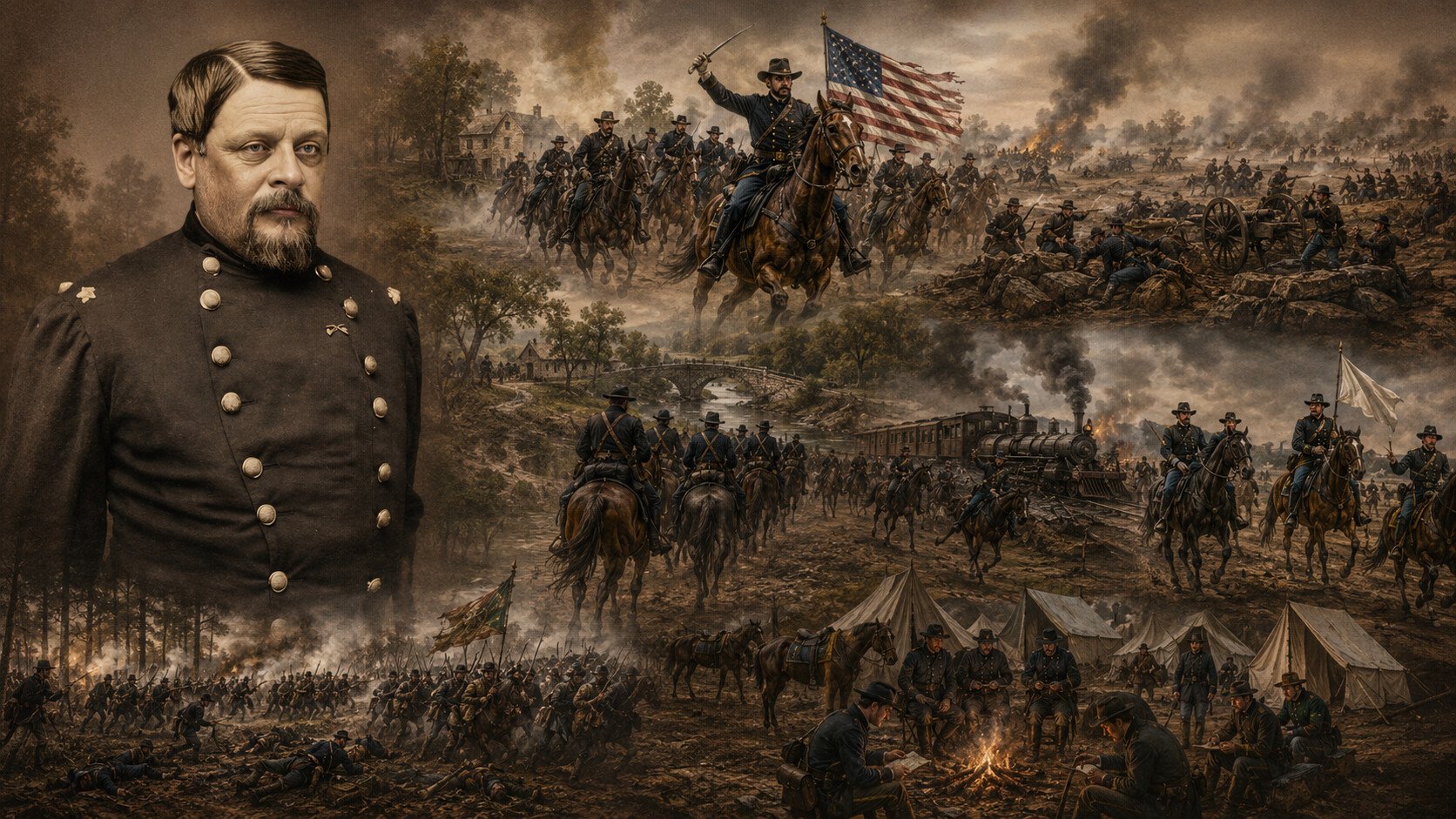
Imagine Alfred Gibbs born in 1840 instead of 1823. Give him George Custer’s youth and Custer’s luck. Let him rise at twenty-four, unmarried and unmarked, ride at the head of a volunteer brigade with a scarlet necktie and a hometown newspaper, and live long enough to write his memoirs. That man would be a household name. He would have statues.
The man who actually wore the uniform, who did the same fighting and earned the same brevets, is a footnote. Our newest essay, Too Old for Glory: The General History Forgot to Make, asks why, and it does not answer with sentiment. It answers with documents.
Gibbs had already lived the boy-hero chapter. He was wounded at Cerro Gordo at twenty-four, in a war the public of the 1860s had filed away. By the great cavalry campaigns he was past forty, married, with two sons, and carrying an Apache lance scar, a year’s captivity, and eyes that were beginning to fail. He was the anti-Custer: he published his own war correspondence unsigned and his sporting letters under a pen name. And when the fame machine ran, on patronage, on the press, on youth and on a dramatic death, he was cut off from every part of it. He died quietly in 1868, eight years before the Little Bighorn turned his own regiment’s Custer into a god.
The essay lays the evidence out one document at a time, each one reproduced on this site: his service record, his own battle reports, his brigade commander’s praise, the colors he seized under arrest, the letter that says in plain words that he was “passed by because there was no one to present his case.” It is an argument you can check, not an opinion you have to take on faith.
Views: 9