George Gibbs to Alfred Gibbs – New York, October 25, 1847
The Gibbs Family Papers · Reel 2 · The Alfred Gibbs Correspondence · Mexico, 1847-1848
George Gibbs to Alfred Gibbs – New York, October 25, 1847
“All West Point was in a blaze at the letter as I published it.” George answers Alfred’s account of the fall of Mexico City: the battle letters printed in the National Intelligencer, Wellington’s admiration of Scott, and a brother’s plea to stay out of danger.
This is the letter that turned Lieutenant Alfred Gibbs into a published war correspondent against his own orders. His brother George admits it outright: Alfred’s firsthand accounts of Contreras, Churubusco, and the taking of Mexico City arrived in New York with an injunction not to print them, and George published extracts anyway – “It was important in the highest degree” – and watched the National Intelligencer and the Union copy them across the country. “All West Point was in a blaze at the letter as I published it, officers & cadets.” Around that confession moves the whole home front of October 1847: George carrying the letter to the mothers of Alfred’s comrades, the Morrises broken by their son’s death, Maury’s shattered arm, the Duke of Wellington’s reported admiration of Scott, and a promise, in guarded code, to fight the promotion injustice in Washington – “but you & the rest must keep quiet.” It ends with the sentence every family of the war wrote in some form: “God bless you always & grant that you come safe out of this most murderous of all wars.”
❦The Letter
Page 1 (scan 1319)

[Heavy show-through of page 2 is visible across the top margin; not separately transcribed.]
Newyork October 25th 1847
My dear Alfred
Your letter giving an account of the taking of Mexico arrived on Saturday afternoon and although the reception of the accounts of the killed and wounded had previously relieved us of our worst [?] anxiety, still it was no little gratification to receive [?] your own [illegible] that you were alive and kicking. Your letter giving an account of the battles at Contreras & Churubusco had previously arrived and I wrote by Macalister [?] acknowledging it and explaining the reasons [?] for violating your injunction & publishing some extracts. The letter has been copied by the National Intelligencer & the Union & Capt Kenny [?] says it is the best account that has been given of any battle. Wetmore was delighted with it. Now to make you growl still more I have extracted and published part of your last. It was important [underlined] in the highest degree. In the first place to show the actual force of Scott’s, second to show what your division did, for Kendall is chiefly Worth’s historian, third to let the country feel how murderous the policy of a small army fed only by driblets is, and lastly to let the friends of the officers you mentioned know of their safety or fate. I called immediately on Mrs Hamilton who had no letter from Schuyler & who with the family were greatly relieved by hearing of his convalescence. I also sent a note to Col Thorn who called this morning to thank me & say that he had a letter from his son which was very gratifying. The Morrises had of course heard of poor Blakely’s [?] death. Their distress was terrible. Mrs Morris bears it with more strength than her husband who is dreadfully broken. Mother took the letter up and went with Wolcott. They had desired to see him but were very much overcome at the recollections he revived. Mrs Van [?] dared not inform her father of the particulars which are
Page 2 (scan 1320)
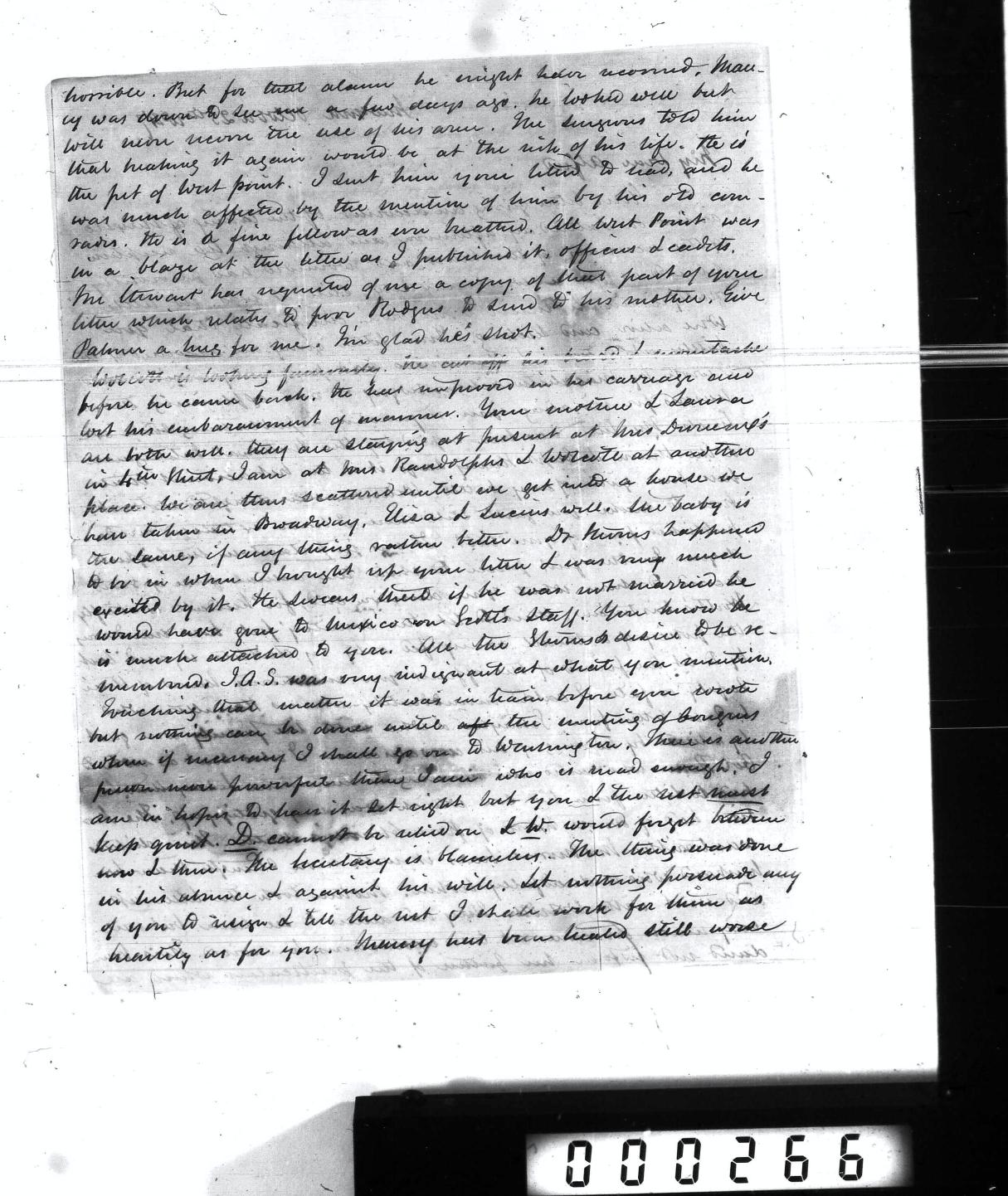
horrible. But for that alarm he might have recovered. Maury was down to see me a few days ago. He looked well but will never recover the use of his arm. The surgeons told him that using [?] it again would be at the risk of his life. He is the pet of West point. I sent him your letter to read, and he was much affected by the mention of him by his old comrades. He is a fine fellow as ever breathed. All West Point was in a blaze at the letter as I published it, officers & cadets. Mr Stewart has requested of me a copy of that part of your letter which relates to poor Rodgers to send to his mother. Give Palmer a hug for me. I’m glad he’s shot. Wolcott is looking famously. He was ill [three or four words illegible] before he came back. He has improved in his carriage and lost his embarrassment of manner. Your mother & Laura are both well. they are staying at present at Mrs Dunevay’s [?] in 4th Street. I am at Mrs Randolph’s & Wolcott at another place. We are thus scattered until we get into a house we have taken in Broadway. Eliza & Lucius well. The baby is the same, if any thing rather better. Dr Kearns [?] happened to be in when I brought up your letter & was very much excited by it. He swears that if he was not married he would have gone to Mexico on Scott’s staff. You know he is much attached to you. All the Stevenses [?] desire to be remembered. J.A.S. was very indignant at what you mention. Touching that matter it was in train before you wrote but nothing can be done until after the meeting of Congress when if necessary I shall go on to Washington. There is another person more powerful than I am who is mad [?] enough. I am in hopes to have it set right but you & the rest must [underlined] keep quiet. D. cannot be relied on & W. would forget between now & then. The Secretary is blameless. The thing was done in his absence & against his will. Let nothing persuade any of you to resign & tell the rest I shall work for them as heartily as for you. Maury has been treated still worse
Page 3 (scan 1321)
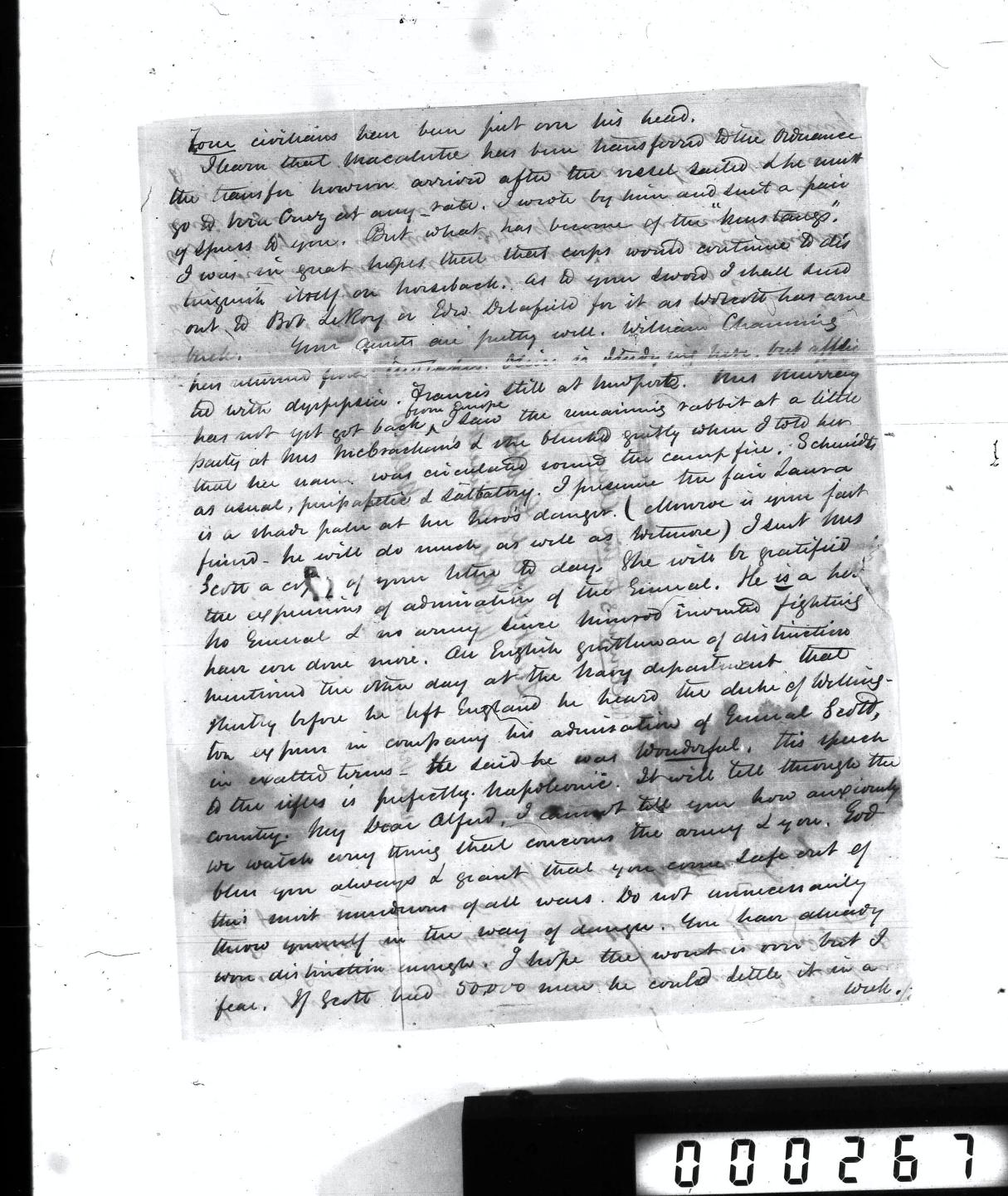
four [underlined] civilians have been put over his head.
I learn that Macalister has been transferred to the Ordnance[.] the transfer however arrived after the vessel sailed & he must [?] go to Vera Cruz at any rate. I wrote by him and sent a pair of spurs to you. But what has become of the “Mustangs”. I was in great hopes that that corps would continue to distinguish itself on horseback. As to your sword I shall send out to Bob LeRoy or Edw Delafield for it as Wolcott has come back [illegible]. Your aunts are pretty well. William Channing has returned from [two or three words illegible] here, but afflicted with dyspepsia. Francis still at Newport. Mrs Murray has not yet got back ^from Europe [interlined]. I saw the remaining rabbit at a little party at Mrs McCracken’s & she blushed guilty when I told her that her name was circulated round the camp fire. Schmidt as usual, peripatetic & saltatory. I presume the fair Laura is a shade paler at her hero’s danger. (Munroe is your fast friend – he will do much as well as Wetmore) I sent Mrs Scott a copy of your letter to day. She will be gratified [at?] the expressions of admiration of the General. He is [is underlined] a hero – no General & no army since Nimrod invented fighting have ever done more. An English gentleman of distinction mentioned the other day at the Navy department that shortly before he left England he heard the duke of Wellington express in company his admiration of General Scott, in exalted terms – He said he was wonderful [underlined]. This speech to the rifles is perfectly Napoleonic. It will tell through the country. My dear Alfred, I cannot tell you how anxiously we watch every thing that concerns the army & you. God bless you always & grant that you come safe out of this most murderous of all wars. Do not unnecessarily throw yourself in the way of danger. You have already won distinction enough. I hope the worst is over but I fear. If Scott had 50000 men he could settle it in a week.
Page 4 (scan 1322)
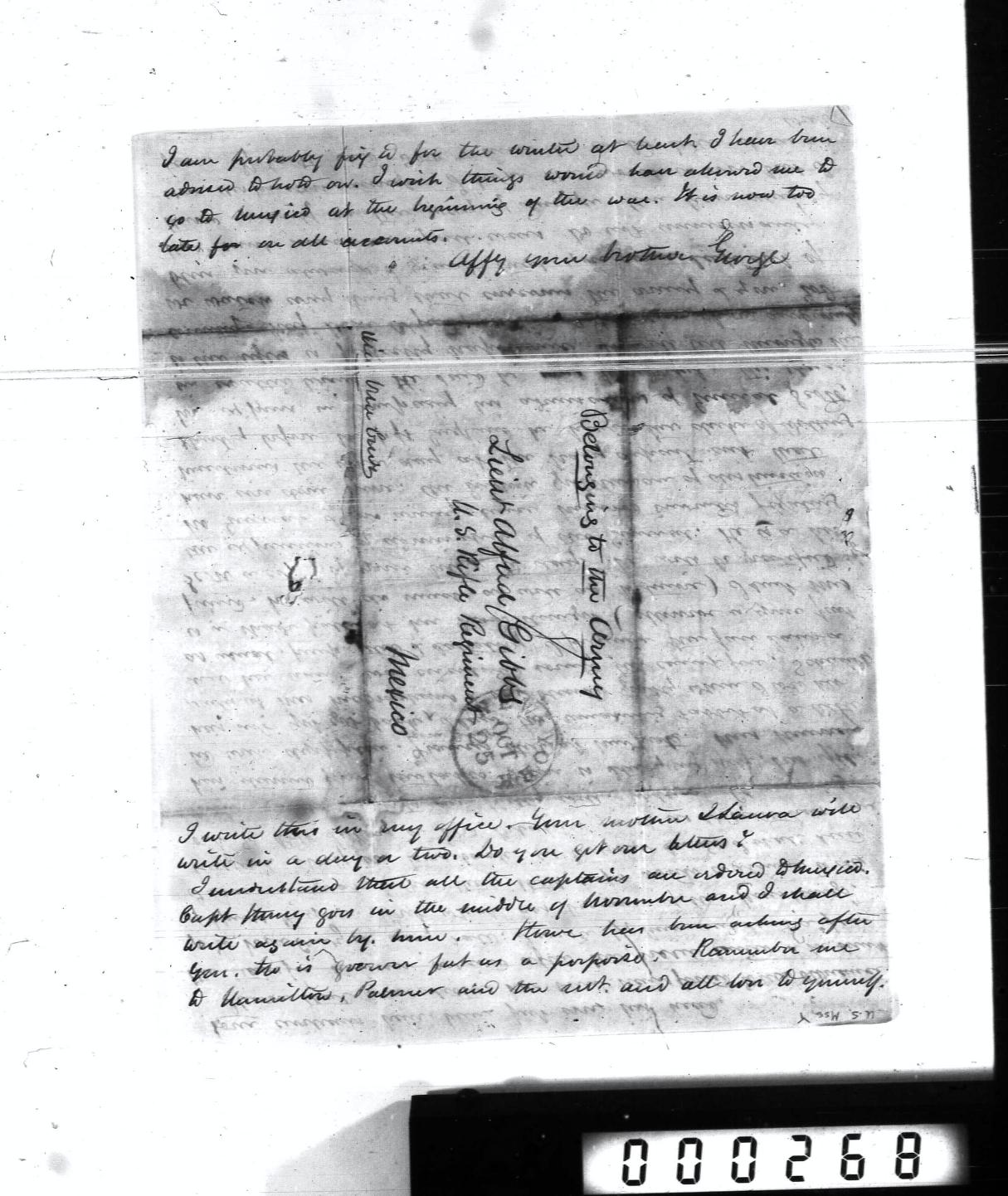
[Upper portion – close of the letter:]
I am probably fixed for the winter at least. I have been advised to hold on. I wish things would have allowed me to go to Mexico at the beginning of the war. It is now too late for [me?] on all accounts.
Affy your brother George
[Address panel, written at right angles across the folded cover:]
Belonging to the Army [underlined]
Lieut Alfred Gibbs
U.S. Rifle Regiment
Mexico
[Circular postmark: NEW-YORK – OCT 25]
[Vertically along the left fold:] Via Vera Cruz
[Faint mark at foot of leaf, partly legible: U.S. Mss Y [?] – archival/collection marking]
[Lower portion – postscript below the address panel:]
I write this in my office. Your mother & Laura will write in a day or two. Do you get our letters?
I understand that all the captains are ordered to Mexico. Capt Haney [?] goes in the middle of November and I shall write again by him. Stone [?] has been asking after you. He is grown fat as a porpoise. Remember me to Hamilton, Palmer and the rest. and all love to yourself.
[Heavy mirrored show-through of the inner pages crosses the middle of the leaf; not separately transcribed.]
1. FOUND. The published letter this page describes exists exactly where George says: copied in both the National Intelligencer AND the Union of October 13, 1847, and now exhibited complete on this site as The War Correspondent: Battles of Contreras and Churubusco. The two documents prove each other: this letter supplies the byline the newspapers never printed.
2. The catchwords confirm the page order across all four scans (“particulars which are / horrible,” “treated still worse / four civilians…”).
3. The Wellington anecdote is secondhand (“An English gentleman of distinction mentioned the other day at the Navy department…”), and the phrase “perfectly Napoleonic” reads as George’s own verdict on Scott’s speech to the Rifles, not Wellington’s verbatim words.
4. Identifications: Maury = Dabney Herndon Maury, Mounted Rifles, arm shattered at Cerro Gordo; Schuyler = Schuyler Hamilton, Scott’s aide; Palmer = Innis N. Palmer, Mounted Rifles; Kearny’s charge = Capt. Philip Kearny’s charge at the San Antonio garita, Aug. 20, 1847, in which Alfred rode. The cover is endorsed “Belonging to the Army” and routed “Via Vera Cruz.”
Archival citation
Gibbs Family Papers, 1763-1918. U.S. Mss Y; Micro 1117; Photo Lots 3696-3697. Wisconsin Historical Society, Division of Library, Archives, and Museum Collections, Madison, Wis. Digitized research copy (Green collection), Reel 2. Scans 1319-1322 (scan 1323 is a duplicate exposure of the cover, noted in the reel index); microfilm frames as sequenced in the reel index. Every page of the letter is shown above; duplicate microfilm exposures are noted in the reel index.
Suggested citation (Chicago): George Gibbs to Alfred Gibbs, October 25, 1847. Gibbs Family Papers, 1763-1918, U.S. Mss Y, Micro 1117, reel 2. Wisconsin Historical Society, Madison, WI. Accessed via AlfredGibbs.com.
Related in the Record
References
Gibbs, G.. (1847, October 25). [Letter to Alfred Gibbs]. Gibbs Family Papers, 1763-1918 (U.S. Mss Y, Micro 1117, reel 2) [Manuscript]. Wisconsin Historical Society, Madison, WI.
Gibbs family. (1763-1918). Gibbs Family Papers (U.S. Mss Y; Micro 1117; Photo Lots 3696-3697) [Manuscript collection]. Wisconsin Historical Society, Madison, WI.
Accuracy review: transcription checked against the full-resolution scans, July 11, 2026. Original spelling and punctuation are preserved; editorial matter appears in square brackets and uncertain readings are marked [?] rather than guessed. Corrections are made openly; this page will be updated, never silently, if better readings are established.
Views: 5