“Fishing in Texas”: Alfred Gibbs in the Spirit of the Times, August 19, 1854
The Alfred Gibbs Letters · The Published Letter · Found in Print, July 2026
“Fishing in Texas”: Alfred Gibbs in the Spirit of the Times, August 19, 1854
The General’s private letter said “you will see an account I have written of the fun in the Spirit of the Times.” Here it is: the front page of America’s great sporting weekly, August 19, 1854, signed with a Mounted Rifleman’s pun of a pen name – WRY-FULL.
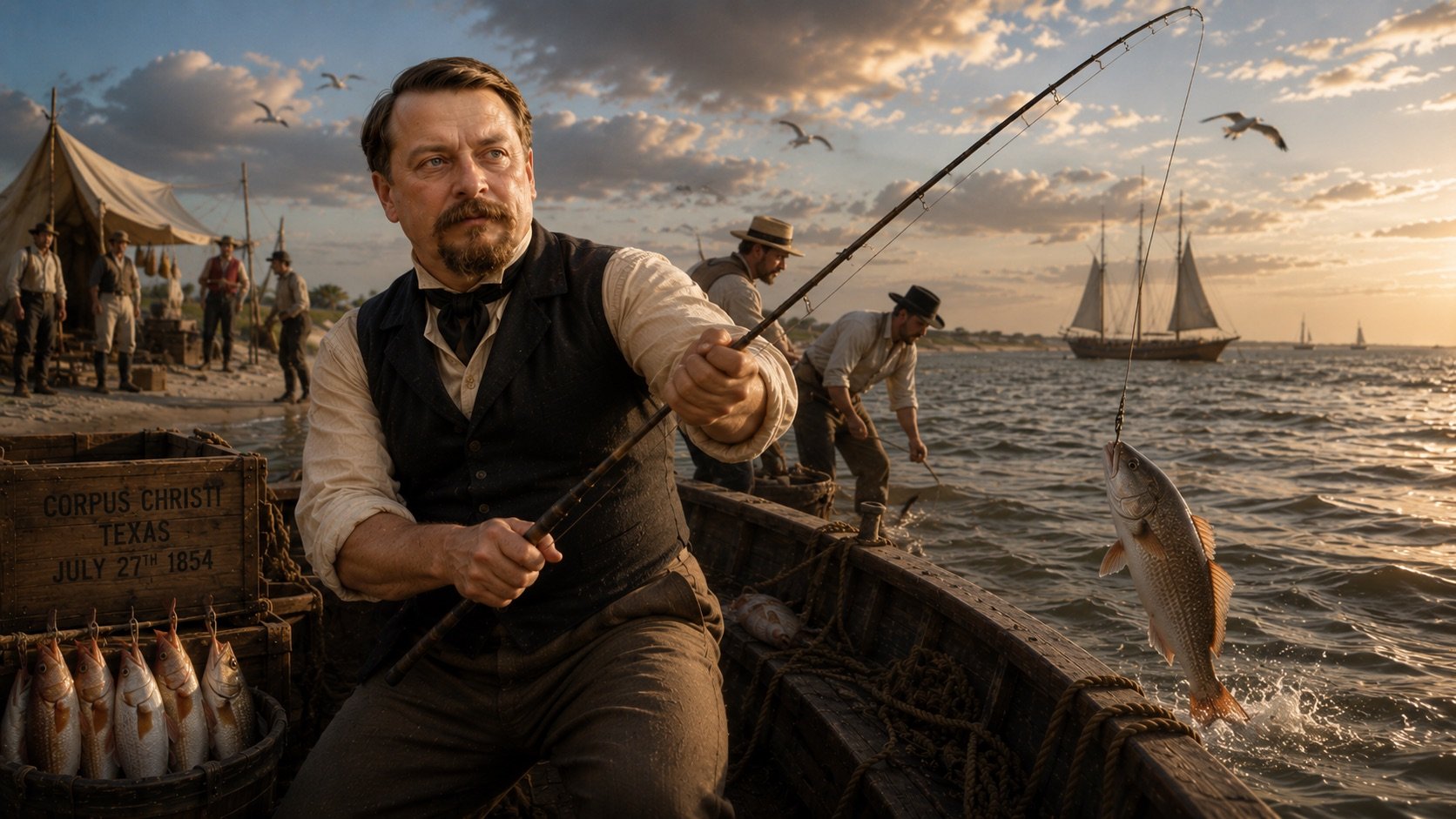
An artistic interpretation of the excursion the article describes: the party on the Laguna Madre, July 1854, with the tent pitched on the point, the schooner standing off, and the redfish coming in. This is a modern illustration, not a period image; the evidence is the printed page below, shown in full with its complete transcription.
On July 26, 1854, Lieutenant Alfred Gibbs told his brother Frank, in a private letter now in the Wisconsin Historical Society’s Gibbs Family Papers: “You will see an account I have written of the fun in the Spirit of the Times.” That single sentence sent this archive hunting through the digitized files of the great New York sporting weekly – and the account was exactly where he said it would be. The issue of August 19, 1854 carries, as its FRONT-PAGE lead article, “Fishing in Texas,” datelined Corpus Christi, July 27, 1854 – the very day after Alfred’s private addendum – and reporting the identical excursion: the schooner on the Laguna Madre, the midnight anchorage, the “American patent gravitating hooks,” and the famous count, “one hundred and eighty-one red-fish, averaging over twenty pounds a-piece… nearly two tons.” The signature is a soldier’s joke hiding in plain sight: WRY-FULL – say it aloud, and a Mounted Rifleman tips his cap. The private manuscript claims authorship; the printed page matches it fact for fact; the pen name winks at the regiment. The General of this archive was a published sporting correspondent, and this page returns his byline to him after 172 years.
❦The Letter
Spirit of the Times, Aug. 19, 1854, p. 313 – complete article
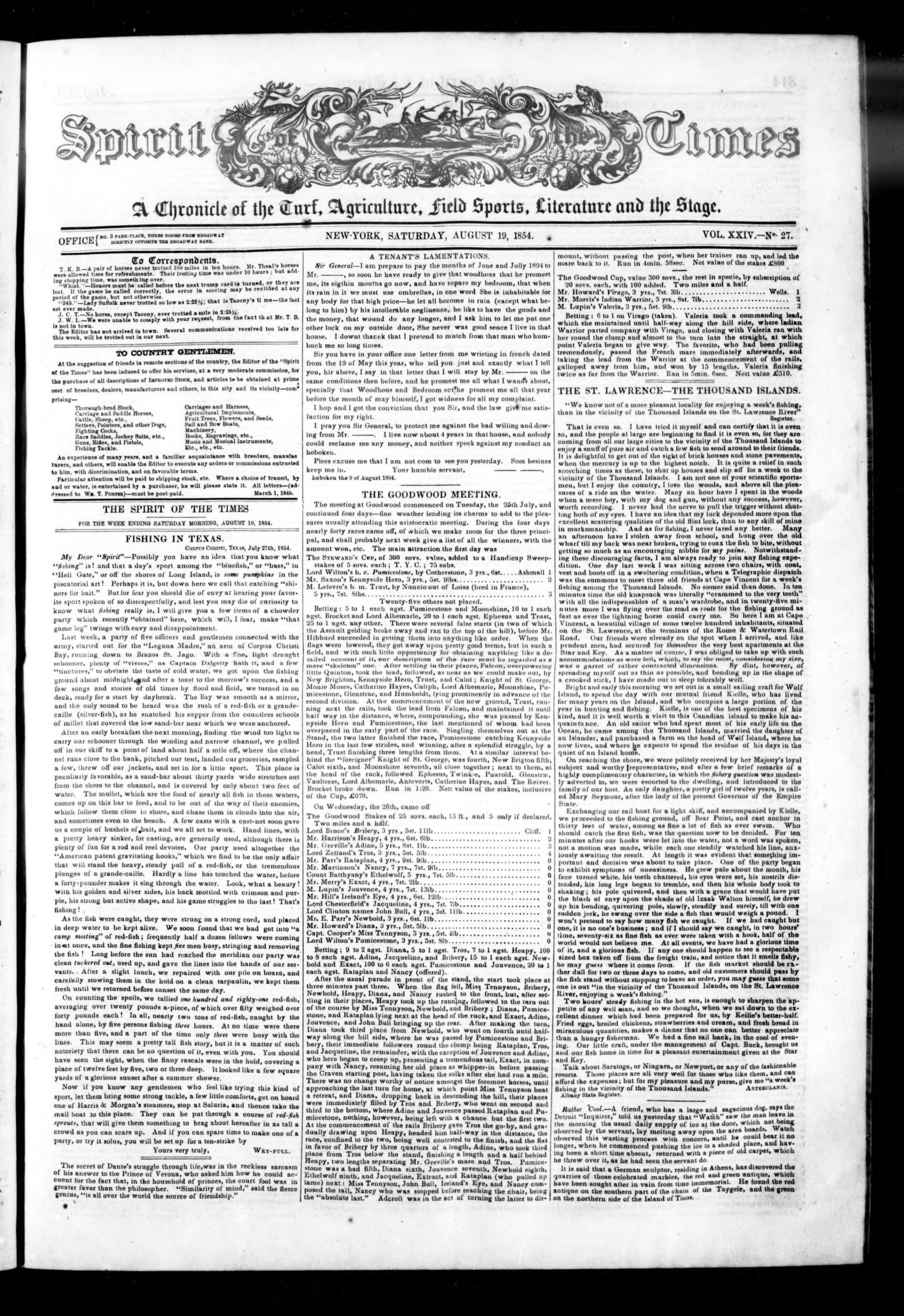
FISHING IN TEXAS.
Corpus Christi, Texas, July 27th, 1854.
My Dear “Spirit”-Possibly you have an idea that you know what “fishing” is! and that a day’s sport among the “bluefish,” or “bass,” in “Hell Gate,” or off the shores of Long Island, is some pumpkins in the piscatorial art! Perhaps it is, but down here we call that catching “shiners for bait.” But for fear you should die of envy at hearing your favorite sport spoken of so disrespectfully, and lest you may die of curiosity to know what fishing really is, I will give you a few items of a chowder party which recently “obtained” here, which will, I fear, make “that game leg” twinge with envy and disappointment.
Last week, a party of five officers and gentlemen connected with the army, started out for the “Laguna Madre,” an arm of Corpus Christi Bay, running down to Brazos St. Jago. With a fine, light draught schooner, plenty of “vivres,” as Captain Dalgetty hath it, and a few “tinctures,” to obviate the taste of cold water, we got upon the fishing ground about midnight, and after a toast to the morrow’s success, and a few songs and stories of old times by flood and field, we turned in on deck, ready for a start by daybreak. The Bay was smooth as a mirror, and the only sound to be heard was the rush of a red-fish or a grande-caille (silver-fish), as he snatched his supper from the countless schools of mullet that covered the low sand-bar near which we were anchored.
After an early breakfast the next morning, finding the wind too light to carry our schooner through the winding and narrow channel, we pulled off in our skiff to a point of land about half a mile off, where the channel runs close to the bank, pitched our tent, landed our groceries, sampled a few, threw off our jackets, and set in for a little sport. This place is peculiarly favorable, as a sand-bar about thirty yards wide stretches out from the shore to the channel, and is covered by only about two feet of water. The mullet, which are the food of nearly all fish in these waters, comes up on this bar to feed, and to be out of the way of their enemies, which follow them close in shore, and chase them in clouds into the air, and sometimes even to the beach. A few casts with a cast-net soon gave us a couple of bushels of bait, and we all set to work. Hand lines, with a pretty heavy sinker, for casting, are generally used, although there is plenty of fun for a rod and reel devotee. Our party used altogether the “American patent gravitating hooks,” which we find to be the only affair that will stand the heavy, steady pull of a red-fish, or the tremendous plunges of a grande-caille. Hardly a line has touched the water, before a forty-pounder makes it sing through the water. Look, what a beauty! with his golden and silver sides, his back mottled with crimson and purple, his strong but active shape, and his game struggles to the last! That’s fishing!
As the fish were caught, they were strung on a strong cord, and placed in deep water to be kept alive. We soon found that we had got into “a camp meeting” of red-fish; frequently half a dozen fellows were coming in at once, and the fine fishing kept five men busy, stringing and removing the fish! Long before the sun had reached the meridian our party was clean tuckered out, used up, and gave the lines into the hands of our servants. After a slight lunch, we repaired with our pile on board, and carefully stowing them in the hold on a clean tarpaulin, we kept them fresh until we returned before sunset the same day.
On counting the spoils, we tallied one hundred and eighty-one red-fish, averaging over twenty pounds a-piece, of which over fifty weighed over forty pounds each! In all, nearly two tons of red-fish, caught by the hand alone, by five persons fishing three hours. At no time were there more than five, and a part of the time only three were busy with the lines. This may seem a pretty tall fish story, but it is a matter of such notoriety that there can be no question of it, even with you. You should have seen the sight, when the finny rascals were in the hold, covering a place of twelve feet by five, two or three deep. It looked like a few square yards of a glorious sunset after a summer shower.
Now if you know any gentlemen who feel like trying this kind of sport, let them bring some strong tackle, a few little comforts, get on board one of Harris & Morgan’s steamers, stop at Saluria, and thence take the mail boat to this place. They can be put through a course of red-fish sprouts, that will give them something to brag about hereafter in as tall a crowd as you can scare up. And if you can spare time to make one of a party, or try it solus, you will be set up for a ten-strike by
Yours very truly,
WRY-FULL.
1. THE CLAIM. Alfred’s private letter to Frank (July 21-26, 1854, Gibbs Family Papers, Reel 2): “in three hours, four of us caught 181 red-fish, averaging considerably over 20 lbs apiece, or in all about 2 tons of fish… You will see an account I have written of the fun in the Spirit of the Times in a letter of about this date.”
2. THE MATCH. The printed letter is datelined July 27, 1854 – the day after the private addendum – and repeats the same facts: 181 red-fish, twenty-pound average, about two tons, three hours, the Laguna Madre, the schooner anchored at midnight, and the “American patent gravitating hooks” (the same hooks Alfred grumbled that Ackerman had failed to restock in the private letter). The private count says “four of us”; the printed version credits a party of five, “a part of the time only three… busy with the lines” – the kind of variation an author makes, not a copyist.
3. THE PEN NAME. The article is signed WRY-FULL – a homophone of Rifle. Alfred Gibbs was adjutant of the Regiment of Mounted Riflemen. The pseudonym is the regiment’s calling card.
4. INDEPENDENT CORROBORATION. Six weeks later another Texas correspondent, writing from Indianola over the signature “Las Cruces” (Spirit of the Times, September 30, 1854, page 2), reported: “I was informed by Lieut. W., that some four officers in an [afternoon?] about half a day in the bay of Corpus Christi, took 5400 pounds of red-fish, with hook and line. This is a fish story – a big one – but nevertheless true.” The catch was, as Alfred wrote, “a matter of such notoriety” on the coast that it traveled on its own.
5. WHAT THIS PAGE PROVES. A first-person published work by the future general, restored to his name by the coincidence of a private manuscript and a public print – the private letter held by his family for a century and a half, the printed page sitting in the files of the Spirit of the Times. Neither alone names him; together they are conclusive.
Archival citation
Gibbs Family Papers, 1763-1918. U.S. Mss Y; Micro 1117; Photo Lots 3696-3697. Wisconsin Historical Society, Division of Library, Archives, and Museum Collections, Madison, Wis. Digitized research copy (Green collection), Reel 2. Scans digitized microfilm, Internet Archive item sim_spirit-of-the-times_1854-08-19_24_27; microfilm frames front page (volume page 313). Every page of the letter is shown above; duplicate microfilm exposures are noted in the reel index.
Suggested citation (Chicago): [Gibbs, Alfred] “Wry-Full.” “Fishing in Texas.” Spirit of the Times (New York), August 19, 1854, 313. Authorship established by Alfred Gibbs to Francis S. Gibbs, July 21-26, 1854, Gibbs Family Papers, Wisconsin Historical Society. Accessed via AlfredGibbs.com.
Related in the Record
References
[Gibbs, A.] “Wry-Full.” (1854, August 19). Fishing in Texas. Spirit of the Times (New York), 24(27), 313. https://archive.org/details/sim_spirit-of-the-times_1854-08-19_24_27
“Las Cruces.” (1854, September 30). [Letter from Indianola, Texas]. Spirit of the Times (New York), 24(33). https://archive.org/details/sim_spirit-of-the-times_1854-09-30_24_33
Gibbs, A. (1854, July 21-26). [Letter to Francis S. Gibbs]. Gibbs Family Papers, 1763-1918 (U.S. Mss Y, Micro 1117, reel 2, frames 547-549). Wisconsin Historical Society, Madison, WI.
Accuracy review: transcription checked against the full-resolution scans, July 11, 2026. Original spelling and punctuation are preserved; editorial matter appears in square brackets and uncertain readings are marked [?] rather than guessed. Corrections are made openly; this page will be updated, never silently, if better readings are established.
Views: 7