Alfred Gibbs to Francis Gibbs – Corpus Christi, May 26, 1855
The Gibbs Family Papers · Reel 2 · The Alfred Gibbs Letters · No. 3
Alfred Gibbs to Francis Gibbs – Corpus Christi, May 26, 1855
Drought at ninety degrees, a tarpon that parted his swivel, the economics of his mother’s household, and eleven quiet lines that date one of the turning points of his life: “Mother has probably told you before this of my engagement.”
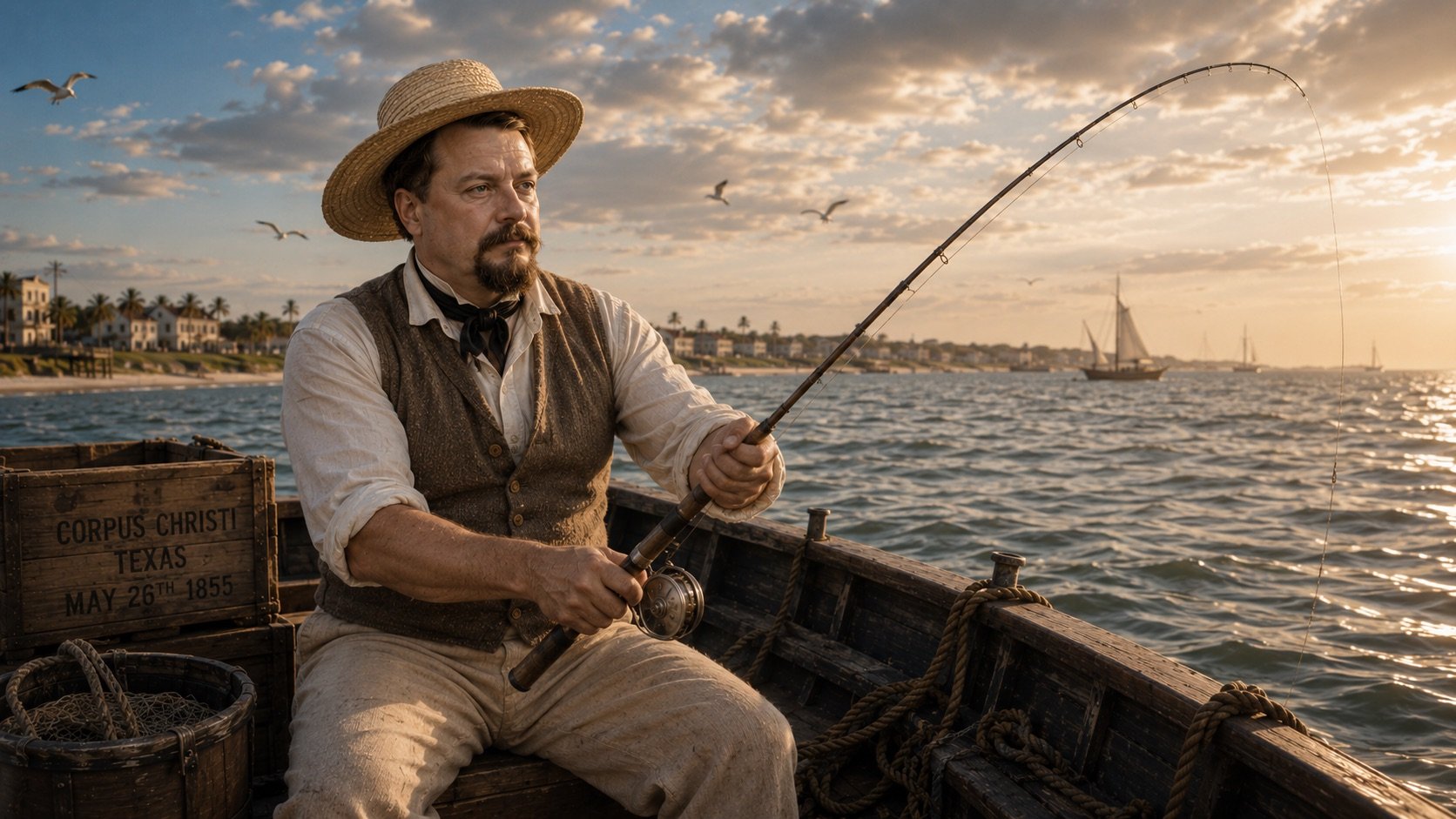
An artistic interpretation of the scene in this letter: an officer with rod and reel on the water off Corpus Christi, May 1855. This is a modern illustration, not a period image; the evidence is the manuscript below, shown in full with its complete transcription.
Ten months after the El Paso letter, Alfred writes Frank again from a Corpus Christi burning in drought, and buried in the middle of a virtuoso account of tarpon fishing is the sentence this archive has been waiting for: “Mother has probably told you before this of my engagement. It is not formally announced by either party but there is no objection to any of my friends knowing it… I hope to have the good luck as well as pleasure of going North next winter to be married.” The bride was Peggy Foushee Blair of Richmond. The letter fixes the chronology of the general’s marriage for the first time: engaged by May 1855, married the following winter, and by October 1856 his first son would be born at Fort Fillmore, New Mexico Territory. Around the announcement stands the rest of the man: the sportsman “determined to catch one of these fellows before I give it up,” the son organizing his brothers to support their mother’s household, and the older brother pressing Frank, gently and specifically, about his future.
❦The Letter
Page 1 (scan 1629, frame 000550)
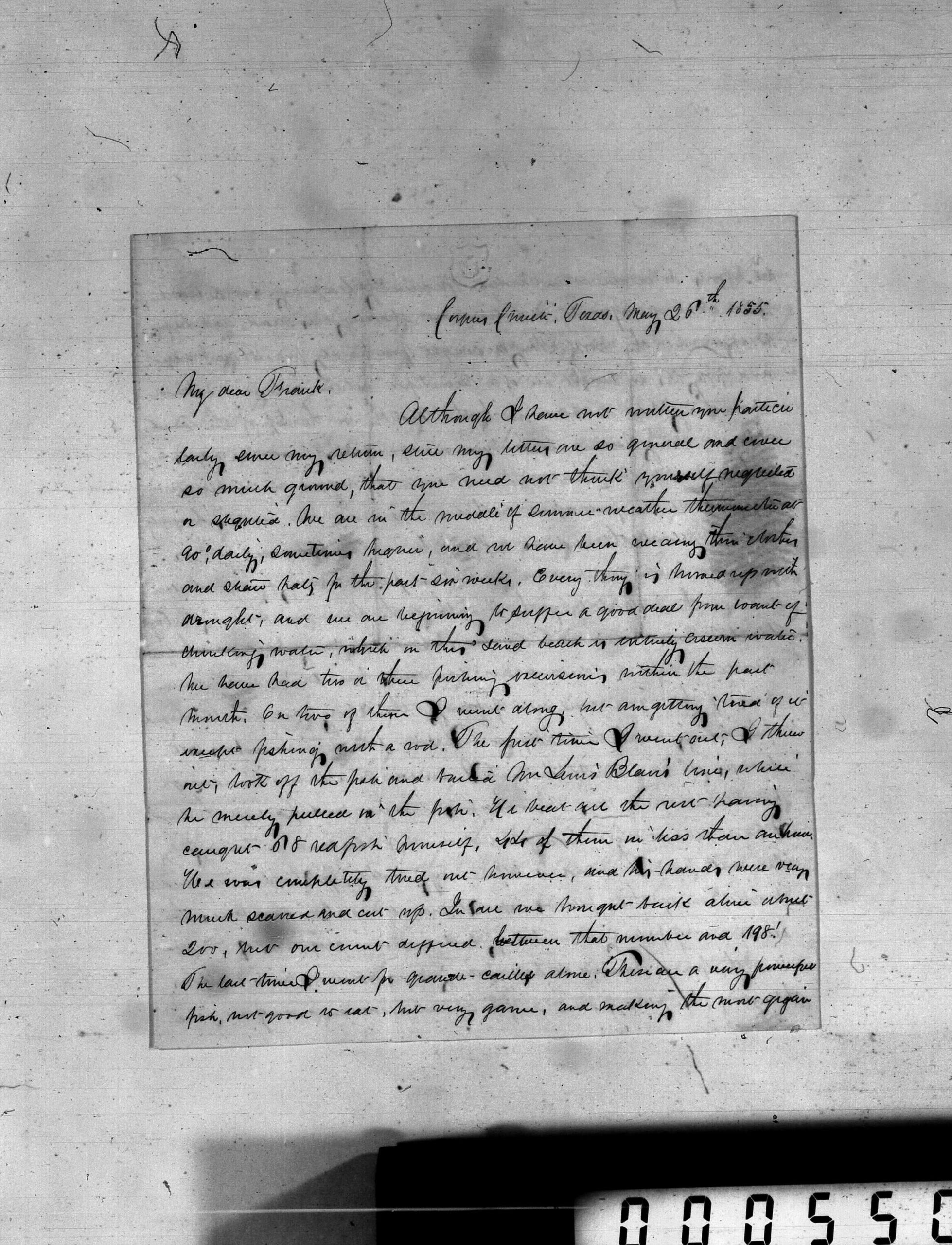
Corpus Christi, Texas. May 26th 1855.
My dear Frank.
Although I have not written you particularly since my return, still my letters are so general and cover so much ground, that you need not think yourself neglected or slighted. We are in the middle of summer weather, thermometer at 90° daily, sometimes higher, and we have been wearing thin clothes and straw hats for the past six weeks. Every thing is burned up with drought, and we are beginning to suffer a good deal from want of drinking water, which in this sand beach is entirely cistern water. We have had two or three fishing excursions within the past month. On two of them I went along, but am getting tired of it except fishing with a rod. The first time I went out, I threw out, took off the fish and baited Mr Louis Blanc’s line, while he merely pulled in the fish. He beat all the rest having caught 58 redfish himself, 40 of them in less than an hour. He was completely tired out however, and his hands were very much scarred and cut up. In all we brought back alive [?] about 200, but our count differed between that number and 198. The last time I went for grande-cailles alone. These are a very powerful fish, not good to eat, but very game, and making the most gigan-
Page 2 (scan 1630)
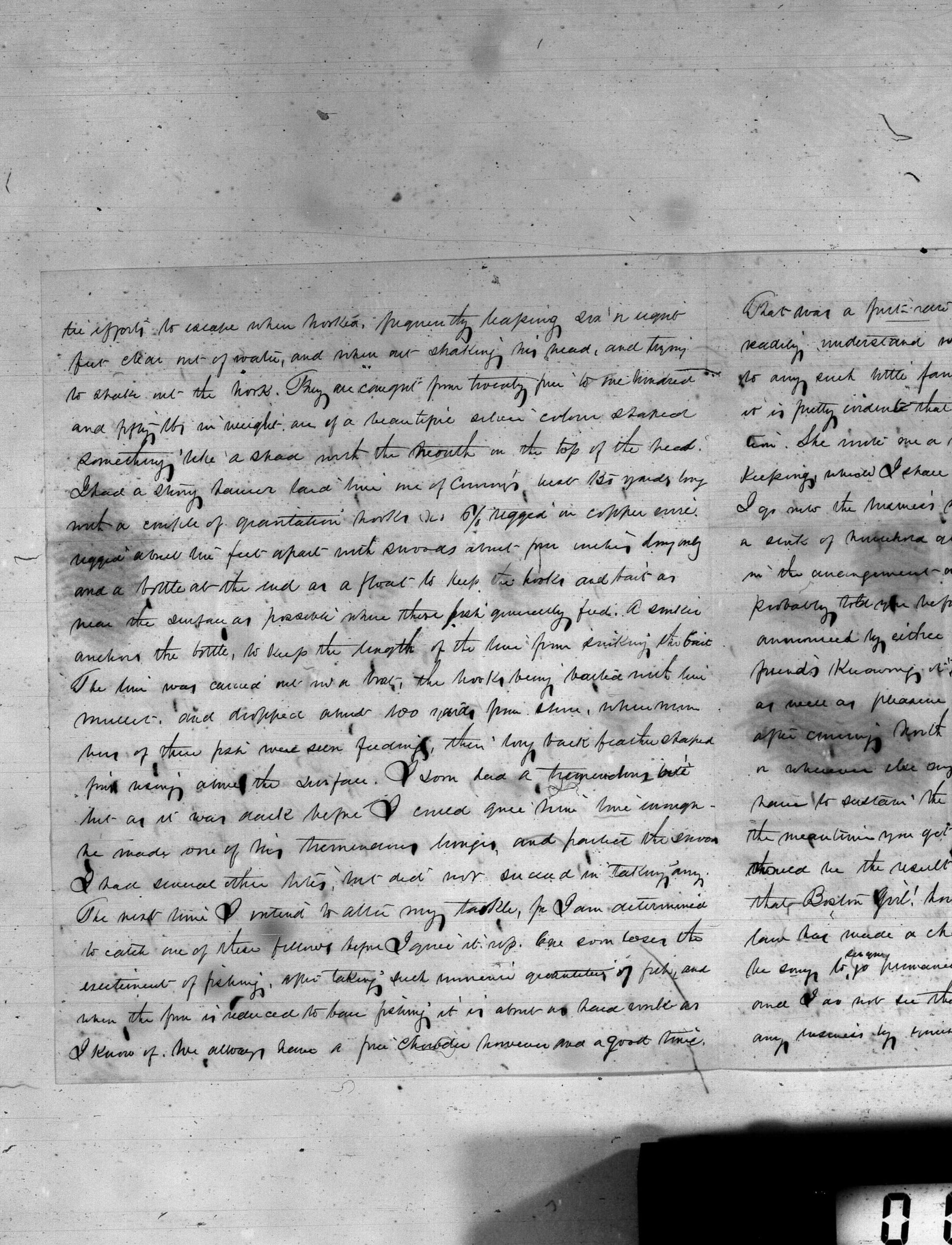
-tic efforts to escape when hooked, frequently leaping ten or eight feet clear out of water, and when out shaking his head, and trying to shake out the hook. They are caught from twenty five to one hundred and fifty lbs in weight, are of a beautiful silver colour shaped something like a shad with the mouth on the top of the head. I had a strong hawser-laid line, one of Conn’s [?] best, 150 yards long, with a couple of gravitating hooks No. 6/0 rigged in copper wire, rigged about two feet apart with swivels about four inches long only, and a bottle at the end as a float to keep the hooks and bait as near the surface as possible where these fish generally feed. A sinker anchors the bottle, to keep the length of the line from sinking the bait. The line was carried out in a boat, the hooks being baited with live mullet, and dropped about 100 yards from shore, where numbers of these fish were seen feeding, their long back fins waving above the surface. I soon had a tremendous bite but as it was dark before I could give him line enough he made one of his tremendous lunges, and parted the swivel. I had several other bites, but did not succeed in taking any. The next time I intend to alter my tackle, for I am determined to catch one of these fellows before I give it up. One soon loses the excitement of fishing, after taking such immense quantities of fish, and when the fun is reduced to bone fishing [?] it is about as hard work as I know of. We always have a fine chowder however and a good time.
Page 3 (scan 1631, frame 000551)
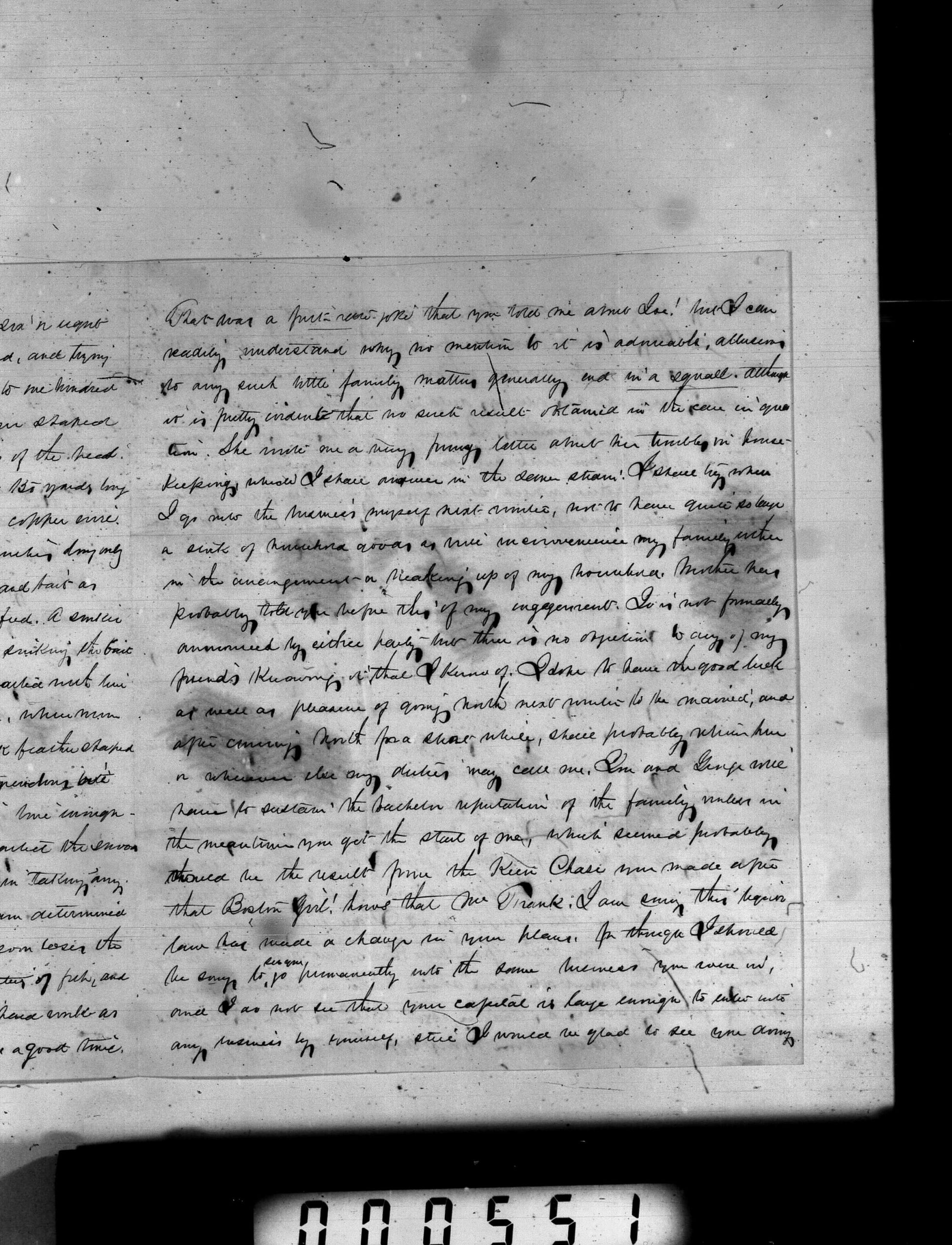
That was a pretty rich joke that you told me about Joe! but I can readily understand why no mention [of] it is so advisable, alluding to any such little family matters generally end in a squall. Although it is pretty evident that no such result obtained in the case in question. She wrote me a very funny letter about her troubles in housekeeping which I shall answer in the same strain. I shall try when I go into the ménage [?] myself next winter, not to have quite so large a suite of [household goods?] as will inconvenience my family either in the arrangement or breaking up of my household. Mother has probably told you before this of my engagement. It is not formally announced by either party but there is no objection to any of my friends knowing it that I know of. I hope to have the good luck as well as pleasure of going North next winter to be married; and after coming North for a short while, shall probably return here or wherever else my duties may call me. You and George will have to sustain the bachelor reputation of the family unless in the meantime you get the start of me, which seemed probably should be the result from the keen chase you made after that Boston Girl! Now then Mr Frank; I am sorry this [new] law has made a change in your plans. For though I should be sorry to [see you] go permanently into the same business you were in, and I do not see that your capital is large enough to enter into any business by yourself, still I would be glad to see you doing
Page 4 (scan 1632, frame 000552)
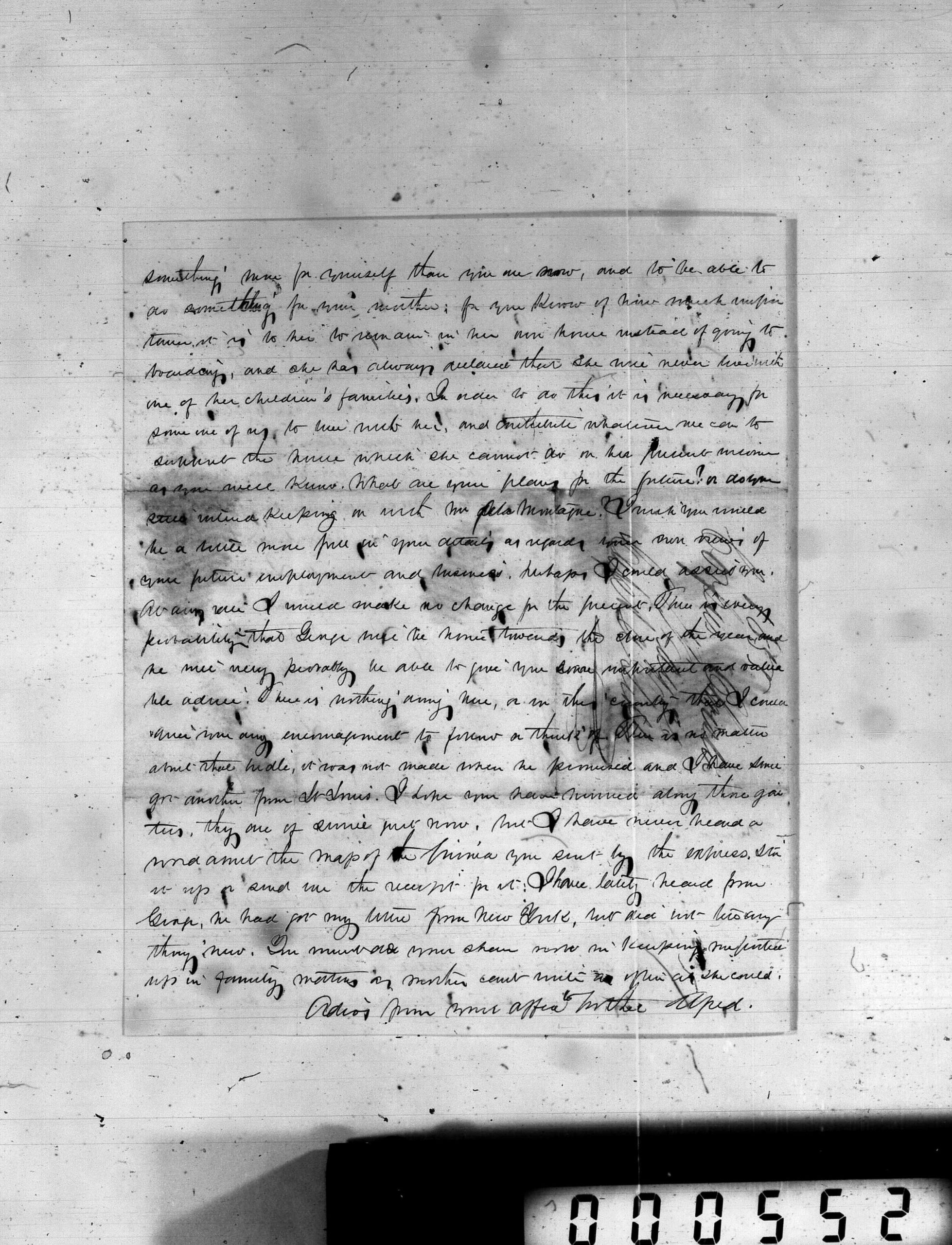
something more for yourself than you are now, and to be able to do something for your mother; for you know of how much importance it is to her to remain in her own house instead of going to boarding, and she has always declared that she will never live with one of her children’s families. In order to do this it is necessary for some one of us to live with her, and contribute whatever we can to support the house which she cannot do on her present income as you well know. What are your plans for the future? or do you still intend keeping on with Mr de la Montagne? I wish you would be a little more full in your details as regards your own views of your future employment and business. Perhaps I could assist you. At any rate I would make no change for the present. There is every probability that George will be home towards the close of the year and he will very probably be able to give you sound, important and valuable advice. There is nothing doing now, or in this country, that I could [give] you any encouragement to follow or think of. There is no [hurry?] about that bridle, it was not made when he promised and I have since got another from St Louis. I hope you have moved along those gaiters, they are of service just now, but I have never heard a word about the map of the Crimea you sent by the express. Stir it up and send me the receipt for it. I have lately heard from George, he had got my letter from New York, but did not know anything new. You must all [do] your share now in keeping my [interest] up in family matters as [Mother] can’t write as often as she could.
Adios from your affect brother
Alfred.
1. THE CHRONOLOGY. This letter dates the general’s engagement to Peggy Foushee Blair of Richmond for the first time: engaged (informally) by May 26, 1855; wedding planned “North next winter” (1855-56); and their first son, Alfred Wolcott Gibbs, was born at Fort Fillmore, New Mexico Territory, on October 27, 1856. The engagement, the marriage, and the arrival at the post this archive documents now form one continuous, dated arc.
2. “Grande-cailles” is Alfred’s rendering of grande écaille (“big scale”), the Gulf-coast French name for the tarpon; his account is among the era’s vivid descriptions of tarpon fishing, a decade before the fish became famous among sportsmen.
3. The passage on their mother’s household – that Laura Wolcott Gibbs “will never live with one of her children’s families” and that the sons must contribute to keep her in her own house – is the sequel, twenty years on, to the story told in Laura’s War: the widow’s fierce independence, and her children’s quiet compact to sustain it.
4. “Since my return” (line one) implies a recent absence from Corpus Christi – possibly the return from the El Paso expedition of 1854, possibly a leave North on which the engagement was made. An open question for the record.
5. “You and George will have to sustain the bachelor reputation of the family” proved prophetic: George Gibbs did not marry until 1871.
Archival citation
Gibbs Family Papers, 1763-1918. U.S. Mss Y; Micro 1117; Photo Lots 3696-3697. Wisconsin Historical Society, Division of Library, Archives, and Museum Collections, Madison, Wis. Digitized research copy (Green collection), Reel 2. Scans 1629-1632; microfilm frames 000550-000552. Every page of the letter is shown above; duplicate microfilm exposures are noted in the reel index.
Suggested citation (Chicago): Alfred Gibbs to Francis S. Gibbs, May 26, 1855, Gibbs Family Papers, 1763-1918, U.S. Mss Y (Micro 1117, reel 2, frames 550-552), Wisconsin Historical Society, Madison. Accessed via AlfredGibbs.com.
Related in the Record
References
Gibbs, A. (1855, May 26). [Letter to Francis S. Gibbs]. Gibbs Family Papers, 1763-1918 (U.S. Mss Y, Micro 1117, reel 2, frames 550-552). Wisconsin Historical Society, Madison, WI.
Gibbs family. (1763-1918). Gibbs Family Papers (U.S. Mss Y; Micro 1117; Photo Lots 3696-3697) [Manuscript collection]. Wisconsin Historical Society, Madison, WI.
Accuracy review: transcription checked against the full-resolution scans, July 11, 2026. Original spelling and punctuation are preserved; editorial matter appears in square brackets and uncertain readings are marked [?] rather than guessed. Corrections are made openly; this page will be updated, never silently, if better readings are established.
Views: 10