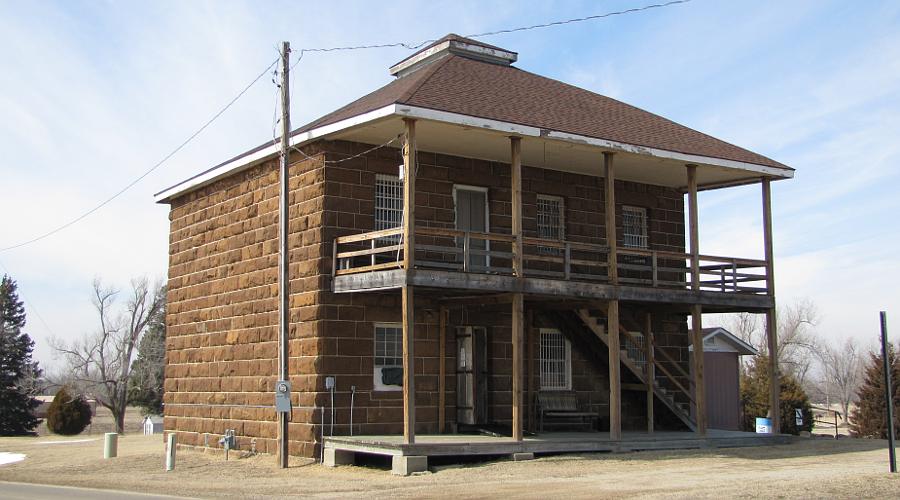

Fort Harker, located in present-day Kanopolis, Kansas, was a vital military outpost on the American frontier during the post-Civil War period. Active from 1866 to 1872, it played a crucial role in protecting settlers, facilitating western expansion, and serving as a supply and distribution center for military operations on the Great Plains (Guerns, 2002).
The fort was built to replace the aging Fort Ellsworth, which had been hastily established in 1864 at the junction of the Fort Riley-Fort Larned Road and the Smoky Hill Trail. Fort Ellsworth was initially tasked with defending wagon trains from Native American resistance and distributing supplies to frontier outposts such as Fort Zarah, Fort Larned, and Fort Hays (Mix & Mix, 2006). However, within two years, the site proved insufficient due to rapid growth and poor facilities. In November 1866, General Winfield S. Hancock issued orders to construct a new installation approximately one mile northeast. This new post, Fort Harker, was named after General Charles Garrison Harker, a Union officer who died at the Battle of Kennesaw Mountain (Wikipedia, 2023).
Fort Harker’s construction began before the official order was issued, with a team of masons and carpenters already employed by September 1866. The fort was completed by mid-1867, coinciding with the arrival of the Union Pacific Eastern Division railroad, which transformed the fort into a central hub for distributing supplies to other western military posts (Mix & Mix, 2006). Two large warehouses and a depot were constructed, cementing Fort Harker’s role as a logistical cornerstone for western expansion.
Shortly after the completion of the fort, a cholera epidemic struck. It began in late June 1867 and was likely brought to the area by the 38th Infantry traveling from St. Louis, Missouri. The disease spread quickly through the garrison and into the surrounding civilian population. Official reports noted 392 cases and 24 deaths among white troops, and 500 cases with 22 deaths among Black troops stationed at or near the fort (Mix & Mix, 2006). Civilians were equally affected, with 58 citizens reported buried during June alone (Legends of America, n.d.).

Despite the outbreak, Fort Harker remained a central staging ground for military operations against Native American tribes. Troops from the fort performed more escort missions for wagon trains in 1867 than those at any other frontier post during that era. After the arrival of the railroad, however, the need for escorts diminished, and the fort shifted toward supporting military campaigns logistically. Notably, it served as the base for General Winfield S. Hancock’s 1,400-man expedition in 1867. Though intended to intimidate the Cheyenne and other tribes, the campaign backfired, inciting increased Native resistance (Legends of America, n.d.).
In 1868, General Philip H. Sheridan moved his headquarters from Fort Leavenworth to Fort Harker, directing a winter campaign from the post. Brevet Colonel Joseph G. Tilford and elements of General George A. Custer’s 7th Cavalry also wintered at Fort Harker before continuing westward (Mix & Mix, 2006).
By 1871, as Native populations were forcibly relocated and railroads spread across the region, Fort Harker’s strategic importance declined. Troop deployments were reassigned to Fort Union and Fort Hays, and by May 1872, only a token garrison remained. The fort was officially abandoned on October 5, 1872 (Wikipedia, 2023).
Today, several original structures of Fort Harker remain preserved, including the guardhouse, junior officer quarters, and commanding officer quarters. These are maintained by the Ellsworth County Historical Society as part of the Fort Harker Museum (Smith, 2005). Exhibits include historical artifacts, a restored Union Pacific depot, and displays on local salt mining history, which has been a significant industry in Kanopolis for over a century (Stokes, 2023).
Fort Harker’s legacy endures not only through its buildings but also through its role in shaping military and civilian life on the Kansas frontier. As both a staging ground for major campaigns and a safeguard for westward migration, Fort Harker contributed significantly to the narrative of U.S. expansionism and the transformation of the American West.
References
Guerns, J. (2002). Welcome to Fort Harker. Retrieved August 10, 2006.
Legends of America. (n.d.). Fort Harker – Protecting Kansas Pioneers. Retrieved from https://www.legendsofamerica.com/ks-fortharker/
Mix, L., & Mix, C. (2006). Fort Harker. Santa Fe Trail Research Site. Archived from https://www.santafetrailresearch.com
Smith, M. (2005). Welcome to Ellsworth County Museums. Retrieved August 10, 2006.
Stokes, K. (2023). Fort Harker Guardhouse Museum – Kanopolis, Kansas. Retrieved from http://kansastravel.org/fortharker.htm
Wikipedia. (2023). Fort Harker (Kansas). Retrieved from https://en.wikipedia.org/wiki/Fort_Harker_(Kansas)
Views: 468