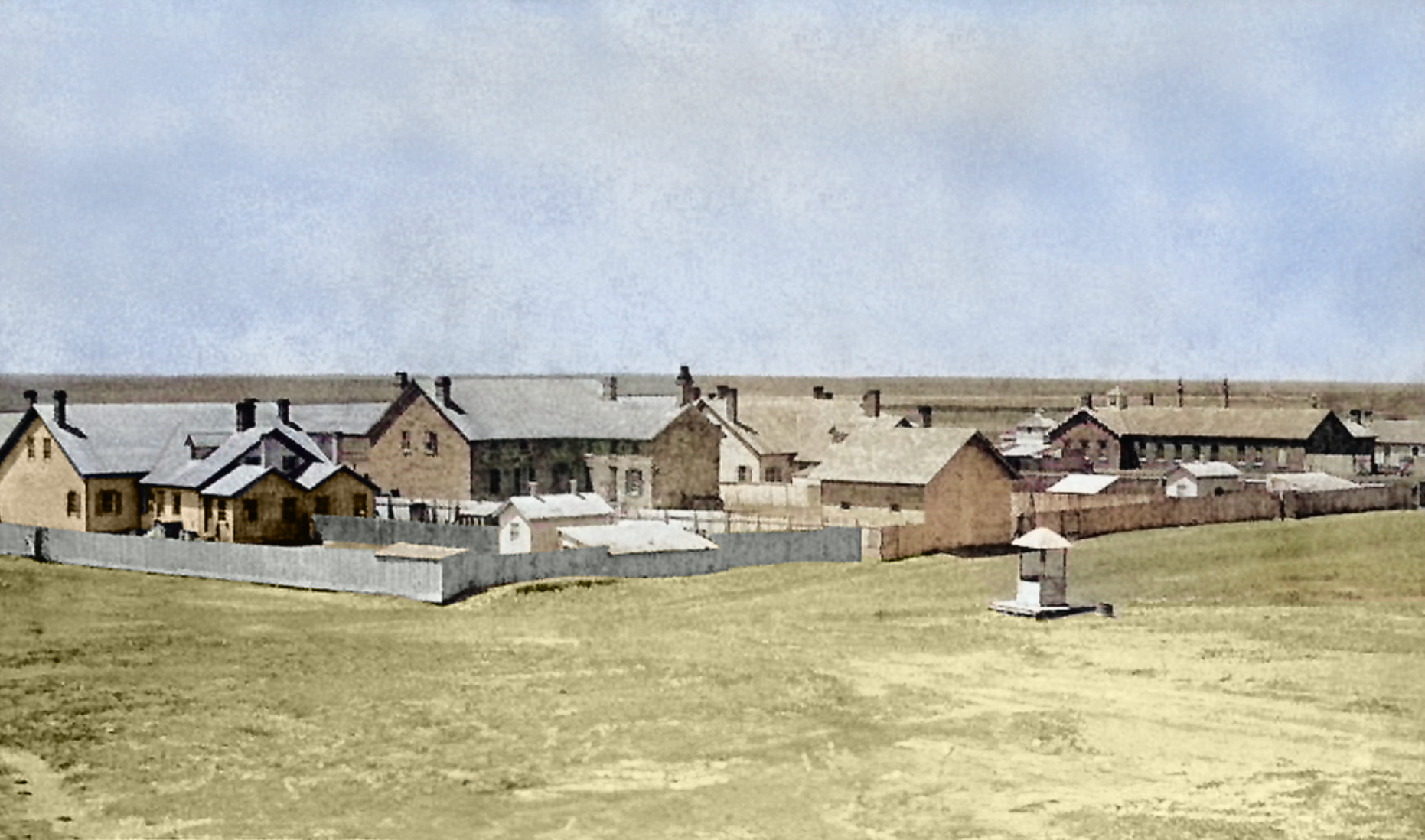
Fort Dodge, Kansas, stands as a testament to the military and pioneering spirit that defined the American West during the mid-to-late 19th century. Established on April 10, 1865, by Captain Henry Pearce under the direction of Major General Grenville M. Dodge, the fort served as a critical military post for protecting wagon trains traversing the Santa Fe Trail en route to New Mexico (Legends of America, n.d.). Located near the intersection of the dry and wet routes of the trail, Fort Dodge occupied a strategic position near the Arkansas River, southeast of present-day Dodge City.
In its earliest days, the fort was little more than a series of primitive dugouts carved into the riverbanks. With no lumber or hardware available, soldiers, many of whom were Confederate prisoners given the option of frontier service, used earth and prairie grass to construct makeshift shelters. These dugouts were spartan and unsanitary, often flooded by spring rains, and diseases such as pneumonia, dysentery, and malaria spread rapidly among the troops (Legends of America, n.d.). By 1867, however, the original fort was relocated and rebuilt with stone structures, signaling a permanent military presence in the area.

The threats Fort Dodge faced were not merely environmental. The surrounding plains were rife with tension between Native American tribes and encroaching settlers. In 1868, Comanche and Kiowa warriors attacked the fort, resulting in four fatalities and seventeen wounded soldiers. This attack prompted General Philip H. Sheridan to camp near the fort and outfit his forces for a retaliatory campaign against the Plains tribes. Although General Alfred Sully initially prepared for the winter campaign, command was ultimately passed to General George A. Custer, who continued the offensive (Legends of America, n.d.).
During its peak, Fort Dodge housed up to four companies of troops, acting as a protective buffer for freighters, emigrants, and military convoys. Yet as the perceived threat from Native tribes diminished, the fort was reduced to a skeleton crew. By December 1880, parts of the reservation were opened to settlers, many of whom were not traditional homesteaders but rather local gamblers, saloon keepers, and other opportunists from Dodge City (Legends of America, n.d.). The fort was officially closed in 1882, and its final troops were reassigned to Fort Supply, Oklahoma, later that year.
Though military activity ceased, the site remained significant. In 1889, after efforts from Dodge City residents and veterans’ advocates, federal legislation authorized the transformation of the former fort into a soldiers’ home. By early 1890, the Kansas Soldiers’ Home was operational, hosting veterans from the Civil War, the Mexican-American War, Indian Wars, and eventually even those from later conflicts including both World Wars, Korea, and Vietnam (Legends of America, n.d.).
Fort Dodge also holds geographical and cultural significance beyond its military role. Though not directly on the main route of the Santa Fe Trail, the post was intimately tied to the trail’s southern branches. Trade caravans and military escorts frequently passed through the area, and the land surrounding the fort still bears visible ruts from the trail’s traffic nearly 150 years later (Legends of America, n.d.; Wikipedia, 2023).
The fort’s founding has sparked some debate regarding its namesake. General Grenville M. Dodge claimed in his autobiography that it was named after him, albeit sarcastically, as a slight by troops forced to winter in harsh conditions without adequate supplies (Dodge, 1914). However, others have suggested the name honors Colonel Henry Dodge, an earlier frontier officer who led expeditions through the area in the 1830s (Gannett, 1905).
Today, Fort Dodge remains an active and historic site. The Kansas Soldiers’ Home still operates, offering medical care and housing for retired service members. The area also features a library and museum, residences, and preserved buildings that reflect its military past. The fort’s long arc from a frontier outpost to a sanctuary for veterans mirrors the transformation of the American West itself, from a contested borderland to a settled and commemorated chapter of national history.
References
Dodge, G. M. (1914). *Biography of Major General Grenville M. Dodge from 1831 to 1871: Written and compiled by himself at different times and completed in 1914.* Retrieved from https://en.wikipedia.org/wiki/Fort_Dodge_(United_States_Army_Post)
Gannett, H. (1905). *The origin of certain place names in the United States.* Government Printing Office.
Legends of America. (n.d.). *Fort Dodge, Kansas – Serving the Santa Fe Trail.* Retrieved from https://www.legendsofamerica.com/ks-fortdodge/
Wikipedia. (2023). *Fort Dodge, Kansas.* Retrieved from https://en.wikipedia.org/wiki/Fort_Dodge,_Kansas


Views: 63