
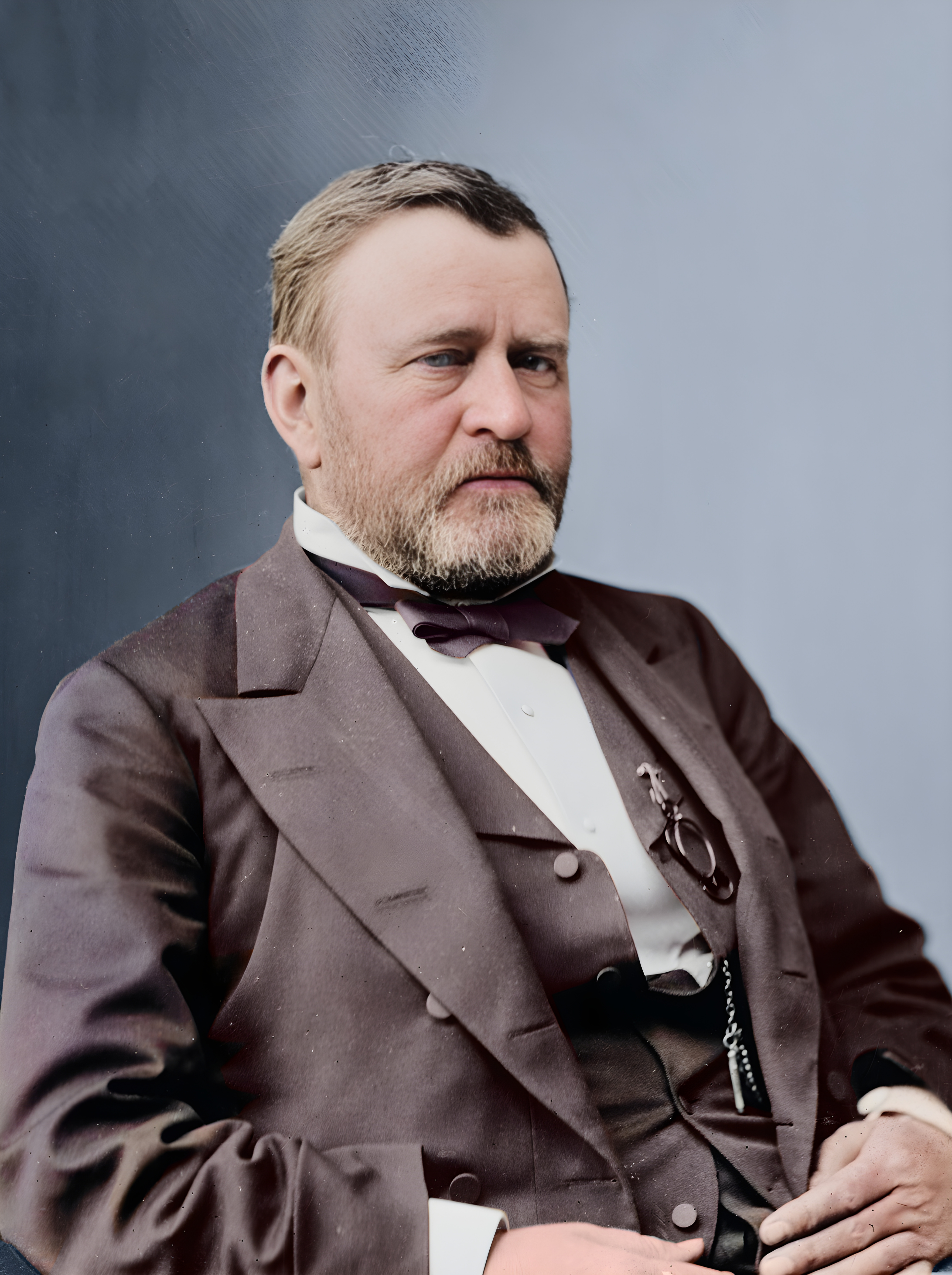
Ulysses S. Grant, the 18th President of the United States and commanding general of the Union Army during the American Civil War, is regarded as one of the most important figures in American history. His leadership helped preserve the Union, and his presidency was marked by efforts toward Reconstruction and the protection of civil rights for formerly enslaved individuals.
Early Life and Military Beginnings
Born Hiram Ulysses Grant on April 27, 1822, in Point Pleasant, Ohio, Grant came from a modest background. His father, Jesse Root Grant, worked as a tanner, while his mother, Hannah Simpson Grant, was a devout Methodist. Ulysses grew up in a rural environment, but his natural affinity for horses and his calm demeanor stood out from an early age. In 1839, through the intercession of Congressman Thomas Hamer, Grant received an appointment to the United States Military Academy at West Point. Due to an administrative error, his name was recorded as Ulysses Simpson Grant, and the name stuck .
Though not particularly distinguished at West Point, Grant was known for his exceptional horsemanship and graduated 21st in his class in 1843. He was commissioned as a brevet second lieutenant in the 4th U.S. Infantry, which led him to participate in the Mexican-American War. Under General Zachary Taylor and later General Winfield Scott, Grant saw combat in numerous engagements, including the battles of Palo Alto, Resaca de la Palma, and the siege of Veracruz. These experiences honed his tactical skills and shaped his views on military leadership .

The Civil War and Leadership
At the outbreak of the Civil War in 1861, Grant initially struggled to find a significant role, but he was eventually appointed as a colonel of the 21st Illinois Infantry. His leadership abilities quickly garnered attention, and he was promoted to brigadier general. One of his first major successes came with the capture of Fort Donelson in February 1862. Grant’s demand for “unconditional surrender” became legendary, earning him national fame .
Grant’s leadership during the Vicksburg Campaign in 1863 solidified his reputation as one of the Union’s most capable generals. His ability to maneuver his troops and lay siege to Vicksburg, a critical Confederate stronghold along the Mississippi River, ultimately led to the city’s surrender on July 4, 1863. This victory effectively split the Confederacy in two and gave the Union control of the Mississippi River, marking a turning point in the war .
Following the victory at Vicksburg, President Abraham Lincoln promoted Grant to lieutenant general and gave him command of all Union armies in March 1864. In this role, Grant coordinated the Union’s military strategy, working closely with generals such as William Tecumseh Sherman and Philip Sheridan. Grant’s Overland Campaign, which included the bloody battles of the Wilderness and Spotsylvania, exemplified his relentless pursuit of the Confederate forces under General Robert E. Lee. Despite heavy casualties, Grant continued to press Lee’s army, culminating in Lee’s surrender at Appomattox Court House on April 9, 1865.
Post-War Presidency and Reconstruction
After the war, Grant was celebrated as a national hero. His popularity eventually led to his election as the 18th President of the United States in 1868. His presidency, which lasted from 1869 to 1877, was marked by efforts to reunify the nation and to enforce civil rights protections for African Americans, particularly through the Reconstruction Acts and the enforcement of the 15th Amendment, which granted African American men the right to vote. Grant also worked to dismantle the Ku Klux Klan, signing the Ku Klux Klan Act in 1871, which gave the federal government the authority to suppress the group’s violent activities .
However, Grant’s presidency was not without controversy. His administration was marred by several scandals, including the infamous Crédit Mobilier scandal and the Whiskey Ring, where government officials were implicated in fraudulent schemes. Though Grant was not personally involved, the corruption within his administration damaged his reputation .
Final Years and Legacy
After leaving office, Grant embarked on a world tour with his wife, Julia, meeting with foreign dignitaries and receiving widespread acclaim. Unfortunately, financial troubles later plagued his life when a brokerage firm he invested in collapsed. Facing bankruptcy, Grant turned to writing his memoirs as a means of providing for his family. Despite suffering from throat cancer, Grant completed his memoirs shortly before his death on July 23, 1885. The memoirs were a critical and commercial success, securing his family’s financial future and solidifying his place in American history .
Grant’s legacy is complex. While he is remembered as a brilliant military leader who helped preserve the Union, his presidency is often viewed as a mix of noble intentions marred by political mismanagement. However, his steadfast efforts to protect the civil rights of African Americans during Reconstruction have earned him lasting recognition as a leader who sought to heal a divided nation.
Final Thought
Ulysses S. Grant remains a pivotal figure in American history, both for his role in leading the Union to victory in the Civil War and for his presidency during a challenging period of Reconstruction. His leadership on the battlefield, combined with his efforts to promote civil rights, define his enduring legacy as one of the nation’s most influential leaders. As historian Ron Chernow noted, Grant’s “heroic efforts to win the Civil War and his magnanimity toward the defeated South ensured that he would be remembered as one of America’s great soldier-statesmen” .
Views: 107