
George Gibbs to His Dearest Mother
Astoria, Oregon, Dec. 19, 1852
My Dearest Mother,
I wrote a hasty letter to Wolcott last Sunday to apprise him of my arrival in San Francisco on my way here, and as you will probably want an autobiography of the last few months of my life, I will give you that in brief, and the business matters to him on another sheet. My letters to you have clearly met with the same misfortunes that yours have on their way to my “diggings.” I trust, however, that they will all eventually turn up. I have written once a month through the summer until the last month, November, when I was prevented by want of paper, until the end of it, and then, as I had resolved to go to the seaboard for the winter, I deferred it till I should reach the Bay. I received quite a number of letters at the end of September and dispatched in return a large budget by the next train that went down. The next I got were at the Bay on the 1st of December and still more at Astoria the day before yesterday. These came down to September from you and Laura (Laura Wolcott Gibbs [d’Oremieulx] – his siter), and one from Wolcott (OLIVER “WOLCOTT” GIBBS – his Brother) of Oct. 8th. I mention them particularly because I find from your letters as well as Alfred’s that you have been under some alarm.
I remained at Gullion’s Bar on the Salmon after my return from the mountain expedition, of which I gave some account in my letter to Austin Stevens, from the end of September to the middle of November, mining in the riverbed or in the bars and creeks, but without much success, as in October it rained heavily for a few days and the water rose rapidly. The best work is done at the extreme low water which precedes the fall rains. This year these set in nearly a month earlier than usual for a short time and, though the river fell again so as to enable the miners to repair the dams and resume work, they recommenced with great violence and not only the dams were washed away but the bridge over the Salmon carried off. In these canyons, a rise of 15 feet in a night is not unusual.
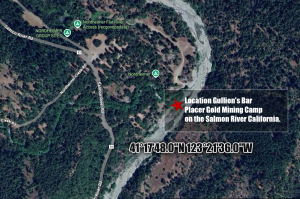
RESEARCHER’S NOTE: Established in 1850 along the Salmon River, Gullion’s Bar was one of the premier placer gold mining camps in early California gold rush history. Originally situated in Trinity County, it quickly gained a reputation as one of the region’s largest gold producers alongside nearby camps like Sawyers Bar and Negro Flat. The camp’s location shifted through various administrative boundaries, becoming part of Klamath County in 1851 before its eventual placement in modern-day Siskiyou County. Although the initial riverbed placers eventually dwindled, a new gold strike on Nordheimer’s Creek in 1858 revived the settlement at a site now known as Nordheimer Flat. By 1868, the camp had evolved from simple panning to more advanced operations, supported by a two-mile ditch constructed to provide the steady water supply necessary for large-scale mining.
I intended next to conduct the water of one of the small creeks over a high bar and work a long tom for the winter, on my own account. A company had been engaged all summer in building a heavy timber dam across a larger branch, for the purpose of throwing it over the extensive flat of Gullion’s Bar, and I had expected to hire water from them. I had accordingly spent a fortnight on the house we were to winter in, but the freshet prevented their finishing the work. I concluded to try a smaller one myself. But the train sent down for our provisions did not return, and there was every appearance of severe scarcity in the mines generally. I did not consider it safe to remain cooped up in a place almost impossible to get out of or into after the snows fall, and still did not like to move again when I heard that a packer who had passed up had reported that I was appointed to an office, which, according to the rumor, was worth $100,000. In some wonder at the liberality of Congress and the Cabinet, I shouldered my rifle and traveled up to the packer’s trading post. There I got a little clearer idea of the matter. It was a custom house officer in Oregon, but there were no letters. The idea of going back to Astoria at the old pay of a collector, as I supposed it still to remain, did not please me, but I was of course ignorant of how far I might be committed, was pretty near broke again, and had every prospect of present starvation, saving always black-tailed venison which is not much better than mule. Accordingly, I concluded to get out of that, at any rate, trusting to find some certain information below or at any rate to get employment for the winter at the sawmills on Humboldt Bay. One or two other miners were of this same mind and the storm holding up for a day, I shouldered my inevitable gun, took my blankets on my back, and leaving the rest of my plunder at the shanty, crossed the mountains to Orleans Bar on the Klamath, my old stamping ground. There I found one or two old letters and a note from an acquaintance mentioning my appointment. It was lucky I got out when I did, for it snowed that night heavily on the mountains and covered the trail.
RESEARCHER’S NOTE: A placer gold mining camp was a quintessential feature of the 19th-century gold rush landscape, representing a temporary, utilitarian settlement built for the sole purpose of exploiting a nearby placer deposit. These deposits consisted of gold particles that had been naturally eroded from their source veins and washed into riverbeds, sandbars, and other alluvial areas. Due to the accessibility of this gold, which could be extracted with simple tools like pans and sluice boxes, miners would establish ephemeral camps directly adjacent to the deposits. These settlements were often rudimentary, composed of tents and crude cabins, and existed only as long as the gold remained plentiful. Once a deposit was exhausted, the camp would be abandoned as miners moved on to the next promising location, leaving behind little more than a ghost of the brief, intense activity that had defined its existence.
RESEARCHER’S NOTE: The area known today as Orleans has a rich, layered history that began long before the arrival of European-Americans. Originally the site of a significant Karuk Tribe settlement named Panamnik, its identity was dramatically reshaped during the California Gold Rush. Prospectors established a bustling mining camp on the river, calling it New Orleans Bar, which quickly became a key center for placer gold operations in the region. The settlement’s prominence was solidified in 1855 when it was officially renamed Orleans Bar and designated the county seat of the now-defunct Klamath County. Today, this unincorporated community in Humboldt County continues to be a place of deep historical and cultural importance, where the Karuk Tribe maintains a strong and active presence.
At the bar, I learned that there was no provision on the river, that everybody had put off packing till the last in hopes of a fall in prices and in consequence had been caught by the early rains. After spending a day with my friend Dr. Whitmore and finding it would not stop raining, I traveled down to the forks with a couple of companions, making about twenty miles on an awful trail, wet through and what was worse being obliged to pack my blankets, which weighed twenty pounds dry and I don’t know how much more when well soaked. At the forks of the Klamath and Trinity, however, we found a welcome at the trading post of a friend of mine, Mr. MacDonald, a New Yorker who was with us on the expedition last year and had fixed his tabernacle at this point. He was luckily going down with his train which saved me forty-five miles of severe footing, so I put my blankets over a pack saddle, tied a rope round a mule’s jaw for a bridle, and with a hide lariat twisted into a pair of stirrups, started to help drive his train. We had no other company but a big dog, and it was not altogether a safe operation, but needs must, etc. We had to make two camps in the mountains, at the second and most dangerous one fortunately finding company in a train going up and the third day got into Union.
I never was a good horseman yet, but when I hear of “rough riding” I shall always think of traveling through the Redwoods behind a light train on a pack saddle as a highly creditable performance. The soil in these Redwood forests is a deep black mold which when wet becomes a greasy glutinous paste to an astonishing depth. The ground is moreover in this particular tract, very rough in steep up and down pitches and covered with protruding roots, between which on the trail are deep holes full of water and mud. Through all this we hurried at breakneck pace to reach the town before nightfall, the mules sometimes not raising a foot for twenty feet where a good slide presented itself, and at the bottom bringing up “all sitting” instead of standing. Besides this, we had to cross several streams swollen just to the swimming point and rapid as torrents. I believe I gave you a description of mule driving last spring when I went out to the mines with the cattle, but driving a light train is worse than a loaded one as the animals are always running off the road to pick up grass. At the bay, I found several vessels ready to go out, but we were detained until the 4th by the severe storms which have swept this coast the past month. There I found just arrived a package of letters which the boys had forwarded containing among others two from Mr. [Elisha?] Whittlesey informing me of the appointment, etc.
We had a speedy but boisterous run down to San Francisco, thirty-six hours. There I saw George and his brothers and met some army friends of Alfred’s and mine. Capt. [George] Stoneman, Major [Osborne] Cross, etc. I also saw Dr. Stout and passed part of the evening with him. Lt. Col. [Joseph] Hooker, I believe intends soon to return to the states. I beg if you see him you will show him all attention as a most gentlemanly officer and a warm friend. Williamson, I understand, was going home too, but did not meet him. Dr. Griffin was at Benitia [Benicia]. I had previously got a very long and pleasant letter from him. He is a perfect trump and when you see him you will not wonder that we both like him as much as we do.
I left with the boys to forward to you by the Sovereign of the Seas, which was to sail in a few days, a quantity of Indian traps—two Klamath women’s aprons, one of straw ornamented with the nuts of the sugar pine and the “dew claws” or little hoofs of the deer, and the other entirely of pinones or pine nuts. This last is very dirty, but it is the most valued of the two and may be considered as like old lace. There is also a necklace of straw braid and some tassels for the hair. Specimens of rope and twine and a number of baskets—the round small ones worked in figures are worn on the head, the flat ones are used to winnow seeds from the chaff, the close deep ones are pots in which they cook the acorn porridge by putting in hot stones. The six round sticks are the gambling tools. The game is to guess in which hand the player holds the one which is unmarked, the whole being first rolled up in a bit of bunch of hay and torn in two, an accompaniment of singing and gesticulating being kept up. I will give you a clearer account of this when I send you my notes. You will also find a Humboldt Bay quiver with bow and arrows, some fishhooks, a seal spear head of bone, and an elk horn in the velvet. I could not get any skins except at an outrageous price. By the way, I have not heard whether you got the things I sent you last winter. I trust the sea otter got out safe. I have sent by express to Mr. Hall a dozen Redwood seedlings and half a dozen young salmon berry plants. Tell Wolcott to say to him that the Redwoods are to be planted in a oriface [?] of mold (vegetable) and say I will write to Mr. Hall himself soon.
I sent Wolcott an account of the sugar pine a while ago. If he did not publish it, tell him to hold on to it and I will send a more correct one together with measurements of the Redwoods, counting ages by rings, etc. Did he get the account of the Shoshonee falls which I sent for publication? Whenever he prints anything, I should like a copy. If he has a spare one of the Salmon article, tell him to send it to me. Schoolcraft writes me that he is publishing my journal in his large work with the map reduced. I regret this as I could now add much to it. I was in hopes it would have appeared merely in the annual Indian Department report. It is not valuable enough for a more permanent or costly shape. But the moment I am settled I mean to rewrite the portions relative to the Klamath and embody my notes of the last summer which I will send to Wolcott to do what he likes with. I have written a note to Mr. de Couviers [?] whom I had not time to hunt up to apologize to him for my apparent neglect and to let him know my future address, as well as to ask his. I always envy you the pleasant people you constantly speak of in your letters as having met. I am afraid it is true that I should be somewhat out of water at a watering place nowadays, but the imagination still wants society with a great deal of pleasure. What would you have said if I could have suddenly appeared among the Newport crowd in my usual costume? A pair of buckskin breeches fringed down the legs, a red flannel shirt over a hickory one, and a Panama hat, once worth an ounce but blackened with dust and sweat. A leather belt supporting a sheath knife and revolver and a beard as long and grizzly as a bearskin.
I am sorry you have had any uneasiness about me. I have never been in better health, though my weight is much reduced—even Alfred could no longer complain of my fat—I weigh but 153 pounds.
Well, in any event, I had to quit the mines for the winter and even if our new Uncle Sam turns me out next spring I can but go back again with the experience of the past summer. I think I should meet with success. It takes some time to learn that, as with any other trade. But sufficient for the day is the evil thereof. Goodbye, my dear mother. I will write again by the next steamer and must now talk to Wolcott. Love to all my friends from your son,
George
Views: 25