Wolcott Gibbs to Cadet Alfred Gibbs – Berlin, August 1845
The Gibbs Family Papers · Reel 2 · The Alfred Gibbs Correspondence · The Cadet Years
Wolcott Gibbs to Cadet Alfred Gibbs – Berlin, August 1845
“I would lay any wager that the corps of Cadets at West Point would drive an equal number of Prussian soldiers off the field in 15 minutes.” The chemist brother reviews the Prussian army for the cadet.
Wolcott Gibbs, twenty-three and studying chemistry in Berlin, turns military correspondent for his cadet brother: “Dear 1st Lieutenant” – saluting Alfred’s new cadet rank – and then a professional’s inventory of the Prussian army. Every third man in Berlin an officer; every private carrying a sword; the spiked helmets sketched in ink mid-sentence (“the spike of brass at the top serves to ward off blows from above”); the arsenal’s fifty or sixty thousand percussioned stands of arms; the grand review of 15,000 before the King. And then the verdict only a West Point cadet’s brother would dare: for all their drill, “they do not look as if they could fight” – and the corps of cadets would drive an equal number of Prussians off the field in fifteen minutes. The letter closes with the study advice of a working scientist (“think over what you have learnt… exactly as a cow chews the cud”) and breaks off mid-sentence at the frame’s edge, promising the cadet his profession would always mean bread and butter.
❦The Letter
Page 1 (scan 1139)
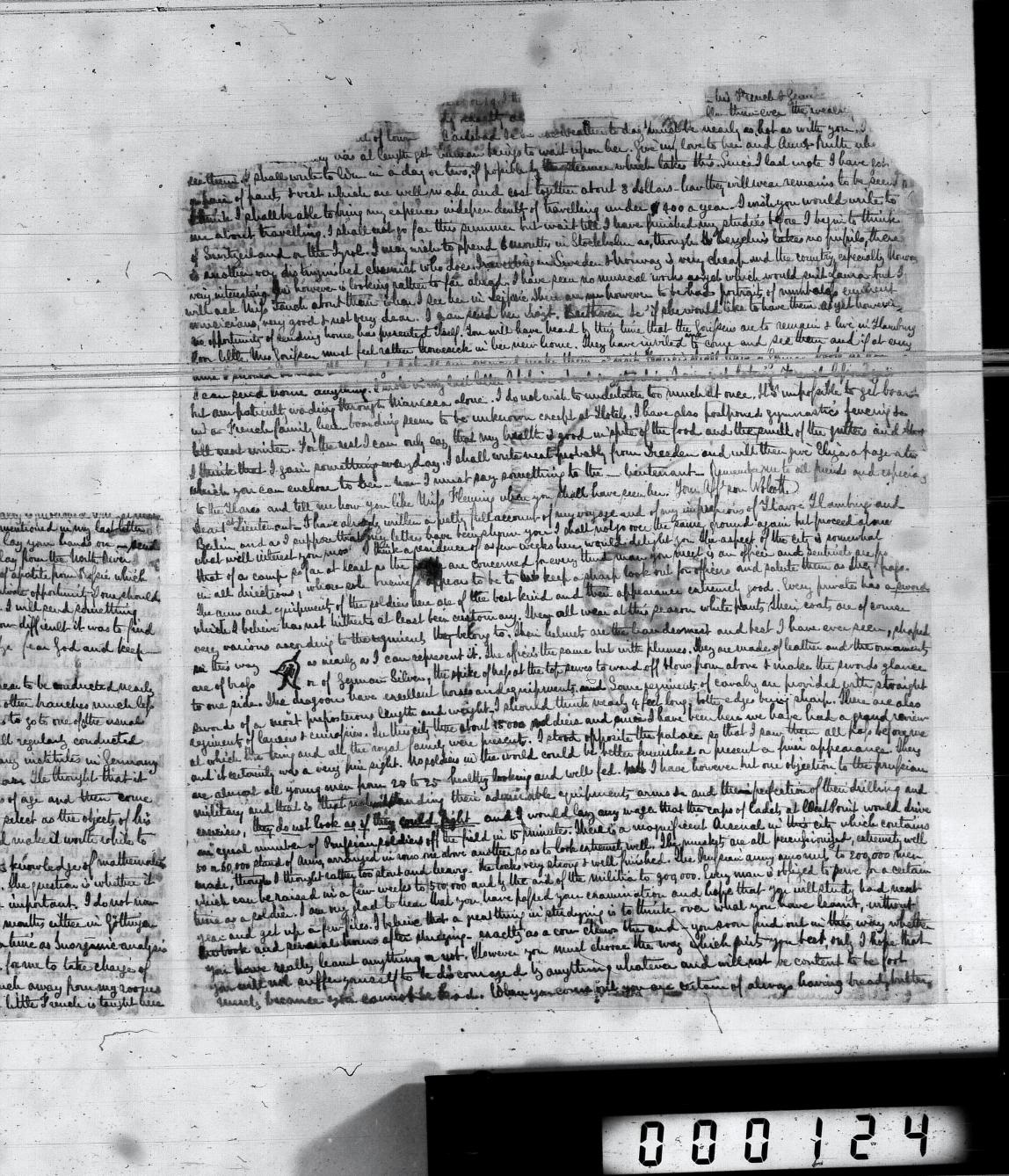
[End of a letter to his mother; the top lines are cropped by the frame and badly faded, with heavy show-through:]
[fragmentary line: “…er or [?] I th…”] … his French & Germ[an] …
[fragmentary line: “…[?] exactly as…”] … than ever the wealthy …
… out of town – Carlsbad &c &c[?] – The weather to day must be nearly as hot as with you. [?]
…[?]y has at length got human beings to wait upon her. Give my love to her and Aunt Ruth[?] who[m?]
[?] see them[?] I shall write to her in a day or two, if possible by the steamer which takes this. Since I last wrote I have got
a pair of pants & vest which are well made and cost together about 8 dollars – how they will wear remains to be seen
I think I shall be able to bring my expences independently of travelling under $400 a year – I wish you would write to
me about travelling. I shall not go far this summer but wait till I have finished my studies before I begin to think
of Switzerland or the Tyrol. I may wish to spend 6 months in Stockholm as, though the[?] Berzelius[?] takes no pupils, there
is another very distinguished chemist who does. Travelling in Sweden & Norway is very cheap and the country, especially Norway
very interesting. This however is looking rather too far ahead. I have seen no musical works as yet which would suit Laura but I
will ask Miss Tauch[?] about them when I see her in Leipsic. There are now however to be had portraits of numbers of[?] eminent
musicians, very good & not very dear. I can send her Liszt, Beethoven &c if she would like to have them. As yet however
no opportunity of sending home has presented itself. You will have heard by this time that the Jorissens[?] are to remain & live in Hamburg
Poor little Mrs Jorissen[?] must feel rather homesick in her new home. They have invited ^me^ to come and see them and if at any[?]
[line damaged at a fold, largely illegible: “time I promised …”]
[line damaged at a fold, largely illegible: “…I wrote in my last letter I believe about my studies … but am patiently wading through Marietta[?] alone …”]
I can send home anything. I [?] in my last letter [several words illegible]. I do not wish to undertake too much at once. It is impossible to get board
in a French family here; boarding seems to be unknown except at Hotels. I have also postponed gymnastics fencing &c
till next winter. For the rest I can only say that my health is good in spite of the food and the smell of the gutters and that
I think that I gain something every day. I shall write next probably from Dresden and will then give Eliza a page or two
which you can enclose to her – now I must say something to the – Lieutenant – Remember me to all friends and especially[?]
to the Hares and tell me how you like Miss Fleming when you shall have seen her. Your Aff son Wolcott
[The letter to Alfred begins on the same frame:]
Dear 1st Lieutenant – I have already written a pretty full account of my voyage and of my impressions of Havre[?], Hamburg and
Berlin, and as I suppose that my letters have been shown you I shall not go over the same ground again but proceed at once [to]
what will interest you most. I think a residence of a few weeks here would delight you. The aspect of the city is somewhat
that of a camp so far at least as the [people?] are concerned for every third man you meet is an officer and sentinels are p[osted?]
in all directions, whose sole business appears to be to [struck: -] keep a sharp look out for officers and salute them as they pass
The arms and equipments of the soldiers here are of the best kind and their appearance extremely good. Every private has a sword (underlined)
which I believe has not hitherto at least been customary. They all wear at this season white pants their coats are of course
very various according to the regiments they belong to. Their helmets are the handsomest and best I have ever seen, shaped
in this way [small ink sketch of a spiked helmet] as nearly as I can represent it. The officers the same but with plumes. They are made of leather and the ornaments
are of brass or of German Silver, the spike of brass at the top serves to ward off blows from above & make the swords glance
to one side. The dragoons have excellent horses and equipments, and Some regiments of cavalry are provided with straight
swords of a most preposterous length and weight. I should think nearly 4 feet long, both edges being sharp. There are also
regiments of lancers & cuirassiers. In this city there [are] about 15,000 soldiers and since I have been here we have had a grand review
at which the king and all the royal family were present. I stood opposite the palace so that I saw them all pass before me
and it certainly was a very fine sight. No soldiers in the world could be better furnished or present a finer appearance. They
are almost all young men from 20 to 25 healthy looking and well fed. [struck: -] I have however but one objection to the Prussian
military and that is that notwithstanding their admirable equipments arms &c and the[ir] perfection of their drilling and
exercises, they do not look as if they could fight (underlined) and I would lay any wager that the corps of Cadets at West Point would drive
an equal number of Prussian soldiers off the field in 15 minutes. There is a magnificent Arsenal in this[?] city which contains
50 or 60,000 stand of Arms, arranged in rows one above another so as to look extremely well. The muskets are all percussioned, extremely well
made, though I thought rather too stout and heavy. The locks very strong & well finished. The Prussian army amounts to 200,000 men
which can be raised in a few weeks to 500,000 and by the aid of the militia to 900,000. Every man is obliged to serve for a certain
time as a soldier. I am very glad to hear that you have passed your examination and hope that you will study hard next
year and get up a few files. I believe that a great thing in studying is to think over what you have learnt, without
textbook and pencil[?] at all[?] hours after studying – exactly as a cow chews the cud – you soon find out in this way whether
you have really learnt anything or not. However you must choose the way which suits you best, only I hope that
you will not suffer yourself to be discouraged by anything whatever and will not be content to be foot
merely because you cannot be head. When you come out you are certain of always having bread & butter,
[Frame ends here; the letter breaks off mid-sentence. Continuation not among these scans.]
[Left edge of the frame shows a narrow strip of an adjacent page (another letter or an inner page), partly legible, upper portion: “…mentioned in my last letter … lay your hands on – send … [?] from the North River … of apatite from [?] which … [?] opportunity if one should … I will send something … [h]ow difficult it was to find … [?] for food and keep-“; lower portion: “…seem to be conducted nearly … other branches much less … to go to one of the usual … all regularly conducted … institutes in Germany … He thought that it … of age and then come … select as the objects of his … [?] make it worth while to … knowledge of mathemati[cs] … the question is whether it … important. I do not [know?] … results either in Göttingen[?] … time as Inorganic analysis … for me to take charge of … [?] away from my rooms[?] … little French is taught here”]
1. The frame carries two letters: the close of Wolcott’s letter to his mother (signed “Your Aff son Wolcott”) and the opening of the letter to Alfred, which breaks off mid-sentence; its continuation is not on the adjacent frames as filmed.
2. “Glad to hear that you have passed your examination” and the jocular “Dear 1st Lieutenant” date the fragment to August 1845, on the news of the June examination and Alfred’s cadet-officer appointment.
3. Wolcott’s ink sketch of the Prussian Pickelhaube appears in the manuscript at the point transcribed; his fifteen-minutes wager belongs beside his December letter’s mock-battle report as the scientist-brother’s continuing military commentary for the cadet.
Archival citation
Gibbs Family Papers, 1763-1918. U.S. Mss Y; Micro 1117; Photo Lots 3696-3697. Wisconsin Historical Society, Division of Library, Archives, and Museum Collections, Madison, Wis. Digitized research copy (Green collection), Reel 2. Scans 1139; microfilm frames as sequenced in the reel index. Every page of the letter is shown above; duplicate microfilm exposures are noted in the reel index.
Suggested citation (Chicago): Oliver Wolcott Gibbs to Alfred Gibbs (cadet), August 1845 (fragment). Gibbs Family Papers, 1763-1918, U.S. Mss Y, Micro 1117, reel 2. Wisconsin Historical Society, Madison, WI. Accessed via AlfredGibbs.com.
Related in the Record
References
Gibbs, O. W.. (1845, August (fragment)). [Letter to Alfred Gibbs]. Gibbs Family Papers, 1763-1918 (U.S. Mss Y, Micro 1117, reel 2) [Manuscript]. Wisconsin Historical Society, Madison, WI.
Gibbs family. (1763-1918). Gibbs Family Papers (U.S. Mss Y; Micro 1117; Photo Lots 3696-3697) [Manuscript collection]. Wisconsin Historical Society, Madison, WI.
Accuracy review: transcription checked against the full-resolution scans, July 11, 2026. Original spelling and punctuation are preserved; editorial matter appears in square brackets and uncertain readings are marked [?] rather than guessed. Corrections are made openly; this page will be updated, never silently, if better readings are established.
Views: 9