The Laboratory at Redwood and Champlin: Wolcott Gibbs at Newport, 1887
The Laboratory at Redwood and Champlin
Wolcott Gibbs retired from Harvard in 1887 and went home to Newport. A four line notice in a local paper that October records the building of the room where he finished his life’s work.
The documents on this page were found by Deborah Anthony Dodge, an Official Contributor to AlfredGibbs.com, in the course of her own searching through online newspaper archives, and supplied to this site in September 2026. The identification of the site on the map is hers as well.
What the memoir does not say
The standard account of Wolcott Gibbs’s life is the memoir Edward W. Morley read before the American Philosophical Society on May 20, 1910, reproduced in full on this site. It is precise about his science and brisk about his surroundings. Of the last twenty years of his working life it says only this:
After the closing of the chemical laboratory of the Lawrence Scientific School, Dr. Gibbs lectured to small classes on the spectroscope and on thermodynamics till 1887, when he retired as professor emeritus. After this, he lived at Newport, where he had before spent summer vacations. His private laboratory was reestablished here, and he continued his researches as long as health and strength sufficed.
Reestablished here. Morley gives no date, no street, and no builder. He does not say whether Gibbs took over an existing room or put up a new one. For a laboratory in which, on Morley’s own account, the most elaborate work of Gibbs’s life was carried on, that is a thin record. The notice below closes the gap.
The notice
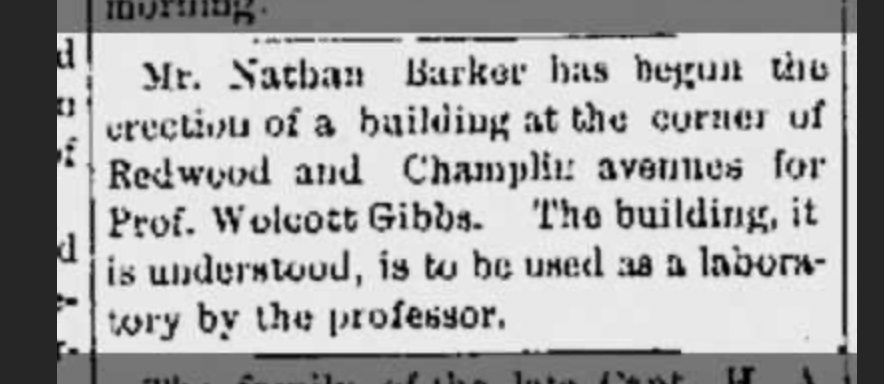
Complete transcription.
Mr. Nathan Barker has begun the erection of a building at the corner of Redwood and Champlin avenues for Prof. Wolcott Gibbs. The building, it is understood, is to be used as a laboratory by the professor.
Four lines, and every one of them useful. The building was new, not adapted: Barker had begun its erection. It went up at a named corner. It was put up for Gibbs, by a builder with a name, in the autumn of the very year he retired as professor emeritus. And the town already knew what it was for.
The paper’s own hedge is worth keeping: it is understood. The Mercury was reporting a thing generally known in Newport, not quoting Gibbs. What the notice proves is that the building was begun and what the town believed it was for. That it was finished, and what became of it, is told by a different witness altogether.
“Behold the Parthenon!”
The building was finished, it was used, and it had a name. The witness is Herman Richter, whose life of Gibbs was written, in George Gibbs’s words, by “a devoted pupil,” and which Gibbs reprinted almost entire in The Gibbs Family of Rhode Island, Chapter VII. On page 138 Richter writes:
In 1887, Dr. Gibbs retired from the Rumford Professorship and was made emeritus. He now withdrew to his estate near the First Beach in Newport, the charming sea-girt town of his forefathers. Not far from his residence he erected a small laboratory, which he had planned with great care, and which, next to his garden, became his special pride. Almost every visitor to the Gibbs home was escorted down the road; and when the modest little building was reached, Dr. Gibbs would turn to his guest, wave his hand gaily toward it, and exclaim, “Behold the Parthenon!”
In the “Parthenon,” with its sun-flooded rooms and its cheerful outlook over the fields and the pond below, the work on the complex acids was continued and completed.
Four things follow, and every one of them answers a question this page had left open. The laboratory was erected, not merely begun. Gibbs planned it himself, with great care, which is why the Mercury could report it as a building going up for him rather than a room taken over. It stood not far from his residence, down a road he walked his visitors along, which is exactly the relation the map bears out between the house at Gibbs and Catherine and the corner at Champlin. And the great work on the complex acids was not merely carried on there but finished there, which is what Morley’s memoir implies and Richter states outright.
He called it the Parthenon. A small building put up by a man who had spent his life among great institutions and had lost his laboratory at one of them, named after the most famous building in the world, with a wave of the hand. Richter took the joke for what it was: “The sense of humor which led him thus to characterize the tiny structure was ever present in Wolcott Gibbs.”
The passage also carries the first physical description of the place: sun-flooded rooms, and a cheerful outlook over the fields and the pond below. That is a topographic test, and it is the best lead now open. Deb Dodge is already on it: “I was hoping that there might be a smaller pond than ‘Easton’s Pond’ which is in clear view from Wolcott’s house on Gibbs/Catherine; as well as from Champlin and the currently named Hunter. Since Richter mentions ‘the outlook of the fields and the pond below’ I imagine there was little development there at the time.” Easton’s Pond lies east and below both the house and the Champlin corner, and in the 1880s the ground between was open. The description fits the corner this page proposes. It does not prove it, because it fits a good deal of that hillside.
Dating the photograph
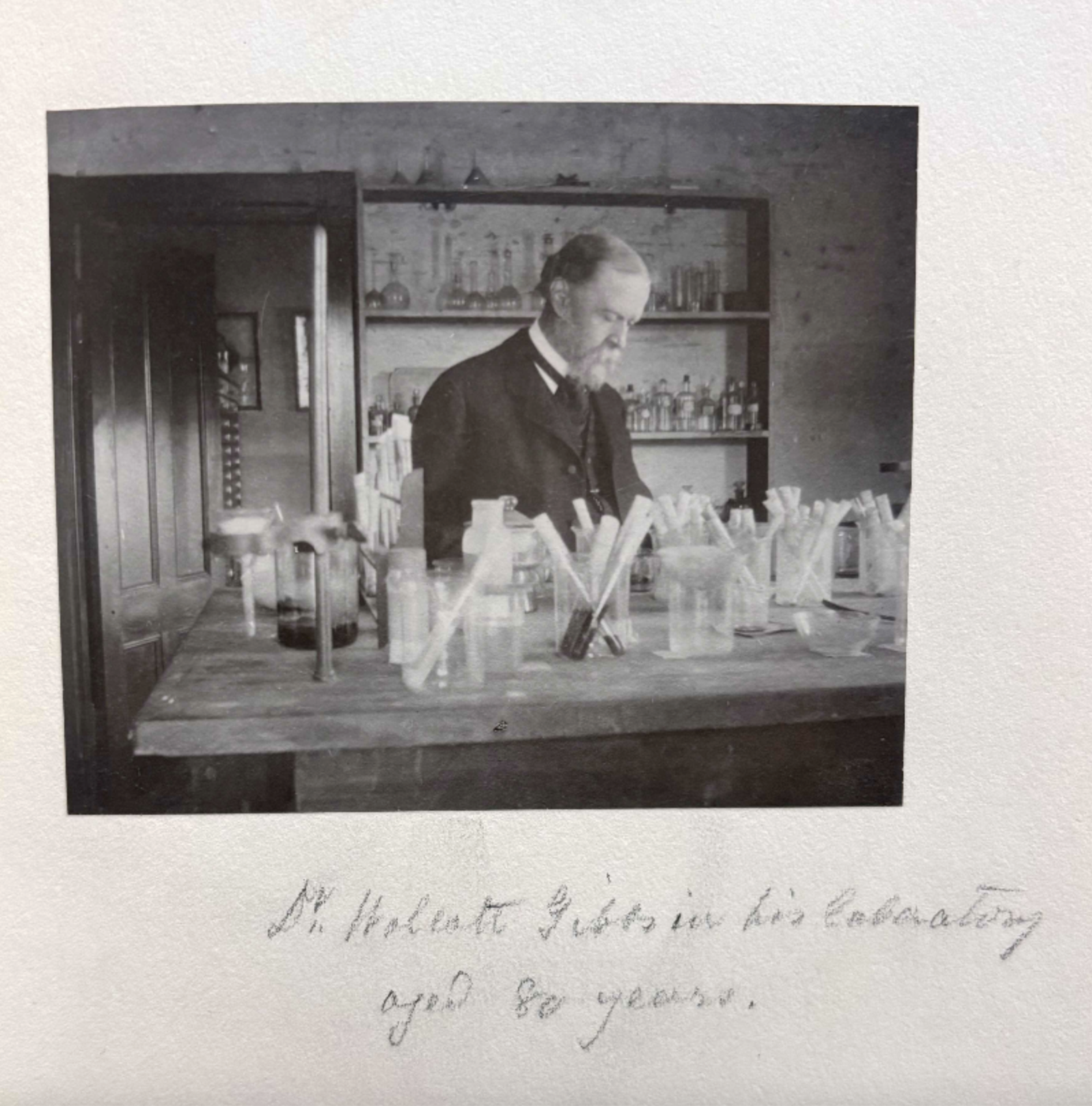
The photograph at the head of this page was for a long time undated, and it was not clear whether it showed Newport at all. Deb Dodge, who supplied it, said so plainly: “I am not sure if the picture of Wolcott in the lab is from his lab in Newport (where I don’t know - basement?) or Harvard before he retired.”
On September 11, 2026 she found the uncropped print at the Newport Historical Society, and it answers the question. Her earlier copies had cut off the last line of the caption written in pencil beneath the mount. It reads in full:
The caption, transcribed.
Dr. Wolcott Gibbs in his laboratory
aged 80 years.
Gibbs was born on February 21, 1822. Aged eighty places the photograph in 1902. That is fifteen years after Nathan Barker began the building at Redwood and Champlin, and fifteen years after Gibbs left Cambridge for good. By 1902 he had no laboratory at Harvard to be photographed in: the Lawrence Scientific School laboratory had closed to him in 1871, and he had retired as professor emeritus in 1887. A photograph of Gibbs at eighty, at work in what its own caption calls his laboratory, is a photograph taken at Newport.
And since Richter puts Gibbs at work in the Parthenon from 1887 onward, a photograph of him at his bench at Newport in 1902 is, in all likelihood, a photograph taken inside the Parthenon. The room in it is bright, which is what Richter means by sun-flooded, and the shelves behind him are loaded with the reagent bottles of exactly the work he says was finished there.
What none of it proves is the address. As Deb Dodge put it, settling that would need “another property map, closer to this date that shows he owns that corner, or another record - tax listings?” So the photograph is firmly Newport and firmly 1902, the building is firmly the Parthenon, and the corner it stood on is still an argument rather than a fact.
Where it stood
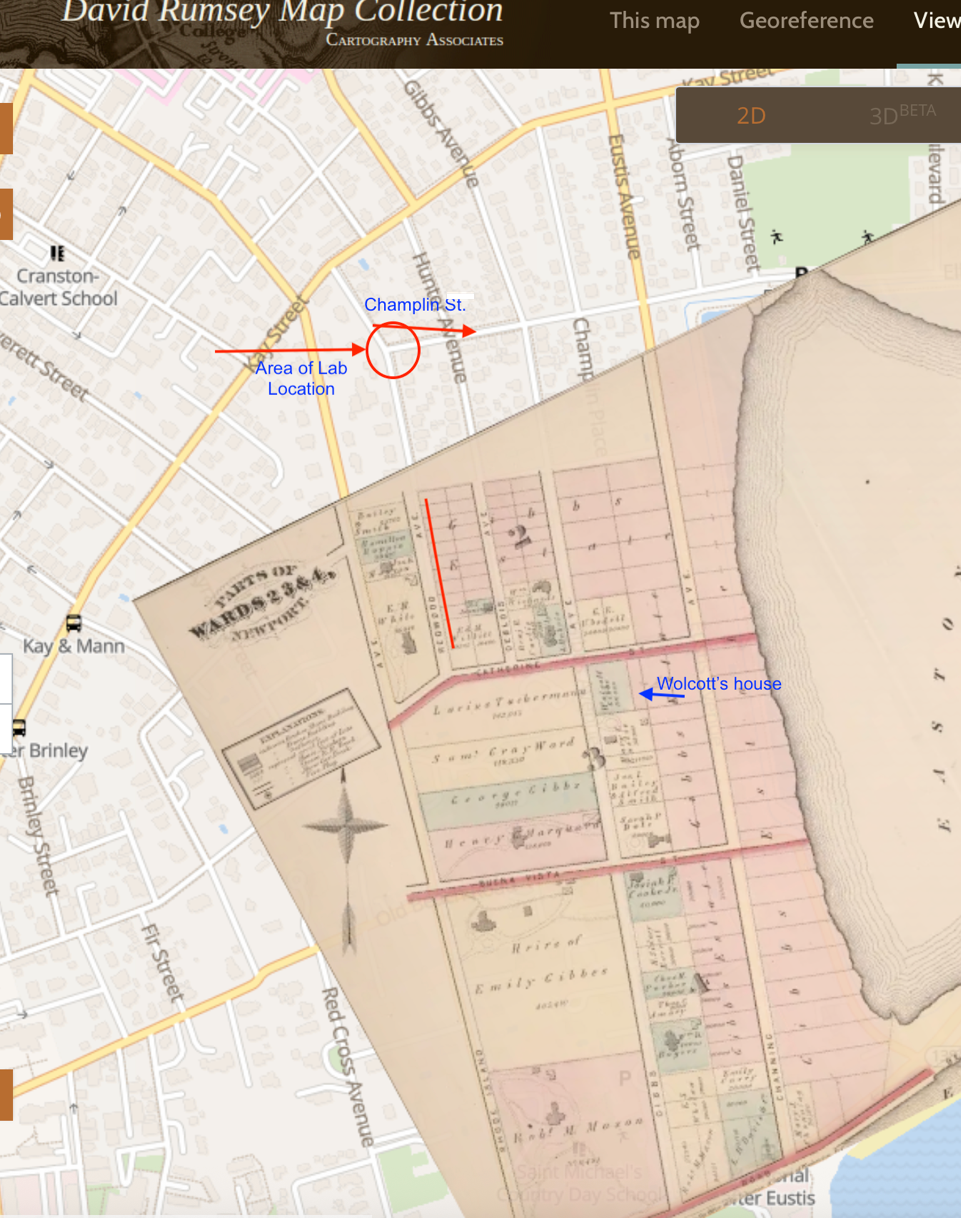
Her annotations, transcribed.
“Champlin St.”, labelling the modern street. “Area of Lab Location”, with a red circle at the corner. “Wolcott’s house”, with an arrow to a plot on the historic plate. A red line drawn along Redwood.
Champlin Avenue is Champlin Street on the modern map, and the corner Deb marks sits a short walk from the house. The historic plate underneath carries the family across it in property lines: a plot marked George Gibbs, and another marked Heirs of Emily Gibbs. The modern map laid over it still has a Gibbs Avenue running through the same ground. Gibbs did not build his laboratory in a town he happened to retire to. He built it among his family’s own lots, in the place Morley says he had been summering for years.
Where it stood today
The notice names a corner, and a reader may reasonably want to go and stand on it. One of the two streets can still be found by that name; the other cannot.
Champlin Street survives. It runs east and west through the Kay Street, Catherine Street and Old Beach Road historic district, crossing Rhode Island Avenue, Prairie Avenue, Hunter Avenue, Gibbs Avenue and Eustis Avenue. Every modern street name on Deb Dodge’s overlay belongs to that district, so the plate is laid down in the right neighbourhood.
Redwood Avenue does not. There is no Redwood in that neighbourhood today. The one Redwood Street now in Newport lies beside the Redwood Library off Bellevue Avenue, most of a mile away and on the other side of the old town. The name went out of use here at some point after 1887.
Deb Dodge’s overlay answers the rest. Her marked circle falls on Champlin Street immediately west of Hunter Avenue, and the red line she drew runs up the plate’s Redwood Avenue toward that same corner. On that reading the building of 1887 stood at what is now the corner of Champlin Street and Hunter Avenue, Newport, which Google Maps records as an intersection in its own right, at 41.492195, -71.3020223.
To stand there: open the corner in Google Street View. What the camera finds is a quiet residential street: hedges, mature trees, clapboard houses set back behind low walls. Nothing there announces itself as a chemist’s laboratory, and no attempt is made here to say which building, if any, is the one. The corner is the claim; the building is not.
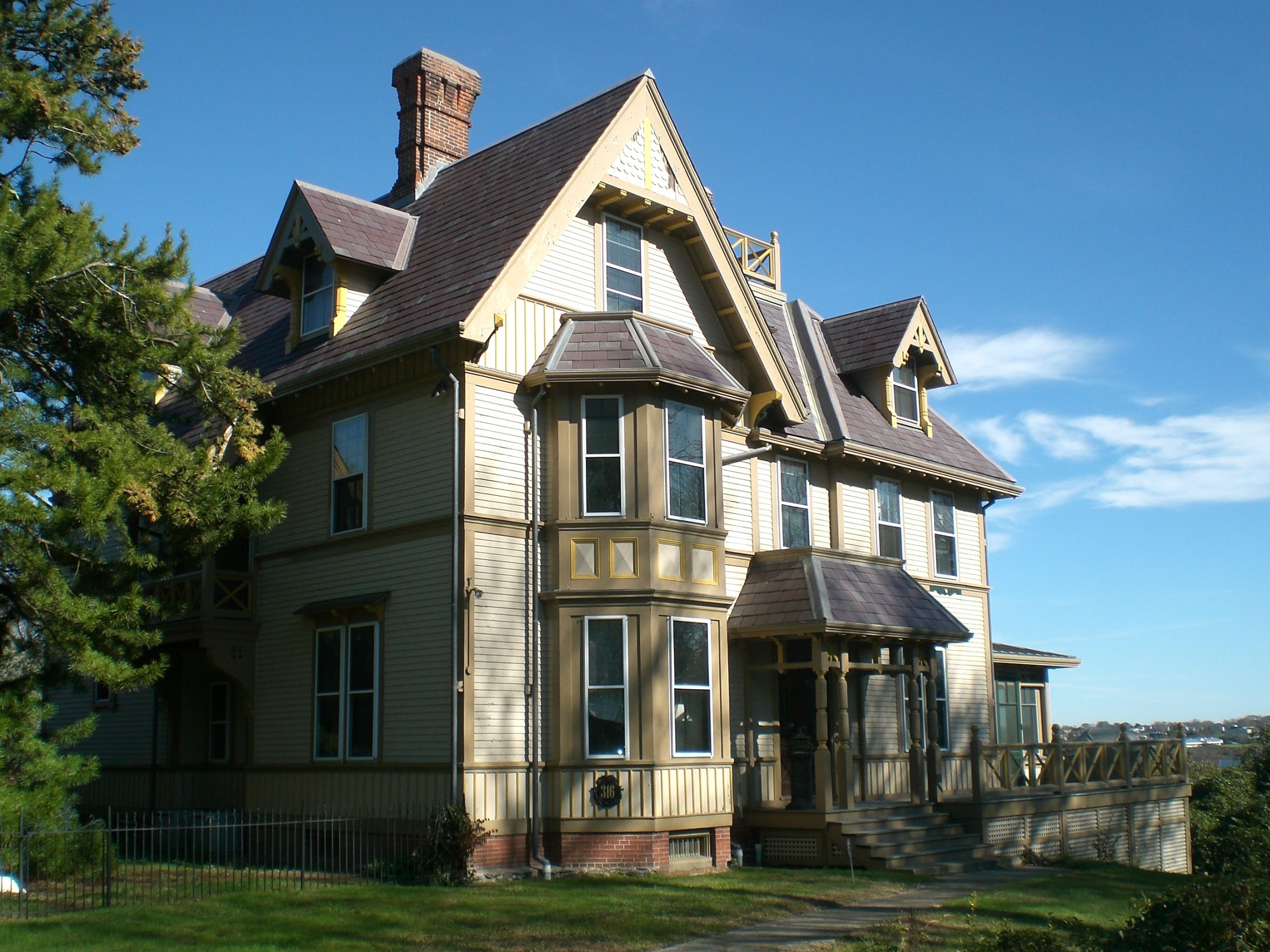
The house, though, is certain, and it survives. Gibbs lived a few blocks from the laboratory corner, at Gibbs Avenue and Catherine Street, on the ground the historic plate marks with the family’s own lots. Deb Dodge photographed it in 2012. It still carries the number 316.
How firm is that corner? Firm on Champlin, not yet firm on Redwood. No record of a renaming has been found: searches for a documented change from Redwood Avenue to Hunter Avenue turned up nothing, and the plate’s own lettering, seen through a screen capture, is at the limit of what can be read. The identification therefore rests on the georeferenced overlay and on Deb Dodge’s reading of it, not on a record of the name being changed. It is given here as the working identification and should be treated as such until it is confirmed. Three things would settle it: the atlas plate itself at full resolution rather than a screen capture, a Newport city directory or atlas of the 1880s or 1890s carrying both names, or the Newport Historical Society, who hold the records that would show it. Deb Dodge, who is hunting, adds the two records that would tie Gibbs himself to the corner rather than merely name the street: “another property map, closer to this date that shows he owns that corner, or another record - tax listings?” Richter adds a fourth and quite different test: the Parthenon looked out “over the fields and the pond below”. Any candidate corner has to command that view, downhill, across open ground, toward water. Champlin and Hunter does. So, at present, does a good deal of that hillside. This paragraph will be replaced when one of these answers.
What he did there
It would be easy to read a retirement shed into this. Morley does not allow it. When Harvard consolidated the chemical teaching of the Lawrence Scientific School into the College in 1871, Gibbs lost his laboratory and his students at once, and the protests of the scientific journals, of scientific men, and of Gibbs himself came to nothing. He had, in Morley’s phrase, “more time for private research, but fewer facilities for it.” So he built his own. And then:
It was in this laboratory, first at Cambridge and afterwards at Newport, that he carried out that one of all his researches which was the most important and elaborate and extensive.
That research was the work on the complex inorganic acids. It began in 1877 and ran on past 1890, which places its later years squarely in the Newport building. Gibbs showed that the complex acids, of which a few such as the phosphomolybdates were already in common use, were not curiosities but members of an enormous class; that tungstates and molybdates formed them to an extraordinary degree; and that the possible number of such compounds was vast. He fixed the true composition of the sodium tungstates, prepared the phosphotungstates and phosphomolybdates and their arsenic analogues, then acids carrying three acid radicals at once, then others drawing in platinum, selenium, tellurium, cerium and uranium. Morley records a barium salt whose formula ran to an atomic weight of 20,066. Salts of more than fifty such acids were described.
Morley’s summary of how it was done is the sentence that gives this building its importance:
All this immense volume of work was accomplished in a small private laboratory with only one assistant.
And the fittings were plain to the point of comedy. An ordinary kitchen stove dried the precipitates in its oven, ignited crucibles buried in its burning coal, and heated and evaporated liquids on its top, and did so, Morley writes, for much of the time over many years. He makes the comparison deliberately, to Priestley and his iron spoon and gun barrel: this was not poverty of means but judgment, a man who could have bought refined apparatus and did not need it for the region he was working in.
The man in that room was already one of the founders and original members of the National Academy of Sciences and had served as its president. He would be president of the American Association for the Advancement of Science in 1897 and 1898, an honorary member of the three great chemical societies of the world and of the Prussian Academy of Science. He was sixty five when Nathan Barker began the building, and he worked in it, in Morley’s words, as long as health and strength sufficed. He died at Newport on December 9, 1908, aged eighty six. His roses, Morley thought worth recording, were much admired.
He was also, and this site has told the story at length, the brother whose name opened the file: the “Oliver W. Gibbs” for whom his mother first asked a West Point warrant in 1838, before the application was shifted to his younger brother Alfred. Oliver stayed at college. The Cadet File records the moment the family chose; the building at Redwood and Champlin is where that choice ended up.
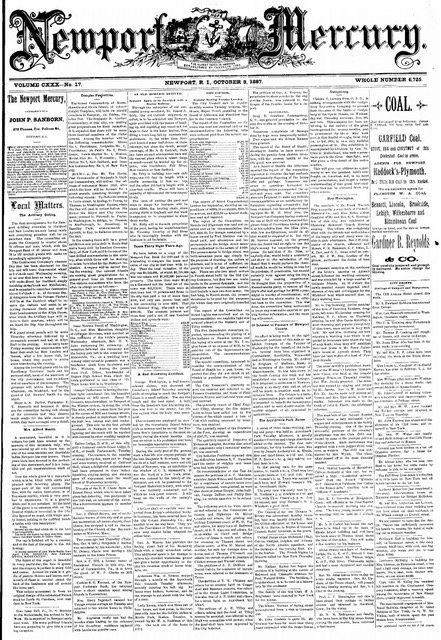
What is established here, and what is not. The clipping and the map are reproduced exactly as supplied. Two limits are worth stating plainly. First, the newspaper now dates itself: the complete sheet above carries its own masthead, VOLUME CXXX - No. 17, NEWPORT, R. I., OCTOBER 8, 1887, so the date and the title of the paper no longer rest on anything but the document. An earlier version of this note asked readers to treat them as Deb Dodge’s attribution; she supplied the full page on September 13, 2026 and that caveat is withdrawn. Second, the notice by itself records only a building begun; that a laboratory was finished and used rests on Richter, and no single document yet joins the two. Strictly, this page has a building begun at a named corner in 1887 and a building completed near the house soon after, and infers that they are one and the same. Third, the historic map plate is identified here only by the title legible on it, “Parts of Wards 2, 3 and 4”; the atlas it comes from, its plate number and its year are not yet established, and the reference below says so rather than guessing. This note will be replaced when those are confirmed.
References
Dodge, D. A. (2026, September). Newport Mercury notice of the Wolcott Gibbs laboratory, and an annotated georeferenced plate of the Newport wards [Newspaper clipping and annotated map image]. Contributed to AlfredGibbs.com.
Dodge, D. A. (2026, September 11). Dr. Wolcott Gibbs in his laboratory, aged 80 years [Photograph of the uncropped print held by the Newport Historical Society, with its pencil caption]. Contributed to AlfredGibbs.com.
Dodge, D. A. (2012). The Wolcott Gibbs house, Gibbs Avenue and Catherine Street, Newport, Rhode Island [Photograph]. Contributed to AlfredGibbs.com, September 11, 2026.
Newport Mercury. (1887, October 8). Volume CXXX, No. 17, page 1. [Notice: Nathan Barker has begun the erection of a building at the corner of Redwood and Champlin avenues for Prof. Wolcott Gibbs]. Newport, Rhode Island. (Complete sheet supplied by D. A. Dodge, September 13, 2026; the paper is dated from its own masthead.)
Richter, H. (1933). Wolcott Gibbs. In G. Gibbs, The Gibbs family of Rhode Island and some related families (pp. 117-142, at p. 138). Privately printed. Reproduced at AlfredGibbs.com, Chapter VII. (Brought to notice by D. A. Dodge, September 12, 2026.)
Morley, E. W. (1910, May 20). Oliver Wolcott Gibbs, 1822-1908 [Memoir read before the American Philosophical Society]. Reproduced in full at AlfredGibbs.com.
Parts of Wards 2, 3 and 4, Newport [Atlas plate]. David Rumsey Map Collection, georeferenced viewer. https://www.davidrumsey.com/ (Atlas, plate number and year not yet established; see the note above.)
Documents found and contributed by Deborah Anthony Dodge, an Official Contributor to this site; see her contributor page. Related: Oliver Wolcott Gibbs (1822-1908), The Wolcott Gibbs Archive, his obituary in Science, 1909, and The Cadet File. Page added September 11, 2026. Update, September 13, 2026: Deb Dodge found the uncropped print at the Newport Historical Society, whose pencil caption dates the photograph to 1902 and settles it as Newport rather than Harvard; her 2012 photograph of the Gibbs house at Gibbs Avenue and Catherine Street was added at the same time. The earlier note saying the laboratory in the photograph was unidentified has been replaced by the section above. Update, September 13, 2026: Deb Dodge pointed to Herman Richter’s life of Gibbs, reprinted by George Gibbs in The Gibbs Family of Rhode Island at page 138, which records that Gibbs erected the laboratory, planned it himself, called it the Parthenon, and finished the work on the complex acids in it. The page previously said only that a building had been begun and that no completion notice had been found; that is now superseded. Also September 13, 2026: Deb Dodge supplied the complete front page of the Newport Mercury, so the notice can now be seen in its column and the paper dates itself from its masthead; the note asking readers to treat the date as her attribution has been withdrawn.
Views: 32