Peggy Gibbs: The Widow, 1868–1908
Update, November 20, 2026: Libbie Custer's 1898 letter says only "the general" liked best the post "where my boys were born"; the page now says that reading him as Alfred Gibbs is my inference from the letter's context (Blair, 1933, p. 119).
Alfred Gibbs has been written about as a soldier for a century and a half. His wife has not. When Peggy Foushee Blair Gibbs became a widow at the end of 1868, she was thirty-seven years old, with two young sons and roughly forty years of life still ahead of her. Those forty years, the longest single stretch of her life, are nearly a blank in the record. This page is an attempt to fill that blank as far as the surviving documents allow, and to give the second half of Peggy Gibbs’s life the telling it has never had.
The General’s Wife Becomes a Widow
Peggy was born in 1831, the tenth child and fifth daughter of John Geddes Blair and Sarah Ann Eyre Heron Blair of Richmond, Virginia, and a granddaughter of the Reverend John Durburrow Blair, the city’s beloved “Parson Blair” (Blairs of Richmond, Virginia, p. 20). She married Alfred Gibbs at Richmond on December 27, 1855. The family record holds that “it was while he was in Texas that he met and married Peggy Foushee Blair of Richmond, VA, the sister of a fellow officer.” That officer was her brother, Capt. William B. Blair, who served beside Gibbs at the Corpus Christi depot, the connection traced on this site in A Love Connection? and at the Corpus Christi Army Depot. She followed Alfred across the West, bearing her first son at Fort Fillmore, New Mexico, in 1856 and her second in Richmond in 1858. By 1867 she was living the hard life of a cavalry wife on the Kansas plains, the subject of our companion page, Peggy Gibbs and the Boys on the Kansas Frontier.
Update, October 31, 2026: Two corrections. Peggy Blair and Alfred Gibbs were married at Richmond, Virginia, on December 27, 1855, by the Rev. Charles H. Read, not on the Texas frontier (her widow’s pension file). And a photograph of her has now been found: Garland H. Green Jr. found her carte de visite through Deborah Anthony Dodge in August 2026, shown on Peggy Foushee Blair (Wife & Mother), which also records her death at Richmond on February 25, 1908.
It ended without warning. On the night of December 26, 1868, at Fort Leavenworth, Alfred Gibbs went out to a small Christmas party and was dead by the next morning, aged forty-five. In a single night Peggy passed from the wife of a serving major general by brevet to a widow on the edge of the settled country, responsible alone for two boys: Alphie, who was twelve, and Blair, who was ten. A friend later recalled the younger boy’s “silent, but intense sympathy for you when you were called upon to give up the one so dear to you.”
East to New Brunswick
With her husband gone and the Army no longer her home, Peggy took the boys east and settled the family in New Brunswick, New Jersey. The choice shaped both sons’ futures, for New Brunswick was the seat of Rutgers College, and to Rutgers both boys would go. It is the first sign of the quality the old Richmond genealogy ascribed to her, that she was “a woman of considerable beauty and charming, yet resolute, qualities.” A less resolute woman, suddenly poor and far from her people, might have folded back into her large Richmond family. Peggy instead planted herself in a college town and set about making educated men of her sons.
A Widow’s Petitions
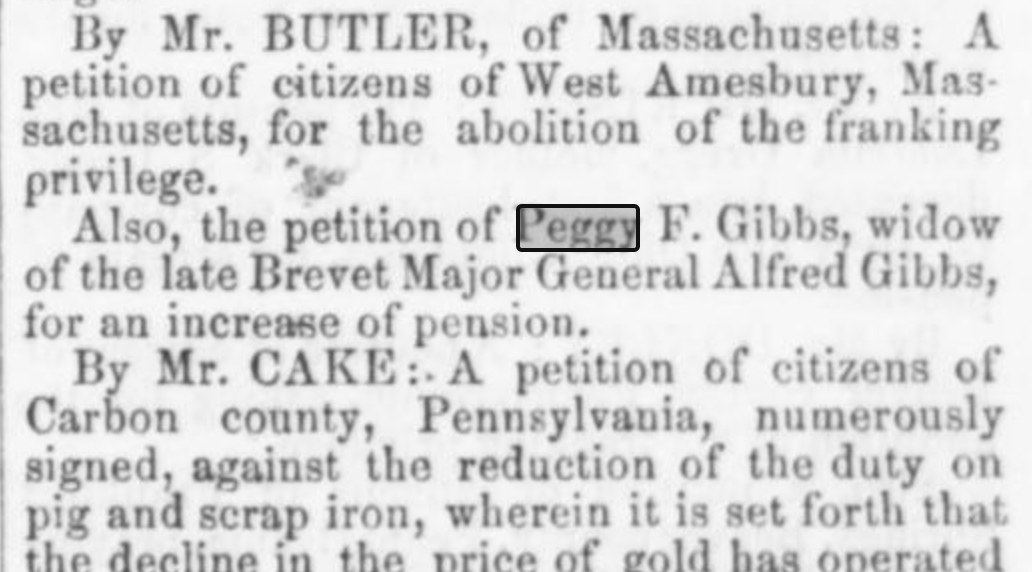
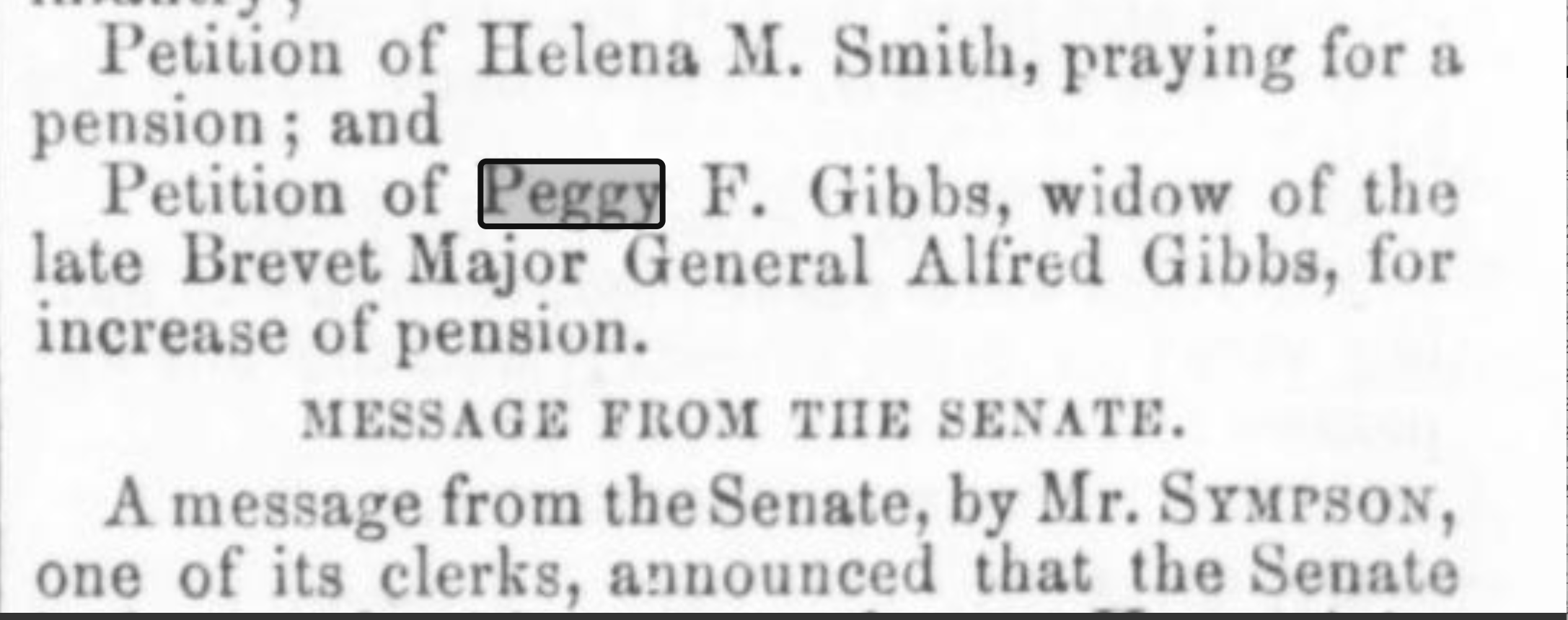
Raising two boys on a widow’s pension was not a quiet business, and Peggy did not suffer it quietly. The Congressional Globe records that “Peggy F. Gibbs” petitioned Congress for an increase of her pension on December 6, 1869 (Congressional Globe, 1869-12-06), and again in 1871 (Congressional Globe, 1871, Appendix). These are small entries, a line apiece in the proceedings of the House, but they are among the very few documents in which Peggy acts in her own name and on her own initiative. They show a woman who knew what her husband’s service was worth and was prepared to go to the national legislature to claim it for her children. The frontier wife who had managed a tent through prairie fire and flood now managed a household through the Reconstruction years on a soldier’s widow’s allowance, and pressed for more.
The Boys Become Men
Her resolve was repaid. The elder son, Alfred Wolcott Gibbs, grew into a distinguished mechanical engineer and would make his life in Altoona, Pennsylvania, the great workshop city of the Pennsylvania Railroad. The younger, John Blair Gibbs, took degrees from Rutgers and the University of Pennsylvania, studied surgery in Vienna under the great Theodor Billroth, and built a large and respected practice in New York City. By the 1890s Peggy could look on two grown sons who had each, in his own field, risen to prominence. Whatever else those obscure decades held, she had done the work she set out to do in New Brunswick.
There is a family tradition, preserved in the Blair genealogy and on this site, that touches Peggy’s protectiveness directly. General Custer, the old family friend, is said to have invited the Gibbs boys to ride with him on the western campaign that ended at the Little Bighorn, and that “Mrs. Gibbs prudently declined for them, and so the boys escaped the tragedy of that massacre.” Whatever the exact circumstances, the story preserves a true thing about her: a mother who had already buried a husband was not going to give her sons to the plains.
“Where My Boys Were Born”
Across all these years one friendship held. Elizabeth Bacon Custer, who had been Peggy’s neighbor in the canvas camps of Kansas, never forgot her. The two women had shared the frontier, the floods, the fear, and the small daily kindnesses, and they remained, in Libby Custer’s own phrase, “dear old friends” for the rest of their lives. It was a bond first made when Peggy gave up her own room to the exhausted Custer party at Big Creek, beginning, Libby wrote, “a friendship that has lasted through the darkest as well as the brightest hours of my life.”
1898: The Second Grave
The darkest hour came in the summer of 1898. When war with Spain broke out, Dr. John Blair Gibbs gave up his lucrative New York practice and volunteered for the Navy, telling his brother that he did not see “how with any self-respect I could stay in New York while such a scrap was going on.” On June 12, 1898, at one o’clock in the morning, on a barren hill above Guantánamo Bay, Surgeon Gibbs stepped out of his medical tent in the middle of a night attack and was killed by a Mauser bullet. He was the first American officer to fall on Cuban soil. The writer Stephen Crane, lying nearby in the dark, heard him die. Thirty years after losing her husband, Peggy had lost her son, and lost him to the kind of soldier’s death his father had spent a lifetime escaping. The fuller account is told on the page for Dr. John Blair Gibbs.
A Letter from Paris
A week after Blair’s death, Elizabeth Custer sat down in Paris and wrote to her old friend. It is the most moving document we have touching Peggy’s widowhood, one widow writing to another across the ocean and across the years, and it deserves to be read whole.
Paris, June 19th, 1898
My dear friend, my heart is heavy with sorrow for you in this dark hour of your life. All the memories of long ago come to me: the children playing their little pranks on my husband and his delight in their companionship, their father’s pride when he had them mounted on the ponies, their little legs almost straight out from the saddle. Then Blair’s silent, but intense sympathy for you when you were called upon to give up the one so dear to you. And I remember that when I once asked the general where had been the station he liked best, he said, “Where my boys were born.” The hundred little incidents of the boys’ lives, their quaint speeches, their courtesy and kindness as tiny fellows, their dear dog, indeed so much is indelibly impressed on my mind as I go back to those happiest days of my life that now it seems as if I could not face the future for you. The few brief lines I have yet had prove how worthy a son of such a father and of such courageous ancestors. It was a grand departure from this life to die so heroically while working to save the lives of others. My heart sorrows for you, my dear old friend, and I cannot help but think how deep would be the sympathy of him I love and how intense would be his admiration for your noble boy. May the Saviour comfort you. With love, Elizabeth B. Custer.

In a few lines the letter gives back almost everything we know of Peggy’s happiness: the boys on the ponies, the dog, the quaint speeches, and the general’s quiet answer that the post he loved best was simply the one “where my boys were born.” Libbie does not name him there; Custer had no sons, so I read the general as Alfred. It is Libby Custer, not Peggy, who preserves these things. That is the cruelty of the record. We see Peggy’s joys only in the memory of her friend.
The Woman We Cannot See
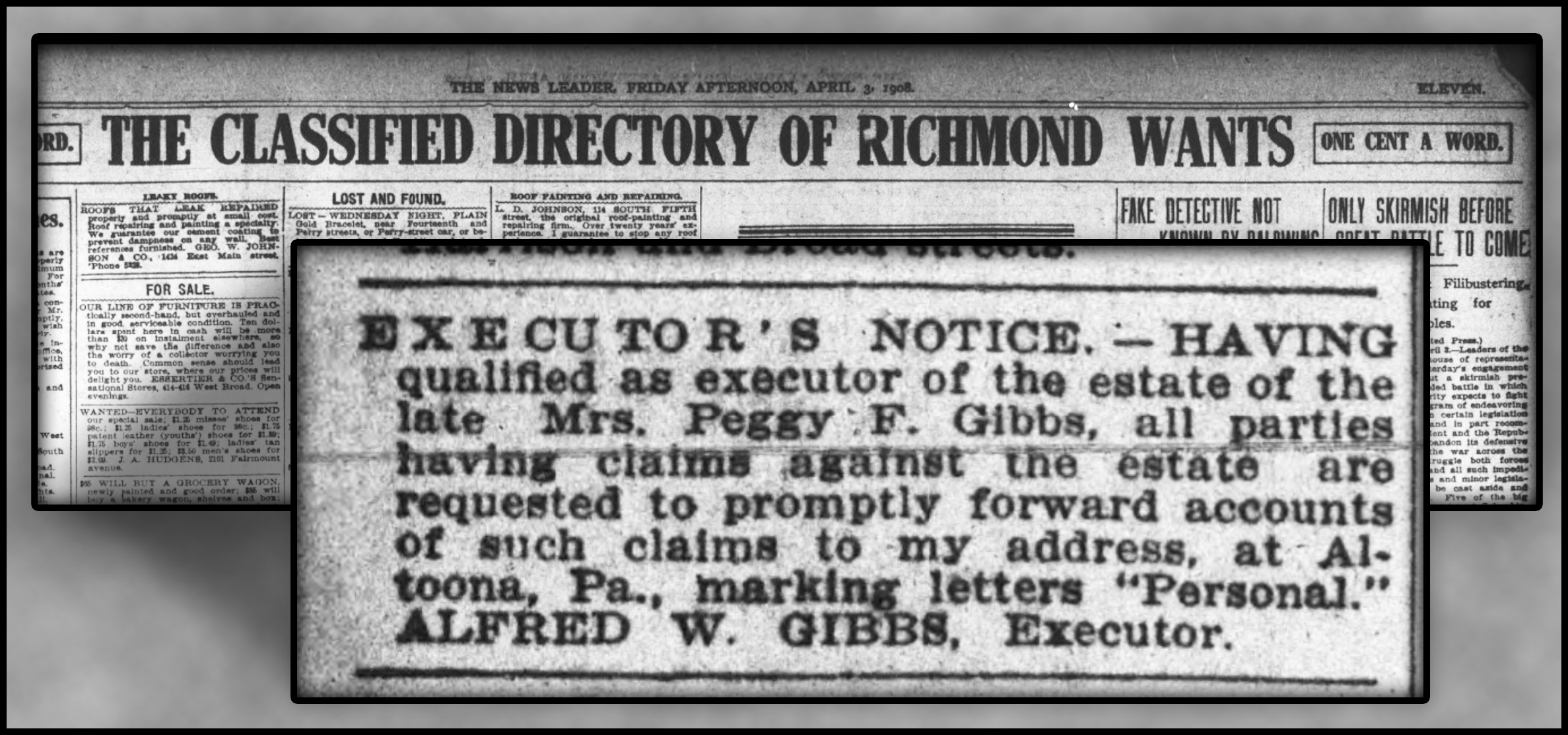
Peggy Foushee Blair Gibbs died in 1908, in her seventy-seventh year, forty years after the husband she had married at Richmond in 1855 and ten years after the son she had raised in New Brunswick. Her death is recorded in a single small notice. On April 3, 1908, the Richmond News Leader (No. 5115, p. 11) carried an Executor’s Notice for the settling of her estate:
Having qualified as executor of the estate of the late Mrs. Peggy F. Gibbs, all parties having claims against the estate are requested to promptly forward accounts of such claims to my address, at Altoona, Pa., marking letters “Personal.” ALFRED W. GIBBS, Executor.
Richmond News Leader, April 3, 1908 (Virginia Chronicle)
That the notice ran in Richmond’s own paper is itself a clue. The Blair daughter appears, in the end, to have come home to the city of her birth, while her executor son, Alfred W. Gibbs, kept the family’s northern foothold at Altoona, Pennsylvania. Her exact date of death and her place of burial remain to be confirmed, and that gap is itself part of her story.
For the hardest fact about Peggy Gibbs is that we cannot see her. For a long time no photograph of her was known. We have a rebuilt portrait of her father, John Geddes Blair, and enhanced images of both her sons, but of Peggy herself, the Richmond beauty who crossed the continent with the cavalry, buried a general and a hero, and held a family together for forty years on her own, not one likeness survives. She comes down to us entirely in the words of others: a line in a genealogy, a clerk’s entry in the Congressional Globe, a friend’s letter from Paris. The resolute woman at the center of all of it remains, for now, a face we have to imagine.
Sources and Further Reading
Primary sources
- Petition of “Peggy F. Gibbs” to Congress for an increase of her widow’s pension. The Congressional Globe, December 6, 1869.
- Petition of “Peggy F. Gibbs” to Congress for a further increase of pension. The Congressional Globe, 1871 (Appendix).
- Executor’s Notice, estate of Mrs. Peggy F. Gibbs (Alfred W. Gibbs, executor). Richmond News Leader, No. 5115, April 3, 1908, p. 11. Digitized at Virginia Chronicle.
- Elizabeth B. Custer to Peggy Gibbs (“the widow of Gen. Custer to the widow of Gen. Gibbs”), condolence letter, Paris, June 19, 1898. Source: the Spanish-American War Centennial Website, spanamwar.com/1stmarinesgibbs; reproduced on the Dr. John Blair Gibbs page.
- Blairs of Richmond, Virginia: The Descendants of Reverend John Durburrow Blair and Mary Winston Blair (William Byrd Press), p. 20, for Peggy’s parentage and place in the family.
- “It was while he was in Texas that he met and married Peggy Foushee Blair of Richmond, VA, the sister of a fellow officer,” per the Wolcott military-men record; the connecting brother, Capt. William B. Blair, is documented in A Love Connection?
Related pages on this site
- Peggy Foushee Blair (Wife & Mother).
- Peggy Gibbs and the Boys on the Kansas Frontier, 1867–1868.
- Corpus Christi Army Depot, Department of Texas, 1852–56.
Researcher’s note: Peggy’s birth year (1831) and death year (1908) are drawn from the family record and the 1908 estate notice. Her exact death date, place of death, and burial remain to be confirmed, as does the origin of the “Foushee” name in her line. Corrections and additions are welcome.
Views: 20